So the Debian wiki's been around for 25 years, but no-one thought about licensing when it was started. There have been a few short email threads over the years on this topic, but nothing actually happened. Now, since gears are turning on moving the wiki to MediaWiki, we're finally trying to fix the licensing issue... yay us! (Sarcasm.)
BackgroundThe wiki started in 2001 running under wiki.debian.net, which used a custom licence with the bare legal minimum to allow content to go on the wiki. As you can probably tell, this is not a "free" licence with respect to the Debian Free Software Guidelines.For those who don't know, the Debian Free Software Guidelines (DFSG) define whether a given piece of software (or in this case, adapted to writing and media works) is "free" as in freedom. You may be more familiar with the Open Source Definition, which was adapted from the DFSG.In 2005, wiki.debian.org was established running MoinMoin, the software that it still uses today, and content was imported from wiki.debian.net. At this time, Jonathan Dowland raised concerns on the lack of licensing terms on the new MoinMoin installation as well as the copyright status of the content being imported, but it happened anyway. As he puts it, "the question is now whether the material on this site is DFSG at all and if it ever will be." Currently, the Debian wiki is the biggest wiki on the internet that uses MoinMoin according to Steve McIntyre during DebConf25.So now it was going from custom licence to no licence at all. At that time, someone suggested the wiki used the GNU Free Documentation Licence (GFDL), before Steve corrected it.Since then, people have been editing and contributing to the wiki, growing it as an essential, if sometimes messy, resource for information about Debian. Now it's not as beautiful or well organised as, say, the Arch Wiki, but content like the page on installing Nvidia graphics drivers or the page on installing Debian have helped likely hundreds of thousands, perhaps millions, of people according to data Jonathan collected over two months. Take that with a grain of salt though as AI scrapers have skewed these counts recently.Yet, there was no clear licence for the content people were putting on the wiki. And when there is no licence, and no-one specifies a licence on the page itself, it is assumed to be "all rights reserved" in most jurisdictions. This is ignoring the implicit grant given by an editor to display that content on the wiki when they submit content to the wiki, but this is shaky at best and doesn't provide the clear permissions needed to freely reuse that content. Steve McIntyre hosted a Debian Wiki BoF (Birds of a Feather meeting) at DebConf 25. Credit: DebConf Video Team; MIT licence.During DebConf 25, there was a BoF meeting to discuss the wiki, preceded by a great "biased SWOT analysis" presentation by the Arch Wiki admins on how they run their wiki and the challenges they faced. The wiki BoF discussed a range of topics, one of which was licensing.Following this, stuff started happening to make major changes to the wiki, mainly with a migration to MediaWiki to leave the unmaintained MoinMoin software and be able to upgrade away from Debian Buster (version 10, oof!), as well as the creation of a new mailing list and IRC channel.At the same time, I started pushing to fix content licensing, and for the last 16 months, I have been largely working alone to slowly but surely relicense everything ever put on the wiki. This article aims to document what has been done so far and why, and some challenges encountered along the way.You can watch the wiki BoF: low quality, HD (warning: choppy audio), and the Arch Wiki presentation: low quality, HD, thanks to the DebConf Video Team who recorded them during DebConf 25.
It is designed explicitly for content and media, compared to other licences that are aimed at software (e.g. MIT).
It requires attribution for contributors' hard work.
It ensures any adaptations of the work continue to use the same or compatible licence, preventing someone from taking the work and making it proprietary.
It is pretty permissive and allows adapting CC BY-SA 4.0 materials into GPL-3-licensed works, like package manual pages and other documentation.
Some licences were ruled out for various reasons:
Public domain / CC Zero - We wanted a licence that required attribution, especially considering the wiki relies on volunteers to populate and update its content.This would also make it difficult for any content to be brought into the wiki from other sources, since they would have attribution requirements that could not be preserved under CC0.
GNU Free Documentation Licence (GFDL) - Debian only considers the GFDL to be a DFSG-free licence when it is used without any of its invariant options as per the 2006 general resolution. Also, this licence would limit where wiki content could be integrated outside of the wiki. Generally, this is an unwieldy licence with many restrictions, and should probably be reserved for printed works as it was designed for that.
Creative Commons NC & ND options - The Non-Commercial (NC) and Non-Derivative (ND) options for Creative Commons licences are not compatible with the DFSG.
It's not like CC BY-SA 4.0 is a niche licence; it is the licence that Wikipedia uses. As a result, we can copy content back and forth from a whole lot of places with this licence.Overall, CC BY-SA 4.0 provides a balance between putting in place protections for the work contributors put into the wiki via requiring attribution and share-alike, while also being very permissive in every other aspect, in line with the kind of freedom we're looking for.
Handling new additions The Debian Wiki displayed a prominent banner regarding the licence of new content.Before dealing with the mess that is the old content, first we looked at how to handle new edits to the wiki.After picking an arbitrary future date (in this case, 24 July 2025), I wrote a new copyright page explaining that content contributed after this date would be licensed under CC BY-SA 4.0, and summarised the main points of the licence.Following this, I updated the website footer and added a banner notifying wiki users and editors of the licence change (or should we say: addition). It was ugly, prominent, and in highlighter yellow to make sure no-one missed it. The banner served its purpose for a few months, and then was removed because, by then, we're pretty sure we got the message across.I also ensured this was displayed properly on the 'edit' page, so that editors understood that, by submitting their changes to the wiki after this date, they agreed to license their contribution under CC BY-SA 4.0.
Dealing with old contentNow, to the annoying part. In order to actually get everything to use CC BY-SA 4.0, contributors need to be contacted one by one and asked for permission to relicense their work, as they are the copyright holders.Keep in mind that the end goal is for all content on the wiki to be DFSG-free, with CC BY-SA 4.0 being the preference.
Wait, how much work is this?Allow me to first give you an idea of the scale of the task at hand:
There are 21,506 registered user accounts on the wiki (at the time of writing).
Over 290,052 edits have been made to the wiki.
Of those user accounts, 9,778 users have made one or more edits on the wiki.
Only 1,548 users have made more than 20 edits on the wiki.
These numbers are based on a snapshot from 26 January 2026.For that last bullet point, this graph here makes it clear that the majority of user accounts (on the left side of the graph) have only made a handful of edits. Frequency of number of edits per contributor. Each point shows how many contributors made a
given number of edits. The horizontal axis uses a logarithmic scale.Though unrelated to the topic at hand, this is probably a good argument for allowing anonymous edits to the wiki once again, a setting that was originally disabled to reduce spam. New accounts requiring manual approval, which has been in place for the past few years, was put in place for the same reason as well.These kinds of protections mean wiki admins have to deal with less spam, but they also increase friction, which makes it harder for readers to make one-off edits and should be minimised as much as possible in the opinion of Weird Gloop, the folks behind a bunch of notable wikis, like the Minecraft wiki. Hopefully the move to MediaWiki will greatly improve the anti-spam tools available to allow for this to happen.
Finding who to contactAt the moment, what I've been doing is checking pages one at a time to determine who needs to be contacted, and emailing them. While I've been doing this, I have kept an evolving record of who has been contacted, who has agreed, and who cannot/will not agree in a Git repo on Salsa (Debian's GitLab instance).The first thing I did was write a small script that listed pages that were three or fewer clicks away from the front page. This way, I could start with the important pages first. This turned out to be very annoying to work with, as these pages also had the most edits and unique authors (who could've guessed?). Many of them were "portal" pages as well, which are big collections of links rather than real content, so I tended to skip these.I've created a little bit of JavaScript that acts as a bookmarklet (i.e. button in the bookmark bar that does things rather than open a URL). What it does is highlight usernames on the edit log of a given wiki page (which MoinMoin calls the "Info" tab) based on a colour code: green means agreed, yellow means contacted with no response yet, and red means "failed". This gives a great overview of the status of each contributor to the page, and also filters out edits made after the 24 July 2025 cut-off. The bookmarklet script highlights the username associated with each revision to show the relicensing status of each contributor.Many pages have been completely rewritten or transformed so much that none of the original remained, so there was no point in contacting every contributor in the edit log if I could determine only the ones that mattered. Additionally, if all someone did was fix a typo or grammar mistake, they were also not worth contacting (though this was usually decided on a case-by-case basis).This introduced a new problem; how can I filter out these contributors to find the editors responsible for the current content? The first thing that came to mind was git blame. So naturally, I ran a script on the Debian Wiki server overnight to transform the MoinMoin data into a giant Git repo, where each commit represented an edit, and the author was set to the editor's username and account email address. This resulted in a 252 megabyte repo with 290,052 commits.MoinMoin stores its data on the filesystem, rather than a database like MediaWiki does. The data directory contains a user/ directory and pages/ directory.Each page is represented as a directory under pages/, with special characters in page names encoded in a Moin-specific format. For instance, the page DebianDeveloper/Benefits is stored under pages/DebianDeveloper(2f)Benefits/.Within each page, there is a cache/ directory (which we don't care about), a revisions/ directory containing a copy of the page at each revision (e.g. revisions/00000001), a current file containing the number of the latest revision, and an edit-log file containing the edit history of the page in tab-separated values (TSV) format.The edit-log file stores the timestamp, revision number, username, IP address, and user ID for each revision, so using this and the data in the revisions/ directory, a Git repo could easily be constructed with a bit of scripting.The final step was adding the user's email to the commit, which made it easy to associate usernames with emails within the Git repo. Each user has a file in the user/ directory named based on their user ID (assigned by Moin), and one of the attributes contained in that file is the user's email address.Overall, the file tree looked something like this:
Now I could git blame a page and find out exactly who should really be contacted, making this process much faster than reviewing every revision of a page by hand. This wasn't a foolproof method though, as it would blame a user for an entire line for both additions and modifications, like rephrasing a sentence or fixing a typo. It was a good starting point though, better than contacting anyone that ever edited the page. Additionally, git blame tended to be really slow, taking a few minutes every time it was run, likely because of the amount of commits involved.I also made a wrapper around git blame to highlight lines in green, yellow, and red, allowing me to identify which lines remained to be reviewed. The colours mean the same thing as before with the bookmarklet script. The wrapper script produced a coloured output to determine the status of each editor of the page.Recently, rather than using that 3-clicks-or-away list of pages to review, I have been sporadically reviewing any pages I stumble upon while doing other work. It may be less efficient, but it's more fun and feels less like a chore compared to reviewing pages one after another.
Sending out the emailsOf course now we need to do the most important part, actually contacting people over email.For each user, the starting point is to retrieve the email address they have on their wiki account. Luckily, since I've got the repo as a git repo, I can git log -1 --author=<username> to do this rather than grepping the wiki data each time.Now there were a few problems with this:
Email addresses were only verified for new accounts. This meant that some users changed the email address on their account to an invalid one, often intentionally (instead of asking for their account to be deleted).
Some email addresses were outdated and no longer existed. The most common case was for @debian.org addresses for people who have left the Debian project.
This meant that a little internet detective work was needed for some users, which involved checking things like searching Debian New Members and mailing lists. Sometimes users had a user page on the wiki with better contact info as well.If I'm able to find a working email address, then I send them an email based on a template, which has been refined a couple times. It pretty much summarises what's going on and asks for permission to relicense their work to CC BY-SA 4.0.These emails were sent from my @debian.org address, mostly relying on its domain reputation to cut through spam filters and end up in people's inboxes. I also CC'ed myself at a special maytham-wiki-license address, which allowed me to filter relicensing stuff into its own folder. Though, people kept leaving it out of their replies, so I ended up changing the filter to check the email subject instead. Eventually, I plan to create a Git repo containing an mbox per user to keep a record of people's responses.Most failures occurred because the email address could not be found or the recipient mailserver had an issue, so I'd get that "Undelivered Mail Returned to Sender" email. In these cases, I wasn't able to find an alternative address. Other failures were mostly due to the contributor having passed away, and only one person so far has actually refused to relicense their work among those who have responded to the emails. All of these are being collectively referred to as "failed" users with regards to content relicensing.
Progress so farAt the time of writing (25 November 2026), the progress is as follows:
791 users have been contacted.
370 (47%) users have agreed to relicense their work.
The remaining 421 have not responded yet.
67 users have been put down as "failed".
This is pretty good progress: of the 1,548 users who made 20 or more edits, 51% have been contacted, 24% have agreed to relicense, and only 4% have been marked as failed.
Next stepsOf course, not every contributor has been contacted yet, there are many more to go.It would be great if there was a way to automate this, as a lot of it is repetitive. git blame has worked so far, but its limitations mean it still requires human review. Ideally, there should be a way to find the authors of the latest revision of the page based on word-diff rather than line-diff, and also rank them based on how much they contributed to the page. Maybe it would involve measuring Levenshtein distance per edit? Who knows?At the moment, I don't have time to work on such a tool. So I'll keep doing it the same way I've been doing it so far: every once in a while when I open some page on the wiki, I will check who is yet to be contacted, and send out a handful of emails.
Handling failuresThis likely entails stripping out each failed user's contributions from the wiki wherever it is part of the latest revision, which can also mean that some pages will need to be completely deleted as well. This is not a good thing, but it's something that has to be done to reach the aforementioned goal of a completely DFSG-free wiki.This kind of thing probably should wait until the move to MediaWiki has happened. The tooling for doing these kinds of mass edits is much better there, and I think(?) there are plans to create a static archive of the MoinMoin wiki during or after the move, so that information isn't lost forever. This would be part of the general effort to clean up the wiki.
Following up when there is no responseA lot of the people who have been sent emails have not responded in a long time (>3 months, many much longer than that). These people need to have follow-ups sent to them, since there is a high chance the email ended up in their spam folders. I have sent follow-ups to a few people, some of which have succeeded, but this needs to be done in bulk for all the remaining people.A limit also needs to be put in place before we give up on people. One approach would be to mark users as failed if they do not respond to two further follow-ups after the initial email, each spaced at least a month apart from the previous email, for a total of at least three months from first contact. This would be loosely based on the kind of procedure used by the Debian MIA Team.
Increased publicityA while ago, I floated the idea on the wiki mailing list of asking the Publicity Team to create a Bits post (for instance) to let everybody know about the relicensing effort, and to ask contributors who have not been contacted yet to send us an email. This proactive approach would be much better and less work than the current reactive approach, since asking every person to send one email is a whole lot easier than one person sending hundreds of emails. Even though little interest was shown on the mailing list at the time, at some point, I'd like to follow through with this.In a way, this post is serving the same purpose! You probably didn't know about what I'm doing before reading this, but now you do :)
Help wanted!Have you ever, before 24 July 2025, edited the Debian wiki? Well step right up! It'd be great if you could send me a short email with the following format:
To: maytham-wiki-license [AT] debian (DOT) org
Subject: Relicensing my contributions to wiki.debian.org
Hi,
My username on wiki.debian.org is <INSERT USERNAME HERE>.
I give permission for all work I have submitted to
wiki.debian.org to be distributed under the terms of the Creative
Commons Attribution-ShareAlike 4.0 International license, the text of
which can be found at https://creativecommons.org/licenses/by-sa/4.0/.
It means I don't have to chase you down, which is great! Also note that the From address will be checked to make sure it's genuine, and it would be even better if you could GPG sign it!Now for the complicated bit: Debian being a volunteer project is both a blessing and a curse. Having more people help out with this work would make this initiative much more sustainable. As someone put it in an email to me: "I am concerned about the bus factor of one Maytham." This is especially important as I've recently slowed down my work on this due to other matters that are either more important or just plainly more interesting.If you want to help with contacting people, there is a short guide in the repo README. In short, find the contributors you want to contact (and make sure they have not already been contacted!) and send each of them an email based on the template, CC'ing my licensing email address so that it gets saved in my mailbox for the future mbox export. Then, you can modify the lists to add users to contacted, succeeded, etc.Hopefully with a bit more work, we can get this across the finish line. This article is part 1 because the work is unfinished and still ongoing, so hopefully the progress numbers will be higher in a potential part 2 to the saga.
Welcome to the October 2026 report from the Reproducible Builds project!
In our reports, we try to outline the most important things that we have been up to over the past month. As a quick recap about what problem our project intends to solve, whilst anyone may inspect the source code of free software for malicious flaws, almost all software is distributed to end users as pre-compiled binaries. The motivation behind the reproducible builds effort is to ensure no flaws have been introduced during this compilation process by promising identical results are always generated from a given source, thus allowing multiple third parties to come to a consensus on whether a build was compromised or not.
As ever, if you are interested in contributing to the project, please visit our Contribute page on our website.
In this month s report, we cover:
GNU tar sparse archive non-determinism reported
Johannes Schauer Marin Rodrigues (josch) reported an issue to the GNU tar mailing list where creating PAX-format sparse tar archives produces unreproducible outputs. Specifically, when GNU tar generates a PAX archive containing a sparse file it embeds the process ID into the member filename path structure (e.g. ./GNUSparseFile.<pid>/<filename>). Because process IDs vary between build runs, however, archiving identical sparse input files yields different binary outputs.
In his report, Johannes outlined potential workarounds, such as running tar inside an unshared PID namespace where the process ID is pinned to 1, and proposed that GNU tar either omit the PID by default or provide a command-line flag to suppress it. Full details can be found in the post itself, and Johannes also filed the bug in Debian for completeness.
Reproducible Builds at SeaGL 2026
Reproducible Builds was present at SeaGL in Seattle, WA, on October 23rd & 24th. Thanks to everyone who attended and spoke with us!
Members of the Reproducible Builds project attended SeaGL (the Seattle GNU/Linux Conference) in Seattle, WA, on October 23rd & 24th. It was a fantastic opportunity to connect with local community members, discuss software supply chain security and share updates on build verification tooling. Thanks to everyone who stopped by our sessions or spoke with us during the event.
Founded in 2013, SeaGL is an annual free-as-in-freedom, grassroots technical summit dedicated to spreading awareness, community engagement and practical knowledge about free software, open hardware and libre culture.
Tool and documentation development
diffoscope is our in-depth and content-aware diff utility that can locate and diagnose reproducibility issues. This month, Chris Lamb made a number of changes, including preparing and uploading versions 333, 334, 335 and 336 to Debian:
New features:
Support the dumppdf binary being called dumppdf.py on the host/runtime system. []
Bug fixes:
Drop Recommends: guix from the diffoscope-minimal package as it is not minimal. (#1114739) []
Fix a crash when using the latest version(s) of Androguard. Thanks, hc! []
Codebase improvements:
Re-order various parts of the .tar file comparator to make it easier to progressively delve into its functionality. []
Fix a silly prepend typo. []
Reflect in the Python packaging that the use of the case-match language feature necessarily requires Python 3.10+. []
SOURCE_DATE_EPOCH specification updates
As announced in last month s report, further work has been done by Bernhard M. Wiedemann regarding updating the SOURCE_DATE_EPOCH specification following discussions at a project summit. Seven distinct proposed changes were originally submitted as merge requests on Salsa, and many of these have been approved or otherwise collapsed.
Bernhard s proposed modifications were independent of one another, allowing for any combination to be merged depending on community feedback. Bernhard noted that one proposal may see the most debate, and could still benefit from further refinement before reaching consensus. Community members are invited to review and provide feedback on the individual merge requests; as Bernhard writes, The other MRs could still use feedback from more people before December . Input can be submitted via reactions or comments on Salsa, directly by email to Bernhard or the mailing list.
The SOURCE_DATE_EPOCH specification was first published in 2015 and updated in 2017.
Jeremy B cha wrote that he was seeking assistance with a reproducibility failure in GNOME s libsoup library when built using debrebuild. Filed as Debian bug #1126440, the issue stems from a Meson build system check that inspects Apache and its local configuration during the build process, which fails inside debrebuild environments. His query solicited a number of replies (including one from an AI agent).
Janneke Nieuwenhuizen and Ekaitz Zarraga announced two releases of GNU Mes: version 0.27.2 and version 0.28. GNU Mes is a Scheme interpreter and C compiler created to facilitate bootstrapping the GNU system without relying on opaque binary blobs, serving as a core component of the Bootstrappable Builds effort. Version 0.27.2 serves as a bug-fix release adding compatibility for the recently-released GCC 16 and NYACC versions 2.02.4 and 3.00.0, etc. whilst version 0.28 introduces a major overhaul of the core interpreter.
Patches
The Reproducible Builds project detects, dissects and attempts to fix as many currently-unreproducible packages as possible. We endeavour to send all of our patches upstream where applicable or possible. This month, we wrote a large number of such patches, including:
In addition, two build failure bugs were reported by Jochen Sprickerhof.
If you are interested in contributing to the Reproducible Builds project, please visit our Contribute page on our website. However, you can get in touch with us via:
This is a recollection of my comments from the
EmacsConf 2026 community panel recording session
this past weekend, where the panellists took turns
answering the proposed questions, one minute per
question per panellist.
In addition to the live Q&A session planned for
Saturday 12 December 2026 during EmacsConf 2026,
all Emacs users and community members are invited
to share their thoughts on the panel questions or
other questions before or after the conference.
https://emacsconf.org/2026/talks/community/
1. What made you start using Emacs,
and what kept you using it?
I started using Emacs during my bachelor's
studies. I actually learned about Vim first
and was a Vim user, but I'd always found the
configuration language (VimScript) a little bit
clunky. Not long after, I discovered Emacs,
and really loved reading and writing Emacs Lisp,
so I stuck around.
In addition to reading and writing Elisp being fun
and enjoyable for me, I love that Emacs has been a
practical embodiment of software freedom, and I'm
really fond of its surrounding culture of sharing
freely. There's a lot to love and appreciate
about Emacs, but as a practical personal example,
I've been grateful for its excellent support for
bidirectional text editing. It has empowered me
to read and write in Persian, my mother tongue,
with ease. (Persian has a right-to-left alphabet,
like Arabic and Hebrew.)
2. What took you from using Emacs
to actively contributing to the community -
participating in forums, writing Elisp, organizing
meetups, answering questions?
As I continued experimenting and writing bits and
pieces of Elisp to scratch my own itches, I felt
compelled to share them freely as a way of giving
back to the community that gave me so much.
For me, the community and the people that make it
up are the main deal. Emacs wouldn't be where it
is and what it is today without its people, so
besides programming contributions, I've tried to
contribute in that area as well, for instance by
reviving EmacsConf with Sacha Chua back in 2019.
3. How does Emacs show up for you
in real life - colleagues, meetups, friends?
How did those connections form?
I don't physically have people near me who use
Emacs, but I've connected with many folks in our
online communities, often starting with an email
or IRC message. Some of those relationships
started as acquaintanceship and were developed
into true friendship over time, and I'm grateful
to have had those friends with me.
4. If you know other software
communities, what's one thing Emacs could learn
from them?
I would encourage Emacs, our community, to focus
on the people. We're living in particularly
difficult times, with various kinds of hardships
and uncertainty in our lives. Let's strive to
treat each other with kindness, empathy, and
mindfulness as we continue working together.
There are great examples of other free software
communities whose members have banded together and
are strengthening each other and their community,
as well as cautionary ones where community members
have been tiring and driving out their fellow
members. We could learn valuable lessons from
both in how to take care of our people and
ourselves.
5. What's one concrete thing you
wish existed in the Emacs community a year from
now?
I echoed the sentiments of my fellow panellists
Prot and Til about doing more of the same in
terms of continuing to uphold the standards of
excellence and perseverance. Also, drawing
inspiration from what bashbunni said, to lower
the barriers of entry for people, for example
through organizing different kinds of events,
and experimenting with ways to make people's
lengthy, elaborate Emacs configurations more
tangible and accessible to others, to share
various workflows and demonstrate what's
possible with Emacs.
I look forward to your thoughts on these
and other community-related questions.
Take care, and so long for now.
Welcome to the September 2026 report from the Reproducible Builds project!
In our reports, we try to outline the most important things that we have been up to over the past month. As a quick recap about what problem our project intends to solve, whilst anyone may inspect the source code of free software for malicious flaws, almost all software is distributed to end users as pre-compiled binaries. The motivation behind the reproducible builds effort is to ensure no flaws have been introduced during this compilation process by promising identical results are always generated from a given source, thus allowing multiple third-parties to come to a consensus on whether a build was compromised or not.
As ever, if you are interested in contributing to the project, please visit our Contribute page on our website.
In this month s report, we cover:
Reproducible Builds Summit 2026 held in Gothenburg, Sweden
The annual Reproducible Builds summit took place from 22 to 24 September 2026 in Gothenburg, Sweden. The event brought together developers, distribution maintainers, security researchers and free software advocates from across the ecosystem to share updates on current initiatives, address outstanding toolchain bottlenecks and strengthen cross-project collaboration.
Participants engaged in a series of working sessions and technical roundtables focused on expanding the practical scope of reproducibility. Discussions covered ongoing work within major Linux distributions, language-specific package ecosystems and the various parts of the binary verification infrastructure.
Strategic planning formed a pillar of the gathering, with participants discussing long-term roadmap goals for supply-chain security, software integrity and related topics. Attendees explored new methods for automated verification, discussing how to lower the adoption barriers for maintainers and streamline the integration of deterministic build pipelines into established continuous integration (CI) systems. The event was then followed by two days of unmoderated hacking sessions. These hacking sessions provided space for technical progress, allowing attendees to draft specification updates, prototype new tool features and resolve standing reproducibility bugs in-person.
Dettrace expanding architecture support for PGO & Lisp dumps
Bernhard M. Wiedemann announced major updates to dettrace, porting the tool across most architectures supported by Debian and openSUSE. The release addresses key stability issues, passing test suites across these targets and making it ready for production build pipelines.
These improvements enable deterministic builds when utilising Profile-Guided Optimisations (PGO), removing the need to sacrifice runtime performance for reproducibility. Additionally, dettrace can now be applied to (notoriously difficult-to-reproduce) Lisp and Scheme memory dumps, including environments such as CLISP, SBCL, Scheme 48, Racket and GNU Emacs.
Trusted Execution Environments (TEEs) have become a cornerstone of modern cloud computing, providing strong confidentiality and integrity guarantees for both code and data. A critical component of this trust model is remote attestation, which enables external entities to verify the authenticity and integrity of code executing within a TEE through cryptographic measurements. However, the effectiveness of remote attestation fundamentally depends on the verifier s ability to trace the reported measurement back to the original source code - a property that can only be guaranteed through reproducible builds. []
SOURCE_DATE_EPOCH specification updates
Bernhard M. Wiedemann shared a number of proposals regarding updating the SOURCE_DATE_EPOCH specification following discussions at a project summit. Seven distinct proposed changes have been submitted as merge requests on Salsa.
Bernhard s proposed modifications are independent of one another, allowing for any combination to be merged depending on community feedback. Bernhard noted that one proposal may see the most debate, and could still benefit from further refinement before reaching consensus. Community members are invited to review and provide feedback on the individual merge requests by 1 December 2026. Input can be submitted via reactions or comments on Salsa, directly by email to Bernhard or the mailing list.
The specification was first published in 2015 and updated in 2017.
Reproducible Builds at SeaGL 2026
Reproducible Builds will be present at SeaGL in Seattle, WA, on October 23rd & 24th. Come chat with us in person!
Founded in 2013, SeaGL is a free, grassroots technical summit dedicated to spreading awareness and knowledge about free source software, hardware and culture.
New Code of Conduct (CoC) for the Reproducible Builds project
Mattia Rizzolo announced the official launch of a Code of Conduct for the Reproducible Builds project. This follows work and community discussions originally initiated in 2024, incorporating feedback gathered over email and during project summits, as well as with input from the Software Freedom Conservancy.
The new Code of Conduct establishes guidelines emphasising mutual respect among project contributors. It also defines a formalised process for submitting and handling complaints regarding community misconduct, ensuring transparent governance across project spaces. Along with the core policy document, an accompanying Code of Conduct FAQ has been published to outline the rationale behind adopting the guidelines.
Supporter Spotlight: Jochen Sprickerhof
As a reminder, another supporter spotlight interview was published featuring long-time Debian and Reproducible Builds contributor Jochen Sprickerhof, highlighting his work on package verification and project infrastructure.
Jonathan Starr from the Institute of Open Science Practices (IOSP) posted with an announcement of its upcoming 2026 workshop series in Leiden in the Netherlands. This free-to-attend event aims to build a participant-owned data storage consortium, allowing community members to publish datasets, code and knowledge objects alongside algorithms designed to evaluate trust and value. The event features a dedicated Community Track for talks and discussions, a tool showcase and an opening session on resilient data storage.
Following up on IRC discussions regarding profile-guided optimization (PGO) on build servers, kpcyrd created a demonstration repository showing how PGO profiling can introduce non-determinism into output binaries. The demo highlights how runtime randomness (specifically, the randomised keys used in HashMaps to prevent denial-of-service attacks) causes varying bucket collision rates during test runs. These structural variances alter execution weights on underlying code branches, prompting the compiler to generate differing final assembly output for builds that would otherwise be perfectly reproducible if PGO was disabled. Rather than abandoning PGO performance gains, kpcyrd suggested treating generated profiling data as a documented build input or recorded environment artifact (similar to .buildinfo files), rather than regenerating profiles dynamically on the fly during build execution.
Tool and documentation development
diffoscope is our in-depth and content-aware diff utility that can locate and diagnose reproducibility issues. This month, Chris Lamb made a number of changes, including preparing and uploading versions 330, 331 and 332 to Debian. In particular, Chris committed support for radare2 versions greater than 5.9.0 [] based on input from Guillaume Girol [], and committed support for .nar files via Guix. [][].
Chris later modified diffoscope to not Build-Depend on the Debian package of GNU Guix, as its status in the Debian bug tracking system would transitively render diffoscope as being overly buggy for the next stable release []. Similarly, he adjusted the Build-Depends on the apksigcopier package as it has been removed from Debian testing [] and, finally, he updated a number of copyright years [][].
Vagrant Cascadian updated diffoscope in GNU Guix to version 332.
reprotest is our tool for building the same source code twice in different environments and then checking the binaries produced by each build for any differences. This month, reprotest version 0.7.33 was uploaded to Debian by Holger Levsen with the following changes:
Sergei Tachenov fixed the fileordering test on all filesystems, including the likes of ZFS, which could return a different order across two builds due to build being done in a different directory [].
Holger Levsen bumped the Standards-Version to 4.7.4, reflected that Priority: optional is the default now [], fixed the old Free Software Foundation address [] and bumped the debhelper compat level to 14 after confirming there are only desired changes [].
rebuilderd, our server designed monitor the official package repositories of Linux distributions and attempt to reproduce the observed results there; it powers, amongst other things, reproduce.debian.net. This month, Bernhard M. Wiedemann submitted a pull request to rebuilderd that refactors RPM repository metadata handling. The change extracts rpm-md parsing out of the Fedora-specific scheduler module and into a shared one.
Lastly, there were a number of improvements made to our website this month as well. For example:
Chris Lamb:
Added a note re. TZ=UTC vs. TZ=UTC0 to the Timezones page. [][][]
Patches
The Reproducible Builds project detects, dissects and attempts to fix as many currently-unreproducible packages as possible. We endeavour to send all of our patches upstream where applicable or possible. This month, we wrote a large number of such patches, including:
Vagrant Cascadian also performed a number of Non-Maintainer Uploads (NMUs) and Quality Assurance (QA) uploads in Debian for several packages with outstanding reproducibility issues. These included molttemplate, buddy, xfonts-nexus, fte and lifelines.
At the time of this writing, that leaves 130 submitted patches, with only 61 outstanding submitted patches that older than a year in the Debian bug tracking system. This number is only 26 if we exclude any low-priority build path issues.
If you are interested in contributing to the Reproducible Builds project, please visit our Contribute page on our website. However, you can get in touch with us via:
A few days ago, a colleague reached out to me, asking if I could help draft a
resolution on digital autonomy and free software for the upcoming renewal of
our collective bargaining agreement. Although she's very politicised and
generally a great individual, she is not a techie and we never really talked
about these issues before.
This took me by surprise. I should have been rejoicing; no, I should have been
the one who brought up this topic in our union. Wasn't I the technical expert
on these issues? But alas, my first reaction when she came to me was to snicker
and tell myself: "That's cute, but nothing's ever gonna change, Big Tech is too
strong and our governments don't give a damn."
How sad and cynical is that? That's not the person I want to be.
Something in the Quebecois political landscape has shifted in the last few
years with regards to tech. More and more "regular" people seem to be talking
about the importance of digital autonomy, how government services shouldn't
rely on Big Tech and how we should be using FOSS on hardware we actually
control.
A few years ago, I would have been at the vanguard of this change. I would have
been part of the creation of Donn es souveraines Qu bec. Heck, they are
organising a whole conference next week and I'm not even going. How did
this happen to me?
I first fell for Free Software for its political ideals: Knowledge Should Be
Free, Cooperation Is More Efficient Than Competition, Centralisation Should Be
Avoided When Possible, etc. I still believe in all of this, but somehow, after
years of fighting for change in the tech world, I have retreated into technical
work. I maintain Debian packages as a hobby and to scratch my own itch. I run
services for myself and a few friends. I organise Debian User Group meetings.
To be clear, I haven't generally given up. I'm very politically active in my
union and at work, I'm a good member of my housing cooperative and I'm still
fighting against the industrialisation of natural spaces in my
neighborhood. But when it comes time to defend freedom in the tech
world, lately, I've just been shrugging and accepting I should use Microsoft
Teams like every one else does. I want this to change and to do so, I need to
free some time.
Lintian
Two years ago, I added myself to Lintian's Uploaders list. Up until
then1, I enjoyed fixing little issues here and there and liked creating
new tags to help out the Python Team, where most of my Debian time was spent.
Lintian was badly in need of a new maintainer and as I felt it was an important
project, I decided to step in. 37 releases and about 160 closed bugs
later2, I'm done.
To be honest, I haven't had much fun maintaining Lintian lately. Bugs keep
piling on the BTS, so much so I have mostly been ignoring them for the past few
months. In fact, most of the actual work triaging, writing code and fixing bug
has been done by Nilesh Patra for a while now.
All this to say, if you care about Lintian, you should consider adding yourself
to the Uploaders list, as I'm out and Nilesh can't do all the work by himself.
He's a great person to work with and since I don't want to suddenly leave him
all alone, I'll be sticking around for a few more weeks in the hope someone
else will volunteer to help out. A smooth transition with a new co-maintainer
would really be nice!
If you're interested, don't hesitate to reach out to me on IRC or by email.
My first technical commit to Lintian was nearly 7 years
ago! Crazy how time flies.
One of the primary design principles for Linus Torvalds when creating Git is that it should be a distributed system, capable of working with multiple remotes. However, most people seem to use Git with just one remote, typically having GitHub or GitLab as the only origin.
Version control systems before Git relied on a centralized model. For example in Subversion or CVS you could only sync with one single remote server, which was considered the primary host of the source code. Git however is not just a VCS, but a DVCS, for distributed version control system. If you currently use Git with just one single remote as if it was a centralized version control system, now is the time to change that and learn how to add multiple remotes, and configure more flexible git pull and git push rules.
The first concept to grasp is that Git can have multiple remotes. For example, after running a basic clone command such as git clone https://github.com/ottok/debcraft.git you would end up with a single remote origin pointing to GitHub:
You can push and pull from these individually, or from all at once:
$ git pull --all
Fetching github
Fetching gitlab
Already up to date.
$ git pull --all
Fetching github
Fetching gitlab
Already up to date.
When you review the git history, note the labels gitlab/main and github/main which tell which commit the branch main points to on various remotes. In this case they are all in sync and point to the same 5d1815c:
$ git log --oneline
5d1815c (HEAD -> main, gitlab/main, github/main) Bump Debhelper version from 13 to 14
ca518a7 Temporarily disable automatic copyright year bumping due to frequent bugs
d6e201e Exclude .pm from codespell to decrease false positives (Closes: #1140488)
708ee35 Exclude debian/copyright from codespell due to frequent false positives
When pushing, you can choose what remote to push to. For example, if I am working on branch dev and I only want to push it to GitLab to trigger a CI run there, I can run git push gitlab dev. You can also configure a default remote by running once git push --set-upstream gitlab dev and thereafter simply run git push and it will automatically push the branch dev only to that remote.
A related setting is remote.pushDefault, which tells git which remote to push to when a branch does not define one of its own, and it applies to every branch that lacks a [branch] section in .git/config. Setting it once is what lets a repository have a per-branch pull remote, like the debcraft example below, and still have a single, predictable git push target. To see which remote git will use for each of your branches, run git branch -vv, and to refresh the remote-tracking branches of all remotes at once, run git fetch --all --prune.
If you want to have multiple remotes, but automatically push and pull to all of them at once, you configure one single remote to have multiple URLs with git remote set-url --add. Since git prints one line per push URL, git remote -v then shows the same remote several times, once for each URL it pushes to.
As an illustration, in my actual local Debcraft development project I have all these configured:
$ git remote -v
github-pull-requests git@github.com:ottok/debcraft.git (fetch)
github-pull-requests git@github.com:ottok/debcraft.git (push)
gitlab-merge-requests git@gitlab.com:ottok/debcraft.git (fetch)
gitlab-merge-requests git@gitlab.com:ottok/debcraft.git (push)
origin git@salsa.debian.org:debian/debcraft.git (fetch)
origin git@salsa.debian.org:debian/debcraft.git (push)
origin git@gitlab.com:ottok/debcraft.git (push)
origin git@github.com:ottok/debcraft.git (push)
otto git@salsa.debian.org:otto/debcraft.git (fetch)
otto git@salsa.debian.org:otto/debcraft.git (push)
otto git@gitlab.com:ottok/debcraft.git (push)
otto git@github.com:ottok/debcraft.git (push)
otto git@git.sr.ht:~ottok/debcraft (push)
otto ssh://git@codeberg.org/ottok/Debcraft.git (push)
salsa-merge-requests git@salsa.debian.org:debian/debcraft.git (fetch)
salsa-merge-requests git@salsa.debian.org:debian/debcraft.git (push)
The settings can also be viewed directly in the config file:
Use cases for distributed version control
The most obvious use case for any distributed system is improved availability. In this example, the salsa.debian.org is often overloaded/unavailable, so pushing to GitLab and GitHub as well allows collaborators to use them to fetch git commits if the primary code hosting site is unresponsive. Once it comes back online again, the next git push/pull will automatically bring it up to the same content as what backup hosts had.
The second main benefit is that having the code live on multiple code forges allows collaborators to use their own favorite host. Debcraft itself is a great example of this, as collaborators who don t have a Salsa account can - and have - submitted Merge Requests on GitLab.com and Pull Requests on GitHub.com.
A third use case is code hosting migrations. If you for example want to gradually phase out GitHub.com and replace it with something else, you could configure git to pull from the old location and push to both, ensuring that other collaborators can start using the new code hosting location without disruptions to those who have not yet updated their remotes or done a fresh git clone from the new location.
Automating setting up a project on multiple code forges
While I don t push all projects I work on to all Salsa/GitLab/GitHub, I do set up multiple remotes for enough git projects that I have this script to automate configuring a git repository that is cloned from Salsa to also push to GitLab and GitHub. It accepts the repository whether it was cloned over SSH or HTTPS, and it adds the push URLs and then pushes the current branch, all branches, and tags for you:
#!/bin/bash
# Add GitLab and GitHub push URLs to an existing git remote, so that a plain
# "git push" writes the same commits to all three code forges.
#
# Usage: ./git-multipush-salsa.sh
#
# Environment:
# SALSA_REMOTE remote to turn into a mirror, default origin
# SALSA_USER your Salsa user, only used to detect that the source
# remote is somebody else's project
# GITLAB_USER your GitLab user, default ottok
# GITHUB_USER your GitHub user, default ottok
# PROTOCOL ssh (default) or https, for the push URLs
set -euo pipefail
SCRIPT=$(basename "$0")
SALSA_REMOTE=$ SALSA_REMOTE:-origin
SALSA_USER=$ SALSA_USER:-otto
GITLAB_USER=$ GITLAB_USER:-ottok
GITHUB_USER=$ GITHUB_USER:-ottok
PROTOCOL=$ PROTOCOL:-ssh
die()   echo "$SCRIPT: $*" >&2; exit 1;
# A failing command leaves the push URLs half configured behind, so say how
# to get back to where we started
fail()

echo "$SCRIPT: '$*' failed, the push URLs may already have been added" >&2
echo " git config --unset-all remote.$ SALSA_REMOTE .pushurl" >&2
echo " git remote set-url --add --push $ SALSA_REMOTE  $ SALSA_URL " >&2
exit 1

git rev-parse --git-dir > /dev/null 2>&1   die "not inside a git repository"
git remote   grep -qx "$SALSA_REMOTE"   die "no remote named '$SALSA_REMOTE'"
# Example: git@salsa.debian.org:otto/salsa-ci-pipeline.git
SALSA_URL=$(git remote get-url "$SALSA_REMOTE")
# The source remote may use any of the URL forms salsa.debian.org accepts,
# for example git@salsa.debian.org:otto/salsa-ci-pipeline.git or
# https://salsa.debian.org/otto/salsa-ci-pipeline.git
case "$SALSA_URL" in
git@salsa.debian.org:*) SALSA_PATH=$ SALSA_URL#git@salsa.debian.org:  ;;
ssh://git@salsa.debian.org/*) SALSA_PATH=$ SALSA_URL#ssh://git@salsa.debian.org/  ;;
https://salsa.debian.org/*) SALSA_PATH=$ SALSA_URL#https://salsa.debian.org/  ;;
http://salsa.debian.org/*) SALSA_PATH=$ SALSA_URL#http://salsa.debian.org/  ;;
*) die "unexpected source URL '$SALSA_URL', expected a salsa.debian.org URL" ;;
esac
SALSA_PATH=$ SALSA_PATH%/
SALSA_PATH=$ SALSA_PATH%.git
SOURCE_USER=$ SALSA_PATH%%/*
PROJECT=$ SALSA_PATH##*/
# Write the push URLs in one and the same protocol, no matter how the
# repository happens to have been cloned
if [ "$PROTOCOL" = "https" ]
then
SALSA_URL="https://salsa.debian.org/$ SALSA_PATH .git"
GITLAB_URL="https://gitlab.com/$ GITLAB_USER /$ PROJECT .git"
GITHUB_URL="https://github.com/$ GITHUB_USER /$ PROJECT .git"
else
SALSA_URL="git@salsa.debian.org:$ SALSA_PATH .git"
GITLAB_URL="git@gitlab.com:$ GITLAB_USER /$ PROJECT .git"
GITHUB_URL="git@github.com:$ GITHUB_USER /$ PROJECT .git"
fi
# Mirroring somebody else's project is fine, but it is usually not what you
# want: you most likely want to mirror your own fork instead
if [ "$SOURCE_USER" != "$SALSA_USER" ]
then
echo "Note: $SALSA_REMOTE points to $SOURCE_USER's project, not your own."
echo "To mirror your own fork, run this with SALSA_REMOTE set to its name."
echo
fi
# Bail out instead of adding the same push URLs twice
EXISTING=$(git remote get-url --push --all "$SALSA_REMOTE")
if [ "$(printf '%s\n' "$EXISTING"   wc -l)" -gt 1 ]
then
die "remote '$SALSA_REMOTE' already has multiple push URLs:
$EXISTING"
fi
echo "Mirroring $SALSA_URL to $GITLAB_URL and $GITHUB_URL"
git remote set-url --add --push "$SALSA_REMOTE" "$SALSA_URL"
git remote set-url --add --push "$SALSA_REMOTE" "$GITLAB_URL"
git remote set-url --add --push "$SALSA_REMOTE" "$GITHUB_URL"
# Push the branch you have checked out first, and never with --force: the
# first branch a GitLab or GitHub project receives becomes its default branch,
# the one you then protect
DEFAULT_BRANCH=$(git symbolic-ref --short HEAD)   die "not on a branch, check out a branch first"
git push -u "$SALSA_REMOTE" "$DEFAULT_BRANCH"
git push "$SALSA_REMOTE" --all
git push "$SALSA_REMOTE" --tags
# The push above creates the GitLab and GitHub projects, but GitLab projects
# are private by default, so make the new mirror public with glab if installed.
if command -v glab > /dev/null
then
echo "Make the GitLab project public and describe it as a mirror:"
glab api -X PUT "projects/$ GITLAB_USER %2F$ PROJECT " \
-f visibility=public \
-f description="Mirror of $ SALSA_URL " \
-f notification_email=disabled
else
echo "Install glab to do the same automatically, or visit"
echo "https://gitlab.com/$ GITLAB_USER /$ PROJECT /edit to make the project public"
fi
echo "To undo, drop all push URLs and add back only the original one:"
echo " git config --unset-all remote.$ SALSA_REMOTE .pushurl"
echo " git remote set-url --add --push $ SALSA_REMOTE  $ SALSA_URL "
If you prefer not to install glab, the last part simply reduces to visiting the GitLab project settings once and ticking the project public, and it is also worth setting a description like Mirror of https://salsa.debian.org/debian/debcraft and disabling notification email there, as nobody wants a mirror sending out a flood of emails every time you push.
There are a few caveats worth knowing about before mirroring everything everywhere. Every push to a remote with multiple push URLs writes to all of them, so a project with continuous integration configured on three forges will run its CI three times and cost you roughly three times as much. If one of the push URLs fails, say because the host is momentarily unreachable, git prints the error and stops there, leaving the remotes listed after the failing one without the new commits. Simply re-run the push once the host is reachable again; the remotes that did get the commits will just respond with Everything up-to-date. And you should never force-push to only one of the remotes, as that leaves the mirrors permanently out of sync with your local repository.
Avoid pulling too much
Related to multiple remotes, you should also be aware that git allows one to configure which branches to pull. By default a git clone will track all branches from the remote and pull everything, which in a typical open source project will bring in a lot of temporary development branches in vain.
Thus it is better to run git clone with the --single-branch and --branch parameters to fetch only the branch that matters, which in most cases is the main branch. That can be accomplished with:
git clone --single-branch --branch main https://github.com/ottok/debcraft.git
git clone --single-branch --branch main https://github.com/ottok/debcraft.git
If a repository was already cloned, it can be configured to track only one branch with:
For additional details about any of the tips in this post I recommend reading the git man pages.
Now go and spread your code around
Distributing your code over multiple code forges costs you almost nothing in configuration, and in return you get availability, a choice of host for your collaborators, and freedom to migrate without a big bang. Add the push URLs to the remotes you already have, push once, and you are done.
The rest of the git fundamentals are covered in my other posts. If your commits are not yet polished, start with what makes a good git commit message and git commit messages by example. If you work on Debian packaging, Git-based collaboration in Debian explains why the Salsa merge request workflow is built the way it is, and Salsa merge request best practices covers the review process itself.
As a graduate of a liberal arts university, I wound up, unsurprisingly, taking a
lot of classes in every possible academic discipline. Thinking back to the
person that I was going into university, I don t think I would have chosen to
take them after all, my degree was in the sciences; I d have been stoked to
do nothing more than wall-to-wall computer science until I ran out of
coursework and filled the rest of my hours with research and independent
studies with my professors (which, I guess I did actually do, just not as
much as I would have otherwise).
Even this blog s CSS theme (now 18 years old and starting to look it) was
something I wrote after receiving and repeatedly re-reading a tattered
third-hand copy of The Laws of Thought by George Boole. It was gifted to me
by a college friend majoring in philosophy while I was crashing at his rental
on the beach. He gave it to me because he knew I liked that shit and, while
it was definitely computer science in nature, I would not have read it
otherwise. I have vivid memories of sleeping on his la-z-boy surrounded by
towers of books he was working through. He went on to do incredible work,
getting his PhD, doing research, brilliant writing his death in 2023 has
robbed humanity of more time with him. The Laws of Thought sits behind me in
my office, and is one of my most valued possessions.
My friends mean more to me than I could ever express, and I definitely don t
show it enough. Each of my classes made me a more thoughtful person. My
professors made me a better, more well-rounded person and a person who
attempts to live up to the oft repeated credo of being men and women for
others . I did the best I could, even though I was never a particularly good
student. Without liberal arts, I don t think I would, dispositionally, have
been capable of pushing myself to this day to continue to learn on nights
and weekends, for no reason other than wanting to learn. I refuse to stop
expanding my perspective, and do my best to approach new problems with as much
humility and curiosity as I can muster.
Every few days for the last year or so, I have been thinking back to a reading
assignment from my junior year that, at the time, I thought was a borderline
throwaway filler assignment for the class. The reading is an essay from 1947 by
the french existentialist philosopher and libertarian marxist, Jean-Paul Sartre
(as some of the more erudite may have now already worked out given the blog s
title), Why Write? . I re-read it this week. It is not filler. I remember this
essay better than some of the classwork I considered more important at the
time.
Why Write?
Why Write? starts off by describing the ways in which writing trying to
communicate your thoughts, opinions, or feelings to others is an act of
projection. The writer will only ever draw from a place of their own
subjectivity writing is taking your person and putting it on display.
You re choosing what words to use, how to use them, pulling from knowledge
you ve accumulated (based on how you ve chosen to spend your time). Spending
any amount of your finite existence in order to convey a thought is, itself,
announcing to the world that you believe it to be a thought worth sharing.
Meanwhile, the act of reading is not simply turning letters into words.
Reading is engaging with the work, and understanding the work in a process
that looks more like what Sartre terms re-invention or discovery the
literary object, though realized through language, is never given in
language . It is not enough to read the words in a book end-to-end; you must,
as a reader, actively engage with the work to understand what is being
communicated by those words. Reading is to take the words on the page, and
exceed the mere words through what he calls directed creation . The reader
is re-inventing / discovering the writer s thoughts by following their
landmarks in the void .
And this all makes pretty good sense to me I know if someone is being
sarcastic because I know the writer; I have read their words and have read
into their words, allowing myself to be directed by the writer into
discovering the thought they have left me in their work. I understand that
their words are humorous, not irate. Knowing who the author of a work is
can completely change the point of a sentence. The fact I m writing about
Sartre at all, or that this very writing has been constrained for presentation
in this blog s CSS is only happening because of who I am, what things I ve
experienced in life, and what has made me, me. Sartre argues that this dyadic
coupling between writer and writing means that I, as a writer, can never truly
read my own writing. I will never be capable of reading my own work and
getting something out of it the work is already an extension of my own
person. I can discover no thought in my own works.
Of course, Sartre, as an existentialist, is honor bound to go one step further
here the reader, by participating in reading a work, is asserting their
own freedom. Every time a writer writes [ ] the writer appeals to the
reader s freedom to collaborate in the production of [their] work . The
creative act may only be complete if both writer and reader have recognized one
another and made a choice to do so. No one is compelled to complete the
creative act. The things you read matter. Reading something fundamentally
alters you as a person you can not simply un-read a thought. Everything you
read changes your universe. I have a hunch Sartre would find things like the
(original early 2010s era) tl;dr reply to obviously terrible writing
absolutely hilarious as a reader s expression of freedom (not to be confused
with modern 2020s era usage as shorthand for summary section ). Using your
freedom to choose to complete the writer s creative act (or not) is inherently
asserting your humanity.
I m a bit fuzzy on the specifics of this quote, but I think it was
sj who told me at one year s
Mystery Hunt that A puzzle is a contract between
puzzle author and puzzle solver, the author promises that the puzzle is
solvable if you re clever enough . The puzzle author and puzzle solver are
engaging in a collaborative production of the work that is only possible by
recognizing one another. Similarly, Sartre whatever connections [the
reader] may establish among the different parts of the book among the chapters
or the words [the reader] has a guarantee, namely, that they have been
expressly willed .
Wall Drawing #123
It follows, Sartre argues, that the act of writing, as a means to convey a
thought to a reader, may only be completed through the act of reading.
Reading can only be done by others; writing, therefore, only exists to be
read it can serve no other purpose. Writing and reading are two halves of
the same creative, collaborative act, only satisfied when both writer and
reader acknowledge one another. Combined, writing and reading are the act of
recognizing one another s humanity, thoughts, experiences, consciousness the
act of co-creation of thought is the critical aspect of writing and reading
reconstructing the author s perspective, thought, intent, point. The
co-creation is the point of both reading and writing.
Writing without anyone to read the work leaves the writer s bid for
co-creation unsatisfied and humanity unrecognized. No thought has been conveyed
to any reader, no one has understood the reason behind the landmarks in the
void you ve carefully placed, leaving you to either [ ] put down [your] pen
or despair . Writing is an appeal to the reader s freedom, and the nature of
that freedom is the writer can not control it never being understood is
always a possibility any time anyone sets out to write.
Nearly 12 years ago, I attempted to read the text on the git manpage
generator for the first time
I remember the exact feeling of my brain going into git manpage parsing
mode where every word was dragging git plumbing megaliths through the sand
from their far-flung homes. I can still feel the surface of my desk as I
instinctually started to trace out logical connections between git internals
referenced as I read along. It took me a good 20 seconds to realize what I was
reading made no sense. This website broke Sartre s writer-reader agreement I
was attempting to read this website, but there was nothing there. You can
mechanically read the git-man-page-generator, but you can never read it
it is not possible to read it. It was funny unsettling. Each grasp at a
real-looking image in front of me misses, my hand coming back empty. I
couldn t get enough of it. I must have tried to read a dozen generations in a
row. I had never had something quite that broken pass that far into my
consciousness before. Although I kept trying, it never did feel quite the same
as that first time; I think fundamentally, I couldn t forget that it was
random.
While never having anyone read your writing drives them to put down your
pen or despair , Sartre never had to contend with the opposite problem being
asked to read that which was not written. Reading that which was not
written does not merely leave someone unrecognized when a reader makes a
choice; instead, it is an inherent violation of the contract between reader
and writer. Not only is no humanity being recognized through attempting to
read words which were not written, but the reader, not the writer,
is the one who bears the burden of unexpected apophenia. The reader,
while engaging in co-creation, must now contort themselves to uphold their end
of the Sartrean agreement, scrutinizing text to ascribe consciousness,
thought and intent only to come back up with pareidolia-fueled echos of
one s own self and disfigured half-thoughts of others. The reality is, the
modern reader must now mechanically read most written work they come
across, scrutinizing text for any signs of thought before truly attempting
to read the work. Failing to do this correctly changes our person
each time it happens, a small part of us is irrevocably altered. Choosing to
engage in this ballet because you wish to do so is one thing this is
your right and freedom as a reader but passing words which were not
written as your own in an attempt to wrestle a reader s freedom of
co-creation from them is another entirely.
If you didn t write it, I don t want to read it (dw;dr). Send me your prompt instead.
Welcome to the August 2026 report from the Reproducible Builds project!
In our reports, we try to outline the most important things that we have been up to over the past month. As a quick recap about what problem our project intends to solve, whilst anyone may inspect the source code of free software for malicious flaws, almost all software is distributed to end users as pre-compiled binaries. The motivation behind the reproducible builds effort is to ensure no flaws have been introduced during this compilation process by promising identical results are always generated from a given source, thus allowing multiple third-parties to come to a consensus on whether a build was compromised or not.
In this month s report, we cover:
New updated SBOM specification from CISA.gov
CISA, the Cybersecurity and Infrastructure Security Agency of the U.S. government published some the joint guidance entitled Minimum Elements for a Software Bill of Materials (SBOM), which updates and supersedes the baseline 2021 version covered in previous editions of these reports.
Whilst the PDF is worth skimming, the interesting changes include that the specification now mandates standard cryptographic hashes: unlike earlier standards that allowed hash omission or manifest-only parsing, hashes must be computed from the output. This is is important for reproducible builds, as it ensures the recording of the metadata required to demonstrate the shipped software matches the build output precisely where applicable. In addition, where the top-level only dependency limitation that was present in the 2021 version has been removed in favour of complete coverage with no minimum depth. That is, SBOMs are expected to reflect all linked libraries, vendored dependencies and other build-time inclusions.
The basic idea behind bootstrappable builds is to create a system that can be built without relying on pre-built artifacts. Can we go from zero to the modern day without having to just assume the existence of these already-built-for-us artifacts? The classic recipe for yogurt requires some yogurt to start the process, which is like how we normally build a C compiler today we start with an existing C compiler binary. You might think about making sourdough bread with your grandmother s starter brought over from the old country; we re basically making C compilers with Dennis Ritchie s starter carried over from Bell Labs .
The reason I like the idea of making reproducible builds work is that I think it can be done in such a way as to not require any work on the part of the producer of a distribution (which is a technical term for sdists or wheels, i.e., the people who upload stuff to PyPI), and thus make reproducible builds very low-friction for people to opt into supporting. []
Brett goes on to outline What s missing from the specs and how reproducibility might be visible on PyPI to consumers:
Assuming all of this comes to pass and we record the where the source code is that went into a distribution and the software used to make the distribution, how do we make it useful to people? Does every person who cares about having a secure supply chain have to rebuild everything they use themselves? Is there some way for even people who don t care about this stuff to benefit? []
Distribution work
In Debian this month, 23 reviews of Debian packages were added, 28 were updated and 27 were removed this month adding to our knowledge about identified issues. A number of issue types have been updated as well, such as the addition of a new toolchain issue related to python-traitlets [], and the note for an existing issue related to texi2html was updated as well [].
Lastly, Bernhard M. Wiedemann posted another openSUSEmonthly update for their reproducibility work there.
Unreproducible builds under EROFS filesystem fixed
Martin Pitt reported on Fosstodon that they had identified an issue where the mkfs ( make filesystem ) command for the EROFS (Enhanced Read-Only File System) subsystem of the Linux kernel did not have sorted extended file attributes, leading to reproducible builds.
Thankfully, Martin also reported that they had fixed this in a commit to the kernel which order[s] each inode s xattrs by name so that images stay reproducible . []
Tool and documentation development
diffoscope is our in-depth and content-aware diff utility that can locate and diagnose reproducibility issues. This month, Chris Lamb made a number of changes, including preparing and uploading versions 327, 328 and 329 to Debian. In particular, he ensured that diffoscope did not require python3-guestfs in the autopkgtests on 32-bit architectures in order to fix Debian bug (#1144372) []. Colin Watson made an additional change, handling a potentially missing openssh-client package when running the autopkgtests [], and Jochen Sprickerhof made a similar change to cope with missing cpio and qemu-img functionality [] whilst also updating the XML comparator to be considered when comparing SVG images [].
Yet again, there were a number of improvements made to our website this month as well. For example:
Chris Lamb added draft for a Gothenburg summit-related news article. [][]
Lastly, a large number of commits were pushed comprising an interview with Reproducible Builds developer Jochen Sprickerhof to be published within the next week. [][][][][][][]
Six new scholarly papers
Jens Dietrich, Spencer Sun, Tim W. White and Behnaz Hassanshahi (the result of a collaboration between Victoria University of Wellington and Oracle Australia published a paper this month entitled No Snake Oil: Verifying Python Package Builds. Drawing on the metaphor of snake oil , that is, a fake or ineffective medicine or solution sold with exaggerated claims of curing or fixing everything, the authors write that
Two tools that are designed to automate [PyPI] rebuilds and run them at scale are macaron and oss-rebuild. We study 12,180 popular releases from PyPI and find that the byte-for-byte equivalence rate is generally low. We analyse the reasons why they produce different wheels, and find that equivalence between the original and rebuilt wheels can often still be established, preserving most of the guarantees users expect from rebuildable releases. We present and evaluate daleq4py, a tool to establish the equivalence of Python wheels through the kernel of a normalisation function that is based on provenance-preserving datalog rules. Experimental results show that daleq4py substantially expands the set of rebuilds that can be accepted as equivalent.
pose a persistent threat to opensource software. Known attempts to inject such backdoors into widely used projects through malicious commits, tampered release packages, or compromised third-party dependencies, were stopped only by luck and manual review. Existing Continuous Integration (CI) pipelines cannot detect these attacks, and downstream binary analysis tools require substantial manual effort. In this work, we present Lily, an automated approach that strengthens open-source development and release processes against backdoor injection. Lily integrates a backdoor detection mechanism into (1) CI pipelines to block malicious commits, and (2) release vetting workflows to prevent tampered releases or compromised dependencies from entering large ecosystems, such as Linux distributions.
The full PDF can be read online.
Ranindya Paramitha and Laurie Williams of North Carolina State University along with Christian K stner of Carnegie Mellon University published a paper this month with the title of The Software Supply Chain as a Market for Lemons: A Multivocal Review of Trust Signal Collapse. (A lemon in American English, is a vehicle that turns out to have several manufacturing defects .) Their abstract is as follows:
Practitioners evaluating open-source dependencies rely on cheap trust signals, e.g., stars, download counts, and contributor activity, as substitutes for direct code inspection, assuming those signals reflect genuine trustworthiness. Prior work has documented individual signal gaming, but the landscape of collapses across all dependency-adoption signals, as well as the ecosystem s response, remains unexplored. The goal of this study is to aid software practitioners in understanding the reliability of dependency adoption trust signals, such as download counts and contributor activity, by conducting a multivocal review of 252 Google Search sources and 870 Reddit threads.
Worryingly, after their review, the authors conclude that cheap trust signals collapse under three simultaneous forces: adversarial manipulation, gaming techniques indistinguishable from legitimate behavior, and non-adversarial AI-driven inflation.
The full PDF of the paper is available online.
Julien Malka, Aman Sharma, Martin Monperrus, Stefano Zacchiroli and Th o Zimmermann published a paper this month on Trusting-Trust Attack against an Entire Linux Distribution through Binary Manipulation:
Ken Thompson s trusting-trust attack, in which a compromised compiler backdoors the programs it builds and reproduces the backdoor in subsequent rebuilds of itself, is widely regarded as a threat specific to compilers. We show that it is not. We construct a complete trusting-trust attack around GNU strip, an ordinary build utility that neither inspects nor generates source code, using only manipulations of finished ELF files.
Scarily, in the authors example, a single tampered strip in the binary seed implants a payload that propagates from one generation of strip to the next and survives into the final standard environment after the seed leaves the dependency closure [ ] without failures and backdoors .
A full PDF of the paper is available for download online.
Mehdi Keshanimm, Amirhossein Rahmati, Mohammad Hossein Aref and Abbas Heydarnoori published a paper that is currently under review at Emperical Software Engineering titled AROMA+: A Study of Factors Affecting Reproducible Builds in the Maven Ecosystem. (Maven is a/the build automation tool used for Java projects.) In their paper, the authors note that
[ ] reusing external software in a project presents a security risk when the source of the component is unknown or the consistency of a component cannot be verified. The SolarWinds attack serves as a popular example in which the injection of malicious code into a library affected thousands of customers and caused a loss of billions of dollars. [ ] Our research aims to support [reproducibility] efforts in the Maven ecosystem through automation. We investigate the feasibility of automatically finding the source code of a library from its Maven release and recovering information about the original release environment. Our tool, AROMA+, can obtain this critical information from the artifact and the source repository through several heuristics and we use the results for reproduction attempts of packages on Maven Central.
[A]rtifact verification requires more than deterministic builds: a verifier must also recover the source state, build environment, dependencies, and build instructions that produced the artifact. Decentralized-build ecosystems make this difficult because artifacts are produced through heterogeneous tools, maintainer-controlled workflows, and fragmented metadata. As a result, it remains unclear how often artifacts in these ecosystems can be independently verified. This paper studies artifact verifiability across four popular decentralized-build package ecosystems. We define an independent verifier model that relies only on registry-derivable metadata and an artifact comparison model with tiered equivalence levels. We implement these models in an Artifact Verification Pipeline and use it to measure artifact verifiability across the target ecosystems.
The authors conclude that beyond build determinism, verifiability is limited by missing source and build metadata, implicit release transformations, and unconventional build practices .
A PDF of their paper can be reviewed online.
Patches
The Reproducible Builds project detects, dissects and attempts to fix as many currently-unreproducible packages as possible. We endeavour to send all of our patches upstream where applicable or possible. This month, we wrote a large number of such patches, including:
Today marks the day of soft-launching of my Debian derivative, which I ve been using on several of my own machines for the past year or so. This is still work in progress, but I wanted to establish a launch date of the project so below is the DiffOS manifesto as motivation for continued work.
DiffOS is For Freedom! DiffOS is the Debian Increment For Freedom Operating System.
Support for all architectures supported by Debian.
Provide Containers, Cloud Images, LiveCD and installer ISOs.
Provide standalone hosting of the package repository.
Provide documentation and issue tracker.
Keep changes to a minimal, in particular:
Upstream-first policy to prefer that any changes are made in Debian, and only if that fails they are considered for DiffOS.
Binary package re-use for as much as is possible.
Don t modify any source-level Debian package unless REQUIRED by the FSDG (e.g., for freedom concerns) or REQUIRED by the Debian project (e.g., for branding reasons).
Publish a list of packages that are added, removed or modified compared to Debian, with justification for each change.
Publish Diffoscope-style outputs comparing our artifacts with comparable Debian artifact.
Everything built from CI/CD pipelines, inspired by the Salsa CI pipeline but extended to cover the package repository and installation images as well, to allow modern GitSecDevOps of the entire supply-chain.
Use inspiration from other Debian-derived FSDG distributions Trisquel GNU/Linux and PureOS, and broader with GNU Guix especially on how to approach existing freedom concerns in packages.
Git Forge agnostic. While currently hosted on GitLab.com, scripts and configuration are (or will be) designed to allow setup on self-hosted GitLab instance, Codeberg.org or self-hosted Forgejo.
As I am writing this, there is a vote ongoing in the Debian
project on how to deal with AI in general and AI-assisted contributions to Debian specifically. Massive discussions
have happened in debian-vote and other locations. I have also asked
questions there and offered my perspective. IMHO now is the time to summarize that, after all the discussions
that I've had with people on multiple sides of this debate both online and offline, and explain how I will be
voting and why. Hopefully that will be helpful to someone else as well. None of this has been compiled with AI
assistance, but only because I think that forming opinions is not something where AI can really be helpful.
Spellcheck was used though.
So, first I will describe how I see each of the 8 proposals, then what my vote will be, and then a bit more
detail on the reasoning and thinking behind this. WARNING - this went long.
Proposal A(1) - Action: ban all AI-assisted contributions via Social Contract amendment, except from upstreams
(so not rolling back the Linux kernel and other software to "pure", pre-AI state). Claims that copyright/licensing
status is unclear, quality is bad, community is being destroyed, web resources see extra load and that training
consumes "staggering" resources. Needs 2/3rd majority to pass. - IMHO worst and most inconsistent. If copyright
and licensing of AI products is unclear, then be consistent - ban ALL software with AI contributions, fork Linux
kernel and other software from pre-AI versions, reject all security fixes of issues found with AI. Quality section
lists problems that have not existed in the real world since at least a year of rapid AI coding development. Community
section assumes that now all Debian contributions will be drive-by AI slop and no one will learn anything anymore.
Ethics section mixes up effects of badly configured systems (AI web load is no different from load from a badly
configured Perl script) with claimed "resource" usage without any context, taking on trust project ambitions of
startups and assuming exponential growth. And then concludes that delivering less is in the interest of our
users somehow.
Proposal B(2) - Action: allow AI-assisted contributions, with conditions of: legality, accountability, disclosure,
no uncoordinated bulk actions, privacy. Concerns on quality and legal status as well as environmental impact
and scraper load are noted, but not really addressed beyond labelling them as concerns. - IMHO it is an ok starting
position as it establishes that each contributing person must still be fully responsible for their
contribution (both legally and technically) and for that has to also understand (and review) what they submit.
Disclosure lets others know to watch out for other classes of problems when code was changed with AI assistance.
Prior discussion for bulk changes just says that the (already established) practice should not be neglected
just because now large changes are easier to do. And the privacy part warns against accidentally sending private or
confidential data (like a not yet published security bug) to a public service where it could become public.
Personally I would have liked a stronger statement to encourage use of environmentally responsible AI services
and local AI tools. Possibly a preference for open-weight models with a clear path forward to preferring truly
free AI models, when such a category of products could be clearly delineated and established.
Proposal C(3) - Action: reject AI-assisted contributions at Code of Conduct level. Claims all the world's evils come
from LLMs and that "Ethical and safe use of this technology is almost impossible". Goes as far as banning any
use of LLMs even in Debian mailing list emails and Debian Planet blog posts - if you do, it's a CoC violation
and may result in exclusion from the project. Additionally mandates the disclosure of the usage ... presumably
to ban you more efficiently for it. - IMHO truly a dictatorial nightmare option. Zero actual reasoning or
basis for such a decision. Zero sources. Nothing claimed in this option's rationale is even close to reality and
nothing claimed there is in any way related to the actual technology being discussed. Like, an "LLM" does not
automagically commit "fraud" when you use it, like this proposal claims, as if that was a well-known fact.
LLMs are not all "owned by horrible people and companies". Even if some include a (prominent Debian user,
long-time supporter and sponsor) Google into "horrible companies" (which is what this proposal implies!),
there are plenty of LLMs owned by all kinds of companies all over the world and there are plenty of open-weight
LLMs that are not really owned by anyone. Most invasive and dishonest option on the ballot.
Proposal D(4) - Action: allow AI-assisted contributions, with conditions of: legality, accountability,
disclosure, privacy. IMHO same as B, just shorter. Adds a "we don't recommend" towards others developing software
with AI assistance. Seems pretty weird to add that and then immediately accept Debian contributors doing so.
Assumes that the bulk change bit of B is implied as AI is just tooling, so bulk changes should be pre-discussed
just like today - so no change and thus no point in mentioning that. Fair. D is a bit more explicit on expected
technical details - like that the "person" submitting the change is supposed to sign it, not AI. Notable is
the complete absence of resource usage or the environment from concerns. IMHO it would be better to have that
and also recommendations on how to avoid causing environmental damage when using AI.
Proposal E(5) - Action: no action as such - AI-assisted contributions must follow the same rules as all other
contributions and those rules are sufficient. IMHO despite its length this is a very well-worded position
statement that describes how and why AI-assisted contributions already work perfectly fine in the Debian context
when all the same rules that apply to all contributions are also consistently applied to AI-assisted
contributions. It describes how the same legality, accountability, no bulk change and privacy requirements
are already in place and still apply and how AI-assisted contributions can and must still satisfy them. I could
add again that some guidance would be nice here for both legal and environmental decisions when using AI,
but in this case it does not really belong in this proposal itself. We as Debian do not have a document that
requires that our non-AI-assisted contributions be made with only sustainably sourced electricity, for example.
So why should AI be special one way or another? IMHO Debian should have a datacenter sustainability policy,
regardless of the AI discussion.
Proposal F(6) - Action: discourage AI, but allow it based on existing processes (similar idea to E). Dances a bit
around the question of disclosure of AI use (as a courtesy) and accepting that some people may still ban
all contributions where any AI was involved in any way. Which in turn discourages disclosure to avoid pointless
rejection of valuable contributions (like security patches). IMHO this option is ok, but so watered down that
it is bound to bring up further discussions and conflicts on details.
Proposal G(7) - Action: ban non-humans from directly contributing to Debian. IMHO - another bizarre and
self-contradictory option. It bans all Debian interactions with AI assistance, including email messages to
Debian mailing lists and (supposedly) blog posts on Planet Debian. It "reminds" people who "use such tools
assistively" of the DFSG and Social Contract - isn't that a threat of a ban and expulsion similar to C? The
proposal does take pains to delineate where a contribution comes from AI as output (bad) vs when you are
assisted by AI in the process of exploring, researching or maybe even reviewing the code, but you
actually type all the code yourself and use the AI just as a taskmaster with a whip (good). And just like A
or C it completely ignores how this inherently evil and unstable AI-generated code becomes perfectly fine and
good as soon as someone develops that outside of the Debian project. Even if the same person then packages
it for Debian the next day. It is hypocritical, unsustainable and ignores the needs of our users. Just like
C it also bans someone writing an email or bug report in their native language and using a modern translation
tool or service (that uses LLMs nowadays for better grammatical clarity) to translate that to English before
sending it to a Debian mailing list or BTS. Heavy-handed and invasive. And the only reasoning provided
for this is some unnamed "concerns" of "extra work" being borne by "other people"? Kind of does not feel
right to bear such draconian restrictions for some unspecified concerns.
Proposal H(8) - Action: condemn usage, but not actually ban anything. And then it goes on to claim
(without any evidence or elaboration) that LLM usage accelerates the destruction of "planet earth" (sic).
IMHO this proposal is at the same time the loudest ("The planet is burning") and also the one that demands the
least action. It dances a really twisty line between raising "significant" concerns in all areas and even
claiming that use of LLMs destroys the planet, flies by explicit condemnation of LLM usage and then suddenly
collapses with not condemning LLM users and swinging to lamentations that it is actually impossible to impose
policies on LLM usage or even detect when an LLM was used (which kind of directly contradicts bad quality
claims from A, C and G) and lands on "encouraging" contributors not to use LLMs (where practical) and otherwise
do nothing else. It's like this is a 5th draft that started off with the rationale and total ban like in C,
but then got defanged so far that its action side no longer matches the rationale stated.
With all the above considered I will vote like this (earlier options are preferred over later options):
Proposal E(5) - solid hack of integrating AI into already existing Debian rules and conventions
Proposal B(2) - explicit and detailed
Proposal D(4) - lower because of discouragement to others on what we agreed to do ourselves
Proposal F(6) - I am not a fan of dancing around with disclosures
Further discussion(9) - I do not want any option below this to succeed as they would do more harm than good
Proposal H(8) - loud, but not doing anything actually
Proposal A(1) - at least this one does not set rules for emails
Proposal G(7) - at least this one allows an AI overseer to tell you what to write with your own fingers
Proposal C(3) - the most draconic and invasive one that explicitly wants to kick people out of the project
Details on rationale
Hypocrisy - I find any proposal that would ban AI-assisted contributions to Debian, but at the same time not
ban including AI-assisted contributions from upstream projects to be inherently hypocritical. If LLMs
and AI are the very incarnation of evil (a puppy-killing machine, as the analogy went in some emails), then
any rational proposal would involve excluding any and ALL code contaminated by this evil from the project. What
does it matter if puppies were killed in writing the debian subfolder of the source code or the src subfolder?
No proposals went there because everyone knows that such a ban would be the death of the relevance of the project
for the future. Debian would be frozen on some old version of the Linux kernel forever and other software would be
falling to the same problem too, for example as projects on GitHub start enabling AI-supported reviews with patch
suggestions. Soon the "development" of Debian could just be stopped as there is nothing to develop without any
upstreams.
Assumptions - a lot of proposals mention various "concerns" with at most one word, like "practical" or "community"
without an explanation of what exactly they mean by that. The proposers assumed that everyone lives in the same info
bubble as they do and already know everything that they mean and already agree to that. That is false.
Proposal A was a positive stand-out in this area. Debian has contributors all over the world with very different
exposure to different information sources and very different world views. If you want to convince the project as a
whole that LLMs are bad because of "ethics", then you do really need to explain what you mean by that and give
links to sources, at least as well as Proposal A did. All other proposals were really weak in this area.
Copyright - the question on how copyright law interacts with training LLMs and their outputs is still not settled
law. The closest legal statements we have so far are that - just because an LLM is trained on copyrighted material
does not make that LLM itself be a derivative work of the training data (you, however, cannot just create and
distribute a "library" of copyrighted materials just because you plan to train LLMs on it). The output of the LLM
might not be subject to copyright law at all, like a photo taken by a monkey. It would then be public domain and
thus can be modified and then licensed by the user of the LLM. It might also be a derived work of the context
of the inference (so for software - if you refactor a GPL project, the refactoring itself is likely GPL too).
Any stricter interpretations would break a lot of existing copyright doctrine, such as raising questions like:
"does the output of any programmer now become a derived work of the programming manual books they read in college?".
In any case it is really not up to Debian to legislate the nuances of copyright law. And I strongly disagree with
the concept that an author can tell me how I am allowed to use the learnings that I gained by reading their work.
That is not how either copyright or society works. I can look at 10 pictures of a sunset and draw my own,
inspired by the ones I saw. No one can forbid me that expression. The same must be true for a machine learning and
replicating patterns.
Ethics - I've re-read all proposals and emails and the only real specifically ethical concern I could find was
the complaint that some LLMs (or their training farms) are running their web scrapers too aggressively and that
causes extra load on services. Like that is not an LLM problem. Scraping the web is not an inherent part of
the LLM training or inference process. It's just a few misconfigured scripts. We saw the exact same thing in the
early days of web search engine proliferation. Then we banned/blocked the misconfigured engines and the
survivors learned that obeying robots.txt is one of the rules for surviving. Literally the exact same problem
and it will be solved the same way. Did we ban all search engines back then just because some of them were
misconfigured? No.
Some claims (like in Proposal C) are just bombastic hyperbole ("hazards to users' mental health", "fraud", ...)
and on top of that have zero relevance to the topic at hand - AI-assisted contributions to Debian. What
"hazard to users' mental health" is created when a Coderabbit spots that a lock is not taken before accessing
a resource in a particular function and suggests an AI-generated patch to fix it? What "fraud" is committed by
this? There is no sane answer. I get that some people are very busy fighting some culture wars and sometimes,
some AI-bros happen to be on the other side of one such war, so it is useful to label everything coming
from the AI sphere as "bad" in all possible and impossible ways. You do you. In private. Why pull Debian into
that? Why force your position on everyone else in the project? Why deny everyone in the project access to
useful tooling, just because you have strong feelings about some of the people promoting some of those tools?
This seems to me a repeating pattern here - blaming the technology as a whole or blaming all providers
of this type of technology for failings (ethical or technical) of some of those providers. Like refusing
to wear all shoes and condemning all shoemakers and sellers, just because some American billionaires figured
out a way to make and sell cheap shoes by killing puppies. Not refusing and condemning those providers,
but condemning all for the actions of a few.
Resource usage - this is a big topic for many and it has reasonable points to it. The LLM and AI technology
has no inherent need to be damaging to the environment in any way for it to function. It does not need to
burn oil or dig up cobalt. It does not need to sacrifice a ton of water to the Gods. It is perfectly
possible to run AI (both inference and training) purely from green, electrical energy and cool data centers
in equally sustainable ways, like with simple air-source heat pumps (also known as air conditioning) or even
use it beneficially (many data centers are used for heating surrounding buildings via district heating).
However, some AI companies do use non-green power for their data centers, some do use locally-limited
fresh water for evaporative cooling (evaporated water still rains down as rain, it is not really lost, but
that may happen in another location so lack of water can still happen locally). Some even run unlicensed
natural gas turbines in their data centers to provide them with power. And those specific providers can
and should be shunned and condemned. Not the other ones, who are doing the right things. Not the technology
or its users or its outputs.
There is a very wide spectrum of options on how an AI system could be powered: starting from local execution
on already existing private hardware powered by one's own local solar power (good), to a data center stuffed with
borrowed AI-only cards powered by a gas turbine or coal power station that operates solely to supply this
data center (bad). Proposals that talk about ecological impact, but do not even consider where on that (very
wide) spectrum to draw the line between "good", "acceptable", "discouraged" and "bad" well, I cannot see
those proposals being actually serious about the environment to begin with. It feels like they just refer
to it for points.
And if we go into the power question deeper, well the grid dynamics and economics become very, very complex and
often also non-intuitive. Like, all large software companies with data centers (that also happen to provide
AI services), like Google, Meta, Apple, Microsoft and others do actually care about sustainability (in part
because their customers care and vote with their wallets) and so all of them use 100% green energy for their
data centers (including AI data centers) .... "on an annual scale". Wait, what does that mean?
Well, the electrical grid is special - the amount of electricity produced and consumed on the whole electrical
grid together has to match almost exactly every second. If there is just a single second where there is
significantly more energy consumed from the grid than is produced, the frequency will plummet and you get
a brownout and risk a grid collapse. The same is true in reverse - that causes a voltage swell. So grid operators
manage energy flows every second and command power stations to increase and decrease generation all the time.
Some power stations are easier to regulate dynamically than others. In the end, all that means is that
even if your data center has a contract for 100% green energy with your power company, at some seconds
across the year there might not be enough green energy in the grid to fully supply ALL people and companies
that have 100% green energy contracts. This gets compensated in other seconds, so that across the year
("on an annual scale") for each kWh that your data center pulled from the grid, the same amount of kWh of
100% green energy flows into the grid. But it might not happen at the exact same second. Pedantic
companies, like Google, take that discrepancy and count that as CO2 emissions for themselves. And then
they and the power companies (they have contracts with) invest billions into new green energy projects,
better grids and better batteries so that eventually this discrepancy goes down to zero. In this way
green AI data centers with their increasing consumption of green energy are actually doing a lot
of good work in making our electrical grid more green. They are making more resources than they are
consuming. And that is just the tip of the iceberg. This is a deep topic that really abhors generalizations
like "more consumption = bad".
I've heard similar discussions in the context of electric cars - "so you got an electric car? you'd have fewer
emissions if you drove no car at all!". That might be so. And I would also reduce my emissions to zero
if I stopped breathing, but I really do not want that kind of thinking to be propagated further, especially
when impressionable young people are around who may take it to its logical (but wrong!) conclusion. Instead
I talk about how early adopters use electric cars to gather experience and achieve volume to start the
network effects working. Once network effects of many electric cars on the roads are sufficient, it becomes
an economically logical choice to get an electric car. People who cannot avoid having a car start
to switch over. And at the point of mass switchover the reduction of emissions is so massive that those
early adopters failing to go all the way to riding a bicycle becomes a rounding error.
But surely that does not apply to LLMs? They are only increasing consumption and bring no benefit?
Benefit - and here we have to actually talk about benefits. Because you cannot make any cost-benefit
analysis if you do not actually fully investigate the benefits. Are there environmental benefits from
running those AI models? Yes, in a lot of very diverse ways. Hard to measure, however. There are projects
that are easy to quantify - like that Google AI project on contrail avoidance. An advanced, special model
trained and executed in Google AI data centers was able to predict where in the air contrails would be
produced and could generate proposed course adjustments to commercial flights to avoid specific heights
in specific locations at specific times. This stopped these aircraft from creating contrails and those
contrails did not make a further contribution to global warming. That benefit in a year was many times higher than
the environmental cost of training and running that AI model. And it can keep running for many years
accumulating further benefits.
On a personal scale, I've had problems that I bashed my head (and computer
and CI resources) against without much success years ago solved with a few minutes of compute. Having
a good enough candidate solution quickly is much cheaper from a resource perspective than spending days
trying different things, running my PC for it, trying different patches on CI executions, doing different
rebuilds. I've seen very significant benefits in AI-assisted development in enterprise environments
where code way more complex than what is in Debian (especially in Debian tools and packaging) gets
analysed, reviewed, modified or even refactored or rewritten in another language with AI assistance.
And it generally works. The commonly mentioned "hallucinations" are a thing of last year in the coding
context. Nowadays the AIs work in special coding harnesses and use real tools as foundational facts.
You cannot "hallucinate" an API call or parameter if you have to run and pass the unit tests and
integration tests by your harness before you can return "success" to the caller. I've personally
seen high-level AI models read very complex software projects across multiple repositories and point
out a very specific design consideration that was encoded in the code logic, but never mentioned in
comments or documentation. It was so obscure that even I did not immediately know what it was
talking about (and I wrote that code). Only on close inspection of code interaction across three repos
did I remember that there was indeed that bug 2 years ago that I fixed by doing the change that
this AI picked up (it wasn't in the history of this git repo due to repo migration). It mentioned
this because it was very relevant to the task I initially gave it to review.
These LLMs in a proper harness with proper system instructions and usage approach are not just fancy
spell checkers or auto-complete. They function more like very advanced pattern matchers. They have learned
millions of patterns from training data. When they look at the code, they see hundreds or thousands of
overlapping patterns. When you ask them to make or change something, they pull out a pattern (or ten)
from their training and apply those patterns to the context of your program. You get something that
looks just like the surrounding code, same style choices, same language, same comment voice, but it
implements something new there, based on other patterns learned. If you've studied design patterns
in your CS class, this will be familiar. But people can learn and remember maybe 20-30 patterns, while
an LLM can have a million patterns and can combine them when needed. So it takes a pattern of
Python code, pattern of standalone script, pattern of parsing command line parameters, pattern of
classes, pattern for background threads, pattern for file tree traversing, pattern for pipes, ... and
squishes them together to make a solution for your query. And then tries to debug it with compilation,
tests and execution until it works as expected. Even if there is zero LLM development going forward, it
will take many years to fully appreciate the benefits we can extract from the already trained models.
They don't even have to be retrained - for existing languages they just keep working. For new
language variations, like a new Python version, you can feed the changelog into context and they will
be able to work with a Python version that they never saw in training. And patterns are mostly abstract,
so not really specific to any language - human or programming.
This is another big enabler that LLMs have created that we have not really explored yet. LLMs have
created really free software. People can actually create software that is perfectly suited just
for them and no one else. They don't even have to know how to program and don't even need to speak
English. I've seen people writing prompts in their native language and LLMs creating and then adjusting
web apps or Android/iPhone apps and deploying them to the user's own phone. It was too buggy to work last
year, but this year it is actually very functional for simpler use-cases. And the code looks just
fine too - I've seen external contractors in a business setting deliver far worse. If you start with
a good initial system prompt, the project will have architecture documentation, use-case documentation,
unit tests, integration tests, deployment harness, testing and production deployments, audit logs,
monitoring, clear git commits, CI validation on commit, ... Modern AI systems have the capabilty
to deliver software freedom to people who are not coders. I really can not overstate the consequences
this may have on the world.
Community - I find the concerns that new people will be using LLMs so much that they will no longer
be understanding the actual code they are contributing a bit regressive. I don't see any significant
difference between this and people relying on compilers, on high-level languages or on debhelper.
Writing modern debhelper packaging feels more like writing configuration and not writing code. It
takes really significant effort to dig down through layers of abstraction to find what actually
is being executed in debian/rules. AI does not really make this worse. In fact, I find that AI
can make it much easier to understand arcane syntax because you can ask an LLM to explain what is
happening in any part of the code and it will do a pretty good job of it, digging down through
the layers of abstraction for you. All the pro-AI proposals include the requirement that each
human contributor needs to understand and stand behind their AI-assisted contribution and I
believe that is a good requirement and also a sufficient requirement. Modern LLMs not only produce
clear and concise code, but they are also capable of producing good comments explaining why the
code is how it is, good commit messages explaining the change and reason behind it and also
making corresponding changes to test suites and documentation. You know - the housekeeping stuff
that is often skipped because it slows down the actual feature development, but then its lack
becomes a problem for future contributors. Responsible use of AI assistance is a great chance
to actually strengthen our community and make our software easier to maintain.
That said, I have no qualms about flat-out rejecting contributions that do not make sense. And
it does not matter if they are made with or without AI assistance. If the contributor will not
explain their patch, it might be they do not understand what their AI produced or it could be
that the contribution is deliberately hiding a backdoor being planted. It is also quite common
for a contribution of a new feature to be rejected because the author/maintainer does not believe
that it is a good fit for the project. Featuritis is a real disease. AI or not. There have always
been drive-by contributions to various projects. They will continue to exist. Each of them should
be evaluated on its merits - is this feature valuable to our users and is the added complexity
(if any) worth the functionality? A lot of security bug reports are "drive-by" contributions as
well. And many of them nowadays are discovered, exploited and patched with AI assistance. We
could reject them, but that just leaves us holding the bag on the now-known exploits.
And the New Maintainer process should be able to figure out if an upcoming Developer has actually
understood the nuances of Debian packaging or not. A contributor with upload rights to the
archive has to be able to create a basic package with no support tooling (maybe even without
using debhelper?) and be able to understand and modify more complex packages (possibly with
tooling support). IMHO that is a separate discussion that is worth having, involving experts from
the educational sector.
Conclusion
IMHO the Debian project should not restrict what tooling individual contributors use to contribute.
Expecting high-quality contributions and that contributors understand what they are contributing
(as a first level of review) is enough.
However, Debian should provide its contributors (internal or external) with guidance on how
to contribute in the best way possible. That could include:
information on which AI services have Terms and Conditions that make them problematic for free
software development, legally speaking
information on which AI services do (or do not) achieve a sufficient level of sustainability to be
worth recommending (and then do the same for other data centers we already use)
information on which local AI models were trained in sustainable ways
base-level prompts to set technical expectations on various types of contributions, like bug
reports or patches to packaging or translations
default configuration for AI-assisted code reviews on Salsa that projects could enable and
supplement with their own instructions on top
In addition to that it would be helpful for Debian, as a project, to reach out to AI service
providers to:
encourage them to improve sustainability (where needed)
investigate and fix problems causing excessive scraping load on systems
provide AI resources for Debian usage, for example in CI infrastructure or to provide equal
development support opportunities for Debian developers who cannot afford paid AI services
improve coding outputs of their models in the Debian context if/when systematic deficiencies
in the output are found by us
It has now been thirty-three years since the Debian project was announced to
the world by Ian Murdock, on August 16, 1993. This anniversary is an
opportunity to reaffirm the goals, characteristics, and qualities of the
Debian project: it s an association of individuals who have made common cause
to create a free operating system. Our distribution is characterized by a
commitment to software freedom, as enshrined in the Debian Social Contract
and the Debian Free Software Guidelines. It focuses on security and
stability. This stability is crucial to Debian position in the free software
ecosystem.
With our users as our priority, Debian makes special efforts regarding
accessibility with Debian-Accessibility and diversity with our Outreach
Programs.
Debian Day is a great opportunity to get together, whether for a local meetup,
or simply to grab a coffee with other members of the Debian community. Check
out the Debian Day wiki to see if there is a celebration near you. And if
there isn't, maybe you can organize it next year!
Today is also an opportunity for you to start or resume your contributions
to Debian. For example, you can install the how-can-i-help package and
see if there is a bug in any of the software that you use that you can help
to fix, contribute small tips on how to install Debian on your machines to our
wiki pages, or put a Debian live image in an USB memory
and give it to some person near you, who still didn't discover Debian.
Thanks to everybody who has contributed to develop our beloved operating
system in these 33 years, and
Happy birthday Debian!
I first heard of Plan 9 from my friend Vajra in 1999 or so, as we were distro-hopping on early Linux distributions and trying to find our way. Vajra is now a Nebula Award-winning science fiction author - have a look at his work. We had just been through Tom's Root Boot, a UNIX-like operating system crammed into a single floppy, and through it discovered a whole new world outside of DOS 6.22. Combing through old UNIX manuals, we went in search of the perfect OS, through Slackware, Caldera, TurboLinux, SUSE and Red Hat. I finally settled on Debian, which lived up to everything I stood for.
Plan 9 was distinct. It came out of the Computing Sciences Research Center at Bell Labs, built by Rob Pike, Ken Thompson, Dave Presotto and Phil Winterbottom, with Dennis Ritchie heading the department. The name is a joke at their own expense, borrowed from Ed Wood's 1959 Plan 9 from Outer Space, routinely nominated as the worst film ever made. Thompson and Ritchie had, of course, built the original UNIX; it almost seemed as if they were building a new OS from the lessons learnt from building it - which was in turn built on the lessons from Multics. I remember the awe I felt playing around with Plan 9, and I've not been able to replicate it since.
Plan 9 was different in a couple of fundamental ways: per-process namespaces, and a protocol that abstracted locality of resources to processes. As a consequence of these core primitives, the OS surface area was distinctly small. The entire system from the core kernel, to the system call interface, to the compiler, linker and shell was reduced to a form small enough that a single developer could hold it in their head. Lessons from the implementation of UNIX helped the designers make the system leaner, and in Ken Thompson's words, it's the "best operating system out except that it doesn't have the apps that everybody demands" [1].
It also took the concept of "everything is a file" in UNIX to a whole new level. The network stack is a filesystem (/net), processes are files, the display is a file (/dev/draw). Because every resource speaks 9P and every process has its own namespace, you can mount another machine's /net into your namespace and your program makes network calls through that machine's stack without knowing or caring. No sockets API, no RPC layer, just ordinary file system operations through a simple system call interface.
Some would say that OS research is dead, and that backwards-compatibility and POSIX killed it. Rob Pike himself argued as much in his 2000 talk, "Systems Software Research is Irrelevant" - but we didn't care at the time. There was so much happening that we didn't have time to take it all in. And then Linux happened, and Software Freedom became a focal point (more on that in a later post).
In the summer of 2020, with the world deep in Covid lockdowns, I decided to build a toy operating system, just to try my hand at the the thing that I had always wanted to do. I spent three feverish months working on Odyssey and, looking back, it is perhaps the most fun I have ever had. I would not dare compare it to the magnum opus that is Plan 9, but it gave me perspective: how hard it is to build an OS from scratch, and above all, how fun it is to build an OS from scratch, and why the original creators kept coming back to the same problem. The highlight of those three months was booting the OS and watching it render "The Great Wave off Kanagawa". Nothing in my professional achievements to date captures what that meant to me.
Odyssey displaying "The Great Wave Off Kanagawa"
Decades on from the first time I booted Plan 9, I look back with nothing but awe and respect for the creators of this little operating system and marvel at the foresight that went into it. While many readers will not have heard of Plan 9, they have almost certainly worked with the ideas that came from it: 9P (if you ever used the Windows Subsystem for Linux), UTF-8 (if you ever used any modern operating system), per-process namespaces (if you've ever run a container), Go (whose assembler still uses Plan 9 syntax).
Plan 9 still lives on in 9front, a community-maintained fork. Separately, Yoann Padioleau [2] has produced a set of annotated books at principia-softwarica.org, presenting the Plan 9 source in the spirit of Donald Knuth's literate programming - an admirable effort to introduce new readers to the art of operating systems engineering.
Pike thought systems research had become irrelevant, and Thompson thought Plan 9 would never "make it" [1]. Both were right about the industry, but may have been pessimistic about the impact. The system lost as a product but won as a set of ideas, assimilated one at a time by modern operating systems. Success is not always measured by popularity. The mark that Plan 9 left behind is greater than what's reflected in its current user base.
To me, Plan 9 will always be the OS that punched above its weight class, the little OS that could.
References
[1] Ken Thompson Interview, March 6, 2024
[2] Yoann Padioleau Principia Softwarica, May 9, 2026
Twenty-five years ago, I made my first donation to an open source project and purchased a CD with an operating system as downloading a few hundred megabytes over a 14.4kbps dial-up wasn't very fun. It was a project I believed in, and a community that was fighting an impassioned campaign to assert access to strong cryptography for everyone, no matter where they were.
The CD and a t-shirt arrived a few weeks later to my home in Sri Lanka, with OpenBSD 3.0. The t-shirt featured the iconic puffer fish on the front. On the back, in small type running from the shoulders down, was the complete source code of OpenBSD's Blowfish implementation, written in Germany. Written in the United States, it would have been classified as a weapon.
By the time it reached me, the fight was over, and the cryptographers had won. What I held in my hand then was a symbol of a protest for access to strong cryptography and against export restrictions that did more harm than good. Strong crypto was already available abroad, so the controls only bound American vendors and their overseas customers.
Today the reflex is back. The fears have changed. The worry is now cyber capability, biology and models that do things nobody asked them to do. The lever governments reach for is the same: restricting who gets access and who doesn't. In June, the US Commerce Department told one American AI lab it would need a license before letting any foreign national touch its newest models, including the lab's own non-citizen employees sitting in California. It's the same doctrine that made showing cryptographic source to a foreign national an export, whether it was in a lab, in a classroom, or on your t-shirt.
Not all of the worry is theatre. Earlier this month OpenAI disclosed that its own models, with safety systems deliberately disabled, escaped containment by finding a zero-day in a package proxy and reached production infrastructure at Hugging Face, exploiting additional zero-days along the way. Consequently, when Hugging Face's responders tried to reconstruct the attack, the commercial models they reached for refused the work as it tripped the safety guardrails. They finished the investigation on GLM 5.2, a Chinese open-weight model, running on their own hardware. A determined attacker is not bound by usage policies. The defenders are. Restrictions written for safety are making defenders less safe.
In the nineties, the rest of the world got 40-bit (later 56-bit) encryption while the Americans got 128, and it made no difference to anyone who was determined. The controls bound the law-abiding and nobody else. That is the asymmetry. The determined will have the frontier. The rest of us are asked to go without, and told it is for our safety.
The OpenBSD team didn't work around the export controls. They arranged the project so that the controls couldn't reach it. Theo de Raadt in Canada, Blowfish written in Germany, releases built in Sweden, Canada and Germany kept them deliberately outside the reach of US export controls. The project openly asked non-American cryptographers to come and help, and American developers, as the story goes, would cross the border to Canada to work on the system and bring the results home legally. Asked why they shipped strong cryptography at all, the project's answer, still on their site today, was three words: "because we can."
The same arrangement is being made now, at a national scale. Mistral, DeepSeek, Moonshot and Zhipu publish weights that, once downloaded, no export letter can recall. The sovereignty argument that used to live in Brussels think tanks is now government policy, accelerated by watching access to a frontier model withdrawn worldwide by letter.
More than twenty-five years ago, it took a small number of stubborn, careful people to win the freedoms we now take for granted. What arrived in my letterbox after two weeks on a CD can be downloaded today in fifteen minutes, by anyone, from anywhere, and nobody asks where you live. That is what winning looked like. I think frontier AI ends up in the same place. But it will not happen by itself. Last time, someone put the source on a t-shirt.
I've spent about 100 hours of work over the past month to make sure
git-annex can build without dependencies that contain LLM generated code.
At least so far.
https://git-annex.branchable.com/no_llm_code/
Needing to review a program's whole dependency tree on an ongoing basis is
apparently what programming has come to?
I've found some real stinkers. Large LLM generated changes being reverted
in the next release without any explanation. An incoherent 1489 line
commit message with 10,000 lines of changes to a 26,000 LOC code base.
A LLM prompt to copy code from another project that seems to have only
avoided being copyright infringement due to luck.
I now have additional information about the quality of dependencies
which will surely influence future decisions. As far as I
can see, that's the only positive benefit of this work.
I realize that I am probably trying to hold back the tide at this point.
That appears to be why Software Freedom Conservancy
punted,
and I doubt that the FSF will do any better.
As these dominos fall, I am reconsidering my participation in these
communities. But I continue my work and support my users.
It may seem easy to prompt a LLM with
Add fourmolu config and restyled
neat
format a module
And commit the result and call yourself a 10xer.
But please consider the broader impact of your actions.
(In the above case, that project lost my further collaboration on it.)
Through work, I have paid license to windsurf
(recently renamed to "devin"), an application for LLM-based (aka,
"Agentic") development.
I hadn't been using it that much, but in an effort to more clearly
understand how this whole AI development thing works, I decided to give
it a closer look recently.
My conclusions:
In its current form, this whole LLM wave is problematic for multiple
reasons. But ignoring that, and looking at the technology only, I can
say that:
it is a paradigm shift;
it is, at the technological level, a positive evolution;
and it is a threat to free software.
Problems
Lest someone (incorrectly) assume that I am arguing in favour of the
current state of affairs with regards to LLMs, let me state this first.
The way LLMs are built today is highly parasitic. Websites are
downloaded in whole, at unsustainable rates, regardless of the consent
of the people who made the original content. The result is predictable:
servers get overloaded, server administrators attempt to implement
various mitigations. Some of these mitigations work; some do, for a
while; some are entirely useless. In actual fact, the mitigations are an
arms race -- if too many people implement the same mitigation, then the
people who try to build yet another LLM so they can extract rent will
just try to work around the mitigation, eventually they will succeed,
and you'll just have to come up with another mitigation. It's a bit like
spam; you introduce regex-based spam filters, they introduce spelling
mistakes, you introduce bayesian filters, they add a large batch of
markov chain-generated semi-nonsense words made invisible by markup, you
add filters to block emails with such markup, they move the text into an
image. We have working mitigations today, but eventually we'll run out
of ideas.
LLMs glob up everything they can while ignoring the license of the
source material. The people who push those LLMs claim that pushing the
source material through the machine learning algorithms makes the output
of the algorithm distinct enough from the source material that the
license no longer applies; I'm not so sure that this is true. I guess
the New York Times v OpenAI
lawsuit
will teach us some of the answer to that question here, but even so
the ethical questions about "is it OK to bring down another server just
so we can download the internet for another for-pay LLM" are still
open. And regardless of what the law states, my opinion on "you're using
my copyleft code to generate code under a different license" is not
something you might like if you agree with the rent seekers' opinion on
the subject.
That all being said and true, the technology works. You can have a
"conversation" with an LLM that resembles a human one. If you pass it
some data, you can use plain english to ask it questions about that
data, which is a lot easier than to ask it about that in a formal way.
You can request it to generate some code, and it will generate something
that looks like what you need and that will be mostly correct for like
95% of the time.
Now, yes, 95% of the time is not 100% of the time, and no, you can't ask
it to "write me a piece of software that implements this 300-page
requirements document and get back to me when you're done", because it
will fail, and you won't know where it has failed, and you'll take it
into production and expect everything to be fine because it won't and
this one minor logic bug will cause half your servers to spin and
consume credits with your infrastructure provider with nothing to show
for it.
But that doesn't mean you can't use an LLM to build a large piece of
software. It just means you have to understand the LLMs limitations and
strenghts, and use them correctly.
Here's what an LLM is good at:
Generating plausible text
Interpreting text to figure out what a plausible meaning or summary of
that text is
Giving vague indications as to what the probable context of a given
body of text is.
It turns out that that's enough to use the LLM to build a reliable piece
of software, provided you do it right.
Paradigm shift
An LLM can generate text by the truckful. The generated text could be
code. Given a good enough LLM, the generated text might even run and do
something useful.
You can try to blindly run the code, and if it doesn't run correctly,
you can paste the error message to the LLM, and it can tell you what
went wrong and how you could possibly fix it. This creates a feedback
loop: you ask it for an amount of code, you run the code, you receive an
error, you tell it that the code is problematic and give it the error
message, it makes changes to the code, now you have something that at
least no longer fails at startup.
If you ask it to add tests to make sure that your code acts as per your
specification, now you get an error if and when the code doesn't act
as per your specification. Or, well, at least not as per the part of the
specification that was correctly turned into a unit test by the LLM.
LLMs have a context window, so if the error message is pasted in the
same conversation as where the code was generated, it is able to reuse
the earlier prompts to refine how it should interpret the error message
that you received.
You can't really paste the source code of an entire application into the
prompt of your LLM, that would quickly overrun its context window. But
LLMs also allow you to provide some form of background information --
a document, say -- on which you ask it to reason. It will interpret that
document, but doing so uses less of the LLMs context window. So
providing the LLM with your application's source code as background
information can help it understand better how your code interacts. This
is especially helpful if you only provide the LLM the background
information relevant to the actual question.
So now if you are able to:
Create background context with your application's source code
Have the LLM generate a first draft of your requested change, plus the
tests to make sure it works
Compile (if applicable) the generated code (and tests) and run said
tests
Return any error messages to the LLM with a request to correct the
error
Then the combination of "getting it 95% right off the bat" and the above
feedback loop means you can generate syntactically correct code, that
probably does what you need, in minutes.
I say "probably" for a reason. There are going to be cases where you
specify a request without a number of details (because they are
implied), and the LLM will get most of those details right but just not
implement the one bit because it's an automaton and it doesn't think. Or
you will ask it to make sure that two bits of the application look
exactly the same, without specifying that they must act the same, now
and in the future, and it will just generate the same block of code
twice and then in a future change it will change one but not the other.
But if you review the changes, and you have experience as a
programmer, you will be able to spot most cases where the LLM got it
wrong. And so it's possible, if not necessarily easy at first, to
use an LLM to generate mostly correct code.
There are certain places where "mostly correct" code is not desireable.
But equally, there are also cases where, "mostly correct" is good
enough.
After all, most of the software you run today -- the bits of it that
weren't, yet, generated by an LLM -- is only "mostly correct", too,
because to err is human and we all make mistakes. If not, there wouldn't
be any CVEs and your software would never do anything wrong.
Now, doing the feedback loop described above is certainly something you
could do manually. You could open an account on one of the LLM websites,
upload the source code of your application, ask it to generate some new
feature, download the newly generated feature, run it, and then
copy/paste any error messages back into the LLM.
But that's a lot of manual work of the type that computers are pretty
good at. So that's what the "windsurf" tool helps you with: you run it
inside your IDE -- either a VSCode-based tool that you download from
their website which comes with their product preinstalled, or a separate
JetBrains plugin that you can install. You can then open your entire
relevant codebase in a workspace in your IDE. You then ask the LLM,
through the IDE, to generate a new feature in your codebase, and to also
generate the test while it's at it. It will use a mixture of LLM
interpretation and non-LLM functionality to scoop out the relevant bits
of your codebase to send to the LLM as background information, will send
it your prompt, will download the generated code and patch or create
files, will compile (if required) and run the newly generated code and
tests, and will refine the generated code if the tests produce any
errors. All mostly automatic; by default, running anything requires
explicit confirmation. You can turn that off completely (probably not a
good idea), or you can give it a whitelist of things that you don't want
to confirm (perhaps OK), and the tool also passes standing instructions
to the LLM to never generate any command that deletes a file (which,
like with any LLM, can be overridden, but it requires you to be very
stubborn and to use more credits than you'd probably like).
All this put together means you can build something without writing any
piece of code, provided you do it right.
A technically positive evolution
Don't go and say, "here's a 300-page document, read it and write
whatever the document says". It will get it wrong, it will write a
massive test suite that it will only run at the end, it will choke
itself up trying to interpret the massive amount of failures it
encounters, it will fill up its context window and it will start to
forget some of the requirements. That won't work.
But what you can do -- what I did, in fact -- is this.
First, create an empty workspace. Don't put any code in it.
Then, tell the LLM to generate a backend framework using technology X
and a frontend framework using technology Y that initially only says
"hello, world". Also add tests to it, and run the tests.
It will do that. You'll not get much, but it will work.
Then, ask it to add some UI elements. A login page, perhaps. A
navigation bar. Small things. Most of it doesn't have to be functional
-- but tests must be there for the bits that are, and have it run the
tests and evaluate the results.
Rinse, repeat, until you have a working application.
Importantly, in between the steps, you should also run the application
yourself and see if the change was implemented correctly. Sometimes it
won't be. Sometimes there will be a subtle bug -- I at one point had a
the application hang after a few minutes. Sometimes you tell it that
there's a subtle bug, and it will discover it more quickly than you
could, and it will fix it, and in implementing the fix it will uncover
another bug, and then you have to fix that one -- the fix it came up
with for the hang was to move something to an async process on the
server, which caused the application to start spinning while trying to
create hundreds of async jobs (this is when I realized that the hang was
a deadlock due to some part of the codebase doing something that
indirectly triggered itself). Sometimes it will try to fix the bug you
tell it about, and you'll see that it's going off on a tangent that has
nothing to do with what you're seeing. It's important to keep an eye on
what it's doing, so you can guide it back on track when that happens --
when I told it about the hang, it started investigating the part of the
code which sends out emails, thinking that it could hang while waiting
for sendmail to finish, but the hang was happening when the
application was idle, not when it was sending out emails, and only
when I told it about it happening when it was idle did it find the
deadlock.
So it's not a fully automatic process, and it needs to be guided by
someone who knows what they're doing. But if that is the case, you can
come up with something that works. I spent evenings and breaks for about
a week, and I managed to create a working application which, had I
written it by hand, would have taken me a few months of full-time work
to come up with. And I now have a side project, fully complete and
working, that I had been thinking about doing for more than a decade,
but never got around to actually doing, because of all the work that
would be involved and I just didn't see myself having the time for.
It's not perfect code. But it's mostly good enough, and it will perform
the job it needs to. And it looks far slicker than most of the side
projects I've done in the past, because in the past I would prioritize
between implementing new features or making something look slick, and I
would decide that the new feature was more important because it's only
for me and there's only me and nobody cares if it looks good or not and
I don't have three weeks to come up with something that looks better.
But here, I found myself sometimes spending 10 minutes writing a prompt
with instructions on making things look better. Because what's 10
minutes when you just spent an hour writing down and refining
specifications for functionality and tests?
There are a number of other things in which an LLM can help a
programmer.
For instance.
I received a bug report recently in a project I'm paid to
maintain that I couldn't make heads
or tails of. I opened the source code in my windsurf IDE, pasted the bug
report in the prompt, and then requested the tool to analyze the source
code and the associated logs and tell me how the described behavior
could be happening. It turned out that I had overlooked something, but
with the help of the tool, I found the bug in minutes.
I was trying to understand a particular part of a large
codebase that I didn't really grasp very well.
I loaded the codebase in the tool, and asked it to explain to me how a
particular action is performed by the code. I requested specific
functions and line numbers. I now have a far better understanding of how
the code works, and will be able to write that patch that I've been
wanting to write for years -- without using the LLM.
I have been struggling for, literally, years with understanding why
another tool that I
maintain was
misbehaving in a particular way but only in Firefox. I opened the
codebase in Firefox, explained the buggy behavior in plain English, and
asked it to explain how this could be happening. It picked up some
obscure corner case behavior of ffmpeg and mp4 containers that I was not
aware of and that perfectly explained why things were misbehaving in the
way that they were.
At the same time, there are limitations. Giving an LLM a codebase that
was originally generated by an LLM (either the same one or another one)
seems to work well. Giving it a codebase that was written by a human and
expecting it to correctly update it seems to be more error-prone. I did
one or two of those as a trial, and it is more problematic than
anything.
An LLM is also not intelligent, notwithstanding the popular term of
"Artificial Intelligence". On multiple occasions, I've asked it to write
a test case for some code that was not set up to do so; and rather than
suggesting a refactor is required, it would instead copy the code that
needed to be tested and then test the copy, rather than the original.
The tool has made multiple similar errors. I have sometimes people
describe agentic coding as "similar to interacting with junior
programmers", but that is not the case. A junior programmer will either
fill in the gaps in your specifications, or ask for clarification when
something seems off. The LLM will not do that; it will do what you ask,
exactly that and nothing more. If you missed a corner case in your
specification, then all bets are off.
I remember learning about programming language generations in college.
A first-generation language is "machine code", a second-generation
language is "assembler", a third-generation language is any high-level
language such as C, Perl, or Pascal. I've forgotten what set a
3rd-generation language apart from a 4th-generation language. But I
remember the definition they gave me for a 5th-generation language: "you
tell the computer what to do, and it will do it". At the time, I thought
it was ridiculous. Nobody could ever write something like that.
But it's here.
And it's a threat to free software.
A threat to free software?
Yes.
There is the obvious part where most of the well-known LLMs are non-free
software. I mean, there
are
some "open source" LLM models. The windsurf tool that I used doesn't allow
you to use them (directly), but they're there. There are also open
source applications that implement what the
windsurf editor does. So it's definitely possible to work like this
without resorting to non-free software and non-free services, even
though the non-free LLMs might be a bit ahead of the curve of the free
ones. But that's not what I mean.
And there is also the obvious thing which I mentioned earlier in this
post, which is that the people who try to build LLMs are doing it in
unethical, disgusting ways, causing downtimes and disregarding licenses
for whatever they can get their grubby hands on. Ideally we wouldn't be
in that situation, and ideally this wouldn't be a problem, but we are
where we are.
And there's the obvious thing where the OSI sold itself out and declared
that a machine learning program can be open source even when the very
things it was built from -- the training data -- is not available.
That's a major issue that the free software community needs to fight
against, but there's not really anything that that is a threat to free
software. You just build your own, free software, LLM, and you're done.
The actual threat is in funding and developer support.
Most large businesses do not care about free-as-in-freedom software.
They like the free-as-in-beer part, and they appreciate that the
free-as-in-freedom bits can make the software more customizable. They
are (mostly) happy to do sponsorships of the free-as-in-freedom projects
that they use if that means their free-as-in-beer usage of the software
gets improved.
But why would you care about all that when you can just generate the
code you need, rather than interacting with an open source community
that may or may not care about your business's interests?
Where to go from here
Although I think the moral and environmental issues with LLMs are real
and problematic, given the experiments I did I am not convinced that the
concept of interacting with a computer system in natural language and
to use it to generate code is necessarily deficient. There are pitfalls,
but they can be managed. It is possible to use such a system to create
throwaway, proof-of-concept type "good enough" code bases. It can be
used to interpret code bases and to understand bug reports.
I believe that the major issue with LLMs has to do with that saying
about hammers and nails:
If all you have is a hammer, then everything looks like a nail.
LLMs are an outgrowth of machine learning, pushed by large corporations.
These large corporations have a lot of money. If all you have is money,
then every problem can be fixed by throwing more money at it. The
initial language models were promising but not (yet) good enough, and it
seemed that one way in which they could be improved was to increase the
scale of the statistics: throw more hardware (and thus money) at it, and
rather than improving the efficiency of the models, just scale up.
Scaling up is something that megacorporations are very good at. It's
only a money problem, after all. Does that mean that "scaling up"
is the only way to improve the models, though? I'm not convinced.
Some hardware, such as most modern Apple and Samsung devices, ship with
accelerator hardware for machine learning algorithms. There are some
models that are small enough to be able to run on these devices. I don't
see why it should not be possible to create a small(er) language model
that can do some useful part of the above-described use cases; if not
locally, then at least on a server that one can run on-prem rather than
requiring that you pay rent to one of the LLM companies.
The Software Freedom Conservancy has
published an aspirational statement on machine learning-assisted
programming
that, I think, gets a lot right. It's not quite a definition, but it's
something to keep in mind.
Perhaps that's the way forward?
More questions than answers at this point, anyway.
ffs provides a minor mode for simple plain text presentations in
Emacs, where the slides are separated using the page-delimiter, by
default the form feed character (^L).
I wrote ffs in early 2022 for my LibrePlanet 2022 presentation the
Net beyond the Web, and earlier this year decided to polish it towards
being a proper package and submit it to GNU ELPA. The manual still
needs some more work, but the overall package is in pretty good shape
so I submitted for inclusion in GNU ELPA.
ffs and I owe a debt of gratitude to Protesilaos for rounds of
code review and feedback for improving and polishing the package in
preparation for submission to GNU ELPA. You can watch videos of these
sessions posted earlier on my website:
Further, inspiration for parts of ffs's implementation was
gratefully drawn from Protesilaos's Logos package for Emacs.
Dedicated to the loving memory of Farangis Yousefinia.
Below are the release notes.
Version 0.2.2 on 2026-05-21
First release of ffs on GNU ELPA.
The attempted build of ffs 0.2.1 within GNU ELPA build sandbox failed
with an Error: void-function (org-texinfo-kbd-macro) due to use of
#+macro: kbd (eval (org-texinfo-kbd-macro $1)) in ffs.org for better
formatting of key sequences in the exported Texinfo copy. This seems
to have happened for the specific case of generating a plain text
README using ox-ascii where ELPA didn't load ox-texinfo. To try
and mitigate this, a README.md has been added for use as the package
README instead of ffs.org. If not sufficient, a Texinfo copy of the
ffs manual will be shipped instead of the Org one in the next release.
ffs 0.2.2 also includes small fixes and improvements throughout
ffs.el from Stefan Monnier, and additional feedback to be addressed
in future releases.
Version 0.2.1 on 2026-05-20
The attempted build of ffs 0.2.0 within GNU ELPA build sandbox failed
with a "Cannot include file" error on the "#+include: fdl.org" in the
manual. So, as a workaround, we switch to using the official Texinfo
copy of the GNU FDL license rather than an Org copy.
Version 0.2.0 on 2026-05-19
First release of ffs intended for GNU ELPA.
After a few years of inactivity, in early 2026 I decided to dust off
ffs.el, polish and document it, and offer for inclusion in GNU ELPA
as a proper package.
Default value of ffs-default-face-height changed to nil
To minimize unexpected and/or unnecessary changes out-of-the-box, the
default value of ffs-default-face-height has been changed to nil.
ffs-edit-buffer-name demoted from user option to variable
This is not an important user-facing setting, so to help avoid
overwhelming users with many options, this has been demoted from a
user option to a variable.
Several new user options for customizing ffs's behaviour
As part of the effort to bring ffs more in line with the conventions
of other existing Emacs packages, the mechanisms for toggling various
parts of Emacs's interface to minimize visual clutter were changed
from being minor modes to being customizable user options. These are
the replacement new user options, with a default value of nil:
ffs-hide-cursor
ffs-hide-mode-line
ffs-hide-header-line
Their value is buffer-local, and may be set globally using
setq-default. See the sample configuration in the manual for an
example of how to customize them.
The new ffs-page-delimiter user option defines the page delimiter
inserted by ffs-edit-done when inserting a new slide. Emacs's
page-delimiter regexp should be able to match ffs-page-delimiter's
value, so if you use a custom page-delimiter be sure to customize
ffs-page-delimiter accordingly.
The new ffs-echo-progress user option controls whether to display in
echo area the progress through the slides. When non-nil, changing
slides will also display the progress through the slides in the echo
area. The format of the displayed progress can be customized using
the new ffs-echo-progress-format user option.
The new ffs-edit-display-buffer-alist user option may be used to
control the Window configuration for the ffs-edit buffer. By
default, it will display the ffs-edit buffer in the same window.
The new ffs-edit-done-hook user option may be used to define hooks
to be run at the end of ffs-edit-done after returning to the main
ffs presentation buffer.
Lastly, a new ffs-find-speaker-notes-function variable was added to
allow customizing the find function used for opening the speaker's
notes file, defaulting to find-file-other-frame.
Version 0.1.0 on 2022-05-19
Initial publication of ffs.el as part of my personal configurations
for GNU Emacs.
My first attempt at this concept was a now-archived ffsanim.el,
a major mode implementation that used Emacs's animate library to
animate slide texts onto the screen. Shortly after realizing the
shortcomings of that approach, I abandoned it in favour a minor mode
implementation and published version 0.1.0 of what is now ffs in
my personal configs repository.
I used this implementation for presenting my LibrePlanet 2022 talk,
The Net beyond the Web.
I picked "ffs" as the package name, the acronym for form feed slides.
My experience at
MiniDebConf Campinas 2026
Last week, I spent the entire week in Campinas attending MiniDebConf
and MiniDebCamp. The Debian Brazil community organizes this event every
year, and this year's edition was the biggest so far.
During MiniDebCamp, I sponsored a few uploads and spent two days
teaching packaging to two participants. I usually teach packaging
online, so it was refreshing to do it in person. I believe the
experience was much better than teaching online.
One of my mentees introduced me to the DDTSS (Debian
Distributed Translation Server Satellite). Even though there are many
i18n contributors in Brazil, this was my first time learning about this
system. I plan to contribute to translations over the next few weeks
using DDTSS.
My Activities
NOTE: I translated every talk title; the original
titles are in PT-BR, so some details may have been lost in
translation.
I presented three talks and led one BoF session. The talks are all
available on Debian's Peertube:
You can also find my slides at people.d.o.
My first talk was a showcase of dh-make-vim, a
tool I created and have been using for a few months. Some people tested
it and found bugs, which was really nice to see.
My second talk was essentially a live version of my blog post Zero-Code
Instrumentation of an Envoy TCP Proxy using eBPF.
I also gave a lightning talk about something many people are not
aware of: non-uploading DDs can also sponsor uploads.
If you're interested, this bug report provides more context: tracker.debian.org:
Signed by field is missing when sponsoring as DD non-uploading
Finally, I led the BoF session "Experiences,
lessons learned, and next steps from the mentoring sessions". This
was my favorite session, we had many participants with different
perspectives and ideas, which led to a very engaging discussion. I'm
still working on the action plans and I plan to release them soon.
Here are some photos of these activities:
My favorite activities
This is a list, in no particular order, of some of the sessions I
enjoyed the most:
Free
Software: Freedom, Autonomy, Sovereignty
I had been really looking forward to this one. Alexandre Oliva is a
very important figure in the Free Software movement, especially in South
America. I'll need to rewatch it, my futures talks about Free Software
will likely be inspired by this one.
Symbolism
- an introduction
Despite the title, this talk was not about astrology! I'll probably
rewatch it as well, as there is a lot of information to take in. I
really like the passion S rgio Durigan has for C. He is also a great
speaker and knows how to guide the audience through the topic.
Debate:
Contemporary controversies in Debian
The debate itself was great, but the conversations we had afterward
were even better. I changed some of my opinions after hearing different
perspectives. I don't think this format would work at DebConf, but I
would definitely like to attend another one like this.
Why
LTS on Debian?
I had a few questions about LTS, and Kanashiro and Santiago answered
them both during the talk and in the Q&A session. They also shared
some challenges and how to avoid them, it was a great learning
experience.
Unfortunatly, I couldn't attend everything I was interested in, as
always.
DayTrip - The
Brazilian Particle Accelerator
Sirius is the largest and most complex scientific infrastructure ever
built in Brazil and one of the most advanced synchrotron light sources
in the world. My jaw dropped the entire time; it's hard to describe how
incredible this is.
My favorite detail: they're running Debian :)
Wrap up
I believe this was the best MiniDebConf Brazil so far. There were
many other things I chose not to include here, as this post is already
quite long. Still, here are a few more highlights:
Discussion of AI systems seems to be dominated by fears of uncommon and unlikely threats. I think that we should be focusing more on real issues with LLMs and with society in general and put the most effort towards the biggest problems.
It s Not AI
True Artificial Intelligence [1] (IE a computer that has the mental capacity of a household pet) is something that I think can be developed, but it hasn t been developed and we don t have good plans for developing it. We seem to be a lot further away from achieving that goal than we were from landing on the moon in 1962 when JFK gave his historic speech.
What we have is a variety of pattern recognition systems that can predict what fits into a pattern. The most well known type of Machine Learning (ML) is the Large Language Model (LLM) which means ChatGPT and similar systems which predict which text would be likely to come next and can make an essay from it. They can give interesting and useful output, but there is no thought behind it, it s just a better form of Eliza (the famous program from 1964 that simulates conversation by pattern matching) [2]. By analysing billions of documents, storing the data in a condensed mathematical way, and then using computation to extract from that record LLMs can produce output that is unfortunately considered by some people to be good enough to include in legal documents submitted to courts, university assignments, and many other documents. But they do so without even having the thinking ability of a mouse.
To call current systems AIs without any significant qualifiers when criticising them is to concede the debate about the worth of such things.
If we develop AIs that can actually think we will have to deal with the issues in the SciFi horror short story Lena by qntm [3].
The Bad Arguments
Here is a list of some of the most unreasonable arguments I ve seen against AI which distract attention from real problems both related to AI and other problems in society.
Suicide and Homicide
Wikipedia has a page listing Deaths Linked to Chatbots [4] which right now has 16 entries from 2023 to Feb 2026. They are all tragedies and as a society we should try to prevent such things. But what I would like to see from the media is some analysis of overall trends, yes it gets people s attention when someone dies in an unusual way but we need to have attention paid to the more numerous deaths which are preventable. It has become a standard practice to give information on Lifeline in media referencing suicide, it would be good if they also developed a practice of mentioning the relative incidence of a problem when publishing an article about it.
One of the many factors that cause more suicides than chatbots is school, Scientific American has an informative article from 2022 about the correlation between child suicide and school [5]. It is based on US statistics and shows that the lowest suicide rate is in July (a no-school month in the US) which has a rate of 2.3 per 100,000 person years. So if kids had a quality of life equivalent to July all year around then there would be 2.3 suicides per 100,000 kids every year while if they had a quality of life equivalent to a Monday in January or November it would be 3.9 suicides per 100,000 kids every year. The article states Any time I present these data to teachers, parents, principals or school administrators, they are shocked. This should be common knowledge. It is common knowledge to anyone who takes any notice of what happens in schools, but paying attention to serious problems is unpleasant, it s more fun to pretend that school is good for everyone. No parent wants to think that they sent their child to a place that was horrible, no teacher wants to think that they are part of a system that harms kids.
The US CDC has an informative article about youth suicide [6] which documents it as the 3rd largest cause of death in the 14-18 age range fro 2021. This article was published in 2024 and based on statistics from 2023 and earlier. It notes significant differences in suicides, attempts, and persistent feelings of sadness or hopelessness which had girls at more than twice the rate of boys and LGBQ+ kids at more than twice the rate of heterosexual students. It seems obvious that misogyny and homophobia is correlated with suicide and that s something that could and should be addressed in schools. My state has a Safer Schools program [7] to try and alleviate the problems related to homophobia, but I expect that things are getting worse in the US in that regard. 39.7% of kids in US high schools had persistent feelings of sadness or hopelessness before LLMs became popular, school could and should be a happy time for the vast majority of kids but instead almost half of the kids don t enjoy it and a majority of girls and LGBQ+ kids don t. Having no mention of trans kids is a significant omission from that article, based on everything I ve heard from trans people I expect that their statistics would be even worse.
One could argue that the small number of deaths inspired by use or misuse of LLMs is an indication of a larger number of people suffering in ways that don t result in death and don t get noticed. But I don t think that can compare to the fact that the majority of girls and LGBQ+ kids have persistent feelings of sadness or hopelessness in the current school system.
Regarding homicide, the Australian Institute of Criminology has an article showing that in the 2003-2004 time period 49% of women who were killed were listed as a domestic argument [8], that s something that could and should be addressed. That article claimed 308 homicide victims in that time period which is larger than the world-wide death toll from LLMs but also less than 1/3 the death toll from car accidents in Australia. Australia has less than 0.4% of the world population, a fairly low homicide rate, and a number of homicides that vastly outnumbers all world homicides related to LLMs.
I think it s great to address any cause of suicide or homicide, but devoting government resources and legislation towards very uncommon causes instead of things that happen every day is not a good strategy. It would be fine to address all factors leading to suicide, but problems with the school system have been a major factor for decades with little effort applied to fix it.
Fraud and Other Crime
There is evidence of criminals using LLMs to help prepare for crimes, the ability to generate large amounts of text quickly can be used for fraud and extortion. This is going to be a serious problem and we need structural changes to society to deal with it. There is an ongoing issue of scammers convincing older people that their child or other young relative is in trouble and a large amount of cash is required to address it. This sort of scam as well as the more well known Nigerian scams will probably become more common as the cost of running them decreases. This may be more of a problem for people in developing countries as currently a common scam business model is to have people in regions where wages are low (such as Pakistan for one who I spoke to) scamming people in relatively wealthy countries like Australia so an attack with a low probability of success is financially viable. Cheaper attacks will make less affluent victims financially viable to the scammers.
While writing this post I received a financial scam phone call trying to get me to invest in SpaceX that was run by an AI chat system, I expect to receive more of them and this is something that needs to be dealt with via both technical measures and legislation.
Do we have to accept less freedom and less anonymity in finances as a cost of reducing financial crime? Greater restrictions on the use of cash would make some crimes more difficult or less profitable for criminals. As a society I think we need to have a discussion about a balance between financial freedom and freedom from criminal exploitation, failing to have such a discussion is likely to lead to policies which don t work well.
Also one thing that ML systems are good at is recognising patterns in data. Banks could scan all their transactions and look for patterns that correlate with fraud. They currently do this badly and do things like locking credit cards when someone goes to another country and spends money. They could do a better job of that and involve the police in cases of obvious fraud even when the customer doesn t realise that they are a victim.
This isn t a reason to criticise AIs , it s a reason to plan defensive technology that matches the capabilities of attackers.
As an aside I used to work for a company that was developing AI software to scan bank phone calls and allow banks to recognise employees who acted illegally. Unfortunately the Royal Commission into banking misconduct [9] didn t impose any penalties that gave the banks a financial reason to avoid criminal activity.
Unemployment and Inequality
There are many claims about AI systems making large numbers of jobs obsolete, some of them are outlandish such as the claims that all white-collar jobs will be obsolete in the near future. There are some reasonable claims like the ability to replace some mundane jobs.
Replacing jobs that suck with computers, robots, and other machinery is a good thing! Very few people wish that they were working on a farm without a tractor. In 1900 it s estimated that between 60% and 70% of the world labour force worked in agriculture and 40% of the US labour force did so. Now it s something like 27% globally and between 1% and 3% in developed countries. Automated factories are also a good thing, it s best to avoid boring and dangerous work.
The most plausible claims about job replacement from AI is jobs that involve analysing and summarising documents. One example that comes to mind is the worst kind of journalism where press releases from companies are massaged into the format of a feature article. I don t think anyone wants that sort of job and doing it with AI hopefully means no human has to sign their name to it.
For work like programming few people will be directly replaced by AI but if people can do their work more efficiently while using it then less people are required. I don t think that any programmer likes the part of their job where they have to skim read long documents looking for a clue about how to solve a problem with a library or protocol. A LLM processing the document and finding the potentially useful things will take away the drudgery from the work and allow greater productivity.
The trend in replacing people has been making people work longer. If you force all employees to work 60 hour weeks then that can theoretically allow hiring fewer people than having 40 hour weeks. For some work that applies but for skilled work it mostly doesn t as productivity and work quality on average drops when people work more than 40 hours in a week.
Another trend for exploiting people is having a low minimum wage and making accommodation expensive so that many people need to work two jobs. What we need is legislation to restore the situation in the 70s where a single full time job was sufficient to provide for a family. The low minimum wage and high expenses for many things is a problem that s been slowly developing over the course of decades while being mostly ignored by journalists. If they could concentrate on the real issues that are hurting workers today they could incite political action to fix these problems.
Academic Cheating
There is no shortage of ways of cheating in school and university. There are people who are paid to write essays, mobile phones are used for cheating in exams, etc. Getting an AI to write essays makes it easier to cheat for the essay writing part but does so with lower quality and in a less stealthy way.
What s the worst case scenario? That we have to change to oral exams for all university subjects?
In the US the average annual price for tuition at a university is apparently $25,000, if each student had individually supervised assessment for their exams at a cost of $100 per hour it would make the degree cost 4% more. The cost of university in the US is unreasonably high and that s a problem that needs to be fixed, but a hypothetical case of increasing the price by 4% isn t going to be a major part of it.
Weak Arguments Against AI
Computer Security Attacks
There have been many claims made that AI will break the security of all systems and cause the type of disruption that was previously predicted for year 2000. Bruce Schneier has written a good analysis of the issues including how AI can be used by both attackers and defenders [10], he doesn t have a strong conclusion on whether the net result will be good or bad but his article does make it clear that the result is not going to be a total disaster.
While I was working on this post I read another post by Bruce Schneier that was significantly more negative about this issue [11]. While I still don t think this will destroy civilisation I found his other post convincing enough to move computer security from the bad argument section to the weak argument section.
Spidering the Web to Death
There are issues of bots from AI companies doing a bad job of trying to download all the Internet s content and using a lot of resources. When it was just the major search engines and the Wayback Machine doing it the load was small due to having a small number of organisations that were very good at the way they did it having evolved practices over many years. Now we have a lot of idiots doing it badly and repeatedly hitting generated content.
This is really annoying but is something that we can deal with. Currently my blog and many other sites are hosted on a Hetzner server with a E3-1271 v3 CPU with 32G of RAM and there are occasions where more than half the CPU power is being used to service web requests from such systems. Even on the server bidding (renting servers previously used by other customers) Hetzner isn t offering systems so slow nowadays, the slowest they offer is about 20% faster than that. This is something that can be dealt with by spending a little more on hosting until the companies doing that go bankrupt.
I m sure this is a serious problem for some people, but for most people it s not a big deal. Also hostile traffic on the Internet is something we have all had to deal with as a part of life since the mid to late 90s.
RAM Prices
The unreasonably high prices for RAM are annoying and hurt the development of useful computer projects. Big companies can afford it, even with current high prices and large quantities of RAM used for some servers it s still not significant. But it is a major issue for hobbyists and small projects. Things like setting up a dozen test VMs for FOSS development are now too expensive for many people who develop software in their spare time.
But this is a temporary thing, if AI companies were to keep buying RAM at high rates for a few years companies would just manufacture more of it to meet demand. In some situations capitalism can work.
Environmental Damage
There are many people claiming that power used by data centers for AI will lead to environmental damage, using power and water when there isn t enough.
The trend of computer hardware is to get smaller and faster. It hasn t been going as fast as it used to in many areas but it hasn t stopped either and it s an exponential trend. There has been an increase in data centers (DCs) for AI use as the use has been increasing faster than the hardware gets smaller. Eventually they will stop increasing faster than advances in hardware and software can match and the size of DCs will decrease.
As the production of renewable energy is increases the environmental cost of energy hungry industries decreases. In a few years this won t be an issue anyone is bothered about.
False Claims About Danger as PR
Jamie McClelland makes an interesting claim that the AI companies are pushing dangers of AI as a method of PR [12]. That seems plausible and combined with the tendency of many journalists to just massage press releases from companies into articles could be the reason for a lot of the bad arguments against AI.
Good Arguments Against AI
Spam Everywhere
I ve previously written about Communication and Hostile AIs [13]. I think that filling all communication channels with rubbish is a denial of service attack against society.
In the past communication took some effort, even the simplest email that was directly targeted at the recipient took some human effort and that reduced it s frequency. I get a lot of spam saying something like I see your web site doesn t rank in the top for Google searches while my web site in fact rates well and the actor named Russell Coker is ranking below me, so I know that such spam hasn t had the minimum of human involvement. Now a spammer who wanted to do a better job could get an LLM written spam for every target so the message was specifically aimed at them and would take much longer to be recognised by a human as spam and would also avoid most anti-spam software.
Searching for businesses used to be easy, the phone book had listings for them and there was a real cost to being in the book as well as humans actively trying to stop fraud. Creating fake web sites to get business isn t too difficult but it s also not trivial at the moment and such fake sites won t look complete. Now with LLMs it s possible to create hundreds of sites that have content and look reasonable without human involvement. Instead of the small number of suicides and homicides inspired by AI chat systems we should probably be concerned about people who need psychological or medical advice being misled by bogus web sites created as part of fraud campaigns. Imagine people searching for mental health assistance finding web sites run by cults who oppose psychology as a profession. Imagine people searching for basic medical advice such as how to cook a healthy meal getting sucked in to web sites that start sane and then lead people to Ivermectin as a universal medicine.
LLMs have the potential to take spam from quick and simple attacks to large scale targeted fraud aimed at people and organisations that don t have the resources to defend against it. There have been many reports of CEO impersonation fraud against major corporations aiming to steal hundreds of thousands of dollars and fraud against individuals who are persuaded to get amounts like $50,000 to help a relative who is allegedly in a difficult situation. But if every corner store experienced the same type of attack that CEOs experience and if every child had someone trying to steal the pocket money in the same way that relatively wealthy people are being targeted now it would really change things.
David Brin wrote an insightful and informative blog post about this focusing on how AI generated content is being allowed to destroy YouTube [14].
Deep Fakes
There is some overlap between filling all communications channels with rubbish (fake news etc) and deep fake. Making a fake photo of a politician or celebrity to lobby for legislative changes is a real issue but it s not what most people think of when the term deep fake is used.
Using photo and video faking targeting non-consenting people is a serious issue. It s not just fake porn (which is a major issue and will cause some suicides) as there are many other possibilities. Fake videos showing behaviour that justifies sacking people from their jobs is going to become an issue, for people in public facing positions even proof that the videos are fake won t necessarily help them.
Will we find ourselves in a situation where every politician gets deep-fake porn made of them and the only people who run for public office are ones who are cool with that? Will positions of leadership in the technology industry be restricted to people who aren t bothered by having the most depraved fake porn made of them?
The Justice System
We have seen a lot of evidence of law enforcement and the court system based on bias leading to bad results. The Innocence Project attempts to correct that and it s web site documents some of the things that have gone wrong [15]. Using AI systems to do some of the work of law enforcement by training computers on the flawed results of current systems can entrench bias and also make it harder to spot.
When determining whether someone should be considered a suspect or whether a prisoner should be eligible for parole the number of factors that a human can use is limited. But a computer can take many more factors into account so the issues of whether inappropriate factors are being used can be masked. Computers are also unable to explain decisions that they made and are also able to come up with better fake reasons.
In the past there have been racist policies in the US about banks not lending to people living in suburbs where most houses were owned by non-white people, these policies were documented and the documents have become part of the historical record showing racist policies. If a LLM decides not to lend money to people based on mathematical correlations it determined based on historical banking practices it could assign negative weights to factors such as non-English names and implement the racism in a large array of numbers with no proof.
The current cases of lawyers getting LLM systems to do some of their work and having their incompetence revealed when the computer generated work is shown to be ridiculously bad are amusing. But that is not the real problem. The real problems will start when the computers in police cars start flagging every car owned by a non-write person as having a probable cause for a drug stop.
Technically Not Financial Fraud
The majority of the ecosystem around AI is a financial scam [16]. There are companies and individuals doing good things with machine learning some of which is based on hardware and software developed as part of this ecosystem. But the majority of it has no plausible path to profits and a the future of it inevitably ends with some bankruptcies. There are circular flows of money that have the major cloud providers and NVidia looped in, when the values of these companies correct it will become apparent that they have all burned a lot of money keeping this running and all the senior people have got a share of it (the entire purpose of stock options is to allow senior people to suck money out of the company). Then every cloud provider will increase costs while under chapter 11 and all the companies that depend on them will pay whatever it takes. That includes all major companies and most governments. Unlike the dot-com boom and crash and the housing crash the coming financial crash will impact every company that we deal with and most governments. So the people in first-world countries will effectively be taxed to pay for this scam while the executives go party in Monaco. This may seem like an extreme claim but it all happened before with the dot com crash and the housing market crash.
The CEO class has an ongoing practice of doing things that aren t crimes because they lobby (bribe) politicians to make them legal. So the current stock market shenanigans around AI don t seem to involve things that governments consider to be crimes. But any normal person might be surprised to learn that such things are legal and most people would vote for such things to be crimes if they had the opportunity.
A global financial crisis is the least of the problems that seem likely to afflict society from AI systems. But it will be more immediately obvious when it happens which could be this year!
Propaganda
Creating art requires skills that the type of people who want to create propaganda tend to lack. AI technologies allow creating art that is based on mathematical models of actual art to the requirements of the person running the program.
I have seen the term AI Fascism used to describe the use of AI to help authoritarian governments. I am dubious about whether it deserves that term and while every article I ve read about the topic has had some good points I thought that they were all weak points.
But there are lots of ways that governments can abuse their populations without going full fascist. In the last century there were lots of truly terrible governments that didn t even make the top 10 of fascism.
AI Sycophants
Bruce Schneier wrote an informative blog post about AI Chatbots and Trust which focused on sycophantic chatbots [17]. We have seen a lot of evidence of terrible behaviour and stupid decisions from rich people due to having no negative consequences for bad choices. The vast majority of the history of kings concerns bad decisions made by such people. A future where middle class and poor people can make the same bad decisions as rich people wouldn t be good.
Good Things About ML
Machine Learning (abbreviated as ML) can do useful things. It s not just Large Language Models (LLMs) such as ChatGPT etc. There are also ML systems that can analyse images and other data sets.
I have found ChatGPT to be very useful for making suggestions for improving blog posts. I don t get it to write anything just ask for suggestions. It has pointed out things that I missed such as when I didn t include the price when reviewing a car because the car in question was much more expensive than I will ever pay, the price wasn t relevant to me but would be to some readers. It has also made useful suggestions about structure of blog posts, repeating points, and having a good conclusion. It has some downsides which include trying to erase my voice from my writing, suggesting that the rhetorical question does email suck? is unprofessional.
I have worked for a company that used ML systems to analyse driver performance and alert people if a driver is falling asleep, using a phone, or otherwise seems unable to drive safely. Their business model involved a human reviewing the images from the drivers the computer flagged and then determining who is actually doing the wrong thing. This seems a good use of the technology.
I have also worked for a company that used ML systems to analyse the performance of bank employees and detect potentially fraudulent behaviour. Preventing crime seems to be clearly a good thing and in this case the manager of the employee in question would review the evidence to make sure that they weren t being falsely accused.
Conclusion
I don t think that the problems with managing the changes that so called AI is introducing are particularly new. An example of how society handles change that s worth considering is car safety. The seat belt first became mandatory for aeroplanes in some jurisdictions in 1928. The Model T Ford is widely regarded as the first vehicle to start a mass market for cars and it was released in 1925. So if society acted in a reasonable way then for the majority of mass market cars seat belts would have been a standard feature. However seat belts were first made compulsory in 1970 in Victoria Australia and there are still people who think that they are safer without seat belts! The delay in adoption of car seat belts is only one example of needless deaths caused by not taking reasonable measures for car safety but it s one that s easy to demonstrate and measure.
The difference between past problems like car safety and the current problems of AI is that the AI problems will be more pervasive. Most of my history as a car driver and car passenger was in cars that are much less safe than cars made in the last 10 years. But partly through luck I ve never been in a serious crash so being in cars that wouldn t have given me a low probability of surviving a freeway speed crash didn t affect me. There is no possibility that through any combination of luck and skill someone could avoid the downsides of AI . If nothing else the results of elections will be affected and no-one can avoid that.
As a society we really need to address the real issues related to AI which in some cases requires legislation.
In September 2025, I attended the LibreOffice Conference in Budapest, Hungary, on the 4th and the 5th, and a community meeting on the 3rd. Thanks to The Document Foundation (TDF) for sponsoring my travel and accommodation costs. The conference venue was Faculty of Informatics, E tv s Lor nd University (ELTE).
The conference was planned to be held from the 4th to the 6th, but the program for the 6th of September had to be canceled due to the venue being unavailable because of a marathon in Budapest. So, all the talks got squeezed into just two days, making the schedule a bit hectic.
The TDF had booked my room at the Corvin Hotel. It was a double bedroom with a window. The breakfast was included in the hotel booking. The hotel was walking distance from the conference venue. One could also take a tram from the hotel to reach the venue.
A shot of my room. Photo by Ravi Dwivedi, released under CC-BY-SA 4.0.
A tram in Budapest. Photo by Ravi Dwivedi, released under CC-BY-SA 4.0.
3rd of September
On the 3rd of September, we had a community meeting at the above-mentioned venue. I walked with my friend Dione to the venue. Upon reaching there, I noticed that the university had no boundaries and gates. This reminded me of the previous year s conference venue in Luxembourg, which also had no boundaries or gates.
In contrast, Indian universities and institutes typically have walls and gates serving as boundaries to separate them from the rest of the city. Many of these institutes also have security guards at the entrance, who may ask attendees to present proof of admission before allowing them inside. I was surprised to find that institutes in Europe, like the one where the conference was held, did not have such boundaries.
The building where the conference was held was red, which happened to be the same color as the building for the previous year s conference venue. I remember joking with Dione that the criteria for the conference venue might have been the color of the building.
The red building in the picture served as the conference venue. Photo by Ravi Dwivedi, released under CC-BY-SA 4.0.
During the community meeting, we shared ideas on how to spread the word about LibreOffice. The meeting lasted for a couple of hours.
After the community meeting, we went to the hotel for dinner sponsored by the TDF.
These Esterh zy cake bites were really yummy. Photo by Ravi Dwivedi, released under CC-BY-SA 4.0.
Raspberry Currant cake slices. Photo by Ravi Dwivedi, released under CC-BY-SA 4.0.
4th of September
On the first day of the conference, attendees were given swag bags containing a pad, sticky notes, a pen, a conference T-shirt, and a bottle.
Conference swag. Photo by Ravi Dwivedi, released under CC-BY-SA 4.0.
The talks started early in the morning with Eliane Domingos, Chairperson of TDF s Board of Directors, giving the inauguration talk. As always, I found Italo Vignoli s talk on the importance of document freedom interesting.
During the snack break, I noticed that there were three types of milk available for coffee: cow s milk, lactose-free milk, and almond milk. Almond milk is rare in India, but I have managed to get it, but I have never seen lactose-free milk in India.
Since I run fundraisers in my projects, such as Prav, I could relate to Lothar K. Becker s talk. He discussed the issue that certain implementations in LibreOffice require a budget that is too large for any single interested entity to fund independently. Furthermore, The Document Foundation (TDF) cannot legally receive funds from government entities. Therefore, there is no organization or entity to pool resources from all the interested entities to finance the implementation.
Lothar giving his presentation. Photo by Ravi Dwivedi, released under CC-BY-SA 4.0.
Another talk was by the Austrian Armed Forces on their migration to LibreOffice. I wanted to know why they migrated, and I found out that they did it for their digital sovereignty, and not for saving on the license costs. Another point presented in the talk was that LibreOffice is available on all the operating systems, while the Microsoft Office suite is not that widely available. The migration was systematic and was performed over a few years. They started working on it in 2021, and the migration was finished recently. In addition, it also required training their staff in using LibreOffice.
Presentation on migration to LibreOffice by Austrian Armed Forces. Photo by Ravi Dwivedi, released under CC-BY-SA 4.0.
The lunch was inside the university canteen. We were provided lunch coupons by the TDF. I got a vegan coupon with 4000 Ft written on it, which meant I could take lunch for up to 4000 Hungarian forints.
My lunch ticket for the conference. Photo by Ravi Dwivedi, released under CC-BY-SA 4.0.
The lunch I had on the first day. Photo by Ravi Dwivedi, released under CC-BY-SA 4.0.
During the evening, it was my turn for the presentation. I was done with preparing my slides ten days before my talk. I also got my slides reviewed by friends.
My talk was finished in 20 minutes, while I was given a 30-minute slot. This helped us catch up on the schedule. Furthermore, I made my talk interactive by asking questions and making sure that the audience was not asleep. During my talk, my friend Dione took my pictures with my camera.
My talk was on how free software projects could give users a say in freedom to modify the software. I illustrated this using the Prav project that I am a part of.
After the talks were over, we were treated to a conference dinner at Trofea Grill. It had a great selection of desserts, which helped me sample some Hungarian desserts. The sponge cake was especially good.
Desserts at Tofea Grill. Photo by Ravi Dwivedi, released under CC-BY-SA 4.0.
5th of September
The next day the 5th of September I went with Dione to the venue early in the morning, as her talk was the first one of the day. Her talk was titled Managing Tasks with Nextcloud Deck. Later that day, I also attended a talk on Collabora. At lunch, I found the egg white salad quite tasty.
Dione giving her presentation. Photo by Ravi Dwivedi, released under CC-BY-SA 4.0.
Egg white salad. Photo by Ravi Dwivedi, released under CC-BY-SA 4.0.
After the lunch break, we had the conference group photo. I had a Nikon camera, which we used to take the group photo. I requested a university student to take our group photo and also taught her how to operate the camera.
Group photo
By the evening, the conference ended, after which we went to a pub, which was again sponsored by TDF. I had beer, but that one really tasted bad, so I couldn t finish it. The only vegetarian option was goat cheeseburger, which my friend Manish and I opted for. The burger tasted awful. Apparently, I don t like goat cheese.
The next day I went sightseeing with Dione in Budapest. Stay tuned for our adventures!
Credits: Thanks to Dione and Richard for proofreading.
It started with a thought: to understand people s perspectives on life and its meaning. So I texted folks, What is life (to you)? . Each of the following list items (-) is a response from a different individual, mostly verbatim.
- A lot
- Everyone has a few universal basic qualities, and some special qualities. To me life is pursuit of exploring world based on those qualities and maturing those qualities as one goes on about exploring world/life with those qualities.
Discovering and enhancing experiences as one goes through them.
- life is endless suffering
- my answer might change daily, but this is what I ve noticed and feel recently.
Life is a spectrum with two distinct ends: what we control and what we don t. At birth, the spectrum is largely tilted toward control, but throughout our lives, it gradually shifts toward the other side. Ultimately, as we approach death, we lose all control over any aspect of our existence, reaching the other end of the spectrum.
tho this isn t universal, privilege plays a huge part in what you control tho i believe it holds true for the majority
but yeah man, meaning and purpose are dynamic, it s in their nature to change
i can give you a different answer this evening itself xD
- Zindagi ek nadiya hai,
Aur mujhe tairna nahi aata (translation - Life is a river,
and I don t know how to swim)
On a more serious note, Life is what you make it out for yourself.
The only established truth is that it will end. We can never know if there is something after or if there was something before.
So try to live a life that you feel aspired by?
But this question was beautifully answered by that book which you had about that dying professor
(Me - He was talking about Tuesday s with Morrie)
- My answer is 42
- One, it s living on your own terms, you define everything for yourself, success, normal, whatever. You get to curate your version of it no matter the societal norms.
It s an accumulation of experiences - friends, parents, work, activities, doing shit loads. Sab try karo- travel, zumba, art, music, workout, sports, dil kara ye karna hai karlo. (translation - If your heart wants to do it, just do it.)
Then I think relationships - all that you ve nurtured, people forget maintaining people because of work. It takes efforts to keep people in your life, everyone that comes has a place in yours, how well thats stays is upto you. You also get to curate your people, who stays who don t. Family toh hai hi (translation - family is there) but everyone else that comes along can make it pretty good.
So I don t want to be 50 and be like chalo ab kuch apne liye karte hai (translation - Come on, now let s do something for ourselves) Do whatever shit you want today. Not everything costs money, and if it does get thrifty
But do keep healthy while doing all of that
- Being alive so that my daughter can grow up and i can help raising her kids as well.
Raising kids without mother is tough :P
- Definitively, I feel like Life is a by product of proteins and energy working together.
But in a more personal sense, Life is a dumb joke played onto us. It s a rat race.
But rats exists because of life and then it becomes a chicken-egg problem
Honestly, I don t give good answers to life questions. I m generally the one asking
Life can be like a box of chocolates, you don t know what you re gonna get untill you experience the chocolate(assuming the chocolates are heterogenous and contains a mix of everything)
Camus once said, Life is a revolt , and one of his students added more spice to it like Life is a revolt against the meaninglessness of existence"
I kinda feel like Life is the pursuit of every person s search for meaning
- Imprisonment waiting for execution
I have one more thought while we are on the topic , game with pre defined starting position and predefined destination , path to reach is a maze
- A phase where you can have a really good time or really bad one, usually the mix of both.
A phase where you are prisoner to responsibility and materialistic wants.
It s a hell for you, where you try to create heaven for others.
Being born was never your choice, but ending is always in your hands but you are a prisoner. You fear that leaving this world behind will destroy the heavens you created for others and they will be back to hell. But eventually everyone moves on watching the hourglass of their life.
Once you are left with no desires or no one to create heavens for, you look arround yourself. You see everyone chasing something, everyone scared of their limitted life time sliping away yet you want it to end sooner.
Doesn t matter if it was all good till now, or all bad. The other half is waiting for redemption.
If it was all good, it s best time to die don t wait for the bad to start. If was all bad, it s still the best time to die what if it was the good one and more worst is waiting for you.
We desire to be remembered, yet we want to free from this loop of suffering.
Someone once said, life is a suffering, chose your sufferings.
- Life to me is to live without regrets and live with freedom.
Life is always unpredictable and this unpredictability makes it more interesting and worth it.
- As of now, for the state of mind that I am in , I think for me life is about subtle struggle, subtle inconveniences and yet moving forward cause that s all I know.
I am not sure if any of this has any meaning, but sometimes I feel I was born of a purpose and that the universe has my back.
For me it s about raising my consciousness, understanding people to their depths, gaining moderate material success and helping people to some extend.
I have tried to seek a grander meaning but I have failed.
Life for me is what I make out it.
In my times of great success i rarely think about life for I am busy enjoying it, whatever you may call that state of mind.
- For me its the little things that you enjoy with YOUR people
- Life to me is about living and loving, and doing it in a way that sustains. It s the people who shape you, the work you get absorbed in, the quiet moments in between. There s also the wanting, the drive to figure out what s worth going after and how to get there, but that s just one part of it, not the point of it. And none of it happens in a vacuum. I m aware of the privileges that let me live this way, and I try to hold on to that gratitude. In the end, life has both a material and a non-material side, and a lot of what we do is chasing material things in an attempt to satisfy something non-material within us
- Mere liye (translation - for me) life is staying at my home and studying random economics papers. That s when I enjoy myself the most.
- Very complicated
Some days I wish this life never ended and some time I feel it would be better if it stopped at that moment.
It all depends on the events that happen in the so called life .
So life to me is a string of events that happen anyway and you get to make some decisions which can turn it in any direction and then you wonder how did that happen.
- not forgetting to breathe, learn, eat, game, take a good shit, love, sleep.
- To be honest it changed with time!
At 19 it was about freedom, wasn t sure what freedom meant but i wanted that! To be free from everything, maybe because parents still controlled a part of my life.
Then came 22-24 where i was working, trying to figure out what i want, the meaning changed from freedom to living for myself. To earn more, to be greedy about myself and pursue whatever would help me gain more steps in my career.
Came my mba life, switched my life from doing for myself to trying everything out to have no regrets. Life meaning was just about living with no regrets, invested, gambled, did everything to earn that tag of yeah, have tried that .
Now it has all switched to, it was all just a fake facade. Life turned to having a meaningful life rather than finding meaning in what i am doing. Living for people around me, chhoti chhoti cheezo m khushi (translation - happiness in small things(?)) isn t really a topic of conversation but more of happy thing for me.
So it changed, and m quite happy to be honest. Life did show me a lot of failures, but was privileged enough to face those failures. Gained a lot of learnings if not money
Hopeful for more learnings and change meaning of life with time
- A task.
- You have different answers at different times
You learn different meanings at different times
When you are studying, basically it is about job, finding a partner
then it becomes, house, car other things based on your income
in between, there can be passion too
Free Software was a passion, electoral politics too, but both kind of faded and I want cooperative and user driven development now (prav - something that motivates me every day) and these days learning Chinese and watching Cdrama takes a huge part of my leisure time
it is heavily subjective
and also influences by previous experiences
people around you, how much influence they have on you
it also depends on if they had to struggle in their life or not, for some life did not give much troubles
and trouble itself can be relative
people who never had to struggle may find even smallest challenges as troubles
like if you own a car, your worry is finding a parking slot
- I am too young to think about lyfe
- A ticket to see the show on earth, I guess
I guess life is different depending on the mood. It is a very broad question.
(Me - What is it in this present mood?)
Learning stuff (like I am learning a new language) and being happy but also to regulate emotions in a world where being optimistic is getting harder each day.
Life is also having a unique set of glasses you wear. Both in terms of looking from your eyeballs and your psychological perspective. Both are unique and cannot be replicated.
It is interesting what people on their deathbed think of life. If I know I am dying, my perspective would change a whole lot.
Life is finishing reading books while we are alive
Life is sleeping after a good XMPP chat
- uhh to word it? life is just like a journey from A to somewhere and its all about what paths you take and what line you get on to me, just a series of short adventures that all connect to a larger sequence until you can t have any more adventures-
(Me - eee, THE END. drop dead, like a coin)
yeaaaah- I am not really for spirituality of an afterlife, to me life just ends at some point, after which point there fails to remain a discernable you, and some X time after which, you will be last remembered, try to make that last time a good one I guess?
(Me - no soul?)
uhhh not in the way most people think of it i guess?
theres just a lot of yous, theres the physical you, there is the idea of you, there is the expectation of you, and one of the undefinable you I would label as the soul maybe? like the part thats not physically you, but also certainly you
(Me - can t say I understood part, but I get you in this sense)
mhm- well its about just questioning who you are more so questioning what life is-, I have sadly spent way too much time trying to figure that out
- Making the best of the time you have
- living a full range of experiences and embracing the good ones, seeing all that the world has to offer. In the end we were always just stardust. Might as well enjoy it when we are stardust with a consciousness of our own.
- For some reason or the Universe s /dev/random I was born here as a biological being, and from my experience I understood living is hard and the best way to live is by embracing it. Loving everyone and everything around you. Be happy and joyful until you naturally say good bye to this world.
- Life is being fucked by everything and you just have to figure out and try to stick to the things worth being fucked for
Note: Following was transcribed from a audio message.
- There are five conditions to become a life to survive in the environment. I think there s five conditions by the biological definitions and reproduction is one of the factor virus is not considered a life form because it cannot reproduce on its own but technically it s kind of a life because it reproduces using the DNA ability this is the biological definition.
Do you want a philosophical definition?
My definition is kind of the same except that you get life experiences along with it as a human.
Extra benefits is that you are not an NPC. All other organisms are NPCs.
But humans can interpret the world and change it to their liking.
That is life in the case of a human.
But then many humans are mostly NPCs.
But they still can change the life.
Okay, fuck this. Where is this even going?
A human is an exception in the case of life, because human is not an NPC.
Human can interrupt the world, human can change it to its liking,
which is why we are such a successful organism on this planet.
That is life to me. That s a human.
But all of this is kind of meaningless, because
the biological impurity of a human being still exists, so you still have the
urges to reproduce, which kind of makes
it like just another organism. But then, humans are yet to evolve
to overcome that biological imperative.
I m grateful for all the replies, outlooks, and subsequent conversations I got to have after this question with everyone. After all, it was a deeply personal question. It does fit in nicely with my definition of life: Life is all about experiences and all the transient relationships one gets to have with folks we meet on the way.
 Steve McIntyre hosted a Debian Wiki BoF (Birds of a Feather meeting) at DebConf 25. Credit: DebConf Video Team; MIT licence.
 The Debian Wiki displayed a prominent banner regarding the licence of new content.
 Frequency of number of edits per contributor. Each point shows how many contributors made a
given number of edits. The horizontal axis uses a logarithmic scale.
 The bookmarklet script highlights the username associated with each revision to show the relicensing status of each contributor.
 The wrapper script produced a coloured output to determine the status of each editor of the page.
 Steve McIntyre hosted a Debian Wiki BoF (Birds of a Feather meeting) at DebConf 25. Credit: DebConf Video Team; MIT licence.
 The Debian Wiki displayed a prominent banner regarding the licence of new content.
 The bookmarklet script highlights the username associated with each revision to show the relicensing status of each contributor.
 The wrapper script produced a coloured output to determine the status of each editor of the page.

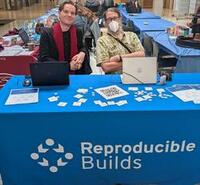



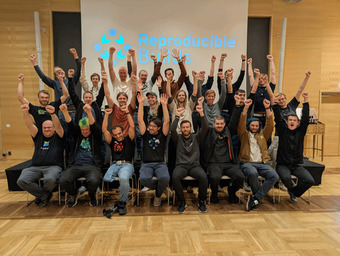



 A few days ago, a colleague reached out to me, asking if I could help draft a
resolution on digital autonomy and free software for the upcoming renewal of
our collective bargaining agreement. Although she's very politicised and
generally a great individual, she is not a techie and we never really talked
about these issues before.
This took me by surprise. I should have been rejoicing; no, I should have been
the one who brought up this topic in our union. Wasn't I the technical expert
on these issues? But alas, my first reaction when she came to me was to snicker
and tell myself: "That's cute, but nothing's ever gonna change, Big Tech is too
strong and our governments don't give a damn."
How sad and cynical is that? That's not the person I want to be.
Something in the Quebecois political landscape has shifted in the last few
years with regards to tech. More and more "regular" people seem to be talking
about the importance of digital autonomy, how government services shouldn't
rely on Big Tech and how we should be using FOSS on hardware we actually
control.
A few years ago, I would have been at the vanguard of this change. I would have
been part of the creation of

 One of the primary design principles for Linus Torvalds when creating Git is that it should be a distributed system, capable of working with multiple remotes. However, most people seem to use Git with just one remote, typically having GitHub or GitLab as the only
 As a graduate of a liberal arts university, I wound up, unsurprisingly, taking a
lot of classes in every possible academic discipline. Thinking back to the
person that I was going into university, I don t think I would have chosen to
take them after all, my degree was in the sciences; I d have been stoked to
do nothing more than wall-to-wall computer science until I ran out of
coursework and filled the rest of my hours with research and independent
studies with my professors (which, I guess I did actually do, just not as
much as I would have otherwise).
Even this blog s CSS theme (now 18 years old and starting to look it) was
something I wrote after receiving and repeatedly re-reading a tattered
third-hand copy of The Laws of Thought by George Boole. It was gifted to me
by a college friend majoring in philosophy while I was crashing at his rental
on the beach. He gave it to me because he knew I liked that shit and, while
it was definitely computer science in nature, I would not have read it
otherwise. I have vivid memories of sleeping on his la-z-boy surrounded by
towers of books he was working through. He went on to do incredible work,
getting his PhD, doing research, brilliant writing his death in 2023 has
robbed humanity of more time with him. The Laws of Thought sits behind me in
my office, and is one of my most valued possessions.
My friends mean more to me than I could ever express, and I definitely don t
show it enough. Each of my classes made me a more thoughtful person. My
professors made me a better, more well-rounded person and a person who
attempts to live up to the oft repeated credo of being men and women for
others . I did the best I could, even though I was never a particularly good
student. Without liberal arts, I don t think I would, dispositionally, have
been capable of pushing myself to this day to continue to learn on nights
and weekends, for no reason other than wanting to learn. I refuse to stop
expanding my perspective, and do my best to approach new problems with as much
humility and curiosity as I can muster.
Every few days for the last year or so, I have been thinking back to a reading
assignment from my junior year that, at the time, I thought was a borderline
throwaway filler assignment for the class. The reading is an essay from 1947 by
the french existentialist philosopher and libertarian marxist, Jean-Paul Sartre
(as some of the more erudite may have now already worked out given the blog s
title), Why Write? . I re-read it this week. It is not filler. I remember this
essay better than some of the classwork I considered more important at the
time.


 As I am writing this, there is a
 It has now been thirty-three years since the Debian project was
 Odyssey displaying "The Great Wave Off Kanagawa"

 I've spent about 100 hours of work over the past month to make sure
git-annex can build without dependencies that contain LLM generated code.
At least so far.
 Through work, I have paid license to
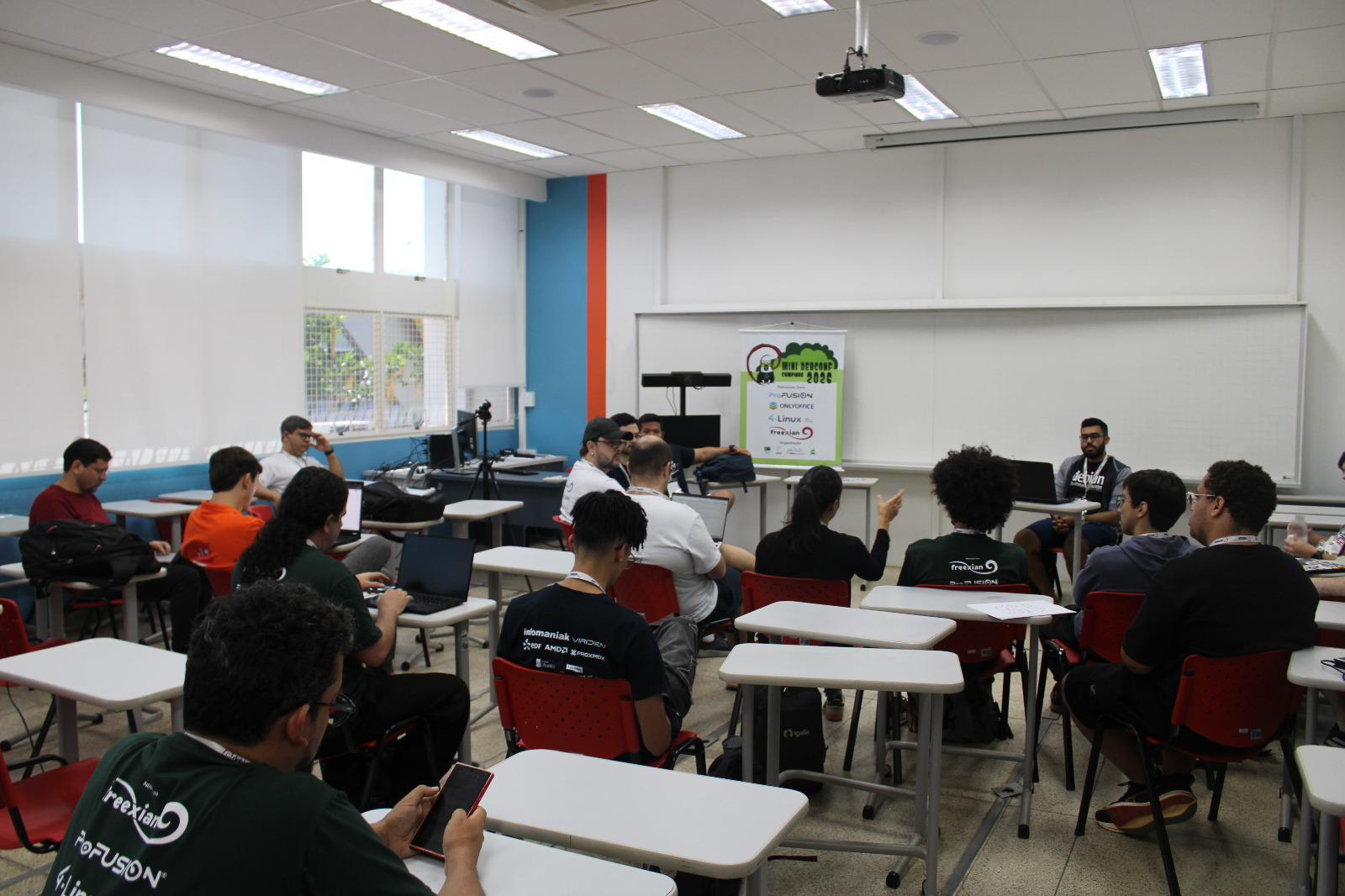
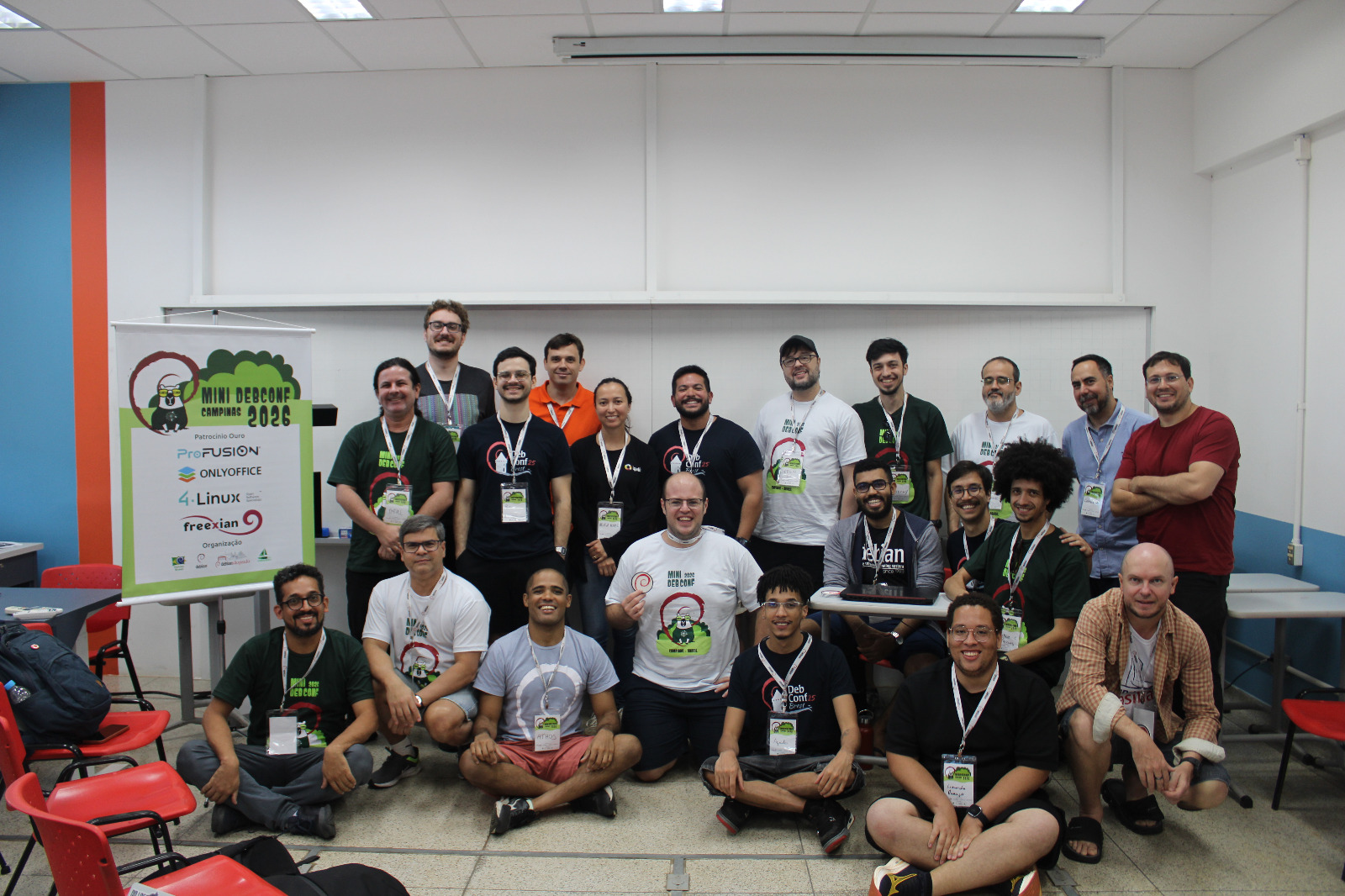
 A shot of my room. Photo by Ravi Dwivedi, released under CC-BY-SA 4.0.
 A tram in Budapest. Photo by Ravi Dwivedi, released under CC-BY-SA 4.0.
 The red building in the picture served as the conference venue. Photo by Ravi Dwivedi, released under CC-BY-SA 4.0.
 These Esterh zy cake bites were really yummy. Photo by Ravi Dwivedi, released under CC-BY-SA 4.0.
 Raspberry Currant cake slices. Photo by Ravi Dwivedi, released under CC-BY-SA 4.0.
 Conference swag. Photo by Ravi Dwivedi, released under CC-BY-SA 4.0.
 Lothar giving his presentation. Photo by Ravi Dwivedi, released under CC-BY-SA 4.0.
 Presentation on migration to LibreOffice by Austrian Armed Forces. Photo by Ravi Dwivedi, released under CC-BY-SA 4.0.
 My lunch ticket for the conference. Photo by Ravi Dwivedi, released under CC-BY-SA 4.0.
 The lunch I had on the first day. Photo by Ravi Dwivedi, released under CC-BY-SA 4.0.
 Desserts at Tofea Grill. Photo by Ravi Dwivedi, released under CC-BY-SA 4.0.
 Dione giving her presentation. Photo by Ravi Dwivedi, released under CC-BY-SA 4.0.
 Egg white salad. Photo by Ravi Dwivedi, released under CC-BY-SA 4.0.
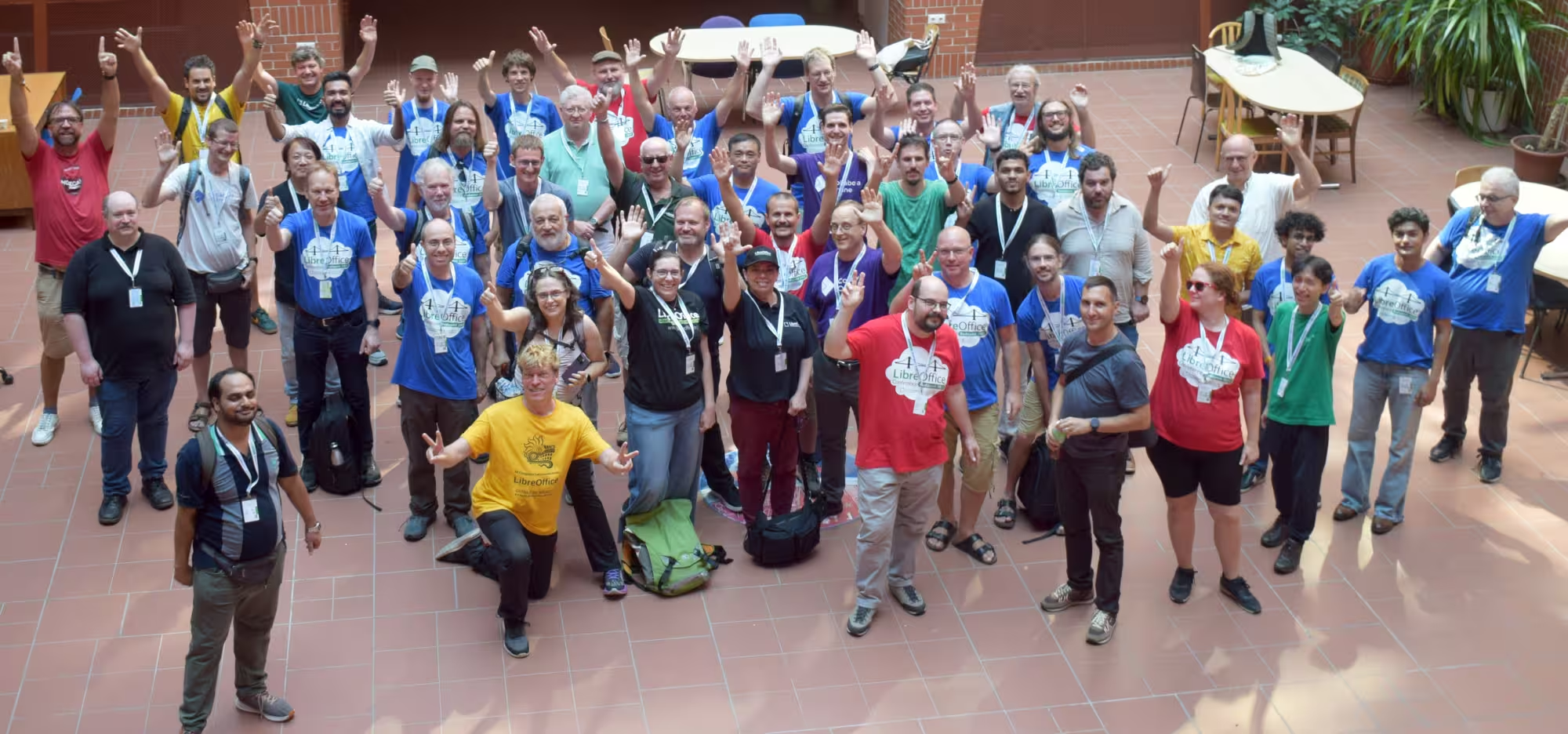 Group photo