Otto Kek l inen: Will decentralized social media soon go mainstream?

 In today s digital landscape, social media is more than just a communication tool it is the primary medium for global discourse. Heads of state, corporate leaders and cultural influencers now broadcast their statements directly to the world, shaping public opinion in real time. However, the dominance of a few centralized platforms X/Twitter, Facebook and YouTube raises critical concerns about control, censorship and the monopolization of information. Those who control these networks effectively wield significant power over public discourse.
In response, a new wave of distributed social media platforms has emerged, each built on different decentralized protocols designed to provide greater autonomy, censorship resistance and user control. While Wikipedia maintains a comprehensive list of distributed social networking software and protocols, it does not cover recent blockchain-based systems, nor does it highlight which have the most potential for mainstream adoption.
This post explores the leading decentralized social media platforms and the protocols they are based on: Mastodon (ActivityPub), Bluesky (AT Protocol), Warpcast (Farcaster), Hey (Lens) and Primal (Nostr).
Comparison of architecture and mainstream adoption potential
| Protocol | Identity System | Example | Storage model | Cost for end users | Potential |
|---|---|---|---|---|---|
| Mastodon | Tied to server domain | @ottok@mastodon.social |
Federated instances | Free (some instances charge) | High |
| Bluesky | Portable (DID) | ottoke.bsky.social |
Federated instances | Free | Moderate |
| Farcaster | ENS (Ethereum) | @ottok |
Blockchain + off-chain | Small gas fees | Moderate |
| Lens | NFT-based (Polygon) | @ottok |
Blockchain + off-chain | Small gas fees | Niche |
| Nostr | Cryptographic Keys | npub16lc6uhqpg6dnqajylkhwuh3j7ynhcnje508tt4v6703w9kjlv9vqzz4z7f |
Federated instances | Free (some instances charge) | Niche |
1. Mastodon (ActivityPub)
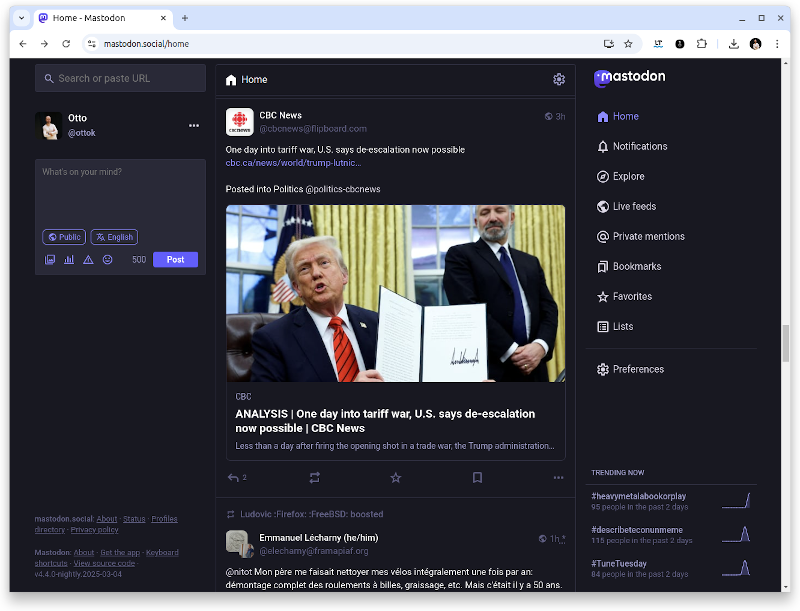 Mastodon was created in 2016 by Eugen Rochko, a German software developer who sought to provide a decentralized and user-controlled alternative to Twitter. It was built on the ActivityPub protocol, now standardized by W3C Social Web Working Group, to allow users to join independent servers while still communicating across the broader Mastodon network.
Mastodon operates on a federated model, where multiple independently run servers communicate via ActivityPub. Each server sets its own moderation policies, leading to a decentralized but fragmented experience. The servers can alternatively be called instances, relays or nodes, depending on what vocabulary a protocol has standardized on.
- Identity: User identity is tied to the instance where they registered, represented as
@username@instance.tld.
- Storage: Data is stored on individual instances, which federate messages to other instances based on their configurations.
- Cost: Free to use, but relies on instance operators willing to run the servers.
The protocol defines multiple activities such as:
- Creating a post
- Liking
- Sharing
- Following
- Commenting
Example Message in ActivityPub (JSON-LD Format)
json
"@context": "https://www.w3.org/ns/activitystreams",
"type": "Create",
"actor": "https://mastodon.social/users/ottok",
"object":
"type": "Note",
"content": "Hello from #Mastodon!",
"published": "2025-03-03T12:00:00Z",
"to": ["https://www.w3.org/ns/activitystreams#Public"]
Servers communicate across different platforms by publishing activities to their followers or forwarding activities between servers. Standard HTTPS is used between servers for communication, and the messages use JSON-LD for data representation. The WebFinger protocol is used for user discovery. There is however no neat way for home server discovery yet. This means that if you are browsing e.g. Fosstodon and want to follow a user and press Follow, a dialog will pop up asking you to enter your own home server (e.g. mastodon.social) to redirect you there for actually executing the Follow action on with your account.
Mastodon is open source under the AGPL at github.com/mastodon/mastodon. Anyone can operate their own instance. It just requires to run your own server and some skills to maintain a Ruby on Rails app with a PostgreSQL database backend, and basic understanding of the protocol to configure federation with other ActivityPub instances.
Popularity: Already established, but will it grow more?
Mastodon has seen steady growth, especially after Twitter s acquisition in 2022, with some estimates stating it peaked at 10 million users across thousands of instances. However, its fragmented user experience and the complexity of choosing instances have hindered mainstream adoption. Still, it remains the most established decentralized alternative to Twitter.
Note that Donald Trump s Truth Social is based on the Mastodon software but does not federate with the ActivityPub network.
The ActivityPub protocol is the most widely used of its kind. One of the other most popular services is the Lemmy link sharing service, similar to Reddit. The larger ecosystem of ActivityPub is called Fediverse, and estimates put the total active user count around 6 million.
2. Bluesky (AT Protocol)
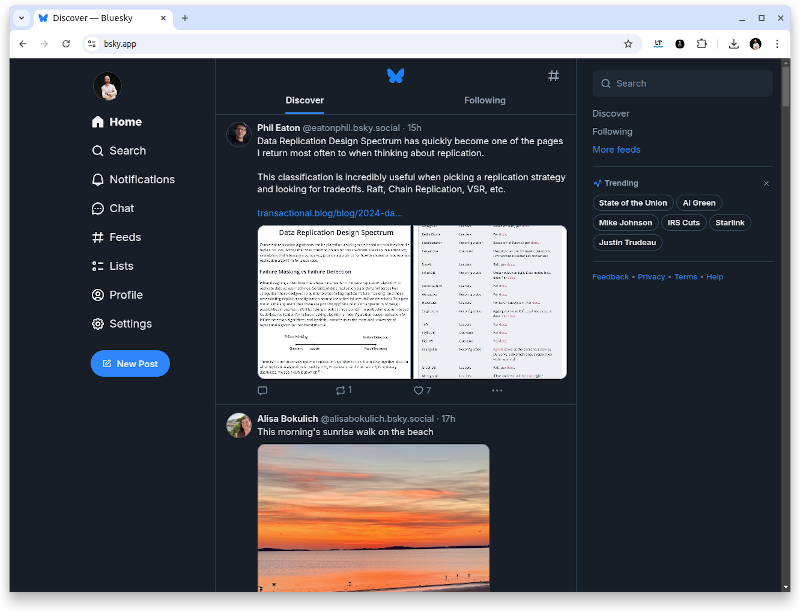 Interestingly, Bluesky was conceived within Twitter in 2019 by Twitter founder Jack Dorsey. After being incubated as a Twitter-funded project, it spun off as an independent Public Benefit LLC in February 2022 and launched its public beta in February 2023.
Bluesky runs on top of the Authenticated Transfer (AT) Protocol published at https://github.com/bluesky-social/atproto. The protocol enables portable identities and data ownership, meaning users can migrate between platforms while keeping their identity and content intact. In practice, however, there is only one popular server at the moment, which is Bluesky itself.
- Identity: Usernames are domain-based (e.g.,
@user.bsky.social).
- Storage: Content is theoretically federated among various servers.
- Cost: Free to use, but relies on instance operators willing to run the servers.
Example Message in AT Protocol (JSON Format)
json
"repo": "did:plc:ottoke.bsky.social",
"collection": "app.bsky.feed.post",
"record":
"$type": "app.bsky.feed.post",
"text": "Hello from Bluesky!",
"createdAt": "2025-03-03T12:00:00Z",
"langs": ["en"]
Popularity: Hybrid approach may have business benefits?
Bluesky reported over 3 million users by 2024, probably getting traction due to its Twitter-like interface and Jack Dorsey s involvement. Its hybrid approach decentralized identity with centralized components could make it a strong candidate for mainstream adoption, assuming it can scale effectively.
3. Warpcast (Farcaster Network)
Farcaster was launched in 2021 by Dan Romero and Varun Srinivasan, both former crypto exchange Coinbase executives, to create a decentralized but user-friendly social network. Built on the Ethereum blockchain, it could potentially offer a very attack-resistant communication medium.
However, in my own testing, Farcaster does not seem to fully leverage what Ethereum could offer. First of all, there is no diversity in programs implementing the protocol as at the moment there is only Warpcast. In Warpcast the signup requires an initial 5 USD fee that is not payable in ETH, and users need to create a new wallet address on the Ethereum layer 2 network Base instead of simply reusing their existing Ethereum wallet address or ENS name.
Despite this, I can understand why Farcaster may have decided to start out like this. Having a single client program may be the best strategy initially. One of the decentralized chat protocol Matrix founders, Matthew Hodgson, shared in his FOSDEM 2025 talk that he slightly regrets focusing too much on developing the protocol instead of making sure the app to use it is attractive to end users. So it may be sensible to ensure Warpcast gets popular first, before attempting to make the Farcaster protocol widely used.
As a protocol Farcaster s hybrid approach makes it more scalable than fully on-chain networks, giving it a higher chance of mainstream adoption if it integrates seamlessly with broader Web3 ecosystems.
- Identity: ENS (Ethereum Name Service) domains are used as usernames.
- Storage: Messages are stored in off-chain hubs, while identity is on-chain.
- Cost: Users must pay gas fees for some operations but reading and posting messages is mostly free.
Example Message in Farcaster (JSON Format)
json
"fid": 766579,
"username": "ottok",
"custodyAddress": "0x127853e48be3870172baa4215d63b6d815d18f21",
"connectedWallet": "0x3ebe43aa3ae5b891ca1577d9c49563c0cee8da88",
"text": "Hello from Farcaster!",
"publishedAt": 1709424000,
"replyTo": null,
"embeds": []
Popularity: Decentralized social media + decentralized payments a winning combo?
Ethereum founder Vitalik Buterin (warpcast.com/vbuterin) and many core developers are active on the platform. Warpcast, the main client for Farcaster, has seen increasing adoption, especially among Ethereum developers and Web3 enthusiasts. I too have an profile at warpcast.com/ottok. However, the numbers are still very low and far from reaching network effects to really take off.
Blockchain-based social media networks, particularly those built on Ethereum, are compelling because they leverage existing user wallets and persistent identities while enabling native payment functionality. When combined with decentralized content funding through micropayments, these blockchain-backed social networks could offer unique advantages that centralized platforms may find difficult to replicate, being decentralized both as a technical network and in a funding mechanism.
4. Hey.xyz (Lens Network)
The Lens Protocol was developed by decentralized finance (DeFi) team Aave and launched in May 2022 to provide a user-owned social media network. While initially built on Polygon, it has since launched its own Layer 2 network called the Lens Network in February 2024. Lens is currently the main competitor to Farcaster.
Lens stores profile ownership and references on-chain, while content is stored on IPFS/Arweave, enabling composability with DeFi and NFTs.
- Identity: Profile ownership is tied to NFTs on the Polygon blockchain.
- Storage: Content is on-chain and integrates with IPFS/Arweave (like NFTs).
- Cost: Users must pay gas fees for some operations but reading and posting messages is mostly free.
Example Message in Lens (JSON Format)
json
"profileId": "@ottok",
"contentURI": "ar://QmExampleHash",
"collectModule": "0x23b9467334bEb345aAa6fd1545538F3d54436e96",
"referenceModule": "0x0000000000000000000000000000000000000000",
"timestamp": 1709558400
Popularity: Probably not as social media site, but maybe as protocol?
The social media side of Lens is mainly the Hey.xyz website, which seems to have fewer users than Warpcast, and is even further away from reaching critical mass for network effects. The Lens protocol however has a lot of advanced features and it may gain adoption as the building block for many Web3 apps.
5. Primal.net (Nostr Network)
Nostr (Notes and Other Stuff Transmitted by Relays) was conceptualized in 2020 by an anonymous developer known as fiatjaf. One of the primary design tenets was to be a censorship-resistant protocol and it is popular among Bitcoin enthusiasts, with Jack Dorsey being one of the public supporters. Unlike the Farcaster and Lens protocols, Nostr is not blockchain-based but just a network of relay servers for message distribution. If does however use public key cryptography for identities, similar to how wallets work in crypto.
- Identity: Public-private key pairs define identity (with prefix
npub...).
- Storage: Content is federated among multiple servers, which in Nostr vocabulary are called relays.
- Cost: No gas fees, but relies on relay operators willing to run the servers.
Example Message in Nostr (JSON Format)
json
"id": "note1xyz...",
"pubkey": "npub1...",
"kind": 1,
"content": "Hello from Nostr!",
"created_at": 1709558400,
"tags": [],
"sig": "sig1..."
Popularity: If Jack Dorsey and Bitcoiners promote it enough?
Primal.net as a web app is pretty solid, but it does not stand out much. While Jack Dorsey has shown support by donating $1.5 million to the protocol development in December 2021, its success likely depends on broader adoption by the Bitcoin community.
Will any of these replace X/Twitter?
As usage patterns vary, the statistics are not fully comparable, but this overview of the situation in March 2025 gives a decent overview.
@username@instance.tld.
 "@context": "https://www.w3.org/ns/activitystreams",
 "type": "Create",
 "actor": "https://mastodon.social/users/ottok",
 "object":
 "type": "Note",
 "content": "Hello from #Mastodon!",
 "published": "2025-03-03T12:00:00Z",
 "to": ["https://www.w3.org/ns/activitystreams#Public"]
Popularity: Already established, but will it grow more?
Mastodon has seen steady growth, especially after Twitter s acquisition in 2022, with some estimates stating it peaked at 10 million users across thousands of instances. However, its fragmented user experience and the complexity of choosing instances have hindered mainstream adoption. Still, it remains the most established decentralized alternative to Twitter.
Note that Donald Trump s Truth Social is based on the Mastodon software but does not federate with the ActivityPub network.
The ActivityPub protocol is the most widely used of its kind. One of the other most popular services is the Lemmy link sharing service, similar to Reddit. The larger ecosystem of ActivityPub is called Fediverse, and estimates put the total active user count around 6 million.
2. Bluesky (AT Protocol)
Interestingly, Bluesky was conceived within Twitter in 2019 by Twitter founder Jack Dorsey. After being incubated as a Twitter-funded project, it spun off as an independent Public Benefit LLC in February 2022 and launched its public beta in February 2023.
Bluesky runs on top of the Authenticated Transfer (AT) Protocol published at https://github.com/bluesky-social/atproto. The protocol enables portable identities and data ownership, meaning users can migrate between platforms while keeping their identity and content intact. In practice, however, there is only one popular server at the moment, which is Bluesky itself.
- Identity: Usernames are domain-based (e.g.,
@user.bsky.social).
- Storage: Content is theoretically federated among various servers.
- Cost: Free to use, but relies on instance operators willing to run the servers.
Example Message in AT Protocol (JSON Format)
json
"repo": "did:plc:ottoke.bsky.social",
"collection": "app.bsky.feed.post",
"record":
"$type": "app.bsky.feed.post",
"text": "Hello from Bluesky!",
"createdAt": "2025-03-03T12:00:00Z",
"langs": ["en"]
Popularity: Hybrid approach may have business benefits?
Bluesky reported over 3 million users by 2024, probably getting traction due to its Twitter-like interface and Jack Dorsey s involvement. Its hybrid approach decentralized identity with centralized components could make it a strong candidate for mainstream adoption, assuming it can scale effectively.
3. Warpcast (Farcaster Network)
Farcaster was launched in 2021 by Dan Romero and Varun Srinivasan, both former crypto exchange Coinbase executives, to create a decentralized but user-friendly social network. Built on the Ethereum blockchain, it could potentially offer a very attack-resistant communication medium.
However, in my own testing, Farcaster does not seem to fully leverage what Ethereum could offer. First of all, there is no diversity in programs implementing the protocol as at the moment there is only Warpcast. In Warpcast the signup requires an initial 5 USD fee that is not payable in ETH, and users need to create a new wallet address on the Ethereum layer 2 network Base instead of simply reusing their existing Ethereum wallet address or ENS name.
Despite this, I can understand why Farcaster may have decided to start out like this. Having a single client program may be the best strategy initially. One of the decentralized chat protocol Matrix founders, Matthew Hodgson, shared in his FOSDEM 2025 talk that he slightly regrets focusing too much on developing the protocol instead of making sure the app to use it is attractive to end users. So it may be sensible to ensure Warpcast gets popular first, before attempting to make the Farcaster protocol widely used.
As a protocol Farcaster s hybrid approach makes it more scalable than fully on-chain networks, giving it a higher chance of mainstream adoption if it integrates seamlessly with broader Web3 ecosystems.
- Identity: ENS (Ethereum Name Service) domains are used as usernames.
- Storage: Messages are stored in off-chain hubs, while identity is on-chain.
- Cost: Users must pay gas fees for some operations but reading and posting messages is mostly free.
Example Message in Farcaster (JSON Format)
json
"fid": 766579,
"username": "ottok",
"custodyAddress": "0x127853e48be3870172baa4215d63b6d815d18f21",
"connectedWallet": "0x3ebe43aa3ae5b891ca1577d9c49563c0cee8da88",
"text": "Hello from Farcaster!",
"publishedAt": 1709424000,
"replyTo": null,
"embeds": []
Popularity: Decentralized social media + decentralized payments a winning combo?
Ethereum founder Vitalik Buterin (warpcast.com/vbuterin) and many core developers are active on the platform. Warpcast, the main client for Farcaster, has seen increasing adoption, especially among Ethereum developers and Web3 enthusiasts. I too have an profile at warpcast.com/ottok. However, the numbers are still very low and far from reaching network effects to really take off.
Blockchain-based social media networks, particularly those built on Ethereum, are compelling because they leverage existing user wallets and persistent identities while enabling native payment functionality. When combined with decentralized content funding through micropayments, these blockchain-backed social networks could offer unique advantages that centralized platforms may find difficult to replicate, being decentralized both as a technical network and in a funding mechanism.
4. Hey.xyz (Lens Network)
The Lens Protocol was developed by decentralized finance (DeFi) team Aave and launched in May 2022 to provide a user-owned social media network. While initially built on Polygon, it has since launched its own Layer 2 network called the Lens Network in February 2024. Lens is currently the main competitor to Farcaster.
Lens stores profile ownership and references on-chain, while content is stored on IPFS/Arweave, enabling composability with DeFi and NFTs.
- Identity: Profile ownership is tied to NFTs on the Polygon blockchain.
- Storage: Content is on-chain and integrates with IPFS/Arweave (like NFTs).
- Cost: Users must pay gas fees for some operations but reading and posting messages is mostly free.
Example Message in Lens (JSON Format)
json
"profileId": "@ottok",
"contentURI": "ar://QmExampleHash",
"collectModule": "0x23b9467334bEb345aAa6fd1545538F3d54436e96",
"referenceModule": "0x0000000000000000000000000000000000000000",
"timestamp": 1709558400
Popularity: Probably not as social media site, but maybe as protocol?
The social media side of Lens is mainly the Hey.xyz website, which seems to have fewer users than Warpcast, and is even further away from reaching critical mass for network effects. The Lens protocol however has a lot of advanced features and it may gain adoption as the building block for many Web3 apps.
5. Primal.net (Nostr Network)
Nostr (Notes and Other Stuff Transmitted by Relays) was conceptualized in 2020 by an anonymous developer known as fiatjaf. One of the primary design tenets was to be a censorship-resistant protocol and it is popular among Bitcoin enthusiasts, with Jack Dorsey being one of the public supporters. Unlike the Farcaster and Lens protocols, Nostr is not blockchain-based but just a network of relay servers for message distribution. If does however use public key cryptography for identities, similar to how wallets work in crypto.
- Identity: Public-private key pairs define identity (with prefix
npub...).
- Storage: Content is federated among multiple servers, which in Nostr vocabulary are called relays.
- Cost: No gas fees, but relies on relay operators willing to run the servers.
Example Message in Nostr (JSON Format)
json
"id": "note1xyz...",
"pubkey": "npub1...",
"kind": 1,
"content": "Hello from Nostr!",
"created_at": 1709558400,
"tags": [],
"sig": "sig1..."
Popularity: If Jack Dorsey and Bitcoiners promote it enough?
Primal.net as a web app is pretty solid, but it does not stand out much. While Jack Dorsey has shown support by donating $1.5 million to the protocol development in December 2021, its success likely depends on broader adoption by the Bitcoin community.
Will any of these replace X/Twitter?
As usage patterns vary, the statistics are not fully comparable, but this overview of the situation in March 2025 gives a decent overview.
Interestingly, Bluesky was conceived within Twitter in 2019 by Twitter founder Jack Dorsey. After being incubated as a Twitter-funded project, it spun off as an independent Public Benefit LLC in February 2022 and launched its public beta in February 2023.
Bluesky runs on top of the Authenticated Transfer (AT) Protocol published at https://github.com/bluesky-social/atproto. The protocol enables portable identities and data ownership, meaning users can migrate between platforms while keeping their identity and content intact. In practice, however, there is only one popular server at the moment, which is Bluesky itself.
- Identity: Usernames are domain-based (e.g.,
@user.bsky.social). - Storage: Content is theoretically federated among various servers.
- Cost: Free to use, but relies on instance operators willing to run the servers.
Example Message in AT Protocol (JSON Format)
json
 "repo": "did:plc:ottoke.bsky.social",
 "collection": "app.bsky.feed.post",
 "record":
 "$type": "app.bsky.feed.post",
 "text": "Hello from Bluesky!",
 "createdAt": "2025-03-03T12:00:00Z",
 "langs": ["en"]
Popularity: Hybrid approach may have business benefits?
Bluesky reported over 3 million users by 2024, probably getting traction due to its Twitter-like interface and Jack Dorsey s involvement. Its hybrid approach decentralized identity with centralized components could make it a strong candidate for mainstream adoption, assuming it can scale effectively.
3. Warpcast (Farcaster Network)
Farcaster was launched in 2021 by Dan Romero and Varun Srinivasan, both former crypto exchange Coinbase executives, to create a decentralized but user-friendly social network. Built on the Ethereum blockchain, it could potentially offer a very attack-resistant communication medium.
However, in my own testing, Farcaster does not seem to fully leverage what Ethereum could offer. First of all, there is no diversity in programs implementing the protocol as at the moment there is only Warpcast. In Warpcast the signup requires an initial 5 USD fee that is not payable in ETH, and users need to create a new wallet address on the Ethereum layer 2 network Base instead of simply reusing their existing Ethereum wallet address or ENS name.
Despite this, I can understand why Farcaster may have decided to start out like this. Having a single client program may be the best strategy initially. One of the decentralized chat protocol Matrix founders, Matthew Hodgson, shared in his FOSDEM 2025 talk that he slightly regrets focusing too much on developing the protocol instead of making sure the app to use it is attractive to end users. So it may be sensible to ensure Warpcast gets popular first, before attempting to make the Farcaster protocol widely used.
As a protocol Farcaster s hybrid approach makes it more scalable than fully on-chain networks, giving it a higher chance of mainstream adoption if it integrates seamlessly with broader Web3 ecosystems.
- Identity: ENS (Ethereum Name Service) domains are used as usernames.
- Storage: Messages are stored in off-chain hubs, while identity is on-chain.
- Cost: Users must pay gas fees for some operations but reading and posting messages is mostly free.
Example Message in Farcaster (JSON Format)
json
"fid": 766579,
"username": "ottok",
"custodyAddress": "0x127853e48be3870172baa4215d63b6d815d18f21",
"connectedWallet": "0x3ebe43aa3ae5b891ca1577d9c49563c0cee8da88",
"text": "Hello from Farcaster!",
"publishedAt": 1709424000,
"replyTo": null,
"embeds": []
Popularity: Decentralized social media + decentralized payments a winning combo?
Ethereum founder Vitalik Buterin (warpcast.com/vbuterin) and many core developers are active on the platform. Warpcast, the main client for Farcaster, has seen increasing adoption, especially among Ethereum developers and Web3 enthusiasts. I too have an profile at warpcast.com/ottok. However, the numbers are still very low and far from reaching network effects to really take off.
Blockchain-based social media networks, particularly those built on Ethereum, are compelling because they leverage existing user wallets and persistent identities while enabling native payment functionality. When combined with decentralized content funding through micropayments, these blockchain-backed social networks could offer unique advantages that centralized platforms may find difficult to replicate, being decentralized both as a technical network and in a funding mechanism.
4. Hey.xyz (Lens Network)
The Lens Protocol was developed by decentralized finance (DeFi) team Aave and launched in May 2022 to provide a user-owned social media network. While initially built on Polygon, it has since launched its own Layer 2 network called the Lens Network in February 2024. Lens is currently the main competitor to Farcaster.
Lens stores profile ownership and references on-chain, while content is stored on IPFS/Arweave, enabling composability with DeFi and NFTs.
- Identity: Profile ownership is tied to NFTs on the Polygon blockchain.
- Storage: Content is on-chain and integrates with IPFS/Arweave (like NFTs).
- Cost: Users must pay gas fees for some operations but reading and posting messages is mostly free.
Example Message in Lens (JSON Format)
json
"profileId": "@ottok",
"contentURI": "ar://QmExampleHash",
"collectModule": "0x23b9467334bEb345aAa6fd1545538F3d54436e96",
"referenceModule": "0x0000000000000000000000000000000000000000",
"timestamp": 1709558400
Popularity: Probably not as social media site, but maybe as protocol?
The social media side of Lens is mainly the Hey.xyz website, which seems to have fewer users than Warpcast, and is even further away from reaching critical mass for network effects. The Lens protocol however has a lot of advanced features and it may gain adoption as the building block for many Web3 apps.
5. Primal.net (Nostr Network)
Nostr (Notes and Other Stuff Transmitted by Relays) was conceptualized in 2020 by an anonymous developer known as fiatjaf. One of the primary design tenets was to be a censorship-resistant protocol and it is popular among Bitcoin enthusiasts, with Jack Dorsey being one of the public supporters. Unlike the Farcaster and Lens protocols, Nostr is not blockchain-based but just a network of relay servers for message distribution. If does however use public key cryptography for identities, similar to how wallets work in crypto.
- Identity: Public-private key pairs define identity (with prefix
npub...).
- Storage: Content is federated among multiple servers, which in Nostr vocabulary are called relays.
- Cost: No gas fees, but relies on relay operators willing to run the servers.
Example Message in Nostr (JSON Format)
json
"id": "note1xyz...",
"pubkey": "npub1...",
"kind": 1,
"content": "Hello from Nostr!",
"created_at": 1709558400,
"tags": [],
"sig": "sig1..."
Popularity: If Jack Dorsey and Bitcoiners promote it enough?
Primal.net as a web app is pretty solid, but it does not stand out much. While Jack Dorsey has shown support by donating $1.5 million to the protocol development in December 2021, its success likely depends on broader adoption by the Bitcoin community.
Will any of these replace X/Twitter?
As usage patterns vary, the statistics are not fully comparable, but this overview of the situation in March 2025 gives a decent overview.
"repo": "did:plc:ottoke.bsky.social",
"collection": "app.bsky.feed.post",
"record":
"$type": "app.bsky.feed.post",
"text": "Hello from Bluesky!",
"createdAt": "2025-03-03T12:00:00Z",
"langs": ["en"]
3. Warpcast (Farcaster Network)
Farcaster was launched in 2021 by Dan Romero and Varun Srinivasan, both former crypto exchange Coinbase executives, to create a decentralized but user-friendly social network. Built on the Ethereum blockchain, it could potentially offer a very attack-resistant communication medium.
However, in my own testing, Farcaster does not seem to fully leverage what Ethereum could offer. First of all, there is no diversity in programs implementing the protocol as at the moment there is only Warpcast. In Warpcast the signup requires an initial 5 USD fee that is not payable in ETH, and users need to create a new wallet address on the Ethereum layer 2 network Base instead of simply reusing their existing Ethereum wallet address or ENS name.
Despite this, I can understand why Farcaster may have decided to start out like this. Having a single client program may be the best strategy initially. One of the decentralized chat protocol Matrix founders, Matthew Hodgson, shared in his FOSDEM 2025 talk that he slightly regrets focusing too much on developing the protocol instead of making sure the app to use it is attractive to end users. So it may be sensible to ensure Warpcast gets popular first, before attempting to make the Farcaster protocol widely used.
As a protocol Farcaster s hybrid approach makes it more scalable than fully on-chain networks, giving it a higher chance of mainstream adoption if it integrates seamlessly with broader Web3 ecosystems.
- Identity: ENS (Ethereum Name Service) domains are used as usernames.
- Storage: Messages are stored in off-chain hubs, while identity is on-chain.
- Cost: Users must pay gas fees for some operations but reading and posting messages is mostly free.
Example Message in Farcaster (JSON Format)
json
 "fid": 766579,
 "username": "ottok",
 "custodyAddress": "0x127853e48be3870172baa4215d63b6d815d18f21",
 "connectedWallet": "0x3ebe43aa3ae5b891ca1577d9c49563c0cee8da88",
 "text": "Hello from Farcaster!",
 "publishedAt": 1709424000,
 "replyTo": null,
 "embeds": []
Popularity: Decentralized social media + decentralized payments a winning combo?
Ethereum founder Vitalik Buterin (warpcast.com/vbuterin) and many core developers are active on the platform. Warpcast, the main client for Farcaster, has seen increasing adoption, especially among Ethereum developers and Web3 enthusiasts. I too have an profile at warpcast.com/ottok. However, the numbers are still very low and far from reaching network effects to really take off.
Blockchain-based social media networks, particularly those built on Ethereum, are compelling because they leverage existing user wallets and persistent identities while enabling native payment functionality. When combined with decentralized content funding through micropayments, these blockchain-backed social networks could offer unique advantages that centralized platforms may find difficult to replicate, being decentralized both as a technical network and in a funding mechanism.
4. Hey.xyz (Lens Network)
The Lens Protocol was developed by decentralized finance (DeFi) team Aave and launched in May 2022 to provide a user-owned social media network. While initially built on Polygon, it has since launched its own Layer 2 network called the Lens Network in February 2024. Lens is currently the main competitor to Farcaster.
Lens stores profile ownership and references on-chain, while content is stored on IPFS/Arweave, enabling composability with DeFi and NFTs.
- Identity: Profile ownership is tied to NFTs on the Polygon blockchain.
- Storage: Content is on-chain and integrates with IPFS/Arweave (like NFTs).
- Cost: Users must pay gas fees for some operations but reading and posting messages is mostly free.
Example Message in Lens (JSON Format)
json
"profileId": "@ottok",
"contentURI": "ar://QmExampleHash",
"collectModule": "0x23b9467334bEb345aAa6fd1545538F3d54436e96",
"referenceModule": "0x0000000000000000000000000000000000000000",
"timestamp": 1709558400
Popularity: Probably not as social media site, but maybe as protocol?
The social media side of Lens is mainly the Hey.xyz website, which seems to have fewer users than Warpcast, and is even further away from reaching critical mass for network effects. The Lens protocol however has a lot of advanced features and it may gain adoption as the building block for many Web3 apps.
5. Primal.net (Nostr Network)
Nostr (Notes and Other Stuff Transmitted by Relays) was conceptualized in 2020 by an anonymous developer known as fiatjaf. One of the primary design tenets was to be a censorship-resistant protocol and it is popular among Bitcoin enthusiasts, with Jack Dorsey being one of the public supporters. Unlike the Farcaster and Lens protocols, Nostr is not blockchain-based but just a network of relay servers for message distribution. If does however use public key cryptography for identities, similar to how wallets work in crypto.
- Identity: Public-private key pairs define identity (with prefix
npub...).
- Storage: Content is federated among multiple servers, which in Nostr vocabulary are called relays.
- Cost: No gas fees, but relies on relay operators willing to run the servers.
Example Message in Nostr (JSON Format)
json
"id": "note1xyz...",
"pubkey": "npub1...",
"kind": 1,
"content": "Hello from Nostr!",
"created_at": 1709558400,
"tags": [],
"sig": "sig1..."
Popularity: If Jack Dorsey and Bitcoiners promote it enough?
Primal.net as a web app is pretty solid, but it does not stand out much. While Jack Dorsey has shown support by donating $1.5 million to the protocol development in December 2021, its success likely depends on broader adoption by the Bitcoin community.
Will any of these replace X/Twitter?
As usage patterns vary, the statistics are not fully comparable, but this overview of the situation in March 2025 gives a decent overview.
"fid": 766579,
"username": "ottok",
"custodyAddress": "0x127853e48be3870172baa4215d63b6d815d18f21",
"connectedWallet": "0x3ebe43aa3ae5b891ca1577d9c49563c0cee8da88",
"text": "Hello from Farcaster!",
"publishedAt": 1709424000,
"replyTo": null,
"embeds": []
Popularity: Decentralized social media + decentralized payments a winning combo?
Ethereum founder Vitalik Buterin (warpcast.com/vbuterin) and many core developers are active on the platform. Warpcast, the main client for Farcaster, has seen increasing adoption, especially among Ethereum developers and Web3 enthusiasts. I too have an profile at warpcast.com/ottok. However, the numbers are still very low and far from reaching network effects to really take off.
Blockchain-based social media networks, particularly those built on Ethereum, are compelling because they leverage existing user wallets and persistent identities while enabling native payment functionality. When combined with decentralized content funding through micropayments, these blockchain-backed social networks could offer unique advantages that centralized platforms may find difficult to replicate, being decentralized both as a technical network and in a funding mechanism.
4. Hey.xyz (Lens Network)
The Lens Protocol was developed by decentralized finance (DeFi) team Aave and launched in May 2022 to provide a user-owned social media network. While initially built on Polygon, it has since launched its own Layer 2 network called the Lens Network in February 2024. Lens is currently the main competitor to Farcaster.
Lens stores profile ownership and references on-chain, while content is stored on IPFS/Arweave, enabling composability with DeFi and NFTs.
- Identity: Profile ownership is tied to NFTs on the Polygon blockchain.
- Storage: Content is on-chain and integrates with IPFS/Arweave (like NFTs).
- Cost: Users must pay gas fees for some operations but reading and posting messages is mostly free.
Example Message in Lens (JSON Format)
json
 "profileId": "@ottok",
 "contentURI": "ar://QmExampleHash",
 "collectModule": "0x23b9467334bEb345aAa6fd1545538F3d54436e96",
 "referenceModule": "0x0000000000000000000000000000000000000000",
 "timestamp": 1709558400
Popularity: Probably not as social media site, but maybe as protocol?
The social media side of Lens is mainly the Hey.xyz website, which seems to have fewer users than Warpcast, and is even further away from reaching critical mass for network effects. The Lens protocol however has a lot of advanced features and it may gain adoption as the building block for many Web3 apps.
5. Primal.net (Nostr Network)
Nostr (Notes and Other Stuff Transmitted by Relays) was conceptualized in 2020 by an anonymous developer known as fiatjaf. One of the primary design tenets was to be a censorship-resistant protocol and it is popular among Bitcoin enthusiasts, with Jack Dorsey being one of the public supporters. Unlike the Farcaster and Lens protocols, Nostr is not blockchain-based but just a network of relay servers for message distribution. If does however use public key cryptography for identities, similar to how wallets work in crypto.
- Identity: Public-private key pairs define identity (with prefix
npub...).
- Storage: Content is federated among multiple servers, which in Nostr vocabulary are called relays.
- Cost: No gas fees, but relies on relay operators willing to run the servers.
Example Message in Nostr (JSON Format)
json
"id": "note1xyz...",
"pubkey": "npub1...",
"kind": 1,
"content": "Hello from Nostr!",
"created_at": 1709558400,
"tags": [],
"sig": "sig1..."
Popularity: If Jack Dorsey and Bitcoiners promote it enough?
Primal.net as a web app is pretty solid, but it does not stand out much. While Jack Dorsey has shown support by donating $1.5 million to the protocol development in December 2021, its success likely depends on broader adoption by the Bitcoin community.
Will any of these replace X/Twitter?
As usage patterns vary, the statistics are not fully comparable, but this overview of the situation in March 2025 gives a decent overview.
- Identity: Profile ownership is tied to NFTs on the Polygon blockchain.
- Storage: Content is on-chain and integrates with IPFS/Arweave (like NFTs).
- Cost: Users must pay gas fees for some operations but reading and posting messages is mostly free.
Example Message in Lens (JSON Format)
json
"profileId": "@ottok",
"contentURI": "ar://QmExampleHash",
"collectModule": "0x23b9467334bEb345aAa6fd1545538F3d54436e96",
"referenceModule": "0x0000000000000000000000000000000000000000",
"timestamp": 1709558400
Popularity: Probably not as social media site, but maybe as protocol?
The social media side of Lens is mainly the Hey.xyz website, which seems to have fewer users than Warpcast, and is even further away from reaching critical mass for network effects. The Lens protocol however has a lot of advanced features and it may gain adoption as the building block for many Web3 apps.
5. Primal.net (Nostr Network)
Nostr (Notes and Other Stuff Transmitted by Relays) was conceptualized in 2020 by an anonymous developer known as fiatjaf. One of the primary design tenets was to be a censorship-resistant protocol and it is popular among Bitcoin enthusiasts, with Jack Dorsey being one of the public supporters. Unlike the Farcaster and Lens protocols, Nostr is not blockchain-based but just a network of relay servers for message distribution. If does however use public key cryptography for identities, similar to how wallets work in crypto.
- Identity: Public-private key pairs define identity (with prefix
npub...).
- Storage: Content is federated among multiple servers, which in Nostr vocabulary are called relays.
- Cost: No gas fees, but relies on relay operators willing to run the servers.
Example Message in Nostr (JSON Format)
json
 "id": "note1xyz...",
 "pubkey": "npub1...",
 "kind": 1,
 "content": "Hello from Nostr!",
 "created_at": 1709558400,
 "tags": [],
 "sig": "sig1..."
Popularity: If Jack Dorsey and Bitcoiners promote it enough?
Primal.net as a web app is pretty solid, but it does not stand out much. While Jack Dorsey has shown support by donating $1.5 million to the protocol development in December 2021, its success likely depends on broader adoption by the Bitcoin community.
Will any of these replace X/Twitter?
As usage patterns vary, the statistics are not fully comparable, but this overview of the situation in March 2025 gives a decent overview.
"profileId": "@ottok",
"contentURI": "ar://QmExampleHash",
"collectModule": "0x23b9467334bEb345aAa6fd1545538F3d54436e96",
"referenceModule": "0x0000000000000000000000000000000000000000",
"timestamp": 1709558400
5. Primal.net (Nostr Network)
Nostr (Notes and Other Stuff Transmitted by Relays) was conceptualized in 2020 by an anonymous developer known as fiatjaf. One of the primary design tenets was to be a censorship-resistant protocol and it is popular among Bitcoin enthusiasts, with Jack Dorsey being one of the public supporters. Unlike the Farcaster and Lens protocols, Nostr is not blockchain-based but just a network of relay servers for message distribution. If does however use public key cryptography for identities, similar to how wallets work in crypto.
- Identity: Public-private key pairs define identity (with prefix
npub...).
- Storage: Content is federated among multiple servers, which in Nostr vocabulary are called relays.
- Cost: No gas fees, but relies on relay operators willing to run the servers.
Example Message in Nostr (JSON Format)
json
"id": "note1xyz...",
"pubkey": "npub1...",
"kind": 1,
"content": "Hello from Nostr!",
"created_at": 1709558400,
"tags": [],
"sig": "sig1..."
Popularity: If Jack Dorsey and Bitcoiners promote it enough?
Primal.net as a web app is pretty solid, but it does not stand out much. While Jack Dorsey has shown support by donating $1.5 million to the protocol development in December 2021, its success likely depends on broader adoption by the Bitcoin community.
Will any of these replace X/Twitter?
As usage patterns vary, the statistics are not fully comparable, but this overview of the situation in March 2025 gives a decent overview.
npub...).
"id": "note1xyz...",
"pubkey": "npub1...",
"kind": 1,
"content": "Hello from Nostr!",
"created_at": 1709558400,
"tags": [],
"sig": "sig1..."
Popularity: If Jack Dorsey and Bitcoiners promote it enough?
Primal.net as a web app is pretty solid, but it does not stand out much. While Jack Dorsey has shown support by donating $1.5 million to the protocol development in December 2021, its success likely depends on broader adoption by the Bitcoin community.
Will any of these replace X/Twitter?
As usage patterns vary, the statistics are not fully comparable, but this overview of the situation in March 2025 gives a decent overview.
| Platform | Total Accounts | Active Users | Growth Trend |
|---|---|---|---|
| Mastodon | ~10 million | ~1 million | Steady |
| Bluesky | ~33 million | ~1 million | Steady |
| Nostr | ~41 million | ~20 thousand | Steady |
| Farcaster | ~850 thousand | ~50 thousand | Flat |
| Lens | ~140 thousand | ~20 thousand | Flat |
 I mentioned this briefly yesterday, but now I'll try to summarize the
story of a great surprise and a big moment for me.
 The Debian Python Modules Team is
 And while I was on it, I thought I could do the same for the GNOME and GStreamer teams:
 (hint: pox-guest and piotr in python-modules are the same person)


 * Congrats to
