Search Results: "pranav"

13 November 2026

Bits from Debian: New Debian Developers and Maintainers (September and October 2026)

The following contributors got their Debian Developer accounts in the last two months: The following contributors were added as Debian Maintainers in the last two months: Congratulations!

9 April 2025

Freexian Collaborators: Debian Contributions: Preparations for Trixie, Updated debvm, DebConf 25 registration website updates and more! (by Anupa Ann Joseph)

Debian Contributions: 2025-03 Contributing to Debian is part of Freexian s mission. This article covers the latest achievements of Freexian and their collaborators. All of this is made possible by organizations subscribing to our Long Term Support contracts and consulting services.

Preparing for Trixie, by Rapha l Hertzog As we are approaching the trixie freeze, it is customary for Debian developers to review their packages and clean them up in preparation for the next stable release. That s precisely what Rapha l did with publican, a package that had not seen any change since the last Debian release and that partially stopped working along the way due to a major Perl upgrade. While upstream s activity is close to zero, hope is not yet entirely gone as the git repository moved to a new location a couple of months ago and contained the required fix. Rapha l also developed another fix to avoid an annoying warning that was seen at runtime. Rapha l also ensured that the last upstream version of zim was uploaded to Debian unstable, and developed a fix for gnome-shell-extension-hamster to make it work with GNOME 48 and thus ensure that the package does not get removed from trixie.

Abseil and re2 transition in Debian, by Stefano Rivera One of the last transitions to happen for trixie was an update to abseil, bringing it up to 202407. This library is a dependency for one of Freexian s customers, as well as blocking newer versions of re2, a package maintained by Stefano. The transition had been stalled for several months while some issues with reverse dependencies were investigated and dealt with. It took a final push to make the transition happen, including fixing a few newly discovered problems downstream. The abseil package s autopkgtests were (trivially) broken by newer cmake versions, and some tests started failing on PPC64 (a known issue upstream).

debvm uploaded, by Helmut Grohne debvm is a command line tool for quickly creating a Debian-based virtual machine for testing purposes. Over time, it accumulated quite a few minor issues as well as CI failures. The most notorious one was an ARM32 failure present since August. It was diagnosed down to a glibc bug by Tj and Chris Hofstaedtler and little has happened since then. To have debvm work somewhat, it now contains a workaround for this situation. Few changes are expected to be noticeable, but related tools such as apt, file, linux, passwd, and qemu required quite a few adaptations all over the place. Much of the necessary debugging was contributed by others.

DebConf 25 Registration website, by Stefano Rivera and Santiago Ruano Rinc n DebConf 25, the annual Debian developer conference, is now open for registration. Other than preparing the conference website, getting there always requires some last minute changes to the software behind the registration interface and this year was no exception. Every year, the conference is a little different to previous years, and has some different details that need to be captured from attendees. And every year we make minor incremental improvements to fix long-standing problems. New concepts this year included: brunch, the closing talks on the departure day, venue security clearance, partial contributions towards food and accommodation bursaries, and attendee-selected bursary budgets.

Miscellaneous contributions
  • Helmut uploaded guess-concurrency incorporating feedback from others.
  • Helmut reacted to rebootstrap CI results and adapted it to cope with changes in unstable.
  • Helmut researched real world /usr-move fallout though little was actually attributable. He also NMUed systemd unsuccessfully.
  • Helmut sent 12 cross build patches.
  • Helmut looked into undeclared file conflicts in Debian more systematically and filed quite some bugs.
  • Helmut attended the cross/bootstrap sprint in W rzburg. A report of the event is pending.
  • Lucas worked on the CFP and tracks definition for DebConf 25.
  • Lucas worked on some bits involving Rails 7 transition.
  • Carles investigated why the job piuparts on salsa-ci/pipeline was passing but was failing on piuparts.debian.org for simplemonitor package. Created an issue and MR with a suggested fix, under discussion.
  • Carles improved the documentation of salsa-ci/pipeline: added documentation for different variables.
  • Carles made debian-history package reproducible (with help from Chris Lamb).
  • Carles updated simplemonitor package (new upstream version), prepared a new qdacco version (fixed bugs in qdacco, packaged with the upgrade from Qt 5 to Qt 6).
  • Carles reviewed and submitted translations to Catalan for adduser, apt, shadow, apt-listchanges.
  • Carles reviewed, created merge-requests for translations to Catalan of 38 packages (using po-debconf-manager tooling). Created 40 bug reports for some merge requests that haven t been actioned for some time.
  • Colin Watson fixed 59 RC bugs (including 26 packages broken by the long-overdue removal of dh-python s dependency on python3-setuptools), and upgraded 38 packages (mostly Python-related) to new upstream versions.
  • Colin worked with Pranav P to track down and fix a dnspython autopkgtest regression on s390x caused by an endianness bug in pylsqpack.
  • Colin fixed a time-based test failure in python-dateutil that would have triggered in 2027, and contributed the fix upstream.
  • Colin fixed debconf to automatically use the noninteractive frontend if stdin is not a terminal.
  • Stefano bisected and fixed a pypy translation regression on Debian stable and older on 32-bit ARM.
  • Emilio coordinated and helped finish various transitions in light of the transition freeze.
  • Thorsten Alteholz uploaded cups-filters to fix an FTBFS with a new upstream version of qpdf.
  • With the aim of enhancing the support for packages related to Software Bill of Materials (SBOMs) in recent industrial standards, Santiago has worked on finishing the packaging of and uploaded CycloneDX python library. There is on-going work about SPDX python tools, but it requires (build-)dependencies currently not shipped in Debian, such as owlrl and pyshacl.
  • Anupa worked with the Publicity team to announce the Debian 12.10 point release.
  • Anupa with the support of Santiago prepared an announcement and announced the opening of CfP and Registrations for DebConf 25.

1 April 2025

Colin Watson: Free software activity in March 2025

Most of my Debian contributions this month were sponsored by Freexian. You can also support my work directly via Liberapay. OpenSSH Changes in dropbear 2025.87 broke OpenSSH s regression tests. I cherry-picked the fix. I reviewed and merged patches from Luca Boccassi to send and accept the COLORTERM and NO_COLOR environment variables. Python team Following up on last month, I fixed some more uscan errors: I upgraded these packages to new upstream versions: In bookworm-backports, I updated python-django to 3:4.2.19-1. Although Debian s upgrade to python-click 8.2.0 was reverted for the time being, I fixed a number of related problems anyway since we re going to have to deal with it eventually: dh-python dropped its dependency on python3-setuptools in 6.20250306, which was long overdue, but it had quite a bit of fallout; in most cases this was simply a question of adding build-dependencies on python3-setuptools, but in a few cases there was a missing build-dependency on python3-typing-extensions which had previously been pulled in as a dependency of python3-setuptools. I fixed these bugs resulting from this: We agreed to remove python-pytest-flake8. In support of this, I removed unnecessary build-dependencies from pytest-pylint, python-proton-core, python-pyzipper, python-tatsu, python-tatsu-lts, and python-tinycss, and filed #1101178 on eccodes-python and #1101179 on rpmlint. There was a dnspython autopkgtest regression on s390x. I independently tracked that down to a pylsqpack bug and came up with a reduced test case before realizing that Pranav P had already been working on it; we then worked together on it and I uploaded their patch to Debian. I fixed various other build/test failures: I enabled more tests in python-moto and contributed a supporting fix upstream. I sponsored Maximilian Engelhardt to reintroduce zope.sqlalchemy. I fixed various odds and ends of bugs: I contributed a small documentation improvement to pybuild-autopkgtest(1). Rust team I upgraded rust-asn1 to 0.20.0. Science team I finally gave in and joined the Debian Science Team this month, since it often has a lot of overlap with the Python team, and Freexian maintains several packages under it. I fixed a uscan error in hdf5-blosc (maintained by Freexian), and upgraded it to a new upstream version. I fixed python-vispy: missing dependency on numpy abi. Other bits and pieces I fixed debconf should automatically be noninteractive if input is /dev/null. I fixed a build failure with GCC 15 in yubihsm-shell (maintained by Freexian). Prompted by a CI failure in debusine, I submitted a large batch of spelling fixes and some improved static analysis to incus (#1777, #1778) and distrobuilder. After regaining access to the repository, I fixed telegnome: missing app icon in About dialogue and made a new 0.3.7 release.

23 October 2021

Antoine Beaupr : The Neo-Colonial Internet

I grew up with the Internet and its ethics and politics have always been important in my life. But I have also been involved at other levels, against police brutality, for Food, Not Bombs, worker autonomy, software freedom, etc. For a long time, that all seemed coherent. But the more I look at the modern Internet -- and the mega-corporations that control it -- and the less confidence I have in my original political analysis of the liberating potential of technology. I have come to believe that most of our technological development is harmful to the large majority of the population of the planet, and of course the rest of the biosphere. And now I feel this is not a new problem. This is because the Internet is a neo-colonial device, and has been from the start. Let me explain.

What is Neo-Colonialism? The term "neo-colonialism" was coined by Kwame Nkrumah, first president of Ghana. In Neo-Colonialism, the Last Stage of Imperialism (1965), he wrote:
In place of colonialism, as the main instrument of imperialism, we have today neo-colonialism ... [which] like colonialism, is an attempt to export the social conflicts of the capitalist countries. ... The result of neo-colonialism is that foreign capital is used for the exploitation rather than for the development of the less developed parts of the world. Investment, under neo-colonialism, increases, rather than decreases, the gap between the rich and the poor countries of the world.
So basically, if colonialism is Europeans bringing genocide, war, and its religion to the Africa, Asia, and the Americas, neo-colonialism is the Americans (note the "n") bringing capitalism to the world. Before we see how this applies to the Internet, we must therefore make a detour into US history. This matters, because anyone would be hard-pressed to decouple neo-colonialism from the empire under which it evolves, and here we can only name the United States of America.

US Declaration of Independence Let's start with the United States declaration of independence (1776). Many Americans may roll their eyes at this, possibly because that declaration is not actually part of the US constitution and therefore may have questionable legal standing. Still, it was obviously a driving philosophical force in the founding of the nation. As its author, Thomas Jefferson, stated:
it was intended to be an expression of the American mind, and to give to that expression the proper tone and spirit called for by the occasion
In that aging document, we find the following pearl:
We hold these truths to be self-evident, that all men are created equal, that they are endowed by their Creator with certain unalienable Rights, that among these are Life, Liberty and the pursuit of Happiness.
As a founding document, the Declaration still has an impact in the sense that the above quote has been called an:
"immortal declaration", and "perhaps [the] single phrase" of the American Revolutionary period with the greatest "continuing importance." (Wikipedia)
Let's read that "immortal declaration" again: "all men are created equal". "Men", in that context, is limited to a certain number of people, namely "property-owning or tax-paying white males, or about 6% of the population". Back when this was written, women didn't have the right to vote, and slavery was legal. Jefferson himself owned hundreds of slaves. The declaration was aimed at the King and was a list of grievances. A concern of the colonists was that the King:
has excited domestic insurrections amongst us, and has endeavoured to bring on the inhabitants of our frontiers, the merciless Indian Savages whose known rule of warfare, is an undistinguished destruction of all ages, sexes and conditions.
This is a clear mark of the frontier myth which paved the way for the US to exterminate and colonize the territory some now call the United States of America. The declaration of independence is obviously a colonial document, having being written by colonists. None of this is particularly surprising, historically, but I figured it serves as a good reminder of where the Internet is coming from, since it was born in the US.

A Declaration of the Independence of Cyberspace Two hundred and twenty years later, in 1996, John Perry Barlow wrote a declaration of independence of cyberspace. At this point, (almost) everyone has a right to vote (including women), slavery was abolished (although some argue it still exists in the form of the prison system); the US has made tremendous progress. Surely this text will have aged better than the previous declaration it is obviously derived from. Let's see how it reads today and how it maps to how the Internet is actually built now.

Borders of Independence One of the key ideas that Barlow brings up is that "cyberspace does not lie within your borders". In that sense, cyberspace is the final frontier: having failed to colonize the moon, Americans turn inwards, deeper into technology, but still in the frontier ideology. And indeed, Barlow is one of the co-founder of the Electronic Frontier Foundation (the beloved EFF), founded six years prior. But there are other problems with this idea. As Wikipedia quotes:
The declaration has been criticized for internal inconsistencies.[9] The declaration's assertion that 'cyberspace' is a place removed from the physical world has also been challenged by people who point to the fact that the Internet is always linked to its underlying geography.[10]
And indeed, the Internet is definitely a physical object. First controlled and severely restricted by "telcos" like AT&T, it was somewhat "liberated" from that monopoly in 1982 when an anti-trust lawsuit broke up the monopoly, a key historical event that, one could argue, made the Internet possible. (From there on, "backbone" providers could start competing and emerge, and eventually coalesce into new monopolies: Google has a monopoly on search and advertisement, Facebook on communications for a few generations, Amazon on storage and computing, Microsoft on hardware, etc. Even AT&T is now pretty much as consolidated as it was before.) The point is: all those companies have gigantic data centers and intercontinental cables. And those are definitely prioritizing the western world, the heart of the empire. Take for example Google's latest 3,900 mile undersea cable: it does not connect Argentina to South Africa or New Zealand, it connects the US to UK and Spain. Hardly a revolutionary prospect.

Private Internet But back to the Declaration:
Do not think that you can build it, as though it were a public construction project. You cannot. It is an act of nature and it grows itself through our collective actions.
In Barlow's mind, the "public" is bad, and private is good, natural. Or, in other words, a "public construction project" is unnatural. And indeed, the modern "nature" of development is private: most of the Internet is now privately owned and operated. I must admit that, as an anarchist, I loved that sentence when I read it. I was rooting for "us", the underdogs, the revolutionaries. And, in a way, I still do: I am on the board of Koumbit and work for a non-profit that has pivoted towards censorship and surveillance evasion. Yet I cannot help but think that, as a whole, we have failed to establish that independence and put too much trust in private companies. It is obvious in retrospect, but it was not, 30 years ago. Now, the infrastructure of the Internet has zero accountability to traditional political entities supposedly representing the people, or even its users. The situation is actually worse than when the US was founded (e.g. "6% of the population can vote"), because the owners of the tech giants are only a handful of people who can override any decision. There's only one Amazon CEO, he's called Jeff Bezos, and he has total control. (Update: Bezos actually ceded the CEO role to Andy Jassy, AWS and Amazon music founder, while remaining executive chairman. I would argue that, as the founder and the richest man on earth, he still has strong control over Amazon.)

Social Contract Here's another claim of the Declaration:
We are forming our own Social Contract.
I remember the early days, back when "netiquette" was a word, it did feel we had some sort of a contract. Not written in standards of course -- or barely (see RFC1855) -- but as a tacit agreement. How wrong we were. One just needs to look at Facebook to see how problematic that idea is on a global network. Facebook is the quintessential "hacker" ideology put in practice. Mark Zuckerberg explicitly refused to be "arbiter of truth" which implicitly means he will let lies take over its platforms. He also sees Facebook as place where everyone is equal, something that echoes the Declaration:
We are creating a world that all may enter without privilege or prejudice accorded by race, economic power, military force, or station of birth.
(We note, in passing, the omission of gender in that list, also mirroring the infamous "All men are created equal" claim of the US declaration.) As the Wall Street Journal's (WSJ) Facebook files later shown, both of those "contracts" have serious limitations inside Facebook. There are VIPs who systematically bypass moderation systems including fascists and rapists. Drug cartels and human traffickers thrive on the platform. Even when Zuckerberg himself tried to tame the platform -- to get people vaccinated or to make it healthier -- he failed: "vaxxer" conspiracies multiplied and Facebook got angrier. This is because the "social contract" behind Facebook and those large companies is a lie: their concern is profit and that means advertising, "engagement" with the platform, which causes increased anxiety and depression in teens, for example. Facebook's response to this is that they are working really hard on moderation. But the truth is that even that system is severely skewed. The WSJ showed that Facebook has translators for only 50 languages. It's a surprisingly hard to count human languages but estimates range the number of distinct languages between 2500 and 7000. So while 50 languages seems big at first, it's actually a tiny fraction of the human population using Facebook. Taking the first 50 of the Wikipedia list of languages by native speakers we omit languages like Dutch (52), Greek (74), and Hungarian (78), and that's just a few random nations picks from Europe. As an example, Facebook has trouble moderating even a major language like Arabic. It censored content from legitimate Arab news sources when they mentioned the word al-Aqsa because Facebook associates it with the al-Aqsa Martyrs' Brigades when they were talking about the Al-Aqsa Mosque... This bias against Arabs also shows how Facebook reproduces the American colonizer politics. The WSJ also pointed out that Facebook spends only 13% of its moderation efforts outside of the US, even if that represents 90% of its users. Facebook spends three more times moderating on "brand safety", which shows its priority is not the safety of its users, but of the advertisers.

Military Internet Sergey Brin and Larry Page are the Lewis and Clark of our generation. Just like the latter were sent by Jefferson (the same) to declare sovereignty over the entire US west coast, Google declared sovereignty over all human knowledge, with its mission statement "to organize the world's information and make it universally accessible and useful". (It should be noted that Page somewhat questioned that mission but only because it was not ambitious enough, Google having "outgrown" it.) The Lewis and Clark expedition, just like Google, had a scientific pretext, because that is what you do to colonize a world, presumably. Yet both men were military and had to receive scientific training before they left. The Corps of Discovery was made up of a few dozen enlisted men and a dozen civilians, including York an African American slave owned by Clark and sold after the expedition, with his final fate lost in history. And just like Lewis and Clark, Google has a strong military component. For example, Google Earth was not originally built at Google but is the acquisition of a company called Keyhole which had ties with the CIA. Those ties were brought inside Google during the acquisition. Google's increasing investment inside the military-industrial complex eventually led Google to workers organizing a revolt although it is currently unclear to me how much Google is involved in the military apparatus. Other companies, obviously, do not have such reserve, with Microsoft, Amazon, and plenty of others happily bidding on military contracts all the time.

Spreading the Internet I am obviously not the first to identify colonial structures in the Internet. In an article titled The Internet as an Extension of Colonialism, Heather McDonald correctly identifies fundamental problems with the "development" of new "markets" of Internet "consumers", primarily arguing that it creates a digital divide which creates a "lack of agency and individual freedom":
Many African people have gained access to these technologies but not the freedom to develop content such as web pages or social media platforms in their own way. Digital natives have much more power and therefore use this to create their own space with their own norms, shaping their online world according to their own outlook.
But the digital divide is certainly not the worst problem we have to deal with on the Internet today. Going back to the Declaration, we originally believed we were creating an entirely new world:
This governance will arise according to the conditions of our world, not yours. Our world is different.
How I dearly wished that was true. Unfortunately, the Internet is not that different from the offline world. Or, to be more accurate, the values we have embedded in the Internet, particularly of free speech absolutism, sexism, corporatism, and exploitation, are now exploding outside of the Internet, into the "real" world. The Internet was built with free software which, fundamentally, was based on quasi-volunteer labour of an elite force of white men with obviously too much time on their hands (and also: no children). The mythical writing of GCC and Emacs by Richard Stallman is a good example of this, but the entirety of the Internet now seems to be running on random bits and pieces built by hit-and-run programmers working on their copious free time. Whenever any of those fails, it can compromise or bring down entire systems. (Heck, I wrote this article on my day off...) This model of what is fundamentally "cheap labour" is spreading out from the Internet. Delivery workers are being exploited to the bone by apps like Uber -- although it should be noted that workers organise and fight back. Amazon workers are similarly exploited beyond belief, forbidden to take breaks until they pee in bottles, with ambulances nearby to carry out the bodies. During peak of the pandemic, workers were being dangerously exposed to the virus in warehouses. All this while Amazon is basically taking over the entire economy. The Declaration culminates with this prophecy:
We will spread ourselves across the Planet so that no one can arrest our thoughts.
This prediction, which first felt revolutionary, is now chilling.

Colonial Internet The Internet is, if not neo-colonial, plain colonial. The US colonies had cotton fields and slaves, we have disposable cell phones and Foxconn workers. Canada has its cultural genocide, Facebook has his own genocides in Ethiopia, Myanmar, and mob violence in India. Apple is at least implicitly accepting the Uyghur genocide. And just like the slaves of the colony, those atrocities are what makes the empire run. The Declaration actually ends like this, a quote which I have in my fortune cookies file:
We will create a civilization of the Mind in Cyberspace. May it be more humane and fair than the world your governments have made before.
That is still inspiring to me. But if we want to make "cyberspace" more humane, we need to decolonize it. Work on cyberpeace instead of cyberwar. Establish clear code of conduct, discuss ethics, and question your own privileges, biases, and culture. For me the first step in decolonizing my own mind is writing this article. Breaking up tech monopolies might be an important step, but it won't be enough: we have to do a culture shift as well, and that's the hard part.

Appendix: an apology to Barlow I kind of feel bad going through Barlow's declaration like this, point by point. It is somewhat unfair, especially since Barlow passed away a few years ago and cannot mount a response (even humbly assuming that he might read this). But then again, he himself recognized he was a bit too "optimistic" in 2009, saying: "we all get older and smarter":
I'm an optimist. In order to be libertarian, you have to be an optimist. You have to have a benign view of human nature, to believe that human beings left to their own devices are basically good. But I'm not so sure about human institutions, and I think the real point of argument here is whether or not large corporations are human institutions or some other entity we need to be thinking about curtailing. Most libertarians are worried about government but not worried about business. I think we need to be worrying about business in exactly the same way we are worrying about government.
And, in a sense, it was a little naive to expect Barlow to not be a colonist. Barlow is, among many things, a cattle rancher who grew up on a colonial ranch in Wyoming. The ranch was founded in 1907 by his great uncle, 17 years after the state joined the Union, and only a generation or two after the Powder River War (1866-1868) and Black Hills War (1876-1877) during which the US took over lands occupied by Lakota, Cheyenne, Arapaho, and other native American nations, in some of the last major First Nations Wars.

Appendix: further reading There is another article that almost has the same title as this one: Facebook and the New Colonialism. (Interestingly, the <title> tag on the article is actually "Facebook the Colonial Empire" which I also find appropriate.) The article is worth reading in full, but I loved this quote so much that I couldn't resist reproducing it here:
Representations of colonialism have long been present in digital landscapes. ( Even Super Mario Brothers, the video game designer Steven Fox told me last year. You run through the landscape, stomp on everything, and raise your flag at the end. ) But web-based colonialism is not an abstraction. The online forces that shape a new kind of imperialism go beyond Facebook.
It goes on:
Consider, for example, digitization projects that focus primarily on English-language literature. If the web is meant to be humanity s new Library of Alexandria, a living repository for all of humanity s knowledge, this is a problem. So is the fact that the vast majority of Wikipedia pages are about a relatively tiny square of the planet. For instance, 14 percent of the world s population lives in Africa, but less than 3 percent of the world s geotagged Wikipedia articles originate there, according to a 2014 Oxford Internet Institute report.
And they introduce another definition of Neo-colonialism, while warning about abusing the word like I am sort of doing here:
I m loath to toss around words like colonialism but it s hard to ignore the family resemblances and recognizable DNA, to wit, said Deepika Bahri, an English professor at Emory University who focuses on postcolonial studies. In an email, Bahri summed up those similarities in list form:
  1. ride in like the savior
  2. bandy about words like equality, democracy, basic rights
  3. mask the long-term profit motive (see 2 above)
  4. justify the logic of partial dissemination as better than nothing
  5. partner with local elites and vested interests
  6. accuse the critics of ingratitude
In the end, she told me, if it isn t a duck, it shouldn t quack like a duck.
Another good read is the classic Code and other laws of cyberspace (1999, free PDF) which is also critical of Barlow's Declaration. In "Code is law", Lawrence Lessig argues that:
computer code (or "West Coast Code", referring to Silicon Valley) regulates conduct in much the same way that legal code (or "East Coast Code", referring to Washington, D.C.) does (Wikipedia)
And now it feels like the west coast has won over the east coast, or maybe it recolonized it. In any case, Internet now christens emperors.

13 April 2021

Shirish Agarwal: what to write

First up, I am alive and well. I have been receiving calls from friends for quite sometime but now that I have become deaf, it is a pain and the hearing aids aren t all that useful. But moreover, where we have been finding ourselves each and every day sinking lower and lower feels absurd as to what to write and not write about India. Thankfully, I ran across this piece which does tell in far more detail than I ever could. The only interesting and somewhat positive news I had is from south of India otherwise sad days, especially for the poor. The saddest story is that this time Covid has reached alarming proportions in India and surprise, surprise this time the villain for many is my state of Maharashtra even though it hasn t received its share of GST proceeds for last two years and this was Kerala s perspective, different state, different party, different political ideology altogether.
Kerala Finance Minister Thomas Issac views on GST, October 22, 2020 Indian Express.
I briefly also share the death of somewhat liberal Film censorship in India unlike Italy which abolished film censorship altogether. I don t really want spend too much on how we have become No. 2 in Covid cases in the world and perhaps death also. Many people still believe in herd immunity but don t really know what it means. So without taking too much time and effort, bid adieu. May post when I m hopefully emotionally feeling better, stronger

22 May 2020

Bits from Debian: Debian welcomes the 2020 GSOC interns

GSoC logo We are very excited to announce that Debian has selected nine interns to work under mentorship on a variety of projects with us during the Google Summer of Code. Here are the list of the projects, students, and details of the tasks to be performed.
Project: Android SDK Tools in Debian Deliverables of the project: Make the entire Android toolchain, Android Target Platform Framework, and SDK tools available in the Debian archives.
Project: Packaging and Quality assurance of COVID-19 relevant applications Deliverables of the project: Quality assurance including bug fixing, continuous integration tests and documentation for all Debian Med applications that are known to be helpful to fight COVID-19
Project: BLAS/LAPACK Ecosystem Enhancement Deliverables of the project: Better environment, documentation, policy, and lintian checks for BLAS/LAPACK.
Project: Quality Assurance and Continuous integration for applications in life sciences and medicine Deliverables of the project: Continuous integration tests for all Debian Med applications, QA review, and bug fixes.
Project: Systemd unit translator Deliverables of the project: A systemd unit to OpenRC init script translator. Updated OpenRC package into Debian Unstable.
Project: Architecture Cross-Grading Support in Debian Deliverables of the project: Evaluate, test, and develop tools to evaluate cross-grade checks for system and user configuration.
Project: Upstream/Downstream cooperation in Ruby Deliverables of the project: Create guide for rubygems.org on good practices for upstream maintainers, develop a tool that can detect problems and, if possible fix those errors automatically. Establish good documentation, design the tool to be extensible for other languages.
Congratulations and welcome to all the interns! The Google Summer of Code program is possible in Debian thanks to the efforts of Debian Developers and Debian Contributors that dedicate part of their free time to mentor interns and outreach tasks. Join us and help extend Debian! You can follow the interns' weekly reports on the debian-outreach mailing-list, chat with us on our IRC channel or reach out to the individual projects' team mailing lists.

24 August 2017

Urvika Gola: Much awaited.. DebConf 17 in Montreal.

On 5th August I got a chance to attend, speak and experience DebConf 2017 at Montreal, Canada. The conference was stretch ed from 6 August to 12 August .
debconf_picture1Seasons of Debian Summer of Code & Winter of Outreachy
Pretty late for me to document my DebConf fun-learning-experiences, thanks to my delaying tactics.. I need to overcome.
But better late than ever, I had amazing time at DebConf. I got to meet and learn from my Outreachy Mentor, Daniel Pocock!
img_5634-e1503506917678.jpgPicture of Daniel and me captured by : Dorina Mosku
One thing about DebConf I loved was the amount of Diversity in Debian family! As a beginner, I got to get a big picture of what all projects are there. Daniel helped me a lot in getting started with packaging in Debian. I really appreciate the time he took out to guide me @DebConf and Pranav, remotely. One specific line I liked about Daniel s talk on Open Day, 5th August Free Communications with Free Software and Debian while talking about free RTC (Real Time Communication) is that, ..Instead of communication controlling the user, the user can control the communcation.. I talked about free RTC, my Project Lumicall and about my journey being an Outreachy Intern with Debian. I also covered my co-speaker s project work on Lumicall being a GSoC 2016 student.
IMG_0796Picture captured by Aigars Mahinovs
debconf_picture2Managing Debian s RTC services Daniel Pocock
Meeting the Outreachy family feels amaazzing! Karen Sandler, executive director of the Software Freedom Conservancy gave a talk on the Significance and Impact of Outreachy and Debian s support for the programme.
DG58B_gXUAA2GsAwith Karen Sandler and Outreachy alumini
DebConf 2017 has been a wonderful conference with the community being very welcoming and helpful

6 July 2017

Urvika Gola: Speaking at Open Source Bridge 17

Recently, I and my Co speaker Pranav Jain, got a chance to speak at Open Source Bridge conference which was held in Portland, Oregon! Pranav talked about GSoC and I talked about Outreachy , together we talked about Free RTC project Lumicall.
OSB conference was much more than just a conference . More than content in the talks, it had meaning. I am referring to the amazing keynote session by Nicole Sanchez on Tech Reform. She explained wonderfully the need of the hour, i.e Diversity inclusion is not just inclusion . Focus should be on what comes after the inclusion, Growth. We also met several Debian developers and Debian mentor for Outreachy (Hoping to meet my mentors someday!! ) Thanks to OSB, I got to meet Outreachy co-ordinator Sarah Sharp! It was wonderful meeting an Outreachy-person!  We talked and exchanged ideas about the programme. and.. she clicked beautiful pictures of us delivering the talk.
Urvika Gola at Open Source BridgePicture Courtesy Sarah Sharp
The talk ended with an unexpected and very precious hand written note written by Audrey Eschright.. 20170622_114118-1 Thank you Debian for giving us a chance to speak at Open Source Bridge and to meet wonderful people in Open Source.

25 March 2017

Urvika Gola: Speaking at FOSSASIA 17 Seasons of Debian : Summer of Code & Winter of Outreachy

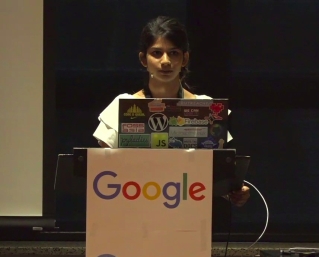
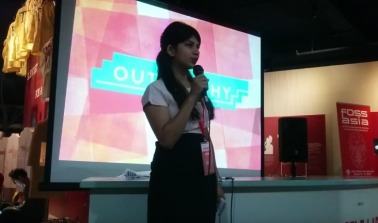
I got an amazing chance to speak at FOSSASIA 2017 held at Singapore on Seasons of Debian Summer of Code and Winter of Outreachy . I gave a combined talk with my co-speaker Pranav Jain, who contributed to Debian through GSoC. We talked about two major open source initiatives Outreachy and Google Summer of Code and the work we did on a common project Lumicall under Debian. WhatsApp Image 2017-03-23 at 11.32.33 PM The excitement started even before the first day! On 16th March, there was a speakers meetup at Microsoft office in Singapore. There, I got the chance to connect with other speakers and learn about their work The meetup was concluded by Microsoft Office tour! As a student it was very exciting to see first hand the office of a company that I had only dreamt of being at. On 17th March, i.e the first day of the three days long conference, I met Hong Phuc Dang, Founder of FOSSASIA. She is very kind and just talking to her just made me cheerful!
Meeting so many great developers from different organizations was exciting. On 18th March, was the day of our talk! I was a bit nervous to speak in front of amazing developers but, that s how you grow  Our talk was preceded by a lovely introduction by Mario Behling. WhatsApp Image 2017-03-25 at 2.32.01 PM.jpeg I talked about how Outreachy Programme has made a significant impact in increasing the participation of women in Open Source, with one such woman being me I also talked about Android Programming concepts which I used in while adding new features into Lumicall. Pranav talked about Debian Organization and how to get started with GSoC by sharing his journey! After our talk, students approached us asking questions about how to participate in Outreachy and GsOC. I felt that a lot more students were receptive to knowing about this new opportunity. Our own talk was part of the mini DebConf track. Under this track, there were two other amazing sessions namely, Debian The best Linux distribution and Open Build Service in Debian . The variety of experiences I gained from FOSSASIA was very diverse. I learned how to speak at a huge platform, learned from other interesting talks, share ideas with smart developers and saw an exciting venue and wonderful city! I would not be able to experience this without the continuous support of Debian and Outreachy !

17 November 2016

Urvika Gola: Reaching out to Outreachy

The past few weeks have been a whirlwind of work with my application process for Outreachy taking my full attention. When I got to know about Outreachy, I was intrigued as well as dubious. I had many unanswered questions in my mind. Honestly, I had that fear of failure which prevented me from submitting my partially filled application form. I kept contemplating if the application was good enough , if my answers were perfect and had the right balance of du-uh and oh-ah!
In moments of doubt, it is important to surround yourself with people who believe in you more than you believe in yourself. I ve been fortunate enough to have two amazing people, my sister Anjali, who is an engineer at Intel and my friend, Pranav Jain who completed his GSoC 16 with Debian.
They believed in me when I sat staring at my application and encouraged me to click that final button. When I initially applied for Outreachy, I was given a task for building Lumicall and subsequent task was to examine a BASH script which solves the DNS-01 Challenge.
I deployed the DNS-01 challenge in Java and tested my solution against a server.
Within a limited time frame, I figured things out and wrote my solution in Java and then eagerly waited for the results to come out. Going through a full cycle of : lifecycle.JPG I was elated with joy when I got to know I ve been selected for Outreachy to work with Debian. I was excited about open source & found the idea of working on the project open source fun because of the numerous possibilities of contributing towards a voice video and chat communication software.
My project mentor, Daniel Pocock, played a pivotal role in the time after I had submitted my application. Like a true mentor, he replied to my queries promptly and guided me towards finding the solutions to problems on my own. He exemplified how to feel comfortable with developing on open source. I felt inspired and encouraged to move along in my work. Beyond him, The MiniDebConf was when I was finally introduced to the Debian community. It was an overwhelming experience and I felt proud to have come so far.. It was pretty cool to see JitsiMeet being used for this video call. I was also introduced to two of my mentors , Juliana Louback & Bruno Magalh es . I am very excited to learn from them.

I am glad I applied for Outreachy which helped me identify my strengths and I am totally excited to be working with Debian on the project and learn as much as I can throughout the period. I am not a blog person, this is my first blog ever! I would love to share my experience with you all in the hopes of inspiring someone else who is afraid of clicking that final button!

20 June 2016

Daniel Pocock: WebRTC and communications projects in GSoC 2016

This year a significant number of students are working on RTC-related projects as part of Google Summer of Code, under the umbrella of the Debian Project. You may have already encountered some of them blogging on Planet or participating in mailing lists and IRC. WebRTC plugins for popular CMS and web frameworks There are already a range of pseudo-WebRTC plugins available for CMS and blogging platforms like WordPress, unfortunately, many of them are either not releasing all their source code, locking users into their own servers or requiring the users to download potentially untrustworthy browser plugins (also without any source code) to use them. Mesut is making plugins for genuinely free WebRTC with open standards like SIP. He has recently created the WPCall plugin for WordPress, based on the highly successful DruCall plugin for WebRTC in Drupal. Keerthana has started creating a similar plugin for MediaWiki. What is great about these plugins is that they don't require any browser plugins and they work with any server-side SIP infrastructure that you choose. Whether you are routing calls into a call center or simply using them on a personal blog, they are quick and convenient to install. Hopefully they will be made available as packages, like the DruCall packages for Debian and Ubuntu, enabling even faster installation with all dependencies. Would you like to try running these plugins yourself and provide feedback to the students? Would you like to help deploy them for online communities using Drupal, WordPress or MediaWiki to power their web sites? Please come and discuss them with us in the Free-RTC mailing list. You can read more about how to run your own SIP proxy for WebRTC in the RTC Quick Start Guide. Finding all the phone numbers and ham radio callsigns in old emails Do you have phone numbers and other contact details such as ham radio callsigns in old emails? Would you like a quick way to data-mine your inbox to find them and help migrate them to your address book? Jaminy is working on Python scripts to do just that. Her project takes some inspiration from the Telify plugin for Firefox, which detects phone numbers in web pages and converts them to hyperlinks for click-to-dial. The popular libphonenumber from Google, used to format numbers on Android phones, is being used to help normalize any numbers found. If you would like to test the code against your own mailbox and address book, please make contact in the #debian-data channel on IRC. A truly peer-to-peer alternative to SIP, XMPP and WebRTC The team at Savoir Faire Linux has been busy building the Ring softphone, a truly peer-to-peer solution based on the OpenDHT distribution hash table technology. Several students (Simon, Olivier, Nicolas and Alok) are actively collaborating on this project, some of them have been fortunate enough to participate at SFL's offices in Montreal, Canada. These GSoC projects have also provided a great opportunity to raise Debian's profile in Montreal ahead of DebConf17 next year. Linux Desktop Telepathy framework and reSIProcate Another group of students, Mateus, Udit and Balram have been busy working on C++ projects involving the Telepathy framework and the reSIProcate SIP stack. Telepathy is the framework behind popular softphones such as GNOME Empathy that are installed by default on the GNU/Linux desktop. I previously wrote about starting a new SIP-based connection manager for Telepathy based on reSIProcate. Using reSIProcate means more comprehensive support for all the features of SIP, better NAT traversal, IPv6 support, NAPTR support and TLS support. The combined impact of all these features is much greater connectivity and much greater convenience. The students are extending that work, completing the buddy list functionality, improving error handling and looking at interaction with XMPP. Streamlining provisioning of SIP accounts Currently there is some manual effort for each user to take the SIP account settings from their Internet Telephony Service Provider (ITSP) and transpose these into the account settings required by their softphone. Pranav has been working to close that gap, creating a JAR that can be embedded in Java softphones such as Jitsi, Lumicall and CSipSimple to automate as much of the provisioning process as possible. ITSPs are encouraged to test this client against their services and will be able to add details specific to their service through Github pull requests. The project also hopes to provide streamlined provisioning mechanisms for privately operated SIP PBXes, such as the Asterisk and FreeSWITCH servers used in small businesses. Improving SIP support in Apache Camel and the Jitsi softphone Apache Camel's SIP component and the widely known Jitsi softphone both use the JAIN SIP library for Java. Nik has been looking at issues faced by SIP users in both projects, adding support for the MESSAGE method in camel-sip and looking at why users sometimes see multiple password prompts for SIP accounts in Jitsi. If you are trying either of these projects, you are very welcome to come and discuss them on the mailing lists, Camel users and Jitsi users. GSoC students at DebConf16 and DebConf17 and other events Many of us have been lucky to meet GSoC students attending DebConf, FOSDEM and other events in the past. From this year, Google now expects the students to complete GSoC before they become eligible for any travel assistance. Some of the students will still be at DebConf16 next month, assisted by the regular travel budget and the diversity funding initiative. Nik and Mesut were already able to travel to Vienna for the recent MiniDebConf / LinuxWochen.at As mentioned earlier, several of the students and the mentors at Savoir Faire Linux are based in Montreal, Canada, the destination for DebConf17 next year and it is great to see the momentum already building for an event that promises to be very big. Explore the world of Free Real-Time Communications (RTC) If you are interesting in knowing more about the Free RTC topic, you may find the following resources helpful: RTC mentoring team 2016 We have been very fortunate to build a large team of mentors around the RTC-themed projects for 2016. Many of them are first time GSoC mentors and/or new to the Debian community. Some have successfully completed GSoC as students in the past. Each of them brings unique experience and leadership in their domain. Helping GSoC projects in 2016 and beyond Not everybody wants to commit to being a dedicated mentor for a GSoC student. In fact, there are many ways to help without being a mentor and many benefits of doing so. Simply looking out for potential applicants for future rounds of GSoC and referring them to the debian-outreach mailing list or an existing mentor helps ensure we can identify talented students early and design projects around their capabilities and interests. Testing the projects on an ad-hoc basis, greeting the students at DebConf and reading over the student wikis to find out where they are and introduce them to other developers in their area are all possible ways to help the projects succeed and foster long term engagement. Google gives Debian a USD $500 grant for each student who completes a project successfully this year. If all 2016 students pass, that is over $10,000 to support Debian's mission.

24 April 2016

Bits from Debian: Debian welcomes its 2016 summer interns

GSoC 2016 logo Outreachy logo We're excited to announce that Debian has selected 29 interns to work with us this summer: 4 in Outreachy, and 25 in the Google Summer of Code. Here is the list of projects and the interns who will work on them: Android SDK tools in Debian: APT - dpkg communications rework: Continuous Integration for Debian-Med packages: Extending the Debian Developer Horizon: Improving and extending AppRecommender: Improving the debsources frontend: Improving voice, video and chat communication with Free Software: MIPS and MIPSEL ports improvements: Reproducible Builds for Debian and Free Software: Support for KLEE in Debile: The Google Summer of Code and Outreachy programs are possible in Debian thanks to the effort of Debian developers and contributors that dedicate part of their free time to mentor students and outreach tasks. Join us and help extend Debian! You can follow the students weekly reports on the debian-outreach mailing-list, chat with us on our IRC channel or on each project's team mailing lists. Congratulations to all of them!