Search Results: "mak"

16 November 2026

Russell Coker: After the AI Bust

The Crash Charles Stross wrote an interesting blog post about the latest developments in the AI bubble [1]. He predicts the imminent burst of the AI bubble because of Jensen Huang s out of control dick. The bubble was caused by out of control dicks (figuratively speaking) and now may be burst by an out of control dick (both literally and figuratively speaking). The end result of the AI related financial schemes is going to involve more than a few bankruptcies. The Rebuild I previously blogged about the fuss about AI [2] and concluded that the bust would be like the dot-com bust which paved the way for new profitable Internet developments. I am less positive towards the AI bubble now as it has gone a lot further than the dot-com bubble. The bankruptcies won t just affect the IT industry, a lot of money from pension funds and index tracker funds has gone into AI and the pain will be spread around. But I am confident that after the crash there will be new and interesting developments in Machine Learning (ML) technology that will benefit people. The Data Centers (DCs) that have been built at great expense will continue to be run and their services will for a while be offered at slightly above the cost of maintenance and power. A lot of home users (Free Software developers) who can t afford a GPU with 16G of RAM will find themselves able to rent time on systems with 48G or 96G of GPU compute to experiment with LLMs. Most such experiments won t achieve any useful output, but if someone can spend a few dollars and learn useful things about software engineering then that s a win for society. Also I think there will be some useful products developed as a result of this. The people who came of age when Linux was first released are now in their 50s and tend to have the reduction in vision and hearing expected in that age range so we can hope for some good developments in assistive technologies based on the cheap hardware. The current situation is that renting time on ML servers is cheap and often free while renting time on virtual servers with GPU access is expensive ($2 per hour for a not particularly high end VM) so people are learning how to use (or misuse) services like ChatGPT and not learning how to run their own LLM service and understand how it works. The future situation will involve renting VMs available for not much more than the cost of electricity at off-peak times and services like ChatGPT will need to have an operational profit so running your own LLM on rented hardware or hardware you own will be a better option. While corporate web sites are known for having rubbish chatbots using proprietary backend systems. While most of them suck badly and the idea of using them to replace staff is a really bad one the concept could work. If we increased the knowledge of such technology in the entire industry and if management was prepared to pay for it via increased budget for service improvements instead of trying to cut staff costs then it could give a good result. Other Computer Hardware The market for RAM for enterprise GPUs has been strong which reduced supply for consumer grade hardware. This caused prices to become unreasonably high. There s a general trend of software becoming bigger. Computers get bigger screens so media sources need higher resolution content which drives the demand for more storage and RAM for buffering things. Computers get more hardware features and more devices to connect to so all the software needs to be able to communicate with them. This makes the software bigger for everyone even people who aren t using the features. For example adapting the audio subsystem to deal with different Bluetooth devices with options for different encodings increases the memory requirements for all the computers that have audio hardware but don t have Bluetooth hardware. Perfectly reasonable decisions that make things work better for many people can have downsides for other people. RAM is one area that seems to have been repeatedly the subject of design trade-offs that resulted in systems with 16G of RAM performing the same tasks that systems with 16M of RAM did in the mid 90s but just at a higher resolution and with more features. The ongoing increase of RAM use by software combined with high prices caused by the AI companies has been bad for consumers. The PC RAM use issue isn t going to end. When I started editing the Debian Wiki page about Mobile Apps [3] I added a field for typical RSS of apps. Phones never have an option to increase RAM and the RAM is always limited. The largest RAM in commonly available phones in English speaking countries is 16G for the Pixel 11 Pro and the largest RAM for open Linux phones is 8G. When even relatively simple apps like an eBook reader take 500M of RAM it s obvious that 8G isn t enough. The phone and laptop design process is based on a cycle of about one year, so maybe 8 months after the AI crash we will see ultralight laptops with 64G of soldered RAM and phones like the Pixel 12 Pro with 32G of RAM. Looking at Officeworks (the chain store for cheap office supplies including laptops) the vast majority on sale currently have 16G or less and 16G of RAM performs really badly for Windows and has performance problems for heavy use on Linux. It would be nice if the minimum RAM for a laptop was 16G and it was a common and affordable option to have 32G or more and that is a likely result of the AI crash. Single Board Computers (SBCs) are currently expensive with reasonable amounts of RAM, when RAM prices drop significantly it will enable more uses of them for replacing desktop PCs and for developing other products. The Humane AI Pin [4] was an interesting research project but a poorly managed product, it would be interesting to have some free software research into that space and cheap SBCs with lots of RAM will facilitate it. Employment I expect that a lot of IT people will be looking for work in California soon. But for most of the world I don t think it will change much. Cheaper hardware decreases the cost of starting IT businesses but a market crash decreases confidence in investing in the sector. Maybe there will be an increase in startups and small companies, including small companies based around LLM operation. I don t expect any sort of catastrophic decrease in IT employment. Also a CEO sleeping with employees at his company creates a bad working environment, that sort of thing should be stopped. Sacking a CEO for such misbehaviour is a good thing even without all the financial fraud and possibly breaking laws about exports. Conclusion The sooner the crash happens the better things will be for everyone. As this bubble goes on the impending financial damage increases and the upsides of the crash are delayed.

15 November 2026

Russell Coker: The Cutlery Thief

A few years ago the kitchen of the company I worked for suddenly had no soup spoons or dessert spoons. One day there was about 40 in the drawer and the next day there was none, to the great annoyance of everyone who ate breakfast cereal, soup, and similar food at the office. Someone had stolen about 20 dessert spoons and about 20 soup spoons while apparently not stealing tea spoons, knives, or forks. For a while I kept my own soup spoon in a locked desk drawer, but that was a hassle. After a couple of months of unsuccessfully lobbying management to buy more spoons I went to an op-shop (thrift-shop for American readers) and bought most of the soup spoons and dessert spoons they had and donated them to the office. After that everything was good for about a week until all the regular knives were stolen. They didn t steal carving knives or bread knives, just the type of knife you would use to eat dinner or make a Vegemite sandwich. After the knife theft management agreed to buy new knives. Not long after that the company had financial issues and I was laid off, so I don t know whether the forks ended up being stolen later on. If the cutlery thief wasn t among the people laid off then I m sure a fork heist happened sooner or later. I remain mystified as to why someone would want to steal cutlery. The security around laptops wasn t great and walking out of the office with a laptop would look much less suspicious than walking out with a bag of spoons or knives. One would expect that stealing a laptop and selling it to buy cutlery would be a better option. If anyone who lives in my area wondered why their local op-shop had a sudden lack of spoons, I m sorry that I don t have a satisfying answer for you, just many more questions.

13 November 2026

Reproducible Builds: Reproducible Builds in October 2026

Welcome to the October 2026 report from the Reproducible Builds project! In our reports, we try to outline the most important things that we have been up to over the past month. As a quick recap about what problem our project intends to solve, whilst anyone may inspect the source code of free software for malicious flaws, almost all software is distributed to end users as pre-compiled binaries. The motivation behind the reproducible builds effort is to ensure no flaws have been introduced during this compilation process by promising identical results are always generated from a given source, thus allowing multiple third parties to come to a consensus on whether a build was compromised or not. As ever, if you are interested in contributing to the project, please visit our Contribute page on our website. In this month s report, we cover:

  1. GNU tar sparse archive non-determinism reported
  2. Reproducible Builds at SeaGL 2026
  3. Tool and documentation development
  4. Distribution work
  5. SOURCE_DATE_EPOCH specification updates
  6. Mailing list news
  7. Patches


GNU tar sparse archive non-determinism reported Johannes Schauer Marin Rodrigues (josch) reported an issue to the GNU tar mailing list where creating PAX-format sparse tar archives produces unreproducible outputs. Specifically, when GNU tar generates a PAX archive containing a sparse file it embeds the process ID into the member filename path structure (e.g. ./GNUSparseFile.<pid>/<filename>). Because process IDs vary between build runs, however, archiving identical sparse input files yields different binary outputs. In his report, Johannes outlined potential workarounds, such as running tar inside an unshared PID namespace where the process ID is pinned to 1, and proposed that GNU tar either omit the PID by default or provide a command-line flag to suppress it. Full details can be found in the post itself, and Johannes also filed the bug in Debian for completeness.

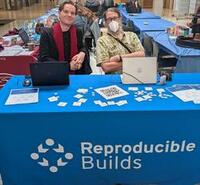
Reproducible Builds at SeaGL 2026 Reproducible Builds was present at SeaGL in Seattle, WA, on October 23rd & 24th. Thanks to everyone who attended and spoke with us! Members of the Reproducible Builds project attended SeaGL (the Seattle GNU/Linux Conference) in Seattle, WA, on October 23rd & 24th. It was a fantastic opportunity to connect with local community members, discuss software supply chain security and share updates on build verification tooling. Thanks to everyone who stopped by our sessions or spoke with us during the event. Founded in 2013, SeaGL is an annual free-as-in-freedom, grassroots technical summit dedicated to spreading awareness, community engagement and practical knowledge about free software, open hardware and libre culture.

Tool and documentation development diffoscope is our in-depth and content-aware diff utility that can locate and diagnose reproducibility issues. This month, Chris Lamb made a number of changes, including preparing and uploading versions 333, 334, 335 and 336 to Debian:
  • New features:
    • Support the dumppdf binary being called dumppdf.py on the host/runtime system. [ ]
  • Bug fixes:
    • Drop Recommends: guix from the diffoscope-minimal package as it is not minimal. (#1114739) [ ]
    • Fix a crash when using the latest version(s) of Androguard. Thanks, hc! [ ]
  • Codebase improvements:
    • Re-order various parts of the .tar file comparator to make it easier to progressively delve into its functionality. [ ]
    • Fix a silly prepend typo. [ ]
    • Reflect in the Python packaging that the use of the case-match language feature necessarily requires Python 3.10+. [ ]
  • Misc:
    • Update debian/tests/control. [ ]
    • Update copyright years. [ ]
In addition, Johannes Schauer Marin Rodrigues added support for POSIX.1-2001 PAX headers in the .tar file comparator [ ] and Vagrant Cascadian proposed an update in diffoscope in GNU Guix to version 335.

Distribution work In Debian this month, 20 reviews of Debian packages were added, 28 were updated and 27 were removed this month adding to our knowledge about identified issues. One issue type was updated to reflect that Debhelper compat level 14 is no longer experimental. [ ] In addition, Vagrant Cascadian performed a number of Non-Maintainer Uploads (NMUs) and Quality Assurance (QA) uploads in Debian for several packages with outstanding reproducibility issues. These included clhep, tea-cli, argparse-manpage, ruby-timers, mandos and cdebootstrap.
Lastly, Bernhard M. Wiedemann posted another openSUSE monthly update for their reproducibility work there.

SOURCE_DATE_EPOCH specification updates As announced in last month s report, further work has been done by Bernhard M. Wiedemann regarding updating the SOURCE_DATE_EPOCH specification following discussions at a project summit. Seven distinct proposed changes were originally submitted as merge requests on Salsa, and many of these have been approved or otherwise collapsed. Bernhard s proposed modifications were independent of one another, allowing for any combination to be merged depending on community feedback. Bernhard noted that one proposal may see the most debate, and could still benefit from further refinement before reaching consensus. Community members are invited to review and provide feedback on the individual merge requests; as Bernhard writes, The other MRs could still use feedback from more people before December . Input can be submitted via reactions or comments on Salsa, directly by email to Bernhard or the mailing list. The SOURCE_DATE_EPOCH specification was first published in 2015 and updated in 2017.

Mailing list news On our mailing list this month:

Patches The Reproducible Builds project detects, dissects and attempts to fix as many currently-unreproducible packages as possible. We endeavour to send all of our patches upstream where applicable or possible. This month, we wrote a large number of such patches, including: In addition, two build failure bugs were reported by Jochen Sprickerhof.

If you are interested in contributing to the Reproducible Builds project, please visit our Contribute page on our website. However, you can get in touch with us via:

Amin Bandali: Building GNU Emacs from source

In the recent years, I've been configuring and building GNU Emacs from source, specifically the master branch of the emacs.git repository. Doing so allows me to use and test latest Emacs features, test my Emacs Lisp code with the laest developments in Emacs, and easily contribute my own changes to Emacs. Before we start, I recommend reading the INSTALL file in the Emacs source repository for building Emacs from source tarballs, and also INSTALL.REPO for details about building Emacs from its source repository. The information provided here were built upon the details documented in those files. When in doubt, consult those files as the main, authoritative source of information for how to build Emacs from source. Installing build dependencies To build GNU Emacs from its source repository, we first need to install the various required tools and build dependencies of Emacs. On Debian-based systems, this can be done using apt. First, we need to add the source packages for the current release of our Debian-based distribution in apt's configuration by adding the corresponding deb-src lines in an apt source list file. For currently existing and older Debian releases, that would be done by adding a corresponding deb-src line for each deb line in /etc/apt/sources.list, such as:
deb http://deb.debian.org/debian/ trixie main
deb-src http://deb.debian.org/debian/ trixie main
In systems with recent apt versions with so-called modernized sources that might look editing a file like /etc/apt/sources.list.d/debian.sources and adding deb-src to the Types lines:
Types: deb deb-src
URIs: http://deb.debian.org/debian/
Suites: trixie
Components: main
Signed-By: /usr/share/keyrings/debian-archive-keyring.gpg
Then run sudo apt update to have apt download package information from the configured sources. We can now run sudo apt build-dep emacs to have apt download and install the build dependencies of Emacs. Debian-based distributions have packages for a few different configurations of Emacs, like emacs-pgtk with PGTK support for Wayland, and emacs-nox for Emacs without GUI support, which we can use with apt build-dep to download the specific dependencies of those configurations. Cloning the Emacs source repository After installing Git using sudo apt install git if not already installed, we're now ready to clone the Emacs source repository from GNU Savannah:
git clone https://https.git.savannah.gnu.org/git/emacs.git
We can add --depth 1 to make a shallow clone of the repository, if we don't care about having a complete log of previous commits to the Emacs repository (shallow clones are much faster). If cloning over HTTPS is slow, we can try cloning over Git's own protocol (with the caveat that the repository is cloned over an insecure channel) or over SSH if we have a Savannah account, using one of the following URLs instead of the one above:
git://git.git.savannah.gnu.org/emacs.git
ssh://git.savannah.gnu.org/srv/git/emacs.git
Configuring the Emacs build We now change to the Emacs repository directory we just cloned, and run the autogen.sh script once to generate the configure script, which we will use to configure Emacs to our liking:
cd emacs
./autogen.sh
To configure Emacs, the simplest approach is to run configure without any additional options, to have it use the defaults. We can get a list of available configuration options by running:
./configure --help
As I rebuild Emacs frequently, I normally don't "install" it, but for a typical setup, we'll want to specify the installation directory using --prefix, e.g.:
./configure --prefix=$HOME/.local
Later, make install will install Emacs under the specified directory. By default, some of the files (such as *.el) will be compressed during installation. We can prevent that using --without-compress-install. For my builds, I always use these configuration options:
--without-gconf
--without-gsettings
--without-gpm
--with-native-compilation
As I don't use the GNOME desktop, the GConf and GSettings integrations are always more trouble than useful for me, so I disable them. Further, I disable the GPM support, since I never use the mouse when using Emacs in the terminal. Lastly, I explicitly enable native compilation support. In Wayland environments, I usually use PGTK:
--with-pgtk
And in X11 environments (e.g. EXWM), I either use the Lucid toolkit:
--with-x-toolkit=lucid --with-xaw3d
Or no toolkit at all:
--with-x-toolkit=no --without-xaw3d
Later after building Emacs, we can view the configuration options in Emacs by inspecting the system-configuration-options variable. Building Emacs After running ./configure, we can now finally build Emacs by running make. The first build will take a while, since all of Emacs is being built from scratch. Subsequent builds will generally be faster. We can optionally run make install to install Emacs into the prefix specified earlier, or the default /usr/local. Note that this step might require using sudo if our user doesn't have write permission for the prefix. Running Emacs After building Emacs, we run it either from the install location if we ran make install earlier, or directly from the source repository. Currently, Emacs's build system makes a symlink to the latest built binary in the repository at src/emacs, and for emacsclient and other auxiliary binaries under the lib-src directory. When skipping make install, we might still want to be able to easily launch Emacs from anywhere by typing emacs. We can do that by making symlinks to emacs and its auxiliary binaries inside a directory in our $PATH, such as $HOME/.local/bin, like so:
cd $HOME/.local/bin
ln -s $HOME/src/emacs/src/emacs .
for e in \
 ebrowse emacsclient etags make-docfile\
 make-fingerprint hexl rcs2log; do\
  ln -s $HOME/src/emacs/lib-src/$e .; done
For non-install setups like this, I augment Info-directory-list in my init file with the location of the info manuals in the repository to make them known to Emacs:
(defvar Info-directory-list) 
(with-eval-after-load 'info 
  (setq 
   Info-directory-list
    (,@Info-directory-list
     ,(expand-file-name
       (convert-standard-filename "info/")
       source-directory)
     "/usr/share/info/"))) 
Updating Emacs We can pull in the latest changes in the Emacs repository using git pull, then rebuild our Emacs by running make. Occasionally, rebuilds may fail due to bad interaction of changes with leftover build artifacts. In such cases, the easiest thing to do would be a make bootstrap for an almost-from-scratch build. On even rarer occasions, make bootstrap might also fail. We would then want to run git clean -xdf to remove every file that's not tracked by Git, as if we freshly cloned the repository. In such cases, we would need to configure the build again using ./configure and provide the desired options before running make again. Further reading Protesilaos's similar post from early 2025 was part of the inspiration for writing and sharing my version: https://protesilaos.com/codelog/2025-03-22-emacs-build-source-debian/ Lastly, to reiterate, Emacs's own INSTALL and INSTALL.REPO files for building from source: https://cgit.git.savannah.gnu.org/cgit/emacs.git/tree/INSTALL
https://cgit.git.savannah.gnu.org/cgit/emacs.git/tree/INSTALL.REPO Take care, and so long for now.

Freexian Collaborators: Debian Contributions: Python 3.15 transition, OpenSSH GSS-API package split improvements and more! (by Anupa Ann Joseph)

Debian Contributions: 2026-10 Contributing to Debian is part of Freexian s mission. This article covers the latest achievements of Freexian and their collaborators. All of this is made possible by organizations subscribing to our Long Term Support contracts and consulting services.

Python 3.15 transition, by Stefano Rivera with a little help from Colin Watson Debian has started the transition to add Python 3.15 as a supported version alongside 3.14, which is still the default version. Stefano uploaded Python 3.15.0 final to unstable. Maximiliano Curia has been test-rebuilding the archive in Debusine with Python 3.15 as a supported version and prepared some patches to dh-python to smooth over some common failure points. Stefano reviewed these MRs, applying some and implementing alternative approaches for some of the issues. Debian only has multiple supported Python versions during the transition to a new version, and typically this shows up some bugs in packages. This time was no different, the common failure was many packages that installed intermediate build artifacts into the Python module tree. Some of these artifacts would differ between Python versions. We decided to detect both of these and fail the package build, rather than silently ship garbage in the binary packages. Colin helped to fix quite a bit of the build fallout from this.

OpenSSH GSS-API package split improvements, by Colin Watson The recent GSS-API package split has largely gone relatively smoothly, but there was a subtle problem for people switching from one variant to the other: installing the replacement packages followed by purging the old one would cause some configuration files to disappear. Colin fixed this, and also reviewed and merged some autopkgtest contributions from Andreas Hasenack to make sure that this doesn t regress in future.

Miscellaneous contributions
  • Carles, using check-relations, investigated and reported 52 bugs for packages which have Recommended packages that are not available in Debian anymore. Followed up bugs on the topic.
  • Carles added support to check-relations to detect Recommends that recommend a transitional package.
  • Carles submitted merge requests (MR89, MR90, MR91, MR92) to the Debian developers-reference to remove or update references to packages that are not available anymore, have their name changed, have typos, etc.
  • Carles investigated and opened bugs regarding notifications on LXDE (#1151954, #1151955) and added a section related to notifications on the Wiki.
  • Carles uploaded new python-ping3 upstream version. Fixed simplemonitor lintian bugs. Carles also investigated python-librosa documentation building. started preparing a new python-firebase-messaging version.
  • Helmut released asyncvarlink/0.3.3 to fix several bugs including connection robustness fixes by Alex Kiernan. Colin uploaded it to Debian.
  • Helmut uploaded guess-concurrency to improve behavior on riscv64 by taking swap into account thanks to Adrian Bunk and Aurelien Jarno.
  • Helmut sent patches for 55 cross build failures.
  • Emilio updated some X11 libraries that fixed security vulnerabilities.
  • Emilio managed various transitions.
  • Rapha l updated gnome-shell-extension-hamster to work with GNOME 51 that was uploaded to Debian unstable.
  • Stefano backported postsrsd 2.4.1 to Debian trixie.
  • Stefano installed security updates on debian.social infrastructure.
  • October saw a series of security releases for Python, due to the eMudhra key compromise incident. Stefano uploaded cPython 3.15.2, 3.14.10, and 3.13.18 which include blocks for the compromised intermediate CAs.
  • Stefano reviewed CVEs fixed in recent cPython releases.
  • Stefano spun up a VM for dragon.debian.net.
  • Stefano uploaded PyPy3 8.0.1 to unstable.
  • Stefano reviewed some of the wafer-debconf MRs that came in as part of Antonio s Outreachy project.
  • Stefano uploaded python-authlib, with many security updates. And started preparing a stable update with backports of these patches.
  • Stefano looked at the latest upstream version of munkres and submitted some 32-bit test failure fixes upstream. A new upstream maintainer has been very busy building out accelerated versions of the algorithms with AI assistance.
  • Thorsten was finally able to fix the autopkgtest of cups. Afterwards he uploaded the latest version of cups to unstable.
  • Santiago proposed a merge request for the Salsa CI pipeline to fix how logs were stored in the piuparts job.
  • Lucas reviewed and merged community contributions to Ruby 3.4 in Debian unstable.
  • Lucas coordinated with the security team and fixed multiple CVEs reported against Ruby 3.3 in Debian stable.
  • Colin did quite a bit of work on the Python 3.15 transition, fixing lots of build and test fallout.
  • Colin upgraded python-maturin from 1.9.4 to 1.16.0, helping with several Rust transitions; this involved more or less completely reworking our patch stack.
  • Colin improved the packaging of the Frescobaldi frontend to LilyPond to help with his amateur music typesetting work, fixing its missing desktop entry, icon, and translations based on a patch set by Joachim Wiedorn.
  • Anupa joined the Publicity team meeting to discuss upcoming events and activities of the Debian Publicity Team including on-boarding meeting for new contributors.
  • Antonio spent quite some time welcoming Outreachy applicants to the DebConf/MiniDebConf websites project, replying to questions, reviewing contributions, etc. One of them will be selected for an internship that will start in December.
  • Antonio spent some time investigating problems with Salsa background job processing, leading to an upstream bug report.
  • Antonio released debci 4.4.

11 November 2026

Colin Watson: Free software activity in October 2026

My Debian contributions this month were all sponsored by Freexian. You can also support my work directly via Liberapay or GitHub Sponsors. OpenSSH I upgraded both openssh and openssh-gssapi from 10.5p1 to 10.6p1, started generating MLDSA44-ED25519 host keys by default now that upstream no longer considers them experimental, and fixed a problem where switching between the normal and GSS-API variants followed by purging the old packages caused some configuration files to disappear. Python packaging New upstream versions: Other build/test failures: Since lots of Python modules use Rust extensions nowadays, we often have to help with upgrades of Rust packages. I did some of this: Other bugs: One of my hobbies is typesetting ( engraving ) music, sometimes for my own use, sometimes for teaching, and sometimes for my choir. I ve used LilyPond for a long time and have got pretty used to it. My workflow was a bit cumbersome, though, usually involving side-by-side editor and PDF viewer windows with some ad-hoc Makefiles and editor macros. I recently discovered the Frescobaldi frontend to LilyPond, and decided I liked it enough to switch over to it. It was already packaged in Debian, but it had a missing desktop entry and icon and missing translations; I fixed those based on a patch set by Joachim Wiedorn. My upload introduced a testing migration problem, which I also fixed. Rust packaging I upgraded rust-jiter and rust-smallvec to new upstream versions for a new version of pydantic-core. The rust-smallvec upgrade caused an FTBFS in rust-saphyr-parser-bw, which I fixed. I packaged rust-cargo-cyclonedx for a new version of python-maturin. This needed some porting to work with a new version of rust-cargo-metadata, which I contributed upstream. I improved the dev/list-rdeps.sh tool used by the Rust team to check build-depends too, which should make it easier for that team to remember Python packages in transitions. Code reviews

Russell Coker: Thinkpad T14

The Problems In mid 2025 I bought a Thinkpad X1 Carbon Gen 6 with 1440p display for $350 [1]. It has been working reasonably well for me, but my vision is diminishing so my current setup with the Kitty terminal emulator allows 4 terminals of 153/154 columns and 40/41 rows or 9 terminals of about 101*27. To have this much text I use the minimum font size I can see which is unreadable when I first wake up which is bad for the woken by network management system alert situations. Also 16G of RAM is a bit of a limit, the Thinkpad X1 Carbon has 4G of swap space and it s all used most of the time. While there s usually plenty of buffer/cache RAM it does sometimes get to an OOM situation. Another issue is that the battery is approaching it s end of life. The upower -d command reports the following which might imply that the battery should last more than 80% of the time when it was new, but testing shows that the time I can use it on battery is not much more than half what it was when I bought the laptop, maybe 1/3 of the battery life when new. I used to be able to consistently run the machine on battery for 7+ hours and still have plenty of charge left, now I can t even get 5 hours.
energy-full:         50.35 Wh
energy-full-design:  57.02 Wh
I could buy a new battery for about $70, but there are plenty of things I can do with that laptop for which 1/3 the designed battery life is more than enough. Also I have a couple of USB-C batteries that are capable of supplying 30W+ to power a Thinkpad X1 Carbon but they are inconvenient and I d rather have external batteries and an internal battery that will last most of a day. My Thinkpad History Below is a table summarising most of the Thinkpads I ve owned. I really like the Trackpoint on Thinkpads and have not considered buying a laptop without one. I skipped two laptops I bought in the 2000-2002 time period, that was an expensive laptop time for me. Fortunately by 2000 ebay was getting useful so I only ever had to buy one brand new Thinkpad.
Thinkpad Purchase Date Release Year Price Price 2025 money RAM CPU Display Replacement Reason
385XD Jul 1998 1998 $5800 $12268 96M Pentium MMX 233 800*600 weight screen resolution CPU and RAM
T41p 2003 2003 1.5G Pentium M 1400*1050 overheating and screen backlight
T61 Feb 2010 2007 $796 $1182 5G Core 2 Duo 1680*1050 overheating battery-life and PSU
T420 Oct 2013 2011 $306.35 $422 8G i5-2540M maybe 1600*900 lid hinge broken and generally old
X301 Dec 2017 2008 $0 $0 4G Core 2 Duo SU9400 1440*900 battery entirely died
X1 Carbon Gen 1 Feb 2018 2012 $289 $364 8G i7-3667U 1600*900 error on proprietary SSD lack of USB-C and screen resolution
X1 Carbon Gen 5 Jul 2022 2017 $575.25 $644 8G i5-6300U 1920*1080 screen resolution and wanted a 2in1
X1 Yoga Gen 3 Jan 2024 2018 $359.10 16G i5-8350U 2560*1440 crashed when on battery
X1 Carbon Gen 6 Jul 2025 2018 $350 16G i7-8550U 2560*1440 RAM and screen resolution
T14 Gen 1 Oct 2026 2020 $340 16G+ i7-10610U 3840*2160
So I ve spent $2675.70 on Thinkpads that I used from 2010 until now (not counting the one I just bought), so that s $160 per annum for the past 16 years and 9 months. When I convert that to 2025/2026 dollars that s $3,221 for 16 years 9 months or $198 per annum. So I just need to make this T14 last for 2 years to be spending less than usual. Some Generic Laptop Advice A while ago I was asked for advice on buying a laptop for an architect to use. I can give good advice for laptops used by programmers and for home use and students but I really don t know what an architect does and even a description wouldn t do it justice. The advice I gave was to buy or borrow a relatively low end laptop, something that costs $400 new or $300 second hand and give it a go. Using it will reveal that it doesn t do what is desired in some ways, whether it s screen resolution, RAM, CPU power, storage capacity, physical size/weight, or some combination of them is something you won t know until you try it. Then after having used a cheap laptop they could buy a laptop for $1500+ (for serious work use by people outside the IT industry buying a new laptop is recommended) knowing what features they really need. So I have gone through a similar process of buying different laptops and discovering the benefits which has arrived at the T14. The New Thinkpad Upsides I saw a Thinkpad T14 with 4K display and 16G of RAM on Facebook Marketplace advertised for $400 and they ended up selling it to me for $300 without the SSD and without the PSU. The seller has a business of selling used enterprise gear so he was happy to keep the SSD and PSU for sale with other laptops. I don t have a need for more laptop PSUs as I have most of the laptops in my fleet charged from 200W+ PSUs that charge multiple devices and I also have a collection of spare SSDs. $300 for a laptop with 4K display is a good deal. The T14 is significantly better than the T14s because it has one SODIMM socket while the T14s has soldered RAM, so I could expand the RAM to 48G at some future time but with current prices I bought an 8G SODIMM for $40 so 24G will have to do for now. That gives a total of $340 plus the value of a SSD. My first tests with the 4K display I set the display scaling to 150% (previously I had 100% which was a little small for some parts of the display). For my current favourite terminal emulator Kitty I had the Terminus font set to 10.5 point and now have it set to 9.0 point. This set of changes took the amount of text displayed in terminals from about 300*80 to about 330*100 while also increasing readability. This is a very significant improvement. If I knew that 4K in a 14 display would be so good I d have got it years ago! The T14 still fits in the pocked of my ScotteVest jacket [2]! Neutral The i7-10610U in my new Thinkpad scores only about 10% faster on Passmark than the i7-8550U in my previous one. That s disappointing given that Intel had another 3 years of research to develop it and it s running with faster RAM. The two CPUs have the same TDP so it s just a 10% performance gain over 3 years and no change anywhere else. If the new CPU had a lower TDP then the small performance increase would be understandable. When I first booted the system Chrome graphics were corrupted and system performance was bad, after installing the packages firmware-nvidia-graphics and firmware-sof-signed to deal with the kernel errors about not finding firmware the graphics display was correct and the system ran a lot faster. I had forgotten about the issues related to having NVidia and Intel GPUs on the same system that I had dealt with in previous T series Thinkpads. In the systemd-boot loader.conf file I added console-mode 0 to prevent the font being ridiculously small for the boot selection. The battery life seems like it might be a bit less than my previous laptop was when I got it, but it s definitely better than the previous laptop gives now. Downsides The screen is very shiny, I prefer the screens with matt finish to avoid seeing reflections. The anti glare screens for the T14 are for FullHD and worse while the glossy screen is the only option for 4K.. Maybe I should investigate one of those hoodie jackets with a hood that s large enough to cover the screen, they are being sold as a privacy feature but can also be used to avoid reflection. As an aside if you are in an environment with hostile parties then you really shouldn t block your vision of them. A problem I previously had with T series Thinkpads which contributed to the replacement of two of them is the screen hinges breaking. This laptop is significantly heavier and more solidly built than the X1 series I ve been using and opening and closing the screen takes a lot more force. I am now wondering if I ll be looking for a for parts condition Thinkpad on ebay in the future. It seems that cracking the screen is a much more common failure case than breaking the hinges so hopefully there will be spares available. But as my previous T series thinkpads lasted 7, 3, and 4 years this one could be expected to last until 2030 and maybe by then giving it to someone in Vietnam and buying a replacement would be the easiest option. Future Laptops I thought that going from 2560*1440 to 3840*2160 I would be hitting the diminishing returns range but it seems that there are still further gains to be found in screen resolution for my use, maybe the Apple people with their Retina displays are on to something. There are Thinkpad X1 Carbon models with 3840*2400 displays, so maybe that s something to move on to in a few years. The minimum model with 3840*2400 is the X1 Carbon Gen 9 and there s the X1 Yoga Gen 6 with an OLED 3840*2400. There s also the P series which has 16 3840*2400 displays which would allow more usable text with the caveat of being much less portable. It sucks that no-one seems to be making a laptop with more than 3840*2400 resolution. 5120*2160 desktop monitors are common and affordable nowadays. I m sure that even now I could use more than 3840*2400 in a 14 laptop and when I was younger I could have benefited from more than 3840*2400 in an 11 laptop if such hardware had been available.

10 November 2026

Louis-Philippe V ronneau: A good-looking Corsi-Rosenthal Box

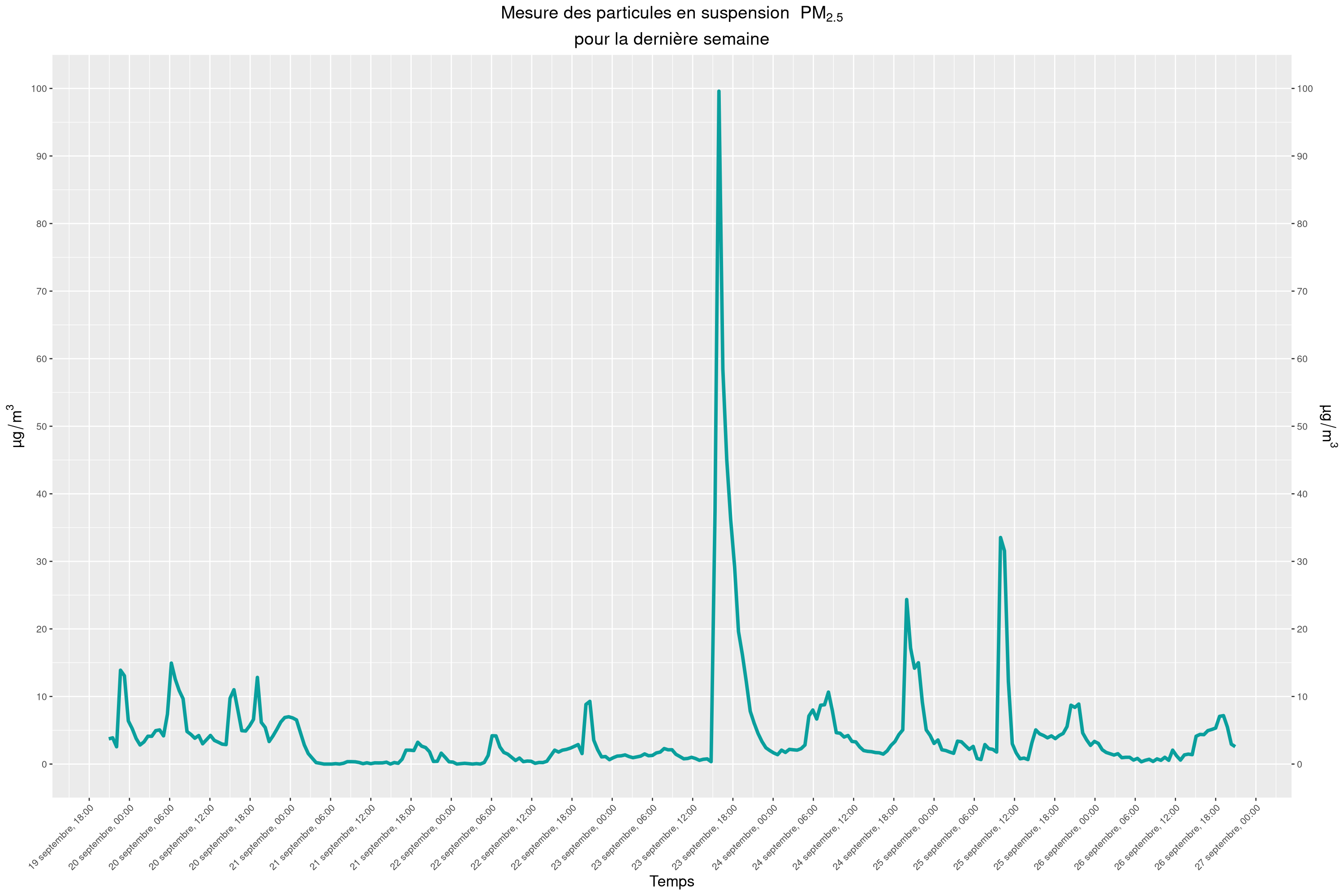
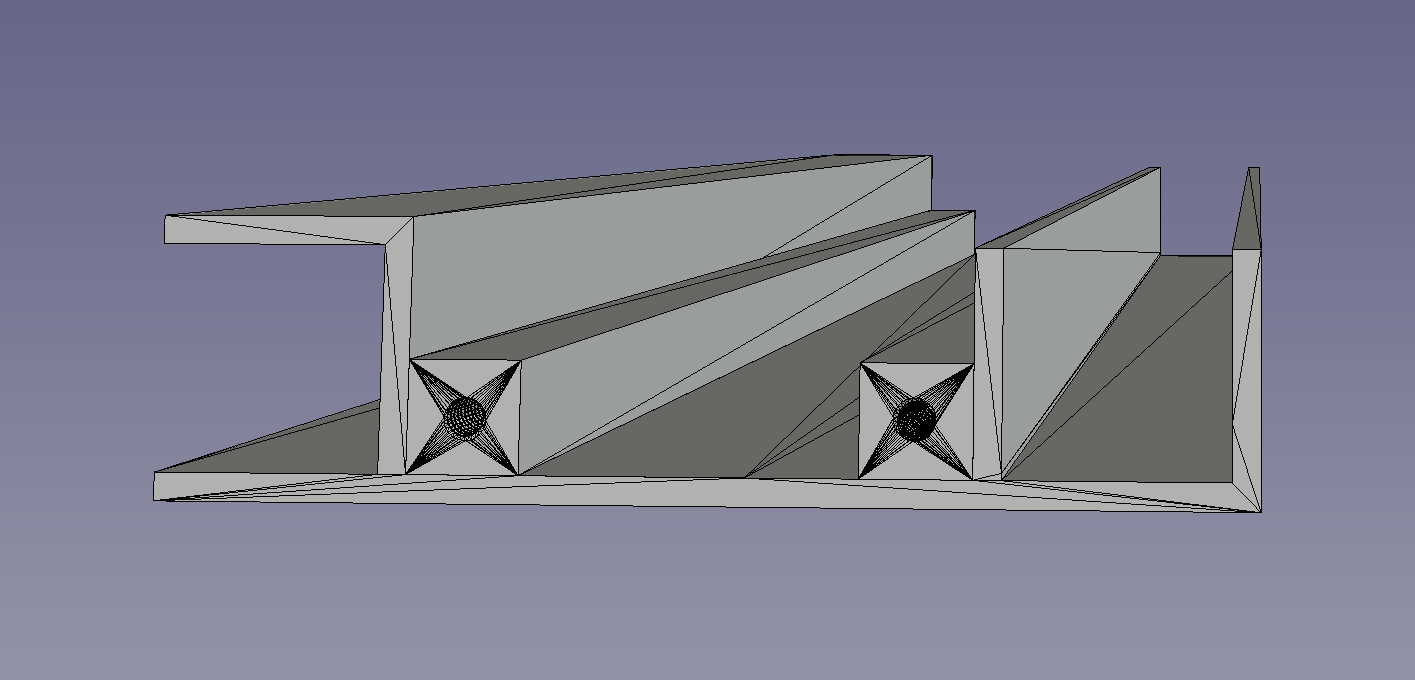
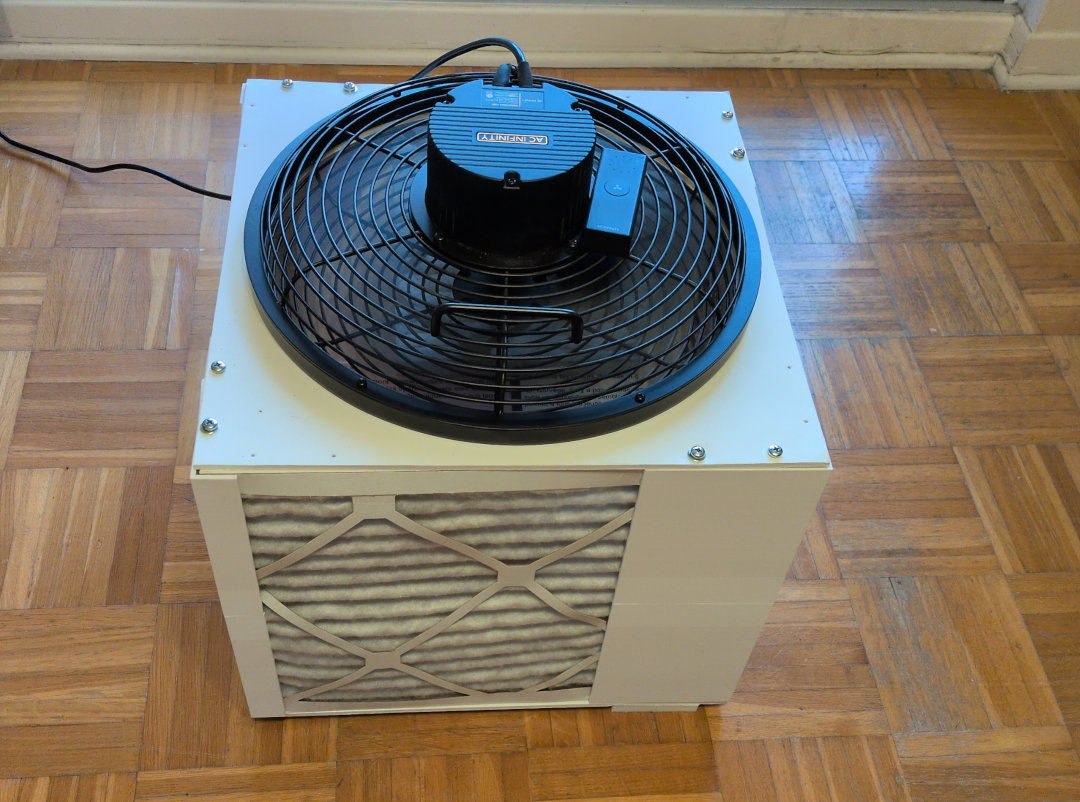
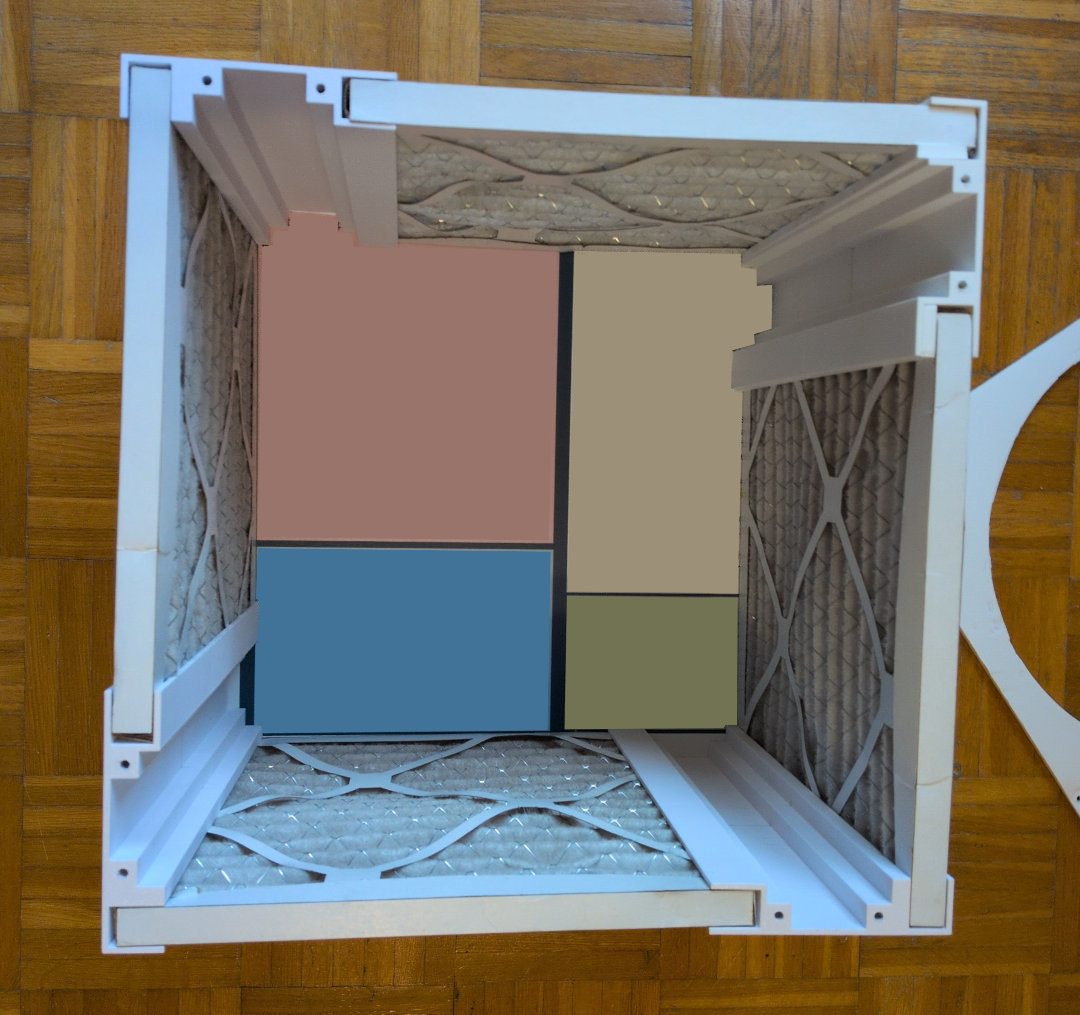
Ever since I built an AirGradient board back in 2023, I have been more and more conscientious about air quality. Pretty instantly after installing the board in my living room, I realised common habits like cooking can significantly increase the particulate levels in my entire apartment. Here is a good example of a pretty large (and long-lasting) PM2.5 spike on September 23rd after cooking a meal1: A graph showing a large PM 2.5 spike Isn't this crazy? Last time Montreal had such bad outdoor air quality, there were public broadcasts telling people not to go outside and to wear N95 face masks if we absolutely needed to. Inside my apartment though, no one ever told me cooking veggies in a little oil on medium-low2 could make the air I breathe unsafe. This of course is aggravated by the fact my apartment is pretty much as airtight as it can reasonably be, since winters here are very cold and air infiltrations are a major heat loss source. As such "opening my windows when I cook" is not a viable solution to this problem half of the year. I first tried solving this issue by tuning my HVAC system. Sadly, its controls don't offer much flexibility3, which means it is not the right tool to respond to short-lived spikes like these. Not only this, but the quality of the air outside is not always good either: Canada now has a forest fire season (we're all doomed) and my neighbors regularly smoke cigarettes right under my HVAC air intake4. A box, but nicer-looking Clearly, the solution to this particular issue was to buy an air purifier. Or at least, that's what a "normal" people would have done. Sadly, these units are expensive, use (expensive) proprietary filters, don't work very well and can be loud. One of the great inventions of the COVID-19 pandemic is the Corsi-Rosenthal box. Popularised in 2020 by Richard Corsi and Jim Rosenthal, the idea is to make a DIY air purifier by using a large fan to force air through cheap and readily available MERV13 air filters. The main downsides of regular CR boxes is they are pretty ugly, can be loud depending on the fan used and need to be rebuilt when the filters are changed (they are held using tape). That's when I stumbled on this amazing design for a silent and sleek CR box sold by The 3D Handyman. Clearly, with a bit of tinkering and a 3D printer, I could also design something sleek, silent and efficient! Since I was already using MERV13 air filters in my HVAC, I decided to design around 4 vertical "beams" where the filters would slot in. With tight enough tolerances, I figured I could get rid of the complex moving parts in The 3D Handyman's design. I also added M5 threads to screw the top and bottom panels and the TPU feet to elevate the box from the floor. One of the 'beams' on its side in FreeCAD The final result looks like this. I used some foamcore boards I had laying around at work for the top and bottom panels, but any somewhat rigid plastic panels (like coroplast) would also work: out' position" alt="The whole CR box assembled, with the fan in the 'in -> out' position"> View from the top, with the top panel removed. Disregard the bad GIMP job to remove the old text from a student's project! I ended up having to split the "beams" in two and joining them with dowels, as even the largest 3D printers I had access to couldn't print them in one piece. Costs Here's the cost breakdown for this project (shipping and taxes are included): Total: 502.19 CAD Yikes, expensive! But: All in all, I'm very happy with this project. Since finishing it, I have been able to consistently get the PM2.5 levels in my apartment down to zero and significantly reduce the time it takes to recover from a spike caused by cooking food. I certainly could have cut the cost of this project in half by choosing a cheaper fan, like the box fans used in the reference Corsi-Rosenthal instructions, but I decided to spend more for a more quiet and reliable option. 3D files Here are the STLs I used for this project. I certainly don't recommend just printing them as-is, since I am using the 12" x 12 " x "5 custom air filters from my HVAC and you should probably use something more standard. If you use these files as inspiration, your goal should be to make a box that is 16" wide, to fit the AC Infinity fan comfortably. I printed the "beams" in PETG at 100% infill and the feet in TPU 95: Future The next step in this project is to automate the fan speed based on the PM2.5 levels in my apartment. At the moment, I manage this manually and it is becoming a chore. This should be relatively easy to do with a Raspberry Pi Pico board, since AC Infinity sells a USB-C to Molex adapter for the fan.

  1. This was with my pretty good range hood running at a reasonable level. Without it, I've seen PM2.5 levels spike as much as 250 from cooking alone.
  2. To be clear, this spike was not the result of me burning the hell out of a piece of meat or something like that.
  3. The HVAC either runs in manual "low high" mode, or on a timed "20min ON 40min OFF" loop that can be tuned by fiddling with a hydrostat knob that triggers the "high" mode. This is pretty dumb and makes it so the HVAC runs even when the apartment is empty or doesn't run enough to keep CO2 levels low when multiple people are there. A future project of mine will be to hack the controls to tie them into my air quality monitoring and trigger the HVAC based on CO2 levels.
  4. I'm also working on another HVAC hack to fix this.
  5. Sold, of course, as as 1" thick filters...

John Goerzen: The Large Project Bias of CVEs

I recently discovered some vulnerabilities in C-Kermit, one dating back to 1984. I tried to do the reasonable thing: create advisories with CVEs. That turns out to be pretty difficult for a small independent project. Large projects have a way to self-assign CVE IDs. They are their own CVE Numbering Authority (CNA). There is a massive list of CNAs. Just looking at the first page of results, I see everyone from Airbus to 9front (the niche Plan 9 OS). The OpenKermit project is not a CNA. If you re a CNA, you can create and publish CVEs on your schedule. There is apparently no external review process. You can wait for months, or publish immediately. If you re not a CNA, you have to find someone that is. The general ones that are CNAs appear to be Github and MITRE. Since C-Kermit is hosted on Github, I thought I would go that route. I followed the documented procedure: created Github security advisories for C-Kermit, then clicked the request CVE button for each. The documentation states they will typically review within 72 hours. It s been a week and a half and no sign of a review yet. Apparently the real review time is more than a month. The other option for projects without a CNA is via MITRE. You have to use a strange and often broken web form, logging in with either Google or Gitlab. (It seems to be broken on Firefox). Then you submit your request and wait. How long do you wait on MITRE? It seems it could be anywhere from a day to several months. The first CVE I obtained for C-Kermit was CVE-2025-68920. At the time, I had not yet started the OpenKermit project. That issue was found and fixed in the context of my work maintaining C-Kermit for Debian, and Debian is a CNA. These were discovered while wearing my upstream C-Kermit maintainer hat. I m sure I could ask Debian for CVEs again, but that seems a bit cheating; not everyone that maintains a FLOSS project will have connections with a distro like I do. There are a lot of components of a modern OS and Internet ecosystem that are small projects without a large institution behind them. This bias towards large organizations when it comes to communicating security problems benefits nobody. It doesn t benefit users, and only serves to discourage timely communication. Not everyone is as persistent as I am, and when it is made so difficult to make announcements which seem to go into a giant black hole it s easy to say, why bother? By Microsoft s own admission, they are under-funding their CVE process on Github (which may also be poorly-designed). They blame it on increasing load due to LLMs a problem they helped create and predicted! Having a fiction about being able to communicate a security issue in a reasonable time is worse than not offering the path at all. Linux was once a student s experiment. Let s not pretend that quality only matters from large projects.

Vasudev Kamath: Experiment: Debian Cloud/VM Images using mkosi

Debian's Cloud Images for various public cloud platforms and VM environments are built using a tool called debian-cloud-images, an in-house utility developed and maintained by the Debian Cloud Team.
What? The debian-cloud-images tooling uses FAI (Fully Automatic Installation) to create custom VM images for public clouds like GCP, Azure, and AWS, along with the genericcloud class. I wanted to convert this into a fully declarative, mkosi-based image build where the entire image is described using INI-format configuration files, with only a few post-installation scripts to handle final customizations.
Why? I've been working with various image customization formats for a long time. In my previous company, I used to build customized industrial PC distributions based purely on Debian using multistrap and a bunch of shell scripts to stitch together raw image creation, bootloader installation, etc. I've also done custom installs using debootstrap on my own laptop with systemd-boot as the bootloader, but that was mostly hand-crafted and not automated. Once I came across mkosi, I was impressed by how a single utility can do everything and churn out a fully usable image without extra glue scripts for partitioning and image creation. You still need a few scripts to finalize some parts of the installation (via postinst hooks), but those are very minimal. So I decided: why not convert debian-cloud-images into mkosi's declarative format with a few architectural changes? My requirements were:
  1. Btrfs as the root filesystem: Partly because I like it, but primarily for the ability to use transparent compression (zstd:1), subvolumes, and snapshots for atomic rollbacks when things go wrong.

  2. systemd-boot and Unified Kernel Images (UKI): Primarily because systemd-boot is clean and minimal exactly what a modern bootloader should be. Combining it with UKIs and UEFI Secure Boot is bliss compared to the complexity of the GRUB2 world. Note: This intentionally drops legacy BIOS (MBR/CSM) partitioning support in favor of pure UEFI. Modern cloud platforms (AWS Nitro, Azure Gen2, GCP) support UEFI natively, and dropping BIOS allows shedding significant legacy bootloader baggage though it does make these images unsuitable for older, non-UEFI hypervisors.

Implementation Of course, the initial heavy lifting was done mostly using Antigravity (agy), along with debugging, tuning, and cleanup from my side. I pointed agy to a local copy of debian-cloud-images and laid out my requirements: preserve parity with the original packages and configurations, while enabling selective builds for each cloud via modular profiles. The resulting specification is documented here. The repository also includes a verification script that audits functional parity against official images produced by debian-cloud-images (verifying packages, APT deb822 sources, and systemd services, while accounting for the switch to Btrfs and systemd-boot). Initial verification was performed for all Trixie profiles, and the parity report is published here. I've also booted the genericcloud profile image under UEFI in a local VM to verify live bootability, bootctl status, network connectivity, and APT repository setup. This completes Phase 1 of the implementation. The remaining phases outlined in the specification include:
  1. Phase 2: Immutable Images with dm-verity: Configure Verity=hash in systemd-repart's 10-root.conf. Enable mkosi auto-signing for the verity root hash and pass the root hash into UKI kernel command lines automatically.
  2. Phase 3: Secure Boot & Signed UKIs: Integrate SecureBoot=yes with custom owner keys or ShimBootloader=signed using Microsoft Third-Party CA signed shim binaries.
  3. Phase 4: System Extensions (systemd-sysext): Decouple cloud vendor agents (AWS CLI, Azure waagent, GCP guest agent) into separate .raw system extensions. Maintain a single unified, signed base OS image across all cloud platforms.
  4. Phase 5: Btrfs Automated Rollbacks: Combine Btrfs @snapshots with systemd-boot snapshot boot entries for fail-safe OS upgrades.
Another advantage of this setup is that the same tooling can build images for physical laptops and bare-metal servers. For example, in an earlier post, I walked through live-booting with debootstrap and manually configuring systemd-boot for a custom UEFI installation. With mkosi, I can simply generate a customized image locally with UKIs ready to go, live-boot the target machine, and write the image directly to the root disk.
Conclusion This experiment is an exploration of the power of mkosi; I haven't discussed adoption with the Debian Cloud Team yet. For now, this will continue as my pet project. While I won't be hosting pre-built binary images, anyone interested is welcome to clone the repository and build the images locally. I will probably take some more time before tackling dm-verity images, as I want to understand the nuances thoroughly before experimenting with them. Until then, happy hacking! Please report any issues or suggestions on GitHub.

Utkarsh Gupta: FOSS Activities in October 2026

Here s my monthly but brief update about the activities I ve done in the FOSS world.

Debian
Whilst I didn t have much time, here are still a few things that I worked on:
  • Sponsored ubuntu-dev-tools/0.215 for Florent Skia Jacquet, so that seeded-in-ubuntu no longer crashes when distro-info-data is outdated.
  • Assisted a few folks in getting their patches submitted via Salsa.
  • Mentoring for newcomers.
  • Moderation of -project mailing list.

Ubuntu
I joined Canonical to work on Ubuntu full-time back in February 2021.
  • Released Ubuntu 26.10 (Stonking Stingray)! With my Release team hat on, I:
  • Approved the FFe for adsys 0.17.0, as it isn t seeded.
  • Sponsored libp11/0.4.12-1.1ubuntu2 for Guruprasad, an SRU to Noble which drops the workaround from the previous SRU that broke EAP-TLS Wi-Fi with TPM-backed PKCS#11 keys (LP: #2163152).
  • Proposed a fix for net-tools FTBFS in stonking - Linux 7.1 removed the amateur radio subsystem along with <linux/rose.h>, so ROSE support has to go: (MP).
  • Reviewed quite a lot of MPs and PRs - britney hints, ubuntu-cdimage, livecd-rootfs, ubuntu-seeds, ubuntu-dev-tools, a bunch of 26.10 release notes, and so on.
  • Did Archive Admin, DMB, and Release team duties as usual.

Debian (E)LTS
This month I have worked 3.50 hours on Debian Long Term Support (LTS) and on its sister Extended LTS project and did the following things:

Work in Progress
  • libpng1.6: Use-after-free of zlib input in png_read_end() after incomplete zTXt, iTXt, or iCCP decompression (CVE-2026-46675).
    • [ELTS]: The patch is ready but couldn t finish testing this month. The upstream fix that went into bookworm via DLA 4824-1 applies to all three ELTS suites as-is. Will roll out the fix in November.

Other Activities
  • [E/LTS] Monitored discussions on mailing lists, IRC, and all the documentation updates.
  • [E/LTS] Couldn t make it to the monthly LTS meeting live, but left my thoughts in the meeting notes on Beuc s proposal of offering help to the Release team with reviewing security SPUs - +1 for trying, as long as the Release team is on board with it and we don t end up doing the same work twice.

Until next time.
:wq for today.

9 November 2026

Amin Bandali: EmacsConf 2026 community panel - my comments

This is a recollection of my comments from the EmacsConf 2026 community panel recording session this past weekend, where the panellists took turns answering the proposed questions, one minute per question per panellist. In addition to the live Q&A session planned for Saturday 12 December 2026 during EmacsConf 2026, all Emacs users and community members are invited to share their thoughts on the panel questions or other questions before or after the conference. https://emacsconf.org/2026/talks/community/
1. What made you start using Emacs, and what kept you using it?
I started using Emacs during my bachelor's studies. I actually learned about Vim first and was a Vim user, but I'd always found the configuration language (VimScript) a little bit clunky. Not long after, I discovered Emacs, and really loved reading and writing Emacs Lisp, so I stuck around. In addition to reading and writing Elisp being fun and enjoyable for me, I love that Emacs has been a practical embodiment of software freedom, and I'm really fond of its surrounding culture of sharing freely. There's a lot to love and appreciate about Emacs, but as a practical personal example, I've been grateful for its excellent support for bidirectional text editing. It has empowered me to read and write in Persian, my mother tongue, with ease. (Persian has a right-to-left alphabet, like Arabic and Hebrew.)
2. What took you from using Emacs to actively contributing to the community - participating in forums, writing Elisp, organizing meetups, answering questions?
As I continued experimenting and writing bits and pieces of Elisp to scratch my own itches, I felt compelled to share them freely as a way of giving back to the community that gave me so much. For me, the community and the people that make it up are the main deal. Emacs wouldn't be where it is and what it is today without its people, so besides programming contributions, I've tried to contribute in that area as well, for instance by reviving EmacsConf with Sacha Chua back in 2019.
3. How does Emacs show up for you in real life - colleagues, meetups, friends? How did those connections form?
I don't physically have people near me who use Emacs, but I've connected with many folks in our online communities, often starting with an email or IRC message. Some of those relationships started as acquaintanceship and were developed into true friendship over time, and I'm grateful to have had those friends with me.
4. If you know other software communities, what's one thing Emacs could learn from them?
I would encourage Emacs, our community, to focus on the people. We're living in particularly difficult times, with various kinds of hardships and uncertainty in our lives. Let's strive to treat each other with kindness, empathy, and mindfulness as we continue working together. There are great examples of other free software communities whose members have banded together and are strengthening each other and their community, as well as cautionary ones where community members have been tiring and driving out their fellow members. We could learn valuable lessons from both in how to take care of our people and ourselves.
5. What's one concrete thing you wish existed in the Emacs community a year from now?
I echoed the sentiments of my fellow panellists Prot and Til about doing more of the same in terms of continuing to uphold the standards of excellence and perseverance. Also, drawing inspiration from what bashbunni said, to lower the barriers of entry for people, for example through organizing different kinds of events, and experimenting with ways to make people's lengthy, elaborate Emacs configurations more tangible and accessible to others, to share various workflows and demonstrate what's possible with Emacs. I look forward to your thoughts on these and other community-related questions. Take care, and so long for now.

7 November 2026

Dirk Eddelbuettel: prrd 0.1.0 at CRAN: Now With Real Concurrency

A new release of prrd arrived at CRAN today, and has already been built for r2u and on r-universe. The prrd package facilitates the parallel running [of] reverse dependency [checks] when preparing R packages. It is used extensively for releases I make of Rcpp, RcppArmadillo, RcppEigen, BH, and others. prrd screenshot image The key idea of prrd is simple, and described in some more detail on its webpage and its GitHub repo. Reverse dependency checks are an important part of package development that is easily done in a (serial) loop. But these checks are also generally embarassingly parallel as there is no or little interdependency between them (besides maybe shared build depedencies). See the (somewhat dated) screenshot (running six parallel workers, arranged in a split byobu session). This release updates internals to allow for greater concurrency. SQLite is used as the backend, both for the job queue (managed via the liteq package) as well as for storing actual reverse-dependency test results. It is well-known that SQLite copes quite well with multiple readers. Multiple concurrent writers are more challenging. We tended to get by via BEGIN EXCLUSIVE pragma use, but still get occassional issue even at a somewhat moderate concurrency levels. After some back and forth and trying a few approaches, more recently we established one first solution relying on very explicity (OS-level, filesystem-based) locking via package filelock. That worked. We mentioned this in an old liteq issue that had circled around the same question with a number of posts over the years, but no resolution. This comment seemingly awoke G bor, and he nailed this years-open issue with a fine pull request deploying BEGIN IMMEDIATE and well as a loop around tryCatch to not immediately fail. I borrowed/ported that approach to prrd and we now have a second solution (and no longer need filelock). On a somewhat better server with enough cores and memory, I am now running eighteen concurrent workers watched via three multi-pane byobu windows. Works like a charm without issues. At last! A big thanks to G bor for finding another solution, and especially that only relies on SQLite. The release is summarised in the NEWS entry:

Changes in prrd version 0.1.0 (2026-11-07)
  • Concurrent operations are now supported via updated sqlite semantics borrowed with appreciation from liteq
  • This follows an interim solution relying on filelock use; however this later package is not needed so no increase in dependencies

Courtesy of my CRANberries, there is also a diffstat report for this release.

This post by Dirk Eddelbuettel originated on his Thinking inside the box blog. If you like this or other open-source work I do, you can sponsor me at GitHub.

Mike Gabriel: OpenAGPS - The New Kid on the Block

There is a new project coming to Open Source Software land these days: OpenAGPS. It is not yet 100% functional, but we are working on it. It is not fully operational, yet, but we are on it. Let me introduce OpenAGPS to you... The Situation Today The domain of assisted geo location services has been left to a few big tech providers. When using GPS on mobile devices, most of us send info on our approximate device location (based on cell tower IDs seen by our devices around us) mostly to Google's SUPL service in order to facilitate a faster GNSS/GPS lock on the satellites flying above us. Without assistance, retrieving a GNSS/GPS lock on sufficient satellites includes "finding" those satellites and once found retrieving data (in bytes/sec) from them. In some regions, this leads to waiting periods of up to 45 minutes, before a mobile devices has gained a lock on sufficient satellites (3 or more). In Assisted-GNSS/GPS, "other" information (such as cell tower IDs) gets used to estimate what GNSS/GPS satellites are currently passing over one's location. With AGPS, the mobile devices retrieve information via a so-called SUPL server, containing two details: a list of potential satellites above and their dataframes. Esp. providing those dataframes over the device's internet connection (and not via the GNSS/GPS receiver downloading it from the satellite itself) speeds up the lock-on process of the mobile tremendously (several seconds to a few minutes). However, for this mechanism to work, your device will share your IMSI (although not needed for AGPS), a list of cell towers around you and their signal strengths with the provider of the SUPL service, revealing your approximate position. In total, this allows SUPL providers to re-identify each mobile device and create motion profiles of each such device (and its owner). If the SUPL service is hosted by one main provider (i.e. Google SUPL), there is a lot of valuable information available to them for free that they can commercialize. Currently, there is only one mitigation method available to hide one's location info from the SUPL server(s) at e.g. Google: using a SUPL proxy server implementation (available as OSS, provided by and used in e.g. GrapheneOS). A SUPL proxy still depends on the big tech service provider(s) for SUPL as it merely proxies SUPL requests from mobile devices through to the proprietary SUPL services, at e.g. Google, but the mobile device is being camouflaged behind the SUPL proxy in use. The OpenAGPS Teaser OpenAGPS, on the contrary, will be a fully independent implementation from proprietary service providers, and it will refrain from collecting and commercializing end users data. It will be driven by individuals of the OpenAGPS community. There will likely be one central service that the OpenAGPS project plans to host and operate (the Porygon frontend/backend, OpenAGPS's GNSS Almanach service), but except from that SUPL servers can be self-hosted by individuals, companys or other communities. The requesting mobile devices' IDs will be hidden from the Porygon server (like with existing SUPL proxy implementations), so that the only centrally operated component (the Porygon Almanach server) does not know who is requesting what geo position information (and thus cannot collect such data, neither derive info about where requesting devices are located). In addition, with a large OpenAGPS community, it is imaginable (in theory) that there will also be multiple central Almanach servers available on the internet (with parallel networks of base stations attached to each GNSS Almanach server). Checkout the OpenAGPS architecture schematics and our website/documentation to learn more. Collecting Satellite Data The OpenAGPS project is not simply a software that admins/users can install, it needs kind of a huge and global community to operate/host/house its base station network. The challenge with providing a community-driven AGPS service on the internet is that up-to-date (real-time!) GNSS/GPS satellite position data is not available for free download. Almanach data can be obtained per region from various organisations, but then their datasets are often days to weeks old, thus too outdated. GNSS/GPS satellites are not geo-stationary, they circulate around the planet. Their position is dependent on the current date-time. A globally spanning network of GNSS/GPS base stations will do the trick here. We will need a community that harvests the needed satellite data in real time and makes it available through the Porygon Almanach server to all OpenAGPS users. The OpenAGPS project will depend on at least one community member every ~40-50 km to operate a so-called OpenAGPS base station: These base stations are stationary, need to run 24/7, and they will harvest GNSS/GPS statellite data information from the satellites above in real-time and share this data with the (central) Porygon server, continuously. The Porygon server will create a timestamp-dependent "map" of all seen satellites and extrapolate locations between base stations' Almanach data updates. Help making OpenAGPS a Success: Host a Base Station To make OpenAGPS a success, we need volunteers who are willing to host (actually: house) an OpenAGPS base station at their home or work place (or both). Users will only be able to use their self-hosted OpenAGPS SUPL server with their mobile devices (instead of e.g. Google SUPL), if we manage to establish sufficient coverage with those base stations in the area of interest, so that the OpenAGPS Almanach will get populated with sufficient satellite position data. If you'd like to host/house such a base station, please get in touch and check the docs. Support this project by Co-Funding it If you realize that you have an interest in this project and would like to improve your level of digital sovereignty in your government, organization, at your home, etc. then consider sending financial support to the project. If you want to support us, please get in touch with Raoul Kramer at BetaBreak or Mike Gabriel at Fre(i)e Software GmbH. If you are a software developer and would like to contribute to OpenAGPS, also get in touch and let us meet at FOSDEM 2027. Credits A huge thanks to the NLnet Foundation for funding this project's bootstrap phase. Follow-up funding has been applied for, so please keep fingers crossed!

6 November 2026

Isoken Ibizugbe: Seeing Accessibility in Debian

Recently, I ve been noticing something on packaging around my house that I used to glance right past: raised Braille dots on a carton of medicine, and embossed markings on a container of body cream. I ve always known what Braille looked like, but I never paid close attention to it. Now that I m actively working on accessibility testing for the Debian Installer, I see it everywhere.

It made me reflect on how accessibility usually enters our consciousness. In tech, we re taught about accessibility as a best practice when designing user interfaces or web apps. But realistically, you mostly see it implemented well in massive global software, like mobile operating systems or browsers like Firefox. You rarely see accessibility features integrated into local Nigerian physical products or everyday tech. Paying attention to these details made me realize how much care goes into making sure every person is considered, and how vital that mindset really is.

Manual Testing & The openQA Bottleneck

My recent work with Debian has been focused on automating tests for the Debian Installer s accessibility features, specifically validating Braille display emulation.

I started out by manually testing following the official steps on the Debian Installer Accessibility Wiki. Once I understood the manual flow, the next goal was figuring out how to automate it inside openQA.

Initially, the idea was to initialize from the bootloader by adding parameters to the Grub (GRUB= brltty=auto )and it should start the installation with the braille visual. However, this didn t work, the parameters never initiated the brttyl and it was a huge blocker going back and forth. Getting brltty to talk to the test runner in that environment would have required sweeping changes across the main Debian openQA instance configuration.

Instead of pushing for complex system-wide changes on the instance, we started looking for easier alternative approaches and noted the complicated ones, when we advance in the test.

We brainstormed streaming the display output directly to a dedicated file to capture and verify the Braille virtual display output. Ultimately, nested virtualization proved to be the most easiest path forward.

You can check out the implementation details and changes in the Merge Request

Joining the Conversation

As part of this work, I joined the debian-accessibility mailing list to introduce what we were building and share our progress.

The responses were encouraging. I got some feedback and suggestions and the thread also created a discussion on how accessible the installation process currently feels for blind or visually impaired users, and where they also find issues. It served as a great reminder that test suites aren t just about passing CI checks, they re about serving actual people who rely on these systems every day.

Steve McIntyre: Geeks hacking in Cambridge...

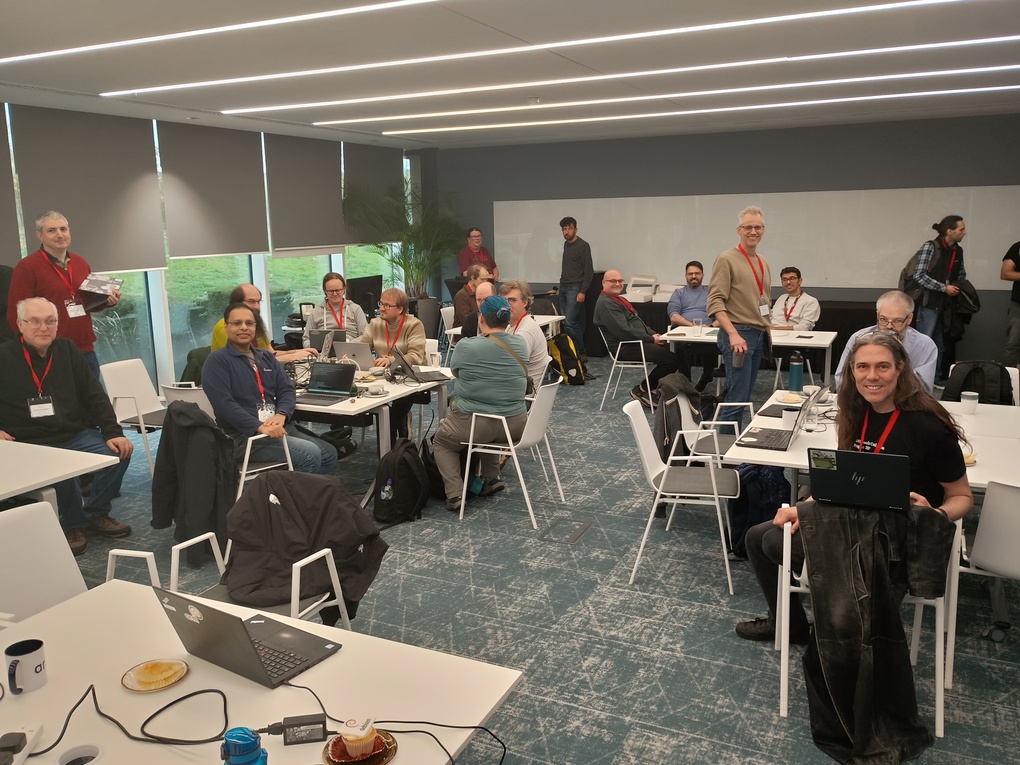
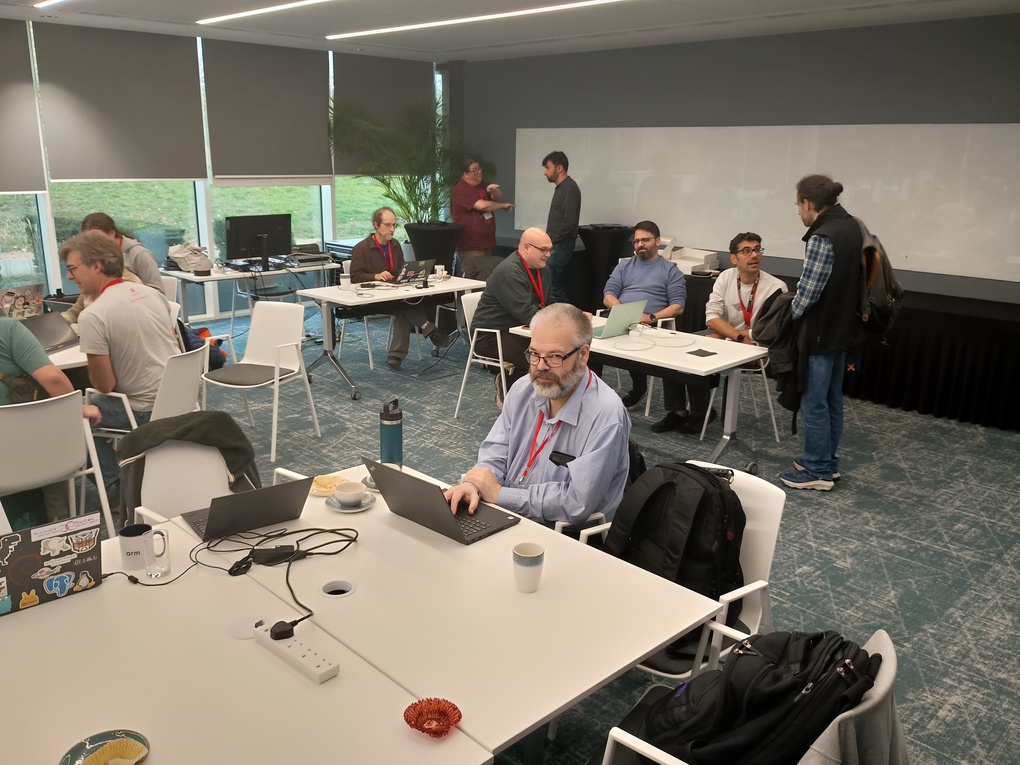
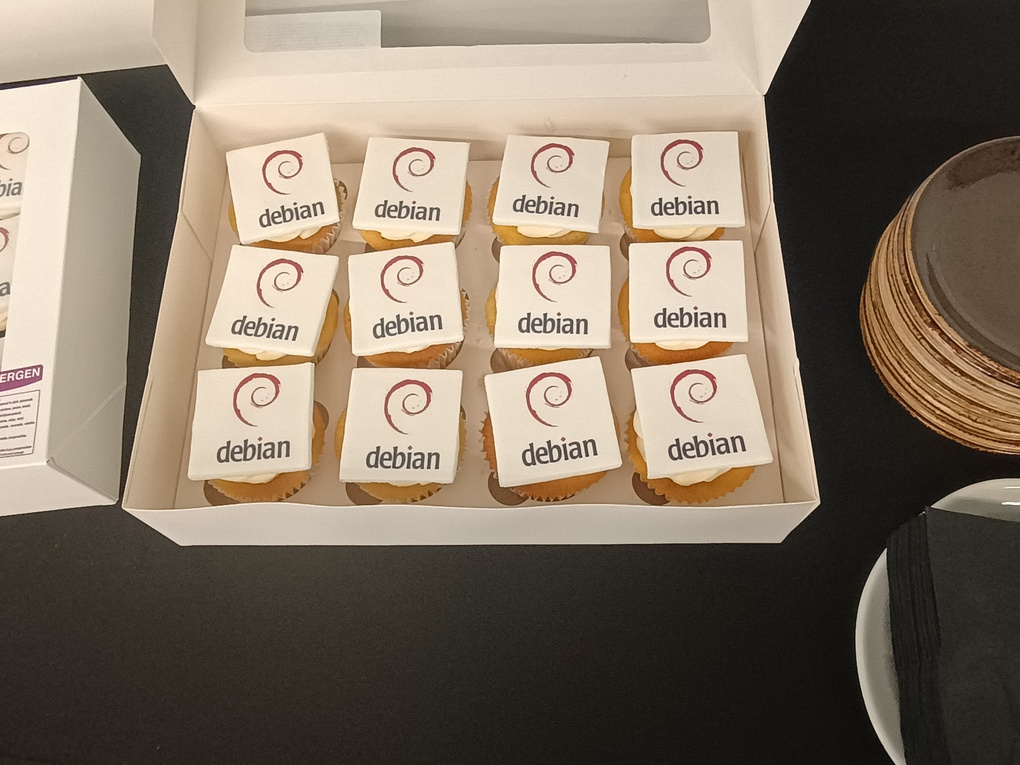
We're at the Arm office in Cambridge for fun conversations and Debian hacking, as part of this year's mini-DebConf. Here's some geek pron... :-) Geeks! More geeks! Massive thanks to the Arm folks for making us welcome: Steve Capper and especially Charlie Dixon for going above and beyond to set things up for us! Cakes!
Vincent Bernat: Scriptable GeoDNS: leaving AWS for Bunny

To optimize the performance metrics of this blog, I relied on Amazon CloudFront to serve the assets,1 and Route 53 for the geo-aware DNS2 to direct readers to the closest host serving the content. But Route 53 is expensive: US$0.50 per zone per month, US$0.70 per million geolocation queries, and US$0.75 per healthcheck per month, plus US$1 per month for the KMS key needed to sign zones with DNSSEC. When I discovered that Bunny DNS is almost free for up to 500 domains and features scriptable answers, I made the jump! Plus, it's a European company based in Slovenia.

Bunny CDN Bunny.net started as BunnyCDN in 2015. They added IPv6 support in 2017. Switching was uneventful. I don't bring a custom domain: I serve the content from the b-cdn.net domain. As I depend on content negotiation to serve AVIF and WebP images, I configure the CDN to cache each image format separately. I disable logging to avoid collecting personal information. While the bunny.net GDPR page promises they anonymize data, it is unclear what CloudFront keeps in its own logs when logging is disabled. The only downside of the bunny.net CDN offering is the lack of HTTP/3. I asked their support: two minutes later, they answered they are working on it but have no ETA to share.

Bunny DNS Bunny.net introduced their DNS offering in 2022 and recently reduced its cost to almost zero. They support geographical routing, but a very cool feature is the scriptable DNS: it runs a piece of user-supplied JavaScript on each query to compute the answer. I run seven small NixOS virtual machines to host this blog around the world: Paris, Nuremberg, Ashburn, Singapore, San Jose, S o Paulo, and Sydney. Bunny's scriptable DNS lets me return the IP addresses of the two nearest servers. The browser falls back to the second server if the first one is down.
const servers = [
   
    ipv4: "45.90.160.60",
    ipv6: "2a0c:8881:5:100::1",
    latitude: 48.88,
    longitude: 2.22,
   ,
  /* [ ] */
   
    ipv4: "139.180.162.114",
    ipv6: "2001:19f0:5800:1855:5400:6ff:fef0:4c0a",
    latitude: -33.87,
    longitude: 151.21,
   ,
];
const families =   A: "ipv4", AAAA: "ipv6"  ;
const records =   A: ARecord, AAAA: AaaaRecord  ;
export default function handleQuery(query)  
  const type = String(query.request.queryType).toUpperCase();
  const family = families[type];
  if (!family) return [];
  // Get user location
  const location = query.request.geoLocation;
  // Build a list of candidates
  let candidates = servers.map(
    (s) => new Server(s[family], s.latitude, s.longitude, 100),
  );
  // Select the two closest alive servers
  const selected = [];
  while (selected.length < 2)  
    const server = RoutingEngine.getClosestServer(candidates, location, true);
    selected.push(server);
    candidates = candidates.filter((s) => s.ip !== server.ip);
   
  // Return their IP addresses
  return selected.map((s) => new records[type](s.ip, 3600));
 
The above script relies on the RoutingEngine.getClosestServer() helper, which returns the closest alive3 server to the user.4 Thanks to Doggo, we can check it works as expected, at least for A:5
$ doggo --gp-from="Amsterdam" A vincent.bernat.ch
LOCATION          NAME                TYPE  TTL    ADDRESS
Amsterdam, NL
                  vincent.bernat.ch.  A     3600s  45.90.160.60
                  vincent.bernat.ch.  A     3600s  116.203.18.48
$ doggo --gp-from="Texas" A vincent.bernat.ch
LOCATION          NAME                TYPE  TTL    ADDRESS
Houston (TX), US
                  vincent.bernat.ch.  A     3600s  5.161.44.145
                  vincent.bernat.ch.  A     3600s  149.28.219.155
The most annoying drawback of this method is that a user from Buenos Aires gets both S o Paulo (1000 mi, 30 ms RTT) and Ashburn (5200 mi, 140 ms RTT). Most resolvers randomize the order, so the user may pull the web page from Ashburn. We could return only the nearest server and swap the scripted record with the built-in geographic routing instead. But if the server becomes unavailable, the browser has no alternative until the DNS cache expires. It leaves a short window of unavailability, even with a short TTL.

The HTTPS record solution The HTTPS DNS record, defined in RFC 9460, solves both the availability and the latency issues. Modern browsers query this record to get additional information to reach an HTTP server, including an alternative port and the application layer protocol HTTP/2 or HTTP/3. Each record has a priority. We can ask browsers to contact the nearest server first and fall back to the next one if the first is unavailable:
vincent    HTTPS  1 first.geo  alpn="h3,h2"
vincent    HTTPS  2 second.geo alpn="h3,h2"
vincent    HTTPS  3 .          alpn="h3,h2"
; Bunny DNS must provide the two closest servers as "first.geo"
; and "second.geo" with geographic or latency routing.
first.geo  A      45.90.160.60
first.geo  AAAA   2a0c:8881:5:100::1
second.geo A      116.203.18.48
second.geo AAAA   2a01:4f8:1c0c:5eb5::1
vincent    A      45.90.160.60
vincent    A      116.203.18.48
vincent    AAAA   2a0c:8881:5:100::1
vincent    AAAA   2a01:4f8:1c0c:5eb5::1
This looks like the ideal solution! Unfortunately, Chrome ignores any record whose target is not ., hence the last record at priority 3. Moreover, unlike with a CNAME, Bunny DNS does not return the IP addresses for first.geo and second.geo in the additional section. The resolver needs to send a first request to get the HTTPS record, and a second to resolve first.geo. HTTPS records are still too new for this use case. Back to the drawing board!

The hybrid solution As a compromise, the script returns the two nearest servers if they are at a similar distance from the user. Otherwise, it returns only the nearest one with a lower TTL of 2 minutes.
export default function handleQuery(query)  
  const location = query.request.geoLocation;
  let candidates = servers.map(
    (s) => new Server(s.ipv4, s.latitude, s.longitude, 100),
  );
  // Select the two closest servers
  const selected = [];
  while (selected.length < 2)  
    const server = RoutingEngine.getClosestServer(candidates, location, true);
    selected.push(server);
    candidates = candidates.filter((s) => s.ip !== server.ip);
   
  // Compute the distance to the user for each of them
  const [first, second] = selected.map((s) =>
    GeoDistance.calculate(s, location),
  );
  // If the second one is at twice the distance and at more than 1000 miles
  // from the first, return only the first one with a TTL of 2 minutes.
  if (second > 2 * first && second - first > 1000)  
    return [new ARecord(selected[0].ip, 120)];
   
  // Otherwise, return both with a TTL of 1 hour.
  return selected.map((s) => new ARecord(s.ip, 3600));
 
We can check it with Doggo. From Chicago, we get only the Ashburn server with a TTL of 2 minutes, while from Mexico, we get both Ashburn and San Jose.
$ doggo --gp-from="Chicago" A vincent.bernat.ch
LOCATION          NAME                TYPE  TTL    ADDRESS
Chicago (IL), US
                  vincent.bernat.ch.  A     120s   5.161.44.145
$ doggo --gp-from="Mexico" A vincent.bernat.ch
LOCATION          NAME                TYPE  TTL    ADDRESS
Queretaro, MX
                  vincent.bernat.ch.  A     3600s  5.161.44.145
                  vincent.bernat.ch.  A     3600s  149.28.219.155
$ doggo --reverse 5.161.44.145 149.28.219.155
NAME                          TYPE  TTL    ADDRESS
145.44.161.5.in-addr.arpa.    PTR   7187s  web05.luffy.cx.
155.219.28.149.in-addr.arpa.  PTR   3600s  web07.luffy.cx.

Note On the live page, the map below is interactive: point at a location to get the DNS answer, or disable servers to see how the answers change.

Map of the servers answered by Bunny DNS for each location
The complete code is a bit more complex. It works around RoutingEngine.getClosestServer() supporting only IPv4, and it handles the case where there are not enough alive servers to build an answer. Bunny.net has a comprehensive Terraform provider. I leverage CDK Terrain to build the target state in TypeScript and OpenTofu to deploy it. Have a look at "Managing infrastructure with Terraform, CDKTF, and NixOS" for more details.6

ACME DNS with Hickory DNS Route 53 covered one additional use case of mine: serving acme.luffy.cx to solve DNS-01 ACME challenges. Unlike Route 53, Bunny DNS cannot restrict access to a single zone with a fine-grained access policy. As this usage requires neither high availability nor low latency, I replaced Route 53 with Hickory, a memory-safe DNS server written in Rust. It supports automatic DNSSEC signatures and dynamic updates. Its configuration is simple:
[[zones]]
zone = "acme.luffy.cx"
zone_type = "Primary"
[zones.stores]
allow_update = true
type = "sqlite"
journal_path = "acme.luffy.cx.sqlite"
zone_path = "acme.luffy.cx.zone"
# Private key to sign the zone with DNSSEC. Generated with:
#  openssl genpkey -algorithm EC -pkeyopt ec_paramgen_curve:P-256
[[zones.keys]]
algorithm = "ECDSAP256SHA256"
key_path = "/etc/hickory-dns.acme.luffy.cx.pem"
# TSIG key to sign zone updates. Generated with:
#  openssl rand 32
[[zones.stores.tsig_keys]]
algorithm = "hmac-sha256"
key_file = "/etc/hickory-dns.acme.luffy.cx.update.acme.luffy.cx.tsig"
name = "update.acme.luffy.cx."
The provided zone file only seeds the database on first start. I delegate DNS-01 challenges to this zone with CNAME records:
_acme-challenge          CNAME bernat.ch.acme.luffy.cx.
_acme-challenge.vincent  CNAME vincent.bernat.ch.acme.luffy.cx.
Lego, the ACME client I use to get certificates from Let's Encrypt, answers the DNS-01 challenge by pushing entries with the DNS UPDATE protocol. Unfortunately, Bunny DNS cannot publish a DS record in a zone.7 I need one to secure the acme.luffy.cx zone and certificate delivery. Therefore, I host the luffy.cx zone on deSEC,8 a free DNS hosting service run by a non-profit organization based in Berlin. I derive the DS record to publish in luffy.cx from the DNSKEY record of acme.luffy.cx:
$ ZONE=acme.luffy.cx
$ dig @nsupdate.luffy.cx $ZONE DNSKEY +noall +answer \
>     dnssec-dsfromkey -a SHA-256 -f - $ZONE
acme.luffy.cx. IN DS 55628 13 2 4946E7508F20E15F1B577A231104B029A1A82E04699A80CD46ADCE31227EE81F

Overall, I am quite happy with the switch to bunny.net. There are still a few rough edges, like the inability to publish DS records, the lack of HTTP/3, and the IPv4-only RoutingEngine.getClosestServer() helper. The bill went from US$5 per month to US$1. So far, performance is on par with AWS, but I only finalized the current setup, including the server in Sydney, in late October. I need a bit more time to gather more data, and I'll post a short update.

Update (2026-11) This post was briefly discussed on Hacker News and Lobsters.


  1. I had been hosting media assets on CloudFront since 2011.
  2. Route 53 had served bernat.ch since December 2021. I didn't use healthchecks as they were too expensive. I didn't host most of my zones there either, as queries for haproxy.debian.net alone would have cost me around US$10 per month.
  3. A server is alive if it answers an ICMP ping. The bunny.net documentation gives more details about the checks.
  4. The user queries Bunny DNS through a resolver. Usually, either the resolver is close to the user, or it exposes the user's subnet through EDNS client subnet.
  5. Don't use this script as is: RoutingEngine.getClosestServer() only works with IPv4. The final script works around this limitation.
  6. The article is a bit outdated. CDK Terrain replaces CDKTF, OpenTofu replaces Terraform, and I now use Colmena instead of NixOps.
  7. I contacted bunny.net support to ask when they will support publishing a DS record and got an answer seven minutes later: they don't know. This is a bummer, as they support automatic CDS, a DNS record to advertise a DS record to the parent zone. They handle one side of the delegation, not the other. I also reported a bug with the proof of non-existence, and they replied a day later with a detailed answer.
  8. Why not use deSEC for ACME challenges? You can limit its tokens to a single RRset. I could say I prefer to self-host, but the truth is I only discovered this while writing this article.

Andrew Cater: Arm Cambridge - pre-mini-Debconf days 20261106

Another interesting morning so far. Lots of interesting side conversations (and, of course, people using IRC to talk to the person next to them as is traditional).

It's nice to hear somebody ask a question and be told, effectively "Oh, you need to talk to XX - they're sitting over there" or " I need to talk to someone about X, Y and Z - and they all resolve to you".

Especially noticeable in this room, perhaps, but it does point to the fact that many things in Debian ultimately resolve to one or two people. There are a lot of people each with multiple areas of expertise which overlap - and then a few individuals who are essential as points of reference for *everyone* else.

Thanks again to Arm for hosting us, for excellent food, coffee and facilities which make this _so much easier_ as a working environment for these days.

5 November 2026

John Goerzen: Letter from a Kansan: Would You Rather Be Right or Happy?

As a person that has lived in Kansas almost all my life, I have never seen such good political news for this state as we got this week. It is a stunning rebuke of fascism from across the country. One of the many pieces of wisdom from mechanic Tom Magliozzi is this question: Would you rather be right, or happy? He often asked it in the context of somebody that had just won an argument. This is my plea to all our progressive friends: remember that question, and keep it in mind carefully over the next 2 years. We can either build on this momentum for an even bigger victory in 2028, or we can start to lose this unique coalition. Kansans spend our lives being misunderstood and forgotten. Many of us, myself included, visit large cities regularly. It is a more surprising event when someone from a large city drives down one of our dirt roads. The kind of road that leaves your car covered in mud when you drive your daughter to school. The kind of road that we drive on for 3 miles before we reach the nearest paved road. Statisticians label Topeka, the capital of Kansas and city of 126,000 people, as rural. The nearst town to me, 7 miles away, has a population of 600. In winter, many people here still leave their keys in their running, unlocked cars while they run into the grocery store. The person at the bank, the owner of the grocery store, the mechanic, the electricians, the builders, the people that run the local museum, all know my name and recognize me. Not because I m famous locally, but because this is normal here. We are a community, a real one. Yet I ve lost long-time friends, especially from the west coast, because, while I m progressive, I still talk to Republicans. They thought Republicans are so evil, they ought to be shunned and ostracized. It probably doesn t compute to a San Franciscan what it means to live in a county that went 80% for Trump one time. A county of about 10,000 people living in a space larger than Los Angeles, New York, and San Jose combined. (Those cities have a combined population of about 13 million, living on the same amount of land as 10,000 people do out here.) If I avoided talking to Republicans, it wouldn t be them that would be isolated. It would be me. Out here, many of us have lived with each other for generations. We may go on living with them for generations. If somebody s car is stuck in the mud, the first person that comes by with a truck and a rope will probably pull them out. Nobody asks who you voted for. This is what you do for neighbors, because neighbors are humans, and next time it might be me that s stuck in the mud. I can be as incensed as anyone else about what the fascists are doing. I don t have direct knowledge of how a lot of people vote. But I take a deep breath sometimes and remind myself: these are my neighbors. I ve seen them go out of their way to be kind and generous with all walks of humanity. (Yes, even whatever groups you re imaginging to argue with me about.) This is part of how Adam Hamilton defeated Roger Marshal. The anti-Trump sentiment wasn t enough on its own. Lifelong Republicans dissatisfied with how Trump handled things weren t just going to vote for any Democrat. They needed someone that was safe. Someone that talked to them as humans. Someone that respected them. Adam Hamilton went and shook hands with MAGA protestors at his events. He told them I want to be your senator, too. This is how you win over the most strident of Republicans. Hamilton didn t compromise his beliefs. He invited discussion about them. I have already been seeing some progressives say things like, Don t cut them any slack. Remember how many times people voted for fascism! They need to still be ostracized. That, folks, is the way we lose. It is the wrong strategy everywhere. And it is especially culturally wrong in the close-knit communities again, actual communities where people know each other and have for years that make up the heartland. Building relationships with people different than us is our best chance to build on this coalition. And, isn t that what progressive values call for? So, celebrate this victory. Clap for all the activists that made it happen. And, before you set off to alienate your new and tentative allies, ask yourself: Would I rather be right? Or win again?

3 November 2026

John Goerzen: Must we always use LLMs this way?

As with my last post on AI, let me open with a statement:
Just because most people hold AI a certain way, doesn t mean that we always must, either now or in the future.
As I noted in that piece, and my shades of gray post, I am well aware and agree with the notion that a lot of frontier AI models have disturbing ethical concerns that we shouldn t dismiss, including concentration of power and wealth, environmental concerns, unethical scraping and training, the financial bubble they seem to be creating, and more. The most poisonous of AI cheerleaders are accelerating enshittification while cutting quality all over the place. AI slop is also a real problem, which I ll discuss in a bit. Before I dive in, I need to mention that no AI assistance was used for writing this post, and I have been using em dashes correctly for years before LLMs did. Secondly, while popular discourse seems to use AI and LLM interchangeably, the AI field is much more broad and much more old than LLMs. I will, nonetheless, adopt the common AI jargon here, but be more specific when necessary to differentiate. In The Reverse Centaur s Guide to Life After AI by Cory Doctorow, he presented two ideas I particularly want to focus on here:
  1. The present and future of LLMs outside of the cloud-hosted frontier models
  2. What differentiates productive use of AI from slop
The two are related, in fact. Doctorow discussed how he never uses AI to write anything, but he sometimes uses it as an assistant to help him write. Is that contradictory? Not really. He gave this example: he remembered a quote from a podcast, which he wanted to cite and attribute correctly. But he couldn t remember which podcast or who said it. So he fired up Whisper, an open-weight model you can download and run locally, even on meagre hardware. Whisper is a speech-to-text model. Doctorow ran likely podcast episodes (from the target range and set of podcasts he listens to) through the model, and at that point it was a regular search. He found the quote, then went back and listened to the episode at that time spot to verify its accuracy. It would have taken so much time to do this without Whisper that he simply would not have done it otherwise. His writing was better because of AI. Not because AI wrote any words for him, but because it helped him find the right ideas and attributions. He didn t even have to trust its transcription; it pointed him at the right place, and then he could transcribe with precision. I too have used Whisper in much the same way. A little while back, I digitized many hours of old family audio recordings going back to the 1970s. Thanks to Whisper, which I ran locally primarily during hours of being fully solar-powered, I have a searchable index to these gems. A person I know recently asked me if I knew any way to transcribe some old family recordings he had. I told him I could run it through Whisper. It wouldn t have great punctuation, but most of the words would be there. This meant a lot to him and his family; what I did in 2 minutes would have taken him many days (I presume he is not a fast typist as well.) So we can start by naming: AI isn t just chatbots, and AI can help even if it isn t writing anything. Doctorow goes on to ask the question: what happens after the AI bubble bursts? I do believe it will, as Ed Zitron has carefully documented for us for a long time now. The environmental damage done by frontier training and inference in the last few years will, of course, be done. But as he points out, we ll be left with a plethora of surprisingly-capable open weight models, a community that has made significant strides running them on low-end devices (even phones), and a massive buildup of clean energy that hopefully will be finally able to offset some polluting energy once these heavy users drop off the grid. So then what? Will the world just throw away the likes of Whisper and Gemma? Obviously not. Doctorow imagines, credibly, a situation in which individuals and universities tinker with locally-run models, iterating on them and improving them with the more traditional scale of resources available to individuals and universities. In other words, this future sounds a lot like the earlier days of Open Source. As Ed Zitron has pointed out, the real costs of frontier AI have been hidden as these companies rack up fantastical losses. When the bubble bursts, the real costs of frontier AI are likely to be high enough that CEO s won t be able to ignore the poor ROI. But we ll be left with these artifacts, these open-weight starting points, that people can use. That brings me to my central thesis: a lot of anti-AI sentiment is focused on the real downsides of the hyped uses of AI, and fails to account for the more ethical advances being made now, and likely to come in the future. Varying quality of AI use We are all familiar with AI slop. I ve seen it, and have an increasingly skeptical eye when I see new projects announced in even places as niche as a BBS community (where I see things like new terminal emulators announced, written in shockingly-poor nodejs, and such). I ve seen documents that take many pages to say what amounts to nothing intelligble to a human, with perfect grammar. I ve seen pull requests that have a description that amounts to several pages of slop. I ve personally seen an AI agent do things like correctly detect passing an untrusted argument to a shell, then propose a broken quoting algorithm to fix it (rather than proper sanitization and exec() or, better yet, avoiding the call altogether.) I ve also seen AI tools very quickly and accurately identify bugs that had passed human review, even professional security reviews, for years. I ve seen them bring more joy to some people s jobs by handling the more drudgery parts of the jobs. One of my favorite podcasts, Oxide and Friends, had an episode called Engineering Rigor in the LLM age and credibly described ways in which careful use of LLMs can increase quality and safety. Yes, I said increase. (Oxide and Friends are not hype cheerleaders by any means; these are very serious people with solid technical chops, and I know some of them.) What accounts for this disconnect? We can point to many factors, but Doctorow asks a fundamental question: who is in charge? Is it the person or the computer? Does the AI service people, or do people service the AI? In some of the most ridiculously AI-first companies, it is very clearly the latter. Mandates from CEOs to increase AI usage lead to perverse outcomes that sacrifice quality. The AI is in charge. I ve never seen an AI be any good at design questions, and it s no wonder than all these vibe-coded apps have the same generic feeling of crappiness. But when the AI is used pragmatically as a junior research assistant, that s a different approach. Its output is greeted skeptically, its actions distrusted, and it s never asked to design something. These are the cases where I ve seen it make a meaningful difference. It s not black-and-white All this adds up to why I was opposed to the Debian proposals that would have banned LLM use. Those votes are hard to change. They would have left Debian in a vulnerable position of being unable to react to accurate security findings if they originated with an LLM, or left Debian unable to adopt ethical use of models. It would be akin to saying you should never buy a PC because Windows 11 is terrible. I agree Windows 11 is terrible, but saying something like that is so dismissive of all those that have invested decades of their time in building something better. So, I find AI hype to be uncredible and dangerous. I also find knee-jerk reactions to AI to be the same. They are actually a form of capitulation: they let the AI megacorps dictate the terms of the conversation to revolve around them. Case study: Debian s DFSG scanner For a long time, my two biggest annoyances with Debian have been the difficulty of packaging Rust and Go packages with their long dependency trees, and how long it takes a new package to get reviewed. About a year ago, the latter process was set on a path to reform, and it has gotten dramatically better. It also cuts off a potential connection with someone that hasn t yet heard of Linux. Some people may not jump from Windows 11 (or the ChatGPTs of the world) immediately, but pretending that it s ChatGPT or nothing does a disservice to all those that are trying to do research etchically. We should state at the outset that Debian takes compliance with the Debian Free Software Guidelines (DFSG) extremely seriously. Every new package gets a review, and these reviews often catch things that upstream repos and other distros don t. One common example would be a package that has a stated copyright and license, but then includes files that bear a different copyright and license. You can imagine reviewing packages at this level of detail isn t a fun task for people, and it s hard to find volunteers to do it. Perhaps the answer to this should be Debian should stop caring so much more than everyone else , and perhaps you re right (and perhaps you aren t). In any case, the DFSG team that reviews this added what amounts to an LLM-backed license linter. Its job is to produce an initial assessment that the license statements documented in debian/copyright are correct, thorough, and in compliance with DFSG. This report was not taken to be authoritative, but was designed to help with some initial assessments. There were some predictable reactions. People were angry that the DFSG team had added this tool without any communication about it (justifiably so, I d say). Many were angry just because of LLM. People made assumptions about what kind of model it used, what kind of quality it would produce, how definitive it would be in the project. It is worth noting here that Debian is uniquely decentralized. There is a central policy, but maintainers are free to maintain their packages how they like. They don t have to use a standard location for a Git repo, or even use Git. One person said essentially, it s fine for others to use whatever tool they want, but I shouldn t have to be exposed to LLM slop. The other perspective boiled down to, why should they keep the reports secret? If you want to proactively fix things, or flag false positives, why not? As Andreas Tille wrote, I have read the LLM reviews carefully, and in many cases their findings inspired additional commits to improve my packaging. In some cases, they even helped me catch mistakes that led me to reject an upload myself before human inspection. Joey Hess raises an interesting risk: that LLMs will remove the incentive for Debian to actually fix its cumbersome processes, by letting an LLM paper them over. I have seen this tendency in other contexts, both at work and at home, as well. It s a real risk, especially if Debian doesn t tackle the packaging problem for Rust and Go. The Mastodon post that prompted me to write this began a chain of events that started with Uploaders will be forced to address LLMs issues without human inspection. I don t believe that will be the case; it goes too far against the Debian ethos. I encourage everyone to take a deep breath. We are all getting used to a shifting landscape. We will all make missteps, myself included. The issues are complicated, the picture isn t black and white, and there is incredible hype around the ecosystem that can make finding nuance difficult. Let s be kind to each other, fellow humans. But, I do not care if you are kind to Claude.

Next.