A colleague asked me if we should move all our money to our pillow cases after
reading the latest AI editorial from Thomas
Friedman.
The article reads like a press release from Anthropic, repeating the claim that
their latest AI model is so good at finding software vulnerabilities that it is
a danger to the world.
I think I now know what it s like to be a doctor who is forced to watch Gray s
Anatomy.
By now every journalist should be able to recognize the AI publicity playbook:
Step 1: Start with a wildly unsubstantiated claim about how dangerous your
product is:
AI will cause human extinction before we have a chance to colonize mars
(remember that one? Even Kim Stanley Robinson, author of perhaps the most
compelling science fiction on colonizing mars calls bull
shit
on it).
AI will eliminate all of our jobs (this one was extremely effective at
providing cover for software companies laying off staff but it has quickly
dawned on people that the companies that did this are living in chaos not
humming along happily with functional robots)
AI will discover massive software vulnerabilities allowing bad actors to hack
pretty much every major software system in the world . (Did Friedman pull that
directly from Anthropic s press release or was that his contribution?)
Step 2: To help stave off human collapse, only release the new version to a
vetted group of software companies and developers, preferably ones with big
social media followings
Step 3: Wait for the limited release developers to spew unbridled
enthusiasm and shocking examples that seem to suggest this new AI produce is
truly unbelievable
Step 4: Watch stock prices and valuations soar
Step 5: Release to the world, and experience a steady stream of mockery as
people discover how wrong you are
Step 6: Start over
Even if Friedman missed the text book example of the playbook, I have to ask:
if you think bad actors compromising software resulting in massive loss of
private data, major outages and wasted resources needs to be reported on, then
where have you been for the last 10 years? This literally happens on a daily
basis due to the
fundamentally flawed way capitalism has been writing software even before the
invention of AI. A small part of me wonders - maybe AI writing software is not
so bad, because how could it be any worse than it is now?
Also, let s keep in mind that AI s super ability at finding vulnerable software
depends on having access to the software s source code, which most companies
keep locked up tight. That means the owners of the software can use AI to find
vulnerabilities and fix them but bad actors can t.
Oh, but wait, what if a company is so incompetent that they accidentally
release their proprietary software to the
Internet?
Surely that would allow AI bots to discover their vulnerabilities and destroy
the company right? I m not sure if anyone has discovered world ending
vulnerabilities in Anthropic s Claude code since it was accidentally released,
but it is fun to watch people mock
software that is clearly
written by AI (and spoiler alert, it seems way worse that software written
now).
Well we probably should all be keeping our money in a pillow case anyway.
Afropean: Notes from Black Europe (2019)
Johny Pitts
Johny Pitts is a photographer and writer who lives in the north of England who set out to explore "black Europe from the street up" those districts within European cities that, although they were once 'white spaces' in the past, they are now occupied by Black people. Unhappy with the framing of the Black experience back home in post-industrial Sheffield, Pitts decided to become a nomad and goes abroad to seek out the sense of belonging he cannot find in post-Brexit Britain, and Afropean details his journey through Paris, Brussels, Lisbon, Berlin, Stockholm and Moscow.
However, Pitts isn't just avoiding the polarisation and structural racism embedded in contemporary British life. Rather, he is seeking a kind of super-national community that transcends the reductive and limiting nationalisms of all European countries, most of which have based their national story on a self-serving mix of nostalgia and postcolonial fairy tales.
Indeed, the term 'Afropean' is the key to understanding the goal of this captivating memoir. Pitts writes at the beginning of this book that the word wasn't driven only as a response to the crude nativisms of Nigel Farage and Marine Le Pen, but that it:
encouraged me to think of myself as whole and unhyphenated. [ ] Here was a space where blackness was taking part in shaping European identity at large. It suggested the possibility of living in and with more than one idea: Africa and Europe, or, by extension, the Global South and the West, without being mixed-this, half-that or black-other. That being black in Europe didn t necessarily mean being an immigrant.
In search of this whole new theory of home, Pitts travels to the infamous banlieue of Clichy-sous-Bois just to the East of Paris, thence to Matong in Brussels, as well as a quick and abortive trip into Moscow and other parallel communities throughout the continent. In these disparate environs, Pitts strikes up countless conversations with regular folk in order to hear their quotidian stories of living, and ultimately to move away from the idea that Black history is defined exclusively by slavery. Indeed, to Pitts, the idea of race is one that ultimately restricts one's humanity; the concept "is often forced to embody and speak for certain ideas, despite the fact it can't ever hold in both hands the full spectrum of a human life and the cultural nuances it creates." It's difficult to do justice to the effectiveness of the conversations Pitts has throughout his travels, but his shrewd attention to demeanour, language, raiment and expression vividly brings alive the people he talks to. Of related interest to fellow Brits as well are the many astute observations and comparisons with Black and working-class British life.
The tone shifts quite often throughout this book. There might be an amusing aside one minute, such as the portrait of an African American tourist in Paris to whom "the whole city was a film set, with even its homeless people appearing to him as something oddly picturesque." But the register abruptly changes when he visits Clichy-sous-Bois on an anniversary of important to the area, and an element of genuine danger is introduced when Johny briefly visits Moscow and barely gets out alive.
What's especially remarkable about this book is there is a freshness to Pitt s treatment of many well-worn subjects. This can be seen in his account of Belgium under the reign of Leopold II, the history of Portuguese colonialism (actually mostly unknown to me), as well in the way Pitts' own attitude to contemporary anti-fascist movements changes throughout an Antifa march. This chapter was an especial delight, and not only because it underlined just how much of Johny's trip was an inner journey of an author willing have his mind changed.
Although Johny travels alone throughout his journey, in the second half of the book, Pitts becomes increasingly accompanied by a number of Black intellectuals by the selective citing of Frantz Fanon and James Baldwin and Caryl Phillips. (Nevertheless, Jonny has also brought his camera for the journey as well, adding a personal touch to this already highly-intimate book.) I suspect that his increasing exercise of Black intellectual writing in the latter half of the book may be because Pitts' hopes about 'Afropean' existence ever becoming a reality are continually dashed and undercut. The unity among potential Afropeans appears more-and-more unrealisable as the narrative unfolds, the various reasons of which Johny explores both prosaically and poetically.
Indeed, by the end of the book, it's unclear whether Johny has managed to find what he left the shores of England to find. But his mix of history, sociology and observation of other cultures right on my doorstep was something of a revelation to me.
Orwell's Roses (2021)
Rebecca SolnitOrwell s Roses is an alternative journey through the life and afterlife of George Orwell, reimaging his life primarily through the lens of his attentiveness to nature. Yet this framing of the book as an 'alternative' history is only revisionist if we compare it to the usual view of Orwell as a bastion of 'free speech' and English 'common sense' the roses of the title of this book were very much planted by Orwell in his Hertfordshire garden in 1936, and his yearning of nature one was one of the many constants throughout his life. Indeed, Orwell wrote about wildlife and outdoor life whenever he could get away with it, taking pleasure in a blackbird's song and waxing nostalgically about the English countryside in his 1939 novel Coming Up for Air (reviewed yesterday).
By sheer chance, I actually visited this exact garden immediately to the publication of this book
Solnit has a particular ability to evince unexpected connections between Orwell and the things he was writing about: Joseph Stalin's obsession with forcing lemons to grow in ludicrously cold climates; Orwell s slave-owning ancestors in Jamaica; Jamaica Kincaid's critique of colonialism in the flower garden; and the exploitative rose industry in Colombia that supplies the American market. Solnit introduces all of these new correspondences in a voice that feels like a breath of fresh air after decades of stodgy Orwellania, and without lapsing into a kind of verbal soft-focus. Indeed, the book displays a marked indifference towards the usual (male-centric) Orwell fandom.
Her book draws to a close with a rereading of the 'dystopian' Nineteen Eighty-Four that completes her touching portrait of a more optimistic and hopeful Orwell, as well as a reflection on beauty and a manifesto for experiencing joy as an act of resistance.
The Disaster Artist (2013)
Greg Sestero & Tom Bissell
For those not already in the know, The Room was a 2003 film by director-producer-writer-actor Tommy Wiseau, an inscrutable Polish immigr with an impenetrable background, an idiosyncratic choice of wardrobe and a mysterious large source of income. The film, which centres on a melodramatic love triangle, has since been described by several commentators and publications as one of the worst films ever made.
Tommy's production completely bombed at the so-called 'box office' (the release was actually funded entirely by Wiseau personally), but the film slowly became a favourite at cult cinema screenings. Given Tommy's prominent and central role in the film, there was always an inherent cruelty involved in indulging in the spectacle of The Room the audience was laughing because the film was astonishingly bad, of course, but Wiseau infused his film with sincere earnestness that in a heartless twist of irony may be precisely why it is so terrible to begin with. Indeed, it should be stressed that The Room is not simply a 'bad' film, and therefore not worth paying any attention to: it is uncannily bad in a way that makes it eerily compelling to watch. It unintentionally subverts all the rules of filmmaking in a way that captivates the attention. Take this representative example:
This thirty-six-second scene showcases almost every problem in The Room: the acting, the lighting, the sound design, the pacing, the dialogue and that this unnecessary scene (which does not advance the plot) even exists in the first place.
One problem that the above clip doesn't capture, however, is Tommy's vulnerable ego. (He would later make the potentially conflicting claims that The Room was both an ironic cult success and that he is okay with people interpreting it sincerely). Indeed, the filmmaker's central role as Johnny (along with his Willy-Wonka meets Dracula persona) doesn't strike viewers as yet another vanity project, it actually asks more questions than it answers. Why did Tommy even make this film? What is driving him psychologically? And why and how? is he so spellbinding?
On the surface, then, 2013's The Disaster Artist is a book about the making of one the strangest films ever made, written by The Room's co-star Greg Sestero and journalist Tom Bissell. Naturally, you learn some jaw-dropping facts about the production and inspiration of the film, the seed of which was planted when Greg and Tommy went to see an early screening of The Talented Mr Ripley (1999). It turns out that Greg's character in The Room is based on Tommy's idiosyncratic misinterpretation of its plot, extending even to the character's name Mark who, in textbook Tommy style, was taken directly (or at least Tommy believed) from one of Ripley's movie stars: "Mark Damon" [sic].
Almost as absorbing as The Room itself, The Disaster Artist is partly a memoir about Thomas P. Wiseau and his cinematic masterpiece. But it could also be described as a biography about a dysfunctional male relationship and, almost certainly entirely unconsciously, a text about the limitations of hetronormativity. It is this latter element that struck me the most whilst reading this book: if you take a step back for a moment, there is something uniquely sad about Tommy's inability to connect with others, and then, when Wiseau poured his soul into his film people just laughed. Despite the stories about his atrocious behaviour both on and off the film set, there's something deeply tragic about the whole affair.
Jean-Luc Godard, who passed away earlier this year, once observed that every fictional film is a documentary of its actors. The Disaster Artist shows that this well-worn aphorism doesn't begin to cover it.
On Friday I attended the second BelFOSS conference. I d spoken about my involvement with Debian at the conference last year, which seemed to be well received. This year I d planned to just be a normal attendee, but ended up roped in at a late stage to be part of a panel discussing various licensing issues. I had a thoroughly enjoyable day - there were many great speakers, and plenty of opportunity for interesting chats with other attendees.
The conference largely happens through the tireless efforts of Jonny McCullagh, though of course many people are involved in bringing it together. It s a low budget single day conference which has still managed to fill its single track attendee capacity both years, and attract more than enough speakers. Last year Red Hat and LPI turned up, this year Matt Curry from Allstate s Arizona office appeared, but in general it s local speakers talking to a local audience. This is really good to see - I don t think Jonny would object at all if he managed to score a big name speaker, but one of his aims is to get students interested and aware of Free Software, and I think it helps a lot that the conference allows them to see that it s actively in use in lots of aspects of the industry here in Northern Ireland.
Here s hoping that BelFOSS becomes an annual fixture in the NI tech calendar!
I recently learnt that my former coworker Jonny took his efforts around his own monitoring system
Bloonix and moved to self-employment.
If you're considering to outsource your monitoring consider Bloonix. As a plus
all the code is open under GPLv3 and available on
GitHub. So if you do not like to outsource it you can still build up an instance on your own.
Since this has been a one man show for a long time most of the documentation is still in german.
Might be a pro for some but a minus for others, if you like Bloonix I guess documentation translations
or a howto in english is welcome.
Beside of that Jonny is also the upstream author of a few Perl modules like
libsys-statistics-linux-perl.
So another one has taken the bold step to base his living on free and open source software, something
that always has my admiration. Jonny, I hope you'll succeed with this step.
Public transport strikes in Rome are so frequent that it s hard to remember when they are. I wrote a Gnome Shell extension to help remind me when there s one either coming up or in progress. Find it on extensions.gnome.org. It gets its data from another little service I just made.
A Roma gli scioperi dei mezzi pubblici sono cos frequenti che spesso facile dimenticarsi quando ci sono. Ho scritto un estensione per Gnome Shell per avvisare quando c o si avvicina uno sciopero dell Atac. La puoi trovare su extensions.gnome.org. Funziona grazie ad un altro piccolo servizio che ho creato.
Previously i d talked about how we use GNOME technologies in the Moblin Myzone. Now i m going to talk about another component that i m responsible for, the People Panel.
An important aspect of the Moblin user experience is about communicating with others and this panel provides quick access to do this. The core of the content is provided by an abstraction, simplification and aggregation library called Anerley. This provides a feed of items (an addressbook of people) that aggregates across the system addressbook, powered by EDS, and your IM roster, powered by Telepathy. You have small set of actions you can do on these people such as start an IM conversation / email / edit them with Contacts. The core of our IM experience is supplied by the awesome Empathy. We ve been working with the upstream maintainers to accomodate some of the needs of Moblin into the upstream source. This included the improvements to the accounts dialog and wizard that landed for GNOME 2.28.
One of the biggest problems with the IM experience in Moblin 2.0 was that it was easy to miss when somebody was talking to you. If you were looking away when the notification popped up, whoops, it s gone. With our switch to Mission Control 5 I was able to integrate a Telepathy Observer into Anerley and the People Panel. An Observer will be informed of channels that are requested on the system. This allows us to show ongoing conversations in the panel and by exploiting channel requests and window presentation allow the user to switch between ongoing conversations. This wouldn t have been possible without the assistance of the nice folks in #telepathy and at Collabora: Sjoerd, Will, Jonny and countless others.
My network blocks SIP on 3G, so when I start using its 3G
service after leaving a wireless network my N900 goes absolutely
crazy about not being to connect. Although this is a specific
annoyance I have, it's a general problem with loads of similar
cases, such as "I only want my work jabber/skype/MSN/etc.
account enabled when I'm at work".
So, I wrote a small daemon and a fun UI to make this easy. It's
actually really simple: once you configure which connections
accounts should listen for, it uses libconic to
listen for connect/disconnect events and enables and disables
accounts as appropriate. You should also be able to override its
actions temporarily without it clobbering your setting.
A sneaky peek at the UI. See if you can guess where I've been
visiting recently.
I think the UI is pretty easy to use, and should cover most use
cases.
I just uploaded it to extras-devel. It's called Automatic
Connections.
Recently, I've been working on a file transfer app for the N900.
It's called monorail and
I uploaded it to extras-devel last night, so you can try it out right
now.
I implemented an
OssoABookContactView with support for filtering on
Contact Capabilities (or a draft of it, at least) as
old-style caps aren't great. This gives a nice list of address
book contacts who have at least one account that should support
receiving file transfers. It would be nice if these extra caps
could go into the address book which is where they belong, but it
won't.
If someone would find this widget useful, I'll clean up the code
and maybe throw it in its own library.
Choose one of the accounts which support file transfer.
I also started to implement a
sharing plugin, but it turns out it's poorly documented and
appears to be impossible to do anything useful for my use-case,
like popping up a dialog when the user taps "Share". The
example isn't very exemplary, but does contain some
amusing code.
This sharing plugin is only half-written and impossible to
debug. If anyone has any pointers on writing these plugins, I would
appreciate them.
It's a shame that although Hildon widgets can look really good
on the device, it can often take some fiddling to make them look
consistent with the rest of the UI. Additionally,
oddities in some widgets can leave you baffled, or amused.
The most annoying thing I have come across regarding this app is
just how little I can get it integrated. The file manager is all
hard-coded so there's no way to add a Send to Contact menu
item, and no buttons can be added to the libsharing dialog (which
appears when the user shares a photo) which is annoying as it
looks
like it's missing this feature.
Oh, and Telepathy is pretty sweet.
A few weeks ago, I got a cool
Christmas present from work. It's pretty sweet, and I've
been writing some apps for it. I'll try and blog about them
here.
A while ago, I wrote some a number of account plugins for Maemo
5, so that other Telepathy connection managers could be used and
well-integrated into the N900's Contacts and Conversations User
interface. This enables the following extra protocols:
There are still a few problems which I'll try to iron out soon
enough but they appear to be working pretty well. The best thing
about it is clearly the integration with the rest of the phone, as
demonstrated by Marco in the screenshot above.
The PR1.1
update, which is due today, also opens the door for enabling
other protocols dynamically by providing libpurple plugins. I will
be adding Facebook Chat support soon, and someone else has made a
package for Twitter.
This is in extras-testing for you all to download and try out.
You can find all the packages in the "Network" category of the
Application manager. The Extra protocol plugins for
Conversations and Contacts metapackage (telepathy-extras, in
reality) pulls in all the cool account plugins and connection
managers of the time. File bugs from the maemo.org package
link.
I'm now a Debian Developer. :) My thanks go to Ben Hutchings,
gregor herrmann, Chris Lamb, Christoph Berg, Steve McIntyre, Brad
Smith, Jonny Lamb, Chris Boyle, everyone at credativ, and everyone
else who helped me with Debian over the last... almost six years?
Actually, I've been a DD since the weekend, but have been too
absorbed to write about it.
In other news, I'm moving house today... I'm more or less packed
now. My internet access may be intermittent at home for the next few
weeks. (Home is now Southampton, UK.)
Previously i d talked about how we use GNOME technologies in the Moblin Myzone. Now i m going to talk about another component that i m responsible for, the People Panel.
An important aspect of the Moblin user experience is about communicating with others and this panel provides quick access to do this. The core of the content is provided by an abstraction, simplification and aggregation library called Anerley. This provides a feed of items (an addressbook of people) that aggregates across the system addressbook, powered by EDS, and your IM roster, powered by Telepathy. You have small set of actions you can do on these people such as start an IM conversation / email / edit them with Contacts. The core of our IM experience is supplied by the awesome Empathy. We ve been working with the upstream maintainers to accomodate some of the needs of Moblin into the upstream source. This included the improvements to the accounts dialog and wizard that landed for GNOME 2.28.
One of the biggest problems with the IM experience in Moblin 2.0 was that it was easy to miss when somebody was talking to you. If you were looking away when the notification popped up, whoops, it s gone. With our switch to Mission Control 5 I was able to integrate a Telepathy Observer into Anerley and the People Panel. An Observer will be informed of channels that are requested on the system. This allows us to show ongoing conversations in the panel and by exploiting channel requests and window presentation allow the user to switch between ongoing conversations. This wouldn t have been possible without the assistance of the nice folks in #telepathy and at Collabora: Sjoerd, Will, Jonny and countless others.
So we all know how awesome Telepathy is, but sometimes debuggingit can be rather a pain. I die a little every time I see so, just run gabble from the command line with GABBLE_DEBUG=all etc on #telepathy.
Daf started implementing a debug interface in gabble but he fled the country, so I finished it off, and added a hot new dialog to Empathy.
So now that your debug messages are appearing on D-Bus, you could easily write a simple script to tweet them. Sounds like a good idea, right?
Additionally, if you re a Telepathy developer, this may be overkill^Wuseful for your zshrc:
Welcome back for the last part of the reviews. You may want to look at the previous parts : part 1 and part 2.
Jigdo-ivory, a JavaScript Jigdo client
Presentation
Debian CDs and DVDs take up a huge mount of space on download servers. Using jigdo to download those images can significantly reduce the amount of bandwidth and space needed on the central servers. Unfortunately, jigdo currently needs special client software to be downloaded/installed first. Adding support directly into a browser-based application could potentially make a very big difference for first-time users here.
Jigdo was created in 2001. It allowed to create ISOs from .debs grabbed from regular mirrors. It eliminated the need to duplicate the entire contents of the package repository into ISO files for each release, or even more importantly, for weekly snapshots of testing/unstable/whatever.
You may find the complete proposal from the student here. The original idea originated from the Debian-CD people, who wanted to explore ideas about creating a light web client. The project was mentored by Steve McIntyre, who developed a new version of the Jigdo tools, jigit, which is much more efficient.
Student
Dustin Rayner was a 5th year senior undergraduate student at the Oklahoma Christian University in Oklahoma City, Oklahoma. I studied Computer Engineering for 3 years as a Computer Engineering student before deciding to pursue a Mathematics and Computer Science degree.
Result
This project was unsuccessful due to numerous issues. First, because of an inadequate technical preparation of the original proposal. The Debian-CD people were too optimistic with the possibilities of Javascript. In the end, the copying and checksumming part of the Jigdo process were implemented but the checksumming (with a Javascript implementation of md5) was so slow that it was unusable (think 50kb/s on a regular laptop at full CPU charge). The student did the right thing to investigate Java and ActiveX but it was too late unfortunately and he ultimately lacked the experience and knowledge in the relevant technologies.
If the proposal is tried again, the student would be requested to have much more experience with Java (and possibly ActiveX). Those would be much more efficient for the task, as they are the most used technologies among on-line anti-virus scanners, which have a workload somewhat similar to Jigdo.
I could not find further public involvement of Dustin Rayner within Debian.
Aptitude-gtk, usability and GTK+ GUI for the Aptitude package manager
Presentation
A GTK+ GUI for Aptitude that will work alongside improved current ncurses and command-line interfaces. This will offer an alternative to Synaptic with an interface design geared toward usability and advanced functionality.
Debian currently supports multiple non-command-line package managers, the most used being Synaptic and Aptitude. Synaptic uses a GTK+ interface but offers no command-line mode. Aptitude offers a command-line mode but no X interface, although it offers a ncurses interface.
Comparing the interfaces of Synaptic and Aptitude reveal many design differences. Although Synaptic may be more accessible to beginners, Aptitude offers many interface behaviors and functions that are useful to the regular to advanced users : fully hyperlinked tabbed navigation between packages and versions of packages, mostly modeless interface, interactive dependency conflict resolver
The proposal was introduced by the student in coordination with Daniel Burrows, the mentor and developer of Aptitude.
Student
Obey Arthur Liu was a 22 year old french student of Computer Science and Applied Mathematics at Grenoble Institute of Technology - ENSIMAG, in France. Did I mention that he s also yours truly ? If you want to know more, you might be interested in my previous post.
Result
This project was successful. The interface was mostly done and functional by the end of the summer. Daniel merged the code into the main post-lenny branch. Development is still ongoing and packages are released into Experimental. For further information, just read the rest of my blog.
I could find some further public involvements of Obey Arthur Liu within Debian. Doh!
Lintian for fuller automated setups
Presentation
lintian, the Debian package checker, at the moment presents possible problems in three categories: errors, warnings and informational messages. This leads to several problems, most importantly that the severity and certainty of a check can t be expressed separately. In the course of this project, the student should design and implement in lintian an improvement of the current situation, for example by using a two-letter code (one for certainty, one for severity).
This project would make lintian errors much more fine-grained and help in maintaining pertinent quantitative analysis of package quality.
The project was mentored by Marc Brockschmidt. The project proposal was commonly introduced by the Lintian team.
Student
UPDATED: Jord Polo Bard s has done a lot of work with translation in Catalan, his native tongue. He can usually be found on #debian-catalan. He also maintains a few packages as a DM.
Result
This project was successful. The classification was entirely done. Jord also helped with the new lintian.debian.org website. The Lintian team was very satisfied with the revamped errors list and new website. They have an immediate impact on packages quality reporting.
Jord is still active within Debian, helping package a few games.
Debexpo, a generic web-based package repository
Presentation
mentors.debian.net is currently a very specialized web-based repository that allows everybody to contribute software packages to Debian without the need to be a Debian Developer (or Debian Maintainer). It has successfully helped simplifying the sponsoring process in the last years. However it needs to be refactored and in the process should be turned into a generic piece of software that can be used for other Debian source/binary package repositories, too.
Mentors is a very good initiative to recruit new packages maintainers (and needs your help!) and the software underlying it could be reused for many different purposes (think PPA).
The project was mentored by Christoph Haas. The project proposal was commonly introduced by the mentors team.
Student
Jonny Lamb was a Computer Science student in the United Kingdom. He was already quite involved within Debian, maintaining a lot of significant packages.
Result
This project was successful. The whole proposal was perfectly executed. Jonny now continues to develop debexpo, with the mailing-lists and commit logs showing interesting activity. Of course, help for debexpo is appreciated to get it into full shape.
Jonny has since become a Debian Developer (here is his AM report). Congratulations to him.
It s nice to end on a nice note isn t it ? Now that we re done with the individual reports, I m going to write down my recommendations report. Hopefully it will help with next year s Summer of Code.
It s the last day of the most awesome linux.conf.au 2009 conference in Hobart, Tasmania. I ve just witnessed the a room full of 500 people sit with baited breath as Linus wielded a set of clippers to shave Bdale Garbee s beard, followed by Bdale (with a razor with 3 more blades than last time he shaved, a tiny bowl of water and a hand-mirror) trying to make it look neater. The LCA twitter feed was up on the projector, and someone rightly observed this whole event was actually pretty weird. There are already pictures on flickr too. However, well done to Bdale for being such a good sport, but it looks like his wife Karen will accompany him next year to make sure he doesn t agree to anything else like this, and supervise the waxing of Rusty s chest :)
What s this all in aid of? After the incredible auction for this beautiful picture from Karen, and generous donations at the Penguin Dinner on Wednesday night, the conference has now raised between AU$ 35k and 40k towards the Save the Tasmanian Devil appeal. Around AU$ 1.3k of the nonsensical winning consortium s AU $10.6k bid came from the Collabora folks who were at the dinner, and AU$ 1.2k from Collabora and Collabora Multimedia directly. We were all set to place a winning AU$ 3k bid but then Matthew and Daniel came up with the Bdale shaving scheme, and then things really picked up. I m glad we took part - the lead scientist from the project was really grateful, and I hope the money can make a real difference to their great work.
On more mundane matters, I also gave my talk this morning, and my slides (Telepathy slides v2.0 thanks to Marco) are online. I also made a few demos of new awesome stuff you can do with Telepathy (most of the patches are already merged upstream or well on the way):
Support for launching file transfers over link-local XMPP from Nautilus using the Empathy plugin for nautilus-sendto. This is already merged upstream but needs a patch to work with trunk Empathy. Thanks to Marco, Jonny and Guillaume for their work on this.
Alban also made a neat hack to Rhythmbox which allows exporting your DAAP music server to one of your contants over a Telepathy Stream Tube. Thanks also to recent work from Marco, these tubes now go over XMPP s SOCKS5 Bytestreams, giving much better throughput than the earlier in-band implementation, network permitting. The next step is unleashing the full might of our libnice NAT traversal library, signalling tubes with Jingle, and therefore making connections work peer to peer in up to 95% of the cases. However, this won t affect the APIs, stuff will just go faster! Isn t Telepathy wonderful?
Olivier stepped up to show off the demo from his talk about Farsight, which shows his branch using the new telepathy-farsight library to allow recording Telepathy video calls directly into the PiTiVi video editor. His network was screwed up so it didn t work, but I did see it work in his talk yesterday! Awesome stuff, hopefully Edward and friends can pick it up and merge it in before too long.
Unfortunately we ran out of time for Will to show off Guillaume s recent work on Telepathy-enabled Abiword on the desktop (rather than just Sugar s Write activity), but I expect he ll blog about it soon!
On that note, these were just the five that I picked to try and fit into my talk. There are a load more demos in the pipeline from the other guys in Collabora of doing stuff with Telepathy, so keep a close look on Planet Collabora for the next cool thing.
It's been nearly 10 months after the previous Tasks release, for which I
profusely apologise. I wanted to fix one final bug before releasing, which
sadly took five months to get around too... I eventually fixed it last night,
so here is Tasks 0.14.
Magic date parser when adding tasks
Support libunique in the GTK+ port (Jonny Lamb)
Support OWL window menus in the GTK+ port
Save and restore the edit window size
Add a clickable note icon (#548)
Ellipsize the undo/redo menu items (#741)
Make sure the date popup doesn't go off the screen (#752)
The most interesting change in this release is the magic date parser, which
first landed back in March. This lets you use Google Calendar
style descriptive tasks such as "release tasks today", "do shopping next
tuesday" or "pay bills on 2nd". There are many patterns that are matched but
I need two things from any users of Tasks.
Translations. At the moment there are only English and French translations
for the strings, which are critical for the parser to work. Translators,
please update the translations!
Feedback. The parser handles all of the natural language expressions that I
thought would be useful. There are probably plenty more which are not
handled, so if you find one which isn't handled (or is handled incorrectly)
then please file a bug.
Oh, and one last thing. The OpenMoko and Maemo ports have likely bitrotted.
New functionality has been added to the platform abstraction and I don't think
those ports were updated. If someone actively uses Tasks on either Maemo or
OpenMoko and is willing to test builds before release,
please contact me.
debexpo (Debian package exposition) is a web application that allows one to run a user-friendly public Debian package repository with social interaction that one may be used to from social networking sites. debexpo will be the basis for the mentors.debian.net site but will be useful for others as well. debexpo is the project I am working on for this year’s Summer of Code for Debian under the watch of Christoph Haas
debexpo is more than just a web application though. It was based on suggestions by you, and therefore it has some nifty features:
Uploading is done through HTTP PUT directly in debexpo, and handled immediately. This means that packages can be available within seconds of you uploading the package instead of having to wait for a cron job running an importer.
debexpo supports plugins for several stages of package life-cycle. The main use of these are for QA purposes on the package, such as automatically running Lintian, checking the watch file, or checking bugs closed actually belong to the package in question, but there is scope for much more. Plugins are easy so you can customize a repository to check for whatever you want. Other cool plugins allow features such as pulling an orig.tar.gz from Debian if it is absent from the upload and not in the repository already. Plugins provide you the option to customize your repository for any purpose.
Users will be able to have their own personal repository (much like Launchpad’s PPAs) to host binary packages. This is simply achieved by creating a new user, uploading, and adding the appropriate entry to your sources.list.
Sponsors will be able to tell debexpo what kind of packages he or she likes to see, and a filtered package list will be shown. These kind of filters will include whether it’s a python package, or C library, whether it uses CDBS or straight debhelper, or even whether the maintainer is in the New Maintainer process (this is clearly a mentors-specific feature).
Packages will be able to be commented on by other users, in the same way as Ubuntu’s REVU tool. This keeps package discussion in one place, and Debian Developers can claim to have uploaded the package. This is useful to stop the scenario of a Debian Developer reviewing a package that has requested a sponsor, and then finding the package has been uploaded already after the initial uploader left no mention of this.
Development can be tracked through its Trac instance: http://debexpo.workaround.org/, where I invite you to submit tickets or even submit patches! Its Git repository is public: http://debexpo.workaround.org/debexpo.git (and mirrored here). Last but not least, the there is also a low-traffic mailing list.
I invite you to try it out, and report bugs. Posting to the list is a great way to get in contact.
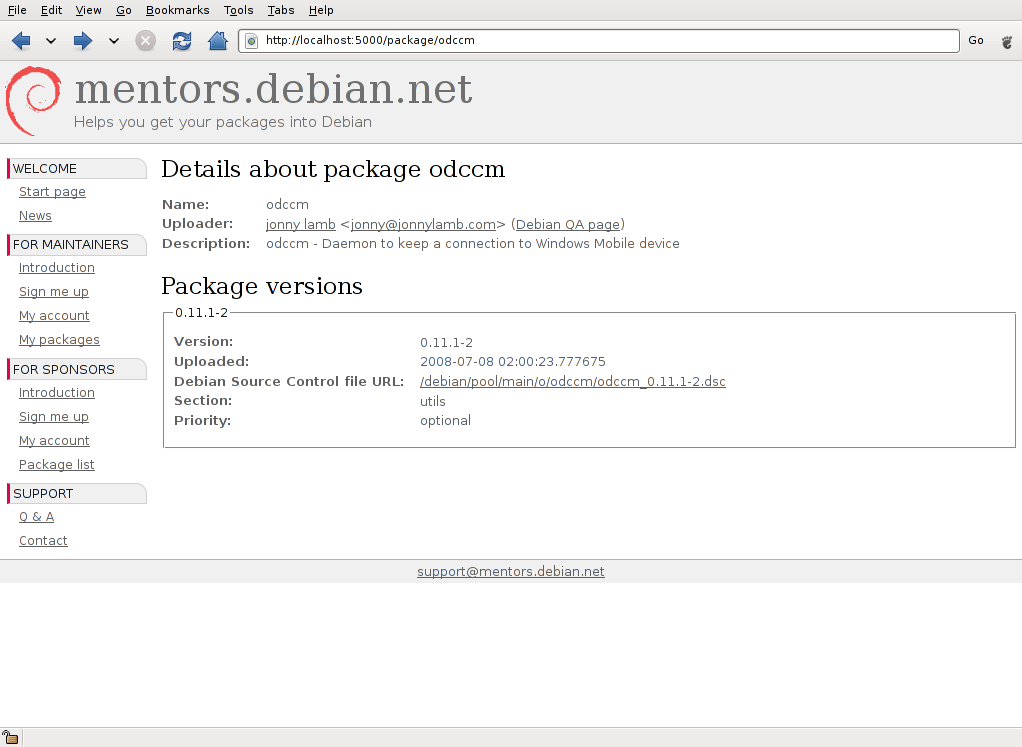
There is little visible eye-candy in your browser to show for the work so far as nearly all the work so far has gone into the backend. A sneak peek at what it looks like at the moment is available though:
As you can see, the theme is somewhat familiar. Hopefully, as the SoC program nears an end, this will be fixed.
Oh, and hello: this is my first post to Planet Debian.
I had my first day of class at the Montreal Goethe-Institut today. It was a great walk down through Parc LaFontaine and rue Cherrier out to St. Denis. There were footprints in the snow over the pond in the parc, so I assume the ice is frozen. It'd be great if the lake were open for skating sometime this winter; it was liquid last week.
The class itself was great. The building itself is like the office of a dot-com with good VC backing -- indirect lighting and modern furniture and quiet carpeting. My lehrerin is a nice woman from Freiburg. We had about 8 people in the class, a good mix of men and women, young and old, Quebecois and eux autres.
We spent most of the class time practicing how to introduce ourselves, say hello and where we were from and where we lived and such and so. I haven't taken a class in so long, it was a little hard to get back in the swing of things. I didn't even have a notebook with me -- just my Moleskine notebook, which it seems a waste to fill up with irregular verbs. But we'll see.
I got home and sang the song we learned to Maj and Amita June, just so they knew how Deutsch I am now. Here's the song (to the tune of "Twinkle, Twinkle, Little Star"):
"Guten Abend! Ich hei e Knabe!""Freut mich! Jonny Watanabe.""Kommen Sie aus Tokio?""Nein! Ich komm' aus Buffalo!"
I've been sitting on this for a while, gradually adding more bits as I
think of them. So it's a bit long and rambly, but if I don't post it now
I'll never get round to it.
First, the details, for anyone who cares.
I got married to my partner of 11 years, Katherine, on 1st December.
This was actually our 11 year anniversary. We had a civil ceremony in
The Assembly House, Norwich
with a wine reception afterwards, then moved on to
Wolterton Hall for the main
reception, with a magnificant feast provided by
Brasteds. Afterwards there was a chocolate
fountain courtesy of Digby's and
Nero thanks to Milton.
The wedding cars were provided by
American Dream (we had the Excalibur
Sedan and the Lincoln Town Car). The bus to/from the reception was from
Dolphin Autos.
Robin Phillips brought the band.
Wonderful purple jacket + the other suits were from
John Field Formal Hire.
Next, some photos.
BurlyDaveGaneshPaddySteveTim (Ceremony)Tim (Reception)
Finally, some things I've learned.
For guests (I wish someone had told me these - Katherine says I sound
stroppy but I don't mean to):
As soon as you know if you're going or not, let the couple know. Especially if you're not going. They will probably be constrained on numbers and there are very few people who can be invited at short notice if you only let them know you're not coming by the RSVP deadline.
Don't leave buying your present until the last minute. The couple will have lots more important things on their minds in the final week or two than trying to make sure there's enough left on the gift list.
People really do mean that they'd rather you turned up than gave a gift. I never fully appreciated this; I'd feel bad going to a wedding without having given a gift. However I know that it's not cheap to get to Norwich and (in most cases) have to spend at least one night in a hotel. I'd much rather people did that and I got to see them on the day than they sent a present.
For couples getting married:
It costs more than you think. Really. I'd always assumed hotels dug their arm in for weddings and upped all the prices, but actually the hotels we looked at were the cheap options, both in terms of the actual cost and also the fact they'd throw extras like a honeymoon suite in for free.
Make sure everyone in the wedding party knows the way to the ceremony venue. Really. Don't rely on them to ask you, or assume that they'll have looked at the directions you've prepared.
People are far too generous. We received many completely unexpected gifts from relatives or friends who we hadn't invited to the wedding, or those who couldn't make it. (As well as many of the people who came to the wedding buying us far too much.) If you gave us a gift, you will get a thank you card - these are already in progress but it probably won't be until after the New Year before they're all sorted and sent.
Don't leave booking a honeymoon until after the wedding. We had issues regarding not being sure about Katherine's holidays and we ended up not sorting anything until a couple of weeks later. This reduced our options somewhat.
So far it doesn't seem to have changed anything much. Katherine and I have already been living together for some time which we consider a bigger step. And we haven't seen a whole lot of each other since the wedding, though we have spent the past week together. But really, we don't feel a lot different yet.
Fantastic beginning to the weekend - was in Norwich from Thursday, saw the Dave and the Becca on thursday night - many many thanks to them for floor space thurs and fri and for generally just being fantastic people (with tea *and* coffee, no less - and a silly beepy tivo box for even more fun - and for introducing me to the american chopper type show thingummy - and for letting me watch the a-team!)
Then, serious amounts of thanks to Noodles and Kathy (who I appear to not be able to find a link for :( ) for inviting me to the wedding and the reception - was fantastic - you're both such absolutely lovely people! Pictures so far appear to be available from Becca and Dave, Burly and Steve McIntyre - hopefully more soon... specially from Dave Noble (can't find him *bah* he needs more google juice the damned slacker ;) which should be cool! Saturday was absolutely brilliant - including talking about atmosperic physics, failing a-levels, and random universities doing questions (hey, I can't entirely remembere - someone bought a half barrel of nero and some port, and lots of red wine... I wasn't *entirely* sober ;).
Saturday morning was a bit of a blur - I remember watching the A-Team and then food in the Glass House with Dave and Becca (thanks guys, you rock!) then I wandered to the Fat Cat and met with Eli and Dave Noble, a while later Rob and James and Kaz arrived and we played Munchkin, which was a very very silly game but quite fun (thanks James and Kaz - you're both mildly insane - but it's always fun when you come to the pub!).
Went home with Eli, tried to escape because of the annoying giggly evil students from hell, started wandering back towards the train station and a random bench to sleep on, then got emotional black mail and ended up back at Eli's - ho hum.
Went to catch train at around 10am Sunday morning - discovered trains from Norwich weren't running - replacement bus service from Norwich to Diss left Norwich at around 10:25am, got to Diss, had a 10 to 15 minute wait there (mmmmm, bacon roll and a coffee!) then straight to Liverpool Street, wandered straight off to the underground and got the circle line to Victoria, got to Victoria around 13:40 ish, wandered to look at the boards and saw a 14:17 from Victoria round half the planet to Brighton - thought to myself "not in any rush" and wandered off and found food and then wandered round the WHSmith in Victoria station.... got out of there, glanced at the board again, Victoria to Brighton train had been cancelled - wondered what to do - announcement over the tannoy that to get to Brighton the best idea was to travel to East Croyden and the train would meet us there. So, grabbed that train, got to East Croyden, jumped on the train (first 8 carriages Brighton, back four Plymouth... so, jumped on somewhere around the 7th carriage from what I thought was the front - turned out to be the back - wasn't entirely sure what was going on so when it stopped at Gatwick wandered further to the front of the train a lot, found an empty pair of seats and sat down. Got to Three Bridges and there was a delay, it was announced on the train as "We're waiting for the conductor, he's missed a train and is currently in a taxi, there's at least a 10 minute delay before he gets here", so a load of us bundled out of the train on the basis that that was very much long enough for a cigarette break - just as we were finishing the conductor turned up, so we all got back on the train for the "scenic" route to Brighton (yay for going round the coast), finally got in to Brighton at 17:05, so wasn't too bad, only about 6 and a half hours for a 3 and a half or 4 hour train journey ;). Grabbed chinese on the way home, watched some Morse - all was well with the world.
Lots of beeping this morning around 8.30am, ignored it, finally re-woke up at about 10:30am (ish) - watched some more Morse, grabbed some lunch and then watched more Morse until going to the pub quiz tonight.
Charly, Julius and Pieter turned up for a quick drink and then all left me to fend for my self at the quiz - I came in my usual place - very last (by over 20 points, no less ;) - but had fun, so who cares :)
Anyways - it's now tuesday morning, so probably time for some good ol' fashioned sleep type stuff... might put on the next episode of Morse for the hell of it (might even manage to stay awake through it!).
Tomorrow is probably more Morse, some work on the django packages (just got the first bug report in for those) and possibly applying some of the patches to the scrobbler packages to close some of those bug reports too. It appears that upstream for xmms-scrobbler has disappeared a bit, so might have to look at that a lot closer over the next few months - have some time off work soon - last day this year being the 15th (also happens to be when work are planning the "christmas do").
Wow - that was a ridiculously longer post than I though it was going to be! Night all!
 In my two most recent posts, I listed the

 On Friday I attended the second
 As a plus
all the code is open under GPLv3 and available on


 One of the biggest problems with the IM experience in Moblin 2.0 was that it was easy to miss when somebody was talking to you. If you were looking away when the notification popped up, whoops, it s gone. With our switch to Mission Control 5 I was able to integrate a Telepathy

 Welcome back for the last part of the reviews. You may want to look at the previous parts :



 It's been nearly 10 months after the previous Tasks release, for which I
profusely apologise. I wanted to fix one final bug before releasing, which
sadly took five months to get around too... I eventually fixed it last night,
so here is