Search Results: "jelmer"

10 October 2026

Jelmer Vernoo : Mailsift: Extracting structured data from email messages

As a casual user of Gmail, I find its ability to recognize when I ve received tickets, invoices, and flight confirmations, and to display this information in a structured way, very useful. Flights appear directly in Google Calendar, parcel delivery statuses are tracked, and reservations are easy to find at a glance. However, my main email address is not Gmail, and I don t want to migrate to Gmail for a number of reasons (privacy, data sovereignty, vendor lock-in). At the same time, I missed having that automatic extraction: having flight and train bookings appear in my calendar without manual copy-pasting, keeping track of incoming parcels, and having invoices neatly organized.
JSON-LD and schema.org There is an established standard format for structured data called JSON-LD, which is used by Google and other search engines to extract structured data from web pages. JSON-LD represents linked data using JSON, and it can be embedded directly in HTML documents. Email messages can also contain structured data in the form of JSON-LD, which can link the information in the email to external data sources. There are standardized schemas for structured data in email messages, such as the schema.org vocabulary, which defines types and properties for describing entities including flight reservations, train trips, hotel bookings, parcel deliveries, and invoices. For example, an email containing a flight reservation might embed the following JSON-LD snippet:
 1
 2
 3
 4
 5
 6
 7
 8
 9
10
11
12
13
14
15
16
17
18
19
20
21
22
23
 
  "@context": "https://schema.org",
  "@type": "FlightReservation",
  "reservationNumber": "ABC123",
  "underName":  
    "@type": "Person",
    "name": "John Doe"
   ,
  "reservationFor":  
    "@type": "Flight",
    "flightNumber": "AA123",
    "departureAirport":  
      "@type": "Airport",
      "name": "John F. Kennedy International Airport"
     ,
    "arrivalAirport":  
      "@type": "Airport",
      "name": "Los Angeles International Airport"
     ,
    "departureTime": "2026-11-01T10:00:00-05:00",
    "arrivalTime": "2026-11-01T13:00:00-08:00"
   
 
When this is present, reading email data is clean and straightforward. The reality, however, is that only a fraction of vendors actually include schema.org markup in their emails. Most airlines, train operators, couriers, and web shops still send regular HTML or plain-text messages with arbitrary layouts that change over time.
Mailsift To bridge this gap on my own infrastructure, I built mailsift. Written in Rust, it is a daemon and CLI tool that monitors incoming email, extracts structured information, and routes it to standard files and services. Rather than locking data into an internal database, mailsift embraces the Unix philosophy: it delegates extraction to small, isolated programs and files the resulting structured artifacts into standard formats and protocols:
  • Calendar events & reservations: Turned into iCalendar (.ics) events and pushed directly to a CalDAV server (such as Xandikos) or stored in a local directory.
  • Bills & invoices: Extracted as structured JSON records, organized by year, and optionally synced to a personal finance manager like Firefly III.
  • Parcels: Extracted as delivery records keyed by tracking number, merged across status update emails, and optionally registered with tracking APIs like 17track or Karrio.
  • Tickets & boarding passes: Saved as PDFs, Apple Wallet passes (.pkpass), or images, accompanied by JSON metadata sidecars linking them to the booking.
  • Receipts & orders: Filed as JSON records, synced over WebDAV, or forwarded via email.
How extractors work Mailsift decouples the pipeline that handles emails from the logic that parses individual vendors. It discovers extractors from a directory of manifests. The contract between mailsift and an extractor is deliberately simple:
  • Input: The raw RFC822 message is fed to the extractor on stdin.
  • Execution: The extractor runs in a fresh, temporary working directory, with a strict timeout (typically 10 seconds).
  • Output: The extractor writes zero or more named artifact files into its working directory and exits 0.
Extractors can be written in any programming language. In practice, most are small Python scripts that parse HTML with regexes or BeautifulSoup, using a small helper library (mailsift_extractor) that handles Unicode normalization and HTML body stripping.
Filtering and DKIM verification Spawning a subprocess for every single email in an active inbox would be wasteful. Each extractor therefore has a YAML manifest declaring prefiltering criteria:
 1
 2
 3
 4
 5
 6
 7
 8
 9
10
name: easyjet
order: 50
from_domains:
  - easyjet.com
  - "*.easyjet.com"
subject_regex: "(?i)easyJet booking reference"
requires:
  - html
require_dkim:
  - easyjet.com
Before running an extractor, mailsift evaluates the message headers and MIME structure - possibly converting it to an IMAP filter. If the sender domain or subject doesn t match, or the required MIME parts are missing, the extractor is skipped immediately. Crucially, the manifest can also require a valid DKIM signature via require_dkim. Mailsift inspects the Authentication-Results: header produced by the receiving mail server. This guarantees that an extractor only processes messages that genuinely originated from the vendor s domain, preventing forged emails from injecting fake calendar events or bills.
Generic vs. vendor extractors Extractors fall into two categories:
  1. Generic extractors: schema-ld inspects the HTML for any <script type="application/ld+json"> blocks conforming to schema.org reservations. Another extractor, ics-passthrough, extracts standard iCalendar attachments.
  2. Vendor-specific extractors: For vendors that don t include structured markup, dedicated extractors parse the message text. For instance, the easyjet extractor looks for booking references and flight tables, producing a standard FlightReservation artifact:
 1
 2
 3
 4
 5
 6
 7
 8
 9
10
11
12
13
14
reservation =  
    "@context": "https://schema.org",
    "@type": "FlightReservation",
    "reservationNumber": f"easyjet- reference - flight_no ",
    "reservationFor":  
        "@type": "Flight",
        "flightNumber": flight_no,
        "departureAirport":  "@type": "Airport", "name": origin ,
        "arrivalAirport":  "@type": "Airport", "name": dest ,
        "departureTime": dep.isoformat(),
        "arrivalTime": arr.isoformat(),
     ,
 
Path(f" slug .reservation.json").write_text(json.dumps(reservation))
The collection of extractors is maintained in a separate repository, mailsift-extractors, and currently includes nearly 60 extractors covering airlines (British Airways, KLM, EasyJet, Transavia, Eurostar), transport (NS, SNCF Connect, FlixBus), package carriers (Royal Mail, DPD, DHL, UPS, Evri, PostNL), online orders, and utility bills.
Handling forwarded mail In real life, travel bookings or receipts are often forwarded by family, friends, or colleagues. By default, forwarded mail would fail sender checks, and DKIM signatures on inline forwards are broken by mail clients. Mailsift handles this via a trusted_forwarders configuration. When an email arrives from a trusted forwarder, mailsift unwraps the forwarded message:
  • Attachment forwards: If the original email was attached as message/rfc822, mailsift extracts the original message and re-evaluates the vendor s DKIM signature on the inner message.
  • Inline forwards: Mailsift reconstructs a synthetic RFC822 message from the client s forwarded quotation header block and quotes, deriving a deterministic Message-ID.
This means hotel confirmations or flight tickets forwarded by a partner still end up in the family calendar automatically.
Running mailsift Mailsift fits into existing email setups in several ways:
Dovecot Sieve For local delivery, Sieve provides an elegant integration using the sieve_extprograms plugin. Because Sieve runs during local delivery after Dovecot has validated DKIM and added Authentication-Results:, require_dkim checks work as expected:
1
2
require ["vnd.dovecot.pipe"];
pipe :copy "mailsift";
The :copy flag ensures the email continues to the user s inbox while a copy is piped through mailsift.
IMAP watching If you don t run your own mail server, or want to process mail on an existing remote mailbox, imap-scan connects over IMAP:
$ mailsift imap-scan imaps://user@mail.example.com/INBOX \
    --password-file ~/.config/mailsift/imap.pass \
    --watch
With --watch, mailsift uses IMAP IDLE (RFC 2177) to wait for new messages and process them as they arrive. It supports standard passwords, Kerberos (SASL GSSAPI), and OAuth2 (XOAUTH2) for providers like Gmail and Microsoft 365 via an interactive mailsift imap-auth flow.
Other modes
  • Postfix Milter: mailsift milter runs as an MTA filter, processing messages in real-time as they pass through Postfix.
  • Maildir scan: mailsift maildir-scan walks an on-disk Maildir folder, useful for backfilling historical mail.
  • Replay: mailsift replay message.eml runs extractors on a single saved message file, which is invaluable when writing or testing an extractor.
Web UI and REST API In addition to routing data to CalDAV and disk, mailsift includes an optional read-only web dashboard (mailsift web):
$ mailsift web --listen 127.0.0.1:8088
The dashboard provides an overview of upcoming trips, arriving packages, unpaid bills, and recent orders. It rescans the artifact directories on request, so it stays in sync with incoming mail without needing a separate database. JSON endpoints (such as /api/parcels.json or /api/bills.json) are also available for custom status scripts or home automation dashboards.
Status and getting involved Mailsift has been running reliably on my mail server for over a year, and having flights, hotel bookings, and train journeys seamlessly sync into my calendar without relying on proprietary cloud services has been very satisfying. The project is free software under the GPL-3.0: Adding support for new vendors only requires writing a small YAML manifest and a Python script with a couple of regexes. If you have vendors you d like to extract data from, contributions of new extractors are very welcome!

9 May 2026

Jelmer Vernoo : Remove-after Annotations for Debian Files

deb-scrub-obsolete is a tool in the debian-codemods suite that tries to identify and remove cruft automatically. It knows about dummy transitional packages, superseded alternatives, and similar patterns it can detect by querying the archive. But some workarounds are too project-specific for a generic tool to recognise on its own. Developers can leave structured comments in their packaging files that tell deb-scrub-obsolete when a particular line or block can be removed. The Debian Janitor regularly runs various codemods like deb-scrub-obsolete on all vcs-accessible Debian packages. This means that if you leave a remove-after: trixie annotation in your package, you will automatically get a pull request to remove the annotated code once trixie has been released, without needing to remember to do it yourself.
The Comment Format The annotations take the form of specially-formatted comments. For shell files (and by extension most maintainer scripts), a line-level annotation looks like this:
install -m 755 compat-wrapper /usr/lib/foo/  # remove-after: trixie
When trixie has been released, deb-scrub-obsolete will remove that line entirely. The comment can appear anywhere on the line before or after other comments and additional explanatory text can follow:
blah  # Trixie comes with blah built in # remove-after: trixie
For larger sections, block-level annotations bracket the code to remove:
# begin-remove-after: trixie
alternatives --add foo bar
alternatives --add foo bar1
# end-remove-after
These blocks can be nested, which is useful when one outer condition wraps several inner ones with finer-grained timing.
Expressions The initial set of supported expressions is deliberately small. The main one is a Debian release name: remove-after: trixie means once trixie has been released . The condition is checked against distro-info <https://manpages.debian.org/trixie/distro-info/distro-info.1.en.html>_, the same data source that other Debian tooling uses to track release status. The expression language is designed to be monotonic conditions should only ever go from false to true, not back. A workaround that needs to be re-introduced after removal belongs in a new commit, not in an annotation. If deb-scrub-obsolete cannot parse an annotation it finds in a file, it leaves all annotations in that file untouched, to avoid a situation where related blocks are only partially removed. Annotations can also carry a marker name an arbitrary label with no spaces, commas, or the word after which can then be passed to deb-scrub-obsolete on the command line. This makes it possible to trigger removal of a named set of annotations together, useful for coordinated transitions where several packages need to be cleaned up at the same time.
Future Extensions The initial expression set is minimal; the design leaves room for richer conditions. Some candidates under consideration:
  • Whether a particular suite has a new enough version of a package (removing a Build-Depends version constraint once it is satisfied everywhere)
  • Whether a package has been removed from the archive
  • Whether all currently-supported releases contain a new enough version
  • Whether a Debian transition has completed
Compound expressions using and / or are also on the list, for cases where removal depends on multiple conditions being true simultaneously.
Status The annotation format is specified but not yet implemented in deb-scrub-obsolete - it is planned for a future release. If you maintain Debian packages and have opinions on the annotation format or the expression language, feedback is welcome. The specification lives in scrub-obsolete/doc/scrub-annotations.md in the lintian-brush repository. Many thanks to Helmut Grohne for the initial suggestion and feedback on the design.

3 May 2026

Jelmer Vernoo : Inquest, a test result repository in Rust

testrepository For a long time I ve used Robert Collins testrepository (testr) to run tests in many of the projects I work on. It s a small, focused tool built around a simple idea: decouple the running of tests from the recording and querying of their results. The way it works is straightforward. A test runner emits a subunit stream a compact binary protocol for test results and testrepository stores those streams in a per-project .testrepository/ directory. Once results are in the repository, you can ask questions like which tests failed in the last run? , re-run only the failures , what are the slowest tests? , or what changed between this run and the previous one? . The killer feature, for me, has always been the failing-test loop. When a big test suite breaks, you don t want to re-run the whole thing after every fix you want to iterate on just the failures, and only re-run the full suite once they re all green. testrepository made that workflow ergonomic long before most language-specific test runners had anything comparable, and many of them still don t have a good answer for it. testrepository has served me well for over a decade, but it has been largely unmaintained for a while, and I had some ideas of improvements that I wanted to try out. So I wrote a Rust port, which has since grown a number of features of its own.
Inquest Inquest is a Rust port of testrepository that has since grown a number of features of its own. The binary is called inq.
Goals The goals are deliberately modest:
  • a single static binary, no Python runtime required
  • no need to write a dedicated config file for most projects
  • compatible enough with testrepository s workflow that I can switch projects over without retraining my fingers
  • a richer on-disk format that captures more about each run (git commit, command line, duration, exit code, concurrency)
  • good support for the languages I actually use day-to-day: Rust, Python, Go, and Node.js
  • mostly Do What I Mean (DWIM), e.g. getting me to know as quickly as possible what tests are failing and why, and being clever about doing this
Inquest reads and writes subunit v2 streams, so anything that can produce subunit (directly or via one of the many converters) can feed into it.
Quick start Inquest can usually figure out how to run your tests on its own. In a Rust, Python, Go or Node.js project:
 $ cd my-project
 $ inq
Or if the auto-detection doesn t work, you can ask it to generate a config file and then run the tests:
 $ inq auto
 $ inq run
inq auto writes an inquest.toml describing how to invoke the test runner; inq run runs the tests, captures the subunit stream, and stores the results in a .inquest/ directory. For a Rust project the generated config looks like:
 test_command = "cargo subunit $IDOPTION"
 test_id_option = "--test $IDFILE"
 test_list_option = "--list"
After the first run, the usual queries work:
 $ inq stats             # repository-wide statistics
 $ inq last              # results of the most recent run
 $ inq failing           # only the failing tests
 $ inq slowest           # the slowest tests in the last run
 $ inq run --failing     # re-run only what failed last time
The last one is the workflow I use most often: run the full suite once, fix the obvious failures, then iterate on inq run --failing until the list is empty.
A few things that aren t in testrepository Some of the features that have grown in inquest beyond the original testrepository functionality:
  • Timeouts. --test-timeout, --max-duration, and --no-output-timeout will kill a test process that is hanging or has stopped producing output. --test-timeout auto derives a per-test timeout from the historical duration of that test, which is handy for catching tests that hang. Once the test runner is killed, the test is marked as failed and the next test is started, so a broken test doesn t hold up the whole suite.

  • Ordering --order can be used to run tests in a specific order, e.g. to run the slowest tests first, to run the tests that failed most recently first, or to run the widest variety of tests first to maximize the chance of finding a failure early on.

  • Live progress. inq running tails the in-progress subunit stream on disk and reports observed/expected test counts, percent complete, elapsed wall-clock time, and an ETA derived from each test s historical duration. Useful when a CI run is taking longer than you d like.

  • Flakiness ranking. inq flaky ranks tests by pass fail transitions in consecutive runs in which the test was recorded, so chronically broken tests rank low and genuinely flapping tests rank high.

  • Comparing runs. inq diff <A> <B> shows what changed between two test runs newly failing, newly passing, and tests that flipped state which makes it easy to see whether your last change actually fixed (or broke) anything.

  • Bisecting git history. inq bisect <TEST> drives git bisect to find the commit that broke a given test. It defaults the known-good and known-bad commits from the recorded run history (the most recent run where the test passed, and the most recent where it failed), so in the common case there is no need to remember either just point it at the test name and let it work.

  • Richer run metadata. inq info shows the git commit, command line, duration, exit code, and concurrency for a run, with a flag for whether the working tree was dirty when the run started. Combined with inq diff this makes it much easier to triangulate when a regression was introduced.

  • Rerun a previous run verbatim. inq rerun <ID> re-runs exactly the tests of a previous run, in the same order, forwarding the same -- arguments that the original run used. inq rerun -1 repeats the latest.

  • Web based view. inq web serves a web-based view of the repository, with a dashboard of recent runs and detailed views of individual runs and tests.

Web UI Most of the time I drive inquest from the command line, but for browsing historical results of a large suite spotting flapping tests, drilling into a single test s run history, or just getting a visual sense of which parts of the suite are hurting a web view is more pleasant. inq web starts a local server with exactly that:
 $ inq web
The repository overview shows totals and a per-test history grid where each cell is one run, coloured by outcome. Bands of red make it easy to pick out tests that have been broken for a long time, and isolated red cells in an otherwise green column point at flaky tests. Inquest web UI repository overview, with a grid of per-run results Drilling into an individual test gives you its full run history, a duration sparkline, and per-run pass/fail status: Inquest web UI per-test view with run history and duration sparkline
Migrating from testrepository If you already have a .testrepository/ directory full of historical runs, inq upgrade will migrate it into the new .inquest/ format, with a progress bar for the impatient. The legacy .testr.conf (INI) format is still understood, so existing projects don t have to be converted to inquest.toml immediately though the TOML format is preferred for new projects.
Trying it The source is on GitHub at jelmer/inquest. To install from source:
 $ cargo install inquest
In a project with a Rust, Python, Go or Node.js test suite:
 $ inq
Bug reports and patches are welcome.

3 September 2025

Colin Watson: Free software activity in August 2025

About 95% of my Debian contributions this month were sponsored by Freexian. You can also support my work directly via Liberapay or GitHub Sponsors. Python team forky is open! As a result I m starting to think about the upcoming Python 3.14. At some point we ll doubtless do a full test rebuild, but in advance of that I concluded that one of the most useful things I could do would be to work on our very long list of packages with new upstream versions. Of course there s no real chance of this ever becoming empty since upstream maintainers aren t going to stop work for that long, but there are a lot of packages there where we re quite a long way out of date, and many of those include fixes that we ll need for 3.14, either directly or by fixing interactions with new versions of other packages that in turn will need to be fixed. We can backport changes when we need to, but more often than not the most efficient way to do things is just to keep up to date. So, I upgraded these packages to new upstream versions (deep breath): That s only about 10% of the backlog, but of course others are working on this too. If we can keep this up for a while then it should help. I packaged pytest-run-parallel, pytest-unmagic (still in NEW), and python-forbiddenfruit (still in NEW), all needed as new dependencies of various other packages. setuptools upstream will be removing the setup.py install command on 31 October. While this may not trickle down immediately into Debian, it does mean that in the near future nearly all Python packages will have to use pybuild-plugin-pyproject (note that this does not mean that they necessarily have to use pyproject.toml; this is just a question of how the packaging runs the build system). We talked about this a bit at DebConf, and I said that I d noticed a number of packages where this isn t straightforward and promised to write up some notes. I wrote the Python/PybuildPluginPyproject wiki page for this; I expect to add more bits and pieces to it as I find them. On that note, I converted several packages to pybuild-plugin-pyproject: I fixed several build/test failures: I fixed some other bugs: I reviewed Debian defaults: nftables as banaction and systemd as backend, but it looked as though nothing actually needed to be changed so we closed this with no action. Rust team Upgrading Pydantic was complicated, and required a rust-pyo3 transition (which Jelmer Vernoo started and Peter Michael Green has mostly been driving, thankfully), packaging rust-malloc-size-of (including an upstream portability fix), and upgrading several packages to new upstream versions: bugs.debian.org I fixed bugs.debian.org: misspelled checkbox id uselessmesages , as well as a bug that caused incoming emails with certain header contents to go missing. OpenSSH I fixed openssh-server: refuses further connections after having handled PerSourceMaxStartups connections with a cherry-pick from upstream. Other bits and pieces I upgraded libfido2 to a new upstream version. I fixed mimalloc: FTBFS on armhf: cc1: error: -mfloat-abi=hard : selected architecture lacks an FPU, which was blocking changes to pendulum in the Python team. I also spent some time helping to investigate libmimalloc3: Illegal instruction Running mtxrun generate, though that bug is still open. I fixed various autopkgtest bugs in gssproxy, prompted by #1007 in Debusine. Since my old team is decommissioning Bazaar/Breezy code hosting in Launchpad (the end of an era, which I have distinctly mixed feelings about), I converted Storm to git.

9 March 2025

Dirk Eddelbuettel: RcppNLoptExample 0.0.2: Minor Updates

An update to our package RcppNLoptExample arrived on CRAN earlier today marking the first update since the intial release more than four year ago. The nloptr package, created by Jelmer Ypma, has long been providing an excellent R interface to NLopt, a very comprehensive library for nonlinear optimization. In particular, Jelmer carefully exposed the API entry points such that other R packages can rely on NLopt without having to explicitly link to it (as one can rely on R providing sufficient function calling and registration to make this possible by referring back to nloptr which naturally has the linking information and resolution). This package demonstrates this in a simple-to-use Rcpp example package that can serve as a stanza. More recent NLopt versions appear to have changed behaviour a little so that an example we relied upon in simple unit test now converges to a marginally different numerical value, so we adjusted a convergence treshold. Other than that we did a number of the usual small updates to package metadata, to the README.md file, and to continuous integration. The (very short) NEWS entry follows:

Changes in version 0.0.2 (2025-03-09)
  • Updated tolerance in simple test as newer upstream nlopt change behaviour ever so slightly leading to an other spurious failure
  • Numerous small and standard updates to DESCRIPTION, README.md, badges, and continuous integration setup

Courtesy of my CRANberries, there is also a diffstat report for this release. For questions, suggestions, or issues please use the issue tracker at the GitHub repo.

This post by Dirk Eddelbuettel originated on his Thinking inside the box blog. If you like this or other open-source work I do, you can now sponsor me at GitHub.

1 November 2024

Colin Watson: Free software activity in October 2024

Almost all of my Debian contributions this month were sponsored by Freexian. You can also support my work directly via Liberapay. Ansible I noticed that Ansible had fallen out of Debian testing due to autopkgtest failures. This seemed like a problem worth fixing: in common with many other people, we use Ansible for configuration management at Freexian, and it probably wouldn t make our sysadmins too happy if they upgraded to trixie after its release and found that Ansible was gone. The problems here were really just slogging through test failures in both the ansible-core and ansible packages, but their test suites are large and take a while to run so this took some time. I was able to contribute a few small fixes to various upstreams in the process: This should now get back into testing tomorrow. OpenSSH Martin- ric Racine reported that ssh-audit didn t list the ext-info-s feature as being available in Debian s OpenSSH 9.2 packaging in bookworm, contrary to what OpenSSH upstream said on their specifications page at the time. I spent some time looking into this and realized that upstream was mistakenly saying that implementations of ext-info-c and ext-info-s were added at the same time, while in fact ext-info-s was added rather later. ssh-audit now has clearer output, and the OpenSSH maintainers have corrected their specifications page. I looked into a report of an ssh failure in certain cases when using GSS-API key exchange (which is a Debian patch). Once again, having integration tests was a huge win here: the affected scenario is quite a fiddly one, but I was able to set it up in the test, and thereby make sure it doesn t regress in future. It still took me a couple of hours to get all the details right, but in the past this sort of thing took me much longer with a much lower degree of confidence that the fix was correct. On upstream s advice, I cherry-picked some key exchange fixes needed for big-endian architectures. Python team I packaged python-evalidate, needed for a new upstream version of buildbot. The Python 3.13 transition rolls on. I fixed problems related to it in htmlmin, humanfriendly, postgresfixture (contributed upstream), pylint, python-asyncssh (contributed upstream), python-oauthlib, python3-simpletal, quodlibet, zope.exceptions, and zope.interface. A trickier Python 3.13 issue involved the cgi module. Years ago I ported zope.publisher to the multipart module because cgi.FieldStorage was broken in some situations, and as a result I got a recommendation into Python s dead batteries PEP 594. Unfortunately there turns out to be a name conflict between multipart and python-multipart on PyPI; python-multipart upstream has been working to disentangle this, though we still need to work out what to do in Debian. All the same, I needed to fix python-wadllib and multipart seemed like the best fit; I contributed a port upstream and temporarily copied multipart into Debian s python-wadllib source package to allow its tests to pass. I ll come back and fix this properly once we sort out the multipart vs. python-multipart packaging. tzdata moved some timezone definitions to tzdata-legacy, which has broken a number of packages. I added tzdata-legacy build-dependencies to alembic and python-icalendar to deal with this in those packages, though there are still some other instances of this left. I tracked down an nltk regression that caused build failures in many other packages. I fixed Rust crate versioning issues in pydantic-core, python-bcrypt, and python-maturin (mostly fixed by Peter Michael Green and Jelmer Vernoo , but it needed a little extra work). I fixed other build failures in entrypoints, mayavi2, python-pyvmomi (mostly fixed by Alexandre Detiste, but it needed a little extra work), and python-testing.postgresql (ditto). I fixed python3-simpletal to tolerate future versions of dh-python that will drop their dependency on python3-setuptools. I fixed broken symlinks in python-treq. I removed (build-)depends on python3-pkg-resources from alembic, autopep8, buildbot, celery, flufl.enum, flufl.lock, python-public, python-wadllib (contributed upstream), pyvisa, routes, vulture, and zodbpickle (contributed upstream). I upgraded astroid, asyncpg (fixing a Python 3.13 failure and a build failure), buildbot (noticing an upstream test bug in the process), dnsdiag, frozenlist, netmiko (fixing a Python 3.13 failure), psycopg3, pydantic-settings, pylint, python-asyncssh, python-bleach, python-btrees, python-cytoolz, python-django-pgtrigger, python-django-test-migrations, python-gssapi, python-icalendar, python-json-log-formatter, python-pgbouncer, python-pkginfo, python-plumbum, python-stdlib-list, python-tokenize-rt, python-treq (fixing a Python 3.13 failure), python-typeguard, python-webargs (fixing a build failure), pyupgrade, pyvisa, pyvisa-py (fixing a Python 3.13 failure), toolz, twisted, vulture, waitress (fixing CVE-2024-49768 and CVE-2024-49769), wtf-peewee, wtforms, zodbpickle, zope.exceptions, zope.interface, zope.proxy, zope.security, and zope.testrunner to new upstream versions. I tried to fix a regression in python-scruffy, but I need testing feedback. I requested removal of python-testing.mysqld.

24 March 2024

Niels Thykier: debputy v0.1.21

Earlier today, I have just released debputy version 0.1.21 to Debian unstable. In the blog post, I will highlight some of the new features.
Package boilerplate reduction with automatic relationship substvar Last month, I started a discussion on rethinking how we do relationship substvars such as the $ misc:Depends . These generally ends up being boilerplate runes in the form of Depends: $ misc:Depends , $ shlibs:Depends where you as the packager has to remember exactly which runes apply to your package. My proposed solution was to automatically apply these substvars and this feature has now been implemented in debputy. It is also combined with the feature where essential packages should use Pre-Depends by default for dpkg-shlibdeps related dependencies. I am quite excited about this feature, because I noticed with libcleri that we are now down to 3-5 fields for defining a simple library package. Especially since most C library packages are trivial enough that debputy can auto-derive them to be Multi-Arch: same. As an example, the libcleric1 package is down to 3 fields (Package, Architecture, Description) with Section and Priority being inherited from the Source stanza. I have submitted a MR to show case the boilerplate reduction at https://salsa.debian.org/siridb-team/libcleri/-/merge_requests/3. The removal of libcleric1 (= $ binary:Version ) in that MR relies on another existing feature where debputy can auto-derive a dependency between an arch:any -dev package and the library package based on the .so symlink for the shared library. The arch:any restriction comes from the fact that arch:all and arch:any packages are not built together, so debputy cannot reliably see across the package boundaries during the build (and therefore refuses to do so at all). Packages that have already migrated to debputy can use debputy migrate-from-dh to detect any unnecessary relationship substitution variables in case you want to clean up. The removal of Multi-Arch: same and intra-source dependencies must be done manually and so only be done so when you have validated that it is safe and sane to do. I was willing to do it for the show-case MR, but I am less confident that would bother with these for existing packages in general. Note: I summarized the discussion of the automatic relationship substvar feature earlier this month in https://lists.debian.org/debian-devel/2024/03/msg00030.html for those who want more details. PS: The automatic relationship substvars feature will also appear in debhelper as a part of compat 14.
Language Server (LSP) and Linting I have long been frustrated by our poor editor support for Debian packaging files. To this end, I started working on a Language Server (LSP) feature in debputy that would cover some of our standard Debian packaging files. This release includes the first version of said language server, which covers the following files:
  • debian/control
  • debian/copyright (the machine readable variant)
  • debian/changelog (mostly just spelling)
  • debian/rules
  • debian/debputy.manifest (syntax checks only; use debputy check-manifest for the full validation for now)
Most of the effort has been spent on the Deb822 based files such as debian/control, which comes with diagnostics, quickfixes, spellchecking (but only for relevant fields!), and completion suggestions. Since not everyone has a LSP capable editor and because sometimes you just want diagnostics without having to open each file in an editor, there is also a batch version for the diagnostics via debputy lint. Please see debputy(1) for how debputy lint compares with lintian if you are curious about which tool to use at what time. To help you getting started, there is a now debputy lsp editor-config command that can provide you with the relevant editor config glue. At the moment, emacs (via eglot) and vim with vim-youcompleteme are supported. For those that followed the previous blog posts on writing the language server, I would like to point out that the command line for running the language server has changed to debputy lsp server and you no longer have to tell which format it is. I have decided to make the language server a "polyglot" server for now, which I will hopefully not regret... Time will tell. :) Anyhow, to get started, you will want:
$ apt satisfy 'dh-debputy (>= 0.1.21~), python3-pygls'
# Optionally, for spellchecking
$ apt install python3-hunspell hunspell-en-us
# For emacs integration
$ apt install elpa-dpkg-dev-el markdown-mode-el
# For vim integration via vim-youcompleteme
$ apt install vim-youcompleteme
Specifically for emacs, I also learned two things after the upload. First, you can auto-activate eglot via eglot-ensure. This badly feature interacts with imenu on debian/changelog for reasons I do not understand (causing a several second start up delay until something times out), but it works fine for the other formats. Oddly enough, opening a changelog file and then activating eglot does not trigger this issue at all. In the next version, editor config for emacs will auto-activate eglot on all files except debian/changelog. The second thing is that if you install elpa-markdown-mode, emacs will accept and process markdown in the hover documentation provided by the language server. Accordingly, the editor config for emacs will also mention this package from the next version on. Finally, on a related note, Jelmer and I have been looking at moving some of this logic into a new package called debpkg-metadata. The point being to support easier reuse of linting and LSP related metadata - like pulling a list of known fields for debian/control or sharing logic between lintian-brush and debputy.
Minimal integration mode for Rules-Requires-Root One of the original motivators for starting debputy was to be able to get rid of fakeroot in our build process. While this is possible, debputy currently does not support most of the complex packaging features such as maintscripts and debconf. Unfortunately, the kind of packages that need fakeroot for static ownership tend to also require very complex packaging features. To bridge this gap, the new version of debputy supports a very minimal integration with dh via the dh-sequence-zz-debputy-rrr. This integration mode keeps the vast majority of debhelper sequence in place meaning most dh add-ons will continue to work with dh-sequence-zz-debputy-rrr. The sequence only replaces the following commands:
  • dh_fixperms
  • dh_gencontrol
  • dh_md5sums
  • dh_builddeb
The installations feature of the manifest will be disabled in this integration mode to avoid feature interactions with debhelper tools that expect debian/<pkg> to contain the materialized package. On a related note, the debputy migrate-from-dh command now supports a --migration-target option, so you can choose the desired level of integration without doing code changes. The command will attempt to auto-detect the desired integration from existing package features such as a build-dependency on a relevant dh sequence, so you do not have to remember this new option every time once the migration has started. :)

1 November 2023

Paul Wise: FLOSS Activities October 2023

Focus This month I didn't have any particular focus. I just worked on issues in my info bubble.

Changes

Issues

Review
  • Debian wiki: RecentChanges for the month
  • Debian BTS usertags: changes for the month
  • Debian screenshots:

Administration
  • Debian IRC: rescue obsolete/unused #debian-wiki channel
  • Debian servers: rescue data from an old DebConf server
  • Debian wiki: approve accounts

Communication
  • Respond to queries from Debian users and contributors on the mailing lists and IRC

Sponsors The SWH, golang-ginkgo, DBD-ODBC, sqliteodbc work was sponsored. All other work was done on a volunteer basis.

10 September 2023

Jelmer Vernooij: Transcontinental Race No 9

After cycling the Northcape 4000 (from Italy to northern Norway) last year, I signed up for the transcontinental race this year. The Transcontinental is bikepacking race across Europe, self-routed (but with some mandatory checkpoints), unsupported and with a distance of usually somewhere around 4000 km. The cut-off time is 15 days, with the winner usually taking 7-10 days. This year, the route went from Belgium to Thessaloniki in Greece, with control points in northern Italy, Slovenia, Albania and Meteora (Greece). The event was great - it was well organised and communication was a lot better than at the Northcape. It did feel very different from the Northcape, though, being a proper race. Participants are not allowed to draft off each other or help each other, though a quick chat here or there as you pass people is possible, or when you re both stopped at a shop or control point.
My experience The route was beautiful - the first bit through France was a bit monotonic, but especially the views in the alps were amazing. Like with other long events, the first day or two can be hard but once you get into the rhythm of things it s a lot easier. From early on, I lost a lot of time. We started in the rain, and I ran several flats in a row, just 4 hours in. In addition to that, the thread on my pump had worn so it wouldn t fit on some of my spare tubes, and my tubes were all TPU - which are hard to patch. So at 3 AM I found myself by the side of an N-road in France without any usable tubes to put in my rear wheel. I ended up walking 20km to the nearest town with a bike shop, where they fortunately had good old butyl tubes and a working pump. But overall, this cost me about 12 hours in total. In addition to that, my time management wasn t great. On previous rides, I d usually gotten about 8 hours of sleep per night while staying in hotels. On the transcontinental I had meant to get less sleep but still stay in hotels most night, but I found that not all hotels accomodated well for that - especially with a bike. So I ended up getting more sleep than I had intended, and spending more time off the bike than I had planned - close to 11 or 12 hours per day. I hadn t scheduled much time off work after the finish either, so arriving in Greece late wasn t really an option. And then, on an early morning in Croatia (about 2000km in) in heavy fog, I rode into a kerb at 35 km/h, bending the rim of my front wheel (but fortunately not coming off my bike). While I probably would have been able to continue with a replacement wheel (and mailing the broken one home), that would have taken another day to sort out and I almost certainly wouldn t have been able to source a new dynamo wheel in Croatia - which would have made night time riding a lot harder. So I decided to scratch and take the train home from Zagreb. Overall, I really enjoyed the event and I think I ve learned some useful lessons. I ll probably try again next year.

2 June 2023

Jelmer Vernooij: Porting Python projects to Rust

I ve recently been working on porting some of my Python code to rust, both for performance reasons, and because of the strong typing in the language. As a fan of Haskell, I also just really enjoy using the language. Porting any large project to a new language can be a challenge. There is a temptation to do a rewrite from the ground-up in idiomatic rust and using all new fancy features of the language.
Porting in one go However, this is a bit of a trap:
  • It blocks other work. It can take a long time to finish the rewrite, during which time there is no good place to make other bug fixes/feature changes. If you make the change in the python branch, then you may also have to patch the in-progress rust fork.
  • No immediate return on investment. While the rewrite is happening, all of the investment in it is sunk costs.
  • Throughout the process, you can only run the tests for subsystems that have already been ported. It s common to find subtle bugs later in code ported early.
  • Understanding existing code, porting it and making it idiomatic rust all at the same time takes more time and post-facto debugging.
Iterative porting Instead, we ve found that it works much better to take an iterative approach. One of the hidden gems of rust is the excellent PyO3 crate, which allows creating python bindings for rust code in a way that is several times less verbose and less painful than C or SWIG. Because of rust s strong ownership model, it s also really hard to muck up e.g. reference counts when creating Python bindings for rust code. We port individual functions or classes to rust one at a time, starting with functionality that doesn t have dependencies on other python code and gradually working our way up the call stack. Each subsystem of the code is converted to two matching rust crates: one with a port of the code to pure rust, and one with python bindings for the rust code. Generally multiple python modules end up being a single pair of rust crates. The signature for the pure Rust code follow rust conventions, but the business logic is mostly ported as-is (just in rust syntax) and the signatures of the python bindings match that of the original python code. This then allows running the original python tests to verify that the code still behaves the same way. Changes can also immediately land on the main branch. A subsequent step is usually to refactor the rust code to be more idiomatic - all the while keeping the tests passing. There is also the potential to e.g. switch to using external rust crates (with perhaps subtly different behaviour), or drop functionality altogether. At some point, we will also port the tests from python to rust, and potentially drop the python bindings - once all the caller s have been converted to rust.
Example For example, imagine I have a Python module janitor/mail_filter.py with this function:
 1
 2
 3
 4
 5
 6
 7
 8
 9
10
11
12
13
14
15
16
def parse_plain_text_body(text):
   lines = text.splitlines()
   for i, line in enumerate(lines):
       if line == 'Reply to this email directly or view it on GitHub:':
           return lines[i + 1].split('#')[0]
       if (line == 'For more details, see:'
               and lines[i + 1].startswith('https://code.launchpad.net/')):
           return lines[i + 1]
       try:
           (field, value) = line.split(':', 1)
       except ValueError:
           continue
       if field.lower() == 'merge request url':
           return value.strip()
   return None
Porting this to rust naively (in a crate I ve called mailfilter ) it might look something like this:
 1
 2
 3
 4
 5
 6
 7
 8
 9
10
11
12
13
14
15
16
17
18
19
20
pub fn parse_plain_text_body(text: &str) -> Option<String>  
     let lines: Vec<&str> = text.lines().collect();
     for (i, line) in lines.iter().enumerate()  
         if line == &"Reply to this email directly or view it on GitHub:"  
             return Some(lines[i + 1].split('#').next().unwrap().to_string());
          
         if line == &"For more details, see:"
             && lines[i + 1].starts_with("https://code.launchpad.net/")
          
             return Some(lines[i + 1].to_string());
          
         if let Some((field, value)) = line.split_once(':')  
             if field.to_lowercase() == "merge request url"  
                 return Some(value.trim().to_string());


     None
  
Bindings are created in a crate called mailfilter-py, which looks like this:
 1
 2
 3
 4
 5
 6
 7
 8
 9
10
11
12
13
use pyo3::prelude::*;
 #[pyfunction]
 fn parse_plain_text_body(text: &str) -> Option<String>  
     janitor_mail_filter::parse_plain_text_body(text)
  
 #[pymodule]
 pub fn _mail_filter(py: Python, m: &PyModule) -> PyResult<()>  
     m.add_function(wrap_pyfunction!(parse_plain_text_body, m)?)?;
     Ok(())
  
The metadata for the crates is what you d expect. mailfilter-py uses PyO3 and depends on mailfilter.
 1
 2
 3
 4
 5
 6
 7
 8
 9
10
11
12
[package]
 name = "mailfilter-py"
 version = "0.0.0"
 authors = ["Jelmer Vernoo  <jelmer@jelmer.uk>"]
 edition = "2018"
 [lib]
 crate-type = ["cdylib"]
 [dependencies]
 janitor-mail-filter =   path = "../mailfilter"  
 pyo3 =   version = ">=0.14", features = ["extension-module"] 
I use python-setuptools-rust to get the python ecosystem to build the python bindings. Here is what setup.py looks like:
1
2
3
4
5
6
7
8
9
#!/usr/bin/python3
from setuptools import setup
from setuptools_rust import RustExtension, Binding
setup(
        rust_extensions=[RustExtension(
        "janitor._mailfilter", "crates/mailfilter-py/Cargo.toml",
        binding=Binding.PyO3)],
)
And of course, setuptools-rust needs to be listed as a setup requirement in pyproject.toml or setup.cfg. After that, we can replace the original python code with a simple import and verify that the tests still run:
1
from ._mailfilter import parse_plain_text_body
Of course, not all bindings are as simple as this. Iterators in particular are more complicated, as is code that has a loose idea of ownership in python. But I ve found that the time investment is usually well worth the ability to land changes on the development head early and often. I d be curious to hear if people have had success with other approaches to porting Python code to Rust. If you do, please leave a comment.

8 March 2023

Jelmer Vernooij: The Kali Janitor

The Debian Janitor is an automated system that commits fixes for (minor) issues in Debian packages that can be fixed by software. It gradually started proposing merges in early December. The first set of changes sent out ran lintian-brush on sid packages maintained in Git. This post is part of a series about the progress of the Janitor. Kali Linux have been running their own instance of the Janitor for the last year, under the kali-bot user on GitLab. Their web site has some excellent documentation explaining how the bot works. Both projects share some common components - the core janitor codebase, Silver-Platter and the various codemods (lintian-brush and deb-new-upstream). The site and some of the review logic is different for Kali. The Kali bot has several campaigns:

The last campaign doesn t exist in the Debian janitor, and pulls in new changes from packages that have been imported from other distributions.

For more information about the Janitor s lintian-fixes efforts, see the landing page.

25 February 2023

Jelmer Vernooij: Silver Platter Batch Mode

Background Silver-Platter makes it easier to publish automated changes to repositories. However, in its default mode, the only option for reviewing changes before publishing them is to run in dry-run mode. This can be quite cumbersome if you have a lot of repositories. A new batch mode now makes it possible to generate a large number of changes against different repositories using a script, review and optionally alter the diffs, and then all publish them (and potentially refresh them later if conflicts appear).
Example running pyupgrade I m using the pyupgrade example recipe that comes with silver-platter.
 ---
 name: pyupgrade
 command: 'pyupgrade --exit-zero-even-if-changed $(find -name "test_*.py")'
 mode: propose
 merge-request:
   commit-message: Upgrade Python code to a modern version
And a list of candidate repositories to process in candidates.yaml.
 ---
 - url: https://github.com/jelmer/dulwich
 - url: https://github.com/jelmer/xandikos
With these in place, the updated repositories can be created:
 $ svp batch generate --recipe=pyupgrade.yaml --candidates=candidate.syml pyupgrade
The intermediate results This will create a directory called pyupgrade, with a clone of each of the repositories.
$ ls pyupgrade
batch.yaml  dulwich  xandikos
$ cd pyupgrade/dulwich
$ git log
commit 931f9ffb26e9143c56f20e0b85e6ddb0a8eee2eb (HEAD -> master)
Author: Jelmer Vernoo  <jelmer@jelmer.uk>
Date:   Sat Feb 25 22:28:12 2023 +0000
Run pyupgrade
diff --git a/dulwich/tests/compat/test_client.py b/dulwich/tests/compat/test_client.py
index 02ab6c0a..9b0661ed 100644
--- a/dulwich/tests/compat/test_client.py
+++ b/dulwich/tests/compat/test_client.py
@@ -628,7 +628,7 @@ class HTTPGitServer(http.server.HTTPServer):
         self.server_name = "localhost"
     def get_url(self):
-        return "http:// : /".format(self.server_name, self.server_port)
+        return f"http:// self.server_name : self.server_port /"
 class DulwichHttpClientTest(CompatTestCase, DulwichClientTestBase):
...
There is also a file called batch.yaml that describes the pending changes:
 1
 2
 3
 4
 5
 6
 7
 8
 9
10
11
12
13
name: pyupgrade
work:
- url: https://github.com/dulwich/dulwich
  name: dulwich
  description: Upgrade to modern Python statements
  commit-message: Run pyupgrade
  mode: propose
- url: https://github.com/jelmer/xandikos
  name: xandikos
  description: Upgrade to modern Python statements
  commit-message: Run pyupgrade
  mode: propose
recipe: ../pyupgrade.yaml
At this point the changes can be reviewed, and batch.yaml edited as the user sees fit - they can remove entries that don t appear to be correct, edit the metadata for the merge requests, etc. It s also possible to make changes to the clones. Once you re happy, publish the results:
$ svp batch publish pyupgrade
This will publish all the changes, using the mode and parameters specified in batch.yaml. batch.yaml is automatically stripped of any entries in work that have fully landed, i.e. where the pull request has been merged or where the changes were pushed to the origin. To check up on the status of your changes, run svp batch status:
$ svp batch status pyupgrade
To refresh any merge proposals that may have become out of date, simply run publish again:
svp batch publish pyupgrade

28 November 2022

Jelmer Vernooij: Detecting Package Transitions

Larger transitions in Debian are usually announced on e.g. debian-devel, but it s harder to track the current status of all transitions. Having done a lot of QA uploads recently, I have on occasion uploaded packages involved in a transition. This can be unhelpful for the people handling the transition, but there s also often not much point in uploading if your uploads are going to get stuck. Talking to one of the release managers at a recent BSP, it was great to find out that the release team actually publish a data dump with which packages are involved in which transitions. Here s the script I use to find out about the transitions the package in my current working directory is involved in:
 1
 2
 3
 4
 5
 6
 7
 8
 9
10
11
12
13
14
15
16
17
18
19
20
21
22
23
24
25
26
#!/usr/bin/python3
from urllib.request import urlopen
import sys
from debian.deb822 import Deb822
import yaml
with open('debian/control', 'r') as f:
    package = Deb822(f)['Source']
with urlopen("https://release.debian.org/transitions/export/packages.yaml") as f:
    data = yaml.safe_load(f)
def find_transitions(data, package):
    for entry in data:
        if entry['name'] != package:
            continue
        return dict(entry['list'])
    return  
transitions = find_transitions(data, package)
print(transitions)
sys.exit(1 if 'ongoing' in transitions.values() else 0)
In practice, the output looks something like this:
$ debcheckout bctoolbox
git clone https://salsa.debian.org/pkg-voip-team/linphone-stack/bctoolbox.git bctoolbox ...
Cloning into 'bctoolbox'...
...
$ cd bctoolbox
$ in-transition.py
 'auto-upperlimit-libbctoolbox1': 'ongoing' 

28 September 2022

Jelmer Vernooij: Northcape 4000

This summer, I signed up to participate in the Northcape 4000 <https://www.northcape4000.com/>, an annual 4000km bike ride between Rovereto (in northern Italy) and the northernmost point of Europe, the North cape. The Northcape event has been held for several years, and while it always ends on the North Cape, the route there varies. Last years route went through the Baltics, but this years was perhaps as direct as possible - taking us through Italy, Austria, Switzerland, Germany, the Czech republic, Germany again, Sweden, Finland and finally Norway. The ride is unsupported, meaning you have to find your own food and accomodation and can only avail yourself of resupply and sleeping options on the route that are available to everybody else as well. The event is not meant to be a race (unlike the Transcontinental, which starts at the same day), so there is a minimum time to finish it in (10 days) and a maximum (21 days). Unfortunately, this meant skipping some other events I d wanted attend (DebConf, MCH).

4 January 2022

Jelmer Vernooij: Personal Streaming Audio Server

For a while now, I ve been looking for a good way to stream music from my home music collection on my phone. There are quite a few options for music servers that support streaming. However, Android apps that can stream music from one of those servers tend to be unmaintained, clunky or slow (or more than one of those). It is possible to use something that runs in a web server, but that means no offline caching - which can be quite convenient in spots without connectivity, such as the Underground or other random bits of London with poor cell coverage.
Server Most music servers today support some form of the subsonic API. I ve tried a couple, with mixed results:
  • supysonic; Python. Slow. Ran into some issues with subsonic clients. No real web UI.
  • gonic; Go. Works well & fast enough. Minimal web UI, i.e. no ability to play music from a browser.
  • airsonic; Java. Last in a chain of (abandoned) forks. More effort to get to work, and resource intensive.
Eventually, I ve settled on Navidrome. It s got a couple of things going for it:
  • Good subsonic implementation that worked with all the Android apps I used it with.
  • Great Web UI for use in a browser
I run Navidrome in Kubernetes. It s surprisingly easy to get going. Here s the deployment I m using:
 1
 2
 3
 4
 5
 6
 7
 8
 9
10
11
12
13
14
15
16
17
18
19
20
21
22
23
24
25
26
27
28
29
30
31
32
33
34
35
36
37
38
39
40
41
42
43
44
45
46
47
48
49
50
51
52
53
54
55
56
57
58
59
60
61
62
63
64
65
66
67
68
69
apiVersion: apps/v1
kind: Deployment
metadata:
 name: navidrome
spec:
 replicas: 1
 selector:
   matchLabels:
     app: navidrome
 template:
   metadata:
     labels:
       app: navidrome
   spec:
     containers:
       - name: navidrome
         image: deluan/navidrome:latest
         imagePullPolicy: Always
         resources:
           limits:
             cpu: ".5"
             memory: "2Gi"
           requests:
             cpu: "0.1"
             memory: "10M"
         ports:
           - containerPort: 4533
         volumeMounts:
           - name: navidrome-data-volume
             mountPath: /data
           - name: navidrome-music-volume
             mountPath: /music
         env:
           - name: ND_SCANSCHEDULE
             value: 1h
           - name: ND_LOGLEVEL
             value: info
           - name: ND_SESSIONTIMEOUT
             value: 24h
           - name: ND_BASEURL
             value: /navidrome
         livenessProbe:
            httpGet:
              path: /navidrome/app
              port: 4533
            initialDelaySeconds: 30
            periodSeconds: 3
            timeoutSeconds: 90
     volumes:
        - name: navidrome-data-volume
          hostPath:
           path: /srv/navidrome
           type: Directory
        - name: navidrome-music-volume
          hostPath:
            path: /srv/media/music
            type: Directory
---
apiVersion: v1
kind: Service
metadata:
  name: navidrome
spec:
  ports:
    - port: 4533
      name: web
  selector:
    app: navidrome
  type: ClusterIP
At the moment, this deployment is still tied to the machine with my music on it since it relies on hostPath volumes, but I m planning to move that to ceph in the future. I then expose this service on /navidrome on my private domain (here replaced with example.com) using an Ingress:
 1
 2
 3
 4
 5
 6
 7
 8
 9
10
11
12
13
14
15
16
17
apiVersion: networking.k8s.io/v1
kind: Ingress
metadata:
  name: navidrome
spec:
  ingressClassName: nginx
  rules:
  - host: example.com
    http:
      paths:
      - backend:
          service:
            name: navidrome
            port:
              name: web
        path: /navidrome(/ $)(.*)
        pathType: Prefix
Client On the desktop, I usually just use navidrome s web interface. Clementine s support for subsonic is also okay. sublime-music is meant to be a music player specifically for Subsonic, but I ve not really found it stable enough for day-to-day usage. There are various Android clients for Subsonic, but I ve only really considered the Open Source ones that are hosted on F-Droid. Most of those are abandoned, but D-Sub works pretty well - as does my preferred option, Subtracks.

Jonathan McDowell: Upgrading from a CC2531 to a CC2538 Zigbee coordinator

Previously I setup a CC2531 as a Zigbee coordinator for my home automation. This has turned out to be a good move, with the 4 gang wireless switch being particularly useful. However the range of the CC2531 is fairly poor; it has a simple PCB antenna. It s also a very basic device. I set about trying to improve the range and scalability and settled upon a CC2538 + CC2592 device, which feature an MMCX antenna connector. This device also has the advantage that it s ARM based, which I m hopeful means I might be able to build some firmware myself using a standard GCC toolchain. For now I fetched the JetHome firmware from https://github.com/jethome-ru/zigbee-firmware/tree/master/ti/coordinator/cc2538_cc2592 (JH_2538_2592_ZNP_UART_20211222.hex) - while it s possible to do USB directly with the CC2538 my board doesn t have those bits so going the external USB UART route is easier. The device had some existing firmware on it, so I needed to erase this to force a drop into the boot loader. That means soldering up the JTAG pins and hooking it up to my Bus Pirate for OpenOCD goodness.
OpenOCD config
source [find interface/buspirate.cfg]
buspirate_port /dev/ttyUSB1
buspirate_mode normal
buspirate_vreg 1
buspirate_pullup 0
transport select jtag
source [find target/cc2538.cfg]
Steps to erase
$ telnet localhost 4444
Trying ::1...
Trying 127.0.0.1...
Connected to localhost.
Escape character is '^]'.
Open On-Chip Debugger
> mww 0x400D300C 0x7F800
> mww 0x400D3008 0x0205
> shutdown
shutdown command invoked
Connection closed by foreign host.
At that point I can switch to the UART connection (on PA0 + PA1) and flash using cc2538-bsl:
$ git clone https://github.com/JelmerT/cc2538-bsl.git
$ cc2538-bsl/cc2538-bsl.py -p /dev/ttyUSB1 -e -w -v ~/JH_2538_2592_ZNP_UART_20211222.hex
Opening port /dev/ttyUSB1, baud 500000
Reading data from /home/noodles/JH_2538_2592_ZNP_UART_20211222.hex
Firmware file: Intel Hex
Connecting to target...
CC2538 PG2.0: 512KB Flash, 32KB SRAM, CCFG at 0x0027FFD4
Primary IEEE Address: 00:12:4B:00:22:22:22:22
    Performing mass erase
Erasing 524288 bytes starting at address 0x00200000
    Erase done
Writing 524256 bytes starting at address 0x00200000
Write 232 bytes at 0x0027FEF88
    Write done
Verifying by comparing CRC32 calculations.
    Verified (match: 0x74f2b0a1)
I then wanted to migrate from the old device to the new without having to repair everything. So I shut down Home Assistant and backed up the CC2531 network information using zigpy-znp (which is already installed for Home Assistant):
python3 -m zigpy_znp.tools.network_backup /dev/zigbee > cc2531-network.json
I copied the backup to cc2538-network.json and modified the coordinator_ieee to be the new device s MAC address (rather than end up with 2 devices claiming the same MAC if/when I reuse the CC2531) and did:
python3 -m zigpy_znp.tools.network_restore --input cc2538-network.json /dev/ttyUSB1
The old CC2531 needed unplugged first, otherwise I got an RuntimeError: Network formation refused, RF environment is likely too noisy. Temporarily unscrew the antenna or shield the coordinator with metal until a network is formed. error. After that I updated my udev rules to map the CC2538 to /dev/zigbee and restarted Home Assistant. To my surprise it came up and detected the existing devices without any extra effort on my part. However that resulted in 2 coordinators being shown in the visualisation, with the old one turning up as unk_manufacturer. Fixing that involved editing /etc/homeassistant/.storage/core.device_registry and removing the entry which had the old MAC address, removing the device entry in /etc/homeassistant/.storage/zha.storage for the old MAC and then finally firing up sqlite to modify the Zigbee database:
$ sqlite3 /etc/homeassistant/zigbee.db
SQLite version 3.34.1 2021-01-20 14:10:07
Enter ".help" for usage hints.
sqlite> DELETE FROM devices_v6 WHERE ieee = '00:12:4b:00:11:11:11:11';
sqlite> DELETE FROM endpoints_v6 WHERE ieee = '00:12:4b:00:11:11:11:11';
sqlite> DELETE FROM in_clusters_v6 WHERE ieee = '00:12:4b:00:11:11:11:11';
sqlite> DELETE FROM neighbors_v6 WHERE ieee = '00:12:4b:00:11:11:11:11' OR device_ieee = '00:12:4b:00:11:11:11:11';
sqlite> DELETE FROM node_descriptors_v6 WHERE ieee = '00:12:4b:00:11:11:11:11';
sqlite> DELETE FROM out_clusters_v6 WHERE ieee = '00:12:4b:00:11:11:11:11';
sqlite> .quit
So far it all seems a bit happier than with the CC2531; I ve been able to pair a light bulb that was previously detected but would not integrate, which suggests the range is improved. (This post another in the set of things I should write down so I can just grep my own website when I forget what I did to do foo .)

6 September 2021

Jelmer Vernooij: Web Hooks for the Janitor

The Debian Janitor is an automated system that commits fixes for (minor) issues in Debian packages that can be fixed by software. It gradually started proposing merges in early December. The first set of changes sent out ran lintian-brush on sid packages maintained in Git. This post is part of a series about the progress of the Janitor. As covered in my post from last week, the Janitor now regularly tries to import new upstream git snapshots or upstream releases into packages in Sid.

Moving parts There are about 30,000 packages in sid, and it usually takes a couple of weeks for the janitor to cycle through all of them. Generally speaking, there are up to three moving targets for each package:
  • The packaging repository; vcswatch regularly scans this for changes, and notifies the janitor when a repository has changed. For salsa repositories it is instantly notified through a web hook
  • The upstream release tarballs; the QA watch service regularly polls these, and the janitor scans for changes in the UDD tables with watch data (used for fresh-releases)
  • The upstream repository; there is no service in Debian that watches this at the moment (used for fresh-snapshots)
When the janitor notices that one of these three targets has changed, it prioritizes processing of a package - this means that a push to a packaging repository on salsa usually leads to a build being kicked off within 10 minutes. New upstream releases are usually noticed by QA watch within a day or so and then lead to a build. Now commits in upstream repositories don t get noticed today. Note that there are no guarantees; the scheduler tries to be clever and not e.g. rebuild the same package over and over again if it s constantly changing and takes a long time to build. Packages without priority are processed with a scoring system that takes into account perceived value (based on e.g. popcon), cost (based on wall-time duration of previous builds) and likelihood of success (whether recent builds were successful, and how frequently the repositories involved change).
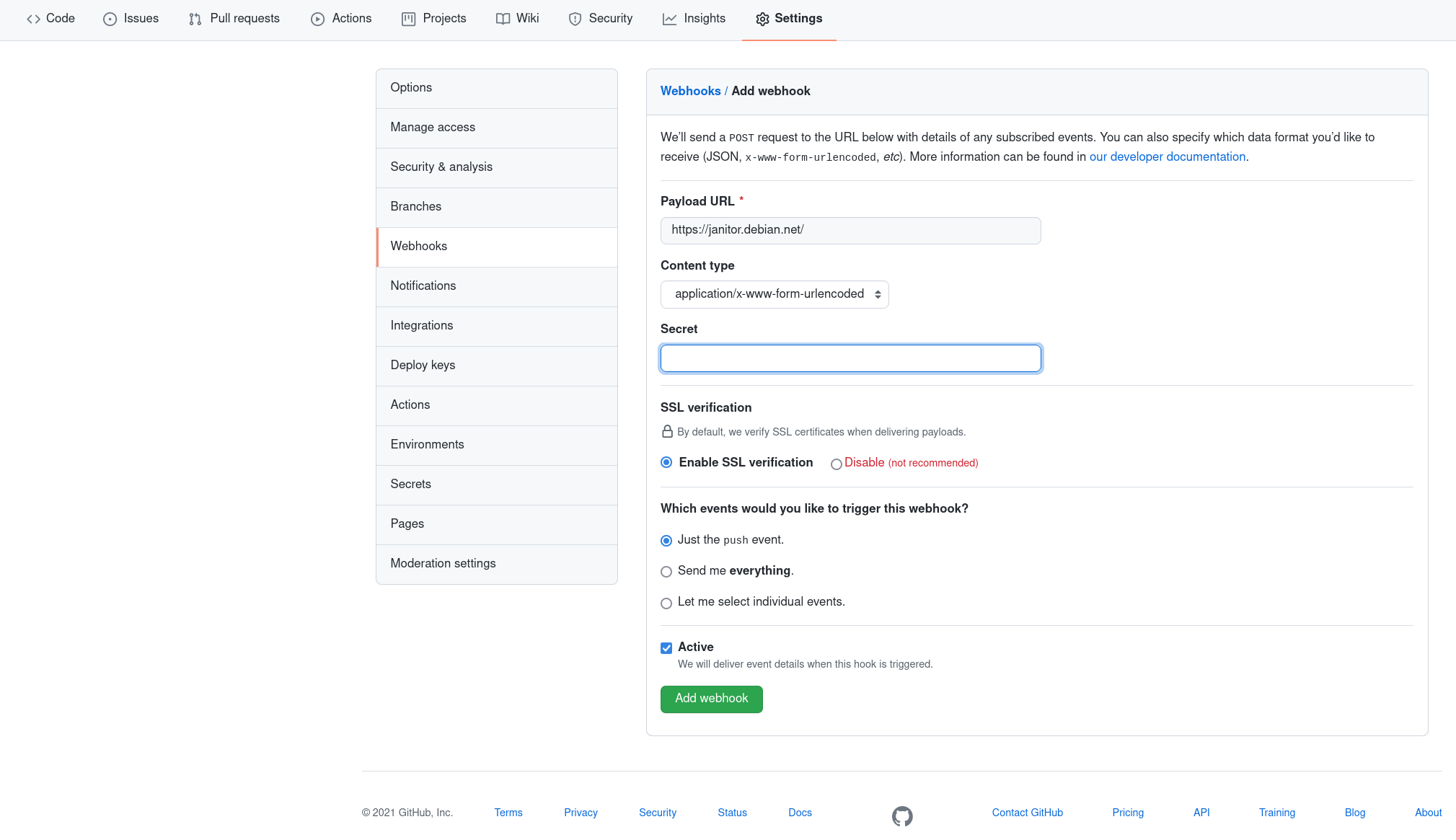
webhooks for upstream repositories At the moment there is no service in Debian (yet - perhaps this is something that vcswatch or a sibling service could also do?) that scans upstream repositories for changes. However, if you maintain an upstream package, you can use a webhook to notify the janitor that commits have been made to your repository, and it will create a new package in fresh-snapshots. Webhooks from the following hosting site software are currently supported: You can simply use the URL https://janitor.debian.net/ as the target for hooks. There is no need to specify a secret, and the hook can either use a JSON or form encoding payload. The endpoint should tell you whether it understood a webhook request, and whether it took any action. It s fine to submit webhooks for repositories that the janitor does not (yet) know about.
GitHub For GitHub, you can do so in the Webhooks section of the Settings tab. Fill the form as shown below and click on Add webhook:
GitLab On GitLab instances, you can find the Webhooks tab under the Settings menu for each repository (under the gear symbol). Fill the form in as shown below and click Add Webhook:
Launchpad For Launchpad, go to the repository (for Git) web view and click Manage Webhooks. From there, you can add a new webhook; fill the form in as shown below and click Add Webhook:

25 August 2021

Jelmer Vernooij: Thousands of Debian packages updated from their upstream Git repository

The Debian Janitor is an automated system that commits fixes for (minor) issues in Debian packages that can be fixed by software. It gradually started proposing merges in early December. The first set of changes sent out ran lintian-brush on sid packages maintained in Git. This post is part of a series about the progress of the Janitor. Linux distributions like Debian fulfill an important function in the FOSS ecosystem - they are system integrators that take existing free and open source software projects and adapt them where necessary to work well together. They also make it possible for users to install more software in an easy and consistent way and with some degree of quality control and review. One of the consequences of this model is that the distribution package often lags behind upstream releases. This is especially true for distributions that have tighter integration and standardization (such as Debian), and often new upstream code is only imported irregularly because it is a manual process - both updating the package, but also making sure that it still works together well with the rest of the system. The process of importing a new upstream used to be (well, back when I started working on Debian packages) fairly manual and something like this:

Ecosystem Improvements However, there have been developments over the last decade that make it easier to import new upstream releases into Debian packages.
Uscan and debian QA watch Uscan and debian/watch have been around for a while and make it possible to find upstream tarballs. A debian watch file usually looks something like this:
1
2
version=4
http://somesite.com/dir/filenamewithversion.tar.gz
The QA watch service regularly polls all watch locations in the archive and makes the information available, so it s possible to know which packages have changed without downloading each one of them.
Git Git is fairly ubiquitous nowadays, and most upstream projects and packages in Debian use it. There are still exceptions that do not use any version control system or that use a different control system, but they are becoming increasingly rare. [1]
debian/upstream/metadata DEP-12 specifies a file format with metadata about the upstream project that a package was based on. In particular relevant for our case is the fact it has fields for the location of the upstream version control location. debian/upstream/metadata files look something like this:
1
2
3
---
Repository: https://www.dulwich.io/code/dulwich/
Repository-Browse: https://www.dulwich.io/code/dulwich/
While DEP-12 is still a draft, it has already been widely adopted - there are about 10000 packages in Debian that ship a debian/upstream/metadata file with Repository information.
Autopkgtest The Autopkgtest standard and associated tooling provide a way to run a defined set of tests against an installed package. This makes it possible to verify that a package is working correctly as part of the system as a whole. ci.debian.net regularly runs these tests against Debian packages to detect regressions.
Vcs-Git headers The Vcs-Git headers in debian/control are the equivalent of the Repository field in debian/upstream/metadata, but for the packaging repositories (as opposed to the upstream ones). They ve been around for a while and are widely adopted, as can be seen from zack s stats: The vcswatch service that regularly polls packaging repositories to see whether they have changed makes it a lot easier to consume this information in usable way.
Debhelper adoption Over the last couple of years, Debian has slowly been converging on a single build tool - debhelper s dh interface. Being able to rely on a single build tool makes it easier to write code to update packaging when upstream changes require it.
Debhelper DWIM Debhelper (and its helpers) increasingly can figure out how to do the Right Thing in many cases without being explicitly configured. This makes packaging less effort, but also means that it s less likely that importing a new upstream version will require updates to the packaging. With all of these improvements in place, it actually becomes feasible in a lot of situations to update a Debian package to a new upstream version automatically. Of course, this requires that all of this information is available, so it won t work for all packages. In some cases, the packaging for the older upstream version might not apply to the newer upstream version. The Janitor has attempted to import a new upstream Git snapshot and a new upstream release for every package in the archive where a debian/watch file or debian/upstream/metadata file are present. These are the steps it uses:
  • Find new upstream version
    • If release, use debian/watch - or maybe tagged in upstream repository
    • If snapshot, use debian/upstream/metadata s Repository field
    • If neither is available, use guess-upstream-metadata from upstream-ontologist to guess the upstream Repository
  • Merge upstream version into packaging repository, possibly importing tarballs using pristine-tar
  • Update the changelog file to mention the new upstream version
  • Run some checks to ensure there are no unintentional changes, e.g.:
    • Scan diff between old and new for surprising license changes
      • Today, abort if there are any - in the future, maybe update debian/copyright
    • Check for obvious compatibility breaks - e.g. sonames changing
  • Attempt to update the packaging to reflect upstream changes
    • Refresh patches
  • Attempt to build the package with deb-fix-build, to deal with any missing dependencies
  • Run the autopkgtests with deb-fix-build to deal with missing dependencies, and abort if any tests fail
Results When run over all packages in unstable (sid), this process works for a surprising number of them.
Fresh Releases For fresh-releases (aka imports of upstream releases), processing all packages maintained in Git for which QA watch reports new releases (about 11,000): That means about 2300 packages updated, and about 4000 unchanged.
Fresh Snapshots For fresh-snapshots (aka imports of latest Git commit from upstream), processing all packages maintained in Git (about 26,000): Or 5100 packages updated and 2100 for which there was nothing to do, i.e. no upstream commits since the last Debian upload. As can be seen, this works for a surprising fraction of packages. It s possible to get the numbers up even higher, by both improving the tooling, the autopkgtests and the metadata that is provided by packages.
Using these packages All the packages that have been built can be accessed from the Janitor APT repository. More information can be found at https://janitor.debian.net/fresh, but in short - run:
1
2
3
4
5
6
echo deb "[arch=amd64 signed-by=/usr/share/keyrings/debian-janitor-archive-keyring.gpg]" \
    https://janitor.debian.net/ fresh-snapshots main   sudo tee /etc/apt/sources.list.d/fresh-snapshots.list
echo deb "[arch=amd64 signed-by=/usr/share/keyrings/debian-janitor-archive-keyring.gpg]" \
    https://janitor.debian.net/ fresh-releases main   sudo tee /etc/apt/sources.list.d/fresh-releases.list
sudo curl -o /usr/share/keyrings/debian-janitor-archive-keyring.gpg https://janitor.debian.net/pgp_keys
apt update
And then you can install packages from the fresh-snapshots (upstream git snapshots) or fresh-releases suites on a case-by-case basis by running something like:
1
apt install -t fresh-snapshots r-cran-roxygen2
Most packages are updated based on information provided by vcswatch and qa watch, but it s also possible for upstream repositories to call a web hook to trigger a refresh of a package. These packages were built against unstable, but should in almost all cases also work for testing.
Caveats Of course, since these packages are built automatically without human supervision it s likely that some of them will have bugs in them that would otherwise have been caught by the maintainer.
[1]I m not saying that a monoculture is great here, but it does help distributions.

27 June 2021

Louis-Philippe V ronneau: Writing QA Scripts for Debian Teams

Since I joined the Debian Python Team, I have had a lot of fun working on different QA issues. Although I'm still a Perl illiterate1, I've for example contributed to a few Lintian tags. There are multiple ways to make mass QA changes to team-managed packages. Projects like the Debian Janitor are more than fantastic: they make for a robust, thorough and automated way to fix QA issues in the archive and I don't have enough good words to describe the amazing work of Jelmer Vernooij on the toolsuite the Janitor uses. But with robustness comes complexity. The Janitor is currently based on 10 different subtools (silver-platter, ognibuild, lintian-brush, ...) and if you want to use it to fix a bug, you first need to make sure there's a Lintian tag that flags the issue you're working on. Then you need to write a lintian-brush fixer to fix said issue. Sadly, sometimes writing a new Lintian tag to flag a trivial changes is not the appropriate course of action and only creates clutter. All this to say until now, I was a missing a "quick and somewhat dirty2" way to make simple one-off changes to a bunch of packages. 200 lines of Python later, I'm happy to report I have a simple way to replace the old Clojure Team email in d/control by the new one for all of our packages. Even better, although this script doesn't aim to be a versatile tool like the Janitor is, most of the functions can be reused for other similar one-off scripts. Many thanks to Felix Lechner showing me the very handy Lintian Query JSON interface!

  1. I don't really enjoy coding in Perl, but it makes up so much of the current Debian infrastructure that I wish I did. I keep telling myself I should buy an "Introduction to Perl" book...
  2. A quick and dirty way to make those changes would've been to write a shell script, but one of my 2021 resolution is to use Python for all my scripting needs.

14 May 2021

Jelmer Vernooij: Ognibuild

The Debian Janitor is an automated system that commits fixes for (minor) issues in Debian packages that can be fixed by software. It gradually started proposing merges in early December. The first set of changes sent out ran lintian-brush on sid packages maintained in Git. This post is part of a series about the progress of the Janitor. The FOSS world uses a wide variety of different build tools; given a git repository or tarball, it can be hard to figure out how to build and install a piece of software. Humans will generally know what build tool a project is using when they check out a project from git, or they can read the README. And even then, the answer may not always be straightforward to everybody. For automation, there is no obvious place to figure out how to build or install a project.

Debian For Debian packages, Debian maintainers generally will have determined that the appropriate tools to invoke are, and added appropriate invocations to debian/rules. This is really nice when rebuilding all of Debian - one can just invoke debian/rules - a consistent interface - and it will in turn invoke the right tools to build the package, meeting a long list of requirements. With newer versions of debhelper and most common build systems, debhelper can figure a lot of this out automatically - the maintainer just has to add the appropriate build and run time dependencies. However, debhelper needs to be consistent in its behaviour per compat level - otherwise builds might start failing with different versions of debhelper, when the autodetection logic is changed. debhelper can also only do the right thing if all the necessary dependencies are present. debhelper also only functions in the context of a Debian package.
Ognibuild Ognibuild is a new tool that figures out the build system in use by an upstream project, as well as the other dependencies it needs. This information can then be used to invoke said build system, or to e.g. add missing build dependencies to a Debian package. Ognibuild uses a variety of techniques to work out what the dependencies for an upstream package are:
  • Extracting dependencies and other requirements declared in build system metadata (e.g. setup.py)
  • Attempting builds and parsing build logs for missing dependencies (repeating until the build succeeds), calling out to buildlog-consultant
Once it is determined which dependencies are missing, they can be resolved in a variety of ways. Apt can be invoked to install missing dependencies on Debian systems (optionally in a chroot) or ecosystem-specific tools can be used to do so (e.g. pypi or cpan). Instead of installing packages, the tool can also simply inform the user about the missing packages and commands to install them, or update a Debian package appropriately (this is what deb-fix-build does). The target audience of ognibuild are people who need to (possibly from automation) build a variety of projects from different ecosystems or users who are looking to just install a project from source. Developers who are just hacking on e.g. a Python project are better off directly invoking the ecosystem-native tools rather than a wrapper like ognibuild.
Supported ecosystems (Partially) supported ecosystems currently include:
  • Combinations of make and autoconf, automake or CMake
  • Python, including fetching packages from pypi
  • Perl, including fetching packages from cpan
  • Haskell, including fetching from hackage
  • Ninja/Meson
  • Maven
  • Rust, including fetching packages from crates.io
  • PHP Pear
  • R, including fetching packages from CRAN and Bioconductor
For a full list, see the README.
Usage Ognibuild provides a couple of top-level subcommands that will seem familiar to anybody who has used a couple of other build systems:
  • ogni clean - remove build artifacts
  • ogni dist - create a dist tarball
  • ogni build - build the project in the current directory
  • ogni test - run the test suite
  • ogni install - install the project somewhere
  • ogni info - display project information including discovered build system and dependencies
  • ogni exec - run an arbitrary command but attempt to resolve issues like missing dependencies
These tools all take a couple of common options:
resolve=apt auto native Specifies how to resolve any missing dependencies:
  • apt: install the appropriate dependency using apt
  • native: install dependencies using native tools like pip or cpan
  • auto: invoke either apt or native package install, depending on whether the current user is allowed to invoke apt
schroot=name Run inside of a schroot.
explain do not make any changes but tell the user which native on apt packages they could install. There are also subcommand-specific options, e.g. to install to a specific directory on restrict which tests are run.
Examples
Creating a dist tarball
1
2
3
4
5
6
7
8
9
% git clone https://github.com/dulwich/dulwich
% cd dulwich
% ogni --schroot=unstable-amd64-sbuild dist
 
Writing dulwich-0.20.21/setup.cfg
creating dist
Creating tar archive
removing 'dulwich-0.20.21' (and everything under it)
Found new tarball dulwich-0.20.21.tar.gz in /var/run/schroot/mount/unstable-amd64-sbuild-974d32d7-6f10-4e77-8622-b6a091857e85/build/tmpucazj7j7/package/dist.
Installing ldb from source, resolving dependencies using apt
1
2
3
4
5
6
7
8
9
% wget https://download.samba.org/pub/ldb/ldb-2.3.0.tar.gz
% tar xvfz ldb-2.3.0.tar.gz
% cd ldb-2.3.0
% ogni install --prefix=/tmp/ldb
 
+ install /tmp/ldb/include/ldb.h (from include/ldb.h)
 
Waf: Leaving directory  /tmp/ldb-2.3.0/bin/default'
'install' finished successfully (11.395s)
Running all tests from XML::LibXML::LazyBuilder
1
2
3
4
5
6
% wget  https://cpan.metacpan.org/authors/id/T/TO/TORU/XML-LibXML-LazyBuilder-0.08.tar.gz _ <https://cpan.metacpan.org/authors/id/T/TO/TORU/XML-LibXML-LazyBuilder-0.08.tar.gz> _
% tar xvfz XML-LibXML-LazyBuilder-0.08.tar.gz
Cd XML-LibXML-LazyBuilder-0.08
% ogni test
 
Current Status ognibuild is still in its early stages, but works well enough that it can detect and invoke the build system for most of the upstream projects packaged in Debian. If there are buildsystems that it currently lacks support for or other issues, then I d welcome any bug reports.

Next.