Dark Horse is a science fiction romance novel, the first of a five
book series as of this writing. It is self-published, although it is
sufficiently well-edited and packaged that I had to do some searching to
confirm that.
Rose was abducted by aliens. The Tecrans picked her up along with a
selection of Earth animals, kept her in a cell in their starship, and
experimented on her. As the book opens, she has managed to make her
escape with the aid of an AI named Sazo who was also imprisoned on the
Tecran ship. Sazo dealt with the Tecrans, dropped the ship in the middle
of Grih territory, and then got Rose and most of the animals on shuttles
to a nearby planet.
Dav Jallan is the commander of the ship the Grih sent to investigate the
unexplained appearance of a Class 5 Tecran warship in the middle of their
territory. The Grih and the Tecran, along with three other species, are
members of the United Council, which means in theory they're all at peace.
With the Tecran, that theory is often strained. Dav is not going to turn
down one of their highly-advanced Class 5 warships delivered to him on a
silver platter. There is only the matter of the unexpected cargo, the
first orange dots (indicating unknown life forms) that most of the Grih
have ever seen.
There is a romance. That romance did not work for me. I thought it was
highly unprofessional on Dav's part and a bit too obviously constructed on
the author's part. It also leans on the subgenre convention that aliens
can be remarkably physically similar and sexually compatible, which always
causes problems for my suspension of disbelief even though I know it's no
less plausible than faster-than-light travel.
Despite that, I had so much fun with this book! It was absolutely
delightful and weirdly grabby in a way that caught me by surprise. I was
skimming some parts of it to write this review and found myself re-reading
multiple pages before I dragged myself back on task.
I think the most charming part of this book is that the United Council has
a law called the Sentient Beings Agreement that makes what the Tecran were
doing extremely illegal, and the Grih and the other non-Tecran aliens take
this very seriously and with a refreshing lack of cynicism. Rose has a
typical human reaction to ending up in a place where she doesn't know the
rules and isn't entirely an expected guest. She almost reflexively
smoothes over miscommunications and tensions, trying to adapt to their
expectations. And then, repeatedly, the Grih realize how much work she's
doing to adapt to them, feel enraged at the Tecran and upset that they
didn't understand or properly explain something, and find some way to make
Rose feel more comfortable. It's surprisingly soothing and comforting to
read.
It occurred to me in several places that Dark Horse could be read
as a wish-fulfillment fantasy of what life as a woman could be like if men
took their fair share of the
mental
load. (This concept is usually applied to housework, but I think it
generalizes to other social and communication contexts.) I suspect this
was not an accident.
There is a lot of wish fulfillment in this book. The Grih are very
human-like but hunky, which is convenient for the romance subplot. They
struggle to sing, value music exceptionally highly, and consider Rose's
speaking voice beautifully musical. Her typical human habit of singing to
herself is a source of immediate and almost overwhelming fascination. The
supplies Rose takes from the Tecran ship when she flees just happen to be
absurdly expensive scented shampoo and equally expensive luxury adaptable
clothing. The world she lands on, and the Grih ship, are low-gravity
compared to Earth, so Rose is unusually strong for her size. Grih
military camouflage has no effect on her human vision. The book is set up
to make Rose special.
If that type of wish fulfillment is going to grate, wait on this book
until you're more in the mood for it. But I like wish fulfillment
books when they're done well. Part of why I like to read is to imagine a
better world. And Rose isn't doted on; despite their hospitality, she's
constantly underestimated by the Grih. Even with their deep belief in the
Sentient Beings Agreement, they find it hard to believe that an unknown
sentient, even an advanced sentient, is really their equal. Their concern
at the start is somewhat patronizing, so watching Rose constantly surprise
them delighted the part of my brain that likes both competence porn and
deserved reversals, even though the competence here is often due to
accidents of biology. It helps that Diener tells the story in alternating
perspectives, so the reader first watches Rose do something practical and
straightforward from her perspective and then gets to enjoy the profound
surprise and chagrin of the aliens.
There is a plot beneath this first contact story, and beyond the political
problem of figuring out what to do with Rose and the Tecran. Sazo, Rose's
AI friend, does not want the Grih to know he exists. He has a history
that Rose does not know about and may not be entirely safe. As the
political situation with the Tecran escalates, Sazo is pursuing goals of
his own, and Rose has a firm opinion about where her loyalties should lie.
The resolution is nothing ground-breaking as far as SF goes, but I thought
it was satisfyingly tense and complex. Dark Horse leaves obvious
room for a sequel, but it comes to a satisfying conclusion.
The writing is serviceable, particularly once you get into the story. I
would not call it great, and it's not going to win any literary awards,
but it didn't interfere with my enjoyment of the story.
This is not the sort of book that will make anyone's award list, but it is
easily in the top five of books I had the most fun reading this year.
Maybe save it for when you're looking for something light and wholesome
and don't mind some rather obvious tropes, but if you're in the mood for
imagining people who take laws seriously and sincerely try to help other
people, I found this an utterly delightful way to pass the time. I
immediately bought the sequel. Recommended.
Followed by Dark Deeds.
Rating: 8 out of 10
Beyond Control is science fiction erotica (dystopian erotic
romance, per the marketing) and a direct sequel to
Beyond Shame. These books shift
protagonists with each volume and enough of the world background is
explained that you could start here, but there are significant spoilers
for the previous book. I read this book as part of the Beyond
Series Bundle (Books 1-3), which is what the sidebar information is for.
This is one of those reviews that I write because I'm stubborn about
reviewing all the books I read, not because it's likely to be useful to
anyone. There are also considerably more spoilers for the shape of the
story than I normally include, so be warned.
The Beyond series is erotica. Specifically, so far, consensual BDSM
erotica with bisexuality but otherwise typical gender stereotypes. The
authors (Kit Rocha is a pen name for Donna Herren and Bree Bridges) are
women, so it's more female gaze than male gaze, but by erotica I don't
mean romance with an above-average number of steamy scenes. I mean it
felt like half the book by page count was descriptions of sex.
This review is rather pointless because, one, I'm not going to review the
sex that's the main point of the book, and two, I skimmed all the sex and
read it for the story because I'm weird. Beyond Shame got me
interested in these absurdly horny people and their post-apocalyptic
survival struggles in the outskirts of a city run by a religious
surveillance state, and I wanted to find out what happened next. Besides,
this book promised to focus on my favorite character from the first novel,
Lex, and I wanted to read more about her.
Beyond Control uses a series pattern that I understand is common in
romance but which is not often seen in SFF (my usual genre): each book
focuses on a new couple adjacent to the previous couple, while the happily
ever after of the previous couple plays out in the background. In this
case, it also teases the protagonists of the next book. I can see why
romance uses this structure: it's an excuse to provide satisfying
interludes for the reader. In between Lex and Dallas's current
relationship problems, one gets to enjoy how well everything worked out
for Noelle and how much she's grown.
In Beyond Shame, Lex was the sort-of partner of Dallas O'Kane, the
leader of the street gang that is running Sector Four. (Picture a circle
surrounding the rich-people-only city of Eden. That circle is divided
into eight wedge-shaped sectors, which provide heavy industries,
black-market pleasures, and slums for agricultural workers.) Dallas is an
intensely possessive, personally charismatic semi-dictator who cultivates
the image of a dangerous barbarian to everyone outside and most of the
people inside Sector Four. Since he's supposed to be one of the good
guys, this is more image than reality, but it's not entirely disconnected
from reality.
This book is about Lex and Dallas forming an actual relationship, instead
of the fraught and complicated thing they had in the first book. I was
hoping that this would involve Dallas becoming less of an asshole. It
unfortunately does not, although some of what I attributed to malice may
be adequately explained by stupidity. I'm not sure that's an improvement.
Lex is great, just like she was in the first book. It's obvious by this
point in the series that she does most of the emotional labor of keeping
the gang running, and her support is central to Dallas's success. Like
most of the people in this story, she has a nasty and abusive background
that she's still dealing with in various ways. Dallas's possessiveness is
intensely appealing to her, but she wants that possessiveness on different
terms than Dallas may be willing to offer, or is even aware of. Lex was,
I thought, exceptionally clear about what she wanted out of this
relationship. Dallas thinks this is entirely about sex, and is, in
general, dumber than a sack of hammers. That means fights. Also orgies,
but, well, hopefully you knew what you were getting into if you picked up
this book.
I know, I know, it's erotica, that's the whole point, but these people
have a truly absurd amount of sex. Eden puts birth control in the water
supply, which is a neat way to simplify some of the in-story consequences
of erotica. They must be putting aphrodisiacs in the water supply as
well.
There was a lot of sector politics in this book that I found way more
interesting than it had any right to be. I really like most of these
people, even Dallas when he manages to get his three brain cells connected
for more than a few minutes. The events of the first book have a lot of
significant fallout, Lex continues being a badass, the social dynamics
between the women are very well-done (and pass the
Bechdel test yet again
even though this is mostly traditional-gender-role erotica), and if Dallas
had managed to understand what he did wrong at a deeper-than-emotional
level, I would have rather enjoyed the non-erotica story parts. Alas.
I therefore wouldn't recommend this book even if I were willing to offer
any recommendations about erotica (which I'm not). I was hoping it was
going somewhere more rewarding than it did. But I still kind of want to
read another one? I am weirdly fascinated with the lives of these people.
The next book is about Six, who has the potential to turn into the sort of
snarky, cynical character I love reading about. And it's not that hard to
skim over the orgies. Maybe Dallas will get one additional brain cell per
book?
Followed by Beyond Pain.
Rating: 5 out of 10
Nation is a stand-alone young adult fantasy novel. It was
published in the gap between Discworld novels Making Money and Unseen
Academicals.
Nation starts with a plague. The Russian influenza has ravaged
Britain, including the royal family. The next in line to the throne is
off on a remote island and must be retrieved and crowned as soon as
possible, or an obscure provision in Magna Carta will cause no end of
trouble. The Cutty Wren is sent on this mission, carrying the
Gentlemen of Last Resort.
Then comes the tsunami.
In the midst of fire raining from the sky and a wave like no one has ever
seen, Captain Roberts tied himself to the wheel of the Sweet Judy
and steered it as best he could, straight into an island. The sole
survivor of the shipwreck: one Ermintrude Fanshaw, daughter of the
governor of some British island possessions. Oh, and a parrot.
Mau was on the Boys' Island when the tsunami came, going through his rite
of passage into manhood. He was to return to the Nation the next morning
and receive his tattoos and his adult soul. He survived in a canoe. No
one else in the Nation did.
Terry Pratchett considered Nation to be his best book. It is not
his best book, at least in my opinion; it's firmly below the top tier of
Discworld novels, let alone Night Watch.
It is, however, an interesting and enjoyable book that tackles gods and
religion with a sledgehammer rather than a knife.
It's also very, very dark and utterly depressing at the start, despite a
few glimmers of Pratchett's humor. Mau is the main protagonist at first,
and the book opens with everyone he cares about dying. This is the place
where I thought Pratchett diverged the most from his Discworld style: in
Discworld, I think most of that would have been off-screen, but here we
follow Mau through the realization, the devastation, the disassociation,
the burials at sea, the thoughts of suicide, and the complete upheaval of
everything he thought he was or was about to become. I found the start of
this book difficult to get through. The immediate transition into
potentially tragic misunderstandings between Mau and Daphne (as Ermintrude
names herself once there is no one to tell her not to) didn't help.
As I got farther into the book, though, I warmed to it. The best parts
early on are Daphne's baffled but scientific attempts to understand Mau's
culture and her place in it. More survivors arrive, and they start to
assemble a community, anchored in large part by Mau's stubborn
determination to do what's right even though he's lost all of his
moorings. That community eventually re-establishes contact with the rest
of the world and the opening plot about the British monarchy, but not
before Daphne has been changed profoundly by being part of it.
I think Pratchett worked hard at keeping Mau's culture at the center of
the story. It's notable that the community that reforms over the course
of the book essentially follows the patterns of Mau's lost Nation and
incorporates Daphne into it, rather than (as is so often the case) the
other way around. The plot itself is fiercely anti-colonial in a way that
mostly worked. Still, though, it's a quasi-Pacific-island culture written
by a white British man, and I had some qualms.
Pratchett quite rightfully makes it clear in the afterward that this is an
alternate world and Mau's culture is not a real Pacific island culture.
However, that also means that its starkly gender-essentialist nature was a
free choice, rather than one based on some specific culture, and I found
that choice somewhat off-putting. The religious rituals are all gendered,
the dwelling places are gendered, and one's entire life course in Mau's
world seems based on binary classification as a man or a woman. Based on
Pratchett's other books, I assume this was more an unfortunate default
than a deliberate choice, but it's still a choice he could have avoided.
The end of this book wrestles directly with the relative worth of Mau's
culture versus that of the British. I liked most of this, but the twists
that Pratchett adds to avoid the colonialist results we saw in our world
stumble partly into the trap of making Mau's culture valuable by British
standards. (I'm being a bit vague here to avoid spoilers.) I think it is
very hard to base this book on a different set of priorities and still
bring the largely UK, US, and western European audience along, so I don't
blame Pratchett for failing to do it, but I'm a bit sad that the world
still revolved around a British axis.
This felt quite similar to Discworld to me in its overall sensibilities,
but with the roles of moral philosophy and humor reversed. Discworld
novels usually start with some larger-than-life characters and an absurd
plot, and then the moral philosophy sneaks up behind you when you're not
looking and hits you over the head. Nation starts with the moral
philosophy: Mau wrestles with his gods and the problem of evil in a way
that reminded me of Job, except with a far different pantheon and rather
less tolerance for divine excuses on the part of the protagonist. It's
the humor, instead, that sneaks up on you and makes you laugh when the
plot is a bit too much. But the mix arrives at much the same place: the
absurd hand-in-hand with the profound, and all seen from an angle that
makes it a bit easier to understand.
I'm not sure I would recommend Nation as a good place to start with
Pratchett. I felt like I benefited from having read a lot of Discworld
to build up my willingness to trust where Pratchett was going. But it has
the quality of writing of late Discworld without the (arguable) need to
read 25 books to understand all of the backstory. Regardless,
recommended, and you'll never hear Twinkle Twinkle Little Star in
quite the same way again.
Rating: 8 out of 10
The Stars, Like Dust is usually listed as the first book in
Asimov's lesser-known Galactic Empire Trilogy since it takes place before
Pebble in the Sky. Pebble in the
Sky was published first, though, so I count it as the second book. It is
very early science fiction with a few mystery overtones.
Buying books produces about 5% of the pleasure of reading them while
taking much less than 5% of the time. There was a time in my life when I
thoroughly enjoyed methodically working through a used book store, list in
hand, tracking down cheap copies to fill in holes in series. This means
that I own a lot of books that I thought at some point that I would want
to read but never got around to, often because, at the time, I was feeling
completionist about some series or piece of world-building. From time to
time, I get the urge to try to read some of them.
Sometimes this is a poor use of my time.
The Galactic Empire series is from Asimov's first science fiction period,
after the Foundation series but contemporaneous with their
collection into novels. They're set long, long before Foundation,
but after humans have inhabited numerous star systems and Earth has become
something of a backwater. That process is just starting in The
Stars, Like Dust: Earth is still somewhere where an upper-class son might
be sent for an education, but it has been devastated by nuclear wars and
is well on its way to becoming an inward-looking relic on the edge of
galactic society.
Biron Farrill is the son of the Lord Rancher of Widemos, a wealthy noble
whose world is one of those conquered by the Tyranni. In many other SF
novels, the Tyranni would be an alien race; here, it's a hierarchical and
authoritarian human civilization. The book opens with Biron discovering a
radiation bomb planted in his dorm room. Shortly after, he learns that
his father had been arrested. One of his fellow students claims to be on
Biron's side against the Tyranni and gives him false papers to travel to
Rhodia, a wealthy world run by a Tyranni sycophant.
Like most books of this era, The Stars, Like Dust is a short novel
full of plot twists. Unlike some of its contemporaries, it's not devoid
of characterization, but I might have liked it better if it were. Biron
behaves like an obnoxious teenager when he's not being an arrogant ass.
There is a female character who does a few plot-relevant things and at no
point is sexually assaulted, so I'll give Asimov that much, but the gender
stereotypes are ironclad and there is an entire subplot focused on what I
can only describe as seduction via petty jealousy.
The writing... well, let me quote a typical passage:
There was no way of telling when the threshold would be reached.
Perhaps not for hours, and perhaps the next moment. Biron remained
standing helplessly, flashlight held loosely in his damp hands. Half
an hour before, the visiphone had awakened him, and he had been at
peace then. Now he knew he was going to die.
Biron didn't want to die, but he was penned in hopelessly, and there
was no place to hide.
Needless to say, Biron doesn't die. Even if your tolerance for pulp
melodrama is high, 192 small-print pages of this sort of thing is
wearying.
Like a lot of Asimov plots, The Stars, Like Dust has some of the
shape of a mystery novel. Biron, with the aid of some newfound companions
on Rhodia, learns of a secret rebellion against the Tyranni and attempts
to track down its base to join them. There are false leads, disguised
identities, clues that are difficult to interpret, and similar classic
mystery trappings, all covered with a patina of early 1950s imaginary
science. To me, it felt constructed and artificial in ways that made the
strings Asimov was pulling obvious. I don't know if someone who likes
mystery construction would feel differently about it.
The worst part of the plot thankfully doesn't come up much. We learn
early in the story that Biron was on Earth to search for a long-lost
document believed to be vital to defeating the Tyranni. The nature of
that document is revealed on the final page, so I won't spoil it, but if
you try to think of the stupidest possible document someone could have
built this plot around, I suspect you will only need one guess. (In
Asimov's defense, he blamed Galaxy editor H.L. Gold for persuading
him to include this plot, and disavowed it a few years later.)
The Stars, Like Dust is one of the worst books I have ever read.
The characters are overwrought, the politics are slapdash and build on
broad stereotypes, the romantic subplot is dire and plays out mainly via
Biron egregiously manipulating his petulant love interest, and the writing
is annoying. Sometimes pulp fiction makes up for those common flaws
through larger-than-life feats of daring, sweeping visions of future
societies, and ever-escalating stakes. There is little to none of that
here. Asimov instead provides tedious political maneuvering among a class
of elitist bankers and land owners who consider themselves natural
leaders. The only places where the power structures of this future
government make sense are where Asimov blatantly steals them from either
the Roman Empire or the Doge of Venice.
The one thing this book has going for it the thing, apart from
bloody-minded completionism, that kept me reading is that the technology
is hilariously weird in that way that only 1940s and 1950s science fiction
can be. The characters have access to communication via some sort of
interstellar telepathy (messages coded to a specific person's "brain
waves") and can travel between stars through hyperspace jumps, but each
jump is manually calculated by referring to the pilot's (paper!) volumes of
the Standard Galactic Ephemeris. Communication between ships (via
"etheric radio") requires manually aiming a radio beam at the area in
space where one thinks the other ship is. It's an unintentionally
entertaining combination of technology that now looks absurdly primitive
and science that is so advanced and hand-waved that it's obviously made
up.
I also have to give Asimov some points for using spherical coordinates.
It's a small thing, but the coordinate systems in most SF novels and TV
shows are obviously not fit for purpose.
I spent about a month and a half of this year barely reading, and while
some of that is because I finally tackled a few projects I'd been putting
off for years, a lot of it was because of this book. It was only 192
pages, and I'm still curious about the glue between Asimov's
Foundation and Robot series, both of which I devoured as a
teenager. But every time I picked it up to finally finish it and start
another book, I made it about ten pages and then couldn't take any more.
Learn from my error: don't try this at home, or at least give up if the
same thing starts happening to you.
Followed by The Currents of Space.
Rating: 2 out of 10
I recently had the most astonishingly bad experience with UPS, the courier company. They severely damaged my parcels, and were very bad about UK import VAT, ultimately ending up harassing me on autopilot.
The only thing that got their attention was my draft Particulars of Claim for intended legal action.
Surprisingly, I got them to admit in writing that the disbursement fee they charge recipients alongside the actual VAT, is just something they made up with no legal basis.
What happened
Autumn last year I ordered some furniture from a company in Germany. This was to be shipped by them to me by courier. The supplier chose UPS.
UPS misrouted one of the three parcels to Denmark. When everything arrived, it had been sat on by elephants. The supplier had to replace most of it, with considerable inconvenience and delay to me, and of course a loss to the supplier.
But this post isn t mostly about that. This post is about VAT. You see, import VAT was due, because of fucking Brexit.
UPS made a complete hash of collecting that VAT. Their computers can t issue coherent documents, their email helpdesk is completely useless, and their automated debt collection systems run along uninfluenced by any external input.
The crazy, including legal threats and escalating late payment fees, continued even after I paid the VAT discrepancy (which I did despite them not yet having provided any coherent calculation for it).
This kind of behaviour is a very small and mild version of the kind of things British Gas did to Lisa Ferguson, who eventually won substantial damages for harassment, plus 10K of costs.
Having tried asking nicely, and sending stiff letters, I too threatened litigation.
I would have actually started a court claim, but it would have included a claim under the Protection from Harassment Act. Those have to be filed under the Part 8 procedure , which involves sending all of the written evidence you re going to use along with the claim form. Collating all that would be a good deal of work, especially since UPS and ControlAccount didn t engage with me at all, so I had no idea which things they might actually dispute. So I decided that before issuing proceedings, I d send them a copy of my draft Particulars of Claim, along with an offer to settle if they would pay me a modest sum and stop being evil robots at me.
Rather than me typing the whole tale in again, you can read the full gory details in the PDF of my draft Particulars of Claim. (I ve redacted the reference numbers).
Outcome
The draft Particulars finally got their attention. UPS sent me an offer: they agreed to pay me 50, in full and final settlement. That was close enough to my offer that I accepted it. I mostly wanted them to stop, and they do seem to have done so. And I ve received the 50.
VAT calculation
They also finally included an actual explanation of the VAT calculation. It s absurd, but it s not UPS s absurd:
The clearance was entered initially with estimated import charges of 400.03, consisting of 387.83 VAT, and 12.20 disbursement fee. This original entry regrettably did not include the freight cost for calculating the VAT, and as such when submitted for final entry the VAT value was adjusted to include this and an amended invoice was issued for an additional 39.84.
HMRC calculate the amount against which VAT is raised using the value of goods, insurance and freight, however they also may apply a VAT adjustment figure.
The VAT Adjustment is based on many factors (Incidental costs in regards to a shipment), which includes charge for currency conversion if the invoice does not list values in Sterling, but the main is due to the inland freight from airport of destination to the final delivery point, as this charge varies, for example, from EMA to Edinburgh would be 150, from EMA to Derby would be 1, so each year UPS must supply HMRC with all values incurred for entry build up and they give an average which UPS have to use on the entry build up as the VAT Adjustment.
The correct calculation for the import charges is therefore as follows:
Goods value divided by exchange rate 2,489.53 EUR / 1.1683 = 2,130.89 GBP
Duty: Goods value plus freight (%) 2,130.89 GBP + 5% = 2,237.43 GBP. That total times the duty rate. X 0 % = 0 GBP
VAT: Goods value plus freight (100%) 2,130.89 GBP + 0 = 2,130.89 GBP
That total plus duty and VAT adjustment 2,130.89 GBP + 0 GBP + 7.49 GBP = 2,348.08 GBP. That total times 20% VAT = 427.67 GBP
As detailed above we must confirm that the final VAT charges applied to the shipment were correct, and that no refund of this is therefore due.
This looks very like HMRC-originated nonsense. If only they had put it on the original bills! It s completely ridiculous that it took four months and near-litigation to obtain it.
Disbursement fee
One more thing. UPS billed me a 12 disbursement fee .
When you import something, there s often tax to pay. The courier company pays that to the government, and the consignee pays it to the courier. Usually the courier demands it before final delivery, since otherwise they end up having to chase it as a debt.
It is common for parcel companies to add a random fee of their own. As I note in my Particulars, there isn t any legal basis for this.
In my own offer of settlement I proposed that UPS should:
State under what principle of English law (such as, what enactment or principle of Common Law), you levy the disbursement fee (or refund it).
To my surprise they actually responded to this in their own settlement letter. (They didn t, for example, mention the harassment at all.) They said (emphasis mine):
A disbursement fee is a fee for amounts paid or processed on behalf of a client. It is an established category of charge used by legal firms, amongst other companies, for billing of various ancillary costs which may be incurred in completion of service. Disbursement fees are not covered by a specific law, nor are they legally prohibited.
Regarding UPS disbursement fee this is an administrative charge levied for the use of UPS deferment account to prepay import charges for clearance through CDS. This charge would therefore be billed to the party that is responsible for the import charges, normally the consignee or receiver of the shipment in question. The disbursement fee as applied is legitimate, and as you have stated is a commonly used and recognised charge throughout the courier industry, and I can confirm that this was charged correctly in this instance.
On UPS s analysis, they can just make up whatever fee they like. That is clearly not right (and I don t even need to refer to consumer protection law, which would also make it obviously unlawful).
And, that everyone does it doesn t make it lawful. There are so many things that are ubiquitous but unlawful, especially nowadays when much of the legal system - especially consumer protection regulators - has been underfunded to beyond the point of collapse.
Next time this comes up I might have a go at getting the fee back. (Obviously I ll have to pay it first, to get my parcel.)
ParcelForce and Royal Mail
I think this analysis doesn t apply to ParcelForce and (probably) Royal Mail. I looked into this in 2009, and I found that Parcelforce had been given the ability to write their own private laws: Schemes made under section 89 of the Postal Services Act 2000.
This is obviously ridiculous but I think it was the law in 2009. I doubt the intervening governments have fixed it.
Furniture
Oh, yes, the actual furniture. The replacements arrived intact and are great :-).
Bluebird is a stand-alone far-future science fiction adventure.
Ten thousand years ago, a star fell into the galaxy carrying three
factions of humanity. The Ascetics, the Ossuary, and the Pyrites each
believe that only their god survived and the other two factions are
heretics. Between them, they have conquered the rest of the galaxy and
its non-human species. The only thing the factions hate worse than each
other are those who attempt to stay outside the faction system.
Rig used to be a Pyrite weapon designer before she set fire to her office
and escaped with her greatest invention. Now she's a Nightbird, a member
of an outlaw band that tries to help refugees and protect her fellow
Kashrini against Pyrite genocide. On her side, she has her girlfriend, an
Ascetic librarian; her ship, Bluebird; and her guns, Panache and
Pizzazz. And now, perhaps, the mysterious Ginka, a Zazra empath and
remarkably capable fighter who helps Rig escape from an ambush by Pyrite
soldiers.
Rig wants to stay alive, help her people, and defy the factions. Pyrite
wants Rig's secrets and, as leverage, has her sister. What Ginka wants is
not entirely clear even to Ginka.
This book is absurd, but I still had fun with it.
It's dangerous for me to compare things to anime given how little anime
that I've watched, but Bluebird had that vibe for me: anime, or
maybe Japanese RPGs or superhero comics. The storytelling is very visual,
combat-oriented, and not particularly realistic. Rig is a pistol
sharpshooter and Ginka is the type of undefined deadly acrobatic fighter
so often seen in that type of media. In addition to her ship, Rig has a
gorgeous hand-maintained racing hoverbike with a beautiful paint job.
It's that sort of book.
It's also the sort of book where the characters obey cinematic logic
designed to maximize dramatic physical confrontations, even if their
actions make no logical sense. There is no facial recognition or
screening, and it's bizarrely easy for the protagonists to end up in same
physical location as high-up bad guys. One of the weapon systems that's
critical to the plot makes no sense whatsoever. At critical moments, the
bad guys behave more like final bosses in a video game, picking up weapons
to deal with the protagonists directly instead of using their supposedly
vast armies of agents. There is supposedly a whole galaxy full of
civilizations with capital worlds covered in planet-spanning cities, but
politics barely exist and the faction leaders get directly involved in the
plot.
If you are looking for a realistic projection of technology or society, I
cannot stress enough that this is not the book that you're looking for.
You probably figured that out when I mentioned ten thousand years of war,
but that will only be the beginning of the suspension of disbelief
problems. You need to turn off your brain and enjoy the action sequences
and melodrama.
I'm normally good at that, and I admit I still struggled because the plot
logic is such a mismatch with the typical novels I read. There are
several points where the characters do something that seems so
monumentally dumb that I was sure Pierlot was setting them up for a fall,
and then I got wrong-footed because their plan worked fine, or exploded
for unrelated reasons. I think this type of story, heavy on dramatic
eye-candy and emotional moments with swelling soundtracks, is a lot easier
to pull off in visual media where all the pretty pictures distract your
brain. In a novel, there's a lot of time to think about the strategy,
technology, and government structure, which for this book is not a good
idea.
If you can get past that, though, Rig is entertainingly snarky and Ginka,
who turns out to be the emotional heart of the book, is an enjoyable
character with a real growth arc. Her background is a bit simplistic and
the villains are the sort of pure evil that you might expect from this
type of cinematic plot, but I cared about the outcome of her story. Some
parts of the plot dragged and I think the editing could have been tighter,
but there was enough competence porn and banter to pull me through.
I would recommend Bluebird only cautiously, since you're going to
need to turn off large portions of your brain and be in the right mood for
nonsensically dramatic confrontations, but I don't regret reading it.
It's mostly in primary colors and the emotional conflicts are not what
anyone would call subtle, but it delivers a character arc and a somewhat
satisfying ending.
Content warning: There is a lot of serious physical injury in this book,
including surgical maiming. If that's going to bother you, you may want
to give this one a pass.
Rating: 6 out of 10
Review: The Library of Broken Worlds, by Alaya Dawn Johnson
Publisher:
Scholastic Press
Copyright:
June 2023
ISBN:
1-338-29064-9
Format:
Kindle
Pages:
446
The Library of Broken Worlds is a young-adult far-future science
fantasy. So far as I can tell, it's stand-alone, although more on that
later in the review.
Freida is the adopted daughter of Nadi, the Head Librarian, and her
greatest wish is to become a librarian herself. When the book opens,
she's a teenager in highly competitive training. Freida is low-wetware,
without the advanced and expensive enhancements of many of the other
students competing for rare and prized librarian positions, which she
makes up for by being the most audacious. She doesn't need wetware to
commune with the library material gods. If one ventures deep into their
tunnels and consumes their crystals, direct physical communion is
possible.
The library tunnels are Freida's second home, in part because that's where
she was born. She was created by the Library, and specifically by Iemaja,
the youngest of the material gods. Precisely why is a mystery. To Nadi,
Freida is her daughter. To Quinn, Nadi's main political rival within the
library, Freida is a thing, a piece of the library, a secondary and
possibly rogue AI. A disruptive annoyance.
The Library of Broken Worlds is the sort of science fiction where
figuring out what is going on is an integral part of the reading
experience. It opens with a frame story of an unnamed girl (clearly
Freida) waking the god Nameren and identifying herself as designed for
deicide. She provokes Nameren's curiosity and offers an Arabian Nights
bargain: if he wants to hear her story, he has to refrain from killing her
for long enough for her to tell it. As one might expect, the main
narrative doesn't catch up to the frame story until the very end of the
book.
The Library is indeed some type of library that librarians can search for
knowledge that isn't available from more mundane sources, but Freida's
personal experience of it is almost wholly religious and oracular. The
library's material gods are identified as AIs, but good luck making sense
of the story through a science fiction frame, even with a healthy
allowance for sufficiently advanced technology being indistinguishable
from magic. The symbolism and tone is entirely fantasy, and late in the
book it becomes clear that whatever the material gods are, they're not
simple technological AIs in the vein of, say, Banks's Ship Minds.
Also, the Library is not solely a repository of knowledge. It is the
keeper of an interstellar peace. The Library was founded after the Great
War, to prevent a recurrence. It functions as a sort of legal system and
grand tribunal in ways that are never fully explained.
As you might expect, that peace is based more on stability than fairness.
Five of the players in this far future of humanity are the Awilu, the most
advanced society and the first to leave Earth (or Tierra as it's called
here); the Mah m, who possess the material war god Nameren of the frame
story; the Lunars and Martians, who dominate the Sol system; and the
surviving Tierrans, residents of a polluted and struggling planet that is
ruthlessly exploited by the Lunars. The problem facing Freida and her
friends at the start of the book is a petition brought by a young Tierran
against Lunar exploitation of his homeland. His name is Joshua, and
Freida is more than half in love with him. Joshua's legal argument
involves interpretation of the freedom node of the treaty that ended the
Great War, a node that precedent says gives the Lunars the freedom to
exploit Tierra, but which Joshua claims has a still-valid originalist
meaning granting Tierrans freedom from exploitation.
There is, in short, a lot going on in this book, and "never fully
explained" is something of a theme. Freida is telling a story to Nameren
and only explains things Nameren may not already know. The reader has to
puzzle out the rest from the occasional hint. This is made more difficult
by the tendency of the material gods to communicate only in visions or
guided hallucinations, full of symbolism that the characters only partly
explain to the reader.
Nonetheless, this did mostly work, at least for me. I started this book
very confused, but by about the midpoint it felt like the background was
coming together. I'm still not sure I understand the aurochs, baobab, and
cicada symbolism that's so central to the framing story, but it's the
pleasant sort of stretchy confusion that gives my brain a good workout. I
wish Johnson had explained a few more things plainly, particularly near
the end of the book, but my remaining level of confusion was within my
tolerances.
Unfortunately, the ending did not work for me. The first time I read it,
I had no idea what it meant. Lots of baffling, symbolic things happened
and then the book just stopped. After re-reading the last 10%, I think
all the pieces of an ending and a bit of an explanation are there, but
it's absurdly abbreviated. This is another book where the author appears
to have been finished with the story before I was.
This keeps happening to me, so this probably says something more about me
than it says about books, but I want books to have an ending. If the
characters have fought and suffered through the plot, I want them to have
some space to be happy and to see how their sacrifices play out, with more
detail than just a few vague promises. If much of the book has been
puzzling out the nature of the world, I would like some concrete
confirmation of at least some of my guesswork. And if you're going to end
the book on radical transformation, I want to see the results of that
transformation. Johnson does an excellent job showing how brutal the
peace of the powerful can be, and is willing to light more things on fire
over the course of this book than most authors would, but then doesn't
offer the reader much in the way of payoff.
For once, I wish this stand-alone turned out to be a series. I think an
additional book could be written in the aftermath of this ending, and I
would definitely read that novel. Johnson has me caring deeply about
these characters and fascinated by the world background, and I'd happily
spend another 450 pages finding out what happens next. But,
frustratingly, I think this ending was indeed intended to wrap up the
story.
I think this book may fall between a few stools. Science fiction readers
who want mysterious future worlds to be explained by the end of the book
are going to be frustrated by the amount of symbolism, allusion, and
poetic description. Literary fantasy readers, who have a higher tolerance
for that style, are going to wish for more focused and polished writing.
A lot of the story is firmly YA: trying and failing to fit in, developing
one's identity, coming into power, relationship drama, great betrayals and
regrets, overcoming trauma and abuse, and unraveling lies that adults tell
you. But this is definitely not a straight-forward YA plot or world
background. It demands a lot from the reader, and while I am confident
many teenage readers would rise to that challenge, it seems like an
awkward fit for the YA marketing category.
About 75% of the way in, I would have told you this book was great and you
should read it. The ending was a let-down and I'm still grumpy about it.
I still think it's worth your attention if you're in the mood for a
sink-or-swim type of reading experience. Just be warned that when the
ride ends, I felt unceremoniously dumped on the pavement.
Content warnings: Rape, torture, genocide.
Rating: 7 out of 10
A Study in Scarlet is the short mystery novel (probably a novella,
although I didn't count words) that introduced the world to Sherlock
Holmes.
I'm going to invoke the 100-year-rule and discuss the plot of this book
rather freely on the grounds that even someone who (like me prior to a few
days ago) has not yet read it is probably not that invested in avoiding
all spoilers. If you do want to remain entirely unspoiled, exercise
caution before reading on.
I had somehow managed to avoid ever reading anything by Arthur Conan
Doyle, not even a short story. I therefore couldn't be sure that some of
the assertions I was making in my review of A Study in Honor were correct. Since A Study in Scarlet
would be quick to read, I decided on a whim to do a bit of research and
grab a free copy of the first Holmes novel. Holmes is such a part of
English-speaking culture that I thought I had a pretty good idea of what
to expect.
This was largely true, but cultural osmosis had somehow not prepared me
for the surprise Mormons.
A Study in Scarlet establishes the basic parameters of a Holmes
story: Dr. James Watson as narrator, the apartment he shares with Holmes
at 221B Baker Street, the Baker Street Irregulars, Holmes's competition
with police detectives, and his penchant for making leaps of logical
deduction from subtle clues. The story opens with Watson meeting Holmes,
agreeing to split the rent of a flat, and being baffled by the apparent
randomness of Holmes's fields of study before Holmes reveals he's a
consulting detective. The first case is a murder: a man is found dead in
an abandoned house, without a mark on him although there are blood
splatters on the walls and the word "RACHE" written in blood.
Since my only prior exposure to Holmes was from cultural references and a
few TV adaptations, there were a few things that surprised me. One is
that Holmes is voluble and animated rather than aloof. Doyle is clearly
going for passionate eccentric rather than calculating mastermind.
Another is that he is intentionally and unabashedly ignorant on any topic
not related to solving mysteries.
My surprise reached a climax, however, when I found incidentally that
he was ignorant of the Copernican Theory and of the composition of the
Solar System. That any civilized human being in this nineteenth
century should not be aware that the earth travelled round the sun
appeared to be to me such an extraordinary fact that I could hardly
realize it.
"You appear to be astonished," he said, smiling at my expression of
surprise. "Now that I do know it I shall do my best to forget it."
"To forget it!"
"You see," he explained, "I consider that a man's brain originally is
like a little empty attic, and you have to stock it with such
furniture as you chose. A fool takes in all the lumber of every sort
that he comes across, so that the knowledge which might be useful to
him gets crowded out, or at best is jumbled up with a lot of other
things so that he has a difficulty in laying his hands upon it. Now
the skilful workman is very careful indeed as to what he takes into
his brain-attic. He will have nothing but the tools which may help
him in doing his work, but of these he has a large assortment, and all
in the most perfect order. It is a mistake to think that that little
room has elastic walls and can distend to any extent. Depend upon it
there comes a time when for every addition of knowledge you forget
something that you knew before. It is of the highest importance,
therefore, not to have useless facts elbowing out the useful ones."
This is directly contrary to my expectation that the best way to make
leaps of deduction is to know something about a huge range of topics so
that one can draw unexpected connections, particularly given the
puzzle-box construction and odd details so beloved in classic mysteries.
I'm now curious if Doyle stuck with this conception, and if there were any
later mysteries that involved astronomy.
Speaking of classic mysteries, A Study in Scarlet isn't quite one,
although one can see the shape of the genre to come. Doyle does not "play
fair" by the rules that have not yet been invented. Holmes at most points
knows considerably more than the reader, including bits of evidence that
are not described until Holmes describes them and research that Holmes
does off-camera and only reveals when he wants to be dramatic. This is
not the sort of story where the reader is encouraged to try to figure out
the mystery before the detective.
Rather, what Doyle seems to be aiming for, and what Watson attempts
(unsuccessfully) as the reader surrogate, is slightly different: once
Holmes makes one of his grand assertions, the reader is encouraged to
guess what Holmes might have done to arrive at that conclusion. Doyle
seems to want the reader to guess technique rather than outcome, while
providing only vague clues in general descriptions of Holmes's behavior at
a crime scene.
The structure of this story is quite odd. The first part is roughly what
you would expect: first-person narration from Watson, supposedly taken
from his journals but not at all in the style of a journal and explicitly
written for an audience. Part one concludes with Holmes capturing and
dramatically announcing the name of the killer, who the reader has never
heard of before. Part two then opens with... a western?
In the central portion of the great North American Continent there
lies an arid and repulsive desert, which for many a long year served
as a barrier against the advance of civilization. From the Sierra
Nevada to Nebraska, and from the Yellowstone River in the north to the
Colorado upon the south, is a region of desolation and silence. Nor
is Nature always in one mood throughout the grim district. It
comprises snow-capped and lofty mountains, and dark and gloomy
valleys. There are swift-flowing rivers which dash through jagged
ca ons; and there are enormous plains, which in winter are white with
snow, and in summer are grey with the saline alkali dust. They all
preserve, however, the common characteristics of barrenness,
inhospitality, and misery.
First, I have issues with the geography. That region contains some of the
most beautiful areas on earth, and while a lot of that region is arid,
describing it primarily as a repulsive desert is a bit much. Doyle's
boundaries and distances are also confusing: the Yellowstone is a
northeast-flowing river with its source in Wyoming, so the area between it
and the Colorado does not extend to the Sierra Nevadas (or even to Utah),
and it's not entirely clear to me that he realizes Nevada exists.
This is probably what it's like for people who live anywhere else in the
world when US authors write about their country.
But second, there's no Holmes, no Watson, and not even the pretense of a
transition from the detective novel that we were just reading. Doyle just
launches into a random western with an omniscient narrator. It features a
lean, grizzled man and an adorable child that he adopts and raises into a
beautiful free spirit, who then falls in love with a wild gold-rush
adventurer. This was written about 15 years before the first critically
recognized western novel, so I can't blame Doyle for all the cliches here,
but to a modern reader all of these characters are straight from central
casting.
Well, except for the villains, who are the Mormons. By that, I don't mean
that the villains are Mormon. I mean Brigham Young is the on-page
villain, plotting against the hero to force his adopted daughter into a
Mormon harem (to use the word that Doyle uses repeatedly) and ruling Salt
Lake City with an iron hand, border guards with passwords (?!), and secret
police. This part of the book was wild. I was laughing out-loud
at the sheer malevolent absurdity of the thirty-day countdown to marriage,
which I doubt was the intended effect.
We do eventually learn that this is the backstory of the murder, but we
don't return to Watson and Holmes for multiple chapters. Which leads me
to the other thing that surprised me: Doyle lays out this backstory, but
then never has his characters comment directly on the morality of it, only
the spectacle. Holmes cares only for the intellectual challenge (and for
who gets credit), and Doyle sets things up so that the reader need not
concern themselves with aftermath, punishment, or anything of that sort.
I probably shouldn't have been surprised this does fit with the Holmes
stereotype but I'm used to modern fiction where there is usually at
least some effort to pass judgment on the events of the story. Doyle
draws very clear villains, but is utterly silent on whether the murder is
justified.
Given its status in the history of literature, I'm not sorry to have read
this book, but I didn't particularly enjoy it. It is very much of its
time: everyone's moral character is linked directly to their physical
appearance, and Doyle uses the occasional racial stereotype without a
second thought. Prevailing writing styles have changed, so the prose
feels long-winded and breathless. The rivalry between Holmes and the
police detectives is tedious and annoying. I also find it hard to read
novels from before the general absorption of techniques of emotional
realism and interiority into all genres. The characters in A Study
in Scarlet felt more like cartoon characters than fully-realized human
beings.
I have no strong opinion about the objective merits of this book in the
context of its time other than to note that the sudden inserted western
felt very weird. My understanding is that this is not considered one of
the better Holmes stories, and Holmes gets some deeper characterization
later on. Maybe I'll try another of Doyle's works someday, but for now my
curiosity has been sated.
Followed by The Sign of the Four.
Rating: 4 out of 10
The shipping container as we know it is only about 65 years old. Shipping
things in containers is obviously much older; we've been doing that for
longer than we've had ships. But the standardized metal box, set on a
rail car or loaded with hundreds of its indistinguishable siblings into an
enormous, specially-designed cargo ship, became economically significant
only recently. Today it is one of the oft-overlooked foundations of
global supply chains. The startlingly low cost of container shipping is
part of why so much of what US consumers buy comes from Asia, and why most
complex machinery is assembled in multiple countries from parts gathered
from a dizzying variety of sources.
Marc Levinson's The Box is a history of container shipping, from
its (arguable) beginnings in the trailer bodies loaded on Pan-Atlantic
Steamship Corporation's Ideal-X in 1956 to just-in-time
international supply chains in the 2000s. It's a popular history that
falls on the academic side, with a full index and 60 pages of citations
and other notes. (Per my normal convention, those pages aren't included
in the sidebar page count.) The Box is organized mostly
chronologically, but Levinson takes extended detours into labor relations
and container standardization at the appropriate points in the timeline.
The book is very US-centric. Asian, European, and Australian shipping is
discussed mostly in relation to trade with the US, and Africa is barely
mentioned. I don't have the background to know whether this is
historically correct for container shipping or is an artifact of
Levinson's focus.
Many single-item popular histories focus on something that involves
obvious technological innovation (paint
pigments) or deep cultural resonance (salt)
or at least entertaining quirkiness (punctuation marks, resignation letters).
Shipping containers are important but simple and boring. The least
interesting chapter in The Box covers container standardization, in
which a whole bunch of people had boring meetings, wrote some things done,
discovered many of the things they wrote down were dumb, wrote more things
down, met with different people to have more meetings, published a
standard that partly reflected the fixations of that one guy who is always
involved in standards discussions, and then saw that standard be promptly
ignored by the major market players.
You may be wondering if that describes the whole book. It doesn't, but
not because of the shipping containers. The Box is interesting
because the process of economic change is interesting, and container
shipping is almost entirely about business processes rather than
technology.
Levinson starts the substance of the book with a description of shipping
before standardized containers. This was the most effective, and probably
the most informative, chapter. Beyond some vague ideas picked up via
cultural osmosis, I had no idea how cargo shipping worked. Levinson gives
the reader a memorable feel for the sheer amount of physical labor
involved in loading and unloading a ship with mixed cargo (what's called
"breakbulk" cargo to distinguish it from bulk cargo like coal or wheat
that fills an entire hold). It's not just the effort of hauling barrels,
bales, or boxes with cranes or raw muscle power, although that is
significant. It's also the need to touch every piece of cargo to move it,
inventory it, warehouse it, and then load it on a truck or train.
The idea of container shipping is widely attributed, including by
Levinson, to Malcom McLean, a trucking magnate who became obsessed with
the idea of what we now call intermodal transport: using the same
container for goods on ships, railroads, and trucks so that the contents
don't have to be unpacked and repacked at each transfer point. Levinson
uses his career as an anchor for the story, from his acquisition of
Pan-American Steamship Corporation to pursue his original idea (backed by
private equity and debt, in a very modern twist), through his years
running Sea-Land as the first successful major container shipper, and
culminating in his disastrous attempted return to shipping by acquiring
United States Lines.
I am dubious of Great Man narratives in history books, and I think
Levinson may be overselling McLean's role. Container shipping was an
obvious idea that the industry had been talking about for decades. Even
Levinson admits that, despite a few gestures at giving McLean central
credit. Everyone involved in shipping understood that cargo handling was
the most expensive and time-consuming part, and that if one could minimize
cargo handling at the docks by loading and unloading full containers that
didn't have to be opened, shipping costs would be much lower (and profits
higher). The idea wasn't the hard part. McLean was the first person to
pull it off at scale, thanks to some audacious economic risks and a
willingness to throw sharp elbows and play politics, but it seems likely
that someone else would have played that role if McLean hadn't existed.
Container shipping didn't happen earlier because achieving that cost
savings required a huge expenditure of capital and a major disruption of a
transportation industry that wasn't interested in being disrupted. The
ships had to be remodeled and eventually replaced; manufacturing had to
change; railroad and trucking in theory had to change (in practice,
intermodal transport; McLean's obsession, didn't happen at scale until
much later); pricing had to be entirely reworked; logistical tracking of
goods had to be done much differently; and significant amounts of
extremely expensive equipment to load and unload heavy containers had to
be designed, built, and installed. McLean's efforts proved the cost
savings was real and compelling, but it still took two decades before the
shipping industry reconstructed itself around containers.
That interim period is where this history becomes a labor story, and
that's where Levinson's biases become somewhat distracting.
In the United States, loading and unloading of cargo ships was done by
unionized longshoremen through a bizarre but complex and long-standing
system of contract hiring. The cost savings of container shipping comes
almost completely from the loss of work for longshoremen. It's a classic
replacement of labor with capital; the work done by gangs of twenty or
more longshoreman is instead done by a single crane operator at much
higher speed and efficiency. The longshoreman unions therefore opposed
containerization and launched numerous strikes and other labor actions to
delay use of containers, force continued hiring that containers made
unnecessary, or win buyouts and payoffs for current longshoremen.
Levinson is trying to write a neutral history and occasionally shows some
sympathy for longshoremen, but they still get the Luddite treatment in
this book: the doomed reactionaries holding back progress. Longshoremen
had a vigorous and powerful union that won better working conditions
structured in ways that look absurd to outsiders, such as requiring that
ships hire twice as many men as necessary so that half of them could get
paid while not working. The unions also had a reputation for corruption
that Levinson stresses constantly, and theft of breakbulk cargo during
loading and warehousing was common. One of the interesting selling points
for containers was that lossage from theft during shipping apparently
decreased dramatically.
It's obvious that the surface demand of the longshoremen unions, that
either containers not be used or that just as many manual laborers be
hired for container shipping as for earlier breakbulk shipping, was
impossible, and that the profession as it existed in the 1950s was doomed.
But beneath those facts, and the smoke screen of Levinson's obvious
distaste for their unions, is a real question about what society owes
workers whose jobs are eliminated by major shifts in business practices.
That question of fairness becomes more pointed when one realizes that this
shift was massively subsidized by US federal and local governments.
McLean's Sea-Land benefited from direct government funding and subsidized
navy surplus ships, massive port construction in New Jersey with public
funds, and a sweetheart logistics contract from the US military to supply
troops fighting the Vietnam War that was so generous that the return
voyage was free and every container Sea-Land picked up from Japanese ports
was pure profit. The US shipping industry was heavily
government-supported, particularly in the early days when the labor
conflicts were starting.
Levinson notes all of this, but never draws the contrast between the
massive support for shipping corporations and the complete lack of formal
support for longshoremen. There are hard ethical questions about what
society owes displaced workers even in a pure capitalist industry
transformation, and this was very far from pure capitalism. The US
government bankrolled large parts of the growth of container shipping, but
the only way that longshoremen could get part of that money was through
strikes to force payouts from private shipping companies.
There are interesting questions of social and ethical history here that
would require careful disentangling of the tendency of any group to oppose
disruptive change and fairness questions of who gets government support
and who doesn't. They will have to wait for another book; Levinson never
mentions them.
There were some things about this book that annoyed me, but overall it's a
solid work of popular history and deserves its fame. Levinson's account
is easy to follow, specific without being tedious, and backed by
voluminous notes. It's not the most compelling story on its own merits;
you have to have some interest in logistics and economics to justify
reading the entire saga. But it's the sort of history that gives one a
sense of the fractal complexity of any area of human endeavor, and I
usually find those worth reading.
Recommended if you like this sort of thing.
Rating: 7 out of 10
Semiosis is a first-contact science fiction novel and the first
half of a duology. It was Sue Burke's first novel.
In the 2060s, with the Earth plagued by environmental issues, a group of
utopians decided to found a colony on another planet. Their goal is to
live in harmony with an unspoiled nature. They wrote a suitably
high-minded founding document, the Constitution of the Commonwealth
of Pax, and set out in cold sleep on an interstellar voyage. 158 years
later, they awoke in orbit around a planet with a highly-developed
ecology, which they named Pax. Two pods and several colonists were lost
on landing, but the rest remained determined to follow through with their
plan. Not that they had many alternatives.
Pax does not have cities or technological mammalian life, just as they
hoped. It does, however, have intelligent life.
This novel struggled to win me over for reasons that aren't the fault of
Burke's writing. The first is that it is divided into seven parts, each
telling the story of a different generation. Intellectually, I like this
technique for telling an anthropological story that follows a human
society over time. But emotionally, I am a character reader first and
foremost, and I struggle with books where I can't follow the same
character throughout. It makes the novel feel more like a fix-up of short
stories, and I'm not much of a short story reader.
Second, this is one of those stories where a human colony loses access to
its technology and falls back to a primitive lifestyle. This is a concept
I find viscerally unpleasant and very difficult to read about. I don't
mind reading stories that start at the lower technological level and
rediscover lost technology, but the process of going backwards, losing
knowledge, surrounded by breaking technology that can never be repaired,
is disturbing at a level that throws me out of the story.
It doesn't help that the original colonists chose to embrace that
reversion. Some of this wasn't intentional some vital equipment was
destroyed when they landed but a lot of it was the plan from the start.
They are the type of fanatics who embrace a one-way trip and cannibalizing
the equipment used to make it in order to show their devotion to the
cause. I spent the first part of the book thinking the founding colonists
were unbelievably foolish, but then they started enforcing an even more
restrictive way of life on their children and that tipped me over into
considering them immoral. This was the sort of political movement that
purged all religion and political philosophy other than their one true way
so that they could raise "uncorrupted" children.
Burke does recognize how deeply abusive this is. The second part of the
book, which focuses on the children of the initial colonists, was both my
favorite section and had my favorite protagonist, precisely because
someone put words to the criticisms that I'd been thinking since the start
of the book. The book started off on a bad foot with me, but if it had
kept up the momentum of political revolution and rethinking provided by
the second part, it might have won me over.
That leads to the third problem, though, which is the first contact part
of the story. (If you've heard anything about this series, you probably
know what the alien intelligence is, and even if not you can probably
guess, but I'll avoid spoilers anyway.) This is another case where the
idea is great, but I often don't get along with it as a reader. I'm a
starships and AIs and space habitats sort of SF reader by preference and
tend to struggle with biological SF, even though I think it's great more
of it is being written. In this case, mind-altering chemicals enter the
picture early in the story, and while this makes perfect sense given the
world-building, this is another one of my visceral dislikes.
A closely related problem is that the primary alien character is, by human
standards, a narcissistic asshole. This is for very good story and
world-building reasons. I bought the explanation that Burke offers, I
like the way this shows how there's no reason to believe humans have a
superior form of intelligence, and I think Burke's speculations on the
nature of that alien intelligence are fascinating. There are a lot of
good reasons to think that alien morality would be wildly different from
human morality. But, well, I'm still a human reading this book and I
detested the alien, which is kind of a problem given how significant of a
character it is.
That's a lot baggage for a story to overcome. It says something about how
well-thought-out the world-building is that it kept my attention anyway.
Burke uses the generational structure very effectively. Events,
preferences, or even whims early in the novel turn into rituals or
traditions. Early characters take on outsized roles in history. The
humans stick with the rather absurd constitution of Pax, but do so in a
way that feels true to how humans reinterpret and stretch and layer
meaning on top of wholly inadequate documents written in complete
ignorance of the challenges that later generations will encounter. I
would have been happier without the misery and sickness and messy
physicality of this abusive colonization project, but watching generations
of humans patch together a mostly functioning society was intellectually
satisfying.
The alien interactions were also solid, with the caveat that it's probably
impossible to avoid a lot of anthropomorphizing. If I were going to sum
up the theme of the novel in a sentence, it's that even humans who think
they want to live in harmony with nature are carrying more arrogance about
what that harmony would look like than they realize. In most respects the
human colonists stumbled across the best-case scenario for them on this
world, and it was still harder than anything they had imagined.
Unfortunately, I thought the tail end of the book had the weakest plot.
It fell back on a story that could have happened in a lot of first-contact
novels, rather than the highly original negotiation over ecological niches
that happened in the first half of the book.
Out of eight viewpoint characters in this book, I only liked one of them
(Sylvia). Tatiana and Lucille were okay, and I might have warmed to them
if they'd had more time in the spotlight, but I felt like they kept making
bad decisions. That's the main reason why I can't really recommend it; I
read for characters, I didn't really like the characters, and it's hard
for a book to recover from that. It made the story feel chilly and
distant, more of an intellectual exercise than the sort of engrossing
emotional experience I prefer.
But, that said, this is solid SF speculation. If your preferred balance
of ideas and characters is tilted more towards ideas than mine, and
particularly if you like interesting aliens and don't mind the loss of
technology setting, this may well be to your liking. Even with all of my
complaints, I'm curious enough about the world that I am tempted to read
the sequel, since its plot appears to involve more of the kind of SF
elements I like.
Followed by Interference.
Content warning: Rape, and a whole lot of illness and death.
Rating: 6 out of 10
Review: The Amazing Maurice and His Educated Rodents, by Terry Pratchett
Series:
Discworld #28
Publisher:
HarperCollins
Copyright:
2001
Printing:
2008
ISBN:
0-06-001235-8
Format:
Mass market
Pages:
351
The Amazing Maurice and His Educated Rodents is the 28th Discworld
novel and the first marketed for younger readers. Although it has enough
references to establish it as taking place on Discworld, it has no obvious
connections with the other books and doesn't rely on any knowledge of the
series so far. This would not be a bad place to start with Terry
Pratchett and see if his writing style and sense of humor is for you.
Despite being marketed as young adult, and despite Pratchett's comments in
an afterward in the edition I own that writing YA novels is much harder, I
didn't think this was that different than a typical Discworld novel. The
two main human characters read as about twelve and there were some minor
changes in tone, but I'm not sure I would have immediately labeled it as
YA if I hadn't already known it was supposed to be. There are
considerably fewer obvious pop culture references than average, though; if
that's related, I think I'll prefer Pratchett's YA novels, since I think
his writing is stronger when he's not playing reference bingo.
Maurice (note to US readers: Maurice is pronounced "Morris" in the UK) is
a talking cat and the mastermind of a wandering con job. He, a
stupid-looking kid with a flute (Maurice's description), and a tribe of
talking rats travel the small towns of Discworld. The rats go in first,
making a show of breaking into the food, swimming in the cream, and
widdling on things that humans don't want widdled on. Once the
townspeople are convinced they have a plague of rats, the kid with the
flute enters the town and offers to pipe the rats away for a very
reasonable fee. He plays his flute, the rats swarm out of town, and they
take their money and move on to the next town. It's a successful life
that suits Maurice and his growing hoard of gold very well. If only the
rats would stop asking pointed questions about the ethics of this scheme.
The town of Bad Blintz is the next on their itinerary, and if the rats
have their way, will be the last. Their hope is they've gathered enough
money by now to find an island, away from humans, where they can live
their own lives. But, as is always the case for one last job in fiction,
there's something uncannily wrong about Bad Blintz. There are traps
everywhere, more brutal and dangerous ones than they've found in any other
town, and yet there is no sign of native, unintelligent rats.
Meanwhile, Maurice and the boy find a town that looks wealthy but has food
shortages, a bounty on rats that is absurdly high, and a pair of
sinister-looking rat-catchers who are bringing in collections of rat tails
that look suspiciously like bootlaces. The mayor's daughter discovers
Maurice can talk and immediately decides she has to take them in hand.
Malicia is very certain of her own opinions, not accustomed to taking no
for an answer, and is certain that the world follows the logic of stories,
even if she has to help it along.
This is truly great stuff. I think this might be my favorite Discworld
novel to date, although I do have some criticisms that I'll get to in a
moment.
The best part are the rats, and particularly the blind philosopher rat
Dangerous Beans and his assistant Peaches. In the middle of daring
infiltration of the trapped sewers in scenes reminiscent of Mission:
Impossible, the rats are also having philosophical arguments. They've
become something different than the unaltered rats that they call the
keekees, but what those differences mean is harder to understand.
The older rats are not happy about too many changes and think the rats
should keep acting like rats. The younger ones are discovering that
they're afraid of shadows because now they understand what the shadows
hint at. Dangerous Beans is trying to work out a writing system so that
they can keep important thoughts. One of their few guides is a children's
book of talking animals, although they quickly discover that the portrayed
clothing is annoyingly impractical.
But as good as the rats are, Maurice is nearly as much fun in an entirely
different way. He is unapologetically out for himself, streetwise and
canny in a way that feels apt for a cat, gets bored and mentally wanders
off in the middle of conversations, and pretends to agree with people when
that's how he can get what he wants. But he also has a weird sense of
loyalty and ethics that only shows up when something is truly important.
It's a variation on the con man with a heart of gold, but it's a very
well-done variation that weaves in a cat's impatience with and inattention
to anything that doesn't directly concern them. I was laughing throughout
the book.
Malicia is an absolute delight, the sort of character who takes over
scenes through sheer force of will, and the dumb-looking kid (whose name
turns out to be Keith) is a perfect counterbalance: a laid-back, quiet boy
who just wants to play his music and is almost entirely unflappable. It's
such a great cast.
The best part of the plot is the end. I won't spoil it, so I'll only say
that Pratchett has the characters do the work on the aftermath that a lot
of books skip over. He doesn't have any magical solutions for the world's
problems, but he's so very good at restoring one's faith that maybe
sometimes those solutions can be constructed.
My one complaint with this book is that Pratchett introduces a second
villain, and while there are good in-story justifications for it and it's
entangled with the primary plot, he added elements of (mild) supernatural
horror and evil that I thought were extraneous and unnecessary. He
already had enough of a conflict set up without adding that additional
element, and I think it undermined the moral complexity of the story. I
would have much rather he kept the social dynamics of the town at the core
of the story and used that to trigger the moments of sacrifice and
philosophy that made the climax work.
The Discworld books by this point have gotten very good, but each
book seems to have one element like that where it felt like Pratchett took
the easy way out of a plot corner or added some story element that didn't
really work. I feel like the series is on the verge of having a truly
great book that rises above the entire series to date, but never quite
gets there.
That caveat aside, I thoroughly enjoyed this and had trouble putting it
down. Mrs. Frisby and the Rats of Nimh was one of my favorite
books as a kid, and this reminded me of it in some good ways (enough so
that I think some of the references were intentional). Great stuff. If
you were to read only one Discworld book and didn't want to be confused by
all the entangled plot threads and established characters, I would
seriously consider making it this one. Recommended.
Followed by Night Watch in publication order. There doesn't appear
to be a direct plot sequel, more's the pity.
Rating: 8 out of 10
The full title page of this book, in delightful 19th century style, is:
Once Upon a Tome: The Misadventures of a Rare Bookseller,
wherein the theory of the profession is partially explained, with a
variety of insufficient examples, by Oliver Darkshire. Interspersed
with several diverting FOOTNOTES of a comical nature, ably ILLUSTRATED
by Rohan Eason, PUBLISHED by W.W. Norton, and humbly proposed to the
consideration of the public in this YEAR 2023
That may already be enough to give you a feel for this book. Oliver
Darkshire works for Sotheran's Rare Books
and Prints in London, most notably running their
highly entertaining Twitter account.
This is his first book.
If you have been hanging out in the right corners of Twitter, you have
probably been anticipating the release of this book, and may already have
your own copy. If you have not (and to be honest it's increasingly
dubious whether there are right corners of Twitter left), you're in for a
treat. Darkshire has made Sotheran's a minor Twitter phenomenon due to
tweets like this:
CUSTOMER: oh thank heavens I have been searching for a rare book
expert with the knowledge to solve my complex problem
ME (extremely and unhelpfully specialized): ok well the words are
usually on the inside and I can see that's true here, so that's a good
start
I find I know lots of things until anyone asks me about it or there is
a question to answer, at which point I know nothing, I am a void, a
tragic bucket of ignorance
My hope was that Once Upon a Tome would be the same thing at book
length, and I am delighted to report that's exactly what it is. By the
time I finished reading the story of Darkshire's early training, I knew I
was going to savor every word.
The hardest part, though, lies in recording precisely in what ways a
book has survived the ravages of time. An entire lexicon of
book-related terminology has evolved over hundreds of years for
exactly this purpose terminology that means absolutely nothing to
the average observer. It's traditional to adopt this baroque language
when describing your books, for two reasons. The first is that the
specific language of the book trade allows you to be exceedingly
accurate and precise without using hundreds of words, and the second
is that the elegance of it serves to dull the blow a little. Most
rare books come with some minor defects, but that doesn't mean one has
to be rude about it.
You will learn something about rare book selling in this book, and more
about Darkshire's colleagues, but primarily this is a book-length attempt
to convey the slightly uncanny experience of working in a rare bookstore
in an entertaining way. Also, to be fully accurate, it is an attempt
shift the bookstore sideways in the reader's mind into a fantasy world
that mostly but not entirely parallels ours; as the introduction mentions,
this is not a strictly accurate day-by-day account of life at the store,
and stories have been altered and conflated in the telling.
Rare bookselling is a retail job but a rather strange one, with its own
conventions and unusual customers. Darkshire memorably divides rare book
collectors into Smaugs and Draculas: Smaugs assemble vast lairs of
precious items, Draculas have one very specific interest, and one's
success at selling a book depends on identifying which type of customer
one is dealing with. Like all good writing about retail jobs, half of the
fun is descriptions of the customers.
The Suited Gentlemen turn up annually, smartly dressed in matching
suits and asking to see any material we have on Ayn Rand. Faces
usually obscured by large dark glasses, they move without making a
sound, and only travel in pairs. Sometimes they will bark out a laugh
at nothing in particular, as if mimicking what they think humans do.
There are more facets than the typical retail job, though, since the
suppliers of the rare book trade (book runners, estate sales, and
collectors who have been sternly instructed by spouses to trim down their
collections) are as odd and varied as the buyers.
This sort of book rests entirely on the sense of humor of the author, and
I thought Darkshire's approach was perfect. He has the knack of poking
fun at himself as much as he pokes fun at anyone around him. This book
conveys an air of perpetual bafflement at stumbling into a job that suits
him as well as this one does, praise of the skills of his coworkers, and
gently self-deprecating descriptions of his own efforts. Combine that
with well-honed sentences, a flair for brief and memorable description,
and an accurate sense of how long a story should last, and one couldn't
ask for more from this style of book.
The book rest where the bible would be held (leaving arms free for
gesticulation) was carved into the shape of a huge wooden eagle. I m
given to understand this is the kind of eloquent and confusing
metaphor one expects in a place of worship, as the talons of the
divine descend from above in a flurry of wings and death, but it
seemed to alarm people to come face to face with the beaked fury of
God as they entered the bookshop.
I've barely scratched the surface of great quotes from this book. If you
like rare books, bookstores, or even just well-told absurd stories of
working a retail job, read this. It reminds me of True Porn Clerk Stories, except with much less off-putting
subject matter and even better writing. (Interestingly to me, it also
shares with those stories, albeit for different reasons, a more
complicated balance of power between the retail worker and the customer
than the typical retail establishment.) My one wish is that I would have
enjoyed more specific detail about the rare books themselves, since
Darkshire only rarely describes successful retail transactions. But
that's only a minor quibble.
This was a pure delight from cover to cover and exactly what I was hoping
for when I preordered it. Highly recommended.
Rating: 9 out of 10
If you're familiar with Elie Mystal's previous work (writer for The
Nation, previously editor for Above the Law, Twitter gadfly, and
occasional talking head on news commentary programs), you'll have a good
idea what to expect from this book: pointed liberal commentary, frequently
developing into rants once he works up a head of steam. The subtitle of
A Black Guy's Guide to the Constitution tells you that the topic is
US constitutional law, which is very on brand. You're going to get
succinct and uncompromising opinions at the intersection of law and
politics. If you agree with them, you'll probably find them funny; if you
disagree with them, you'll probably find them infuriating.
In other words, Elie Mystal is the sort of writer one reads less for "huh,
I disagreed with you but that's a good argument" and more for "yeah, you
tell 'em, Elie!" I will be very surprised if this book changes anyone's
mind about a significant political debate. I'm not sure if people who
disagree are even in the intended audience.
I'm leery of this sort of book. Usually its function is to feed
confirmation bias with some witty rejoinders and put-downs that only sound
persuasive to people who already agree with them. If I want that, I can
just read Twitter (and you will be unsurprised to know that Mystal has
nearly 500,000 Twitter followers). This style can also be boring at book
length if the author is repeating variations on a theme.
There is indeed a lot of that here, particularly in the first part of this
book. If you don't generally agree with Mystal already, save yourself the
annoyance and avoid this like the plague. It's just going to make you
mad, and I don't think you're going to get anything useful out of it. But
as I got deeper into this book, I think Mystal has another, more
interesting purpose that's aimed at people who do largely agree. He's
trying to undermine a very common US attitude (even on the left) about the
US constitution.
I don't know if most people from the US (particularly if they're white and
male) realize quite how insufferably smug we tend to be about the US
constitution. When you grow up here, the paeans to the constitution and
the Founding Fathers (always capitalized like deities) are so ubiquitous
and unremarked that it's difficult not to absorb them at a subconscious
level. There is a national mythology about the greatness of our charter
of government that crosses most political divides. In its modern form,
this comes with some acknowledgment that some of its original provisions
(the notorious three-fifths of a person clause, for instance) were bad,
but we subsequently fixed them and everything is good now. Nearly
everyone gets taught this in school, and it's almost never challenged.
Even the edifices of the US left, such as the ACLU and the NAACP, tend to
wrap themselves in the constitution.
It's an enlightening experience to watch someone from the US corner a
European with a discussion of the US constitution and watch the European
plan escape routes while their soul attempts to leave their body. And I
think it's telling that having that experience, as rare as it might be
given how oblivious we can be, is still more common than a white person
having a frank conversation with a black person in the US about the merits
of the constitution as written. For various reasons, mostly because this
is not very safe for the black person, this rarely happens.
This book is primarily Mystal giving his opinion on various current
controversies in constitutional law, but the underlying refrain is that
the constitution is a trash document written by awful people that sets up
a bad political system. That system has been aggressively defended by
reactionary Supreme Courts, which along with the designed difficulty of
the amendment process has prevented fixing many obviously broken parts.
This in turn has led to numerous informal workarounds and elaborate
"interpretations" to attempt to make the system vaguely functional.
In other words, Mystal is trying to tell the US reader to stop being so
precious about this specific document, and is using its truly egregious
treatment of black people as the main fulcrum for his argument. Along the
way, he gives an abbreviated tour of the highlights of constitutional law,
but if you're at all interested in politics you've probably heard most of
that before. The main point, I think, is to dig up any reverence left
over from a US education, haul it out into the light of day, and compare
it to the obvious failures of the constitution as a body of law and the
moral failings of its authors. Mystal then asks exactly why we should
care about original intent or be so reluctant to change the resulting
system of government.
(Did I mention you should not bother with this book if you don't agree
with Mystal politically? Seriously, don't do that to yourself.)
Readers of my reviews will know that I'm fairly far to the left
politically, particularly by US standards, and yet I found it fascinating
how much lingering reverence Mystal managed to dig out of me while reading
this book. I found myself getting defensive in places, which is absurd
because I didn't write this document. But I grew up surrounded by
nigh-universal social signaling that the US constitution was the greatest
political document ever, and in a religious tradition that often argued
that it was divinely inspired. If one is exposed to enough of this, it
becomes part of your background understanding of the world. Sometimes it
takes someone being deliberately provocative to haul it back up to the
surface where it can be examined.
This book is not solely a psychological intervention in national
mythology. Mystal gets into detailed legal arguments as well. I thought
the most interesting was the argument that the bizarre and unconvincing
"penumbras" and "emanations" reasoning in
Griswold
v. Connecticut (which later served as the basis of
Roe v. Wade) was
in part because the
Lochner
era Supreme Court had, in the course of trying to strike down all worker
protection laws, abused the concept of substantive due process so badly
that Douglas was unwilling to use it in the majority opinion and instead
made up entirely new law. Mystal argues that the Supreme Court should
have instead tackled the true meaning of substantive due process head-on
and decided Griswold on 14th Amendment equal protection and
substantive due process grounds. This is probably a well-known argument
in legal circles, but I'd not run into it before (and Mystal makes it far
more interesting and entertaining than my summary).
Mystal also joins the tradition of thinking of the Reconstruction
Amendments (the 13th, 14th, and 15th amendments passed after the Civil
War) as a second revolution and an attempt to write a substantially new
constitution on different legal principles, an attempt that subsequently
failed in the face of concerted and deadly reactionary backlash. I first
encountered this perspective via Jamelle Bouie, and it added a lot to my
understanding of Reconstruction to see it as a political fight about the
foundational principles of US government in addition to a fight over
continuing racism in the US south. Maybe I was unusually ignorant of it
(I know I need to read W.E.B. DuBois), but I think this line of reasoning
doesn't get enough attention in popular media. Mystal provides a good
introduction.
But, that being said, Allow Me to Retort is more of a vibes book
than an argument. As in his other writing, Mystal focuses on what he sees
as the core of a controversy and doesn't sweat the details too much. I
felt like he was less trying to convince me and more trying to model a
different way of thinking and talking about constitutional law that isn't
deferential to ideas that are not worthy of deference. He presents his
own legal analysis and possible solutions to current US political
challenges, but I don't think the specific policy proposals are the strong
part of this book. The point, instead, is to embrace a vigorous politics
based on a modern understanding of equality, democracy, and human rights,
without a lingering reverence for people who mostly didn't believe in any
of those things. The role of the constitution in that politics is a flawed
tool rather than a sacred text.
I think this book is best thought of as an internal argument in the US
left. That argument is entirely within the frame of the US legal
tradition, so if you're not in the US, it will be of academic interest at
best (and probably not even that). If you're on the US right, Mystal
offers lots of provocative pull quotes to enjoy getting outraged over, but
he provides that service on Twitter for free.
But if you are on the US left, I think Allow Me to Retort is worth
more consideration than I'd originally given it. There's something here
about how we engage with our legal history, and while Mystal's approach is
messy, maybe that's the only way you can get at something that's more
emotion than logic. In some places it degenerates into a Twitter rant,
but Mystal is usually entertaining even when he's ranting. I'm not sorry
I read it.
Rating: 7 out of 10
Welcome to the 39th post in the relatively randomly recurring rants,
or R4 for short. Today s
post picks up where the previous post #38:
Faster Feedback Systems started. As we argued in #38,
the need for fast feedback loops is fairly universal and
widespread. Fairly shortly after we posted #38,
useR! 2022 happened and one presentation had the key line
Waiting 1-24 minutes for a build to finish can be a massive time
suck.
which we would like to come back to today. Furthermore, the
unimitable @b0rk had a fabulous tweet just weeks later
stating the same point debugging
strategy: shorten your feedback loop as a key in a successful
debugging strategy.
So in sum: shorter is better. Nobody likes to wait. And shorter
i.e. faster is a key and recurrent theme in the R4 series. Today we
have a fairly nice illustration of two aspects we have stressed
before:
Fewer dependencies makes for faster installation time (apart from
other desirable robustness aspects); and
Using binaries makes for faster installation time as it removes
the need for compilations.
The combined effects can be staggering as we show below. The
example is motivated by a truly surprising (we are being generous
here) comment we received as an aside when discussing the eternal topic
of whether R users do, or do not, have a choice when picking packages,
or approaches, or verses. To our surprise, we were told that
packages are not substitutable . Which is both demonstrably
false (see below) and astonishing as it came from an academic.
I.e. someone trained and paid to abstract superfluous detail
away and recognise and compare core features of items under
investigation. Truly stunning. But I digress.
CRAN by now has many
packages, slowly moving in on 20,000 in total, and is a unique success
we commented-on time and time before. By now many packages shadow or
duplicate each other, reinvent one another, or revise/review. One
example is the pair of packages accessing PostgreSQL databases. There are
several, but two are key. The older one is RPostgreSQL
which has been around since Sameer Kumar Prayaga wrote it as a Google Summer of Code
student in 2008 under my mentorship. The package has now been maintained
well (if quietly) for many years by Tomoaki Nishiyama. The other
entrant is more recent, though not new, and is RPostgres by Kirill M ller and others. We will
for the remainder of this post refer to these two as the tiny
and the tidy version as either can been as being a
representative of a certain verse .
The aforementioned comment on non-substitutability struck us as
eminently silly, so we set out to prove just how absurd it really is. So
about a year ago we set up pair of GitHub repos with minimal code in a
pair we called lim-tiny
and lim-tidy.
Our conjecture was (and is!) that less is more just as post
#34
titled Less Is More argued with respect to package
dependencies. Each of the repos just does one thing: a query to a
(freely accessible but remote) PostgreSQL database. The tiny version
just retrieves a data frame using only the dependencies needed for RPostgreSQL
namely DBI and
nothing else. The tidy version retrieves a tibble and has access to
everything else that comes when installing RPostgres: DBI, dplyr, and magrittr plus
of course their respective dependencies. We were able to let the code
run in (very default) GitHub Actions on a weekly schedule without
intervention apart from one change to the SQL query when the remote
server (providing public bioinformatics data) changed its schema
slighly, plus one update to the action yaml code version. No other
changes.
We measure the time a standard continuous integration run takes in
total using the default GitHub Action setup in the tidy case (which
relies on RSPM/PPM binaries, caching, , and does not rebuild
from source each time), and our own r-ci script (introduced
in #32
for CI with R. It switched to using r2u during the course of
this experiment but already had access to binaries via c2d4u
so it is always binaries-based (see e.g.#37
or #13
for more). The chart shows the evolution of these run-times over the
course of the year with one weekly run each.
tiny vs tidy ci timing impact
chart
This study reveals a few things:
Yes, Veronica, we have a choice : one year of identical
results retrieving a data set via SQL from a PostgreSQL server. We can
often choose between alternative packages to get (or process) our
data.
There is a Free Lunch (TM) here: RPostgreSQL consistently
dominates RPostgres when measured in CI run-time for the same task.
While there is (considerable) variability (likely stemming from
heterogenous setups at GitHub Action) the tiny approach is on
average about twice as fast as the tidy approch.
You do have a choice. Would you rather wait x minutes for
CI, or 2x?
The key point there is that while the net-time to fire off a single
PostgreSQL is likely (near-)identical, the net cost of continuous
integration is not. In this setup, it is about twice the run-time
simply because Less Is More which (in this setup) comes out
to about being twice as fast. And that is a valid (and concrete, and
verifiable) illustration of the overall implicit cost of adding
dependencies to creating and using development, test, or run-time
environments.
Faster feedback loops make for faster builds and faster debugging.
Consider using fewer dependencies, and/or using binaries as provided by
r2u.
Artifact Space is a military (mostly) science fiction novel, the
first of an expected trilogy. Christian Cameron is a prolific author of
historical fiction under that name, thrillers under the name Gordon Kent,
and historical fantasy under the name Miles Cameron. This is his first
science fiction novel.
Marca Nbaro is descended from one of the great spacefaring mercantile
families, but it's not doing her much good. She is a ward of the
Orphanage, the boarding school for orphaned children of the DHC, generous
in theory and a hellhole in practice. Her dream to serve on one of the
Greatships, the enormous interstellar vessels that form the backbone of
the human trading network, has been blocked by the school authorities, a
consequence of the low-grade war she's been fighting with them throughout
her teenage years. But Marca is not a person to take no for an answer.
Pawning her family crest gets her just enough money to hire a hacker to
doctor her school records, adding the graduation she was denied and
getting her aboard the Greatship Athens as a new Midshipper.
I don't read a lot of military science fiction, but there is one type of
story that I love that military SF is uniquely well-suited to tell. It's
not the combat or the tactics or the often-trite politics. It's the
experience of the military as a system, a collective human endeavor.
One ideal of the military is that people come to it from all sorts of
backgrounds, races, and social classes, and the military incorporates them
all into a system built for a purpose. It doesn't matter who you are or
what you did before: if you follow the rules, do your job, and become part
of a collaboration larger than yourself, you have a place and people to
watch your back whether or not they know you or like you. Obviously, like
any ideal, many militaries don't live up to this, and there are many
stories about those failures. But the story of that ideal, told well, is
a genre I like a great deal and is hard to find elsewhere.
This sort of military story shares some features with found family, and
it's not a coincidence that I also like found family stories. But found
family still assumes that these people love you, or at least like you.
For some protagonists, that's a tricky barrier both to cross and to
believe one has crossed. The (admittedly idealized) military doesn't
assume anyone likes you. It doesn't expect that you or anyone around you
have the right feelings. It just expects you to do your job and work with
other people who are doing their job. The requirements are more concrete,
and thus in a way easier to believe in.
Artifact Space is one of those military science fiction stories. I
was entirely unsurprised to see that the author is a former US Navy career
officer.
The Greatships here are, technically, more of a merchant marine than a
full-blown military. (The author noted in an interview that he based
them on the merchant ships of Venice.) The weapons are used primarily for
defense; the purpose of the Greatships is trade, and every crew member has
a storage allotment in the immense cargo area that they're encouraged to
use. The setting is in the far future, after a partial collapse and
reconstruction of human society, in which humans have spread through
interstellar space, settled habitable planets, and built immense orbital
cities. The Athens is trading between multiple human settlements,
but its true destination is far into the deep black: Tradepoint, where it
can trade with the mysterious alien Starfish for xenoglas, a material that
humans have tried and failed to reproduce and on which much of human
construction now depends.
This is, to warn, one of those stories where the scrappy underdog of noble
birth makes friends with everyone and is far more competent than anyone
expects. The story shape is not going to surprise you, and you have to
have considerable tolerance for it to enjoy this book. Marca is
ridiculously, absurdly central to the plot for a new Middie. Sometimes
this makes sense given her history; other times, she is in the middle of
improbable accidents that felt forced by the author. Cameron doesn't
entirely break normal career progression, but Marca is very special in a
way that you only get to be as the protagonist of a novel.
That said, Cameron does some things with that story shape that I liked.
Marca's hard-won survival skills are not weirdly well-suited for
her new life aboard ship. To the contrary, she has to unlearn a lot of
bad habits and let go of a lot of anxiety. I particularly liked her
relationship with her more-privileged cabin mate, which at first seemed to
only be a contrast between Thea's privilege and Marca's background, but
turned into both of them learning from each other. There's a great mix of
supporting characters, with a wide variety of interactions with Marca and
a solid sense that all of the characters have their own lives and their
own concerns that don't revolve around her.
There is, of course, a plot to go with this. I haven't talked about it
much because I think the summaries of this book are a bit of a spoiler,
but there are several layers of political intrigue, threats to the ship,
an interesting AI, and a good hook in the alien xenoglas trade. Cameron
does a deft job balancing the plot with Marca's training and her
slow-developing sense of place in the ship (and fear about discovery of
her background and hacking). The pacing is excellent, showing all the
skill I'd expect from someone with a thriller background and over forty
prior novels under his belt. Cameron portrays the tedious work of
learning a role on a ship without boring the reader, which is a tricky
balancing act.
I also like the setting: a richly multicultural future that felt like it
included people from all of Earth, not just the white western parts. That
includes a normalized androgyne third gender, which is the sort of thing
you rarely see in military SF. Faster-than-light travel involves typical
physics hand-waving, but the shape of the hand-waving is one I've not seen
before and is a great excuse for copying the well-known property of
oceangoing navies that longer ships can go faster.
(One tech grumble, though: while Cameron does eventually say that this is
a known tactic and Marca didn't come up with anything novel, deploying
spread sensors for greater resolution is sufficiently obvious it should be
standard procedure, and shouldn't have warranted the character reactions
it got.)
I thoroughly enjoyed this. Artifact Space is the best military SF
that I've read in quite a while, at least back to John G. Hemry's
JAG in space novels and probably better than
those. It's going to strike some readers, with justification, as cliched,
but the cliches are handled so well that I had only minor grumbling at a
few absurd coincidences. Marca is a great character who is easy to care
about. The plot was tense and satisfying, and the feeling of military
structure, tradition, jargon, and ship pride was handled well. I had a
very hard time putting this down and was sad when it ended.
If you're in the mood for that class of "learning how to be part of a
collaborative structure" style of military SF, recommended.
Artifact Space reaches a somewhat satisfying conclusion, but leaves
major plot elements unresolved. Followed by Deep Black, which
doesn't have a release date at the time of this writing.
Rating: 9 out of 10
Carpe Jugulum is the 23rd Discworld novel and the 6th witches
novel. I would not recommend reading it before Maskerade, which introduces Agnes.
There are some spoilers for Wyrd
Sisters, Lords and Ladies, and
Maskerade in the setup here and hence in the plot description
below. I don't think they matter that much, but if you're avoiding all
spoilers for earlier books, you may want to skip over this one. (You're
unlikely to want to read it before those books anyway.)
It is time to name the child of the king of Lancre, and in a gesture of
good will and modernization, he has invited his neighbors in Uberwald to
attend. Given that those neighbors are vampires, an open invitation was
perhaps not the wisest choice.
Meanwhile, Granny Weatherwax's invitation has gone missing. On the plus
side, that meant she was home to be summoned to the bedside of a pregnant
woman who was kicked by a cow, where she makes the type of hard decision
that Granny has been making throughout the series. On the minus side, the
apparent snub seems to send her into a spiral of anger at the lack of
appreciation.
Points off right from the start for a plot based on a misunderstanding and
a subsequent refusal of people to simply talk to each other. It is partly
engineered, but still, it's a cheap and irritating plot.
This is an odd book.
The vampires (or vampyres, as the Count wants to use) think of themselves
as modern and sophisticated, making a break from the past by attempting to
overcome such traditional problems as burning up in the sunlight and fear
of religious symbols and garlic. The Count has put his family through
rigorous training and desensitization, deciding such traditional
vulnerabilities are outdated things of the past. He has, however, kept
the belief that vampires are at the top of a natural chain of being,
humans are essentially cattle, and vampires naturally should rule and feed
on the population. Lancre is an attractive new food source. Vampires
also have mind control powers, control the weather, and can put their
minds into magpies.
They are, in short, enemies designed for Granny Weatherwax, the witch
expert in headology. A shame that Granny is apparently off sulking.
Nanny and Agnes may have to handle the vampires on their own, with the
help of Magrat.
One of the things that makes this book odd is that it seemed like
Pratchett was setting up some character growth, giving Agnes a chance to
shine, and giving Nanny Ogg a challenge that she didn't want. This sort
of happens, but then nothing much comes of it. Most of the book is the
vampires preening about how powerful they are and easily conquering
Lancre, while everyone else flails ineffectively. Pratchett does pull
together an ending with some nice set pieces, but that ending doesn't
deliver on any of the changes or developments it felt like the story was
setting up.
We do get a lot of Granny, along with an amusingly earnest priest of Om
(lots of references to Small Gods here,
while firmly establishing it as long-ago history). Granny is one of my
favorite Discworld characters, so I don't mind that, but we've seen Granny
solve a lot of problems before. I wanted to see more of Agnes, who is the
interesting new character and whose dynamic with her inner voice feels
like it has a great deal of unrealized potential.
There is a sharp and condensed version of comparative religion from
Granny, which is probably the strongest part of the book and includes one
of those Discworld quotes that has been widely repeated out of context:
"And sin, young man, is when you treat people as things. Including
yourself. That's what sin is."
"It's a lot more complicated than that "
"No. It ain't. When people say things are a lot more complicated
than that, they means they're getting worried that they won t like the
truth. People as things, that's where it starts."
This loses a bit in context because this book is literally about treating
people as things, and thus the observation feels more obvious when it
arrives in this book than when you encounter it on its own, but it's still
a great quote.
Sadly, I found a lot of this book annoying. One of those annoyances is a
pet peeve that others may or may not share: I have very little patience
for dialogue in phonetically-spelled dialect, and there are two
substantial cases of that here. One is a servant named Igor who speaks
with an affected lisp represented by replacing every ess sound with th,
resulting in lots of this:
"No, my Uncle Igor thtill workth for him. Been thtruck by lightning
three hundred timeth and thtill putth in a full night'th work."
I like Igor as a character (he's essentially a refugee from The
Addams Family, which adds a good counterpoint to the malicious and
arrogant evil of the vampires), but my brain stumbles over words like
"thtill" every time. It's not that I can't decipher it; it's that the
deciphering breaks the flow of reading in a way that I found not at all
fun. It bugged me enough that I started skipping his lines if I couldn't
work them out right away.
The other example is the Nac Mac Feegles, who are... well, in the book,
they're Pictsies and a type of fairy, but they're Scottish Smurfs, right
down to only having one female (at least in this book). They're
entertainingly homicidal, but they all talk like this:
"Ach, hins tak yar scaggie, yer dank yowl callyake!"
I'm from the US and bad with accents and even worse with accents
reproduced in weird spellings, and I'm afraid that I found 95% of
everything said by Nac Mac Feegles completely incomprehensible to the
point where I gave up even trying to read it. (I'm now rather worried
about the Tiffany Aching books and am hoping Pratchett toned the dialect
down a lot, because I'm not sure I can deal with more of this.)
But even apart from the dialect, I thought something was off about the
plot structure of this book. There's a lot of focus on characters who
don't seem to contribute much to the plot resolution. I wanted more of
the varied strengths of Lancre coming together, rather than the focus on
Granny. And the vampires are absurdly powerful, unflappable, smarmy, and
contemptuous of everyone, which makes for threatening villains but also
means spending a lot of narrative time with a Discworld version of
Jacob Rees-Mogg. I
feel like there's enough of that in the news already.
Also, while I will avoid saying too much about the plot, I get very
suspicious when older forms of oppression are presented as good
alternatives to modernizing, rationalist spins on exploitation. I see
what Pratchett was trying to do, and there is an interesting point here
about everyone having personal relationships and knowing their roles (a
long-standing theme of the Lancre Discworld stories). But I think the
reason why there is some nostalgia for older autocracy is that we only
hear about it from stories, and the process of storytelling often creates
emotional distance and a patina of adventure and happy outcomes. Maybe
you can make an argument that classic British imperialism is superior to
smug neoliberalism, but both of them are quite bad and I don't want either
of them.
On a similar note, Nanny Ogg's tyranny over her entire extended clan
continues to be played for laughs, but it's rather unappealing and seems
more abusive the more one thinks about it. I realize the witches are not
intended to be wholly good or uncomplicated moral figures, but I want to
like Nanny, and Pratchett seems to be writing her as likable, even though
she has an astonishing lack of respect for all the people she's related
to. One might even say that she treats them like things.
There are some great bits in this book, and I suspect there are many
people who liked it more than I did. I wouldn't be surprised if it was
someone's favorite Discworld novel. But there were enough bits that
didn't work for me that I thought it averaged out to a middle-of-the-road
entry.
Followed by The Fifth Elephant in publication order. This is the
last regular witches novel, but some of the thematic thread is picked up
by The Wee Free Men, the first Tiffany Aching novel.
Rating: 7 out of 10
Hogfather is the 20th Discworld novel and not a very good place to
start. I recommend at least reading Soul
Music first for a proper introduction to Susan, and you may want to
start with Mort.
When we last saw Susan, she was a student at the Quirm College for Young
Ladies. Now she's a governess for two adorable youngsters, a job that
includes telling them stories and dealing quite capably with monsters in
the cellar. (She uses a poker.) It also includes answering questions
like whether the Hogfather really exists or whether the presents just come
from your parents.
"Look at it this way, then," she said, and took a deep mental breath.
"Wherever people are obtuse and absurd... and wherever they have, by
even the most generous standards, the attention span of a small
chicken in a hurricane and the investigative ability of a one-legged
cockroach... and wherever people are inanely credulous, pathetically
attached to the certainties of the nursery and, in general, have as
much grasp of the physical universe as an oyster has of
mountaineering... yes, Twyla: there is a Hogfather.
Meanwhile, the Auditors, last seen meddling with Death in
Reaper Man, approach the Assassin's
Guild in Ankh-Morpork to hire the assassination of the Hogfather. This
rather unusual assignment falls to Mister Teatime, an orphan who was taken
in by the guild at an early age and trained to be an assassin. Teatime is
a little unnerving, mostly because he enjoys being an assassin. Rather a
lot.
Hogfather has two major things to recommend it: it's a Death novel,
and it features Susan, who is one of my favorite Discworld characters. It
also has two major strikes against it, at least for me.
The first is relatively minor but, for me, the most irritating. A bit of
the way into the story, Pratchett introduces the Oh God of Hangovers
fair, that's a good pun and then decides that's a good excuse for nausea
and vomiting jokes. A lot of nausea and vomiting jokes.
Look. I know a lot of people don't mind this. But I beg authors (and,
even more so, filmmakers and cartoonists) to consider whether a joke that
some of your audience might like is worth making other parts of your
audience feel physically ill while trying to enjoy your work. It's not at
all a pleasant experience, and while I handle it better in written form,
it still knocks me out of the story and makes me want to skip over scenes
with the obnoxious character who won't shut up about it. Thankfully this
does stop by the end of the book, but there are several segments in the
middle that were rather unpleasant.
The second is that Pratchett tries to convince the reader of the mythical
importance of the Santa Claus myth (for which Hogfather is an obvious
stand-in, if with a Discworld twist), an effort for which I am a highly
unsympathetic audience. I'm with Susan above, with an extra helping of
deep dislike for telling children who trust you something that's literally
untrue. Pratchett does try: he has Death makes a memorable and
frequently-quoted point near the end of the book (transcribed below) that
I don't entirely agree with but still respect. But still, the book is
very invested in convincing Susan that people believing mythology is
critically important to humanity, and I have so many problems with the
literalness of "believing" and the use of trusting children for this
purpose by adults who know better.
There are few topics that bring out my grumpiness more than Santa Claus.
Grumbling aside, though, I did enjoy this book anyway. Susan is always a
delight, and I could read about her adventures as a governess for as long
as Pratchett wanted to write them. Death is filling in for the Hogfather
for most of the book, which is hilarious because he's far too good at it,
in his painfully earnest and literal way, to be entirely safe. I was less
fond of Albert's supporting role (who I am increasingly coming to dislike
as a character), but the entire scene of Death as a mall Santa is
brilliant. And Teatime is an effective, creepy villain, something that
the Discworld series doesn't always deliver. The powers arrayed on
Discworld are so strong that it can be hard to design a villain who
effectively challenges them, but Teatime has a sociopathic Professor
Moriarty energy with added creepiness that fills that role in this book
satisfyingly.
As is typical for Pratchett (at least for me), the plot was serviceable but
not the highlight. Pratchett plays in some interesting ways with a
child's view of the world, the Unseen University bumbles around as a side
plot, and it comes together at the end in a way that makes sense, but the
journey is the fun of the story. The conclusion felt a bit gratuitous,
there mostly to wrap up the story than something that followed naturally
from the previous plot. But it does feature one of the most quoted bits
in Discworld:
"All right," said Susan. "I'm not stupid. You're saying humans
need... fantasies to make life bearable."
REALLY? AS IF IT WAS SOME KIND OF PINK PILL? NO. HUMANS NEED
FANTASY TO BE HUMAN. TO BE THE PLACE WHERE THE FALLING ANGEL MEETS
THE RISING APE.
"Tooth fairies? Hogfathers? Little "
YES. AS PRACTICE. YOU HAVE TO START OUT LEARNING TO BELIEVE THE
LITTLE LIES.
"So we can believe the big ones?"
YES. JUSTICE. MERCY. DUTY. THAT SORT OF THING.
"They're not the same at all!"
YOU THINK SO? THEN TAKE THE UNIVERSE AND GRIND IT DOWN TO THE FINEST
POWDER AND SIEVE IT THROUGH THE FINEST SIEVE AND THEN SHOW ME ONE ATOM
OF JUSTICE, ONE MOLECULE OF MERCY. AND YET Death waved a hand. AND
YET YOU ACT AS IF THERE IS SOME IDEAL ORDER IN THE WORLD, AS IF THERE
IS SOME...SOME RIGHTNESS IN THE UNIVERSE BY WHICH IT MAY BE JUDGED.
"Yes, but people have got to believe that, or what's the
point "
MY POINT EXACTLY.
Here's the thing, though: Susan is right. They're not the same
sort of thing at all, and Pratchett doesn't present an argument that they
are. Death's response is great, but it's also a non sequitur: it is true
and correct but has nothing to do with Susan's argument. Justice is not a
lie in the sense that Santa Claus is a lie: justice is something that
humans can create, just like humans can create gift-giving or a tradition
of imaginative story-telling. But this is not at all the same thing as
encouraging children to believe in the literal existence of a fat man in
red who comes down chimneys to deliver gifts by magic.
And Death isn't even correct in Discworld! If one pays careful
attention to the story, the consequences he's thinks would follow from the
Auditors' attempt on the Hogfather not only don't happen, the exact
opposite happens. This is the point of the Unseen University
subplot, and it's also what happened in Reaper Man. The Auditors
may be trying to kill mythology, but what the books show is that the real
danger comes from the backlash. The force they're meddling with is far
more powerful and persistent than they are.
Death appears to be, by the stated events of the story, completely
incorrect in his analysis of Discworld's metaphysics. Maybe Pratchett
knows this? He did write a story that contradicts Death's analysis if one
reads it carefully. But if so, this is not obvious from the text, or from
Susan's reaction to Death's speech, which makes the metaphysics weirdly
unsatisfying.
So, overall, a mixed bag. Most of the book is very fun, but the
metaphysics heavily rest on a pet peeve of mine, and I really could
have done without the loving descriptions of the effects of hangovers.
This is one of the more famous Discworld novels for the above quote, and
on its own this is deserved (it's a great quote), but I think the logic is
muddled and the story itself contradicts the implications. A rather odd
reading experience.
Followed by Jingo in publication order, and Thief of Time
thematically.
Rating: 7 out of 10
Rogers had a catastrophic failure in July
2022. It affected emergency services (as in: people couldn't call 911,
but also some 911 services themselves failed), hospitals (which
couldn't access prescriptions), banks and payment systems (as payment
terminals stopped working), and regular users as well. The outage
lasted almost a full day, and Rogers took days to give any technical
explanation on the outage, and even when they did, details were
sparse. So far the only detailed account is from outside actors like
Cloudflare which seem to point at an internal BGP failure.
Its impact on the economy has yet to be measured, but it probably cost
millions of dollars in wasted time and possibly lead to
life-threatening situations. Apart from holding Rogers (criminally?)
responsible for this, what should be done in the future to avoid such
problems?
It's not the first time something like this has happened: it happened to
Bell Canada as well. The Rogers outage is also strangely similar
to the Facebook outage last year, but, to its credit, Facebook
did post a fairly detailed explanation only a day later.
The internet is designed to be decentralised, and having
large companies like Rogers hold so much power is a crucial mistake
that should be reverted. The question is how. Some critics were
quick to point out that we need more ISP diversity and competition,
but I think that's missing the point. Others have suggested that the
internet should be a public good or even straight out
nationalized.
I believe the solution to the problem of large, private, centralised
telcos and ISPs is to replace them with smaller, public, decentralised
service providers. The only way to ensure that works is to make sure
that public money ends up creating infrastructure controlled by the
public, which means treating ISPs as a public utility. This has been
implemented elsewhere: it works, it's cheaper, and provides better
service.
A modest proposal
Global wireless services (like phone services) and home internet
inevitably grow into monopolies. They are public utilities, just like
water, power, railways, and roads. The question of how they should be
managed is therefore inherently political, yet people don't seem to
question the idea that only the market (i.e. "competition") can solve
this problem. I disagree.
10 years ago (in french), I suggested we, in Qu bec, should
nationalize large telcos and internet service providers. I no longer
believe is a realistic approach: most of those companies have crap
copper-based networks (at least for the last mile), yet are worth
billions of dollars. It would be prohibitive, and a waste, to buy them
out.
Back then, I called this idea "R seau-Qu bec", a reference to the
already nationalized power company, Hydro-Qu bec. (This idea,
incidentally, made it into the plan of a political party.)
Now, I think we should instead build our own, public internet. Start
setting up municipal internet services, fiber to the home in all
cities, progressively. Then interconnect cities with fiber, and build
peering agreements with other providers. This also includes a bid on
wireless spectrum to start competing with phone providers as well.
And while that sounds really ambitious, I think it's possible to take
this one step at a time.
Municipal broadband
In many parts of the world, municipal broadband is an elegant
solution to the problem, with solutions ranging from Stockholm's
city-owned fiber network (dark fiber, layer 1) to Utah's
UTOPIA network (fiber to the premises, layer 2) and
municipal wireless networks like Guifi.net which connects
about 40,000 nodes in Catalonia.
A good first step would be for cities to start providing broadband
services to its residents, directly. Cities normally own sewage and
water systems that interconnect most residences and therefore have
direct physical access everywhere. In Montr al, in particular,
there is an ongoing project to replace a lot of old lead-based
plumbing which would give an
opportunity to lay down a wired fiber network across the city.
This is a wild guess, but I suspect this would be much less
expensive than one would think. Some people agree with me and quote
this as low as 1000$ per household. There is about 800,000
households in the city of Montr al, so we're talking about a 800
million dollars investment here, to connect every household in
Montr al with fiber and incidentally a quarter of the province's
population. And this is not an up-front cost: this can be built
progressively, with expenses amortized over many years.
(We should not, however, connect Montr al first: it's used as an
example here because it's a large number of households to connect.)
Such a network should be built with a redundant topology.
I leave it as an open question whether we
should adopt Stockholm's more minimalist approach or provide direct IP
connectivity. I would tend to favor the latter, because then you can
immediately start to offer the service to households and generate
revenues to compensate for the capital expenditures.
Given the ridiculous profit margins telcos currently have 8 billion
$CAD net income for BCE (2019), 2 billion $CAD for Rogers
(2020) I also believe this would actually turn into a
profitable revenue stream for the city, the same way Hydro-Qu bec is
more and more considered as a revenue stream for the state. (I
personally believe that's actually wrong and we should treat those
resources as human rights and not money cows, but I digress. The
point is: this is not a cost point, it's a revenue.)
The other major challenge here is that the city will need competent
engineers to drive this project forward. But this is not different
from the way other public utilities run: we have electrical engineers
at Hydro, sewer and water engineers at the city, this is just another
profession. If anything, the computing science sector might be more at
fault than the city here in its failure to provide competent and
accountable engineers to society...
Right now, most of the network in Canada is copper: we are hitting the
limits of that technology with DSL, and while cable has some life
left to it (DOCSIS 4.0 does 4Gbps), that is nowhere near the
capacity of fiber. Take the town of Chattanooga, Tennessee: in
2010, the city-owned ISP EPB finished deploying a fiber network to
the entire town and provided gigabit internet to everyone. Now, 12
years later, they are using this same network to provide the
mind-boggling speed of 25 gigabit to the home. To give you an
idea, Chattanooga is roughly the size and density of Sherbrooke.
Provincial public internet
As part of building a municipal network, the question of getting
access to "the internet" will immediately come up. Naturally, this
will first be solved by using already existing commercial providers to
hook up residents to the rest of the global network.
But eventually, networks should inter-connect: Montr al should connect
with Laval, and then Trois-Rivi res, then Qu bec
City. This will require long haul fiber runs, but those links are
not actually that expensive, and many of those already exist as a
public resource at RISQ and CANARIE, which cross-connects
universities and colleges across the province and the
country. Those networks might not have the capacity to cover the
needs of the entire province right now, but that is a router upgrade
away, thanks to the amazing capacity of fiber.
There are two crucial mistakes to avoid at this point. First, the
network needs to remain decentralised. Long haul links should be IP
links with BGP sessions, and each city (or MRC) should have its
own independent network, to avoid Rogers-class catastrophic failures.
Second, skill needs to remain in-house: RISQ has already made that
mistake, to a certain extent, by selling its neutral datacenter.
Tellingly, MetroOptic, probably the largest commercial
dark fiber provider in the province, now operates the QIX, the second
largest "public" internet exchange in Canada.
Still, we have a lot of infrastructure we can leverage here. If RISQ
or CANARIE cannot be up to the task, Hydro-Qu bec has power lines
running into every house in the province, with high voltage power lines
running hundreds of kilometers far north. The logistics of long
distance maintenance are already solved by that institution.
In fact, Hydro already has fiber all over the province, but it is
a private network, separate from the internet for security reasons
(and that should probably remain so). But this only shows they already
have the expertise to lay down fiber: they would just need to lay down
a parallel network to the existing one.
In that architecture, Hydro would be a "dark fiber" provider.
International public internet
None of the above solves the problem for
the entire population of Qu bec, which is notoriously dispersed, with
an area three times the size of France, but with only an eight of its
population (8 million vs 67). More specifically, Canada was originally
a french colony, a land violently stolen from native people who
have lived here for thousands of years. Some of those people now live
in reservations, sometimes far from urban centers (but definitely
not always). So the idea of leveraging the Hydro-Qu bec
infrastructure doesn't always work to solve this, because while Hydro
will happily flood a traditional hunting territory for an electric
dam, they don't bother running power lines to the village they
forcibly moved, powering it instead with noisy and polluting diesel
generators. So before giving me fiber to the home, we should give
power (and potable water, for that matter), to those communities
first.
So we need to discuss international connectivity. (How else could we
consider those communities than peer nations anyways?c) Qu bec has
virtually zero international links. Even in Montr al, which likes to
style itself a major player in gaming, AI, and technology, most
peering goes through either Toronto or New York.
That's a problem that we must fix,
regardless of the other problems stated here.
Looking at the submarine cable map, we
see very few international links actually landing in Canada. There is
the Greenland connect which connects Newfoundland to Iceland
through Greenland. There's the EXA which lands in Ireland, the UK
and the US, and Google has the Topaz link on the west
coast. That's about it, and none of those land anywhere near any major
urban center in Qu bec.
We should have a cable running from France up to
Saint-F licien. There should be a cable from Vancouver to
China. Heck, there should be a fiber cable running all the way
from the end of the great lakes through Qu bec, then up around the
northern passage and back down to British Columbia. Those cables are
expensive, and the idea might sound ludicrous, but Russia is actually
planning such a project for 2026. The US has cables running all the
way up (and around!) Alaska, neatly bypassing all of Canada in the
process. We just look ridiculous on that map.
(Addendum: I somehow forgot to talk about Teleglobe here was
founded as publicly owned company in 1950, growing international phone
and (later) data links all over the world. It was privatized by the
conservatives in 1984, along with rails and other "crown
corporations". So that's one major risk to any effort to make public
utilities work properly: some government might be elected and promptly
sell it out to its friends for peanuts.)
Wireless networks
I know most people will have rolled their eyes so far back their heads
have exploded. But I'm not done yet. I want wireless too. And by wireless, I
don't mean a bunch of geeks setting up OpenWRT routers on rooftops. I
tried that, and while it was fun and educational, it didn't scale.
A public networking utility wouldn't be complete without providing
cellular phone service. This involves bidding for frequencies at
the federal level, and deploying a rather large amount of
infrastructure, but it could be a later phase, when the engineers and
politicians have proven their worth.
At least part of the Rogers fiasco would have been averted if such a
decentralized network backend existed. One might even want to argue that a separate
institution should be setup to provide phone services, independently
from the regular wired networking, if only for reliability.
Because remember here: the problem we're trying to solve is not just
technical, it's about political boundaries, centralisation, and
automation. If everything is ran by this one organisation again, we
will have failed.
However, I must admit that phone services is where my ideas fall a
little short. I can't help but think it's also an accessible goal
maybe starting with a virtual operator but it seems slightly
less so than the others, especially considering how closed the phone
ecosystem is.
Counter points
In debating these ideas while writing this article, the following
objections came up.
I don't want the state to control my internet
One legitimate concern I have about the idea of the state running the
internet is the potential it would have to censor or control the
content running over the wires.
But I don't think there is necessarily a direct relationship between
resource ownership and control of content. Sure, China has strong
censorship in place, partly implemented through state-controlled
businesses. But Russia also has strong censorship in place, based on
regulatory tools: they force private service providers to install
back-doors in their networks to control content and surveil their
users.
Besides, the USA have been doing warrantless wiretapping since
at least 2003 (and yes, that's 10 years before the Snowden
revelations) so a commercial internet is no assurance that we have
a free internet. Quite the contrary in fact: if anything, the
commercial internet goes hand in hand with the neo-colonial
internet, just like businesses
did in the "good old colonial days".
Large media companies are the primary
censors of content here. In Canada, the media cartel requested the
first site-blocking order in 2018. The plaintiffs (including
Qu becor, Rogers, and Bell Canada) are both content providers and
internet service providers, an obvious conflict of interest.
Nevertheless, there are some strong arguments against having a
centralised, state-owned monopoly on internet service providers. FDN
makes a good point on this. But this is not what I am suggesting:
at the provincial level, the network would be purely physical, and
regional entities (which could include private companies) would peer
over that physical network, ensuring decentralization. Delegating the
management of that infrastructure to an independent non-profit or
cooperative (but owned by the state) would also ensure some level of
independence.
Isn't the government incompetent and corrupt?
Also known as "private enterprise is better skilled at handling this,
the state can't do anything right"
I don't think this is a "fait accomplit". If anything, I have found
publicly ran utilities to be spectacularly reliable here. I rarely
have trouble with sewage, water, or power, and keep in mind I live in
a city where we receive about 2 meters of snow a year, which tend
to create lots of trouble with power lines. Unless there's a major
weather event, power just runs here.
I think the same can happen with an internet service provider. But it
would certainly need to have higher standards to what we're used to,
because frankly Internet is kind of janky.
A single monopoly will be less reliable
I actually agree with that, but that is not what I am
proposing anyways.
Current commercial or non-profit entities will be free to offer their services on
top of the public network.
And besides, the current "ha! diversity is
great" approach is exactly what we have now, and it's not working.
The pretense that we can have competition over a single network is
what led the US into the ridiculous situation where they also pretend
to have competition over the power utility market. This led to
massive forest fires in California and major power outages in
Texas. It doesn't work.
Wouldn't this create an isolated network?
One theory is that this new network would be so hostile to incumbent
telcos and ISPs that they would simply refuse to network with the
public utility. And while it is true that the telcos currently do
also act as a kind of "tier one" provider in some places, I
strongly feel this is also a problem that needs to be solved,
regardless of ownership of networking infrastructure.
Right now, telcos often hold both ends of the stick: they are the
gateway to users, the "last mile", but they also provide peering to
the larger internet in some locations. In at least one datacenter in
downtown Montr al, I've seen traffic go through Bell Canada that was
not directly targeted at Bell customers. So in effect, they are in a
position of charging twice for the same traffic, and that's not only
ridiculous, it should just be plain illegal.
And besides, this is not a big problem: there are other providers
out there. As bad as the market is in Qu bec, there is still some
diversity in Tier one providers that could allow for some exits to the
wider network (e.g. yes, Cogent is here too).
What about Google and Facebook?
Nationalization of other service
providers like Google and Facebook is out of scope of this discussion.
That said, I am not sure the state should get into the business of
organising the web or providing content services however, but I will
point out it already does do some of that through its own
websites. It should probably keep itself to this, and also
consider providing normal services for people who don't or can't
access the internet.
(And I would also be ready to argue that Google and Facebook already
act as extensions of the state: certainly if Facebook didn't exist,
the CIA or the NSA would like to create it at this point. And Google
has lucrative business with the US department of defense.)
What does not work
So we've seen one thing that could work. Maybe it's too
expensive. Maybe the political will isn't there. Maybe it will
fail. We don't know yet.
But we know what does not work, and it's what we've been doing ever
since the internet has gone commercial.
Legal pressure and regulation
In 1984 (of all years), the US Department of Justice finally
broke up AT&T in half a dozen corporations, after a 10 year legal
battle. Yet a decades later, we're back to only three large
providers doing essentially what AT&T was doing back then, and those
are regional monopolies: AT&T, Verizon, and Lumen (not counting
T-Mobile that is from a different breed). So the legal approach
really didn't work that well, especially considering the political
landscape changed in the US, and the FTC seems perfectly happy to let
those major mergers continue.
In Canada, we never even pretended we would solve this problem at all:
Bell Canada (the literal "father" of AT&T) is in the same
situation now. We have either a regional monopoly (e.g. Videotron for
cable in Qu bec) or an oligopoly (Bell, Rogers, and Telus controlling
more than 90% of the market). Telus does have one competitor in the
west of Canada, Shaw, but Rogers has been trying to buy it
out. The competition bureau seems to have blocked the merger
for now, but it didn't stop other recent mergers like Bell's
acquisition one of its main competitors in Qu bec, eBox.
Regulation doesn't seem capable of ensuring those profitable
corporations provide us with decent pricing, which makes Canada one
of the most expensive countries (research) for mobile data on
the planet. The recent failure of the CRTC to properly protect smaller
providers has even lead to price hikes. Meanwhile the oligopoly
is actually agreeing on their own price hikes therefore becoming
a real cartel, complete with price fixing and reductions in
output.
There are actually regulations in Canada supposed to keep the worst of
the Rogers outage from happening at all. According to CBC:
Under Canadian Radio-television and Telecommunications Commission
(CRTC) rules in place since 2017, telecom networks are supposed to
ensure that cellphones are able to contact 911 even if they do not
have service.
I could personally confirm that my phone couldn't reach 911 services,
because all calls would fail: the problem was that towers were still
up, so your phone wouldn't fall back to alternative service providers
(which could have resolved the issue). I can only speculate as to why
Rogers didn't take cell phone towers out of the network to let phones
work properly for 911 service, but it seems like a dangerous game to
play.
Hilariously, the CRTC itself didn't have a reliable phone service due
to the service outage:
Please note that our phone lines are affected by the Rogers network outage.
Our website is still available: https://crtc.gc.ca/eng/contact/
https://mobile.twitter.com/CRTCeng/status/1545421218534359041
I wonder if they will file a complaint against Rogers themselves about
this. I probably should.
It seems the federal government is thinking more of the same medicine
will fix the problem and has told companies should "help" each other
in an emergency. I doubt this will fix anything, and could
actually make things worse if the competitors actually interoperate
more, as it could cause multi-provider, cascading failures.
Subsidies
The absurd price we pay for data does not actually mean everyone gets
high speed internet at home. Large swathes of the Qu bec countryside
don't get broadband at all, and it can be difficult or expensive, even
in large urban centers like Montr al, to get high speed internet.
That is despite having a series of subsidies that all avoided
investing in our own infrastructure. We had the "fonds de l'autoroute
de l'information", "information highway fund" (site dead since
2003, archive.org link) and "branchez les familles",
"connecting families" (site dead since 2003, archive.org
link)
which subsidized the development of a copper network. In 2014, more of
the same: the federal government poured hundreds of millions of
dollars into a program called connecting Canadians to connect 280
000 households to "high speed internet". And now, the federal and
provincial governments are proudly announcing that "everyone is now
connected to high speed internet", after pouring more than 1.1
billion dollars to connect, guess what, another 380 000 homes, right
in time for the provincial election.
Of course, technically, the deadline won't actually be met
until 2023. Qu bec is a big area to cover, and you can guess what
happens next: the telcos threw up their hand and said some areas just
can't be connected. (Or they connect their CEO but not the poor folks
across the lake.) The story then takes the predictable twist of
giving more money out to billionaires, subsidizing now Musk's
Starlink system to connect those remote areas.
To give a concrete example: a friend who lives about 1000km away from
Montr al, 4km from a small, 2500 habitant village, has recently
got symmetric 100 mbps fiber at home from Telus, thanks to those subsidies. But I can't get that
service in Montr al at all, presumably because Telus and Bell colluded
to split that market. Bell doesn't provide me with such a service
either: they tell me they have "fiber to my neighborhood", and only
offer me a 25/10 mbps ADSL service. (There is Vid otron offering
400mbps, but that's copper cable, again a dead technology, and
asymmetric.)
Conclusion
Remember Chattanooga? Back in 2010, they funded the development of a
fiber network, and now they have deployed a network roughly a
thousand times faster than what we have just funded with a billion
dollars. In 2010, I was paying Bell
Canada
60$/mth for 20mbps and a 125GB cap, and now, I'm still (indirectly)
paying Bell for roughly the same speed (25mbps). Back then, Bell was
throttling their competitors networks until 2009, when they were
forced by the CRTC to stop
throttling. Both
Bell and Vid otron still explicitly forbid you from running your own servers
at home, Vid otron charges prohibitive prices which make it near
impossible for resellers to sell uncapped services. Those companies
are not spurring innovation: they are blocking it.
We have spent all this money for the private sector to build
us a private internet, over decades, without any assurance of quality,
equity or reliability. And while in some locations, ISPs did deploy
fiber to the home, they certainly didn't upgrade their entire network
to follow suit, and even less allowed resellers to compete on that
network.
In 10 years, when 100mbps will be laughable, I bet those service
providers will again punt the ball in the public courtyard and tell us
they don't have the money to upgrade everyone's equipment.
We got screwed. It's time to try something new.
Updates
There was a discussion about this article on Hacker News which
was surprisingly productive. Trigger warning: Hacker News is kind of
right-wing, in case you didn't know.
Since this article was written, at least two more major acquisitions
happened, just in Qu bec:
In the latter case, vMedia was explicitly saying it couldn't grow
because of "lack of access to capital". So basically, we have given
those companies a billion dollars, and they are not using that very
money to buy out their competition. At least we could have given
that money to small players to even out the playing field. But this is
not how that works at all. Also, in a bizarre twist, an "analyst"
believes the acquisition is likely to help Rogers acquire Shaw.
Also, since this article was written, the Washington Post published a
review of a book bringing similar ideas: Internet for the People
The Fight for Our Digital Future, by Ben Tarnoff, at Verso
books. It's short, but even more ambitious than what I am suggesting
in this article, arguing that all big tech companies should be broken
up and better regulated:
He pulls from Ethan Zuckerman s idea of a web that is plural in
purpose that just as pool halls, libraries and churches each have
different norms, purposes and designs, so too should different
places on the internet. To achieve this, Tarnoff wants governments
to pass laws that would make the big platforms unprofitable and, in
their place, fund small-scale, local experiments in social media
design. Instead of having platforms ruled by engagement-maximizing
algorithms, Tarnoff imagines public platforms run by local
librarians that include content from public media.
(Links mine: the Washington Post obviously prefers to not link to the
real web, and instead doesn't link to Zuckerman's site all and
suggests Amazon for the book, in a cynical example.)
And in another example of how the private sector has failed us, there
was recently a fluke in the AMBER alert system where the entire
province was warned about a loose shooter in Saint-Elz arexcept
the people in the town, because they have spotty cell phone
coverage. In other words, millions of people received a strongly
toned, "life-threatening", alert for a city sometimes hours away,
except the people most vulnerable to the alert. Not missing a beat,
the CAQ party is promising more of the same medicine again and giving
more money to telcos to fix the problem, suggesting to spend
three billion dollars in private infrastructure.
Feet of Clay is the 19th Discworld novel, the third Watch novel,
and probably not the best place to start. You could read only
Guards! Guards! and
Men at Arms before this one, though, if
you wanted.
This story opens with a golem selling another golem to a factory owner,
obviously not caring about the price. This is followed by two murders:
an elderly priest, and the curator of a dwarven bread museum. (Dwarf
bread is a much-feared weapon of war.) Meanwhile, assassins are still
trying to kill Watch Commander Vimes, who has an appointment to get a coat
of arms. A dwarf named Cheery Littlebottom is joining the Watch. And
Lord Vetinari, the ruler of Ankh-Morpork, has been poisoned.
There's a lot going on in this book, and while it's all in some sense
related, it's more interwoven than part of a single story. The result
felt to me like a day-in-the-life episode of a cop show: a lot of
character development, a few largely separate plot lines so that the
characters have something to do, and the development of a few long-running
themes that are neither started nor concluded in this book. We check in
on all the individual Watch members we've met to date, add new ones, and
at the end of the book everyone is roughly back to where they were when
the book started.
This is, to be clear, not a bad thing for a book to do. It relies on the
reader already caring about the characters and being invested in the long
arc of the series, but both of those are true of me, so it worked. Cheery
is a good addition, giving Pratchett an opportunity to explore gender
nonconformity with a twist (all dwarfs are expected to act the same way
regardless of gender, which doesn't work for Cheery) and, even better,
giving Angua more scenes. Angua is among my favorite Watch characters,
although I wish she'd gotten more of a resolution for her relationship
anxiety in this book.
The primary plot is about golems, which on Discworld are used in factories
because they work nonstop, have no other needs, and do whatever they're
told. Nearly everyone in Ankh-Morpork considers them machinery. If
you've read any Discworld books before, you will find it unsurprising that
Pratchett calls that belief into question, but the ways he gets there, and
the links between the golem plot and the other plot threads, have a few
good twists and turns.
Reading this, I was reminded vividly of
Orwell's discussion of Charles Dickens:
It seems that in every attack Dickens makes upon society he is always
pointing to a change of spirit rather than a change of structure. It
is hopeless to try and pin him down to any definite remedy, still more
to any political doctrine. His approach is always along the moral
plane, and his attitude is sufficiently summed up in that remark about
Strong's school being as different from Creakle's "as good is from
evil." Two things can be very much alike and yet abysmally different.
Heaven and Hell are in the same place. Useless to change institutions
without a "change of heart" that, essentially, is what he is always
saying.
If that were all, he might be no more than a cheer-up writer, a
reactionary humbug. A "change of heart" is in fact the alibi of
people who do not wish to endanger the status quo. But Dickens is not
a humbug, except in minor matters, and the strongest single impression
one carries away from his books is that of a hatred of tyranny.
and later:
His radicalism is of the vaguest kind, and yet one always knows that
it is there. That is the difference between being a moralist and a
politician. He has no constructive suggestions, not even a clear
grasp of the nature of the society he is attacking, only an emotional
perception that something is wrong, all he can finally say is, "Behave
decently," which, as I suggested earlier, is not necessarily so
shallow as it sounds. Most revolutionaries are potential Tories,
because they imagine that everything can be put right by altering the
shape of society; once that change is effected, as it sometimes is,
they see no need for any other. Dickens has not this kind of mental
coarseness. The vagueness of his discontent is the mark of its
permanence. What he is out against is not this or that institution,
but, as Chesterton put it, "an expression on the human face."
I think Pratchett is, in that sense, a Dickensian writer, and it shows all
through Discworld. He does write political crises (there is one in this
book), but the crises are moral or personal, not ideological or
structural. The Watch novels are often concerned with systems of
government, but focus primarily on the popular appeal of kings, the skill
of the Patrician, and the greed of those who would maneuver for power.
Pratchett does not write (at least so far) about the proper role of
government, the impact of Vetinari's policies (or even what those policies
may be), or political theory in any deep sense. What he does write about,
at great length, is morality, fairness, and a deeply generous humanism,
all of which are central to the golem plot.
Vimes is a great protagonist for this type of story. He's grumpy,
cynical, stubborn, and prejudiced, and we learn in this book that he's a
descendant of the Discworld version of Oliver Cromwell. He can be
reflexively self-centered, and he has no clear idea how to use his
newfound resources. But he behaves decently towards people, in both big
and small things, for reasons that the reader feels he could never
adequately explain, but which are rooted in empathy and an instinctual
sense of fairness. It's fun to watch him grumble his way through the plot
while making snide comments about mysteries and detectives.
I do have to complain a bit about one of those mysteries, though. I would
have enjoyed the plot around Vetinari's poisoning more if Pratchett hadn't
mercilessly teased readers who know a bit about French history. An
allusion or two would have been fun, but he kept dropping references while
having Vimes ignore them, and I found the overall effect both frustrating
and irritating. That and a few other bits, like Angua's uncommunicative
angst, fell flat for me. Thankfully, several other excellent scenes made
up for them, such as Nobby's high society party and everything about the
College of Heralds. Also, Vimes's impish PDA (smartphone without the
phone, for those younger than I am) remains absurdly good commentary on
the annoyances of portable digital devices despite an original publication
date of 1996.
Feet of Clay is less focused than the previous Watch novels and
more of a series book than most Discworld novels. You're reading about
characters introduced in previous books with problems that will continue
into subsequent books. The plot and the mysteries are there to drive the
story but seem relatively incidental to the characterization. This isn't
a complaint; at this point in the series, I'm in it for the long haul, and
I liked the variation. As usual, Pratchett is stronger for me when he's
not overly focused on parody. His own characters are as good as the
material he's been parodying, and I'm happy to see them get a book that's
not overshadowed by another material.
If you've read this far in the series, or even in just the Watch novels,
recommended.
Followed by Hogfather in publication order and, thematically, by
Jingo.
Rating: 8 out of 10
The Seeress of Kell is the conclusion of the five-book Malloreon
series and a direct sequel to Sorceress of
Darshiva. You do not want to begin the series here (or, to be honest,
at all).
We have finally finished the relaxed tour of Mallorea, the second
continent of Eddings's remarkably small two-continent world. The heroes
have gathered all of their required companions and are headed for Kell,
where the seeress Cyradis awaits. From there, they and the new Child of
Dark must find their way to the Place Which Is No More for the final
confrontation.
By "find," I mean please remain seated with your hands, arms, feet, and
legs inside the vehicle. The protagonists have about as much to do with
the conclusion of this series as the passengers of a roller coaster have
control over its steering.
I am laughing at my younger self, who quite enjoyed this series (although
as I recall found it a bit repetitive) and compared it favorably to the
earlier Belgariad series. My memory kept
telling me that the conclusion of the series was lots of fun. Reader, it
was not. It was hilariously bad.
Both of Eddings's first two series, but particularly this one, take place
in a fantasy world full of true prophecy. The conceit of the Malloreon in
particular (this is a minor spoiler for the early books, but not one that
I think interferes with enjoyment) is that there are two competing
prophecies that agree on most events but are in conflict over a critical
outcome. True prophecy creates an agency problem: why have protagonists
if everything they do is fixed in prophecy? The normal way to avoid that
is to make the prophecy sufficiently confusing and the mechanism by which
it comes true sufficiently subtle that everyone has to act as if there is
no prophecy, thus reducing the role of the prophecy to foreshadowing and a
game the author plays with the reader.
What makes the Malloreon interesting (and I mean this sincerely) is that
Eddings instead leans into the idea of a prophecy as an active agent
leading the protagonists around by the nose. As a meta-story commentary
on fantasy stories, this can be quite entertaining, and it helps that the
prophecy appears as a likable character of sorts in the book. The trap
that Eddings had mostly avoided before now is that this structure can make
the choices of the protagonists entirely pointless. In The Seeress
of Kell, he dives head-first into the trap and then pulls it shut behind
him.
The worst part is Ce'Nedra, who once again spends an entire book either
carping at Garion in ways that are supposed to be endearing (but aren't)
or being actively useless. The low point is when she is manipulated into
betraying the heroes, costing them a significant advantage. We're then
told that, rather than being a horrific disaster, this is her important
and vital role in the story, and indeed the whole reason why she was in
the story at all. The heroes were too far ahead of the villains and were
in danger of causing the prophecy to fail. At that point, one might
reasonably ask why one is bothering reading a novel instead of a summary
of the invented history that Eddings is going to tell whether his
characters cooperate or not.
The whole middle section of the book is like this: nothing any of the
characters do matters because everything is explicitly destined. That
includes an extended series of interludes following the other main
characters from the Belgariad, who are racing to catch up with the main
party but who will turn out to have no role of significance whatsoever.
I wouldn't mind this as much if the prophecy were more active in the
story, given that it's the actual protagonist. But it mostly disappears.
Instead, the characters blunder around doing whatever seems like a good
idea at the time, while Cyradis acts like a bizarre sort of referee with a
Calvinball rule
set and every random action turns out to be the fulfillment of prophecy in
the most ham-handed possible way. Zandramas, meanwhile, is trying to
break the prophecy, which would have been a moderately interesting story
hook if anyone (Eddings included) thought she were potentially capable of
doing so. Since no one truly believes there's any peril, this turns into
a series of pointless battles the reader has no reason to care about.
All of this sets up what has been advertised since the start of the series
as a decision between good and evil. Now, at the least minute, Eddings
(through various character mouthpieces) tries to claim that the decision
is not actually between good and evil, but is somehow beyond morality. No
one believes this, including the narrator and the reader, making all of
the philosophizing a tedious exercise in page-turning. To pull off a
contention like that, the author has to lay some sort of foundation to
allow the reader to see the supposed villain in multiple lights. Eddings
does none of that, instead emphasizing how evil she is at every
opportunity.
On top of that, this supposed free choice on which the entire universe
rests and for which all of history was pointed depends on someone with
astonishing conflicts of interest. While the book is going on about how
carefully the prophecy is ensuring that everyone is in the right place at
the right time so that no side has an advantage, one side is accruing an
absurdly powerful advantage. And the characters don't even seem to
realize it!
The less said about the climax, the better. Unsurprisingly, it was
completely predictable.
Also, while I am complaining, I could never get past how this entire
series starts off with and revolves around an incredibly traumatic and
ongoing event that has no impact whatsoever on the person to whom the
trauma happens. Other people are intermittently upset or sad, but not
only is that person not harmed, they act, at the end of this book, as if
the entire series had never happened.
There is one bright spot in this book, and ironically it's the one plot
element that Eddings didn't make blatantly obvious in advance and
therefore I don't want to spoil it. All I'll say is that one of the
companions the heroes pick up along the way turns out to be my favorite
character of the series, plays a significant role in the interpersonal
dynamics between the heroes, and steals every scene that she's in by being
more sensible than any of the other characters in the story. Her story,
and backstory, is emotional and moving and is the best part of this book.
Otherwise, not only is the plot a mess and the story structure a failure,
but this is also Eddings at his most sexist and socially conservative.
There is an extended epilogue after the plot resolution that serves
primarily as a showcase of stereotypes: baffled men having their habits
and preferences rewritten by their wives, cast-iron gender roles inside
marriage, cringeworthy jokes, and of course loads and loads of children
because that obviously should be everyone's happily ever after. All of
this happens to the characters rather than being planned or actively
desired, continuing the theme of prophecy and lack of agency, although of
course they're all happy about it (shown mostly via grumbling). One could
write an entire academic paper on the tension between this series and the
concept of consent.
There were bits of the Malloreon that I enjoyed, but they were generally
in spite of the plot rather than because of it. I do like several of
Eddings's characters, and in places I liked the lack of urgency and the
sense of safety. But I think endings still have to deliver some twist or
punch or, at the very least, some clear need for the protagonists to take
an action other than stand in the right room at the right time. Eddings
probably tried to supply that (I can make a few guesses about where), but
it failed miserably for me, making this the worst book of the series.
Unless like me you're revisiting this out of curiosity for your teenage
reading habits (and even then, consider not), avoid.
Rating: 3 out of 10
 Welcome to the 39th post in the relatively randomly recurring rants,
or
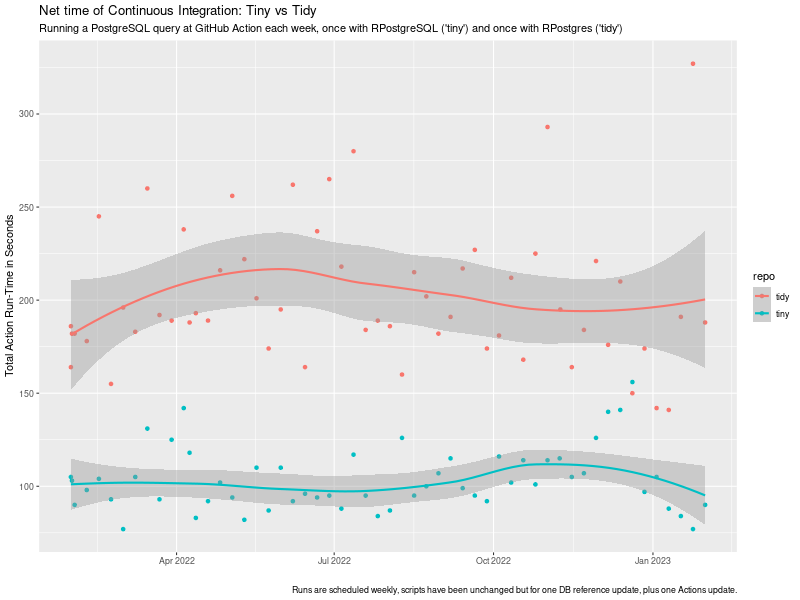 tiny vs tidy ci timing impact
chart