Activity summary
During the month of September, 20 contributors have been
paid to work on Debian LTS (links to individual
contributor reports are located below).
The team released 41 DLAs fixing 1854 CVEs.
In September, the Debian LTS Team was back to focusing on a single release:
Debian 12 ( bookworm ). Debian 11 ( bullseye ) reached the end of its Long Term
Support on 31 August 2026, and Freexian now provides its security maintenance
under the Extended LTS offer.
It is important to highlight the hard work done behind the scenes of the Front
Desk fellows, whose role was fulfilled during September by Emilio, Emmanuel,
Sylvain, Thorsten and Utkarsh.
Besides the very high activity doing daily triage on dozens of packages and
CVEs, Front Desk fellows spent much of their time answering questions and
coordinating with people outside the Freexian team about update proposals.
The team published several notable updates:
jbig2dec
(DLA-4779-1),
prepared by Andreas Henriksson, fixes CVE-2026-38076, where missing input
checks could lead to a denial of service. It is to note that this library is
used by different tools, such as ghostscript.
linux-6.12 (DLA-4788-1),
uploaded by Ben Hutchings, fixing 414 CVEs in the bookworm backport of Linux
kernel version 6.12.
lxml (DLA-4799-1),
prepared by Guilhem Moulin, fixes four vulnerabilities in this widely used
python XML/HTML library. The issues may yield to exposing local files.
nginx (DLA-4784-1),
issued by Carlos Henrique Lima Melara ( charles ), fixing three memory-safety bugs in
this popular web server and reverse proxy, which may result in denial of
service, memory disclosure or potentially the execution of arbitrary code.
openssl
(DLA-4795-1), by
Arnaud Rebillout, fixing six vulnerabilities, including an out-of-bounds heap
write in CMS decryption and an authentication tag verification bypass in
ChaCha20-Poly1305/AES-OCB decryption. This update brings bookworm to OpenSSL
3.0.22, the last upstream release of the 3.0 series, which was
reached its upstream EOL on
7 Sep 2026. Further fixes will be backported by the Debian LTS Team from more
recent releases.
redis DLA-4794-1,
by Chris Lamb, fixing vulnerabilities that could yield to arbitrary code
execution
Contributions from other Debian fellows beyond the Freexian LTS Team:
Thomas Goirand, Keystone released by Emilio as
DLA-4767-1
Thomas also prepared glance and swift updates, whose respective
DLA-4800-1 and
DLA-4801-1
were issued by Charles
Matthew Vernon uploaded a pcre2 security update, and Emilio issued its
DLA-4772-1
Otto Kek l inen uploaded a xz-utils update, released as
DLA-4783-1 by
Sylvain
Salvatore Bonaccorso published a linux (6.1) update released as
DLA-4777-1
Xavier Guimard prepared a lemonldap-ng, released as
DLA-4797-1.
Additionally, Sylvain sent
DLA-4734-1 at the
beginning of the month for the upload made on August.
Thank you so much to the developers above for these valuable contributions.
The LTS Team has also contributed with updates to the latest Debian releases
for the following packages:
ruby-jwt, prepared by Abhijith and released as
DSA-6547-1
urwid, proposed for a point-release update by Abhijith
(#1148950)
puma, proposed for a point-release update by Abhijith
(#1149582)
tomcat10,
and
tomcat9
(which is actually backported to released suites) by Bastien
nodejs, prepared by Bastien and released as
(DSA-6517-1).
If you benefit from Debian, especially throughout its full 5-year lifecycle,
please consider becoming a sponsor of Debian LTS. You can find more information
here: https://www.freexian.com/lts/debian/.
It's Sunday and I'm now sitting in the train from Brest to Paris where I will be changing to Germany, on the way back from the annual Debian conference. A full week of presentations, discussions, talks and socializing is laying behind me and my head is still spinning from the intensity.
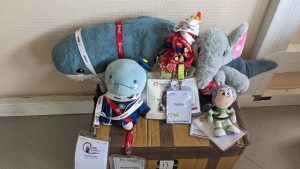
Pollito and the gang of DebConf mascots wearing their conference badges (photo: Christoph Berg)
Table of Contents
Sunday, July 13th
It started last Sunday with traveling to the conference. I got on the Eurostar in Duisburg and we left on time, but even before reaching Cologne, the train was already one hour delayed for external reasons, collecting yet another hour between Aachen and Liege for its own technical problems. "The train driver is working on trying to fix the problem." My original schedule had well over two hours for changing train stations in Paris, but being that late, I missed the connection to Brest in Montparnasse. At least in the end, the total delay was only one hour when finally arriving at the destination. Due to the French julliet quatorze fireworks approaching, buses in Brest were rerouted, but I managed to catch the right bus to the conference venue, already meeting a few Debian people on the way.
The conference was hosted at the IMT Atlantique Brest campus, giving the event a nice university touch. I arrived shortly after 10 in the evening and after settling down a bit, got on one of the "magic" buses for transportation to the camping site where half of the attendees where stationed. I shared a mobile home with three other Debianites, where I got a small room for myself.
Monday, July 14th
Next morning, we took the bus back to the venue with a small breakfast and the opening session where Enrico Zini invited me to come to his and Nicolas Dandrimont's session about Debian community governance and curation, which I gladly did. Many ideas about conflict moderation and community steering were floated around. I hope some of that can be put into effect to make flamewars on the mailing lists less heated and more directed. After that, I attended Olly Betts' "Stemming with Snowball" session, which is the stemmer used also in PostgreSQL. Text search is one of the areas in PostgreSQL that I never really looked closely at, including the integration into the postgresql-common package, so it was nice to get more information about that.
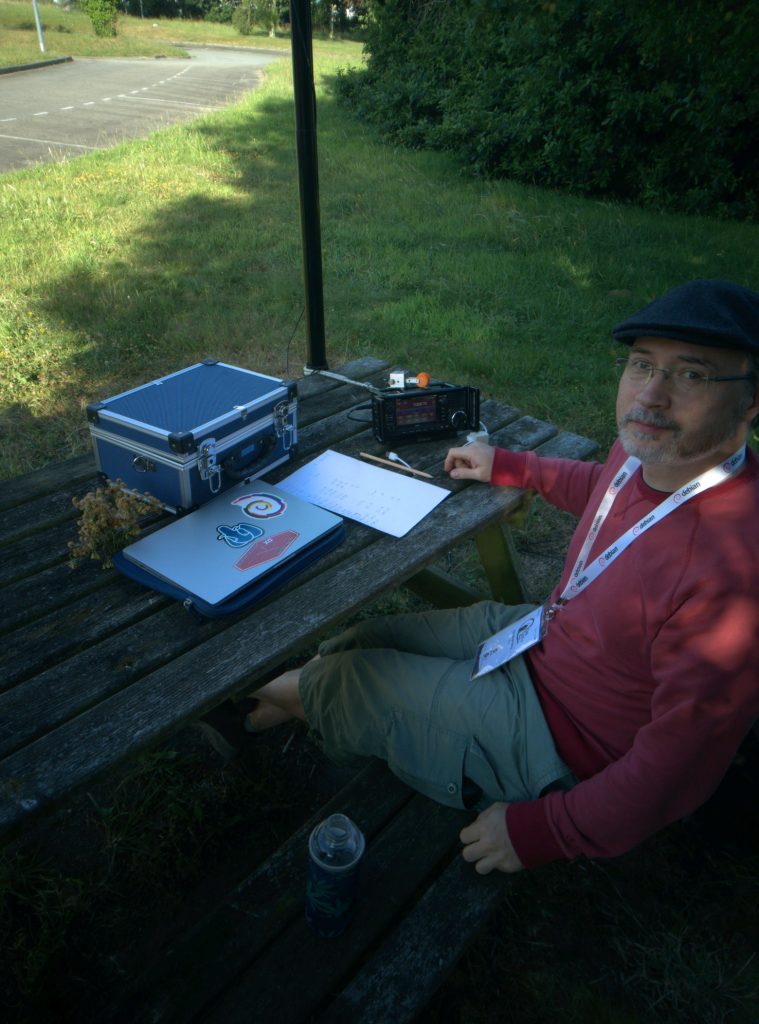
In preparation for the conference, a few of us Ham radio operators in Debian had decided to bring some radio gear to DebConf this year in order to perhaps spark more interest for our hobby among the fellow geeks. In the afternoon after the talks, I found a quieter spot just outside of the main hall and set up a shortwave antenna by attaching a 10m mast to one of the park benches there. The 40m band was still pretty much closed, but I could work a few stations from England, just across the channel from Bretagne, answering questions from interested passing-by Debian people between the contacts. Over time, the band opened and more European stations got into the log.
F/DF7CB in Brest (photo: Evangelos Ribeiro Tzaras)
Tuesday, July 15th
Tuesday started with Helmut Grohne's session about "Reviving (un)schroot". The schroot program has been Debian's standard way of managing build chroots for a long time, but it is more and more being regarded as obsolete with all kinds of newer containerization and virtualization technologies taking over. Since many bits of Debian infrastructure depend on schroot, and its user interface is still very useful, Helmut reimplemented it using Linux namespaces and the "unshare" systemcall. I had already worked with him at the Hamburg Minidebconf to replace the apt.postgresql.org buildd machinery with the new system, but we were not quite there yet (network isolation is nice, but we still sometimes need proper networking), so it was nice to see the effort is still progressing and I will give his new scripts a try when I'm back home.
Next, Stefano Rivera and Colin Watson presented Debusine, a new package repository and workflow management system. It looks very promising for anyone running their own repository, so perhaps yet another bit of apt.postgresql.org infrastructure to replace in the future. After that, I went to the Debian LTS BoF session by Santiago Ruano Rinc n and Bastien Roucari s - Debian releases plus LTS is what we are covering with apt.postgresql.org. Then there were bits from the DPL (Debian Project Leader), and a session moderated by Stefano Rivera interesting to me as a member of the Debian Technical Committee on the future structure of the packages required for cross-building in Debian, a topic which had been brought to TC a while ago. I am happy that we could resolve the issue without having to issue a formal TC ruling as the involved parties (kernel, glibc, gcc and the cross-build people) found a promising way forward themselves. DebConf is really a good way to get such issues unstuck.
Ten years ago at the 2015 Heidelberg DebConf, Enrico had given a seminal "Semi-serious stand-up comedy" talk, drawing parallels between the Debian Open Source community and the BDSM community - "People doing things consensually together". (Back then, the talk was announced as "probably unsuitable for people of all ages".) With his unique presentation style and witty insights, the session made a lasting impression on everyone attending. Now, ten years later (and he and many in the audience being ten years older), he gave an updated version of it. We are now looking forward to the sequel in 2035. The evening closed with the famous DebConf tradition of the Cheese & Wine party in a old fort next to the coast, just below the conference venue. Even when he's a fellow Debian Developer, Ham and also TC member, I had never met Paul Tagliamonte in person before, but we spent most of the evening together geeking out on all things Debian and Ham radio.
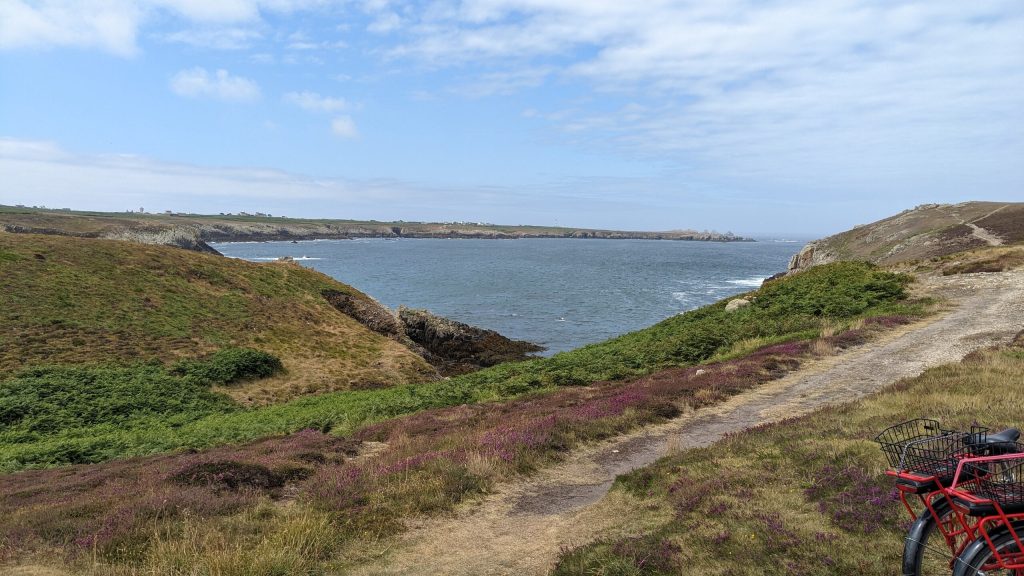
The northern coast of Ushant (photo: Christoph Berg)
Wednesday, July 16th
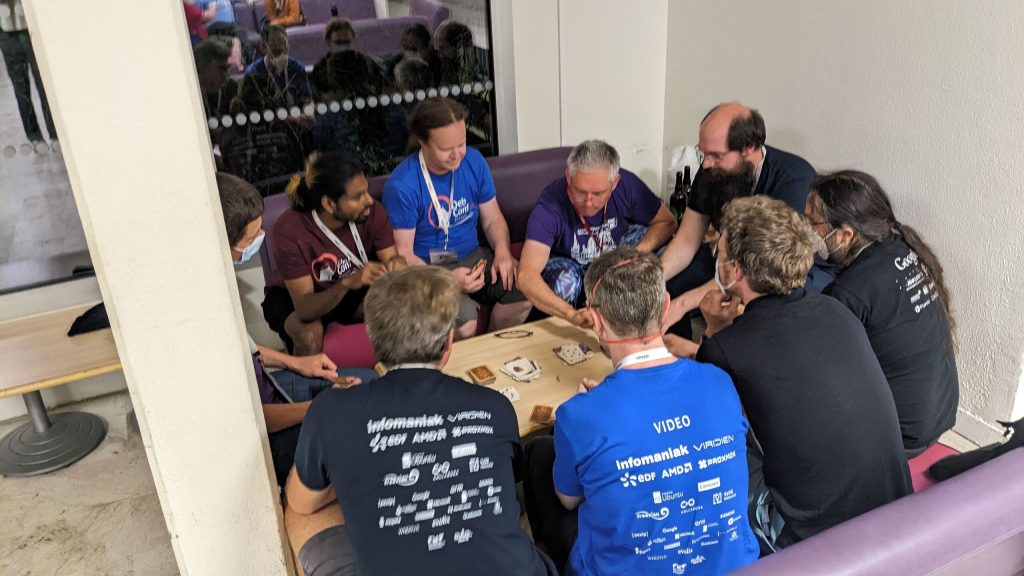
Wednesday already marked the end of the first half of the week, the day of the day trips. I had chosen to go to Ouessant island (Ushant in English) which marks the Western end of French mainland and hosts one of the lighthouses yielding the way into the English channel. The ferry trip included surprisingly big waves which left some participants seasick, but everyone recovered fast. After around one and a half hours we arrived, picked up the bicycles, and spent the rest of the day roaming the island. The weather forecast was originally very cloudy and 18 C, but over noon this turned into sunny and warm, so many got an unplanned sunburn. I enjoyed the trip very much - it made up for not having time visiting the city during the week. After returning, we spent the rest of the evening playing DebConf's standard game, Mao (spoiler alert: don't follow the link if you ever intend to play).
Having a nice day (photo: Christoph Berg)
Thursday, July 17th
The next day started with the traditional "Meet the Technical Committee" session. This year, we trimmed the usual slide deck down to remove the boring boilerplate parts, so after a very short introduction to the work of the committee by our chairman Matthew Vernon, we opened up the discussion with the audience, with seven (out of 8) TC members on stage. I think the format worked very well, with good input from attendees. Next up was "Don't fear the TPM" by Jonathan McDowell. A common misconception in the Free Software community is that the TPM is evil DRM hardware working against the user, but while it could be used in theory that way, the necessary TPM attestations seem to impossible to attain in practice, so that wouldn't happen anyway. Instead, it is a crypto coprocessor present in almost all modern computers that can be used to hold keys, for example to be used for SSH. It will also be interesting to research if we can make use of it for holding the Transparent Data Encryption keys for CYBERTEC's PostgreSQL Enterprise Edition.
Aigars Mahinovs then directed everyone in place for the DebConf group picture, and Lucas Nussbaum started a discussion about archive-wide QA tasks in Debian, an area where I did a lot of work in the past and that still interests me. Antonio Terceiro and Paul Gevers followed up with techniques to track archive-wide rebuilding and testing of packages and in turn filing a lot of bugs to track the problems. The evening ended with the conference dinner, again in the fort close by the coast. DebConf is good for meeting new people, and I incidentally ran into another Chris, who happened to be one of the original maintainers of pgaccess, the pre-predecessor of today's pgadmin. I admit still missing this PostgreSQL frontend for its simplicity and ability to easily edit table data, but it disappeared around 2004.
Friday, July 18th
On Friday, I participated in discussion sessions around contributors.debian.org (PostgreSQL is planning to set up something similar) and the New Member process which I had helped to run and reform a decade or two ago. Agathe Porte (also a Ham radio operator, like so many others at the conference I had no idea of) then shared her work on rust-rewriting the slower parts of Lintian, the Debian package linter. Craig Small talked about "Free as in Bytes", the evolution of the Linux procps free command. Over the time and many kernel versions, the summary numbers printed became better and better, but there will probably never be a version that suits all use cases alike. Later over dinner, Craig (who is also a TC member) and I shared our experiences with these numbers and customers (not) understanding them. He pointed out that for PostgreSQL and looking at used memory in the presence of large shared memory buffers, USS (unique set size) and PSS (proportional set size) should be more realistic numbers than the standard RSS (resident set size) that the top utility is showing by default.
Antonio Terceiro and Paul Gevers again joined to lead a session, now on ci.debian.net and autopkgtest, the test driver used for running tests on packages after then have been installed on a system. The PostgreSQL packages are heavily using this to make sure no regressions creep in even after builds have successfully completed and test re-runs are rescheduled periodically. The day ended with Bdale Garbee's electronics team BoF and Paul Tagliamonte and me setting up the radio station in the courtyard, again answering countless questions about ionospheric conditions and operating practice.
Saturday, July 19th
Saturday was the last conference day. In the first session, Nikos Tsipinakis and Federico Vaga from CERN announced that the LHC will be moving to Debian for the accelerator's frontend computers in their next "long shutdown" maintenance period in the next year. CentOS broke compatibility too often, and Debian trixie together with the extended LTS support will cover the time until the next long shutdown window in 2035, until when the computers should have all been replaced with newer processors covering higher x86_64 baseline versions. The audience was very delighted to hear that Debian is now also being used in this prestige project.
Ben Hutchings then presented new Linux kernel features. Particularly interesting for me was the support for atomic writes spanning more than one filesystem block. When configured correctly, this would mean PostgreSQL didn't have to record full-page images in the WAL anymore, increasing throughput and performance. After that, the Debian ftp team discussed ways to improve review of new packages in the archive, and which of their processes could be relaxed with new US laws around Open Source and cryptography algorithms export. Emmanuel Arias led a session on Salsa CI, Debian's Gitlab instance and standard CI pipeline. (I think it's too slow, but the runners are not under their control.) Julian Klode then presented new features in APT, Debian's package manager. I like the new display format (and a tiny bit of that is also from me sending in wishlist bugs).
In the last round of sessions this week, I then led the Ham radio BoF with an introduction into the hobby and how Debian can be used. Bdale mentioned that the sBitx family of SDR radios is natively running Debian, so stock packages can be used from the radio's touch display. We also briefly discussed his involvement in ARDC and the possibility to get grants from them for Ham radio projects. Finally, DebConf wrapped up with everyone gathering in the main auditorium and cheering the organizers for making the conference possible and passing Pollito, the DebConf mascot, to the next organizer team.
Pollito on stage (photo: Christoph Berg)
Sunday, July 20th
Zoom back to the train: I made it through the Paris metro and I'm now on the Eurostar back to Germany. It has been an intense week with all the conference sessions and meeting all the people I had not seen so long. There are a lot of new ideas to follow up on both for my Debian and PostgreSQL work. Next year's DebConf will take place in Santa Fe, Argentina. I haven't yet decided if I will be going, but I can recommend the experience to everyone!
The post The Debian Conference 2025 in Brest appeared first on CYBERTEC PostgreSQL Services & Support.
What happened in the reproducible
builds effort between December
27th and January 2nd:
Infrastructure
dak now silently accepts and discards .buildinfo files (commit 1, 2), thanks to Niels Thykier and Ansgar Burchardt. This was later confirmed as working by Mattia Rizzolo.
Packages fixed
The following packages have become reproducible due to changes in their
build dependencies:
banshee-community-extensions,
javamail,
mono-debugger-libs,
python-avro.
The following packages became reproducible after getting fixed:
fltk1.1/1.1.10-20 by Aaron M. Ucko, currently FTBFS.
fltk1.3/1.3.3-5 by Aaron M. Ucko, currently FTBFS.
reproducible.debian.net
The testing distribution (the upcoming stretch) is now tested on armhf. (h01ger)
Four new armhf build nodes provided by Vagrant Cascandian were integrated in the infrastructer. This allowed for 9 new armhf builder jobs. (h01ger)
The RPM-based build system, koji, is now in unstable and testing. (Marek Marczykowski-G recki, Ximin Luo).
Package reviews
131 reviews have been removed, 71 added and 53 updated in the previous week.
58 new FTBFS reports were made by Chris Lamb and Chris West.
New issues identified this week:
nondeterminstic_ordering_in_gsettings_glib_enums_xml,
nondeterminstic_output_in_warnings_generated_by_breathe, qt_translate_noop_nondeterminstic_ordering.
Misc.
Steven Chamberlain explained in length why reproducible cross-building across architectures mattered, and posted results of his tests comparing a stage1 debootstrapped chroot of linux-i386 once done from official Debian packages, the others cross-built from kfreebsd-amd64.
Joachim Breitner uploaded haskell-devscripts/0.9.11 which ads support for UTF-8 encoded debian/control file with all locales. Original patch by Chris Lamb.
reproducible.debian.net
Four armhf build hosts were provided by Vagrant Cascadian and have been configured to be used by jenkins.debian.net. Work on including armhf builds in the reproducible.debian.net webpages has begun. So far the repository comparison page just shows us which armhf binary packages are currently missing in our repo. (h01ger)
The scheduler has been changed to re-schedule more packages from stretch than sid, as the gcc5 transition has started This mostly affects build log age. (h01ger)
A new depwait status has been introduced for packages which can't be built because of missing build dependencies. (Mattia Rizzolo)
debbindiff development
Finally, on August 31st, Lunar released debbindiff 27 containing a complete overhaul of the code for the comparison stage. The new architecture is more versatile and extensible while minimizing code duplication. libarchive is now used to handle cpio archives and iso9660 images through the newly packaged python-libarchive-c. This should also help support a couple other archive formats in the future. Symlinks and devices are now properly compared. Text files are compared as Unicode after being decoded, and encoding differences are reported. Support for Sqlite3 and Mono/.NET executables has been added. Thanks to Valentin Lorentz, the test suite should now run on more systems. A small defiency in unquashfs has been identified in the process. A long standing optimization is now performed on Debian package: based on the content of the md5sums control file, we skip comparing files with matching hashes. This makes debbindiff usable on packages with many files. Fuzzy-matching is now performed for files in the same container (like a tarball) to handle renames. Also, for Debian .changes, listed files are now compared without looking the embedded version number. This makes debbindiff a lot more useful when comparing different versions of the same package.
Based on the rearchitecturing work has been done to allow parallel processing. The branch now seems to work most of the time. More test needs to be done before it can be merged.
The current fuzzy-matching algorithm, ssdeep, has showed disappointing results. One important use case is being able to properly compare debug symbols. Their path is made using the Build ID. As this identifier is made with a checksum of the binary content, finding things like CPP macros is much easier when a diff of the debug symbols is available. Good news is that TLSH, another fuzzy-matching algorithm, has been tested with much better results. A package is waiting in NEW and the code is ready for it to become available.
A follow-up release 28 was made on August 2nd fixing content label used for gzip2, bzip2 and xz files and an error on text files only differing in their encoding. It also contains a small code improvement on how comments on Difference object are handled.
This is the last release name debbindiff. A new name has been chosen to better reflect that it is not a Debian specific tool. Stay tuned!
Documentation update
Valentin Lorentz updated the patch submission template to suggest to write the kind of issue in the bug subject.
Small progress have been made on the Reproducible Builds HOWTO while preparing the related CCCamp15 talk.
Package reviews
235 obsolete
reviews have
been removed, 47 added and 113 updated this week.
42 reports for packages failing to build from source have been made by Chris West (Faux).
New issue added this week: haskell_devscripts_locale_substvars.
Misc.
Valentin Lorentz wrote a script to report packages tested as unreproducible installed on a system. We encourage everyone to run it on their systems and give feedback!
Thorsten Glaser reported Debian bug
#780000 on Saturday March 7th 2015, against the gcc-4.9 package.
Bug #770000 was reported as of November 18th so there have been 10,000
bugs in about 3.5 months, which was significantly slower than earlier.
Matthew Vernon reported Debian bug
#790000 on Friday June 26th 2015, against the pcre3 package.
Thus, there have been 10,000
bugs in 3.5 months again. It seems that the bug report rate stabilized
again.
Sorry for missing bug #780000 annoucement. I'm doing this
since....November 2007 for bug #450000 and it seems that this lack of
attention is somehow significant wrt my involvment in Debian. Still,
this involvment is still here and I'll try to "survive" in the project
until we reach bug #1000000...:-)
See you for bug #800000 annoucement and the result of the bets we
placed on the date it would happen.
What happened about the reproducible
builds effort for this week:
Toolchain fixes
Guillem Jover uploaded dpkg/1.18.0 which now uses an approximation to compute Installed-Size, making it indpendent from the underlying filesystem. It now always sort the Dpkg::Dist::Files files list on output to make the output stable with parallel builds.
Lunar uploaded mozilla-devscripts/0.40 which told xpi-pack to skip saving extra zip attributes when making jar.
Patches submitted which did not make their way to the archive yet:
#775531 on console-setup by Reiner Herrmann: update and split patch written in January.
#785535 on maradns by Reiner Herrmann: use latest entry in debian/changelog as build date.
#785549 on dist by Reiner Herrmann: set hostname and domainname to predefined value.
#785583 on s5 by Juan Picca: set timezone to UTC when unzipping files.
#785617 on python-carrot by Juan Picca: use latest entry in debian/changelog as documentation build date.
#785774 on afterstep by Juan Picca: modify documentation generator to allow a build date to be set instead of the current time, then use latest entry in debian/changelog as reference.
#786508 on ttyload by Juan Picca: remove timestamp from documentation.
#786568 on linux-minidisc by Lunar: use latest entry in debian/changelog as build date.
#786615 on kfreebsd-10 by Steven Chamberlain: make order of file in source tarballs stable.
#786633 on webkit2pdf by Reiner Herrmann: use latest entry in debian/changelog as documentation build date.
reproducible.debian.net
Holger Levsen made several small bug fixes and a few more visible changes:
For packages in testing, comparisions will be done using the sid version
of debbindiff.
The scheduler will now schedule old packages from sid twice often as the
ones in testing as we care more about the former at the moment.
More statistics are now visible
and the layout has been improved.
Variations between the first and second build are now explained on the statistics
page.
strip-nondeterminism
Version 0.007-1 of
strip-nondeterminism the
tool to post-process various file formats to normalize them has been uploaded
by Holger Levsen. Version 0.006-1 was already in the reproducible repository,
the new version mainly improve the detection of Maven's pom.properties files.
debbindiff development
At the request of Emmanuel Bourg, Reiner Herrmann added a comparator for Java
.class files.
Documentation update
Christoph Berg created a new page for the timestamps in manpages created by
Doxygen.
Package reviews
93 obsolete
reviews have
been removed, 76 added and 43 updated this week.
New identified issues: timestamps in manpages generated by Doxygen, modification time differences in files extracted by unzip, tstamp task used in Ant build.xml, timestamps in documentation generated by ASDocGen. The description for build id related issues has been clarified.
Meetings
Holger Levsen announced a first
meeting on Wednesday,
June 3rd, 2015, 19:00 UTC. The agenda is amendable on the wiki.
Misc.
Lunar worked on a proof-of-concept script to import the build environment found
in .buildinfo
files to
UDD. Lucas Nussbaum has positively reviewed the
proposed schema.
Holger Levsen cleaned up various experimental toolchain repositories, marking
merged brances as such.
Out of curiosity, and because it is Sunday morning and I have a cold and
can't get my brain to do anything tricky, I counted the number of
candidates in each year's DPL elections.
Year
Count
Names
1999
4
Joseph Carter, Ben Collins, Wichert Akkerman, Richard Braakman
2000
4
Ben Collins, Wichert Akkerman, Joel Klecker, Matthew Vernon
2001
4
Branden Robinson, Anand Kumria, Ben Collins, Bdale Garbee
2002
3
Branden Robinson, Rapha l Hertzog, Bdale Garbee
2003
4
Moshe Zadka, Bdale Garbee, Branden Robinson, Martin Michlmayr
2004
3
Martin Michlmayr, Gergely Nagy, Branden Robinson
2005
6
Matthew Garrett, Andreas Schuldei, Angus Lees, Anthony Towns, Jonathan Walther, Branden Robinson
2006
7
Jeroen van Wolffelaar, Ari Pollak, Steve McIntyre, Anthony Towns, Andreas Schuldei, Jonathan (Ted) Walther, Bill Allombert
2007
8
Wouter Verhelst, Aigars Mahinovs, Gustavo Franco, Sam Hocevar, Steve McIntyre, Rapha l Hertzog, Anthony Towns, Simon Richter
2008
3
Marc Brockschmidt, Rapha l Hertzog, Steve McIntyre
2009
2
Stefano Zacchiroli, Steve McIntyre
2010
4
Stefano Zacchiroli, Wouter Verhelst, Charles Plessy, Margarita Manterola
2011
1
Stefano Zacchiroli (no vote yet)
Winner indicate by boldface. I expect Zack to win over "None Of The Above",
so I went ahead and boldfaced him already, even if there has not been
a vote for this year.
Median number of candidates is 4.
Nearly a year ago people starting worrying about the complexity of SHA-1 being reduced and the potential availability of viable attacks against things such as PGP keys that used SHA-1. Many people (myself included) generated a new key, or updated preferences on keys that were otherwise strong enough. There were worries about what this might mean for Debian. We were getting ahead of ourselves a bit though. Firstly there haven't been any public viable attacks that I'm aware of (though of course this doesn't mean we shouldn't continue to migrate away), but secondly there's a much easier method of attack. PGP v3 keys. To quote RFC4880:
V3 keys are deprecated. They contain three weaknesses. First, it is relatively easy to construct a V3 key that has the same Key ID as any other key because the Key ID is simply the low 64 bits of the public modulus. Secondly, because the fingerprint of a V3 key hashes the key material, but not its length, there is an increased opportunity for fingerprint collisions. Third, there are weaknesses in the MD5 hash algorithm that make developers prefer other algorithms. See below for a fuller discussion of Key IDs and fingerprints.
At the time of writing Debian has 21 remaining v3 keys. This is a significant improvement over a year ago, when we had 200, but it's still 21 more than I'd like. I've been chasing people since last May (starting with those who had v3 + v4 keys, all of whom now only have a v4 key) and we're down to the stragglers. So it's time to name and shame, in the hope of kicking them into action. The following keys are what's left (doesn't match the currently active keyring because we've had a few replacements since the last promote):
0x0D2156BD3D97C149 Michael Stone <mstone>
0x225FD911CD269B31 Carlos Barros <cbf>
0x31E73F14E298966D James R. Van Zandt <jrv>
0x366CD3FEEBC11B01 Chris Waters <xtifr>
0x37A73FE355E8BC4D Frederic Lepied <lepied>
0x3E973117DCC528E9 Ardo van Rangelrooij <ardo>
0x5C7A46637953F711 Rich Sahlender <rsahlen>
0x5D6560F85F30F005 Craig Brozefsky <craig>
0x6B0E322836129171 Jim Westveer <jwest>
0x723724B4A5B6DD31 Christian Meder <meder>
0x7629B22ED71DAABD Adrian Bridgett <bridgett>
0x8FFC405EFD5A67CD Adam Di Carlo <aph>
0xB0D269DE17F3D4D1 Matthew Vernon <matthew>
0xBC151FC8D2A913A1 Peter S Galbraith <psg>
0xC1A0A171C2DCD3B1 Jim Mintha <jmintha>
0xC3168EBA23F5ADDB Ian Jackson <iwj>
0xCE951B1160D74C7D Patrick Cole <ltd>
0xE82A8B0D57137FE5 Paul Seelig <pseelig>
0xF20E242CE77AC835 Brian White <bcwhite>
0xFBAA570C3087194D Alan Bain <afrb2>
0xFFD1B4AC7C19FD19 David Engel <david>
Of these keys only 2 voted in the recent DPL election. 8 have failed to make any response to my mails (3 since last August). Only 9 have uploaded a package since August 2008. And 10 were already known to the MIA database. Some of them have stated they'll sort out a new key, but not yet done so.
If you are one of these people, please either get a new key sorted and signed and reply to the mails I've sent you, or reply and say you no longer wish to be involved in Debian. And if you know any of these people, encourage them to get a new key sorted and offer to sign it for them.

 The Debian LTS Team, funded by Freexian s Debian LTS offering,
is pleased to report its activities for September.
 It's Sunday and I'm now sitting in the train from Brest to Paris where I will be changing to Germany, on the way back from the
 Pollito and the gang of DebConf mascots wearing their conference badges (photo: Christoph Berg)
 F/DF7CB in Brest (photo: Evangelos Ribeiro Tzaras)
 The northern coast of Ushant (photo: Christoph Berg)
 Having a nice day (photo: Christoph Berg)
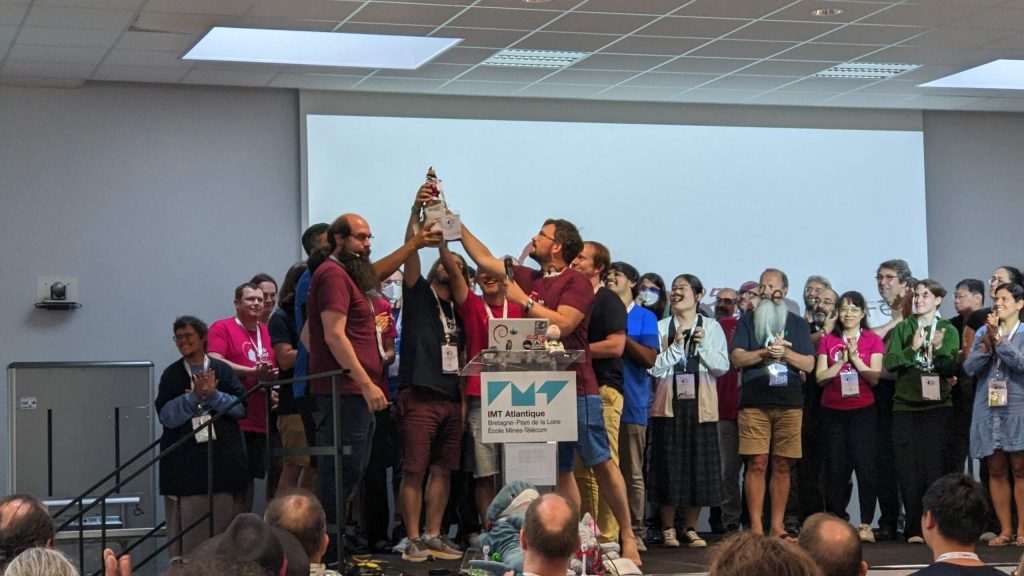 Pollito on stage (photo: Christoph Berg)
 What happened in the
 Thorsten Glaser reported Debian
 Out of curiosity, and because it is Sunday morning and I have a cold and
can't get my brain to do anything tricky, I counted the number of
candidates in each year's DPL elections.
 Nearly a year ago people starting worrying about the complexity of SHA-1 being reduced and the potential availability of viable attacks against things such as PGP keys that used SHA-1. Many people (myself included) generated a new key, or updated preferences on keys that were otherwise strong enough. There were worries about what this might mean for Debian. We were getting ahead of ourselves a bit though. Firstly there haven't been any public viable attacks that I'm aware of (though of course this doesn't mean we shouldn't continue to migrate away), but secondly there's a much easier method of attack. PGP v3 keys. To quote