Reproducible Builds: Reproducible Builds in February 2026
Welcome to the February 2026 report from the Reproducible Builds project!
 These reports outline what we ve been up to over the past month, highlighting items of news from elsewhere in the increasingly-important area of software supply-chain security. As ever, if you are interested in contributing to the Reproducible Builds project, please see the Contribute page on our website.
- reproduce.debian.net
- Tool development
- Distribution work
- Miscellaneous news
- Upstream patches
- Documentation updates
- Four new academic papers
reproduce.debian.net
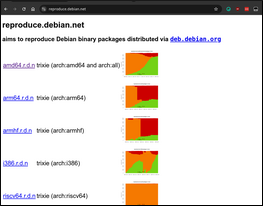
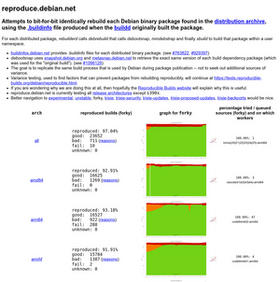 The last year has seen the introduction, development and deployment of reproduce.debian.net. In technical terms, this is an instance of rebuilderd, our server designed monitor the official package repositories of Linux distributions and attempt to reproduce the observed results there.
This month, however, Holger Levsen added suite-based navigation (eg. Debian trixie vs forky) to the service (in addition to the already existing architecture based navigation) which can be observed on, for instance, the Debian trixie-backports or trixie-security pages.
Tool development
 diffoscope is our in-depth and content-aware diff utility that can locate and diagnose reproducibility issues. This month, Chris Lamb made a number of changes, including preparing and uploading versions,
312 and 313 to Debian.
In particular, Chris updated the post-release deployment pipeline to ensure that the pipeline does not fail if the automatic deployment to PyPI fails [ ]. In addition, Vagrant Cascadian updated an external reference for the 7z tool for GNU Guix. [ ]. Vagrant Cascadian also updated diffoscope in GNU Guix to version 312 and 313.
Distribution work
 In Debian this month:
-
26 reviews of Debian packages were added, 5 were updated and 19 were removed this month adding to our extensive knowledge about identified issues.
-
A new debsbom package was uploaded to unstable. According to the package description, this package generates SBOMs (Software Bill of Materials) for distributions based on Debian in the two standard formats, SPDX and CycloneDX. The generated SBOM includes all installed binary packages and also contains Debian Source packages.
-
In addition, a
sbom-toolkit package was uploaded, which provides a collection of scripts for generating SBOM. This is the tooling used in Apertis to generate the Licenses SBOM and the Build Dependency SBOM. It also includes dh-setup-copyright, a Debhelper addon to generate SBOMs from DWARF debug information, which are extracted from DWARF debug information by running dwarf2sources on every ELF binaries in the package and saving the output.
 Lastly, Bernhard M. Wiedemann posted another openSUSE monthly update for their work there.
Miscellaneous news
-
S ren Tempel (nmeum) wrote up their insightful notes on Debugging Reproducibility Issues in Rust Software after nondeterministic issues were found and investigated for
pimsync in the GNU Guix review process
-
Jeremy Bicha reported a bug in GNOME Clocks after they noticed that version
50.beta regressed in reproducibility compared to 49.0. Specifically, the new generated .oga files differ in their Serial No. and Checksum [fields] . However, Jeremy ended up fixing the issue by replacing ffmpeg with oggenc.
-
kpcyrd shared some information from the
archlinux-dev-public mailing list on our mailing list this month after a discussion at our latest Summit meeting on the topic of Link-Time Optimisation (LTO) specifically on the reasons why LTO often needs to be disabled in relation to Arch Linux s approach to binary hardening.
-
Janneke Nieuwenhuizen posed a question to our list about whether there might be situations where using the UNIX epoch itself (i.e.
0) may materially differ from using SOURCE_DATE_EPOCH) when a situation demands the use of a fixed timestamp.
-
Laurent Huberdeau announced that they had recently finished their masters thesis arguing for the use of POSIX shell for diverse double-compilation and reproducible builds . Laurent also presents
pnut, a C compiler capable of bootstrapping itself and TCC from any POSIX-compliant shell and human-readable source files.
Upstream patches
The Reproducible Builds project detects, dissects and attempts to fix as many currently-unreproducible packages as possible. We endeavour to send all of our patches upstream where appropriate. This month, we wrote a large number of such patches, including:
-
Bernhard M. Wiedemann:
-
Gioele Barabucci:
- #1127641 filed against
bitsnpicas.
- #1127643 filed against
fonts-topaz-unicode.
- #1128901 filed against
bitsnpicas.
Documentation updates
 Once again, there were a number of improvements made to our website this month including:
-
Aman Sharma added a Java reproducible builds paper to the Academic publications page. [ ]
-
Chris Lamb added a reference to the
repro-build to the Tools page. [ ]
-
Michiel Hendriks corrected an issue on the JVM page in relation to
.properties files. [ ]
-
kpcyrd added Homebrew to the Who is involved page. [ ][ ]
Four new academic papers
 Julien Malka and Arnout Engelen published a paper titled Lila: Decentralized Build Reproducibility Monitoring for the Functional Package Management Model:
[While] recent studies have shown that high reproducibility rates are achievable at scale demonstrated by the Nix ecosystem achieving over 90% reproducibility on more than 80,000 packages the problem of effective reproducibility monitoring remains largely unsolved. In this work, we address the reproducibility monitoring challenge by introducing Lila, a decentralized system for reproducibility assessment tailored to the functional package management model. Lila enables distributed reporting of build results and aggregation into a reproducibility database [ ].
A PDF of their paper is available online.
 Javier Ron and Martin Monperrus of KTH Royal Institute of Technology, Sweden, also published a paper, titled Verifiable Provenance of Software Artifacts with Zero-Knowledge Compilation:
Verifying that a compiled binary originates from its claimed source code is a fundamental security requirement, called source code provenance. Achieving verifiable source code provenance in practice remains challenging. The most popular technique, called reproducible builds, requires difficult matching and reexecution of build toolchains and environments. We propose a novel approach to verifiable provenance based on compiling software with zero-knowledge virtual machines (zkVMs). By executing a compiler within a zkVM, our system produces both the compiled output and a cryptographic proof attesting that the compilation was performed on the claimed source code with the claimed compiler. [ ]
A PDF of the paper is available online.
 Oreofe Solarin of Department of Computer and Data Sciences, Case Western Reserve University, Cleveland, Ohio, USA, published It s Not Just Timestamps: A Study on Docker Reproducibility:
Reproducible container builds promise a simple integrity check for software supply chains: rebuild an image from its Dockerfile and compare hashes. We built a Docker measurement pipeline and apply it to a stratified sample of 2,000 GitHub repositories that contained a Dockerfile. We found that only 56% produce any buildable image, and just 2.7% of those are bitwise reproducible without any infrastructure configurations. After modifying infrastructure configurations, we raise bitwise reproducibility by 18.6%, but 78.7% of buildable Dockerfiles remain non-reproducible.
A PDF of Oreofe s paper is available online.
 Lastly, Jens Dietrich and Behnaz Hassanshahi published On the Variability of Source Code in Maven Package Rebuilds:
[In] this paper we test the assumption that the same source code is being used [by] alternative builds. To study this, we compare the sources released with packages on Maven Central, with the sources associated with independently built packages from Google s Assured Open Source and Oracle s Build-from-Source projects. [ ]
A PDF of their paper is available online.
Finally, if you are interested in contributing to the Reproducible Builds project, please visit our Contribute page on our website. However, you can get in touch with us via:
-
IRC:
#reproducible-builds on irc.oftc.net.
-
Mastodon: @reproducible_builds@fosstodon.org
-
Mailing list:
rb-general@lists.reproducible-builds.org
diffoscope is our in-depth and content-aware diff utility that can locate and diagnose reproducibility issues. This month, Chris Lamb made a number of changes, including preparing and uploading versions, 312 and 313 to Debian.
In particular, Chris updated the post-release deployment pipeline to ensure that the pipeline does not fail if the automatic deployment to PyPI fails [ ]. In addition, Vagrant Cascadian updated an external reference for the 7z tool for GNU Guix. [ ]. Vagrant Cascadian also updated diffoscope in GNU Guix to version 312 and 313.
Distribution work
In Debian this month:
-
26 reviews of Debian packages were added, 5 were updated and 19 were removed this month adding to our extensive knowledge about identified issues.
-
A new debsbom package was uploaded to unstable. According to the package description, this package generates SBOMs (Software Bill of Materials) for distributions based on Debian in the two standard formats, SPDX and CycloneDX. The generated SBOM includes all installed binary packages and also contains Debian Source packages.
-
In addition, a
sbom-toolkit package was uploaded, which provides a collection of scripts for generating SBOM. This is the tooling used in Apertis to generate the Licenses SBOM and the Build Dependency SBOM. It also includes dh-setup-copyright, a Debhelper addon to generate SBOMs from DWARF debug information, which are extracted from DWARF debug information by running dwarf2sources on every ELF binaries in the package and saving the output.
Lastly, Bernhard M. Wiedemann posted another openSUSE monthly update for their work there.
Miscellaneous news
-
S ren Tempel (nmeum) wrote up their insightful notes on Debugging Reproducibility Issues in Rust Software after nondeterministic issues were found and investigated for
pimsync in the GNU Guix review process
-
Jeremy Bicha reported a bug in GNOME Clocks after they noticed that version
50.beta regressed in reproducibility compared to 49.0. Specifically, the new generated .oga files differ in their Serial No. and Checksum [fields] . However, Jeremy ended up fixing the issue by replacing ffmpeg with oggenc.
-
kpcyrd shared some information from the
archlinux-dev-public mailing list on our mailing list this month after a discussion at our latest Summit meeting on the topic of Link-Time Optimisation (LTO) specifically on the reasons why LTO often needs to be disabled in relation to Arch Linux s approach to binary hardening.
-
Janneke Nieuwenhuizen posed a question to our list about whether there might be situations where using the UNIX epoch itself (i.e.
0) may materially differ from using SOURCE_DATE_EPOCH) when a situation demands the use of a fixed timestamp.
-
Laurent Huberdeau announced that they had recently finished their masters thesis arguing for the use of POSIX shell for diverse double-compilation and reproducible builds . Laurent also presents
pnut, a C compiler capable of bootstrapping itself and TCC from any POSIX-compliant shell and human-readable source files.
Upstream patches
The Reproducible Builds project detects, dissects and attempts to fix as many currently-unreproducible packages as possible. We endeavour to send all of our patches upstream where appropriate. This month, we wrote a large number of such patches, including:
-
Bernhard M. Wiedemann:
-
Gioele Barabucci:
- #1127641 filed against
bitsnpicas.
- #1127643 filed against
fonts-topaz-unicode.
- #1128901 filed against
bitsnpicas.
Documentation updates
Once again, there were a number of improvements made to our website this month including:
-
Aman Sharma added a Java reproducible builds paper to the Academic publications page. [ ]
-
Chris Lamb added a reference to the
repro-build to the Tools page. [ ]
-
Michiel Hendriks corrected an issue on the JVM page in relation to
.properties files. [ ]
-
kpcyrd added Homebrew to the Who is involved page. [ ][ ]
Four new academic papers
Julien Malka and Arnout Engelen published a paper titled Lila: Decentralized Build Reproducibility Monitoring for the Functional Package Management Model:
[While] recent studies have shown that high reproducibility rates are achievable at scale demonstrated by the Nix ecosystem achieving over 90% reproducibility on more than 80,000 packages the problem of effective reproducibility monitoring remains largely unsolved. In this work, we address the reproducibility monitoring challenge by introducing Lila, a decentralized system for reproducibility assessment tailored to the functional package management model. Lila enables distributed reporting of build results and aggregation into a reproducibility database [ ].
A PDF of their paper is available online.
Javier Ron and Martin Monperrus of KTH Royal Institute of Technology, Sweden, also published a paper, titled Verifiable Provenance of Software Artifacts with Zero-Knowledge Compilation:
Verifying that a compiled binary originates from its claimed source code is a fundamental security requirement, called source code provenance. Achieving verifiable source code provenance in practice remains challenging. The most popular technique, called reproducible builds, requires difficult matching and reexecution of build toolchains and environments. We propose a novel approach to verifiable provenance based on compiling software with zero-knowledge virtual machines (zkVMs). By executing a compiler within a zkVM, our system produces both the compiled output and a cryptographic proof attesting that the compilation was performed on the claimed source code with the claimed compiler. [ ]
A PDF of the paper is available online.
Oreofe Solarin of Department of Computer and Data Sciences, Case Western Reserve University, Cleveland, Ohio, USA, published It s Not Just Timestamps: A Study on Docker Reproducibility:
Reproducible container builds promise a simple integrity check for software supply chains: rebuild an image from its Dockerfile and compare hashes. We built a Docker measurement pipeline and apply it to a stratified sample of 2,000 GitHub repositories that contained a Dockerfile. We found that only 56% produce any buildable image, and just 2.7% of those are bitwise reproducible without any infrastructure configurations. After modifying infrastructure configurations, we raise bitwise reproducibility by 18.6%, but 78.7% of buildable Dockerfiles remain non-reproducible.
A PDF of Oreofe s paper is available online.
Lastly, Jens Dietrich and Behnaz Hassanshahi published On the Variability of Source Code in Maven Package Rebuilds:
[In] this paper we test the assumption that the same source code is being used [by] alternative builds. To study this, we compare the sources released with packages on Maven Central, with the sources associated with independently built packages from Google s Assured Open Source and Oracle s Build-from-Source projects. [ ]
A PDF of their paper is available online.
Finally, if you are interested in contributing to the Reproducible Builds project, please visit our Contribute page on our website. However, you can get in touch with us via:
-
IRC:
#reproducible-builds on irc.oftc.net.
-
Mastodon: @reproducible_builds@fosstodon.org
-
Mailing list:
rb-general@lists.reproducible-builds.org
sbom-toolkit package was uploaded, which provides a collection of scripts for generating SBOM. This is the tooling used in Apertis to generate the Licenses SBOM and the Build Dependency SBOM. It also includes dh-setup-copyright, a Debhelper addon to generate SBOMs from DWARF debug information, which are extracted from DWARF debug information by running dwarf2sources on every ELF binaries in the package and saving the output.
-
S ren Tempel (nmeum) wrote up their insightful notes on Debugging Reproducibility Issues in Rust Software after nondeterministic issues were found and investigated for
pimsyncin the GNU Guix review process -
Jeremy Bicha reported a bug in GNOME Clocks after they noticed that version
50.betaregressed in reproducibility compared to49.0. Specifically, the new generated.ogafiles differ in theirSerial No.andChecksum[fields] . However, Jeremy ended up fixing the issue by replacingffmpegwithoggenc. -
kpcyrd shared some information from the
archlinux-dev-publicmailing list on our mailing list this month after a discussion at our latest Summit meeting on the topic of Link-Time Optimisation (LTO) specifically on the reasons why LTO often needs to be disabled in relation to Arch Linux s approach to binary hardening. -
Janneke Nieuwenhuizen posed a question to our list about whether there might be situations where using the UNIX epoch itself (i.e.
0) may materially differ from usingSOURCE_DATE_EPOCH) when a situation demands the use of a fixed timestamp. -
Laurent Huberdeau announced that they had recently finished their masters thesis arguing for the use of POSIX shell for diverse double-compilation and reproducible builds . Laurent also presents
pnut, a C compiler capable of bootstrapping itself and TCC from any POSIX-compliant shell and human-readable source files.
Upstream patches
The Reproducible Builds project detects, dissects and attempts to fix as many currently-unreproducible packages as possible. We endeavour to send all of our patches upstream where appropriate. This month, we wrote a large number of such patches, including:
-
Bernhard M. Wiedemann:
-
Gioele Barabucci:
- #1127641 filed against
bitsnpicas.
- #1127643 filed against
fonts-topaz-unicode.
- #1128901 filed against
bitsnpicas.
Documentation updates
Once again, there were a number of improvements made to our website this month including:
-
Aman Sharma added a Java reproducible builds paper to the Academic publications page. [ ]
-
Chris Lamb added a reference to the
repro-build to the Tools page. [ ]
-
Michiel Hendriks corrected an issue on the JVM page in relation to
.properties files. [ ]
-
kpcyrd added Homebrew to the Who is involved page. [ ][ ]
Four new academic papers
Julien Malka and Arnout Engelen published a paper titled Lila: Decentralized Build Reproducibility Monitoring for the Functional Package Management Model:
[While] recent studies have shown that high reproducibility rates are achievable at scale demonstrated by the Nix ecosystem achieving over 90% reproducibility on more than 80,000 packages the problem of effective reproducibility monitoring remains largely unsolved. In this work, we address the reproducibility monitoring challenge by introducing Lila, a decentralized system for reproducibility assessment tailored to the functional package management model. Lila enables distributed reporting of build results and aggregation into a reproducibility database [ ].
A PDF of their paper is available online.
Javier Ron and Martin Monperrus of KTH Royal Institute of Technology, Sweden, also published a paper, titled Verifiable Provenance of Software Artifacts with Zero-Knowledge Compilation:
Verifying that a compiled binary originates from its claimed source code is a fundamental security requirement, called source code provenance. Achieving verifiable source code provenance in practice remains challenging. The most popular technique, called reproducible builds, requires difficult matching and reexecution of build toolchains and environments. We propose a novel approach to verifiable provenance based on compiling software with zero-knowledge virtual machines (zkVMs). By executing a compiler within a zkVM, our system produces both the compiled output and a cryptographic proof attesting that the compilation was performed on the claimed source code with the claimed compiler. [ ]
A PDF of the paper is available online.
Oreofe Solarin of Department of Computer and Data Sciences, Case Western Reserve University, Cleveland, Ohio, USA, published It s Not Just Timestamps: A Study on Docker Reproducibility:
Reproducible container builds promise a simple integrity check for software supply chains: rebuild an image from its Dockerfile and compare hashes. We built a Docker measurement pipeline and apply it to a stratified sample of 2,000 GitHub repositories that contained a Dockerfile. We found that only 56% produce any buildable image, and just 2.7% of those are bitwise reproducible without any infrastructure configurations. After modifying infrastructure configurations, we raise bitwise reproducibility by 18.6%, but 78.7% of buildable Dockerfiles remain non-reproducible.
A PDF of Oreofe s paper is available online.
Lastly, Jens Dietrich and Behnaz Hassanshahi published On the Variability of Source Code in Maven Package Rebuilds:
[In] this paper we test the assumption that the same source code is being used [by] alternative builds. To study this, we compare the sources released with packages on Maven Central, with the sources associated with independently built packages from Google s Assured Open Source and Oracle s Build-from-Source projects. [ ]
A PDF of their paper is available online.
Finally, if you are interested in contributing to the Reproducible Builds project, please visit our Contribute page on our website. However, you can get in touch with us via:
-
IRC:
#reproducible-builds on irc.oftc.net.
-
Mastodon: @reproducible_builds@fosstodon.org
-
Mailing list:
rb-general@lists.reproducible-builds.org
- #1127641 filed against
bitsnpicas. - #1127643 filed against
fonts-topaz-unicode. - #1128901 filed against
bitsnpicas.
Once again, there were a number of improvements made to our website this month including:
- Aman Sharma added a Java reproducible builds paper to the Academic publications page. [ ]
-
Chris Lamb added a reference to the
repro-buildto the Tools page. [ ] -
Michiel Hendriks corrected an issue on the JVM page in relation to
.propertiesfiles. [ ] - kpcyrd added Homebrew to the Who is involved page. [ ][ ]
Four new academic papers
Julien Malka and Arnout Engelen published a paper titled Lila: Decentralized Build Reproducibility Monitoring for the Functional Package Management Model:
[While] recent studies have shown that high reproducibility rates are achievable at scale demonstrated by the Nix ecosystem achieving over 90% reproducibility on more than 80,000 packages the problem of effective reproducibility monitoring remains largely unsolved. In this work, we address the reproducibility monitoring challenge by introducing Lila, a decentralized system for reproducibility assessment tailored to the functional package management model. Lila enables distributed reporting of build results and aggregation into a reproducibility database [ ].
A PDF of their paper is available online.
Javier Ron and Martin Monperrus of KTH Royal Institute of Technology, Sweden, also published a paper, titled Verifiable Provenance of Software Artifacts with Zero-Knowledge Compilation:
Verifying that a compiled binary originates from its claimed source code is a fundamental security requirement, called source code provenance. Achieving verifiable source code provenance in practice remains challenging. The most popular technique, called reproducible builds, requires difficult matching and reexecution of build toolchains and environments. We propose a novel approach to verifiable provenance based on compiling software with zero-knowledge virtual machines (zkVMs). By executing a compiler within a zkVM, our system produces both the compiled output and a cryptographic proof attesting that the compilation was performed on the claimed source code with the claimed compiler. [ ]
A PDF of the paper is available online.
Oreofe Solarin of Department of Computer and Data Sciences, Case Western Reserve University, Cleveland, Ohio, USA, published It s Not Just Timestamps: A Study on Docker Reproducibility:
Reproducible container builds promise a simple integrity check for software supply chains: rebuild an image from its Dockerfile and compare hashes. We built a Docker measurement pipeline and apply it to a stratified sample of 2,000 GitHub repositories that contained a Dockerfile. We found that only 56% produce any buildable image, and just 2.7% of those are bitwise reproducible without any infrastructure configurations. After modifying infrastructure configurations, we raise bitwise reproducibility by 18.6%, but 78.7% of buildable Dockerfiles remain non-reproducible.
A PDF of Oreofe s paper is available online.
Lastly, Jens Dietrich and Behnaz Hassanshahi published On the Variability of Source Code in Maven Package Rebuilds:
[In] this paper we test the assumption that the same source code is being used [by] alternative builds. To study this, we compare the sources released with packages on Maven Central, with the sources associated with independently built packages from Google s Assured Open Source and Oracle s Build-from-Source projects. [ ]
A PDF of their paper is available online.
Finally, if you are interested in contributing to the Reproducible Builds project, please visit our Contribute page on our website. However, you can get in touch with us via:
-
IRC:
#reproducible-builds on irc.oftc.net.
-
Mastodon: @reproducible_builds@fosstodon.org
-
Mailing list:
rb-general@lists.reproducible-builds.org
#reproducible-builds on irc.oftc.net.
rb-general@lists.reproducible-builds.org
 My Debian contributions this month were all




 The following contributors got their Debian Developer accounts in the last two
months: