Activity summary
During the month of September, 20 contributors have been
paid to work on Debian LTS (links to individual
contributor reports are located below).
The team released 41 DLAs fixing 1854 CVEs.
In September, the Debian LTS Team was back to focusing on a single release:
Debian 12 ( bookworm ). Debian 11 ( bullseye ) reached the end of its Long Term
Support on 31 August 2026, and Freexian now provides its security maintenance
under the Extended LTS offer.
It is important to highlight the hard work done behind the scenes of the Front
Desk fellows, whose role was fulfilled during September by Emilio, Emmanuel,
Sylvain, Thorsten and Utkarsh.
Besides the very high activity doing daily triage on dozens of packages and
CVEs, Front Desk fellows spent much of their time answering questions and
coordinating with people outside the Freexian team about update proposals.
The team published several notable updates:
jbig2dec
(DLA-4779-1),
prepared by Andreas Henriksson, fixes CVE-2026-38076, where missing input
checks could lead to a denial of service. It is to note that this library is
used by different tools, such as ghostscript.
linux-6.12 (DLA-4788-1),
uploaded by Ben Hutchings, fixing 414 CVEs in the bookworm backport of Linux
kernel version 6.12.
lxml (DLA-4799-1),
prepared by Guilhem Moulin, fixes four vulnerabilities in this widely used
python XML/HTML library. The issues may yield to exposing local files.
nginx (DLA-4784-1),
issued by Carlos Henrique Lima Melara ( charles ), fixing three memory-safety bugs in
this popular web server and reverse proxy, which may result in denial of
service, memory disclosure or potentially the execution of arbitrary code.
openssl
(DLA-4795-1), by
Arnaud Rebillout, fixing six vulnerabilities, including an out-of-bounds heap
write in CMS decryption and an authentication tag verification bypass in
ChaCha20-Poly1305/AES-OCB decryption. This update brings bookworm to OpenSSL
3.0.22, the last upstream release of the 3.0 series, which was
reached its upstream EOL on
7 Sep 2026. Further fixes will be backported by the Debian LTS Team from more
recent releases.
redis DLA-4794-1,
by Chris Lamb, fixing vulnerabilities that could yield to arbitrary code
execution
Contributions from other Debian fellows beyond the Freexian LTS Team:
Thomas Goirand, Keystone released by Emilio as
DLA-4767-1
Thomas also prepared glance and swift updates, whose respective
DLA-4800-1 and
DLA-4801-1
were issued by Charles
Matthew Vernon uploaded a pcre2 security update, and Emilio issued its
DLA-4772-1
Otto Kek l inen uploaded a xz-utils update, released as
DLA-4783-1 by
Sylvain
Salvatore Bonaccorso published a linux (6.1) update released as
DLA-4777-1
Xavier Guimard prepared a lemonldap-ng, released as
DLA-4797-1.
Additionally, Sylvain sent
DLA-4734-1 at the
beginning of the month for the upload made on August.
Thank you so much to the developers above for these valuable contributions.
The LTS Team has also contributed with updates to the latest Debian releases
for the following packages:
ruby-jwt, prepared by Abhijith and released as
DSA-6547-1
urwid, proposed for a point-release update by Abhijith
(#1148950)
puma, proposed for a point-release update by Abhijith
(#1149582)
tomcat10,
and
tomcat9
(which is actually backported to released suites) by Bastien
nodejs, prepared by Bastien and released as
(DSA-6517-1).
If you benefit from Debian, especially throughout its full 5-year lifecycle,
please consider becoming a sponsor of Debian LTS. You can find more information
here: https://www.freexian.com/lts/debian/.
DebConf site visit, by Stefano Rivera
In preparation for DebConf 27, Stefano Rivera,
Nattie Mayer-Hutchings, and Jongmin Kim from the DebConf Committee visited
Asahikawa Japan. A contingent of the local team gathered to tour the venues
with us, discuss plans, and meet the local organizations assisting the event.
We held a press conference at the city hall that got
some coverage.
A few potential day-trip options were explored.
Photos from the site visit.
autopkgtest-virt-pconr, by Helmut Grohne
Following the creation of the pconr
module that provides a basis for
unschroot
and a more secure containment for mmdebstrap,
an experimental autopkgtest backend autopkgtest-virt-pconr
is now available. It fits a spot between autopkgtest-virt-unshare and more fully
fledged containers as it does not require much infrastructure like setting up
incus or lxc but still provides a containment running an initsystem. Due to the
use of erofs as base image format,
it boots and reverts quickly. This development also required fixing concurrency
issues in asyncvarlink and even shed
light on a matching bug in systemd
that was promptly fixed upstream.
Miscellaneous contributions
Carles reviewed and submitted six Catalan po-debconf translations using
po-debconf-manager.
Improved po-debconf-manager s workflow for updating translations.
Carles reviewed, translated or updated webwml
Catalan translations for security and CD pages. He also fixed issues that
prevented building webwml, deleted orphaned translation pages, etc. and
experimented with a more global HTML tidying up experiment.
Carles refactored check-relations
adding capacity to ignore concrete from_package -> to_package specific relations
and more flexibility around ignores. Detects unused ignore rules as well.
Carles improved some Wiki pages (LibreOffice,
Framework amongst some
other ones)
Thorsten did an hplip upload to replace an expired certificate of HP. This
certificate is used to sign new upstream releases and modules that can be
downloaded later. Afterwards work on a new upstream version started.
Thorsten also struggles with autopkgtest problems of the new upstream version
of cups. Work is still ongoing.
Antonio worked on several topics around Debian CI maintenance, reliability and
performance.
Stefano updated the autopkgtests for cPython packages in Debian to support
setuptools 80.
Stefano uploaded pypy 8.
Stefano helped to get DebConf 26 reimbursement claims processed, and worked on
some of the resulting issues in debian-reimbursements.
Emilio managed various transitions.
Emilio worked on the rustc-web/trixie bootstrap for armel, using the rustc
1.95 version from trixie-backports. This will be needed by the upcoming clamav
security updates.
Helmut sent patches for 11 cross build failures.
Helmut introduced a new build profile to libcap-ng to keep architecture cross
bootstrap working.
Helmut uploaded debvm_0.5.5
introducing support for Hurd thanks to a lot of work by Johannes Schauer Marin
Rodrigues.
Colin upgraded to new security releases of groff and parted.
Colin upgraded 50 Python packages to new upstream versions, and fixed over 40
RC bugs in the Python team.
Santiago continued mentoring Aryan Karamtoth with the GSoC project about
introducing livepatching support for linux. This mentoring is done in
collaboration with Emmanuel Arias. In particular, Santiago explored different
requirements for providing binary modules for the same kernel packages used by
Debian, that require a matching version number.
Anupa joined Jean-Pierre Giraud to prepare the files for point release
announcement for Debian 13.7.
Activity summary
During the month of August, 19 contributors have been
paid to work on Debian LTS (links to individual
contributor reports are located below).
The team released 58 DLAs fixing 1885 CVEs.
Debian 11 ( bullseye ), which
has reached the end of its Long Term Support on 31 August 2026, will
now get security support from Freexian under the
Extended LTS offer.
The team published several notable updates:
chromium
(DLA 4710-1),
uploaded by Emilio, to fix 375 security flaws in bookworm, including
issues that could lead to arbitrary code execution.
Further DLA 4728-1,
uploaded by Emilio as well, fixed additional 41 security issues in bookworm and
DLA 4739-1
fixed 5 issues.
Last but not least,
DLA 4749-1
fixed another 15 issues and
DLA 4758-1
fixed another 7 issues.
ruby2.7
(DLA 4716-1),
uploaded by Abhijith, to fix four security flaws in bookworm, including
issues that could lead to arbitrary code execution.
several DLAs
(DLA 4717-1,
DLA 4720-1,
DLA 4723-1,
DLA 4724-1,
DLA 4745-1)
have been uploaded by Ben and Emilio to fix myriad security flaws in
different versions of the linux kernel
(5.10.262-1, 6.1.180-1, 6.12.100-1~deb12u1, 6.12.101-1~deb12u1)
in bullseye and bookworm.
7zip
(DLA 4718-1)
and p7zip
(DLA 4719-1),
uploaded by Sylvain, to fix multiple security flaws in bookworm and
bullseye, including issues that could yield to remote code execution.
ca-certificates
(DLA 4726-1),
uploaded by Bastien to add some new trusted certificates to bookworm and bullseye,
but also remove some untrusted ones.
thunderbird
(DLA 4727-1
and DLA 4754-1),
uploaded by Emilio to fix 35 and 31 issues in bookworm and bullseye.
nss
(DLA 4729-1),
uploaded by Jochen to fix a vulnerability in bookworm and bullseye that could
yield to arbitrary code execution.
libgd2
(DLA 4731-1),
uploaded by Guilhem to fix a vulnerability in bookworm and bullseye that could
yield to arbitrary code execution if a malformed GIF file is processed.
xorg-server
(DLA 4737-1
and DLA 4738-1),
uploaded by Arnaud to fix several vulnerabilities in bookworm and bullseye.
postgresql-15
(DLA 4740-1),
uploaded by Carlos Henrique Lima Melara to fix 26 vulnerabilities
in bookworm.
unzip
(DLA 4741-1),
uploaded by Andrej to fix a vulnerability in bookworm and bullseye
that could yield to arbitrary code execution.
firefox-esr
(DLA 4750-1),
uploaded by Emilio to fix 31 vulnerabilities in bookworm and bullseye
that could potentially result in arbitrary code execution, privilege escalation
or information disclosure.
nvidia-graphics-drivers
(DLA 4752-1 and
DLA 4753-1),
uploaded by Tobias to fix lots of vulnerabilities in bookworm and bullseye.
roundcube
(DLA 4760-1),
uploaded by Guilhem to fix ten vulnerabilities in bookworm and bullseye
that could potentially result in remote code execution or information disclosure.
Contributions from outside the LTS Team:
We are greatly thankful for the contributions from people outside the LTS Team:
Salvatore Bonaccorso released a libyaml-syck-perl security update
(DLA 4730-1),
to fix a denial of service and potentially arbitrary code execution.
Thomas Goirand released a neutron security update
(DLA 4735-1).
Thomas Goirand released an ironic security update
(DLA 4743-1).
Thomas Goirand released a designate security update
(DLA 4751-1),
to fix a denial of service or DNS hijacking.
The LTS Team has also contributed with updates to the latest Debian releases:
xrdp
(DSA 6469-1),
prepared by Abhijith to address privilege escalation and arbitrary
code execution related flaws.
Other contributions:
Besides the work on security updates, different documentation and tooling
changes were needed. This work was mainly done by Sylvain.
Replacing lxc with Incus for Debian CI, by Antonio Terceiro
At the beginning of this month,
the default backend for tests was changed to incus-lxc,
leaving only a few dozen packages explicitly configured to run as lxc. Those
packages got bug reports filed
and once those bugs are fixed they will be migrated over to incus-lxc. This
marks an important milestone for Debian CI, as the low level of isolation
between the worker host OS and the OS under test when using lxc was a
significant source of instability in our platform. Common causes for test
failures when comparing runs under plain lxc with runs with incus-lxc are
documented in the wiki page
linked from the bug reports.
security-tracker git performance, by Helmut Grohne
Developers working with Debian s security-tracker
have reporteddegrading
performance for a while. The options for solving this are few with repository
sizes now reaching 30GB for a repository whose working tree is a mere 60MB.
While there have been a number of proposals for changing the storage layout,
Helmut evaluated options not requiring such changes. Much of the problem hinges
on the 50MB data/CVE/list file that is updated in most commits. Efficiency
hinges on representing its content in git packs.
Practically, git frequently fails to represent its content as a delta and stores
a full copy that is typically compressed to 12MB. Add a few thousand 12MB full
blobs and you quickly have a large repository. In particular, the copy at
salsa.debian.org stores many such full blobs, so pulling from it consumes
significant bandwidth.
One might think that running git gc helps, but its utility is limited here.
When git stores objects in packs, it stores the
history in reverse.
It starts with the current version and represents older objects as differences
(deltas) to more recent objects. A delta effectively is a sequence of copying
ranges from a base object and insertion of new content. Given that humans tend
to add content over time, those additions are often represented as deletions.
The crux here is finding that base object. Given that the data/CVE/list file
is large, finding it involves comparing quite a few versions of it with each
other. This requires both a significant amount of RAM and CPU time. How many
objects git considers for this comparison is controlled with the --window
option. It is beneficial if the base object does not come from a direct child
commit but skips over commits. In doing so, long chains of deltas are avoided.
The --depth option controls the maximum chain length.
In this search, git combines all objects into a single window to facilitate file
renames. As such, it tends to compare data/CVE/list with data/DSA/list,
data/DLA/list and others. This is less than helpful and tends to evict all
data/CVE/list versions from the comparison window such that a new full blob of
it becomes required. Since the security-tracker repository rarely renames files,
we can ask git to instead consider one window per filename
via --path-walk. Once doing so, it becomes quite a bit better at finding
suitable deltas. The technique is less applicable to older history (2025 and
earlier), but given a lot of RAM and a bit of partitioning, git gc can shrink
that as well. Combining these techniques, we can shrink the repository into
700MB and keep new growth somewhat under control.
Temporarily, Helmut is providing a proof-of-concept mirror at
git://git.subdivi.de/~helmut/security-tracker.git using these techniques.
Avoid pulling from it directly as it does not provide a secure transport. While
it does reduce the amount of data being downloaded, it does not resolve a number
of related problems. After downloading, a git client will still expend
considerable amounts of CPU on verifying received deltas and attempting to
git blame data/CVE/list is not improved in any way. Still, there is work on
integrating some of the improvements back into salsa.
OpenSSH GSS-API split, by Colin Watson
In an option review
Colin did in 2024, shortly after the xz-utils backdoor,
he explained that having GSS-API authentication and key exchange support in the
main OpenSSH packages is problematic. The key exchange patch is large and
intrusive. Even linking to the necessary libraries isn t without risk: as the
Ebury malware attack demonstrated
way back in 2009, each extra library linked into security-critical daemons such
as sshd (or nowadays into its privilege-separated helper programs) can modify
the behaviour of the daemon even if you aren t doing anything that would involve
calling into that library. Of course some of that risk remains, but as
Damien Miller wrote,
minimizing the number of libraries that end up in the address space of sshd
and friends is still valuable.
This split is now complete in testing. As of openssh 1:10.4p1-5, the OpenSSH
client and server are built without GSS-API authentication and key exchange
support. If you need those features, install openssh-client-gssapi or
openssh-server-gssapi instead, as appropriate. Debian 13 (trixie) already has
packages with those names that just depend on the regular openssh-client and
openssh-server so that you can pre-emptively install them, as
documented in the release notes.
The new openssh-*-gssapi packages have relatively tight dependencies on
openssh-common, in order for the testing migration system to ensure that we
can t forget to keep them up to date. This will mean a bit more ongoing work on
each new upstream version, but it should be manageable.
Catching up on DebConf video publication, by Stefano Rivera
DebConf 25 videos suffered terribly
from a bug in voctomix that
stopped us from being able to publish the videos immediately after the
conference. Ivo De Decker did some work on the videos earlier this year, fixing
enough of the audio problems to make the videos at least intelligible.
While at MiniDebConf Winterthur Stefano
published all the videos from 2025 and 2026 to PeerTube
and YouTube.
DebConf 25 and DebConf 26 videos as well as all the videos from miniconfs that
had got caught up in the backlog were published.
Miscellaneous contributions
Carles used po-debconf-manager
to review and submit Catalan translations for six packages.
Carles prepared a prototype
of building webwml and running tidy (linter) in Salsa.
Carles created different webwml
merge requests
with different fixes: invalid links to different architectures, 404s to external
sites, fixed templates with invalid URL to favicon.ico, making USE_SAMPLE_FILES=1
to avoid fetching external files, typos in English, etc.
Antonio did several Salsa maintenance tasks,
including his first platform security update and investigating an issue that was
causing the background tasks to be severely delayed, imparting the site usability.
Thorsten tried to fix some bugs in hplip and cups. Unfortunately this did not
result in an upload this month, but stay tuned!
Helmut continued to report undeclared file conflicts and correspond about them.
Helmut reviewed and merged Johannes Schauer Marin Rodrigues work on adding
hurd support to debvm.
Helmut fixed a pile of minor issues in the support libraries underpinning
unschroot.
Helmut adapted rebootstrap to archive regressions and improved its handling of
non-default gcc versions.
Santiago continued helping Aryan Karamtoth with the GSoC project on
introducing livepatching support for linux. Several challenges have been
identified in the recent couple of months, and Santiago is trying to guide Aryan
to address them and design the solution. The mentoring is done in collaboration
with Emmanuel Arias.
Lucas onboarded a co-maintainer for Valkey.
Lucas has started to work on a draft for the Debian Outreach project for
onboarding newcomers interested in Debian packaging via a video course.
Stefano worked on the after-math of DebConf 26, handling the bursary expense
reimbursement process and winding down the conference finances.
Stefano uploaded Python 3.15 RC 1 to Debian unstable.
Stefano did some budgeting and travel planning for the DebConf 27 site-visit
in Asahikawa, Japan. The DebConf committee sends a couple of members to meet
with the local team and view the venue together, in advance of the next DebConf.
Activity summary
During the month of July, 23 contributors have been
paid to work on Debian LTS (links to individual
contributor reports are located below).
The team released 52 DLAs fixing 2159 CVEs.
In July, the Debian Stable Release Managers published the
last point release of Debian 12 ( bookworm ),
after which the Debian LTS team took full responsibility of Debian 12. This
completes the handover from the Security Team, that took place in June. This
also marks the second month in a row where the Debian LTS has been focusing on
two simultaneous Debian releases.
Other than Debian 12, the team is maintaining Debian 11 ( bullseye ), which
will reach the end of its Long Term Support on 31 August 2026. After that
date, Freexian will continue the security support under the
Extended LTS offer.
The team published several notable updates:
jq (DLA 4662-1
and DLA 4661-1)
prepared by Andreas Henriksson in collaboration with Jochen Sprickerhof,
addressing multiple vulnerabilities.
Several updates for the different linux supported versions prepared by Ben
Hutchings, in collaboration with Emilio Pozuelo Monfort. Other than the
regular security advisories:
DLA 4664-1,
DLA 4665-1,
DLA 4671-1,
DLA 4688-1, and
DLA 4700-1, Ben
started preparing packages of 6.12 via bookworm-backports.
nginx (DLA 4667-1),
updated for bookworm by Carlos Henrique Lima Melara, as a follow up of the
bullseye update
(DLA 4660-1),
that was prepared in June.
grub2/bullseye (DLA 4685-1),
prepared by Emilio. Other than addressing several security issues, this DLA
was needed for being able to update the shim boot loader.
samba (DLA 4692-1),
uploaded by Markus Koschany, to fix several security flaws in bullseye,
including issues that could yield to remote code execution.
imagemagick (DLA 4680-1
and DLA 4696-1),
prepared by Bastien Roucari s, addressing several issues that could lead to
denial of service, information disclosure or potentially arbitrary code
execution in some scenarios.
poppler (DLA 4709-1),
by Guilhem Moulin, fixing several vulnerabilities.
nss (DLA-4694-1),
by Jochen, fixing flaws that may result in or denial of service or
potentially the execution of arbitrary code.
Other contributions:
Besides the work on security updates, different documentation and tooling
changes were needed, especially in the context of the Debian 12 handover. This
work was mainly done by
Sylvain Beucler.
The Debian LTS Team, funded by [Freexian s Debian LTS offering]
(https://www.freexian.com/lts/debian/), is pleased to report its activities for
June.
Activity summary
During the month of June, 20 contributors have been
paid to work on Debian LTS (links to individual
contributor reports are located below).
The team released 48 DLAs fixing 231 CVEs.
Debian 12 ( bookworm ) has been handed over to
the LTS Team on June 11th. During this handover Sylvain helped to update relevant tools and
documentation. If you benefit from Debian, especially during the
full 5-year lifecycle, please consider subscribing as a sponsor of Debian LTS:
https://www.freexian.com/lts/debian/.
Moreover, Debian 11 ( bullseye ) will reach the end of the Debian LTS period on
August 31st. After that, Freexian will continue the security support under the
Extended LTS offer.
The team published several notable updates:
haveged update
(DLA-4616-1),
prepared by Thorsten, to address local privilege escalation.
tomcat9 update
(DLA-4619-1),
prepared by Markus, to address, among others, an authentication bypass.
apache2 update
(DLA-4620-1),
prepared by Bastien, to address a HTTP/2 bomb.
apache2 update
(DLA-4629-1),
prepared by Bastien, to address, among others, remote code execution and privilege escalation.
libinput update
(DLA-4626-1),
prepared by Santiago, to address local privilege escalation and arbitrary code execution.
asterisk update
(DLA-4631-1),
prepared by Thorsten, to address, among others, wrong processing of invalid or untrusted certificates.
nginx update
(DLA-4634-1),
prepared by Charles, to address a remote code execution and denial of service.
firefox-esr update
(DLA-4635-1),
prepared by Emilio, to address dozens of CVEs, among other things, related to arbitrary code execution and privilege escalation.
thunderbird update
(DLA-4636-1),
prepared by Emilio, to address dozens of CVEs, among other things, related to arbitrary code execution.
chromium update
(DLA-4654-1),
prepared by Emilio, to address dozens of CVEs, among other things, related to arbitrary code execution.
Contributions from outside the LTS Team:
We are greatly thankful for the contributions from people outside the LTS Team:
Salvatore Bonaccorso prepared a libhttp-daemon-perl update, that was released by Santiago as
DLA-4639-1.
Salvatore also directly uploaded libgd-perl
DLA-4638-1
and libconfig-inifiles-perl
DLA-4637-1.
Peter Palfrader prepared a tor update, that was released by Santiago as
DLA-4656-1.
Pieter Lenaerts prepared a beets update, that was released by Emmanuel as
DLA-4641-1.
Noah Meyerhans prepared a cloud-init update
DLA-4645-1.
The LTS Team has also contributed with updates to the latest Debian releases:
Besides publishing
DLA-4642-1 for package u-boot
Andreas also prepared an NMU for an upload to sid and prepared a stable-proposed-update (SPU) bug
for trixie, which was already acknowledged by a stable release manager (SRM).
Andreas also prepared an upload of package atril for trixie, which was handled by the security team as
DSA-6349-1.
Besides publishing
DLA-4620-1 for package apache
Bastien also prepared an upload for trixie, which was handled by the security team as
DSA-6323-1.
Thorsten fixed some (not security related but RC) issues in package dahdi-linux. This was in preparation to fix lots of security issues in asterisk.
Unfortunately the maintainer ignored the corresponding debdiff and prefered to upload a new upstream version.
Anyway, the concerns of the security team about security support of asterisk could be overcome and asterisk can migrate to tesing and again be
part of a Debian release.
Activity summary
During the month of May, 21 contributors have been
paid to work on Debian LTS (links to individual
contributor reports are located below).
The team released 56 DLAs fixing 877 CVEs.
May was a much busier month than usual, especially due to the disclosed
vulnerabilities on linux regarding Local Privilege Escalation (LPE), that
included public proof-of-concept (PoC) exploits. These reports of course
impacted Debian as a whole, and the situation warrants a special mention to the
Kernel Team, especially Ben Hutching and Salvatore Bonaccorso, who faced the
pace and released linux packages on a weekly basis. On the LTS side, the Front
Desk team also
triaged a significant flow of high severity CVEs.
It is also important to note that
Debian 12 ( bookworm ) will be
handed over to
the LTS Team on June 11th. If you benefit from Debian, especially during the
full 5-year lifecycle, please consider subscribing as a sponsor of Debian LTS:
https://www.freexian.com/lts/debian/.
Moreover, Debian 11 ( bullseye ) will reach the end of the Debian LTS period on
August 31st. After that, Freexian will continue the security support under the
Extended LTS offer.
The team published several notable updates:
As mentioned above, several exploitable LPE vulnerabilities in linux were published during May. Ben released the following DLAs for the Debian LTS versions:
exim update
(DLA-4580-1),
prepared by Thorsten, to address a vulnerability that may result in remote code
execution.
gnutls28 update
(DLA-4595-1) by
Guilhem Moulin, fixes several vulnerabilities that may result in execution of
arbitrary code, information leak, authentication bypass, among other impacts.
krb5 updates released as
DLA-4603-1, fixing
two vulnerabilities that may yield to a denial of service. Updated prepared by
Emmanuel Arias
lemonldap-ng
(DLA-4602-1),
released by Abhijith PA, fixing multiple vulnerabilities
Two imagemagick updates
(DLA-4559-1 and
DLA-4609-1), prepared
by Bastien Roucari s, fixing several vulnerabilities
openjdk-11 and openjdk-17 updates
(DLA-4566-1 and
DLA-4565-1), both
prepared by Emilio, to fix seven vulnerabilities.
php7.4 update
(DLA-4586-1) to fix
six vulnerabilities that could result in remote code execution, information
disclosure or denial of service. Update prepared by Guilhem Moulin.
python3.9 update (DLA-4583-1), prepared
by Arnaud Rebillout, addressing multiple vulnerabilities.
Contributions from outside the LTS Team:
We are greatly thankful for the contributions from people outside the LTS Team:
Colin Watson prepared an OpenSSH update, that was released by Santiago as
DLA-4584-1.
Thomas Goirand handled a keystone update, whose advisory was done by Santiago
and released as
DLA-4611-1.
Christopher Obbard kindly prepared a sentry-python update, released as
DLA-4612-1.
Christoph Goehre made two thunderbird updates
(DLA-4562-1 and
DLA-4582-1). As is
customary, Emilio released the advisories.
The LTS Team has also contributed with updates to the latest Debian releases:
Andreas proposed a firewalld update
for bookworm to fix a local issue that may result in bypass control rules.
Andreas proposed atril updates
for trixie and bookworm.
Thorsten completed the uploads of zvbi, taglib and libuev to bookworm and did
an upload of libcoap3 for
wtrixie.
Tobi prepared libpng1.6 updates for trixie and bookworm, released as
DSA-6263-1.
Moreover, thanks to our partnership with Catalyst, it has been possible to extend the support for Samba 4.17, the version shipped with Debian 12. In May, several vulnerabilities were disclosed, and their patches were prepared by Catalyst. For Debian 12, the update was prepared by the Samba maintainer and released as DSA-6297-1.
Go default compatibility, by Helmut Grohne
At the MiniDebConf Hamburg, Andrew Lee
had prepared a talk on how Debian accidentally chooses Go compatibility.
Helmut joined Tobias Quathammer and Andrew Lee in looking into the problem.
Go has a compatibility system where modules declare a desired Go version to be
compatible with. This influences various features such as whether RSA keys
smaller than 1024 bits are accepted. Unfortunately, Debian s way of building Go
packages is unique in setting GO111MODULE=off, which practically implies a
very old compatibility version that enables a number of insecure settings. Most
Linux distributions use the default GO111MODULE=on and therefore consult a
go.mod file that often declares a sensible version. While doing so is the way
for Debian longer term, getting there involves major changes so we also sought
a more short term workaround. We developed a
patch to the Go compiler
that would enable it to pick up a compatibility version from the environment.
Tobias uploaded it to unstable. The next step is
communicating the declared compatibility version
from go.mod to the compiler via the new variable. Then, rebuilding the archive
resolves the immediate symptoms. This does not save us from having to perform
the larger transition to GO111MODULE=on, but this shortcut can be backported
to trixie.
Trimming build-essential, by Helmut Grohne
One of the harder problems of the architecture cross bootstrap is correctly
expressing the Build-Depends of glib during the toolchain bootstrap. It
implicitly depends on build-essential, which happens to depend on libc6-dev.
This poses a cycle. It applies even for cross building, because it is
interpreted for the host architecture and that there is no way of satisfying
this dependency during the toolchain bootstrap.
Given discussions at MiniDebConf Hamburg
with Jochen Sprickerhof and others, a seemingly stupid idea evolved: Let s
delete build-essential. What looks insane on the surface might deserve a
second look. Given how we moved away from C, C++ and autotools, what is in
build-essential no longer is required by much of the archive. With the rise of
debputy, debian/rules no longer has to be a makefile. While the task would
be huge, those packages relevant to architecture bootstrap could explicitly
support building without the implied dependency making their dependencies
explicit. In a number of cases, this amounts to issuing a dependency on
g++-for-host. This dependency requires the use of architecture-prefixed tools.
Therefore, Helmut wrote a debhelper change
that makes it always pass build tools to various build systems. This also
enables more packages to honour environment variables such as CC and CXX.
Python upstream engagement, by Stefano Rivera
Stefano attended PyCon US (at personal expense)
to improve upstream relations and ensure Debian s voice is heard where it needs
to be. On Friday there was a packaging summit
(notes) with good
discussion on the future of the wheel format, and some discussion of the new
abi3t shared library format for free-threaded python.
In preparation for the event, Stefano did a complete review of the current patch
stack.
Stefano s primary goal was to get some of Debian s patches merged during the
sprints, and results were mixed. Some trivial patches
(e.g. GH-150098, made progress
and merged, but the most consequential patch Debian is carrying
is still blocked. Stefano will
continue to try to drive progress on this.
Miscellaneous contributions
Carles worked on po-debconf-manager:
Reviewed Catalan translations for 6 packages, submitted 10 packages to
maintainers, and removed 3 packages from po-debconf-manager.
Carles worked on check-relations:
Continued improving the backend, including importing source package build
dependencies to better support analysis of Debian blends. Added support for
ignoring packages using regular expressions and source package names in response
to user feedback. Used the tool to report 5 new bugs and followed up on
previously reported issues.
Helmut sent a cross build patch on behalf of a customer.
Helmut uploaded debvm and guess_concurrency both featuring improved
reproducibility and documentation.
Helmut continued maintaining rebootstrap and made it correctly handle binNMUs
of gcc-defaults. Additionally, he poked at existing gcc patches giving answers,
rebasing or closing them.
Helmut supported the video team in Hamburg mixing audio.
Helmut continued to report undeclared file conflicts of various kinds and
corresponded with maintainers about them.
Antonio attended a debate during the Brazil Internet Forum
about the impacts of the child protection regulation (ECA Digital) on free
software operating systems.
Antonio worked on Debian CI to improve the system transparency for users. This
included listing any pending jobs explicitly in the job lists for each
package/architecture/suite page, as well as adding a
queue status page that users can check
for an estimate of test latency.
Antonio worked on several Debian CI maintenance tasks, including but not
limited to some monitoring improvements, replacing usage of fonts-font-awesome
with fonts-fork-awesome, and adding the ability in debci to configure a global
notice (which is being used in Debian CI to point to the system status pages).
Antonio started doing some tests related to the change of default Debian CI
backend from lxc to incus-lxc. This helped identify an omission in the creation
of incus-lxc images. It was missing dpkg-dev, which caused a few packages that
assumed its presence to fail. In the end, the incus-lxc backend will be fixed to
include dpkg-dev by default in the image, but that uncovered an undeclared
dependency in gem2deb (Ruby packaging helper) and in ruby-byebug, both
already fixed in unstable.
May included the discovery of several high-severity Linux kernel root
exploits. Stefano updated kernels and rebooted debian.social infrastructure
several times.
Stefano supported the Hamburg miniDebConf s
wafer website during the event, and set up an instance
for the 2027 edition too.
Stefano supported the bursary team issuing bursaries for
DebConf 26.
Stefano uploaded routine updates of python-pip, pystemmer, snowball-data,
snowball (making up a mini, uncoordinated snowball transition),
python-authlib, python-discovery, python-installer, python-mitogen,
python-pipx, python-cachecontrol, platformdirs, and python-virtualenv.
Stefano fixed a small number of bugs in dh-python, culminating in the
7.20260524 upload.
Thorsten finally managed to upload a new upstream version of hplip. He also
uploaded a new upstream version of epson-inkjet-printer-escpr. Last but not
least with the help of other contributors he could fix bugs in lprng.
Lucas and Santiago contributed significantly to the DebConf 26 Content team;
helping to organize the team, review and rate talk proposals.
Lucas also supported a packaging sprint held in India by rebuilding and
publishing the latest results of the Ruby 3.4 transition effort.
Santiago continued contributing to the efforts to organize DebConf 26,
especially supporting the local team with different tasks.
In collaboration with Emmanuel Arias, Santiago is mentoring Aryan Karamtoth,
a GSoC participant that is working to introduce linux live-patching support in
Debian. The GSoC project started in May, with community bonding and coding.
Santiago reviewed a merge request
to prepare the clang-extract package for debian. clang-extract is one of the
building blocks that will help to extract specific functions from large C code,
so only relevant code can be patched, without recompiling the whole original
basecode.
Anupa assisted Jean-Pierre Giraud with the point release announcements for
Debian 13.5 and Debian 12.14.
Colin backported various security fixes from OpenSSH 10.3 to all supported
releases (including LTS and ELTS).
Colin backported IP quality-of-service fixes to OpenSSH in trixie. The
situation there had been unsatisfactory for some time, and upstream reworked
their QoS support in OpenSSH 10.1 in a way that typically produces much better
results.
Colin imported new upstream versions of 26 Python packages, and fixed around
25 RC bugs for the Python team.
Activity summary
During the month of April, 21 contributors have been
paid to work on Debian LTS (links to individual
contributor reports are located below).
The team released 37 DLAs fixing 145 CVEs.
The team continued preparing security updates in its usual rhythm. Beyond the
updates targeting Debian 11 ( bullseye ), which is the current release under LTS,
the team also proposed updates for more recent releases (Debian 12 ( bookworm )
and Debian 13 ( trixie )), including Debian unstable.
We highlight several notable security updates here below.
Andrej Shadura prepared DLA 4525-1 for libyaml-syck-perl to fix a vulnerability related to a memory leak.
Andrej also prepared DLA 4551-1 for mbedtls to fix a leak of secrets.
Arnaud Rebillout prepared DLA 4532-1 for python3.9 to fix a use-after-free issue in several decompressors.
Arnaud also prepared DLA 4533-1 for systemd to fix multiple vulnerabilities, which might be also used to execute arbitrary code.
Bastien Roucari s prepared DLA 4529-1 for bind9 to fix a DNSSEC issues, which can cause the resolver to consume excessive CPU.
Bastien also prepared DLA 4539-1 for imagemagick to fix 21 vulnerabilities.
Emilio Pozuelo Monfort prepared DLA 4535-1 for openssh to fix a potentially execution of arbitrary code.
Jochen Sprickerhof prepared DLA 4524-1 for postgresql-13 to fix multiple vulnerabilities, which might be also used to execute arbitrary code.
Sylvain Beucler prepared DLA 4538-1 for perl to fix unauthorized access to data or arbitrary code execution.
Thorsten Alteholz prepared DLA 4545-1 for packagekit to fix a local privilege escalation.
Thorsten also prepared DLA 4544-1 for ntfs-3g to fix a local privilege escalation.
Tobias Frost prepared DLA 4521-1 for libpng1 to fix multiple vulnerabilities, which might be also used to execute arbitrary code.
Contributions from outside the LTS Team:
As usual, the thunderbird updates, released as DLA 4534-1 and DLA 4549-1, were prepared by its maintainer Christoph Goehre. This month 28 CVEs has been fixed. Thanks a lot for his continuous contributions. The DLAs have been sent by Emilio.
Thanks alot as well to Mathias Behrle for providing DLA 4543-1 for package simpleeval. The DLA has been sent by Santiago.
The LTS Team has also contributed with updates to the latest Debian releases:
Andreas Henriksson completed the upload of gvfs for trixie and bookworm
Ben Hutchings did uploads of several kernel packages to unstable and the corresponding backports repositories.
Sylvain took care of uploads of awstats to trixie and bookworm. He also did the same for 7zip-rar with an upload to bookworm-backports).
Some milestones in the lifecycle of two Debian releases are just around the corner. The support of Debian 12 will be handed over to the LTS team on June 11th 2026. After August 31st, support for Debian 11 will move from Debian LTS to ELTS managed by Freexian.
The Debian LTS Team, funded by [Freexian s Debian LTS offering]
(https://www.freexian.com/lts/debian/), is pleased to report its activities for
March.
Activity summary
During the month of March, 20 contributors have been
paid to work on Debian LTS (links to individual
contributor reports are located below).
The team released 24 DLAs fixing 250 CVEs.
We also welcomed two new members: Lukas M rdian and
Emmanuel Arias to the team, who actually started to
contribute to the LTS project several months ago.
The team continued preparing security updates in its usual rhythm. Beyond the
updates targeting Debian 11 ( bullseye ), which is the current release under LTS,
the team also proposed updates for more recent releases (Debian 12 ( bookworm )
and Debian 13 ( trixie )), including Debian unstable. We highlight several notable security updates here below.
ansible (DLA 4502-1),
prepared by Lee Garret in collaboration with Jochen, fixing a vulnerability
that allows attackers to bypass unsafe content protections
asterisk (DLA 4515-1),
prepared by Lukas M rdian, fixing four CVEs that include possible privilege
escalations.
gimp (DLA 4500-1),
prepared by Thorsten, fixing four CVEs related to denial of service or
execution of arbitrary code.
gst-plugins-base1.0 and gst-plugins-ugly1.0
(DLA-4514-1,
DLA-4516-1,
respectively), both prepared by Utkarsh, addressing vulnerabilities that may
yield to arbitrary code execution.
imagemagick, released by Bastien Roucari s
(DLA 4497-1) fixing
multiple vulnerabilities that could lead to information leaks, bypass of
security policies, denial of service or arbitrary code execution.
libpng1.6 (DLA 4521-1),
prepared by Tobias Frost, fixing an arbitrary code execution vulnerability
linux: Ben Hutchings released
DLA 4498-1
and DLA 4499-1
for linux 5.10 and linux 6.1, respectively. Those updates especially address
the CrackArmor flaw.
ruby-rack (DLA 4505-1),
prepared by Utkarsh Gupta, addressing two vulnerabilities
strongswan (DLA 4512-1),
prepared by Thorsten Alteholz, fixing a Denial of Service vulnerability
roundcube (DLA 4517-1)
prepared by Guilhem Moulin, who discovered that one of the fixes provided by upstream was incomplete.
Contributions from outside the LTS Team:
As usual, the thunderbird update, released as DLA 4511-1, was prepared by its maintainer Christoph Goehre. Thanks a lot for his continuous contributions.
The LTS Team has also contributed with updates to the latest Debian releases:
Andreas Henriksson completed the uploads of glib2.0 for both trixie and bookworm
Debusine projects in Google s Summer of Code
While Freexian initiated Debusine, and is investing a lot of resources in the
project, we manage it as a true free software project that can and should have a
broader community.
We always had documentation for new contributors
and we aim to be reactive with them when they interact via the issue tracker or
via merge requests. We decided to put those intentions under stress tests by
proposing five projects
for Google s Summer of Code as part of Debian s participation in that program.
Given that at least 11 candidates managed to get their merge request accepted in
the last 30 days (interacting with the development team is part of the
pre-requisites to apply to Google Summer of Code projects these days), the
contributing experience must not be too bad. If you want to try it out, we
maintain a list of quick fixes
that are accessible to newcomers. And as always, we welcome your
feedback!
Debian CI: incus backend and upgrade to Bootstrap 5, by Antonio Terceiro
debci 3.14 was released on March 4th, with a followup 3.14.1 release with
regression fixes a few days afterwards. Those releases were followed by new
development and maintenance work that will provide extra capabilities and
stability to the platform.
This month saw the initial version of an incus backend
land in Debian CI. The transition into the new backend will be done carefully so
as to not disrupt testing migration. Each package will be running jobs with
both the current lxc backend and with incus. Packages that have the same result
on both backends will be migrated over, and packages that exhibit different
results will be investigated further, resulting in bug reports and/or other
communication with the maintainers.
On the frontend side, the code has been ported to Bootstrap 5
over from the now ancient Bootstrap 3. This need has been
originally reported back in 2024
based on the lack of security support for Bootstrap 3. Beyond improving
maintainability, this upgrade also enables support for dark mode in debci,
which is still work in progress.
Both updates mentioned in this section will be available in a following debci
release.
Salsa CI maintenance by Santiago Ruano Rinc n et al.
Santiago reviewed some Salsa CI issues and reviewed associated merge requests.
For example, he investigated a regression (#545),
introduced by the move to sbuild,
on the use of extra repositories configured as .source files; and reviewed the
MR (!712)
that fixes it.
Also, there were conflicts with changes made in debci 3.14
and debci 3.14.1
(those updates are mentioned above), and different people have contributed to
fix the subsequent issues, in a long-term way. This includes Rapha l who
proposed MR !707
and who also suggested Antonio to merge the Salsa CI patches to avoid similar
errors in the future. This happened shortly after.
Those fixes finally required the unrelated MR !709,
which will prevent similar problems when building images.
To identify bugs related to the autopkgtest support in the backport suites as
early as possible, Santiago proposed MR !708.
Finally, Santiago, in collaboration with Emmanuel Arias also had exchanges with
GSoC candidates for the Salsa CI project,
including the contributions they have made as merge requests. It is important to
note that there are several very good candidates interested in participating.
Thanks a lot to them for their work so far!
Miscellaneous contributions
Rapha l reported a zim bug
affecting Debian Unstable users, which was already fixed in git apparently. He
could thus cherry-pick the fix and update the package
in Debian Unstable.
Carles submitted translation errors in the debian-installer Weblate.
Carles, using po-debconf-manager,
improved Catalan translations: reviewed and submitted 3 packages. Also improved
error handling when forking or submitting an MR if the fork already existed.
Carles kept improving check-relations:
code base related general improvements (added strict typing, enabled pre-commit).
Also added DebPorts support, virtual packages support and added commands for
reporting missing relations and importing bugs from bugs.debian.org.
Antonio handled miscellaneous Salsa support requests.
Stefano and Santiago continued to help with DebConf 26 preparations.
Stefano reviewed some contributions to debian-reimbursements and handled admin
for reimbursements.debian.net.
Stefano attended the Debian Technical Committee meeting.
Helmut sent 8 patches for cross build failures.
Building on the work of postmarketOS,
Helmut managed to cross build systemd for musl in rebootstrap and sent several
patches in the process.
Helmut reviewed several MRs of Johannes Schauer Marin Rodrigues expanding
support for DPKG_ROOT to support installing hurd.
Helmut incorporated a final round of feedback for the Multi-Arch documentation
in Debian policy, which finally made it into unstable
together with documentation of Build-Profiles.
In order to fix python-memray, Helmut
NMUed libunwind
generally disabling C++ exception support as being an incompatible duplication
of the gcc implementation. Unfortunately, that ended up breaking suricata on riscv64.
After another NMU,
python-memray finally migrated.
Thorsten uploaded new upstream versions of epson-inkjet-printer-escpr and
sane-airscan. He also fixed a packaging bug in printer-driver-oki. As of
systemd 260.1-1 the configuration of lpadmin has been added to the sysusers.d
configuration. All printing packages can now simply depend on the
systemd-sysusers package and don t have to take care of its creation in
maintainer scripts anymore.
In collaboration with Emmanuel Arias, Santiago had exchanges with GSoC
candidates and reviewed the proposals of the
Linux livepatching GSoC 2026 project.
Colin upgraded tango and pytango to new upstream releases and packaged
pybind11-stubgen (needed for pytango), thanks to a Freexian customer. Tests of
reproducible builds revealed that pybind11-stubgen didn t generate imports in a
stable order; this is now fixed upstream.
Lucas fixed CVE-2025-67733
and CVE-2026-21863
affecting src:valkey in unstable and testing. Also reviewed the same fixes
targeting stable proposed by Peter Wienemann.
Faidon worked with upstream and build-dep Debian maintainers on resolving
blockers in order to bring pyHanko into Debian, starting with the adoption of
python-pyhanko-certvalidator. pyHanko is a suite for signing and stamping PDF
files, and one of the few libraries that can be leveraged to sign PDFs with
eIDAS Qualified Electronic Signatures.
Anupa co-organized MiniDebConf Kanpur
and attended the event with many others from all across India. She handled the
accommodation arrangements along with the registration team members, worked on
the budget and expenses. She was also a speaker at the event.
Lucas helped with content review/schedule for the
MiniDebConf Campinas. Thanks Freexian for
being a Gold sponsor!
Lucas organized and took part in a one-day in-person sprint to work on
Ruby 3.4 transition. It was held in a coworking space in Brasilia - Brazil on
April 6th. There were 5 DDs and they fixed multiple packages FTBFSing against
Ruby 3.4 (coming to unstable soon hopefully). Lucas has been postponing a blog
post about this sprint since then :-)
DebConf 26 Registration, by Stefano Rivera, Antonio Terceiro, and Santiago Ruano Rinc n
DebConf 26, to be held in Santa Fe Argentina
in July, has opened for registration and event proposals.
Stefano, Antonio, and Santiago all contributed to making this happen.
As always, some changes needed to be made to the registration system. Bigger
changes were planned, but we ran out of time to implement them for DebConf 26.
All 3 of us have had experience in hosting local DebConf events in the past and
have been advising the DebConf 26 local team.
Debian CI improvements, by Antonio Terceiro
Debian CI is the platform responsible for automated
testing of packages from the Debian archive, and its results are used by the
Debian Release team automation as Quality Assurance to control the migration of
packages from Debian unstable into testing, the base for the next Debian release.
Antonio started developing an incus backend,
and that prompted tworounds of
improvements to the platform, including but not limited to allowing user to
select a job execution backend (lxc, qemu) during the job submission, reducing
the part of testbed image creation that requires superuser privileges and other
refactorings and bug fixes. The platform API was also improved to
reduce disruption when reporting results
to the Release Team automation after service downtimes. Last, but not least, the
platform now has support for testing packages against variants of autopkgtest,
which will allow the Debian CI team to test new versions of autopkgtest before
making releases to avoid widespread regressions.
Miscellaneous contributions
Carles improved po-debconf-manager
while users requested features / found bugs. Improvements done - add packages
from unstable instead of just salsa.debian.org,
upgrade and merge templates of upgraded packages, finished adding typing
annotations, improved deleting packages: support multiple line texts, add
debug to see subprocess.run commands, etc.
Carles, using po-debconf-manager, reviewed 7 Catalan translations and sent
bug reports or MRs for 11 packages. Also reviewed the translations of
fortunes-debian-hints and submitted possible changes in the hints.
Carles resumed effort for checking relations (e.g. Recommends / Suggests)
between Debian packages. A new codebase
(still in early stages) was started with a new approach in order to detect,
report and track the broken relations.
Emilio drove several transitions, most notably the haskell transition and the
glibc/gcc-15/zlib transition for the s390 31-bit removal. This last one
included reviewing and requeueing lots of autopkgtests due to britney losing a
lot of results.
Emilio reviewed and uploaded poppler updates to experimental for a new transition.
Emilio reviewed, merged and deployed some performance improvements proposed
for the security-tracker.
Stefano prepared routine updates for pycparser, python-confuse,
python-cffi, python-mitogen, python-pip, wheel, platformdirs,
python-authlib, and python-virtualenv.
Stefano updated Python 3.13 and 3.14 to the latest point releases, including
security updates, and did some preliminary work for Python 3.15.
Stefano reviewed changes to dh-python and merged MRs.
Stefano did some debian.social sysadmin work, bridging additional IRC channels
to Matrix.
Stefano and Antonio, as DebConf Committee Members, reviewed the DebConf 27
bids and took part in selecting the Japanese bid
to host DebConf 27.
Helmut sent patches for 29 cross build failures.
Helmut continued to maintain rebootstrap addressing issues relating to
specific architectures (such as musl-linux-any, hurd-any or s390x)
or specific packages (such as binutils, brotli or fontconfig).
Helmut worked on diagnosing bugs such as rocblas#1126608,
python-memray#1126944upstream
and greetd#1129070 with varying success.
Antonio provided support for multiple MiniDebConfs whose websites run
wafer + wafer-debconf (the same stack as DebConf itself).
Santiago reviewed some Merge Requests for the Salsa CI pipeline, including
!703
and !704,
that aim to improve how the build source job is handled by Salsa CI. Thanks a
lot to Jochen for his work on this.
In collaboration with Emmanuel Arias, Santiago proposed a couple of projects
for the Google Summer of Code (GSoC) 2026 round. Santiago has been reviewing
applications and giving feedback to candidates.
Thorsten uploaded new upstream versions of ipp-usb, brlaser and gutenprint.
Rapha l updated publican
to fix an old bug that became release critical and that happened only when
building with the nocheck profile. Publican is a build dependency of the Debian s
Administrator Handbook and with that fix, the package is back into testing.
Rapha l implemented a small feature
in Debusine that makes it possible to refer to a collection in a parent
workspace even if a collection with the same name is present in the current
workspace.
Lucas updated the current status of ruby packages affecting the Ruby 3.4
transition after a bunch of updates made by team members. He will follow up on
this next month.
Lucas joined the Debian orga team for GSoC this year and tried to reach out
to potential mentors.
Lucas did some content work for MiniDebConf Campinas - Brazil.
Colin published minor security updates to bookworm and trixie for
CVE-2025-61984 and CVE-2025-61985
in OpenSSH, both of which allowed code execution via ProxyCommand in some
cases. The trixie update also included a fix for
mishandling of PerSourceMaxStartups.
Colin spotted and fixed a typo in the bug tracking system s spam-handling rules,
which in combination with a devscripts regression
caused bts forwarded commands to be discarded.
Colin ported 12 more Python packages away from using the deprecated (and now
removed upstream) pkg_resources module.
Anupa is co-organizing MiniDebConf Kanpur
with Debian India team. Anupa was responsible for preparing the schedule,
publishing it on the website, co-ordination with the fiscal host in addition to
attending meetings.
Anupa attended the Debian Publicity team online sprint which was a skill
sharing session.
Welcome to the report for November 2025 from the Reproducible Builds project!
These monthly reports outline what we ve been up to over the past month, highlighting items of news from elsewhere in the increasingly-important area of software supply-chain security. As always, if you are interested in contributing to the Reproducible Builds project, please see the Contribute page on our website.
In this report:
10 years of Reproducible Builds at SeaGL 2025
On Friday 8th November, Chris Lamb gave a talk called 10 years of Reproducible Builds at SeaGL in Seattle, WA.
Founded in 2013, SeaGL is a free, grassroots technical summit dedicated to spreading awareness and knowledge about free source software, hardware and culture. Chris talk:
[ ] introduces the concept of reproducible builds, its technical underpinnings and its potentially transformative impact on software security and transparency. It is aimed at developers, security professionals and policy-makers who are concerned with enhancing trust and accountability in our software. It also provides a history of the Reproducible Builds project, which is approximately ten years old. How are we getting on? What have we got left to do? Aren t all the builds reproducible now?
Distribution work
In Debian this month, Jochen Sprickerhof created a merge request to replace the use of reprotest in Debian s Salsa Continuous Integration (CI) pipeline with debrebuild. Jochen cites the advantages as being threefold: firstly, that only one extra build needed ; it uses the same sbuild and ccache tooling as the normal build ; and works for any Debian release . The merge request was merged by Emmanuel Arias and is now active.
kpcyrd posted to our mailing list announcing the initial release of repro-threshold, which implements an APT transport that defines a threshold of at least X of my N trusted rebuilders need to confirm they reproduced the binary before installing Debian packages. Configuration can be done through a config file, or through a curses-like user interface.
Holger then merged two commits by Jochen Sprickerhof in order to address a fakeroot-related reproducibility issue in the debian-installer, and J rg Jaspert deployed a patch by Ivo De Decker for a bug originally filed by Holger in February 2025 related to some Debian packages not being archived on snapshot.debian.org.
Elsewhere, Roland Clobus performed some analysis on the live Debian trixie images, which he determined were not reproducible. However, in a follow-up post, Roland happily reports that the issues have been handled. In addition, 145 reviews of Debian packages were added, 12 were updated and 15 were removed this month adding to our knowledge about identified issues.
Lastly, Jochen Sprickerhof filed a bug announcing their intention to binary NMU a very large number of the R programming language after a reproducibility-related toolchain bug was fixed.
Bernhard M. Wiedemann posted another openSUSEmonthly update for their work there.
Julien Malka and Arnout Engelen launched the new hash collection
server for NixOS. Aside from improved reporting to help focus reproducible builds
efforts within NixOS, it collects build hashes as individually-signed attestations
from independent builders, laying the groundwork for further tooling.
Tool development
diffoscope version 307 was uploaded to Debian unstable (as well as version 309). These changes included further attempts to automatically attempt to deploy to PyPI by liaising with the PyPI developers/maintainers (with this experimental feature). [][][]
In addition, reprotest versions 0.7.31 and 0.7.32 were uploaded to Debian unstable by Holger Levsen, who also made the following changes:
Do not vary the architecture personality if the kernel is not varied. (Thanks to Ra l Cumplido). []
Drop the debian/watch file, as Lintian now flags this as error for native Debian packages. [][]
Bump Standards-Version to 4.7.2, with no changes needed. []
Drop the Rules-Requires-Root header as it is no longer required.. []
In addition, however, Vagrant Cascadian fixed a build failure by removing some extra whitespace from an older changelog entry. []
Website updates
Once again, there were a number of improvements made to our website this month including:
Bernhard M. Wiedemann updated the SOURCE_DATE_EPOCH page to fix the Lisp example syntax. []
Web3 applications, built on blockchain technology, manage billions of dollars in digital assets through decentralized applications (dApps) and smart contracts. These systems rely on complex, software supply chains that introduce significant security vulnerabilities. This paper examines the software supply chain security challenges unique to the Web3 ecosystem, where traditional Web2 software supply chain problems intersect with the immutable and high-stakes nature of blockchain technology. We analyze the threat landscape and propose mitigation strategies to strengthen the security posture of Web3 systems.
Their paper lists reproducible builds as one of the mitigating strategies. A PDF of the full text is available to download.
Upstream patches
The Reproducible Builds project detects, dissects and attempts to fix as many currently-unreproducible packages as possible. We endeavour to send all of our patches upstream where appropriate. This month, we wrote a large number of such patches, including:
Finally, if you are interested in contributing to the Reproducible Builds project, please visit our Contribute page on our website. However, you can get in touch with us via:
DebConf26 is already in the air in Argentina. Organizing DebConf26 give us the
opportunity to talk about Debian in our country again. This is not the first
time that Debian has come here, previously Argentina has hosted DebConf 8 in Mar
del Plata.
In August, Nattie Mayer-Hutchings and Stefano Rivera from DebConf Committee
visited the venue where the next DebConf will take place. They came to Argentina
in order to see what it is like to travel from Buenos Aires to Santa Fe (the
venue of the next DebConf). In addition, they were able to observe the layout
and size of the classrooms and halls, as well as the infrastructure available at
the venue, which will be useful for the Video Team.
But before going to Santa Fe, on the August 27th, we organized a meetup in
Buenos Aires at GCoop, where we hosted some talks:
Qu es Debian? - Pablo Gonzalez (sultanovich) / Emmanuel Arias
On August 28th, we had the opportunity to get to know the Venue. We walked around
the city and, obviously, sampled some of the beers from Santa Fe.
On August 29th we met with representatives of the University and local government
who were all very supportive. We are very grateful to them for opening
their doors to DebConf.
In the afternoon we met some of the local free software community at an event we
held in ATE Santa Fe. The event included several talks:
Qu es Debian? - Pablo (sultanovich) / Emmanuel Arias
Ciberrestauradores: Gestores de basura electr nica - Programa RAEES Acutis
Debian and DebConf (Stefano Rivera/Nattie Mayer-Hutchings)
Thanks to Debian Argentina, and all the people who will make DebConf26
possible.
Thanks to Nattie Mayer-Hutchings and Stefano Rivera for reviewing an earlier
version of this article.
It's Sunday and I'm now sitting in the train from Brest to Paris where I will be changing to Germany, on the way back from the annual Debian conference. A full week of presentations, discussions, talks and socializing is laying behind me and my head is still spinning from the intensity.
Pollito and the gang of DebConf mascots wearing their conference badges (photo: Christoph Berg)
Table of Contents
Sunday, July 13th
It started last Sunday with traveling to the conference. I got on the Eurostar in Duisburg and we left on time, but even before reaching Cologne, the train was already one hour delayed for external reasons, collecting yet another hour between Aachen and Liege for its own technical problems. "The train driver is working on trying to fix the problem." My original schedule had well over two hours for changing train stations in Paris, but being that late, I missed the connection to Brest in Montparnasse. At least in the end, the total delay was only one hour when finally arriving at the destination. Due to the French julliet quatorze fireworks approaching, buses in Brest were rerouted, but I managed to catch the right bus to the conference venue, already meeting a few Debian people on the way.
The conference was hosted at the IMT Atlantique Brest campus, giving the event a nice university touch. I arrived shortly after 10 in the evening and after settling down a bit, got on one of the "magic" buses for transportation to the camping site where half of the attendees where stationed. I shared a mobile home with three other Debianites, where I got a small room for myself.
Monday, July 14th
Next morning, we took the bus back to the venue with a small breakfast and the opening session where Enrico Zini invited me to come to his and Nicolas Dandrimont's session about Debian community governance and curation, which I gladly did. Many ideas about conflict moderation and community steering were floated around. I hope some of that can be put into effect to make flamewars on the mailing lists less heated and more directed. After that, I attended Olly Betts' "Stemming with Snowball" session, which is the stemmer used also in PostgreSQL. Text search is one of the areas in PostgreSQL that I never really looked closely at, including the integration into the postgresql-common package, so it was nice to get more information about that.
In preparation for the conference, a few of us Ham radio operators in Debian had decided to bring some radio gear to DebConf this year in order to perhaps spark more interest for our hobby among the fellow geeks. In the afternoon after the talks, I found a quieter spot just outside of the main hall and set up a shortwave antenna by attaching a 10m mast to one of the park benches there. The 40m band was still pretty much closed, but I could work a few stations from England, just across the channel from Bretagne, answering questions from interested passing-by Debian people between the contacts. Over time, the band opened and more European stations got into the log.
F/DF7CB in Brest (photo: Evangelos Ribeiro Tzaras)
Tuesday, July 15th
Tuesday started with Helmut Grohne's session about "Reviving (un)schroot". The schroot program has been Debian's standard way of managing build chroots for a long time, but it is more and more being regarded as obsolete with all kinds of newer containerization and virtualization technologies taking over. Since many bits of Debian infrastructure depend on schroot, and its user interface is still very useful, Helmut reimplemented it using Linux namespaces and the "unshare" systemcall. I had already worked with him at the Hamburg Minidebconf to replace the apt.postgresql.org buildd machinery with the new system, but we were not quite there yet (network isolation is nice, but we still sometimes need proper networking), so it was nice to see the effort is still progressing and I will give his new scripts a try when I'm back home.
Next, Stefano Rivera and Colin Watson presented Debusine, a new package repository and workflow management system. It looks very promising for anyone running their own repository, so perhaps yet another bit of apt.postgresql.org infrastructure to replace in the future. After that, I went to the Debian LTS BoF session by Santiago Ruano Rinc n and Bastien Roucari s - Debian releases plus LTS is what we are covering with apt.postgresql.org. Then there were bits from the DPL (Debian Project Leader), and a session moderated by Stefano Rivera interesting to me as a member of the Debian Technical Committee on the future structure of the packages required for cross-building in Debian, a topic which had been brought to TC a while ago. I am happy that we could resolve the issue without having to issue a formal TC ruling as the involved parties (kernel, glibc, gcc and the cross-build people) found a promising way forward themselves. DebConf is really a good way to get such issues unstuck.
Ten years ago at the 2015 Heidelberg DebConf, Enrico had given a seminal "Semi-serious stand-up comedy" talk, drawing parallels between the Debian Open Source community and the BDSM community - "People doing things consensually together". (Back then, the talk was announced as "probably unsuitable for people of all ages".) With his unique presentation style and witty insights, the session made a lasting impression on everyone attending. Now, ten years later (and he and many in the audience being ten years older), he gave an updated version of it. We are now looking forward to the sequel in 2035. The evening closed with the famous DebConf tradition of the Cheese & Wine party in a old fort next to the coast, just below the conference venue. Even when he's a fellow Debian Developer, Ham and also TC member, I had never met Paul Tagliamonte in person before, but we spent most of the evening together geeking out on all things Debian and Ham radio.
The northern coast of Ushant (photo: Christoph Berg)
Wednesday, July 16th
Wednesday already marked the end of the first half of the week, the day of the day trips. I had chosen to go to Ouessant island (Ushant in English) which marks the Western end of French mainland and hosts one of the lighthouses yielding the way into the English channel. The ferry trip included surprisingly big waves which left some participants seasick, but everyone recovered fast. After around one and a half hours we arrived, picked up the bicycles, and spent the rest of the day roaming the island. The weather forecast was originally very cloudy and 18 C, but over noon this turned into sunny and warm, so many got an unplanned sunburn. I enjoyed the trip very much - it made up for not having time visiting the city during the week. After returning, we spent the rest of the evening playing DebConf's standard game, Mao (spoiler alert: don't follow the link if you ever intend to play).
Having a nice day (photo: Christoph Berg)
Thursday, July 17th
The next day started with the traditional "Meet the Technical Committee" session. This year, we trimmed the usual slide deck down to remove the boring boilerplate parts, so after a very short introduction to the work of the committee by our chairman Matthew Vernon, we opened up the discussion with the audience, with seven (out of 8) TC members on stage. I think the format worked very well, with good input from attendees. Next up was "Don't fear the TPM" by Jonathan McDowell. A common misconception in the Free Software community is that the TPM is evil DRM hardware working against the user, but while it could be used in theory that way, the necessary TPM attestations seem to impossible to attain in practice, so that wouldn't happen anyway. Instead, it is a crypto coprocessor present in almost all modern computers that can be used to hold keys, for example to be used for SSH. It will also be interesting to research if we can make use of it for holding the Transparent Data Encryption keys for CYBERTEC's PostgreSQL Enterprise Edition.
Aigars Mahinovs then directed everyone in place for the DebConf group picture, and Lucas Nussbaum started a discussion about archive-wide QA tasks in Debian, an area where I did a lot of work in the past and that still interests me. Antonio Terceiro and Paul Gevers followed up with techniques to track archive-wide rebuilding and testing of packages and in turn filing a lot of bugs to track the problems. The evening ended with the conference dinner, again in the fort close by the coast. DebConf is good for meeting new people, and I incidentally ran into another Chris, who happened to be one of the original maintainers of pgaccess, the pre-predecessor of today's pgadmin. I admit still missing this PostgreSQL frontend for its simplicity and ability to easily edit table data, but it disappeared around 2004.
Friday, July 18th
On Friday, I participated in discussion sessions around contributors.debian.org (PostgreSQL is planning to set up something similar) and the New Member process which I had helped to run and reform a decade or two ago. Agathe Porte (also a Ham radio operator, like so many others at the conference I had no idea of) then shared her work on rust-rewriting the slower parts of Lintian, the Debian package linter. Craig Small talked about "Free as in Bytes", the evolution of the Linux procps free command. Over the time and many kernel versions, the summary numbers printed became better and better, but there will probably never be a version that suits all use cases alike. Later over dinner, Craig (who is also a TC member) and I shared our experiences with these numbers and customers (not) understanding them. He pointed out that for PostgreSQL and looking at used memory in the presence of large shared memory buffers, USS (unique set size) and PSS (proportional set size) should be more realistic numbers than the standard RSS (resident set size) that the top utility is showing by default.
Antonio Terceiro and Paul Gevers again joined to lead a session, now on ci.debian.net and autopkgtest, the test driver used for running tests on packages after then have been installed on a system. The PostgreSQL packages are heavily using this to make sure no regressions creep in even after builds have successfully completed and test re-runs are rescheduled periodically. The day ended with Bdale Garbee's electronics team BoF and Paul Tagliamonte and me setting up the radio station in the courtyard, again answering countless questions about ionospheric conditions and operating practice.
Saturday, July 19th
Saturday was the last conference day. In the first session, Nikos Tsipinakis and Federico Vaga from CERN announced that the LHC will be moving to Debian for the accelerator's frontend computers in their next "long shutdown" maintenance period in the next year. CentOS broke compatibility too often, and Debian trixie together with the extended LTS support will cover the time until the next long shutdown window in 2035, until when the computers should have all been replaced with newer processors covering higher x86_64 baseline versions. The audience was very delighted to hear that Debian is now also being used in this prestige project.
Ben Hutchings then presented new Linux kernel features. Particularly interesting for me was the support for atomic writes spanning more than one filesystem block. When configured correctly, this would mean PostgreSQL didn't have to record full-page images in the WAL anymore, increasing throughput and performance. After that, the Debian ftp team discussed ways to improve review of new packages in the archive, and which of their processes could be relaxed with new US laws around Open Source and cryptography algorithms export. Emmanuel Arias led a session on Salsa CI, Debian's Gitlab instance and standard CI pipeline. (I think it's too slow, but the runners are not under their control.) Julian Klode then presented new features in APT, Debian's package manager. I like the new display format (and a tiny bit of that is also from me sending in wishlist bugs).
In the last round of sessions this week, I then led the Ham radio BoF with an introduction into the hobby and how Debian can be used. Bdale mentioned that the sBitx family of SDR radios is natively running Debian, so stock packages can be used from the radio's touch display. We also briefly discussed his involvement in ARDC and the possibility to get grants from them for Ham radio projects. Finally, DebConf wrapped up with everyone gathering in the main auditorium and cheering the organizers for making the conference possible and passing Pollito, the DebConf mascot, to the next organizer team.
Pollito on stage (photo: Christoph Berg)
Sunday, July 20th
Zoom back to the train: I made it through the Paris metro and I'm now on the Eurostar back to Germany. It has been an intense week with all the conference sessions and meeting all the people I had not seen so long. There are a lot of new ideas to follow up on both for my Debian and PostgreSQL work. Next year's DebConf will take place in Santa Fe, Argentina. I haven't yet decided if I will be going, but I can recommend the experience to everyone!
The post The Debian Conference 2025 in Brest appeared first on CYBERTEC PostgreSQL Services & Support.
Tobias Frost
did 2.5h (out of 12.0h assigned), thus carrying over 9.5h to the next month.
Evolution of the situation
In June, we released 35 DLAs.
Notable security updates:
mariadb-10.5, prepared by Otto Kek l inen, fixes vulnerabilities which could result in denial of service, information disclosure, or unauthorized data modification
python-django, prepared by Chris Lamb, fixes vulnerabilities which would result in log injection or denial of service
webkit2gtk, prepared by Emilio Pozuelo Monfort, fixes many vulnerabilities which could results in a wide range of issues
xorg-server, prepared by Emilio Pozuelo Monfort, fixes multiple vulnerabilities which may result in privilege escalation
sudo, prepared by Thorsten Alteholz, fixes a vulnerability which could result in privilege escalation
Notable non-security updates:
debian-security-support, prepared by Santiago Ruano Rinc n, updates status of packages which receive limited security support or which have reached the end of security support
dns-root-data, prepared by Sylvain Beucler, updates the DNSSEC trust anchors
This month s contributions from outside the regular team include the mariadb-10.5 update mentioned above, prepared by Otto Kek l inen (the package maintainer); an update to libfile-find-rule-perl, prepared by Salvatore Bonaccorso (a member of the Debian Security Team); an update to activemq, prepared by Emmanuel Arias (a maintainer of the package).
Additionally, LTS Team members contributed stable updates of the following packages:
curl, prepared by Carlos Henrique Lima Melara
python-tornado, prepared by Daniel Leidert
python-flask-cors, prepared by Daniel Leidert
common-vfs, prepared by Daniel Leidert
cjson, prepared by Adrian Bunk
icu, prepared by Adrian Bunk
node-tar-fs, prepared by Adrian Bunk
rar, prepared by Adrian Bunk
Something of particular noteworthiness is that LTS contributor Carlos Henrique Lima Melara discovered a regression in the upstream fix for CVE-2023-2753 in curl. The corrective action which he took included providing a patch to upstream, uploading a stable update of curl, and further updating the version of curl in LTS.
DebConf, the annual Debian Conference, is coming up in July and, as is customary each year, the week preceding the conference will feature an event called DebCamp. The DebCamp week provides an opportunity for teams and other interested groups/individuals to meet together in person in the same venue as the conference itself, with the purpose of doing focused work, often called sprints . LTS coordinator Roberto C. S nchez has announced that the LTS Team is planning to hold a sprint primarily focused on the Debian security tracker and the associated tooling used by the LTS Team and the Debian Security Team.
Thanks to our sponsors
Sponsors that joined recently are in bold.
Are you a student aspiring to participate in the Google Summer of Code 2025? Would you like to improve the continuous integration pipeline used at salsa.debian.org, the Debian GitLab instance, to help improve the quality of tens of thousands of software packages in Debian?
This summer 2025, I and Emmanuel Arias will be participating as mentors in the GSoC program. We are available to mentor students who propose and develop improvements to the Salsa CI pipeline, as we are members of the Debian team that maintains it.
A post by Santiago Ruano Rinc n in the GitLab blog explains what Salsa CI is and its short history since inception in 2018. At the time of the article in fall 2023 there were 9000+ source packages in Debian using Salsa CI. Now in 2025 there are over 27,000 source packages in Debian using it, and since summer 2024 some Ubuntu developers have started using it for enhanced quality assurance of packaging changes before uploading new package revisions to Ubuntu. Personally, I have been using Salsa CI since its inception, and contributing as a team member since 2019. See my blog post about GitLab CI for MariaDB in Debian for a description of an advanced and extensive use case.
Helping Salsa CI is a great way to make a global impact, as it will help avoid regressions and improve the quality of Debian packages. The benefits reach far beyond just Debian, as it will also help hundreds of Debian derivatives, such as Ubuntu, Linux Mint, Tails, Purism PureOS, Pop!_OS, Zorin OS, Raspberry Pi OS, a large portion of Docker containers, and even the Windows Subsystem for Linux.
Improving Salsa CI: more features, robustness, speed
While Salsa CI with contributions from 71 people is already quite mature and capable, there are many ideas floating around about how it could be further extended. For example, Salsa CI issue #147 describes various static analyzers and linters that may be generally useful. Issue #411 proposes using libfaketime to run autopkgtest on arbitrary future dates to test for failures caused by date assumptions, such as the Y2038 issue.
There are also ideas about making Salsa CI more robust and code easier to reuse by refactoring some of the yaml scripts into independent scripts in #230, which could make it easier to run Salsa CI locally as suggested in #169. There are also ideas about improving the Salsa CI s own CI to avoid regressions from pipeline changes in #318.
The CI system is also better when it s faster, and some speed improvement ideas have been noted in #412.
Improvements don t have to be limited to changes in the pipeline itself. A useful project would also be to update more Debian packages to use Salsa CI, and ensure they adopt it in an optimal way as noted in #416. It would also be nice to have a dashboard with statistics about all public Salsa CI pipeline runs as suggested in #413.
These and more ideas can be found in the issue list by filtering for tags Newcomer, Nice-To-Have or Accepting MRs. A Google Summer of Code proposal does not have to be limited to these existing ideas. Participants are also welcome to propose completely novel ideas!
Good time to also learn Debian packaging
Anyone working with Debian team should also take the opportunity to learn Debian packaging, and contribute to the packaging or maintenance of 1-2 packages in parallel to improving the Salsa CI. All Salsa CI team members are also Debian Developers who can mentor and sponsor uploads to Debian.
Maintaining a few packages is a great way to eat your own cooking and experience Salsa CI from the user perspective, and likely to make you better at Salsa CI development.
Apply now!
The contributor applications opened yesterday on March 24, so to participate act now! If you are an eligible student and want to attend, head over to summerofcode.withgoogle.com to learn more.
There are over a thousand participating organizations, with Debian, GitLab and MariaDB being some examples. Within these organizations there may be multiple subteams and projects to choose from. The full list of participating Debian projects can be found in the Debian wiki.
If you are interested in GSoC for Salsa CI specifically, feel free to
Reach out to me and Emmanuel by email at otto@ and eamanu@ (debian.org).
Sign up at salsa.debian.org for an account (note it takes a few days due to manual vetting and approval process)
Note that you don t have to wait for GSoC to officially start to contribute. In fact, it may be useful to start immediately by submitting a Merge Request to do some small contribution, just to learn the process and to get more familiar with how everything works, and the team maintaining Salsa CI. Looking forward to seeing new contributors!
Tracker.debian.org updates, by Rapha l Hertzog
Profiting from end-of-year vacations, Rapha l prepared for
tracker.debian.org to be upgraded to Debian 12 bookworm by
getting rid of the remnants of python3-django-jsonfield in the code (it was
superseded by a Django-native field). Thanks to Philipp Kern from the Debian
System Administrators team, the upgrade happened on December 23rd.
Rapha l also improved distro-tracker to better deal with invalid Maintainer
fields which recently caused multiples issues in the regular data updates
(#1089985,
MR 105).
While working on this, he filed
#1089648 asking
dpkg tools to error out early when maintainers make such mistakes.
Finally he provided feedback to multiple issues and merge requests
(MR 106,
issues #21,
#76,
#77), there seems to
be a surge of interest in distro-tracker lately. It would be nice if those new
contributors could stick around and help out with the significant backlog of
issues (in the Debian BTS, in
Salsa).
Salsa CI improvements, by Santiago Ruano Rinc n
Given that the Debian buildd network now relies on sbuild using the unshare
backend, and that Salsa CI s reproducibility testing needs to be reworked
(#399), Santiago
resumed the work for moving the build job to use sbuild. There was some related
work a few months ago that was focused on sbuild with the schroot and the sudo
backends, but those attempts were stalled for different reasons, including
discussions around the convenience of the move
(#296).
However, using sbuild and unshare avoids all of the drawbacks that have been
identified so far. Santiago is preparing two merge requests:
!568 to
introduce a new build image, and
!569
that moves all the extract-source related tasks to the build job. As mentioned
in the previous reports, this change will make it possible for more projects to
use the pipeline to build the packages (See
#195).
Additional advantages of this change include a more optimal way to test if a
package builds twice in a row: instead of actually building it twice, the Salsa
CI pipeline will configure sbuild to check if the clean target of debian/rules
correctly restores the source tree, saving some CPU cycles by avoiding one
build. Also, the images related to Ubuntu won t be needed anymore, since the
build job will create chroots for different distributions and vendors from a
single common build image. This will save space in the container registry. More
changes are to come, especially those related to handling projects that
customize the pipeline and make use of the extract-source job.
Coinstallable build-essential, by Helmut Grohne
Building on the gcc-for-host work of last December,
a notable patch turning build-essentialMulti-Arch: same became feasible. Whilst the change is small, its implications
and foundations are not. We still install crossbuild-essential-$ARCH for cross
building and due to a britney2 limitation, we cannot have it depend on the
host s C library. As a result, there are workarounds in place for
sbuild
and pbuilder.
In turning build-essentialMulti-Arch: same, we may actually express these
dependencies directly as we install build-essential:$ARCH instead.
The crossbuild-essential-$ARCH packages will continue to be available as
transitional dummy packages.
Python 3.13 transition, by Colin Watson and Stefano Rivera
Building on last month s work,
Colin, Stefano, and other members of the Debian Python team fixed 3.13 compatibility
bugs in many more packages, allowing 3.13 to now be a supported but non-default
version in testing. The next stage will be to switch to it as the default version,
which will start soon. Stefano did some test-rebuilds of packages that only build
for the default Python 3 version, to find issues that will block the transition.
The default version transition typically shakes out some more issues in applications
that (unlike libraries) only test with the default Python version.
Colin also fixed Sphinx 8.0 compatibility issues
in many packages, which otherwise threatened to get in the way of this transition.
Ruby 3.3 transition, by Lucas Kanashiro
The Debian Ruby team decided to ship Ruby 3.3 in the next Debian release, and
Lucas took the lead of the interpreter transition with the assistance of the
rest of the team. In order to understand the impact of the new interpreter in
the ruby ecosystem, ruby-defaults was uploaded to experimental
adding ruby3.3 as an alternative interpreter, and a mass rebuild of reverse
dependencies was done here.
Initially, a couple of hundred packages were failing to build, after many rounds
of rebuilds, adjustments, and many uploads we are down to 30 package build failures,
of those, 21 packages were asked to be removed from testing and for the other 9,
bugs were filled.
All the information to track this transition can be found here.
Now, we are waiting for PHP 8.4 to finish to avoid any collision. Once it is done
the Ruby 3.3 transition will start in unstable.
Miscellaneous contributions
Enrico Zini redesigned the way nm.debian.org stores
historical audit logs and personal data backups.
Carles Pina submitted a new package (python-firebase-messaging) and prepared
updates for python3-ring-doorbell.
Carles Pina developed further po-debconf-manager: better state transition,
fixed bugs, automated assigning translators and reviewers on edit, updating
po header files automatically, fixed bugs, etc.
Carles Pina reviewed, submitted and followed up the debconf templates
translation (more than 20 packages) and translated some packages (about 5).
Santiago continued to work on DebConf 25 organization related tasks,
including handling the logo survey and results. Stefano spent time on DebConf 25 too.
Santiago continued the exploratory work about linux livepatching with Emmanuel Arias.
Santiago and Emmanuel found a challenge since kpatch won t fully support linux
in trixie and newer, so they are exploring alternatives such as
klp-build.
Helmut maintained the /usr-move transition filing bugs in e.g. bubblewrap,
e2fsprogs, libvpd-2.2-3, and pam-tmpdir and corresponding on related
issues such as kexec-tools and live-build. The removal of the usrmerge
package unfortunately broke debootstrap and was quickly reverted. Continued
fallout is expected and will continue until trixie is released.
Helmut sent patches for 10 cross build failures and worked with Sandro Knau
on stuck Qt/KDE patches related to cross building.
Helmut continued to maintain rebootstrap removing the need to build gnu-efi
in the process.
Colin upgraded 48 Python packages to new upstream versions, fixing four CVEs
and a number of compatibility bugs with recent Python versions.
Colin issued an openssh bookworm update
with a number of fixes that had accumulated over the last year, especially
fixing GSS-API key exchange which had been quite broken in bookworm.
Stefano fixed a minor bug in debian-reimbursements that was disallowing
combination PDFs containing JAL tickets, encoded in UTF-16.
Stefano uploaded a stable update to PyPy3 in bookworm, catching up with security
issues resolved in cPython.
Stefano fixed a regression in the eventlet from his Python 3.13 porting patch.
Stefano continued discussing a forwarded patch (renaming the sysconfigdata module)
with cPython upstream, ending in a decision to drop the patch from Debian.
This will need some continued work.
Anupa participated in the Debian Publicity team meeting in December,
which discussed the team activities done in 2024 and projects for 2025.
autopkgtest/Incus build streamlining, by Colin Watson
Colin contributed a change to allow maintaining Incus container and VM
images in parallel.
Both of these are useful (containers are faster, but some tests need
full machine isolation), and the build tools previously didn t handle
that very well.
This isn t yet in unstable, but once it is, keeping both flavours of
unstable images up to date will be a simple matter of running this
regularly:
Linux live-patching, by Santiago Ruano Rinc n
In collaboration with Emmanuel Arias, Santiago
continued the work on the support for applying security fixes to the
Linux kernel in Debian, without the need to reboot the machine.
As mentioned in the previous month report, kpatch
0.9.9-1
(and 0.9.9-2 afterwards) was uploaded to unstable in July, closing the
Intent to Salvage (ITS) bug.
With this upload, the remaining RC bugs were solved, and kpatch was able
to transition to Debian testing recently.
Kpatch is expected to be an important component in the live-patching
support, since it makes it easy to build a patch as a kernel module.
Emmanuel and Santiago continued to work on the design for Linux
live-patching and presented the current status in the DebConf24
presentation.
Python 3.13 Betas, by Stefano Rivera
As Python 3.13 is approaching the first
release, Stefano has been uploading
the beta releases to Debian unstable.
Most of these have uncovered small bugs that needed to be investigated
and fixed.
Stefano also took the time to review the current patch set against
cPython in Debian.
Python 3.13 isn t marked as a supported Python release in Debian s
Python tooling, yet, so nothing has been built against it, yet.
Now that the Python 3.12 transition has completed, the next task will be
to start trying to build Debian s Python module packages against Python
3.13, to estimate the work required to transition to 3.13 in unstable.
Miscellaneous contributions
Carles Pina updated the packages python-asyncclick, python-pyaarlo and
prepared updates for python-ring-doorbell and simplemonitor.
Carles Pina updated (reviewing or translating) Catalan translations
for adduser, apt-listchanges, debconf and shadow.
Colin merged OpenSSH 9.8, and prepared a corresponding release
note
for DSA support now being disabled.
This version included some substantial changes to split the server
into a listener binary and a per-session binary, and those required
some corresponding changes in the GSS-API key exchange patch.
Sorting out the details of this and getting it to work again took some
time.
Colin upgraded 11 Python packages to new upstream versions, and
modernized the build process and/or
added non-superficial autopkgtests to several more.
Rapha l Hertzog tweaked tracker.debian.org s debci task to work around
changes in the JSON output.
He also improved tracker.debian.org s ability to detect bounces due to
spam to avoid unsubscribing emails that are not broken, but that are
better than Debian at rejecting spam.
Helmut Grohne monitored the /usr-move transition with few incidents.
A notable one is that some systems have ended up with aliasing links
that don t match the ones installed by base-files which could lead
to an unpack error from dpkg.
This is now prevented by having base-files.preinst error out.
Helmut investigated toolchain bootstrap failures with gcc-14 in
rebootstrap but would only discover the cause in August.
Helmut sent a
MR
for the cross-exe-wrapper requested by Simon
McVittie for gobject-introspection.
It is a way of conditionally requesting qemu-user when emulation is
required for execution during cross compilation.
Helmut sent three patches for cross build failures.
Thorsten Alteholz uploaded packages lprint and magicfilter to fix
RC-bugs that appeared due to the introduction of gcc-14.
Santiago continued to work on activities related to the DebConf24
Content Team, including reviewing the schedule and handling updates on
it.
Santiago worked on preparations for the DebConf25, to be held in
Brest, France, next year. A video of the BoF presented during DebConf24
can be found here.
Stefano worked on preparations for DebConf24, and helped to run the event.
YubiHSM packaging, by Colin Watson
Freexian is starting to use YubiHSM devices (hardware security modules)
as part of some projects, and we wanted to have the supporting software
directly in Debian rather than needing to use third-party repositories.
Since Yubico publish everything we need under free software licences,
Colin packaged yubihsm-connector, yubihsm-shell, and
python-yubihsm from
https://developers.yubico.com/, in
some cases based partly on the upstream packaging, and got them all into
Debian unstable.
Backports to bookworm will be forthcoming once they ve all reached
testing.
unschroot by Helmut Grohne
Following an in-person discussion at MiniDebConf Berlin, Helmut
attempted splitting the containment functionality of sbuild --chroot-mode=unshare into a dedicated tool interfacing with sbuild
as a variant of --chroot-mode=schroot providing a sufficiently
compatible
interface.
While this seemed technically promising initially, a discussion on
debian-devel
indicated a desire to rely on an existing container runtime such as
podman instead of using another Debian-specific tool with unclear long
term maintenance.
None of the existing container runtimes meet the specific needs of
sbuild, so further advancing this matter implies a compromise one way
or another.
Linux live-patching, by Santiago Ruano Rinc n
In collaboration with Emmanuel Arias, Santiago is
working on the development of linux live-patching for Debian.
For the moment, this is in an exploratory phase, that includes how to
handle the different patches that will need to be provided.
kpatch could help significantly
in this regard.
However, kpatch was removed from unstable because there are some RC bugs
affecting the version that was present in Debian unstable.
Santiago packaged the most recent upstream version
(0.9.9)
and filed an Intent to Salvage
bug.
Santiago is waiting for an ACK by the maintainer, and will upload to
unstable after July 10th, following the package salvaging rules.
While kpatch 0.9.9 fixes the main issues, it still needs some work to
properly support Debian and the Linux kernel versions packaged in our
distribution.
More on this in the report next month.
Salsa CI, by Santiago Ruano Rinc n
The work by Santiago in Salsa CI this month includes a merge
request
to ease testing how the production images are built from the changes
introduced by future merge requests.
By default, the pipelines triggered by a merge request build a subset of
the images built for production, to reduce the use of resources, and
because most of the time the subset of staging images is enough to test
the proposed modifications.
However, sometimes it is needed to test how the full set of production
images is built, and the above mentioned MR helps to do that.
The changes include documentation, so hopefully this will make it easier
to test future contributions.
Also, for being able to include support for RISC-V, Salsa CI needs to
replace
kaniko as
the tool used to build the images.
Santiago tested
buildah,
but there are some issues when pushing built images for non-default
platform architectures (i386, armhf, armel) to the container registry.
Santiago will continue to work on this to find a solution.
Miscellaneous contributions
Stefano Rivera prepared updates for a number of Python modules.
Stefano uploaded the latest point release of Python 3.12 and the
latest Python 3.13 beta.
Both uncovered upstream regressions that had to be addressed.
Stefano worked on preparations for DebConf 24.
Stefano helped SPI to reconcile their financial records for DebConf
23.
Colin did his usual routine work on the Python team, upgrading 36
packages to new upstream versions (including fixes for four CVEs in
python-aiohttp), fixing RC bugs in ipykernel, ipywidgets,
khard, and python-repoze.sphinx.autointerface, and packaging
zope.deferredimport which was needed for a new upstream version of
python-persistent.
Colin removed the user_readenv option from OpenSSH s PAM
configuration (#1018260), and
prepared a release note.
Thorsten Alteholz uploaded a new upstream version of cups.
Nicholas Skaggs updated xmacro to support reproducible builds
(#1014428),
DEP-3 and DEP-5 compatibility, along with utilizing hardening build
flags.
Helmut supported and uploaded package.
As a result of login having become non-essential, Helmut uploaded
debvm to unstable and stable and fixed a crossqa.debian.net worker.
Santiago worked on the Content Team activities for DebConf24.
Together with other DebConf25 team members, Santiago wrote a document
for the head of the venue to describe the project of the conference.

 The Debian LTS Team, funded by Freexian s Debian LTS offering,
is pleased to report its activities for September.


 DebConf26 is already in the air in Argentina. Organizing DebConf26 give us the
opportunity to talk about Debian in our country again. This is not the first
time that Debian has come here, previously Argentina has hosted DebConf 8 in Mar
del Plata.
In August, Nattie Mayer-Hutchings and Stefano Rivera from DebConf Committee
visited the venue where the next DebConf will take place. They came to Argentina
in order to see what it is like to travel from Buenos Aires to Santa Fe (the
venue of the next DebConf). In addition, they were able to observe the layout
and size of the classrooms and halls, as well as the infrastructure available at
the venue, which will be useful for the Video Team.
But before going to Santa Fe, on the August 27th, we organized a meetup in
Buenos Aires at
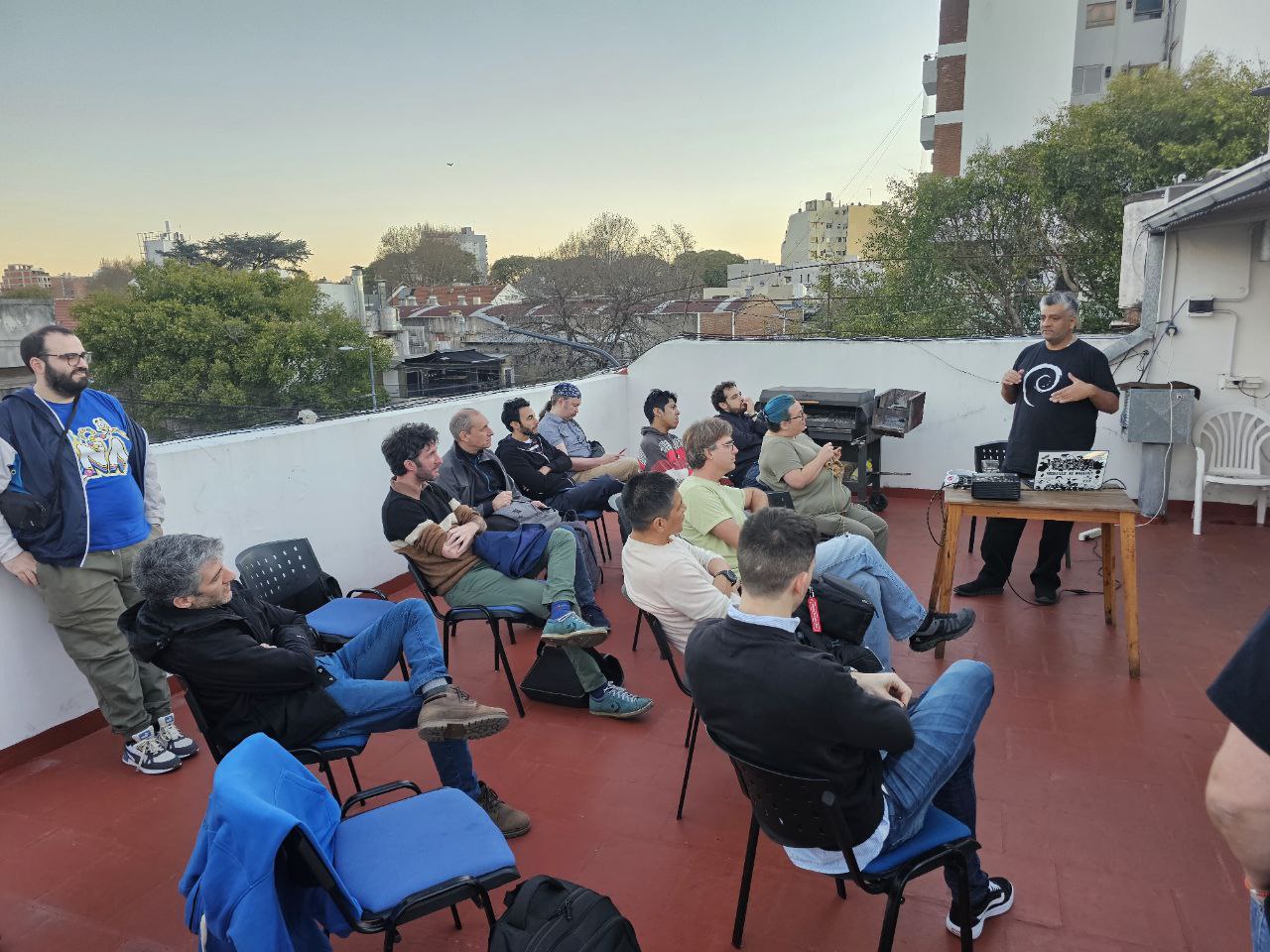 On August 28th, we had the opportunity to get to know the Venue. We walked around
the city and, obviously, sampled some of the beers from Santa Fe.
On August 29th we met with representatives of the University and local government
who were all very supportive. We are very grateful to them for opening
their doors to DebConf.
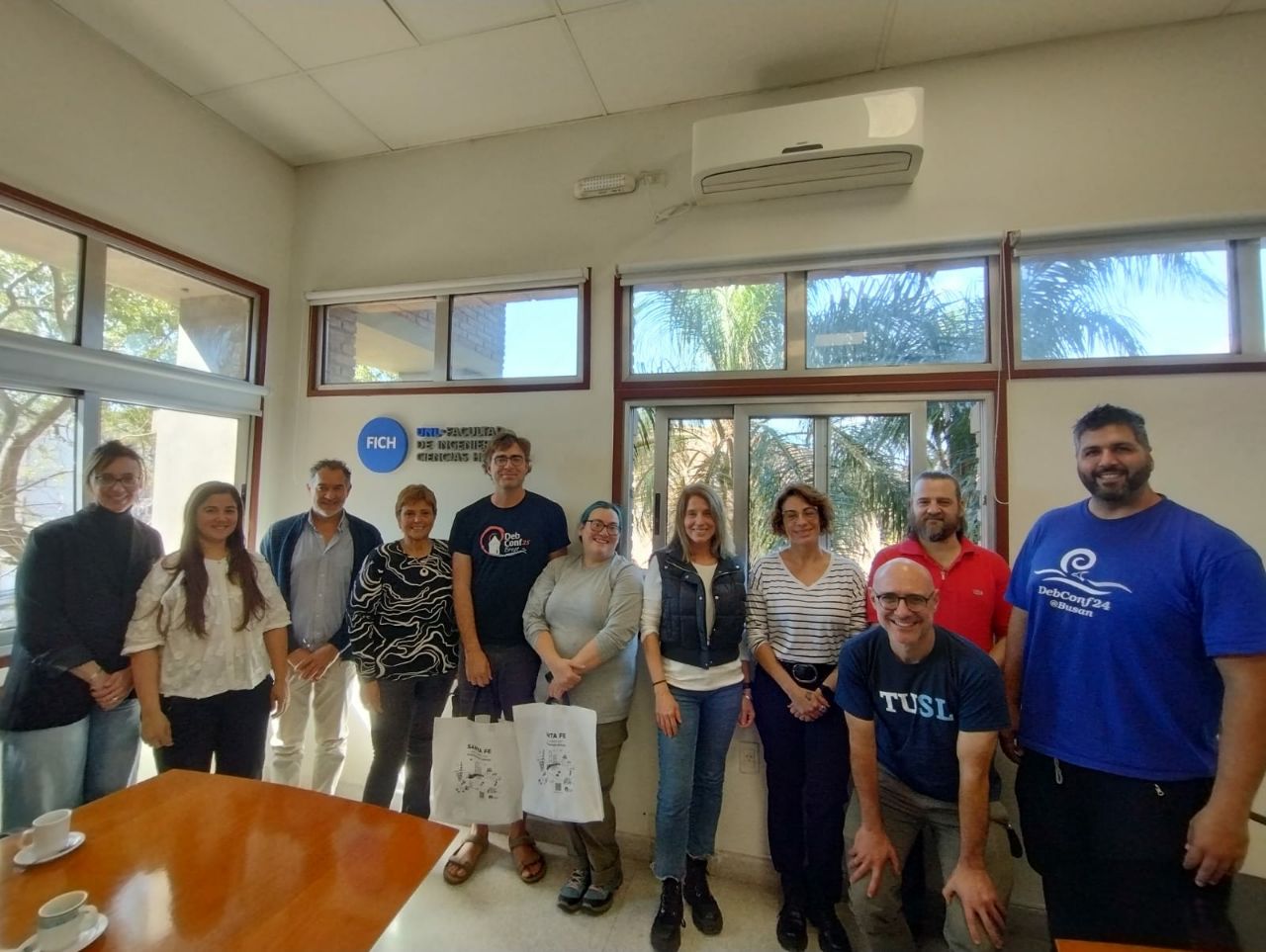 In the afternoon we met some of the local free software community at an event we
held in ATE
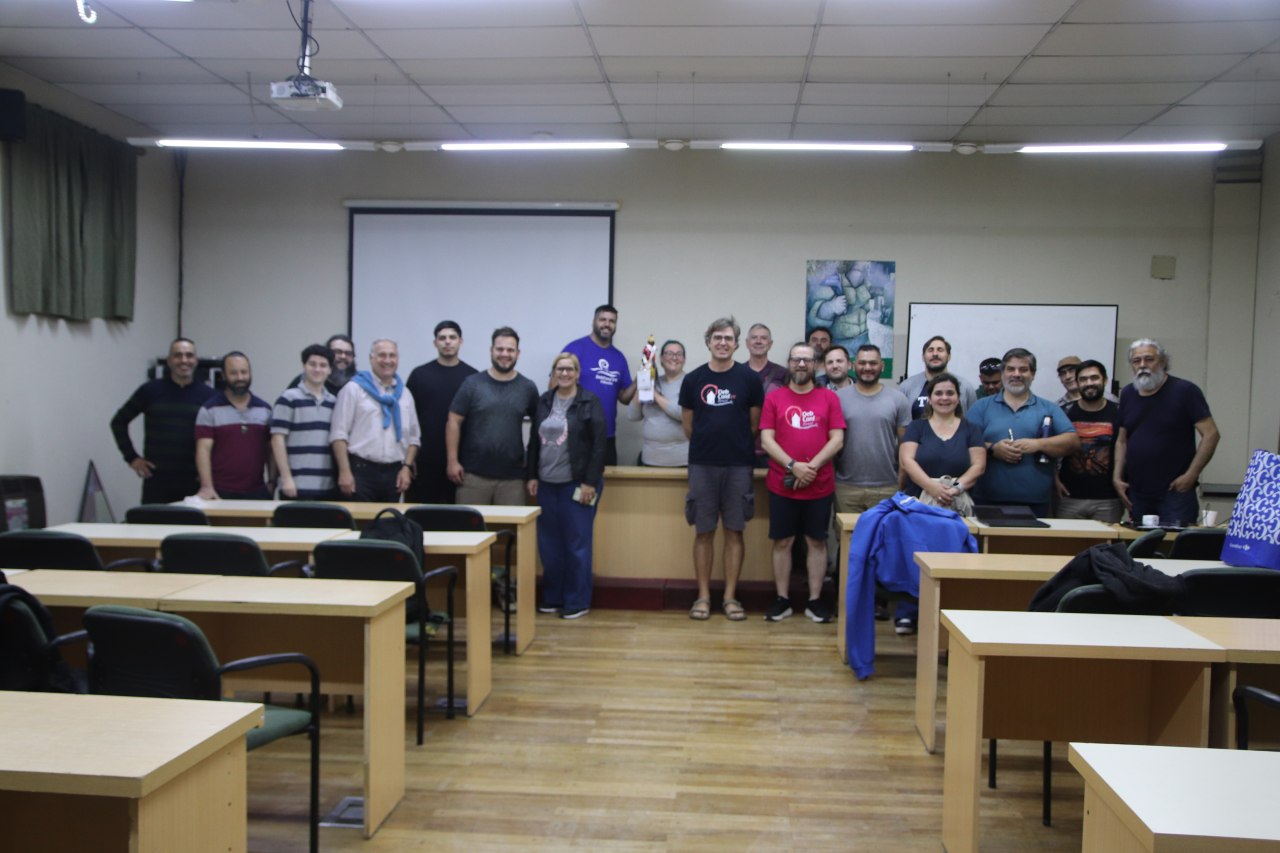 Thanks to Debian Argentina, and all the people who will make DebConf26
possible.
Thanks to Nattie Mayer-Hutchings and Stefano Rivera for reviewing an earlier
version of this article.
 It's Sunday and I'm now sitting in the train from Brest to Paris where I will be changing to Germany, on the way back from the
 Pollito and the gang of DebConf mascots wearing their conference badges (photo: Christoph Berg)
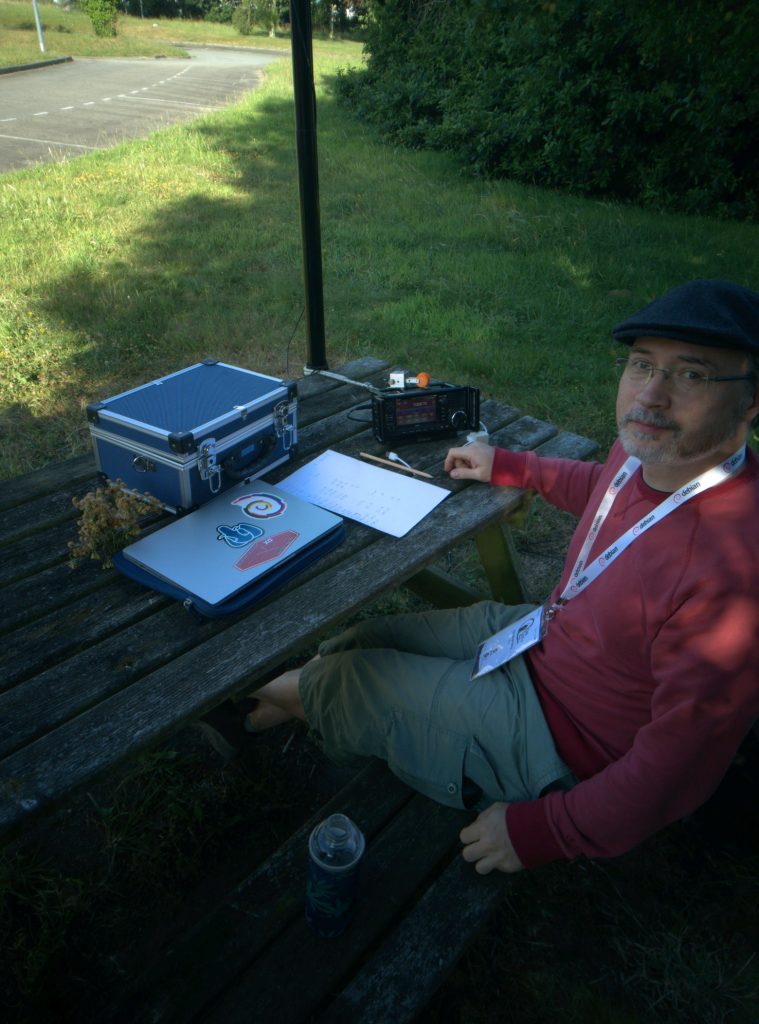 F/DF7CB in Brest (photo: Evangelos Ribeiro Tzaras)
 The northern coast of Ushant (photo: Christoph Berg)
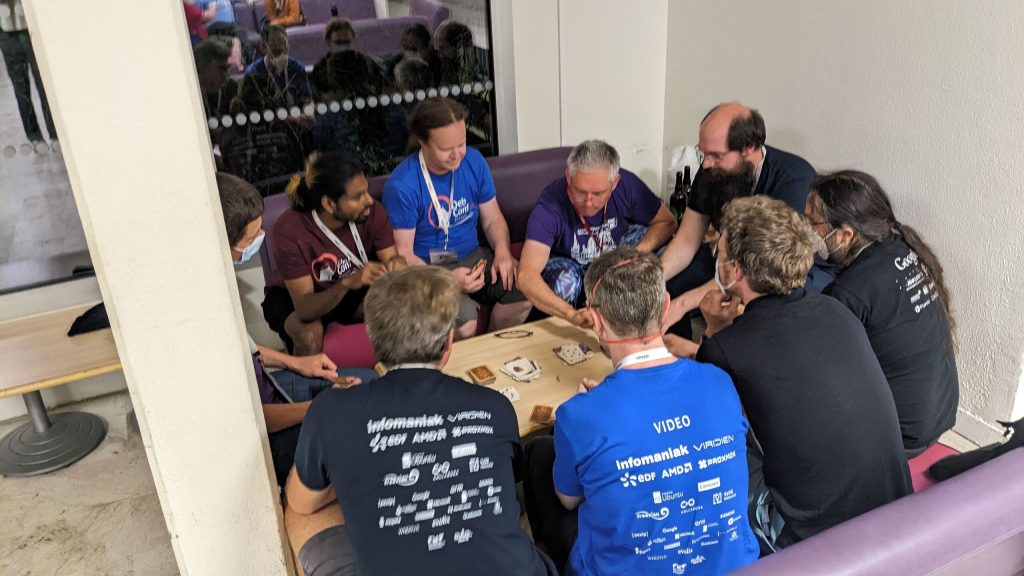 Having a nice day (photo: Christoph Berg)
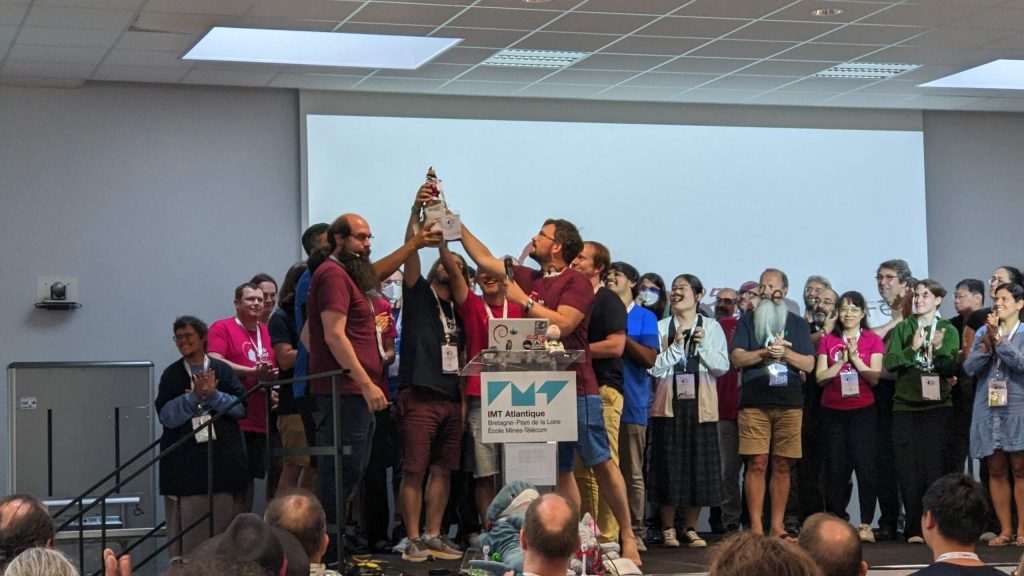 Pollito on stage (photo: Christoph Berg)

 Are you a student aspiring to participate in the