Search Results: "Birger Schacht"

5 July 2026

Birger Schacht: Status update, June 2026

Debian Related Work
  • Uploaded wofi 1.5.3-1 to unstable
  • Uploaded wob 0.16-1 to unstable
  • Uploaded labwc 0.20.0-1 and 0.20.1-1 to unstable; these releases come with support for wlroots-0.20, which made labwc reenter testing
  • Uploaded swaylock 1.8.5-2 to unstable to make it use the common-auth directive of pam (seeh #1140096)
  • Uploaded swayimg 5.4-1 to unstable
  • Uploaded wayback 0.3-2 to unstable, which was waiting in experimental for a reupload and I had forgotten about it; also fixed a typo in wayback upstream
  • Uploaded xdg-desktop-portal-wlr 0.8.3-1 to unstable

DH Related Work The search app I was working on last month was still a focus in June. I refactored the data model a bit and made it simpler. I stumbled over the Python Koans and Koan 15: The Invisible Ink gave me the idea of using unicode normalization when indexing the items. I released a couple of bug fix releases for the APIS framework, namely 0.64.2, 0.64.3 and 0.64.4. I also release 0.65.0 which is one step further in dropping support for the legacy apis_entities app. When the search module is merged it will give way for removing the last bits of the old cruft to be removed. During a regular dependency update session I looked at the changes in the dal dependency. After a long time with no commits, the project suddenly had a lot of commits co-authored by Claude and then released a new major version with a regression. Given the state of the project, we decided to keep using the previous release for now and look into replacing the dependency with an HTMX based solution. I implemented a POC for one of the plugins we develop and it was actually pretty easy. I also managed to combine the autocomplete approach with a multi-select form field, based on this blog post. In the PFP project I finally merged the stats endpoint which give statistics about the named graphs that are used as data sources.

Other I attended BSidesVienna 0x7EA but it was on one of the hottest days this year so far so I left after a couple of talks.

5 June 2026

Birger Schacht: Status update, May 2026

Debian Related Work
  • Uploaded labwc 0.9.7-1 to unstable; labwc 0.20 was released upstream since then, but it requires wlroots 0.20.1 which has not landed in Debian yet
  • Uploaded usbguard 1.1.4+ds-3 & 1.1.4+ds-4: cleaned up the packaging and fixed some long standing issues with the configuration; the legacy permission system isn t the default anymore
  • Uploaded foot 1.27.0-1 to unstable
  • Uploaded scdoc 1.11.4-2 to unstable
  • Uploaded cage 0.3.0-2 to unstable
  • Uploaded sway 1.12~rc3-2 to unstable; on the same day sway 1.12 was released and I uploaded 1.12-1 to unstable
  • Uploaded swayimg 5.2-1 to unstable
  • Uploaded git-quick-stats 2.11.0-1 to unstable
  • Uploaded grim 1.5.0+ds-1 to unstable

DH Related Work A big chunk of my DH related work went into designing & implementing a search app for the APIS framework. Our goal is to have a way of searching over various types of Django models. The app introduces a search model that indexes all registered models. We use a combination of PostgreSQLs full text search and Trigram Similarity to find the search results. Using a SearchVectorField and GinIndices for the trigram indexed fields we can reach a somewhat acceptable performance. We released versions 0.63 and 0.64 of the APIS framework. The 0.63 release introduced the new entities app, which will soon hopefully replace the legacy apis_entities & apis_metainfo modules. Version 0.64 moved some logic from the legacy modules the entities module. We made some progress in defining the endpoints for the PFP API.

3 May 2026

Birger Schacht: Status update, February - April 2026

Due to health reasons I did not have the energy to write individual status updates for February & March, so I ll just combine them with the April update: In February I cleaned out my GitHub account and moved all remaining projects to Codeberg. I archived the repositories on GitHub and added links to the new repositories on Codeberg. GitHub is a platform that is more and more frustrating to use. I still have to use it for my dayjob, though. The number of pull requests and issues that are written either by bots or by users that use bots increased in the last two years. Combined with that, GitHub provides a very low barrier for entitled users who do not want to contribute to a productive environment. GitHub now feels like the Twitter/X of git forges. Codeberg on the other hand is a community project. I feel a lot more at home there and the platform itself feels a lot more responsive than GitHub.

Debian Related Work
  • Uploaded wayback 0.3-1 to experimental
  • Uploaded slurp 1.6.0-1 to unstable
  • Uploaded first a prerelease of sway to experimental to be able to test wlroots 0.20.0 and then uploaded rc1, rc2 and rc3 of the upcoming 1.12 release
  • Uploaded waybar 0.15.0-1 to unstable
  • Uploaded kanshi 1.9.0-1 to unstable, which was possible because the dependency libscfg finally went through NEW
  • Uploaded libscfg 0.2.0-1 to unstable
  • Uploaded swaybg 1.2.2-1 to unstable
  • Uploaded labwc 0.9.4-1, 0.9.5 & 0.9.6 to unstable
  • Fixed the packaging of vali and uploaded version 0.1.1-1 to unstable; then added vali to the build dependencies of kanshi and reuploaded 1.9.0-2 thereof
  • Uploaded swaylock 1.8.5-1 to unstable
  • Uploaded fcft 3.3.3-1 to unstable
  • Uploaded foot 1.26.1-1 to unstable
  • Uploaded swayimg 5.0-1 and 5.1-1 to unstable
  • Fixed some packaging metadata in libsfdo and uploaded 0.1.4-2 to unstable
  • Reverted the upload of slurp from 1.6.0-1 to 1.6.0really1.5.0-1 because the upstream release of 1.6.0 was made by mistake and yanked a week later. Maybe I should add a cooldown period before uploading new releases ;)
  • Uploaded mako-notifier 1.11.0-1 to unstable
  • Uploaded cage 0.3.0-1 to experimental which uses wlroots 0.20.0
  • Uploaded xdg-desktop-portal-wlr 0.8.2-1 to unstable
  • Voted

DH Related Work I took part in the DHD 2026 Conference in Vienna, including a hands-on workshop of the dhinfra project. I released 0.60.0, 0.61.0 and 0.62.0 of apis-core-rdf. We rewrote the configuration format for the importer. We previously used TOML files, but that does not give us inheritance. So we now use simply Python classes as configuration format. I implemented a new backend for our apis-bibsonomy Django package. The package is meant to provide a datamodel for storing reference data that links to Bibsonomy or Zotero. Given that we don t use Bibsonomy anymore we now dropped the Bibsonomy backend but added a Zotero backend that allows to cache the entries locally.

6 February 2026

Birger Schacht: Status update, January 2026

January was a slow month, I only did three uploads to Debian unstable: I was very happy to see the new dfsg-new-queue and that there are more hands now processing the NEW queue. I also finally got one of the packages accepted that I uploaded after the Trixie release: wayback which I uploaded last August. There has been another release since then, I ll try to upload that in the next few days. There was a bug report for carl asking for Windows support. carl used the xdg create for looking up the XDG directories, but xdg does not support windows systems (and it seems this will not change) The reporter also provided a PR to replace the dependency with the directories crate which more system agnostic. I adapted the PR a bit and merged it and released version 0.6.0 of carl. At my dayjob I refactored django-grouper. django-grouper is a package we use to find duplicate objects in our data. Our users often work with datasets of thousands of historical persons, places and institutions and in projects that run over years and ingest data from multiple sources, it happens that entries are created several times. I wrote the initial app in 2024, but was never really happy about the approach I used back then. It was based on this blog post that describes how to group spreadsheet text cells. It uses sklearns TfidfVectorizer with a custom analyzer and the library sparse_dot_topn for creating the matrix. All in all the module to calculate the clusters was 80 lines and with sparse_dot_topn it pulled in a rather niche Python library. I was pretty sure that this functionality could also be implemented with basic sklearn functionality and it was: we are now using DictVectorizer because in a Django app we are working with objects that can be mapped to dicts anyway. And for clustering the data, the app now uses the DBSCAN algorithm (with the manhattan distance as metric). The module is now only half the size and the whole app lost one dependency! I released those changes as version 0.3.0 of the app. At the end of January together with friends I went to Brussels to attend FOSDEM. We took the night train but there were a couple of broken down trains so the ride took 26 hours instead of one night. It is a good thing we had a one day buffer and FOSDEM only started on Saturday. As usual there were too many talks to visit, so I ll have to watch some of the recordings in the next few weeks. Some examples of talks I found interesting so far:

2 January 2026

Birger Schacht: Status update, December 2025

December 2025 started off with a nice event, namely a small gathering of Vienna based DDs. Some of us were at DebConf25 in Brest and we thought it might be nice to have a get-together of DDs in Vienna. A couple of months after DebConf25 I picked up the idea, let someone else ping the DDs, booked a table at a local cafe and in the end we were a group of 6 DDs. It was nice to put faces to names, names to nicknames and to hear what people are up to. We are definitely planning to repeat that! December also ended with a meeting of nerds: the 39th Chaos Communication Congress in Hamburg. As usual, I did not really have that much time to watch many talks. I tend to bookmark a lot of them in the scheduling app in advance, but once I m at the congress the social aspect is much more important and I try to only attend workshop or talks that are not recorded. Watching the recordings afterward is possible anyway (and I actually try to do that!). There was also a Debian Developers meetup at day 3, combined with the usual time confusion regarding UTC and CET. We talked about having a Debian table at 40c3, so maybe the timezone won t be that much of a problem in the next time. Two talks I recommend are CSS Clicker Training: Making games in a styling language and To sign or not to sign: Practical vulnerabilities in GPG & friends. Regarding package uploads this month did not happen that much, I only uploaded the new version (0.9.3) of labwc. I created two new releases for carl. First a 0.5 release that adds Today and SpecifiedDate as properties. I forwarded an issue about dates not being parsed correctly to the icalendar issue tracker and this was fixed a couple of days later (thanks!). I then created a 0.5.1 release containing that fix. I also started planning to move the carl repository back to codeberg, because Github feels more and more like an AI Slop platform. The work on debiverse also continued. I removed the tailwind CSS framework, and it was actually not that hard to reproduce all the needed CSS classes with custom CSS. I think that CSS frameworks make sense to a point, but once you start implementing stuff that the framework does not provide, it is easier if everything comes out of one set of rules. There was also the article Vanilla CSS is all you need which goes into the same direction and which gave me some ideas how to organize the CSS directives. I also refactored the filter generation for the listing filters and the HTML filter form is now generated from the FastAPI Query Parameter Model. Screenshot of the filter form For navigation I implemented a sidebar, that is hidden on small screens but can be toggled using a burger menu. Screenshot of the navigation bar I also stumbled upon An uncomfortable but necessary discussion about the Debian bug tracker, which raises some valid points. I think debiverse could be a solution to the first point of What could be a way forward? , namely: Create a new web service that parses the existing bug data and displays it in a rich format . But if there is ever another way than email to interact with bugs.debian.org, than this approach should not rely on passing on the commands via mail. If I click a button in a web interface to raise the severity, the severity should be raised right away - not 10 minutes later when the email is received. I think the individual parts (web, database, mail interface) should be decoupled and talk to each other via APIs.

2 December 2025

Birger Schacht: Status update, November 2025

I started this month with a week of vacation which was followed by a small planned surgery and two weeks of sick leave. Nonetheless, I packaged and uploaded new releases of a couple of packages: Besides that I reactivated I project I started in summer 2024: debiverse.org. The idea of that was to have interfaces to Debian bugs and packages that are usable on mobile devices (I know, ludicrous!). Back then I started with Flask and Sqlalchemy, but that soon got out of hand. I now switched the whole stack to FastAPI and SQLModel which makes it a lot easier to manage. And the upside is that it comes with an API and OpenAPI docs. For the rendered HTML pages I use Jinja2 with Tailwind as CSS framework. I am currently using udd-mirror as database backend, which works pretty good (for this single user project). It would be nice to have some of the data in a faster index, like Typesense or Meilisearch. This way it would be possible to have faceted search or more performant full text search. But I haven t found any software that could provide this that is packaged in Debian.
Screenshot of the debiverse bug report list Screenshot of the debiverse swagger API

3 November 2025

Birger Schacht: Status update, October 2025

At the beginning of the month I uploaded a new version of the sway package to Debian. This contains two backported patches, one to fix reported WM capabilities and one to revert the default behavior for drag_lock to disabled. I also uploaded new releases of cage (a kiosk for Wayland), labwc, the window-stacking Wayland compositor that is inspired by Openbox, and wf-recorder, a tool for creating screen recordings of wlroots-based Wayland compositors. If I don t forget I try to update the watch file of the packages I touch to the new version 5 format. Simon Ser announced vali, a C library for Varlink. The blog post also mentions that this will be a dependency of the next version of the kanshi Wayland output management daemon and the PR to do so is now already merged. So I created ITP: vali A Varlink C implementation and code generator, packaged the library and it is now waiting in NEW. In addition to libscfg this is now the second dependency of kanshi that is in NEW. On the Rust side of things I fixed a bug in carl. The fix introduces new date properties which can be use to highlight a calendar date. I also updated all the dependencies and plan to create a new release soon. Later I dug up a Rust project that I started a couple of years ago, where I try to use wasm-bindgen to implement interactive web components. There is a lot I have to refactor in this code base, but I will work on that and try to publish something in the next few months.

Miscellaneous Two weeks ago I wrote A plea for <dialog>, which made the case for using standardized HTML elements instead of resorting to JavaScript libraries. I finally managed to update my shell Server to Debian 13. I created an issue for the nextcloud-news android client because I moved to a new phone and my starred articles did not show up in the news app, which is a bit annoying. I got my ticket for 39C3. In my dayjob I continued to work on the refactoring of the import logic of our apis-core-rdf app. I released version 0.56 which also introduced the #snackbar as the container for the toast message, as described in the <dialog> block post. At the end of the month I released version 0.57 of apis-core-rdf, which got rid of the remaining leftovers of the old import logic. A couple of interesting articles I stumbled upon (or finally had the time to read):

20 October 2025

Birger Schacht: A plea for <dialog>

A couple of weeks ago there was an article on the Freexian blog about Using JavaScript in Debusine without depending on JavaScript. It describes how JavaScript is used in the Debusine Django app, namely for progressive enhancement rather than core functionality . This is an approach I also follow when implementing web interfaces and I think developments in web technologies and standardization in recent years have made this a lot easier. One of the examples described in the post, the Bootstrap toast messages, was something that I implemented myself recently, in a similar but slightly different way. In the main app I develop for my day job we also use the Bootstrap framework. I have also used it for different personal projects (for example the GSOC project I did for Debian in 2018, was also a Django app that used Bootstrap). Bootstrap is still primarily a CSS framework, but it also comes with a JavaScript library for some functionality. Previous versions of Bootstrap depended on jQuery, but since version 5 of Bootstrap, you don t need jQuery anymore. In my experience, two of the more commonly used JavaScript utilities of Bootstrap are modals (also called lightbox or popup, they are elements that are displayed above the main content of a website) and toasts (also called alerts, they are little notification windows that often disappear after a timeout). The thing is, Bootstrap 5 was released in 2021 and a lot has happened since then regarding web technologies. I believe that both these UI components can nowadays be implemented using standard HTML5 elements. An eye opening talk I watched was Stop using JS for that from last years JSConf(!). In this talk the speaker argues that the Rule of least power is one of the core principles of web development, which means we should use HTML over CSS and CSS over JavaScript. And the speaker also presents some CSS rules and HTML elements that added recently and that help to make that happen, one of them being the dialog element:
The <dialog> HTML element represents a modal or non-modal dialog box or other interactive component, such as a dismissible alert, inspector, or subwindow. The Dialog element at MDN
The baseline for this element is widely available :
This feature is well established and works across many devices and browser versions. It s been available across browsers since March 2022. The Dialog element at MDN
This means there is an HTML element that does what a modal Bootstrap does! Once I had watched that talk I removed all my Bootstrap modals and replaced them with HTML <dialog> elements (JavaScript is still needed to .show() and .close() the elements, though, but those are two methods instead of a full library). This meant not only that I replaced code that depended on an external library, I m now also a lot more flexible regarding the styling of the elements. When I started implementing notifications for our app, my first approach was to use Bootstrap toasts, similar to how it is implemented in Debusine. But looking at the amount of HTML code I had to write for a simple toast message, I thought that it might be possible to also implement toasts with the <dialog> element. I mean, basically it is the same, only the styling is a bit different. So what I did was that I added a #snackbar area to the DOM of the app. This would be the container for the toast messages. All the toast messages are simply <dialog> elements with the open attribute, which means that they are visible right away when the page loads.
<div id="snackbar">
   % for message in messages % 
    <dialog class="mytoast alert alert-  message.tags  " role="alert" open>
        message  
    </dialog>
   % endfor % 
</div>
This looks a lot simpler than the Bootstrap toasts would have. To make the <dialog> elements a little bit more fancy, I added some CSS to make them fade in and out:
.mytoast  
    z-index: 1;
    animation: fadein 0.5s, fadeout 0.5s 2.6s;
 
@keyframes fadein  
    from  
        opacity: 0;
     
    to  
        opacity: 1;
     
 
@keyframes fadeout  
    from  
        opacity: 1;
     
    to  
        opacity: 0;
     
 
To close a <dialog> element once it has faded away, I had to add one JavaScript event listener:
window.addEventListener('load', () =>  
    document.querySelectorAll(".mytoast").forEach((element) =>  
        element.addEventListener('animationend', function(e)  
            e.animationName == "fadeout" && element.close();
         );
     );
 );
(If one would want to use the same HTML code for both script and noscript users, then the CSS should probably adapted: it fades away and if there is no JavaScript to close the element, it stays visible after the animation is over. A solution would for example be to use a close button and for noscript users simply let it stay visible - this is also what happens with the noscript messages in Debusine). So there are many new elements in HTML and a lot of new features of CSS. It makes sense to sometimes ask ourselves if instead of the solutions we know (or what a web search / some AI shows us as the most common solution) there might be some newer solution that was not there when the first choice was created. Using standardized solutions instead of custom libraries makes the software more maintainable. In web development I also prefer standardized elements over a third party library because they have usually better accessibility and UX. In How Functional Programming Shaped (and Twisted) Frontend Development the author writes:
Consider the humble modal dialog. The web has <dialog>, a native element with built-in functionality: it manages focus trapping, handles Escape key dismissal, provides a backdrop, controls scroll-locking on the body, and integrates with the accessibility tree. It exists in the DOM but remains hidden until opened. No JavaScript mounting required. [ ] you ve trained developers to not even look for native solutions. The platform becomes invisible. When someone asks how do I build a modal? , the answer is install a library or here s my custom hook, never use <dialog>. Ahmad Alfy

1 October 2025

Birger Schacht: Status update, September 2025

Regarding Debian packaging this was a rather quiet month. I uploaded version 1.24.0-1 of foot and version 2.8.0-1 of git-quick-stats. I took the opportunity and started migrating my packages to the new version 5 watch file format, which I think is much more readable than the previous format. I also uploaded version 0.1.1-1 of libscfg to NEW. libscfg is a C implementation of the scfg configuration file format and it is a dependency of recent version of kanshi. kanshi is a tool similar to autorandr which allows you define output profiles and kanshi switches to the correct output profile on hotplug events. Once libscfg is in unstable I can finally update kanshi to the latest version. A lot of time this month in finalizing a redesign of the output rendering of carl. carl is a small rust program I wrote that provides a calendar view similar to cal, but it comes with colors and ical file integration. That means that you can not only display a simple calendar, but also colorize/highlight dates based on various attributes or based on events on that day. In the initial versions of carl the output rendering was simply hardcoded into the app.
Screenshot of carl
This was a bit cumbersome to maintain and not configurable for users. I am using templating languages on a daily basis, so I decided I would reimplement the output generation of carl to use templates. I chose the minijinja Rust library which is based on the syntax and behavior of the Jinja2 template engine for Python . There are others out there, like tera, but minijinja seems to be more active in development currently. I worked on this implementation on and off for the last year and finally had the time to finish it up and write some additional tests for the outputs. It is easier to maintain templates than Rust code that uses write!() to format the output. I also implemented a configuration option for users to override the templates. Additional to the output refactoring I also fixed couple of bugs and finally released v0.4.0 of carl. In my dayjob I released version 0.53 of apis-core-rdf which contains the place lookup field which I implemented in August. A couple of weeks later we released version 0.54 which comes with a middleware to show pass on messages from the Django messages framework via response header to HTMX to trigger message popups. This implementation is based on the blog post Using the Django messages framework with HTMX. Version 0.55 was the last release in September. It contained preparations for refactoring the import logic as well as a couple of UX improvements.

1 September 2025

Birger Schacht: Status update, August 2025

Due to the freeze I did not do that many uploads in the last few months, so there were various new releases I packaged once Trixie was released. Regarding the release of Debian 13, Trixie, I wrote a small summary of the changes in my packages. I uploaded an unreleased version of cage to experimental, to prepare for the transition to wlroots-0.19. Both sway and labwc already had packages in experimental that depended on the new wlroots version. When the transition happened, I uploaded the cage version to unstable, as well as labwc 0.9.1 and sway 1.11. I updated Most of the packages I uploaded using git-debpush, some of them could not be uploaded this way due to upstream using git submodules (this is 1107219). I also created 1112040 - git-debpush: should also say which tag it created and 1111504 - git-debpush: pristine-tar check warns about pristine-tar data thats not present (which is already fixed). I uploaded wayback 0.2 to NEW, where it is waiting for review, (ITP). In my dayjob I added extended the place lookup form of apis-core-rdf to allow searching places and selecting them on a map using leaflet and the nominatim API. Another issue I worked on was about highlighting those inputs of our generic list filter that are used to filter the results. I released a couple of bugfix releases for the v0.50 release, then v0.51 and two bugfix releases and then v0.52 and another couple of bugfix releases. v0.53 will land in a couple of days. I also released v0.6.2 of apis-highlighter-ng, which is sort of a plugin for apis-core-rdf, that allows to highlight parts of a text and link them to whatever Django object (in our case relations).

16 August 2025

Birger Schacht: Updates and additions in Debian 13 Trixie

Last week Debian 13 (Trixie) was released and there have been some updates and additions in the packages that I maintain, that I wanted to write about. I think they are not worth of being added to the release notes, but I still wanted to list some of the changes and some of the new packages.

sway Sway, the tiling Wayland compositor was version 1.7 in Bookworm. It was updated to version 1.10 (and 1.11 is already in experimental and waiting for an upload to unstable). This new version of sway brings, among a lot of other features, updated support for touchpad gestures and support for the ext-session-lock-v1 protocol, which allows for more robust and secure screen locking. The configuration snippet that activates the default sway background is now shipped in the sway-backgrounds package instead of being part of the sway package itself. The default menu application was changed from dmenu to wmenu. wmenu is a Wayland native alternative to dmenu which I packaged and it is now recommended by sway. There are some small helper tools for sway that were updated: swaybg was bumped from 1.2.0 to 1.2.1, swaylock was bumped from 1.7.2 to 1.8.2. The grimshot script, which is a script for making screenshots, was part of the sway s contrib folder for a long time (but was shipped as a separate binary package). It was removed from sway and is now part of the sway-contrib project. There are some other useful utilities in this source package that I might package in the future. slurp, which is used by grimshot to select a region, was updated from version 1.4 to version 1.5.

labwc I uploaded the first labwc package two years ago and I m happy it is now part of a stable Debian release. Labwc is also based on wlroots, like sway. It is a window-stacking compositor and is inspired by openbox. I used openbox for a long time back in the day before I moved to i3 and I m very happy to see that there is a Wayland alternative.

foot Foot is a minimalistic and fast Wayland terminal emulator. It is mostly keyboard driven. foot was updated from version 1.13.1 to 1.21.0. The probably most important change for users updating might be the fact that:
  • Control+Shift+u is now bound to unicode-input instead of show- urls-launch, to follow the convention established in GTK and Qt
  • show-urls-launch now bound to Control+Shift+o

et cetera The Wayland kiosk cage was updated from 0.1.4 to 0.2.0. The waybar bar for wlroots compositors was updated from 0.9.17 to 0.12.0. swayimg was updated from 1.10 to 3.8 and now brings support for custom key bindings, support for additional image types (PNM, EXR, DICOM, Farbfeld, sixel) and a gallery mode. tofi, another dmenu replacement was updated from 0.8.1 to 0.9.1, wf-recorder a tool for screen recording in wlroots-based compositors, was updated from version 0.3 to version 0.5.0. wlogout was updated from version 1.1.1 to 1.2.2. The application launcher wofi was updated from 1.3 to 1.4.1. The lightweight status panel yambar was updated from version 1.9 to 1.11. kanshi, the tool for managing and automatically switching your output profiles, was updated from version 1.3.1 to version 1.5.1. usbguard was updated from version 1.1.2 to 1.1.3.

added
  • fnott - a lightweight notification daemon for wlroots based compositors
  • fyi - a utility to send notifications to a notification daemon, similar to notify-send
  • pipectl - a tool to create and manage short-lived named pipes, this is a dependency of wl-present. wl-present is a script around wl-mirror which implements output mirroring for wlroots-based compositors
  • poweralertd - a small daemon that notifies you about the power status of your battery powered devices
  • wlopm - control power management of outputs
  • wlrctl - command line utility for miscellaneous wlroots Wayland extensions
  • wmenu - already mentioned, the new default launcher of sway
  • wshowkeys - shows keypresses in wayland sessions, nice for debugging
  • libsfdo - libraries implementing some freedesktop.org specs, used by labwc

1 August 2025

Birger Schacht: Status update, July 2025

In beginning of July I got my 12" framework laptop and installed Debian on it. During that setup I made some updates to my base setup scripts that I use to install Debian machines. Due to the freeze I did not do much package related work. But I was at DebConf and I uploaded a new release of labwc to experimental, mostly to test the tag2upload workflow. I started working on packaging wlr-sunclock which is a small Wayland widget that displays the sun s shadows on the earth. I also created an ITP for wayback. Wayback is an X11 compatibility layer to allow to run X11 desktop environments using Wayland. In my dayjob I did my usual work on apis-core-rdf, which is our Django application for managing prosopographic data. I implemented a password change interface and did some restructuring of the templates. We released a new version which was followed by a bugfix release a couple of days later. I also implemented a rather big refactoring in pfp-api. PFP-API is a FastAPI based REST API that uses rdfproxy to fetch data from a Triplestore, converts the data to Pydantic models and then ships the models as JSON. Most of the work is done by rdfproxy in the background, but I adapted the existing pfp-api code to make it easier to add new entity types.

26 July 2025

Birger Schacht: My DebConf 25 review

DebConf 25 happened between 14th July and 19th July and I was there. It was my first DebConf (the big one, I was at a Mini DebConf in Hamburg a couple of years ago) and it was interesting. DebConf 25 happened at a Campus University at the outskirts of Brest and I was rather reluctant to go at first (EuroPython 25 was happening at the same time in Prague), but I decided to use the chance of DebConf happening in Europe, reachable by train from Vienna. We took the nighttrain to Paris, then found our way through the maze that is the Paris underground system and then got to Brest with the TGV. On our way to the Conference site we made a detour to a supermarket, which wasn t that easy because is was a national holiday in France and most of the shops were closed. But we weren t sure about the food situation at DebConf and we also wanted to get some beer. At the conference we were greeted by very friendly people at the badge station and the front desk and got our badges, swag and most important the keys to pretty nice rooms on the campus. Our rooms had a small private bathroom with a toilet and a shower and between the two rooms was a shared kitchen with a refrigerator and a microwave. All in all, the accommodation was simple but provided everything we needed and especially a space to have some privacy. During the next days I watched a lot of talks, met new people, caught up with old friends and also had a nice time with my travel buddies. There was a beach near the campus which I used nearly every day. It was mostly sunny except for the last day of the conference, which apparently was not common for the Brest area, so we got lucky regarding the weather. Landscape view of the sea at Dellec beach Given that we only arrived in the evening of the first day of DebConf, I missed the talk When Free Software Communities Unite: Tails, Tor, and the Fight for Privacy (recording), but I watched it on the way home and it was also covered by LWN. On Tuesday I started the day by visiting a talk about tag2upload (recording). The same day there was also an academic track and I watched the talk titled Integrating Knowledge Graphs into the Debian Ecosystem (recording) which presented a property graph showing relationships between various entities like packages, maintainers or bugs (there is a repository with parts of a paper, but not much other information). The speaker also mentioned the graphcast framework and the ontocast framework which sound interesting - we might have use for something liked this at $dayjob. In the afternoon there was a talk about the ArchWiki (recording) which gave a comprehensive insight in how the ArchWiki and the community behind it works. Right after that was a Debian Wiki BoF. There are various technical limitations with the current wiki software and there are not enough helping hands to maintain the service and do content curation. But the BoF had some nice results: there is now a new debian-wiki mailinglist, an IRC channel, a MediaWiki installation has been set up during DebConf, there are efforts to migrate the data and most importantly: and handful of people who want to maintain the service and organize the content of the wiki. I think the input from the ArchWiki folks gave some ideas how that team could operate. Tag at the wall at Dellec beach Wednesday was the day of the daytrip. I did not sign up for any of the trips and used the time to try out tag2upload, uploaded the latest labwc release to experimental and spent the rest of the day at the beach. Other noteworthy session I ve attended were the Don t fear the TPM talk (recording), which showed me a lot of stuff to try out, the session about lintian-ng (no recording), which is an experimental approach to make lintian faster, the review of the first year of wcurls existence (no recording yet) and the summary of Rust packaging in Debian (no recording yet). In between the sessions I started working on packaging wlr-sunclock (#1109230).

What did not work Vegan food. I might be spoiled by other conferences. Both at EuroPycon last year (definitely bigger, a lot more commercial) and at PyCon CZ 23 (similar in size, a lot more DIY) there was catering with explicitly vegan options. As I ve mentioned in the beginning, we went to a supermarket before we went to the conference and we had to go there one more time during the conference. I think there was a mixture between a total lack of awareness and a LOT of miscommunication. The breakfasts at the conference consisted of pastries and baguettes - I asked at the first day what the vegan options were and the answer was I don t know, maybe the baguette? and we were asked to only take as much baguette as the people who also got pastries. The lunch was prepared by the Restaurant associatif de Kern vent which is a canteen at the university campus. When we asked if there is vegan food, the people there said that there was only a vegetarian option so we only ate salad. Only later we heard via word of mouth that one has to explicitly ask for a vegan meal which was apparently prepared separatly and you had to find the right person that knows about it (I think thats very Debian-like ). But even then a person once got a vegetarian option offered as vegan food. One problem was also the missing / confusing labeling of the food. At the conference dinner there was apparently vegan food, but it was mixed with all the other food. There were some labels but with hundreds of hungry people around and caterers removing empty plates and dropping off plates with other stuff, everything gets mixed up. In the end we ate bread soaked in olive oil, until the olive oil got taken away by the catering people literally while we were dipping the bread in it. And when these issues were raised, some of the reactions can be summarized as You re holding it wrong which was really frustrating. The dinners at the conference hall were similar. At some point I had the impression that vegan and vegetarian was simply seen as the same thing. Dinner menu at the conference If the menus would be written like a debian/copyright file it would probably have looked like this:
Food: *
Diet: Vegan or Vegetarian
But the thing is that Vegan and Vegetarian cannot be mixed. Its similar to non compatible licenses. Once you mix vegan food with vegan food with vegetarian food it s not vegan anymore. Don t get me wrong, I know its hard to organize food for hundreds of people. But if you don t know what it means to provide a vegan option, just communicate the fact so people can look alternatives in advance. During the week some of the vegan people shared food, which was really nice and there were also a lot of non-vegan people who tried to help, organized extra food or simply listened to the hangry rants. Thanks for that!

Paris Saturday was the last day of DebConf and it was a rainy day. On Sunday morning we took the TGV back to Paris and then stayed there for one night because the next night train back to Vienna was on Monday. Luckily the weather was better in Paris. The first thing we did was to look up a vegan burger place. In the evening we strolled along the Seine and had a couple of beers at the Jardins du Trocad ro. Monday the rain also arrived in Paris and we mostly went from one cafe to the next, but also managed to visit Notre Dame.

Conclusio The next DebConf will be in Argentina and I think its likely that DebConf 27 will also not happen anywhere in trainvelling distance. But even if, I think the Mini DebConfs are more my style of happening (there is one planned in Hamburg next spring, and a couple of days ago I learned that there will be a Back to the Future musical show in Hamburg during that time). Nonetheless I had a nice time and I stumbled over some projects I might get more involved in. Thanks also to my travel buddies who put up with me

17 July 2025

Birger Schacht: My first tag2upload upload

Following the DebConf25 talk by Ian Jackson tag2upload - upload simply by pushing a signed git tag I decided to use the quiet time during the day of the DayTrip on DebConf 25 to try out uploading a package using tag2upload. Given the current freeze a couple of the packages I maintainer have new releases waiting. I decided on uploading the new version of labwc to experimental. Labwc is a Wayland compositor based on the wlroots compositor library (the library that sway is using). Labwc is inspired by the Openbox window manager. The upstream team of Labwc released version 0.9.0 last week, the first version that is based on wlroots 0.19.x. Wlroots 0.19.x is also only available in experimental, so that was a good fit for trying an upload with tag2upload. I first used my usual workflow, going into my package repository, doing get fetch origin, checking out the tag of the new release and tagging that with git tag upstream/0.9.0. Then I bumped the version in the debian/experimental branch, adapted the debian/control file for the changed wlroots dependency, committed and built the package using git-buildpackage to check if it builds fine and there are no lintian errors. Then I moved on to look at tag2upload. As a starting point for using tag2upload I read the blogpost by Jonathan Carter My first tag2upload upload. It pointed me to one very important option of git debpush, namely the --baredebian option which I have to use because I use the bare Debian git layout. Given that the last upload of labwc I did was to unstable, I also had to add the --force=changed-suite. I also started right away to use the --tag-only option, because for my first tests I only wanted to have local changes and nothing pushed to anywhere. I also used the --dry-run option. This led to the following command:
> git debpush --baredebian --force=changed-suite --dry-run --tag-only
tags 0.9.0, upstream/0.9.0 all exist in this repository
tell me which one you want to make an orig.tar from: git deborig --just-print '--version=0.9.0-1' TAG
git-debpush: git-deborig failed; maybe try git-debpush --upstream=TAG
This was a bit confusing, because the error message talked about git-deborig, but I was using git-debpush. I also did not want to make an orig.tar! The --upstream option in the git-debpush(1) manual gave an explanation for this:
When pushing a non-native package, git-debpush needs a tag for the upstream part of your package. By default git-debpush asks git-deborig(1), which searches for a suitable tag based on the upstream version in debian/changelog.
So apparently git-debpush can not find out what the correct tag for the upstream version is, because git-deborig can not find out what the correct tag for the upstream version is. git-debpush simply calls git deborig --just-print --version="$version" in line 437. This fails because I initially created a second upstream/0.9.0 to the existing 0.9.0 release tag. I do this for git-buildpackage to find the upstream sources, but with multiple tags git-deborig is not sure which one is the tag it should use (although both point to the same commit). So I removed the upstream/0.9.0 tag and ran git debpush again and now there was no error message (besides the warning regarding the changed suite) but it also did not give an feedback about what is happening. So I tried without the --dry-run option. Again, no output whatsoever, other than the warning about the changed release, BUT my gnupg asked me for permission to sign via my yubikey! And when I looked at the list of tags, I saw that there is now a debian/0.9.0-1 tag that was not there before! Looking at the tag I saw that it was a tag in the format described in the tag2upload(5) manual page, containing the following lines:
labwc release 0.9.0-1 for experimental
[dgit distro=debian split --quilt=baredebian]
[dgit please-upload source=labwc version=0.9.0-1 upstream-tag=0.9.0 upstream=4beee3851f75b53afc2e8699c594c0cc222115bd]
and the tag was signed by me. The 4beee3851f75b53afc2e8699c594c0cc222115bd commit ID is the commit the 0.9.0 tag points to. Now that I had a signed commit tag in the correct format, I went to the labwc packaging repository on salsa and enabled the webhook to trigger the tag2upload service (I just saw that the documentation was updated and there is now a global webhook on salsa, so this step is not needed anymore). Finally I pushed the tags using git push --tags. I could also have used git-debpush for this step, but I d rather use git directly. I then looked at the tag2upload queue and saw how a worker built and uploaded the newest labwc release and I also got an email from the tag2upload service [tag2upload 275] uploaded labwc 0.9.0-1. And a couple of minutes later I got the confirmation that labwc 0.9.0-1 was accepted into experimental. Great! So, to conclude: for tag2upload to work we simply need a git tag in the correct format. The tag2upload service now gets triggered by every pushed tag on salsa but only acts on tags that adhere to the tag2upload(5) format. git-debpush is a simply bash script that creates such a tag and by default also pushes the tag. I think the script could be a bit more verbose, for example telling me that it created a tag and the name of that tag. I think the dependency on git-deborig is also a problem. I use git-buildpackage to build my packages and by default git-buildpacakge assumes upstream tags are of the form upstream/%(version)s (source). I could now change that for all the packages I maintain, but I also think it makes sense to control the tag myself and not use a tag that is controlled by upstream. Upstream could change or delete that tag or I might need to create a tag for a version that is not tagged by upstream. I also think git-debpush is a rather mileading command name, given that the main task of the script is to create a tag in the correct format. Other than that, I m pretty happy about this service. I have a rather crappy uplink at home and it is not so uncommon for my uploads to fail because the connection dropped during dput. Using a simple git based upload approach makes these problems a thing of the past. I might look into other ways to create the needed tag, though.

7 July 2025

Birger Schacht: Debian on Framework 12

For some time now I was looking for a device to replace my Thinkpad. Its a 14" device, but thats to big for my taste. I am a big fan of small notebooks, so when frame.work announced their 12" laptop, I took the chance and ordered one right away. I was in one of the very early batches and got my package a couple of days ago. When ordering, I chose the DIY edition, but in the end there was not that much of DIY to do: I had to plug in the storage and the memory, put the keyboard in and tighten some screws. There are very detailed instructions with a lot of photos that tell you which part to put where, which is nice. Image of the Framework 12 laptop, assembled but powered off My first impressions of the device are good - it is heavier than I anticipated, but very vell made. It is very easy to assemble and disassemble and it feels like it can take a hit. When I started it the first time it took some minutes to boot because of the new memory module, but then it told me right away that it could not detect an operating system. As usual when I want to install a new system, I created a GRML live usb system and tried to boot from this USB device. But the Framwork BIOS did not want to let me boot GRML, telling me it is blocked by the current security policy. So I started to look in the BIOS where I could find the SecureBoot configuration, but there was no such setting anywhere. I then resorted to a Debian Live image, which was allowed to boot. Image of the screen of the Framework 12 laptop, saying it could not detect an operating system I only learned later, that the SecureBoot setting is in a separate section that is not part of the main BIOS configuration dialog. There is an Administer Secure Boot icon which you can choose when starting the device, but apparently only before you try to load an image that is not allowed. I always use my personal minimal install script to install my Debian systems, so it did not make that much of a difference to use Debian Live instead of GRML. I only had to apt install debootstrap before running the script. I updated the install script to default to trixie and to also install shim-signed and after successful installation booted into Debian 13 on the Framwork 12. Everthing seems to work fine so far. WIFI works. For sway to start I had to install firmware-intel-graphics. The touchscreen works without me having to configure anything (though I don t have frame.work stylus, as they are not yet available), also changing the brightness of the screen worked right away. The keyboard feels very nice, likewise the touchpad, which I configured to allow tap-to-click using the tap enabled option of sway-input. Image of the a Framework 12 laptop, showing the default Sway background image One small downside of the keyboard is that it does not have a backlight, which was a surprise. But given that this is a frame.work laptop, there are chances that a future generation of the keyboard will have backlight support. The screen of the laptop can be turned all the way around to the back of the laptops body, so it can be used as a tablet. In this mode the keyboard gets disabled to prevent accidently pushing keys when using the device in tablet mode. For online meetings I still prefer using headphones with cables over bluetooth once, so I m glad that the laptop has a headphone jack on the side. Above the screen there are a camera and a microphone, which both have separate physical switches to disable them. I ordered a couple of expansion cards, in the current setup I use two USB-C, one HDMI and one USB-A. I also ordered a 1TB expansion card and only used this to transfer my /home, but I soon realized that the card got rather hot, so I probably won t use it as a permanent expansion. I can not yet say a lot about how long the battery lasts, but I will bring the laptop to DebConf 25, I guess there I ll find out. There I might also have a chance to test if the screen is bright enough to be usable outdoors ;)

11 August 2023

Birger Schacht: Another round of rust

A couple of weeks ago I had to undergo surgery, because one of my kidneys malfunctioned. Everything went well and I m on my way to recovery. Luckily the most recent local heat wave was over just shortly after I got home, which made being stuck at home a little easier (not sure yet when I ll be allowed to do sports again, I miss my climbing gym ). At first I did not have that much energy to do computer stuff, but after a week or so I was able to sit in front of the screen for short amounts of time and I started to get into writing Rust code again.

carl The first thing I did was updating carl. I updated all the dependencies and switched the dependency that does coloring from ansi_term, which is unmaintained, to nu-ansi-term. When I then updated the clap dependency to version 4 I realized that clap now depends on the anstyle crate for text styling - so I updated carls coloring code once again so it now uses anstyle, which led to less dependencies overall. Implementing this change I also did some refactoring of the code. carl how also has its own website as well as a subdomain1. I also added a couple of new date properties to carl, namely all weekdays as well as odd and even - this means it is now possible choose a separate color for every weekday and have a rainbow calendar:
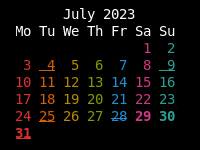
screenshot carl
This is included in version 0.1.0 of carl, which I published on crates.io.

typelerate Then I started writing my first game - typelerate. It is a copy of the great typespeed, without the multiplayer support. To describe the idea behind the game, I quote the typespeed website:
Typespeed s idea is ripped from ztspeed (a DOS game made by Zorlim). The Idea behind the game is rather easy: type words that are flying by from left to right as fast as you can. If you miss 10 or more words, game is over.
Instead of the multiplayer support, typelerate works with UTF-8 strings and it also has another game mode: in typespeed you only type whats scrolling via the screen. In typelerate I added the option to have one or more answer strings. One of those has to be typed instead of the word flying across the screen. This lets you implement kind of an question/answer game. To be backwards compatible with the existing wordfiles from typespeed2, the wordfiles for the question/answer games contain comma separated values. The typelerate repository contains wordfiles with Python and Rust keywords as well as wordfiles where you are shown an Emoji and you have to type the corresponding Github shortcode. I m happy to add additional wordfiles (there could be for example math questions ).
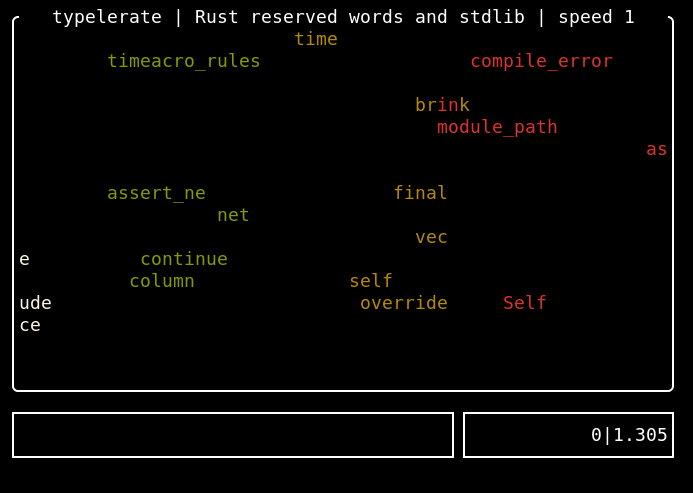
screenshot typelerate

marsrover Another commandline game I really like, because I am fascinated by the animated ASCII graphics, is the venerable moon-buggy. In this game you have to drive a vehicle across the moon s surface and deal with obstacles like craters or aliens. I reimplemented the game in rust and called it marsrover:
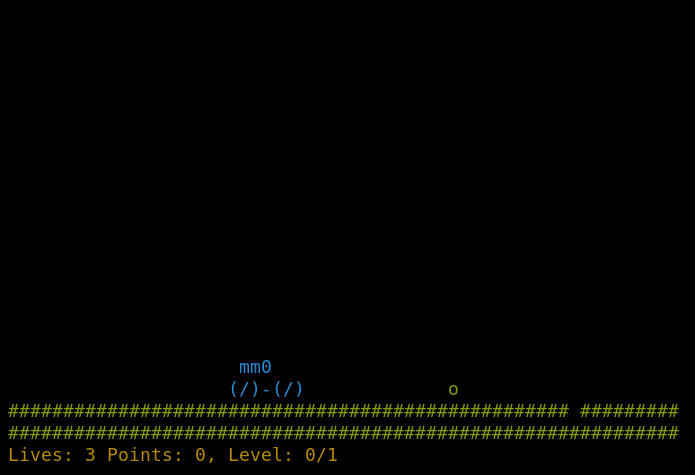
screenshot marsrover
I published it on crates.io, you can find the repository on github. The game uses a configuration file in $XDG_CONFIG_HOME/marsrover/config.toml - you can configure the colors of the elements as well as the levels. The game comes with four levels predefined, but you can use the configuration file to override that list of levels with levels with your own properties. The level properties define the probabilities of obstacles occuring on your way on the mars surface and a points setting that defines how many points the user can get in that level (=the game switches to the next level if the user reaches the points).
[[levels]]
prob_ditch_one = 0.2
prob_ditch_two = 0.0
prob_ditch_three = 0.0
prob_alien = 0.5
points = 100
After the last level, the game generates new ones on the fly.

  1. thanks to the service from https://cli.rs.
  2. actually, typelerate is not backwards compatible with the typespeed wordfiles, because those are not UTF-8 encoded
3 January 2022

Birger Schacht: Introducing carl

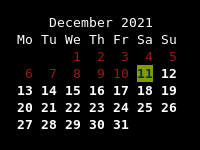
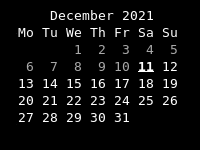
For some time now I wanted to learn Rust, but I either didn t have the time or couldn t come up with a nice beginner project. Given that I recently found myself to be without a job and we had another lockdown in the part of the world I happen to live in, I decided to give that idea another go (no pun intended). There is apparently a trend to reimplement existing Unix tools in Rust (see exa, a modern replacement for ls , delta, a syntax highlighting pager for git, diff and grep output, bat, a cat clone with wings , zellij, a terminal workspace, ripgrep, a line-oriented search tool ). I looked around what else was out there, but what I wasn t able to find was an implementation of cal(1) in Rust (maybe I wasn t looking hard enough, feel free to point anything out to me I might have overlooked). No cal in Rust even though a calendar implementation would provide the potential to go over the top with terminal colors, which is also very important when writing reimplementations of older CLI tools! So I started writing and soon had a simple prototype of a cal reimplementation. A couple of weeks later I can now present carl, a cal implementation in Rust: default carl output The default output of carl is what you would expect from a commandline calendar tool. It prints the days of the current month and highlights the current day. Other than the cal tools I tried, carl by default also prints days that are in the past in grey. Like cal it can also print three month if you use the -3 switch or the whole year if you use the -y switch.

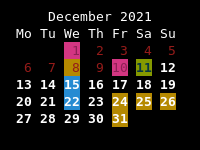
Colors You can use a theme file to change the colors carl uses for various dates. The name of the theme is set in carls configuration file (in XDG_CONFIG_HOME/.carl/config.toml or system-wide in XDG_CONFIG_DIRS/.carl/config.toml) using the theme setting - carl looks for the theme in the file $ themename .theme in the configuration folders. A custom theme could for example look like this: custom carl output You can change the foreground color, background color and/or style of a date using a combination of various stylenames like BGRed, Bold and FGCyan. The README lists all possible stylenames. A list of date properties defines which dates the specific style should affect- date properties are for example CurrentDate, AfterCurrentDate or FirstDayOfMonth. Again, the README lists the existing date properties and I m happy to implement more of them, if you have ideas.
Ical support I also added the option to list .ical files in the configuration file. carl can display the dates from the ical file(s) with a separate style. There can either be a global style for all the dates from all the ical files by using the IsEvent date property or a separate style for the dates of a specific *.ical file. carl output with ical files Using the --agenda commandline switch carl also shows an agenda of dates from the ical files.

Installation I have uploaded carl to crates.io, so you can install carl using cargo: cargo install carl. I also plan to upload it to Debian at some point. If you find bugs or have feature requests, please don t hesitate to create issues.

15 May 2021

Sean Whitton: pinebookpro

I recently bought a Pinebook Pro. This was mainly out of general interest, but also because I wanted to have a spare portable computer. When I was recently having some difficulty with my laptop not charging, I realised that I am dependent on having access to Emacs, notmuch.el and my usual git repositories in the way that most people are dependent on their smartphones all the info I need to get things done is in there, and it s very disabling not to have it. So, good to have a spare. I decided to get the machine running the hard way, and have been working to add a facility to install the device-specific bootloader to Consfigurator. It has been good to learn about how ARM machines boot. The only really hard part turned out to be coming up with the right abstractions within Consfigurator, thanks to the hard work of the Debian U-Boot maintainers. This left me with a chroot and a corresponding disk image, properly partitioned and with the bootloader installed. It was only then that the difficulties began: getting a kernel and initrd combination which can output to the Pinebook Pro s screen and take input from its keyboard is not really straightforward yet, but that s required for inputting disk encryption passwords, which are required on portable devices. I don t have the right hardware to make a serial connection to the machine, so all this took a lot of trial and error. I ve ended up using Manjaro s patched upstream kernel build for now, because that compiles in the right drivers, and debugging an initrd without a serial connection is far too inefficient. What I keep having to remind myself is that this device isn t really a laptop in the usual sense it s a single board computer that s powering several pieces of hardware which together roughly constitute a laptop. I think something which epitomises this is how the power light doesn t come on when you hit the power button, but only when the bootloader or operating system kernel thinks to turn on the LED. You start up this SBC and it loads up some software and then once it has got itself going several seconds later that software starts turning on the screen, keyboard, power LEDs etc. Whereas on an ordinary laptop it s more than you turn on the keyboard, screen, power LEDs etc. all at once, and then /they/ go off and load some software. Of course this description is nothing like what s actually going on, but it s my attempt to capture how it feels as a user, who is installing operating systems, but otherwise treating the laptop s hardware, including things like boot ROMs, as a black box. There are tangible differences between what it is like to do that with an ordinary laptop and with the Pinebook Pro. Thanks to Vagrant Cascadian for all the work on U-Boot in Debian and for help on IRC, Cyril Brulebois for help with crossbuilding, and Birger Schacht for a useful blog post.

23 October 2020

Birger Schacht: An Analysis of 5 Million OpenPGP Keys

In July I finished my Bachelor s Degree in IT Security at the University of Applied Sciences in St. Poelten. During the studies I did some elective courses, one of which was about Data Analysis using Python, Pandas and Jupyter Notebooks. I found it very interesting to do calculations on different data sets and to visualize them. Towards the end of the Bachelor I had to find a topic for my Bachelor Thesis and as a long time user of OpenPGP I thought it would be interesting to do an analysis of the collection of OpenPGP keys that are available on the keyservers of the SKS keyserver network. So in June 2019 I fetched a copy of one of the key dumps of the one of the keyservers (some keyserver publish these copies of their key database so people who want to join the SKS keyserver network can do an initial import). At that time the copy of the key database contained 5,499,675 keys and was around 12GB. Using the hockeypuck keyserver software I imported the keys into an PostgreSQL database. Hockeypuck uses a table called keys to store the keys and in there the column doc stores the OpenPGP keys in JSON format (always with a data field containing the original unparsed data). For the thesis I split the analysis in three parts, first looking at the Public Key packets, then analysing the User ID packets and finally studying the Signature Packets. To analyse the respective packets I used SQL to export the data to CSV files and then used the pandas read_csv method to create a dataframe of the values. In a couple of cases I did some parsing before converting to a DataFrame to make the analysis step faster. The parsing was done using the pgpdump python library. Together with my advisor I decided to submit the thesis for a journal, so we revised and compressed the whole paper and the outcome was now

PUBLISHED in the Journal of Wireless Mobile Networks, Ubiquitous Computing, and Dependable Applications (JoWUA). I think the work gives some valuable insight in the development of the use of OpenPGP in the last 30 years. Looking at the public key packets we were able to compare the different public key algorithms and for example visualize how DSA was the most used algorithm until around 2010 when it was replaced by RSA. When looking at the less used algorithms a trend towards ECC based crytography is visible. What we also noticed was an increase of RSA keys with algorithm ID 3 (RSA Sign-Only), which are deprecated. When we took a deeper look at those keys we realized that most of those keys used a specific User ID string in the User ID packets which allowed us to attribute those keys to two software projects both using the Bouncy Castle Java Cryptographic API (resp. the Spongy Castle version for Android). We also stumbled over a tutorial on how to create RSA keys with Bouncycastle which also describes how to create RSA keys with code that produces RSA Sign-Only keys. In one of those projects, this was then fixed. By looking at the User ID packets we did some statistics about the most used email providers used by OpenPGP users. One domain stood out, because it is not the domain of an email provider: tellfinder.com is a domain used in around 45,000 keys. Tellfinder is a Big Data analysis software and the UID of all but two of those keys is TellFinder Page Archiver- Signing Key <support@tellfinder.com>. We also looked at the comments used in OpenPGP User ID fields. In 2013 Daniel Kahn Gillmor published a blog post titled OpenPGP User ID Comments considered harmful in which he pointed out that most of the comments in the User ID field of OpenPGP keys are duplicating information that is already present somewhere in the User ID or the key itself. In our dataset 3,133 comments were exactly the same as the name, 3,346 were the same as the domain and 18,246 comments were similar to the local part of the email address Last but not least we looked at the signature subpackets and the development of some of the preferences (Preferred Symmetric Algorithm, Preferred Hash Algorithm) that are being published using signature packets. Analysing this huge dataset of cryptographic keys of the last 20 to 30 years was very interesting and I learned a lot about the history of PGP resp. OpenPGP and the evolution of cryptography overall. I think it would be interesting to look at even more properties of OpenPGP keys and I also think it would be valuable for the OpenPGP ecosystem if these kinds analysis could be done regularly. An approach like Tor Metrics could lead to interesting findings and could also help to back decisions regarding future developments of the OpenPGP standard.

21 July 2020

Bits from Debian: New Debian Developers and Maintainers (May and June 2020)

The following contributors got their Debian Developer accounts in the last two months: The following contributors were added as Debian Maintainers in the last two months: Congratulations!

Next.