Search Results: "sto"

15 January 2009

Adeodato Sim : Quality of commit messages

I ve been subscribed to the Git mailinglist for three weeks now, and I ve finally seen in action what was already imaginable by looking at their git log history: they not only review the code for the patches that go in (as in many other projects, that is), but also review the accompanying commit messages, in order to ensure they meet certain quality standards. More than once already I ve seen an otherwise-fine patch get resubmitted in order to gain a more meaningful or thorough commit message. I m sure there are more projects that do this, but alas, I haven t been in any of them (nor in that many projects in general, for that matter). It s very exciting for me to see it in action, because quality commit messages are high in my Grokking VCS list. Ideally, a commit message conveys all the necessary information the maintainer of a project needs to understand your patch and its benefits, in particular those bits that don t fit as comments in the code. If you have to accompany your patch with rationales, wouldn t it make sense to include a condensed version of them in your commit message? If you re writing messages for a project of your own, please think of future people dealing with your code, particularly if it s a public project. (It takes discipline in addition to being convinced of it, though.) Commit messages are also great because they allow you to be verbose, without cluttering the code with information that s only relevant in the context of the change, and not to the final code. There is however an (actually-not-so-fine) line between what should be in the commit message, and what should be as comments in the code, and I think we commit message enthusiasts should watch out for that. Take, for example, 39c19ce. I think a short comment saying Don t call rev-parse for each blamed line would have been a perfect companion. There must be somewhere a document explaining with more detail what makes a good commit message. If you would recommend any, please let me know (but I m not interested in documents that explain how to format your commit messages).

Evan Prodromou: 26 Niv se CCXVII

I got tagged in the bunnymeme. I even got nagged about it. I have to admit, drawing a bunny is kind of a relief from a busy week. Here are the rules:
  1. Draw a Bunny (or more)
  2. Post it to your blog with the rules
  3. Name three other bloggers that should draw a bunny
Here is my bunny: My bunny And here are the three blogger friends I can think of who aren't too uptight and full of themselves to post a picture of a hand-drawn bunny: Update: there's a nice graph tracking the meme's progress. tags:

Montreal Startup invests in Control Yourself, Inc. On a more serious note, I'm glad that GigaOM has published a story about venture investment in my company, Control Yourself, Inc. ("Identi.ca Gets Funding to Make Open-source Twitter Variant"). I'm psyched to be working with Montreal Start Up to build CYI into a viable Open Source business. They've been really supportive of the Open Everything strategy, including building the OpenMicroBlogging standard. Thanks to everyone who's sent private and public congratulations. The fun part starts now! tags:

Open Source Jaiku The news came out on the same day that Google announced they're going to release the Jaiku code as Open Source software. I think this is great news. Hopefully, we can work together to build a federated network of microblogging sites running Open Source software connected with open standards. It's so important to have multiple implementations of any open standard, and I think Identica and Jaiku can be a good team for the microblogging world. tags:

Russell Coker: Old PDA vs New Mobile Phone for PDA use

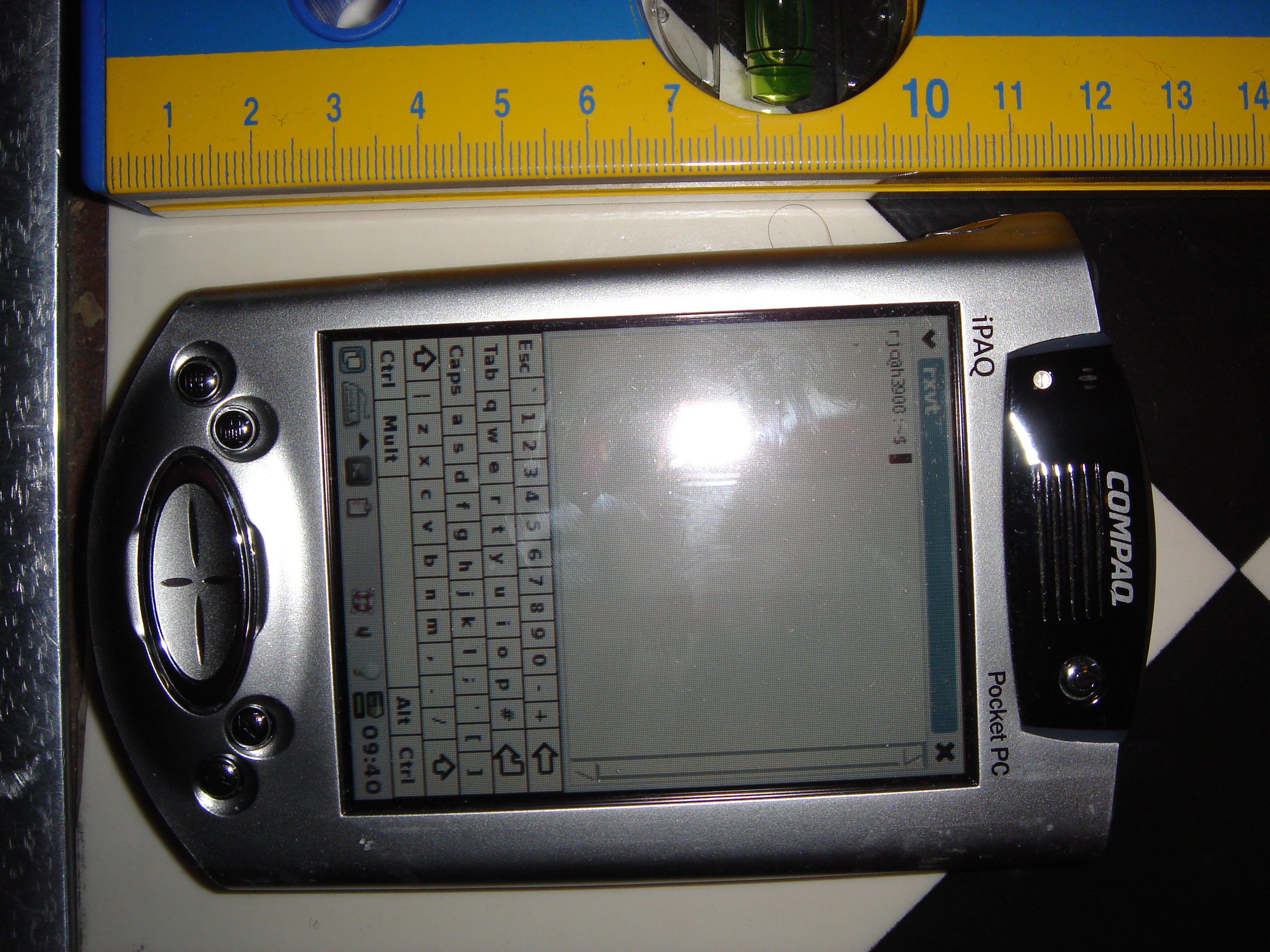
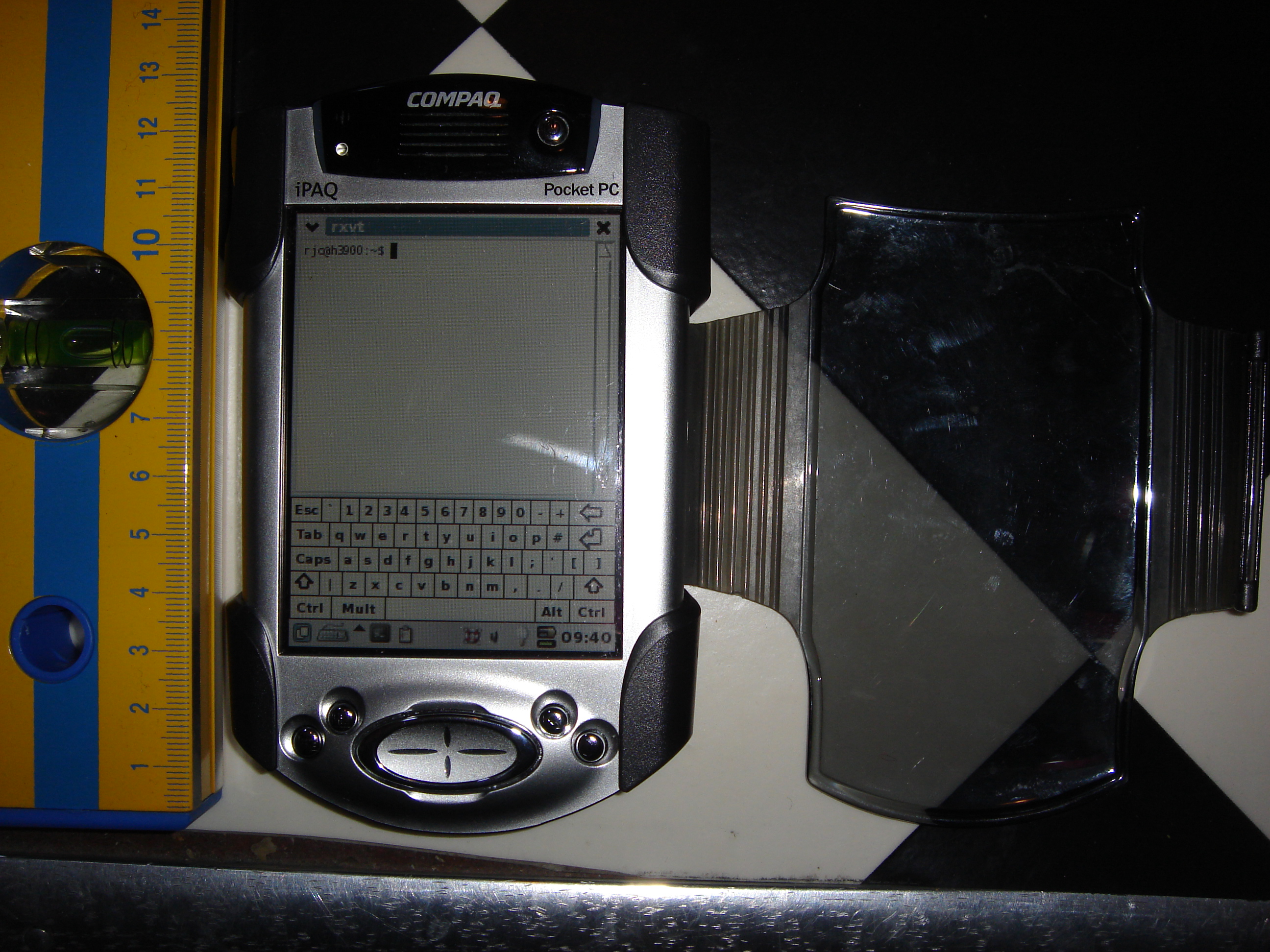
Since about 2002 I have been using a iPaQ [1] for taking notes while on the move. I have a pair of H3950 iPaQs that were given to me for the purpose of some software development work. As modern mobile phones have telephony as a small part of their feature set I think it s worth comparing a 2002 iPaQ with a 2009 mobile phone in terms of the note taking functionality. I have just got myself an LG U990 Viewty mobile phone [2]. It has a screen resolution of 240*320 which is the highest resolution that is remotely common for a mobile phone - and the same resolution as my 2002 model iPaQ. The LG KC910 Renoir has a resolution of 240*400 and seems to be the only phone that my carrier provides which has a higher resolution. The iPhone [3] has a resolution of 480*320. So it seems that the most expensive modern mobile phone that is available in Australia has a screen resolution that is only twice that of a 2002 PDA. I believe that in Japan you could buy a PDA with a higher resolution than 240*320 in 2002. My iPaQ is running Linux, so I can do whatever I want with it. I have a bar at the bottom of the screen with icons to launch, I configure it with the programs that I need most often and they are always one click away. While with my mobile phone I always have two large icons for paid services from my telco and I can t add icons for the things that I want. My iPaQ has a virtual keyboard that can be displayed in portrait or landscape mode. The above pictures show it in the portrait mode which allows the greatest area of screen space for text. The landscape mode is good for entering long lines of text even though the total number of words that can be displayed on screen is smaller. The size of my iPaQ is 134mm in height, between 77 and 84mm in width (it tapers) and 15.9mm thick without it s protective sleeve. The protective sleeve (shown in the second picture) adds about another 5mm to the width and thickness. My iPaQ is 1.76* the volume of my Viewty phone and at 184g vs 112g is 1.64* the mass. With it s sleeve on it is about 2.4* the volume. It s larger but with the sleeve it s a lot more solid, a touch-screen is very fragile so putting a touch-screen device in your back pocket without a sleeve is not a viable option. So I now own a mobile phone that has more storage, RAM, and CPU power than my iPaQ, but is less useful for the basic task of writing small documents and seems to have no facility for drawing diagrams. Most recent mobile phones have the ability to record voice (my Viewty can store 34 hours on it s internal storage and supports mini-SD cards for extra storage). But my Viewty lacks the ability to pause voice recording so if I wanted a series of notes during a meeting I would get a series of short voice recordings rather than a single file with many items. The todo list is also fairly poor in the Viewty, so even disregarding the poor keyboard on the touch-screen it would compare badly to the iPaQ. So it seems that an iPaQ that is almost seven years old when running Linux and the GPE Palmtop Environment [4] with with default configuration handily beats one of the latest and greatest mobile phones for all areas of common functionality. If the Viewty had it s source code available I would be tempted to contribute some patches (even if it was not free software). Finally, before someone suggests an Android [5], Greenphone [6] or other phone that s relatively open and programmable, I wanted a phone that had a good camera (by phone standards) and came essentially for free on an affordable contract. Maybe in two years time (when my current contract ends) there will be such a phone on offer. Mobile phones aren t THAT important to me, so while I would like to encourage the development of open telephony platforms it s a much lower priority than about a dozen free software projects. I expect that in the future something like an Android will become a great mobile phone with great PDA functionality. But for the moment I ll use an iPaQ and a Viewty.

14 January 2009

Gunnar Wolf: Hyperdimensional strings

I am stunned no more people have been bitten by this. Or at least, the Intarweb has not heard about it. Censorship perhaps? I haven't researched more into the causes, but anyway...
I was pushing a project I have had lingering for some time from Rails 2.0.x to 2.1.x (yes, 2.2 is already out there, but 2.1 is the version that will ship with Lenny) - The changes should not be too invasive, as it is a minor release, but there are some quite noticeable changes.
Anyway... What was the problem? Take this very simple migration:
  1. class CreatePeople < ActiveRecord::Migration
  2. def self.up
  3. create_table :people do t
  4. t.column :login, :string, :null => false
  5. t.column :passwd, :string, :null => false
  6. t.column :firstname, :string, :null => false
  7. t.column :famname, :string, :null => false
  8. t.column :email, :string
  9. t.column :pw_salt, :string
  10. t.column :created_at, :timestamp
  11. t.column :last_login_at, :timestamp
  12. end
  13. end
  14. def self.down
  15. drop_table :people
  16. end
  17. end

The problem is that PostgreSQL refuses to create a hyperdimensional string field. I offer this here to you, line-wrapped by me for your convenience.
  1. PGError: ERROR: syntax error at OR near "("
  2. LINE 1: ...serial PRIMARY KEY, "login" character varying(255)(255) NOT ...
  3. ^
  4. : CREATE TABLE "people" ("id" serial PRIMARY KEY,
  5. "login" character varying(255)(255) NOT NULL,
  6. "passwd" character varying(255)(255)(255) NOT NULL,
  7. "firstname" character varying(255)(255)(255)(255) NOT NULL,
  8. "famname" character varying(255)(255)(255)(255)(255) NOT NULL,
  9. "email" character varying(255)(255)(255)(255)(255)(255) DEFAULT NULL NULL,
  10. "pw_salt" character varying(255)(255)(255)(255)(255)(255)(255) DEFAULT NULL NULL,
  11. "created_at" timestamp DEFAULT NULL NULL, "last_login_at" timestamp DEFAULT NULL NULL)

Beautiful. Now I can store strings not only as character vectors, but as planes, cubes, hypercubes, and any other hyperdimensional construct! Are we approaching quantum computers?
What is really striking is that... I found only one occurrence on tha net of this bug - one and a half years ago, in Ola Bini's blog. No stunned users looking for the culprit, no further reports... Strange.
Still, the bug was fixed in Rails 2.2 about half a year ago, although not in revisions of earlier versions. I will request the patch to be applied to earlier versions as well. Sigh.

David Welton: The "Gig" Economy?

This article talks about the rise of people working part-time, doing various 'gigs': http://www.thedailybeast.com/blogs-and-stories/2009-01-12/the-gig-economy/full/ Perhaps her intended audience is not interested in "dull" things like economics, but even someone like me with just a smattering of reading in economics can't help but think of Coase and his Theory of the Firm when reading it. The question is: why do firms exist? Why isn't the economy composed of a huge network of independent contractors? If markets and prices and such work so well, why do these big, monolithic companies, which internally, are not 'free markets' exist? His answer is, greatly simplified, "transaction costs". From the article:
Every time the boss turns around asking for a key member of staff to join today s frantically convened cost-cutting strategy meeting the reply comes back, It s not Sam s day to come in and he s the one working on it. Julia can come, though. Julia? What she got to do with it? Yeah, well, we ll have to bring her up to speed.
In other words, while there is a savings from not having Sam present every day, there is also a cost associated with it, which includes having had to look for and interview Sam to do some work, and bargaining over a price for Sam's services, and then "bring him up to speed". You have to do those things with regular employees too, but you have to do them less often with people who stick around for years. So if one wanted to look, in a less anecdotal way and slightly more scientific way, about whether the US, or other countries, are turning into "gig economies", one could do worse than look at the transaction costs associated with utilizing contractors as opposed to permanent employees. If those costs have fallen (it may be easier to find people, thanks to the internet, for example), perhaps it is more efficient to have more contractors and fewer full time employees and so the equilibrium will tilt in that direction. Of course, another explanation might simply be that the economy is bad, and companies don't have the budget to take on more people, so they get by with what they can in the short term. In terms of the social costs and benefits to a "gig economy"... well, that discussion is best left for other sites, as it's a big, long, complex one with lots of politics and economics and eventually boils down to everyone's own view of how the society they live in ought to look, which is very much outside the scope of this journal.

David Welton: Hosting, Commodities, and "The Cloud"

Anyone connected to the world of IT has been bludgeoned over the head with "cloud" news lately, to the point where the term has become vague and mostly a buzzword. There is, however, something behind the phenomenon, described in Nick Carr's book The Big Switch, with more computing power being centralized at large data centers where economies of scale come into play. I had an interesting chat with Marco D'Itri a while back, about hosting and commodities. It's clear that there is some commoditization going on, but he maintains that hosting is not a commodity. I've been thinking about it and the conclusion I've come to is that some parts of the business are certainly commodities: disk space, memory, bandwidth, and processor cycles. Those things, are, ultimately, what we want to buy when we buy 'hosting'. However, the bits and pieces between that, and people who build on top of those services (i.e. someone who runs a web site) are not really a commodity, yet. Customer service, for instance, might vary a great deal between providers. What will happen in that space, will we see a baseline price for the commodities, and hosting resellers built on top of that that offer different levels of service? I do think that the "mom and pop" hosting type of situations will gradually disappear in favor of larger data centers that can take advantage of economics of scale, though. Also, as I've written about in the past, in Web Hosting - A Market for Lemons, there are some serious information asymmetry issues - how do you know the people providing your service are serious? How do you know they're using good components that wont' break often, rather than cheap junk that will lead to frequent outages? If you have the resources, you can build a system like Google's, where it doesn't matter what fails, it just works around it, but the basic tools that most of us are working with right now aren't that high level. I was reminded of the information asymmetry issue by this article, written by the Dreamhost folks, Web Hosting's Dirty Laundry, which describes how they caught a 'review' site trying to get money from Dreamhost for positive reviews, which is interesting in light of the lemon problem. Wikipedia has some criteria for a lemon market here: http://en.wikipedia.org/wiki/The_Market_for_Lemons#Criteria, which include the following:
Deficiency of effective public quality assurances (by reputation or regulation and/or of effective guarantees / warranties
If it's difficult to get real, honest, impartial reviews of hosting services, that is a push in the direction of 'lemons'. Of course, it's not impossible to get this information, but it seems that a lot of us still go by "hearsay" - what others we know use and report to be ok. To compare it with another product, I'd probably ask around to friends prior to purchasing a new car, but whatever I get is likely to work ok, even if it's not the absolute best. On the other hand, the wrong hosting provider might be very much a "fly by night" operation that leads to a lot of downtime, so I'm far more likely to listen to what other people have to say, and be far more cautious about buying "any old thing". Opinions? Comments? Thoughts? Where do you see this industry going?

David Welton: The "Gig" Economy?

This article talks about the rise of people working part-time, doing various 'gigs': http://www.thedailybeast.com/blogs-and-stories/2009-01-12/the-gig-economy/full/ Perhaps her intended audience is not interested in "dull" things like economics, but even someone like me with just a smattering of reading in economics can't help but think of Coase and his Theory of the Firm when reading it. The question is: why do firms exist? Why isn't the economy composed of a huge network of independent contractors? If markets and prices and such work so well, why do these big, monolithic companies, which internally, are not 'free markets' exist? His answer is, greatly simplified, "transaction costs". From the article:
Every time the boss turns around asking for a key member of staff to join today???s frantically convened cost-cutting strategy meeting the reply comes back, ???It???s not Sam???s day to come in and he???s the one working on it. Julia can come, though.??? ???Julia? What she got to do with it???? ???Yeah, well, we???ll have to bring her up to speed.???
In other words, while there is a savings from not having Sam present every day, there is also a cost associated with it, which includes having had to look for and interview Sam to do some work, and bargaining over a price for Sam's services, and then "bring him up to speed". You have to do those things with regular employees too, but you have to do them less often with people who stick around for years. So if one wanted to look, in a less anecdotal way and slightly more scientific way, about whether the US, or other countries, are turning into "gig economies", one could do worse than look at the transaction costs associated with utilizing contractors as opposed to permanent employees. If those costs have fallen (it may be easier to find people, thanks to the internet, for example), perhaps it is more efficient to have more contractors and fewer full time employees and so the equilibrium will tilt in that direction. Of course, another explanation might simply be that the economy is bad, and companies don't have the budget to take on more people, so they get by with what they can in the short term. In terms of the social costs and benefits to a "gig economy"... well, that discussion is best left for other sites, as it's a big, long, complex one with lots of politics and economics and eventually boils down to everyone's own view of how the society they live in ought to look, which is very much outside the scope of this journal.

David Welton: Hosting, Commodities, and "The Cloud"

Anyone connected to the world of IT has been bludgeoned over the head with "cloud" news lately, to the point where the term has become vague and mostly a buzzword. There is, however, something behind the phenomenon, described in Nick Carr's book The Big Switch, with more computing power being centralized at large data centers where economies of scale come into play. I had an interesting chat with Marco D'Itri a while back, about hosting and commodities. It's clear that there is some commoditization going on, but he maintains that hosting is not a commodity. I've been thinking about it and the conclusion I've come to is that some parts of the business are certainly commodities: disk space, memory, bandwidth, and processor cycles. Those things, are, ultimately, what we want to buy when we buy 'hosting'. However, the bits and pieces between that, and people who build on top of those services (i.e. someone who runs a web site) are not really a commodity, yet. Customer service, for instance, might vary a great deal between providers. What will happen in that space, will we see a baseline price for the commodities, and hosting resellers built on top of that that offer different levels of service? I do think that the "mom and pop" hosting type of situations will gradually disappear in favor of larger data centers that can take advantage of economics of scale, though. Also, as I've written about in the past, in Web Hosting - A Market for Lemons, there are some serious information asymmetry issues - how do you know the people providing your service are serious? How do you know they're using good components that wont' break often, rather than cheap junk that will lead to frequent outages? If you have the resources, you can build a system like Google's, where it doesn't matter what fails, it just works around it, but the basic tools that most of us are working with right now aren't that high level. I was reminded of the information asymmetry issue by this article, written by the Dreamhost folks, Web Hosting's Dirty Laundry, which describes how they caught a 'review' site trying to get money from Dreamhost for positive reviews, which is interesting in light of the lemon problem. Wikipedia has some criteria for a lemon market here: http://en.wikipedia.org/wiki/The_Market_for_Lemons#Criteria, which include the following:
Deficiency of effective public quality assurances (by reputation or regulation and/or of effective guarantees / warranties
If it's difficult to get real, honest, impartial reviews of hosting services, that is a push in the direction of 'lemons'. Of course, it's not impossible to get this information, but it seems that a lot of us still go by "hearsay" - what others we know use and report to be ok. To compare it with another product, I'd probably ask around to friends prior to purchasing a new car, but whatever I get is likely to work ok, even if it's not the absolute best. On the other hand, the wrong hosting provider might be very much a "fly by night" operation that leads to a lot of downtime, so I'm far more likely to listen to what other people have to say, and be far more cautious about buying "any old thing". Opinions? Comments? Thoughts? Where do you see this industry going?

Martin Meredith: Obligatory Post

Ok, so here s my obligatory Hello Planet Debian and I m now a Debian Developer post. So, yeah, I m now a Debian Developer - and have a shiny new email address. For those of you considering going through the NM process, or already going through it - don t give up hope, you ll get there eventually! Thanks to all those who ve helped me along the way. In other news, I ve been meaning to blog about a couple of sites for a while now. First of all, is Feedbooks.com - a nifty little site with lots of ebooks to download. Including a lot of the classics. You can also publish books on there, but I haven t got round to it yet. This is currently my homepage on my eeePC. I ve setup the custom PDF to be a good size for the eeePC (152mmx91mm, 10px font, 5mm all borders) and have been reading some of the Doctor Who books on there (and actually not finding it that uncomfortable curling up in bed with. The next site is Stack Overflow - I ve mentioned this briefly before, but it s a great site. A community driven Programming Q+A site. Kind of hard to describe, but go have a look, you ll soon get the gist of it! Anyway, I think it s time to head to bed for me!

13 January 2009

Christoph Haas: NFS: sec=sys or ruin your day

And once again I was bitten by problems on my Debian laptop mounting directories from the file server via NFS. After a Debian dist-upgrade I couldn t login to KDE any more. Shell login worked somehow but I quickly found out I could neither read nor write any files there. Apparently an ls -al showed me the right permissions (not just unmappable numeric UIDs or something of that kind) and an id -a confirmed that my LDAP PAM configuration still worked. But reading or writing any file just lead to Permission denied . I m not sure if it was an update in the nfs-common package in Sid. But I had the same problem before and it took me hours until I finally figured out that Debian s NFS seems to use non-standard defaults. Namely the sec parameter when mounting the NFS share. According to the Solaris documentation the default is sec=sys which means that NFS uses the locally acquired UIDs and GIDs. Like /etc/passwd, NIS or LDAP/PAM. But on Debian it seems to default to sec=krb5 or something. As I have close to no idea how to set up Kerberos and don t want to (and talking to other people hardly anyone has used Kerberos either) I figured that it s not really a sane default. I didn t even ask for NFSv4 - just NFSv3. Perhaps I undeliberately set some /etc/default/nfs-common configuration setting wrong or whatever. It was just strange. So I set sec=sys in the options of the NFS share of my /etc/fstab and the problem was fixed. Actually I wonder what network file systems other people use in a Debian environment. NFS somehow feels antiquated to me anyway.

12 January 2009

Jonathan McDowell: Life with the Google/T-Mobile G1

I've previously mentioned my desire for a new smartphone. I'd been eyeing the G1 since its release, with the main factor stopping me from going ahead the need for a T-Mobile contract. They don't have any 3G coverage north of Belfast that I've seen and I'm very happy with my 20/month O2 Simplicity contract and don't have any need to pay twice that. Luckily Katherine decided to get me one for my birthday, and after some confusion involving it going to Norwich (always remember to update your Paypal delivery address as well as the card address when you move home, folks. Oh, and your Amazon wishlist address too; it's different than your primary address and I've been bitten by that myself in the past) it turned up the weekend before Christmas.

I have a UK spec T-Mobile G1. First step was to get it unlocked for use on O2. I used Unlock G1 - they weren't the cheapest, but I'd seen them recommended on a few G1 news sites and they had a helpful guide on their site about activating without a T-Mobile SIM. They claim a code within 2 business days. I ordered at 19:30 UTC on a Saturday night and had a code by 21:00 that worked first time.

Once the O2 SIM was working I needed to check if the phone was easily rootable. I typed reboot and was rewarded with a rebooting phone. I had the RC7 UK firmware release, which still had the bug. I followed the android-dls.com guide to keeping root and upgraded to the RC8 release. With that out of the way I could start to actually have a play.

The screen is lovely. I'm used to the high res E70 screen and have been disappointed at the number of phones that only do 320x240. 480x320 is probably the minimum I'd want (if I can't manage an 80 character wide SSH session I'm not really interested) though obviously if HTC ever get round to a Touch Pro with Android I might be tempted... Touch aspect is perfectly responsive, as is the interface in general - while I don't use a phone that much day to day my mobile is the only number I give out so it tends to be the only phone I use. This means that the ability to make/receive calls/sms is the most important feature for me (it's odd having to say this, but I know people who've claimed to love phones but on further probing reveal it's a great PDA but dire for calls and they have to carry something else for that). The G1 performs admirably for my needs.

The built in apps are good too. The browser is much better than the E70. I don't know if that's the bigger screen (though the resolution isn't much different) or a faster processor, but browsing on my mobile is a much more realistic proposition now. I've only played briefly with the iPhone browser and I wouldn't say the G1 was any better, but it's certainly good. Calendaring is functional too and copes with multiple Google Calendars as you'd hope. Shame it doesn't deal with anything else, but for the moment this suits my needs. I haven't used it for email; I prefer to ssh to my colo box and run mutt. Contacts are mostly ok, though I have a few gripes I'll mention later.

I haven't felt the need to install many apps. The connectbot ssh client was an obvious one and is pretty nice (main missing feature is UTF-8 and there's a feature request for it raised already). I've installed a few games off the Android Market, as well as Barcode Scanner (does what you'd think) and CellFinder (displays your location and which mobile cell you're using; it's a bit scary how few O2 masts there seem to be near my house). Installation from the market has been a breeze and it's nice to be able to flick through what's available. With my E70 it was always a real pain to go and hunt down Symbian apps (especially when S60 3rd Edition was new) and install them.

Before I start on my gripes, let me clarify that I am very happy with this phone. I wanted something with a keyboard that was functional and this fits the bill. It's a definite improvement over my E70 and I feel it's much more responsive than any of the recent Windows Mobile devices I've encountered. Also the battery life hasn't proved to be an issue - from articles I'd read I'd expected to have difficulty getting a day out of it, but in general I can easily get 2 and have had 3. Maybe my usage patterns aren't as heavy as everyone else, but that's fine for me (I remember my 9000i Communicator which really was a case of having to charge it every night).

The first issue I hit was the contacts system. Google have tied this into GMail and it really seems to have been a last minute thought process, perhaps along the lines of "Where can we stick this? Oh, hang on, people have email contacts, how about there?". Trying to move my contacts over from my E70 I was surprised to find that there's no way to import a vCard. The only option is CSV. WTF? I'm not saying vCard is perfect, but it's pretty much what we have as a standard method of contact interchange. I ended up writing some Perl to crudely parse the vCards and output CSV. I shouldn't have had to.

Then again, maybe the issue is that Google know their contacts system is a bit lacking. You'd think a company with online calendaring and contacts would be able to cope with things like birthdays, tying them together between contacts and displaying them in your calendar, wouldn't you? They can't. I can't see any way to store a birthday or anniversary with a contact. Nor a home page. The contacts system is the one area that the E70 outshines the G1.

I miss an onscreen keyboard more than I thought I would (ie at all). I understand this should be coming in the next release, which will make things like quick replies to SMSes much easier (there's no point opening the keyboard for a "Nearly there" response).

The use of only a single APN for internet access and MMS is a bit troublesome; I haven't managed to get this to work properly with O2 - either I have fully working 'net or fully working MMS with only web seeming to work. I haven't played with the settings very much though and I spent 7 months without MMS even enabled on my O2 account, so it's not high priority. Also something I understand is being fixed upstream.

I'd like a way to see the next calendar event on my home screen. I may just be missing how to do this, but it was a nice feature on the E70.

I haven't played much with the camera, but I get the impression it's pretty typical of the average mobile phone; ie not great. Not a problem for me, but don't expect this to replace a compact digital camera.

While I accept this phone isn't for everyone I think it's pretty much what I'm looking for in terms of what's on the market today. There's nicer hardware out there, but a large part of what makes this phone is the Android software. I look forward to seeing new phones in the coming year making use of it, hopefully leading to a decent selection by the time I need a new phone again. :)

Theodore Ts'o: Wanted: Incremental Backup Solutions that Use a Database

Dear Lazyweb, I m looking for recommendations for Open Source backup solutions which track incremental backups using a database, and which do not use hard link directories. Someone gave me a suggested OSS backup program at UDS, but it s slipped my memory; so I m fairly sure that at least one or more such OSS backup solutions exist, but don t know their names. Can some folks give me some suggestions? Thanks!

horizontal separator There are a number of very popular Open Source backup solutions that use a very clever hack of using hard link trees to maintain incremental backups. The advantage of such schemes is that they are very easy to code up, and it allows you to easily browse incremental backups by simply using cd and ls . The disadvantage of such schemes is that it creates very large number of directories blocks which must be validated by an fsck operation. As I ve discussed previously, this causes e2fsck to consume a vast amount of memory; sometimes more than can be supported by 32-bit systems. Another problem which has recently been brought home to me, is how much time it can take to fsck such file systems. This shouldn t have come as a surprise. Replicating the directory hierarchy for each incremental backup is perhaps the most inefficient way you could come up with for storing information for an incremental backup. The filenames are replicated in each directory hierarchy, and even if an entire subtree hasn t changed, the directories associated with that subtree must be replicated for each snapshot. As a result, each incremental snapshot results in a large number of additional directory blocks which must be tracked by the filesystem and checked by fsck. For example, in one very extreme case, a user reported to me that their backup filesystem contained 88 million inodes, of which 77 million of them were directories. Even if we assume that every directory was only a single block long, that still means that during e2fsck s pass 2 processing, 77 million times 4k, or 308 gigabytes, worth of directory blocks must be read into memory by e2fsck s pass 2. Worse yet, these 308 GB of directory blocks are scattered all across the filesystem, which means the time to simply read all of the directory blocks so they can be validated will take a very, very, long time indeed. The real right way to do implement tracking incremental backups is to use a database, since it can much more efficiently store and organize the information of what file is located where, for each incremental snapshot. If the user wants to browse an incremental snapshot via cd and ls , this could be done via a synthetic FUSE filesysem. There s a reason why all of the industrial-strength, enterprise-class backup systems use real databases; it s the same reason why enterprise class databases use their own data files, and not try to store relational tables in a filesystem, even if the filesystem supports b-tree directories and efficient storage of small files. Purpose written-and-opimzied solutions can be far more efficient than general purpose tools. So, can anyone recommend OSS backup solutions which track incremental backups using some kind of database? It doesn t really matter whether it s MySQL, Postgresql, SQLite, so long as it s not using/abusing a file systems hard links to create directory trees for each snapshot. For bonus points, there would be a way to browse a particular incremental snapshot via a FUSE interface. What suggestions can you give me, so I can pass it on to ext3/4 users who are running into problems with backup solutions such as Amanda, Backup-PC, dirvish, etc.? Update: A feature which a number of these hard-link tools do right is that they do de-duplication; that is, they will create hard links between multiple files that have the same contents, even if they are located in different directories with different names (or they have been renamed or their directory structure reorganized since they were originally backed up) and even if the two files are from different clients. This basically means the database needs to include a checksum of the file, and a way to look up to see if the contents of that file have already been backed up, perhaps with a different name. Unfortunately, it looks like many of the tape-based tools, such as Bacula, assume that tape is cheap, so they don t have these sorts of de-duplication features. Does anyone know of non-hard-link backup tools that do de-dup and which are also Open Source?

11 January 2009

Russell Coker: Debian Multimedia and SE Linux

I have just had a need to install packages from Debian-Multimedia.org to correctly play .3gp files from my mobile phone (the stock Mplayer in Debian would not play the sound). As part of getting this to work in a way that I like I rebuilt some packages so that shared objects would not demand an executable stack and added them to My SE Linux Etch repository [1]. The liblzo2-2 package is in Debian so I filed bug report #511479 against it. Not that I expect it to be fixed for Etch now that Lenny is about to be released. But it s good to have the data in the bug tracking system for the benefit of all interested people. The lame and xvidcore packages are only in the Debian Multimedia archive. I ve sent email to the maintainer with patches. Not sure if he will accept them (again it s not a good time for filing bug reports about Etch), but there s no harm in sending them in. The lame package also required execmod access, but I don t have enough time to devote to this to fix it. For background information about execmod see my previous post [2]. See my previous post about executable stacks for more background information [3]. The next thing to do is to test this out in Lenny, hopefully I ll get time to work on this tomorrow.

10 January 2009

Marco d'Itri: ssh-agent for unattended processes

This code allows unattended ssh(1) processes, like the ones started by cron(8), to access the SSH keys stored by a running ssh-agent(1) (which will probably have been started in a screen(1) instance). Be sure to understand the security implications of persistent ssh-agent processes and passwordless keys.
#!/bin/sh -e
import_ssh_agent()  
  local pid
  for pid in $(pgrep -u "$LOGNAME" -x -f /bin/bash); do
    local var="$(grep -z '^SSH_AUTH_SOCK=' /proc/$pid/environ   true)"
    [ "$var" ]   continue
    eval "$var"
    export SSH_AUTH_SOCK
    break
  done
 
[ "$SSH_AUTH_SOCK" ]   import_ssh_agent
# now the script can run commands like:
ssh -o BatchMode=yes hostname command

Andrew Pollock: [life/americania] The Story of Stuff

Sarah brought The Story of Stuff to my attention today. It's well worth 20 minutes of your time, irrespective of where you live.

Andrew Pollock: [life] One year and five days later...

...and there was a distinct feeling of deja vu. At least the procedure itself was nowhere near as long (under 2 hours). On Thursday, Sarah had some day-surgery to have her sternal wires removed. The top one was causing her some discomfort because the skin there was the thinnest (whether that in itself was related to any of the previous incision complications remains uncertain). The surgical team popped in to pre-op to autograph their work (seriously, they initialled her chest) before they started, and asked if she wanted just the top wire removed, or all of them. We consulted the Magic Eight Ball application on my phone, and it gave a resoundingly affirmative response, so she got them all removed. Despite removing them all being a bit more surgically invasive, I think this is for the best. It means none of the other wires can cause any problems down the track requiring yet another trip to the operating room. They also did some scar revision on the top part of the scar, where it was a bit stretched (from the previous complications), so incisionally speaking, she's had almost as much incision work done as the original heart surgery. Ironically, this made the plastic surgery (laser treatment and steroid injections) she had late last year largely redundant. She took the dressing off the incision this morning, and we had our first look at it. It certainly looks a lot better than before, so fingers crossed it won't get infected this time, and the overall long-term result will look better.

9 January 2009

James Morrison: Grand Canyon for new years

Sarah came up a great idea for us to do over the long, long weekend after New Years. She wanted to go to the Grand Canyon, and hike in it. I, also enjoying hiking trips, went along.

We organized the trip rather late, I think on the 27th of Dec from my parents house (I think my mom enjoys being around for trip planning since it reminds her of the trips she should plan). Given our late planning we could only get a reservation at Phantom Ranch for the night of the 1st. So the trip plan was get back to SF on 30 Dec 2008. Take bart from the airport, sleep/pack (in either order), then drive to Williams, AZ on the 31st. Take a bus the to Grand Canyon on the 1st, hike down to Phantom Ranch, sleep, hike back up to the top, see the Grand Canyon from the top. Take a bus back to Williams and drive somewhere near the Hoover Dam. Sleep. Drive, see the Hoover Dam, get to Las Vegas, and see the Cirque du Soleil show Ka. Sleep. Drive home.

So that was the plan, now for the execution. We got back to SF on time and picked up our bags from the baggage claim without any issue. The next morning we got up and moving. The optimistic hope was that we would be on the road by 8am to Williams, then stop in Fresno for gear and food. It turns out we weren't ready to go until 10, so we got hiking poles and fake crampons at the REI in SF. We also did our grocery shopping in SF. We were on the road to Williams by noon. We shared the driving Sarah took the parts with traffic, I took the 4 and two lane highways. The fortunate part about this is that I drove through the San Joaquin. One the way there, it was basically IFR conditions (I had no instruments), so I was driving through a cloud (some call it fog) and I couldn't see anything that wasn't on the road. It was really pretty but not the best for a road with lots of ups, downs and turns. I felt like a race car driver. The other interesting part (at least while I was driving) was going through the Mojave desert at sundown. I don't think Sarah has any pictures, but it was very pretty.

Finally we arrived in Williams, AZ and got to the Grand Canyon Railway Hotel, at 2345hrs, (for those counting that means we were on the road for 10h 45m). We checked in by 2358hrs on 31 Dec 2008. So we stood by the fire for two minutes, counted down, and kissed for New Years.

In the morning, things went as expected, we backed our bags to hike 10 miles, and put the rest of the stuff in the car. We got in a van that took us to the Grand Canyon. Our driver up to the Grand Canyon was very nice and showed us the sites along the way. We also met two Japanese exchange students on their way to see the Grand Canyon.

On the way was slow since we took a lot of pictures (Sarah has them all since I lots my 1GB SD card before it made its way into my camera). Unfortunatly, Sarah got tired on the way down, and also hurt her ankle. So we stumbled our way to Phantom Ranch around 1600. From the time we got to the ranch until supper at 1830, we laid back and relaxed, we needed it, our feed were sore and Sarah iced her ankle. The food at Phantom Ranch was good, not great, and there was enough of it after being on our feet all day. At end end of the day, we slept, as planned. In the morning we got up for the early breakfast. Again, it was decently, but not great, but there was enough food. Unfortunatly, Sarah was sick (She'd figured out how to deal with her ankle though) (Oh, and she isn't pregnant). So we harrassed the rangers, got some imodium, and started on our way back up the Bright Angel Trail, we took the Bright Angel Trail down and were planning on the South Kaibab trail up but the Bright Angel Trail has places to stop the South kaibab trail doesn't. Again were were planning on an early 630hrs start, but started a little later at 745hrs. We used our poles with gusto on the way back up and made it up by 1345, 6hrs on the way back up, the same time it took us to get down. The rest of the daylight hours was spent taking the village bus around the Grand Canyon village and seeing the sights from the top.

After the Grand Canyon, we drove to Kingman, stayed there, then continued on, saw the Hoover Dam, it is like Itaipu, but less political and taller, then went on to vegas. In Vegas we saw the inside of a couple hotels, I spent $1 on a slot machine, then we say Ka. Ka is an amazing show, I don't think it really suck in until after the show was over all the things the performers pulled off. That said, the stage itself was an engineering marvel that I watched almost as much as the performers.

After Vegas, the drive back was mostly uneventful, the fog in San Joaquin was a little lighter, but still heavy, Mojave is prettier at sunset and it is still good to sleep in my own bed.

Michal &#268;iha&#345;: Gammu test version 1.22.90

After lot of development, I finally decided to release new testing release of Gammu. The biggest changes are in SMS daemon, which got lot of improvements and is now in separate binary gammu-smsd. It can log better (support for syslog and Windows Event Log has been added), it can work as a proper daemon or Windows Service, it can be debugged easier (Gammu logs go to same log as other messages, SQL queries can be logged), can reload configuration on the fly. In libGammu, debugging has also improved (you can now use callback to process messages), some memory leaks were fixed and some minor bugs has been fixed. Command line interface now supports text for text messages to be entered through parameter and not only using standard input, it has a new command chekfirmware which obsoletes UsePhoneDB configuration option and other bug fixes has happened, for example messages sending is now again working on Windows. And last but not least, SMS daemon, all related things and gammu configuration files now have man pages, which boosts documentation level from none to almost perfect ;-). As a special bonus for Czech users, Gammu translation is now more complete and all new man pages are translated to Czech. Full list of changes: You can download from usual place: http://cihar.com/gammu/, Debian users will find packages in experimental as soon as they will go through NEW queue.

Ian Wienand: Facebook, API's, photos and IPTC data

As a photo management application, Facebook sucks. But it is something that people actually look at (as opposed to Flickr, which is great, but getting people to log-in or follow special guest pass links is a PITA). I like to keep all my raw photos locally, using IPTC for comments (which Flickr reads -- I put them in using some custom scripts and the Python bindings of libiptcdata) and geo-tagged in the EXIF data (using my google maps point locator). I figure this way if Flickr goes bust/gets bought by Microsoft all I need to do is re-upload somewhere else. I was waiting for Flickr to integrate with Facebook in some good way, but I then came across the very useful pyfacebook bindings, which, although being a little light on documentation, is a great way to easily throw my photos into Facebook (it's pending the NEW queue in Debian, see #511279). My fbupload.py script might be a useful starting point if you want to do the same thing. It batches up photos into lots of 60 (the maximum photos in an album) and automatically creates the albums and uploads the photos, reading the IPTC data for comments. The only problem is that you'll have to sign up for a developer key and start a new application to get a secret key to talk to the API (if you're still reading this, I'm sure you can figure it out!).

8 January 2009

David Welton: Angry Perl Users

I work on LangPop.com for fun. I make a tiny bit of money from the adsense there, but nothing much to speak of. Unlike the TIOBE folks, I don't sell my data to anyone. So it can be a bit frustrating when people get all bent out of shape about the results. A case in point was my recent article here, entitled Python "Surpasses" Perl?. In case the title wasn't a dead giveaway, I'll spell things out:
  • I was poking a bit of fun at the idea that any statistics of this nature could pinpoint, to a specific month, the moment when one language "passes" another. They're way too fuzzy for that!
  • I point out that Perl is still quite popular. According to the Freshmeat metric I was reporting, Perl actually still has more code out there than Python.
And just to be clear: I don't use Perl or Python or really care which one is more popular. I mostly use Ruby these days, with Tcl, Java, and bits of C thrown in for fun. In other words: langpop.com is not an evil conspiracy to discredit Perl. However, I also had the temerity to suggest that Python might be a little bit more popular in terms of new things happening. Shock! Horror! Well, that certainly irritated some Perl users. They called my statistics lies, they misspelled my name (as well as the word "you", which is a lot simpler than my name by any standard), and some of them went off on rants that were pretty badly off target (SourceForge is never mentioned in Langpop or this online journal!). However, not once did they really get around to answering my points, or proposing any sort of valid alternative metrics. One of my favorite Linux/Free Software news sources, lwn.net published their 2009 predictions, and had this to say about Perl:
It will be a make-or-break year for Perl. If the Perl developers cannot either bring new life to Perl 5 or turn Perl 6 into something real, this language will, by the end of the year, have moved well down the road to "legacy" status.
As can be imagined, that set them off all over again. The mental image I get is a big angry bull, frothing at the mouth, and ready to stomp that damn red cape. Here's the problem, though, guys: the cape isn't what's holding you back. Trust me, I know. Once upon a time, when people spoke of scripting languages, they talked about "Perl, Python and Tcl". No Ruby, no PHP, although both existed. I happen to like Tcl a lot, and it measures much worse than Perl on all the popularity charts... worse than plenty of other languages, these days. Lately, I don't use it so much, but once upon a time I dedicated a lot of mental energy to wondering why things weren't going better. And in that community too, there were people who consistently held their fingers in their ears and yelled "LALALALA there is no problem!". In the long term, it's not an effective strategy: it makes everyone but the other True Believers think you're going off the rails, because the evidence is plain to see that things weren't quite like they used to be, that there are problems. And it doesn't really address the problem in a constructive way, either. Long term, what works is to produce good code, and get it in people's hands. The most effective way of dealing with problems of this nature includes these points:
  1. Not froth at the mouth any time you perceive a slight to your technology of choice.
  2. Talk up the cool things you're working on. Be positive, explain what's new and exciting.
  3. Acknowledge reality. For instance with Perl (or Tcl), it's plain to anyone that they aren't as popular as they once were. Don't deny it, but focus on the fact that they're still widely used, and lots of new code *is* still written in them, and that they're still the focus of a lot of work to improve them.
  4. Actually follow through. Jon Corbet's (Linux Weekly News) point is not a bad one - you can have all the internal releases and milestones and general fun hackery that you want, but at a certain point, you need to get working code out in front of people. This is something Ruby seems to be suffering from these days too (as observed from afar) - lots of next generation fiddling, and tons of good ideas and energy, but to me there is a lack of technology actually flowing my way in a timely manner. With the possible exception of JRuby, which is making lots of progress and putting good code out there for people to use.
To conclude things, since the Perl guys were so unhappy with Freshmeat, here are some statistics from Amazon and Craigslist, comparing about a year ago with the most recent numbers: As can be seen, both Perl and Python are dropping in Craigslist postings, but Perl is falling farther. As a final footnote, I am sorry about this journal not accepting comments past a certain point (10 days is the cutoff) - otherwise I get 100's of spam postings a day. Unfortunately, the software I'm using didn't deal well with alerting people to the fact that comments were closed. I filed a bug, and they're working on it.

Next.

Previous.