Search Results: "mak"

10 March 2010

Biella Coleman: A Cultural Alibi of Sorts

There is an interesting conversation over at about the nature of peer production, and crowd based production over at PBS. Thankfully folks right off the bat noted that the types of activities they are addressing that range from 4chan to open source are so freaken distinct that perhaps it is not all that useful to use one moniker for them. The comments I am most fascinated by are danah s who notes:
We assume that the collective voice will be populist and, more importantly, that it will reflect the diversity of the populous. Yet, as we ve seen time and time again, certain values and attitudes and voices are over-represented in crowd-sourced activities. Who is looking out for those who aren t represented? In what ways are we reinforcing structural inequalities? What are the implications of this?
And then Clay s response:
So, to re-ask your question in a non-rhetorical way, under what
circumstances would we want to make the population of Deviant Art,
say, less white, or Linux less male, and if we wanted to do so, what
would need to happen?
What I find interesting about this discussion (and will be talking about this topic here, next week) is there not enough recognition of two related things: 1) the efforts are there (more on this soon) 2) that perhaps hacking and F/OSS in particular are not fully accessible to all and everyone because they are full-fledged, full-bodied, cultural worlds and all cultural worlds are to some degree not fully accessible and transparent for there are built on particularities, often invisible and unarticulated, forms of value. That is, just as some norms and values of Indo-Guyanese to take one random example, are not of my world, so too is hacking partially inaccessible for the fact that it is culturally configured. But I am starting to suspect that the culture-ness of these domains are often overlooked because they are overwhelmingly white, male, and chock full of computers (and so economically lucrative). All three, I suspect are (incorrectly) seen as lacking culture, as domains of rationality. (I stand rightly corrected and also forget this very fact, though I know it well from all the Brazil/Latin America Debconfs, as this diversity gets a bit lost from a pure US-European perspective, which I was assuming). Other historical factors have also produced certain distortions that don t allow us to see (easily at least) these worlds as culture-full. First is the fact that so many folks outside of this world lobbed onto F/OSS for being radical (and this is partially right in so far as its challenge to intellectual property can be seen as radical). But the portrayal or mere suggestion of these worlds as uber-democratic and populist, made people expect these groups to behave as radical egalitarian collectives. For the most part, they don t and yet never portrayed their own politics and forms of organization as such (openness comes in the form of code and technical merit). But this vision stuck and when some folks realized that larger projects, for example are very organized (which many people addressed only very late), have hierarchies (which are flexible and also allow them to function, which is I think is a good thing), and are not as diverse, there was deep disappointment that they did not conform to the sense that there was something extremely radical going on as opposed to a cultural group really into producing free software. But if I am offering a cultural alibi of sorts in which barriers to participation are to some degree a function of culture, one of the great things about the norms, values, ideas that compose culture is that there are dynamic and changing. They are alive and historical. They are pushed and pulled upon by insiders and outsiders based on wider social values. And there is an answer to these questions about diversity for there has been a dramatic, noticeable, and noteworthy push within this world, one that really started to coalesce I would say in the last year or so, to address these issues and it ranges from Python s mammoth efforts at addressing diversity (and I have been told that there was a great speech on the topic at Pycon recently), the geek feminism wiki, and smaller but increasingly common efforts such as Libre Planet s women s caucus and their funding of women to participate. So while I do think that culture goes at least part of the way to explain why these worlds are not fully open for culture limits this very domain has grown dissatisfied with its representational make-up and are leading some efforts for cultural change.

John Goerzen: Numerous Updates

It s been awhile since I ve posted some family/home updates, so here they are, sorta random-like Jacob is 3.5 now, and Oliver is about 8 months old at this point. Jacob Jacob has a few trends going on lately: pretending to be a cat, and inventing new games to play. He has one game he likes to play with me called tunnels and slippers. He will have me sit on the couch, put my feet up on the footstool, and crawl on top of my legs. He ll want me to bounce him, then he can crawl underneath the tunnel. The slippers part came because he started to steal my slippers one time during winter. He d struggle furiously to get it off, then shriek with delight as he ran away, listing to my indignation at having a cold foot now. Then I was supposed to run after him, pick him up in the air, and get the slipper back. Here he is, trying to steal a slipper while I happened to be holding a camera: img_2345.jpg He s said quite a few memorable quotes this winter: Dec. 8: Jacob looked outside this morning and yelled, WOW! Look at that! , ran across the room and yelled, MOM! WOW! There is snow outside this window too! WOW! Snow is ALL OVER THE PLACE! January: When told his grandparents were going back to Indiana: The kitty doesn t like that. (the pretending to be a cat thing) The next morning when he remembered they were gone: Oh. My kitty is so very sad now. February: My name is kitty. Jacob Cat! March: I didn t realize the basketball could go so far! He s been starting to make his first attempts at sounding out words. He s been interested in 2- and 3-digit numbers, trying to figure out how to tell time, and asking me the German words for all sorts of things. (And showing some disappointment with my German vocabulary.) Jacob talks about Oliver as a sweet baby, and is often very caring about him. Jacob wants to make sure Oliver has *plenty* of toys. Though there have been some times when Jacob has pushed Oliver over. Here s the Christmas photo of the two of them: img_2367r And another: img_2357.jpg Jacob has also started to pick up an interest in singing: his favorite song is one that he made up, and it goes Engine, engine, passenger car I still sing a song to Jacob at bedtime each night, but Home On the Range doesn t cut it anymore. No, now I have a make up a song on the spot on a topic of Jacob s choosing each night. Last night he chose a song about the ceiling light and the smoke detector. Other nights, it s been about his toy butterfly, his night light, various smoke detectors (that s a popular one), or something from his day. Oliver img_2371.jpg Oliver recently has started being able to sit up by himself. He can also scoot all over the room. I think he s saying dad , but Terah disagrees and thinks he s just babbling. Her case wasn t helped the day I asked him, Are you saying Dad? He got a big smile after the question and laughed at me. He loves playing peek-a-boo, playing with us or playing by himself. Oliver has been eating the mashed-up baby food for awhile. Terah recently gave him a rice puff, and he put it in his mouth but wasn t sure what to do with it. He has been taking quite an interest in watching the rest of us eat, though, and sits at the table with us in his high chair.

Dirk Eddelbuettel: Rcpp 0.7.8

Version 0.7.8 of the Rcpp R / C++ interface classes is now on CRAN and in Debian. As of right now. Debian has already built packages for eight more architectures; and CRAN has built the Windows binary. Oh, and cran2deb had Debian packages for 'testing' before I was done with the blog entry. This is a minor feature release based on a over three weeks of changes that are summarised below in the extract from the NEWS file. Some noteworthy highlights are The full NEWS entry for this release follows:
0.7.8   2010-03-09
    o	All vector classes are now generated from the same template class
    	Rcpp::Vector<int rtype="RTYPE"> where RTYPE is one of LGLSXP, RAWSXP, STRSXP,
    	INTSXP, REALSXP, CPLXSXP, VECSXP and EXPRSXP. typedef are still 
    	available : IntegerVector, ... All vector classes gain methods 
    	inspired from the std::vector template : push_back, push_front, 
    	erase, insert
    	
    o	New template class Rcpp::Matrix<rtype> deriving from 
    	Rcpp::Vector<rtype>. These classes have the same functionality
    	as Vector but have a different set of constructors which checks
    	that the input SEXP is a matrix. Matrix<rtype> however does/can not
    	guarantee that the object will allways be a matrix. typedef 
    	are defined for convenience: Matrix<intsxp> is IntegerMatrix, etc...
    	
    o	New class Rcpp::Row<int rtype="RTYPE"> that represents a row of a matrix
    	of the same type. Row contains a reference to the underlying 
    	Vector and exposes a nested iterator type that allows use of 
    	STL algorithms on each element of a matrix row. The Vector class
    	gains a row(int) method that returns a Row instance. Usage 
    	examples are available in the runit.Row.R unit test file
    	
    o	New class Rcpp::Column<int rtype="RTYPE"> that represents a column of a 
    	matrix. (similar to Rcpp::Row<int rtype="RTYPE">). Usage examples are 
    	available in the runit.Column.R unit test file
    o	The Rcpp::as template function has been reworked to be more 
    	generic. It now handles more STL containers, such as deque and 
    	list, and the genericity can be used to implement as for more
    	types. The package RcppArmadillo has examples of this
    o   new template class Rcpp::fixed_call that can be used in STL algorithms
	such as std::generate.
    o	RcppExample et al have been moved to a new package RcppExamples;
        src/Makevars and src/Makevars.win simplified accordingly
    o	New class Rcpp::StringTransformer and helper function 
    	Rcpp::make_string_transformer that can be used to create a function
    	that transforms a string character by character. For example
    	Rcpp::make_string_transformer(tolower) transforms each character
    	using tolower. The RcppExamples package has an example of this.
        
    o	Improved src/Makevars.win thanks to Brian Ripley
    o	New examples for 'fast lm' using compiled code: 
        - using GNU GSL and a C interface
        - using Armadillo (http://arma.sf.net) and a C++ interface
        Armadillo is seen as faster for lack of extra copying
    o	A new package RcppArmadillo (to be released shortly) now serves 
        as a concrete example on how to extend Rcpp to work with a modern 
	C++ library such as the heavily-templated Armadillo library
    o	Added a new vignette 'Rcpp-introduction' based on a just-submitted 
        overview article on Rcpp
As always, even fuller details are in the ChangeLog on the Rcpp page which also leads to the downloads, the browseable doxygen docs and zip files of doxygen output for the standard formats. A local directory has source and documentation too. Questions, comments etc should go to the rcpp-devel mailing list off the R-Forge page

Update: Two links corrected.

9 March 2010

Martin-&#201;ric Racine: gThumb: thank you for breaking my workflow!

Just a kind thank you note to the gThumb authors for completely breaking my workflow by re-inventing the paradigm used to save imported pictures. Until now, all my pictures landed in a predictable location, using a predictable filename pattern that was easily searchable. Not anymore. Now, files land into my home directory, according to some recursive folder pattern that further complicates searching for files and requires a few more clicks to accomplish. Dammit! Couldn't you at least make this configurable, so that those of us who prefer to retain the old paradigm can?! Note: re-inventing an application's paradigms is always a very bad idea. If you're a software developer who is reading this, please keep it in mind and go scratch your itch to change the world somewhere else. Thank you. Post Scriptum Many thanks to Damon Lynch for pointing me to his own professional picture importer called Rapid. This is an extremely configurable importing tool and, lo and behold, Damon even offers builds for Ubuntu via his PPA! Still, the consequence of this mess is that migrating to Rapid means that I'll be loosing gThumb's simple but extremely efficient editing tools. To me, one strength of gTthumb was this unique combination of picture importing with basic editing tools. Now, I'm forced to split these interconnected tasks, simply because someone chose to completely rethink gThumb's paradigms. I'm of course aware of Gimp's existence, but repeated attempts at mastering it made me conclude that it's entirely the wrong software for my needs and essentially overkill. By contrast, gThumb offers just enough tools to enable someone to crop images to useful sizes and to adjust color balances in easy steps; it does the job without hassle, which is not the case with Gimp. Thinking out loud, it is precisely on days like these that the urge to create my own Linux distribution keeps on coming to mind. Retaining consistent paradigms in the desktop environment and applications that I use, not to mention maintaining the number of duplicate libraries to a bare minimal, has been a constant struggle and, noticing how some developers' urge to re-invent the wheel every other day, using whatever new programming language of the day, persistently takes precedence over keeping system resource consumption to a bare minimum and over preserving user sanity, I'm slowly coming to the conclusion that Free Software has veered way too far into the bazaar and urgently needs a copious amount of cathedral to make it usable for mere mortals again. Some dpkg-based distribution where the only scripting language allowed is Bourne shell and the only programming languages C or C++ comes to mind. Of course, this would also require porting popular application from e.g. Java, Python, etc. which would be a colossal amount of work. Still, I think that the time has come for this to happen. As an added bonus, this would make applications usable again on embedded devices with spartan CPU, RAM and storage resources, so this project could generate huge benefits to the embedded Linux industry. Based on my experience at my previous jobs, I have a rather clear picture (pun intended) of what needs to be done and of who I would hire to make it happen. What I'm missing are investors. Who's with me?

John Goerzen: Review: The Future of Faith by Harvey Cox

I know I ve been on something of a religion streak on the blog of late, and this will be the last such post for awhile. I first hear of Harvey Cox s book The Future of Faith during an excellent hour-long interview with NPR s Diane Rehm. It was intriguing enough that I bought the Kindle edition of the book and read it. The title of the book is both very accurate and rather misleading. A lot of the book and, to me, the most fascinating parts of it focus on the history of faith. Cox s repeated point is that we are only now regaining a notion of faith that the earliest Christians had, and it is a notion that happens to be compatible with modern science and incompatible with fundamentalism and intolerance in all its stripes. Throughout this post, it should be understood that quotes or passages are from the book. Cox is so quotable that a good chunk of this review will be showing you some of his quotes, with a bit of discussion around them. I very much enjoyed this book, and highly recommend it. Faith vs. Belief
It is true that for many people faith and belief are just two words for the same thing. But they are not the same and it is important to clarify the difference. Faith is about deep-seated confidence. In everyday speech we usually apply it to people we trust or the values we treasure a matter of what the Hebrews spoke of as the heart. Belief, on the other hand, is more like opinion. We often use the term to express a degree of uncertainty We can believe something to be true without it making much difference to us, but we place our faith only in something that is vital for the way we live.
This is an important distinction, and if you stop and think about it, Cox is arguing with a common notion about faith almost from page 1. Faith isn t about intellectual assent to a set of propositions. It s about what we hold dear, what we think works for us in life. Creeds
Creeds are clusters of beliefs. But Christianity is not a history of creeds. It is the story of a people of faith who sometimes cobbled together creeds out of beliefs. It is also the history of equally faithful people who questioned, altered, and discarded those same creeds But both the doctrinal canons and the architectural constructions are means to an end. Making either the defining element warps the underlying reality of faith.
Cox here reinforces the point that Christianity isn t about believing certain statements, and it isn t even about a literal (or not) reading of the Bible. It s what C. S. Lewis talked about as the inward transformation in onesself. Creeds, such as the Nicene Creed, are rather irrelevant to him. Cox separates the history of Christianity into three periods: the age of faith, stretching from the time of Jesus only a few centuries until Constantine; the age of belief, stretching from Constantine until the 20th century; and the age of the spirit, now dawning. During the age of faith, their sharing in the living Spirit of Christ united Christians with each other, and faith meant hope and assurance in the dawning of a new era of freedom, healing, and compassion that Jesus had demonstrated. Cox makes the point that doctrinal questions just weren t all that important back then, and though differences existed, they weren t considered to be fundamental to the religion. Confidence in Christ was their primary orientation, and hope for his [earthly] Kingdom their motivating drive. Further, he argues that the age of the spirit is a return to this earlier age, albeit with modern twists.
Christianity is growing faster than it ever has before, but mainly outside the West and in movements that accent spiritual experience, discipleship, and hope; pay scant attention to creeds; and flourish without hierarchies. We are now witnessing the beginning of a post-Constantinian era.
Cox describes a person that described himself as a practicing Christian, not always a believing one. He suggests that the belief/non-believer statement is a disservice to Christianity and to other religions. He then quoted a Catholic bishop as saying: The line between belief and unbelief runs through the middle of each one of us, including myself, a bishop of the church. In other words, The experience of the divine is displacing theories about it. Faith and Belief in Bible reading
Creation myths such as the first chapters of Genesis were not primarily composed to answer the how or when questions. They are not scientific accounts, even though their poetical language, when read literally (which is always a mistake), may sound that way. Rather, they grapple with the linked mysteries of both why there is a universe and what our place in it is They are more like lyrical cantatas, symphonies of symbols through which humans have tried to make sense of their place in the world This is where the distinction between faith and belief is vital. These stories are literally not to be believed. They are, rather, artifacts human beings have crafted to try to wring some meaning from the mystery. They are not themselves the mystery.
I liken this to Michael Crichton s novel Jurassic Park. If you were to read it 1000 years in the future, it might not have been conveniently shelved above the word fiction. Would a reader in the future know that it was not meant to be a literal description of facts? I think sometimes we make this mistake when we read the Bible. Note, though, that although we all understand that Jurassic Park wasn t meant to be a literal description of facts, it seems to have been valued by quite a large part of society. And it didn t even address big mysteries. Cox argues against ridding ourselves of the creation myths, suggesting that they are an important reminder that we are similar to humans who grappled with the same big questions centuries ago as we do today.
The ill-advised transmuting of symbols into a curious kind of facts has created an immense obstacle to faith for many thoughtful people. Instead of helping them confront the great mystery, it has effectively prevented them from doing so the objective knowledge science rightly insists on is not the only kind of knowledge human beings need Faith, although it is evoked by the mystery that surrounds us, is not the mystery itself.
Constantine and the Age of Belief
One of the most devastating blunders made by the church, especially as the Age of Belief began, was to insist that the Spirit is present only in believers.
Cox spends a lot of time covering the very interesting topic of how and why the church moved to the Age of Belief. His central thesis is that money, power, and prestige were primarily responsible, and that an unrighteous collusion between bishops and Constantine, each using Christianity for their own purposes, finally made it happen. This is very interesting stuff, but this post is too long already, so I will not spend a lot of time on it. I found the Council of Nicea to be particularly interesting, considering that the Nicean Creed came about partially by exile or execution of those Christians that disagreed with it. Cox also points out that there never was a single early Christianity ; there were many, and the idea of heresy was unknown.
The time is ripe to retrieve the term Way for Christianity and followers of the Way for Christians. It is at once more accurate, more original, and more contemporary than believers.
To the future Cox describes attending a meeting of the church in Hong Kong in 2003, and uses it as a metaphor for the future of faith:
Their idea of interfaith dialogue was to work with their fellow Asians of whatever religion to advance the Kingdom that Jesus had inspired them, as Christians, to strive for, regardless of what the others called it. They were neither fundamentalist nor modernist. They seemed more attuned to the element of mystery at the core of Christianity and to its vision of justice. They were also clearly impatient with many of the disputes that preoccupy the different wings of the American churches.
Conclusion I found this book to be both enlightening and informative. I highly recommend it, even if you disagree with some of Cox s conclusions. It is a fascinating view into how the world s largest religion evolved over the years, and a candid look at the mistakes it has made in that time.

8 March 2010

Romain Beauxis: Liquidsoap-full 0.9.2-2 and ocaml-cry 0.1.2

An issue with the new ocaml-cry module that replaces the shout library has been recently discovered. This issue was related to the data sent to the icecast server and could result in a higher load and loss of data when sending data to the server. We have released a new version of ocaml-cry that fixes this issue, numbered 0.1.2. We have also released a new liquidsoap-full tarball, numbered 0.9.2-2 and now available in the download section on sourceforge.net. Additionally, our custom stable packages have been rebuild against this new version, both for the i386 and the amd64 architecture. The package available in Debian sid/unstable is now built against the fixed ocaml-cry as well. We recommend that any user that uses liquidsoap 0.9.2 updates its liquidsoap to make sure it uses ocaml-cry 0.1.2. Please note that ocaml modules are not dynamically loaded, so you need to rebuild liquidsoap against the new ocaml-cry if you are building from source.

Nicolas Valc rcel: Ubuntu awesome tools

Last week I was having a conversation with a friend, and while we were discussing some things I mentioned some Ubuntu tools that were completely natural for me since I use them every day in Ubuntu development and for my work, but he was completely amazed by them, so I decided to blog on the subject so more people can know about them. I m going to start with the one that impressed him the most: qa-regression-testing branch The QA and security team maintain a test suite to check for regressions in packages they are updating. These tests are written with python unittest. Most of this test suite can be a little harmful for a production system, so it s recommended to run it using a chroot environment or a virtual machine and to help with that there is a make-test-tarball script. From the script:

export HOSTS= sec-intrepid-amd64 sec-hardy-amd64 sec-dapper-amd64
export TEST=test-glibc-security
./make-test-tarball $TEST.py
for i in $HOSTS; do
scp /tmp/qrt-$TEST.tar.gz $i.local:
done
for i in $HOSTS; do
ssh -t $i.local hostname; rm -rf qrt-$TEST; tar zxf qrt-$TEST.tar.gz; cd qrt-$TEST && ./$TEST.py -v
done
As you can imagine HOSTS are the hostnames of the virtual machines where the tests are going to run. Writing those test isn t rocket science, you just need a little knowledge of the package and the functionality you want to test and python unittesting, there is even a skeleton script that can help you start writing your test. Hope this information is useful for you! And as usual, patches are welcome!

Clint Adams: Why I am not running for DPL, pusling

Every year, at least one person asks me to run for DPL. I don't remember quite when this started, but it was more than five years ago. I have some standard responses: I don't have time to do a good job, and why commit if you know you can't do a good job? That's just irresponsible. Usually I get some feeble relativism back for that one. Oddly enough, this is the one year that I could actually make the time for it, but it is still not a good idea. Also I do not wish to self-nominate. I am told that everyone is too autistic to understand why, so I assume that by observing the timing of nominations (in specific, who stands at the beginning of the nomination period and who waits until close to the last minute), no moro-ethical conclusions will be drawn. To belabor this point: if the culture of self-nomination were fixed, I would actually nominate people I think would do a good job. At present, I cannot, and I resent that. Furthermore, you do not really want me as DPL. There are oodles and oodles of things I think are fundamentally flawed and I would try to fix them. I would not take advice from predecessors because I think that only perpetuates years of flawed DPL behavior. I would not entertain requests in private because there is far, far, far too much backroom discussion right now, and unfortunately it is actively encouraged and promoted by many people in power. Such departures would be extremely unpopular. I would be pleased if Stefano runs unopposed. I think that there is a good chance he will do a decent job.

Vincent Sanders: Squashfs

Well my last post elicited a response from Mr Lougher the squashfs author. Just not one I was expecting. Apparently he did receive one of my emails (I sent five in total) to which he has not replied as I have accidentally come across as critical.

This is absolutely not my intent and I wish to publicly say that, It would have perhaps been more constructive to actually tell me this by email and this misunderstanding could have been avoided.

For reference The final email in the series is reproduced below, if I have been overly unhelpful please let me know in the comments so I can avoid this mistake in future.

Hi, we are using Squashfs and have come across several issues. We
initialy tried to use the Debian source package of the 4.0 release but
then moved to using the the CVS edition which fixed some bugs but had
issues of its own.

Couple of things to start with:

- The commit you made recently titled "Change get_basename() to use
getcwd rather than getting the PWD env var." does not seem to be
what you intended?
http://squashfs.cvs.sourceforge.net/viewvc/squashfs/squashfs/squashfs-tools/mksquashfs.c?r1=1.145&r2=1.146

- I would like to assist in improving these tools so they work better
for our use cases. To aid in this have you considered updating the
revision control system the project is kept in? an SVN or GIT
repository is much easier to work with than CVS.

- I will probably assist with maintainership of the Debian and Ubuntu
packages (I am a Debian Developer <vince> ) and would
like to bring a couple of patches to your attention, one to avoid a
division by zero error and a second to enable building with
alternative libc. These are both attached to this mail.

- The tools currently make a number of assumptions about structure
alignment which are incorrect on some architectures. I am crafting
a patch to address this which should make the tools work correctly
on ARM (they currently simply segfault).

I hope this is seen as constructive and we can work together to
improve this software. If you do not feel you want to interact with me
and choose to take a differnt route, please let me know at your earliest
conveniance.

I do hope that Mr. Lougher will accept that I intended to be helpful and constructive and not cause offence. I have chosen to use the blog format for this as that is the form I made the previous complaint and also email between myself and Mr. Lougher appears somewhat erratic.

It should be noted that some of there points have already been addressed, however there are several more issues which I hope to be able to contribute towards.


Enrico Zini: Temporarily disabling file caching

Temporarily disabling file caching Does it happen to you that you cp a big, big file (say, similar in order of magnitude to the amount of RAM) and the system becomes rather unusable? It looks like Linux is saying "let's cache this", and as you copy it will try to free more and more ram in order to cache the big file you're copying. In the end, all the RAM is full with file data that you are not going to need. This varies according to how /proc/sys/vm/swappiness is set. I learnt about posix_fadvise and I tried to play with it. The result is this preloadable library that hooks into open(2) and fadvises everything as POSIX_FADV_DONTNEED. It is all rather awkward. fadvise in that way will discard existing cache pages if the file is already cached, which is too much. Ideally one would like to say "don't cache this because of me" without stepping on the feet of other system activities. Also, I found I need to also hook into write(2) and run fadvise after every single write, because you can't fadvise a file to be written in its entirety, unless you pass fadvise the file size in advance. But the size of the output file cannot be known by the preloaded library, so meh. So, now I can run: nocache cp bigfile someplace/ without trashing the existing caches. I can also run nocache tar zxf foo.tar.gz and so on. I wish, of course, that there were no need to do so in the first place. Here is the nocache library source code, for reference:
/*
 * nocache - LD_PRELOAD library to fadvise written files to not be cached
 *
 * Copyright (C) 2009--2010 Enrico Zini <enrico@enricozini.org>
 *
 * This program is free software; you can redistribute it and/or modify
 * it under the terms of the GNU General Public License as published by
 * the Free Software Foundation; either version 2 of the License, or
 * (at your option) any later version.
 *
 * This program is distributed in the hope that it will be useful,
 * but WITHOUT ANY WARRANTY; without even the implied warranty of
 * MERCHANTABILITY or FITNESS FOR A PARTICULAR PURPOSE.  See the
 * GNU General Public License for more details.
 *
 * You should have received a copy of the GNU General Public License
 * along with this program; if not, write to the Free Software
 * Foundation, Inc., 59 Temple Place, Suite 330, Boston, MA  02111-1307  USA
 */
#define _XOPEN_SOURCE 600
#include <fcntl.h>
#include <sys/types.h>
#include <sys/stat.h>
#include <fcntl.h>
#include <dlfcn.h>
#include <stdarg.h>
#include <errno.h>
#include <stdio.h>
typedef int (*open_t)(const char*, int, ...);
typedef int (*write_t)(int fd, const void *buf, size_t count);
int open(const char *pathname, int flags, ...)
 
    static open_t func = 0;
    int res;
    if (!func)
        func = (open_t)dlsym(RTLD_NEXT, "open");
    // Note: I wanted to add O_DIRECT, but it imposes restriction on buffer
    // alignment
    if (flags & O_CREAT)
     
        va_list ap;
        va_start(ap, flags);
        mode_t mode = va_arg(ap, mode_t);
        res = func(pathname, flags, mode);
        va_end(ap);
      else
        res = func(pathname, flags);
    if (res >= 0)
     
        int saved_errno = errno;
        int z = posix_fadvise(res, 0, 0, POSIX_FADV_DONTNEED);
        if (z != 0) fprintf(stderr, "Cannot fadvise on %s: %m\n", pathname);
        errno = saved_errno;
     
    return res;
 
int write(int fd, const void *buf, size_t count)
 
    static write_t func = 0;
    int res;
    if (!func)
        func = (write_t)dlsym(RTLD_NEXT, "write");
    res = func(fd, buf, count);
    if (res > 0)
     
        int saved_errno = errno;
        int z = posix_fadvise(fd, 0, 0, POSIX_FADV_DONTNEED);
        if (z != 0) fprintf(stderr, "Cannot fadvise during write: %m\n");
        errno = saved_errno;
     
    return res;
 
Updates Steve Schnepp writes:
Robert Love did a O_STREAMING patch for 2.4. It wasn't merged in 2.6 since POSIX_FADV_NOREUSE should be used instead. But unfortunatly it's currently mapped either as WILLNEED or as a noop. It seems that there is a google code project that has spawned to control this.

Russell Coker: Designing a Secure Linux System

The Threat Bruce Schneier s blog post about the Mariposa Botnet has an interesting discussion in the comments about how to make a secure system [1]. Note that the threat is considered to be remote attackers, that means viruses and trojan horses which includes infected files run from USB devices (IE you aren t safe just because you aren t on the Internet). The threat we are considering is not people who can replace hardware in the computer (people who have physical access to it which includes people who have access to where it is located or who are employed to repair it). This is the most common case, the risk involved in stealing a typical PC is far greater than the whatever benefit might be obtained from the data on it a typical computer user is at risk of theft only for the resale value of a second-hand computer. So the question is, how do can we most effectively use free software to protect against such threats? The first restriction is that the hardware in common use is cheap and has little special functionality for security. Systems that have a TPM seem unlikely to provide a useful benefit due to the TPM being designed more for Digital Restrictions Management than for protecting the user and due to TPM not being widely enough used. The BIOS and the Bootloader It seems that the first thing that is needed is a BIOS that is reliable. If an attacker manages to replace the BIOS then it could do exciting things like modifying the code of the kernel at boot time. It seems quite plausible for the real-mode boot loader code to be run in a VM86 session and to then have it s memory modified before it starts switches to protected mode. Every BIOS update is a potential attack. Coreboot replaces the default PC BIOS, it initialises the basic hardware and then executes an OS kernel or boot loader [2] (the Coreboot Wikipedia page has a good summary). The hardest part of the system startup process is initialising the hardware, Coreboot has that solved for 213 different motherboards. If engineers were allowed to freely design hardware without interference then probably a significant portion of the computers in the market would have a little switch to disable the write line for the flash BIOS. I heard a rumor that in the days of 286 systems a vendor of a secure OS shipped a scalpel to disable the hardware ability to leave protected mode, cutting a track on the motherboard is probably still an option. Usually once a system is working you don t want to upgrade the BIOS. One of the payloads for Coreboot is GRUB. The Grub Feature Requests page has as it s first entry Option to check signatures of the bootchain up to the cryptsetup/luksOpen: MBR, grub partition, kernel, initramfs [3]. Presumably this would allow a GPG signature to be checked so that a kernel and initrd would only be used if they came from a known good source. With this feature we could only boot a known good kernel. How to run User Space The next issue is how to run the user-space. There has been no shortage of Linux kernel exploits and I think it s reasonable to assume that there will continue to be a large number of exploits. Some of the kernel flaws will be known by the bad guys for some time before there are patches, some of them will have patches which don t get applied as quickly as desired. I think we have to assume that the Linux kernel will be compromised. Therefore the regular user applications can t be run against a kernel that has direct hardware access. It seems to me that the best way to go is to have the Linux kernel run in a virtual environment such as Xen or KVM. That means you have a hypervisor (Xen+Linux or Linux+KVM+QEMU) that controls the hardware and creates the environment for the OS image that the user interacts with. The hypervisor could create multiple virtual machines for different levels of data in a similar manner to the NSA NetTop project, not that this is really a required part of solving the general secure Internet terminal problem but as it would be a tiny bit of extra work you might as well do it. One problem with using a hypervisor is that the video hardware tends to want to use features such as bus-mastering to give best performance. Apparently KVM has IOMMU support so it should be possible to grant a virtual machine enough hardware access to run 3D graphics at full speed without allowing it to break free. Maintaining the Virtual Machine Image Google has a good design for the ChromiumOS in terms of security [4]. They are using CGroups [5] to control access to device nodes in jails, RAM, CPU time, and other resources. They also have some intrusion detection which can prompt a user to perform a hardware reset. Some of the features would need to be implemented in a different manner for a full desktop system but most of the Google design features would work well. For an OS running in a virtual machine when an intrusion is detected it would be best to have the hypervisor receive a message by some defined interface (maybe a line of text printed on the console ) and then terminate and restart the virtual machine. Dumping the entire address space of the virtual machine would be a good idea too, with typical RAM sizes at around 4G for laptops and desktops and typical storage sizes at around 200G for laptops and 2T for new desktops it should be easy to store a few dumps in case they are needed. The amount of data received by a typical ADSL link is not that great. Apart from the occasional big thing (like downloading a movie or listening to Internet radio for a long time) most data transfers are from casual web browsing which doesn t involve that much data. A hypervisor could potentially store the last few gigabytes of data that were received which would then permit forensic analysis if the virtual machine was believed to be compromised. With cheap SATA disks in excess of 1TB it would be conceivable to store the last few years of data transfer (with downloaded movies excluded) but such long-term storage would probably involve risks that would outweigh the rewards, probably storing no more than 24 hours of data would be best. Finally in terms of applying updates and installing new software the only way to do this would be via the hypervisor as you don t want any part of the virtual machine to be able to write to it s data files or programs. So if the user selects to install a new application then the request please install application X would have to be passed to the hypervisor. After the application is installed a reboot of the virtual machine would be needed to apply the change. This is a common experience for mobile phones (where you even have to reboot if the telco changes some of their network settings) and it s something that MS-Windows users have become used to but it would get a negative reaction from the more skilled Linux users. Would this be Accepted? The question is, if we built this would people want to use it? The NetTop functionality of having two OSs interchangeable on the one desktop would attract some people. But most users don t desire greater security and would find some reason to avoid this. They would claim that it lowered the performance (even for aspects of performance where benchmarks revealed no difference) and claim that they don t need it. At this time it seems that computer security isn t regarded as a big enough problem for users. It seems that the same people who will avoid catching a train because one mugging made it to the TV news will happily keep using insecure computers in spite of the huge number of cases of fraud that are reported all the time.

Craig Small: dh-make updated to 0.52 and its remaining bugs

I've made a quick release of dh-make, now up to 0.52. Besides a minor dh_make.1 manual page fix this release will put the right value in the debian/source/format file. 0.51 will make it a native source package no matter what flags you use.

If you get weird lintian errors about native source formats and version numbers wrong on your brand-new Debian package you just made, you might of been bitten by this bug.

That leaves a few bugs left, there are two I need help with:
<script defer="defer" src="http://static.zemanta.com/readside/loader.js" type="text/javascript"></script>

Russell Coker: Storage vs RAM Size

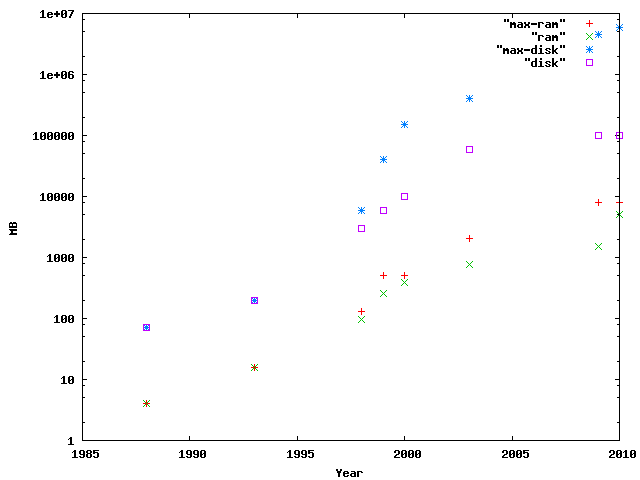
In a comment on my post Shared Objects and Big Applications about memlockd [1] mic said that they use memlockd to lock the entire root filesystem in RAM. Here is a table showing my history of desktop computers with the amounts of RAM, disk capacity, and CPU power available. All systems better than a 386-33 are laptops a laptop has been my primary desktop system for the last 12 years. The columns for the maximum RAM and disk are the amounts that I could reasonably afford if I used a desktop PC instead of a laptop and used the best available technology of the day I m basing disk capacity on having four hard drives (the maximum that can be installed in a typical PC without extra power cables and drive controller cards) and running RAID-5. For the machines before 2000 I base the maximum disk capacity on not using RAID as Linux software RAID used to not be that good (lack of online rebuild for starters) and hardware RAID options have always been too expensive or too lame for my use.
Year CPU RAM Disk Maximum RAM Maximum Disk
1988 286-12 4M 70M 4M 70M
1993 386-33 16M 200M 16M 200M
1998 Pentium-M 233 96M 3G 128M 6G
1999 Pentium-2 400 256M 6G 512M 40G
2000 Pentium-2 600 384M 10G 512M 150G
2003 Pentium-M 1700 768M 60G 2048M 400G
2009 Pentium-M 1700 1536M 100G 8192M 4500G
2010 Core 2 Duo T7500 2200 5120M 100G 8192M 6000G
graph of RAM/disk sizes from the above table The above graph shows how the modern RAM capacities have overtaken older disk capacities. So it seems that a viable option on modern systems is to load everything that you need to run into RAM. Locking it there will save spinning up the hard drive on a laptop. With a modern laptop it should be possible to lock most of the hard drive contents that are regularly used (IE the applications) into RAM and run with /home on a SD flash storage device. Then the hard drive would only need to be used if something uncommon was accessed or if something large (like a movie) was needed. It also shows that there is potential to run diskless workstations that copy the entire contents of their root filesystem when they boot so that they can run independently of the server and only access the server for /home. Note that the size of the RAM doesn t need to be larger than the disk capacity of older machines (some of the disk was used for swap, /home, etc). But when it is larger it makes it clear that the disk doesn t need to be accessed for routine storage needs. I generated the graph with GnuPlot [2], the configuration files I used are in the directory that contains the images and the command used was gnuplot command.txt . I find the GnuPlot documentation to be difficult to use so I hope that this example will be useful for other people who need to produce basic graphs I m not using 1% of the GnuPlot functionality.

Marco T&uacute;lio Gontijo e Silva: Micro BSP

I and Rafael Cunha de Almeida got together today with the purpose of closing as much RC-bugs in Debian as we could. I must say it was better than what I d expect. We started with #570348 . This bug was introduce with an upload that tried to fix #569586 which, in turn, was related to a change in libc6. It would be easy to introduce an ifdef in the code but, as we tried to read and understand the code, we didn t see the need of the function that was causing the problem. It seems to make the same thing as alphasort from dirent.h, with the disadavantage that it was not locale-sensitive. So we removed the customized alphasort and made it use the library one. Then we headed to the strange #504947. As the maintainer didn t seem satisfied with the new patch system introduced by the last NMU, we simply made a patch that removes the patch system and applies the patch directly in .diff.gz. Hope it helps. Searching for another thing to work, we noticed that #571791 was not happening in my box, and asked if anyone could reproduce it. So we found #571748. The first thing about this bug we noticed is that its package causes a division by 0 error in popcon, which made us report a bug about it. We thought that this was a sign that the package was not widely used. Anyway, we decided to fix this bug, which was very fun indeed! After a lot of trials, some succesful, some not, we got to a very simple and nice patch, which was submitted. We also submited other bugs to the same package, that we found while using it. It s a cool package, you should try it out to avoid that division by 0 in popcon.

7 March 2010

David Pashley: Mod_fastcgi and external PHP

Has anyone managed to get a standard version of mod_fastcgi work correctly with FastCGIExternalServer? There seems to be a complete lack of documentation on how to get this to work. I have managed to get it working by removing some code which appears to completely break AddHandler. However, people on the FastCGI list told me I was wrong for making it work. So, if anyone has managed to get it to work, please show me some working config.
Read Comments (1)

Adam Rosi-Kessel: Windows curly quotes, accented characters on Linux Samba Shares and Cygwin XTerm: How to get Windows-1252 (AKA CP1252) from Linux

Before I forget: I have a bunch of files I mirror between Windows/NTFS and Linux/ext4 filesystems that include not only accented characters but curly quotes in the filenames. (I know: the easiest solution would be to just get rid of the extended characters). The curly quotes were created in Windows, so don t render properly in standard Linux character sets (UTF-8, iso8859-1, iso8859-15, etc.). This all came up because iTunes under Windows couldn t find curly-quote files when it was reading from the exported Samba share filesystem rather than an attached NTFS drive. The files showed up as missing because they had different filenames. The solution was not easily google-able, so for the record, in brief, add this to the [Global] section of /etc/samba/smb.conf:

unix charset = cp1252
display charset = cp1252
And reload Samba. Also, to make the characters render properly from a terminal on the Linux box, first create the relevant character set:
sudo localedef -f CP1252 -i en_US en_US.CP1252
Now you can use this charset on your Linux box, and, like magic, the curly characters will be back:
export LC_ALL='en_US.cp1252'

Evgeni Golov: RFT: hdapsd for Intel MacBooks and Hewlett-Packard laptops

After quite some time (last release 01-04-2009), hdapsd got a bit of love.
Brice Arnould has contributed some code for Hewlett-Packard laptops (those supported by the hp_accel module, see drivers/hwmon/hp_accel.c) and I finally crossed all lines and wrote support for Apple MacBooks (the Intel ones, via applesmc module, see drivers/hwmon/applesmc.c).

The HP code is interesting, as it support a hardware-logic mode, where hdapsd only parks the heads when told so by the HP hardware. As I do not own any compatible hardware, this is only tested by Brice himself.
The Apple SMC code isn't tested at all, as I don't have the hardware either.

That's why I want YOU to test it further (both, on HP and Apple) and report me bugs (mail to evgeni@debian.org preferred) if you find any :)

You can get the latest source either via git from github:
git clone -b new-interfaces git://github.com/evgeni/hdapsd.git

Or from githubs tarball generator: http://github.com/evgeni/hdapsd/tarball/eb711f30395ac9bc682b14c22d8445b7ddf0b4a0

After you got the source, a simple
./autogen.sh
make

should produce a src/hdapsd binary, that you can test.

I can provide Debian and Ubuntu .debs if needed too.

Lucas Nussbaum: Ruby release blockers for Lucid and Squeeze

For the first time since I got involved in Ruby maintenance in Debian & Ubuntu, we are seriously at risk of not being able to release working Ruby interpreters in both Ubuntu Lucid and Debian Squeeze, because of two pretty serious issues. Ruby 1.8(.7.249) randomly hangs with eglibc 2.11 That issue was found by Google folks, because Puppet was hanging. After a lot of (quite heated) discussion, it was found that the problem is caused by something in eglibc 2.11: the problem can t be reproduced in a Debian unstable chroot (with eglibc 2.10), but is reproducible if you just upgrade glibc to 2.11 (which is in Debian experimental). It is not clear at all whether it is a glibc bug, or a ruby bug: Ruby has shown in the past that it was making some assumptions on the behaviour of pthread. It is possible that a valid change in glibc conflicts with an assumption made by Ruby. Still, I wonder why Ubuntu chose to release with eglibc 2.11, while Debian still only has 2.10 in unstable, and Ubuntu doesn t really have a lot of people with deep glibc knowledge. (Update: I assumed we would release squeeze with 2.10, but the eglibc maintainers plan to release 2.11 in squeeze.) That issue is tracked in Launchpad as bug 520715 (which was reassigned to eglibc), and in Ruby s redmine as bug 2739. Debian Squeeze isn t affected by that issue, but we are likely to get bitten as well after Squeeze if a solution isn t found by then. As Ruby maintainers in Debian/Ubuntu, we can t do much about this issue, because it requires either a lot of glibc knowledge, or a lot of understanding of the Ruby threading code. Ruby 1.9(.1.37 6,8 ) s test suite hangs on Sparc The development branch of Ruby (declared stable by the interpreter developers, but not considered as such by the third-party libraries developers) also has interesting issues. Its test suite hangs on sparc, but only (apparently) on specific CPUs/kernel versions. Here again, it is not clear whether it is a Ruby issue, or a kernel issue, for the same reasons as above. It is also possible that it is fixed in Linux 2.6.32, but the Debian build daemons run the lenny kernel, so we can t check that. This is tracked as Debian bug 565765, and is not tracked in Ruby s redmine, because Sparc is not supported by the upstream Ruby developers. This issue really requires Sparc knowledge (and access), so as Ruby maintainers, again, we can t do much, besides coordinating and poking the various people that can help.

Thorsten Glaser: CLT 2010

Quite surprisingly, I ll attend the Chemnitzer Linuxtage 2010 in Eastern Germany. This is a happenstance, I managed to get fast transportation (via my boss) and accomodation (in a hotel). I will try to help staffing the booth of Debian this time (so I cannot be called Traitor any longer). Schedule, due to the spontaneousness of this, no, though. I may not even be there on Sunday, dunno No RCBD (or night) though, some real life and a new release (with fix of an FTBFS-on-hurd-i386 bug) though:
RMD160 (/MirOS/dist/mir/makefs/makefs-20100306.tar.gz) = f65bd8ef5cf3306a9112587dd4915b6255e479fe
This version pulls in NetBSD changes (Acorn Archimedes support, for one), but I ve also coded support for boot-info-table (J rg compatible), as well as setting the PVD dates (used by GNU GRUB 2 for UUID s). On MirBSD, cdio(1) can now be used to burn (TAO) and blank (quick) CD-RW media (I backported some OpenBSD changes) too.

6 March 2010

David Bremner: Mirroring a gitolite collection

You have a gitolite install on host $MASTER, and you want a mirror on $SLAVE. Here is one way to do that. $CLIENT is your workstation, that need not be the same as $MASTER or $SLAVE.
  1. On $CLIENT, install gitolite on $SLAVE. It is ok to re-use your gitolite admin key here, but make sure you have both public and private key in .ssh, or confusion ensues. Note that when gitolite asks you to double check the "host gitolite" ssh stanza, you probably want to change hostname to $SLAVE, at least temporarily (if not, at least the checkout of the gitolite-admin repo will fail) You may want to copy .gitolite.rc from $MASTER when gitolite fires up an editor.
  2. On $CLIENT copy the "gitolite" stanza of .ssh/config to gitolite-mirror to a stanza called e.g. gitolite-slave fix the hostname of the gitolite stanza so it points to $MASTER again.
  3. On $MASTER, as gitolite user, make passphraseless ssh-key. Probably you should call it something like 'mirror'
  4. Still on $MASTER. Add a stanza like the following to $gitolite_user/.ssh/config
     host gitolite-mirror
       hostname $SLAVE
       identityfile ~/.ssh/mirror
    
    run ssh gitolite-mirror at least once to test and set up any "know_hosts" file.
  5. On $CLIENT change directory to a checkout of gitolite admin from $MASTER. Make sure it is up to date with respect origin
    git pull
    
  6. Edit .git/config (or, in very recent git, use git remote seturl --push --add) so that remote origin looks like
    fetch = +refs/heads/*:refs/remotes/origin/*
    url = gitolite:gitolite-admin
    pushurl = gitolite:gitolite-admin
    pushurl = gitolite-slave:gitolite-admin
    
  7. Add a stanza
    repo @all
      RW+     = mirror
    
    to the bottom of your gitolite.conf Add mirror.pub to keydir.
  8. Now overwrite the gitolite-admin repo on $SLAVE git push -f Note that empty repos will be created on $SLAVE for every repo on $MASTER.
  9. The following one line post-update hook to any repos you want mirrored (see the gitolite documentation for how to automate this) You should not modify the post update hook of the gitolite-admin repo. git push --mirror gitolite-mirror:$GL_REPO.git
  10. Create repos as per normal in the gitolite-admin/conf/gitolite.conf. If you have set the auto post-update hook installation, then each repo will be mirrored. You should only push to $MASTER; any changes pushed to $SLAVE will be overwritten.

Next.

Previous.