xclip -o xclip -i -selection secondary
echo -n "http://www.srcf.ucam.org/~hmw26/" xclip
xsendkeys Shift_L+Insert
xclip -o -selection secondary xclip -i
static void dispatch(int cmd, Interp interp, Thing[] argv) throws HeclException
That method then does a plain old 'switch' on the cmd int to go to the correct block of code. The code that calls this is simple, and it has to be, because one gets instantiated for every command, and so it's imperitive that it doesn't take up much memory:
class MathCmdFacade implements Command
private int cmdtype;
public MathCmdFacade(int cmd)
cmdtype = cmd;
public void cmdCode(Interp interp, Thing[] argv) throws HeclException
MathCmds.dispatch(cmdtype, interp, argv);
So far, I'm pretty happy with the results. By making the 'facade' (I'm not sure it's really the facade pattern, but... oh well, the name works for me) small, I don't waste memory. Plopping all the code in the switch statements is probably loathsome to purists, but it makes the code smaller, something that's never far from mind when working on Hecl. Things are also a bit faster, because we don't do the string comparisons to dispatch commands either. All things considered, the code isn't illegible by any means, either. Furthermore, because the new 'facade' commands still just implement the regular old Command interface, which means that Proc still works, and that you can still associate a class implementing Command with a string, so that it remains very easy to implement new Hecl commands in Java, and the interface hasn't changed.
Faster, smaller, backwards compatible, and 'rename' works too... life is good!
(this blog post is dedicated to Gigi Marzullo) Update: http://www.enricozini.org/store/dplquestion.grm
- Please write a list of 5 Debian Developers you would like to kick out of the project.
- Please write a list of 5 Debian Developers you would like to see as DPL instead of you.
- Please point to 5 threads in which you were happy to take part.
- Please point to 5 threads in which you didn't want to take part, but you ended up doing it anyway.
- Please point to 5 websites you usually visit.
- Vim or Emacs?
- What do you see in the image at http://tinyurl.com/d6s59 ?
- What is the next word in the sequence "GIANT ROBOTS, sex, JET PACKS, sex, CITIES ON THE MOON, sex, SPACE COLONIES, sex, FLYING CARS, beer..." ?
- Please ask yourself a question, then answer it.
- Is life a dream, or dreams help to live better?
English (Queen's English) is the only real language.After this required short announcement by our main sponsor, Daniel Stone, lets go ahead and explain something of interest to the many Catalan X.Org users out there. Ivan and I have been looking at the issues that block a GNU/Linux user from using the compound geminate L, , instead of the more usual L L spelling. The and characters are unfortunately not included in ISO-8859-1, so fonts were the first big problem we faced. When modern X desktops started using True Type fonts by default, the de-facto free font in most distributions became Bitstream Vera as soon as they were licensed under a Free Software license back in 2003. Bitstream did not include the Unicode glyphs U+013F and U+0140, but some time after, chatting with daf, I learned he was working on Olwen, a Vera extension which would add proper Welsh coverage. He promptly added the Catalan glyphs, but Olwen never got widely exposed in distributions. Luckily, things are changing lately. Due to the lack of bugfixes or new releases of Vera, the list of Vera derivatives like Olwen started growing. The DejaVu project is building a font family, based on Vera, which merged many of these smaller purpose Vera derivatives, including Olwen. DejaVu, is, as far as I know, slowly replacing Bitstream Vera as the standard free, high quality true type font in free desktops. With the font blocker easily solvable now, the next problem was making the input easy. Some terminals, such as GNOME's or rxvt, allow you to insert Unicode typing a Unicode code point. The Spanish layouts don't provide a shortcut for it though, and if you try to do Level3-Shift+l, you'll get a Polish character, , that is of no use in neither Catalan, Spanish, Galician, Basque or other languages in the Spanish state. We wanted to replace that with , but when we had a look at it last Saturday night during our stay in Bruxelles, we couldn't find what the name for Unicode's U+0140/U+013F was in XKB-speak. So, as I said, on Sunday I went looking for Daniel and Keith to see if we would be clued up. The solution is easy: there is no name mapping, but you can use Unicode in 0x100XXXX notation directly in your X config file to make it work. He tried in his laptop, and why not, generated a patch for X.Org 7.0's xkeyboard-config. Daniel can't be that good, so he forced me to spread lies about the English language in this blog entry if we wanted the patch committed. :) Support for X.Org 6.8 and 6.9 isn't planned, unless you bribe your X maintainer to add a tiny patch. This has been implemented as an "es" keyboard extension (named cat ) because other systems don't have that feature in the Spanish layout, and X.Org wants to remain compatible with the rest. We'll have to add a
Option "XkbVariant" "cat"
option to our keyboard section in xorg.conf.
If you're not using X.Org 7.0, you might want to try:
xmodmap -e "keycode 46 = l L U140 U13f U140 U13f"but I don't know if that'll work in all systems. To test in your keyboard, that'll probably be AltGr+l or AltGR+L . What we need to do now is to add support for the character in more fonts, alternative spellings for words using the ela geminada (ie, col labora and co labora ) in dictionaries, wordlists..., and of course, teach users about the avalability of this, and promote its usage.
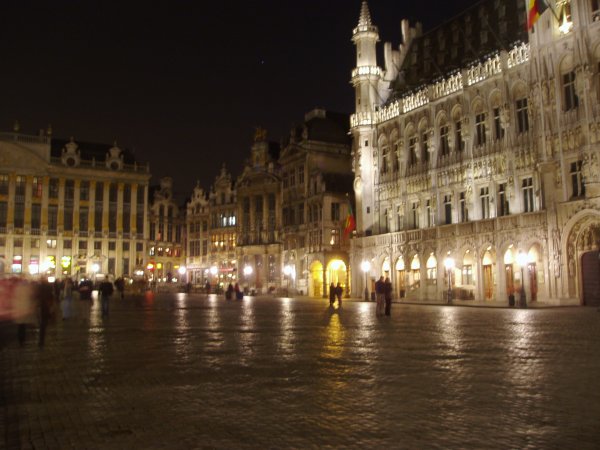
The Grand' Place was bombed by seb128 in 1695
Ra l and Virginia, our official guides during the weekend, chose a
Vietnamese restaurant in the Stock Exchange area they frequent, and for
little money we got an enormous meal. Back at the Roy d'Espagne, I tried to
say hello to most Debian people I saw around, while at the same time I tried
to be with my hosts and the Catalan people. A while after, I spotted tbm and
azeem downstairs, who I finally met. I talked to Michael for a long while,
and at some point we left as we didn't want to miss the last tram.
Ivan, luckily, only snores rarely, so we slept for a while, and then took
the tram to the Universit Libre du Bruxelles. The main room was already
packed for RMS's keynote, which was pretty good. After that, we went to
several talks here and there, while I kept meeting some people around the
place. Ivan and I left when the show ended and we met with Virginia and Ra l
at the centre.
This time, we hooked up with Xevi and
Jes s Corrius from Softcatal ,
as Toni Hermoso had abandoned us for
a cheap dinner with the Mozilla.org people. We were taken to a packed
bar/restaurant (don't remember the name right now), which had a few
interesting features: they wouldn't sell any Coca-Cola, would not accept
credit cards in protest for the high fees Visa charges on small businesses,
and something I wouldn't expect to see in 2006, their chart of prices hadn't
been rounded up when they switched to the Euro. So some plate would be 9.72,
others 12.43, etc. After dinner we had a few beers at the
Th atre de Toone, located in some tiny alley in
the centre and being pretty tired, we went back home at 23:30 or so.
Sunday was a busy days, due to the number of interesting Debian and GNOME
talks going on. I'd highlight liw's
talk on Piuparts, Enrico's on
debtags and fjp's on Debian Installer in the Debian room, and
kris' on the future of
GTK+. There was also a cool demo of Novell's XGL.
During a dead slot, I approached
Little Daniel and keithp to see
if he could point me at some mapping between UTF-8 and XKB symbol names.
But Daniel was cool enough to solve a problem a lot simpler than expected.
:)
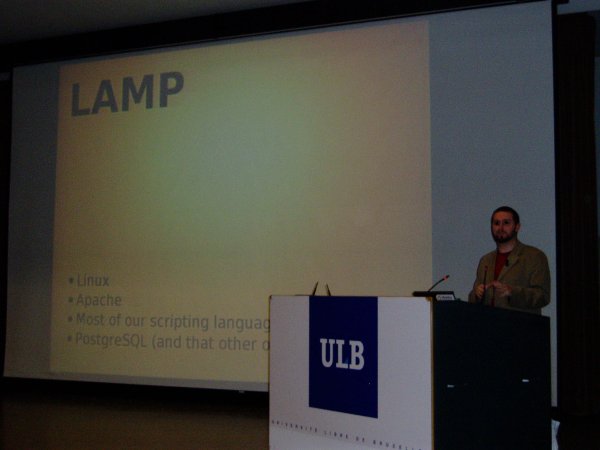
jdub's closing talk was just
fantastic, and telling him "See you in
Vilanova, we left the University, for
our last dinner around Bruxelles.

jdub clues the audience about some basic acronyms
We managed to rescue madduck
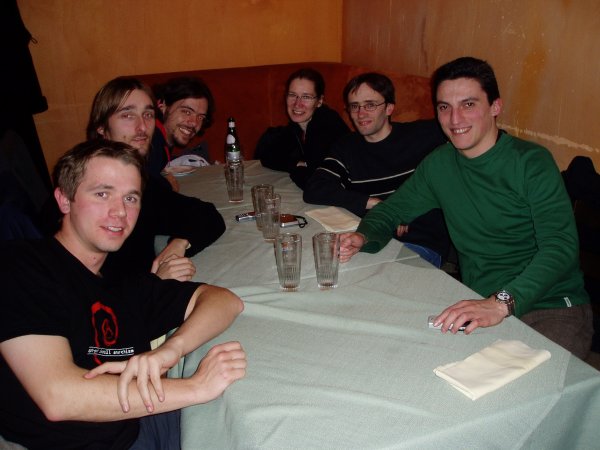
from the Debian UK beer trap and went to an Italian for dinner, this time
with Josep and Mia, from Softcatal , making a nice mix of German,
Valencian/Catalan, and Swedish at our table.

Mia, Josep, Ra l, Ivan, Martin and Jordi after pizza
Ra l took us around the city centre and told us about the underground
river, the remaining city wall's tower, and the church that leaned against it.
That night's beer lesson happened in the "2000 beer bar". We all had a 7
Trappist Westvleteren Bleu 8, apparently "the best beer of the world". It was
pretty good, actually.
Our weekend in Bruxelles was about to end. After not that much sleep,
Ivan and I took a tram and a bus to the Airport, arriving in Val ncia
around 10AM, and after seeing the best view of the Pyrenees ever, which were
absolutely covered with snow, as well as many other places in the
Pa s Valenci and Teruel due to massive snows during the two days we were
out.
FOSDEM is probably a "can't miss" yearly event now. Thanks to all the
organisers for their hard work to make it happen. You rock.
How not to do it: The blog of Alexis Sukrieh not only uses broken letter image tests just now, but sends rude error messages when you fail and has a broken trackback system that returns 403 Forbidden. If that's the Spam Karma 2 mentioned in the footer, I suspect someone will be reincarnated as flame-roasted tinned meat soon. (Is this comment offensive? Report bad content.)
Next.