Search Results: "sto"

20 January 2009

Theodore Ts'o: Israel and Palestine: A Viewpoint from a Former Zionist

Gunnar Wolf is Debian Developer, a Mexican, and is a former member of a Hashomer Kibbutz. He has written an essay on his blog entitled About the recent events and possible outcomes in Israel and Palestine . I strongly encourage people to read it, since he talks about the historical roots of the conflict (going back all the way to the roots of Zionism) in a way that while it is definitely not pro-Zionism, neither is it as unfair as some of the pro-Palestinian accounts of the period 1947-1949. It s about as balanced an account of the roots of the whole mess in the Palestinian areas and Israel that I think you can find, although he definitely has a point of view:
All in all, even if I won t live there again, [Israel] is a country I learnt to love, a society I have long studied And yes, I keep the political stand I had 12 years ago: The only solution is to dialogue, to treat the current enemies -and not only their governments- with respect, recognizing their dignity and right to life, to self-determination. Only then we will change the status quo.
On this day when we will finally see the back side of George W. Bush s presidency, I can only hope and pray that more people will be as thoughtful as Gunnar Wolf was in his blog posting. Even if we disagree (and there will be disagreement), it s only by encouraging more people to learn about all sides of such tragedies such as the Israeli-Palestinian conflict that we can help make decisions that might bring peace to this shattered world. May that day arrive soon!

Russell Coker: Security Lessons from a Ferry

On Saturday I traveled from Victoria to Tasmania via the ferry (to attend LCA), they grossly failed in their security measures and provide three lessons for others:

  1. Make it possible for people to read security relevant documents .

  2. Make obeying the rules not be a cost and make the fact known.

  3. Don t be lazy.

Here is the detail:

  1. When driving towards the ferry in a queue that lasted about 30 minutes just around the last corner there was a sign notifying me of the security rules. As soon as it was visible I started reading it but the security guard started frantically waving at me, the time taken to read it was holding up the queue. Therefore I never discovered the full list of things that I m not supposed to do.

  2. One rule was that cylinders of gas (such as propane) were apparently banned and should be surrendered - presumably to prevent a gas leak in the confined space of the ship s hold from risking an explosion. Anyone who did have such a gas cylinder would probably not want to have it stolen by the security people and would be inclined to lie and hope that the security people wouldn t find it. If they had made it well known that such gas cylinders would be stored in safe keeping for the duration of the voyage and then returned then they would have been more successful.

  3. They wanted to check the luggage compartments of all vehicles. To check the tail-gate of the Kia Carnival van I was driving first required that all the bags which had been put over the back seat be removed (they were resting against the tail-gate and would fall out if it was opened). When the guard realised that they would have to wait for me to empty a lot of luggage out they decided to just trust me that I didn t have any bad things on board (even though due to point #1 I didn t know what bad things were). This problem happened a second time when I reached Tasmania and the guards wanted to search for fruit.

19 January 2009

Stefano Zacchiroli: ocaml batteries gzip

OCaml batteries, now with GZip-ed channels This week-end I've spent some time to kick-start my hacking onto OCaml Batteries Included (yes, it deserves a proper website). Last time I wrote about it was with my package maintainer hat on. In the meantime I've got trapped^Winvolved with upstream development as well, after having been so fool to propose integration with Batteries' I/O channels of compression/decompression libraries. Well, here are the first tiny teeny results:
    # open Batteries.System;;
    # let i = File.open_in "/tmp/fstab.gz";;
    val i : InnerIO.input = <abstr>
    # let i2 = GZip.uncompress i;;
    val i2 : InnerIO.input = <abstr>
    # IO.read_line i2;;
    - : string = "# /etc/fstab: static file system information."
    # IO.read_line i2;;
    - : string = "#"
    # (* same goes for output of course *)

i.e., no matter how you created an I/O channel (and with Batteries you can create it out of a lot of entities), you can apply a gzip compress/decompress filter. The underlying library is Camlzip, which also sets a precedent on how to integrate external libraries into Batteries properly. The code is not released yet (hey, Batteries is still alpha!), but is available from the Git repo, (zack/compress branch). Next milestone: bzip2 ... of course with the same interface, so that changing (de)compressor will be as easy as s/GZip/BZip2/g in the code above. tar and zip will come next (but with different interfaces, as old *nix jokes tell us, compressing and archiving are different tasks).

Stefano Zacchiroli: debcheckout hacking

New features for debcheckout, ... now with TopGit support! Today I've spent some time hacking on debcheckout, which for weird reasons happens to be at the bottom of a stack of chained things that I need to do in the forthcoming days. Also, I had neglected debcheckout for a while, and the other devscripts folks where ready to shout at me because of that :-) . Well, it has been fun, and beside having fixed all the outstanding bugs, debcheckout has grown some cute new features: Enjoy! (ah, of course all this is not uploaded yet, but you can grab a preview from devscripts' VCS or, better, doing debcheckout devscripts which is soooo bootstrapy. SCNR.)

Stefano Zacchiroli: ocaml batteries included debian packages

preview of OCaml batteries included Debian packages OCaml batteries included is a wonderful community-driven initiative to standardize the OCaml development platform. It is similar to initiatives sharing the same motto, like Haskell batteries included and Python batteries included (which then has become the legacy Python distribution), but I have always felt that OCaml was more desperately needing a similar initiative. David Teller and the OCaml batteries included team have been the first actually doing something to address the frustration of many otherwise enthusiastic OCaml developers. A couple of days ago, their efforts have given birth to a first milestone: the release of the first alpha version of batteries included. To help out, I've released as quickly as possible the Debian packages of OCaml batteries included. You can find them in experimental (actually in NEW, at the time of writing), and from my people.d.o space. I've only built the packages for amd64, if you need some other architecture you can build on it by yourself, but I recommend not trying to rebuild the -doc package (which takes 10 minutes on my laptop to build). You can reuse the -doc package I've built, which is arch: all, to rebuild only the -dev part unpack the source package and do fakeroot debian/rules binary-arch.

Stefano Zacchiroli: worst quoting practice

On the saga of weird SPAM, today I received a SPAM message in French about advertising a backgammon portal (WTF?). One of the funniest part was the end of the message (original, horrible line breaking preserved):
P.S.: Pour un meilleur suivi des communications, merci de bien vouloir laisser
l'int gralit 
du message et de r pondre au-dessus de l'historique.

Which roughly translates to: "to better follow further communications, please keep the totality of the original message and write your response on top of it". To be read as: "just in case you know how to quote properly, please don't do that".

Gunnar Wolf: About the recent events and possible outcomes in Israel and Palestine

Several friends, from different groups and backgrounds and with different points of view regarding the current war in Israel (and regarding the Arab-Israeli conflict in general) have asked me for an explanation on what is happening there, what is (my view of) the real conflict, its causes... and any possible answers. And yet I am quite far from being an authority, I do want to write something about it. Be prepared, as this post is quite long.
And yet, after writing frankly a lot more than what I expected... It is by far not enough. I have still much more to add, but I have to say "stop" at some point. So, here you have it: My points of view, as well as some explanation on why are we standing where we currently are.
I am writing this based just on my personal experiencie and, of course, my personal point of view. Furthermore, I wrote a good part of this text while riding a bus, with no network access, so I am offering very few references - In any case, it will allow me to make much more progress. References always take as much time as the text itself! About me Why am I writing this? Why do people ask for my opinion? I must start by explaining who I am, so the rest of this makes sense. I am a Mexican Jew. That means, I was born in a Jewish (albeit secular) family, and grew up in an environment with general Jewish culture. My direct family (say, my parents and brother, and to a lesser degree my closest cousins) are not at all religious, I'd even venture to say most of us are complete atheists. Yet, besides the cultural belonging (which is a mixture of a Eastern European culture with lots of Idish words and dishes and general humor), my family has a strong national identification - In other words, I grew up in a fully Zionist environment, which traces back to Poland.
My grandmother was member of Hashomer Hatzair in Poland, since the early years of its existence, late 1910s and early 1920s. What is it? To make it short, a Zionist Socialist, Kibbutzian youth movement. It has many similarities (and somewhat stems indirectly from) the Scouts many of you will be familiar with, but -obviously- has a way lengthier agenda. And, yes, nowadays I feel it is somewhat out of reach with the current state of the world - It was founded in 1913, and only slightly adjusted its principles since then.
I will talk more about Hashomer later on.
My grandmother arrived in the late 1920s to Mexico, for familiar and economic reasons, but still dreamt about living in Israel for a long time. As they grew up, first my uncle joined Hashomer in Mexico in the late 1940s, when it still pursued a very much Soviet-style ideals for Israel (one of the core points that changed during the 1950s); both my father and my mother joined in the late 1950s (in fact, that's where they met). My cousins and myself were very active in the 1980s and 1990s.
The Iszaevich family has something very unusual, I'd say, engraved in our genes. We live very deeply our ideologies. That's the only explanation I can find to the way we all have led our lives. I won't go into the other family members' details, but just into mine: I was fully convinced of all we taught to our younger members and what we discussed among ourselves. I am among the very few people who really learnt Hebrew at my school, and that was only because I really cared - I know some people that just after 12 years of pseudo-learning could maybe utter a few phrases.
After finishing high school I went with my Hashomer group, together with people my age from other similar-minded Mexican Zionist youth groups, to live and learn for a year in Israel, on what is usually known as shnat hajshar - A year to get ready. To get ready to what? But of course, to come and give back go the younger groups of the movement, and finally go back to Israel and settle there definitively. I came back to Mexico, and after one year I did the only thing that was logical: I became an Israeli and went to live to a kibutz - Zikim, a beautiful place just between Ashkelon and Gaza, very near the sea shore. It was a beautiful period in my life, and I really enjoyed it - But it didn't last for very long - I quickly grew to hate the Israeli society at large. A society full of rage, of hatred. Not just between Arabs and Israelis, as many would think from the outside, but between religious and seculars. And between immigrants and locals. And between leftists and rightists (in several dimensions, as it is one of the countries where you can most easily be a economic leftist while being a political rightist - a complex society it is). A society full of disrespect and intolerance. A very hypocritical society. And one of the things that most shocked me: I wanted to live in a society of proud of its existence, that's what I had learnt Israel was - But Israelis aspire and dream of being anything else (and mostly US-Americans) in a way that made me sick, more than anything I had previously seen in Mexico.
I loved the life at the Kibutz, and I loved being an agricultor, doing hard work every day and literally getting the fruit of it. However, I cannot live isolated to a 300-people universe - At least once a week you have to go to the city if you don't want to become insane. And I could not stand the sick Israeli society.
Anyway, to make things short: After six months as an Israeli, I came back to Mexico. I went through a long period of finding myself, as I could not uphold anymore my Hashomer ideology (if I am not going to live by it, how can I continue teaching it?). Many people do anyway, but for the first months, where my Hashomer work was basically all of my life, I felt really uncomfortable. So, in short, I severed all of my relations to the Jewish community, and even denied for a long time my Jewishness until I found a (I think) better balance.
Today I am at peace. But anyway, I wanted to talk about myself in the critical period that marked me in this regard: The 1990s. Enough, lets get down to business. Zionism 1870-1920 Many people argue that the Jews invaded the Palestinians homeland - And yes, nowadays I cannot counter this. But we cannot judge what happened then based on what we see now.
Modern Zionism started around the 1870s. The Jewish history is full of pogroms and persecution, in different countries all over Europe - And a group of young people decided the only solution was to build a place to call their own. And yes, this was full of idealism and in no small part the foolishness of youth. For several centuries and up to 1920, all of current Middle East were provinces of the Ottoman Empire. Before Zionism began, the population of today-Israel was very sparse, not more than 400,000 people - up to 5% of them Jewish, around 10% Christian Arabs, and the remainder, Muslim Arabs. Of course, the low population was mostly because the country was mostly hostile - A desert in the South, mostly swamps in the North, and some minor towns mostly in the hills. It was a mostly forgotten province, away from the central Turkish rule, and there had been no frictions with the local population. It was a nice place to go, thinking -again- as a fool youngster, or as an idealist. They said, lets take a folk without a land to a land without a folk.
The number of accomplishing Zionists (this is, people who actually went to Israel instead of just talking about doing so) was not high during the first decades. But towards the 1890s, it gained critical mass. The political Zionist movement was born, with Theodor Herzl as a leader, and they started pushing -politically- for different governments to concede a territory to Jews. They went to the Turks, and didn't really get much echo. Went to other colonial powers of the time, and got unfeasible promises with no real backing (i.e. Birobidjan in Eastern Russia, Uganda in Africa)... And, as it happens in strongly ideologized movements, the movement started splitting into different groups with slightly different positions.
And no, I am not talking about the People Front for the Liberation of Judea and the People Judean Liberation Front, but I very well could. Sometimes the differences are as ridiculous as that. But hey, I take that most of my readers are acquinted with the Free Software issues, right? Think BSD vs. GPL vs. OpenSource. To give a broad idea - Only in Mexico City, with a very small Jewish community (~30,000 people), in the mid-1990s we had over 10 such movements, with 50-150 youngsters attending each. And even though some were local, and even though some very important ideologies are not represented in this country, they are all different enough to exist as separate entities. British Mandate The Ottoman empire was divided after the first World War. Its possesions in Europe became independent states, while in Asia (and Africa, if you take the semi-independent Egypt and part of Sudan into account) they were taken over as colonies or protectorates by France and the UK - Evidently, attempting to secure a long-term dominion over the area. In some aspects, they failed. In some aspects, they were (and still are) tremendously successful. The division of people by setting arbitrary boundaries has led to countries sustainable only by force and a harsh rule (such as Iraq, Lebanon and Syria), or doomed to poverty (and thus submission) due to lack of natural resources (as Jordan). Focusing on Israel/Palestine, the UK entered the area by making mutually incompatible promises to arabs and Jews - i.e. the Hussein-McMahon letters and the Balfour declaration, both ambiguous enough to lead to... Well, today. The UK rule was disastrous to the region, both in giving (and taking away) power from all sorts of puppet regimes, and swiftly going away as soon as things started looking too complicated. Yes, typical colonialism.
So, while up to the 1920s there was no real animosity between Arabs and Jews (as i.e. the Faisal-Weizmann agreement shows), during the next decades the seeds of hatred started growing, from both sides.
Many people still quote the 1947 partition plan as the direct antecedent towards Israel's real existence - That was not the first partition plan that existed. Ten years earlier, the Peel commision suggested a similar partition involving forceful population transfer. And many people see the separation of Transjordan (now Jordan) from Palestine in 1922 as a first partition. It is understandable that both partition plans (much more the 1947 than the 1937 one) were accepted by Zionists: Going from having nothing to having something (and against all odds in the environment they lived) is acceptable.
From the Zionist side, two main groups rejected the partitions: The right-wing and religious groups, insisting that the whole of the Mandate should become Israel, and the left-wing groups, which advocated for a single, bi-national state, with equal rights for all of its population. Go over and read this last link, as it was quite interesting (to me at least) to see how this solution has kept existing and regarded by (relatively) many people, and has many interesting links. 1948 onwards: Where did the refugees come from? The November 1947 partition didn't exactly translate to a planned, smooth Israeli independence - It led to six months of revolts (basically, a civil war). By mid May, the UK government and troops abandoned the territory, and one day later, Israel declared its independence. And, of course, all neighbouring countries (and Iraq) sent their troops to invade Israel. The war lasted for over six months (cease-fire was signed in January 1949). There was an intense Arab campaign indicating the armies would enter Israel and devastate it, leaving no stone in place, indicating Arab population to temporarily leave the Jewish-destined areas. The war, they said, would not take more than a couple of months, and they would be able to go back home.
Only that... When the war ended, the results were far from what the Arab governments expected. Not only Israel continued to exist, but it conquered important territories.
Of course, the Israelis were not innocent from said exodus: During the 1947-1948 civil war, and the independence war, some of the existing so-called self-defense forces (some of them were really defensive, while some were quite aggressive, even terrorist) attacked Arab villages in strategic or predominantly Jewish areas to prompt them to leave - yes, what we today call ethnic cleansing.
I had (in my head) the number of 650,000 Arabs (from a total of slightly over a million) fleeing to neighbouring countries. Wikipedia states that it is somewhere between 367,000 and 950,000. A similar number of Jews were expelled from Arab countries, many of which arrived to settle at Israel (and many others went elsewhere - For instance, a good part of the Mexican Jewish community is from Syrian origins - Many of them fleed in those years). Israel didn't accept back the (relatively few) Arabs that requested to resettle, as they were seen as hostile population - but neither did the countries that "temporarily" accepted the Palestinians accepted them as citizens. The Palestinian refugee camps today, mainly in in Lebanon, Syria, and the occupied territories held by Israel have terrible living conditions, and its population -despite living there for over 60 years- have no civil rights at all. Note that I'm omitting Jordan here, although it has several camps as well, as their situation is way better.
The Arab population that didn't leave did receive full Israeli citizenship. No, their living standards are not up to level with the average Israeli. The country and the society do have a sensible degree of racism and segregation. But the situation is nowhere as terrible as it is in the camps.
The areas which were originally to become Palestinian and were not conquered by Israel -this is, current-day West Bank and Gaza- bacame respectively Jordan and Egyptian territory. While Jordan did fully extend its soverignty covering the West Bank, Egypt didn't - Gaza is, since 1949, occupied military territory. Gaza, among the most densely populated areas in the world, has had their inhabitants under military rule ever since. When Israel returned the Sinai after signing the peace treaty with President Sadat, Egypt didn't accept Gaza back - And that's where today's greatest problem is born.
Now, Israel conquered those territories in 1967, along with the very sparsely populated Sinai and Golan. For the first ten years, the territories were basically only administered (yes, under a military rule). In 1977, with the first right-wing Israeli government, an extensive settlement policy began (and led partly to today's seemingly unsolvable situation). In 1980-1982, Israel withdrew from the Sinai. In 1981, Israel claimed full soverignty over the whole of Jerusalem and the Golan. In 1993, the "Oslo Agreement" was signed between Israel and the PLO, and it seemed we were heading towards a bright future. I lived in Israel between 1994 and 1996 - Yes, the most hope-filled period in the country's life.
Since 1996, I have tried to keep up to date with the country's evolution. All in all, even if I won't live there again, it is a country I learnt to love, a society I have long studied (even if in the end I did include many references, I wrote most of this text just off the top of my head, with the data I remember - so it might have several big errata). And yes, I keep the political stand I had 12 years ago: The only solution is to dialogue, to treat the current enemies -and not only their governments- with respect, recognizing their dignity and right to life, to self-determination. Only then we will change the status quo. How not to fight hatred Since 1993, the dream of peaceful coexistence seems to have faded. What we saw during the past three weeks, along to what we saw in Lebanon in 2006, is plainly a gross mistake if the goal is to achieve good, lasting peace.
Try to imagine how could life in Gaza be, even in the total absence of Israeli attacks. Just to set some numbers first: The Gaza strip hosts almost 1.5 million people on 360 km . When I lived in Israel, I was constantly surprised at how small a country it is - Israel tops at 550Km North to South, 150Km east to West (it is amazing, almost wherever you stand, except in the middle of the Negev, you can see the country's borders. Yes, I recognize as the border the so-called Green Line); over half of the territory is a desert, and it hosts seven million inhabitants. And it is hard to imagine how that country can be economically viable.
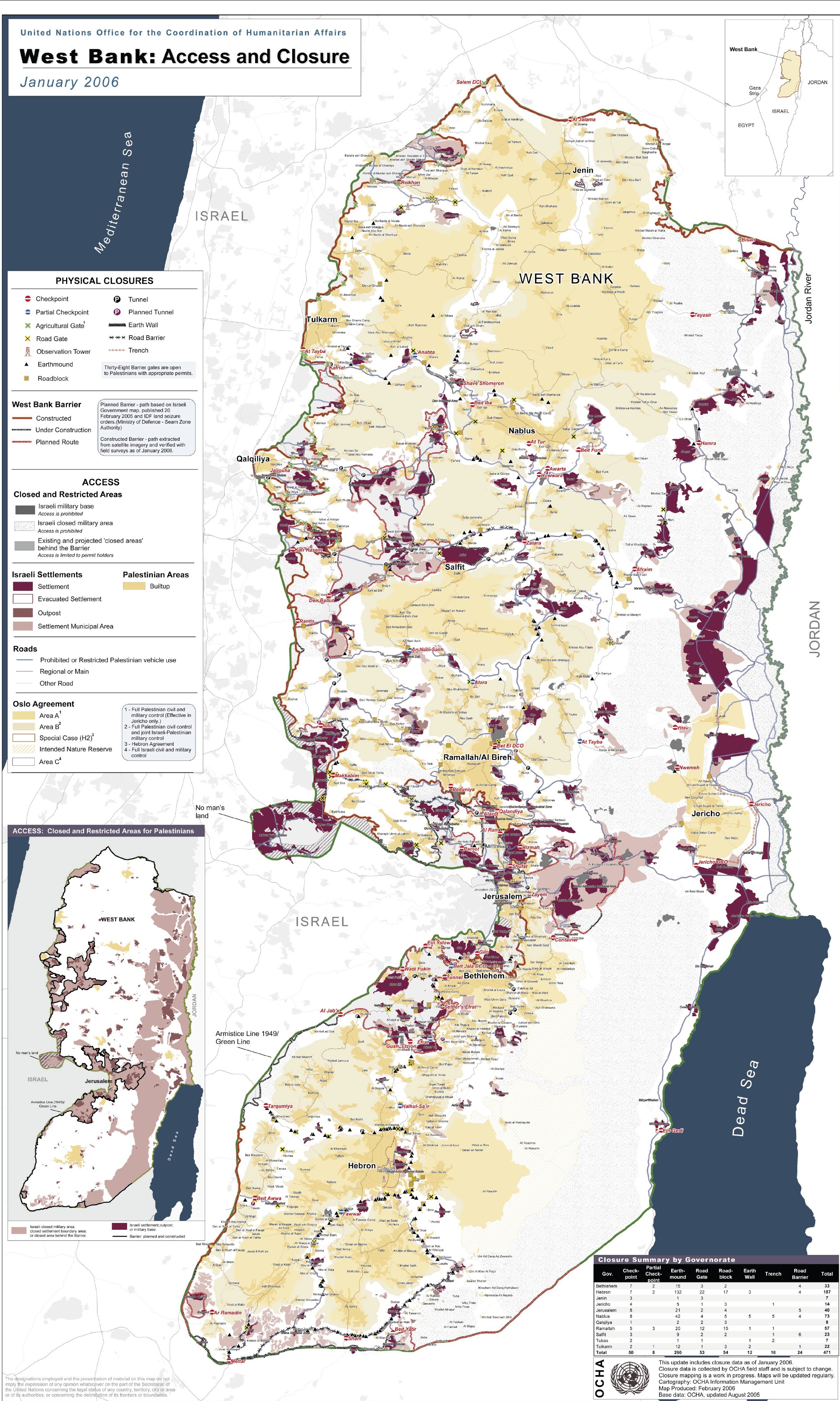
I do not find it feasible to imagine Gaza and the West Bank integrating a single country, and not only because they are separated by ~40Km, but because they are so sociologically different. People in the West Bank, yes, live opressed under military rule and subject to a much more constant, more visible apartheid-like state (as the territory is truly sprinkled with Jewish outposts which many Israelis refuse to recognize as their own, but still, which have incredibly higher living standards). The best land has been taken away from them, yes, but they have some space between cities to have some farming, to communicate, to... Breathe. Besides, West Bank inhabitants -even those in refugee camps- have much better living standards than anybody in Gaza. It is still an overpopulated area, but not nearly as much as Gaza.
Gazan population have been driven towards extremism. And yes, there was a civil war between Palestinian factions, as the world views between both populations are completely different - However hostile a Jenin inhabitant can be towards Israel, he does not lead the life -if it can so be called- you see at Khan Yunis.
But back to Gaza... What Israel is doing (and not only during this military operation terror campaign is wrong, from any rational point of view. Israel wants Hamas to become weaker? Then don't drive the population into supporting them!
Palestinians started giving over 50% of their support to Fatah (ex-PLO), and under 20% to Hamas. That was less than 15 years ago. However, Fatah has shown to be corrupt and inefficient at building infrastructure and improving life conditions, ineffective at negotiating a permanent agreement which secures dignity and sustainability to their people. Hamas stands as a religious, righteous organization. There are no serious corruption charges against any Hamas leaders. Hamas is clearly still at war - They didn't subscribe any peace agreement so far, and their stated #1 goal is to build a Muslim State in the whole of Israel. And the Hamas movement -like Hizbollah in Lebanon- has built quite a bit of infrastructure in the areas they control - Mainly housing. Yes, housing where they mix their own offices, many will accuse, getting human shields for free. But still, they are benefactors to a dehumanized, pauperized population.
I find it obvious that, if living conditions were at a basic level in the region, support of Hamas would decrease. Even more, of course, if they improved due to Israeli support. Israel controls this territory, so it is responsible for the well-being of its population, like it or not. And Gaza is simply too small and low on resources to survive by itself.
I was a bit surprised to find mention -although very brief- of a three state solution - And yes, this is close to what I would expect as a viable outcome. It is clear that Israel will not ever grant full citizenship to the Palestinians, as they would -euphemistically speaking- challenge the Jewish character of the State. Dropping the euphemism, Israel relies on apartheid in order not to become an Arab majority country. I might have some numbers wrong, but AFAIK, there are ~7 million Israelis, 20% of which are Arab citizens (which means, 1.4 million Arabs and probably 5 million Jews, with many other minor denominations for the difference), and ~4 million Palestinians live in the territories. Today, the country is already predominantly Arab, or at least is close to being so. So, Israel should permanently, formally disengage from all of the occupied territories. And in order to ensure violence stops, start a comprehensive, unconditional, long-term aid program. Start with giving them autonomy to regain their sea, as the Gaza port has long been closed. Allow the airport to operate again. Instead of bombing tunnels in the Egypt-Gaza borders, allow Gaza to trade with Egypt - Perhaps even to integrate territorialy, if the conditions are met. Treat their people with respect, and help them ease the terrible situation they have lived for so many decades - and then, undoubtely, terror will stop.
The West Bank? Possibly it could become a Palestinian state by itself. Possibly, it could integrate back to Jordan. That would be up to Jordans and Palestinians to decide. Of course, Jordan has already a large segment of its population defining itself as Palestinians, which counts both for and against. So, I won't venture into this supposition.
But anyway - Back to what prompted me to write this text -yes, a very or maybe even too long text - I hope somebody even takes the time to read it!- is to explain what is my point of view on the current situation, and why.
Today, a cease-fire was announced, after 23 days of murder and destruction. I sadly do not hold very high hopes for it to be lasting, much the less to be enough, to lead to what they call a de-escalation of the conflict. The most I can currently do is to voice my opinion, and hope that mine is just one more voice pointing to a sane solution, to a permanent, dignifying way out, for all people involved. Every people has the right for survival and for safety. We cannot deny this to any others. And certainly, we cannot expect anybody not to fight for their right to live.

Fabio Tranchitella: Distributed application-level filesystem for web applications

While developing web applications using Zope3, my Python web framework of choice, I always have the same issue: where should I store the UGC data? I usually used an NFS filesystem, using a Zope utility to manage the storage and retrieval of the files.

The most obvious disadvantage of this technique is that the NFS server is a single point of failure: if it disappears, there is no way to access the files from the application servers.

Another problem with this implementation is that all the UGC data files have to be served by the application servers, using resources which could be used to serve more clients instead of transmitting a static file over the network.

MogileFS is an application-level distributed filesystem which solves these problems, ensuring data integrity and redundancy, written by Danga. The only problem is that it is written in Perl, it works only with MySQL and requires WebDAV servers for the storage.

To solve my problem, I decided to borrow some of the ideas behind MogileFS and to develop my own distributed application-level filesystem. KoboldFS is written in Python, uses a PostgreSQL database to store the filesystem status and it is released under the GPL license.

I deployed it a few days ago on one of our production clusters, and it reduced the load of the application servers allowing us to serve the UGC files directly from nginx. You can find the source code along with a rough description here.

Axel Beckert: Mini-ITX based Home Server: Hardware Review

Mostly for my backups needs, I planned a Mini-ITX based home server around the Chenbro ES34069 Mini-ITX case which features four hot-swap S-ATA bays. I wanted a low-consumption motherboard and CPU in there (not only because of the default 120W power supply) and since low-consumption mainboards with 4 S-ATA connectors are quite seldom I ve chosen the not so cheap VIA EPIA SN18000G mainboard with actively cooled 1.8 GHz VIA C7 processor and a maximum power consumption of less than 30W (including CPU). Waiting for delivery While the Chenbro ES34069 case I ordered at digitec only needed a few weeks to deliver, the VIA EPIA SN18000G mainboard from Brack took over eleven weeks to deliver, it finally has been delivered on Wednesday, 5th of November 2008. I initially ordered the VIA board for CHF 324, now it s at CHF 397 (without rebate even at CHF 439) because Brack seems to have had a lot of hassles to get some of them at all. Although they usually sell for the prices at the time they ship the hardware (market price), they sold it to me at their purchase price, so it became only about CHF 15 more expensive than when I ordered. And since the RAM price dropped by one third during those eleven weeks, the whole order became about CHF 25 cheaper, the order was CHF 10 cheaper overall than when ordered. :-) (Still waiting for the according voucher, though.) So I ve joined the two main components together, installed Debian Lenny on it, crammed four 400 GB Samsung S-ATA disks (formerly in a TheCus N4100) and the 160 GB 2.5 harddisk from my MicroClient JrSX (I never really used it in there, it always runs from CF card) into it, created a software RAID-5 and now fill it with music, games and backups. But not everything was as easy as it sounds above. Although Chenbro lists the VIA EPIA SN18000G as officially compatible mainboard for the ES34069, not everything really fitted as expected. So here s my review of this hardware combination. Chenbro ES34069 It s really awesome how much features you can stuff in such a small case. Of course it s not as small as a thin client case or the mCubed HFX micro case, but it s smaller than most book-size cases like the ASUS Pundits, just a little bit thicker. Inside the case (laying on its left side) there are two decks. The lower deck contains the 3.5 hot-swappable S-ATA harddisk bays, the internal part of the power supply and the two fans for cooling the interal power supply components and the disks. The upper deck has space for the mainboard, a 2.5 harddisk, a slim-line optical drive slot and all the front-panel stuff (card reader, LEDs, USB sockets). Both decks are divided in two section. The front section belongs to the case itself and the back section containing the mainboard mount points and the two fans can be easily unplugged after removing four screws and keeping an eye on the cables from the lower to the upper deck. That way the mainboard can be mounted very easily. So far a very convincing design. To mount the 2.5 harddisk in between the mainboard and the front panel, it s not really necessary, but convenient to remove the slim-line optical drive slot, since you then have better access to the harddisk s IDE socket. To remove the slot, you need to remove the front cover. That sounded easier than it actually was and I nearly broke of one its catches. :-/ Although all parts of the case seems to fitting very well together, the bays for the hot-swappable drives weren t perfect: The drive slots not always connected even if the latch iss already closed. This was definitely better with the TheCus N4100. Additionally the bays seem to be made for slightly larger disks, so mine had play and the screws pressed the it together and you need to take care that the screws don t cant. A big positive point of the case was that there were all necessary screws included and they were fitting. This was a bigger problem with the TheCus N4100, since many harddisks ship with their own screws, but those are seldom the needed flat-head ones. Even a P-ATA to slim-line optical drive adapter was included, so I don t need to buy one. (Would have costed CHF 42 at digitec.) VIA EPIA SN18000G While it s surely not the most performant board out there, I m quite satisfied with its performance. I installed BackupPC 3.1.0 as backup system on it and it works like a charm. It daily backs up up to 14 machines over ssh tunnels more to come) and is way more performant than expected. But I probably had very low expectations due to everyone arguing about the bad performance of the VIA C7. ;-) Not nice, but known is the problem that most (but not all) USB connectors on the SN mainboard have 2.00mm pitch while all the case s plugs have 2.54mm pitch. Apropriate adaptors are available from Mini-ITX.com. Thanks to Akim for this tip! Power consumption I hoped to get more details into this posting, e.g. measured power consumption, etc. But then I recently read in the c t magazine how inexact my watt meter (from Brennenstuhl) is, so its values would probably bring more confusion than help. Additionally I don t feel like powering down the server just for measurement. Feedback I got quite a few mails with hints to further Mini-ITX boards and TDP but also with questions about the case. I hope that this blog post asnwers some of the questions also for other readers. Thanks to all who replied to my initial blog post about my Chenbro/VIA based home server, either by mail, or comment, or both. :-) Further plans For deploying music to my other computers I tried both, mediatomb and gmediaserver but none really convinced me. Currently I just mount the media directory using the FUSE and ssh based sshfs. Not sure if I ll add NFS due to it s user base syncing hell. Further plans are an HTTP proxy with ad filtering and caching capabilities, it ll be Privoxy combined with either Squid or Polipo. Maybe even a Tor SOCKS proxy.

Erich Schubert: U3 hackware

The U3 software that everybody so loathes is somewhat hacker technology. It's not entirely unlike the Sony rootkit, except it (as far as I know) by default doesn't install persistently.Fortunately, it doesn't work on Linux.What U3 essentially does is the following: It probably is just a matter of time until the first viruses find out how to install themselves onto the U3 partition and get auto-run whenever you plug in such a stick.So if you plan to buy a USB pen drive, make sure it doesn't bear the U3 logo. If you end up with such a hack-drive, grab the Uninstall application from U3, which unfortunately is Windows and Mac only. If anyone found a way to erase the U3 partition on Linux, please share. A low-level format on the usb-storage device is not sufficient.

18 January 2009

Biella Coleman: Blue Cross No Shield

After two years of phone calls, nasty emails, filing claims and reports, Blue Cross Blue Shield of NJ finally ponied up every last cent of cash they originally did not want to pay. Since the ordeal began, many BCBS customers left comments here where I chronicled my plight and many have also sent me emails as well. In the end, I think I was successful mostly because I had the email of the director of public relations (he made the mistake of emailing me) because well, I would send him these emails and I think he just did not want to receive anymore. Recently I received an email from Reynold Weidenaar with a pointer to his webpage where he is also chronicling what is happening with BCBS since they want to deny coverage for physical therapy. This is great and more folks need to do this exact thing, which is chronicle every last detail in a public place. In the end, they have a lot of paperwork and we need to turn it back to them and in very large numbers.

Wouter Verhelst: FOSDEM Debian Devroom: annotated schedule

FOSDEM is a 2-day weekend of insanity. 218 talks this year; if you want to understand exactly how insane that is, have a look at the schedule grid. There are 19 rooms where events are held; possibly more, since I understand not every devroom has sent in its schedule yet. Might be hard for people to make a choice that way, I guess. Now there're supposed to be abstracts of each talk on the FOSDEM website, but reading them all can be quite tedius. In an effort to help, at least for the Debian devroom, here's the schedule for our devroom with a bit of explanation of what it's about. Note that this is mainly aimed at people not familiar with Debian; those who are should probably understand it enough by looking at the titles. Saturday: 13:00 - 14:00: 'Outside broadcast on a budget - the DebConf video team and DVswitch'. DVswitch is the software used to create those excellent Debian videos. The best ones yet, IMO, are the ones of Debconf8. Check them out. There's nothing Debian-specific about DVswitch, except that it was written by Debian people. It's a great way to do live Internet .ogg streaming by using nothing more than DV cams, Firewire, and plain old Ethernet. 14:00 - 15:00: 'Ultimate Debian Database: datamining Debian made easy!'. UDD is a SQL database containing a shitload of data related to Debian, and which should allow easy datamining. Hence the title. This probably won't be of any interest to people who are not either a Debian Developer or a statistician, but I might be mistaken. 15:00 - 16:00: 'Introducing DDE, Debian Data Export'. This is a new project Enrico came up with, and which is related to the same subject as the previous talk. I don't know much more beyond what's in the abstract. However, given the fact that Enrico is going to be doing this talk, it can't be bad. Seriously. 16:00 - 17:00: 'The Debian status quo on the Openmoko Neo Freerunner'. Yup, Debian runs on the OpenMoko, and has done so since Debconf8, last august. This talk should give some more insight; if you have an OpenMoko, this definately is for you. 17:00 - 17:30: 'Running Debian on Inexpensive Network Storage Devices'. I've been running Debian on a Thecus N2100 for a few years now, and it's great. There are more options, however, and Martin does most of the hard work related to these devices. He's done a similar talk on the two previous FOSDEMs (go check out the videos), and this one will mainly be an update on what's going to be new in Lenny. 17:30 - 18:15: 'Grid Computing with Debian, Globus and ARC'. These guys are a group of academics from three different universities who've been doing grid computing (i.e., something like 'SETI@Home', but then somewhat different) with Debian and some other technologies. They'll be explaining how, exactly. I don't know much about this talk; it could be great, or it could fail miserably. I guess we'll see. 18:15 - 19:00: 'What does the DPL do?'. This is really firmly targetted at Debian people. If you're not in the least interested in how Debian does things, you'll be bored. Sunday 09:15 - 10:00: 'The state of Virtualization in Debian'. If you're a Debian user interested in virtualization, this talk is for you. Henning will explain what virtualization options exist in the upcoming 'Lenny' release, and how to use them. 10:00 - 11:00: 'TDebs'. This might not be too interesting to you unless you happen to be involved in Debian infrastructure. TDebs don't exist yet, but will sometime soon; Neil will be explaining how, why, and what. 11:00 - 12:00: 'Internationalization in Debian: How to improve further?' If you're interested in i18n, this is probably for you. 12:00 - 13:00: 'The Common Debian Build System (CDBS)'. CDBS is one way to build a Debian package. This is probably only of interest to Debian people. 13:00 - 14:00: 'Release management in Debian - can we do better?'. Frans isn't a member of the release team, but has some criticism on how they function. He intends to present his arguments in order to start a discussion. This is Debian internal kitchery, really. 14:00 - 15:00: 'Lenny - the road to release'. Neil is a member of the release team, and is going to explain how we got to the current state. I hope he'll also explain why we still haven't released. I guess we'll see :-) 15:00 - 16:00: 'The long road to KDE4 in Debian'. Um, yeah. I'm not a KDE guy, but I understand some other people are. In any case, might be an interesting talk even if you don't use Debian, since I understand it will look at some of the new features in KDE (and how they relate to packaging). 16:00 - 17:00: 'Debian and Google Summer of Code 2008: wrap-up and insights'. I guess Leslie will be there. The speaker was a student working on Debian during this year's SoC, and he will present what's been accomplished. There, that's it. Now my only hope is that there'll be many people attending. If previous editions are any indication, however, that won't be a problem.

John Goerzen: Milestones

It s been quite the day. This evening, Jacob had a new first. He requested I read him an owner s manual for his bedtime story. Yes, I m sure years from now, he will still remember how to operate a Motorola W376g cell phone. He had found the manual in its box and had been carrying it around, reading it to himself for days already. I can feel him following in my footsteps - I remember pulling the car manual out of the glove box on long trips and reading it. For fun. So yes, Jacob chose an owner s manual over nice children s bedtime books involving caterpillars. This morning, I set out on what would be a 43-mile bike ride - home to Wichita. It was about 28F when I left. I had been wanting to ride from home to Wichita for some time now, and finally found the right day. The wind was at my back (mostly), the sun was shining (I even got burned a bit), and the ride was fun. It took me about 4.5 hours, including the 1.5 hours I spent for lunch and other breaks. I didn t take a completely direct route, but that was intentional. This is my second-farthest ride in a day, behind the time I rode 55 miles in a day for charity. But it is the farthest I ve gone in winter. I was taking the bike to the bike shop for its free 6-month tuneup. So I even had the perfect excuse to ride it. I hope to ride it back home if the weather is cooperative. As for the third milestone, while I was riding to Wichita, Barack Obama and Joe Biden were riding a train to Washington. I recorded it, and have been watching it this evening. Remembering all they said during the campaign, seeing how they act it really does give me some hope in this country s government, some hope that some important things will be accomplished in the future. One TV commentator pointed out that the Bush administration carefully avoided using the word recession as long as they possibly could, while Obama is trying as hard he can to be straight and direct with people about the situation. I appreciate that. What a milestone the next few days represent for the country.

17 January 2009

David Moreno: Introducing Apache2::EmbedFLV Exposing FLVs with Flowplayer and a customized interface

Situation You have a bunch of Flash videos, FLV files. Every once in a while you dump new files on your publicly accessible Apache directory. You would like to give your users the ability to play those FLVs within a webpage you provide, instead of just serving them the files for a direct download. Maybe you want this for all FLVs, not only an specific directory. Solution Apache2::EmbedFLV!
<Files ~ "\.flv$">
  SetHandler modperl
  PerlResponseHandler Apache2::EmbedFLV
</Files>
So now, all your FLV files will be served through Apache2::EmbedFLV on mod_perl with a neat interface you can define yourself, and using the very nice and GPL ed Flowplayer. Apache2::EmbedFLV uses a default template, but you can define your own with:
<Files ~ "\.flv$">
  SetHandler modperl
  PerlSetVar template /path/to/your/template.tt
  PerlResponseHandler Apache2::EmbedFLV
</Files>
Also, Apache2::EmbedFLV expects to find Flowplayer (flowplayer.swf and flowplayer.controls.swf) on http://your.server.com/flowplayer.swf, the root of your server. So you can do something like this to make it work:
Alias /flowplayer.swf /home/web/flowplayer/flowplayer.swf
Alias /flowplayer.controls.swf /home/web/flowplayer/flowplayer.controls.swf
Or, you just define the flowplayer variable:
<Files ~ "\.flv$">
  SetHandler modperl
  # relative to the document root
  PerlSetVar flowplayer /swf/flowplayer.swf
  # or absolute:
  PerlSetVar flowplayer http://my.other.server/was/hacked/flowplayer.swf
  PerlResponseHandler Apache2::EmbedFLV
</Files>
Action! You can see it in action at http://axiombox.com/apache2-embedflv/flv. This Radiohead video is particularly cool :-) Getting it UPDATE: Oops! Fixed link to Flowplayer s website! flowplayer.org. Thanks to those who noticed and let me knew.

Joey Hess: investigation of an inelegant installer

Various people have been taken in by a pretend Debian installer/bootloader for the android G1 phone. What is it, really? Well, it's a 200+ mb zip file, containing a filesystem image of a Debian installation. About 100 mb of that is cached .debs in /var. A few minor changes have been made, and /root/.bash_history helpfully shows what was done. None of it seems to be malicious, but I did not check every file. Also included is a hilarious "boot loader" script that contains literally the following code:
echo "Custom Linux Pseudo Bootstrapper V1.0 - by Mark Walker"
echo "WEB: http://www.androidfanatic.com/"
echo "EML: admin@androidfanatic.com"
echo " "
sleep 1
echo "Starting init process"
sleep 1
echo "INIT: Debian booting....."
sleep 1
echo "Running Linux Kernel"
sysctl -w net.ipv4.ip_forward=1
sleep 1
echo "AutoMounter started"
sleep 1
echo "Type EXIT to end session"
echo "Make sure you do a proper EXIT for a clean kill of Debian!"
echo " "
chroot $mnt /bin/bash
That's worth the price of admission right there! I especially like how "init" is "started" before the "kernel". You can't make stuff like this up. So, in summary, this is a way to get a prebuilt Debian chroot at the expends of wasting bandwidth and space on your phone with unncessary bits. Running debootstrap on the phone is the correct way to accomplish the same thing. It's sad that there's such interest for Debian on the G1, and general lack of clue, that people will actually probably use this. And, like it or not, this "is" the Debian install for the G1 -- no further efforts are likely to get this kind of press. Sorta like that badly pressed CD back in the day stole the thunder of Debian 1.0. More generally, it's a pity that when people want to get Debian on a new device, be it the G1 phone or the EEE or OpenMoko or what have you; only about half of them seem to do it right, by modifying d-i and sending the modifications back to the installer team. For this rest, this kind of hand-built, unverifyable chroot gimmeckery is the de facto standard. This also shows you the kind of fact checking that slashdot and random blogs tend to do -- ie, none. (My own blog, of course, is rigorously fact-checked and edited by armies of lolcats.) (Sorry, this seems to be my week for posting corrections to other people's posts to Planet Debian. I don't mean to pick on you guys.)

Gunnar Wolf: M talo, luego virig as (roughly: Kill him, ask questions later)

The phrase on this title is often attributed to Pancho Villa (1878-1923), Mexican Revolution leader. He had a fame of cruelty, killing suspects before even questioning them.
Today, it started as a very nice day. I had even time in the morning to find, fix, upload and send upstream a trivial bug in libgruff-ruby... At 11:00, I left the Institute as my father came to the city to do some paperwork... We sat having a cup of coffee in a restaurant near the office we had went to at around 12:00, and my phone rang.
And it was from work. That's never a good sign. My boss told me he was facing a massive virus infection, and decided to disconnect the firewall. I corrected him - that will do no good once the virus is in our system, if you want to disconnect anything, disconnect all of our switches.
Came back, and found him and my coworker stunned and not knowing what to do. He says, the antivirus alarm went off almost simultaneously on the two computers he had on his desk, and in few minutes over 15 computers all over the Institute were ill. The symptoms? Programs not showing up in the taskbar, copy/paste functionality b0rken, many programs misbehaved or just didn't open... They were grimly facing a complete recovery operation they have grown used to: The whole OS has become corrupted or destroyed, we will have to open the computer, extract the HD, install it elsewhere, back it up, reinstall OS and applications, restore the backup. Yes, I know too many extra steps are included here, but I have come to accept their ways of dealing with Windows. Nobody says dealing with Windows is fun. I like my work to be fun, so I stay clear of theirs.
I insisted on turning back one one of the switches, the one for the servers and my machine (and some more in the same physical area). OK'd. But they didn't want to switch on any other switch, so a traffic capture (tcpdump / wireshark) led nowhere - but at least it gave my my Google back.
They have configured the antivirus software we deploy to all of the Windows machines in such a way that it deletes upon sight any malware - And when they manually scan, they blindly hit Delete whenever anything is found as well. Of course, no infected binary was left alive for me to inspect, and the machines were dead. But I was able to glimpse at the name of the deleted file: rpcss.dll.
After googling a bit - Bliss! Joy! I found the answer. So here is the set of interactions, and how they led to this killing spree. Please remember I am a Windows newbie and speak just out of guesswork.
  1. This is a fast-spreading virus. My friend Rub n at DGSCA suggest it might be related to this report submitted today; at Barrapunto there is a thread about another virus that appeared four days ago, infected 1.1 million Windows machines on its first day, and so far is around the ninth million. Update: Equivalent thread at Slashdot, for the Spanish-impaired.
  2. The virus infects at least two copies of a system binary: %system32%\rpcss.dll and \Windows\ServicePackFiles\i386\rpcss.dll. Windows uses the second one to restore the first one in case it is damaged, if I understood correctly.
  3. The antivirus does not detect the infection when the library files are written, but when they are linked, so it only spots it the next time %system32%\rpcss.dll is brought into memory.
  4. This is a very common library - It takes care of, well, RPC. So, quite probably, this file will be linked again on the next program launch - or accessed when a running program requires anything not currently in RAM? Dunno. The thing is, the library gets linked.
  5. The antivirus will happily tell you it has killed a threat! Your nice RPC library is now defunct. M talo, luego virig as!
  6. So, of course, notifying the taskbar of a new window appearing, or clipboard actions, or whatnot will refuse to work.
  7. Machine restart, full system scan requested. The antivirus finds de second copy of this library in the master directory (\Windows\ServicePackFiles\i386). The virus used this location so that Windows won't restore a clean version over it. But yes, it will fall again under the claws of the antivirus... I guess. Anyway, the antivirus offers to delete this file as well, and does so.
  8. User is desperate. My coworkers are desperate. I am... mildly annoyed?
Once I found this line of thought... I went to a working machine, inserted my flash memory, and copied %system32%\rpcss.dll to it. Went back to a sick machine, and ran cmd. Then, it was just matter of copy f:\rpcss.dll c:\windows\system32, a simple reboot (it never hurts to reboot in Windows!), and problem solved!
Oh, as a side rant: I find it extremely annoying and sad that many people I know, sometimes with more experience as a computer operator/supporter than what I have of experience as a living human being, are so scared of using a command-line interface. They were dismayed at seeing no drag-and-drop and no copy/paste functionality were available! copy is not an option.
Anyway... Today was an experience on how a simple, mostly-harmless and quite-fertile virus is able to be terribly magnified by the presence of a trigger-happy antivirus.
Why won't they give themselves a chance to try something else? Say, GNU/Linux? :-/

16 January 2009

Christoph Berg: RFH: mutt

From: Christoph Berg <myon@debian.org>
To: Debian Bugs Submit <submit@bugs.debian.org>
Subject: Bug#512072: RFH: mutt -- text-based mailreader supporting MIME, GPG, PGP and threading
Package: wnpp
Hi, the Debian Mutt package needs more maintainers. There are almost 200 open bugs. Some of these are already forwarded upstream and might just need some triaging/poking. Some need forwarding. Some might be fixed with a trivial patch. Others are Debian specific, mostly for the extra patches we include. There's duplicates and sub-wishlist items. We are using bts-link to link to dev.mutt.org's trac, but that also needs more tweaking. There's a new upstream version 1.5.19 pending, we need people to check which bugs still apply. The (in?)famous mutt-patched package needs love to get the sidebar patch updated to the new version, and to get some of mutt-ng's extra gimmicks and add-ons integrated. I've moved packaging to git since that seems to be the least scary choice nowadays: http://git.debian.org/?p=pkg-mutt/mutt.git The repository has been updated to 1.5.19. The mutt-patched build is disabled for now, as the patch doesn't apply. Testers welcome :) If you are interested in helping out, please get in contact with me. To get started, subscribe to mutt's PTS feed. There's no extra maintainer mailinglist, mailing mutt@packages.debian.org will work for PTS subscribers. If you prefer IRC, join #mutt on irc.freenode.net. Thanks,
Christoph

David Welton: Rivet in Action

I'm terrified of flying (actually heights more than flying, but planes tend to go pretty high), and seeing all the images of Flight 1549 floating down the river didn't help things. I'm glad everyone got out ok. An interesting detail about the whole story though, from my point of view at least, is all the press hits that Karl Lehenbauer's http://flightaware.com/ got - it was mentioned on CNN and a number of other places, and seemed to handle the traffic ok. A little known fact is that, as can be seen from the HTTP headers, FlightAware is built on Apache Rivet, which was one of my first serious open source projects. It's good to see them doing well, although it'd be nice to see them help out a bit more with Rivet. It's still good code, and does what it does quite well, but needs some love.

Wouter Verhelst: Re: On filesystem layouts

Someone posted a comment to my previous post on ACLs; and now Andrew blogs about the same question: Why don't I believe in multiple filesystems for a laptop? Andrew's arguments don't really convince me. A filesystem eating itself? That's never happened to me yet. A hard disk dying on me, however, I've had that. Since I first owned a computer with a hard disk, I think there've been 5 of them. There's only one thing you can do against that -- have a proper backup strategy. That not only protects you against losing your data due to the somewhat likely event of a hard disk dying, it also protects you against losing your data due to the somewhat unlikely event of a filesystem eating itself. On the other hand, however, a laptop hard disk is usually slow, small, and painfully so. Partitioning already-small hard disks into even-smaller partitions therefore doesn't sound like a particularly bright idea to me. Losing half a gig on unused space for /, then 400M for /usr, and 600M for /home, and another 2G for /var, or some such, is pretty stupid if you want to store a 3G file that you want to burn to disk; you have the available space, but you don't have it in one partition, so you get to do the cleanup dance. And nobody likes to do that, right? Oh, and don't try to fool me I have yet to see a laptop that's been in use for more than a few months and whose disk is not filled to all but a few gigabytes. Nobody removes files until they're out of space, and then you only remove just as much as you need to be able to do the job at hand... Occasionally, I do install server systems with multiple filesystems, and with LVM. On a server, the inability of a run-away system process (or user) to 'accidentally' fill up the root filesystem with junk is definately a life-saver. But once you have lost data, you need to recover anyway, and having partitions doesn't particularly help you in doing that. Also, servers tend to have multiple huge disks in a RAID array, so loss is less likely, and disk space is plenty; as such, the loss of 10% on the LVM overhead isn't something I care about, which it is on my laptop. But, hey, to each their own preference. I won't look at you funny for preferring multiple partitions on your laptop. Promise!

15 January 2009

Julien Blache: Antec PSU suck

How not to start your day, from the all-hardware-sucks department. For years, I ve been struggling to keep my machines quiet. I ve miserably failed for years, and pretty much gave up once I realised that the quiet parts I was looking for just did not exist. Last year, I finally found what I was looking for: I ve been very happy with this hardware for both my workstation and my filer. Well, until today. No need to mention that this hardware is not exactly cheap, but the price is right for the quality. So, wake up today, do random things, grab my TomTom, unplug it from the workstation it s sucking its power from, do things, plug it back in the USB port so it won t draw its battery. This is how it went: Check machine temp, PSU temp, attempt to restart PSU, check UPS, check cables, replace power cable and bypass UPS. Admit defeat for this round and accept the PSU as dead. Pull out the machine, rip out the fscking damn PSU. Grab the tools, crack the PSU open. Notice bulging and leaking capacitors. Yes, this PSU is anything but cheap, yet it uses el-cheapo chinese capacitors. Antec, you suck, big time. For the past decade everybody in the industry has known that el-cheapo chinese capacitors manufactured after 1999 are total crap, using an electrolyte that isn t actually one because its formula was stolen by industrial spies who got totally PWNED and ended up stealing a bad formula. (If you need a reference, google for singing capacitors . Note that singing capacitors can also happen with good parts used in a crappy electronic design. Like that 100 Mbps D-Link switch over there, or that Sony-Ericsson mobile phone charger. Hmm. Not everybody can hear it, I do.) A healthy, young capacitor should not bulge nor leak. A capacitor that leaks, bulges or sings is a crappy capacitor and needs to be replaced with a quality part ASAP. I ve been routinely replacing such capacitors on my older motherboards (manufactured between 1999 and 2001) in the past years. I ve not had the problem in ANY of my el-cheapo PSU, and did not replace any capacitor in any of them to date. Fortunately, the machine did not suffer any further damage, nor did the TomTom. Everything is up and running again with a spare PSU. I m now going to replace the fscking capacitors on this PSU, replace the fuse, probably R&R a couple of high-voltage transistors too (they have a tendency to fry before the fuse blows out) and get it back up and running. Then I ll do the same with the other PSU in the filer, because that machine has 8 disks attached, so draws more power and hence is much more vulnerable. Fuck you Antec.

Next.

Previous.