Search Results: "will"

27 November 2010

Paul van Tilburg: 10 Years of Spacelabs

A few months ago I realised it has been 10 years already since Spacelabs 1 was founded. Today we will celebrate that with a reunion and probably reminisce about past projects, events and experiences. Therefore, I thought it would be nice to accompany this with a post. The past Spacelabs was founded to create something that sits in between research and consumer appliances. Since we are associated to the Electro-Optical Communication group these things often had to do with bandwidth. For example, showing the ease of use of plastic optical fiber or participate in GPRS/UMTS trials. However, due to the loose structure of Spacelabs, we ventured into many other projects of our own such a information system-enabled fridge with a barcode reader, a dynamic DNS system, etc. At some point we got our own Internet connection with an accompanying subnet. It has been fun and rewarding to learn how to setup and run a mini ISP. Spacelabs doesn t have any formal structure: when you are on the mailing list, you are a member. There are no regular meetings, no hierarchy, no obligations. So in some ways, we are a group that is much like a free/open source software community. I think that this approach has provided us the drive to work both on projects during our free time as well as our own ideas. I feel that Spacelabs has contributed so much to my life. It might not be the typical study association, but it was a big supplement to my studies, it was fun and it was completely ours. Not only did it teach me many, many technical things from networks to program languages to software design but it also gave me experiences on other levels, such as very attuned group work and responsibilities for key systems. Spacelabs in 2006 The future Soon, everyone connected to Spacelabs will have finished their Master s or PhD (in my case) and nobody will be left to continue the project. Although this is a bit sad, I think we can be proud of what we have accomplished, learnt and experienced. I will miss our location high in the Potentiaal/E-hoog building overlooking Eindhoven, and our being together as a group. We are however not gone yet, there is still a lot to plan and to work on if we want to rescue the huge amount of servers and services that we have accumulated over the years if we were to leave

1 Yes, the website is very much from the past.

Petter Reinholdtsen: Why isn't Debian Edu using VLC?

In the latest issue of Linux Journal, the readers choices were presented, and the winner among the multimedia player were VLC. Personally, I like VLC, and it is my player of choice when I first try to play a video file or stream. Only if VLC fail will I drag out gmplayer to see if it can do better. The reason is mostly the failure model and trust. When VLC fail, it normally pop up a error message reporting the problem. When mplayer fail, it normally segfault or just hangs. The latter failure mode drain my trust in the program. But even if VLC is my player of choice, we have choosen to use mplayer in Debian Edu/Skolelinux. The reason is simple. We need a good browser plugin to play web videos seamlessly, and the VLC browser plugin is not very good. For example, it lack in-line control buttons, so there is no way for the user to pause the video. Also, when I last tested the browser plugins available in Debian, the VLC plugin failed on several video pages where mplayer based plugins worked. If the browser plugin for VLC was as good as the gecko-mediaplayer package (which uses mplayer), we would switch. While VLC is a good player, its user interface is slightly annoying. The most annoying feature is its inconsistent use of keyboard shortcuts. When the player is in full screen mode, its shortcuts are different from when it is playing the video in a window. For example, space only work as pause when in full screen mode. I wish it had consisten shortcuts and that space also would work when in window mode. Another nice shortcut in gmplayer is [enter] to restart the current video. It is very nice when playing short videos from the web and want to restart it when new people arrive to have a look at what is going on.

26 November 2010

Julien Viard de Galbert: Triage X Bugs of the Week 3 (TXBW3)

This week it has been harder for me to start on this but KiBi s post Debian XSF News #1 pushed me to continue. Thanks for the cheers! The X Strike Force (still) needs you ! You can have a look at the X Strike Force Bug Closing Procedure and check XSF unstable bugs sorted by date.

David Welton: Kindle thoughts

I went ahead and got myself a Kindle for my birthday. Thanks to everyone for their comments in the last post. Here are my thoughts on it, in no particular order:
I like it a lot. I was worried that I would not actually enjoy reading with it, or that it would be significantly inferior to real books. However, I do enjoy reading with it, and I think they have achieved their aim of making it so that it 'just disappears' like a good book does. It's a very small and light device, even with the leather cover I got for it (always best with a small child in the house), so it's in no way heavy or uncomfortable. It's relatively more expensive and fragile than a copy of The Economist or a paperback, so I don't sling it around quite so casually, and do try and remember to keep it out of reach of said small child, which makes it a little less worry-free than an actual book. On the other hand, it's much cheaper than an ipad or samsung galaxy or something like that, so it's not the end of the world if something happens to it, although it would be unfortunate to be without reading material for the time it took to replace it!
The selection of material available for it is ok, but I'm just a bit disappointed - I thought offhand there were more books than there are. I regularly bump into things I might consider getting if they were available for it, but are not. On the other hand, there are quite a few books available for it for *free* because they're old and out of copyright. Stuff you might get for 99 cents at a used book store as a paperback, but it's pretty cool to be able to just zip it right to the device, for nothing at all. I am not convinced that the economics of it all has settled down yet. It's pretty absurd, for instance, that The Intelligent Investor costs nearly twice as much for the Kindle version as for the paperback! Especially since I can never resell it. I think a lot of the value I get from the device is derived from my situation: living abroad here in Italy, it's expensive and slow to get English language books, and now I can get them *instantly*, which is absolutely wonderful, and will significantly increase my reading. Also, should we ever move back to the US or elsewhere, it means a few less books to lug along or go through the sorrow of parting with. Were I in the US in a place with a decent used book store, and sure about staying in the same place for a while, I am not sure I would have bothered. I find it somehow a bit monotonous to read everything in the same form factor and with the same fonts. It takes something away from the character of a book, especially a well-done hardback. Of course, what counts is the content, but the presentation counts for something too, I think. I really do like the size and shape of the Kindle, and could see the 'smaller tablet' size catching on. Speaking of which, I'm curious to see how reading devices and tables will intersect. Clearly, a generic device that can also read books is going to be a lot more popular, but for now e-ink still has a few advantages: it's better for reading - I can stare at it much longer than I can at an LCD screen; also the battery life is much better, meaning I don't have to worry about/fiddle with charging it every day. Also, in some ways, it's nice not to have the siren-call of the web just a click away... I think though that at some point, generic devices will likely overtake dedicated readers. Who knows when, though.
Yes, it does have a browser, however, the screen refresh is so slow that I'd only really consider using it for reading web pages - wikipedia, say, rather than doing much with it. Still, I think it's nice to have and hope they continue the experiment.
Coming back to the comparison with 'real' books, I don't like the fact that I can no longer finish a book and then hand it to my wife if it's good. We could get her a Kindle too, but I'm still not sure they have the sharing thing worked out that well. 2 weeks - and then what? One way to do it might be that you can share it with anyone who you trust with one-click purchases. That'd limit it to family members or really trustworthy friends. Although... even there, I regularly loan books to friends, and would like to continue to be able to do so. Also, like I mentioned in the previous article, I'm leary of a future where my daughter doesn't have a multitude of books to peruse on our bookshelves. Bookshelves are a great way of making serendipitous discoveries that recommendation engines (those I've used at least) don't really account for. All in all, I'm very pleased with the Kindle, though, and look forward to seeing what the future holds.

Russell Coker: Quality of Cameras in Phones

The discussion in the comments on my post about a mobile phone for Sysadmin use [1] turned to the issue of picture quality. This is an issue for a sysadmin as photographing the screen of a crashed computer while being a rare occurrence can be an important part of solving a computer problem.Lon recommended a review of phone cameras by the Norwegian site Amobil [2]. This review only included devices that had already passed earlier review, so even the HTC Desire HD (which came last on the Amobil tests) still has a better camera than most phones on the market. It s a pity that no English-language site seems to have done such a review.The Amobil article (when translated) says: In the mobile industry is faced with the need for much extra processing for the images to look good, because there is no room for large optics and large image sensors that receive sufficient amount of light .IMHO that s overstating the case. I have yet to see a camera-phone that couldn t be redesigned in a trivial way to give a better camera functionality. It appears that the limiting factor is the thickness of phone which limits the maximum focal length and therefore the maximum area (I presume it s safe to assume that Fresnel lenses are not viable for cameras). My LG U990 Viewty is 14.8mm thick, I would be happy with something a bit thicker if it gave a better picture, 30mm wouldn t be a problem (my first few mobile phones were thicker than that and had no camera). Maybe a design could have the camera stick out such that the main body of the phone was 15mm thick while the camera part was 30mm. Also having the camera in a central part of the phone (underneath the touch-screen) probably loses at least 1mm of focal length. It seems that the amount of light captured will be the square of the focal length, so an ideal (IMHO) camera design could have twice the depth of a Viewty, 4* the light captured, and therefore have an 8MP camera with a better response in adverse light than the Viewty (which is pretty good for a phone but crap for a camera).I noted in the comments that it s a pity that camera-phones don t support storing pictures in RAW format, Paul pointed out that the Nokia N900 supports RAW pictures. I m glad to learn that at least one phone-camera manufacturer is doing the sane thing, now we just need to have RAW pictures as a check-list item on reviews to force others to do the same. I wonder whether a modified version of the Android OS could support RAW format Amobil published an article about some joint ventures between camera and phone companies [3]. Apparently LG are working on a phone with 3* Optical Zoom that uses Pentax optics, while the Olympus camera company is considering the purchase of a phone company with the apparent aim of producing a killer camera-phone.I wonder whether I should delay the purchase of my next phone for a few months to take advantage of some of these developments. If nothing else I expect some significant improvements in the screen resolution of phones in the near future. The maximum screen resolution that is common at the moment is 800*480 (WVGA), but the iPhone 4 supports 960*640 resolution which is 60% more pixels and I expect other manufacturers to release phones to compete with it in the near future.

25 November 2010

Russell Coker: Victorian State Election

Election TomorrowOn Saturday we will have a Victorian state election. As usual for state elections most people will vote on issues related to the federal government, the mainstream media has little coverage of state politics and people seem to vote on what they see on TV. Presumably that means we have a good chance of having a similar situation to the last Federal Election where the Labor and Liberal parties each won 72 seats in the lower house and Labor formed a coalition with the Greens MP and three independents.The independent MPs didn t give much explanation of the reasons for their choices. But it seems that a large motivating factor was the Greens success in the senate, as Labor was more willing to work with the Greens that meant that if a Liberal based coalition had won in the lower house there was a good chance of a Double Dissolution.The Liberal party can t make dealsIn a world where sanity prevailed the result of this would be the Liberal party firstly adjusting their policies to appeal to Greens voters and secondly trying to make some deals with the Greens at a high level to allow the possibility of a Liberal/Green coalition government. While there are substantial policy conflicts between the Liberal and Green parties it does seem possible to get a coalition working if both sides accept that they won t get everything that they want. Forming government and getting only some of your policy implemented seems like a better option than being in the opposition and getting almost none of your policy implemented. Also there is no reason why we couldn t have a Liberal/Labor coalition government in the next decade it seems unlikely that any election will deliver a result that doesn t have Liberal + Labor comprising more than 50% of the seats in both houses.But it seems that sanity doesn t prevail. The Liberal party have put the Greens below Labor on their preferences for the upper house and on their How To Vote cards for the lower house [1]. This greatly increases the probability of Labor scoring an outright win. It also seems likely to drive a wedge against the conservative voters who want to conserve the environment.The Sad State of the Liberal PartyKevin Andrews (Liberal MP and former minister) wrote a strange and amusing diatribe titled The ideological drive behind the Greens [2]. Here is what I regard as the best part:First, those who vote Green as their primary vote: This is the Don s Party group that used to be in the ALP in the 60s and 70s: young university students or graduates, frequently working or still studying in academia, no kids, often gay, arts and drama type degrees or architecture where they specialise is designing environmentally friendly suburbs, agnostic or atheist, often US or Canadian refugees from capitalism, but well paid in professional consulting or media jobs. According to the CIA World Factbook [3] the median age of Australians is 37.5, the majority of the population were born in 1972 or later. The film Don's_Party was released in 1976 and was about the 1969 election. While Kevin Andrews was old enough to remember the 1969 election clearly the majority of the Australian population weren t even born before that election and isn t old enough to have watched the movie when it was in the cinemas. Kevin is making it quite clear that he and his party represent a time that is past. The rest of that paragraph is filled with strangeness that is a good sample of the rest of his article.The sad thing is that he seems to think that this appeal to the minority of people who are old enough to remember the 1969 election, bigoted enough to appreciate the discrimination against homosexuals (which is a long standing Liberal policy), and politically clueless enough to support McCarthyist policies against alleged communists.We need a decent and sane conservative party to represent the decent and sane Australian citizens who are politically conservative. I am beginning to doubt that the Liberal party could ever be reformed enough to become such a party.

Roland Mas: FusionForge news, November 2010

Okay, so it's been five months since the last update. Sorry about that. I guess I could force myself to more regular updates. What have you missed? Only the branching of what will eventually (soon?) become FusionForge 5.1. Quoting from the default home page, and in no particular order: We've also added many tests to our testsuite, and we'd welcome more. If you're interested in the new features coming to FusionForge, now would be a good time to try them and report the bugs you find. And if you don't want to upgrade your production server just yet, you can use a VM image that builds and installs everything automatically inside a VirtualBox (or another virtualization system). See details of my VM image for easy testing mailing-list post. That VM covers trunk rather than the 5.1 branch, but since the branching is still rather recent there isn't much difference yet. Another tidbit of information: since I recently realized the IPv4 horizon is less than a hundred days away, I've been engaging in a flurry of migrations from IPv4-only to dual-stack, one result of which is that fusionforge.org is now accessible via IPv6. Yay for less NAT and reverse-proxying. And I think that's it for now. There's one obvious piece of news I'm looking forward to announce, but it has to actually happen first

Raphaël Hertzog: People behind Debian: Colin Watson, the tireless man-db maintainer and a debian-installer developer

Colin Watson is not a high-profile Debian figure, you rarely see him on mailing lists but he cares a lot about Debian and you will see him on Debconf videos sharing many thoughtful comments. I have the pleasure to work with him on dpkg as he maintains the package in Ubuntu, but he does a lot of more interesting things. I also took the opportunity to ask some Ubuntu specific questions since he s worked for Canonical since the start. Read on. My questions are in bold, the rest is by Colin. Who are you? Hi. I m 32 years old, grew up in Belfast in Northern Ireland, but have been living in Cambridge, England, since I was 18. I m married with a stepson and a daughter. I became interested in Debian due to the critical mass of Debian work happening in Cambridge at the time (and perhaps more immediately because my roommate was running Debian: hey, what s that? ), started doing random bits of development in 2000, and joined as a developer in 2001 (a really exciting time, with lots of new people joining who became integral parts of the project). I d only really been intending to do QA work and various bits of packaging around the edges, and maybe some work on the BTS, but then Fabrizio Polacco died and I took over man-db from him, and it sort of snowballed from there. I graduated from university shortly before becoming a Debian developer. I worked for a web server company (Zeus), then a hardware cryptography company (nCipher), before moving to work for Canonical in 2004, since when I ve been working full-time on Ubuntu. By this point, I suspect that going back to work in an office every day would be pretty tough. What s your biggest achievement within Debian or Ubuntu? One thing I should say: I rarely start projects. Firstly I don t think I m very good at it, and secondly I much prefer coming on to an existing project and worrying away at all the broken bits, often after other people have got bored and wandered off to the next new and shiny thing. That s probably why I ended up in the GNU/Linux distribution world in the first place, rather than doing lots of upstream development from the start I like being able to polish things into a finished product that we can give to end users. So, I ve had my fingers in a lot of pies over the years, doing ongoing maintenance and fixing lots of bugs. I think the single project I m most proud of would have to be my work on the Debian installer. I joined that team in early 2004 (a few months before Canonical started up) partly because I was a release assistant at the time and it was an obvious hot-spot, and partly because I thought it d be a good idea to make sure it worked well on the shiny new G4 PowerBook I d just treated myself to. I ended up as one of the powerpc d-i port maintainers for a while (no longer, as that machine is dead), but I ve done a lot of core work as well: much of the work to put progress bars in front of absolutely everything that used to have piles of text output, rescue mode, the current kernel selection framework, a good deal of udev support, several significant debconf extensions, lots of os-prober work, and I think I can claim to be one of the few people who understands the partitioner almost top to bottom. :-) d-i is the very first thing many of our users see, and has a huge range of uses, from simple desktop installs to massive corporate deployments; it s unspeakably important that it works well, and it s a testament to its design that it s been able to trundle along without actually very much serious refactoring for the best part of five years now. I have a soft spot for man-db too. It was my first major project in Debian, starting out from an embarrassingly broken state, and is now nice and stable to the point where I recently had time to spawn a useful generic library out of it (libpipeline). What are your plans for Debian Wheezy? d-i has a lot of code to deal with disks and partitions. Of course a lot of it is in the partitioner, and for that we use libparted so we don t have to worry very much about the minutiae of device naming. But there are several other cases where we do need to care about naming, mainly before the partitioner when detecting disks, and after the partitioner when installing the boot loader. Back in etch, we introduced list-devices , which abstracted away the disk naming assumptions involved in hardware detection. In wheezy, I would like to take all the messy, duplicated, and error-prone code that handles disk naming in the boot loader installers, and design a simple interface to cover all of them. This has only got more important following the addition of the kFreeBSD and Hurd d-i ports in squeeze, but it bites us every time we notice that, say, CCISS arrays aren t handled consistently, and it s a pain to test all that duplicated code. I d also like to spread the use of libpipeline through C programs in the archive, which I think has potential to eliminate a class of security vulnerabilities in a much simpler way than was previously available. If you could spend all your time on Debian, what would you work on? I would love to systematically reduce the need for the current mass of boot loaders. There s a significant cost to having so much variation across architectures here: it s work that needs to be done in N different places, the wildly differing configuration means that d-i has to have huge piles of code to manage them all differently, and there are a bunch of strange arbitrary limitations on what you can do. The reason I m working on GRUB 2 is that, in my view, it s the project with the best chance of centralising all this duplicated work into a single place, and making it easier to bring up new hardware in future (in a way that doesn t compromise software freedom, as many proprietary boot loaders of the kind often found on phones do). Of course, with flexibility tends to come complexity, and some people have a natural objection to that and prefer something simpler. The things I don t quite have time to do here are to figure out a coherent way to address the specific over-complexity problems people have with the configuration framework while still keeping the flexibility we need, and to do enough QA and porting work to be able to roll out GRUB 2 at installation time to all the Debian architectures it theoretically supports. What s the biggest problem of Debian? Backbiting, and too much playing the man rather than the ball. With one or two honourable exceptions, I ve largely stopped reading most Debian mailing lists since it just never seems a productive way to spend time compared to writing code and fixing bugs; and yet I m conscious that they re one of the primary means of communication for the project and I m derelict in not taking part in them. I do find it a bit frustrating that people are seen primarily in terms of their affiliations. I suppose it s natural for people to see me as an Ubuntu guy , but I don t really see myself that way: I ve been working on Debian for nearly twice as long as I ve been working on Ubuntu, and, while I care a great deal about both projects, I ve put far more of my own personal time into Debian and I try to make sure that a decent number of the things I m involved with there aren t to do with work. Work/life separation is a good thing, not that I m very good at it. Generally speaking, when I m working on Debian, I m doing so as a Debian developer, because I want Debian to be better. When that s not the case, if it matters, I try to indicate it explicitly. You re working for Canonical since Ubuntu s inception. If you were Mark Shuttleworth, is there something that you would have done differently? We had many good intentions when we founded Ubuntu. We also had a huge amount of work to deliver, to the point where it wasn t at all clear whether it would be possible (the warty release was named based on the expectations of it, after all, and came out much more usable than we d dared to hope). In hindsight, it might have helped to be quieter about our good intentions, so that we could exceed expectations rather than in some cases failing to meet them. That might have set a very different tone early on. (Personally, I m happy I m not Mark. The decisions in my office are much easier to take.) It seems to me that the community part of Ubuntu is much more eager to cooperate with Debian than the corporate part. It s probably just that more and more Canonical employees are not former Debian contributors. Do you also have this feeling? Are there processes in place to ensure everybody at Canonical is trying to do the right thing towards Debian cooperation? Just to be clear, I m wearing my own hat here which, ironically, is a fedora rather than a company hat. It makes sense for Canonical to be taking on more non-Debian folks; after all, we can t simply hire from the Debian community forever, and a variety of backgrounds is healthy. As you say, it may well be natural that Ubuntu developers who don t work for Canonical are more likely to have a Debianish background, as it tends to take something significant to get people to switch to a very different family of GNU/Linux distributions, and changing jobs is one of the most obvious of those things. Certainly, there was a definite sense among the early developers that we were all part of the Debian family and cared about the success of Debian as well. As Ubuntu has developed its own identity, people involved in it now tend to care primarily about the success of Ubuntu. At the same time, pragmatically, it s still true that getting code changes into Debian is one of the most economical ways to land them; changes made in Debian or upstream land once and tend to stay in place, while changes made only in Ubuntu incur an ongoing merge overhead, which is not at all trivial. In many ways it s human nature to try to fulfil your immediate goals in the most direct way possible. If your goal is to deliver changes to Ubuntu users, then it s natural to concentrate on that rather than looking at the bigger picture (which takes experience). Debian developers often fail to send changes upstream for much the same reason, although there s more variation there because they re normally working on Debian of their own volition and thus tend to have wider goals; the economics are more or less parallel though. Thus, I think the best way to improve things is to make it the path of least resistance for Ubuntu developers to send changes to Debian. We re already seeing how this works with the Ubuntu MOTU group; if you send a patch for review, or work on merging a package from Debian, very often the response includes have you sent these changes to Debian? . We re working on both streamlining our code review through a regular patch pilot programme and requiring more code review for changes in general, so I think this will be a good opportunity to ask more people to work with Debian when they propose changes to Ubuntu. For myself, this may be obvious, but I notice that I m much better at getting changes into Debian when I already have commit access to the Debian package in question. All the work on improving collaborative maintenance in Debian can only help, for Ubuntu as well as for everyone else. It doesn t make so much difference for large changes that require extensive discussion, but there are lots of small changes too. Canonical is upstream of many software projects (unity, indicators infrastructure, etc.). Why aren t those software immediately packaged in Debian? Do you think we can get this to change? I m not sure what the right approach is here, particularly as I haven t been involved with much of that on the Ubuntu side. I suspect it would be helpful to look at this in a similar way to Ubuntu changes in general. It s understandable that those developers have getting changes into Ubuntu as their first goal. And yet, having code in Debian offers a wider, and often technically adept, audience, and most developers like having their code reach a wider audience even if it s not their first priority, particularly if that audience is likely to be able to help with finding problems and fixing bugs. It should be seen as something beneficial to both distributions. The hardest problems will be with things that aren t merely optional add-ons (which should generally be fairly non-controversial in Debian, given the breadth of the archive in general the existence of things like bzr and germinate as Debian packages was never a hard question), but which require changes in established packages. For example, gnome-power-manager in Ubuntu is built with application indicator support, and that s an important part of having a good indicator-based panel: a lot of the point of indicators is consistency. Since I do very little desktop work myself, I don t know exactly what would be involved in making it possible to choose this system based on a Debian desktop, but I think it s probably a bit more complicated than just making sure all the new packages exist in Debian too. Obviously you have to start somewhere. Is there someone in Debian that you admire for his contributions? Christian Perrier is absolutely tireless and has done superb things for the state of translations in Debian. And Russ Allbery, even aside from his fine ongoing work on policy, Lintian, and Kerberos, is a constant voice of sanity and calmness. Release management is incredibly hard work, as I know from my own experience, and anyone who can sustain involvement in it for a long period is somebody pretty special. Steve Langasek and I got involved at about the same time but he outlasted me by quite a few years. He deserves some kind of medal for everything he s done there.
Thank you to Colin for the time spent answering my questions. I hope you enjoyed reading his answers as I did. Subscribe to my newsletter to get my monthly summary of the Debian/Ubuntu news and to not miss further interviews. You can also follow along on Identi.ca, Twitter and Facebook.

11 comments Liked this article? Click here. My blog is Flattr-enabled.

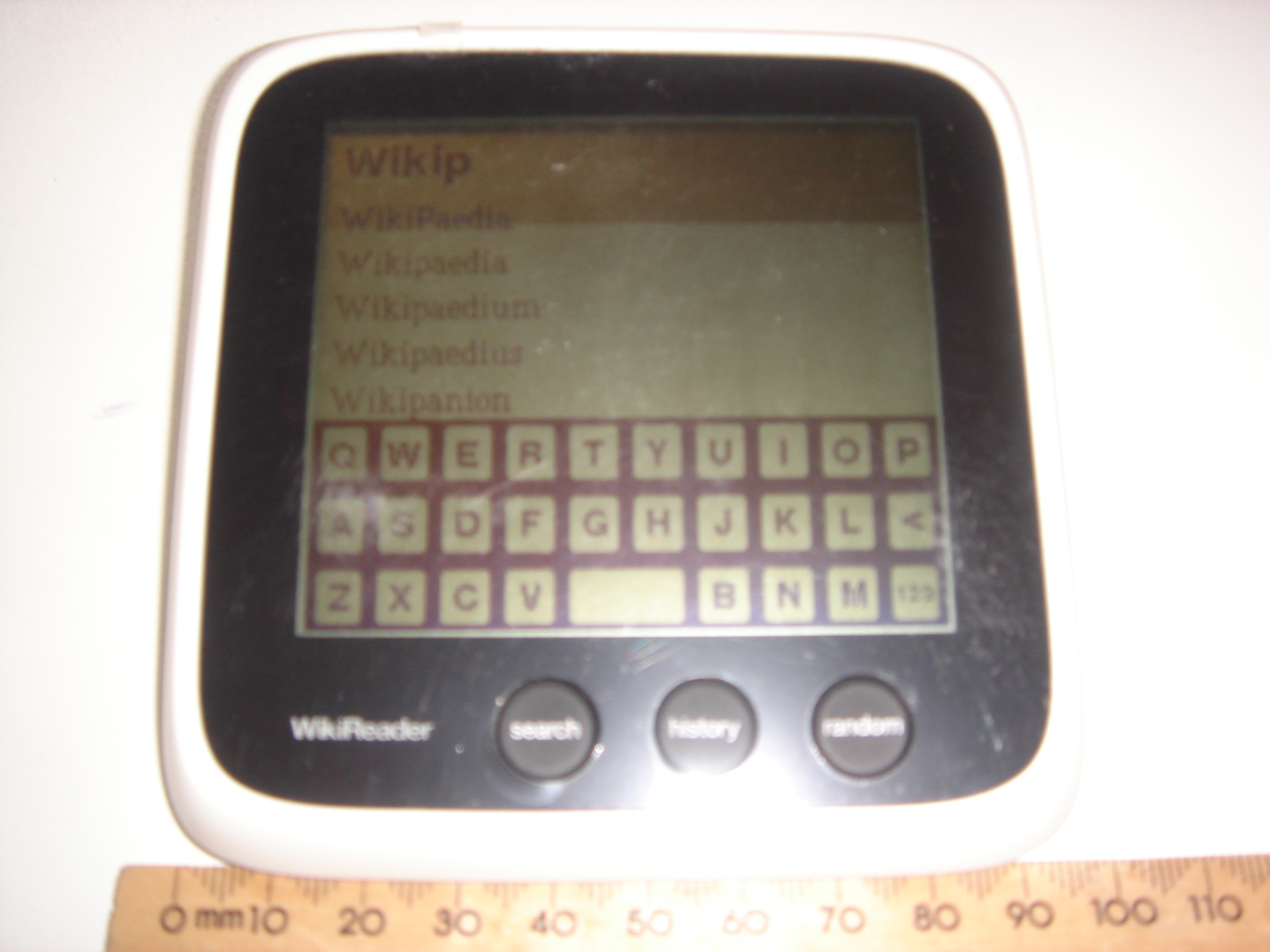
Russell Coker: The Wikireader

Just over a month ago I bought a Wikireader [1] from Officeworks (an Australian chain of stores that sell all manner of office supplies). It cost only $99, thanks to Brianna for informing me about this [2]. When I purchased my Wikireader an Officeworks employee had to get one from the back office and told me that I was the first person to buy one. I suggested to him that when a product isn t mentioned in their advertising and isn t put on the shelves it s unlikely to sell in quantity and that they shouldn t rely on bloggers to promote what is possibly one of the most desirable products that they stock.The Wikireader stores a copy of the text of the English language version of Wikipedia on a micro-SD card. They have a service whereby you can get two updates posted to you every year for $29, which would make it pretty close to free once postage and the cost of the micro-SD cards is taken into account. Also you can download new content. I have no immediate plans for updating my Wikireader as the content is more than good enough to answer idle questions while waiting for a bus but as it s lacking external links due to no net access and images it can t be used for serious Wiki reading IMHO.Brianna has documented the process of updating a Wikireader to add more content [3], she added the Chinese version and discovered that inter-wiki links are preserved! I have no immediate plans to add extra content (I don t know any other language well enough to read an encyclopaedia). Also an 8GB MicroSD card (which is the minimum requirement to use multiple languages) costs $35 and is a significant portion of the original purchase price.In terms of functionality the device is pretty good. The screen is not back-lit, but if it was then the two AA batteries wouldn t last anywhere near a year. The screen is not high resolution and the touch functionality isn t particularly accurate or sensitive but I guess that s a necessary trade-off to get the $99 price. The Wikipedia content seems quite complete, so far the only page which I found to be missing was the bio of an Australian architect, I m not sure if his page was removed from the Wikireader to save space or whether my device has a snapshot that predates the addition of the page.The Wikipedia page about downloading the database is interesting [4], it s 6GB of compressed data for the text of the English pages (not including history or talk pages) and for years they haven t even tried to provide a dump of the images. So I guess that a Wikireader that displays pictures is out of the question.The Wikireader has a parental filter, in my quick tests the only page that has been blocked is Sexual Intercourse , I could read all about safe-sex, infidelity, and lots of other related adult topics without being asked for a password. It also shows pages about goatse and other related things without asking for a password NB if you don t know what goatse is then you probably don t want to learn, trust me that it s something that most people won t want their children to learn about. The filter is so bad that I think they shouldn t include it, it will just give people false confidence. It s OK to sell a cheap device that is designed to give a detailed description of goatse etc on request to anyone, but IMHO it s not OK to sell such a device with a claim that it is kid safe and has parental controls . Note that holding down the History button will allow you to clear your history this is useful if you have just verified that goatse isn t blocked and you want to give the device to a young child.There is a button to give a random page, I believe that this would be more useful if it had some metric to make it more often return pages that might be interesting. It could weight the randomness by the length of the page (usually a longer page is more interesting to more people and has more links to other pages) or by some other metric that indicates the potential popularity. Random links often get me pages about obscure country towns and other things that probably aren t of interest to people who don t live near them.But overall this is a great product, $99 is not much to pay, and I recommend getting one!

24 November 2010

Sergio Talens-Oliag: The Freaky Wall (Part 2: Initial Installation)

For the Freaky Wall I have installed a Debian GNU/kFreeBSD system using the installer with ZFS support announced on: http://robertmh.wordpress.com/2010/09/06/debian-installer-with-zfs/ I used the mini.iso found on: http://people.debian.org/~rmh/zfs/kfreebsd-amd64/monolithic/mini.iso the 12th of October of 2010; as I had some problems and reported them to Robert is possible that the current image solves part of them. Installation plan I did a standard installation on a machine with two hard disks, but only used the first one from the installer. The plan was to use ZFS with RAID-1, but current versions of grub do not support booting from a ZFS + RAID file system, so I had to use the same technique used for Linux for a long time; three partitions: a swap partition, a small /boot partition and a big partition for /; / and /boot were formated to use ZFS. First reboot After the installation the system failed to boot because of a bug when building the /boot/grub/grub.cfg (some routes were missing a //@ prefix); to be able to boot Iwe edited the config on the grub prompt and later fixed the file:
    --- grub.cfg.orig       2010-10-13 16:40:39.000000000 +0200
    +++ grub.cfg    2010-10-13 18:38:47.535436766 +0200
    @@ -64,7 +64,7 @@
            set root='(hd0,1)'
            search --no-floppy --fs-uuid --set a371979bb836d1fe
            echo                    'Loading kernel of FreeBSD 8.1-1-amd64 ...'
    -       kfreebsd                /kfreebsd-8.1-1-amd64.gz
    +       kfreebsd                //@/kfreebsd-8.1-1-amd64.gz
            insmod part_msdos
            insmod zfs
            set root='(hd0,3)'
    @@ -75,7 +75,7 @@
            insmod zfs
            set root='(hd0,1)'
            search --no-floppy --fs-uuid --set a371979bb836d1fe
    -       kfreebsd_module         /zfs/zpool.cache type=/boot/zfs/zpool.cache
    +       kfreebsd_module         //@/zfs/zpool.cache type=/boot/zfs/zpool.cache
            set kFreeBSD.vfs.root.mountfrom=zfs:dkfbf1-ad4s3
            set kFreeBSD.vfs.root.mountfrom.options=rw
      
I haven't tested the installer since that day, but I believe that the current ZFS installer was fixed by Robert to deal with that problem. Once the system was booted I had to fix a couple of things: Adjusting ZFS to do RAID-1 On the second disk I created the same partitions as the ones on the first disk using parted; the final result was:
    # parted -l     
    Model: ST3250620NS/3BKS (ide)
    Disk /dev/ad6: 250GB
    Sector size (logical/physical): 512B/512B
    Partition Table: msdos
    Number  Start   End     Size    Type     File system  Flags
     1      1049kB  256MB   255MB   primary
     2      256MB   4256MB  4000MB  primary
     3      4256MB  250GB   246GB   primary
    Model: ST3250620NS/3BKS (ide)
    Disk /dev/ad4: 250GB
    Sector size (logical/physical): 512B/512B
    Partition Table: msdos
    Number  Start   End     Size    Type     File system     Flags
      1      1049kB  256MB   255MB   primary
      2      256MB   4256MB  4000MB  primary  linux-swap(v1)
      3      4256MB  250GB   246GB   primary
To use the second partition of both disks as swap I added the following to /etc/fstab:
    /dev/ad4s2      none            swap    sw              0       0
    /dev/ad6s2      none            swap    sw              0       0
To configure the mirroring for the root file system I did the following:
    zpool attach dkfbf1-ad4s3 ad4s3 ad6s3
As the /boot can't work as a replica I adjusted it to make two copies of every file:
    zfs   set copies=2     dkfbf1-ad4s1
Leaving the second disk copy alone, although my plan is to configure it to hold a copy of the /boot partition synchronized with rsync each night. After all those changes the system didn't boot, as the grub-pc generates a buggy /boot/grub/grub.cfg; the problem is on the /etc/grub.d/10_kfreebsd section:
    ### BEGIN /etc/grub.d/10_kfreebsd ###
    menuentry 'Debian GNU/kFreeBSD, with kFreeBSD 8.1-1-amd64' --class debian \
      --class gnu-kfreebsd --class gnu --class os  
          insmod part_msdos
          insmod zfs
          set root='(hd0,1)'
          search --no-floppy --fs-uuid --set a371979bb836d1fe
          echo 'Loading kernel of FreeBSD 8.1-1-amd64 ...'
          kfreebsd /kfreebsd-8.1-1-amd64.gz
          set kFreeBSD.vfs.root.mountfrom=unknown:/dev/ad4s3
          set kFreeBSD.vfs.root.mountfrom.options=rw
     
    ### END /etc/grub.d/10_kfreebsd ###
To fix it there has to be a copy of the modules for ZFS on the boot partition (in my case I moved the /lib/modules directory to /boot and created a link on the root partition to the new directory):
    cd /boot
    mkdir lib
    mv /lib/modules lib
    cd /lib
    ln -s ../boot/lib/modules
And instead of fixing the /etc/grub.d/10_kfreebsd code I wrote a new script (/etc/grub.d/09_zfs_kfreebsd) that creates the right config for my current configuration on the grub.cfg file:
    #!/bin/sh
    prefix=/usr
    exec_prefix=$ prefix 
    bindir=$ exec_prefix /bin
    libdir=$ exec_prefix /lib
    . $ libdir /grub/grub-mkconfig_lib
    prepare_boot_cache="$(prepare_grub_to_access_device $ GRUB_DEVICE_BOOT    sed -e "s/^/\t/")"
    kfreebsd_versions="$(ls /lib/modules/)"
    zfs_root_device="$(zfs list   awk '/\/$/   print $1  '   head -1)"
    for kversion in $kfreebsd_versions; do
      cat << EOF
    # Entry when using ZFS (we have issues with /etc/grub.d/10_kfreebsd)
    menuentry 'Debian GNU/kFreeBSD, with kFreeBSD $kversion and ZFS' --class debian --class gnu-kfreebsd --class gnu --class os  
    $ prepare_boot_cache 
          echo                    'Loading kernel of FreeBSD $kversion ...'
          kfreebsd                //@/kfreebsd-$kversion.gz
          kfreebsd_module_elf     //@/lib/modules/$kversion/opensolaris.ko
          kfreebsd_module_elf     //@/lib/modules/$kversion/zfs.ko
          kfreebsd_module         //@/zfs/zpool.cache type=/boot/zfs/zpool.cache
          set kFreeBSD.vfs.root.mountfrom=zfs:$zfs_root_device
          set kFreeBSD.vfs.root.mountfrom.options=rw
     
    EOF
    done
I solved the problem this way to have a working solution that does not break with squeeze upgrades, assuming that a future grub-pc package will deal well with my config and I'll be able to remove this script, but I guess I'll have to install it from backports. The entry generated by the script when called from update-grub will be similar to:
    ### BEGIN /etc/grub.d/09_zfs-kfreebsd ###
    # Entry when using ZFS (we have issues with /etc/grub.d/10_kfreebsd)
    menuentry 'Debian GNU/kFreeBSD, with kFreeBSD 8.1-1-amd64 @ ITI' --class debian --class gnu-kfreebsd --class gnu --class os  
          insmod part_msdos
          insmod zfs
          set root='(hd0,1)'
          search --no-floppy --fs-uuid --set a371979bb836d1fe
          echo                    'Loading kernel of FreeBSD 8.1-1-amd64 ...'
          kfreebsd                //@/kfreebsd-8.1-1-amd64.gz
          kfreebsd_module_elf     //@/lib/modules/8.1-1-amd64/opensolaris.ko
          kfreebsd_module_elf     //@/lib/modules/8.1-1-amd64/zfs.ko
          kfreebsd_module         //@/zfs/zpool.cache type=/boot/zfs/zpool.cache
          set kFreeBSD.vfs.root.mountfrom=zfs:dkfbf1-ad4s3
          set kFreeBSD.vfs.root.mountfrom.options=rw
     
    ### END /etc/grub.d/10_iti-kfreebsd ###
And after rebooting the machine with this new configuration the system boots OK. On my next post I'll continue explaining how to compile a kernel that supports the use of the OpenBSD Packet Filter and related technologies (CARP, pflog, etc.).

Tim Retout: The Archers website

For those who are not aware, The Archers is a soap opera about rural life, broadcast on BBC Radio 4. Its website has recently been revamped. Unfortunately, I appear to be served the mobile version when I visit the front page (in all of Chromium, Iceweasel and Epiphany on Debian - admittedly not the most mainstream of browsers). BBC Mobile is doing some over-zealous useragent sniffing, it seems. Also amusing: there's a "Who's Who" database of Archers characters, and several of them share the birthday "1st Jan 1970". There was I thinking that Harry Mason and Fallon Rogers had a 15 year age gap... but no. This will be as a result of the underlying database storing values in Unix time, and having a default value of "0". An explanation of Unix time popped up in an episode of The Infinite Monkey Cage the other week, which was nice to hear.

Julien Blache: OFED 1.5.2 for Debian

A few weeks ago, I ve been busy at work updating the OFED packaging for OFED 1.5.2. We needed a version of the stack newer than what s (partially) available in Squeeze. As this has now been tested, we are all happy to contribute this work to Debian, courtesy of my customer, EDF. This morning, I ve pushed out packages for OFED 1.5.2 to the pkg-ofed SVN repository on Alioth. The packages should be made available in experimental at some point too, though a number of them will have to go through NEW. With this update, I ve cleaned up & updated the packaging where needed and also made two important changes that I need to highlight: A number of libraries have changed their interfaces and bumped their soversions. libibcommon is gone, it has been folded into libibumad. The API/ABI between libibverbs and the IB driver modules has changed, so the new libibverbs comes with appropriate Breaks in place. Thanks to Beno t Mortier from pkg-ofed for his 2-day IB & OFED crash course that was instrumental in getting started with the OFED maze.

23 November 2010

Matthew Garrett: Barnes and Noble response

<quote>"We are working on consolidating and will be distributing the open sourcecode in the coming weeks."</quote>

So, Barnes and Noble's release process doesn't include them ensuring that they have the source code that they're legally obliged to be able to provide to customers - even after they'd screwed this up once before. Their negligence leaves them open to potential litigation[1], so if you're a shareholder you probably ought to be asking questions about their corporate responsibility.

[1] No, I don't plan to sue them

Russell Coker: Links November 2010

Guy Deutscher wrote an interesting article for the New York Times about how language shapes how we think [1]. The example of people who have no language construct for self-sentered directions and how they describe things is particularly interesting.TED published an interesting interview with Shaffi Mather the founder of India s first organised ambulance service (with differential pricing based on ability to pay) [2]. He also talks about founding schools in small towns and his BribeBusters.com company.World Changing has an interesting article about a legislative change in California that allows car-sharing of personal vehicles [3]. The concept is that if you own a car that you don t use most of the time (as is usually the case) then you can contract with a car-share company to share it to others when you don t need it. This saves the car share company from the capital expense of owning cars and thus allows them to place cars in remote locations that wouldn t otherwise be financially viable (IE the street in front of random people who sign up). The person who owns the car may get about $2 per hour for the time when it s rented. The car owner gets to specify when the car may be available.Charles Stross wrote an entertaining and informative rant about Steam-Punk [4]. He cites Michael Moorcock s informative essay about Starship Troopers and other right-wing apologist themes in sci-fi [5] as well as China Mieville s essay about politics and The Lord of the Rings [6].Glenn Greenwald wrote an informative article about the New York Times defending torture by the US military [7]. I have unsubscrubed from the @Times mailout and will avoid citing NYT articles wherever possible. I sent the URL for Glenn s article to the NYT feedback address but I don t expect them to take any notice.Fate Of the World is a new computer game that s in beta where you have a simulation of the next 200 years of climate change [8]. It s currently in beta for Windows only, they hope to have a Mac version in March and have no stated plans for Linux support.Cory Doctorow wrote an interesting article for Locus about Sci-Fi fans and cosmopolitanism taking the best option after consideration rather than doing what s locally fashionable [9]. He uses the term Martian to refer to some of the viewpoints, but it seems to me that Vulcan would be more appropriate.The Wall St Journal has an interesting article about people who manufacture drugs that aren t yet illegal, every time one drug gets banned they market a new one [10]. This is yet another example of the War on Drugs doing more harm than good, instead of taking drugs which have well known effects (that can be treated by hospitals) people are taking weird new drugs and no-one knows what will happen to them.Mieke Meijer in the Netherlands has invented a new product known as newspaper wood [11], it involves gluing paper together to create a form of chip-board that keeps the layers of paper distinct to give a result like wood grain. The World Changing commentary suggests that this could give a heirloom quality to objects made with it, while I m dubious about that I think that the surface would be pleasing to look at in a kitchen or office environment.Ze Frank gave an interesting TED talk about unusual social projects that he s run on the Internet [12]. This includes an attempt to reconcile Red and Blue voters after the 2008 US presidential election, the creation of inspirational songs, and remixing the Whip Somebody s Ass song. This is really worth watching!The Chronicle Review has an interesting article by someone who is paid to complete academic assignments for other people [13]. The scope of cheating that is claimed is profound. Naturally we have to take claims by someone who admits acting unethically with a grain of salt, but if there is any truth to this then it s a serious matter. I m surprised that no-one has made a serious attempt to catch the customers of such people.David Brin (the famous sci-fi author) gave an interesting short lecture about the future of humanity [14]. He promotes the Lifeboat Foundation (of which he is a director) and describes his concern about the Fermi Paradox.Shimon Schocken gave an inspiring TED talk about his work rehabilitating juvenile prisoners through taking them mountain-bike riding [15]. This shows that anyone can do great things to help other people, he got this idea when riding past a prison, convinced the prison governor that it was a good idea and then started doing it.Conrad Wolfram gave an insightful TED talk about math education [16]. His claim is that the entire mathematical education system is wrong in it s focus on hand calculation, instead the aim should be to teach children how to use computers to solve problems which is what is mostly done in the real world.

Julien Danjou: Color contrast correction

I finally took some time to finish my color contrast corrector. It's now able to compare two colors and to tell if they are readable when used as foreground and background color for text rendering. If they are too close, the code corrects both colors so to they'll become distant enough to be readable. To do that, it uses color coordinates in the CIE L*a*b* colorspace. This allows to determine the luminance difference between 2 colors very easily by comparing the L component of the coordinates. The default threshold used to determine readability based on luminance difference is 40 (on 100), which seems to give pretty good results so far. Then it uses the CIE Delta E 2000 formula to obtain the distance between colors. A distance of 6 is considered to be enough for the colors to be distinctive in our case, but that can be adjusted anyway. That depends on reader's eyes. If both the color and luminance distances are big enough, the color pair is considered readable when used upon each other. If these criteria are not satisfied, the code simply tries to correct the color by adjusting the L (luminance) component of the colors so their difference is 40. Optionally, the background color can be fixed so only the foreground color would be adjusted; this is especially handy when the color background is not provided by any external style, but it the screen one (like the Emacs frame background in my case). Here is an example result generated over 10 pairs of random colors. Left colors are randomly generated, and right colors are the corrected one. <style type="text/css"> </style>

bg: DarkSeaGreen4 fg: gray67 ->                             fg: #4a6b4b bg: #cccccc
bg: SlateGray4 fg: forest green ->                          fg: #9faec0 bg: #005700
bg: grey13 fg: grey36 ->                                    fg: #131313 bg: #6c6c6c
bg: MediumPurple2 fg: honeydew ->                           fg: #9e78ed bg: #f0fff0
bg: grey43 fg: chartreuse3 ->                               fg: #5e5e5e bg: #79de25
bg: linen fg: DeepPink2 ->                                  fg: linen bg: DeepPink2
bg: CadetBlue4 fg: blue1 ->                                 fg: #6c9fa4 bg: #0000e1
bg: gray33 fg: NavajoWhite3 ->                              fg: #525252 bg: #cfb58c
bg: chartreuse1 fg: RosyBrown3 ->                           fg: #9cff38 bg: #b28282
bg: medium violet red fg: DeepPink1 ->                      fg: #9c0060 bg: #ff55b9
All this has been written in Emacs Lisp. The code is now available in Gnus (and therefore in Emacs 24) in the packages color-lab and shr-color. A future work would be to add support for colour blindness. As a side note, several people pointed me at the WCAG formulas to determine luminance and contrast ratio. These are probably good criteria to choose your color when designing a user interface. However, they are not enough to determine if displayed color will be readable. This means you can use them if you are a designer, but IMHO they are pretty weak for detecting and correcting colors you did not choose. Flattr this

Mike Hommey: Improving libxul startup I/O by hacking the ELF format

If you have been following this blog during the past months, you might have gathered that I ve been focusing on I/O patterns on library initialization, more specifically libxul.so. The very patterns there s not much to do about, except enduring them, or hacking ld.so and/or the toolchain. The latter is not necessarily easy, and won t benefit everyone until all linux distros use an improved glibc and/or toolchain. This could take years before any actual result would reach end users. But with a little creativity, one can overcome these limitations and improve the situation today. Here is a summary of my recent hacks. Backwards static initializers As Taras showed in the past, static initializers are executed in reverse order. It turns out it is an unfortunate design choice in gcc, and it also turns out not to impact all ELF binary files. As far as I know there are currently two different implementations of the static initializers call loop, one provided by gcc, and one provided by ld.so. In the gcc case, the compiler creates a .ctors section, starting with 0xffffffff, ending with 0x00000000, and filled with pointers to the various static initializer functions, in ascending order. The compiler also injects an initializer function, called from .init, going through this .ctors section, starting from the end (__do_global_ctors_aux in crtend.o). A similar .dtors section is created for functions to run when the library is unloaded, and the pointers in it are called in ascending order. There is actually no importance in the order in which .ctors and .dtors are executed. All that matters is that they are executed in reverse order from each other, because that limits the risks of bad ordering. It is only unfortunate that .ctors was chosen to be the one backwards. In the ld.so case, the compiler creates a .init_array section, filled with pointers to the various static initializer functions, in ascending order. It also stores the location and the size of this section in the PT_DYNAMIC ELF header. At runtime, ld.so itself reads this information and executes the static initializers in ascending orders. A similar .fini_array section is created for functions to run when the library in unloaded, and ld.so goes through it in descending order. The .init_array section is newer, and for backwards compatibility reasons, is not used on systems that have been using the .ctors approach forever. On the other hand, some newer ABIs, such as arm EABI, uses the new facility, which means they are not victim of backwards static initialization. I however wonder if backwards compatibility is still needed, considering how long .init_array support has been around (more than 11 years, according to glibc git repository). While we could obviously bug the gcc maintainers to revert their .ctors execution order, or ditch .ctors support on glibc systems, which means we wouldn t get any immediate global benefit, we can also just revert the .ctors section content. Please note the source code out there doesn t take care of reverting the .dtors section accordingly, because it is currently empty in libxul.so. Relocations As I mentioned in an earlier post, relocations are what make it possible to load libraries at arbitrary locations. Unfortunately, a great number of relocations means awful I/O patterns: ld.so reads and applies them one by one, and while the kernel reads ahead by 128 KB chunks, when your relocation section exceeds that amount by more than an order of magnitude, it means I/O goes back and forth a lot between the relocation section and where the relocations take place. There are two classes of relocations: REL and RELA. In both cases, there are several types of relocations, some of which require an addend. The difference between both classes is in REL relocations, the addend is stored at the offset the relocation takes place, and in RELA relocations, the addend is stored in the relocation entry. It means that RELA relocations effectively waste space, as the addend ends up actually being stored twice: it is also stored at the offset the relocation takes place, like with REL relocations, though it could technically be nulled out, there ; in any case, the space is wasted. REL relocations thus take 2 words of storage, and RELA relocations, 3. On x86, the ELF ABI only uses REL relocations, and words are 32 bits, making each relocation take 8 bytes ; on x86-64, the ELF ABI only uses RELA relocations, and words are 64 bits, thus making each relocation take 24 bytes, 3 times that of x86 relocations. On ARM, both may be used, but apparently the compiler and the linker only use REL relocations. These words of storage are used to store 3 or 4 bits of informations: The linker splits relocations in two main categories: those for dynamic linking at startup and those for procedure linkage table (PLT) resolution at runtime. Here is what the repartition look like on libxul.so (taken from the mozilla-central nightly from Nov, the 22nd):
dynamic relocations PLT relocations
Architecture number size (bytes) number size (bytes)
x86 231,836 1,854,688 3,772 30,176
x86-64 235,893 5,661,432 3,773 90,528
So, PLT relocations are quite negligible, and dynamic relocations are just huge, especially on x86-64. Compared to the binary size, it s pretty scary:
Architecture libxul.so size relocations size %
x86 21,869,684 1,884,864 8.61%
x86-64 29,629,040 5,751,984 19.41%
Let me remind you that not only do we need to read these relocations at startup (at least the dynamic ones, but the PLT ones are just negligible), but we only read them by chunks, and need to read other data in between. Of the many existing types of relocations, only a few are actually used in dynamic libraries. Here is a summary of those in use in libxul.so:
x86 relocation type number x86-64 relocation type number
dynamic relocations
R_386_TLS_DTPMOD32 1 R_X86_64_DTPMOD64 1
R_386_GLOB_DAT 213 R_X86_64_GLOB_DAT 238
R_386_32 27,643 R_X86_64_64 27,611
R_386_RELATIVE 203,979 R_X86_64_RELATIVE 208,043
PLT relocations
R_386_JUMP_SLOT 3,772 R_X86_64_JUMP_SLOT 3,773
The above types can be separated in two distinct categories: In the second category, it means we are wasting all the bits for the symbol reference in each entry: 24 on x86 and 32 on x86-64. Unfortunately, the vast majority of the relocations in libxul.so are from that category. At this point, this is how much waste we identified:
description num. entries waste per entry (bytes) total % of relocation size
x86
Relocation without symbol ref. 203,980 3 611,937 32.46%
x86-64
Duplicated addend 239,666 8 1,917,328 33.33%
Relocation type encoded on 32 bits 239,666 3 718,998 12.49%
Relocation without symbol ref. 208,044 4 832,176 14.46%
Total 3,468,502 60.30%
On top of that, one could argue that we don t need 24 or 32 bits for symbol reference (which is the entry number in the symbol table), and that we re really far from requiring 64 bits for r_offset on 64 bits systems, as libxul.so is far from being bigger than 4GB. Anyways, that means we have room for improvement here, and it means that the ELF format, especially on 64 bits systems with RELA relocations, really doesn t help with big programs or libraries with a lot of relocations. (For that matter, the mach-o format used on OS-X has some kind of similar issues ; I don t know for the DLL format) Another interesting data point is looking at how relocations r_offset are following each other, once relocations are reordered (to avoid too much symbol resolution, they are actually grouped by symbol). It turns out 206,739 relocations r_offset are at 4 bytes from the previous one on x86 (i.e. strictly following it), and 210,364 at 8 bytes from the previous on x86-64. The main reason why this happens is that most relocations are happening in pointer tables, and libxul.so has lots of them: And when I say libxul.so has lots of them, that s not an understatement: there are 184,320 relocations due to vtables (function tables you get when using virtual methods in C++) on x86 and 184,098 on x86-64. That s respectively 78.23% and 76.81% of the total number of relocations. Interestingly, while most of these relocations are R_*_RELATIVE, 26,853 are R_386_32, and 26,829 are R_X86_64_64. Except for a very few, these non relative relocations are for the __cxa_pure_virtual symbol, which is a dummy function that does nothing, used for pure virtual methods, such as the following:
class Abstract
public:
virtual void pure_virtual() = 0;
;
As for the remaining relative relocations, there are a few pointer tables responsible for several thousand relocations, such as JSString::length2StringTable, gEntries, GkAtoms_info, Html5Atoms_info, kUnixCharsets, nsIDOMCSS2Properties_properties, etc. Packing relocations While they are not detrimental to most binaries, we saw that relocations can have a bad effect on startup I/O for big binaries. Reducing how much space they take would have a direct impact on these startup I/Os. One way to do so is obviously to reduce the number of relocations. But as we saw above, the vast majority are due to vtables. While reducing vtables would be a nice goal, it s a long way before this can have a significant impact on the relocations number. So another possible way is to try to avoid wasting so much space in relocations. The main problem is that relocations are applied by ld.so, and that, as mentioned in the introduction, while we can hack ld.so to do what we want, it won t work everywhere before a long time. Moreover, it s difficult to test various implementations, and binary compatibility needs to be guaranteed once something is applied in the upstream libc. The idea I started to test a few weeks ago, is to effectively apply relocations by hand instead of relying on ld.so doing it. Considering the first thing ld.so does with a library after applying relocations is to call its DT_INIT function, the idea was to replace the dynamic relocations we can with a new DT_INIT function we would inject that d apply those relocations, while storing them in a more efficient manner. The function would obviously need to call the original DT_INIT function once done. Some parts of the PT_DYNAMIC section also obviously need to be adjusted accordingly. The first iteration I tested a few weeks ago helped validating the idea, but didn t change much of the binary: the dynamic relocation section still was taking all the space it took before, though its content was mostly empty (we ll see further below how efficient even the current dumb format is). Once the theory that an injected DT_INIT function could apply the relocations without breaking everything, I went on to implement a program that would actually strip the ELF binary. I won t get too much into the gory details, but it required PT_LOAD splitting, thus program headers growth, which means moving the following sections, then removing a huge part of the relocations, shrinking the relocations section, injecting our code and the packed relocations as sections, and moving the remaining sections after these new sections, to avoid empty space, but still respecting the proper offsets for both PT_LOAD and the code itself. So far, I only took care of the R_*_RELATIVE relocations. Some but not all other relocations could be taken care of, too, but everything involving symbol resolution from other libraries would be really difficult to handle from the injected code. The relocations are currently stored with a quite dumb format: As we only take care of one type of relocations, we can skip any information about the type. Also, the addend already being stored at r_offset, we just strip it from RELA relocations ; the binary being far from 4GB big, 32 bits is enough on 64 bits systems too. We also saw that a lot of relocations were next to the following ones, so instead of storing r_offset for each one, storing some kind of range is more efficient. As I ve so far been focusing on getting something that actually works more than on getting something really efficient, I only tested this format, but the results are already nice:
x86 x86-64
before
dynamic relocations (bytes) 1,854,688 5,661,432
libxul.so size 21,869,684 29,629,040
after
dynamic relocations (bytes) 222,856 668,400
injected code size 129 84
packed relative relocations (bytes) 224,816 228,568
libxul.so size 20,464,836 (-6.42%) 24,865,520 (-16.07%)
Getting rid of the __cxa_pure_virtual relocations would help getting this even further down, and an even better storage format could be used, too. Gathering new startup coverage data should be interesting as well. The code is available via mercurial. Please note the Makefile deeply sucks, and that the code is in the middle of its third refactoring. Anyways, once you get the code to compile, you just need to run test-x86 or test-x64 depending on your architecture, from the build directory, and give it the libxul.so file as an argument. It will create a libxul.so.new file that you can use to replace libxul.so. You may successfully use the tool on other libraries, but chances are you ll bump into an assert(), or in the worst case, that the resulting library ends up broken. The tool might work on PIE executables, but most probably not on other executables. If you wonder, Chrome is not PIE. It s not even relocatable (which means ASLR won t work with it) ; or at least the x86-64 binaries I just got aren t. More possible ELF hacking The code I wrote to pack relocations allows to do various tricks on ELF files, and it opens various opportunities, such as: Some of the above could probably be done with linker scripts, but using linker scripts is unnecessarily over complicated: as soon as you start using a linker script to fiddle with sections, you need to reimplement the entire default linker script (the one you can see with ld --verbose). And it s not guaranteed to work (Taras told me he had a hard time failing to align the .bss section). And as far as I know, you can t use the same thing depending whether you use ld or gold (AIUI, gold doesn t support the whole ld linker script syntax).

Biella Coleman: An unlikely story about a pit bull attack, free software, and a New York Times reporter

If I told you that in the last two days, I have been caught in a vortex of coincidence, a vortex composed of pit bulls, free software, diaspora (the software), mold, and a New York Times reporter, I bet you would think not likely. So the story started on Jet Blue, which offers snacks, lots of them, and Direct TV. Since I don t have TV I kinda go on a binge, watching all sorts of shows as I make my way home. I watched a pretty distributing but interesting documentary on Jim Jones on CNN and a show on Animal Planet on pit bulls and parolees. When I rolled into my my current digs in northern Manhattan (I am currently banished from my downtown apt due to mold, but that is a whole other story), there was a dinner party well underway. At some point in the evening prompted by me, we talked pit bulls as my friends want to get one but their family has issued a threat of disavowal if they do. The next morning, I was scoping out the website for the Animal Planet show as I was intrigued by it and frankly I kinda like pit bulls (maybe less now although I think they are unfairly maligned). Five minutes into pursuing the site, I hear screeches from hell. It sounds like a woman is being attacked. And she is. A woman right outside of my window was being attacked by a pit bull. So I am staying with a friend, an open source developer, Karl Fogel and good soul that he is, he runs out to help the lady (since I have been subject to 5 weeks of sickness due to mold or so that is what we think it is was enough for me; I could not stomach the idea of getting bit so I played the role of concerned spectator). It took minutes upon minutes, really just too many minutes to get the pit bull off, even a brick pounded against his head failed (apparently, a cigarette or match held to the throat does the trick, which I found out later). Eventually, the dog was extracted, a huge team of cops showed up, the dog was whisked away, the victim taken to the hospital, and life returned to calm and quiet. So the next day, I was being interviewed by a New York Times reporter Jim Dwyer who wrote a story about Diaspora for the New York Times back in the summer, helping to propel it from relative obscurity to near insta-fame (one of the Diaspora developers, Max, was my student). We were running out of time (I had another appointment) so I asked him if he lived in northern Manhattan as that is what his bio page indicates. He confirmed, I explained I was up there and that we could meet up there later to finish up. He inquired what part, I told him roughly where I was, he remarked he was near there, and so naturally I told him about the crazy pit bull attack I witnessed from my window as I can t shut my trap when it comes to things like that. Well yes you know what is coming next next: he was there, helping Karl (and others) deal with the pit bull attack. He lives nearby and heard the shrieks of agony and came out to aid. All and all it was pretty horrific. He also met Karl in so far as Karl gave him his phone number and email just in case he was needed as a witness (Karl had to dash off to catch a plane). Well, the funny thing, or as you also might guess: Jim, who is doing some more writing on tech, free software etc, should really talk to Karl given his key role in the community, so they already met, although under odd and terrible circumstances. I am not sure if I am more wigged out by the fact that I was reading about pit bulls when the attack happened or whether the reporter I was interviewed by was there along side with a free software developer he really needs to interview. Whatever the case, I kinda hope the vortex of coincidence now leaves me to hit someone else (sans any horrible attack). Or else, as Karl noted in the blog comments, I will have to be very careful about what shows I watch:
Amen to that! Enough with the coincidence vortex. As I said to Biella in IRC later: Do us a favor don t watch any shows about nuclear attacks on New York, okay

Dominique Dumont: How about a configfs with Config::Model ?

Hello During the Config::Model presentation at Debian mini-conf, I was asked whether Config::Model could be used from other languages than Perl. Of course, config-edit command line can be launched from any program with any language, but we can hardly call it an API. There s also the possibility to use Config::Model::SimpleUI to fork a process and send commands on its STDIN and get results on STDOUT. But using this from another program is awkward. On kernel side, /proc and /sys are widely used to get information from the kernel and set kernel configuration. How about using a similar approach with system configuration data ? Configuration data from config files is already mapped into a tree within Config::Model. This tree can also be mapped to a file system structure. This file system structure could have the following layout:
/conf/
system/
sshd/
PermitRootLogin # contain 0 or 1
ssh/

popcon/
As a bonus, this file system would provide a unified access to all system configuration data available through Config::Model. In any case, people would still be able to tinker configuration with their favorite text editor on a file in /etc. The modification will be propagated to the corresponding entry in the /conf virtual file system. The reverse will also be done. Anyone interested ? All the best PS: Further technical discussion will be held on Config::Model mailing list: config-model-users at lists.sourceforge.net 2010.11.25 edit: specified that config data can still be written in usual config file.

Russell Coker: A First Digital Camera

I ve just been asked for advice on buying a digital camera. I m not an expert on cameras but I have a good general knowledge of technology and I m sure that the readers of my blog will correct me rapidly if I make any serious mistakes. ;)Types of CameraThe Wikipedia Page about Digital Cameras is worth reading [1].Here are the types of camera that are useful as a stand-alone camera (IE not camera phones or industrial cameras):I suggest that people not start out a hobby of digital photography with a DSLR or other interchangeable lens camera. I think that it s best to start out with simple gear that s cheap if you decide that digital photography is not your thing then you have wasted less money, and if you really get into it then you ll be able to make a more informed choice about an expensive camera after getting some experience.A spare cheap compact camera can be useful even if you own a more expensive camera. There are times when you don t want the bulk of a DSLR or Bridge Camera and when you have a risk of theft or accidental damage such that you don t want to take an expensive camera. People who are really serious about photography apparently take a camera everywhere, you could have a compact camera in your front pocket for fast pictures and a bulky camera in your backpack for when you have time to prepare a quality shot. So buying a cheap camera and then buying an expensive one a few months later would not be wasting money!As the person who asked for advice has never owned a digital camera before I ll focus on cheap compact cameras for the rest of this post.Pixels and LensesCameras are typically advertised with the resolution in Megapixels described in bold. Presumably most people search for the camera with the highest resolution. The first thing to beware of is cameras that don t have hardware which is capable of taking a picture of the stated resolution, they use interpolation to generate a higher resolution image. There are probably some cameras with interpolation that are OK and provide a decent picture at a low price, but generally I recommend avoiding all cameras that do interpolation.Optical zoom is a very important feature. Often pictures have to be cropped to remove unwanted background, if you zoom in appropriately you can avoid cropping and make better use of the available resolution. Beware of cameras that advertise things such as advanced zoom , anything that doesn t exactly say optical zoom is using digital zoom IE interpolation. I suggest not considering a compact camera unless it can do at least 4* optical zoom, with 5* or better being preferable.The physical size of the lens is important. A bigger lens allows better pictures in adverse lighting and also allows a faster shutter speed to give better photos of moving objects and better photos when you are moving. Generally you can get a rough idea of the potential that a camera has by just glancing at the lens, if it s the size of a lens in a mobile phone then the pictures won t be that great. If it is on a telescopic mount and it s wide then the result will be better. When buying a lens for a DSLR or other detachable lens camera you should be able to read specifications of the lens which indicate it s size. For compact cameras the specifications of the lens are usually available from the vendor and often available from review sites but generally aren t included in adverts by retailers. If you are comparing cameras in the store looking at them seems like the best option.The ratio of the lens area to the number of pixels determines how much light is received by the sensors for each pixel. So when there are two cameras that are essentially identical apart from the number of megapixels the one with the highest number isn t necessarily better in all situations. A 12MP camera might not give a better result than a 10MP camera, a monitor described as Full HD has a resolution of 1920*1080 which is 2MP. A 5MP camera is useful to allow cropping but if the aim is to display pictures on current monitors then anything much bigger than 5MP is probably wasted at this time and 10MP will provide pictures that can use the capabilities of monitors that are developed for a while.PrintingSome printers that are affordable for home use might require something like a 7MP camera to print a picture at A4 or Letter size at the highest quality. Professional printing will probably require something even greater. But if your intended use of a digital camera doesn t involve printing the pictures, or only rarely involves printing them at A4 or Letter size then you don t need a high resolution for printing. I expect that there are some available printers that can use paper at sizes such as B3 which might require a 20MP camera for best quality. But if the aim of the printing is to put a picture on your wall (the most common case) then even if it s not at the ideal resolution then probably no-one will notice the difference you can t see the pixels from a few meters away.If the aim of the camera is to photograph professional artwork for the purpose of selling it on the Internet then a high resolution camera really isn t desired. You want to offer pictures on the Internet which aren t good enough to be usefully printed.VideoThe capabilities for recording video can vary significantly between different cameras in the same range. If you don t care about video then that s fine, but if video matters to you then you have to read the specs. It s also worth considering digital video cameras, I have previously summarised the available digital video cameras although I m sure that there have been some new models since then [3]. A good (expensive) digital camera will have video functionality that compares well to most digital video cameras but it will cost a lot more.Choosing a Compact CameraThere are many compact cameras in the $100 to $150 price range. Ted s has the Samsung Digimax ES65 for $99.95 which has 10MP and 5* optical zoom. This seems like a good deal. Practice with a cheap camera could easily allow you to make a better choice when buying a more expensive camera that saves you more than $100 so it seems unlikely that you will have any great regrets about buying a $100 camera.Buying from the specs is a bad idea, I recommend testing a camera in the store before buying every store that you want to buy from allows this. But don t expect that quality pictures in the store means much, the people who run the camera stores usually set them up with good lighting so that pictures will tend to turn out well. The aim of an in-store test is not to discover what the camera does well, but to discover what (if anything) it does badly. Also it s useful to test the ergonomics of the camera before buying, discover whether you would be happy to hold the camera for an hour.It s a good idea to ask the staff at a camera store for advice, but don t rely on such advice. My experience is that they tend not to ask what the prospective customer plans to do with the camera and this significantly limits the quality of their recommendations.ConclusionMake your first digital camera a cheap compact camera that doesn t cost much more than $100. Make sure it has at least 4* optical zoom with 5* being preferred. Don t worry too much about the number of megapixels, anything more than 5 will do. Test the camera in the store to look for any obvious reasons that make it unsuitable for your use. If you want video then be prepared to pay a little more as the cheapest cameras have a low resolution for video.

Michal &#268;iha&#345;: New phpMyAdmin features - user interface cleanup

Next article highlighting some new features which will come in phpMyAdmin 3.4 is about more little changes. You can try them it out on our demo server. Or just wait few hours for first alpha release of 3.4. The user interface cleanup is partly connected with previous changes, because some functionality simply required more Javascript (for example editor for ENUM/SET fields). Besides these there were major changes in export and import pages, which now should be easier to understand, hiding advanced options from unexperienced users, while still providing ability to change them. New phpMyAdmin export page This feature was implemented by Lori Lee during Google Summer of Code 2010.

Filed under: Phpmyadmin 0 comments Flattr this!

Next.

Previous.