Search Results: "mak"

24 March 2010

John Goerzen: Review: Travel as a Political Act by Rick Steves

Rick Steves is known for writing books, and producing public TV shows, about travel to Europe. He encourages people to get out of their comfort zone, advocates staying in homes instead of hotels, and giving yourself permission to struggle to communicate in a land of unfamiliar language. That way, you get to experience not just the landmarks, but the culture and history. That was the approach we favored in our recent trip to Europe, and after being there (and seeing tour groups), I think Rick Steves is right on. On the plane to Europe, I read his Travel as a Political Act. This is not a guidebook, but more a book about the philosophy of travel. As usual with my book reviews, unless indicated otherwise, all quotes here come from the book. He starts out with this statement:
I ve taught people how to travel. I focus mostly on the logistics: finding the right hotel, avoiding long lines But that s not why we travel. We travel to have enlightening experiences, to meet inspirational people, to be stimulated, to learn, and to grow. Travel has taught me the fun in having my cultural furniture rearranged and my ethnocentric self-assuredness walloped.
I read this book mostly on the plane to Hamburg, or the week prior to leaving. I can credit Rick Steves directly for encouraging me to strike up a conversation with a random German on the bus from Hamburg to L beck, which I ll discuss here in a couple of days. Probably the biggest lament from Rick Steves is that the people that really ought to travel the ones that are so sure that their ways are correct and best are least likely to do so.
Make a decision that on any trip you take, you ll make a point to be open to new experiences, seek options that get you out of your comfort zone, and be a cultural chameleon trying on new ways of looking at things and striving to become a temporary local. My best vacations have been both fun and intensely educational Travel challenges truths that we were raised thinking were self-evident and God-given. Leaving home, we learn that other people find different truths to be self-evident. We realize that it just makes sense to give everyone a little wiggle room.
The book is set with an introductory encouragement to travel, followed by seven vignettes of different countries he s visited, and descriptions of how it s impacted him. He gave a lesson of the opening of the German Reichstag (parliament building), which he was present for in 1999. He was surrounded by teary-eyed Germans and a few tourists so preoccupied with trivialities forgotten camera batteries, needing a Coke, the lack of air-conditioning that they were missing out on this once-in-a-lifetime opportunity to celebrate a great moment with the German people. He comments that we can learn from other countries that no one country has a monopoly on good ideas, and it is plenty patriotic to insist what we adopt good ideas (such as drug policy) from other countries and adopt them for our own. Particularly touching to me was the description and photo of a memorial in El Salvador, very much looking like the American Vietnam memorial except that one remembering loved ones lost fighting the United States. How many Americans even know that we were involved in a damaging war in El Salvador? A large part of his book was, for me, preaching to the choir, as this comment illustrated:
In the European view, America is trapped in an inescapable cycle to feed its military-industrial complex: As we bulk up our military, we look for opportunities to make use of it. (When your only tool is a hammer, you treat every problem like a nail.) And then, when we employ our military unwisely, we create more enemies which makes us feel the need to grow our military even more. If an American diplomat complained to his European counterpart, America is doing all the heavly lifting when it comes to military, the European might respond, Well, you seem to be enjoying it. We re building roads and bridges instead.
That s a sentiment I ve agreed with for quite some time already, and as such, some parts of the book moved slowly for me though I imagine his target audience included people that had never seriously considered these arguments before. Then there were surprising facts:
by the end of World War I, an estimated half of all the men in France between the ages of 15 and 30 were casualties. When some Americans, frustrated at France s reluctance to follow us into a war, call the French surrender monkeys, I believe it shows their ignorance of history.
And again, I d agree with him on that point. The vignette on Iran was particularly interesting, as he described his experiences in person, they sounded far different than the picture we often get in the media. I have realized, incidentally, that I am terrible at writing book reviews. So rather than inflict more paragraphs upon you with this one, I ll summarize by saying that this is a touching, informative, and motivational book, which I highly recommend. I ll leave you with this quote:
Mark Twain wrote, Travel is fatal to prejudice, bigotry, and narrow-mindedness. These wise words can be a reallying cry for all travelers once comfortably back home. When courageous leaders in our community combat small-mindedness and ignorance travelers can stand with them in solidarity.
I didn t travel to make some sort of statement or as a political act. But I was enriched in many ways by travel of course the obvious ones of contemplating the history of a 900-year-old beautiful church, but also in seeing the different character of different cities, being with two families for a couple of days, and seeing different approaches to common problems. I am very glad I wasn t shut off from this behind a tinted window in a tour bus.

Theppitak Karoonboonyanan: The Mini-DebCamp in Khon Kaen

So, Thailand Mini-DebCamp 2010 in Khon Kaen has already ended. It's another memorable event I've joined, and especially for this one, been in the organizing team. We owed many people for its success. I'd like to thank our guest DDs for their talks, many of which are improvised. Special thanks to Paul Wise and Yakiharu Yabuki for preparing the talks on Debian Social Contract and Debian packaging in one night, so our audiences can prepare themselves for the Bug Squashing Party in the next 3 consecutive days. Thanks Paul Wise, Andrew Lee, Yakiharu Yabuki, Daiki Ueno, Christian Perrier and our local participants for their efforts in tackling more than 50 bugs during the BSP, 30 of which have been closed and 14 with proposed patches. Thanks Christian Perrier for several talks in the last two days. We also had Andrew Lee's talk on Debian EzGo project, along with talks from our local distro developers (Linux SIS, Linux TLE) on what are being worked on and what can be pushed into Debian. And Neutron Soutmun had presented some future plan on the RahuNAS, a captive portal software based on Debian. A special agenda had been arranged to improve Debian mirroring in Thailand. Chatchai Jantaraprim, the ftp.th.debian.org maintainer, had shared us the backgrounds and motivations behind the official mirror setup for Thailand. Andrew Lee, the ftp.tw.debian.org maintainer, had introduced us to the Debian mirroring infrastructure, and encouraged the local mirror Debian mirror maintainers to do it Debian way. We had exchanged experiences and problems found among the current mirror sites, which can be much useful for their improvements, as well as cooperation in the future. Christian Perrier had also introduced us to the Debian translation workflow and how to coordinate translation via mailing list. This can be useful in the future for Thai if we can form a team, rather than a single-handed translation as present. Christian's talk on Debian contribution paths, along with their fresh hands-on experience in the BSP, had indeed motivated many local people to join Debian. I've been told by some people that they wanted to actually join Debian after this event, after just having a wish to do so for a long time. And Christian's yet another talk on key signing, with live demonstration, was really helpful for Thai audiences, as few of us were familiar with the concept and practice. Yes, taking care of PGP key does require special cares! Night chats and parties were also cool. We enjoyed the drinks (especially, Debian wine!), snacks, and chats together, and exchanged many stories. For me personally, it made me feel Debian as a live community, with people living in it. For the record, we even had a real bug squashing party, as fried bugs are among well-known Esaan dishes. And we had immediately got new voluntary vegetarians because of it! Hee hee.. Hello Christian, I witnessed it. ;-) And thumbs up to Yabuki for his bravery! Yes, it's a wonderful event for me indeed. Thanks Khon Kaen University (Kitt Tientanopajai et. al.) for hosting it. Thanks NECTEC Information and Mobile Applications Program and Science Park KKU for the financial support. Thanks NECTEC people for taking care of foreign participants in traveling between Bangkok and Khon Kaen. And thanks all participants for their contributions to make this event a great one! Picture credits: Supphachoke Suntiwichaya, DebConf Gallery

John Goerzen: Trip part 1: Kansas to Indiana

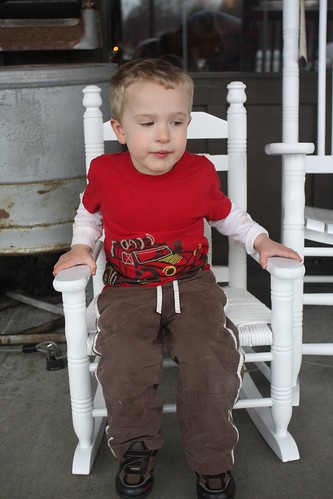
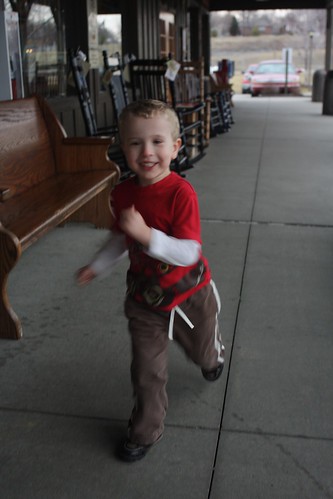
Note: This post was written March 12, and posting was delayed until our return home. This is the first part of our trip: driving from Kansas to Indiana with Jacob and Oliver. From Indiana, we ll be flying to Germany while the boys stay with their grandparents. We normally don t like long road trips. Our preferred way to travel is by train. By air is second, and car is last. But this time, driving was all that made sense. We planned to make the 11-hour drive in two days to give the boys more of a chance to get out of the car and run around. It s always a bit demoralizing heading east from our place. You drive at highway speeds for an hour and are barely one county over. We left at about noon and made it as far as Kansas City before our first stop much to our surprise. We ate at a Cracker Barrel there. Afterwords, Jacob loved running in front of the restaurant. IMG_2507 Meanwhile, Oliver chilled on a wooden bench. IMG_2494 Jacob was excited to find this chair. He said Here is a chair just the size of me! IMG_2489 We spent the night in a hotel on the eastern edge of the metro area. Then Thursday hit the road again. We stopped for a mid-morning snack, then ate lunch at Pizza Hut. Jacob ran around in the grass outside again. Jacob invented a new game with me. He d ask, How will we get there? I was supposed to guess. With a pickup? No With a boat? No Eventually he d come up with a silly answer: We ll ride a pile of bricks there! or We ll ride on top of a stop sign! Then he d sit there laughing for a little bit. Pretty soon: Hey dad. How will we get there? We had a few toy-throwing episodes, but overall Jacob did very well. Oliver did even better. He slept a good part of the way, and happily watched Jacob for most of the rest. The car trip went well. This morning, it s time to get ready to head to the airport, and to break the news to Jacob that we ll be gone for a few days. We ve learned that he worries a lot about change if he knows about it too much in advance, finding it hard to process and understand, so we ll tell him after he wakes up this morning. Then off to the airport for our flight to Newark. Then we get to sit around in New Jersey for a few hours before our 7.5-hour flight to Hamburg.

23 March 2010

Benjamin Mako Hill: Antifeatures Talk

The recordings for Linux Conf Australia 2010, held this year in Wellington, are finally online. The recordings include a video of my keynote on Antifeatures. I was deeply honored to be invited to give a keynote at LCA and, as a result, felt more pressure than usual to put together something that was novel, relevant and entertaining and that spoke to core issues and problems facing free software. Although it's always hard for me to watch myself speaking, I've made it through the video and am reasonably happy with the result. Although perhaps it's a minor distinction, I think this lecture is probably the best talk I've given given to date! I hope to give the talk again so, as always, I welcome comments and feedback. If you'd like to watch it, the talk is available in a number of free and non-free formats:

Joerg Jaspert: GSoC

Googles Summer of Code has Debian participating again. And this year I wrote a proposal on my own, to try and see if there is a student out there interested in taking it on. It is easy described, writing a SmartUploadServer and should also fit into the timeline of a GSoC project, at least the server itself. Adapting the upload tools in Debian should also be easy, depending on various decisions taken for the SUS (oh hey, who thought of Windows now?). Especially if one manages to have existing protocols for the transfer and not invent an own one. There are more things available to code all around the archive. Most of them are hard to put into a GSoC project, for example a dak code cleanup doesn t sound all that good. And actually requires more insight, the above Upload Server is a nice self-contained project. It should and has to use parts of dak code and be integrated, but all in all you do not need much prior knowledge there. One other GSoC proposal I like and would want to participate (in the mentors view) is the one from Marc about DeveloperPackageRepositories. His current proposal is limited on the buildd site, I am interested in the archive side of it. Much of what is required for this is actually already there in the code, at least functionality to support it, it just requires glue around it to make it work. And I think such kinds of repositories would be a nice thing to have. This whole thing, as nice as it sounds, has one drawback: I had to create a google account. Evil thing, evil bad data miners over there. I m pretty unhappy with that fact, as I have survived without one for a nice long time. But given my position in this part of Debian (there are only 2 people who currently can change the code that actually runs the archive, for example) I think letting this opportunity pass by would have been the wrong decision. Now it only needs a student to take it! :)

Daniel Kahn Gillmor: Avoiding erroneous OpenPGP certifications

i'm aware that people don't always take proper measures during mass OpenPGP keysignings. Apparently, some keys even get signed with no one at the keysigning present speaking for that key (for example, if the key was submitted to the keysigning via online mechanisms beforehand, but the keyholder failed to show up). Unverified certifications are potentially erroneous, and erroneous certifications are bad for the OpenPGP web of trust. Debian and other projects rely on the OpenPGP web of trust being reasonable and healthy. People should make a habit of doing proper verifications at keysignings. People who make unverified certifications should probably be made aware of better practices. So for future keysignings, i may introduce a key to the set under consideration and see what sort of OpenPGP certifications that key receives. I won't pretend to hold that key in person, won't speak for it, and it won't have my name attached to it. But it may be on the list. Depending on the certifications received on that key (and the feedback i get on this blog post), i'll either publish the list of wayward certifiers, or contact the certifiers privately. Wayward certifiers should review their keysigning practices and revoke any certifications they did not adequately verify. Remember, at a keysigning party, for each key: After the keysigning, when you go to actually make your OpenPGP certifications: Feedback welcome! Tags: keysigning, openpgp, tip

22 March 2010

Russell Coker: Links March 2010

Blaise Aguera y Arcas gave an exciting demonstration of new augmented reality mapping software from Microsoft that combines video (including live video) with static mapping data and pictures [1]. This is a significant advance over current mapping systems such as Google Earth but it s not released yet either. It will be interesting to see whether Google or Microsoft gets this released first. The New York Review of Books has an insightful atricle by Garry Kasparov about human/computer chess [2]. It s surprising the degree to which a combination of human and computer chess playing can give a good result. Amateur human chess players plus regular PCs can beat grandmasters with computers or high-end computers with human help. It s apparently the quality of human-computer interaction that determines the quality of play. But the article contains a lot more, I recommend reading it. Daniel Kahneman gave an interesting TED talk about the difference between experiential and memory happyness [3]. As the concept of the moment is so short (about 3 seconds) apparently most people try to optimise their actions for the best memories of being happy. But to do so requires some different strategies. For example a two week vacation gives a memory that s not much different from a one week vacation. Therefore it seems that you would be better off staying in a five star hotel for a week than a four star hotel for two weeks, and eat dinner at a Michelin Star restaurant at least once per holiday even if it means eating at McDonalds on other occasions due to lack of funds. Temple Grandin gave an interesting TED talk The World Needs all Kinds of Minds [4] which mostly focussed on teaching children who are on the Autism spectrum. She is concerned that autistic children won t end up where they belong in Silicon Valley . Anupam Mishra gave an interesting TED talk about how the people of India s Golden desert built structures to harvest and store water [5]. Some of their ideas should be copied in Australia, due to mismanagement and stupidity Australians are failing to survive in much more hospitable places. Michael Tieman wrote an insightful and well researched article about the OSI s rejection of the IIPA s attacks on Open Source [6]. This is worth reading by anyone who wants to make a business or social case for free software. Mark Shuttleworth wrote an interesting post about the new visual style for Ubuntu and Canonical [7]. Apparently this includes the creation of a new font set which will be available for free use. Divorced Before Puberty an informative New York Times article by Nicholas Kristof about the links between treatment of women and terrorism [8]. The New York Times has an interesting article on Human Flesh Searches on the Internet in China [9]. It s basically crowds targetting people to find private information and harass them (similar to what some griefers are known for doing on the English-language part of the Internet). But they seem more interested in vigilante justice than lulz. The New York Times has an informative article about the Cult of Scientology (Co$) [10]. Among other interesting news it suggests that the number of cult victims in the US has dropped from 55,000 to 25,000 in the 2001-2008 time period. Senator Xenophon has called for an inquiry into the crimes committed by the cult and a review of it s tax-exempt status [11]. As always Xenu.net is the authoritative source for information on the Cult of Scientology AKA the Church of Scientology. The New York Times has an interesting article about formally studying the skills related to school teaching [12]. It largely focuses on Doug Lemov s Taxonomy of Effective Teaching describes 49 techniques that improve school results and some other related research. The article also mentions that increasing teacher salaries is not going to help much due to the large number of teachers, it s only professions that employ small numbers of people that can potentially have their overall skills improved by increasing salaries. Andy Wingo wrote an interesting article about Julius Caesar [13] based on the book The Assassination of Julius Caesar: A People s History of Ancient Rome by Michael Parenti. It seems that Caesar was more of a populist than a despot. Interesting article in The Register about the Large Hadron Collider (LHC) [14]. Apparently one 3.5TeV proton beam has as much energy as a British aircraft carrier running at 8 knots.

Christian Perrier: Amazing week in Khon Kaen for Thailand MiniDebconf

I'm now on my way back from The first miniDebCamp and miniDebconf that happened from March 13th to March 19th in Khon Kaen, Thailand. This even was organized locally by a team of very motivated Thai Debian enthusiasts and contributors, such as Theppitak Karoonboonyanan (*the* Thai DD), Neutron Soutmun, Kitt Tientanopajai, and all those whose name I'm not remembering as of now (I hope they won't mind). The even had kinda the structure of DebConfs, with a few days of "Debcamp" to begin. See the full schedule. We were hosted in Khon Kaen University (KKU), one one the most famous universities in Thailand, a small "town in town" in a city with a few hundred thousand inhabitants (dunno exactly). Lodging was done in a hotel located inside the university. Interestingly, the hotel was also hosting youg students participating to "Summer Camps" (apparently training systems to get good school results) gving to all this a very young atmosphere. The hacking lab and talks location was a 30-seat room in the university library, and meals were brought in there very efficiently, with the very specific way that Thai people have to transport each and every kind of meal (in small plastic bags closed by rubber). I arrived only in the 3rd day because I had commitments at home that made it impossible to me to come for the first day. During these days, people have been very busy hacking and participating to the Bug Squashing Party. During that BSP, about 50 bugs have been touched, without about 15 or so closed. Other non Thai attendees were Andrew Lee from TW, Paul Wise from AU, Daiki Ueno and Yukiharu Yabuki from JP. Organizers were expecting some attendees from neighbouring countries such as Laos, Vietnam or Cambodia. Unfortunately, none of them could come, including Anousak Soupavanh, leader of Lao free software localization efforts, who I was very impatient to meet. Transport difficulties, or visa problems, do not make things easy in that part of the world. On Wednesday we had a "DayTrip" as it is common for such event. We went abotu 50 km away from Khon Kaen, to visit a nice place, close to a dam lake, and climbed a hill surrounded by a big temple and a giant Buddha statue. Then we had a wonderful lunch in a fish restaurant in the very specific Thai way to share stuff: everything is on the table and you pick your food here and there, at you rconvenience. Of course, local advice before trying apparently innocent food is always worth it because the fire might be hidden anywhere (for instance in that soja plate which I tried and that set my mouth as a burning hell for 20 minutes). The journey ended by a visit of a great temple in Khon Kaen and, very noticeably by a dinner in a very popular barbecue restaurant in "all you can eat" style for...100Bath (so, about 2.5 euros). Maybe only vegetarian people had more trouble enjoying the meal as it was mostly made of various meat (and sea food). The talk days were very intense, at least in my opinion. Probably because I ended up giving four talks, some of them completely improvised (about IP-over-DNS, which I was using at the hotel and about which many wanted to learn a little bit more, and GPG keysigning processes). It turned out that the GPG talk was well received and, discussing with Paul later on, we agreed that such a talk, mostly meant to explain the DOs and DON'Ts For good GPG keys signing, could be a good idea even for Debconfs. There were also a few talks about local initiatives and efforts to develop (and not only promote) free software. We have no recordings of these talks as we were infortunately missing some video recording installation (maybe next time, Thep) just like the miniConf that was happening in Panama at about the same time was having. Due to local regulation on the university network, we had some limitations with Internet access (some firewalling that for instance was preventing SIP to work properly, which made a video-conference with a japanese user group fail, unfurtunately). The event ended in a round table discussion about ideas to organize something bigger in the future. The local community in Thailand has apparently the energy, maybe ressources and local support to be able to organize a slightly bigger event as first try (somethign like an Asian DebConf or something similar, targeting mostly Asian contributors and about 50-100 people. Thailand seems to be a good target to host such event, with many things being relatively inexpensive (and not only beer!). And they even think about possibly hosting a Debconf at some time in the future (actually, Martin Krafft should also be credited for bringing this idea). That isn't as crazy as it seems and, provided that potential organizers start involving themselves in the current Debconfs, everything seems to be possible. After all, if we look back to 2005, only one person (hello, Safir) was seriously thinking that Debconf could really happen in Bosnia and Herzegovina, right? After this week (followed by 2.5 days of sightseeing in Bangkok for me, plus a small meeting today with local Thai Linux corporate users and IT company owners), I feel like the mood in Asia about Debian development is high and full of potential. The miniconf last year in Taiwan was already a good success, by establishing a good connection between people.....we need to keep that alive and, hopefully, there will be other miniconfs in this part of the world. And, well, if I can be there, I'll be there.

Brice Goglin: Debian/X.org notes - Radeon KMS in unstable, enabled by default

Now that we have DRM from 2.6.33 in latest 2.6.32 kernel in unstable, I just uploaded Radeon KMS and DRI2 to unstable. xserver-xorg-video-radeon 1:6.12.192-2 even enables KMS by default. Please test it. In case of problems, you may for instance disable KMS by changing modeset to 0 in /etc/modprobe.d/radeon-kms.conf. You may also downgrade to testing where xserver-xorg-video-radeon 1:6.12.6-1 does not enable/support KMS. Make sure you run linux-image-2.6.32-4-$arch or later so that you actually have DRM from 2.6.33 and the radeon kernel module gets loaded early by udev. Otherwise, you may experience problems like this. You may need to add radeon to /etc/modules as a temporary fix.
(Permanent link)

Ian Wienand: What exactly does -Bsymblic do? -- update

Some time ago I wrote a description of the -Bsymbolic linker flag which could do with some further explanation. The original article is a good starting place. One interesting point that I didn't go into was the potential for code optimisation -Bsymbolic brings about. I'm not sure if I missed that at the time, or the toolchain changed, both are probably equally likely! Let me recap the example...
ianw@jj:/tmp/bsymbolic$ cat Makefile 
all: test test-bsymbolic
clean:
	rm -f *.so test testsym
liboverride.so : liboverride.c
	       $(CC) -Wall -O2 -shared -fPIC -o liboverride.so $<
libtest.so : libtest.c
	   $(CC) -Wall -O2 -shared -fPIC -o libtest.so $<
libtest-bsymbolic.so : libtest.c
		     $(CC) -Wall -O2 -shared -fPIC -Wl,-Bsymbolic -o $@ $<
test : test.c libtest.so liboverride.so
     $(CC) -Wall -O2 -L. -Wl,-rpath=. -ltest -o $@ $<
test-bsymbolic : test.c libtest-bsymbolic.so liboverride.so
	$(CC) -Wall -O2 -L. -Wl,-rpath=. -ltest-bsymbolic -o $@ $<
$ cat liboverride.c 
#include <stdio.h>
int foo(void)
 
	printf("override foo called\n");
	return 0;
 
$ cat libtest.c 
#include <stdio.h>
int foo(void)  
    printf("libtest foo called\n");
    return 1;
 
int test_foo(void)  
    return foo();
 
$ cat test.c
#include <stdio.h>
int test_foo(void);
int main(void)
 
	printf("%d\n", test_foo());
	return 0;
 
In words; libtest.so provides test_foo(), which calls foo() to do the actual work. libtest-bsymbolic.so is simply built with the flag in question, -Bsymbolic. liboverride.so provides the alternative version of foo() designed to override the original via a LD_PRELOAD of the library. test is built against libtest.so, test-bsymbolic against libtest-bsymbolic.so. Running the examples, we can see that the LD_PRELOAD does not override the symbol in the library built with -Bsymbolic.
$ ./test
libtest foo called
1
$ ./test-bsymbolic 
libtest foo called
1
$ LD_PRELOAD=liboverride.so ./test
override foo called
0
$ LD_PRELOAD=liboverride.so ./test-bsymbolic 
libtest foo called
1
There are a couple of things going on here. Firstly, you can see that the SYMBOLIC flag is set in the dynamic section, leading to the dynamic linker behaviour I explained in the original article:
ianw@jj:/tmp/bsymbolic$ readelf --dynamic ./libtest-bsymbolic.so 
Dynamic section at offset 0x550 contains 22 entries:
  Tag        Type                         Name/Value
 0x00000001 (NEEDED)                     Shared library: [libc.so.6]
 0x00000010 (SYMBOLIC)                   0x0
...
However, there is also an effect on generated code. Have a look at the PLTs:
$ objdump --disassemble-all ./libtest.so
Disassembly of section .plt:
[... blah ...]
0000039c <foo>:
 39c:   ff a3 10 00 00 00       jmp    *0x10(%ebx)
 3a2:   68 08 00 00 00          push   $0x8
 3a7:   e9 d0 ff ff ff          jmp    37c <_init+0x30>
$ objdump --disassemble-all ./libtest-bsymbolic.so
Disassembly of section .plt:
00000374 <__gmon_start__@plt-0x10>:
 374:   ff b3 04 00 00 00       pushl  0x4(%ebx)
 37a:   ff a3 08 00 00 00       jmp    *0x8(%ebx)
 380:   00 00                   add    %al,(%eax)
        ...
00000384 <__gmon_start__@plt>:
 384:   ff a3 0c 00 00 00       jmp    *0xc(%ebx)
 38a:   68 00 00 00 00          push   $0x0
 38f:   e9 e0 ff ff ff          jmp    374 <_init+0x30>
00000394 <puts>:
 394:   ff a3 10 00 00 00       jmp    *0x10(%ebx)
 39a:   68 08 00 00 00          push   $0x8
 39f:   e9 d0 ff ff ff          jmp    374 <_init+0x30>
000003a4 <__cxa_finalize@plt>:
 3a4:   ff a3 14 00 00 00       jmp    *0x14(%ebx)
 3aa:   68 10 00 00 00          push   $0x10
 3af:   e9 c0 ff ff ff          jmp    374 <_init+0x30>
Notice the difference? There is no PLT entry for foo() when -Bsymbolic is used. Effectively, the toolchain has noticed that foo() can never be overridden and optimised out the PLT call for it. This is analogous to using "hidden" attributes for symbols, which I have detailed in another article on symbol visiblity attributes (which also goes into PLT's, if the above meant nothing to you). So -Bsymbolic does have some more side-effects than just setting a flag to tell the dynamic linker about binding rules -- it can actually result in optimised code. However, I'm still struggling to find good use-cases for -Bsymbolic that can't be better done with Version scripts and visibility attributes. I would certainly recommend using these methods if at all possible. Thanks to Ryan Lortie for comments on the original article.

Dirk Eddelbuettel: 2010 March Madness Half Marathon in Cary

The annual March Madness Half Marathon in Cary took place this morning. This is both one of Chicagoland's 'early races' to start the season as well as the classic Boston preparation due to the hilly course. I have now run this consecutively for six years (see 2005. 2006, 2007, 2008, and 2009). As for the race conditions, we had fantastic weather all week with temperatures up to the sixties and then all of a sudden a forecast of rain, snow and even sleet for the weekend. Luckily, and while yesterday was sucky, today was allright or better. A little chilly and damp, but neither rain nor snow --- or even wind. So the conditions were good, with the course challenging as usual. The race itself went fine. I ran more or less steadily, never had to stop but was not particularly fast at 1:39:38 or a pace of 7:36.3. I had aimed for beating 1:40, had missed that target by miles 4 to 6 and was about 10 or 15 seconds behind but managed to get a negative split on the second half of the course to reach that goal. Which is nice, but the time is still the slowest I've ever run that race, and my slowest half-marathon since 2004. Training had been sluggish all winter. Oddly enough, already in last year's post I stated pretty much the same and feared that Boston may become tough --- which it did. But this year may well be a lot worse as I had no spring in my step all winter long. No fire in the belly for training will make for a long race. We'll see how it goes. Four weeks to go.

21 March 2010

Robert Collins: LibrePlanet 2010 day 3

Free network services A discussion session led by Bradley Kuhn, Mako & Matt Lee : Libre.fm encouraged last.fm to write an API so they didn t need to screen scrape; outcome of the network services story still unknown netbooks without local productivity apps might now work, most users of network office apps are using them because of collaboration. We have a replacement for twitter status.net, distributed system, but nothing like facebook [yet?]. Bradley says like the original GNU problem, just start writing secure peer to peer network services to offer the things that are currently proprietary. There is perhaps a lack of an architectural vision for replacing these proprietary things: folk are asking how we will replace the cloud aspects of facebook etc tagging photos and other stuff around the web, while not using hosted-by-other-people-services. I stopped at this point to switch sessions the rooms were not in sync session time wise. Mentoring in free software Leslie Hawthorne: Projector not working, so Leslie carried on a discussion carried on from the previous talk about the use of sexual themes in promoting projects/talk content and the like. This is almost certainly best covered by watching the video. A few themes from it though: We then got Leslies actual talk. Sadly I missed the start of it I was outside organising security guards because we had (and boy it was ironic) a very loud, confrontational guy at the front who was replying to every statement and the tone in the room had gotten to the point that a fight was brewing. From where I got back: Chris Ball, Hanna Wallach, Erinn Clark and Denise Paolucci Recruiting/retaining women in free software projects. Not a unique problem to women things that make it better for women can also increase the recruitment and retention of men. Make a lack of diversity a bug; provide onramps small easy bugs in the bug tracker (tagged as such), have a dedicated womens sub project and permit [well behaved :) ] men in there helps build connections into the rest of the project. Make it clear that mistakes are ok. On retention recognise first patches, first commits in newsletters and the like. Call out big things or long wanted features by the person that helped. Regular discussion of patches and fixes rather than just the changelog. CMU did a study on undergrad women participation in CS : Lack of confidence preceeds lack of interest/partipation . Engagement with what they are doing is a key thing too. Women are consistently undervaluing their worth to the free software community . Its the personal touch that seems to make a huge difference . More projects should do a code of conduct kudos to Ubuntu for doing it Chris Ball. I found the mentoring and women-in-free-software talks to have extremely similar themes which is perhaps confirmation or something but it wasn t surprising to me. They were both really good talks though! And thats my coverage of LibrePlanet I m catching a plane after lunch :( . Its a good low-key conference, and well put together.

Russell Coker: Citing Wikipedia

A meme that has been going around is that you can t cite Wikipedia. You can t Cite Wikipedia Academically Now it s well known and generally agreed that you can t cite Wikipedia for a scientific paper or other serious academic work. This makes sense firstly because Wikipedia changes, both in the short term (including vandalism) and in the long term (due to changes in technology, new archaeological discoveries, current events, etc). But you can link to a particular version of a Wikipedia page, you can just click on the history tab at the top of the screen and then click on the date of the version for which you want a direct permanent link. The real reason for not linking to Wikipedia articles in academic publications is that you want to reference the original research not a report on it, which really makes sense. Of course the down-side is that you might reference some data that is in the middle of a 100 page report, in which case you might have to mention the page number as well. Also often the summary of the data you desire simply isn t available anywhere else, someone might for example take some facts from 10 different pages of a government document and summarise them neatly in a single paragraph on Wikipedia. This isn t a huge obstacle but just takes more time to create your own summary with references. When Wikipedia is Suitable The real issue however is how serious the document you are writing is and how much time you are prepared to spend on it. If I m writing a message to a mailing list or a comment on a blog post then I probably won t bother reading all the primary sources of Wikipedia pages, it would just waste too much of my time. Wikipedia is adequate for the vast majority of mailing list discussions. If I m discussing several choices for software with some colleagues we will probably start by reading the Wikipedia pages, if one option doesn t appear to have the necessary features (according to Wikipedia) then we may ask the vendor if those features are really missing and if so whether they will be added in the next version but we may decide that we don t really need the features in question and modify our deployment plans. Many business decisions are made with incomplete data, time is money and there often isn t time to do everything you want to do. Using Wikipedia as a primary source for business decisions is a way of trading off a little accuracy for a huge time saving. This is significantly better than the old fashioned approach of comparing products by reading their brochures companies LIE in their advertising! When writing blog posts the choice of whether to use Wikipedia as a reference depends on the point that you are trying to make and how serious the post is. If the post isn t really serious or contentious or if the Wikipedia reference is for some facts that are not likely to be disputed then Wikipedia will probably do. For some posts a reference to a primary source will be better. A blog post that references data that is behind a pay-wall (such as a significant portion of academic papers and news articles) is practically of less use than a post that cites Wikipedia. In most cases Wikipedia references free primary sources on the Internet (although it does sometimes refer to dead tree products and data that is behind a pay-wall). In the minority of cases where the primary references for a Wikipedia page are not available for free on the Internet there will be people searching for freely available references to replace the non-free ones. So if you refer to a Wikipedia page with non-free references a future reader might find that someone has added free references to it. The Annoying People One thing that often happens is that an Internet discussion contains no references for anything it s all just unsupported assertions. Then if anyone cites Wikipedia someone jumps in with you can t cite Wikipedia . If you want to criticise Wikipedia references then please first start by criticising people who state opinions as fact and people who provide numbers without telling anyone where they came from! The Guinness Book of Records (now known as Guinness World Records ) was devised as a reference to cite in debates in pubs [1]. It seems that most of the people who dismiss references to Wikipedia on the net would prefer that Internet debates have lower requirements for references than a pub debate. When Wikipedia is cited in an online discussion it is usually a matter of one mouse click to check the references for the data in question. If Wikipedia happens to be wrong then anyone who cares can correct it. Saying the Wikipedia page you cited had some transcription errors in copying data from primary sources and some of the other data was not attributed, I ve corrected the numbers and noted that it contains original research would be a very effective rebuttal to an argument that relies on data in Wikipedia. Saying you can t cite Wikipedia means little, particularly if you happen to be strongly advocating an opposing position while not providing any references. If one person cites an academic paper and someone else cites Wikipedia then it seems reasonable to assume that the academic paper is the better reference. But when it s a choice between Wikipedia and no reference then surely Wikipedia should win! Also references to non-free data are not much good for supporting an argument, that s really just unverified claims as far as most people can determine therefore the issue becomes how much the person citing the non-free reference can be trusted to correctly understand and summarise the non-free data. Also it has to be considered that not all primary sources are equal. Opinion pieces should be considered to have a fairly low value and while they are authoritative for representing the opinion of the person who wrote them they often prove little else unless they happen to cite good references which brings them to the same level as Wikipedia. The main benefit for linking to opinion pieces is that it saves time typing and gives a better product for the readers it s sometimes easier to find someone else expressing an opinion well than to express it yourself. So please, don t criticise me for citing Wikipedia unless others in the discussion are citing better references. If most people are not citing any references or only citing opinion pieces then a Wikipedia page may be the best reference that is being provided!

20 March 2010

Robert Collins: LibrePlanet 2010 Day 2

John Gilmore keynote What do we do next, having produced a free software system for our computers? Perhaps we should aim at Windows? Wine + an extended ndiswrapper to run other hardware drivers + a better system administration interface/resources/manuals. However that means knowing a lot about windows internals something that open source developers don t seem to want to do. We shouldn t just carry on tweaking its not inspiring; whats our stretch goal? Discussion followed reactos, continue integrating software and people with a goal of achieving really close integration: software as human rights issue! Desktop paradigm needs to be replaced : need to move away from a document based desktop to a device based desktop. Concern about the goal of running binary drivers for hardware: encourages manufacturers to sell hardware w/out specs; we shouldn t encourage the idea that that is ok. Lots of concern about cloning, lots of concern about what will bring more freedom to users, and what it will take to have a compelling vision to inspire 50000 free software hackers. Free software in cars lots of safety issues in .e.g brake controllers, accelerators. Eben Moglen We re at the inflection point of free software because any large scale global projects these days are not feasible without free software. Claims that doing something that scales from tiny to huge environment requires us A claim I would (sadly) dispute. Lots of incoming and remaining challenges. Entirely clear that the patent systems relationship to technology is pathological and dangerous that I agree with! Patent muggings are a problem patent holders are unhappy with patents granted to other people :) . Patent pools are helping slowly as they grow. Companies which don t care about the freedom aspect of GPLv3 are adopting it because of the patent protection aspects. Patent system is at the head of the list of causes-of-bad-things affecting free software. SFLC is building coalitions outside the core community to protect the interests of the free software community. We are starting to be taken for granted at the high end of mgmt in companies that build on free software. We face a problem in the erosion of privacy. We need to build a stack, running on commodity hardware that runs federated services rather than folk needing centralised services. Marina Zhurakhinskaya on GNOME Shell: Integrates old and new ideas in an overall comprehensive design. Marina ran through the various goals of the shell growing with users, being delightful, starting simply so new users are not overwhelmed. The activities screen looks pretty nice ;) The workspace rearrangement UI is really good. The notifications thing is interesting; you can respond to a chat message in-line in the notification. Richard Stallman on Software as a Service he presented verbally the case made in the paper. Some key quotes All your data on a server is equivalent to total spyware I think this is a worst-case analogy; it suggests that you can never trust another party: kindof a sad state of paranoia to assume that all network servers are always out to get you all the time. And I have to ask should we get rid of Savannah then (because all the data is stored there) the argument for why Savannah is not SaaS is not convincing: its just file storage, so what makes it different to e.g. Ubuntu One? If there is a server and only a little bit of it is SaaS, perhaps just say don t worry about it because that little bit is often the hardest bit to replace. Lets write systems for collaborative word process that don t involve a central server abiword w/the sharing plugin ? :) RMS seems to be claiming that someone else sysadmining a server for you is better than someone else sysadmining a time-shared server for you: I don t actually see the difference, unless you re also asserting that you ll always have root over your own machine . The argument seems very fuzzy and unclear to me as to why there is really a greater risk in particular when there is a commercial relationship with the operator (as opposed to, say, an advertising supported relationship).

Maximilian Attems: New klibc release 1.5.17

Not only fixes ipconfig regressions due to fixes in 1.5.16, but ipconfig should no longer discard useful packages. We also fixed a long standing klibc sparc specific socket bug (#444087): sparc lists socket system calls, but does not provide all of them natively. So one is better off on sparc to use sys_socketcall. Thanks to Jan Hauke Rahm the packaging switched to modern Source Format 3.0 (quilt) with debhelper 7 usage reducing cdbs overhead on build. This is a big switch and makes me very happy. New addition include a $(make help) target in Makefile to ease klibc build. A small losetup got added to klibc-utils. i386 and sparc build fine against current linux-libc-dev: klibc-1.5.17 released
P.S.: New outfall seem to include armel and s390 due to libgcc changes.
Update: Seems only a small packaging error due to test target invocation, should be fixed in 1.5.17-3.

19 March 2010

Robert Collins: LibrePlanet GNU Hackers Meetup

GNU Hackers meetups are a face to face meeting to balance the online collaboration that GNU maintainers and contributors do all the time. These are a recent (since 2007) thing, and are having a positive effect within GNU and the FSF. The LibrePlanet 2010 GNU Hackers meetup runs concurrent with the first day of LibrePlanet. We started with some project updates: Felipe Sanches presented his list of things that should be on the high priority project list: lunch John Eaton on Octave. John compared the octave contributors 30 or so over the years, and never more than 2 at a time. The Proprietary product Matlab that Octave is very similar to has 2000 staff working at the company producing it. Users seem to expect the two products to be equivalent, and are disappointed that Octave is less capable, and that the community is not as able to do the sort of support that a commercial organisation might have done. Octave would like to gain some more developers and be able to educe users more effectively convert more to become developers. Rob Myers, the chief GNU webmaster gave a description of his role: The webmasters deal with adding new content, dealing with mail to webmaster@, which can be queries for the GNU project, random questions about CDs, and an endless flood of spam. The webmasters project is run as a free software project the site is in CVS (yes CVS), visible on Savannah. Templates could be made nicer and perhaps move to a CMS. Aubrey Jaffer on cross platform. There is a thing called Water which is meant to replace all the different languages used in web apps generates html, css, alters the DOM, does what you d do with javascript. So there is a Water -> backend translator that outputs Java for servers, C# for windows, and so on. (I think, this wasn t entirely clear). He went on to talk about many of the internals of a thing called Schlep which is used as a compiler to get scheme code running in C/C#/Java so as to make it available to Water backends in different environments. Matt Lee spoke about GNU FM GNU FM is a free last.fm site. The site is running at http://libre.fm/. 24ish devs, but stalle after 6 months whats next? Matt has started GNU Social to build a communication framework for GNU projects to talk to each other e.g. for each GNU FM site to communicate on the back end, with a particular focus on doing social functionality groups, friendships, personal info. The wiki page needs ideas! GNU advisory board discussion too much to capture, but focused GNU wide issues things like how projects get contributors, contributions, coordination. Teams were a big discussion point, bug trackers how to coordinate teams followed up of that, and there is s GNU Source Release Collection project to do coordinated releases of GNU software that are all known to work together.

Aigars Mahinovs: Latvijas pavasara Ubuntu Bug Jam un Installest 27.03.2010

The following is an invitation to the Latvian Ubuntu Bug Jam (in Latvian) sent for a bit of a wider circulation to catch people that monitor Planet Debian, but not Planet Ubuntu.lv. 27. mart LU Linux centr notiks divi pas kumi vien Ubuntu Global Bug Jam Latvijas da a un installfests. Global Bug Jam ir pas kums, kur piedal ties ir aicin ti interesenti, speci listi, studenti, lai mekl tu k das Ubuntu Lucid Lynx test anas versij . Cilv ki, kas grib uzzin t par Ubuntu Linux, vai kuri grib atrisin t k du konkr tu probl mu ar Ubuntu Linux tiek aicin ti n kt uz pas kuma otro da u no pulksten 14:00 l dz 16:00. Pas kuma b s kafija un bulci as ar Accenture atbalstu. Ubuntu Global Bug Jam ir glob ls pas kums, kura m r is ir iepaz stin t programm t jus un tulkot jus ar r kiem, kas tiek lietoti, lai labotu probl mas Ubuntu oper t jsist m un ar izlabot p c iesp jas liel ku skaitu probl mu s laik . Izstr d t ji, kas grib labot Ubuntu probl mas vai iem c ties k labot Ubuntu probl mas, tiek aicin ti ierasties 12:00 un palikt l dz 16:00. Installfest pas kuma sada tiek aicin ti visi eso ie Ubuntu lietotaji, kuriem ir k das konkr tas probl mas un ar cilv ki, kas tikai v l interes jas par Ubuntu Linux. Ja jums ir konkr ta probl ma ar Ubuntu Linux ir ieteicams atnest uz pas kumu savu datoru, kur o probl mu var atk rtot, lai pas kum eso ie programm t ji var tu noteikt s probl mas iemeslu un pal dz tu no nov rst. Installfests s ksies 14:00 un turpin sies l dz 16:00. Ubuntu ir bezmaksas, uz Linux balst ta pilna apjoma oper t jsist ma jebkuram person lajam datoram, serverim un portat vajai iek rtai. T s standarta komplekt iek autas visas nepiecie am s programmas, lai str d tu ar tekstiem, att liem, elektronisko pastu un Internetu, k ar j s varat instal t papildus programmat ru da diem nol kiem. Pasaul to obr d jau lieto vair k k 8 miljoni cilv ku, un to leg li bez maksas var lietot gan m j s, gan komerci l s un nekomerci l s organiz cij s. LU Linux Centrs ir izveidots Latvijas Universit tes Datorikas fakult t . Linux Centra darb bas m r i ir: populariz t atv rt pirmkoda (Open Source) programmat ras, tai skait , Linux oper t jsist mas un citu atv rto tehnolo iju iesp jas un priek roc bas; piedal ties LU studiju proces un stenot lieti o IKT p t jumu projektus, tajos izmantojot un att stot atv rt s tehnolo ijas; sekm t APP pieejam bu Latvij un pasaul .

Jon Dowland: the world we live in

Sometimes the world we live in amazes me. Rentokil falsify scientific studies that show an alarming number of bugs and pests on public transport. Ben Goldacre calls them out, and fellow marketing people defend the practice as a sound marketing tool. On the other side of the globe, Viacom sue Youtube for breach of the Digital Millenium Copyright Act, specifically for not doing an adequate job of preventing their copyright material from being shared via the site. At the same time, Viacom hired at least 18 marketing agencies to upload its content to Youtube. They even went as far as to apply post-production techniques to make the videos look illegally sourced.

MJ Ray: Co-ops at the North Somerset Initiative

On Wednesday, I went to a meeting of the Business Initiative for North Somerset for Cooperatives-SW (our regional cooperative cooperative). It was the first time anyone from the cooperative and mutual sector was present.
platform
Conference Bank of England The first speaker was Geoff Harding from the Bank of England, who talked through topics in their agents summary and related news. One interesting graph showed a steep rise in the percentage of household income being saved. Answers to questions suggested that more of that goes to mutuals and building societies, but they find it difficult to be competitive while the banks are keen to increase their balances. There was mention of employment hoarding businesses short-time working, redeploying or shutting down temporarily to keep trained workers under contract, rather than make them redundant and rehire later. People from both the Federation of Small Businesses and the Hoteliers Association made strong comments about the banks claiming to government that they are willing to lend, but still offering deeply unattractive depth-of-recession rates and terms. If the regional agents get details of such cases, they pass them to the central bank. South West Regional Development Agency The second main speaker was Ann O Driscoll, who covers business development for the West of England (what many people call CUBA Councils that Used to Be Avon). She introduced their four strategic priorities:-

  1. Low Carbon Economy apparenly our region has good wind, wave and solar experience. However, Vestas were mentioned and I know that when Vestas closed the UK s only wind turbine blade factories in August 2009, the RDAs were criticised for not acting against the subsidy-chasing, socially irresponsible conduct of Vestas and related companies continue to worry workers. If Vestas is one of the praised companies, I wonder whether we re attracting sustainable work to the region. On a related note, North Somerset Council and NS Enterprise Agency are organising a Climate Change forum on 1st April, but it s at Cadbury House Hotel, which is awkward to get to except by car: no footpath to the door, a mile-and-a-half walk along a busy road from a train station, bad roads for biking, wheelbending speedhumps on the drive, I can t remember if there is bicycle parking and its website doesn t say
  2. Successful Businesses SWRDA funds our rather poor Business Link service. Does someone in the South West have some good news about Business Link? If so, please leave a comment on this article.
  3. Prosperous Places intervention in areas like south Bristol or central Weston.
  4. United Approach co-ordinating with other regional groups.
The main activities introduced were: The questions were fascinating, except for mine. The best one was probably about the forthcoming election and the Conservatives pledge to shut down the RDAs and Business Links. The answer was that much of the work will still need to be done somehow, so it s more a question of who will do it, rather than what the name on the door says. So I don t think axing RDAs is going to achieve more than shuffling people between organisations. When allowed to ask a question, I got too excited and ranted a bit about how the Co-operative Group s co-operative enterprise hub is doing work that Business Link should have been funding, but the RDA doesn t understand social enterprise and treats it as a ghetto service. I ll try to take that up in a more coherent form later. Overview I think Cooperatives-SW were invited to the North Somerset Initiative largely because of pressure from software.coop for co-ops to be represented better in the Local Strategic Partnership, which has treated us badly. NSI holds one of the three business places on the partnership board, with the other two being held by NSEA and Bristol International Airport. I think it s a bit off that a private company and an enterprise agency are both represented by other groups and also have their own board seats while co-ops don t even have a collective seat, so that pressure for a representative organisation for co-operatives and mutuals to have a board place (in line with national government guidance) should continue, useful though the NSI meetings seem to be. The other thing which would really help is some funding for co-operative business development specialists to work in North Somerset at strategic tasks like this, instead of it being left to ordinary workers from other sectors. I don t know where that funding will come from and until then, I ll continue to try my best. We need to make sure that local strategy at least does no harm to the sector.

Ren&#233; Mayorga: MiniDebConf Panam 2010

Finally, after almost 6 months of planing, this event is coming and will be start tomorrow, this is really great, There was a first attempt, and an idea to do a local(central-america based) Debian gathering on 2007 IIRC, now it will happen :) (almost 3 years later and at the same country). There was a lot of things that actually change since the fitst attempt, now Central-america has a more strong FLOSS Community, and now this event is possible, and it will happen this weekend yay! I really need to say thanks to Anto, Mauro Rosero, David, Caro and Gunnar, but I realize that doing all the orga stuffs was hard, I was quite involved since January, and I really say that you need a lot of work and energy to make a small event like this happen, but right now while I still sitting at home trying to finish to prepare my talks I realize that there was a lot of hard work put on this from everyone, and I m really happy to attend this gathering, also I hope that this event do something good on the local FLOSS people, since we have quite nice people here, but they are afraid to contribute, this is the chance to work together and push a bit to get more contributors from central-america.

Next.

Previous.