Search Results: "ana"

20 November 2006

Clint Adams: Before that, some trollop sang the great doxology

They wouldn't let my husband downgrade to business class, she complained. Um, I'd cheerfully change seats with him, he cried. Oh, why didn't that occur to us, she lamented. Now it's too late!

19 November 2006

Biella Coleman: On Posting on Planet Debian

Since Debconf Mexico, parts of my blog have been published on planet debian. To be exact, only the categories, Debian, Academic and (I think) Tech are included while a plethora of other ones, such as Canada are not. At times I feel pangs of guilt or discomfort because a number of my academic posts have, on the surface at least, little to do with Debian, F/OSS, tech or law. But many do have either to do with law or science more generally, so I hope they are of some interest to a group of folks who seem pretty keen on these topics. Soon though, I am going to be in monk-mode, working like a hard working ox on my manuscript, full-time (now I am sharing my mindspace with an article on survivors and one that I have to present in January on the battles between hackers and scientologist, which I am pretty excited about too). I have just finished reading about 15 articles related to my book that have help to reignite the fire of interst, after burning out after years and years and can I add a few more years, on the same topic. So bear with me as soon there will either be many posts related to just F/OSS or at least none at all as I will be so overtaken by the work!

Andreas Metzler: cheapskate HD upgrade

As the hard-disk of my PC exhibited its first hard error after months of strange noises I was forced to replace it. This machine dual-boots WinXP (on NTFS) and Debian, Windows' boot manager invokes grub and I absolutely did not want to re-install either Windows or Debian or try to figure how to resurrect a broken WinXP bootmanager. So I used the the dd-method again:
  1. Plugin new disk as hdc
  2. dd_rescue -b 512k -A /dev/hda /dev/hdc (I had to use -b 1 for copying the almost broken sectors.)
  3. Either re-partion or simply add more partitions at the end. (The new disk is always bigger.) Don't touch the first partition, which is NTFS and take care that the partion containing /boot gets the same partition number/position. - This way grub will grub will continue to work. Use cp -ax to acually copy the data to the new partitions. (cp is dog slow for copying directories containing many files, like ~/mail or ~/.ccache. - Two tar instances talking to each other over a pipe would probably be a lot faster but I cannot remember the 42 options needed to replicate cp -ax behavior.)
  4. Power off, switch disks, power on.
  5. Verify that your data is still there and clean the old disk, using shred(1) and openssl rand -rand /dev/urandom -out /dev/hdc1 somereallybignumber.
The process would be smoother if I knew of a sane way of copying NTFS (preserving ACLs) and could be bothered to actually remember how I setup grub in the first place. ;-)

Ross Burton: Sound Juicer "Wish I Could Stop You From Talking" 2.16.2

Sound Juicer "Wish I Could Stop You From Talking" 2.16.2 is out. Tarballs are available on burtonini.com, or from the GNOME FTP servers. Loads of fixes!

Clint Adams: I gave her no quarter

I can still see her smiling, dancing barefoot on the grass. She was young and na ve then. She lived in the sleeplessness and the soul-crushing poison, a refugee from the past that was never there. Some say that one's character is defined not by one's principles, but by the manner in which one compromises those principles. Others say that it's all about ideals. She tried to settle, but she failed. Maybe she couldn't let go of her principles, maybe she couldn't let go of mine. She grasped the wick with her fingers and pinched. That quenched flame drove ripples of confusion through the crowd, and some adapted to the darkness better than others. Oddly enough, I can't find my candles, and I don't know whom to blame. One day that will matter more than it does now.

Jonathan McDowell: What's the point of the BCS?

I read El Reg's article about the BCS complaining about the lack of IT skills. And found myself wondering once again what purpose the BCS actually serve. I mean, it's a great idea, a professional organisation that serves the needs of IT professionals. Except, what exactly are our needs? And what exactly does the BCS do? No one I know has been able to explain the point of them, and that include a few people who've been members. All their blurb sounds much more tailored to IT management than people who actually hack on stuff. What am I missing?

18 November 2006

Clint Adams: Meaningless numbers

With these shells as sh, results from the current posh testsuite:
ShellFailedPassed
bash25 (22 unexpected)140 (1 unexpected)
dash47 (45 unexpected)118 (2 unexpected)
ksh36 (32 unexpected)129
pdksh16 (12 unexpected)149
posh4 (as expected)161
This may reflect more on the unsuitability of the posh testsuite for other shells than the failure of those shells to conform to the expectations set by Debian policy. Patches welcome.

17 November 2006

Joachim Breitner: Linux Gaming Tournament

To promote Linux with the students I held a gaming tournament tonight. The sixteen participants played two rounds of four-player-tetrinet-games, as well a single elimination bracket of Frozen Bubble. It was very chaotic, but in the end we had two winners: Elridge Nikki Gordon (tetrinet) and Beteab Gebreyesus (Frozen Bubble), and they got winner certificates (the names of course not printed but hand written). Unfortunately, we did not manage to pull through the Tuxracer competition, but it was still fun. For them at least, for me it was only stress. But the good kind of stress.

Biella Coleman: The Politics of (lyme) bacteria

Recently I read an amazing review of patient advocacy and health (counter)movements by Steven Epstein from the STS program at UCSD. It is still a draft but bound to be published in the New Handbook of Science and Technology Studies and when it is, anyone who works in this area will gain so much from reading the review. It was stunningly broad yet highly specific. He is able to synthesize an enormous literature on patient advocacy, a field that has seen a blizzard of activity, especially in the last twenty years. Along with providing points of entry and departure into the field, he also examines who the burgeoning interest in the field of STS. What I found interesting is that there is very little work being done on a topic I happen to know a lot about, lyme disease and whose politics I have been following since at least 1999. I am not sure why the lacuna but it is an odd disease dripping and screaming with controversy and seems to stand apart from many illnesses, in part because of its odd dual existence. On the one hand, it is an illness that the medical establishment totally recognize as real (and thus in some respects is unlike the class of syndromes from MCS to chronic fatigue, which another STS researcher, Joe Dumit provocatively describes as illnesses you have to fight to get ). But that is only half the picture because mainstream medicine tends think that lyme is not only easy to diagnose but also to treat, so much so that if a person thinks they have lyme (even after a round of antibiotics or lacking diagnostic markers), the are either seen as suffering from something else (and usually then told they have one of those highly contested syndromes), or more often just crazy. So it exists dually: at once recognized but only narrowly, so that in another form, that of chronicty, lyme cannot exist. It is this dual quality of lyme that defines and shapes its politics and just recently, new developments have fueled the controversy. Namely it follows from the Infectious Diseases Society of America new guidelines for the diagnosis and treatment of lyme, published last month. In a nutshell, they basically re-reduce lyme to a very easily diagnosable and treatable illness, calling for even more strict guidelines for its diagnosis than now exist. They sanction a small range of blood tests and thus totally nullify the role for clinical diagnosis, which even the CDC had acknowledged as vital in times past. Unsurprisingly this has thrown the chronic lyme community in a total tizzy and they have not taken this sitting down. A petition has been launched and protests have been planned. And amid the controversy, politicians have already heard the call to arms. In the state where lyme is a famous entity for it was first discovered there, Connecticut, its Attorney General is calling for an anti-trust investigation into the Infectious Diseases Society of America, in essence for using their clout and prestige to legitimate a gold standard in diagnosis and treatment, when it seems far from obvious that this should be the standard. According to the LDA press release:
The national non-profit Lyme Disease Association (LDA), representing more Lyme disease patients than any organization in the United States, applauds Connecticut State Attorney General Richard Blumenthal for beginning an investigation into the Infectious Diseases Society of America (IDSA) Lyme disease guidelines development process. In an unprecedented move, the Attorney General’s office filed a Civil Investigative Demand (CID) to look into possible anti-trust violations by the IDSA in connection with exclusionary conduct and monopolization in the development of the Lyme guidelines
What I find so interesting is that this latest chapter in the grungy and torrid politics of lyme encapsulates the very nature of the politics of lyme, which really is about the agency of bacteria and in the Latourian sense. If Pasteur had to put a lot of effort into making credible the bacteriological model of disease as Brunto Latour covers in The Pasteurization of France and if there was plenty of future prostelyzing needed to bring credibility to the bacteria to more general publics, as Nancy Tomes illustrates in The Gospel of Germs, well now, I think we are in an era where we think we have such intimacy with the biological ins and outs of bacteria, it is almost impossible for the scientific community to imagine bacteria as such complex organisms that they can be in fact very difficult to diagnose, eradicate and treat. It is just no longer part of the basic conceptual universe of most doctors and medical researchers to think of bacteria in this way. The LDA press release acknowledges this very fact in the following way:
The October 2006 guidelines do not acknowledge that a complex bacterium such as the Lyme disease spirochete could possibly survive in the body and the brain, evading the immune system and short-term courses of antibiotics.
For many lyme researchers and doctors, since lyme is a bacteria and we know how to treat those pesky critters, it is frivolous to even imagine or contemplate otherwise. I would call this a hubris that arises not from the arrogance of doctors and the medical establishment but following the heels of success that medicine has indeed had with conquering the bacteria with antibiotics. Even new forms of poweful and highly resistanant TB are still treatable with a potent cocktail. That is, at a cultural level, I understand the blinders. At a political level, however, because people are suffering and because it is plausible that lyme can exist chronically, it is imperative to unseat this cultural comfort borne from past success to get the ball of research rolling anew. I think bacteria (and parasites for that matter as a recent smattering of articles demonstrate) are a lot more savvy creatures that should be treated as novel, wondorous creatures, once again. I would dare say the medical establishment, by refocusing energies on that which they think they have solved, would find themselves quite surprised. updateHere is an article discussing the issues.

Joey Schulze: Version 0.3 of GUI APT Key nearly finished

Now that version 0.2 of the graphical APT key manager has been migrated into Debian testing the work an update has been nearly finished as well. The code is stable and a final call for translation updates has been sent out to the translators. The new version is expected to be released on Sunday. Hopefully it'll migrate into etch as well. This version should be usable even more intuitively. A context-sensitive menu will pop up in the key listing and enable the user to display key details or to remove a key. This key-specific functionality has also been moved into its own menu and should therefore be a lot easier to reach. Deletion of a key can only be achieved by using one of these menus. Hence, it should be more difficult to delete a key by accident. The other buttons have been converted to stock buttons which come with nice graphics and hence should be easier to understand as well.

Alexis Sukrieh: Logger::Syslog, my first CPAN-candidate Perl module

I wrote a Perl module a couple of years ago, and got used to it, I just cannot code without that module now. It’s called Logger::Syslog and is a wrapper over Sys::Syslog that lets you deal with syslog in a very simple manner. Use the module and enjoy the easiness of calling info(), warning(), error() or whichever Syslog message level you like, there is a function wrapping it. It also works properly under a mod_perl environment an logs your message with additional information coming from the Perl stack (module, function name, line number, …). I use that module quite everywhere I use Perl : at work but also in my Free Software projects, like Backup Manager. It’s really time to release an “official” version that I can rely on in the future. Next step is submitting the module to the CPAN (it’s pending) and then, debianize it so backup-manager can depend on it. Todo: set up a public SVN repo to handle the sources. Updates

Steve Langasek: On setting and meeting goals, and statistical fun

While NMUing plays an important part in getting us to a release, as shown by the thousand or so fixed-in-NMU RC bugs that we recently cleaned up the BTS state on, it's evident after doing this whole release-managing thing for a while that there is a very high (non-linear) correlation between the age of an open RC bug and the likelihood that a release manager is going to have to touch it at some point in order to get it fixed. By and large, maintainers really do a good job of fixing their own packages, which is probably something we don't say enough - maybe 75% of all RC bugs, I'd guess, will (or would) get fixed by maintainers in the first week without anyone needing to poke them about it, and of the remainder, probably another 80-90% get taken care of by BSPers and serial-NMUers like bug-a-day mascot Steinar Gunderson. That's why I'm not bothered overly much by the idea of full-archive searches for hidden RC bugs, like Lucas's piuparts tests, affecting the release timeline, because I know that 95-98% of those bugs are going to be gone two weeks after they're filed anyway, especially when they're no-brainer fixes to maintainer scripts or dependencies. But then that leaves the other 2-5%, which are the ones nobody else has fixed. And why hasn't anyone fixed them? Because they're the hard ones, of course... So although I follow the debian-bugs-rc list and occasionally swat a few non-bugs closed to save the maintainers time, and also provide some nudges when it looks like a package is causing RC bugs to be filed on other packages, my goal for the last full week of my Dunc-Tank contract was to get the count of etch RC bugs unfixed in unstable that are 20 days old or older down from around 50 to under 30. This seemed a reasonable goal, since it had been at 80 the week before, and it would go a long way towards helping the real blockers on the release. Initially I was aiming to bring down the count of RC bugs unfixed in testing that are 20 days old or older to this number, but quickly realized that this wasn't going to be realistic because it depended too much on the autobuilders all operating optimally and there wasn't time to both help fix 20 of the hardest RC bugs and handhold 60 RC bugfixes into testing in one week. In the end, we did miss this lesser target by a day or two. Still not a bad week's work, given that I'm pretty sure I fixed about 20 of these bugs myself in that time period (through NMUs, removals, and analysis+downgrades) and they seem to average 3 hours of work for a fix. And we've been holding at or below 30 on this list of bugs since then, so we're successfully keeping up with new bugs aging past the 20-day mark, which is also a good sign. Unfortunately, I seem to have left myself to fix the alpha Xorg 7.1 bugs on my own time. :) By now the announcement has made the rounds that the release team doesn't think we can hit the Dec. 4 target date because more time is needed for a final release candidate of the installer. Does that mean that RC bugs were the wrong thing to be focusing on for the past weeks? Well, no; if you want one place in Debian where Brooks' Law holds, I think you'll find that getting a d-i release out is it, and we still have a hard road ahead to make sure we do get our other RC issues sorted out in the same time frame. The installer just happens to put a lower limit on a release date, we still have an opportunity to screw it up from there. ;) At least the statistics suggest that we're going in the right direction. Only 13% of RC bugs fall into the "20 days or older and unfixed" category. Half of all RC bugs over 10 days old have a fix of some kind in unstable, and 64% of all reported RC bugs are less than 10 days old. We'll see whether this graph backs me up on this in a couple more days.

Joerg Jaspert: Call for Papers for DebConf7

So, after a lot of work to get the system up and running (and then changing it until others from the team liked it) we finally sent out the Call for Papers and Registration informations for DebConf7. Now, only about one hour later we already have 37 registered users in that system. Thats fast. A nice detail about the new system we use (except the complete change it means for everyone :) ) is that accounts you create now get re-used for all future DebConfs. No need to reenter your data every year. Additionally we (as in DebConf) can offer other Debian related events the ability to use this system for their stuff. That means - if you organize a Debian related conference and want to keep track of attendees, events/talks, manage a schedule, or just parts of this - contact me, it can be arranged easily. The advantage for your attendees/speakers is that they only need one account at one system, not one for every conference. And you as organizer get a fully running system for free. :)

16 November 2006

Joachim Breitner: Kofi-Annan Center for Excellence in ICT

Until now, I always had to tell the not very joyful story of the motivated volunteer who came to Ghana to run against a wall of disinterest and misunderstandings. Luckily, things will change:Yesterday, I had an appointment with the Director of the Ghana-India Kofi-Annan Center for Excellence in ICT (KACE), where I asked, with little hope, if they might make more use of me in the next weeks, until I will most likely return to Europe. To my surprise, She found that an excellent idea and immediately referred me to the techies to discuss the details. Today I saw the principal of the SOSHGIC and my current employer, trying to find out if this would be possible. She agreed that it makes more sense for me to work at KACE instead of the school, and would lend me to them while still being empoyed by SOSHGIC. I will be around the school a few times, to finish some reports and two more club meetings and luckily I am still allowed to live in the flat. I think I ll spend another one or two weeks in January at KACE (as a real volunteer then), before I head back to my boring standard safe study life.The first, smaller, project at KACE came up spontaniously during the meeting yesterday: I mentioned the game infon (see my last blog entry), and she was very interested in that as a programming teaching aid. My idea is now to polish it a bit, make it a bit easier to use for beginners, improve documentation, create debian packages and maybe work on some lessen plan suggestions. The author of infon, dividuum, is also quite happy about the news and the attention that his work might get now.The other project is my idea about an internet caf distribution. It happens that the team at KACE is working on a very similar thing (called Community Information Center ) for the government, and they will start a Linux version in very few weeks, so I think I can help there as well. I expect that a lot of work for Skolelinux can be used here, so I m looking forward to work with the DebianEDU team a bit.

I m also looking forward to work with my future collegues at KACE. All of them qualify as geeks, in my opinion, most are Free Software advocates (or at least approvers), and the work athmosphere is very relaxed. Seven weeks of (almost) DebCamp! I ll keep you up to date...

Adrian von Bidder: A replacement for screen

ITP: retty says:
retty is a tiny tool that lets you attach processes running on other terminals. So you were running that mutt outside of screen at your home machine and now wanna check your mail? Attach it with retty, do whatever you want, detach it again and everything is as it was before. You don't have to run them all in screen just in case.
Daniel Jacobowitz analyzed the tool a bit:
What it seems to be doing is injecting code onto the stack which causes the target process to open your terminal and dup2 it onto stdout, stderr, et cetera. Interesting.
Interesting isn't really the word I'd use here. More like Eek! Incredibly ugly, but incredibly useful if it works reliably.

Zak B. Elep: Ubuntu-PH Release Party for 6.10 (Edgy Eft)


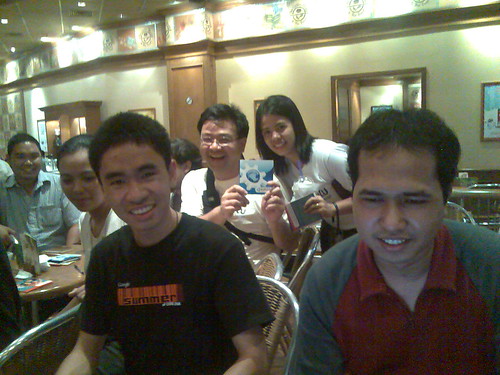
Last night I called Ubunteros nearby Manila for the Edgy Eft (belated) release party at the Coffee Bean and Tea Leaf at Greenbelt 3. Little did I know that there will be a lot of folks coming from the just-concluded FOSS@work workshop joining in the fun, thanks to Yolynne Medina and Eric Pareja. Diane Gonzales and I got to the venue first, then followed by the FOSS@Work folks. Dominique Cimafranca, Migs Paraz, Ranulf Goss, Jopes Gallardo, and Joel Bryan Juliano were there too, and all in all we were easily the noisiest group in the coffee shop, seemingly occupying the entirety of the place. I originally planned to move the group to have dinner somewhere, but along the way everybody seemed to forgot dinner and we quite engaged in talking to everyone else. It was terrific. The 2 boxes of Edgy ,K,Ed Ubuntu CDs I brought were easily given away to everyone; we even had them exchanged and autographed (naks!) reminiscent of what Ealden and I did last February when Mark came here. As a finale, we had a group photo of everyone with their CDs; Dominique remarks that in his informal’ study, more and more women prefer Ubuntu (and I sure do think he’ll be blogging more about this soon. ;) Needless to say, the above photo doesn’t do great justice to what happened last night; it came from my elric which I didn’t get use much as a camera since I too was happily chatting away. That said, I expect RJ Ian will be posting his photos from his brand-spanking-new Kodak camera to the Ubuntu-PH site once he gets back to Mindanao with Yolynne and company. I also think the FOSS@Work folks also have their own photosite or wiki to post more photos, which we’ll be seeing sooner. Jerome Gotangco and Ealden Esca an, the guys whom we all owe Ubuntu-PH to, were unfortunately unable to attend last night, as Jerome was off to Cebu to participate in the ICT congress there, while Ealden was quite busy at work. Hopefully they (as well as last night’s attendees!) can attend the next Release Party for 7.04 (aka Feisty Fawn,) and hopefully it will be just as fun, and be more meaningful if more Ubuntu-PH folks get involved in its development! Update: Yolynne and RJ just posted pics fresh from their arrival to home. Expect more pics later, nicely tagged too…

15 November 2006

Russell Coker: economics of a computer store (why they don't stoc...


In some mailing list discussions recently some people demonstrated a lack of knowledge of the economics of a shop. Having run a shop for a few years (an Internet Cafe) I have some practical knowledge of this. I will focus on small businesses in this article, but the same economic principles apply to large corporations too.

When running a shop the main problem you have is in managing stock. There are two ways of getting stock, one is to have wholesalers give it to you for a period in which you can try to sell it and you pay for it when it's sold, this is probably quite rare (I don't know of an example of it being done - and probably no retailer wants to talk about it in case they lose it). Often retailers consider themselves to be privileged if they are permitted to pay for hardware one month after they receive it! The more common way of getting stock is simply to buy it and hope you can sell it in a reasonable period of time (often the wholesaler will offer to buy the stock back at a 10% discount if you can't sell it).

To buy stock you need money, this can come from money that has accrued in the business account (if things are going really well) or from a mortgage taken out by the business owner if things aren't going so well. For small businesses things usually don't go so well so the money used to buy stock is borrowed at an interest rate of about 7% or 8% (I'm using numbers based on the current economic conditions in Australia, different numbers apply to different countries and different times but the same principles apply). The ideal situation is when there is money in the company bank account to cover the purchase of all stock, this means that the cost of owning stock is that you miss out on the 5.5% interest that the money will get in a term deposit.

Almost all stock has a use-by date of some form. Some items have a very short expiry (EG milk used to make hot chocolate in an Internet cafe, some have a moderate expiry date (computer systems become almost unsellable in about 18 months and lose value steadily month after month), but in the computer industry nothing has a long expiry date.

Let's assume for the sake of discussion that you want to run a small computer store that is open to passing trade (this means that you must have stock for an immediate sale). Let's assume that all items of computer hardware lose half their value over the period of 20 months at a steady rate of 2.5% of the original price per month (I think that most computer hardware loses value faster than that, but it's just an assumption to illustrate the point).

The next major issue is the profit margin on each sale. If you can make a 20% profit on a sale then an item that has lost 10% of it's value while gathering dust in your store will still be profitable. However the profit margins on computer sales are very small due to having a small number of major manufacturers (Intel, AMD, nVidia, ATI, Seagate, and WD) that have almost cartel positions in their markets and there being little to differentiate the stores apart from price. I have been told that 3% profit is typical for retail computer hardware sales by the small companies nowadays! Now if the stock will lose 2.5% of it's value per month, you pay 0.5% interest per month and you make a 3% profit then if an item remains in stock for a month then you lose money. So on average (by value) you need to have stock spending significantly less than a month in your store. Cheap items such as low-quality cases and PSUs can stay in stock for a while. More expensive items such as new CPUs and the motherboards to house them must be moved quickly.

What's the first thing that you do to reduce stock? You can keep stocks low, but there is a limit to how low you can go without losing sales. The next thing to do is to not stock items that customers won't often buy or items where there is a similar item that you can stock as a substitute. The classic example of this is hard drives, a customer will want a certain capacity for a certain price - if their preferred brand is not in stock they will almost always take a different brand if it has the same capacity at the same price. Stores often advertise prices on multiple brands of hard drive in each capacity, but often only try to keep one brand in stock.

Of course this is a problem for the more fussy buyer. If you want to buy two identical parts from the same store on different days you might discover that they don't have the stock on the second day and that they instead offer you something equivalent. Not only do retailers have issues with managing their investment in stock but wholesalers have the same problem. So if a retailer runs out of WD drives and discovers that their preferred wholesaler has also run out of WD drives then they just buy a different brand - most customers don't care anyway.

There are some companies I deal with that have a business model based on services. One of them sells hardware to customers at cost, but charges them for the time spend assembling them, transporting them, etc. The potential for a 3% profit on the hardware isn't worth persuing, they prefer to just charge for work and also save themselves the sales effort. Another company I know operates almost exclusively on the basis of ordering parts when customers request them (but still make a small profit margin on the sales), this means that the customer can be invoiced as soon as the hardware arrives. The down-side to this is that wholesalers have the same stock issues and they sometimes have excessive delays before the wholesaler can deliver the hardware.

Dell is the real winner out of this. As they operate by mail-order they don't need to have the stock immediately available, they have a few days to deliver it which gets them time to arrange the supply. They can also have a central warehouse per region which reduces the stock requirements again. A 3% profit on items that rapidly decrease in value makes it almost impossible to sustain a small business. But an organization such as Dell can sustain a successful business at that level.

Of course the down-side for the end-user is that Dell doesn't want to have too many models as that just makes it more complex for the sales channel. Also they have deals with major suppliers which presumably give them deep discounts in exchange for not selling rival products (this is why some brands of parts are conspicuously absent from Dell systems).

10 years ago there used to be a small computer store in every shopping area. Now in Australia there are a few large stores (which often only have a small section devoted to computers) and mail-order. There seems to be much less choice in computer hardware than there was, but it is much cheaper.


PS I've attached a picture of day 39 of the beard.
Steve Kemp: I could kill, but I don t care about it

I’ve significantly updated the code behind the Debian Administration website over the past few days. Now: I still need to decide whether to open up the inter-user messaging system, and implement a few more tweaks and fixups. But these are pretty trivial to do, it is more a matter of deciding whether they are appropriate things than actually writing the code. All of this work combined with travelling a fair amount recently has left me behind on several fronts though. I’m going to dedicate tomorrow to catching up on the biggest outstanding issues, but I’m not sure how far I’ll get. Being behind on things actually makes me feel pretty good, I’m no longer on as many critic paths as I was a few months ago, so whilst getting behind is frustrating and annoying it doesn’t affect quite so many people/projects/packages/things. Either way better to be happy and behind than the reverse .. ObXen: The xen-hosting setup managed to reach an uptime of 100 days. I’m obviously not geeky enough; powers of ten remain much more significant to me than powers of two! Actually I take that back: I can recite powers of two to rediculous degrees and disassemble x86 and z80 hex dumps into opcodes with a fair degree of accuracy .. About time I got more practised at patching binaries; although its hard to find GNU/Linux software which requires serial numbers ;)

Biella Coleman: Stuck on the technology of yesterday

So I am in Alberta, Canada but I decided not to get a local phone number mostly because I have a VOIP phone that works fine and it lets me call Puerto Rico for free, and allows my sister call me for free too. But not having an Alberta 780 area code can be quite problematic at times and the latest chapter in the confusion has come from trying to get the IBM warranty folks to accept that you can call from Alberta with a non Alberta area code and realze that even if they accept that, the computer is the one wearing the pants and thus making the decision…So even if you convince them that new technologies make this possible, the transaction is still sabotaged because in the end, they rely on computer to get the actual service repair person to call you and the computer relies, and can only rely on the area code., who can only see that an area code 773= USA, so then it gets a US rep to contact you back after the initial phone call. Here is an IRC transcript discussing the confusion, which I think is pretty amusing: m: they are so confused
m: the guys says “what province are you in?” I say “Alberta”
m: and then he gets my number and he says “You aren’t in Alberta, sir”
m: and I say “Yes I am, my phone number is a US phone number, but I assure you, I am in Edmonton, Alberta right now”
m: and he says “Are you a canadian citizen?”
m: and I say ‘no, do I need to be, in order to be in Alberta?” and he says “The problem is, you are actually in the US right now”
m: I AM NOT IN THE USA
biella: heh
m: so I had to say “You realize that cell phones and voip technology allow you to roam outside of the USA and still use the same phone number?!”
b: and then what?
m: well he said I needed a canada number or their system would send it to the states
m: regardless if thats where my address is
m: their computer is too smart
micah anyways
biella: or not smart enough Well, we are now using my office number so hopefully all will be OK.

Jonathan McDowell: MPEG2 straight to the brane

I received a Freecom DVB-T stick last week (early wedding present). I've not actually played with DVB-T before, so I wasn't sure how much of a hassle it would be. My first act was to plug it into my laptop, with the aim of finding out the USB ID and thus which driver I'd need to compile up (I have a tendancy to build my own kernels with only drivers I think I'm likely to need). I did so and was greeted with:
dvb-usb: found a 'WideView WT-220U PenType Receiver (Typhoon/Freecom)' in cold state, will try to load a firmware
dvb-usb: did not find the firmware file. (dvb-usb-wt220u-02.fw) Please see linux/Documentation/dvb/ for more details on firmware-problems. (-2)
usbcore: registered new driver dvb_usb_dtt200u
Interesting, think I. I'm more organised than I thought and have already compiled up all the various v4l bits I thought I might end up using. So I go looking for the firmware file, find a copy, dump it in /usr/lib/hotplug/firmware/. Replug the device. And get:
dvb-usb: found a 'WideView WT-220U PenType Receiver (Typhoon/Freecom)' in cold state, will try to load a firmware
dvb-usb: downloading firmware from file 'dvb-usb-wt220u-02.fw'
usb 1-4: USB disconnect, address 15
dvb-usb: generic DVB-USB module successfully deinitialized and disconnected.
usb 1-4: new high speed USB device using ehci_hcd and address 16
usb 1-4: configuration #1 chosen from 1 choice
dvb-usb: found a 'WideView WT-220U PenType Receiver (Typhoon/Freecom)' in warm state.
dvb-usb: will use the device's hardware PID filter (table count: 15).
DVB: registering new adapter (WideView WT-220U PenType Receiver (Typhoon/Freecom)).
DVB: registering frontend 0 (WideView USB DVB-T)...
Rockin'. Now I need to tune it. I find Adam's DVB page which has the initial tuning file for the Tacolneston transmitter in Norfolk. I type scan uk-Tacolneston. It fails to find anything. I wonder if I'm using the wrong transmitter. I decide the supplied antenna is probably to blame and go to see about sorting out the one in the attic. I try again. I get a channels.conf containing 91 channels. Wooo. Copy this into ~/.mplayer/ and fire up mplayer dvb://. And have Freeview on my laptop. Nice. Unfortunately this requires me to have the loft aerial plugged into my laptop, which isn't very portable. Paddy tell me this will get better when the analogue transmitters get turned off and the digital power ramped up, so I look forward to that. Until then it should still prove useful to have a portable DVB-T stick - I intend to see if I can pick up BBC HD next time I'm staying in London, and check if Freeview coverage has made it to my parents' yet. Writing this all down makes it seem quite convoluted, but actually the process was a lot smoother than I expected; plug in stick, copy firmware, replug stick, scan for channels, watch tv. The issue that took most time to sort was the aerial. It's really quite cool to think about how easily you can get yourself an MPEG2 stream of TV to play with.

Next.

Previous.