Search Results: "mak"

1 April 2010

Alexander Reichle-Schmehl: lawsuit coming up?

I don't know how Adrian got to know about the Canonical vs. SPI lawsuit; as DPL and press team decided not to make the details public before tomorrow. But rest assured: All involved parties agreed, that it would be in the best interest of all, to settle things out of court.

31 March 2010

Christoph Egger: Another piece of well done software

As I really liked saying why I think Open Game Art is a good project I decided to start a small serie of well done free (well not only software) projects. This time SFML got to be the one. SFML is, as the name already tells, a Simple and Fast Multimedia Library written in C++ but providing bindings for a whole bunch of other languages like Python, Ruby, C, D and others. Debian currently provides the original library as well as the C and Python bindings maintained by the Games Team and myself. On a side remark, SFML also uses my favourite License, zlib. What I really like about SFML is the readable code all through the project. Every time I was unsure what some function does having a look at the actual implementation (and some OpenGL and X11) knowledge turned out to be quite satisfactory. This is, of course, aided by the fact that SFML's development is driven by a single Developer, Laurent Gomila. On the rather weak points I'm still hoping the to-be-released 2.0 Version of SFML will introduce something like a stable API which it currently lacks (although the API has settled and there are no such huge changes as from 1.2 to 1.3 in recent updates any more). SFML also uses hand-made Makefiles for building (now supporting DESTDIR at least -- in some non-standard way) and has the usual load of embedded libraries which results in it's current load of patches. For a nice time burner make sure you take a look at the python binding's snake-like clone. It clearly misses some important aspects to form a full game but it's nice nontheless. I have a (not-quite) small SFML based Project myself, a forward ported game from my old DirectX days, however it's unfortunately not yet playable again und rather stalled at the moment due to lack of time. So much for SFML. If you feel like it feel free to join me on writing about well done pieces of software or just about pieces on how you think it should be done and tell us where you found it happening.

30 March 2010

David Bremner: Distributed Issue Tracking with Git

I'm thinking about distributed issue tracking systems that play nice with git. I don't care about other version control systems anymore :). I also prefer command line interfaces, because as commentators on the blog have mentioned, I'm a Luddite (in the imprecise, slang sense). So far I have found a few projects, and tried to guess how much of a going concern they are. Git Specific VCS Agnostic Sortof VCS Agnostic

Frans Pop: Debianizing an ARM-based netbook

I got this neat little Chinese netbook after a mail to the debian-arm list where one machine was offered in exchange for porting Debian to it. So I offered to get Debian Installer running on it. In total 20 of these ChiTech PC89E netbooks were bought as a group by various people in different countries. The netbook is based on an ARM S3C6410 SoC, has 256 MB RAM and an excellent 8.9" 1024x600 LCD display. The machine itself is 11" and weighs under 800 grams. Most of the weight is the LCD display; they've even had to add a small extra weight in the base to avoid it toppling over backwards. The goal of getting D-I running was achieved last week, though not without needing to overcome some steep hurdles. Base installation Our main problem is that we don't have the source code to either the kernel they use (2.6.24.2 with patches from Samsung and others), or the u-boot bootloader. SSH was available without password for the user account and various basic errors allowed us to root the system relatively quickly. Brute force cracked the root password a few days later. The only information we did have was from the provided desktop system (which is really quite good and certainly looks very polished, but in the end still way too limited), what's on the flash memory and the contents ofa "firmware upgrade" image they provided. Having that firmware upgrade image proved very important as it gave us a good idea how to boot the system from SD card and made it possible to locate the kernel, u-boot bootloader and other files in flash memory. Googling for some boot messages we found two kernel source trees (for a different device: SmartQ) that looked promising as a basis. After some disassembly work by Luke Kenneth Casson Leighton on the kernel to get LCD timings and correct GPIO data we managed to get a basic working kernel: LCD, USB (and thus keyboard and touchpad), and wired networking. Although there are still loads of things that need improving/fixing, that gave me enough to work with to try to get Debian Installer going. The main limitations for running D-I are that we cannot change the bootloader configuration and that their boot procedure does not use an initrd. But we did work out how to boot a custom kernel from an external SD card by making creative use of their "firmware upgrade" procedure. Essentially I needed to find a way to run D-I by only booting a kernel. Piggy-backing an initrd onto a kernel is possible (using the 'bootpImage' target from the upstream kernel build system), but then the size of kernel plus initrd is limited to 4 MB and that is really too limited for a decent D-I initrd (especially if you want full i18n support). I ended up creating a micro-initrd (only 66 kB!) which only function is to mount the external SD card, load the real D-I root initramfs (which now no longer has any real size limitation) and then run init in that. After adding some relatively minor customizations for this netbook (such as installing the kernel from a custom repository on alioth), the installer was up and running. As the framebuffer worked without problem for the newt frontend, I next wondered if it would be possible to also get the graphical installer working. This should be easier for non-x86 systems after the recent switch from DirectFB to X.Org as backend for the graphical installer. And the image below shows it was. I had to create an /etc/xorg.conf to get the USB keyboard and touchpad working (apparently auto-detection does not quite work for less standard hardware), but that was basically it. Language selection So now all we have to do is get all the remaining kernel issues sorted out...

Michal Čihař: Summer of Code is almost here

It looks like being separate organisation in GSoC definitely brings more attention than last years where we were under MySQL. Hopefully this will allow us to choose really enthusiastic students who will do their work properly and without much kicking. So if you are interested in participation in GSoC 2010 with phpMyAdmin, please take care filling up the proposal and showing us some previous contributions (see student checklist for more hints) in order to be selected. The dark side of this is enormous increase of mails on our devel mailing list and combined with my illness last week and vacation few days before, it makes constant volume of 50 unread mails there for me :-).

David Welton: Where Tcl and Tk Went Wrong

I've been pondering this subject for a while, and I think I'm finally ready to write about it.
Tcl was, for many years, my go-to language of choice. It's still near and dear to me in many ways, and I even worked on a portion of a book about it ( http://journal.dedasys.com/2009/09/15/tcl-and-the-tk-toolkit-2nd-edition ). However, examining what "went wrong" is quite interesting, if one attempts, as much as possible, a dispassionate, analytical approach that aims to gain knowledge, rather than assign blame or paper over real defects with a rose-colored vision of things. It has made me consider, and learn, about a variety of aspects of the software industry, such as economics and marketing, that I had not previously been interested in. Indeed, my thesis is that Tcl and Tk's problems primarily stem from economic and marketing (human) factors, rather than any serious defects with the technology itself. Before we go further, I want to say that Tcl is not "dying". It is still a very widely used language, with a lot of code in production, and, importantly, a healthy, diverse, and highly talented core team that is dedicated to maintaining and improving the code. That said, since its "heyday" in the late 90ies, it has not ... "thrived", I guess we can say. I would also like to state that "hindsight is 20-20" - it's easy to criticize after the fact, and not nearly so easy to do the right thing in the right moment. This was one reason why I was reticent to write this article. Let me repeat that I am writing it not out of malice or frustration (I went through a "frustrated" phase, but that's in the past), but because at this point I think it's a genuinely interesting "case history" of a the rise and gentle decline of a widely used software system, and that there is a lot to be learned. At the height of its popularity, Tcl was up there with Perl, which was the scripting language in those days. Perl, Tcl, and Python were often mentioned together. Ruby existed, but was virtually unknown outside of Japan. PHP was on the rise, but still hadn't really come into its own. Lua hadn't really carved out a niche for itself yet, either. Tcl is no longer one of the popular languages, these days, so to say it hasn't had problems is to bury one's head in the sand: it has fallen in terms of popularity. To examine what went wrong, we should probably start off with what went right: These features led to Tcl being widely used, from Cisco routers to advanced television graphics generation programs to the AOLserver web server, which was busy serving out large quantities of dynamic web pages when many of us were still fiddling around with comparatively slow and clunky CGI programs in Perl. Note also that there have been a lot of cool things to have gone into Tcl in the mean time. It has a lot of impressive features; many more than most people realize, and has had a lot of them for a while. Check out http://www.tcl.tk to learn more about the "good stuff". But that's not the point of this article... There was a healthy, active community of developers producing lots of interesting add-ons for the language, and working on the language itself. This culminated in its adoption by Sun Microsystems, which hired the language's creator, Dr. John Ousterhout, and a team of people, who added a lot of great features to the language. Quoting from Ousterhout's history of Tcl page:

The additional resources provided by Sun allowed us to make major improvements to Tcl and Tk. Scott Stanton and Ray Johnson ported Tcl and Tk to Windows and the Macintosh, so that Tcl became an outstanding cross-platform development environment; Windows quickly came to be the most common platform. Jacob Levy and Scott Stanton overhauled the I/O system and added socket support, so that Tcl could easily be used for a variety of network applications. Brian Lewis built a bytecode compiler for Tcl scripts, which provided speedups of as much as a factor of 10x. Jacob Levy implemented Safe-Tcl, a powerful security model that allows untrusted scripts to be evaluated safely. Jacob Levy and Laurent Demailly built a Tcl plugin, so that Tcl scripts can be evaluated in a Web browser, and we created Jacl and TclBlend, which allow Tcl and Java to work closely together. We added many other smaller improvements, such as dynamic loading, namespaces, time and date support, binary I/O, additional file manipulation commands, and an improved font mechanism. Unfortunately, after several years, Sun decided that they wanted to promote one and only one language. And that language was Java. So Ousterhout and many people from his team decamped to a startup that Ousterhout founded, called Scriptics, where the Tcl and Tk innovations continued:

In 1998, Scriptics made several patch releases for Tcl 8.0 to fix bugs and add small new features, such as a better support for the [incr Tcl] extension. In April 1999, Scriptics made its first major open source release, Tcl/Tk 8.1. This release added Unicode support (for internationalization), thread safety (for multi-threaded server applications), and an all-new regular expression package by Henry Spencer that included many new features as well as Unicode support.
However, as many a company based around open source was to find later, it's a tough space to be in. Scriptics changed its name to Ajuba, and was eventually sold (at a healthy profit, apparently, making it a relative dot com success story, all in all) to Interwoven, for the "B2B" technology that Ajuba had developed. Interwoven was not interested in Tcl, particularly, so, to create a system for the ongoing development and governance of the language, the "Tcl Core Team" was created. This was something of a blow to Tcl, but certainly not fatal: Perl, Python, Ruby, PHP, Lua have all had some paid corporate support, but it has by no means been constant, or included large teams. At the same time in the late 90ies, open source was really starting to take off in general. Programmers were making all kinds of progress, and had begun to make Linux into what is today the world's most widely used server platform, and laying the groundwork for the KDE and Gnome desktops. While these may still not be widely used, they are for the most part very polished systems, and leaps and bounds better than what passed for the 'Unix desktop' experience in the 90ies. One of the key bits of work that was added to Tk was to make it look pretty good on Microsoft Windows systems. This was in an time when the "enterprisey" folks were turning away from Unix in the form of AIX, Solaris, HPUX, et al. and taking up NT as the platform of choice, so it was in some ways sensible to make Tk work well there, and in any case as a cross platform GUI toolkit, it ought to work well there in any case. And, on the Unix side, Tk emulated the expensive, professional Motif look and feel that serious Unix programmers used. What could go wrong? As Gnome and KDE continued to mature, though, what would become one of Tk's major (in my opinion) marketing blunders took root. I have it on good authority, from someone who was there in the office, that the Scriptics guys working on Tcl and Tk viewed Gnome and KDE (and the Gtk and Qt toolkits) as not really worth their while. To be fair, since Tk has always been under a liberal BSD style license, the Qt toolkit has always been "off limits". Still, though, the attitude was that Tk was a standalone system, and since it ran on pretty much any Unix system, it didn't need to bother with Gnome or KDE. Gradually, though, as more and more people used Gnome and KDE exclusively on Linux, the Tk look and feel began to look more and more antiquated, a relic from the 1990ies when Motif (which has since pretty much disappeared) was king. Tk applications started to really stand out by not looking at all like the rest of the operating system. And, while Linux may not be responsible for a vast portion of the world's desktops, it is widely used by developers, who were turned off by the increasingly creaky look of the Tk applications they saw. Tk is and was actually a fairly flexible system, and it would have been possible to tweak the look and feel to make it look a bit better on Linux, without even doing any major work. Maybe not perfect, but certainly better looking. Nothing happened, though. Another problem was that Tk and Tcl made it so easy to create GUIs that anyone could, and did, despite, in many cases, a complete lack of design skills. You can't particularly blame the tools for how they're used, but there was certainly a cultural problem: if you read most of the early Tcl and Tk books, and even many of the modern ones, there are hundreds of pages dedicated to exactly how to use Tk, but few to none explaining even basic user interface concepts, or even admonitions to the user to seek out that knowledge prior to attempting a serious GUI program. The end result is that a lot of Tk programs, besides just looking "old fashioned" had fairly poor user interfaces because they were made by programmers who did not have a UI/design culture. Contrast that with Gnome and KDE, which have made a point of focusing on how to make a good GUI for their systems, complete with guidelines about how applications should behave. It may have taken them some time to get things right, but they have done a lot to try and instill a culture of creating high quality, well-integrated GUI's that are consistent with the system where they run. Lately, there has been a lot of work to update the Tk look and feel, and it has finally started to bear fruit. However, in terms of marketing, the damage has already been done: the image of "old, crufty Tk" has been firmly planted in countless developers' minds, and no amount of facts are going to displace it in the near future. Another problem Tcl faced, as it grew, was the tug-of-war between those wishing to see it small, light, and easy to distribute embedded within some other program, and those wishing it to become a "full-fledged" programming language, with lots of tools for solving every day programs. Unfortunately, that tug of war seems to have left it somewhere in the middle. Lua is probably more popular these days as an embedded language, because it is very small, and very fast, and doesn't have as much "baggage" as Tcl. Meaning, of course, that it doesn't do as much as Tcl either, but for a system where one merely wishes to embed a scripting language, without much 'extra stuff', Tcl's extra functionality is perhaps a burden rather than a bonus. On the other hand, while Perl was happily chugging along with their CPAN system for distributing code, giving users easy access to a huge array of add-on functionality, and Python was building up a "batteries included" distribution, that included a lot of very useful software straight out of the box. Tcl, on the other hand, chose to keep the core distribution smallish, and only lately has got some semblance of a packaging and distribution system, that is, however, run by ActiveState, and is (at least according to a cursory glance at the Tcl'ers wiki), not even fully open source. The lack of a good distribution mechanism, and, in the meantime, eschewing a larger, batteries-included main distribution left Tcl users with a language that, out of the box, did significantly less than the competition. Technically, a Python style "big" distribution would not have been all that difficult, so once again, I think this is a marketing problem: a failure of the Tcl Core Team to observe the "market", assess what users needed, and act on it in a timely manner. Somewhat related to the large Tcl vs small Tcl issue was one particular extension, or extensions to the language that was noticeably absent: a system for writing "object oriented" code. Tcl, at heart, will never be an OO language through and through, like Ruby or Smalltalk, but that doesn't mean that an OO system for it is not a useful way of organizing larger Tcl systems. Indeed, Tcl's syntax is flexible enough that it's possible to write an OO system in Tcl itself, or, optimizing for speed, utilizing the extensive C API in order to create new commands. Over the years, a number of such systems have arisen, the most well-known being "Incr Tcl" (a play on the incr command, which is akin to += 1 in languages like C). However, none of these extensions was ever included with the standard Tcl distribution or somehow "blessed" as the official OO system for Tcl. This meant that a newcomer to Tcl wishing to organize their code according to OO principles had to pick a system to use from several competing options. And of course, newcomers are the least able to judge a complex feature like that in a language, making it a doubly stressful choice. Furthermore, even experienced Tcl programmers who wanted to share their code could not utilize an OO system if they wanted their code to work with just standard Tcl. Also, if their code had a dependancy on some OO system, it would require the user to download not only the extension in question, but the OO system it was built on, which, naturally, might conflict with whatever OO system the user had already selected! As of Tcl 8.6, thanks to the work of Donal Fellows, Tcl is finally integrating the building blocks of an OO system in the core itself, but this effort is probably something like 10 years too late. Some other more or less minor things that have taken too long to get integrated in the Tcl or Tk distributions include the PNG format (still not there in a production release of Tcl), a readline-based command line (Tkcon is nice, but not a replacement for simply being able to type "tclsh" and get a nice, functional shell like Python, Ruby and most other languages have. This could easily lead to a bad first experience for someone trying out Tcl). Tcl also took too long to integrate a first-class hash type (accessed with the 'dict' command), which only appeared in 8.5. Its "arrays" aren't bad, but don't quite have the full power of a hash table as dict implements them. Once again, the code to do these things was/is out there, it has just been a matter of integrating it into Tcl and Tk, which has been a slow process. One actual technical problem that Tcl faces is the concept that all values must be representable as a string. This is more or less ok for things like lists, hash tables or numbers, but is problematic when the user wishes to represent a value that simply isn't a string. A basic example is a file handle, which at the C API level is a FILE*. How does Tcl get around this? It keeps an internal hash table with a Tcl-script accessible string, such as "file5" that points to a FILE * value that is used internally by file commands. This works pretty well, but there is a big "but": since you can compose a string like "file5" at any time, that must be able to access the actual file pointer, you can't do any sort of "garbage collection" to determine when to clean things up automatically. Other languages have explicit references to resources, so the program "knows" when a resource is no longer referenced by the rest of the program, and can clean it up. Therefore, the programmer must explicity free any resources referenced this way. This explanation is simplifying things somewhat, but it is something I view as a technical problem with Tcl. If you've been following along, you've noticed a lot of "these days" and "recently". That's because Tcl is still very actively developed, with a lot of new ideas going into it. However, if you look at the release dates, it seems that after Ajuba was sold off, and Ousterhout pretty much abandoned an active role in the language for good, placing it in the hands of the Tcl Core Team, there was a lull in the momentum, with Tcl 8.5 taking 5 years to be released. This is actually, in my opinion, an interesting phenomenon in languages: you risk hitting some kind of local maximum when your language is popular enough to have a lot of users who will be angry if things are changed or accidentally broken in the course of big upheavals. So you have to slow down, go carefully, and not rock the boat too much. On the other hand, there is an opportunity cost in that newer languages with less to lose can race ahead of you, adding all kinds of cool and handy new things, or simply fix and remove "broken" features. Erlang is another system that has, in my opinion, suffered from this problem to some degree, but this article is long enough already! Once again, though, not really a technical issue, but a problem with how the code was managed (and not an easy one to solve, at that). A Tcl failure that I was personally involved with was the web infrastructure. What went on to become Apache Rivet was one of the first open source Apache/Tcl projects, and was actually quite a nice system: it was significantly faster than PHP, and of course made use of Tcl, which at the time had a large library of existing code, and could be easily repurposed for projects outside the web (or the other way around: non-web code could be brought in to a web-based project). One thing I ought to have done differently with the Apache Rivet project was listen to the wise advice of Damon Courtney, my "partner in crime" on the project, who wanted to see Apache Rivet have a fairly "fat" distribution with lots of useful goodies. Rails and Django, these days, have shown that that's a sensible approach, rather than relying on lots of little extensions that the user has to go around and collect. The code was out there, I should have helped make Rivet do more "out of the box". A problem that is and it isn't: the syntax. Tcl's syntax is amazingly flexible. Since everything is a command, you can write new commands in Tcl itself - and that goes for control structures, too! For instance, Tcl has a "while" command, but no "do ... while". It's very easy to implement that in Tcl itself. You simply can't do that in most "everyday" languages. However, this comes at something of a "cost". The syntax, for your average programmer who doesn't want to go too far out of their comfort zone, is perhaps a little bit further afield from the C family of languages than they would prefer. Still though, a "human" problem, rather than a technical one. Perhaps, sadly, the message is that you'd better not "scare" people when introducing a new language, by showing people something that doesn't look at least a little bit familiar. Conclusions? First and foremost, that, gradually, Tcl and Tk continue to be improved. However, if one visits developer forums, there are also a lot of negatives associated with the Tcl and Tk "brands", and I am not sure if it will be possible to rectify that. So what can we learn from the rise and subsequent "stagnation" of Tcl?

Russell Coker: Why Comments?

Russ Albery has described why he doesn t support comments on his blog [1]. I respect his opinion and I m not going to try and convince him to do otherwise. But I think it s worth describing why I want comments on my blog and feel that they are worth having for many (possibly most) other blogs. Types of Blog The first thing to consider is the type of post on the blog. Some blogs are not well suited to comments. I have considered turning off comments on my documents blog [2] because it gets a small number of readers and is designed as reference material rather than something you might add to a public Planet feed or read every week as it has a small number of posts that are updated. So conversations in the blog comments are unlikely to happen. One thing that has made me keep comments open on my documents blog is the fact that I am using blog posts as the main reference pages for some of my projects and some people are using the comments facility for bug reports. I may make this the main bug reporting facility I will delete the comments when I release a version of the software with the bugs fixed. One particular corner case is a blog which has comments as a large part of it s purpose. Some blogs have a regular open thread where anyone can comment about any topic, blogs which do such things have the owners act more like editors than writers. One example of this is the Making Light blog by Teresa and Patrick Nielsen Hayden [3] who are both professional editors. The next issue is the content of the post. If I was to create a separate blog for authoritative posts about SE Linux then there wouldn t be much point in allowing comments, there are very few people who could correct me when I make a mistake and they would probably be just as happy to use email. When I write about issues where there is no provably correct answer (such as in this post) the input of random people on the net is more useful. Another content issue is that of posts of a personal nature. Some people allow comments on most blog posts apart from when they announce some personal matter. I question the wisdom of blogging about any topic for which you would find comments intolerable, but if you are going to do so then turning off comments makes sense. Finally there is the scale of the blog. If you don t get enough readers to have a discussion in the comments then there is less benefit in having the facility turned on the ratio of effort required to deal with spam to the benefit in comments isn t good enough. In his FAQ about commenting [4] Russ claims that controlling spam can take a tremendous amount of time or involve weird hoop-jumping required for commenters . I have found the Block Spam by Math [5] Wordpress plugin to be very effective in dealing with the spam, so for this blog it s a clear benefit to allow comments. Since using that plugin my spam problem has decreased enough that I now allow comments on posts which are less than 1 year old previously comments were closed after 90 days. The plugin is a little annoying but I changed the code to give an error message that describes the situation and prevents a comment from being lost so the readers don t seem too unhappy. The Purpose of Comments Russ considers the purpose of comments to be meaningfully addressed to the original post author or show intent to participate in a discussion . That s a reasonable opinion, but I believe that in most cases it s best if comments are not addressed to the author of the post and are instead directed towards the general readers. I believe that participating in a discussion and helping random people who arrive as the result of a Google search are the main reasons for commenting. For my blog an average post will get viewed about 500 times a year and the popular posts get viewed more than 200 times per month, so when over the course of a year more than 1000 people read the comments on a post (which is probably common for one of my posts) then 99.9% of readers are not me and commentators might want to direct their comments accordingly. Of course a comment can be addressed at the blog author so the unknown audience can enjoy watching the discussion. For some of my technical posts I don t have time to respond to all comments. If I have developed a solution to a technical problem that is good enough I may not feel inclined to invest some extra work in developing an ideal solution. So when a reader suggests a better option I sometimes don t test that out and therefore can t respond to the comment. But the comment is still valuable to the 1000+ other people who read the comment section. So a commentator should not assume that I will always entirely read a comment on a technical matter. Comment threads can end up being a little like mailing lists. I don t think that general discussions really work well in comment threads and don t aim for such things. But if a conversation starts then I think you might as well continue as long as it s generally interesting. Generally for most blogs I think that providing background information, supporting evidence, and occasionally evidence of errors is a major part of the purpose of blog comments. But entertainment is always welcome. I would be happy to see some poems in the comments section of technical posts, sometimes a Limerick or haiku could really help make a technical point. Political blog posts can be a difficult area. Generally the people who feel inclined to write political blog posts or comment on them are not going to be convinced to entirely change course, but as there are many people who can t seem to understand this fact a significant portion of the comments on political blog posts consist of different ways of saying you re wrong . The solution to this is to moderate the comments aggressively, too many political blogs have comments sections that are all heat and no light. I m happy for people to go off on tangents when commenting on my political posts or to suggest a compromise between my position and their preferred option. But my tolerance of comments that simply disagree is quite small. Generally I think that blogs which directly advocate a certain political position should have the comments moderated accordingly, people will read a site in the expectation of certain content and I believe that the comments should also meet that expectation to some degree. Comments on political posts can provide insights into different points of view and help discover compromise positions if moderated well. How to provide Feedback Russ advocates commenting to the blog author via email it is now the only option he accepts. My observation is that the number of people who are prepared to comment via email (which generally involves giving away their identity) is vastly smaller than those who use Blog comment facilities. This means that you will miss some good comments. One of the most valuable commentators on my blog uses the name Anonymous and has not felt inclined to ever identify themself to me, I wouldn t want to miss the input of that person and some of the other people who have useful things to say but who don t want to identify themself. I have previously written about how not all opinions are equal and anonymous comments are given a lower weight [6]. That post inspired at least one blogger to configure their blog to refuse anonymous comments, it was not my intent to inspire such reactions (although they are logical actions based on a different opinion of the facts I presented). I believe that someone who is anonymous can gain authority by repeatedly producing quality work. Another option is for people to write their own blog posts referencing the post in question. I don t believe that my core reader base desires short posts so I won t write a blog post unless I have something significant to say. I expect that many other people believe that the majority of their blog comments would not meet the level of quality that their readers expect from their posts (posts are expected to be more detailed and better researched than comments). As an aside forcing people to comment via blog posts will tend to increase your Technorati rating. :-# A final option is for people to use services such as Twitter to provide short comments on posts. While Twitter is well designed for publishing short notes the problem with this is that it s a different medium. There are many people who like reading and discussing blog posts but who don t like Twitter and thus using a different service excludes them from the conversation. For my blog I prefer comments for short responses and blog posts for the longer ones. If you write a blog post that references one of my posts then please enter a comment to inform me and the readers of my blog. Email is not preferred but anyone who wants to send me some is welcome to do so. If this post inspires you to change your blog comment policy then please let me know. I would like to know whether I inspire people to allow or deny blog comments.

Russell Coker: New Portslave release after 5 Years

I ve just uploaded Portslave version 2010.03.30 to Debian, it replaces version 2005.04.03.1. I considered waiting a few days to make the anniversary but I wanted to get the bugs fixed. I had a bug report suggesting that Portslave should be removed from Debian because of being 5 years without a major release. It has been running well 24*7 on one of my servers for the last 5 years and hasn t really needed a change. There were enough bugs to keep me busy for a few hours fixing things though. The irony is that I started using dates as version numbers back when there were several forks of Portslave with different version numbering schemes. I wanted to show that my fork had the newer version and a recent date stamp was a good indication of that. But then when Portslave didn t need an update for a while the version number showed it and people got the wrong idea. The new project home page for Portslave is on my document blog [1].

29 March 2010

Dominique Dumont: V1.0: To release or not to release ?

Hello As the author of Config::Model, I ve often pondered whether my project was mature enough to be released as 1.0. After all, every time I seriously use it, I find new bugs or need to make it easier to use or even add some new features. So I thought that my software was not good enough for V1.0. Then again, all other software have the same issues: fix bugs, improve usage and follow user requirements. Then, I ve realized that wondering about software quality is not the right question. Sure, you need a decent quality level for 1.0. But the more important is not there. The most important is the compatibility pledge. Do I pledge to keep backward compatibility so people can rely on me and my software? Will I do my utmost to preserve the work done by others ? In fact, that s what I ve been doing for several months now, all the changes I ve made are backward compatible (even if warnings are issued) and people have a smooth migration path. So, yesterday, I ve released Config::Model V1.001. Ta-da ! :-D

Russell Coker: Server Costs vs Virtual Server Costs

The Claim I have seen it claimed that renting a virtual server can be cheaper than paying for electricity on a server you own. So I m going to analyse this with electricity costs from Melbourne, Australia and the costs of running virtual servers in the US and Europe as these are the options available to me. The Costs According to my last bill I m paying 18.25 cents per kWh that s a domestic rate for electricity use and businesses pay different rates. For this post I m interested in SOHO and hobbyist use so business rates aren t relevant. I ll assume that a year has 365.25 days as I really doubt that people will change their server arrangements to save some money on a leap year. A device that draws 1W of power if left on for 365.25 days will take 365.25*24/1000 = 8.766kWh which will cost 8.766*0.1825 = $1.5997950. I ll round that off to $1.60 per Watt-year. I ve documented the power use of some systems that I own [1]. I ll use the idle power use because most small servers spend so much time idling that the time that they spend doing something useful doesn t affect the average power use. I think it s safe to assume that someone who really wants to save money on a small server isn t going to buy a new system so I ll look at the older and cheaper systems. The lowest power use there is a Cobalt Qube, a 450MHz AMD K6 is really small, but at 20W when idling means a cost of only $32 per annum. My Thinkpad T41p is a powerful little system, a 1.7GHz Pentium-M with 1.5G of RAM, a 100G IDE disk and a Gig-E port should be quite useful as a server which now that the screen is broken is a good use for it. That Thinkpad drew 23W at idle with the screen on last time I tested it which means an annual cost of $36.80 or something a little less if I leave the screen turned off. A 1.8GHz Celeron with 3 IDE disks drew 58W when idling (but with the disks still spinning), let s assume for the sake of discussion that a well configured system of that era would take 60W on average and cost $96 per annum. So my cost for electricity would vary from as little as $36.80 to as much as $96 per year depending on the specs of the system I choose. That s not considering the possibility of doing something crazy like ripping the IDE disk out of an old Thinkpad and using some spare USB flash devices for storage I ve been given enough USB flash devices to run a RAID array if I was really enthusiastic. For virtual server hosting the cheapest I could find was Xen Europe charges E5 for a virtual server with 128M of RAM, 10G of storage and 1TB of data transfer [2], that is $AU7.38. The next best was Quantact who charges $US15 for a virtual server with 256M of RAM [3], that is $AU16.41. Really for my own use if I was paying I might choose Linode [4] or Slicehost [5], they both charge $US20 ($AU21.89) for their cheapest virtual server which has 360M or 256M of RAM respectively. I ve done a lot of things with Linode and Slicehost and had some good experiences, Xen Europe got some good reviews last time I checked but I haven t used them. The Conclusion When comparing a Xen Europe virtual server at $88.56 per annum it might be slightly cheaper than running my old Celeron system but would be more expensive than buying electricity for my old Thinkpad. If I needed more than 128M of RAM (which seems likely) then the next cheapest option is a 256M XenEurope server for $14.76 per month which is $177.12 per annum which makes my old computers look very appealing. If I needed more than a Gig of RAM then my old Thinkpad would be a clear winner, also if I needed good disk IO capacity (something that always seems poor in virtual servers) then a local server would win. Virtual servers win when serious data transfer is needed. Even if you aren t based in a country like Australia where data transfer quotas are small (see my previous post about why Internet access in Australia sucks [6]) you will probably find that any home Internet connection you can reasonably afford doesn t allow the fast transfer of large quantities of data that you would desire from a server. So I conclude that apart from strange and unusual corner cases it is cheaper in terms of ongoing expenses to run a small server in your own home than to rent a virtual server. If you have to purchase a system to run as a server (let s say $200 for something cheap) and assume hardware depreciation expenses (maybe another $200 every two years) then you might be able to save money. But this also seems like a corner case as the vast majority of people who have the skills to run such servers also have plenty of old hardware, they replace their main desktop systems periodically and often receive gifts of old hardware. One final fact that is worth considering is that if your time has a monetary value and if you aren t going to learn anything useful by running your own local server then using a managed virtual server such as those provided by Linode (who have a really good management console) then you will probably save enough time to make it worth the expense.

John Goerzen: Trip part 6: Prague

Note: this post written on March 20-21 and posted after our return. IMG_2895
(two women looking into the crypt at St. George s Basilica) We ve had a good couple of days in Prague. The city definitely feels more, well, foreign than Germany and that is perhaps accentuated by the fact that I don t know any Czech at all, while I know some basic German. It s been slow going at times, and surprisingly easy at others. Despite my lack of knowledge of Czech, I d say communicating here has been roughly as easy as in Germany. That is perhaps partially due to the fact that, of the places where we ve needed to communicate, we are either making simple requests (buying bread at a bakery) or the people we re talking to know some basic English. (Or, in one case, a guard at a museum at the Prague Castle complex used German to ask me to check a bag at the coat check, mildly surprising me and confusing Terah when I started to comply with instructions she didn t understand, and didn t know how I did.) The very first time we had a situation where it was a bit difficult to communicate, in the bakery, I got into my difficult to communicate mode and accidentally slipped in a couple of German words. Oops. Terah was laughing at me later, and commented that the store owner might have also been laughing at me or perhaps at his employee that also accidentally slipped into basic German mode. On Friday, we visited Vy ehrad Castle, the one that nobody that visits Prague seems to know about. That is perhaps because the palace/castle part of the complex has been mostly destroyed (but we did know that before going there.) It is in a nice, quiet, and beautiful park, and has the beautiful and old Basilica of Saints Peter and Paul, as well as a large ornate cemetery. Then we visited two iconic Prague places: V clavsk n m st (Wenceslas Square) and Starom stsk n m st (Old Town Square). Both were beautiful. And, unfortunately, also packed with tourists and made-in-China plastic trinket shops. There I got my first clue that large tour groups tend to have a detrimental effect on any free site in Prague. They come in, the guides yell, they clog up things, and also generally miss the sites of true interest because buying tickets to them makes the price of the tour uncompetitive. On Saturday, we took the tram out to Pra sk hrad (Prague Castle) the one that everybody knows about. We got there at about 8:15, and although the grounds are open, most of the buildings weren t open until 9. As a result, we had 45 minutes almost to ourselves in the nearly-empty castle complex. We could walk around on the giant squares, take some photos, and generally enjoy a crisp and quiet morning. IMG_2771 At 9, it was still pretty empty and we went into the ticket offices to buy our tickets. By the time we got out a few minutes later, it was packed mostly due to the arrival of innumerable tour groups from all over Europe and, apparently, Japan. We went to the Star kr lovsk pal c (Old Royal Palace) first, since I knew from their website that it would close at noon due to a visit from Prince Charles. That was a beautiful building, and it s amazing to read about the features of it that are centuries old or even almost a thousand years old. The Vladislavsk s l (Vladislav Hall) and chapel particularly caught my eye. Underneath the palace is a museum, including some 1000-year-old jewelry and flooring, and some clothing that is several hundred years old recoverd from burial plots. IMG_2775
(Vladislav Hall) Next, we went to the iconic (and free) Katedr la svat ho V ta (St. Vitus Cathedral). Our audioguides fortunately allowed us to bypass the long line, and we could step inside at a side door. That was one of many times in Europe I stepped inside a building, and suddenly came to a stop with a wow . That building is every bit as much impressive as it is made out to be, even crowded as it was. IMG_2839 We also went to Bazilika Sv. Ji (St. George s Basilica), which one of the guides described as ancient . It was another wow moment, and it felt like the oldest church we were in yet. I think it probably was, actually; last rebuilt in 1142. IMG_2874 For lunch, we asked for a recommendation from our hotel. They suggested one place, which we walked to. It was a nice easy walk down some Prague side streets, but the restaurant and all the others along our walk were closed on Saturday. We eventually made our way back to the hotel and asked for a new recommendation, which was successful this time. Terah ordered some ribs, while I ordered a more traditional Czech goulash, which happened to be served in a bread bowl. A minute later, the waiter brought Terah a fork and knife. And he brought me a bowl of water with a slice of lemon, and announced wash for you. That was a surprise, and a bit puzzling one at that. Turns out that eating bread that had stew served in it is indeed a bit messy, and having some water to clean up with is indeed helpful. We met up with Anna from Leipzig and one of her Czech friends for dinner Saturday night. We found a nice local Czech place. I had ham with sauerkraut in a folded potato cake. It was excellent, and the total bill for Terah and me came to 235 Kc or about $12.50. We had a nice walk back to the hotel in the crisp, dark evening. Sunday morning we had breakfast at our hotel the only time we ate a meal at a hotel this whole trip then got on the tram, the metro, and the bus to the airport. Total cost for that trip for two: 52 Kc, or about $2.75. Far cheaper than a taxi. One weird thing happened to us in Prague. We were riding the tram towards downtown, and as we would be on it for several stops, Terah was sitting. I was standing as there wasn t an available seat for me. Terah and I were both looking out windows, until Terah was startled because her arm was wet. She looked around and it turned out a middle-aged woman had spit on her, and was glaring at her. We never did figure out why. About all we can think of is maybe someone else, such as a very old person, had gotten aboard but Terah hadn t noticed and therefore didn t offer to give up her seat. That was probably the only real rude gesture towards us on the entire trip. We ran the story by Anna s friend (the native Czech) and she was as surprised and baffled as we were. As I wrap this up, we re sitting at our gate in Prague waiting for our flight to Munich. In this airport, in an out of the way corner on the very lowest floor, I spotted only the second drinking fountain I ve seen in Europe this entire time and also perhaps the continent s most expensive cup of coffee. After we get to Munich, it s a flight to Chicago, another to Indianapolis, and finally a drive home Monday.

Roland Mas: FusionForge 5.0

Fourteen months after the renaming of the Free/Open Source code of GForge 4.x to the new FusionForge name, we're pleased to announce version 5.0. As mentioned in the release notes, this is still an incremental step over version 4.8 rather than a revolution, but the changes are important enough, and numerous enough, that we felt it justified to bump the major version number. Major improvements, beyond a host of bugfixes, include: FusionForge 5.0 now also includes new plugins that were previously only floating around (or completely private): These plugins, as well as a large part of the improvements in the trackers and the rewritten Mediawiki plugin, are a direct consequence of the upstreaming of work having been done in private instances of forges. We're happy to note that this goal of ours (to merge local patches into the central repository when it makes sense) seems to be working well. For the record, this 5.0 release includes work and plugins that were reintegrated from sources such as Alcatel-Lucent, Adullact and AdaCore. This release is also the first to have had the benefit of automated testing during the whole cycle. Coverage isn't 100 % yet, but the existing unit tests and functional tests help us be confident in the quality of the release. We'll keep adding more tests as time passes, of course. Looking back at the initial goals stated when the project started, we seem to be on the right track: We still need to work on the database schema and the cross-distro part, as well as cross-forge interoperability. The good news is that work is happening on these fronts already. And with almost 2500 commits, we truly seem to have accomplished at least one of the (implicit) goals: to bring development back to a healthy state. And we're far from being out of ideas for the future, so there's a lot of good stuff still cooking!

Matt Brown: Initial Review of Xero Personal

I ve been eagerly looking forward to the release of Xero Personal which has been heavily promoted by Xero and BNZ (as MoneyMap) for the last few months. Unfortunately my first impressions of the product today are extremely underwhelming. Xero Personal is definitely not worth anywhere close to $5/month for me at this point in time and I m unlikely to even keep using the free trial. To set the context for that statement, Xero Business set the bar high. I first used the original version of Xero while it was still in beta and even then it was clear that it was an application that took accounting to a new level and would provide an order of magnitude improvement in how I maintained the accounts for our business. That promise held true once we started paying for it, even though the cost of Xero is more than 10% of our annual expenses, the time and hassle it saves makes it a worthwhile investment. By contrast today s release of Xero Personal offers nothing new above existing personal finance websites or desktop packages and would take me extra time to use as it fails to handle many of the basic transactions that a normal household will encounter. The way Xero Personal works is by having you manually upload your bank statements (the automatic import functionality that is so useful in the business version of Xero has been restricted to BNZ MoneyMap customers only). For each transaction you are asked to provide two pieces of information. The first is a category which serves as a basic form of account to track expenses and income. For each category you can set a spending or saving goal which Xero will help you track progress towards. The second is a name to identify the other party in the transaction. Xero Personal comes pre-loaded with some fairly generic categories. Annoyingly you re restricted to no more than 8 additional custom categories and the names associated with each transaction are are simple strings you can t link a transaction to another account or entity. To represent a transfer you need two separate transactions, one in each account, which you assign to the special category Transfer so that Xero knows to essentially ignore it. Nothing links the transactions together or ensures that the values balance. In addition to the basic categorisation functionality the application also attempts to track your assets and liabilities (bank accounts and credit cards show up automatically) so that it can compute your net worth. Unfortunately as soon as you try and use this you hit the problem that there is no way to link transactions from your accounts back to your assets and liabilities. This means unless you regularly and manually update your assets and liabilities the net worth calculation only takes into account changes in your cash position and becomes blatantly incorrect. As an example, take the common case of a household with a weekly mortgage (or other loan) repayment. You want the weekly payment to decrease the balance of your current account, increase the balance of your interest expense category and decrease the value of your mortgage liability. Your net worth should decrease by the value of the interest expense only, as the decrease in the value your mortgage liability offsets the remainder of the decrease in the value of your current account. Xero Personal doesn t come close to being able to handle this example today. The ability to split payments to different categories has also been left out (even though it s present in Xero Business and therefore presumably in the underlying engine) so your only option is to categorise the entire payment as a mortgage or housing expense, decreasing your net worth by the full value of the payment. Even if you could split the payment between two categories, one for the interest and one for the principal the inability to link the category for the principal to the liability account means the net worth calculation will still be incorrect. Maybe I m being to hard on this newly released product? It is a SaaS application after all and Xero has an excellent history of releasing regular updates to the business version of Xero. The reason I m so surprised and disappointed by this initial release is that it essentially lacks any double-entry accounting support many of the missing features are core functionality that is already implemented in the accounting platform that supports the business version. Assuming that Xero Personal is built on the same platform (and that would be the obvious choice wouldn t it?) the fact that Xero Personal has been released and is being heavily promoted without these features (compared to the initial version of Xero Business which was fully functional and obviously awesome even in beta) suggests to me that it s a conscious decision to significantly limit the scope and usefulness of the application rather than simply a limit on what could be implemented before the initial release. I sincerely hope that I m wrong and that the coming months bring significant improvements to the functionality of Xero Personal, but until it can support common transactions like mortgage repayments correctly I won t be using it or recommending it to anyone.

28 March 2010

Clint Adams: DPL Campaign Questions 009

Serafeim Zanikolas:
With respect to attracting new contributors, please ponder the idea of a formal one-on-one mentoring scheme (as opposed to one-off interactions via d-mentors).
I see nothing particularly objectionable about this. A long time ago people were talking about replacing NM with a saner mentoring process, and I am certain that mentoring occurs unofficially. I see no reason that you could not set up a formal one-on-one mentoring infrastructure with or without the Project's blessing. Charles Plessy:
So my question to other candidates is simple: what is your opinion and program about membership?
I think that we have enough inequality in the project as it is. That is why I consider DM to be a bad thing, even though it has practical benefits. I think that NM is probably fundamentally broken, and I get a bit nervous when people are talking about increasing the amount of NM indoctrination or bureaucracy. I would be in favor of exploring the replacement of NM with some kind of mentorship-type process, though I would worry it would not scale. I would be in favor of exploring the replacement of NM with something like Lars's proposal a while back, though I would worry that it would encourage popularity contests and cliques and cabals. Raphael Hertzog:
1/ Do you believe that it's a good move to standardize our packaging tools? (example: debhelper is almost standard, quilt is gaining status of the standard patch system thanks to the new source format) 3/ Do you have any preference on the tools that we should try to standardize on (which source format/patch system, dh7/CDBS/yada/etc., VCS helper, etc.)? 4/ Organizing changes that have an impact on (a large part of all) the archive is very difficult: How can we change our processes so that doing/organizing such changes is less of a burden? 5/ I have the feeling that Debian is innovating less than it used to do. We are more often followers rather than leaders. Do you share that feeling? What shall we do to make that change?
1/ I think that we should standardize on dpkg-dev. If there are features which absolutely every package needs, it would seem the logical place to add them. 3/ Right now I wish everyone were using git, but I do not believe in forcing them. Of the available source formats, I like 3.0 (quilt) with no additional patch system, and no package helpers at all. I am not quite sure what a VCS helper is so I have no known preference to express. 4/ I am not sure whether or not what you are talking about should, in fact, be less of a burden, and why it should or should not, so I do not have a valid opinion on how to change the process. 5/ I do share that feeling. I think that sometimes we get bullied by Ubuntu when there are things we would do for our own benefit which would make their lives difficult. I think that people are generally resistant to change, even when it would be of little cost to them and great benefit to someone else. These problems are social and might be correctable with a better spirit of teamwork and cooperation. However, I do not think we should be innovating just for innovation's sake or to be known as the most innovative kid on the block. We should be making my favorite operating system.

Clint Adams: DPL Campaign Questions 010

Hector Oron:
Secondly, I was wondering how Debian could make it easier for people to contribute than other (derivatives and non-derivatives) distributions. I came up with a really nice draft howto[1] which I would like to bring up to your attention, so the basic question would be what do you think you could do to make contributions paths easier (take in account not all teams, groups follow such community guidelines)
Human beings are not computers, so I find that applying HOWTOs to them to be misguided at best. As for enforcing a set of arbitrary community guidelines, I would not do that. Frank Lin PIAT:
planet.d.o has became one of the most visible media for Debian, if not the most visible one. Do you think it is a good thing?
I consider it neutral. If people start thinking of blogs or microblogging as important though, I think we might have a problem. I am in favor of our informal policy to never post anything important on blogs unless it is merely a copy of something communicated properly on an official channel. This includes anything that would go into our packages. Consequently I do not think it a valuable goal to respect copyright law by enforcing DFSG-free licenses on blogs, whether they are aggregated or not. Kumar Appaiah:
One of the questions which I've not yet seen exactly in the discussions is on the transparency in the maintenance of non-core but "important" packages, such as python, wherein the maintenance of the package and policy (till a short while ago) has been, poor at best, and we've had near zero communication from the maintainer(s) for over a year. This has led some parts of the "community" (Debian Python, in this case) to knock the doors of the tech-ctte[1] (recommended reading, unless you have done so already).
I think that is a failure of the entire community that the situation has even come to this point. In other analogous situations, the package would have been hijacked by now and the situation resolved. I think it would be appropriate for the DPL either to step in and mediate situations like this before they get anywhere near the tech-ctte, or to delegate someone to do the same. I think it would be equally appropriate for the people involved to resolve this themselves. Of course all of this should be open.

Stefano Zacchiroli: RC bugs of the week - issue 25

RCBW - #25 Last (long) week has finally passed: first in Geneve visiting Gismo, then in Sierre/Crans-Montana to present a paper at SAC 2010, then back in Paris for half a day before a day in Bruxelles for the 2nd year Mancoosi project review. (And of course campaigning has always been going on ...) All went fine and I can finally relax a bit for a week-end back "home" (i.e. Paris). Regarding RCBW, it looks like that in the past 2 months I've stabilized around 3 issues per month, which makes me happy nevertheless. Without any further ado, here are this weekissue's squashes: Random points:

Russell Coker: Autism vs Asperger Syndrome

Diagnostic Changes for Autism Spectrum Disorders Currently Asperger Syndrome (AS) is one of a group of conditions that are grouped into the category Autism Spectrum Disorders (ASD). The American Psychiatric Association plans to merge Asperger s Disorder into Autism Spectrum Disorder [1] in version 5 of their Diagnostic and Statistical Manual (DSM). Apparently a primary reason for the change is the difficulty in assessing people into the various categories (AS, Autism, and PDD-NOS) and some variation in diagnosis between regions. Professor Simon Baron-Cohen (a leading researcher on Autism and Asperger Syndrome) wrote an insightful article about this for the New York Times [2]. He suggests that while genetic research about the causes of Autism Spectrum Disorders (ASDs) is in progress there should be no change. If it turns out that AS and Autism have the same genetic cause then that would be good evidence to combine them into a single diagnostic category. If however they turn out to have different genetic causes then they would need different categories and he suggests that changes should be delayed until this issue is resolved. Simon also raises the issue of the status of people who have already been diagnosed, this is one of the social issues relating to a change in diagnostic criteria. Social Issues related to Diagnosis Unlike some disorders listed in the DSM, many (possibly most) people with AS really care about such things. I think that a common reaction to being diagnosed with Aspergers is to make the study of ASDs a Special Interest , which therefore makes it impossible to ignore what the psychologists are doing in this regard. The biggest problem with changing the diagnostic criteria in this regard is that AS has a good reputation. Some people even think that it s generally a good thing and seem to imagine that every child who is diagnosed with it will end up working for Google! This means that parents will be less likely to reject a diagnosis and therefore will be more likely to try and create a good environment for their child and seek appropriate therapies (such as social skills training and occupational therapy). I expect that a child who is diagnosed as Autistic but who doesn t obviously conform to the worst stereotypes will likely have their parents reject the diagnosis which will lead to a bad result for everyone concerned. The contrary view in this issue is that people who are on the spectrum but who insist that they aren t Autistic are prejudiced and they should embrace the Autism Spectrum label as a measure of solidarity [3], while that s a reasonable point it s not going to happen in the short term. Also there is the issue of adult diagnosis of AS, there are lots of adults who could benefit from being diagnosed and obstacles to such diagnosis (such as associating it with a label that is not well accepted such as Autism) are not going to do any good for anyone. Is Asperger Syndrome really that similar to Autism? Roy Richard Grinker (Professor of Anthropology) wrote a positive article for the New York Times about the diagnostic changes [4]. He seems to think that because in some cases it is difficult to distinguish the difference between Autism and AS they should be in a single diagnostic criteria. Based on that logic you could say that no-one should be diagnosed with an ASD because there is never a clear dividing line between the Neuro-Typical and those who are on the spectrum! Some people are clearly on the spectrum, some clearly aren t, and some are near the border. Roy cites his daughter and Temple Grandin as examples of Autistic people who have greater ability to relate to animals than someone who is Neuro-Typical (NT). I don t have any particular skills in terms of relating to animals. Animals have smaller brains than humans and have thoughts that are less complex and more related to short-term issues, this makes them easier to predict in some situations. I do have significantly better skills in figuring out how to operate machines than most NTs, and this doesn t appear to be uncommon among Aspies. I ve read some of the material that Temple Grandin has written and watched the video of her TED talk, and I get a strong impression that she isn t like me. Even the Aspies who are the least successful in terms of their career (IE quite unlike Temple Grandin) often seem to be like me, I can understand the way they think and recognise that the problems they face are similar to mine but merely more severe. It seems to me that there are significant personality differences between people who have an affinity for animals and those who have an affinity for machines, maths, and engineering. I wouldn t be surprised if it was discovered that Autism and AS had different genetic causes, and this might mean that someone could have both sets of genes. It is obvious that the dividing line between Autism and AS is not that clear. It also seems that part of the diagnosis as implemented by psychologists may be based on the ability to act like an NT and succeed by objective criteria IE earn a good salary in the case of adults. One thing that Roy does get right is that he notes that among people diagnosed with AS and Autism there are both high and low functioning individuals. One thing that Roy gets wrong is the implication that Autistic people can become Aspies. An adult who is assessed without background information on their childhood may get a different diagnosis. If someone was reassessed as an adult with the full facts about their childhood available then (barring DSM changes) the same diagnosis should be returned. Conclusion It appears that this DSM change is going through regardless of the opinion of the people who are affected. While there is a logical basis for giving more weight to researchers than to the research subjects (who are bound to be more biased) it seems that there are some things you can t properly understand unless you live them. When a good portion of the research subjects feel compelled to share their experiences with anyone who will listen it is disappointing that so few of the researchers appear to be listening.

John Goerzen: Trip part 5: Leipzig

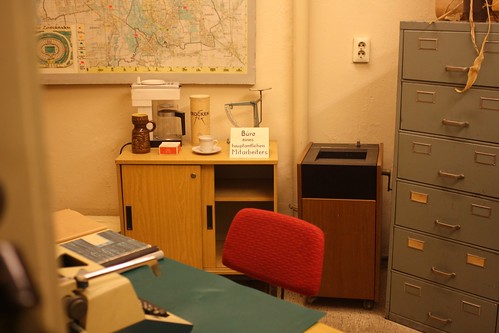
Note: this post written on March 19 for posting after we return. We arrived at Leipzig surprisingly about 5 minutes late on Wednesday morning. My friend Brad was at the Leipzig Hauptbahnhof (central stration) to meet us. As we walked through the city with him, he commented that I hadn t yet tried Currywurst, and there was a stand selling them with different levels of spiciness. I tried one and liked it; Terah was afraid to touch them. After a light lunch with Brad and Anna, we went back into town and saw the V lkerschlachtdenkmal (Monument to the Battle of the Nations). We were warned that it was weird and ugly. And when we arrived, I noticed that it was enormous. And, well, somewhat ugly. And, yes, weird. IMG_2681 After that, we walked through the old trade fair grounds. Leipzig has a long history as a trade center, and after they built the new trade fair grounds, the old ones were reused for other things except for the old Soviet building, which is now both gaudy and abandoned. We picked up Fritzi, who is a very cute 4 years old, from preschool and returned to their house for supper. After that, Brad and I went back into town, intending to hear a reading at the old city pool. When we realized it was a different day, we walked around the city center for awhile and then had a beer at a yes combination cafe/laundromat. Thursday was our day to explore the city. Brad showed us a couple of buildings in the university, including the library, then dropped us off at St. Thomaskirche. That s the church where J. S. Bach was music director for many years, and was buried. Like so many, it was impressive in its height and history. IMG_2703 Next we went to the Stasi museum. The Stasi were the feared and powerful East German secret police during the Communist times. The museum itself was housed in the former Stasi headquarters for Leipzig and was involved with the history of the overthrow of the Communists. The museum covered a lot of the history of the Stasi, including its frantic last days during the 1989 revolution. The level of spying on people was incredible and sophisticated, and they tried to destroy records as the overthrow of the government was imminent. One of the offices in the inner part of the building was left untouched from the Communist years, right down to the typewriter and coffee machine. IMG_2717 After that, we went to the Altes Rathaus (old city hall or townhouse, built in 1556) to do a bit of shopping. Terah was wanting some souvenirs, and I had spotted a shop I thought she might like when walking through the city with Brad the night before. We had already bought some souvenirs at the Schloss Charlottenburg museum store in Berlin (some East German-style crosswalk fridge magnets, and a decorative egg), but wanted something a bit nicer for us and were on the lookout for gifts for others too. We wound up buying a wood carved church scene with a woven wheat tree for us, and another item for others. The shopkeeper spoke no English, and my German vocabulary is small, but we managed to communicate the question of whether or not she could wrap it up in a box for our trip home and she could, and did. Excellent. (I didn t know how to ask about box, but knew how to say that we were Americans, and with a fair bit of gesturing all around, managed to get the idea across.) Then we went in the Altes Rathaus itself, which was both a museum and an interesting cultural experience. We bought our tickets at the booth downstairs, then went upstairs to the entrance. We asked for the English audio guide, which is very common at museums in Germany. (They are small digital audio players that contain recorded information; each room or display has a number you can key in to hear about it in your own language.) We got it, and were told in incredible detail how to use it, even though they are quite easy to figure out and we had used them before. The museum employee told us where the audio tour starts, and in what order it usually goes, which was an effort for her given her limited English. But we all understood and went on our way. It wasn t even 5 minutes later when she had left her desk and came over to us. She was slightly alarmed at two things: one that we didn t have the volume at full blast (which was loud enough for the entire room to hear), and secondly that we weren t looking at the exhibits in the proper order. Never mind that it s easy enough to pull up the audio information about any room just by keying in the number posted in it, I guess. Anyhow, we sort of inwardly shrugged, let her turn the volume up to potentially disturbing the other visitors level, and went through the museum in the order she wanted us to. (Note that this wasn t a museum where there is a one-way flow of traffic or something; you walk into one exhibit, back to the main hall, and then pick your next one.) So we went through the rest of the museum with our English audioguide blaring throughout the large, echoing, wood rooms, feeling a bit rude to the other visitors (maybe 5 of them while we were there) due to its volume. Anyhow, the Altes Rathaus was beautiful and interesting, covering mainly the pre-industrial history of Leipzig. We learned about some of the guilds, the city treasury (vault), and where the town council/parliament met along with rich merchants. There were about as many museum guards as visitors there, and one or two of them sort of followed us around, pointing out the large and completely obvious signs with audio guide numbers in the rooms for us. They are serious about their audio guides in Leipzig. I m glad we went, and I m glad we had the experience we did, too. Terah told me later that she felt reprimanded about the audio guide and visiting order. My take on it was a bit different: the museum is impressive and interesting, but obviously not visited by tourists as much as museums in other cities, or even touristy sites like Thomaskirche in Leipzig. I think they they noticed two people, obviously very foreign (speaking only a little German, and with an American accent) with an interest in their city s history, and took pride in making sure we got the most of our visit and learned as much as possible about something they care about. Here is the main hall of the Altes Rathaus. IMG_2727 We met up with Brad in a cafe near St. Thomaskirche for coffee and cake, then it was on to St. Nikolaikirche (the Church of St. Nicholas), the other large church in town. We stepped out of a passageway to face the large building, and walked in. The interior was decorated in pastels, and was also beautiful and historic. I can t get enough of that sort of building, I think. This building was especially important because it was the site of organizing for the Monday evening protests against the Communist government in 1989. People met at the church, sang a few hymns (to qualify it as a religious service, perhaps), then organized their protest for the evening. Sometimes they would wind through city streets and put flowers at the Stasi headquarters steps, and once the citizens actually overtook the Stasi headquarters. IMG_2745 After awhile we grabbed a bit more for lunch: a pretzel for Terah and a Currywurst for me. (This one wasn t spicy and wasn t all that good.) Then we went to the GDR museum, which was large and interesting, but unfortunately for us, completely in German with no English guide available. That evening, we went to a Bach concert at the Leipzig Gewandhaus, celebrating Bach s 325th birthday. That was fun, and a neat experience with such good music in a very nice venue. The program included Bach s Suite for Orchestra no. 1 in C Major (BWV 1066), Concerto for Violin no. 2 in E major (BWV 1042), Ich habe genug (BWV 82), and Suite for Orchestra no. 4 in D major (BWV 1069). Sir Roger Norrington was conducting, and was rather fun and atypical to watch. He had the audience chuckling a few times with his minimalist conducting or perhaps his flamboyant gestures. Anyhow, the music was excellent and the tickets included free passage on the public transit system 3 hours before and after the concert a nice touch. Due to our schedule, we didn t spend much time with Fritzi, but we did get to play with her a bit. She likes to pretend to be a shopkeeper, and had her store all ready to lay out. We would ask her for some items, which she d put in a basket for us, and then of course there would be a child s twist: we d get our items, and she d pay us for them too. Terah and I brought some books for Fritzi. The particularly enjoyed Goodnight Moon because inside it is an picture of The Runaway Bunny, which she already had. Fritzi chose one of her books to give to Jacob it was a German book (Maulwurf) based on a Czech cartoon mole. That was nice of her, and Jacob really liked it (I ll write about that later). We had a good time in Leipzig, and I was getting fairly good at navigating downtown and with the trams and then, of course, it was time to move on. So Friday morning we caught our 7:50 train from the Leipzig Hauptbahnhof. We took the ICE train to Dresden, then walked a few feet to get onto the EC to Prague. That was a bit of a funny experience. The ICE trains are all sleek, modern, meticulously maintained, and the passengers tend to be very quiet. Talking is barely above a whisper, and people seem alarmed if their cell phone rings, even outside the quiet car. The EC passenger car appears to have been built, or last renovated, in the 1970s, and may have been Hungarian. The seats and curtains are old and faded; some of the seat backs have rips in the vinyl headrests. People were talking or eating loudly, in a very different setting than on the ICE train. As we rode along, we were on the right side the river Elbe for many miles. The scenery was beautiful, with small houses in the river valley, and the occasional house up in the hillside. At one point (a bit before we passed through K nigstein on the way to the Bad Schandau stop), we spotted what looked like an old walled city up on the hill. I figured out later that it was Festung K nigstein (K nigstein Fortress). Update: I forgot to mention a couple of things about Leipzig. One was our walk through a forest yes, a forest in the city. That was a nifty, quiet, and pleasant surprise. Secondly was seeing all the DDR apartment blocks, where the apartments evidently were quite literally blocks. It is interesting to see the Communist architecture.

Clint Adams: DPL Campaign Questions 007

Bernd Zeimetz:
From the other candidates I'd like to know their opinion and plans (if there are any) about license/copyright requirements in Debian.
I believe that intellectual property laws are wrong and should be abolished, so I am not particularly in favor of giving copyrights any more respect than necessary. However, I do not think that Debian is the place to undermine copyright, and that we should attempt to maintain standards which not only protect people from legal liability, but are also in the best interests of our developers and users. I do not know what level of nitpicking best serves our developers and users. A GR seems like an interesting way of determining at part of that. Anthony Towns:
What's your estimate of the current number of Debian users?
I do not have one. While I do acknowledge that the number of users does affect us in terms of potential contributor base, and scaling issues (including bug reporting), I do not think that the exact number is important at all to what we do. Also I would hope that whichever DPL is elected chooses to focus on practical matters rather than academic exercises. Kurt Roeckx:
I think that one of issues we have is that there is alot of work to be done by some teams, some of them even regularaly mail that they need more members, but they seem to have a hard time keeping the numbers up, burning the other team members out. What are your ideas to make sure those teams keep running?
Note that I do not think it appropriate either for core teams to choose their own members or to reserve the privilege of demanding that a new person be able to work with them in a certain way. An ideal team member should be able to work with anyone. If the existing delegates are unable to work with new people, perhaps they are not ideal team members. Charles Plessy:
During the discussions that started after the GR, I suggested that the GR proposer should have more control about the options put to the vote. In particular, it would be useful if he can refuse an option that would disequilibrate the voting system. That would make him responsible for the success of the GR: discarding a popular option is taking the risk that the whole GR is refused and the option is accepted as a separate GR, which is the kind of public failure that I expect that people will avoid.
I do not think GR proposers should have any special control over general resolutions beyond what is Constitutionally granted at present. In fact, I would prefer if people did not try to propose multiple options or strategically craft ballots for any purpose. To me, the only honest method is to propose the outcome one genuinely wants to win, and let our strange and special brand of parliamentary procedure take care of the rest. As for the supermajority issue, I am not a huge fan of political word games. Debian distributes non-free software. We have a non-free section within our normal infrastructure, and while it is segregated and does not receive quite the same love that main does, it is still very much part of what we work on and distribute from our official infrastructure. So there is no amount of word lawyering, cognitive dissonance, or NM indoctrination that can make me believe that it is an honest statement to say that non-free is not part of Debian. Likewise I do not believe in redefining success or the meanings of Foundation Documents. I do not think that we should allow ourselves to pass any kind of magical resolution that contravenes the DFSG or Social Contract without actually modifying them. That seems utterly absurd to me, and I have seen what has become of the United States government.

Russ Allbery: Why no comments

When I first converted my journal from Movable Type, I converted all the comments with it and planned on adding comment support, as a long-term goal. But I've increasingly found that not having comment support is nice, and recently after reading several different takes on this topic, I've decided to take this off my long-term to-do list. A point made by both people involved with sites with strong commenting communities (Making Light and John Scalzi's Whatever) and others who have turned off comments is that maintaining a good comment community in the face of significant interest is a lot of work. One of my goals right now is to do less work that isn't directly interesting so that I can reserve my energy for things that I consider more core. I've now added a link to my explanation for why there are no comments to all of my journal posts and indices. A few more thoughts in addition to the ones there: I've been reading a lot of comments recently, mostly from following the debate in the US about health care reform, and I've been struck at how rarely comments are meaningfully addressed to the original post author or show intent to participate in a discussion. On political topics, most comments appear instead to be taking advantage of the comment platform to post one's own opinion in public, sometimes with the additional gratification of forcing that opinion to show up in the space of someone who obviously disagrees. I'm not interested in participating in or enabling that. If you want to make a controversial statement or take a political stance, own your own words and take that stance in your own space. I also suspect that one of the reasons why this happens so much in comments is that comments are considerably more anonymous than journals. Even if one's journal isn't openly connected with one's real name and life, like mine is, there is some persistance and history to most journals. I'm a strong believer in anonymous speech for a variety of different reasons, but one of those reasons is not to permit drive-by content-free attacks on other people. And that's the standard behavior in both political blogs and comment pages on newspaper sites. The anonymous speech I have the most respect for is the type that creates and builds reputation for an anonymous nom de plume, presenting a consistent public image and taking responsibility for one's previous beliefs. This isn't what happens in comment threads. Finally, I consider all of my web site, including my journal, to be to some extent permanent. I mostly do not take down pages, and I wouldn't want to take down comment threads. But for the most part comments, particularly on controversial topics, don't fit into that model. There's nothing wrong with that, but it makes me want to redirect them to a more appropriate forum. If I felt like there was some lack in the world of places where people could anonymously publish controversial opinions, I might feel more obligation to provide one in my journal, but I don't. It's also not something that I'm good at; other people are doing a much better job. So I'm going to stay out of hosting that type of on-line discussion and leave it to people with more interest and time. I welcome e-mail replies to journal posts, and have had several good discussions in those e-mail exchanges. That's what works best for me.

Next.

Previous.