Search Results: "mak"

16 April 2010

Wouter Verhelst: DPL vote

The DPL vote is over. I did not win, apparently. Let me start off by thanking the other candidates for running, and congratulating Stefano for winning. My own results aren't too bad; I beat 'none of the above' by a comfortable margin of almost 10 to 1, and ended up defeating Charles Plessy by a slightly smaller margin. My margin to NOTA was far better than during the previous DPL election that I participated in, though I did end up defeating more than half of the other candidates back then, which I didn't this time around. All in all, not enough to win, but enough to conclude that I might have a chance some other time. Margarita and Stefano were just better candidates this time around. My own vote was:
[ 2 ] Stefano Zacchiroli
[ 1 ] Wouter Verhelst
[ 4 ] Charles Plessy
[ 2 ] Margarita Manterola
[ 3 ] NOTA
If you run, you have to be serious about running, and support yourself. So I did. After that, I wasn't sure that Stefano would do a better job than Margarita (or vice versa), so I put them at the same spot. Finally, I became convinced during campaigning that Charles has a lot to learn still about what lives in the Debian community, and I am of the opinion that feeling the community is a vital requirement for a DPL; so that ruled him out. So why did I not win? Obviously because there were better candidates in the election, but the real question is: why is that the case? What did I do, or what did other candidates do, that meant they fared better than I? One possibility was given on IRC:
< svuorela> ol: and "I'm running because no other runs" is also
not a good way to get votes ...
Which is fair enough; but I did run with the intention of winning, and I did try to make that clear. I'm hoping that worked out okay, which would imply that there could be other reasons. I'd like to know about those. So if you voted, and did not place me on the top spot, I'd very much appreciate learning about your motivations for doing so especially so if you were one of the 39 people who would rather have redone the vote than see me win. Comments on this blog post are welcome, or by private e-mail if you'd rather not see them made public.

Andrew Pollock: [tech] On the iPad

I tend not to be a huge Apple fanboy. They make nice stuff, but it's just too closed for my liking. I like to tinker. I had a PowerBook for a while, but I gave it to Sarah in favour of a Linux laptop. Sarah's been a happy Mac user for a number of years, and had an iPhone (until I gave her a Nexus One). For a "normal" user like her, a Mac is fine, especially if you want to embrace Apple's entire ecosystem. Anyway, the iPad. When it was announced, I sat up and took notice. Why? This seemed like something I might actually use as a casual computing device. I mean, I'm almost in the target market for Chrome OS these days. I spend most of my time in a web browser, and the rest of my time in a terminal window SSHing to another computer. I could leave this thing lying around on the coffee table in the living room, and instead of digging my phone out of my pocket to look something up, I could pick this up instead. It is also appealing because I found Microsoft's Surface to be pretty cool. The iPad is like a more affordable, portable, version of that. It also appeals to me as a computing platform for my parents. Their computing needs have simplified over the years, but they're still running Windows, largely because I've never had the time to try and foist Linux on them. Since I moved to the US, my visits back home have been too brief to do a proper migration. I think an iPad that supported user switching would be perfect. Mum and Dad could share it, and read their email and do their web browsing from anywhere in the house. Since the first generation iPad doesn't do user profiles and lacks a camera, I'll wait impatiently for the second generation one. I heard a rumour today that it would have a camera, and do user profile switching based on the face of whoever was in front of it. That would be pretty cool. I'd also be very interested in an Android tablet. I love Android's speech to text input support, and I could really see an Android tablet stuck to the wall in the kitchen, instead of a whiteboard on the fridge and a paper calendar. The WePad also sounds intriguing. So I'm not so bothered by the iPad's closed nature. I think for the set of users who have basic computing needs, and don't care about openness, it's very cool.

15 April 2010

Josselin Mouette: A new toy

It takes a lot to prepare for a big trip if you want to really enjoy it. This time, we re going to Japan, and we bought some stuff to stay connected there. First, there s the new camera: that s a Sony 230. We haven t made a photo trip to see all its capabilities yet, but it looks like an excellent toy so far. You ll see probably more photos on this blog in the future. And there s the new laptop: a Packard-Bell Dot-M/A. Theoretically it s called a netbook, but in practice it has everything a real laptop has. The reason I chose this model is that it features Radeon (X1270) graphics and a 64-bit processor, all in a 11,6" laptop which is one of the cheapest of all. Lots of power in one kilogram for a low price, although the drawback is more cells in the battery. Getting the Dot-M/A to work under Debian I first tried to install lenny on it, and while it worked nicely there are several problems with hardware support.
  1. The CPU runs extremely slow; you would think it is an Atom. It takes no less than one minute to boot a minimal installation. This is a very strange issue.
  2. Wi-Fi doesn t work, even after installing the firmware.
  3. 2D works out of the box, but 3D doesn t: the kernel doesn t recognize the PCI ID.
  4. Frequency scaling doesn t work, it always runs at full speed which eats battery at an impressive pace.
Upgrading to squeeze solved the first three issues in a blink. The CPU is now as fast as you can expect from an Athlon 64 @1,2 GHz, there s wifi and 3D. OTOH I was hit by a GStreamer bug when the useless snd_pcsp module was loaded why isn t this thing blacklisted by default? ACPI nightmare CPU frequency scaling is another story. I discovered that the BIOS for such Athlon L110 computers does not expose P-states in the ACPI DSDT table. Which means Linux cannot tell at which frequencies it is supposed to work. However, thanks to the awesome work from a guy named Krists Krilovs and the awesome tutorial from the Gentoo wiki I was able to: After a reboot, I immediately noticed the fan slowing down. Under GNOME, the CPU was no less than 10 C cooler and the CPU frequency applet started to work. <hrule> The Debian kernel maintainers deliberately chose not to provide support for loading a DSDT table from the initrd. There are very good reasons for this, and anyway it shouldn t be necessary to hack something as awful as that to have power saving support. The question remains: how do we deal with this madness? There needs to be some kind of support out-of-the-box for the Athlon L110, which is otherwise a very nice beast. Could the powernow-k8 module set hard-coded defaults when it detects this CPU model? It would be better than the current situation. Other pieces of the toy Otherwise this laptop is very good hardware. Among other things, I enjoyed: There is one minor annoyance: the integrated RealTek Ethernet card is only 100 Mbits/s. With all this performance otherwise, you would have expected Gigabit, but well, not everyone has GigE at home yet.

Jan Hauke Rahm: MiniDebconf in Berlin, T 8 weeks

To give a short update on where we stand now with the amazing plan of having a Mini Debconf in Berlin this year. There are just 8 weeks left which means there is lots of stuff to do and it needs to be done soon. But luckily Of course, all this is written in the wiki and you can put yourself in it at any time to offer your help! And if you have questions or want to join more real time ;), point your IRC client to OFTC and
/join #debian-miniconf-berlin
Help is still needed with video and audio stuff. If you think you know how to move a camera, or you can even work a sound mixer, get in touch with us. We need a few volunteers to cover the whole two days. Also, more generally help is needed in order to have people to talk to at all times both for speakers and visitors. No special knowledge is necessary although it might prove handy to know what Debian actually is. :) Interested? As a visitor or helper? Anyways, get in touch with us and it s going to be awesome! </commercial>

Gustavo Noronha Silva: WebKit2 and WebKitGTK+

So you ve seen people talking about WebKit2, perhaps have seen someone claiming it drops support for Linux , and you ve been wondering what the hell that means for WebKitGTK+. Well, welcome to the preemptive Q&A section with WebKitGTK+ maintainers =D. Let s first explore some history so we can better understand what exactly is going on. What exactly is WebKit2? Currently, when we say WebKit we really mean one of the ports that are built on top of WebCore using the WebKit layer. WebCore is the part that does all of the hard Web-related work, WebKit an API layer that exposes WebCore functionality in a coherent way, so that the platform-specific ports can expose a public API layer for their applications to use, which is usually also called WebKit . This WebKit layer was designed by Apple to build the Mac, and Windows ports it maintains, and was later released as Free Software so that other ports, such as the GTK+, Qt, EFL ports could be built on top of it, instead of having to do all the heavy lifting from WebCore directly.

Current WebKit model WebKit2 is nothing more than the second version of that interface, with a whole lot of changes on what you can expect from it, and on how it interacts with WebCore, and the platform-specific API and UI. First of all, the first WebKit was not API stable, and that interface was usually not made public by the various ports - they only exposed their platform-specific APIs. WebKit2 is being designed to provide a stable, cross-platform, C-based, non-blocking public API. This is huge. It will allow cross-platform code to be written without having to consider language, and port differences for basic functionality. The second big change is the API will be made fully non-blocking. Currently most things you do are asynchronous already, but some of them may be completed in a synchronous ways (like, loading a string into WebKit instead of an URI). This is important for responsiveness, and is also a very important need for what comes next: process splitting. WebKit2 will bring into WebKit proper the concept of splitting the UI process from the Web process, similar to what Chromium has. It also much more awesome than what Chrome has for a large number of reasons, including, but not limited to:

  1. It s being contributed directly to the WebKit project, in a cross-platform way that lets ports such as WebKitGTK+ take advantage of it, instead of being shipped directly into Safari, like Google does with Chrome;
  2. The process separation goes bellow the API layer, meaning that all complexity involved in managing the process separation is handled by the library, and hopefully none of it leaks to the application using it; that means that applications like Devhelp and Yelp will be able to take advantage of this without having to make their lives more complicated;
There s a much better diagram in WebKit2 s wiki page, but here goes a simplified version that demonstrates what I m talking about:
WebKit2 model
What WebKit2 is not? WebKit2 is NOT a rewrite of the whole WebKit stack. Webcore will continue mostly unchanged, and all ports currently building on top of it will keep working. It is also not a fork - the code lives in the same tree as the current version of WebKit, which will allow us to progressively move towards using this new, improved layer. WebKit2 is not Apple-only, and it is not dropping Linux support. Initial builds of the code that is being landed will likely show up building on Linux in the near future (specially because us porters are already eager to play with it). What happens to WebKitGTK+? In the near future, nothing special. We will continue working towards making it feature-complete, more stable, faster, and rocking on it as always. We will, though, start working out how we can best take advantage of WebKit2 in order to provide an even more awesome library for the G world. What this means is you can expect us to have a library that will provide a nice GTK+ widget, just like we have today, with a GObject-based API, like we have today, but that is built on top of this new WebKit2 infrastructure, taking advantage of the process-splitting, and the bigger focus on not blocking the UI thread. This should give us a platform that is more stable, and faster and more responsive than what we already have today. The API is bound to change, of course, but the WebKit2 version of WebKitGTK+ will be a separate, parallel-installable library, and we will keep supporting the WebKit1 version while we work on making the new one at least as good as the current one. This is long term we re talking here. We ll likely see WebKitGTK+ 1.4, and 1.6 come to life before we are satisfied enough with WebKitGTK+2. We hope this clears some of the doubts up, and lightens your hearts! The WebKitGTK+ maintainers.

Biella Coleman: Cultural Cornucopia

Today all across America, many are experiencing a soft form of hell, anxiety, and constant cursing for it is tax day. Thankfully last night I squared those away (more or less). Today is also the last day to register forDebconf sponsored registration. Even if there is a chance you can t make it, it is worth filling out the form just in case. For those spending a little extra time in NYC or planning on sneaking out to take a whirl in the city, here are some more fun options. NYC is known to be a cultural cornucopia of sorts and one reason are the many museums. I just found a twitter list listing those museums with a feed. Probably one of my favorite museums is located in the far north of Manhattan, the Cloisters. It is a haven, an oasis with small beautiful gardens, as well large stone rooms and buildings filled with medieval art, tapestry, and manuscripts. If you need to get away from people, chatter, and computers, this might be a good place to visit. Museums are easy enough to find but there are other spots in NYC that may be a little harder to spot. If you want to hit Chinatown for dim sum, I would recommend Jing Fong, which is mind blowing largely because of its LARGE (like there are escalators that take you up) room, which gets pretty darn packed on the weekend. If you want something that involves not just food but involves sweat, water, food, sun, hot rocks, body scrubs, funny looking pink, orange and blue uniforms and all in a cross-cultural context, then Spa Castle is the place to go to. Just check out the website and you will see what I am talking about. It s family friendly, has a cornucopia of saunas (filled with jade, gold, ice, Tibetan bricks), some decent Korean food, among many other attractions. In general is one of the best deals in NY.

MJ Ray: Debian Project Leader Election Campaign Round-up

I ve been AWOL for most of the debian project leader election campaigns this year, but I still want to vote, so I ve been dredging the emails on the last day. Maybe someone still has to vote and reads this, or maybe it ll help someone to interpret the result. What I ve done this year is to make a quick tally of platform points and campaign answers that I liked and disliked for each candidate, then total them up to get an order. If anyone gets a negative (more dislikes than likes), then I ll rank them below NOTA. Platforms: Margarita Manterola, Stefano Zacchiroli, Wouter Verhelst, Charles Plessy. Some of the questions: Make of that what you will. It surprised me which way the scores came out, but there was one answer with such a massive problem (in my opinion) that I ranked its giver equal with the next candidate down anyway. If you re a debian developer (DD), have you voted yet?

14 April 2010

Joey Hess: git reflex

snapshot.debian.org launched
with all Debian packages produced in the past 5 years
6.5 terabytes first Wikipedia database dump in 4.5 years
5.6 terabytes (32 gigabytes compressed) My reflex on seeing both of these was to think about putting them into git repositories. For snapshot.debian.org, injecting source packages into git repositories is easy with git-import-dsc (and it can also use pristine-tar to make the original tarballs accessible with a miminal overhead). I hope the snapshot.debian.org admins find time & space to do that, because being able to easily access git annotate data spanning 5 years for any package in the archive would be very useful. To produce a usable git repository from the Wikipedia dump would probably involve writing a custom git-fast-import that processed the huge xml dump, and chunked it up into individual files, and commits changing those files. Frankly, I do prefer wikis that store data in git in that format natively and don't have multi-month dump procedures. ;) How big would the git repos be? My SWAG is well under 1 terabyte for snapshot.debian.org, and between 30 and 300 gigabytes for the wikipedia data.

Matt Zimmerman: Pop visualization

It s no surprise that information visualization and related fields have been active research topics in the past decade. The widespread availability of large, valuable data sets has created a need for improved tools and techniques for making sense of it. This is highly technical work, requiring expertise in design, mathematics, software and other fields, and there is a vibrant community of professionals and amateurs who experiment and critique the latest methods. In the geeky blogs that I follow, I see more and more amateur interest in visualization. Visualization is starting to take on political significance as well, as evidenced by the appointment of information design pioneer Edward Tufte to a US government advisory panel to help explain economic policy to the American public. A technology is confirmed to be truly and vitally relevant, though, when it enters the mainstream consciousness in the form of humor. In the case of visualization, geeks have been trading funny charts and graphs for many years, but this phenomenon seems to have finally crossed the chasm into popular Internet culture with the advent of the Venn diagram meme. Now, anyone with an elementary education and a drawing program can create their own chuckle-inducing infographics and enjoy their 15 minutes of Twitter fame. Likewise for the X as seen by Y two-dimensional grids, revealing how various (stereotyped) groups perceive each other. This is the future, becoming more evenly distributed by the minute.

Andrew Pollock: [opinion] Queensland and daylight saving: the epic battle continues

I see that Queensland is making noises about daylight saving again. I personally quite like daylight saving. I think it works great in California. I remember when it was trialed in Queensland, and I enjoyed it when I lived in Canberra. I can't remember who told me why the farmers object to it so much, (no, it's not that they're worried about their curtains fading), but it was an interesting explanation: Farmers work the land, from sunrise to sunset, not the clock. The pub, however still closes at the same time. If they're now knocking off work an hour later, but the pub still closes at the same time, that's an hour less drinking. No idea how accurate that explanation is, but it makes for a good story. Anyway, the point of this post is to say that I think the idea of carving the state into two timezones is insane. It should be all or nothing.

13 April 2010

Gunnar Wolf: Regarding the fatal cycling accident in Ciudad Universitaria

My blog is written in English, even though I sometimes post content relevant locally. Anyway, I want this to be as widely known as possible. We are about to launch a website/community for my University's cyclists, BiciUNAMonos. Please note the site I'm linking is still very preliminary in several ways. But that's the least relevant for now. I am translating here a message written by fellow cyclist (and researcher in the Institute of Astronomy of my University) Sergio Mendoza.
Regarding the fatal cycling accident in Ciudad Universitaria Yesterday night I got home, and was quite surprised to open my mailbox and find a considerable amount of messages under the subject Urgent: Fallen cyclist! I immediately noticed something was very wrong, and was surprised they were contacting me. When I decided to read the first such message, I realized what happened: Dr. Jorge Villanueva was run over by the Puma [internal University service] bus number 14, route 2, which was being driven over the speed limit. This happened last Sunday, April 11. On Sundays, all of Ciudad Universitaria becomes a cycling and running circuit. I was immediately brought back to the moment that, when I was leaving my office in the Astronomy Institute and heading towards Cerro del Agua avenue, a lady driving over the speed limit on the circuit that comes from Metro Universidad threw her car at me. I saw her at a few centimeters distance from her windshield... To the day I don't know how I pulled my bike away, as I was going to hit the windshield with my shoulder. Everything happened in slow motion, I just heard several cars honking at this imprudent lady. I didn't have a scratch, but got excessively close to getting a strong hit, and with the adrenaline raging I gave a kind caress with my closed fist to her brand new car. I had to free my adrenaline somehow... My legs were trembling when I tried to pedal. I told her, lady, I am excessively visible in my bike, why did you do this? , she didn't answer, she just looked despectively at me. This kind of accidents happen every day in the University and its main entries. Precisely today, a University professor threw his car at me entering the University via Cerro del Agua. When I reached him and confronted him, he told me completely sure of his words that I was invading the lane with my bike, and that it was my fault. Anybody would have thought a car-driving university professor is capable of reading the Metropolitant Transit Regulations that clearly states on its 1st article: The priority for using the public space, for the different transport modes will be according to the following priorization: I. Pedestrians; II. Cyclists; III. Users and providers of massive, collective or individual public transport service; IV. users of particular automotor transport; and V. users and providers of freight transport. We are now organizing to put up the first ghost bike in Ciudad Universitaria. This happens few days before the formal inauguration of BiciUNAMonos, the universitary association of urban cyclists; we will do this remembering our university mate. I see every day more people in the University hitting their bike pedals to get to their faculties, centers and research institutes, but what is striking is the lack of University infrastructure. The few cycleways we have are built to use a bycicle system that is open only until 16:00. It is good, but it is in no way useful for those of us who use the bike every day and at every hour, no matter the weather. The main problem lies at the communication points, when cyclists arrive from outside Ciudad Universitaria and have to take the regular circuits to reach the cycleways. The Transit Regulation, in the 1st article I quoted above, defines in an excellent way the priorities that must exist to allow human movility. In this regard we have to mention that:
  1. The pedestrians must be enormously protected with walkways and semaphores to allow them to safely walk. In Ciudad Unviersitaria there are many places that don't even have a walkway or semaphores, and drivers do not respect the pedestrian's preference. Also, now in the central area of Ciudad Universitaria we have the Pumabus system on a confined lane, providing an excellent service to the pedestrians to move within the campus.
  2. The cyclist comes next in this priorization, but there is nothing obvious for him. There are a couple of cyclist ways, usually invaded by pedestrians, and explicitly made to use the Bicipuma system. Cyclists need their own lane for circulation in the Universitary circuit; pedestrians have walkways, Pumab s has its confined lanes, but the cyclists still lack it. The third lane that remains is precisely for the IV and V entries in the Metropolitan Transport Regulations. They can perfectly share the remaining lane in the campus.
The last thing I wanted was to formally announce BiciUNAMonos reminding a fallen cyclist and dedicating a ghost bycicle to his memory in Ciudad Universtiaria, but we don't have a choice. We have to make it very clear to the University community that the bicycle is the best transport system, and that the drivers' imprudence inside Ciudad Universitaria must be strongly punished. Sergio Mendoza
President
http://www.biciunamonos.org
Coincidentally, today I also had a freightening experience. Taking one of my usual routes to work, going up from the sporting area in the Western half of the campus (just before where the map lists the highest point in my ride), just by Investigaciones Biom dicas, I heard a car hitting the breaks behind me and passing me (on my right side) quite narrowly. I was, as always, driving towards the center of the lane, to be able to respond to unforseen events (as this one, precisely). The Universitary authorities had the great(?) idea of placing round, small bumps before the Pumabus stations to avoid drivers parking in front of them. I have seen a strong accident caused by them, and was close to suffering one myself some months ago. I know that just after Biom dicas there are some such bumps, so I never ride too much to the right I don't know what was on this driver's head. Ciudad Universitaria has a 40 Km/h speed limit. Yes, it might seem too low - Circuits are wide and well planned. But there is a lot of cyclist and pedestrian transit, at all times, and I must recognize such a limit is well in place. I often take a longer route to my Institute, bordering the University along Av. Delf n Madrigal. People tell me I'm crazy, as this is an avenue that's often taken at high speed - Usually, cars pass me by between 60 and 80 Km/h. However, I even feel safer going that way than going inside the University. Contrary to the popular belief, Universitary people do not have better driving habits than the bulk of the population. And it's often much easier to drive along a way where the traffic even if it goes at three times my speed runs only in one direction, unlike the swarming of people going in every possible direction inside the main campus. Anyway, last Sunday we lost a University professor, we lost a cyclist. Some people lost a friend, a family member. We have to make this case well known, we have to speak with the authorities so they see the Bicipuma system is good, but not enough. Cycling is the only way to go for a city as complex as ours. A much needed first step is to allow proper vial connections linking the University and the many avenues that surround it. Another one is to make a campaign so the cyclists are not seen as Sergio regards as intruders in the streets The street belongs to us all. Cyclists should never drive on walkways or among pedestrians. Drivers need to learn to share the streets with us.

Guido G?nther: Simple git data provider for Zeitgeist

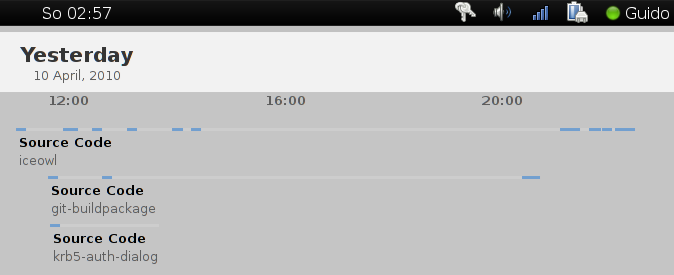
gnome-activity-journal recently entered Debian and it could become a great tool to keep track of hacking activities. The underlying zeitgeist can log these and other events and make the information available via DBus. I couldn't find a data provider that feeds the information about Git commits to it so I wrote a simple post commit hook. This way one can easily see when one worked on a source repository: gnome-activity-journal Now is there a nice way to store additional information like current branch or commit message along with that?

Asheesh Laroia: Let people help your project: Give them a button to click

This note goes out to the maintainers and contributors of Free and open source projects. (Cross-posted at the OpenHatch blog.) I recently had the chance to look at Mozilla Quality Assurance's research into the people who help out with testing versions of Firefox. I saw numbers that really spoke to my experience as a volunteer. On one hand, the vast majority of people put in three or fewer hours a week, most of whom put in one hour or fewer (such as zero). On the other hand, a huge number wish they could put in a lot more: Now imagine you're that one-hour-a-week contributor. You have all these other bits of your life tugging at your time. You want to make sure that when you sit down to work on free software, you're doing something that really helps out. Otherwise, not only will you feel bad that you aren't giving free software as much time as you wish, you'll feel bad that you're not even making a difference. In my experience, even reading the project mailing list counts toward that time you're putting into the project. But that doesn't feel productive. So fellow contributors, I have a request for you: Would you be willing to make it super easy for someone to stand waiting, on guard, for instructions from you? Imagine if all they had to do is click a button on your website, write a little bit of info about what they could do, and you would suggest something for them to work on. Maybe you can offer them a bitesize bug to fix, or maybe you need someone to download and test the latest version before you release it. If you're handing out assignments, then part-time contributors don't have to spend their time figuring out what they should do. I want to tell you that I can give you such a button. It would look like this: To get it, you just have to add a little snippet of HTML to your project website. Just go to the OpenHatch project list. and find your project. If it's not there yet, search for it, and click the link to create it. Then find the box labeled "Have your own website?" and click. Ta-da! HTML source code you can copy-paste. Since OpenHatch itself is an open source project, we added the button to our own "source code, etc." page. When people click it, they appear in a list of "People willing to help" on your project's OpenHatch page. Like all the friendly faces on the Gwibber page. Would you try it, too?

12 April 2010

Ingo Juergensmann: Syncing N97 with DAViCal

A few days ago I blogged about my problems syncing my N97 with iCal, Sunbird and other calendar apps. Today I tried DAViCal instead of Apples calendarserver (caldavd). To my surprise it worked fairly well, although not flawlessly. To make it short: I can now sync between my N97 smartphone via Bluetooth and iCal on OS X and Sunbird (tested on OS X as well): creating appointments on the N97, syncing via iSync and having the appointment exported to DAViCal via iCal works pretty well. Deleting dates works well in iCal as well. It has some problems as mentioned before on N97, though. But when you delete the date in iCal, it will vanish on the N97 as well.


It was somewhat tricky to get it that far. The problem is, that iSync can only sync to a local calendar in iCal. But with DAViCal you can publish/export that local calendar to the server where it is display a another calendar principal. That why syncing with the N97 works pretty well, although you might end up with double entry in iCal. I unchecked the N97 prinicipal/calendar from the server in iCal, as you can see in the screenshot above.

I haven't been able to test calendar sycing on Debian yet, but I believe that there will be some app that will work. And there are still problems. For example I have an appointment in July and August that are displayed in iCal and Sunbird, but not on the N97. Maybe there are some attributes to those dates that prevent them from being imported into the N97. Dunno.
But so far this is the best syncing solution so far. I'll test how well this works out for me...

Andrew Pollock: [tech] Using capabilities from Python

I've become passingly interested in Linux's capabilities functionality, as a way of reducing full-blown UID 0 requirements. Unrelated to this, one of my few gripes about Python, coming from Perl, was the inability to do anything like Perl's $0 to alter the appearance of the running program. I used to use this functionality in Perl a lot to provide cheap insight into what a long running Perl script was up to. Well the other day, I was rather excited to learn that Dennis Kaarsemaker has written a Python interface to capabilities, which also implements a set_proctitle() function. The python-prctl module isn't currently available in Debian, but as Dennis has all of the packaging in the Git repository, I've offered to sponsor it for him if he wishes.

11 April 2010

Gunnar Wolf: Lets all get running

There is no clear reason, but for many months already, I have almost given up running Which is a shame, as I enjoy it so much. And yes, I can talk a lot about why not, but outside of one seemingly stupid point there is really no reason. And yes, I have taken on cycling, although on a very different fashion: Cycling is by far not as good as an exercise as running Yes, cycling for ~1h on average 3 times a week has kept my body from becoming sedentary again, but I do feel some increased clumsiness and a undeniable weight gain that I don't want to allow. I said there is one seemingly stupid point: Shoes. My running shoes are around two year old, and they are an important factor on me not running. Why? Because they started giving me blisters at ~5Km. And my shoe size is beyond what is considered as normal by Mexican standards European 44-45 (US 10 -11). Shoe-shopping is always frustrating and very off-putting for me, as instead of what most people do (go to one store, ask for their favorite n pairs on their size, test them on, pay, be happy), I follow almost the opposite process (go to n stores, ask for whatever they have on my size, test it on, pray, pay). Of course, for some people, entering many stores and checking what's offered at each is a thrill by itself. For me, that sounds as thrilling as visiting the dentist for an endodontic treatment. Oh, and to make things even better, I am quite low on cash. Scarcity economics explain that if a given good is hard to find, it will probably be more expensive. So, while many people in Mexico buy ~US$30 shoes, I often get to pay ~US$90. Fun, hah? Anyway, I had a short semi-vacation to Argentina. I decided to kill this excuse, and went shoe-shopping. Fearsome memories sprang in my mind when the first store said they didn't have anything right for me. But they pointed to a second store, one block away, where I found (I was even able to choose between several models!) a nice pair of Olimpikus. In 2008, I was routinely running slightly over 10Km. Today I went out to get back the feeling, and made a not-so-great-but-still-satisfying 4Km. And upon arriving back home, I read Christian's chronicle on his Paris Marathon run Well, only 10% of what my fellow DD achieved But I am definitively back on track. I expect to make some time to get a run, at least three times a week, trying to push my limit at least back to the nice spot I was at two years ago.

Gunnar Wolf: Snails flying by

Snails flying by
Snail mail has become a despised media. While I still held long conversations at a distance written with ink on paper, with latency measured in weeks and not in milliseconds, that's basically history now. Snail mail is where invoices are received. Ocassionally, a joyous invitation finds its way into my mailbox But its regular use has been almost completely abandoned. Which probably makes it more striking and more of a surprise to receive a very short note of a good friend living far away just stating a very warm greeting. (of course, the paper was not GPG-signed, but I'll have to believe it was sent by him ;-) ) (Oh, about the title: The card is a print of Don Nisbett's Fly By , which recreates Ilwaco, Washington's panorama)

Martin-&#201;ric Racine: xf86-video-geode: EXA Composite support broken on X server 1.7

Just a quick note to everyone who recently upgraded their X server to 1.7 on Geode hardware to report that changes in X server since 1.6 have exposed and escalated bugs in our Geode driver that make EXA Compositing fail, resulting in broken image support on GTK2+ applications. As a temporary work-around, add this line to /etc/X11/xorg.conf in the Devices section:
Option "EXANoComposite" "true"
On my Lucid host, this gives me the following minimalistic xorg.conf:
Section "Device"
 Identifier "Geode Video"
 Driver "geode"
 Option "EXANoComposite" "true"
EndSection
We're currently working to produce new upstream packages that default to EXANoComposite as a temporary work-around, so that the driver at least produces useful results by default, and push this to distributions ASAP, especially keeping in mind pending Squeeze and Lucid releases. Meanwhile, AMD recently assigned new engineers to contribute to the driver's development and to eventually pick up maintenance, so we should soon have a permanent solution to these recent breakages in acceleration support for both GX2 and LX chipsets.

Christian Perrier: [life] Paris marathon 2010~bubulle-1 ACCEPTED

Upload accepted by organisers. Upload time has been 3h49'29" (my watch says 27", eh!). That was a good one, really (actually, I can compare to only 3 as it was my fourth marathon after Paris and Cologne 2009, plus the unofficial Rambouillet Forest marathon I ran alone 6 weeks after Paris 2009). For marathoners around, here are the chronometric data. Please note that GPS watches tend to overestimate the distance, mostly because of the jerky way one runs in mass events, as well as geometric considerations related to the imprecision of GPS (imprecision may be lateral and thus the line recorded by the watch is often less straight than the real one). For instance, according to my watch, Paris marathon was 42.63km long, so an overestimate by nearly 500meters. As a consequence, the recorded speed of 5'23"/km should be corrected to 5'25". So, times below should be increased by 2 seconds. As a conclusion, even though I can improve the pace and avoid going too fast in the first 25km, I'm very happy as I avoided nearly collapsing as I did last year (with sometimes over 7'00/km and a few walks). Going back home was OK and I had no cramps and I still haven't any. This is also what one gets when preparing well. My only regret is that I didn't run over 30km since, indeed, Cologne Marathon! That made the difference in the last 12 kilometers, obviously. Having spent the winter on many half-marathons (either alone, or a few officials) clearly improved my "performance" up to 25km. For the next marathon (a marathoner always thinks about the next one), I need to have 1 or 2 long trainings a few weeks before. Now, I have to find out which one will be the next one... and I wish good luck to my friend No l K the, who is preparing the Mainz marathon for May 9th as well as Dirk who's certainly preparing another one. Guys, rendez-vous is of course for Debconf10 in NYC. We won't run a marathon for sur, but how about an half one? :-)

Next.

Previous.