Benjamin Drung: Unreliable SSDs
Today my system froze and failed to reboot. I plugged in an Ubuntu live USB stick and booted from it. Then I discovered the problem that my Intel SSD 320 broke. The output of hdparm is attached to the end of the blog post. You can see that the device size is reduced to 8 MB from 120 GB and the serial number is called BAD_CTX 00000159. The firmware of the SSD was up-to-date and the last firmware update should have fixed the 8 MB bug.
The Intel SSD 320 is my second SSD. My first SSD was a Super Talent Ultradrive GX 64GB, which died after around fifteen month of heavy use. It left a big bunch of my data corruption behind. SSDs seems to be very unreliable. Both SSDs died, but I cant remember that one of my HDDs died.


$ sudo hdparm -I /dev/sda
/dev/sda:
ATA device, with non-removable media

	Model Number:       INTEL SSDSA2CW120G3

	Serial Number:      BAD_CTX     00000159

	Firmware Revision:  4PC10362

	Transport:          Serial, ATA8-AST, SATA 1.0a, SATA II Extensions, SATA Rev 2.5, SATA Rev 2.6

Standards:

	Used: unknown (minor revision code 0x0029)

	Supported: 8 7 6 5

	Likely used: 8

Configuration:

	Logical		max	current

	cylinders	16383	16

	heads		16	16

	sectors/track	63	63

	--

	CHS current addressable sectors:      16128

	LBA    user addressable sectors:      16384

	LBA48  user addressable sectors:      16384

	Logical  Sector size:                   512 bytes

	Physical Sector size:                   512 bytes

	device size with M = 1024*1024:           8 MBytes

	device size with M = 1000*1000:           8 MBytes

	cache/buffer size  = unknown

	Nominal Media Rotation Rate: Solid State Device

Capabilities:

	LBA, IORDY(can be disabled)

	Standby timer values: spec'd by Standard, no device specific minimum

	R/W multiple sector transfer: Max = 16	Current = 16

	DMA: mdma0 mdma1 mdma2 udma0 udma1 udma2 udma3 udma4 udma5 *udma6

	     Cycle time: min=120ns recommended=120ns

	PIO: pio0 pio1 pio2 pio3 pio4

	     Cycle time: no flow control=120ns  IORDY flow control=120ns

Commands/features:

	Enabled	Supported:

	    	Security Mode feature set

	   *	Power Management feature set

	   *	Write cache

	   *	Look-ahead

	   *	Host Protected Area feature set

	   *	WRITE_BUFFER command

	   *	READ_BUFFER command

	   *	NOP cmd

	   *	DOWNLOAD_MICROCODE

	    	SET_MAX security extension

	   *	48-bit Address feature set

	   *	Device Configuration Overlay feature set

	   *	Mandatory FLUSH_CACHE

	   *	FLUSH_CACHE_EXT

	   *	General Purpose Logging feature set

	   *	WRITE_ DMA MULTIPLE _FUA_EXT

	   *	64-bit World wide name

	   *	IDLE_IMMEDIATE with UNLOAD

	   *	WRITE_UNCORRECTABLE_EXT command

	   *	 READ,WRITE _DMA_EXT_GPL commands

	   *	Segmented DOWNLOAD_MICROCODE

	   *	Gen1 signaling speed (1.5Gb/s)

	   *	Gen2 signaling speed (3.0Gb/s)

	   *	Phy event counters

	   *	Software settings preservation

	   *	SMART Command Transport (SCT) feature set

	   *	SCT LBA Segment Access (AC2)

	   *	SCT Error Recovery Control (AC3)

	   *	SCT Features Control (AC4)

	   *	SCT Data Tables (AC5)

	   *	Data Set Management TRIM supported (limit 8 blocks)

	   *	Deterministic read ZEROs after TRIM

Security:

	Master password revision code = 65534

		supported

	not	enabled

	not	locked

		frozen

	not	expired: security count

		supported: enhanced erase

	2min for SECURITY ERASE UNIT. 2min for ENHANCED SECURITY ERASE UNIT.

Logical Unit WWN Device Identifier: 500151795951d4b9

	NAA		: 5

	IEEE OUI	: 001517

	Unique ID	: 95951d4b9

Checksum: correct
 I just read reports about Boston marathon 2012. Incredibly though race
this year as the heat raised up to 32-35 C (around 90 F?) for the last
runners and 26 C at 10:00 at marathon start.
The outcome is indeed impressive: the 2012 winner won with a "not so
good" time of 2h12 while last year saw an unofficial world best time
of 2h03'02" (there can't be any world record in Boston because of the
race being one-way, thus prone to too favourable wind, plus a negative
slope between start and finish).
Even though this year is less likely to see great records (because
this is an olympic year and the best runners won't run another
marathon before the Olympics), we still had times around 2h05 in Paris,
Rotterdam....and this year's best time in London with 2h04'44" (Dubai
time is 2h04'23" but I do not count this one as a mass marathon).
So, 2h12 in Boston just says how hard this race was.
But, still, that's my dream marathon, even more than NYC marathon. And
I'll do it, I promise....though I now have to run below 3h30 to
qualify....unless I'm still running marathons when I reach 55, where
the qualificaiton mark will be only 3h40 (which is exactly my PB as of
now). Will I still be able to run in 3h40 in 4 years? Or will I
succeed in running in less than 3h30 in the meantime? We'll see..:-)
Until then....my first marathon for this year will be on June 9th, in
Caen, as planned. Target: less than 3h40, despite the quite hard
profile (and possible windy conditions as the first half of the race
is along the famous Normandy beaches code named Sword, Gold and Juno,
between Courseulles sur Mer and Ouistreham).
So, until then, I'll forget about my nice races in forests and plains,
and concentrate on interval trainings, boring sequences of 400m or
1000m runs, etc, etc. That will be the first time I'm doing this but
everybody keeps telling me I need to do that if I want to lower my PB
(and every marathoner wants to!).
 The marketing industry divides itself up into a number of businesses.
Some are boutique agencies, but most are owned by one of the
world's four major holding companies. These conglomerates pursue
an aggressive M&A strategy, snapping up smaller companies all the
time.

 In a simple world, if you wanted to store some objects and distribute them
on 4 nodes, you would split your hash space in 4. You would have 4
partitions, and computing hash(object) modulo 4 would tell you where to
store your object: on node 0, 1, 2 or 3.
But since you want to be able to extend your storage cluster to more nodes
without breaking the whole hash mapping and moving everything around, you
need to build a lot more partitions. Let's say we're going to build
210 partitions. Since we have 4 nodes, each node will
have
 Data replication
Now that we have our storage theory in place (accounts, containers and
objects distributed into partitions, themselves stored into multiple zones),
let's go the replication practice.
When you put something in one of the 3 rings (being an account, a container
or an object) it is uploaded into all the zones responsible for the ring
partition the object belongs to. This upload into the different zones is the
responsibility of the swift-proxy daemon.
 But if one of the zone is failing, you can't upload all your copies in all
zones at the upload time. So you need a mechanism to be sure the failing
zone will catch up to a correct state at some point.
That's the role of the swift- container,account,object -replicator
processes. This processes are running on each node part of a zone and
replicates their contents to nodes of the other zones.
When they run, they walk through all the contents from all the partitions on
the whole file system and for each partition, issue a special REPLICATE
HTTP request to all the other zones responsible for that same partition. The
other zone responds with information about the local state of the partition.
That allows the replicator process to decide if the remote zone has an
up-to-date version of the partition.
In case of account and containers, it doesn't check at the partition level,
but check each account/container contained inside each partition.
If something is not up-to-date, it will be pushed using rsync by the
replicator process. This is why you'll read that the replication updates are
"push based" in Swift documentation.

 this week I've started to look at the (not yet release critical)
 Obnam is my backup program. See
 Work on my bathroom continues. I had expected it to be complete on Friday but it lookse like the new completion date will be Tuesday or Wednesday.
It will be very nice to have a working shower, and a toilet I don't need to "flush" with a bucket.
The only interesting thing I've been doing is planning on a kernel to support long-term for some poor unfortunate souls who cannot use Debian-based kernels.
I know building, supporting, and maintaining a kernel will be a pain. But at the moment it looks like a valid thing to be suggesting.
Otherwise life goes on. I've been hit by the DIY bug, largely as the result of seeing all the bathroom work going on, and figuring I was going to live with dust/mess anyway - so I've erected some more book-shelves, and ordered a pair of ceiling fans.
The only other thing to report is that I've started deleting emails. (shock!)
I look after a few machines for myself, friends and so on. Each one will send me automated emails at times. I've got them going back years - but no longer:
 Just a short update for those who are wondering what is Kannada Dictionary bot, it is
a small Jabber chat bot written in Python which pulls out meaning for given English or Kannada
word from
 S more days, s more patches:
Hacked out a few over the last few days, this time, to some good eats. I m making a habit of this tv-hack-time thing.
 I came across this article today and really found it noteworthy:
 I did sort of commit to at least trying to add support for Android string resource to
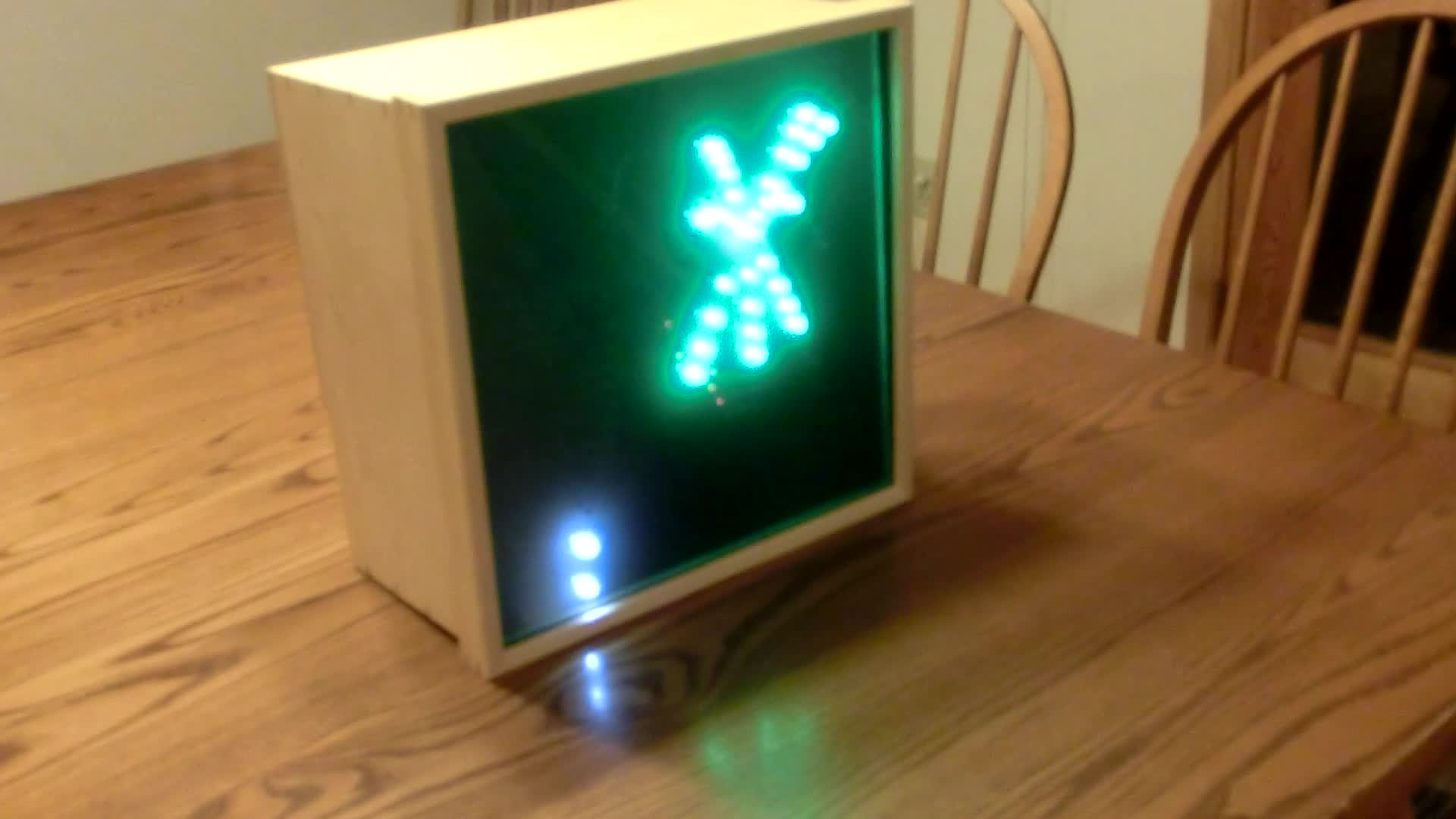
 LED Fireworks. Or, parent helpers go overboard
My friend, Mike Ward, and I help out at our kids school by teaching
5th and 6th graders programming in conjunction with a Lego class. For
several years, I was teaching Logo on ancient Apple II machines. The
teacher had a great curriculum and the kids learned a lot, but
this year we decided to switch things around and try them out on
Arduinos.
This spring, the kids are building a Lego display centered around
a birthday party theme for the star elephant at the Oregon Zoo
(Packy), who turned 50 last weekend. In a moment of fun, I suggested
that perhaps we should have some fireworks, along with the presents
and birthday cake. How hard could it be to wire up a couple of LEDs to
an Arduino to make something that looked like fireworks?
Selecting parts.
Mike and I sat down to order some parts from Digikey. We found these
nice, cheap,
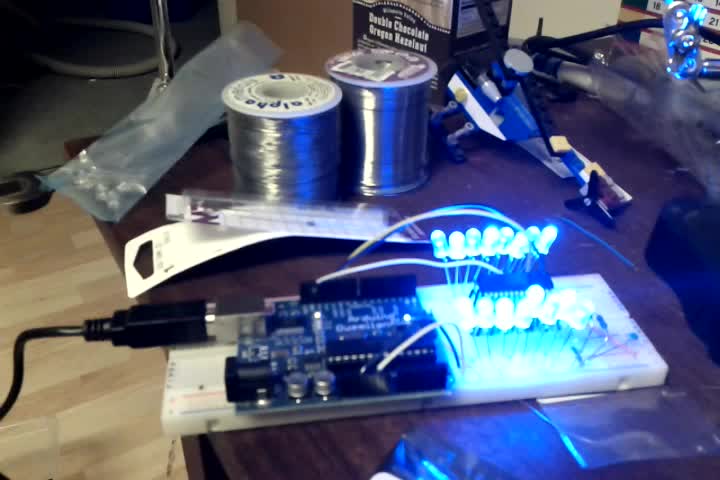 You can see the LED driver chip sitting on a set of extension leads
plugged into the breadboard. It s hooked to the SPI port on the
Arduino board, with the clock set as fast as it will go. If you
watch the video, you can see that the LEDs actually vary in
brightness. They re actually being pulse-width modulated. Clocked at
2MHz, there s enough bandwidth in the SPI bus to drive 160 LEDs with
127 discrete pulse widths at nearly 100Hz (100 * 127 * 160 = 2032000).
Is bread boarding practical?
With the chip propped up on its extension wires, and the LEDs plugged
in, the whole setup was not surprisingly fragile. Getting five
of these chips wired up and running for the length of the Lego show
(one day at school and two days at the zoo) seemed unlikely. So, we
decided to build some custom circuit boards.
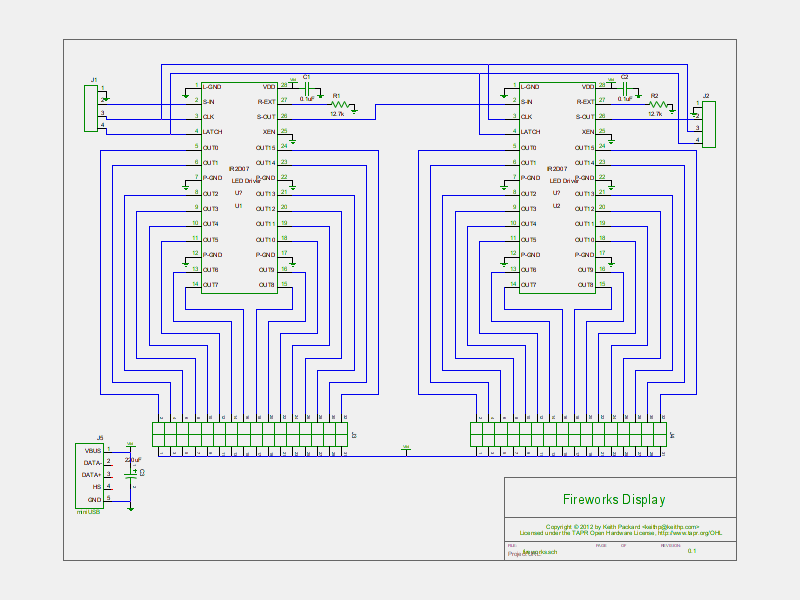
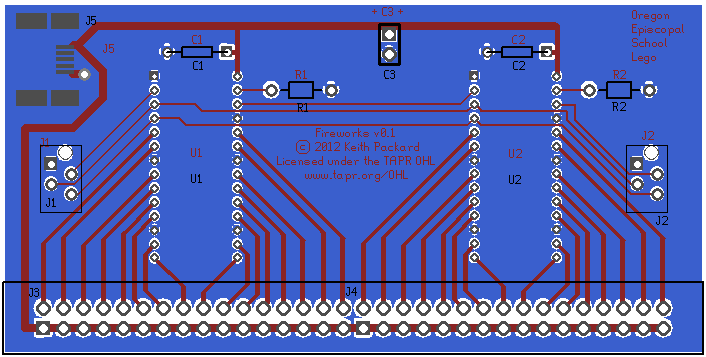
Using the GEDA tools to make circuit boards
My business partner, Bdale Garbee, and I build rocketry electronics
through



 Just for reference,