Search Results: "ron"

31 August 2007

John Goerzen: The Story of One Barn
img_2575

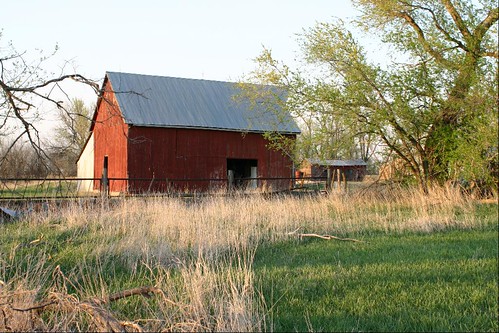
About 80 years ago, a Kansas family -- the Janzens -- built this barn.

About 60 years ago, my grandparents moved onto the farm. Their cattle were kept right here. I remember Grandpa's red tractor being parked in the barn.

So many memories have this barn in the background. We had a visit from one of the Janzens that lived here as a child. He had fond memories of this building. My dad and his siblings once played in the deep snow in front of this barn.

Here's one memory from those times:

078.jpg

That's my grandma and grandpa on their 25th anniversary in 1970. It was a working barn back then, so they probably weren't standing right next to it for this picture, if you get my drift. But they were on the yard.

About 25 years ago, Grandma lost her battle with cancer. At some point or another, Grandpa had eased out of farming, so the barn had a lot less activity. I remember exploring his outbuildings when I got bored at family gatherings. And I used to mow the lawn next to it every summer when Grandpa went off to be a cook at a camp. I didn't mind mowing next to the barn. But I always tried to go past one corner of the house as fast as I could, because there were wasp and hornet nests right there.

About 7 years ago, it was time for Grandpa to move off the farm. It was getting to be too much to keep up the old house, the barn, the yard, and deal with things like freezing water pipes and water getting in through the windows. He moved to an independent-living duplex in town. He was always worried about what would happen to the farm. Over the next few years, the farm would sometimes be vacant, sometimes have renters. Some renters did some work on the house, but the barn sat. Grandpa would eventually move into the nursing home because of his Parkinson's.

Two and a half years ago, Grandpa passed away. I shared some memories from Grandpa's place at the funeral.

But what of the house, the farm now? Renters went, and it sat empty. Nothing was in great shape, and the house needed a lot of work. Perhaps the whole place would be leveled and turned back into the prairie that it once was, or used as farmland. Perhaps someone would have an interest someday.

A year and a half ago, Jacob was on the way. Terah and I had occasionally thought of buying Grandpa's place, but we never talked about it seriously. We figured that we better finally decide what we're doing, before we have a baby around, or a child in school. So in April 2006, we went out to the farm and checked it out. The picture at the top of this post is from that visit. Terah and I checked out the house, the barns, the granary, the pasture, and the creek. As we walked past one of the barns, a pigeon flew out. Terah jumped with a shout. I grew up around barns and didn't really notice it. In the big red barn, besides Grandpa's tractor, we found some remnants from years ago: some old bales, corn cobs that raccoons had found long ago, several generations of electric fencers, old appliances.

And we decided to go for it and buy the farm. This was right at a year after Grandpa died.

The family always liked to get together for Easter. What would happen for 2006? Well, they decided to have a picnic out at the farm. It was vacant, and a bit eerie. Yet they knew that we were working on buying the place and moving in. All but one took a last look through the house before our renovations began. The one person who didn't was my great aunt, Grandma's sister. She said, "I haven't been in this house for years. I remember how it looked back then. I don't want to remember how it looks now, run down like this. So I'm not going in. But once you have it all fixed up, THEN I'll go in!"

In June of 2006, we bought the farm.

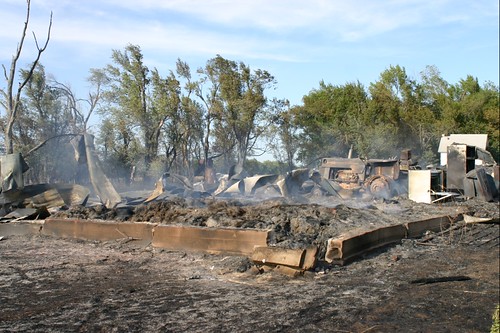
One month later, we lost this barn, and two other buildings, to a fire at our yard. This is what the beautiful red barn looked like that sad afternoon last year:
IMG_3630.JPG

As I wrote back then, nobody got hurt, the barn was insured, but "somehow, despite all these things, it still feels like we lost a little bit of Grandpa today."

2006 was a hot, dry summer. We had a patch of debris, then a patch of dirt, where the barn once stood.

7 months ago, Terah, Jacob, and I moved out to the farm. For the first time in 80 years, someone could stand in the farmhouse in the evening, look to the west, and see the colorful Kansas sunset over the pasture; the trees down by the creek; and even the neighbor's barn off in the distance. It was a beautiful sight, but it was also sad; that's not the view we had expected.

But then a surprise. This spring and summer, plants started coming up where none had grown for 80 years. But only where this barn stood -- not where the other two buildings were.

We watched as they grew tall. I'm sure decades of animals hanging out there were well appreciated by the plants.

As they grew, it looked like we might be seeing Terah's favorite flower: wild Kansas sunflowers.

And sure enough, they were.

Last weekend, Terah, Jacob, and I went out to the old barn. I took some pictures of its new appearance.

img_3429.jpg

This one stands where Grandpa's tractor used to be parked.

img_3401.jpg

And here we see a lifetime of flowers, from the old and withering, to the young just about ready to bloom.

img_3462.jpg

At the edge of the sunflowers, there's an old plow next to them. Though you might think it's barn-colored.

img_3411.jpg

Animals continue to be attracted to the area. Here's one of the smaller visitors.

img_3447.jpg

And here's a picture of almost the whole patch, right where the barn used to stand. I still mow right up to it.

I still miss the old barn. But somehow it still seems to be full of surprises and worth exploring. I wonder what next year will bring.

And I wonder if, a few years from now, Jacob will tell his friends about mowing right up to the sunflower patch, going fast to try to avoid any trouble with the bees.

30 August 2007

Steve Kemp: I gotta be cool relax, get hip

Fighting Spam Lots of people get spam and don't want to fight it themselves. Many of those people elect to use a service such as Google Mail, which does an adequate job of filtering most of the time. For people who wish to host their own mailservers, and off-load their anti-spam support to another entity, there are big companies such as MessageLabs. But if you can't/won't pay for somebody else how would you handle it? Right now I run my own mailserver and mostly it rocks. However I also manage a couple of servers for other people, and this mostly means that I have identical configuration(s) scattered across other machines. (Or as I recently discovered "mostly identical" setups scattered across N hosts.) After viewing a recent thread upon the forums of my employers I'm wondering how hard it would be to setup an anti-spam mail host. The idea being that users of domain example.org would continue to run their own mailserver (+optional POP/IMAP server). However this server wouldn't be listed in an MX record. Instead the MX record would point at the antispam server, which would then process and forward the mail on. (I'm assuming that the mailserver at example.org would be firewalled such that it would only accept SMTP connections from the anti-spam host). The only challenges I see would be: The last one is the killer point which makes me wonder if I'm wasting my time on the general case; I don't believe I could persuade people to pay for such a service (on the grounds that I wouldn't!) and if ever a mail were dropped I'd be the first person who would be blamed. And probably rightly so. The simple solution would be to always accept mail - but just tag it. Then you still have the same issue, but you have the excuse that "I still delivered your mail; just tagged wrongly". The downside of that is that the recipient still has to filter the mail; and still eats the bandwidth cost. The main gain is the lack of spam-processing CPU that is eaten locally. Anti-spam, and to a lesser extent anti-virus, topics are very interesting to me, and I'd love to hear any thoughts - or even what you use for yourself. Right now I'm 50/50 on setting up my main mailserver as the proxy for a few domains I have to manage (family, friends) to see how it works, but I'm not quite convinced yet. (Single point of failure == bad. Though centralised configuration == good.)

Chris Lamb: Strawman

We have a somewhat esoteric heating arrangement at my parent’s house. We burn bales of bean straw inside a large combustion chamber (similar to these) which is located in an out-house to the main building. A number of water-filled pipes run through the chamber which is then pumped around the house. Environmentally, it’s really good. Most of the straw would have been burnt anyway (the rest cut into the soil) and the combustion is fan-assisted to minimise incomplete combustion. Very little ash is produced from burning such a bale. Anyway, the delivery and storage of approximately 700 straw bales has become a yearly tradition in our house. As a guide, the trailer in the picture below is holding 160. It’s pretty tough going: even individually these things weigh a considerable amount, and they require removing from the trailer and then stacking in a 3 metre pile inside another shed! You quickly adopt the rules of moving a bale as little as possible vertically (carry them on your back if you’re young enough!), and never, ever, moving a bale twice. There’s also a large amount of dust, and a geek’s delicate palms quickly tire of the string holding the bales together. Anyway, this happened today on a couple of hours notice. The other two males in the house decided to be elsewhere *cough*, leaving it up to me and my poor mum. If anyone was expecting email/code/chat/info today.. sorry.

Russell Coker: Identifying the Distribution of a Linux System

I just needed to test something so I mounted the filesystem of one of my Xen domains in the Dom0 and chroot’d into it (I didn’t need the overhead of running a DomU for a quick test). Then strangely I found that my chroot environment had no apt-get and no dpkg installed. After a small amount of thought I realised that I had accidentally mounted the filesystem for a Fedora image instead of a Debian image. It seems to me that it might be a good idea for distributions to have shell scripts replacing the package tools for other distributions. For example dpkg on a Fedora box could be a shell script that runs echo “This system is running Fedora, you want to use rpm instead of dpkg”. Such a command would have saved me a couple of minutes of thinking. This may sound trivial, but if you consider the number of people who make such mistakes (and the even larger number of people who don’t realise that there is even more than one package tool in existence) then wasting a few K of disk space on every system to help them seems like a good idea. The minimum size of new hard drives that you can purchase seems to be 36G nowadays. So it’s not as if this would really cost anything. Please leave comments to tell me if I’m being sensible or silly. If the idea is regarded as good I’ll start filing bug reports.

Theodore Ts'o: On the benevolent dictator model

Recently, Josh Berkus blogged about The Myth of the Benevolent Dictator. In it he complained about people who try to posit that a benevolent dictator was "an unalloyed asset" to their project, and that there were many successful and valid forms project governance other than the singleton project leader. Furthermore, he argues that the best way is to form a community, and then ends by suggesting that people who say "dictatorship good" is really saying "democracy bad", and perhaps the motives of the person using that argument should be questioned.

Given that I was one of the first people (and probably the first person) to use that phrase to describe Linus's governance model, obviously I feet the need to respond to his thoughts on the matter.

First of all, the term "benevolent dictator" comes from an old saying, "the best form of government is the benevolent dictator --- there's only one problem, finding the benevolent dictator"[1]. And in my presentations where I explained the Linux project management model, I was always careful to say that there were other models that were used by other projects, and that it was interesting to study why certain management models worked for some projects but not others.

So by definition, if a project is successful with a single project leader ultimately responsible for making decisions to settle conflicts, then that leader is a "benevolent dictator"; if they aren't successful, then that would be an example of a dictator who wasn't able to be "benevolent", eh? :-)

In all seriousness, though, I agree with Josh when he says that the key part of an open source project being successful is gathering together a healthy community. But let's unpack that a little. In order for a community to be healthy, there needs to be general consensus on the values and cultural norms for that community. So for example, in the case of Debian, which Josh holds up as a successful community, not everyone has the ability to vote; you have to pass a fairly stringent process which tests your technical skills and your willingness to subscribe to Debian's core values as embedded to the Debian Social Contract. People who do not pass the New Membership process do not have the right to vote in Debian, even if they are the most rabid, fanatical users of Debian.

This brings up a key point about governance analogies; they all don't map cleanly into the real world for two closely related and extremely important reasons: (1) No one has a fundamental human right to be a member in some OSS project, and (2) No one is forced to stay in a particular OSS project. These are really two sides of the same coin, and what it means is that, as in Debian, "democracy" does not mean that everyone is entitled to political franchise, or the right to vote, and in a project which has a "benevolent dictator", the powers of the dictator is fundamentally limited by the simple fact that if he is too unreasonable, people are always free to leave or fork the project. These differences are extremely important when trying to reason about "democracy" or "dictatorship" as being good or bad as applied to open source projects.

Democracy is rarely the best way for an open source project to make decisions. For technical issues, you want the right answer, and majority vote isn't necessarily way to resolve a technical issue. As far as policy decisions, if the decision can not be made by consensus, then some percentage of the community will be unhappy with how the decision, and that can cause a huge amount of arguments and dissension. If the community has very clearly expressed values, then the number of times where such votes need to be made will be minimal.

For example, Debian has an explicit declaration of its values and mission in its Debian Social Contract; people who don't agree to the Social Contract aren't allowed to become Debian Developers and thus are not allowed to vote. But, one of the more controversial disputes that have threatened to tear apart Debian is the question of the non-free packages, and that's fundamentally because of an ambiguity in the Social Contract. On the one hand, Debian has declared that it is fundamentally 100% about Free Software, to the extent that it has adopted Richard Stallman's rather petulant request that the Linux operating system be called GNU/Linux (which admittedly is better than Lignux.) On the other hand, the Social Contract also explicitly specifies the existent of the non-free section in the distribution. Over time, this ambiguity have been the source of a lot of highly passionate debate and controversial votes that have satisfied neither the FSF fanatics nor the more Linux-like moderate position tolerating the use of proprietary as well as open source software. I submit that if Debian had either explicitly stated an FSF-centric position, and only accepted members that supported point of view, or explicitly subscribed to a position that users should be able to use whatever software they feel meets their needs, as Ubuntu has, it would avoided many arguments that have threatened to tear apart Debian.

More recently the fact that the Social Contract has been silent about whether or not Debian Developers should be paid or purely be 100% volunteer. This was never an issue in the Linux Kernel community, but for some reason it has been a highly divisive and disruptive issue inside Debian. Democratic votes have not really resolved the conflicts, and in fact some might claim that these votes have if anything hardened various Debian Developers' positions.

Going back to Josh's final point, "Next time you hear the words 'benevolent dictator' you probably want to think about the motives of the person saying it. Because the corollary to 'dictator good' is 'democracy bad', and is that a place you really want to go?", I am quite proud to stand by my convictions that for Open Source Projects, pure democracy is a bad idea. If a projects wants to be technically successful, it needs to be a meritocracy, and chose the best technical decisions; Linus does not decide by abiding with majority vote whether or not a patch should be accepted, and that's as it should be.

Even Debian's "raw democracy" doesn't let any random luser get to vote on who should be the Debian Project Leader. Decisions need to be made by people who are competent to make a valid choice. Even in real life, one could argue that the choice made by Americans, over of which 70% believed that Saddam Hussein was "very likely" or "somewhat likely" to be personally involved with the 9/11 attacks even though there has been absolutely no evidence to support this "gut feeling", made a rather disastrous choice in voting to re-elect George Bush to the presidency. Democracy without sufficient education, literacy, and intellectual curiosity to learn about what is happening in the world can result in truly disastrous choices being made. So certainly, democracy is not a panacea. In the real world, it may be the best choice of many bad choices, given how much people have suffered under military dictatorships. However, in the Open Source world, things are different because people are always free to leave one project and affiliate with another --- not an alternative most people living in dictatorships have historically had. Given these key differences, I think it is clear that for open source projects, democracy is indeed often a bad idea, and that if you if a project has a single person with a strong technical vision and good interpersonal skills, the benevolent dictator model can indeed be a very viable and successful.

Does that mean that other forms of governance can't work? Of course not! The rotating dictatorship used by Perl[2], the core-team-with-strongarm leader used by OpenBSD, the corporate dominated scheme of MySQL, the self-selecting core team model of Samba, all are successful models. I just have to strongly disagree with Josh's claim the single strong leader approach is somehow inferior to "democracy" as if democracy was somehow a magic bullet.


[1] For am early example of this quote, nine years ago, please see this message, where I'm pretty sure I authored the colon prefixed quote, and I know I was using the term "benevolent dictator" much earlier than 1998.

[2] In the early days of Perl, it also used the benevolent dictator model. Larry Wall is a great exemplar of how someone who has a strong vision of what he wanted to accomplish, and was humble and easy to work with, both on-line and in person, can make all the difference in the world for an up-and-coming open source project.

29 August 2007

Russell Coker: The Silly BMW 745h

BMW has released a new prototype hydrogen powered car. The bmwworld.com web page about it claims the cruising range is 190 miles. Added to the 400-mile range of the normal fuel tank, the 745h can go 600 miles between fill-ups. The first issue is that 10 miles are not accounted for (maybe it finishes the 190 miles of hydrogen power at the top of a hill). But more seriously the hydrogen needed to drive for 190 miles would take as much space as petrol needed to drive for 646 miles (hydrogen needs 3.4* the volume to store an equivalent amount of energy). I wonder if that BMW has any space left in the boot/trunk? Now we have some green bloggers praising BMW. An internal combustion engine that burns hydrogen will not give no emissions other than water vapour, it will produce some nitrogen oxides. The processes to produce hydrogen for fuel all consume unreasonable amounts of energy (more than is required to charge a plug-in hybrid). BMW demonstrates their level of interest by giving the cars to some celebrities. This gets some PR but no analysis of the performance. They also introduce the prototype based on one of the most expensive models (the 745) which you almost never see on the roads. If they produced a 318 or 520 that ran on hydrogen it would demonstrate some level of interest in getting this working for the mass market. If BMW wanted to make their cars more environmentally friendly they would start by adopting some of the technology from the Prius. Rumour has it that part of Toyota’s plan to make money from Prius development is in licensing the technology that they patent. A couple of years ago I test drove a BMW 316 and a Prius. The Prius was very quiet and gave a smooth ride (you might call these luxury features), and also gave decent performance (it’s widely regarded that luxury cars should perform well - pity the BMW 316 is a slug). In Australia the concept of “badge engineering” of cars is well established. When government subsidies favoured large manufacturing runs the Ford Laser and Mazda 323 were essentially the same car. Maybe BMW could adopt this concept and sell a re-badged Prius i-tech with a few extra luxury features as a BMW 4 series (it’s a much better car than the 3 series BMW). Finally bmwworld.com has an amusing FAQ about hydrogen power, here are some of the mistakes that they make:
  1. They say “About 45 billion kilograms (50 million tons) [of hydrogen] is produced every year enough hydrogen to fuel 250 million fuel cell cars“, but only if the average fuel-cell car uses 180Kg of fuel per year. According to Wikipedia hydrogen has slightly more than 3* the energy density per mass than petrol, so 180Kg of fuel would be equivalent to 540L of petrol per year. The Australian Bureau of Statistics states that in 1996 the average annual distance travelled by car (it’s not clear whether this is per car or per person) was 14,600Km while among the countries listed the lowest was Japan with 10,130. When efficiently using hydrogen in a Prius (that is quoted as using 5.4L of petrol per 100Km) you might expect that 540/5.4*100=10,000Km could be travelled on the 180Kg of hydrogen. So the FAQ claim that 250M cars could be powered by the current hydrogen production would only apply if the cars are of Prius efficiency and driven the typical distances of Japanese drivers, or the cars were 46% more efficient than the Prius and driven in the Australian manner. Of course in the US things are even worse with 17,862Km being the average distance driven which means that their hypothetical fuel-cell car would need to be 78% more efficient than a Prius.

  2. They state that “the majority of merchant hydrogen is produced by a process called steam methane reforming“. Why not just run cars on methane then? Anything that burns can be used to fuel cars, and methane has a much higher boiling point than hydrogen so it would be easier to store and transport (see the Wikipedia page on methane).

  3. In regard to hydrogen production they say “about 95% of the total global hydrogen production is captive meaning it is used at the site where it is produced“, that is of course because it’s difficult and expensive to transport hydrogen.

  4. The final amusing fact is that it is noted that most hydrogen comes from fossil-fuels. What problem are they trying to solve here? Hydrogen isn’t going to help the environment if it comes from fossil fuels, it will be more expensive than other fuels. Apart from getting government grant money for BMW it doesn’t seem to do any good.

Gunnar Wolf: Gl cklich in sterreich!

Good comrades, great chat, greater motivation.
Some good Scotch whisky, a good friend who was lumped along with me in .br by mere chance. A very good time.
A strong whisky aftertaste and numbness in the mouth. My first couple of pages of Terry Pratchet - Thanks a bunch!
My mind wanders, I go over all the nice and dear things and people
Maybe tomorrow I should restart my reading? I know Pratchett is not supposed to make much (rational) sense, but still... Although I've enjoyed this couple of pages, I'd rather let the whisky wear out before continuing with the gollem owner's life and tribulations, with his friendly treatment for his plausible but honorable assassin...
Today I saw quantum superpositions mixed with special relativity in a small (less than 200 lines) Perl module. Positronic variables go back in time, yay! Damian Conway rules.
Time to sleep, yes, if tomorrow you want to be in time for the lightning talks. Oh, BTW: great honor, great honor: One of the lightning talkers requested /me to sit on the front row "to have a friendly face to look at". Have to comply, have to do.
But... Last reflection before going away: What a better way to describe bliss in Vienna (oder auf Deutstch, ich glaube - gl cklich in sterreich;) than to go to sleep while listening to the neighbour's fucking-loud music? Of course, his fucking-loud-music is just the-Balkan-music-you-seem-to-love, so everything's berfine!
Thanks to everybody who made this possible. Specially to the Austrian friends.

Sune Vuorela: Debian acronym?

According to a KDE packager in some Germany based distro:

Delivering Eventually, By Interminable Annihilation of Novelty

John Goerzen: Desktop Linux: Gnome

I had been intending to write an entire series of posts about our corporate switch to Linux on the Desktop. To date, I wrote only one introducing the project and our reasons for switching from Windows. That was back in April.

Today I'd like to start talking about it all some more.

We have standardized on Gnome for our desktops. Given the Windows background of our user base, it was pretty much a given that we would have to use either Gnome or KDE. Something like fvwm or a non-integrated environment just wouldn't be a good option.

We evaluated both Gnome and KDE. The very "clean" appearance of Gnome was a nice thing for us. KDE seemed to be to "chatty", talked about entering in audiocd:/ when it shouldn't have needed to, and generally violated the KISS and principle of least surprise too often. That said, I continue to run KDE for my personal desktop because Gnome just doesn't have the flexibility that KDE does. It is too bad that Gnome has gone on this remove functionality kick, and KDE hasn't gotten the KISS religion yet.

Anyway, Gnome worked well for the most part. We have set some defaults in gconf for things like panel icons. We also set a few mandatory defaults. I fixed a couple of bugs in the vfs system related to nfs4 support, which manifested themselves as icons for files newly saved to the desktop never showing up.

We wanted to present a customized menu to people based on what their job function is. That is, we are using a single system image, so all apps will be installed on all machines. But we didn't want people to have to see a ton of software that they don't use. That was easily enough accomplished for custom apps by creating desktop files with mode 0640 and setting the group to the set of people that should see the program on their menu. We removed a few stock programs (such as the terminal) from the menu as well, using dpkg-statoverride. That was also quite easily done. However, I will say that the entire Gnome XDG menu thing is woefully under-documented.

We use Firefox for the standard web browser. It is integrated well enough with Gnome and we have no problems there, aside from sites that are IE-only. We solve that with a Windows terminal server, which I'll discuss later.

Our network printing was already based on Cups. The individual machines are set up as Cups clients only, which works fine. We did find, however, that gnome-cups-manager automatically installs a tray monitor for cups. This monitor puts little printer icons on the tray when printers are in use. Unfortunately, it figures out which printers are in use by polling the server, and it is turned on by default out of the box, with no good way to disable it short of dpkg-statoverriding it to 0000. You can imagine that hundreds of users times dozens of printers times numerous polls per minute created quite the load on the server. This was a really braindead design and the people that wrote it should have known better. It is also quite useless to have icons coming on for all the printers on the network, which on some networks could be thousands, and not even on the same continent as the user.

Printing is generally a bit iffy in Gnome. They seem to be transitioning between about 3 different printing toolkits, all of which have different print dialog boxes with different supported features and different ways of selecting printers. One chief annoyance is that the print box in evince (the document/PDF viewer) does not let people access printer-specific features such as hole punching and stapling. So we installed gtklp and xpdf for people. The people that print heavy PDFs are huge fans of gtklp these days; it's a nicer solution than we had in Windows. Nobody really likes evince. We also have had some trouble with evince generating PostScript output that some printers can't grok. It sounds like all this should be much better in newer versions of Gnome, which if true, would be welcome news.

The Gnome screenshot tool makes it easy to save off a screenshot to a file, or to drag it into an email, but it is difficult to print it (you have to save it first). That was a common complaint around here, so I wrote a little wrapper around xwd and gtklp for printing screenshots. People really like that because gtklp gives them lots of options about orientation and size of the image if they want it, or a simple "Print" button to click if they don't care. We set a gconf default to bind this to Ctrl-PrintScr and it works well. KDE's screenshot tool is much more capable, and if we were using KDE, we wouldn't have had any problem with screenshots.

The bottom line on Gnome is that we, and are users, are happy with it after we've made these customizations. But we have had to do more customization that we should have. I still think that Gnome has been better for our users than KDE, but I do wonder how long we'll be able to survive with our "no KDE libraries" policy, as people want ksnapshot, kolour, etc.

Michal Čihař: Phone database cleanup

Gammu Phone Database grew into quite big size and there were quite a lot of duplicate or poor quality records. So I today decided to do some cleanup of data inside it. First step was figuring out duplicates. There were quite a lot of them and I could remove about 50 records without loosing information about any phone. The quality issue is always harder. Some empty records really did not make a sense, so they're gone now. However some users really don't understand what some features mean, so there were quite a lot of phones being reported to support MMS and I'm pretty sure there is no code in Gammu for it :-). I went through their list and dropped almost half of phones there. Some records might have been useful in other way, but I can not verify what all was wrong with them. Maybe I should add some basic checks when adding new entry to check such errors as MMS support for AT connection.

28 August 2007

Russell Coker: The Silly BMW 745h

BMW has released a new prototype hydrogen powered car. The bmwworld.com web page about it claims the cruising range is 190 miles. Added to the 400-mile range of the normal fuel tank, the 745h can go 600 miles between fill-ups. The first issue is that 10 miles are not accounted for (maybe it finishes the 190 miles of hydrogen power at the top of a hill). But more seriously the hydrogen needed to drive for 190 miles would take as much space as petrol needed to drive for 646 miles (hydrogen needs 3.4* the volume to store an equivalent amount of energy). I wonder if that BMW has any space left in the boot/trunk? Now we have some green bloggers praising BMW. An internal combustion engine that burns hydrogen will not give no emissions other than water vapour, it will produce some nitrogen oxides. The processes to produce hydrogen for fuel all consume unreasonable amounts of energy (more than is required to charge a plug-in hybrid). BMW demonstrates their level of interest by giving the cars to some celebrities. This gets some PR but no analysis of the performance. They also introduce the prototype based on one of the most expensive models (the 745) which you almost never see on the roads. If they produced a 318 or 520 that ran on hydrogen it would demonstrate some level of interest in getting this working for the mass market. If BMW wanted to make their cars more environmentally friendly they would start by adopting some of the technology from the Prius. Rumour has it that part of Toyota’s plan to make money from Prius development is in licensing the technology that they patent. A couple of years ago I test drove a BMW 316 and a Prius. The Prius was very quiet and gave a smooth ride (you might call these luxury features), and also gave decent performance (it’s widely regarded that luxury cars should perform well - pity the BMW 316 is a slug). In Australia the concept of “badge engineering” of cars is well established. When government subsidies favoured large manufacturing runs the Ford Laser and Mazda 323 were essentially the same car. Maybe BMW could adopt this concept and sell a re-badged Prius i-tech with a few extra luxury features as a BMW 4 series (it’s a much better car than the 3 series BMW).

Kai Hendry: MBP versus X40

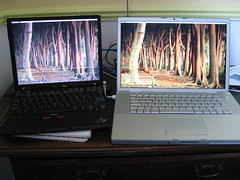
Thinkpad X40 vs MBP I’ve spent a bit of the bank holiday weekend by probably violating the warranty of a new 15” Macbook Pro (MBP) from work. I also was at the Debian bbq 2007 in Cambridge and met some friendly faces. :) More MBP & X40 porn So now I can boot into MacOSX and run Ubuntu or boot straight into Ubuntu from rEFIt. There are a couple of problems. There are some things I quite like about the MBP compared to the X40: Currently I remain not totally convinced about the Apple MBP. I’ll keep my Debian X40 my personal machine and the MBP for work. Now I can compile Webkit on Apple OSX (Debian can too) and see what’s happening in Ubuntu.

Alexis Sukrieh: Perl Console 0.3 released

A new version of PerlConsole is available. As you can see in the changelog, lots of goodness with this release comes to you (~/.perlconsolerc rules, thanks to S. Zachariah Sprackett for his patch). After reading the source code of Devel::REPL and learning from it (this is really a great library, congrats to mst) I decided not to orphan Perl Console. Yes, that was a possibility as Devel::REPL provides anything you need to build a console (and comes with “re.pl” which actually is a console itself). I decided not to give it up for one reason: Devel::REPL is great, and better written than Perl Console (it supports plugins and profiles and is Moose-based) but, it’s slow. When you launch it, you have to wait a couple of seconds before the console prompts you. This is because of Moose I suppose. I know that’s not blocker as a console is a development tool, but I feel like some of PerlConsole’s users would like to have the choice between a full featured, extensible and Moose-base console that’s slow, and a light one that is basic in design and implementation. I backported one of the most interesting plugin of Devel::REPL to PerlConsole, being the console’s lexical environement. Devel::REPL did a great thing there, using Lexical::Persistence to simulate a namespace in the console. Feel free to give your feedback about this, I wonder if there’s still an audience for PerlConsole when Devel::REPL is in the town. I think so, maybe I’m wrong, then tell me.

Biella Coleman: Conversing about Open Access

Karl Fogel’s recent comment asking why Samir Chopra and Scott Dexter did not publish Decoding Liberation with some sort of open licenses, especially since they are such unabashed advocates of open licensing, spurred a flurry of further comments from the authors on my blog as well as some more thought out blog posts and commentary. I don’t have too much to add except perhaps to state the obvious: the economics of book publishing and software are quite distinct creatures. When it comes to software, one can pull in revenue from support and services, while this is pretty much impossible for most books. Software also has a much shorter shelf life, which is why making it open access, fast, is key. Books however have a longer shelf life, which is why I am personally not opposed to some sort of limited copyright for books (around 5 years, give or take a couple) so that publishers can recoup their costs (and in academic publishing, no one is making a bundle of money, that is sure) but then it should be made free to the world, never to die that awful death of “out of print” (in so far as it can be thrown on the web, legally). Journal publishing is another matter and I firmly believe that articles should spread far and wide and quick because of their shorter shelf life, which tends to be shorter mostly because there are just so many articles… As Alex Golub has informed us, my own professional association has really failed not only in providing more open access journals, they are not even allowing the members of the organization any say in the matter. But thankfully other disciplines and academics are taking open access and the possibilities afforded by new media a little more seriously and here is an edited volume by CT Watch Quarterly The Coming Revolution in Scholarly Communications & Cyberinfrastructure that provides an important node in what is an important conversation.

Andrew Pollock: [opinion] On hydrogen powered cars

Russell Coker very effectively debunks hydrogen for fuel. In my opinion, the only reason the oil companies and various shall we say pro-oil governments are getting behind hydrogen is because they know it's completely untenable. They can say "but look over here, we're researching clean energy" knowing full well that it's years away (if at all). It's a diversion, that's all. Meanwhile, we've had perfectly viable electric cars in the mid-1990's, yet fast-forward ten years, and apparently it's only just become commercially viable to have hybrids. Talk about regression. Something's really wrong with the world.

27 August 2007

Adrian von Bidder: Favorite movies

Since I've never bloged about movies before, here's the “best of”, in more or less random order and from the top of my head. Not quite on the list, but still worth mentioning.

Russell Coker: Writing a CV for a Contract Position

There is a lot of career advice related to writing CVs in books and floating around the net. Unfortunately almost all of it is tailored to permanent positions. Some advice that I have seen includes researching the company you are applying for and emphasising your experience in related fields. This probably makes some sense if you have targetted a major company to be your employer for the rest of your life. But if you are after contract work (which incidentally tends to pay better than permanent positions) then it’s not going to work. About half the time when applying for contract work you won’t know the name of the company that is receiving your CV until after they have decided whether to grant you an interview. Contractors therefore need to write their CVs to have broad appeal (emphasising common technologies such as C programming and skills such as debugging), and to appeal to a recruiting agent. Some people recommend writing your CV in MS-Word to support agencies and potential employers who are not competent enough to open other file formats (such as PDF and HTML). I strongly disagree with this advice, most contract positions are advertised by multiple recruiting agencies and it would be best for you to be represented by the most competent agency. Therefore having an agency staffed by incompetent people not represent you because they can’t figure out how to read a HTML or PDF file is a good thing! The same applies for employers, while applying for the best paying contracts will often result in some strange and unpleasant working conditions having a manager who can’t open a PDF or HTML file is likely to result in something that is unusually bad - run away! Recruiting agents will often give specific requirements for a CV. Sometimes these requirements are a little odd (such as demanding that references to C programming be removed from a CV when applying for a Unix sys-admin job), but being merely a little odd is no reason to boycot the agency. To solve this I wrote my CV in M4 macros to generate HTML code. When I wanted to apply for a position I would just type make to compile the M4 source into five or more different CVs. Sometimes a recruiting agent would request two versions when applying for one position, it’s a strange request but when five versions were compiled in one pass it was easy to satisfy it. If I liked PDF I could have written M4 macros that generate TeX and have the make process convert TeX to PS and then PS to PDF. Unfortunately I can’t share any macros because the code was not of particularly high quality (which is a little ironic) and because it’s tightly tied in to my CV. The best piece of advice that I can give to anyone trying this is to get columns sorted out as the first issue. If you want to have some lists of programming languages, lists of OSs, and lists of hardware, etc in your CV then it usually works best to have two columns in the page. If the largest list is removed then the other lists need to be shuffled around to get the column lengths to match. Doing this in HTML required some ugly M4 macros. There probably is a better way of doing this in TeX (but I’m really not good at TeX and can’t give advice about it). James has some interesting advice about writing CVs. I think that his most useful points are:
  1. Use file names based on your name so that agents can find your CV in the directory full of CVs

  2. Include complete contact details. One thing he doesn’t mention is that you should buy a mobile phone for the purpose of getting a job even if you don’t want one for any other reason. A 5% difference in pay for a year’s work would cover the cost of many mobile phones and the difference between a good job and a bad one is likely to be more than 5%. If you are afraid of brain cancer then don’t worry, if you only spend a few minutes a month talking to recruiting agents then you are at no risk.

  3. Don’t start a sentence in the career history section with the word worked - everything in that section will be related to where you worked in the past. It seems obvious in retrospect but I realised that I have made this mistake on my CV.

26 August 2007

Biella Coleman: The problem with presentism

A few days ago, Joe Reagle was telling me about the rise of (sometimes very arcane) policies and bureaucratic imperatives that now characterize Wikipedia. A few days later I stumbled across a few interesting posts on the topic, posts (especially Nick Carr’s) seeping with almost celebratory gloom and doom:
‘But, given human nature, is it really so “incredible” that Wikipedia has evolved as it has? Although writers like Yochai Benkler have presented Wikipedia as an example of how widescale, volunteer-based “social production” on the Internet can exist outside hierarchical management structures, the reality is very different. As Wikipedia has grown, it has developed a bureaucracy that is remarkable not only for the intricacies of its hierarchy but for the breadth and complexity of its rules. The reason Deletionism has triumphed so decisively over Inclusionism is pretty simple: It’s because Deletionism provides a path toward ever more elaborate schemes of rule-making - with no end - and that’s the path that people prefer, at least when they become members of a large group. The development of Wikipedia’s organization provides a benign case study in the political malignancy of crowds.”
It is without question that a problem has arisen in Wikipedia, a problem composed of a thick web and net of rules that can be helpful as guidelines but often are often confusing and clearly work to ensnarl new users. But can we so quickly put blame on so-called human nature? Or is it not a problem of human organization, which as the anthropological and sociological record shows, can take many forms? And is it not just that: a problem begging for a solution instead of an opportunity to declare the fundamental nature of wikipedia (and that of human nature?). Not only may history prove him wrong, other large scale collaborative projects at least prove that solutions can be found to deal with problems of growth and scale. It is as if Carr just wants to see a project like Wikipedia fail, which somehow, this morning hit a raw nerve. What I find exciting about large scale projects of (at times unwieldy) collaboration are not just the explicit outputs of the projects (an encyclopedia or operating system) but the social worlds they create. And there is no inevitable path they *must* follow. These groups have a choice to react to and respond to these sort of problems and enact solutions that will hopefully solve them and allow these projects to change. Debian, a slightly older project than Wikipedia, has gone through many growing pains and there was even a period when the the whole process of integrating new Debian developers was shut down and if my memory serves me correctly, for 2 years! At the time, it could have been possible to say: “This signals the end of Debian” but eventually a solution was found, the New Maintainer process, which while not perfect (what is?) allowed the project to grow and produce a great operating system for years to come. Debian today faces new problems and is working to find solutions. I hope that Wikipedia can and will do the same. And instead of declaring its death, why not wait and see, and offer something a little more constructive and illuminating, than destructive?

Andrew McMillan: I have finally chosen a new name: DAViCal

After much wading through possible names, none of which really excited me, I have finally chosen "DAViCal" as the new name for my CalDAV server that was previously called RSCDS, or the "Really Simple CalDAV Store". In the end, I chose DAViCal because it: That was about the hardest part of preparing for the 0.8.1 release, and now that I've done that I should manage to make the changes to the packaging, though I have no doubt that the old name will appear in all sorts of places for a while yet. Choosing names is an important business, and I should know that from the length of time we spent agonising over names for our children, discarding all sorts of things because they had silly abbreviation collisions (like the "Royal Scottish Country Dance Society" :-) Even then, I think we got the kids names wrong, and the big one should be called "Thumper" with the little one called "Sly", but perhaps that's just a temporary annoyance and in time the names that we registered for them will fit them better. I also recall Grant once saying that you should never use the word "Simple" in the name of your project, and he should know. DAViCal is no longer particularly simple, although I have attempted to hide the complexity from the user as far as that is possible, and will continue to do so. Once I get out version 0.8.1 of DAViCal I will finally upload it to Debian, proper. This version has some important enhancements to its DAV spec compliance which are going to be needed by some future versions of Mozilla, and probably other things too, so it's important to push it out as soon as possible now.

Russell Coker: Solar Hot Water - Not Expensive

The Australian has a new Environment writer named Matthew Warren who has a history of doing PR work for the coal industry. This has the potential for insightful articles based on knowledge of what the industry is doing or for PR work for the coal industry masquerading as journalism. Unfortunately it seems like the latter is what we are getting. Matthew’s latest effort is an article claiming a $6.5 billion cost to home-owners because of an “effective ban” on electric hot water systems that Labor might impose. Unfortunately he doesn’t clearly state what an effective ban is, but does note that apartments are exempt. The specific claim that is used as the basis for the article is that solar hot-water systems cost $2,800 more than electric systems, and that after the solar hot-water rebate ($1,000) the additional cost would be $650,000,000 per annum, and that a period of 10 years would be required to replace all hot-water systems thus giving a cost of $6,500,000,000. So I presume that he expects that there would be 650,000,000/1,800 hot water systems installed per year which would be about 361,111. According to the Australian Bureau of Statistics there were 6,744,800 households in Australia in 2003. Matthew’s article states that about 40% of homes can have gas hot-water systems fitted that comply with the proposed new regulations, given that and the exemption for apartment buildings let’s assume for the sake of discussion that 50% of homes would require a solar hot-water system. Assuming that each household has a separate hot-water system that means that for these claims to hole we need an average expected lifetime for a hot water system of 6,744,800/2/361,111 = about 9.3 years. If the currently installed hot-water systems are expected to be replaced in 9.3 years then we can expect that hot water systems tend to survive for an average of about 18.6 years. I wonder if that number is correct (some google searching didn’t turn up an answer). One of the disadvantages of old-fashioned media is that they tend not to include calculations or cite sources adequately so we can’t easily verify or disprove their claims, I wonder if this is deliberate… Matthew admits that using a solar hot water system can be expected to save households $300 per annum in electricity expenses, I presume that this is based on current energy prices and that the savings can therefore be expected to increase as energy prices increase (we have a lack of water which is increasing the cost of producing electricity from coal). Let’s assume for the sake of discussion that the typical home-owner has a mortgage, the Commonwealth Bank is currently advertising mortgages with a rate of just over 8%, the way things work is that there are various criteria for getting a discount rate which most borrowers can meet so the result will be slightly below 8%. If a solar hot water system costs $1,800 extra to install and the money comes from a mortgage then every year it will cost the home owner about 8% of $1,800 which is about $144 (a saving of $156 per annum). If the solar hot water system saves the home owner $300 per annum then at any interest rate below 300/1800 (16.66%) they will make money. If there was no government subsidy and the entire $2,800 extra was paid by the home owner then at 8% interest it will cost $224 per annum (a saving of $76 per annum) and the interest rate would need to increase to 300/2800 = 10.7% to make it break even. So for solar hot water to not save the home-owner money we need to have a significant increase in interest rates (which incidentally would bankrupt many home owners), AND to have electricity prices remain the same (which would require even more of our tax money to be spent on supporting the coal industry). Finally Matthew complains that the solar hot-water rebate could cost the government $4 billion over the course of the scheme (the next 10 years). This sounds like a lot of money until you think about the 9 billion dollars a year that the government spends on subsidies for the coal, oil, and gas industries! On the current course the government would spend 90 billion dollars of our tax money subsidising polluting industries that cause climate change, but Matthew opposes spending 4 billion subsidising technology that prevents pollution and reduces climate change.

Next.

Previous.