Search Results: "tg"

18 January 2012

Sylvestre Ledru: Major changes in the Debian HDF5 packages

Yesterday, I uploaded hdf5 1.8.8 in unstable. This new version, which has been available in experimental for a while, is a major step in the HDF5 packaging. For those who are using this package, besides the switch from version 1.8.6 to 1.8.8, the changes are the following: More information about the transition:
http://release.debian.org/transitions/html/hdf5.html TODO: Fix the FTBFS (Fail To Build From Sources) under sparc & ia64.

15 January 2012

Kai Wasserb ch: Note about building Wine 1.3.37 onwards from source

I just uploaded my unofficial wine-unstable packages to dev.carbon-project.org (I skipped 1.3.36 over the holiday period). These new packages come with an important and often-requested change: they use GCC 4.5 to build the binaries, this works around an upstream GCC bug, see WineHQ bug report #22053 for further details. Unfortunately that clashes with the recent multi-archification on Debian and can lead to FTBFS in an automated build environment (like pbuilder would set up). The reason is the missing symlink from /usr/include/asm to /usr/include/DEB_BUILD_MULTIARCH/asm which then leads to GCC not finding e.g. errno.h (see #638418 for further details). That gives you the following options to make your build work again: Otherwise you can also use the pre-built binary packages.

7 January 2012

Jon Dowland: Flow My Tears, the Policeman Said

The Philip K. Dick Collection The Philip K. Dick Collection
I've just finished reading "Flow My Tears, the Policeman Said" by Philip K Dick, one of 13 novels collected in the Library of America's wonderful "The Philip K. Dick Collection" boxed set. This story has never jumped out at me as one to read with any particular urgency, despite the title being a reference to a composition by my namesake. I was reminded about it whilst listening to one of BBC Radio 4's "Great Lives" broadcasts, where Michael Sheen read a passage from the book. As an aside, the "Great Lives" series is a really interesting listen: I particularly enjoyed their episode on Ludwig Wittgenstein. You can get the whole series in podcast form. Back to the book. It features Dick's trademark theme of fractured realities, perhaps more so than in many of his more well-known works such as Ubik or A Scanner Darkly. It also has much better characterisation than I expect from his writing. His female characters remain as always sinister, threatening, mischevious, but they are at least fleshed out. There is a lot more of an exploration of the human condition than usual. Dick wrote that the novel begun as an attempt to explore different varieties of love. I enjoyed the mystery of the weird goings-on whilst they were mysterious, but I felt mildly let down when the explanation was eventually proffered.

6 January 2012

Kai Wasserb ch: Skanlite 0.8 in Debian's experimental suite

In case you haven't heard of Skanlite let me give you a quick overview: Skanlite is a really simple scanning application for KDE 4 (if you used Kooka with KDE 3 you'll probably be happy with Skanlite too). It doesn't offer too much options besides preview and real scans except some basic colour corrections, a selection whether you want colour scans or not and whatever options the SANE driver for your scanner offers. But then it doesn't offer too much options, finds your scanners automatically (if SANE can find them) and suffices most needs. With the basic "what does it do" question out of the way, I'd like to point out, that version 0.8 just entered Debian's experimental suite. The reason for the upload to experimental instead of Sid is, that 0.8 needs a method in KSaneWidget, that was added in the 4.7 branch. Sid has only the 4.6 branch. As soon as KDE 4.7 becomes available in Sid, I'll upload a version of Skanlite to unstable. If you want to give Skanlite 0.8 a try, you need to upgrade most parts of your KDE installation to the 4.7 versions in experimental. So be careful not to break anything (on the other hand 4.7 has been working quite nicely for me so far), maybe try it out in a virtual machine or something similar.

Timo Jyrinki: I have a new GPG key


-----BEGIN PGP SIGNED MESSAGE-----
Hash: SHA1,SHA512

Hello,

I'm transitioning from my 2003 GPG key to a new one.

The old key will continue to be valid for some time, but I eventually
plan to revoke it, so please use the new one from now on. I would also
like this new key to be re-integrated into the web of trust. This message
is signed by both keys to certify the transition.

The old key was:

pub 1024D/FC7F6D0F 2003-07-10
Key fingerprint = E6A8 8BA0 D28A 3629 30A9 899F 82D7 DF6D FC7F 6D0F

The new key is:

pub 4096R/90BDD207 2012-01-06
Key fingerprint = 6B85 4D46 E843 3CD7 CDC0 3630 E0F7 59F7 90BD D207

To fetch my new key from a public key server, you can simply do:

gpg --keyserver pgp.mit.edu --recv-key 90BDD207

If you already know my old key, you can now verify that the new key is
signed by the old one:

gpg --check-sigs 90BDD207

If you don't already know my old key, or you just want to be double
extra paranoid, you can check the fingerprint against the one above:

gpg --fingerprint 90BDD207

If you are satisfied that you've got the right key, and the UIDs match
what you expect, I'd appreciate it if you would sign my key:

gpg --sign-key 90BDD207

Lastly, if you could send me these signatures, i would appreciate it.
You can either send me an e-mail with the new signatures by attaching
the following file:

gpg --armor --export 90BDD207 > timojyrinki.asc

Or you can just upload the signatures to a public keyserver directly:

gpg --keyserver pgp.mit.edu --send-key 90BDD207

Please let me know if there is any trouble, and sorry for the inconvenience.

(this post has been modified from the example at
http://www.debian-administration.org/users/dkg/weblog/48)

-----BEGIN PGP SIGNATURE-----
Version: GnuPG v1.4.11 (GNU/Linux)

iEYEARECAAYFAk8GuZoACgkQgtffbfx/bQ9nqACglWyHnDTFQfdKmz8OCd3oL6iR
hcEAmgKJ7RZsgwxwkRGPhygy5y1Ztb+3iQIcBAEBCgAGBQJPBrmaAAoJEOD3WfeQ
vdIHdVQQAMT1yvIogzbtK6sUnWqwbrXI9pDEFk7AzJTb80R+wzxsw7gu9gcBDk8G
BL2O26GKUqKWA3ytuApSl42FJam/Lusi9npT3XNkmHs6FaBMNuLYrqEXmCwXwWr/
OrLyeeLiF4yxgbNWbv+600BqAWqFlo6NeTgQKsJWtCjR3RVMxX3R8nzjDnKJuF+z
c6+2JKBWyx/HVUKcJpJrFDDR36HRFvVJomTuma2JCQ/RAl9vzAguqNYOi1QkuuQv
EF1gXH7gLifukGuwquP1DHP6SWWkj77jtRWr5ewC0xymbrArzAwKbvMQl3VpKBHh
MmpJjYP3ECyL14AKi/TY2Lidi0Sf6yqFMcPcreoih01N0OU0NXmD4IrHMT24/ssb
okDUe1o3YImjGq1jTACvlzC8s54EfLsqDgSP98SGVpuoDqPJUwVk4nuHj8q0vDSs
qZox26gVwB2FAOUi1BFiZbIzM5rsyYfCGyWUGiAwBFf54lYRAeCDCt8iAOOL1Ov/
TumIGYdLoXnDuOJq1VjXLGx2OFDrpyU8SPGoa3zNEVz39tgxQ48ASJEqcqt7HvBy
IW+TTsMLdJ1Ait9aCM3mzzr1iwP8TrL0qUsdRLOE6AKdAqocIfqXY8OeDKhbUiOJ
CXWk5q3xheK3sDWUXX7J63bAAUH4jFnpQEOVMJKBUNMKsWa0iXDS
=mklN
-----END PGP SIGNATURE-----

5 January 2012

Michal Čihař: PostgreSQL setup for SMSD testing

This is mostly note to myself, when I will set this up for next time. Every time I set up test environment for Gammu SMSD, I'm lost in PostgreSQL configuration. Simple reason is that I do not use it at all for any other reason. Adding user and creating a database:
# su - postgres
postgres@rincewind:~> psql template1
psql (9.1.1)
Type "help" for help.
template1=# CREATE USER smsd WITH PASSWORD 'smsd';
CREATE ROLE
template1=# CREATE DATABASE smsd OWNER = smsd;
CREATE DATABASE
template1=# GRANT ALL PRIVILEGES ON DATABASE smsd TO smsd;
GRANT
template1=# \q
Next stem is to allow anybody to connect as smsd user. There might be better ways to do that, however I've chosen the simplest one - to trust any local connection - as testing of Gammu SMSD is anyway the only thing this database server does. Edit /var/lib/pgsql/data/pg_hba.conf:
# "local" is for Unix domain socket connections only
local   all             all                                     trust
# IPv4 local connections:
host    all             all             127.0.0.1/32            trust
# IPv6 local connections:
host    all             all             ::1/128                 trust

Filed under: English Gammu 1 comments Flattr this!

27 December 2011

David Welton: 2011 in Books

Since I got my Kindle a bit more than a year ago, I have finally been able to slake my thirst for reading materials, something that was prohibitively expensive when ordering English language books via Amazon.co.uk, and took lots of time to boot. Here are some of the interesting books I've happened on in the past year: The big one was "Start Small, Stay Small": which has tons of ideas on how to do small, niche startups, "for the rest of us". Those of us who aren't in Silicon Valley, who aren't seeking millions in VC funding, those who don't want to aim for "astronomically rich", but just a comfortable lifestyle with more control over our own destiny. This book gets special mention for being a big inspiration for LiberWriter. Here is a list of the others. And for fun, a variety of Sci fi and Western books, but nothing particularly noteworthy. Neal Stephenson's REAMDE was fun, but I'm not sure I'd read it more than once, like some of his other books. Here are my Amazon wishlists of things I'm considering reading at some point in the future. Comments welcome on the value of the books listed. "Regular" books: http://amzn.com/w/20I0Y1YGD1FUB and random fun books and movies. Business books: http://amzn.com/w/5B2JQOP8VZEW - although some of them are not strictly business books. Yes, if you're curious, the book links do have referral codes in them, to help sustain my reading habit.

Christoph Berg: Generating symbols files from a series of .deb files

PostgreSQL's libpq5 package got its symbols file somewhere around version 8.4, so the symbols in there were all marked with version "8.4~" or greater. As I'm working on pgapt.debian.net aiming at providing packages for all upstream-supported PG versions (currently 8.3 and up), this made packages incompatible with 8.3's libpq5. There didn't seem to be a ready program to feed a series of .deb files which would then run dpkg-gensymbols and build a symbols file, so I wrote this shell script:
#!/bin/sh
set -eu
[ -d tmp ]   mkdir tmp
i=1
for pkg in "$@" ; do
    echo "$pkg"
    test -e "$pkg"
    name=$(dpkg-deb -I "$pkg"   perl -lne 'print $1 if /^ Package: (.+)/')
    version=$(dpkg-deb -I "$pkg"   perl -lne 'print $1 if /^ Version: (.+)/')
    out=$(printf "tmp/%03d_%s" $i "$version")
    dpkg-deb -x "$pkg" "$out"
    dpkg-gensymbols -P"$out" -p"$name" -v"$version" \
        $ oldsymbols:+-I"$oldsymbols"  -O"$out.symbols"   \
        tee "$out.symbols.diff"
    test -s "$out.symbols.diff"   rm "$out.symbols.diff"
    oldsymbols="$out.symbols"
    rm -rf "$out"
    i=$(expr $i + 1)
done
To use it, do the following: The highest-numbered *.symbols file in tmp/ will then have symbol information for all packages. I then did some manual post-processing like s/~rc1-1/~/ to get nice (and backportable) version numbers. Another nice trick (pointed out by jcristau) is to replace the lowest version number of that package (8.2~ here, where libpq changed SONAME) by 0 which will make dpkg-shlibdeps omit the >= version part. (Most packages depending on libpq5 will profit from that.) I'm still pondering whether this script is non-trivial enough add to devscripts. (The people I asked so far only made comments about the mkdir call...)

26 December 2011

Steve Kemp: So I'm a peddler of smut nowadays.

Over the Christmas period I've not been doing too much. December was a month that started out pretty well, in the first 10 days I had five models/friends/random-folk come to pose for me. (I have a few folk lined up for mid-January, but things tailed off quickly this month due to people having little free time). I spent a while mulling over what I was doing with images, as I've recently been doing a fair number of more NSFW images - In December this and this were my two favourite shots. I've posted NSFW images in various places over the past year (with permission; some volunteers/victims/friends don't want me to share anything, so I don't. They just hang on my walls.) but I was never consistent. Anyway I realised that .xxx domains are now available, so I figured I'd snarf one up and use that. That lead to tasteful.xxx - which is mostly full of images I didn't actually take, but that will change. (Sadly "artistic" was gone!) In more on-topic news I reported #651896 - a trivial security issue in another setgid(games) binary. I've got a couple more of those to tidy up and report in the near future. ObQuote: "Bright light. Bright light." - Gremlins

Russ Allbery: git-pbuilder 1.25

As is typical, I've been sitting on several requests and updates for git-pbuilder for quite a few months. But the year-end holiday is always a good time to go through backlog and take care of things like that, when it's quiet and calm and there's a break from work. This release adds support for traditional pbuilder as a possible builder program, which despite the name was not previously supported (at least since I converted an early verison of this script over to use cowbuilder). It alas cannot be determined from the name of the script for backward compatibility, since lots of cowbuilder users are invoking the script as git-pbuilder, but you can use real pbuilder by setting the BUILDER option. Thanks to Clint Adams for the initial patch. While implementing that, I discovered that the code to set defaults for BUILDER, DIST, and ARCH from the program name (so that people can create symlinks like git-qemubuilder-squeeze-armel and have them do something appropriate) was pretty badly broken and was breaking the BUILDER environment handling. This should also now be fixed. Finally, there's now a GIT_PBUILDER_AUTOCONF environment variable that can be set to "no" to tell git-pbuilder not to attempt to figure out any of the arguments to the builder. This is useful if you've already got complex logic in your .pbuilderrc to figure out the basepath/basetgz, architecture, distribution, and so forth and don't want git-pbuilder to bypass all of that. Note that this turns off everything, including --buildresult .., so if yoy use it, .pbuilderrc really has to handle everything. You can get the latest version from my scripts distribution page, and I suspect it will show up in the git-buildpackage package before too long.

23 December 2011

Keith Packard: calypso

Calypso CalDAV/CardDAV/WebDAV for Android and Evolution Ever since I bought my first Palm Pilot in 1997, I ve relied upon a pocket-able device to carry a copy of my calendar and contacts, and for that same database to be present on my laptop. I went through a long list of Palm-compatible devices, including both the Palm Treo and Palm Centro telephones. I even wrote a number of my own Palm applications. Years ago, it was pretty obvious that I d have to find a new phone, but I was stuck looking for something that could provide the same hot-sync functionality. SyncML on the Series 40 I bought a Series 40 Nokia phone in Shanghai that promised SyncML support. Given that I had seen numerous SyncML implementations for Linux, it seemed like I should be able to get something to work. SyncML on the Series 40 is a disaster the phone couldn t actually store all of my contacts, and it couldn t hold half of the data fields I used. So, that phone landed in the box and back to the Centro I went. SyncML on the N900 Nokia kindly sent me an N900 at some point, so I gave SyncML another try. Given that the N900 runs evolution-data-server, and that I ve had evolution-data-server running on my laptop, it seemed like I should be in business. Well, almost. It took several days of hacking to fix bugs in the evolution SyncML back end, then another several days fussing with opensync. I ended up abandoning direct synchronization as unworkable opensync would sit in an infinite loop, or worse, trash my database completely. I finally found syncml-ds-tool , which is a debugging tool that comes with opensync. This tool simply synchronizes a set of disk files, one per contact or calendar entry, with the phone. That worked for well over a year. And then, a few months ago, Bluetooth on the laptop stopped connecting with the phone s SyncML server. I d get ECONNREFUSED every time I tried to use it. So much for the N900. DUN still worked, mostly, although it too would get ECONNREFUSED at times, but retrying seemed to make it work. However, While the N900 SyncML solution worked, I discovered another thing I wanted contacts and calendar entries stored in individual files and revision controlled with git. This makes it reasonable to delete stale calendar entries and know that they re never really gone, just left behind in an older version of the calendar. And, if you mess up, you can recover by poking at the database with git directly. I switched back to the venerable Palm Centro; it turns out that calendar and contacts are more important to me than being able to surf the web on my phone. Alas, my Centro went swimming in August and has passed on to the great electronics recycling house in the sky. I pulled the SIM out and switched back to the N900. I got my contacts imported on the N900 by copying files over the net work; not a long-term strategy, but at least I had phone numbers again. There was no hope for my calendar. I started looking for a solution in earnest. How about Android? At this point in my story, I m sure you re asking why I didn t just use one of the numerous Android phones that came through my hands. The answer is simple my calendar and contacts are probably some of my most personal data, and I m not willing to store them outside of my direct control, for reasons similar to those which are driving the development of the FreedomBox. When Android first came out, it could only talk to Google services, which didn t meet my hard requirement for personal data storage. One of my co-workers had his Google account suspended for violating the terms-of-service; he asked what he had done, but they wouldn t say. He asked if he could get his data back, and they said no . They invited him to create a new account, but it would not ever get any of the old data. A few days later, he got a nice apologetic email letting him know that they d made a mistake and that he hadn t, in fact, violated any of the terms-of-service, and that his old account was restored with all of his data intact. Wasn t that nice of Google? WebOS? I got a WebOS phone over the summer and discovered that while it had multiple contact/calendar back ends, none of them used standard protocols and so you only had the choice between multiple corporate data centers, which isn t actually a choice at all. Furthermore, the WebOS phone refused route PAN packets over the phone network, even though I have a data plan which allows this. It s not that it couldn t support it, it s that it refused. A couple of weeks after the WebOS phone arrived, HP canceled all of their WebOS hardware products, which made me less interested in trying to solve this problem. Android recovers About the same time the WebOS phone arrived, I discovered that Google had published enough information about the calendar/contacts internals for Marten Gajda to write CalDAV-Sync and CardDAV-Sync. And then, Andrew McMillan wrote aCal, which is a complete replacement for the built-in calendar and contacts applications and supports CalDAV and CardDAV. With two different standards-compliant solutions available, it seemed like it might be time to try Android again. I d love for CardDAV-Sync and CalDAV-Sync to become free software like aCal is. Andrew makes money from aCal by offering it for sale via the Android Market, while still publishing the sources for those who want to build their own copy. CalDAV/CardDAV on Linux I think the most widely known CalDAV server for Linux is probably DAViCal, a huge pile of PHP and SQL sitting on top of Apache. I m sure it s suitable for running on a server and being accessed over the internet, but I m not interested in that, nor am I interested in having my laptop run Apache and PostgreSQL. I found a tiny little CalDAV server, Radicale, which seemed like a lot better fit. It s written in Python and uses the usual Python HTTP server infrastructure, which provides SSL and authentication support along with some fairly convenient APIs for parsing and generating HTML. Before long, I discovered that Radicale was actually too simple for my needs. It stores the whole calendar in a single file, re-parsing it whenever a request is made, so a calendar with just hundreds of entries caused the server to slow down enough that evolution would time-out when talking to it. Also, Radicale doesn t actually parse the calendar entries completely, it has some ad-hoc code that finds various pieces of data, but without dealing with the whole syntax. I started hacking at Radicale to see how far I could get. I changed the storage code to store one event per file, then added hooks to use git for change management. Then, I found a full vcalendar/vcard parsing library in python, vobject, which I used to replace the ad-hoc parsing code. Finally, I added support for VCARD entries as well, allowing the system to store both calendar and contact information. Introducing Calypso, a CardDAV/CalDAV server With this much divergence from the original project, I ve figured I d best rename things to avoid confusion, so I decided to call it calypso , after a brief trip through the dictionary looking for names starting with ca . Calypso works with evolution, iceowl and the Android CalDAV/CardDAV plugins. It does not yet work with aCal; for some reason aCal cannot find any calendars on the server. Calypso also supports importing calendar changes from the command line, allowing you to integrate support into a text-based email application like notmuch or mutt. Calypso is available via git from git://keithp.com/git/calypso and is distributed under the GPL (v3 or later). I still consider it a work derived from Radicale, and so the code retains all of the Radicale copyrights along with my own. Using Calypso Initial setup Calypso runs as a regular user, all data are stored in ~/.config/calypso. To initialize calypso:
$ mkdir ~/.config/calypso ~/.config/calypso/calendars
$ cat > ~/.config/calypso/config << EOF
[server]
ssl=true
certificate=/home/keithp/.config/calypso/ssl/server.crt
key=/home/keithp/.config/calypso/ssl/server.key
[acl]
;type=htpasswd
type=fake
filename=/home/keithp/.config/calypso/passwd
Running calypso Then run calypso:
$ python ./calypso.py
No, I haven t figured out how to install it Creating new calendars To add a new database:
$ mkdir -p ~/.config/calypso/calendars/private/my_calendar
$ cd ~/.config/calypso/calendars/private/my_calendar
$ git init
$ git commit --allow-empty -m'initialize new calendar'
The new calendar should now be visible as https://localhost:5233/private/my_calendar You can add files to the directory at any time; calypso will check the directory mtime at each operation and update its internal state from that on disk automatically when the directory changes. Importing files Given a set of files with VCALENDAR or VCARD entries, you can import them with:
$ calypso --import private/my_calendar <filenames...>
This will update any changed entries and add any new ones. ToDo list for calypso
  1. Document the config file contents.
  2. Make it installable
  3. Figure out what aCal wants
  4. Support calendar creation
More Android info I m running cyanogenmod on my Nexus S as that provides PAN support. With PAN, I can create a network link between laptop and phone which doesn t depend on any local WiFi infrastructure and which gives both phone and laptop static IP addresses, allowing me to configure the sync URLs statically on the phone. I d use mDNS, but Android doesn t bother to support that.

14 December 2011

Emanuele Rocca: First steps with Sinatra on Heroku

Lately I have been playing a little bit with different Platform as a Service providers. So far, the most developer-friendly one seems to be Heroku. In particular, Heroku provides an incredibly straightforward way to get started. After creating an account on their website, you just have to install the appropriate gem: sudo gem install heroku The command heroku help will then show you all the possible invocations of the command line client, just to give you an idea of what you can do with it (everything). Alright, that s not particularly interesting without an application to play with, is it? So let s create a new Sinatra application. In order to do that, we need a new directory containing a file like the following one:
# webapp.rb
require 'rubygems'
require 'sinatra'
# Add other gems you might need here
get '/' do
  "Your Sinatra app is working!"
end
Also add a Gemfile with all the required dependencies, in our trivial example sinatra is actually the only gem you need:
source :rubygems
gem "sinatra"
Lastly, you need a config.ru file where you can require our newly created Ruby program and specify that it is a Sinatra application. In this example, the Ruby file is called webapp.rb.
require './webapp'
run Sinatra::Application
A very useful program when developing a Sinatra application is shotgun. gem install shotgun and you will be able to run your new shiny app by executing the command shotgun. While developing on your machine, shotgun will take care of reloading the application for every request, so that you don t have to restart the server after every modification to the source code. Run bundle install to easily install all the required dependencies in your development environment, and shotgun to start the app locally. Pointing your browser to http://127.0.0.1:9393/ you can check if everything works as expected. If nothing went wrong, you can create a git repository to track changes to the source code:
git init
git add . 
git commit -m "Initial commit"
Perfect! Now, how do you create and deploy your application on Heroku?
heroku create
git push heroku master
Heroku will automatically find out that you deployed a Sinatra application, it will install all the required dependencies and start serving requests. A few interesting commands you might want to run to see what s going on are heroku info, heroku ps and heroku logs. The client also provides a command, heroku open, that opens your browser at the right production URL. So, you now have a working application under revision control. Dependencies are handled by specifying them into the Gemfile, and the required gems can be installed locally using bundle. Shotgun is our friend when it comes to use the application for development purposes. A git push heroku master is all we need to deploy a new version of the code. Of course there is way much more about Sinatra and Heroku than what I ve covered in this mini-intro. Please refer to the Sinatra Book and the Heroku Dev Center for more information!

13 December 2011

Vincent Bernat: Tuning Linux IPv4 route cache

The route cache is a Linux kernel component enabling route lookups to be faster by caching the results in some table and checking it before issuing a regular lookup in the route tables. When using Linux as a router, the inefficiency of the route cache can hinder the performances of your box. The documentation on this component is scarce and it is difficult to find up-to-date bits on how the route cache works and how to tune it. The book Understanding Linux Network Internals from O Reilly is an exception and contains valuable information on how the route cache works. Even if the book is targeted at 2.6.12, the part on the route cache is still quite accurate. Unfortunately, it fails to provide appropriate tips on how to monitor and tune the route cache. I hope to provide here a concise view of the route cache, as it is implemented in Linux 3.1. It is protocol-dependent1 and I will cover only the IPv4 version here.

Overview of the route cache subsystem To handle an incoming or outgoing IP datagram, the kernel needs to issue a lookup in the route tables. While it seems to be quite trivial, several questions need to be answered:
  • Does the source address and the destination address appear to be valid?
  • Is the source address a martian address2?
  • Is the destination address mine or should I forward the packet?
  • Which route table should I use?
  • Does the destination address match this route? And this one?
  • Can I currently contact the gateway that I should use?
Those checks can be a bit time consuming, even for small route tables. To avoid them for each packets, Linux maintains a route cache which is queried before doing a regular lookup and updated after each one. You can dump it with ip -s route show cache:
$ ip -s route show cache
198.51.100.7 from 203.0.113.2 via 192.0.2.1 dev eth1
  cache used 7 age 2sec ipid 0x1fce rtt 131ms rttvar 45ms cwnd 10
198.51.100.17 from 203.0.113.15 via 192.0.2.1 dev eth1
  cache used 3 age 0sec ipid 0xc3bd
local 192.0.2.18 from 203.0.113.15 dev lo src 192.0.2.18
  cache <local> used 154 age 1sec iif eth0
Here are two examples:
  • If Linux receives a packet from 198.51.100.17 to 203.0.113.15, it will find this flow in the route cache. Therefore, it already knows that it should forward the packet to 192.0.2.1. No checks needed.
  • If it receives a packet from 198.51.100.16 to 203.0.113.15, there is no appropriate entry in the route cache and therefore, the system will have to look at the route tables. It is likely to use the exact same entry than if the source was 198.51.100.17 but maybe there is some policy routing requesting the use of a special route table or 198.51.100.16 is a local address and the packet will therefore be classified as martian.
The schema below shows how this cache is implemented3. It uses a separate hash table (BSD systems keep the cache in the routing table). Each bucket is a chained list of route cache entries. Schema of the route cache hash table Once an entry has been added to the route cache, there are several ways to remove it. Most entries are removed by the garbage collector which will scan the route cache and remove invalid and older entries. It will be triggered when the route cache is full or at regular interval, once a certain threshold has been met.

Available knobs There are several values you can tune. Most of them are available in sysctl.
  • rhash_entries is the size of the hash table4. If you don t specify it on the kernel command line, it is computed dynamically based on the memory available on your system. You can view its value by looking at something like IP route cache hash table entries: 262144 (order: 9, 2097152 bytes) in the kernel logs.
  • net.ipv4.route.max_size is the maximum number of entries in the route cache. Except under exceptional circumstances, this value is never exceeded.
  • net.ipv4.route.gc_elasticity is the target average length of a chain in the route cache. The garbage collector will work harder if this value is exceeded. This means that if you multiply this value by the value of rhash_entries, you will get the target average number of entries in the route cache.
  • net.ipv4.route.gc_min_interval_ms is the minimum delay between two runs of the garbage collector, except when the cache is full. The default value should be fine.
  • net.ipv4.route.gc_thresh is a threshold triggering the garbage collector every net.ipv4.route.gc_min_interval_ms milliseconds.
  • net.ipv4.route.gc_timeout is the base value to determine if an entry is old enough to be removed or not. Whatever its value, the garbage collector will attempt to remove the same number of entries. However, this value could potentially influence its efficiency. See below for more details on this.
You may find documentation about those obsolete sysctl values:
  • net.ipv4.route.secret_interval has been removed in Linux 2.6.35; it was used to trigger an asynchronous flush at fixed interval to avoid to fill the cache.
  • net.ipv4.route.gc_interval has been removed in Linux 2.6.38. It is still present until Linux 3.2 but has no effect. It was used to trigger an asynchronous cleanup of the route cache (but in a different way of what the garbage collector does). The garbage collector is now considered efficient enough for the job.

Statistics & monitoring Linux maintains some statistics about the use of the route cache. You can find them in /proc/net/stat/rt_cache. The command lnstat can print them nicely for you:
$ lnstat -s1 -i1 -c-1 -f rt_cache
rt_cache rt_cache rt_cache rt_cache rt_cache rt_cache rt_cache rt_cache rt_cache rt_cache rt_cache rt_cache rt_cache rt_cache rt_cache rt_cache rt_cache 
 entries   in_hit in_slow_ in_slow_ in_no_ro   in_brd in_marti in_marti  out_hit out_slow out_slow gc_total gc_ignor gc_goal_ gc_dst_o in_hlist out_hlis 
                       tot       mc      ute            an_dst   an_src              _tot      _mc                ed     miss  verflow  _search t_search 
 3096848    42309      686        0        0        0        0        0        3        0        0      674      672        0        0    27644        8 
 3096984    41405      636        0        0        0        0        0        3        0        0      623      621        0        0    28189        8 
 3097160    42483      700        0        0        0        0        0        5        0        0      694      692        0        0    29506       12 
Except for the first column, lnstat outputs values in units per second. Let s review some of those values:
  • rt_cache_entries is the number of entries in the route cache. You should compare it with net.ipv4.route.max_size and ensure that the cache is never full to avoid triggering the garbage collector too often.
  • rt_cache_in_hit and rt_cache_out_hit are the number of regular lookups avoided because the result was found in the cache for incoming and outgoing packets, respectively. When the system is a router, most lookups only happen on the incoming side. You should compare this value with rt_cache_in_slow_tot and rt_cache_in_out_slow_tot which are the number of lookups in the route tables. On this system, the efficiency of the route cache is more than 98% which is quite good.
  • rt_cache_gc_total is how often the garbage collector was requested to be triggered while rt_cache_gc_ignored corresponds to how often it was finally not run because it has already been triggered shortly beforehand (less than net.ipv4.route.gc_min_interval_ms milliseconds). The difference between those two values should be very small to ensure that the garbage collector does not run more a handful of times per second.
  • rt_cache_gc_goal_miss is how often the garbage collector was not able to fulfill its goal. This value should rarely be different of 0.
  • rt_cache_gc_dst_overflow is how often the route cache is bigger than the allowed maximum size. This should never happen except when you try to shrink the cache.
  • rt_cache_in_hlist_search and rt_cache_out_hlist_search is how often a lookup in the cache had to look at the next entry in the chain for the computed bucket: each time Linux has to follow the next pointer in a cache entry, it increments one of those counters. It is a clue on the average length of chains in the route cache hash table. Compare those values with the number of cache lookups (hit and miss).
As an illustration, here is a plot of the various statistics exposed above for a router whose route cache receives about 1000 routes par second: Plot of various statistics for the route cache rhash_entries is 1,048,576, as is net.ipv4.route.gc_thresh. Therefore, the garbage collector was requested to be run when the number of entries goes above this level. Because the cache is not full, it is only really run twice per seconds (the value of net.ipv4.gc_interval_ms is 500). net.ipv4.gc_elasticity is set to 3. This explains why the garbage collector is aggressive when the number of entries reached 3,145,728. As you can see, the efficiency is near 100% all the time. The percentage of collisions is rt_cache_in_hlist_search ratio to the sum of rt_cache_in_hit and rt_cache_in_slow_tot.

Tuning Do you need to modify any of those values? You have two questions to ask yourself:
  1. How much efficiency do you want to get from the route cache?
  2. How much memory do you want to dedicate to the route cache?
As a rule of thumb, two millions entries eat about 500 MB of memory on a 64bit system. You should be able to compute the average memory usage and the maximum memory usage from the values of net.ipv4.route.max_size, rhash_entries and net.ipv4.route.gc_elasticity. For example, if the route cache hash table has 262,144 buckets, the maximum allowed number of entries in the cache is 4,194,304 and net.ipv4.route.gc_elasticity is set to 8, the memory usage will be 500 MB on average and 1 GB max. If this is too much, you will need to lower some values. Look at the previous section to compute the current efficiency of your route cache. It should be above 90%. If you are dissatisfied with that, you could increase the cache size. If you want to double the number of entries, double net.ipv4.route.max_size, net.ipv4.route.gc_thresh and rhash_entries but keep net.ipv4.route.gc_elasticity to 8. For the garbage collector to be efficient, the route cache should not be filled too fast. The garbage collector should be able to cope with this situation but this may impact performance because it needs to walk several times the route cache to find entries to expire. Watching gc_goal_miss may give you a hint about this: if this value starts to be different of 0, lower net.ipv4.gc_timeout.

In-depth look into the garbage collector Those different pieces of advice may have puzzled you. We need to understand how the garbage collector works to better cope with them. The garbage collector is triggered when a new entry needs to be added to the cache and the number of entries is superior to net.ipv4.route.gc_thresh. It is implemented in rt_garbage_collect() function. It will do nothing if it has been called less than net.ipv4.route.gc_interval_ms milliseconds and the cache is not full (more than net.ipv4.route.max_size entries).

Setting a goal The garbage collector will first assess the situation. It will look how the number of entries currently in the cache compares to the product of rhash_entries and net.ipv4.gc_elasticity:
  1. Above this limit, it will try to remove at least rhash_entries entries.
  2. Otherwise, it will try to remove no more than half the difference.
If you look at the previous plot, you can easily see the difference when the garbage collector is not aggressive (above 1,048,576 entries but below 3,145,728) and when it is (above 3,145,728 entries). If we assume the garbage collector is able to meet its goal, we can easily simulate its algorithm: Plot showing influence of various kernel parameters The first plot shows what would happen if about 2000 routes are added per second with rhash_entries equal to 262,144 and net.ipv4.route.gc_elasticity set to 8. When net.ipv4.route.gc_threshold is met, the garbage collector has almost no effect. However, when the number of entries reaches 2,097,152, the garbage collector sets its goal to 262,144. From this point, the number of entries oscillates around 2 millions entries. On the second plot, rhash_entries is now equal to 1,048,576 but net.ipv4.route.gc_elasticity has been set to 2. Therefore, the aggressive part of the garbage collectors kicks at the same threshold than for the previous plot. However, its goal is now four times larger and the oscillations have a larger amplitude. The fact that the aggressive part of the garbage collector kicks less often is nullified by the fact that it needs to remove more entries each time. Because of the slight impact on cache efficiency, it seems better to keep net.ipv4.route.gc_elasticity around 8, or 4 if we want to keep shorter chains (but there seems to be no improvement to do so). The other plots show what happens when there is a sudden surge in the number of routes added or when there is a pause.

Meeting the goal Now that we understand how rhash_entries, net.ipv4.route.gc_elasticity and net.ipv4.route.gc_threshold interact, let s look at net.ipv4.route.gc_timeout. Once the garbage collector has set its goal and if it is positive, it needs to choose which entries to remove from the cache. It walks the hash table from the position of its last run and remove entries until its goal is met. If the entry is not current anymore (for example, the network interface associated to it has changed its IP configuration), it is removed. Otherwise, the system looks at the age of the entry and its position in the chain. If the entry is the first in the chain, it is kept only if its age is below net.ipv4.route.gc_timeout. If it is second, it is kept only if its age is below half of net.ipv4.route.gc_timeout. If it is third, the threshold is a quarter of net.ipv4.route.gc_timeout, and so on. The garbage collector will favor short chains. If after a full run of the hash table, the garbage collector was not able to meet its goal, it will start again but will behave more aggressively, as if net.ipv4.route.gc_timeout is set to half of its value. It will do as many passes as necessary until its goal is met or until there is no way to remove any entry (or until it has spent too much time). Once the garbage collector has switched to this more aggressive behavior, it will keep being aggressive for a few cycles (a bit less for each cycle). With a very large value of net.ipv4.route.gc_timeout, the garbage collector will have a hard time to find entries to expire. It will need to do several passes until it is able to expire some entries. On the other hand, if you choose a very small value, the garbage collector may remove entries that were just added, even if there are older entries further in the hash table. For a more in-depth coverage of how the route cache works, look at chapter 33 of Understanding Linux Network Internals. Just be aware that multipath route caching has been removed (and was never really used) and asynchronous cleanup (rt_periodic_timer) does not exist anymore.

Conclusion When tuning the route cache, rhash_entries, net.ipv4.route.gc_elasticity, net.ipv4.route.max_size and net.ipv4.route.gc_threshold are related and should not be modified independently. net.ipv4.route.gc_thresh should be below the product of net.ipv4.route.gc_elasticity and rhash_entries while net.ipv4.route.max_size should be above this value. Linux exposes several interesting metrics related to the route cache. Monitoring them allows one to watch the efficiency of the route cache and may uncover some anomalies (garbage collector running too often, difficulty to remove routes from the cache, ). The route cache subsystem still evolves and some old behaviors have been dismissed. The best documentation is, unfortunately, still the code and other documentations tend to become obsolete. The IPv6 route cache is quite different of the one presented here. Don t blindly apply the same tuning for IPv6.

  1. Linux provides a protocol-independent destination cache subsystem (DST). This component is not a generic cache layer and only enables loose coupling with external subsystems.
  2. Martian addresses are addresses that cannot be used as a source address, either because they are reserved for special-use (like a multicast address) or because of the use of reverse path filtering which checks if a packet received on one interface would be answered on the same interface, as defined in RFC 3704. This feature is enabled by setting rp_filter in Linux.
  3. For more details, you may want to look at include/net/dst.h, include/net/route.h and net/ipv4/route.c.
  4. In fact, the size of the hash table is always a power of two. If specified, rhash_entries is rounded to the next power of two and, internally, is stored as rt_hash_mask + 1.

7 December 2011

Gustavo Noronha Silva: WebKitGTK+ hackfest \o/

It s been a couple days since I returned from this year s WebKitGTK+ hackfest in A Coru a, Spain. The weather was very nice, not too cold and not too rainy, we had great food, great drinks and I got to meet new people, and hang out with old friends, which is always great!

Hackfest black board, photo by Mario

I think this was a very productive hackfest, and as usual a very well organized one! Thanks to the GNOME Foundation for the travel sponsorship, to our friends at Igalia for doing an awesome job at making it happen, and to Collabora for sponsoring it and granting me the time to go there! We got a lot done, and although, as usual, our goals list had many items not crossed, we did cross a few very important ones. I took part in discussions about the new WebKit2 APIs, got to know the new design for GNOME s Web application, which looks great, discussed about Accelerated Compositing along with Joone, Alex, Nayan and Martin Robinson, hacked libsoup a bit to port the multipart/x-mixed-replace patch I wrote to the awesome gio-based infrastructure Dan Winship is building, and some random misc. The biggest chunk of time, though, ended up being devoted to a very uninteresting (to outsiders, at least), but very important task: making it possible to more easily reproduce our test results. TL;DR? We made our bots and development builds use jhbuild to automatically install dependencies; if you re using tarballs, don t worry, your usual autogen/configure/make/make install have not been touched. Now to the more verbose version! The need

Our three build slaves reporting a few failures

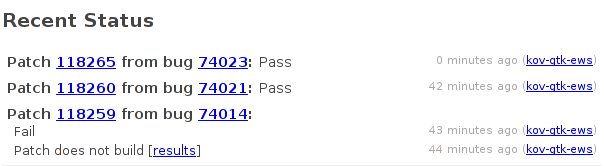
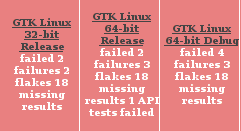
For a couple years now we have supported an increasingly complex and very demanding automated testing infrastructure. We have three buildbot slaves, one provided by Collabora (which I maintain), and two provided by Igalia (maintained by their WebKitGTK+ folks). Those bots build as many check ins as possible with 3 different configurations: 32 bits release, 64 bits release, and 64 bits debug. In addition to those, we have another bot called the EWS, or Early Warning System. There are two of those at this moment: one VM provided by Collabora and my desktop, provided by myself. These bots build every patch uploaded to the bugzilla, and report build failures or passes (you can see the green bubbles). They are very important to our development process because if the patch causes a build failure for our port people can often know that before landing, and try fixes by uploading them to bugzilla instead of doing additional commits. And people are usually very receptive to waiting for EWS output and acting on it, except when they take way too long. You can have an idea of what the life of an EWS bot looks like by looking at the recent status for the WebKitGTK+ bots. Maintaining all of those bots is at times a rather daunting task. The tests require a very specific set of packages, fonts, themes and icons to always report the same size for objects in a render. Upgrades, for instance, had to be synchronized, and usually involve generating new baselines for a large number of tests. You can see in these instructions, for instance, how strict the environment requirements are yes, we need specific versions of fonts, because they often cause layouts to change in size! At one point we had tests fail after a compiler upgrade, which made rounding act a bit different! So stability was a very important aspect of maintaining these bots. All of them have the same version of Debian, and most of the packages are pinned to the same version. On the other hand, and in direct contradition to the stability requirement, we often require bleeding edge versions of some libraries we rely on, such as libsoup. Since we started pushing WebKitGTK+ to be libsoup-only, its own progress has been pretty much driven by WebKitGTK+ s requirements, and Dan Winship has made it possible to make our soup backend much, much simpler and way more featureful. That meant, though, requiring very recent versions of soup. To top it off, for anyone not running Debian testing and tracking the exact same versions of packages as the bots it was virtually impossible to get the tests to pass, which made it very difficult for even ourselves to make sure all patches were still passing before committing something. Wow, what a mess. The explosion^Wsolution So a few weeks back Martin Robinson came up with a proposed solution, which, as he says, is the nuclear bomb solution. We would have a jhbuild environment which would build and install all of the dependencies necessary for reproducing the test expectations the bots have. So over the first three days of the hackfest Martin and myself hacked away in building scripts, buildmaster integration, a jhbuild configuration, a jhbuild modules file, setting up tarballs, and wiring it all in a way that makes it convenient for the contributors to get along with. You ll notice that our buildslaves now have a step just before compiling called updated gtk dependencies (gtk is the name we use for our port in the context of WebKit), which runs jhbuild to install any new dependencies or version bumps we added. You can also see that those instructions I mentioned above became a tad simpler. It took us way more time than we thought for the dust to settle, but it eventually began to. The great thing of doing it during the hackfest was that we could find and fix issues with weird configurations on the spot! Oh, you build with AR_FLAGS=cruT and something doesn t like it? OK, we fix it so that the jhbuild modules are not affected by that variable. Oh, turns out we missed a dependency, no problem, we add it to the modules file or install them on the bots, and then document the dependency. I set up a very clean chroot which we could use for trying out changes so as to not disrupt the tree too much for the other hackfest participants, and I think overall we did good. The aftermath By the time we were done our colleagues who ran other distributions such as Fedora were already being able to get a substantial improvements to the number of tests passing, and so did we! Also, the ability to seamlessly upgrade all the bots with a simple commit made it possible for us to very easily land a change that required a very recent (as in unreleased) version of soup which made our networking backend way simpler. All that red looks great, doesn t it? And we aren t done yet, we ll certainly be making more tweaks to this infrastructure to make it more transparent and more helpful to the users (contributors and other people interested in running the tests). If you ve been hit by the instability we caused, sorry about that, poke mrobinson or myself in the #webkitgtk+ IRC channel on FreeNode, and we ll help you out or fix any issues. If you haven t, we hope you enjoy all the goodness that a reproducible testing suite has to offer! That s it for now, folks, I ll have more to report on follow-up work started at the hackfest soon enough, hopefully =).

29 November 2011

Gustavo Noronha Silva: Accelerated Compositing in webkit-clutter

For a while now my fellow Collaboran Joone Hur has been working on implementing the Accelerated Compositing infrastructure available in WebKit in webkit-clutter, so that we can use Clutter s powers for compositing separate layers and perform animations. This work is being done by Collabora and is sponsored by BOSCH, whom I d like to thank! What does all this mean, you ask? Let me tell me a bit about it. The way animations usually work in WebKit is by repainting parts of the page every few milliseconds. What that means in technical terms is that an area of the page gets invalidated, and since the whole page is one big image, all of the pieces that are in that part of the page have to be repainted: the background, any divs, images, text that are at that part of the page. What the accelerated compositing code paths allow is the creation of separate pieces to represent some of the layers, allowing the composition to happen on the GPU, removing the need to perform lots of cairo paint operations per second in many cases. So if we have a semi-transparent video moving around the page, we can have that video be a separate texture that is layered on top of the page, made transparent and animated by the GPU. In webkit-clutter s case this is done by having separate actors for each of the layers. I have been looking at this code on and off, and recently joined Joone in the implementation of some of the pieces. The accelerated compositing infrastructure was originally built by Apple and is, for that reason, works in a way that is very similar to Core Animation. The code is still a bit over the place as we work on figuring out how to best translate the concepts into clutter concepts and there are several bugs, but some cool demos are already possible! Bellow you have one of the CSS3 demos that were made by Apple to demo this new functionality running on our MxLauncher test browser. <video controls="controls" src="http://cafe.minaslivre.org/~kov/webkit/ac.webm" width="640"></video> You can also see that the non-Accelerated version is unable to represent the 3D space correctly. Also, can you guess which of the two MxLauncher instances is spending less CPU? ;) In this second video I show the debug borders being painted around the actors that were created to represent layers. <video controls="controls" src="http://cafe.minaslivre.org/~kov/webkit/debug-borders.webm" width="640"></video> The code, should you like to peek or test is available in the ac2 branch of our webkit-clutter repository: http://gitorious.org/webkit-clutter/webkit-clutter/commits/ac2 We still have plenty of work to do, so expect to hear more about it. During our annual hackfest in A Coru a we plan to discuss how this work could be integrated also in the WebKitGTK+ port, perhaps by taking advantage of clutter-gtk, which would benefit both ports, by sharing code and maintenance, and providing this great functionality to Epiphany users. Stay tuned!

24 November 2011

Michael Banck: 24 Nov 2011

Tomorrow (25th November) evening, I will be giving a short talk about PostgreSQL at the monthly Munich Open-Source-Treffen event.

The meetings start around 6PM and are always in Cafe Netzwerk in Luisenstr. 11, a nice and cosy hangout and hackerspace for young Munich students near Hauptbahnhof.

22 November 2011

Thorsten Glaser: Those small nice tools we all write

This is both a release announcement for the next installment of The MirBSD Korn Shell, mksh R40b, and a follow-up to Sune s article about small tools of various degrees of usefulness. I hope I don t need to say too much about the first part; mksh(1) is packaged in a gazillion of operating environments (dear Planet readers, that of course includes Debian, which occasionally gets a development snapshot; I ll wait uploading R40c until that two month fixed gcc bug will finally find its way into the packages for armel and armhf. Ah, we re getting Arch Linux (after years) to include mksh now. (Probably because they couldn t stand the teasing that Arch Hurd included it one day after having been told about its existence, wondering why it built without needing patches on Hurd ) MSYS is a supposedly supported target now, people are working on WinAPI and DJGPP in their spare time, and Cygwin and Debian packagers have deprecated pdksh in favour of mksh (thanks!). So, everything looking well on that front. I ve started a collection of shell snippets some time ago, where most of those small things of mine ends up. Even stuff I write at work we re an Open Source company and can generally publish under (currently) AGPLv3 or (if extending existing code) that code s licence. I chose git as SCM in that FusionForge instance so that people would hopefully use it and contribute to it without fear, as it s hosted on my current money source s servers. (Can just clone it.) Feel free to register and ask for membership, to extend it (only if your shell-fu is up to the task, KNOPPIX-style scripts would be a bad style(9) example as the primary goal of the project is to give good examples to people who learn shell coding by looking at other peoples code). Maybe you like my editor, too? At OpenRheinRuhr, the Atari people sure liked it as it uses WordStar like key combinations, standardised across a lot of platforms and vendors (DR DOS Editor, Turbo Pascal, Borland C++ for Windows, ) ObPromise: a posting to raise the level of ferrophility on the Planet aggregators this wlog reaches (got pix)

Dirk Eddelbuettel: RPostgreSQL 0.2-0, 0.2-1 and an unsung Open Source hero

RPostgreSQL goes back to a topic suggestion I had made for the Google Summer of Code 2008, and specifically for the R Project participation that year. And Sameer Kumar Prayaga (whom I then mentored for the project) did a fine job that summer putting together a working framework of package connecting R and the excellent PostgreSQL database system. Unfortunately, Sameer vanished once the summer was up; I heard he got himself a job a another db company. Fast-forward a few years. A caretaker group had maintained the package in the meantime, but without really writing any new code. But thanks to the tireless efforts of Tomoaki Nishiyama, who not only wrote a lot of new code addressing some of issues logged at the Google Code project page, but also stepped forward and became the new lead maintainer, things are much, much better now. The first 0.2-0 release a few weeks ago already addressed a rather large number of issues, bringing the feature set much closer to what one would expect from a feature-complete package. But one big thorn remained: builds on Windows still required a local PostgreSQL library installation as well as local compilation. And as we can tell from the mailing list(s), this is a little daunting for many potential users. But what did release 0.2-1 bring: a complete set of libpq sources so that builds on Windows no longer require presence of local PostgreSQL sources! We tested this using Uwe Ligges' excellent win-builder service for R, and after I reminded Uwe on the weekend to no longer blacklist build attempts of RPostgreSQL, we now have Windows binaries for direct installation. Just call install.packages(), and you're good to go -- much nicer! Tomoaki achieved this pretty much single-handedly, and for that reason he greatly deserves some extra praise as an unsung Open Source hero!

15 November 2011

Michael Casadevall: Secure Boot - its here and been here for quite awhile ...

There's been a lot of noise with Microsoft requiring Secure Boot for Windows 8 OEMs. For those of you unfamiliar with it, Secure Boot requires that the boot chain is signed, and this 'feature' must be enabled by default. Although I have been unable to find specific details, it appears that the chain of trust needs to extend from BIOS/UEFI all the way down to the kernel. Obviously, requiring a signed boot chain makes using FOSS platforms like Ubuntu or Debian an impossibility short of having the UEFI Platform Key and resigning the entire chain.

Steven Sinofsky's MSDN blog has a fairly good overview how it works. Canonical and Red Hat also have a good white paper on why secure boot is a serious problem for Linux distributions. Even if secure boot itself can be disabled, it *greatly* rises the bar for general end-users to successfully install Ubuntu on their machine. In addition, it is the responsibility of OEM and BIOS manufacturers to provide the option to disable it.

There already has been a long history of OEMs removing BIOS options or introducing DRM; for instance, locking out VTx on Sony laptops, or restricting laptops to only accept 'branded' wifi and 3G cards. Given this track record, can OEMs realistically be trusted to have this option available?

What most people don't realize is that secure boot itself is not a new concept; its simply part of the Trusted Computing initiative, and has been implemented on embedded platforms for many years. If you own any iPhone, or one of the vast majority of Android devices, you are using a device that either has the secure boot feature, or something very close. This especially painful in Android as Google's security system restricts users to a *very* limited shell and subset of utilities which can be used on non-rooted devices. WebOS, Maemo, and to my knowledge Meego give the end-user full unrestricted access to the boot chain and you can swap kernels and even the entire OS out if one was so motivated.

Although it is still an ongoing problem, several vendors such as HTC, Samsung, Motorola (kinda), and even Sony. In the Android community, having unlockable bootloaders has been a welcome middle ground in the traditionally restrictive and locked-down world of cellular devices.

While some may argue that such locks are necessary to protect consumers, it is perfectly feasible to create devices with unlocked bootloaders that are still secure. The Nook Color's is an Android powered eReader. It's stock firmware doesn't allow sideloaded applications or even access to a user shell via adb, but the BootROM on the device attempts to boot from the microSD card before eMMC, making it possible for enterprising users to easily modify the underlying OS (as well as making it physically impossible to brick the device due to a bad flash). Barnes and Nobles even sells a book on rooting the Nook Color; it was right next to the devices on display at the time. In addition, they've continued the tradition of easily modifiable devices with both the Nook Simple Touch, and the Nook Tablet.

One of the most impressive attributes is the possibility of running Ubuntu on it. The absolute poster child for this is the Toshiba AC100. For those of you unfamiliar, it ultralight netbook that shipped with Android 2.1/2.2 with easy access to the built in flash via the mini-USB port on the side of the device. Due to the valiant efforts of the AC100 community, Ubuntu was ported to this device, and became a supported platform with images available on cdimages.ubuntu.com. If you were an attendee at UDS, you likely saw several AC100s all running Ubuntu.

This brings me to the point that motivated me to write this post in the first place. One of the most impressive tablets I've seen to date is the ASUS eeePad Transformer, an Android tablet with fully dockable keyboard. I have one of these devices, and its one of the most impressive and usable Android tablets I own. Sadly, such a powerful device was hobbled from its true potential due to ASUS's decision to ship the device with a locked and encrypted bootloader. Surprisingly, the Secure Boot Key (SBK) was acquired and released to the wild, making it possible to reflash the device. Sadly, even with the SBK, the device's bootloader is still extremely hobbled compared to the AC100 making flashing a slow and difficult process.

In response, ASUS refreshed the eeePad's hardware to the new B70 SKU, which has a new Secure Boot. Despite this, a root exploit was recently found to allow people to circumvent these restrictions and install customs ROMs. It is however only a manor of time before ASUS responds and releases a new update that fixes this bug.

Steven Barker (lilstevie) on xda-developers successfully created a port of Ubuntu to the Transformer. Currently, installing Ubuntu on the Transformer requires nvflash access, so its not possible to use his image on the newly liberated B70 devices. I am certain that a new method of installing via an update.zip will be developed for those of us with hobbled devices.

It is a showcase of what is possible when you have open hardware, and also proves one indisputable point: any 'trusted boot' or DRM scheme can and will be defeated; at best you piss off your userbase, and at worst, you force users to exploit bugs to gain control of their device. As it is impossible to reflash these devices from the bootloader, a failed kernel flash WILL brick these devices, increasing warranty and support costs as users try to return their now broken devices.

In closing, while there have been some victories in ongoing war of open hardware vs. trusted comptuing, the road ahead still remains very murky. Victories in the mobile market have shown that there is a market for open devices. Google's own Nexus One was sold as a developers phone and as a way to encourage manufacturers to raise the bar. It sold well enough to recoup its development costs.. While there is no official statements, the Nokia N900 is suspected to have broken all sales expectations, backed up by the fact that Angry Birds sold extremely well on the Ovi Store for the N900.

From the article in question:
What reaction have you had in terms of sales and customer feedback?

Angry Birds had already been launched on App Store before it came out on Ovi Store, and it had a great review average from iPhone reviewers and users alike, so we expected a good reception from N900 users as well.

Even so, we were quite surprised by just how the N900 community immediately took the game to heart. The game obviously made many people very happy, and that is really the greatest achievement that anyone who creates entertainment for a living can hope for. Well, maybe the greatest achievement is huge bundles of cash, but making people happy comes a close second.

In the first week that Angry Birds has been on the Ovi Store, it has been downloaded almost as many times as the iPhone version in six weeks. Given that most N900 users have not even used Ovi Store yet, we are confident that there will be many more downloads in the months to come, and are sure that the N900 version will be very profitable.

That being said, with Microsoft pushing secure boot and trusted computing down everyone's throats with Windows 8, it is hard to say what the future might hold for those of us who want to own our devices.

13 November 2011

Benjamin Mako Hill: Famous in Scratch

A few years ago, I ran into my friend Jay in the MIT Infinite Corridor. He was looking for volunteers to have their pictures taken and then added to the library of freely licensed and remixable media that would ship with every version of Scratch -- the graphical programming language built by Mitch Resnick's Lifelong Kindergarten group that is designed to let kids create animations and interactive games. Jay suggested I make some emotive faces and I posed for three images that made the final cut: /copyrighteous/images/scratchlib-mako-laughing.gif /copyrighteous/images/scratchlib-mako-screaming.gif /copyrighteous/images/scratchlib-mako-stop.gif But although I've spent quite a bit of time studying the Scratch community in the last few years as it is grown to include millions of participants and projects, I forgot about about Jay's photo shoot. A couple months ago, Acetarium resident Andres Lombana Bermudez pointed out that there was a mako tag on the Scratch website and that a whole bunch of users had been publishing projects using the pictures of me which, apparently, shipped in Scratch under my name. For example, in this project in which I dance in front of a enormous "MAKO" banner: /copyrighteous/images/scratchweb-dance.png That said, given the rather emotive nature of the pictures, I seem to usually end up being blown up shot, shrunk, set on fire by dragons, or meeting other similarly unfortunate ends. /copyrighteous/images/scratchweb-bad_mako.png /copyrighteous/images/scratchweb-looks_arent_everything.png There's quite many more entertaining examples under the tag and many more elsewhere on the Scratch website although they are a little trickier to track down. Jonathan Zittrain likes to say that the best technologies are generative in the sense that they encourage their users to make things with them that the designer never forsaw or anticipated. I feel generative.



Next.

Previous.