Search Results: "pa"

2 August 2025

Russell Coker: Server CPU Sockets

I am always looking for ways of increasing the compute power I have at a reasonable price. I am very happy with my HP z840 dual CPU workstation [1] that I m using as a server and my HP z640 single CPU workstation [2]. Both of them were available second hand at quite reasonable prices and could be cheaply upgraded to faster CPUs. But if I can get something a lot faster for a reasonable price then I ll definitely get it. Socket LGA2011-v3 The home server and home workstation I currently use have socket LGA2011-v3 [3] which supports the E5-2699A v4 CPU which gives a rating of 26,939 according to Passmark [4]. That Passmark score is quite decent, you can get CPUs using DDR4 RAM that go up to almost double that but it s a reasonable speed and it works in systems that are readily available at low prices. The z640 is regularly on sale for less than $400AU and the z840 is occasionally below $600. The Dell PowerEdge T430 is an ok dual-CPU tower server using the same socket. One thing that s not well known is that is it limited to something like 135W per CPU when run with two CPUs. So it will work correctly with a single E5-2697A v4 with 145W TDP (I ve tested that) but will refuse to boot with two of them. In my test system I tried replacing the 495W PSUs with 750W PSUs and it made no difference, the motherboard has the limit. With only a single CPU you only get 8/12 DIMM sockets and not all PCIe slots work. There are many second hand T430s on sale with only a single CPU presumably because the T330 sucks. My T430 works fine with a pair of E5-2683 v4 CPUs. The Dell PowerEdge T630 also takes the same CPUs but supports higher TDP than the T430. They also support 18*3.5 disks or 32*2.5 but they are noisy. I wouldn t buy one for home use. AMD There are some nice AMD CPUs manufactured around the same time and AMD has done a better job of making multiple CPUs that fit the same socket. The reason I don t generally use AMD CPUs is that they are used in a minority of the server grade systems so as I want ECC RAM and other server features I generally can t find AMD systems at a reasonable price on ebay etc. There are people who really want second hand server grade systems with AMD CPUs and outbid me. This is probably a region dependent issue, maybe if I was buying in the US I could get some nice workstations with AMD CPUs at low prices. Socket LGA1151 Socket LGA1151 [5] is used in the Dell PowerEdge T330. It only supports 2 memory channels and 4 DIMMs compared to the 4 channels and 8 DIMMs in LGA2011, and it also has a limit of 64G total RAM for most systems and 128G for some systems. By today s standards even 128G is a real limit for server use, DDR4 RDIMMs are about $1/GB and when spending $600+ on system and CPU upgrade you wouldn t want to spend less than $130 on RAM. The CPUs with decent performance for that socket like the i9-9900K aren t supported by the T330 (possibly they don t support ECC RAM). The CPUs that Dell supports perform very poorly. I suspect that Dell deliberately nerfed the T330 to drive sales of the T430. The Lenovo P330 uses socket LGA1151-2 but has the same issues of taking slow CPUs in addition to using UDIMMs which are significantly more expensive on the second hand market. Socket LGA2066 The next Intel socket after LGA2011-v3 is LGA2066 [6]. That is in The Dell Precision 5820 and HP Z4 G4. It takes an i9-10980XE for 32,404 on Passmark or a W-2295 for 30,906. The variant of the Dell 5820 that supports the i9 CPUs doesn t seem to support ECC RAM so it s not a proper workstation. The single thread performance difference between the W-2295 and the E5-2699A v4 is 2640 to 2055, a 28% increase for the W-2295. There are High Frequency Optimized cpus for socket LGA2011-v3 but they all deliver less than 2,300 on the Passmark single-thread tests which is much less than what you can get from socket LGA2066. The W-2295 costs $1000 on ebay and the E5-2699A v4 is readily available for under $400 and a few months ago I got a matched pair for a bit over $400. Note that getting a matched pair of Intel CPUs is a major pain [7]. Comparing sockets LGA2011-v3 and LGA2066 for a single-CPU system is a $300 system (HP x640) + $400 CPU (E5-2699A v4) vs $500 system (Dell Precision 5820) + $1000 CPU (W-2295), so more than twice the price for a 30% performance benefit on some tasks. The LGA2011-v3 and USB-C both launched in 2014 so LGA2011-v3 systems don t have USB-C sockets, a $20 USB-C PCIe card doesn t change the economics. Socket LGA3647 Socket LGA3647 [8] is used in the Dell PowerEdge T440. It supports 6 channels of DDR4 RAM which is a very nice feature for bigger systems. According to one Dell web page the best CPU Dell officially supports for this is the Xeon Gold 5120 which gives performance only slightly better than the E5-2683 v4 which has a low enough TDP that a T430 can run two of them. But according to another Dell web page they support 16 core CPUs which means performance better than a T430 but less than a HP z840. The T440 doesn t seem like a great system, if I got one cheap I could find a use for it but I wouldn t pay the prices that they go for on ebay. The Dell PowerEdge T640 has the same socket and is described as supporting up to 28 core CPUs. But I anticipate that it would be as loud as the T630 and it s also expensive. This socket is also used in the HP Z6 G4 which takes a W-3265 or Xeon Gold 6258R CPU for the high end options. The HP Z6 G4 systems on ebay are all above $1500 and the Xeon Gold 6258R is also over $1000 so while the Xeon Gold 6258R in a Z6 G4 will give 50% better performance on multithreaded operations than the systems I currently have it s costing almost 3* as much. It has 6 DIMM sockets which is a nice improvement over the 4 in the z640. The Z6 G4 takes a maximum of 768G of RAM with the optional extra CPU board (which is very expensive both new and on ebay) compared to my z840 which has 512G and half it s DIMM slots empty. The HP Z8 G4 has the same socket and takes up to 3TB of RAM if used with CPUs that support it (most CPUs only support 768G and you need a M variant to support more). The higher performance CPUs supported in the Z6 G4 and Z8 G4 don t have enough entries in the Passmark database to be accurate, but going from 22 cores in the E5-2699A v4 to 28 in the Xeon Platinum 8180 when using the same RAM technology doesn t seem like a huge benefit. The Z6 and Z8 G4 systems run DDR4 RAM at up to 2666 speed while the z640 and z840 only to 2400, a 10% increase in RAM speed is nice but not a huge difference. I don t think that any socket LGA3647 systems will ever be ones I want to buy. They don t offer much over LGA2011-v3 but are in newer and fancier systems that will go for significantly higher prices. DDR5 I think that DDR5 systems will be my next step up in tower server and workstation performance after the socket LGA2011-v3 systems. I don t think anything less will offer me enough of a benefit to justify a change. I also don t think that they will be in the price range I am willing to pay until well after DDR6 is released, some people are hoping for DDR6 to be released late this year but next year seems more likely. So maybe in 2027 there will be some nice DDR5 systems going cheap. CPU Benchmark Results Here are the benchmark results of CPUs I mentioned in this post according to passmark.com [9]. I didn t reference results of CPUs that only had 1 or 2 results posted as they aren t likely to be accurate.
CPU Single Thread Multi Thread TDP
E5-2683 v4 1,713 17,591 120W
Xeon Gold 5120 1,755 18,251 105W
i9-9900K 2,919 18,152 95W
E5-2697A v4 2,106 21,610 145W
E5-2699A v4 2,055 26,939 145W
W-3265 2,572 30,105 205W
W-2295 2,642 30,924 165W
i9-10980XE 2,662 32,397 165W
Xeon Gold 6258R 2,080 40,252 205W

1 August 2025

Jonathan Dowland: School of Computing Technical Reports

(You wait ages for an archiving blog post and two come along at once!) Between 1969-2019, the Newcastle University School of Computing published a Technical Reports Series. Until 2017-ish, the full list of individually-numbered reports was available on the School's website, as well as full text PDFs for every report. At some time around 2014 I was responsible for migrating the School's website from self-managed to centrally-managed. The driver was to improve the website from the perspective of student recruitment. The TR listings (as well as full listings and texts for awarded PhD theses, MSc dissertations, Director's reports and various others) survived the initial move. After I left (as staff) in 2015, anything not specifically about student recruitment degraded and by 2017 the listings were gone. I've been trying, on and off, to convince different parts of the University to restore and take ownership of these lists ever since. For one reason or another each avenue I've pursued has gone nowhere. Recently the last remaining promising way forward failed, so I gave up and did it myself. The list is now hosted by the Historic Computing Committee, here: https://nuhc.ncl.ac.uk/computing/techreports/ It's not complete (most of the missing entries are towards the end of the run), but it's a start. The approach that finally yielded results was simply scraping the Internet Archive Wayback Machine for various pages from back when the material was represented on the School website, and then filling in the gaps from some other sources. What I envisage in the future: per-page reports with the relevant metadata (including abstracts); authors de-duplicated and cross-referenced; PDFs OCRd; providing access to the whole metadata DB (probably as as lump of JSON); a mechanism for people to report errors; a platform for students to perform data mining projects: perhaps some kind of classification/tagging by automated content analysis; cross-referencing copies of papers in other venues (lots of TRs are pre-prints).

Sergio Cipriano: How I deployed this Website

How I deployed this Website I will describe the step-by-step process I followed to make this static website accessible on the Internet.

DNS I bought this domain on NameCheap and am using their DNS for now, where I created these records:
Record Type Host Value
A sergiocipriano.com 201.54.0.17
CNAME www sergiocipriano.com

Virtual Machine I am using Magalu Cloud for hosting my VM, since employees have free credits. Besides creating a VM with a public IP, I only needed to set up a Security Group with the following rules:
Type Protocol Port Direction CIDR
IPv4 / IPv6 TCP 80 IN Any IP
IPv4 / IPv6 TCP 443 IN Any IP

Firewall The first thing I did in the VM was enabling ufw (Uncomplicated Firewall). Enabling ufw without pre-allowing SSH is a common pitfall and can lock you out of your VM. I did this once :) A safe way to enable ufw:
$ sudo ufw allow OpenSSH      # or: sudo ufw allow 22/tcp
$ sudo ufw allow 'Nginx Full' # or: sudo ufw allow 80,443/tcp
$ sudo ufw enable
To check if everything is ok, run:
$ sudo ufw status verbose
Status: active
Logging: on (low)
Default: deny (incoming), allow (outgoing), disabled (routed)
New profiles: skip
To                           Action      From
--                           ------      ----
22/tcp (OpenSSH)             ALLOW IN    Anywhere                  
80,443/tcp (Nginx Full)      ALLOW IN    Anywhere                  
22/tcp (OpenSSH (v6))        ALLOW IN    Anywhere (v6)             
80,443/tcp (Nginx Full (v6)) ALLOW IN    Anywhere (v6) 

Reverse Proxy I'm using Nginx as the reverse proxy. Since I use the Debian package, I just needed to add this file:
/etc/nginx/sites-enabled/sergiocipriano.com
with this content:
server  
    listen 443 ssl;      # IPv4
    listen [::]:443 ssl; # IPv6
    server_name sergiocipriano.com www.sergiocipriano.com;
    root /path/to/website/sergiocipriano.com;
    index index.html;
    location /  
        try_files $uri /index.html;
     
 
server  
    listen 80;
    listen [::]:80;
    server_name sergiocipriano.com www.sergiocipriano.com;
    # Redirect all HTTP traffic to HTTPS
    return 301 https://$host$request_uri;
 

TLS It's really easy to setup TLS thanks to Let's Encrypt:
$ sudo apt-get install certbot python3-certbot-nginx
$ sudo certbot install --cert-name sergiocipriano.com
Saving debug log to /var/log/letsencrypt/letsencrypt.log
Deploying certificate
Successfully deployed certificate for sergiocipriano.com to /etc/nginx/sites-enabled/sergiocipriano.com
Successfully deployed certificate for www.sergiocipriano.com to /etc/nginx/sites-enabled/sergiocipriano.com
Certbot will edit the nginx configuration with the path to the certificate.

HTTP Security Headers I decided to use wapiti, which is a web application vulnerability scanner, and the report found this problems:
  1. CSP is not set
  2. X-Frame-Options is not set
  3. X-XSS-Protection is not set
  4. X-Content-Type-Options is not set
  5. Strict-Transport-Security is not set
I'll explain one by one:
  1. The Content-Security-Policy header prevents XSS and data injection by restricting sources of scripts, images, styles, etc.
  2. The X-Frame-Options header prevents a website from being embedded in iframes (clickjacking).
  3. The X-XSS-Protection header is deprecated. It is recommended that CSP is used instead of XSS filtering.
  4. The X-Content-Type-Options header stops MIME-type sniffing to prevent certain attacks.
  5. The Strict-Transport-Security header informs browsers that the host should only be accessed using HTTPS, and that any future attempts to access it using HTTP should automatically be upgraded to HTTPS. Additionally, on future connections to the host, the browser will not allow the user to bypass secure connection errors, such as an invalid certificate. HSTS identifies a host by its domain name only.
I added this security headers inside the HTTPS and HTTP server block, outside the location block, so they apply globally to all responses. Here's how the Nginx config look like:
add_header Content-Security-Policy "default-src 'self'; style-src 'self';" always;
add_header X-Frame-Options "DENY" always;
add_header X-Content-Type-Options "nosniff" always;
add_header Strict-Transport-Security "max-age=31536000; includeSubDomains" always;
I added always to ensure that nginx sends the header regardless of the response code. To add Content-Security-Policy header I had to move the css to a separate file, because browsers block inline styles under strict CSP unless you allow them explicitly. They're considered unsafe inline unless you move to a separate file and link it like this:
<link rel="stylesheet" href="./resources/header.css">

Jonathan Dowland: Debian Chronicles

I recently learned that, about 6 months ago, the Debian webteam deleted all news articles from the main website older than 2022. There have been several complaints from people in and outside of Debian, notably Joe Brockmeier of LWN, and this really sad one from the nephew of a deceased developer, wondering where the obituary had gone, but the team have not been swayed and are not prepared to reinstate the news. It feels very important to me, too, that historic news, and their links, are not broken. So, I hastily built a new Debian service, The Chronicles of Debian, as as permanent home for historic web content.
$ HEAD -S -H "Accept-Language: de" https://www.debian.org/News/1997/19971211
HEAD https://www.debian.org/News/1997/19971211
302 Found
HEAD https://chronicles.debian.org/www/News/1997/19971211
200 OK
 
Content-Language: de
Content-Location: 19971211.de.html
 
This was thrown up in a hurry to get something working as fast as possible, and there is plenty of room for improvement. Get in touch if there's an enhancement you would like or you would like to get involved!

Guido G nther: Free Software Activities July 2025

Another short status update of what happened on my side last month - a lot shorter than usual due to real life events (that will also affect August) but there was some progress on stevia and it landed in Debian too now. See below for details on the above and more: phosh phoc phosh-mobile-settings stevia (formerly phosh-osk-stub) phosh-vala-plugins xdg-desktop-portal-phosh feedbackd-device-themes livi Debian foliate Cellbroadcastd git-buildpackage wayland-protocols Reviews This is not code by me but reviews on other peoples code. The list is (as usual) slightly incomplete. Thanks for the contributions! Help Development If you want to support my work see donations. Comments? Join the Fediverse thread

Birger Schacht: Status update, July 2025

In beginning of July I got my 12" framework laptop and installed Debian on it. During that setup I made some updates to my base setup scripts that I use to install Debian machines. Due to the freeze I did not do much package related work. But I was at DebConf and I uploaded a new release of labwc to experimental, mostly to test the tag2upload workflow. I started working on packaging wlr-sunclock which is a small Wayland widget that displays the sun s shadows on the earth. I also created an ITP for wayback. Wayback is an X11 compatibility layer to allow to run X11 desktop environments using Wayland. In my dayjob I did my usual work on apis-core-rdf, which is our Django application for managing prosopographic data. I implemented a password change interface and did some restructuring of the templates. We released a new version which was followed by a bugfix release a couple of days later. I also implemented a rather big refactoring in pfp-api. PFP-API is a FastAPI based REST API that uses rdfproxy to fetch data from a Triplestore, converts the data to Pydantic models and then ships the models as JSON. Most of the work is done by rdfproxy in the background, but I adapted the existing pfp-api code to make it easier to add new entity types.

Paul Wise: FLOSS Activities July 2025

Focus This month I didn't have any particular focus. I just worked on issues in my info bubble.

Changes

Sponsors All work was done on a volunteer basis.

puer-robustus: My Google Summer of Code '25 at Debian

I ve participated in this year s Google Summer of Code (GSoC) program and have been working on the small (90h) autopkgtests for the rsync package project at Debian.

Writing my proposal Before you can start writing a proposal, you need to select an organization you want to work with. Since many organizations participate in GSoC, I ve used the following criteria to narrow things down for me:
  • Programming language familiarity: For me only Python (preferably) as well as shell and Go projects would have made sense. While learning another programming language is cool, I wouldn t be as effective and helpful to the project as someone who is proficient in the language already.
  • Standing of the organization: Some of the organizations participating in GSoC are well-known for the outstanding quality of the software they produce. Debian is one of them, but so is e.g. the Django Foundation or PostgreSQL. And my thinking was that the higher the quality of the organization, the more there is to learn for me as a GSoC student.
  • Mentor interactions: Apart from the advantage you get from mentor feedback when writing your proposal (more on that further below), it is also helpful to gauge how responsive/helpful your potential mentor is during the application phase. This is important since you will be working together for a period of at least 2 months; if the mentor-student communication doesn t work, the GSoC project is going to be difficult.
  • Free and Open-Source Software (FOSS) communication platforms: I generally believe that FOSS projects should be built on FOSS infrastructure. I personally won t run proprietary software when I want to contribute to FOSS in my spare time.
  • Be a user of the project: As Eric S. Raymond has pointed out in his seminal The Cathedral and the Bazaar 25 years ago
    Every good work of software starts by scratching a developer s personal itch.
Once I had some organizations in mind whose projects I d be interested in working on, I started writing proposals for them. Turns out, I started writing my proposals way too late: In the end I only managed to hand in a single one which is risky. Competition for the GSoC projects is fierce and the more quality (!) proposals you send out, the better your chances are at getting one. However, don t write proposals for the sake of it: Reviewers get way too many AI slop proposals already and you will not do yourself a favor with a low-quality proposal. Take the time to read the instructions/ideas/problem descriptions the project mentors have provided and follow their guidelines. Don t hesitate to reach out to project mentors: In my case, I ve asked Samuel Henrique a few clarification questions whereby the following (email) discussion has helped me greatly in improving my proposal. Once I ve finalized my proposal draft, I ve sent it to Samuel for a review, which again led to some improvements to the final proposal which I ve uploaded to the GSoC program webpage.

Community bonding period Once you get the information that you ve been accepted into the GSoC program (don t take it personally if you don t make it; this was my second attempt after not making the cut in 2024), get in touch with your prospective mentor ASAP. Agree upon a communication channel and some response times. Put yourself in the loop for project news and discussions whatever that means in the context of your organization: In Debian s case this boiled down to subscribing to a bunch of mailing lists and IRC channels. Also make sure to setup a functioning development environment if you haven t done so for writing the proposal already.

Payoneer setup The by far most annoying part of GSoC for me. But since you don t have a choice if you want to get the stipend, you will need to signup for an account at Payoneer. In this iteration of GSoC all participants got a personalized link to open a Payoneer account. When I tried to open an account by following this link, I got an email after the registration and email verification that my account is being blocked because Payoneer deems the email adress I gave a temporary one. Well, the email in question is most certainly anything but temporary, so I tried to get in touch with the Payoneer support - and ended up in an LLM-infused kafkaesque support hell. Emails are answered by an LLM which for me meant utterly off-topic replies and no help whatsoever. The Payoneer website offers a real-time chat, but it is yet another instance of a bullshit-spewing LLM bot. When I at last tried to call them (the support lines are not listed on the Payoneer website but were provided by the GSoC program), I kid you not, I was being told that their platform is currently suffering from technical problems and was hung up on. Only thanks to the swift and helpful support of the GSoC administrators (who get priority support from Payoneer) I was able to setup a Payoneer account in the end. Apart from showing no respect to customers, Payoneer is also ripping them off big time with fees (unless you get paid in USD). They charge you 2% for currency conversions to EUR on top of the FX spread they take. What worked for me to avoid all of those fees, was to open a USD account at Wise and have Payoneer transfer my GSoC stipend in USD to that account. Then I exchanged the USD to my local currency at Wise for significantly less than Payoneer would have charged me. Also make sure to close your Payoneer account after the end of GSoC to avoid their annual fee.

Project work With all this prelude out of the way, I can finally get to the actual work I ve been doing over the course of my GSoC project.

Background The upstream rsync project generally sees little development. Nonetheless, they released version 3.4.0 including some CVE fixes earlier this year. Unfortunately, their changes broke the -H flag. Now, Debian package maintainers need to apply those security fixes to the package versions in the Debian repositories; and those are typically a bit older. Which usually means that the patches cannot be applied as is but will need some amendments by the Debian maintainers. For these cases it is helpful to have autopkgtests defined, which check the package s functionality in an automated way upon every build. The question then is, why should the tests not be written upstream such that regressions are caught in the development rather than the distribution process? There s a lot to say on this question and it probably depends a lot on the package at hand, but for rsync the main benefits are twofold:
  1. The upstream project mocks the ssh connection over which rsync is most typically used. Mocking is better than nothing but not the real thing. In addition to being a more realisitic test scenario for the typical rsync use case, involving an ssh server in the test would automatically extend the overall resilience of Debian packages as now new versions of the openssh-server package in Debian benefit from the test cases in the rsync reverse dependency.
  2. The upstream rsync test framework is somewhat idiosyncratic and difficult to port to reimplementations of rsync. Given that the original rsync upstream sees little development, an extensive test suit further downstream can serve as a threshold for drop-in replacements for rsync.

Goal(s) At the start of the project, the Debian rsync package was just running (a part of) the upstream tests as autopkgtests. The relevant snippet from the build log for the rsync_3.4.1+ds1-3 package reads:
114s ------------------------------------------------------------
114s ----- overall results:
114s 36 passed
114s 7 skipped
Samuel and I agreed that it would be a good first milestone to make the skipped tests run. Afterwards, I should write some rsync test cases for local calls, i.e. without an ssh connection, effectively using rsync as a more powerful cp. And once that was done, I should extend the tests such that they run over an active ssh connection. With these milestones, I went to work.

Upstream tests Running the seven skipped upstream tests turned out to be fairly straightforward:
  • Two upstream tests concern access control lists and extended filesystem attributes. For these tests to run they rely on functionality provided by the acl and xattr Debian packages. Adding those to the Build-Depends list in the debian/control file of the rsync Debian package repo made them run.
  • Four upstream tests required root privileges to run. The autopkgtest tool knows the needs-root restriction for that reason. However, Samuel and I agreed that the tests should not exclusively run with root privileges. So, instead of just adding the restiction to the existing autopkgtest test, we created a new one which has the needs-root restriction and runs the upstream-tests-as-root script - which is nothing else than a symlink to the existing upstream-tests script.
The commits to implement these changes can be found in this merge request. The careful reader will have noticed that I only made 2 + 4 = 6 upstream test cases run out of 7: The leftover upstream test is checking the functionality of the --ctimes rsync option. In the context of Debian, the problem is that the Linux kernel doesn t have a syscall to set the creation time of a file. As long as that is the case, this test will always be skipped for the Debian package.

Local tests When it came to writing Debian specific test cases I started of a completely clean slate. Which is a blessing and a curse at the same time: You have full flexibility but also full responsibility. There were a few things to consider at this point in time:
  • Which language to write the tests in? The programming language I am most proficient in is Python. But testing a CLI tool in Python would have been weird: it would have meant that I d have to make repeated subprocess calls to run rsync and then read from the filesystem to get the file statistics I want to check. Samuel suggested I stick with shell scripts and make use of diffoscope - one of the main tools used and maintained by the Reproducible Builds project - to check whether the file contents and file metadata are as expected after rsync calls. Since I did not have good reasons to use bash, I ve decided to write the scripts to be POSIX compliant.
  • How to avoid boilerplate? If one makes use of a testing framework, which one? Writing the tests would involve quite a bit of boilerplate, mostly related to giving informative output on and during the test run, preparing the file structure we want to run rsync on, and cleaning the files up after the test has run. It would be very repetitive and in violation of DRY to have the code for this appear in every test. Good testing frameworks should provide convenience functions for these tasks. shunit2 comes with those functions, is packaged for Debian, and given that it is already being used in the curl project, I decided to go with it.
  • Do we use the same directory structure and files for every test or should every test have an individual setup? The tradeoff in this question being test isolation vs. idiosyncratic code. If every test has its own setup, it takes a) more work to write the test and b) more work to understand the differences between tests. However, one can be sure that changes to the setup in one test will have no side effects on other tests. In my opinion, this guarantee was worth the additional effort in writing/reading the tests.
Having made these decisions, I simply started writing tests and ran into issues very quickly.

rsync and subsecond mtime diffs When testing the rsync --times option, I observed a weird phenomenon: If the source and destination file have modification times which differ only in the nanoseconds, an rsync --times call will not synchronize the modification times. More details about this behavior and examples can be found in the upstream issue I raised. In the Debian tests we had to occasionally work around this by setting the timestamps explicitly with touch -d.
diffoscope regression In one test case, I was expecting a difference in the modification times but diffoscope would not report a diff. After a good amount of time spent on debugging the problem (my default, and usually correct, assumption is that something about my code is seriously broken if I run into issues like that), I was able to show that diffoscope only displayed this behavior in the version in the unstable suite, not on Debian stable (which I am running on my development machine). Since everything pointed to a regression in the diffoscope project and with diffoscope being written in Python, a language I am familiar with, I wanted to spend some time investigating (and hopefully fixing) the problem. Running git bisect on the diffoscope repo helped me in identifying the commit which introduced the regression: The commit contained an optimization via an early return for bit-by-bit identical files. Unfortunately, the early return also caused an explicitly requested metadata comparison (which could be different between the files) to be skipped. With a nicely diagnosed issue like that, I was able to go to a local hackerspace event, where people work on FOSS together for an evening every month. In a group, we were able to first, write a test which showcases the broken behavior in the latest diffoscope version, and second, make a fix to the code such that the same test passes going forward. All details can be found in this merge request.
shunit2 failures At some point I had a few autopkgtests setup and passing, but adding a new one would throw me totally inexplicable errors. After trying to isolate the problem as much as possible, it turns out that shunit2 doesn t play well together we the -e shell option. The project mentions this in the release notes for the 2.1.8 version1, but in my opinion a constraint this severe should be featured much more prominently, e.g. in the README.

Tests over an ssh connection The centrepiece of this project; everything else has in a way only been preparation for this. Obviously, the goal was to reuse the previously written local tests in some way. Not only because lazy me would have less work to do this way, but also because of a reduced long-term maintenance burden of one rather than two test sets. As it turns out, it is actually possible to accomplish that: The remote-tests script doesn t do much apart from starting an ssh server on localhost and running the local-tests script with the REMOTE environment variable set. The REMOTE environment variable changes the behavior of the local-tests script in such a way that it prepends "$REMOTE": to the destination of the rsync invocations. And given that we set REMOTE=rsync@localhost in the remote-tests script, local-tests copies the files to the exact same locations as before, just over ssh. The implementational details for this can be found in this merge request.

proposed-updates Most of my development work on the Debian rsync package took place during the Debian freeze as the release of Debian Trixie is just around the corner. This means that uploading by Debian Developers (DD) and Debian Maintainers (DM) to the unstable suite is discouraged as it makes migrating the packages to testing more difficult for the Debian release team. If DDs/DMs want to have the package version in unstable migrated to testing during the freeze they have to file an unblock request. Samuel has done this twice (1, 2) for my work for Trixie but has asked me to file the proposed-updates request for current stable (i.e. Debian Bookworm) myself after I ve backported my tests to bookworm.

Unfinished business To run the upstream tests which check access control list and extended file system attributes functionality, I ve added the acl and xattr packages to Build-Depends in debian/control. This, however, will only make the packages available at build time: If Debian users install the rsync package, the acl and xattr packages will not be installed alongside it. For that, the dependencies would have to be added to Depends or Suggests in debian/control. Depends is probably to strong of a relation since rsync clearly works well in practice without, but adding them to Suggests might be worthwhile. A decision on this would involve checking, what happens if rsync is called with the relevant options on a host machine which has those packages installed, but where the destination machine lacks them. Apart from the issue described above, the 15 tests I managed to write are are a drop in the water in light of the infinitude of rsync options and their combinations. Most glaringly, not all options of the --archive option are covered separately (which would help indicating what code path of rsync broke in a regression). To increase the likelihood of catching regressions with the autopkgtests, the test coverage should be extended in the future.

Conclusion Generally, I am happy with my contributions to Debian over the course of my small GSoC project: I ve created an extensible, easy to understand, and working autopkgtest setup for the Debian rsync package. There are two things which bother me, however:
  1. In hindsight, I probably shouldn t have gone with shunit2 as a testing framework. The fact that it behaves erratically with the -e flag is a serious drawback for a shell testing framework: You really don t want a shell command to fail silently and the test to continue running.
  2. As alluded to in the previous section, I m not particularly proud of the number of tests I managed to write.
On the other hand, finding and fixing the regression in diffoscope - while derailing me from the GSoC project itself - might have a redeeming quality.

DebConf25 By sheer luck I happened to work on a GSoC project at Debian over a time period during which the annual Debian conference would take place close enough to my place of residence. Samuel pointed the opportunity to attend DebConf out to me during the community bonding period and since I could make time for the event in my schedule, I signed up. DebConf was a great experience which - aside from gaining more knowledge about Debian development - allowed me to meet the actual people usually hidden behind email adresses and IRC nicks. I can wholeheartedly recommend attending a DebConf to every interested Debian user! For those who have missed this year s iteration of the conference, I can recommend the following recorded talks: While not featuring as a keynote speaker (understandably so as the newcomer to Debian community that I am), I could still contribute a bit to the conference program.

GSoC project presentation The Debian Outreach team has scheduled a session in which all GSoC and Outreachy students over the past year had the chance to present their work in a lightning talk. The session has been recorded and is available online, just like my slides and the source for them.

Debian install workshop Additionally, with so many Debian experts gathering in one place while KDE s End of 10 campaign is ongoing, I felt it natural to organize a Debian install workhop. In hindsight I can say that I underestimated how much work it would be, especially for me who does not speak a word of French. But although the turnout of people who wanted us to install Linux on their machines was disappointingly low, it was still worth it: Not only because the material in the repo can be helpful to others planning install workshops but also because it was nice to meet a) the person behind the Debian installer images and b) the local Brest/Finist re Linux user group as well as the motivated and helpful people at Infini.

Credits I want to thank the Open Source team at Google for organizing GSoC: The highly structured program with a one-to-one mentorship is a great avenue to start contributing to well established and at times intimidating FOSS projects. And as much as I disagree with Google s surveillance capitalist business model, I have to give it to them that the company at least takes its responsibility for FOSS (somewhat) seriously - unlike many other businesses which rely on FOSS and choose to freeride of it. Big thanks to the Debian community! I ve experienced nothing but friendliness in my interactions with the community. And lastly, the biggest thanks to my GSoC mentor Samuel Henrique. He has dealt patiently and competently with all my stupid newbie questions. His support enabled me to make - albeit small - contributions to Debian. It has been a pleasure to work with him during GSoC and I m looking forward to working together with him in the future.

  1. Obviously, I ve only read them after experiencing the problem.

Reproducible Builds (diffoscope): diffoscope 303 released

The diffoscope maintainers are pleased to announce the release of diffoscope version 303. This version includes the following changes:
[ Chris Lamb ]
* Don't check for PyPDF version 3 specifically, check for >= 3. Thanks,
  Vagrant, for the patch. (Closes: reproducible-builds/diffoscope#413)
* Ensure that Java class files are named .class on the filesystem before
  passing them to javap(1).
* Update copyright years.
You find out more by visiting the project homepage.

Iustin Pop: Our Grand Japan 2025 vacation is over

As I m writing this, we re one hour away from landing, and thus our Grand (with a capital G for sure) Japan 2025 vacation is over. Planning started about nine months ago, plane tickets bought six months in advance, most hotels booked about four months ahead, and then a wonderful, even if a bit packed, almost 3 weeks in Japan. And now we re left with lots of good memories, some mishaps that we re going to laugh about in a few months s time, and quite a few thousand pictures to process and filter, so that so they can be viewed in a single session. Oh, and I m also left with a nice bottle of plum wine, thanks to inflight shopping. Was planning to, but didn t manage to buy one in the airport, as Haneda International departures, after the security check, is a bit small. But in 15 hours of flying, there was enough time to implement 2 tiny Corydalis features, and browse the shopping catalog . I only learned on the flight that some items need to be preordered, a lesson for next time Thanks to the wonders of inflight internet, I can write and publish this, but it not being StarLink, Visual Studio Code managed to download an update for the UI, but now the remote server package is too big? slow? and can t be downloaded. Well, it started download 5 times, and aborted at about 80% each time. Well, thankful my blog is lightweight and I can write it in vi and push it . And pushing the above-mentioned features to GitHub was also possible. A proper blog post will follow, once I can select some pictures and manage to condense three weeks in an overall summary And in the meantime, back to the real world!

31 July 2025

Matthew Garrett: Secure boot certificate rollover is real but probably won't hurt you

LWN wrote an article which opens with the assertion "Linux users who have Secure Boot enabled on their systems knowingly or unknowingly rely on a key from Microsoft that is set to expire in September". This is, depending on interpretation, either misleading or just plain wrong, but also there's not a good source of truth here, so.

First, how does secure boot signing work? Every system that supports UEFI secure boot ships with a set of trusted certificates in a database called "db". Any binary signed with a chain of certificates that chains to a root in db is trusted, unless either the binary (via hash) or an intermediate certificate is added to "dbx", a separate database of things whose trust has been revoked[1]. But, in general, the firmware doesn't care about the intermediate or the number of intermediates or whatever - as long as there's a valid chain back to a certificate that's in db, it's going to be happy.

That's the conceptual version. What about the real world one? Most x86 systems that implement UEFI secure boot have at least two root certificates in db - one called "Microsoft Windows Production PCA 2011", and one called "Microsoft Corporation UEFI CA 2011". The former is the root of a chain used to sign the Windows bootloader, and the latter is the root used to sign, well, everything else.

What is "everything else"? For people in the Linux ecosystem, the most obvious thing is the Shim bootloader that's used to bridge between the Microsoft root of trust and a given Linux distribution's root of trust[2]. But that's not the only third party code executed in the UEFI environment. Graphics cards, network cards, RAID and iSCSI cards and so on all tend to have their own unique initialisation process, and need board-specific drivers. Even if you added support for everything on the market to your system firmware, a system built last year wouldn't know how to drive a graphics card released this year. Cards need to provide their own drivers, and these drivers are stored in flash on the card so they can be updated. But since UEFI doesn't have any sandboxing environment, those drivers could do pretty much anything they wanted to. Someone could compromise the UEFI secure boot chain by just plugging in a card with a malicious driver on it, and have that hotpatch the bootloader and introduce a backdoor into your kernel.

This is avoided by enforcing secure boot for these drivers as well. Every plug-in card that carries its own driver has it signed by Microsoft, and up until now that's been a certificate chain going back to the same "Microsoft Corporation UEFI CA 2011" certificate used in signing Shim. This is important for reasons we'll get to.

The "Microsoft Windows Production PCA 2011" certificate expires in October 2026, and the "Microsoft Corporation UEFI CA 2011" one in June 2026. These dates are not that far in the future! Most of you have probably at some point tried to visit a website and got an error message telling you that the site's certificate had expired and that it's no longer trusted, and so it's natural to assume that the outcome of time's arrow marching past those expiry dates would be that systems will stop booting. Thankfully, that's not what's going to happen.

First up: if you grab a copy of the Shim currently shipped in Fedora and extract the certificates from it, you'll learn it's not directly signed with the "Microsoft Corporation UEFI CA 2011" certificate. Instead, it's signed with a "Microsoft Windows UEFI Driver Publisher" certificate that chains to the "Microsoft Corporation UEFI CA 2011" certificate. That's not unusual, intermediates are commonly used and rotated. But if we look more closely at that certificate, we learn that it was issued in 2023 and expired in 2024. Older versions of Shim were signed with older intermediates. A very large number of Linux systems are already booting certificates that have expired, and yet things keep working. Why?

Let's talk about time. In the ways we care about in this discussion, time is a social construct rather than a meaningful reality. There's no way for a computer to observe the state of the universe and know what time it is - it needs to be told. It has no idea whether that time is accurate or an elaborate fiction, and so it can't with any degree of certainty declare that a certificate is valid from an external frame of reference. The failure modes of getting this wrong are also extremely bad! If a system has a GPU that relies on an option ROM, and if you stop trusting the option ROM because either its certificate has genuinely expired or because your clock is wrong, you can't display any graphical output[3] and the user can't fix the clock and, well, crap.

The upshot is that nobody actually enforces these expiry dates - here's the reference code that disables it. In a year's time we'll have gone past the expiration date for "Microsoft Windows UEFI Driver Publisher" and everything will still be working, and a few months later "Microsoft Windows Production PCA 2011" will also expire and systems will keep booting Windows despite being signed with a now-expired certificate. This isn't a Y2K scenario where everything keeps working because people have done a huge amount of work - it's a situation where everything keeps working even if nobody does any work.

So, uh, what's the story here? Why is there any engineering effort going on at all? What's all this talk of new certificates? Why are there sensationalist pieces about how Linux is going to stop working on old computers or new computers or maybe all computers?

Microsoft will shortly start signing things with a new certificate that chains to a new root, and most systems don't trust that new root. System vendors are supplying updates[4] to their systems to add the new root to the set of trusted keys, and Microsoft has supplied a fallback that can be applied to all systems even without vendor support[5]. If something is signed purely with the new certificate then it won't boot on something that only trusts the old certificate (which shouldn't be a realistic scenario due to the above), but if something is signed purely with the old certificate then it won't boot on something that only trusts the new certificate.

How meaningful a risk is this? We don't have an explicit statement from Microsoft as yet as to what's going to happen here, but we expect that there'll be at least a period of time where Microsoft signs binaries with both the old and the new certificate, and in that case those objects should work just fine on both old and new computers. The problem arises if Microsoft stops signing things with the old certificate, at which point new releases will stop booting on systems that don't trust the new key (which, again, shouldn't happen). But even if that does turn out to be a problem, nothing is going to force Linux distributions to stop using existing Shims signed with the old certificate, and having a Shim signed with an old certificate does nothing to stop distributions signing new versions of grub and kernels. In an ideal world we have no reason to ever update Shim[6] and so we just keep on shipping one signed with two certs.

If there's a point in the future where Microsoft only signs with the new key, and if we were to somehow end up in a world where systems only trust the old key and not the new key[7], then those systems wouldn't boot with new graphics cards, wouldn't be able to run new versions of Windows, wouldn't be able to run any Linux distros that ship with a Shim signed only with the new certificate. That would be bad, but we have a mechanism to avoid it. On the other hand, systems that only trust the new certificate and not the old one would refuse to boot older Linux, wouldn't support old graphics cards, and also wouldn't boot old versions of Windows. Nobody wants that, and for the foreseeable future we're going to see new systems continue trusting the old certificate and old systems have updates that add the new certificate, and everything will just continue working exactly as it does now.

Conclusion: Outside some corner cases, the worst case is you might need to boot an old Linux to update your trusted keys to be able to install a new Linux, and no computer currently running Linux will break in any way whatsoever.

[1] (there's also a separate revocation mechanism called SBAT which I wrote about here, but it's not relevant in this scenario)

[2] Microsoft won't sign GPLed code for reasons I think are unreasonable, so having them sign grub was a non-starter, but also the point of Shim was to allow distributions to have something that doesn't change often and be able to sign their own bootloaders and kernels and so on without having to have Microsoft involved, which means grub and the kernel can be updated without having to ask Microsoft to sign anything and updates can be pushed without any additional delays

[3] It's been a long time since graphics cards booted directly into a state that provided any well-defined programming interface. Even back in 90s, cards didn't present VGA-compatible registers until card-specific code had been executed (hence DEC Alphas having an x86 emulator in their firmware to run the driver on the card). No driver? No video output.

[4] There's a UEFI-defined mechanism for updating the keys that doesn't require a full firmware update, and it'll work on all devices that use the same keys rather than being per-device

[5] Using the generic update without a vendor-specific update means it wouldn't be possible to issue further updates for the next key rollover, or any additional revocation updates, but I'm hoping to be retired by then and I hope all these computers will also be retired by then

[6] I said this in 2012 and it turned out to be wrong then so it's probably wrong now sorry, but at least SBAT means we can revoke vulnerable grubs without having to revoke Shim

[7] Which shouldn't happen! There's an update to add the new key that should work on all PCs, but there's always the chance of firmware bugs

comment count unavailable comments

Simon Josefsson: Independently Reproducible Git Bundles

The gnulib project publish a git bundle as a stable archival copy of the gnulib git repository once in a while. Why? We don t know exactly what this may be useful for, but I m promoting for this to see if we can establish some good use-case. A git bundle may help to establish provinence in case of an attack on the Savannah hosting platform that compromise the gnulib git repository. Another use is in the Debian gnulib package: that gnulib bundle is git cloned when building some Debian packages, to get to exactly the gnulib commit used by each upstream project see my talk on gnulib at Debconf24 and this approach reduces the amount of vendored code that is part of Debian s source code, which is relevant to mitigate XZ-style attacks. The first time we published the bundle, I wanted it to be possible to re-create it bit-by-bit identically by others. At the time I discovered a well-written blog post by Paul Beacher on reproducible git bundles and thought he had solved the problem for me. Essentially it boils down to disable threading during compression when producing the bundle, and his final example show this results in a predictable bit-by-bit identical output:
$ for i in $(seq 1 100); do \
> git -c 'pack.threads=1' bundle create -q /tmp/bundle-$i --all; \
> done
$ md5sum /tmp/bundle-*   cut -f 1 -d ' '   uniq -c
    100 4898971d4d3b8ddd59022d28c467ffca
So what remains to be said about this? It seems reproducability goes deeper than that. One desirable property is that someone else should be able to reproduce the same git bundle, and not only that a single individual is able to reproduce things on one machine. It surprised me to see that when I ran the same set of commands on a different machine (started from a fresh git clone), I got a different checksum. The different checksums occured even when nothing had been committed on the server side between the two runs. I thought the reason had to do with other sources of unpredictable data, and I explored several ways to work around this but eventually gave up. I settled for the following sequence of commands:
REV=ac9dd0041307b1d3a68d26bf73567aa61222df54 # master branch commit to package
git clone https://git.savannah.gnu.org/git/gnulib.git
cd gnulib
git fsck # attempt to validate input
# inspect that the new tree matches a trusted copy
git checkout -B master $REV # put $REV at master
for b in $(git branch -r   grep origin/stable-   sort --version-sort); do git checkout $ b#origin/ ; done
git remote remove origin # drop some unrelated branches
git gc --prune=now # drop any commits after $REV
git -c 'pack.threads=1' bundle create gnulib.bundle --all
V=$(env TZ=UTC0 git show -s --date=format:%Y%m%d --pretty=%cd master)
mv gnulib.bundle gnulib-$V.bundle
build-aux/gnupload --to ftp.gnu.org:gnulib gnulib-$V.bundle
At the time it felt more important to publish something than to reach for perfection, so we did so using the above snippet. Afterwards I reached out to the git community on this and there were good discussion about my challenge. At the end of that thread you see that I was finally able to reproduce a bit-by-bit identical bundles from two different clones, by using an intermediate git -c pack.threads=1 repack -adF step. I now assume that the unpredictable data I got earlier was introduced during the git clone steps, compressing the pack differently each time due to threaded compression. The outcome could also depend on what content the server provided, so if someone ran git gc, git repack on the server side things would change for the user, even if the user forced threading to 1 during cloning more experiments on what kind of server-side alterations results in client-side differences would be good research. A couple of months passed and it is now time to publish another gnulib bundle somewhat paired to the bi-yearly stable gnulib branches so let s walk through the commands and explain what they do. First clone the repository:
REV=225973a89f50c2b494ad947399425182dd42618c   # master branch commit to package
S1REV=475dd38289d33270d0080085084bf687ad77c74d # stable-202501 branch commit
S2REV=e8cc0791e6bb0814cf4e88395c06d5e06655d8b5 # stable-202507 branch commit
git clone https://git.savannah.gnu.org/git/gnulib.git
cd gnulib
git fsck # attempt to validate input
I believe the git fsck will validate that the chain of SHA1 commits are linked together, preventing someone from smuggling in unrelated commits earlier in the history without having to do SHA1 collision. SHA1 collisions are economically feasible today, so this isn t much of a guarantee of anything though.
git checkout -B master $REV # put $REV at master
# Add all stable-* branches locally:
for b in $(git branch -r   grep origin/stable-   sort --version-sort); do git checkout $ b#origin/ ; done
git checkout -B stable-202501 $S1REV
git checkout -B stable-202507 $S2REV
git remote remove origin # drop some unrelated branches
git gc --prune=now # drop any unrelated commits, not clear this helps
This establish a set of branches pinned to particular commits. The older stable-* branches are no longer updated, so they shouldn t be moving targets. In case they are modified in the future, the particular commit we used will be found in the official git bundle.
time git -c pack.threads=1 repack -adF
That s the new magic command to repack and recompress things in a hopefully more predictable way. This leads to a 72MB git pack under .git/objects/pack/ and a 62MB git bundle. The runtime on my laptop is around 5 minutes. I experimented with -c pack.compression=1 and -c pack.compression=9 but the size was roughly the same; 76MB and 66MB for level 1 and 72MB and 62MB for level 9. Runtime still around 5 minutes. Git uses zlib by default, which isn t the most optimal compression around. I tried -c pack.compression=0 and got a 163MB git pack and a 153MB git bundle. The runtime is still around 5 minutes, indicating that compression is not the bottleneck for the git repack command. That 153MB uncompressed git bundle compresses to 48MB with gzip default settings and 46MB with gzip -9; to 39MB with zst defaults and 34MB with zst -9; and to 28MB using xz defaults with a small 26MB using xz -9. Still the inconvenience of having to uncompress a 30-40MB archive into
the much larger 153MB is probably not worth the savings compared to
shipping and using the (still relatively modest) 62MB git bundle. Now finally prepare the bundle and ship it:
git -c 'pack.threads=1' bundle create gnulib.bundle --all
V=$(env TZ=UTC0 git show -s --date=format:%Y%m%d --pretty=%cd master)
mv gnulib.bundle gnulib-$V.bundle
build-aux/gnupload --to ftp.gnu.org:gnulib gnulib-$V.bundle
Yay! Another gnulib git bundle snapshot is available from
https://ftp.gnu.org/gnu/gnulib/. The essential part of the git repack command is the -F parameter. In the thread -f was suggested, which translates into the git pack-objects --no-reuse-delta parameter:
--no-reuse-delta
When creating a packed archive in a repository that has existing packs, the command reuses existing deltas. This sometimes results in a slightly suboptimal pack. This flag tells the command not to reuse existing deltas but compute them from scratch.
When reading the man page, I though that using -F which translates into --no-reuse-object would be slightly stronger:
--no-reuse-object
This flag tells the command not to reuse existing object data at all, including non deltified object, forcing recompression of everything. This implies --no-reuse-delta. Useful only in the obscure case where wholesale enforcement of a different compression level on the packed data is desired.
On the surface, without --no-reuse-objects, some amount of earlier compression could taint the final result. Still, I was able to get bit-by-bit identical bundles by using -f so possibly reaching for -F is not necessary. All the commands were done using git 2.51.0 as packaged by Guix. I fear the result may be different with other git versions and/or zlib libraries. I was able to reproduce the same bundle on a Trisquel 12 aramo (derived from Ubuntu 22.04) machine, which uses git 2.34.1. This suggests there is some chances of this being possible to reproduce in 20 years time. Time will tell. I also fear these commands may be insufficient if something is moving on the server-side of the git repository of gnulib (even just something simple as a new commit), I tried to make some experiments with this but let s aim for incremental progress here. At least I have now been able to reproduce the same bundle on different machines, which wasn t the case last time. Happy Reproducible Git Bundle Hacking!

Russell Coker: Links July 2025

Louis Rossman made an informative YouTube video about right to repair and the US military [1]. This is really important as it helps promote free software and open standards. The ACM has an insightful article about hidden controls [2]. We need EU regulations about hidden controls in safety critical systems like cars. This Daily WTF article has some interesting security implications for Windows [3]. Earth.com has an interesting article about the rubber hand illusion and how it works on Octopus [4]. For a long time I have been opposed to eating Octopus because I think they are too intelligent. The Washington Post has an insightful article about the future of spies when everything is tracked by technology [5]. Micah Lee wrote an informative guide to using Signal groups for activism [6]. David Brin wrote an insightful blog post about the phases of the ongoing US civil war [7]. Christian Kastner wrote an interesting blog post about using Glibc hardware capabilities to use different builds of a shared library for a range of CPU features [8]. David Brin wrote an insightful and interesting blog post comparing President Carter with the criminals in the Republican party [9].

Michael Ablassmeier: libvirt - incremental backups for raw devices

Skimming through the latest libvirt releases, to my surprise, i found that latest versions (>= v10.10.0) have added support for the QCOW data-file setting. Usually the incremental backup feature using bitmaps was limited to qcow2 based images, as there was no way to store the bitmaps persistently within raw devices. This basically ruled out proper incremental backups for direct attached luns, etc. In the past, there were some discussions how to implement this, mostly by using a separate metadata qcow image, holding the bitmap information persistently. These approaches have been discussed again lately and required features were implemented In order to be able to use the feature, you need to configure the virtual machines and its disks in a special way: Lets assume you have a virtual machine that uses a raw device /tmp/datafile.raw 1) Create an qcow image (same size as the raw image):
 # point the data-file to a temporary file, as create will overwrite whatever it finds here
 qemu-img create -f qcow2 /tmp/metadata.qcow2 -o data_file=/tmp/TEMPFILE,data_file_raw=true ..
 rm -f /tmp/TEMPFILE
2) Now use the amend option to point the qcow image to the right raw device using the data-file option:
 qemu-img amend /tmp/metadata.qcow2 -o data_file=/tmp/datafile.raw,data_file_raw=true
3) Reconfigure the virtual machine configuration to look like this:
    <disk type='file' device='disk'>
      <driver name='qemu' type='qcow2' cache='none' io='native' discard='unmap'/>
      <source file='/tmp/metadata.qcow2'>
        <dataStore type='file'>
          <format type='raw'/>
          <source file='/tmp/datafile.raw'/>
        </dataStore>
      </source>
      <target dev='vda' bus='virtio'/>
    </disk>
Now its possible to create persistent checkpoints:
 virsh checkpoint-create-as vm6 --name test --diskspec vda,bitmap=test
 Domain checkpoint test created
and the persistent bitmap will be stored within the metadata image:
 qemu-img info  /tmp/tmp.16TRBzeeQn/vm6-sda.qcow2
 [..]
    bitmaps:
        [0]:
            flags:
                [0]: auto
            name: test
            granularity: 65536
Hoooray. Added support for this in virtnbdbackup v2.33

30 July 2025

Utkarsh Gupta: FOSS Activites in July 2025

Here s my 70th monthly but brief update about the activities I ve done in the F/L/OSS world.

Debian
This was my 79th month of actively contributing to Debian. I became a DM in late March 2019 and a DD on Christmas 19! \o/ Debian was in freeze throughout so whilst I didn t do many uploads, there s a bunch of other things I did:
  • Attended DebConf25 in Brest, France.
    • Lead the bursary BOF and discussions.
    • Participated in other sessions, especially around the FTP masters.
    • I ve started to look at things with my trainee hat on.
    • Participated in the Debian Security Tracker sprints during DebCamp. More on that below.
  • Mentoring for newcomers.
  • Moderation of -project mailing list.

Ubuntu
This was my 54th month of actively contributing to Ubuntu. I joined Canonical to work on Ubuntu full-time back in February 2021. Whilst I can t give a full, detailed list of things I did (there s so much and some of it might not be public yet!), here s a quick TL;DR of what I did:
  • Released Questing snapshot 3! \o/
  • EOL d Oracular. o/
  • Participated in the mid-cycle sprints.
  • Got a recognition award for leading 24.04.2 LTS release and leading the Release Management team.
  • Preparing for the 24.04.3 LTS release early next month.

Debian (E)LTS
Debian Long Term Support (LTS) is a project to extend the lifetime of all Debian stable releases to (at least) 5 years. Debian LTS is not handled by the Debian security team, but by a separate group of volunteers and companies interested in making it a success. And Debian Extended LTS (ELTS) is its sister project, extending support to the stretch and jessie release (+2 years after LTS support). This was my 70th month as a Debian LTS and 57th month as a Debian ELTS paid contributor.
I only worked for 15.00 hours for LTS and 5.00 hours for ELTS and did the following things:
  • [LTS] Released DLA 4263-1 for ruby-graphql.
    • Coordinated with upstream due to lack of clarity on 1.11.4 being affected & not having a clear reproducer.
    • As 1.11.4 was still partially vulnerable and the backport was non-trivial, it was probably conveinent to bump the upstream version to 1.11.12 instead, fixing:
    • CVE-2025-27407): a remote code execution.
    • Salsa repository: https://salsa.debian.org/lts-team/packages/ruby-graphql.
    • Coordinated with the Security team for a p-u fix or a DSA.
  • [E/LTS] Frontdesk duty from 28th July to 04th August.
  • [LTS] Attended the monthly LTS meeting on IRC. Summary here.

Debian Security Tracker sprint 2025 Thanks to the LTS team for also organizing a security tracker sprint during DebCamp25. I attended the sprint and spent 10 hours working on the following tasks: That s all. A quicky shoutout to Roberto for organizing the sprints remotely and being awake at odd hours. <3
Until next time.
:wq for today.

29 July 2025

Ravi Dwivedi: How to paste your password on your bank's website

If your bank is like mine, its website doesn t allow you to copy your password and paste it by performing a simple Ctrl+V. I tried the Don t Fuck With Paste extension in Firefox, which could paste my bank account s profile password but not the login password. Therefore, I asked on Mastodon a couple of days ago and got some responses. The solution that worked for me was to use Shift+Insert to paste the password. It worked for me in LibreWolf and Firefox, and that s all I needed. Furthermore, this behavior by bank websites leads to users choosing insecure and memorable passwords. Using this trick will help you choose strong passwords for your bank account. I prefer to use random and strong passwords generated using the password manager pass. It is a freedom-respecting software, unlike popular proprietary password managers promoted by YouTubers. Feel free to check out their webpage here. The reason I use pass is that it stores all the passwords locally (and optionally in a remote Git repository) in encrypted form, which can only be decrypted using your private GPG keys.

Christoph Berg: The Debian Conference 2025 in Brest

It's Sunday and I'm now sitting in the train from Brest to Paris where I will be changing to Germany, on the way back from the annual Debian conference. A full week of presentations, discussions, talks and socializing is laying behind me and my head is still spinning from the intensity.
Pollito and the gang of DebConf mascots wearing their conference badgesPollito and the gang of DebConf mascots wearing their conference badges (photo: Christoph Berg)
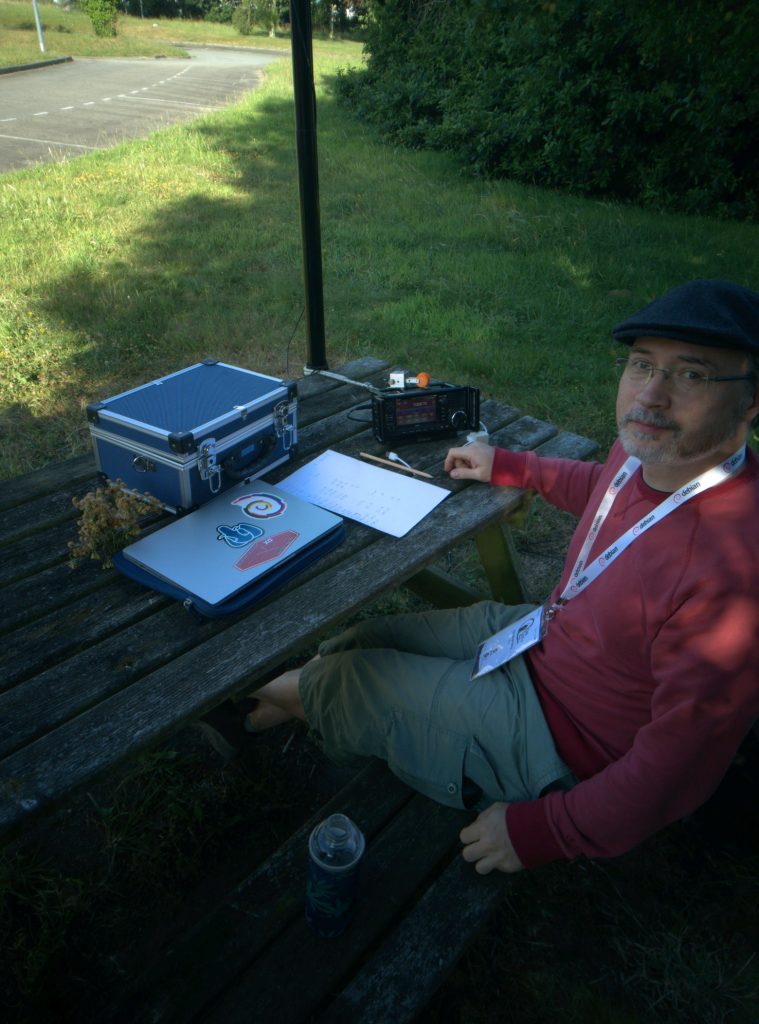
Sunday, July 13th It started last Sunday with traveling to the conference. I got on the Eurostar in Duisburg and we left on time, but even before reaching Cologne, the train was already one hour delayed for external reasons, collecting yet another hour between Aachen and Liege for its own technical problems. "The train driver is working on trying to fix the problem." My original schedule had well over two hours for changing train stations in Paris, but being that late, I missed the connection to Brest in Montparnasse. At least in the end, the total delay was only one hour when finally arriving at the destination. Due to the French julliet quatorze fireworks approaching, buses in Brest were rerouted, but I managed to catch the right bus to the conference venue, already meeting a few Debian people on the way. The conference was hosted at the IMT Atlantique Brest campus, giving the event a nice university touch. I arrived shortly after 10 in the evening and after settling down a bit, got on one of the "magic" buses for transportation to the camping site where half of the attendees where stationed. I shared a mobile home with three other Debianites, where I got a small room for myself. Monday, July 14th Next morning, we took the bus back to the venue with a small breakfast and the opening session where Enrico Zini invited me to come to his and Nicolas Dandrimont's session about Debian community governance and curation, which I gladly did. Many ideas about conflict moderation and community steering were floated around. I hope some of that can be put into effect to make flamewars on the mailing lists less heated and more directed. After that, I attended Olly Betts' "Stemming with Snowball" session, which is the stemmer used also in PostgreSQL. Text search is one of the areas in PostgreSQL that I never really looked closely at, including the integration into the postgresql-common package, so it was nice to get more information about that. In preparation for the conference, a few of us Ham radio operators in Debian had decided to bring some radio gear to DebConf this year in order to perhaps spark more interest for our hobby among the fellow geeks. In the afternoon after the talks, I found a quieter spot just outside of the main hall and set up a shortwave antenna by attaching a 10m mast to one of the park benches there. The 40m band was still pretty much closed, but I could work a few stations from England, just across the channel from Bretagne, answering questions from interested passing-by Debian people between the contacts. Over time, the band opened and more European stations got into the log.
F/DF7CB in Brest (photo: Evangelos Ribeiro Tzaras)
Tuesday, July 15th Tuesday started with Helmut Grohne's session about "Reviving (un)schroot". The schroot program has been Debian's standard way of managing build chroots for a long time, but it is more and more being regarded as obsolete with all kinds of newer containerization and virtualization technologies taking over. Since many bits of Debian infrastructure depend on schroot, and its user interface is still very useful, Helmut reimplemented it using Linux namespaces and the "unshare" systemcall. I had already worked with him at the Hamburg Minidebconf to replace the apt.postgresql.org buildd machinery with the new system, but we were not quite there yet (network isolation is nice, but we still sometimes need proper networking), so it was nice to see the effort is still progressing and I will give his new scripts a try when I'm back home. Next, Stefano Rivera and Colin Watson presented Debusine, a new package repository and workflow management system. It looks very promising for anyone running their own repository, so perhaps yet another bit of apt.postgresql.org infrastructure to replace in the future. After that, I went to the Debian LTS BoF session by Santiago Ruano Rinc n and Bastien Roucari s - Debian releases plus LTS is what we are covering with apt.postgresql.org. Then there were bits from the DPL (Debian Project Leader), and a session moderated by Stefano Rivera interesting to me as a member of the Debian Technical Committee on the future structure of the packages required for cross-building in Debian, a topic which had been brought to TC a while ago. I am happy that we could resolve the issue without having to issue a formal TC ruling as the involved parties (kernel, glibc, gcc and the cross-build people) found a promising way forward themselves. DebConf is really a good way to get such issues unstuck. Ten years ago at the 2015 Heidelberg DebConf, Enrico had given a seminal "Semi-serious stand-up comedy" talk, drawing parallels between the Debian Open Source community and the BDSM community - "People doing things consensually together". (Back then, the talk was announced as "probably unsuitable for people of all ages".) With his unique presentation style and witty insights, the session made a lasting impression on everyone attending. Now, ten years later (and he and many in the audience being ten years older), he gave an updated version of it. We are now looking forward to the sequel in 2035. The evening closed with the famous DebConf tradition of the Cheese & Wine party in a old fort next to the coast, just below the conference venue. Even when he's a fellow Debian Developer, Ham and also TC member, I had never met Paul Tagliamonte in person before, but we spent most of the evening together geeking out on all things Debian and Ham radio.
The northern coast of Ushant (photo: Christoph Berg)
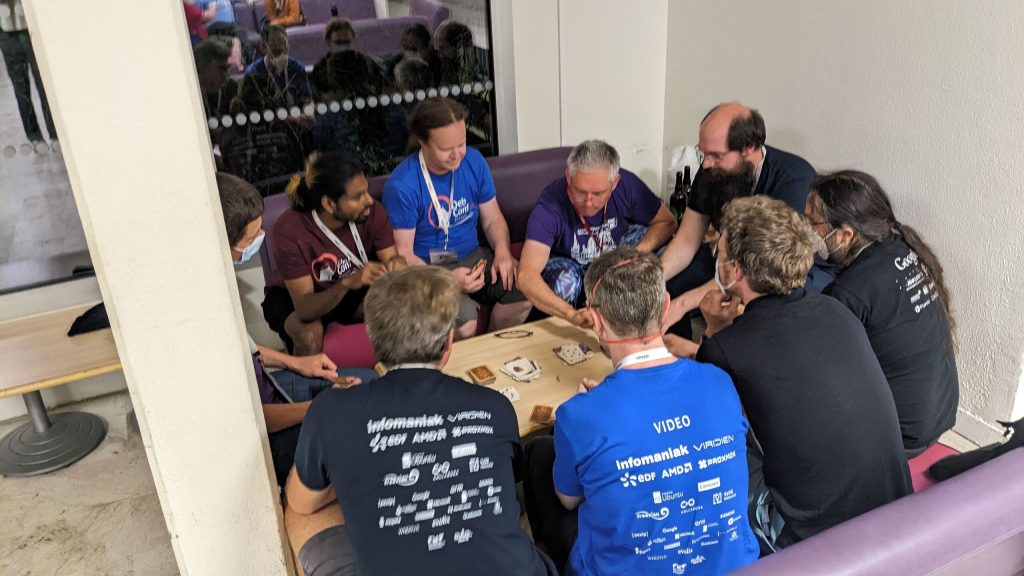
Wednesday, July 16th Wednesday already marked the end of the first half of the week, the day of the day trips. I had chosen to go to Ouessant island (Ushant in English) which marks the Western end of French mainland and hosts one of the lighthouses yielding the way into the English channel. The ferry trip included surprisingly big waves which left some participants seasick, but everyone recovered fast. After around one and a half hours we arrived, picked up the bicycles, and spent the rest of the day roaming the island. The weather forecast was originally very cloudy and 18 C, but over noon this turned into sunny and warm, so many got an unplanned sunburn. I enjoyed the trip very much - it made up for not having time visiting the city during the week. After returning, we spent the rest of the evening playing DebConf's standard game, Mao (spoiler alert: don't follow the link if you ever intend to play).
Having a nice day (photo: Christoph Berg)
Thursday, July 17th The next day started with the traditional "Meet the Technical Committee" session. This year, we trimmed the usual slide deck down to remove the boring boilerplate parts, so after a very short introduction to the work of the committee by our chairman Matthew Vernon, we opened up the discussion with the audience, with seven (out of 8) TC members on stage. I think the format worked very well, with good input from attendees. Next up was "Don't fear the TPM" by Jonathan McDowell. A common misconception in the Free Software community is that the TPM is evil DRM hardware working against the user, but while it could be used in theory that way, the necessary TPM attestations seem to impossible to attain in practice, so that wouldn't happen anyway. Instead, it is a crypto coprocessor present in almost all modern computers that can be used to hold keys, for example to be used for SSH. It will also be interesting to research if we can make use of it for holding the Transparent Data Encryption keys for CYBERTEC's PostgreSQL Enterprise Edition. Aigars Mahinovs then directed everyone in place for the DebConf group picture, and Lucas Nussbaum started a discussion about archive-wide QA tasks in Debian, an area where I did a lot of work in the past and that still interests me. Antonio Terceiro and Paul Gevers followed up with techniques to track archive-wide rebuilding and testing of packages and in turn filing a lot of bugs to track the problems. The evening ended with the conference dinner, again in the fort close by the coast. DebConf is good for meeting new people, and I incidentally ran into another Chris, who happened to be one of the original maintainers of pgaccess, the pre-predecessor of today's pgadmin. I admit still missing this PostgreSQL frontend for its simplicity and ability to easily edit table data, but it disappeared around 2004. Friday, July 18th On Friday, I participated in discussion sessions around contributors.debian.org (PostgreSQL is planning to set up something similar) and the New Member process which I had helped to run and reform a decade or two ago. Agathe Porte (also a Ham radio operator, like so many others at the conference I had no idea of) then shared her work on rust-rewriting the slower parts of Lintian, the Debian package linter. Craig Small talked about "Free as in Bytes", the evolution of the Linux procps free command. Over the time and many kernel versions, the summary numbers printed became better and better, but there will probably never be a version that suits all use cases alike. Later over dinner, Craig (who is also a TC member) and I shared our experiences with these numbers and customers (not) understanding them. He pointed out that for PostgreSQL and looking at used memory in the presence of large shared memory buffers, USS (unique set size) and PSS (proportional set size) should be more realistic numbers than the standard RSS (resident set size) that the top utility is showing by default. Antonio Terceiro and Paul Gevers again joined to lead a session, now on ci.debian.net and autopkgtest, the test driver used for running tests on packages after then have been installed on a system. The PostgreSQL packages are heavily using this to make sure no regressions creep in even after builds have successfully completed and test re-runs are rescheduled periodically. The day ended with Bdale Garbee's electronics team BoF and Paul Tagliamonte and me setting up the radio station in the courtyard, again answering countless questions about ionospheric conditions and operating practice. Saturday, July 19th Saturday was the last conference day. In the first session, Nikos Tsipinakis and Federico Vaga from CERN announced that the LHC will be moving to Debian for the accelerator's frontend computers in their next "long shutdown" maintenance period in the next year. CentOS broke compatibility too often, and Debian trixie together with the extended LTS support will cover the time until the next long shutdown window in 2035, until when the computers should have all been replaced with newer processors covering higher x86_64 baseline versions. The audience was very delighted to hear that Debian is now also being used in this prestige project. Ben Hutchings then presented new Linux kernel features. Particularly interesting for me was the support for atomic writes spanning more than one filesystem block. When configured correctly, this would mean PostgreSQL didn't have to record full-page images in the WAL anymore, increasing throughput and performance. After that, the Debian ftp team discussed ways to improve review of new packages in the archive, and which of their processes could be relaxed with new US laws around Open Source and cryptography algorithms export. Emmanuel Arias led a session on Salsa CI, Debian's Gitlab instance and standard CI pipeline. (I think it's too slow, but the runners are not under their control.) Julian Klode then presented new features in APT, Debian's package manager. I like the new display format (and a tiny bit of that is also from me sending in wishlist bugs). In the last round of sessions this week, I then led the Ham radio BoF with an introduction into the hobby and how Debian can be used. Bdale mentioned that the sBitx family of SDR radios is natively running Debian, so stock packages can be used from the radio's touch display. We also briefly discussed his involvement in ARDC and the possibility to get grants from them for Ham radio projects. Finally, DebConf wrapped up with everyone gathering in the main auditorium and cheering the organizers for making the conference possible and passing Pollito, the DebConf mascot, to the next organizer team.
Pollito on stage (photo: Christoph Berg)
Sunday, July 20th Zoom back to the train: I made it through the Paris metro and I'm now on the Eurostar back to Germany. It has been an intense week with all the conference sessions and meeting all the people I had not seen so long. There are a lot of new ideas to follow up on both for my Debian and PostgreSQL work. Next year's DebConf will take place in Santa Fe, Argentina. I haven't yet decided if I will be going, but I can recommend the experience to everyone! The post The Debian Conference 2025 in Brest appeared first on CYBERTEC PostgreSQL Services & Support.

28 July 2025

Scarlett Gately Moore: Request for Financial Support During Job Search

Dear friends, family, and community, I m reaching out during a challenging time in my life to ask for your support. This year has been particularly difficult as I ve been out of work for most of it due to a broken arm and a serious MRSA infection that required extensive treatment and recovery time.

Current Situation While I ve been recovering, I ve been actively working to maintain and improve my professional skills by contributing to open source software projects. These contributions help me stay current with industry trends and demonstrate my ongoing commitment to my field, but unfortunately, they don t provide the income I need to cover my basic living expenses. Despite my efforts, I m still struggling to secure employment, and I m falling behind on essential bills including:
  • Rent/mortgage payments
  • Utilities
  • Medical expenses
  • Basic living costs

How You Can Help Any financial assistance, no matter the amount, would make a meaningful difference in helping me stay afloat during this job search. Your support would allow me to:
  • Keep my housing stable
  • Maintain essential services
  • Focus fully on finding employment without the constant stress of unpaid bills
  • Continue contributing to the open source community

Moving Forward I m actively job searching and interviewing, and I m confident that I ll be back on my feet soon. Your temporary support during this difficult period would mean the world to me and help bridge the gap until I can secure stable employment. If you re able to contribute, GoFundMe . If you re unable to donate, I completely understand, and sharing this request with others who might be able to help would be greatly appreciated. Thank you for taking the time to read this and for considering helping me during this challenging time. With gratitude, Scarlett

Dimitri John Ledkov: Achieving actually full disk encryption of UEFI ESP at rest with TCG OPAL, FIPS, LUKS

Achieving full disk encryption using FIPS, TCG OPAL and LUKS to encrypt UEFI ESP on bare-metal and in VMs
Many security standards such as CIS and STIG require to protect information at rest. For example, NIST SP 800-53r5 SC-28 advocate to use cryptographic protection, offline storage and TPMs to enhance protection of information confidentiality and/or integrity.Traditionally to satisfy such controls on portable devices such as laptops one would utilize software based Full Disk Encryption - Mac OS X FileVault, Windows Bitlocker, Linux cryptsetup LUKS2. In cases when FIPS cryptography is required, additional burden would be placed onto these systems to operate their kernels in FIPS mode.Trusted Computing Group works on establishing many industry standards and specifications, which are widely adopted to improve safety and security of computing whilst keeping it easy to use. One of their most famous specifications them is TCG TPM 2.0 (Trusted Platform Module). TPMs are now widely available on most devices and help to protect secret keys and attest systems. For example, most software full disk encryption solutions can utilise TCG TPM to store full disk encryption keys providing passwordless, biometric or pin-base ways to unlock the drives as well as attesting that system have not been modified or compromised whilst offline.TCG Storage Security Subsystem Class: Opal Specification is a set of specifications for features of data storage devices. The authors and contributors to OPAL are leading and well trusted storage manufacturers such as Samsung, Western Digital, Seagate Technologies, Dell, Google, Lenovo, IBM, Kioxia, among others. One of the features that Opal Specification enables is self-encrypting drives which becomes very powerful when combined with pre-boot authentication. Out of the box, such drives always and transparently encrypt all disk data using hardware acceleration. To protect data one can enter UEFI firmware setup (BIOS) to set NVMe single user password (or user + administrator/recovery passwords) to encrypt the disk encryption key. If one's firmware didn't come with such features, one can also use SEDutil to inspect and configure all of this. Latest release of major Linux distributions have SEDutil already packaged.Once password is set, on startup, pre-boot authentication will request one to enter password - prior to booting any operating systems. It means that full disk is actually encrypted, including the UEFI ESP and all operating systems that are installed in case of dual or multi-boot installations. This also prevents tampering with ESP, UEFI bootloaders and kernels which with traditional software-based encryption often remain unencrypted and accessible. It also means one doesn't have to do special OS level repartitioning, or installation steps to ensure all data is encrypted at rest.What about FIPS compliance? Well, the good news is that majority of the OPAL compliant hard drives and/or security sub-chips do have FIPS 140-3 certification. Meaning they have been tested by independent laboratories to ensure they do in-fact encrypt data. On the CMVP website one can search for module name terms "OPAL" or "NVMe" or name of hardware vendor to locate FIPS certificates.Are such drives widely available? Yes. For example, a common Thinkpad X1 gen 11 has OPAL NVMe drives as standard, and they have FIPS certification too. Thus, it is likely in your hardware fleet these are already widely available. Use sedutil to check if MediaEncrypt and LockingSupported features are available.Well, this is great for laptops and physical servers, but you may ask - what about public or private cloud? Actually, more or less the same is already in-place in both. On CVMP website all major clouds have their disk encryption hardware certified, and all of them always encrypt all Virtual Machines with FIPS certified cryptography without an ability to opt-out. One is however in full control of how the encryption keys are managed: cloud-provider or self-managed (either with a cloud HSM or KMS or bring your own / external). See these relevant encryption options and key management docs for GCP, Azure, AWS. But the key takeaway without doing anything, at rest, VMs in public cloud are always encrypted and satisfy NIST SP 800-53 controls.What about private cloud? Most Linux based private clouds ultimately use qemu typically with qcow2 virtual disk images. Qemu supports user-space encryption of qcow2 disk, see this manpage. Such encryption encrypts the full virtual machine disk, including the bootloader and ESP. And it is handled entirely outside of the VM on the host - meaning the VM never has access to the disk encryption keys. Qemu implements this encryption entirely in userspace using gnutls, nettle, libgcrypt depending on how it was compiled. This also means one can satisfy FIPS requirements entirely in userspace without a Linux kernel in FIPS mode. Higher level APIs built on top of qemu also support qcow2 disk encryption, as in projects such as libvirt and OpenStack Cinder.If you carefully read the docs, you may notice that agent support is explicitly sometimes called out as not supported or not mentioned. Quite often agents running inside the OS may not have enough observability to them to assess if there is external encryption. It does mean that monitoring above encryption options require different approaches - for example monitor your cloud configuration using tools such as Wiz and Orca, rather than using agents inside individual VMs. For laptop / endpoint security agents, I do wish they would start gaining capability to report OPAL SED availability and status if it is active or not.What about using software encryption none-the-less on top of the above solutions? It is commonly referred to double or multiple encryption. There will be an additional performance impact, but it can be worthwhile. It really depends on what you define as data at rest for yourself and which controls you need. If one has a dual-boot laptop, and wants to keep one OS encrypted whilst booted into the other, it can perfectly reasonable to encrypted the two using separate software encryption keys. In addition to the OPAL encryption of the ESP. For more targeted per-file / per-folder encryption, one can look into using gocryptfs which is the best successor to the once popular, but now deprecated eCryptfs (amazing tool, but has fallen behind in development and can lead to data loss).All of the above mostly talks about cryptographic encryption, which only provides confidentially but not data integrity. To protect integrity, one needs to choose how to maintain that. dm-verity is a good choice for read-only and rigid installations. For read-write workloads, it may be easier to deploy ZFS or Btrfs instead. If one is using filesystems without a built-in integrity support such as XFS or Ext4, one can retrofit integrity layer to them by using dm-integrity (either standalone, or via dm-luks/cryptsetup --integrity option).

If one has a lot of estate and a lot of encryption keys to keep track off a key management solution is likely needed. The most popular solution is likely the one from Thales Group marketed under ChiperTrust Data Security Platform (previously Vormetric), but there are many others including OEM / Vendor / Hardware / Cloud specific or agnostic solutions.

I hope this crash course guide piques your interest to learn and discover modern confidentially and integrity solutions, and to re-affirm or change your existing controls w.r.t. to data protection at rest.

Full disk encryption, including UEFI ESP /boot/efi is now widely achievable by default on both baremetal machines and in VMs including with FIPS certification. To discuss more let's connect on Linkedin.

Russ Allbery: Review: Cyteen

Review: Cyteen, by C.J. Cherryh
Series: Cyteen #1
Publisher: Warner Aspect
Copyright: 1988
Printing: September 1995
ISBN: 0-446-67127-4
Format: Trade paperback
Pages: 680
The main text below is an edited version of my original review of Cyteen written on 2012-01-03. Additional comments from my re-read are after the original review. I've reviewed several other C.J. Cherryh books somewhat negatively, which might give the impression I'm not a fan. That is an artifact of when I started reviewing. I first discovered Cherryh with Cyteen some 20 years ago, and it remains one of my favorite SF novels of all time. After finishing my reading for 2011, I was casting about for what to start next, saw Cyteen on my parents' shelves, and decided it was past time for my third reading, particularly given the recent release of a sequel, Regenesis. Cyteen is set in Cherryh's Alliance-Union universe following the Company Wars. It references several other books in that universe, most notably Forty Thousand in Gehenna but also Downbelow Station and others. It also has mentions of the Compact Space series (The Pride of Chanur and sequels). More generally, almost all of Cherryh's writing is loosely tied together by an overarching future history. One does not need to read any of those other books before reading Cyteen; this book will fill you in on all of the politics and history you need to know. I read Cyteen first and have never felt the lack. Cyteen was at one time split into three books for publishing reasons: The Betrayal, The Rebirth, and The Vindication. This is an awful way to think of the book. There are no internal pauses or reasonable volume breaks; Cyteen is a single coherent novel, and Cherryh has requested that it never be broken up that way again. If you happen to find all three portions as your reading copy, they contain all the same words and are serviceable if you remember it's a single novel under three covers, but I recommend against reading the portions in isolation. Human colonization of the galaxy started with slower-than-light travel sponsored by the private Sol Corporation. The inhabitants of the far-flung stations and the crews of the merchant ships that supplied them have formed their own separate cultures, but initially remained attached to Earth. That changed with the discovery of FTL travel and a botched attempt by Earth to reassert its authority. At the time of Cyteen, there are three human powers: distant Earth (which plays little role in this book), the merchanter Alliance, and Union. The planet Cyteen is one of only a few Earth-like worlds discovered by human expansion, and is the seat of government and the most powerful force in Union. This is primarily because of Reseune: the Cyteen lab that produces the azi. If Cyteen is about any one thing, it's about azi: genetically engineered human clones who are programmed via intensive psychological conditioning starting before birth. The conditioning uses a combination of drugs to make them receptive and "tape," specific patterns of instruction and sensory stimulation. They are designed for specific jobs or roles, they're conditioned to be obedient to regular humans, and they're not citizens. They are, in short, slaves. In a lot of books, that's as deep as the analysis would go. Azi are slaves, and slavery is certainly bad, so there would probably be a plot around azi overthrowing their conditioning, or around the protagonists trying to free them from servitude. But Cyteen is not any SF novel, and azi are considerably more complex and difficult than that analysis. We learn over the course of the book that the immensely powerful head of Reseune Labs, Ariane Emory, has a specific broader purpose in mind for the azi. One of the reasons why Reseune fought for and gained the role of legal protector of all azi in Union, regardless of where they were birthed, is so that Reseune could act to break any permanent dependence on azi as labor. And yet, they are slaves; one of the protagonists of Cyteen is an experimental azi, which makes him the permanent property of Reseune and puts him in constant jeopardy of being used as a political prisoner and lever of manipulation against those who care about him. Cyteen is a book about manipulation, about programming people, about what it means to have power over someone else's thoughts, and what one can do with that power. But it's also a book about connection and identity, about what makes up a personality, about what constitutes identity and how people construct the moral codes and values that they hold at their core. It's also a book about certainty. Azi are absolutely certain, and are capable of absolute trust, because that's part of their conditioning. Naturally-raised humans are not. This means humans can do things that azi can't, but the reverse is also true. The azi are not mindless slaves, nor are they mindlessly programmed, and several of the characters, both human and azi, find a lot of appeal in the core of certainty and deep self-knowledge of their own psychological rules that azis can have. Cyteen is a book about emotions, and logic, and where they come from and how to balance them. About whether emotional pain and uncertainty is beneficial or damaging, and about how one's experiences make up and alter one's identity. This is also a book about politics, both institutional and personal. It opens with Ariane Emory, Councilor for Science for five decades and the head of the ruling Union Expansionist party. She's powerful, brilliant, dangerously good at reading people, and dangerously willing to manipulate and control people for her own ends. What she wants, at the start of the book, is to completely clone a Special (the legal status given to the most brilliant minds of Union). This was attempted before and failed, but Ariane believes it's now possible, with a combination of tape, genetic engineering, and environmental control, to reproduce the brilliance of the original mind. To give Union another lifespan of work by their most brilliant thinkers. Jordan Warrick, another scientist at Reseune, has had a long-standing professional and personal feud with Ariane Emory. As the book opens, he is fighting to be transferred out from under her to the new research station that would be part of the Special cloning project, and he wants to bring his son Justin and Justin's companion azi Grant with them. Justin is a PR, a parental replicate, meaning he shares Jordan's genetic makeup but was not an attempt to reproduce the conditions of Jordan's rearing. Grant was raised as his brother. And both have, for reasons that are initially unclear, attracted the attention of Ariane, who may be using them as pawns. This is just the initial setup, and along with this should come a warning: the first 150 pages set up a very complex and dangerous political situation and build the tension that will carry the rest of the book, and they do this by, largely, torturing Justin and Grant. The viewpoint jumps around, but Justin and Grant are the primary protagonists for this first section of the book. While one feels sympathy for both of them, I have never, in my multiple readings of the book, particularly liked them. They're hard to like, as opposed to pity, during this setup; they have very little agency, are in way over their heads, are constantly making mistakes, and are essentially having their lives destroyed. Don't let this turn you off on the rest of the book. Cyteen takes a dramatic shift about 150 pages in. A new set of protagonists are introduced who are some of the most interesting, complex, and delightful protagonists in any SF novel I have read, and who are very much worth waiting for. While Justin has his moments later on (his life is so hard that his courage can be profoundly moving), it's not necessary to like him to love this book. That's one of the reasons why I so strongly dislike breaking it into three sections; that first section, which is mostly Justin and Grant, is not representative of the book. I can't talk too much more about the plot without risking spoiling it, but it's a beautiful, taut, and complex story that is full of my favorite things in both settings and protagonists. Cyteen is a book about brilliant people who think on their feet. Cherryh succeeds at showing this through what they do, which is rarely done as well as it is here. It's a book about remembering one's friends and remembering one's enemies, and waiting for the most effective moment to act, but it also achieves some remarkable transformations. About 150 pages in, you are likely to loathe almost everyone in Reseune; by the end of the book, you find yourself liking, or at least understanding, nearly everyone. This is extremely hard, and Cherryh pulls it off in most cases without even giving the people she's redeeming their own viewpoint sections. Other than perhaps George R.R. Martin I've not seen another author do this as well. And, more than anything else, Cyteen is a book with the most wonderful feeling of catharsis. I think this is one of the reasons why I adore this book and have difficulties with some of Cherryh's other works. She's always good at ramping up the tension and putting her characters in awful, untenable positions. Less frequently does she provide the emotional payoff of turning the tables, where you get to watch a protagonist do everything you've been wanting them to do for hundreds of pages, except even better and more delightfully than you would have come up with. Cyteen is one of the most emotionally satisfying books I've ever read. I could go on and on; there is just so much here that I love. Deep questions of ethics and self-control, presented in a way that one can see the consequences of both bad decisions and good ones and contrast them. Some of the best political negotiations in fiction. A wonderful look at friendship and loyalty from several directions. Two of the best semi-human protagonists I've seen, who one can see simultaneously as both wonderful friends and utterly non-human and who put nearly all of the androids in fiction to shame by being something trickier and more complex. A wonderful unfolding sense of power. A computer that can somewhat anticipate problems and somewhat can't, and that encapsulates much of what I love about semi-intelligent bases in science fiction. Cyteen has that rarest of properties of SF novels: Both the characters and the technology meld in a wonderful combination where neither could exist without the other, where the character issues are illuminated by the technology and the technology supports the characters. I have, for this book, two warnings. The first, as previously mentioned, is that the first 150 pages of setup is necessary but painful to read, and I never fully warmed to Justin and Grant throughout. I would not be surprised to hear that someone started this book but gave up on it after 50 or 100 pages. I do think it's worth sticking out the rocky beginning, though. Justin and Grant continue to be a little annoying, but there's so much other good stuff going on that it doesn't matter. The other warning is that part of the setup of the story involves the rape of an underage character. This is mostly off-camera, but the emotional consequences are significant (as they should be) and are frequently discussed throughout the book. There is also rather frank discussion of adolescent sexuality later in the book. I think both of these are relevant to the story and handled in a way that isn't gratuitous, but they made me uncomfortable and I don't have any past history with those topics. Those warnings notwithstanding, this is simply one of the best SF novels ever written. It uses technology to pose deep questions about human emotions, identity, and interactions, and it uses complex and interesting characters to take a close look at the impact of technology on lives. And it does this with a wonderfully taut, complicated plot that sustains its tension through all 680 pages, and with characters whom I absolutely love. I have no doubt that I'll be reading it for a fourth and fifth time some years down the road. Followed by Regenesis, although Cyteen stands well entirely on its own and there's no pressing need to read the sequel. Rating: 10 out of 10

Some additional thoughts after re-reading Cyteen in 2025: I touched on this briefly in my original review, but I was really struck during this re-read how much the azi are a commentary on and a complication of the role of androids in earlier science fiction. Asimov's Three Laws of Robotics were an attempt to control the risks of robots, but can also be read as turning robots into slaves. Azis make the slavery more explicit and disturbing by running the programming on a human biological platform, but they're more explicitly programmed and artificial than a lot of science fiction androids. Artificial beings and their relationship to humans have been a recurring theme of SF since Frankenstein, but I can't remember a novel that makes the comparison to humans this ambiguous and conflicted. The azi not only like being azi, they can describe why they prefer it. It's clear that Union made azi for many of the same reasons that humans enslave other humans, and that Ariane Emory is using them as machinery in a larger (and highly ethically questionable) plan, but Cherryh gets deeper into the emergent social complications and societal impact than most SF novels manage. Azi are apparently closer to humans than the famous SF examples such as Commander Data, but the deep differences are both more subtle and more profound. I've seen some reviewers who are disturbed by the lack of a clear moral stance by the protagonists against the creation of azi. I'm not sure what to think about that. It's clear the characters mostly like the society they've created, and the groups attempting to "free" azi from their "captivity" are portrayed as idiots who have no understanding of azi psychology. Emory says she doesn't want azi to be a permanent aspect of society but clearly has no intention of ending production any time soon. The book does seem oddly unaware that the production of azi is unethical per se and, unlike androids, has an obvious exit ramp: Continue cloning gene lines as needed to maintain a sufficient population for a growing industrial civilization, but raise the children as children rather than using azi programming. If Cherryh included some reason why that was infeasible, I didn't see it, and I don't think the characters directly confronted it. I don't think societies in books need to be ethical, or that Cherryh intended to defend this one. There are a lot of nasty moral traps that civilizations can fall into that make for interesting stories. But the lack of acknowledgment of the problem within the novel did seem odd this time around. The other part of this novel that was harder to read past in this re-read is the sexual ethics. There's a lot of adolescent sexuality in this book, and even apart from the rape scene which was more on-the-page than I had remembered and which is quite (intentionally) disturbing there is a whole lot of somewhat dubious consent. Maybe I've gotten older or just more discriminating, but it felt weirdly voyeuristic to know this much about the sex lives of characters who are, at several critical points in the story, just a bunch of kids. All that being said, and with the repeated warning that the first 150 pages of this novel are just not very good, there is still something magic about the last two-thirds of this book. It has competence porn featuring a precociously brilliant teenager who I really like, it has one of the more interesting non-AI programmed computer systems that I've read in SF, it has satisfying politics that feel like modern politics (media strategy and relationships and negotiated alliances, rather than brute force and ideology), and it has a truly excellent feeling of catharsis. The plot resolution is a bit too abrupt and a bit insufficiently explained (there's more in Regenesis), but even though this was my fourth time through this book, the pacing grabbed me again and I could barely put down the last part of the story. Ethics aside (and I realize that's quite the way to start a sentence), I find the azi stuff fascinating. I know the psychology in this book is not real and is hopelessly simplified compared to real psychology, but there's something in the discussions of value sets and flux and self-knowledge that grabs my interest and makes me want to ponder. I think it's the illusion of simplicity and control, the what-if premise of thought where core motivations and moral rules could be knowable instead of endlessly fluid the way they are in us humans. Cherryh's azi are some of the most intriguing androids in science fiction to me precisely because they don't start with computers and add the humanity in, but instead start with humanity and overlay a computer-like certainty of purpose that's fully self-aware. The result is more subtle and interesting than anything Star Trek managed. I was not quite as enamored with this book this time around, but it's still excellent once the story gets properly started. I still would recommend it, but I might add more warnings about the disturbing parts.

Re-read rating: 9 out of 10

Next.

Previous.