The Combatants
In the red corner, weighing in at nah, I m not going to do that schtick.
The plaintiff in the case is Alegeus Technologies, LLC, a Delaware Corporation that, according to their filings, is a leading provider of a business-tobusiness, white-label funding and payment platform for healthcare carriers and third-party administrators to administer consumer-directed employee benefit programs .
Not being subject to the US bonkers health care system, I have only a passing familiarity with the sorts of things they do, but presumably it involves moving a lot of money around, which is sometimes important.
The defendant is DigiCert, a CA which, based on analysis I ve done previously, is the second-largest issuer of WebPKI certificates by volume.
The History
According to a recently opened Mozilla CA bug, DigiCert found an issue in their domain control validation workflow, that meant it may have been possible for a miscreant to have certificates issued to them that they weren t legitimately entitled to.
Given that validating domain names is basically the YOU HAD ONE JOB! of a CA, this is a big deal.
The CA/Browser Forum Baseline Requirements (BRs) (which all CAs are required to adhere to, by virtue of their being included in various browser and OS trust stores), say that revocation is required within 24 hours when [t]he CA obtains evidence that the validation of domain authorization or control for any Fully Qualified Domain Name or IP address in the Certificate should not be relied upon (section 4.9.1.1, point 5).
DigiCert appears to have at least tried to do the right thing, by opening the above Mozilla bug giving some details of the problem, and notifying their customers that their certificates were going to be revoked.
One may quibble about how fast they re doing it, but they re giving it a decent shot, at least.
A complicating factor in all this is that, only a touch over a month ago, Google Chrome announced the removal of another CA, Entrust, from its own trust store program, citing a pattern of compliance failures, unmet improvement commitments, and the absence of tangible, measurable progress in response to publicly disclosed incident reports .
Many of these compliance failures were failures to revoke certificates in a timely manner.
One imagines that DigiCert would not like to gain a reputation for tardy revocation, particularly at the moment.
The Legal Action
Now we come to Alegeus Technologies.
They ve opened a civil case whose first action is to request the issuance of a Temporary Restraining Order (TRO) that prevents DigiCert from revoking certificates issued to Alegeus (which the court has issued).
This is a big deal, because TROs are legal instruments that, if not obeyed, constitute contempt of court (or something similar) and courts do not like people who disregard their instructions.
That means that, in the short term, those certificates aren t getting revoked, despite the requirement imposed by root stores on DigiCert that the certificates must be revoked.
DigiCert is in a real rock / hard place situation here: revoke and get punished by the courts, or don t revoke and potentially (though almost certainly not, in the circumstances) face removal from trust stores (which would kill, or at least massively hurt, their business).
The reasons that Alegeus gives for requesting the restraining order is that [t]o
Reissue and Reinstall the Security Certificates, Alegeus must work with and
coordinate with its Clients, who are required to take steps to rectify the
certificates. Alegeus has hundreds of such Clients. Alegeus is generally
required by contract to give its clients much longer than 24 hours notice
before executing such a change regarding certification.
In the filing, Alegeus does acknowledge that DigiCert is a voluntary member of the Certification Authority Browser Forum (CABF), which has bylaws stating that certificates with an issue in their domain validation must be revoked within 24 hours.
This is a misstatement of the facts, though.
It is the BRs, not the CABF bylaws, that require revocation, and the BRs apply to all CAs that wish to be included in browser and OS trust stores, not just those that are members of the CABF.
In any event, given that Alegeus was aware that DigiCert is required to revoke certificates within 24 hours, one wonders why Alegeus went ahead and signed agreements with their customers that required a lengthy notice period before changing certificates.
What complicates the situation is that there is apparently a Master Services Agreement (MSA) that states that it constitutes the entire agreement between the parties and that MSA doesn t mention certificate revocation anywhere relevant.
That means that it s not quite so cut-and-dried that DigiCert does, in fact, have the right to revoke those certificates.
I d expect a lot of update to your Master Services Agreement emails to be going out from DigiCert (and other CAs) in the near future to clarify this point.
Not being a lawyer, I can t imagine which way this case might go, but there s one thing we can be sure of: some lawyers are going to able to afford that trip to a tropical paradise this year.
The Security Issues
The requirement for revocation within 24 hours is an important security control in the WebPKI ecosystem.
If a certificate is misissued to a malicious party, or is otherwise compromised, it needs to be marked as untrustworthy as soon as possible.
While revocation is far from perfect, it is the best tool we have.
In this court filing, Alegeus has claimed that they are unable to switch certificates with less than 24 hours notice (due to contractual SLAs ).
This is a pretty big problem, because there are lots of reasons why a certificate might need to be switched out Very Quickly.
As a practical example, someone with access to the private key for your SSL certificate might decide to use it in a blog post.
Letting that sort of problem linger for an extended period of time might end up being a Pretty Big Problem of its own.
An organisation that cannot respond within hours to a compromised certificate is playing chicken with their security.
The Takeaways
Contractual obligations that require you to notify anyone else of a certificate (or private key) changing are bonkers, and completely antithetical to the needs of the WebPKI.
If you have to have them, you re going to want to start transitioning to a private PKI, wherein you can do whatever you darn well please with revocation (or not).
As these sorts of problems keep happening, trust stores (and hence CAs) are going to crack down on this sort of thing, so you may as well move sooner rather than later.
If you are an organisation that uses WebPKI certificates, you ve got to be able to deal with any kind of certificate revocation event within hours, not days.
This basically boils down to automated issuance and lifecycle management, because having someone manually request and install certificates is terrible on many levels.
There isn t currently a completed standard for notifying subscribers if their certificates need premature renewal (say, due to needing to be revoked), but the ACME Renewal Information Extension is currently being developed to fill that need.
Ask your CA if they re tracking this standards development, and when they intend to have the extension available for use.
(Pro-tip: if they say we ll start doing development when the RFC is published , run for the hills; that s not how responsible organisations work on the Internet).
The Givings
If you ve found this helpful, consider shouting me a refreshing beverage.
Reading through legal filings is thirsty work!
With the work that has been done in the debian-installer/netcfg merge-proposal !9 it is possible to install a standard Debian system, using the normal Debian-Installer (d-i) mini.iso images, that will come pre-installed with Netplan and all network configuration structured in /etc/netplan/.
In this write-up, I d like to run you through a list of commands for experiencing the Netplan enabled installation process first-hand. Let s start with preparing a working directory and installing the software dependencies for our virtualized Debian system:
Next we ll prepare a VM, by copying the EFI firmware files, preparing some persistent EFIVARs file, to boot from FS0:\EFI\debian\grubx64.efi, and create a virtual disk for our machine:
Finally, let s launch the debian-installer using a preseed.cfg file, that will automatically install Netplan (netplan-generator) for us in the target system. A minimal preseed file could look like this:
For this demo, we re installing the full netplan.io package (incl. the interactive Python CLI), as well as the netplan-generator package and systemd-resolved, to show the full Netplan experience. You can choose the preseed file from a set of different variants to test the different configurations:
We re using the linux kernel and initrd.gz here to be able to pass the preseed URL as a parameter to the kernel s cmdline directly. Launching this VM should bring up the official debian-installer in its netboot/gtk form:
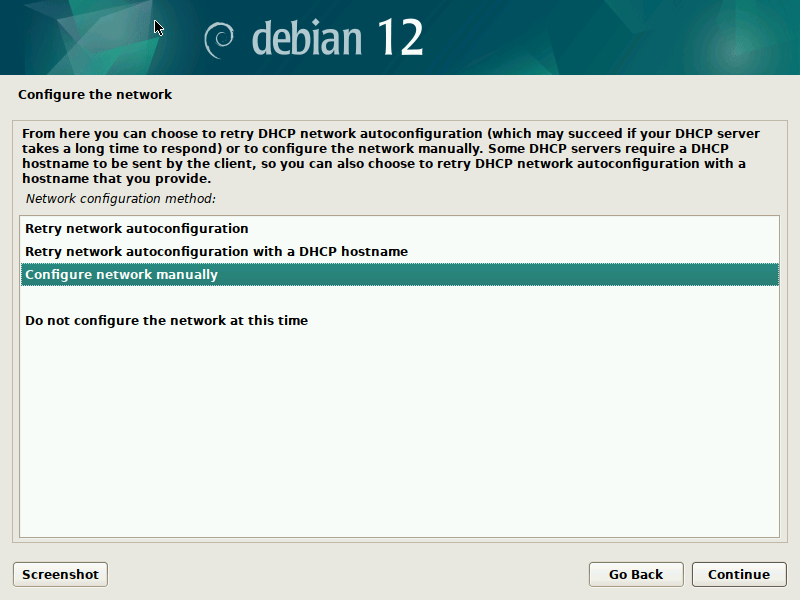
Now you can click through the normal Debian-Installer process, using mostly default settings. Optionally, you could play around with the networking settings, to see how those get translated to /etc/netplan/ in the target system.
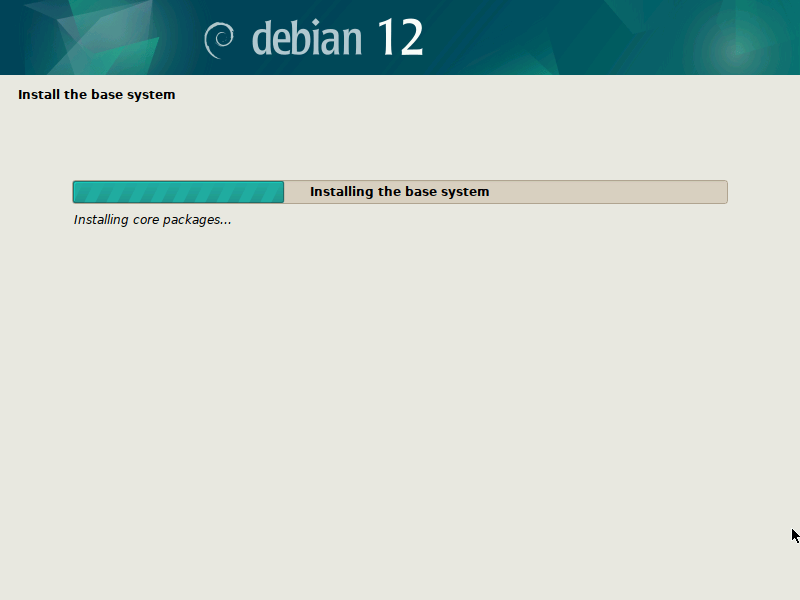
After you confirmed your partitioning changes, the base system gets installed. I suggest not to select any additional components, like desktop environments, to speed up the process.
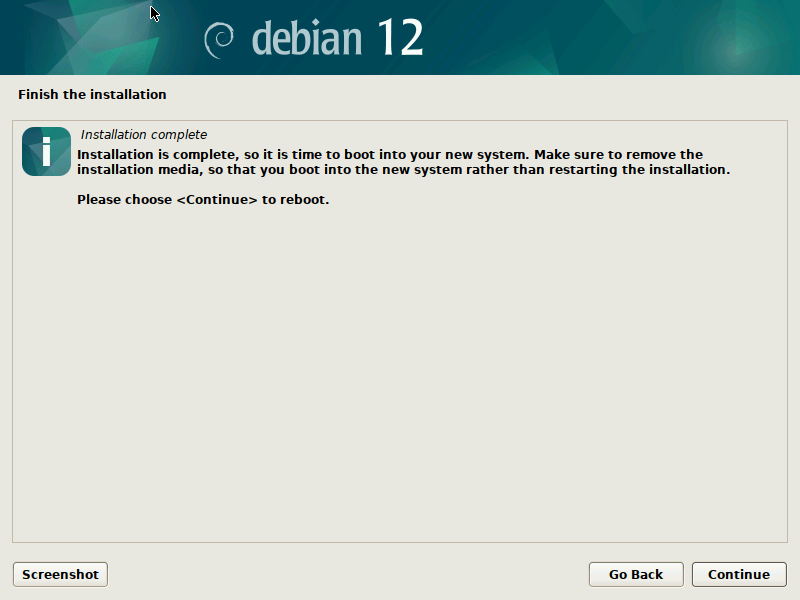
During the final step of the installation (finish-install.d/55netcfg-copy-config) d-i will detect that Netplan was installed in the target system (due to the preseed file provided) and opt to write its network configuration to /etc/netplan/ instead of /etc/network/interfaces or /etc/NetworkManager/system-connections/.
Done! After the installation finished, you can reboot into your virgin Debian Sid/Trixie system.
To do that, quit the current Qemu process, by pressing Ctrl+C and make sure to copy over the EFIVARS.fd file that was modified by grub during the installation, so Qemu can find the new system. Then reboot into the new system, not using the mini.iso image any more:
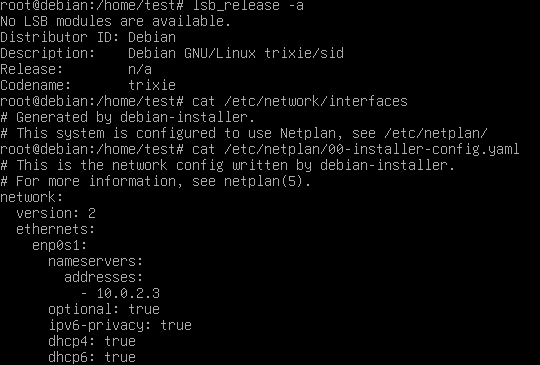
Finally, you can play around with your Netplan enabled Debian system! As you will find, /etc/network/interfaces exists but is empty, it could still be used (optionally/additionally). Netplan was configured in /etc/netplan/ according to the settings given during the d-i installation process.
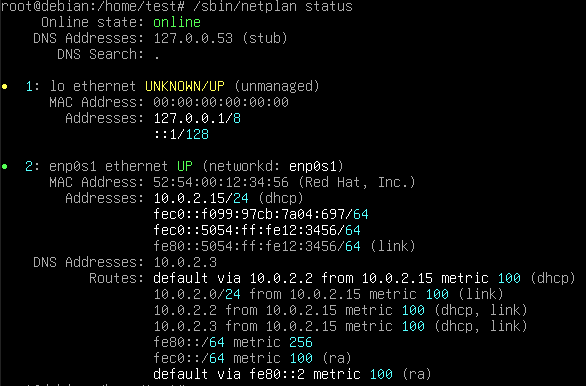
In our case, we also installed the Netplan CLI, so we can play around with some of its features, like netplan status:
Thank you for following along the Netplan enabled Debian installation process and happy hacking! If you want to learn more, find us at GitHub:netplan.
Recently, Ola started rolling out Ola Maps in their main mobile app, replacing Google Maps, while also offering maps as a service to other organizations. The interesting part for me was the usage of OpenStreetMap data as base map with Ola s proprietary data sources. I ll mostly about talk about map data part here.
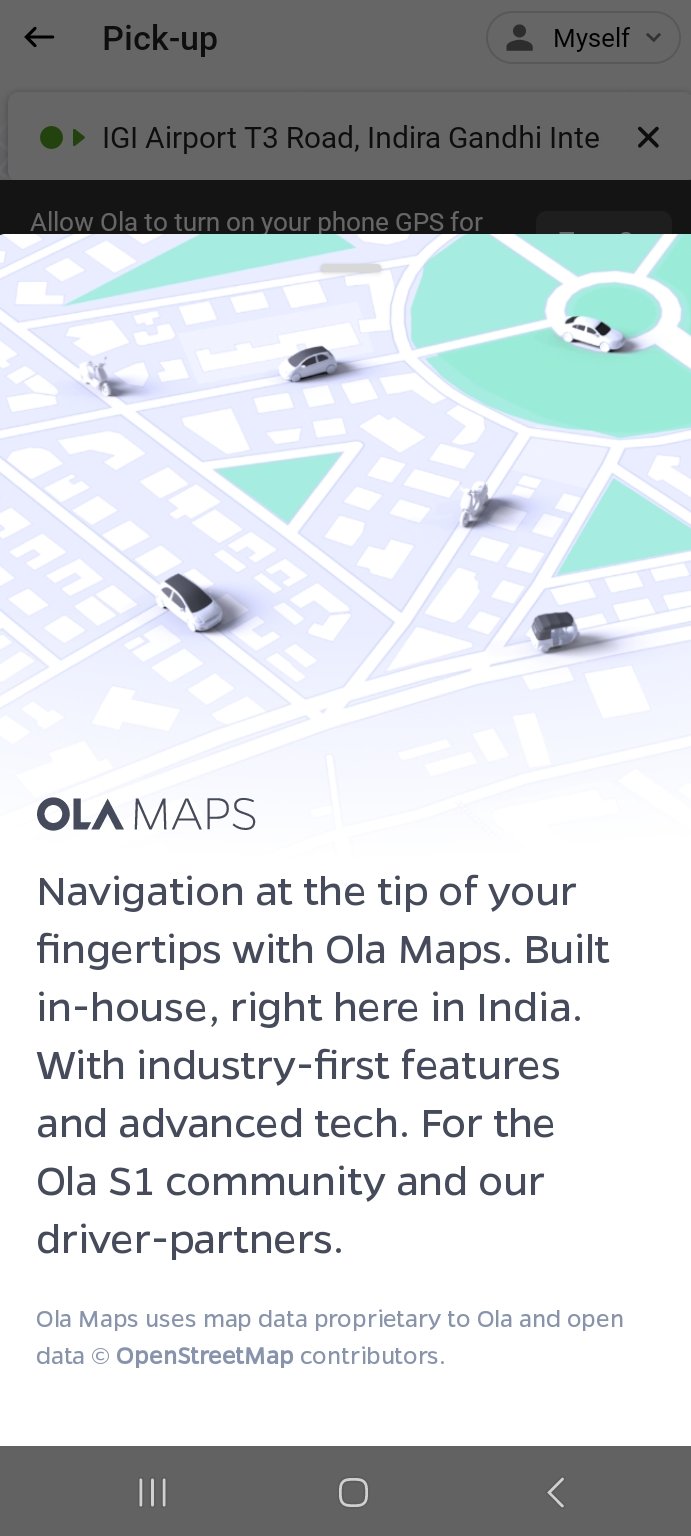
Screenshot of Ola App. OpenStreetMap attribution is shown after clicking the Ola Map icon.
OpenStreetMap (OSM) for starters, is a community owned and edited map data resource which gives freedom to use map data for any purpose. This includes the condition that attribution is given back to OSM which in turn ideally would encourage other users to contribute, correct and edit, helping everyone in turn. Due to this, OSM is also regarded as Wikipedia of maps. OSM data is not just used by Ola. Many others use it for various purposes like Wikipedia Maps, Strava Maps, Snapchat Map, bus tracking in GoIbibo/Redbus.
OSM India community has been following Ola map endeavor to use and contribute to OSM since they went public. As required by OSM for organized mapping efforts, Ola created wiki entry with information regarding their editors, usage, policy and mentions following as their data usage case:
OSM data is used for the road network, traffic signs and signals, buildings, natural features, landuse polygons and some POIs.
Creating a map product is a task in itself, an engineering hurdle creating the tech stack for collection, validation, import and serving the map and the map data part. Ola has done a good job describing the development of tech stack in their blog post. Ola holds an enormous corpus of live and constantly updated GPS trace data. Their drivers, users, and delivery partners generate those, which they harness to validate, correct and add missing map data. Ola employees now regularly contribute new or missing roads (including adding dual carriageway to existing ones), fix road geometry, classification, road access type and restrictions pan India. They have been active and engaging in OSM India community channels, though community members have raised some concerns on their OSM edit practices.
Ola s venture into the map industry isn t something out of the ordinary. Grab, a South East Asian company which has business interests in food deliveries, ride hailing and a bunch of other services too switched to their in-house map based on OpenStreetMap, followed by launching of their map product. Grab too contributed back data like Ola. Both Ola and Grab heavily rely on map for their business operations and seem to chose to go independent for it, bootstrapping the products on OSM.
In India too, a bunch of organizations contribute to OSM like Swiggy, Stackbox, Amazon, Apple. Microsoft, Meta/Facebook and many others. Everyone wants a better map (data), so everyone works together.
Ola could have gone their own route, bootstrapping map data from scratch, which would have been a gargantuan task when you re competing against the likes of Google Maps and Bing Maps, which have been into this since many years. Deciding to use OSM and actively giving back to make data better for everyone deserves accolades. Now I m waiting to for their second blog post, which they mention would be on map data.
If you re an Ola map user through Ola Electric or Ola app, and find some road unmapped, you can always edit them in OSM. What I have heard from their employee, they import new OSM data weekly, which means your changes should start reflecting for you (and everyone else) by next week. If you re new, follow Beginners guide and join OSM India community community.osm.be/resources/asia/india/ for any doubts and participating in various mapping events.
PS You can see live OSM edits in India subcontinent here.
Combining BGP confederations and AS override can potentially
create a BGP routing loop, resulting in an indefinitely expanding AS path.
BGP confederation is a technique used to reduce the number of iBGP sessions
and improve scalability in large autonomous systems (AS). It divides an AS into
sub-ASes. Most eBGP rules apply between sub-ASes, except that next-hop, MED, and
local preferences remain unchanged. The AS path length ignores contributions
from confederation sub-ASes. BGP confederation is rarely used and BGP route
reflection is typically preferred for scaling.
AS override is a feature that allows a router to replace the ASN of a
neighbor in the AS path of outgoing BGP routes with its own. It s useful when
two distinct autonomous systems share the same ASN. However, it interferes with
BGP s loop prevention mechanism and should be used cautiously. A safer
alternative is the allowas-in directive.1
In the example below, we have four routers in a single confederation, each in
its own sub-AS. R0 originates the 2001:db8::1/128 prefix. R1, R2, and
R3 forward this prefix to the next router in the loop.
BGP routing loop using a confederation
The router configurations are available in a Git repository. They are
running Cisco IOS XR. R2 uses the following configuration for BGP:
The session with R3 uses both as-override and next-hop-self directives.
The latter is only necessary to make the announced prefix valid, as there is no
IGP in this example.2
Here s the sequence of events leading to an infinite AS path:
R1 selects it as the best path, forwarding it to R2 with AS
path (64501 64500).
R2 selects it as the best path, forwarding it to R3 with AS
path (64500 64501 64502).
R3 selects it as the best path. It would forward it to R1 with AS path
(64503 64502 64501 64500), but due to AS override, it substitutes R1 s
ASN with its own, forwarding it with AS path (64503 64502 64503 64500).
R1 accepts the prefix, as its own ASN is not in the AS path. It compares
this new prefix with the one from R0. Both (64500) and (64503 64502
64503 64500) have the same length because confederation sub-ASes don t
contribute to AS path length. The first tie-breaker is the router ID.
R0 s router ID (1.0.0.4) is higher than R3 s (1.0.0.3). The new
prefix becomes the best path and is forwarded to R2 with AS path (64501
64503 64501 64503 64500).
R2 receives the new prefix, replacing the old one. It selects it as the
best path and forwards it to R3 with AS path (64502 64501 64502 64501
64502 64500).
R3 receives the new prefix, replacing the old one. It selects it as the
best path and forwards it to R0 with AS path (64503 64502 64503 64502
64503 64502 64500).
R1 receives the new prefix, replacing the old one. Again, it competes with
the prefix from R0, and again the new prefix wins due to the lower router
ID. The prefix is forwarded to R2 with AS path (64501 64503 64501 64503
64501 64503 64501 64500).
A few iterations later, R1 views the looping prefix as follows:4
RP/0/RP0/CPU0:R1#showbgpipv6u2001:db8::1/128bestpath-compare
BGP routing table entry for 2001:db8::1/128Last Modified: Jul 28 10:23:05.560 for 00:00:00Paths: (2 available, best #2) Path #1: Received by speaker 0 Not advertised to any peer (64500) 2001:db8::1:0 from 2001:db8::1:0 (1.0.0.4), if-handle 0x00000000 Origin IGP, metric 0, localpref 100, valid, confed-external Received Path ID 0, Local Path ID 0, version 0 Higher router ID than best path (path #2) Path #2: Received by speaker 0 Advertised IPv6 Unicast paths to peers (in unique update groups): 2001:db8::2:1 (64503 64502 64503 64502 64503 64502 64503 64502 64503 64502 64503 64502 64503 64502 64503 64502 64503 64502 64503 64502 64503 64502 64503 64502 64503 64502 64503 64502 64503 64502 64503 64502 64503 64502 64503 64502 64503 64502 64503 64502 64503 64502 64503 64502 64503 64502 64503 64502 64503 64502 64503 64502 64503 64502 64503 64502 64503 64502 64503 64502 64503 64502 64503 64502 64503 64502 64503 64502 64503 64502 64503 64502 64503 64502 64503 64502 64503 64502 64503 64502 64503 64502 64503 64502 64503 64502 64503 64502 64503 64502 64503 64502 64503 64502 64503 64502 64503 64502 64503 64502 64503 64502 64500) 2001:db8::4:0 from 2001:db8::4:0 (1.0.0.3), if-handle 0x00000000 Origin IGP, metric 0, localpref 100, valid, confed-external, best, group-best Received Path ID 0, Local Path ID 1, version 37 best of AS 64503, Overall best
There s no upper bound for an AS path, but BGP messages have size limits (4096
bytes per RFC 4271 or 65535 bytes per RFC 8654). At some
point, BGP updates can t be generated. On Cisco IOS XR, the BGP process crashes
well before reaching this limit.5
The main lessons from this tale are:
never use BGP confederations under any circumstances, and
be cautious of features that weaken BGP routing loop detection.
When using BGP confederations with Cisco IOS XR, use
allowconfedas-in instead. It s available since IOS XR 7.11.
Using BGP confederations is already inadvisable. If you don t use the
same IGP for all sub-ASes, you re inviting trouble! However, the scenario
described here is also possible with an IGP.
When an AS path segment is composed of ASNs from a confederation, it
is displayed between parentheses.
By default, IOS XR paces eBGP updates. This is controlled by the
advertisement-interval directive. Its default value is 30 seconds for eBGP
peers (even in the same confederation). R1 and R2 set this value to 0,
while R3 sets it to 2 seconds. This gives some time to watch the AS path
grow.
This is CSCwk15887. It only happens when using as-override on an
AS path with a too long AS_CONFED_SEQUENCE. This should be fixed around
24.3.1.
This week our family suffered another loss with my brother in-law. We will miss him dearly. On our way down to Phoenix to console our nephew that just lost his dad our car blew up. Last week we were in a roll over accident that totaled our truck and left me with a broken arm. We are now in great need of a new vehicle. Please consider donating to this fund: https://gofund.me/033eb25d . Kubuntu is out of money and I am between work packages with the project . We are 50 miles away from the closest town for supplies, essentials such as water requires a vehicle.
I have had bad years before ( covid ) in which I lost my beloved job at Blue Systems. I made a vow to myself to never let my personal life affect my work again. I have so far kept that promise to myself and without further ado I present to you my work.
Kubuntu:
Many SRUs awaiting verification stage including the massive apparmor policy bug.
sddm fix for the black screen on second boot has passed verification and should make .1 release.
See Debian for the qt6 Plasma / applications work.
Debian:
qtmpv in NEW
arianna in NEW
kamera uploading today
kcharselect Experimental
Tokodon Done, but needs qtmpv to pass NEW
Gwenview WIP needs kamera, kio-extras
kio-extras WIP
KDE Snaps:
Please note: for the most part the Qt6 snaps are in edge except the few in the project that are heavily tested. Please help test the edge snaps so I can promote them.
Elisa
Okular
Konsole ( please note this is a confined terminal for the project and not very useful except to ssh to the host system )
Kwrite
Gwenview
Kate ( classic )
Gcompris
Alligator
Ark
Blinken
Bomber
Bovo
Calindori
Digikam
Dragon
Falkon
Filelight
WIP Snaps or MR s made
KSpacedual
Ksquares
KSudoku
KTuberling
Kubrick
lskat
Palapeli
Kajongg
Kalzium
Kanagram
Kapman
Katomic
KBlackBox
KBlocks
KBounce
KBreakOut
KBruch
Please note that 95% of the snaps are free-time work. The project covers 5. I am going as fast as I can between Kubuntu/Debian and the project commitments. Not to mention I have only one arm! My GSOC student is also helping which you can read all about here: https://soumyadghosh.github.io/website/interns/gsoc-2024/gsoc-week-3-week-7/
There is still much work to do in Kubuntu to be Plasma 6 ready for Oracular and they are out of funds. I will still continue my work regardless, but please consider donating until we can procure a consistent flow of funding : https://kubuntu.org/donate/
Thank you for reading and have a blessed day!
DebConf24, the 25th edition of the Debian
conference is taking place in Pukyong National University at Busan, Republic of
Korea.
Thanks to the hard work of its organizers, it again will be an interesting and
fruitful event for attendees.
We would like to warmly welcome the sponsors of DebConf24, and introduce them to
you.
We have three Platinum sponsors.
Proxmox is the first Platinum sponsor.
Proxmox provides powerful and user-friendly Open Source server software.
Enterprises of all sizes and industries use Proxmox solutions to deploy
efficient and simplified IT infrastructures, minimize total cost
of ownership, and avoid vendor lock-in.
Proxmox also offers commercial support, training services, and an extensive
partner ecosystem to ensure business continuity for its customers.
Proxmox Server Solutions GmbH was established in 2005
and is headquartered in Vienna, Austria.
Proxmox builds its product offerings on top of the Debian operating system.
Our second Platinum sponsor is Infomaniak.
Infomaniak is an independent cloud service provider recognised throughout
Europe for its commitment to privacy, the local economy and the environment.
Recording growth of 18% in 2023, the company is developing a suite of online
collaborative tools and cloud hosting, streaming, marketing and events
solutions.
Infomaniak uses exclusively renewable energy, builds its own data centers and
develops its solutions in Switzerland, without relocating.
The company powers the website of the Belgian radio and TV
service (RTBF) and provides streaming for more than 3,000
TV and radio stations in Europe.
Wind River is our third Platinum sponsor.
For nearly 20 years, Wind River has led in commercial Open Source Linux
solutions for mission-critical enterprise edge computing.
With expertise across aerospace, automotive, industrial, telecom, and more,
the company is committed to Open Source through initiatives like eLxr, Yocto,
Zephyr, and StarlingX.
Our Gold sponsors are:
Ubuntu,
the Operating System delivered by Canonical.
Freexian,
a services company specialized in Free Software and in particular Debian
GNU/Linux, covering consulting, custom developments, support and training.
Freexian has a recognized Debian expertise thanks to the participation of
Debian developers.
Lenovo,
a global technology leader manufacturing a wide portfolio of connected
products including smartphones, tablets, PCs and workstations as well as
AR/VR devices, smart home/office and data center solutions.
Korea Tourism Organization,
which purpose is to advance tourism as a key driver for national economic
growth and enhancement of national welfare and intends to be a public
organization that makes the Korean people happier; it promotes national wealth
through tourism.
Busan IT Industry Promotion Agency,
an industry promotion organization that contributes to the innovation of the
digital economy with the power of IT and CT and
supports the ecosystem for innovative local startups and companies to grow.
Microsoft,
who enables digital transformation for the era of an intelligent cloud and an
intelligent edge.
Its mission is to empower every person and every organization on the planet to
achieve more.
doubleO,
a company that specializes in consulting and developing empirical services
using big data analysis and artificial intelligence.
doubleO provides a variety of data-centered services together with small and
medium-sized businesses in Busan/Gyeongnam.
Our Silver sponsors are:
Roche, a major international pharmaceutical
provider and research company dedicated to personalized healthcare.
Two Sigma, rigorous inquiry, technology
data science, and invention to bring science to finance and help solve the
toughest challenges across financial services.
Arm: leading technology provider of processor
IP, Arm powered solutions have been supporting innovation for
more than 30 years and are deployed in over 280 billion chips to date.
Google, one of the largest technology companies in
the world, providing a wide range of Internet-related services and products
such as online advertising technologies, search, cloud computing, software,
and hardware.
FSIJ, the Free Software Initiative
of Japan, a non-profit organization dedicated to supporting Free Software
growth and development.
Busan Tourism Organisation:
leading public corporation that generates social and economic values in Busan
tourism industry, developing tourism resources in accordance with government
policies and invigorate tourism industry.
Civil Infrastructure Platform,
a collaborative project hosted by the Linux Foundation,
establishing an open source base layer of industrial grade software.
Collabora, a global consultancy delivering
Open Source software solutions to the commercial world.
Matanel Foundation, which operates in Israel,
as its first concern is to preserve the cohesion of a society and a nation
plagued by divisions.
A special thanks to the
Pukyong National University, our Venue
Partner and our Network Partners KOREN
and KREONET!
Thanks to all our sponsors for their support!
Their contributions make it possible for a large number of Debian contributors
from all over the globe to work together, help and learn from each other in
DebConf24.
apt-upgrade-canary is a helper program to alert when upgrading
packages via apt.
If there are some packages which causes a critical or serious
bug, it shows warnings for terminal.
Then you can stay on current version of package by canceling
upgrades.
This program is aimed to help not to installing
problematic packages via manual upgrades.
Usually, you should delegate package upgrade to
unattended-upgrades and apt-listbugs.
apt-listbugs kindly warns if there are known bugs.
In most cases it is enough safer.
But there is one exception, it is not true that always apt-listbugs
can follow very latest critical or serious bugs in timely manner.
apt-upgrade-canary checks UDD mirror database (it take into account
to cache query not to throw redundant one frequently)
Getting started
Install required packages.
$ sudo apt install -y make ruby-pg ruby-json ruby-term-ansicolor
Use case in action
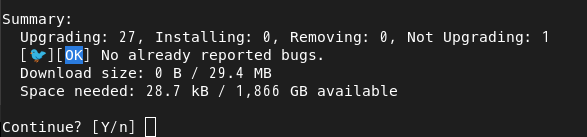
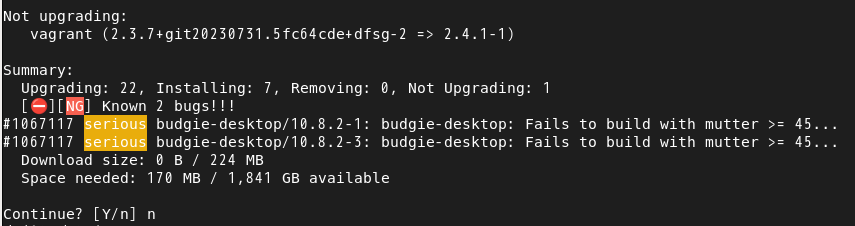
If there is no serious bugs which is reported against target packages,
apt-upgrade-canary reports no error.
apt-upgrade-canary: no problem
If there are something weird happen, it reports matched bugs.
apt-upgrade-canary: serious case
So you can stay on.
Yay, crypto!
DebCamp has started, and in a couple of days, we will fully be in DebConf24
mode!
As most of you know, an important part that binds Debian together is our
cryptographic identity assurance, and that is in good measure tightened by the
Continuous Key-Signing Parties we hold at DebConfs and other Debian and Free
Software gatherings.
As I have done during (most of) the past DebConfs, I have prepared a set of
pseudo-social maps to help you find where you are in the OpenPGP mesh of our
conference. Naturally, Web-of-Trust maps should be user-centered, so find your
own at:
https://people.debian.org/~gwolf/dc24_ksp/
The list is now final and it will not receive any modifications (I asked
for them some days
ago); if your
name still appears on the list and you don t want to be linked to the DC24 KSP
in the future, tell me and I ll remove it from future versions of the list
(but it is part of the final DC24
file, as its checksum
is already final)
Speaking of which!
If you are to be a part of the keysigning, get the final DC24
file and, on a device
you trust, check its SHA256 by running:
Make sure the resulting number matches the one I m presenting. If it doesn t,
ensure your copy of the file is not corrupted (i.e. download again). If it still
doess not match, notify me immediately.
Does any of the above confuse you? Please come to (or at least, follow the
stream for) my session on DebConf opening day, Continuous Key-Signing Party
introduction,
10:30 Korean time; I will do my best to explain the details to you.
PS- I will soon provide a simple, short PDF that will probably be mass-printed
at FrontDesk so that you can easily track your KSP progress.
A new minor release 0.4.23 of RQuantLib
just arrived at CRAN earlier
today, and will be uploaded to Debian in due course.
QuantLib is a rather
comprehensice free/open-source library for quantitative
finance. RQuantLib
connects (some parts of) it to the R environment and language, and has
been part of CRAN for more than
twenty-two years (!!) as it was one of the first packages I
uploaded.
This release of RQuantLib
updates to QuantLib version 1.35
released this morning. It accommodates some removals following earlier
deprecations, and also updates most of the code in the function for a
more readable and compact form of creating shared pointers via
make_shared() along with auto.
Changes in RQuantLib version 0.4.23 (2024-07-23)
Adjustments for QuantLib 1.35 and removal of deprecated code (in
utility functions and dividend case of vanilla options)
Adjustments for new changes in QuantLib 1.35
Refactoring most C++ files making more use of both
auto and make_shared to simplify and shorten
expressions
The Akismet WordPress anti-spam plugin has changed it s policy to not run on sites that have adverts which includes mine. Without it I get an average of about 1 spam comment per hour and the interface for removing spam takes more mouse actions than desired. For email spam it s about the same volume half of which is messages with SpamAssassin scores high enough to go into the MaybeSpam folder (that I go through every few weeks) and half of which goes straight to my inbox. But fortunately moving spam to a folder where I can later use it to train Bayesian classification is a much faster option on PC and is also something I can do from my phone MUA.
As an experiment I have configured my blog to only take comments from registered users. It will be interesting to see how many spammers make it through that and to also see feedback from genuine people. People who can t comment can tell me about it via the contact methods listed here [1].
I previously wrote about other ways of dealing with hostile comments [2]. Blogging seems to be less popular nowadays so a Planet specific forum doesn t seem a viable option. It s a pity, I think that YouTube and Facebook have taken over from blogs and that s not a good thing.
The recent issue of Windows security software killing computers has reminded me about the issue of management software for Dell systems. I wrote policy for the Dell management programs that extract information from iDRAC and store it in Linux. After the break I ve pasted in the policy. It probably needs some changes for recent software, it was last tested on a PowerEdge T320 and prior to that was used on a PowerEdge R710 both of which are old hardware and use different management software to the recent hardware. One would hope that the recent software would be much better but usually such hope is in vain. I deliberately haven t submitted this for inclusion in the reference policy because it s for proprietary software and also it permits many operations that we would prefer not to permit.
The policy is after the break because it s larger than you want on a Planet feed. But first I ll give a few selected lines that are bad in a noteworthy way:
sys_admin means the ability to break everything
dac_override means break Unix permissions
mknod means a daemon creates devices due to a lack of udev configuration
sys_rawio means someone didn t feel like writing a device driver, maintaining a device driver for DKMS is hard and getting a driver accepted upstream requires writing quality code, in any case this is a bad sign.
self:lockdown is being phased out, but used to mean bypassing some integrity protections, that would usually be related to sys_rawio or similar.
dev_rx_raw_memory is bad, reading raw memory allows access to pretty much everything and execute of raw memory is something I can t imagine a good use for, the Reference Policy doesn t use this anywhere!
dev_rw_generic_chr_files usually means a lack of udev configuration as udev should do that.
storage_raw_write_fixed_disk shouldn t be needed for this sort of thing, it doesn t do anything that involves managing partitions.
Now without network access or other obvious ways of remote control this level of access while excessive isn t necessarily going to allow bad things to happen due to outside attack. But if there are bugs in the software there s nothing to stop it from giving the worst results.
The best thing that Dell could do for their customers is to make this free software and allow the community to fix some of these issues.
Here is dellsrvadmin.te:
Another thing to note is that include_directories adds both the source
directory and corresponding build directory to include path, so you don't
have to care.
It seems that I have to care after all.
Thankfully there is an implicit_include_directories setting
that can turn this off if needed.
Its documentation is not as easy to find as I'd like (kudos to Kangie on IRC),
and hopefully this blog post will make it easier for me to find it in the
future.
The Rcpp Core Team is once again pleased to announce a new release
(now at 1.0.13) of the Rcpp package.
It arrived on CRAN earlier
today, and has since been uploaded to Debian. Windows and macOS builds
should appear at CRAN in the next few days, as will builds in different
Linux distribution and of course r2u should catch up
tomorrow too. The release was uploaded last week, but not only does Rcpp always gets flagged because of the
grandfathered .Call(symbol) but CRAN also found two packages
regressing which then required them to take five days to get back to
us. One issue was known; another
did not reproduce under our tests against over 2800 reverse dependencies
leading to the eventual release today. Yay. Checks are good and
appreciated, and it does take time by humans to review them.
This release continues with the six-months January-July cycle started
with release
1.0.5 in July 2020. As a reminder, we do of course make interim
snapshot dev or rc releases available via the Rcpp drat repo as well as
the r-universe page and
repo and strongly encourage their use and testing I run my systems
with these versions which tend to work just as well, and are also fully
tested against all reverse-dependencies.
Rcpp has long established itself
as the most popular way of enhancing R with C or C++ code. Right now,
2867 packages on CRAN depend on
Rcpp for making analytical code go
faster and further, along with 256 in BioConductor. On CRAN, 13.6% of
all packages depend (directly) on Rcpp, and 59.9% of all compiled packages
do. From the cloud mirror of CRAN (which is but a subset of all CRAN
downloads), Rcpp has been downloaded
86.3 million times. The two published papers (also included in the
package as preprint vignettes) have, respectively, 1848 (JSS, 2011) and 324 (TAS, 2018)
citations, while the the book (Springer useR!,
2013) has another 641.
This release is incremental as usual, generally preserving existing
capabilities faithfully while smoothing our corners and / or extending
slightly, sometimes in response to changing and tightened demands from
CRAN or R standards. The move towards a
more standardized approach for the C API of R leads to a few changes;
Kevin did most of the PRs for this. Andrew Johnsom also provided a very
nice PR to update internals taking advantage of variadic templates.
The full list below details all changes, their respective PRs and, if
applicable, issue tickets. Big thanks from all of us to all
contributors!
Changes in
Rcpp release version 1.0.13 (2024-07-11)
Changes in Rcpp API:
Set R_NO_REMAP if not already defined (Dirk in #1296)
Add variadic templates to be used instead of generated code
(Andrew Johnson in #1303)
Count variables were switches to size_t to avoid
warnings about conversion-narrowing (Dirk in #1307)
Rcpp now avoids the usage of the (non-API) DATAPTR function when
accessing the contents of Rcpp Vector objects where possible. (Kevin in
#1310)
Rcpp now emits an R warning on out-of-bounds Vector accesses.
This may become an error in a future Rcpp release. (Kevin in #1310)
Switch VECTOR_PTR and STRING_PTR to new
API-compliant RO variants (Kevin in #1317 fixing #1316)
Changes in Rcpp Deployment:
Small updates to the CI test containers have been made (#1304)
After the VoLTE saga [1] and the problems with battery life on the PinePhonePro [2] (which lasted 4 hours while idle with the screen off in my last test a few weeks ago) I m running a Galaxy Note 9 [3] with the default Samsung OS as my daily driver.
I don t think that many people will be rushing out to buy a 2018 phone regardless of my review. For someone who wants a phone of such age (which has decent hardware and a low price) then good options are the Pixel phones which are all supported by LineageOS.
I recommend not buying this phone due to the fact that it doesn t have support for VoLTE with LineageOS (and presumably any other non-Samsung Android build) and doesn t have support from any other OS. The One Plus 6/6T has Mobian support [4] as well as LineageOS support and is worth considering.
The Note 9 still has capable hardware by today s standards. A 6.4 display is about as big as most people want in their pocket and 2960 1440 resolution in that size (516dpi) is probably as high as most people can see without a magnifying glass. The model I m using has 8G of RAM which is as much as the laptop I was using at the start of this year. I don t think that many people will have things that they actually want to do on a phone which needs more hardware than this. The only hardware feature in new phones which beats this is the large folding screen in some recent phones, but $2500+ (the price of such phones in Australia) is too much IMHO and the second hand market for folding phones is poor due to the apparently high incidence of screens breaking.
The Note 9 has the Dex environment for running as a laptop if you connect it to a USB-C dock. It can run nicely with a 4K monitor with USB keyboard and mouse. The UI is very similar to that of older versions of Windows.
The Samsung version of Android seems mostly less useful than the stock Google version or the LineageOS version. The Samsung keyboard flags words such as gay as spelling errors and it can t be uninstalled even when you install a better keyboard app. There is a Bixby button on the side of the phone to launch the Bixby voice recognition app which can t be mapped to any useful purpose, The Google keyboard has a voice dictation option which I will try out some time but that s all I desire in terms of voice recognition. There are alerts about Samsung special deals and configuration options including something about signing in to some service and having it donate money to charity, I doubt that any users want such features. Apart from Dex the Samsung Android build is a good advert for LineageOS.
The screen has curved sides for no good reason. This makes it more difficult to make a protective phone case as a case can t extend beyond the screen at the sides and therefore if it s dropped and hits an edge (step, table, etc) then the glass can make direct contact with something. Also the curved sides reflect sunlight in all directions, this means that the user has to go to more effort to avoid reflecting the sun into their eyes and that a passenger can more easily reflect sunlight into the eyes of a car driver. It s an impressive engineering feat to make a curved touch-screen but it doesn t do any good for users.
The stylus is good as always and the screen is AMOLED so it doesn t waste much power when in dark mode. There is a configuration option to display a clock all the time when the screen is locked because that apparently doesn t use much power. I haven t felt inclined to enable the always on screen but it s a nice feature for those who like such things.
The VoLTE implementation is apparently a bit unusual so it s not supported by LineageOS and didn t work on Droidian for the small amount of time that Droidian supported it.
Generally this phone is quite nice hardware it s just a pity that it demonstrates all of the downsides to buying a non-Pixel phone.
I just got one of those utterly funny spam messages And yes, I recognize
everybody likes building a name for themselves. But some spammers are downright
silly.
I just got the following mail:
From: Hermine Wolf <hwolf850@gmail.com>
To: me, obviously
Date: Mon, 15 Jul 2024 22:18:58 -0700
Subject: Make sure that your manuscript gets indexed and showcased in the prestigious Scopus database soon.
Message-ID: <CAEZZb3XCXSc_YOeR7KtnoSK4i3OhD=FH7u+A5xSMsYvhQZojQA@mail.gmail.com>
This message has visual elements included. If they don't display, please
update your email preferences.
*Dear Esteemed Author,*
Upon careful examination of your recent research articles available online,
we are excited to invite you to submit your latest work to our esteemed
journal, '*WULFENIA*'. Renowned for upholding high standards of excellence
in peer-reviewed academic research spanning various fields, our journal is
committed to promoting innovative ideas and driving advancements in
theoretical and applied sciences, engineering, natural sciences, and social
sciences. 'WULFENIA' takes pride in its impressive 5-year impact factor of
*1.000* and is highly respected in prestigious databases including the
Science Citation Index Expanded (ISI Thomson Reuters), Index Copernicus,
Elsevier BIOBASE, and BIOSIS Previews.

*Wulfenia submission page:*
[image: research--check.png][image: scrutiny-table-chat.png][image:
exchange-check.png][image: interaction.png]
.
Please don't reply to this email

We sincerely value your consideration of 'WULFENIA' as a platform to
present your scholarly work. We eagerly anticipate receiving your valuable
contributions.
*Best regards,*
Professor Dr. Vienna S. Franz
Who cares what Wulfenia is about? It s about you, my stupid Wolf cousin!
We are pleased to announce that
Wind River has committed to sponsor
DebConf24 as a Platinum Sponsor.
For nearly 20 years, Wind River has led in commercial open source Linux
solutions for mission-critical enterprise edge computing. With expertise
across aerospace, automotive, industrial, telecom, more, the company is
committed to open source through initiatives like eLxr, Yocto, Zephyr,
and StarlingX.
With this commitment as Platinum Sponsor, Wind River is contributing to
make possible our annual conference, and directly supporting the
progress of Debian and Free Software, helping to strengthen the
community that continues to collaborate on Debian projects throughout
the rest of the year.
Wind River plans to announce an exiting new project based on Debian at
this year's DebConf!
Thank you very much, Wind River, for your support of DebConf24!
Become a sponsor too!
DebConf24 will take place from 28th
July to 4th August 2024 in Busan, South Korea, and will be preceded by
DebCamp, from 21st to 27th July 2024.
DebConf24 is accepting sponsors! Interested companies and organizations
should contact the DebConf team through sponsors@debconf.org, or visit the
DebConf24 website at https://debconf24.debconf.org/sponsors/become-a-sponsor/.
Prior to arrival in Kenya, you need to apply for an Electronic Travel Authorization (eTA) on their website by uploading all the required documents. This system is in place since Jan 2024 after the country abolished the visa system, implementing the eTA portal. The required documents will depend on the purpose of your visit, which in my case, was to attend a conference.
Here is the list of documents I submitted for my eTA:
Scanned copy of my passport
Photograph with white background
Flight tickets (reservation)
Hotel bookings (reservation)
Invitation letter from the conference
Yellow Fever vaccination certificate (optional)
Job contract (optional)
Reservation means I didn t book the flights and hotels, but rather reserved them. Additionally, optional means that those documents were not mandatory to submit, but I submitted them in the Other Documents section in order to support my application. After submitting the eTA, I had to make a payment of around 35 US Dollars (approximately 3000 Indian Rupees).
It took 40 hours for me to receive an email from Kenya stating that my eTA has been approved, along with an attached PDF, making this one of my smoothest experiences of obtaining travel documents to travel to a country :). An eTA is technically not a visa, but I put the word visa in the title due to familiarity with the term.
Twenty years ago, it was easy to dislike Microsoft. It was the quintessential evil MegaCorp that was quick to squash competition, often ruthlessly, but in some cases slowly through a more insidious process of embracing, extending, and exterminating anything that got in the way. This was the signature personality of Ballmer-era Microsoft that also inspired and united the software freedom fighting forces that came together to safeguard things that mattered to them and were at risk.I remember the era when the Novell, SCO, and Microsoft saga cast fear, uncertainty, and doubt on the future of open Unix and Linux and on what would happen to the operating systems that we loved if the suits of Redmond prevailed. Looking back, I&aposm glad that the arc of this story has bent towards justice, and I shudder at the possibilities had it worked out differently.Looking at today&aposs Microsoft, I&aposm amazed at how much change a leader with the right vision can make to the trajectory of a company that even makes an old-school software freedom advocate as me admire and even applaud the strides it has taken in the last 10 or so years that has dramatically shifted the perception of Microsoft. The personality of the Satya-era Microsoft is one to behold. While it will take more time to win back the trust, we see the tides changing and the positivity is important for the entire industry.For Microsoft, it was TypeScript and VS Code that helped change the narrative internally which led to its internal resurgence and acceptance of open source. Its acquisition of GitHub propelled it forward within the community overnight. Its contributions to the Linux kernel and other major software projects have also been consequential in changing its public perceptions.It takes a while to claw back trust and is very easy to breach. This time, however, Microsoft seems to understand this dynamic more than it did 20 years ago. All it took was the right leadership.
Welcome to the June 2024 report from the Reproducible Builds project!
In our reports, we outline what we ve been up to over the past month and highlight news items in software supply-chain security more broadly. As always, if you are interested in contributing to the project, please visit our Contribute page on our website.
Table of contents:
Next Reproducible Builds Summit dates announced
We are very pleased to announce the upcoming Reproducible Builds Summit, set to take place from September 17th 19th 2024 in Hamburg, Germany.
We are thrilled to host the seventh edition of this exciting event, following the success of previous summits in various iconic locations around the world, including Venice, Marrakesh, Paris, Berlin and Athens. Our summits are a unique gathering that brings together attendees from diverse projects, united by a shared vision of advancing the Reproducible Builds effort. During this enriching event, participants will have the opportunity to engage in discussions, establish connections and exchange ideas to drive progress in this vital field. Our aim is to create an inclusive space that fosters collaboration, innovation and problem-solving.
If you re interesting in joining us this year, please make sure to read the event page which has more details about the event and location. We are very much looking forward to seeing many readers of these reports there.
GNU Guix patch review session for reproducibility
Vagrant Cascadian will be holding a Reproducible Builds session as part of the monthly Guix patch review series on July 11th at 17:00 UTC.
These online events are intended to encourage everyone everyone becoming a patch reviewer and the goal of reviewing patches is to help Guix project accept contributions while maintaining our quality standards and learning how to do patch reviews together in a friendly hacking session.
New reproducibility-related academic papers
Multiple scholarly papers related to Reproducible Builds were published this month:
An Industry Interview Study of Software Signing for Supply Chain Security was published by Kelechi G. Kalu, Tanmay Singla, Chinenye Okafor, Santiago Torres-Arias and James C. Davis of Electrical and Computer Engineering department of Purdue University, Indiana, USA, and is concerned with:
To understand software signing in practice, we interviewed 18 high-ranking industry practitioners across 13 organizations. We provide possible impacts of experienced software supply chain failures, security standards, and regulations on software signing adoption. We also study the challenges that affect an effective software signing implementation.
Code signing enables software developers to digitally sign their code using cryptographic keys, thereby associating the code to their identity. This allows users to verify the authenticity and integrity of the software, ensuring it has not been tampered with. Next-generation software signing such as Sigstore and OpenPubKey simplify code signing by providing streamlined mechanisms to verify and link signer identities to the public key. However, their designs have vulnerabilities: reliance on an identity provider introduces a single point of failure, and the failure to follow the principle of least privilege on the client side increases security risks. We introduce Diverse Identity Verification (DiVerify) scheme, which strengthens the security guarantees of next-generation software signing by leveraging threshold identity validations and scope mechanisms.
[ ] resulted in an extension of GNU make which is called rmake, where diffoscope a tool for detecting differences between a large number of file types was integrated into the workflow of make. rmake was later used to answer the posed research questions for this thesis. We found that different build paths and offsets are a big problem as three out of three tested Free and Open Source Software projects all contained these variations. The results also showed that gcc s optimisation levels did not affect reproducibility, but link-time optimisation embeds a lot of unreproducible information in build artefacts. Lastly, the results showed that build paths, build ID s and randomness are the three most common groups of variations encountered in the wild and potential solutions for some variations were proposed.
The thesis serves as an introduction to the concept of reproducibility in software engineering, offering a comprehensive overview of formalizations using mathematical notations for key concepts and an empirical evaluation of several key tools. By exploring various case studies, methodologies and tools, the research aims to provide actionable insights for practitioners and researchers alike.
Development news
In Debian this month, 4 reviews of Debian packages were added, 11 were updated and 14 were removed this month adding to our knowledge about identified issues. Only one issue types was updated, though, explaining that we don t vary the build path anymore.
On our mailing list this month, Bernhard M. Wiedemann wrote that whilst he had previously collected issues that introduce non-determinism he has now moved on to discuss about mitigations , in the sense of how can we avoid whole categories of problem without patching an infinite number of individual packages . In addition, Janneke Nieuwenhuizen announced the release of two versions of GNU Mes. [][]
In openSUSE news, Bernhard M. Wiedemann published another report for that distribution.
In NixOS, with the 24.05 release out, it was again validated that our minimal ISO is reproducible by building it on a virtual machine with no access to the binary cache.
What s more, we continued to write patches in order to fix specific reproducibility issues, including Bernhard M. Wiedemann writing three patches (for qutebrowser, samba and systemd), Chris Lamb filing Debian bug #1074214 against the fastfetch package and Arnout Engelen proposing fixes to refind and for the Scala compiler [.
Lastly, diffoscope is our in-depth and content-aware diff utility that can locate and diagnose reproducibility issues. This month, Chris Lamb uploaded two versions (270 and 271) to Debian, and made the following changes as well:
Drop Build-Depends on liblz4-tool in order to fix Debian bug #1072575. []
Update tests to support zipdetails version 4.004 that is shipped with Perl 5.40. []
Website updates
There were a number of improvements made to our website this month, including Akihiro Suda very helpfully making the <h4> elements more distinguishable from the <h3> level [][] as well as adding a guide for Dockerfile reproducibility []. In addition Fay Stegerman added two tools, apksigcopier and reproducible-apk-tools, to our Tools page.
Reproducibility testing framework
The Reproducible Builds project operates a comprehensive testing framework running primarily at tests.reproducible-builds.org in order to check packages and other artifacts for reproducibility. In June, a number of changes were made by Holger Levsen, including:
Marking the virt(32 64)c-armhf nodes as down. []
Granting a developer access to the osuosl4 node in order to debug a regression on the ppc64el architecture. []
Granting a developer access to the osuosl4 node. [][]
In addition, Mattia Rizzolo re-aligned the /etc/default/jenkins file with changes performed upstream [] and changed how configuration files are handled on the rb-mail1 host. [], whilst Vagrant Cascadian documented the failure of the virt32c and virt64c nodes after initial investigation [].
If you are interested in contributing to the Reproducible Builds project, please visit our Contribute page on our website. However, you can get in touch with us via:
 It s not often that a company is willing to make a sworn statement to a court about how its IT practices are incompatible with the needs of the Internet, but when they do it s popcorn time.




 apt-upgrade-canary is a helper program to alert when upgrading
packages via apt.
If there are some packages which causes a critical or serious
bug, it shows warnings for terminal.
Then you can stay on current version of package by canceling
upgrades.
This program is aimed to help not to installing
problematic packages via manual upgrades.
Usually, you should


 A new minor release 0.4.23 of
 The Rcpp Core Team is once again pleased to announce a new release
(now at 1.0.13) of the
 Who cares what Wulfenia is about? It s about you, my stupid Wolf cousin!

 Twenty years ago, it was easy to dislike Microsoft. It was the quintessential evil MegaCorp that was quick to squash competition, often ruthlessly, but in some cases slowly through a more insidious process of embracing, extending, and exterminating anything that got in the way. This was the signature personality of Ballmer-era Microsoft that also inspired and united the software freedom fighting forces that came together to safeguard things that mattered to them and were at risk.I remember the era when the Novell, SCO, and Microsoft saga cast fear, uncertainty, and doubt on the future of open Unix and Linux and on what would happen to the operating systems that we loved if the suits of Redmond prevailed. Looking back, I&aposm glad that the arc of this story has bent towards justice, and I shudder at the possibilities had it worked out differently.Looking at today&aposs Microsoft, I&aposm amazed at how much change a leader with the right vision can make to the trajectory of a company that even makes an old-school software freedom advocate as me admire and even applaud the strides it has taken in the last 10 or so years that has dramatically shifted the perception of Microsoft. The personality of the Satya-era Microsoft is one to behold. While it will take more time to win back the trust, we see the tides changing and the positivity is important for the entire industry.For Microsoft, it was TypeScript and VS Code that helped change the narrative internally which led to its internal resurgence and acceptance of open source. Its acquisition of GitHub propelled it forward within the community overnight. Its contributions to the Linux kernel and other major software projects have also been consequential in changing its public perceptions.It takes a while to claw back trust and is very easy to breach. This time, however, Microsoft seems to understand this dynamic more than it did 20 years ago. All it took was the right leadership.