Search Results: "ghe"

27 August 2010

Russell Coker: Links August 2010

Urban Honking has an insightful article about the Arduino and suggests that it is one of the most important factors for the development of the computer industry in the near future [1]. It compares the Arduino to the Altair. Wired has an interesting article about a company that provides a satellite kit and a launch into low Earth orbit for $8000 [2]. Arduino in space? Linux Journal has an interesting article by David Rowe about the Mesh Potato which is a Wifi mesh router that also runs VOIP [3]. One particularly interesting aspect of this article is the explanation of the way they designed and tested it. Susan Shaw gave an informative TED talk about the toxic effects of the attempts to clean up the oil spill in the Gulf of Mexico [4]. It seems that trying to disperse the oil just makes it worse, and the chemical companies are refusing to disclose the chemicals that are being used. The New York Times has an interesting article by David Leonhardt about the value of pre-school teachers [5]. Some research on the difference that good teachers can make in economic terms suggests that the make an economic difference to the children to the value of $320,000 per annum (IE a class of 16 children who were taught for a year would on average each receive a benefit of $20,000 over their lifetime). Also there are social benefits which aren t counted by that study. While I can t imagine pre-school teachers getting paid $320,000 any time soon, it does seem obvious that good teachers deserve significantly better pay. Of course one problem is how to determine which teachers are good, better test results are not a reliable indication. Paul Krugman describes America as being on the unlit, unpaved road to nowhere due to the policies of saving money by cutting funding for schools, street-lights, and roads [6]. The Chive has an amusing post about how to quit a bad job [7]. It would be good if someone really did this, I m sure that there are enough creative people who don t like their job. Hell Pizza in New Zealand published a zombie themed choose your own adventure on Youtube [8]. Unfortunately the options to choose the next segment don t work on HTML5 with Chromium so if you don t have flash you miss out. AskThePilot.com has an informative essay about airline security written by a commercial pilot [9]. The anecdote about the pilot not being allowed to take the type of knife that is issued to first and business class passengers is rather amusing. FredOnEverything.net has an interesting analysis of Wikileaks and why the Pentagon and Fox News hate it [10]. Fred is a very skillful writer, while he s not the first person to say some of these things he may have said it best. The Wikipedia page on Borosilicate glass (which is best known under the trademark Pyrex) is really interesting [11]. Borsilicate glass was formerly known as Duran and it s main characteristic that makes it suitable for lab use is resistance to Thermal Shock, but it s also harder and has a higher melting point. Apparently you can get Pyrex drinking glasses, I want some! Eben Moglen gave an interesting talk Freedom in the Cloud about the development of free servers to manage personal data and replace Facebook etc (among many other things) [12]. The Debian Wiki has an articla about designing such a system [13]. The APNIC published an interesting paper on IPv4 background radiation [14]. Apparently some /24 s receive so much random traffic (from broken applications and viruses) that they can t be delegated. IPv6 will solve this problem by making it infeasible to scan all IP addresses. Also it s interesting to note the excessive amounts of traffic to 1.0.168.192 which is from applications too broken to correctly send data to 192.168.0.1 which have been installed by sysadmins who are too incompetent to watch what is being sent out of their network.

25 August 2010

Matt Zimmerman: DebConf 10: Last day and retrospective

DebConf continued until Saturday, but Friday the 6th was my last day as I left New York that evening. I m a bit late in getting this summary written up. Making Debian Rule, Again (Margarita Manterola) Marga took a bold look at the challenges facing Debian today. She says that Debian is perceived to be less innovative, out of date, difficult to use, and shrinking as a community. She called out Ubuntu as the elephant in the room , which is taking away from Debian. She insists that she is not opposed to Ubuntu, but that nonetheless Ubuntu is to some extent displacing Debian as a focal point for newcomers (both users and contributors). Marga points out that Debian s work is still meaningful, because many users still prefer Debian, and it is perceived to be of higher quality, as well as being the essential basis for derivatives like Ubuntu. She conducted a survey (about 40 respondents) to ask what Debian s problems are, and grouped them into categories like motivation and communication (tied for the #1 spot), visibility (#3, meaning public awareness and perception of Debian) and so on. She went on to make some suggestions about how to address these problems. On the topic of communication, she proposed changing Debian culture by: This stimulated a lot of discussion, and most of the remaining time was taken up by comments from the audience. The video has been published, and offers a lot of insight into how Debian developers perceive each other and the project. She also made suggestions for the problems of visibility and motivation. These are crucial issues for Debian devotees to be considering, and I applaud Marga for her fortitude in drawing attention to them. This session was one of the highlights of this DebConf, and catalyzed a lot of discussion of vital issues in Debian. Following her talk, there was a further discussion in the hallway which included many of the people who commented during the session, mostly about how to deal with problematic behavior in Debian. Although I agreed with much of what was said, I found it a bit painful to watch, because (ironically) this discussion displayed several of the characteristic people problems that Debian seems to have: These same patterns are easily observed on Debian mailing lists for the past 10+ years. I exhibited them myself when I was active on these lists. This kind of cultural norm, once established, is difficult to intentionally change. It requires a fairly radical approach, which will inevitably mean coping with loss. In the case of a community, this can mean losing volunteer contributors cannot let go of this norm, and that is an emotionally difficult experience. However, it is nonetheless necessary to move forward, and I think that Debian as a community is capable of moving beyond it. Juxtaposition Given my history with both Debian and Ubuntu, I couldn t help but take a comparative view of some of this. These problems are not new to Debian, and indeed they inspired many of the key decisions we made when founding the Ubuntu project in 2004. We particularly wanted to foster a culture which was supportive, encouraging and welcoming to potential contributors, something Debian has struggled with. Ubuntu has been, quite deliberately, an experiment in finding solutions to problems such as these. We ve learned a lot from this experiment, and I ve always hoped that this would help to find solutions for Debian as well. Unfortunately, I don t think Debian has benefited from these Ubuntu experiments as much as we might have hoped. A common example of this is the Ubuntu Code of Conduct. The idea of a project code of conduct predates Ubuntu, of course, but we did help to popularize it within the free software community, and this is now a common (and successful) practice used by many free software projects. The idea of behavioral standards for Debian has been raised in various forms for years now, but never seems to get traction. Hearing people talk about it at DebConf, it sometimes seemed almost as if the idea was dismissed out of hand because it was too closely associated with Ubuntu. I learned from Marga s talk that Enrico Zini drafted a set of Debian Community Guidelines over four years ago in 2006. It is perhaps a bit longand structured, but is basically excellent. Enrico has done a great job of compiling best practices for participating in an open community project. However, his document seems to be purely informational, without any official standing in the Debian project, and Debian community leaders have hesitated to make it something more. Perhaps Ubuntu leaders (myself included) could have done more to nurture these ideas in Debian. At least in my experience, though, I found that my affiliation with Ubuntu almost immediately labeled me an outsider in Debian, even when I was still active as a developer, and this made it very difficult to make such proposals. Perhaps this is because Debian is proud of its independence, and does not want to be unduly influenced by external forces. Perhaps the initial growing pains of the Debian/Ubuntu relationship got in the way. Nonetheless, I think that Debian could be stronger by learning from Ubuntu, just as Ubuntu has learned so much from Debian. Closing thoughts I enjoyed this DebConf very much. This was the first DebConf to be hosted in the US, and there were many familiar faces that I hadn t seen in some time. Columbia University offered an excellent location, and the presentation content was thought-provoking. There seemed to be a positive attitude toward Ubuntu, which was very good to see. Although there is always more work to do, it feels like we re making progress in improving cooperation between Debian and Ubuntu. I was a bit sad to leave, but was fortunate enough to meet up with Debian folk during my subsequent stay in the Boston area as well. It felt good to reconnect with this circle of friends again, and I hope to see you again soon. Looking forward to next year s DebConf in Bosnia

10 August 2010

Gunnar Wolf: Back home, back from DebConf And, hopefully, cleaner than ever!

So, DebConf time is over once again. The two weeks worth of fifty weeks waiting are left behind once again, and it's back to get back to normal. DebConf was great Yes, it always is, and that's what we are all saying, but hey - Seriously! Being in the same building than 300 crazed developers is always fun, and it's always better than last year's fun. A good highlight this year is that, given the number of Free Software and Free Culture groups that exist in USA's north-eastern coast, we had the opportunity to join a large crowd which has never been part of DebConf. Also, I must agree that the USA bid for DebConf was aiming to attract as many Debian people (developers, maintainers, or just happy users) which had not yet been to a DebConf before as possible. And it was a great success! I finally met several people I have long read in the mailing lists, in blogs or in IRC. A much higher proportion than usual, I'd venture to say. Another interesting phenomenon /methinks is that this year's DebCamp started much more staffed than usual: I arrived on the first day, Sunday 25, and there were ~40 people there already; I don't have the actual numbers, but we quickly grew, and the number started to stabilize past mid-week, only to (sharply) rise in the weekend, in time for DebianDay and DebConf start. Great time! But, they say, nobody can go to the USA without buying some sweet toys, right? Well, being the proud owner of six very hairy cats, I have thought into entering the looming and weaving industry... But cat hair, while abundant, I have heard is untreadable... Maybe due to the indisciplined, natural and independent personality of the cats (catonality should I say?)... So I had two choices: Clean up my home quite often, or live in a literally hairy mess. Enter choice #3: The Roomba! I had been waiting to buy this thing for several years, as they refuse to send to Mexico or charge Mexican cards. So, I walked across Manhattan and got my very own robot cleaner! For my further surprise, although I have not yet tried it (I don't even have a suitable cable yet), I found this: Yay, the Roomba is actually hackable (via a 7 pin miniDIN serial port)! Wikipedia says that:
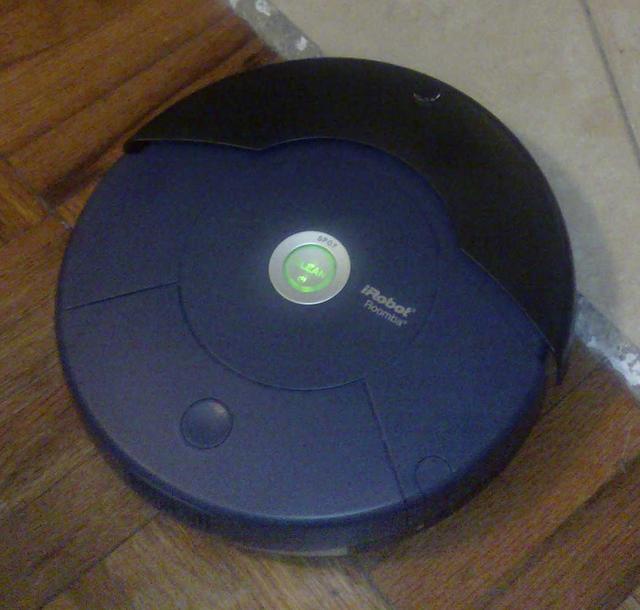
Roomba comes with a Mini-DIN TTL serial interface, which is incompatible with standard PC/Mac serial ports and cables, both electrically and physically. However, third-party adapters are available to access the Roomba's computer via Bluetooth, USB, or RS-232 (PC/Mac serial). New, 500-series, and 410/420 series Roombas upgraded with the OSMO hacker device allow the user to monitor Roomba's many sensors and modify its behavior. The Roomba Open Interface (formerly "Roomba Serial Command Interface") API allows programmers and roboticists to create their own enhancements to Roomba. ( )
My first impressions? Well, the Roomba lazily charged its battery throughout the day today, and was hungry and ready when I arrived home. It is a but louder than what I expected, and of course my cats were not thrilled by the presence of a eighth animated and apparently sentient being at home. Their initial reaction was of course to be verrry alert of the thing. Twelve eyes were constantly pointing at the Roomba while mine alternated between them. As they measured the thing's speed and (I guess) inferred its movement patterns, they started escaping upstairs A flat, round thing with no legs to be seen will not likely be able to climb the stairs. And they were completely right. At first, only Chupchic remained downstairs. After a bit, I went up to show them the Roomba didn't jump on us to eat our brains, and after a bit, Santa and Macusa joined. The Roomba roombed for maybe 90 minutes (this space is large, and decided it was enough... And slowly, the rest of them started coming down. I would not say Roomba's cleaning is perfect, of course. Its room discovery algorithm is funny, and it even seems it's based on the mere chance of covering most (never all) of the space it has to clean. I had, of course, not fully studied it (after a single run, how could I?). It does make a honestly good attempt at cleaning under coaches, chairs and tables. It collected a fair amount of dust (on a house that seemed quite clean to me, I cannot imagine what would happen on a messy one). I have not yet played with the virtual walls (infrared transmitters which limit rooms as if a door was closed), but given the size of this house (and that I don't want it to clean around the cats' designated bathroom area), I guess I will end up using them regularly. During DebConf, I heard one bad (stupid useless noisy thing) and two very good (it has radically changed my life) comments on the Roomba. I hope to shift the balance towards 3/4 and not towards 2/2! Anyways... Thanks to each and every one of you. DebConf is great. Always great. Always a success. I cannot even thank specific teams. Debian Rules, and DebConf Rocks!

9 August 2010

Gerfried Fuchs: On BTS usage

You might remember that I started to work on closing RC bugs for stable. This effort hasn't died off so I joined the RC Bug Squashing Contest that was going on during the Debian conference (which I was unable to attend). The rules did permit it, even though I was aware that it can't (and shouldn't) be compared to the unstable/testing squashers and thus it was split of into its own Special category. There still seems to be a lot of confusion on how our BTS works, especially with respect to version tracking. I was even accused of falsely claiming bug closing because the bug has been closed by someone else already. This wasn't the case, otherwise the bugs would had been archived a long time ago already[1] given that I had expected that person to know how bug archival works and also given the sheer amount of bugs that I simply had closed for stable, I guess it is needed to shine a light upon why some bugs won't get archived as expected. If you followed my IRC talk on BTS usage last month you might already have an idea of what's going on. There might be several different reasons why bugs aren't marked for archival yet. I'll try to explain them as I understand it (given that I neither have taken a look at the debbugs code nor am involved with its development) through my working on bugs over the last 10 years. I hope this will get others also interested to fix stuff for stable. Actually when I see something that potential falls into the last group I ping the maintainers of those packages to let them know about having them fixed. Some of you might already have received such a ping and I am thankful for those that received them well and actually already fixed some of those, too. Thanks for making stable a better place! Coming back to the RCBC, it was an interesting small competition (if only in my brain) between myself and the testing/unstable RC squashers going on. It would had been nice to get at least as many bugs in stable addressed as in testing/unstable because the amount is still a lot higher, but I can still be happy about the things done. And it is good to know that not everything seems to think that it's wasted effort to work on getting the RC count lower for stable, too (like I also was told about my effort). So thanks from that point of view!
[1] There are currently 2688 bugs still unarchived that were closed last year already! This UDD query helps you:
select count(*) from bugs where status = 'done' and last_modified <= '2009-12-31';

/debian permanent link Comments: 0 Flattr this

8 August 2010

Michael Banck: 8 Aug 2010

So, DebConf is over and it was a blast. I wanted to blog about my talks for a couple of days, but the conference was so great that I did not get around to it until now. The unique thing about this year's conference were the outstanding contributions by non-Debian FLOSS people from the east coast. I am really glad the organizers decided to reach out to the communi ty and take this opportunity when a lot of great minds were just a couple of hours away. Also, discussing and hanging out with the local team people was so much fun and interesting that it was wor th the visit alone. The venue was just perfect, the dorms were on campus, the cafeteria had an all-you-can-eat buffet, everything was in short walking distance and the Columbia campus is beautiful. I would have liked to go to a couple more places in the evenings, but hanging out in the Carman basement lounge with awesome people was just as good. A big thanks to Richard Darst, Biella, Micah and the rest of the crew. The Debian GNU/Hurd talk went quite well, I was pleasantly surprised so many people made it to the Davis auditorium. I wanted to do the presentation on Debian GNU/Hurd (and I had it working before the talk), but as my notebook has a different resolution than the projector, I decided to play it safe and just show a d-i run in qemu. Nevertheless, Jeremie's wo rk on debian-installer is impressive, I got it installed on my ThinkPad without a problem (using qemu) and it automatically installed and setup grub2. Unfortunately, grub2 seems to be having issues when booting my notebook natively, but I got it to work with grub-legacy, including X and evince. There were quite a few comments and I had interesting conversations afterwards with a couple of people. It is a shame Emilio Pozuelo Monfort (pochu) could not make it to DebConf to give the talk himself, he did lots of great work on porting packages and fixing the Hurd and glibc for various testsuites over the last couple of months. My other talk about GOsa and FAI was a bit rougher, I scrambled to get FAI integration in GOsa to work based on Mark Pavlichuk'sinstallation scripts which I fixed up over the last couple of weeks to the point where one can install a client using the FAI simple demo classes (which I ported to GOsa's FAI LDAP). There were some problems with the demonstration during the talk and I guess it was a tough audience for a web-based admin tool but I hopefully got my point across that we should salvage this work done for the city of Munich. Indeed, I had great discussions with Andreas Mundt from debian-edu afterwards who posted a summary and call for discussion to the debian-edu mailing list.

4 August 2010

Ingo Juergensmann: OS X, Linux and netatalk

After coming back from holiday where I made lots of photos and videos, I needed the possibility to import all those from SD cards to my fileserver running Debian unstable. To import the photos I used Digikam on Linux, that was no problem. But for the videos I needed iMovie and/or FinalCut Express on my Mac. I've looked into Kino and Cinelerra, but those Linux apps are awful. The problem was that iMovie is able to directly import from our Panasonic HD camcorder to the network storage. I was always forced to first import the fotoage to the drive in my MacBook Pro and copy it then to the Linux box onto a Samba share. The solution for that problem is to use netatalk/AFP. The Linux box appears as a Mac Xserve then. However, I quickly found some HowTos for configuring netatalk. One HowTo is from Mike Hughes and the other one can be found on disgruntled-dutch.com. If you follow these two HowTos you're quite close to have a working AFP service to interact with your Mac via Bonjour/Avahi. There are mainly two problems when you follow them. First, Mike Hughes has some illegal chars in his sample /etc/avahi/services/afpd.servicefile:
<!DOCTYPE service-group SYSTEM avahi-service.dtd >
<service-group>
<name replace-wildcards= yes >%h</name>
The quotation marks are the problem. Instead of you'll need normal " quotation marks. Or you can use the file on disgruntled-dutch.com. Next problem is the configuration of the shares. On both sites the examples are using cdb as CNID backend:
~/ "Home Directory" cnidscheme:cdb options:usedots,upriv
But this will give the following error:
Aug 3 23:30:29 muaddib afpd[8151]: Can't open volume "/home/ij" CNID backend "cdb"
Aug 3 23:31:26 muaddib afpd[8151]: Cannot find module named [cdb] in registered module list!
The solution can be found on forum.ubuntuusers.de (German): you'll need to change the cdb to dbd. So, the Home Directory share will look like this then:
~/ "Home Directory" cnidscheme:dbd options:usedots,upriv
Quite simple and easy. Now restart your avahi-daemon and netatalk services and have fun! When you want to use a share on your Linux server for TimeMachine backups, you'll need to add a "tm" to the options of your share.

31 July 2010

Wouter Verhelst: Wouter Verhelst, Tourist

So for one day a few days ago, I wasn't Wouter Verhelst, Debian Developer, but rather the above. I'm not usually very much interested in doing touristy things, but then on the other hand I'm of the opinion that you can't really claim to have been somewhere if all you've seen is the inside of a certain specific university campus. So, well, touristy things. I took the subway to about 10 blocks away from the very south of Manhattan, and then walked. I passed by city hall and what used to be the world trade center, but there wasn't much to see there construction sites are the same everywhere in the world. I moved on to "the battery", the south tip of Manhattan, and had an... interesting look at the Statue of Liberty in the distance. I thought about going there, but the tickets were sold out, so scratch that. Wall Street from Trinity Church Instead, I walked on to the Brooklyn Bridge (passing by Wall Street on the way), spent some time looking for the pedestrian's entrance to that bridge (which was slightly harder than would've thought it to be), and walked partway up the bridge. I wasn't interested in crossing over to Brooklyn, but it's an interesting bridge to walk on, and I had an interesting time. Brooklyn Bridge When I left the bridge again, it started raining. I don't mind a few drips on a warm day like that day, but this was more than that, and it started to bother me. So, rather than walking to the Empire State building, as I'd been planning, I decided to take the subway there. This did mean I missed out on the SOHO area, which I would've liked to see, but well, you can't have it all. dsc_6639 The Empire State building is something you grow up hearing about, and I'd seen pictures of it. It has a somewhat distinctive silhouette, shown on several comparative graphics of high-profile skyscrapers. But none of that is even close to the real thing. Not that it's higher than I expected; on the contrary. But it does look different; its color is much lighter than I thought, and the distinctive silhouette isn't as distinctive once you're standing right next to the building. But, well, going up the building clearly shows that it is the tallest building of New York. There are other skyscrapers, but most of those seem to be little dwarves in comparison. The view is nice, up there, and I took some interesting pictures. The tickets aren't very cheap ($20), but not insanely expensive either. I don't regret doing this. Going down... (in case you were wondering: yes, the above picture is in the point of view of the one above that, and vice versa) By that time it was around 4 pm already, and I thought about going back to the Columbia campus. As I checked out my map for the most efficient route, I found that it probably would've been easier to walk to Times Square and take the number 1 train there which stops right in front of Columbia (but below the surface, obviously). So since I was going to have to go there, I figured I could just visit Times Square while I was at it. Times "Square" I must say I'm not very impressed by it. For starters, Times Square isn't actually a square, at least not as I'm used to that word. Broadway and 7th avenue happen to cross at a, for Manhattan, uncharacteristically sharp angle, which results in more space between buildings than usual. But it's still fairly small as a "square". They've fenced off a part of that space and put a bunch of chairs and tables there. This would be a cosy and inviting, "gezellig" place, if not for the very audible noise of the traffic still going on all around it, and the fact that everywhere you see, there's three layers of brustling and visually noisy adverts. It could have been a relaxing oasis in the middle of the city, but instead it's just as busy as everywhere else in Manhattan. But then, I guess that's what New York City is all about. At any rate, after spending about half an hour or so there, I walked over to the subway to get back to the venue just in time for dinner. The end of a nice, touristy, day.

Aigars Mahinovs: Debcamp 10 the early days

After I finished an re-read my epic post describing my first day and a half at Debconf10 I suddenly realised that if I continue to describe the rest of 13 days here in such style and verbosity this would become a book, a boring one at that, so I decided to limit myself to 2 posts for Debcamp and then a post a day for the Debconf. But about the first half of the Debcamp week there are things that are as usual and there are things that are not. Let s start with the usual bits: more people arriving every day, evening parties are getting more and more fun and wild (or so people say) and the Internet and power at the hacklabs magically becomes more and more reliable day by day, the cabling mess grows organically trying to spread out evenly and not overload any individual socket, extension cords with non-local plugs appear and spread the load some more, people stress out, volunteer, crash out and repeat. All in all nothing can stop the freight train of few hundred Debian developers determined to have fun. With out own DFSG-free definition of fun. (But this year we appear to be running very close to the edge on volunteers if we run out of those, there will be a train-wreck, so please volunteer!) Now off to the unusual stuff. The City is well it is cool and very, very impressive. It is not terribly different to me at least I am used to such structure of the city: grid based layout of the downtown city (with some parks) and then branching out to separate, but different across-the-river districts and then sprawling out to slightly chaotic suburbs. Riga is very much like New York in the design. The difference is that New York is 10-20 times larger: the areas are 10 times larger, the buildings are 3-4 times higher on average, the streets are 2-3 times wider and yet have more traffic and there are far, far more shops, shows and restaurants. Also there is the subway. It is a great thing in that it hides the size of the city take a bus downtown once, to find out what I mean it takes ages to drive the distance that takes 20 minutes on the subway. I like this city, I am getting a feeling, that I could live here without much problem for me. So far I ve only had this feeling in Riga and Berlin. On the other hand this is USA. I ve so far only encountered one bad thing about it, but it is a pretty big one food. Basically all food that I ve tried so far in the USA has been crap. It was tasty salt, sugars and fat took care on my brain thinking it s food, but underneath that it was pretty crap: there was no texture, no content, no soul. The John Jay cafeteria where we are eating lunch and dinner is better than the most other options, because it is an all-you-can-eat buffet where you can choose your poison and it was also the place where I had the best piece of food in USA so far a slice of pepperoni pizza, that had a bit of taste behind the fat. Also, surprisingly, the fast food options (McDonalds, Burger King, ) are better than the equivalents in Europe, far better. In fact the fast food is cheap and in some cases tastes better than regular food, so there is no wonder why people might prefer it in some situations. So it is easy to see how people just accept shoving bland fast food or bland all-you-can-eat food into their mouths and not think much about it and thus become fat and put undue stress on their health. I expect the average weight of Debian developers to increase by 5 kg by the end of the conference. If you want to prove me wrong, running with bubulle would help you a lot with that. Events downtown. New York is a huge city with a lot of events going on every day, so everyone should be able to find something of interest for them. For me it was the free tickets for tapeings of The Daily Show and The Colbert Report. I got into both of those and for me The Colbert Report was by far the better experience. For one you can not get into Daily Show without a ticket (some tickets show up on the web site on the morning of the shoot around 11am), while 18 people from the stand-by list at Colbert Report got in. At The Daily Show you stand in a live line with ticket holders in one line and stand-by line separate. If you have tickets and arrive around 3pm you should be fine any later than that and you risk to be standing outside even with a ticket. You find that out around 4.30pm when they hand out physical tickets you have one, you get in. If not you might rush over to Colbert Report where a more humane system is used a staffer takes down your name and email on a numbered list and then you can walk around until 5.30pm then they let the ticket holders in and after that call the names of stand-by people that get in. The Colbert Report studio is brighter, more colourful and closer to the action, also it is very rare that cameras block the view from the audience (which is common on The Daily Show). It might have also been my luck when I got on the most boring The Daily Show episode I can remember, ever. The best joke was a woman asking John is she could get a ticket for her friend in August. The warm-up act and crowd control at The Colbert Report was also way better: Colbert staff was hyper, security was ever-present, warm-up was funnier and very engaging (he grilled me for several minutes and I replied making the audience laugh very hard explaining that Latvia was like India of Eastern Europe in regards to IT exports) and Colbert himself was very gracious talking to us out-of-character before the show for a good 10 minutes. Location, location, location. The talk rooms and event rooms and hacklabs are spread out across multiple buildings and there is a lot of other activities going on in those buildings besides Debconf, so moving between place might be confusing for the first day or two. Also the rooms are quite dark that might cause a noise problem for me and the video team as we ll have to up the sensitivity settings on our gear. The video team is working on fixing that by throwing a bit more light on to the speakers. Elevators are wicked fast, but can also be confusing, because the ground floor is on a different number for different buildings it can be G, 1 or even 4. Usually on campus there is a star next to the level with the exit. The dorms. I am in the Carman building and it looks like its interior has not been updated since it was built large ceramic bricks with very visible gaps (for the interior walls), raise-to-open windows, huge aircon fans that take up the whole bottom of the window, plumbing from the 60ies (at least). The security is weird on one hand you have to give your room card to the guard when entering the building, but on the other hand the room cleaning crew can simply forget to close your door after they are done. Like this Thursday I returned to the dorm just before lunch only to find the door of my room open. No one was around and nothing was missing, but it s still worrying. In any case I am steadily uploading photos from Debconf 10 to my Flickr page and new stuff should show up every day.

29 July 2010

Stefano Zacchiroli: DebConf BoF HOWTO

Here at DebConf10 the schedule is starting to get really packed of events, which is great! About a half of those events are BoFs (in the IETF sense), i.e. discussion sessions among people interested in specific topics. (Other conferences use "BoF" to refer to impromptu, non-scheduled, and spontaneous events, while at DebConf we have traditionally submitted, reviewed, and scheduled BoFs in advance.) As most DebConf regulars, I've attended quite some BoFs in the past and I share with others the impression that the quality and usefulness for the project of BoFs varies substantially from BoF to BoF. That's why I'd like to share a BoF recipe, which comes from possibly the best organized BoF I've ever attended. As it happens with all good recipes (and with free software), I've took the liberty of customizing it a bit.
DebConf BoF HOWTO have a coordinator A good BoF should have a coordinator, which is usually (but not necessarily) the person who proposed the BoF in the first place. The role of the coordinator encompasses at least 2 tasks: preparing the BoF in advance (read below) and moderating the discussion to ensure everybody get a chance to participate. prepare in advance A good BoF is more than just getting together, vaguely knowing the BoF topic, and ... discuss. Mind you, it might work very well that way too, but the chances of having a successful BoF are much higher if attendees arrive prepared. That is quite simple to achieve. It just takes the BoF coordinator to prepare some working questions and/or detailed discussion topics, and advertise them as such. That way potential participants can make up their minds, recall experiences that they want to share, note down comments they want to bring into the discussion, etc. In my experience, the BoF time will then be used in a much more productive, exciting, and ultimately fun way. Most BoFs can also benefit from a few introductory slides on the BoF topic, to ensure all participants start from a common ground. The last slide could contain a brief recap of the working questions, so that the audience have them handy. don't be exclusive Debian is not a company and Debian contributors are not employees, therefore we cannot expect all relevant people to attend a specific BoF, just if they had to. As usual, the risk of cutting off community members who cannot attend should be mitigated as much as possible. To that end, minutes are just great; after the BoF, minutes should be posted where appropriate, and possibly uploaded to Penta as event attachments. ... but taking minutes is just boring and not everyone is good at that (for instance, yours truly used to suck at taking minutes, even if I'm trying to get better ...). If you have a trusted participant which is good at taking minutes, great, go for it! If you don't, use collaboration. During past DebConfs as well as at UDS this year, I've been shown a nice way of doing that. It takes a dedicated projector in the BoF room showing some real-time, collaborative editing facility (e.g. gobby). With such a setup, people usually just start taking minutes collaboratively, although explicitly inviting the audience to do that is a very good idea. Ideally, the room should have two projectors, one for supporting slides, another for collaborative minutes taking. In case there is only one, as it is usually the case for DebConf, it's probably better to use it for minutes and switch to them as soon as supporting slides are over.
gobby.debian.net for BoF minutes at DebConf10 For DebConf10, the DebConf team has setup a gobby (infinote) server at gobby.debian.net. Just do the following in order to be ready for collaborative minutes taking:
    # apt-get install gobby-0.5
    $ gobby-0.5 -c gobby.debian.net

(Note: you shouldn't use the non versioned gobby package as it uses a different protocol and doesn't support undo, which is quite risky; see Debian bug #590753 for more background.) As the naming convention for DebConf10 minutes, using document names that start with dc10- sounds sensible.
comments welcome! So, what do you think of the above suggestions? Do you have further best practices to share on BoF organization at DebConf? Leave a comment or mail me. In the end it would be nice to author a proper "DebConf BoF HOWTO" document for further reference. Thanks to Gregor for his feedback on early versions of this post.

Gintautas Miliauskas: Python course projects

This spring I read a course on Python in Vilnius University, Department of Mathematics and informatics. The course was not mandatory, which I suspect is one of the reasons why my students were quite a bright and motivated bunch. I began the course with a brief introduction to the Python language and the standard library, then dedicated a few lectures to Django and in the remainder I covered various libraries (GUI toolkits, Pygame) and techniques (testing, debugging, optimization). One of the major tasks of the course (and the deciding factor in the final valuation) was to develop a project using Python. The students were given complete freedom over the topic of the project and the tools used, as long as Python was involved. The quality of the result varied, of course; had I given concrete tasks, the low bar would definitely have been higher. However, I am happy with how things turned out. Probably the best-executed project was 1000 Online, an online multiplayer card game (see rules). It was developed by Vytautas Karpavi ius. Vytautas apparently had prior experience with Python and Django, nevertheless, the quality of the app (and the code behind it) is impressive. Among the other projects, Gegute.lt, a Lithuanian clone of Reddit is still up and running. It's nothing too fancy, but looks quite clean for a university project. Other projects perhaps were not perfectly executed, but were very interesting conceptually. Jonas Keturka developed a bot (BitBucket) for the online strategy game Travian. Marius Damarackas developed a web-based guess-the-song game. He used YouTube for the song material and Last.fm (IIRC) to make you guess among similar songs, so that it would not be too easy. Andrius Chamentauskas developed a Puyo Pop clone (GitHub) with PyGame, complete with multiplayer and an AI. Paulius Budzinskas worked towards his course paper by developing a bacteria movement modelling and visualisation app (GitHub; Lithuanian only). David Abdurachmanov developed a spell-checker bot for WikiAnswers.com, with a really baroque and sophisticated architecture. I believe he has applied to Google Summer of Code with that project; I wonder how that is working out. For reference, you can find links to all student repositories on GitHub/BitBucket in this list. Beware: some of them may be documented/commented in Lithuanian. Another interesting effect of the course was that people started using Python in other related courses, for example in Mathematical Modelling and Numeric Methods. I even heard that the lecturer was impressed and expressed interest in learning Python. Another lecturer, this time a statistician, was interested in teaching and using SAGE at lab practice. Feeling such 'ripples' going through the department sure felt nice. By the way, the university also offers lectures on Ruby, read by Saulius Grigaitis. I took some inspiration from him for the course form and content.

26 July 2010

Matt Zimmerman: Embracing the Web

The web offers a compelling platform for developing modern applications. How can free software benefit more from web technology, and at the same time promote more software freedom on the web? What would the world be like if FLOSS web applications were as plentiful and successful as traditional FLOSS applications are today? Web architecture The web, as a collection of interlinked hypertext documents available on the Internet, has been well established for over a decade. However, the web as an application architecture is only just hitting its stride. With modern tools and frameworks, it s relatively straightforward to build rich applications with browser-oriented frontends and HTTP-accessible backends. This architecture has its limitations, of course: browser compatibility nightmares, limited offline capabilities, network latency, performance challenges, server-side scalability, complicated multimedia story, and so on. Most of these are slowly but surely being addressed or ameliorated as web technology improves. However, for a large class of applications, these limitations are easily outweighed by the advantages: cross-platform support, instantaneous upgrades, global availability, etc. The web enables developers to reach the largest audience of users with the most compelling functionality, and simplifies users lives by giving them immediate access to their digital lives from anywhere. Some web advocates would go so far as to say that if an application can be built for the web, it should be built for the web because it will be more successful. It s no surprise that new web applications are being developed at a staggering rate, and I expect this trend to continue. So what? This trend represents a significant threat, and a corresponding opportunity, to free software. Relatively few web applications are free software, and relatively few free software applications are built for the web. Therefore, the momentum which is leading developers and users to the web is also leading them (further) away from free software. Traditionally, pragmatists have adopted free software applications because they offered immediate gratification: it s much faster and easier to install a free software application than to buy a proprietary one. The SaaS model of web applications offers the same (and better) immediacy, so free software has lost some of its appeal among pragmatists, who instead turn to proprietary web applications. Why install and run a heavyweight client application when you can just click a link? Many web applications perhaps even a majority are built using free software, but are not themselves free. A new generation of developers share an appreciation for free software tools and frameworks, but see little value in sharing their own software. To these developers, free software is something you use, not something you make. Free software cannot afford to ignore the web. Instead, we should embrace the web more completely, more powerfully, and more effectively than proprietary systems do. What would that look like? In my view, a FLOSS client platform which fully embraced the web would: Imagine a world where free web applications are as plentiful and malleable as free native applications are today. Developers would be able to branch, test and submit patches to them. What about Chrome OS? Chrome OS is a step in the right direction, but doesn t yet realize this vision. It s a traditional operating system which is stripped down and focused on running one application (a web browser) very, very well. In some ways, it elevates web applications to first-class status, though its paradigm is still fundamentally that of a web browser. It is not designed for development, but for consuming the web. Developers who want to create and deploy web applications must use a more traditional operating system to do so. It does not put the end user in control. On the contrary, the user is almost entirely dependent on SaaS applications for all of their needs. Although it is constructed using free software, it does not seem to deliver the principles or benefits of software freedom to the web itself. How? Just as free software was bootstrapped on proprietary UNIX, the present-day web is fertile ground for the development of free web applications. The web is based on open standards. There are already excellent web development tools, web application frameworks and server software which are FLOSS. Leading-edge web browsers like Firefox and Chrome/Chromium, where much web innovation is happening today, are already open source. This is a huge head start toward a free web. I think what s missing is a client platform which catalyzes the development and use of FLOSS web applications.

25 July 2010

Russell Coker: Links July 2010

David Byrne gave an interesting TED talk about how changes to architecture drove changes to musical styles [1]. I think he does stretch the point a little. To a certain extent people develop the most complex instruments and the largest music halls that can be supported by the level of technology in their society people with a hunter-gatherer civilisation play drums because they can build them and can carry them. The NY Times has an interesting article about paternity leave in Sweden [2]. The Swedish government pays for a total of 13 months leave that can be split between parents for every child. Of those 13 months 2 months can only be taken by the father and that is likely to increase to a minimum of 4 months of paternity leave after the next election. Dan Meyer gave an interesting TEDX talk about how the current math curriculum in the US (as well as Australia and lots of other countries that do the same thing) is totally wrong [3]. His main point is that maths problems should be based on real-world use cases where not all needed data is immediately available and there is also useless data that must be discarded. He believes that the most important thing is developing mathematical problem solving skills basically the things that I did for fun when I was in primary school are skills that need to be taught to high-school students The Atlantic magazine has an amusing article by Daniel Byman and Christine Fair about the incompetent Islamic terrorists [4]. In Afghanistan half the suicide bombers kill only themselves and the US government has a lot of evidence of Taliban soldiers practicing bestiality and collecting porn. Islamic extremist groups are staffed by people who are bad soldiers and bad Muslims. Jon Masters wrote an interesting post titled What Would Jesus Buy about ethical purchasing decisions [5]. Jon references The Church of Stop Shopping which isn t a real religious organisation but a street theatre activist group. ZeroHedga has an insightful article comparing corporations and the US government to street gangs [6]. The conclusion is that when gangs take over a neighbourhood everyone has to join a gang for their own protection. Hillel Cooperman gave an interesting TED talk about being obsessed with Lego [7]. He compares Lego fans to Furries and makes a good case for this comparison. Marian Bantjes gave an interesting TED talk about her graphic art / graphic design work [8]. I ve never seen anything quite like this. Business Insider has an interesting article about oil cleanup, it seems that most people who worked on the Exxon Valdez disaster are now dead [9], s opposed to most people who worked in almost every other occupation at that time who are either still working or enjoying their retirement. The current gulf disaster is bigger, will require more workers for the cleanup, and can be expected to have a higher death toll. Some people claim that measures to reduce oil efficiency will impact the economy, how will millions of people who are chronically ill for the rest of their lives impact the economy? The NY Times has an interesting article on circle lenses [10], contact lenses designed to make the eyes look larger. It s illegal to sell contact lenses in the US without a prescription, but the latest trend is for women to buy them online in a variety of colors. The FDA should probably approve them, it would be better to have the quality controls you expect from a medical supply company instead of having people rely on Malaysian mail-order companies for the safety of their eyes. Don Marti has written an interesting article about the economic decline in the US, he suggests making pension funds invest in local jobs [11]. Companies are supposed to act on behalf of their stock-holders, but US companies often have the majority of their stock owned by the pension funds of workers but they act on behalf of a small number of rich people who own a minority of the stock. Don s article was inspired by Andy Grove s article in Bloomberg about the stagnation in technological development that has been caused by off-shoring the manufacturing [12]. Neil Brown has completed a test release of a new Linux software RAID feature for arrays with multiple redundancy that have bad sectors [13]. When a disk gets a bad sector the current behavior is to kick it out of the array, if you have two such errors on a 3 disk RAID-1 or a RAID-6 array then you lose all redundancy and are at risk of catastrophic failure even though in most cases both disks will still mostly work. With this patch some regions of the disk may be excluded but it can provide redundancy for other stripes. Thanks Neil for your great work here, and all your previous work over the last 10+ years! The RSPCA has a new campaign titled Close the Puppy Factories [14]. Dogs are kept in very poor conditions and forced to churn out puppies for their entire lives to supply pet stores. The RSPCA recommends that people buy puppies from registered dog breeders (not registered dog breeding companies ) and ask to see the dog s parents. They also recommend not buying from classified adverts or pet stores. Animal shelters have to euthenise huge numbers of unwanted animals, you can buy a pet dog or cat from an animal shelter for a small fee that covers the expenses related to housing and spaying it and save that animal from being euthenised! Maureen Dowd criticises the Catholic Church properly in an article for the New York Times [15]. The Catholic Church officially regards ordaining a woman and raping a child to be equally bad offenses. Frank Rich wrote an interesting column for the New York Times about Mel Gibson [16]. He describes the destruction of Mel Gibson s reputation as a symptom of changes in the culture in the US and also links it to the fall of Ted Haggard (who supported Gibson s most notorious movie The Passion of the Christ).

Tim Retout: New York

Well, I made it to New York, along with my brother. Yesterday we walked down most of Manhatten Island - we've been staying in the youth hostel on 103rd street, and made our way on foot as far as Battery Park. Along the way, we visited McDonalds (twice) and Starbucks (was that two or three times?), both featuring free wifi and air conditioning. We went up the Rockefeller Tower as well, and got a few photos out of that. It's really quite warm here. It's shorts and sandals weather (just like last year in Spain), and I'm tired of walking in sandals. Interesting differences from the UK: the New York Times crossword is quite different from what we call crosswords. I think Monday's one is meant to be easiest, so perhaps starting with Saturday's was not a good plan. There are water fountains dotted around the city, which is awesome. This morning I went running around Central Park. Except it's tougher than it looks - I'm not sure whether it was the humidity, or the inclines, or not eating anything before setting out... I ended up walking most of the second half, and it took half an hour more than I thought it would. I ran counter(anti-)clockwise - I think it would be better to go clockwise, because there's a hill in the corner with a steep side that I'd prefer to run down rather than up.

20 July 2010

Russell Coker: Digital Video Cameras

I ve just done some quick research on Digital Video Cameras for some relatives. It seems to me that the main feature that is necessary is Full HD (1920*1080) resolution as everyone seems to be getting 1920*1080 resolution monitors (getting smaller doesn t save enough money to be worth-while). Resolutions higher than 1920*1080 will probably available in affordable monitors in the next few years, so the ability of programs like mplayer to zoom videos will probably be required even for Full HD video soon. Saving maybe $300 on a video camera while getting a lower resolution doesn t seem like a good idea. The next feature is optical zoom, most cameras are advertised with features such as advanced zoom to try and trick customers, cameras which advertise 60* or better zoom often turn out to only have 20* zoom. I think that about 20* optical zoom should be considered the minimum, not that there is anything special about 20* zoom, it s just that there is a good range of cameras with better zoom capacity. Image stabilisation is a required feature, no-one can keep their hand perfectly steady and the typically a DVC only gets hand-held use most people who own them don t even own a tripod! Digital image stabilisation is apparently not nearly as good as optical image stabilisation, and image stabilisation that involves moving the CCD is apparently somewhere in between. Finally it s good to have the ability to take quality photos as few people will want to carry a Digital Camera and a Digital Video Camera. I did a search for DVCs on the web site of Ted s Camera store (a chain of camera stores in Australia that generally provide good service at a competitive price but not the cheapest price). The best of the Ted s options seems to be the Panasonic SD60 HD Video [1] which does 25* optical zoom, 1920*1080i video, 5 megapixel still photography, and optical image stabilisation it costs $750 from Ted s. The next best option seems to be the Sony Handycam HDR-CX110 HD [2] which does 25* optical zoom, 1920*1080i video, 3.1 megapixel 2048*1536 still photography, and digital image stabilisation. The Panasonic seems to be a better option due to having optical image stabilisation and a higher resolution for still photographs. It is also $750 from Ted s. Now there s the issue of how well the cameras work on Linux. A quick Google search indicated that the Sony cameras present themselves as USB card readers and can be mounted on a Linux system, I couldn t discover anything about the Panasonic. If I was going to buy one I would take my Netbook to the store and do a quick test. I don t have enough information to recommend either of those cameras, they may have some awful defects that are only apparent when you use them. But in terms of features they seem pretty good. The Panasonic SD60 HD Video should be a good benchmark when comparing cameras in the store. If nothing else the camera store staff seem to not be very helpful if asked generic questions such as which camera is best , but if asked questions such as how is this other camera better than the one I m looking at they can usually give good answers. If anyone has any other advice for purchasing a DVC then please let me know. Either generic advice or specific examples of Linux-friendly DVCs that have been purchased recently.

18 July 2010

Gregor Herrmann: Let's freeze!

I spent the last two days at the BSP in Munich thanks to everyone for inviting & feeding me, & especially to Stefan for hosting me again!

Unfortunately the weather was not good enough for an excursion to a Biergarten but the local chefs at the LiMux office delighted us with self-made spaghetti salmone & self-rolled sushi, & we spent quite some time behind our laptops.

The main results can be seen on the wiki page; my personal conclusion is that the list of remaining RC bugs contains mostly "hard stuff" (e.g. architecture-, hardware-, or desktop-specific bugs). Probably some packages will need to be kicked out of squeeze & some bugs might get a squeeze-ignore tag ... To put it positively: I have a gut feeling that the freeze is getting closer :)

8 July 2010

Aigars Mahinovs: Phoning it in

Currently I own and use an iPhone 3G. I bought it almost two years ago, when the local phone provider LMT started offering the iPhone legally. I had a pretty good experience with it most of the time, but now it is showing its age: I will try to send my iPhone in for repair hoping to extend its usefulness, but frankly it looks that I might have to get a new phone at or before Debconf. So I am considering my options for a new phone and so far I have 3 main options each with some sub-options. The main options are: iPhone 4, MeeGo and Android. Each choice has its benefits and drawbacks and each also has several sub-options related either to specific phone models or to purchase methods. What I need is a phone with: calling function, contact information synchronised to Google, support for Google Mail/Contacts/Calendar simultaneously with one Exchange account also providing mail/contacts/calendars, music, audiobooks saving my place in the audio book and in the list of books, fully featured Twitter client with Twitpic and location support, encrypted password storage application (preferably open source), GPS with maps, ability to download maps for offline use, Geocaching support with offline cache info and logging, Skype client, ability to write in Latvian, English and Russian in all applications, reliable backup and restore of phones data including settings and data of installed apps. Optional features: last.fm streaming and reporting support, ebook applications with purchasable ebooks, high quality video and photo recording (for a phone), ability for me to write applications on the phone, ssh client, wireless data upload to the phone, ability to change the phones battery without loosing data in the phone (on the go), compass, physical keyboard, confidence in getting software upgrades and developer interest for the next 2 years. I ll try to describe all of the options here to organise my thoughts and maybe also help someone else make the choice. Option 1: iPhone 4 To get the iPhone 4 I have two options: LMT and unlocked. The official arrival of iPhone 4 to Latvia is expected in September and it will likely be sold by LMT for the same prices as iPhone 3GS is now. If I choose this scenario, I will need to survive with my semi-broken iPhone for 2-3 more months. Total price over 2 years (LVL): 131 (purchase price) + 24 * 8 (surcharge) = 323 LVL. Note: the surcharge is the extra cost of the iPhone call plan compared to a comparable regular plan (Vien dais 7 + Internets telefon 5). If I go and purchase an unlocked iPhone 4 in a country where such units are sold (UK is the most easily accessible choice, because a few of my workmates travel weekly to and from UK) then the total price over 2 years would be the purchase price: 499 GBP + 65 GBP (2 year warranty extension) = 505 LVL Now lets go over the general benefits and downsides of the iPhone 4, first the positives: Drawbacks: Option 2: Maemo/MeeGo Some of my colleagues at work (in the Riga office of Accenture) have N900 phones and I have been exposed to people with raw enthusiasm towards the Maemo platform ever since the Debconf in Helsinki, where we saw the first N700 devices in the hands of some lucky Debian/Nokia people using it as an Internet tablet. N900 has been a strong leap forward for the platform, before its head was teleported sideways by the whole MeeGo merger/debackle. Again I have two options here: Get a N900 either here in Latvia for 325 LVL (that would be the total cost over 2 years) or get it from USA during Debconf for 399 USD (+129 USD for 2 year warranty) = 317 LVL. And additional option would be to wait until October/November and then buy the new Nokia MeeGo device, rumoured to be N9-00 and likely to be around the same price as N900 was when it was introduced (around 500 LVL). Benefits: Drawbacks: Option 3 Android After looking trough the options for Android phones, I ve narrowed the selection to the ones that are either available from local carriers or can be easily gotten unlocked also the phones need to have announced plans to have at least Android 2.2 version. Currently the choice is limited to HTC Desire (from carrier or unlocked) and Samsung Galaxy S (unlocked). The prices over 2 years break down as follows: HTC Desire (locked to LMT): 69 + 9*24 = 285 LVL
HTC Desire (locked to Bite): 199 + 2*24 = 247 LVL (Note: only 500Mb of data per month available)
HTC Desire (locked to Tele2): 179 + 6*24 = 323 LVL
Note: all the above options would also require me to pay a 45 LVL early termination fee on my current iPhone contract if I choose to do this before September.
HTC Desire (unlocked): 311 LVL
Samsung Galaxy S (unlocked): 350 LVL (import from Germany) Benefits: Drawbacks: Please correct me if I am wrong with something!!! And also it would be cool if you expressed your own opinions in the comments. Currently I am very undecided about what I am going to do, but after completing this entry I am leaning towards an unlocked HTC Desire. Update:
Olivier Cr te shares a N900 vs. Nexus One experience Edit 01-07-2010: Handed my iPhone in for a warranty repair, got a dumbphone Nokia as a loaner during repairs. Very surprised about how long a battery can last on a low powered and cheap phone. In the mean time from all the comments here and elsewhere I am starting to see that I am too annoyed with the iPhone platform (mostly iTunes) to stay there and that I am also not convinced in the direction MeeGo is going (a lot of community developers are annoyed and are jumping ship), so N900 is also out. I will need to see 2-3 MeeGo smartphones and also see how Nokia will treat their smartphone users and developers on this platform, in the long term, before I ll be ready to trust them with my money. Therefore, my choice is becoming pretty clear look for the best Android phone (after my iPhone dies). We have this thing at Accenture, where we can get company phones at a discount and HTC Desire is on that list. If I can get that, it would slash 100 LVL (almost a third of the price!) off it, but to get there I either need to get a promotion (rather rare after just one year with the company) or prove the necessity of the phone for the needs of my project (kinda hard currently). Well, the situation will be a bit clearer next week when I get my iPhone back. (Apparently the Latvia s largest holiday Midsummer Festivities or J i/L go with tons of traditional outdoor activities, caused a lot of phones to become broken and there is a backlog of warranty service :) ) So at this point my plan is: get my iPhone repaired and get a promotion or a project where I can justify a company-paid HTC Desire and then hope that Nokia/Intel really get their stuff together and make MeeGo a great smartphone platform over the next year or two. Update: Got my iPhone 3G back from the warranty . It is in quotes because they just gave me a new iPhone 3G. The battery lasts for 3 days of minimal use and it has not crashed yet. The recovery process was a pain again caused by iTunes: iTunes refused to restore my backup onto the new phone, because my backup was made on a iOS 4.0, while the new phone I got from the warranty has 3.1.3 on it. So I had to set this phone as a new phone, initialise it, make a backup, upgrade to 4.0, restore from the (empty) backup, then reset the phone to factory settings again and only then I could start restoring data from my original (pre-warranty) backup and start copying my data on to the device. All in all it took nearly 3 hours if iTunes doing something and almost a dozen reboots of the phone. Almost half of that time was spent doing completely unnecessary steps to work around the fact that iTunes is braindead. I ll continue using my iPhone for now, keeping my eyes on the newest Android phones and also waiting for the long-promised first MeeGo phone from Nokia.

5 July 2010

Marco T&uacute;lio Gontijo e Silva: Immix on GHC Summer of Code weekly report #8

My project. This post assumes that the reader has read my last post. This week I could get my focus on the project again, since most of my classes are already over. I ve investigated the segfault that was happening in GHC with +RTS -w -DS, and I noticed that the code in rts/sm/Sanity.c assumed that all objects in the allocated area of the block are being used.
    for (; bd != NULL; bd = bd->link)  
	p = bd->start;
	while (p < bd->free)  
	    nat size = checkClosure((StgClosure *)p);
	    /* This is the smallest size of closure that can live in the heap */
	    ASSERT( size >= MIN_PAYLOAD_SIZE + sizeofW(StgHeader) );
	    p += size;
	    /* skip over slop */
	    while (p < bd->free &&
		   (*p < 0x1000   !LOOKS_LIKE_INFO_PTR(*p)))   p++;  
	 
     
Since this is true for copy collection and mark compact, it was only with mark sweep that the error happened. The only way I could manage to make the segfault disappear by now was marking the swept blocks with a new flag, and avoid running this code in them. So I went back to my old problem with the allocation of memory in lines. I noticed that (one of) the problem(s) may be that the object that is allocated in the free line is not scavenged after the evacuation. When the object is allocated in a block, using the current allocation method, it will eventually be scavenged, because all blocks that were being used to allocation are scavenged. I m planning to implement a list of lines that need to be scavenged and code to scavenge the lines in this list, and the current line. It ll be very similar to the code that does this with blocks.

3 July 2010

Peter Eisentraut: Increasing the priority of Debian experimental

Many people run Debian testing or unstable or some mix thereof. This works pretty well for a development system or a general desktop system if you know a bit about what you're doing (note: nonetheless officially not recommended). Sometimes you throw packages from experimental into the mix, if you want to get the latest stuff that isn't yet fully integrated into the rest of Debian.

The default APT priority of the Debian experimental release is 1, which ensures that it is never automatically installed or upgraded. This is not always ideal, in my experience. Of course, you don't want a package from experimental to take precedence over a package from stable, testing, or unstable by default. But I think when you have in the past installed a package from experimental, you probably want to pull in upgrades to that package from experimental as well. Otherwise, you will end up with completely unmaintained packages on your system. That is because in practice many packages in experimental are not actually experimental or broken or unmaintained, but just an advance branch of some software that is just for some reason not ready to go down the unstable-testing-stable road.

To make this work better, I have set the priority of experimental to 101 in my /etc/apt/preferences:
Package: *
Pin: release experimental
Pin-Priority: 101
Now the following will happen: If you just apt-get install a package, it will come from whatever "normal" release you have in your sources.list, say stable or testing. You can override that using -t experimental as usual. If you install a package from experimental and later an upgrade is available in experimental, apt-get upgrade will install that automatically. Also, if an upgrade in a "normal" release appears that has a higher version number, that version will be installed.

Of course, caveats apply. Some software in experimental is really experimental and should only be installed under close supervision. If a package is available only in experimental, this setup will install it when you ask for the package, even if you might not have actually wanted it if you had known that it was in experimental. Figure it out yourself. :)

Similar considerations apply to backports. I use
Package: *
Pin: release a=lenny-backports
Pin-Priority: 102
On the system I have in mind here, the standard distribution is stable, testing is 101, and backports is 102, taking precedence over testing. Because for some architecture-independent packages you don't need backports, so you can pull them directly from testing that way.

In general, the APT priority business is relatively powerful and often a good alternative to, say, manually downloading packages from various distributions, installing them manually, forgetting where they came from, and never upgrading them.

25 June 2010

Anand Kumria: Beginning Django Development

Oddly, I have had four different people ask me about the best way to begin a Django project or setup their system to make it easy to develop with Django. Since I've now given my response via email so many times, I figure I might as well broadcast it and hopefully this will help others as well My assumptions: What we will do is create a private binary directory and another Python modules. Then take a checkout of the two most important Django projects, and make them work. First: create your user
$ sudo adduser newbie
$ ssh localhost -l newbie
$ whoami
newbie
Then we want to create some local bin and lib directories. First the binary directory $ mkdir ~/bin # On Ubuntu/Debian, this will automatically be in your PATH the next time you login And now a local directory for our various libraries
$ mkdir -p ~/lib/python
$ echo "PYTHONPATH=~/lib/python:" >> ~/.bashrc
$ echo "export PYTHONPATH" >> ~/.bashrc
This will add that directory to our Python path. If you happen to also use another language you can put things into ~/lib/ruby, ~/lib/perl as appropriate
$ mkdir ~/Projects
$ cd ~/Projects
Here is where we will store copies of upstream software. What is the reason for using the repositories rather than packages? This allows us to checkout specific versions to match what our clients might be using. Or test things against newer versions of the upstream project. First, let's setup Django. I tend to use git by default, especially if the upstream is using Subversion. If they are using Mercurial or Bazaar, I use those directly.
$ git svn clone -s http://code.djangoproject.com/svn/django/
Initialized empty Git repository in /home/newbie/Projects/django/.git/
Using higher level of URL: http://code.djangoproject.com/svn/django => http://code.djangoproject.com/svn
r1 = 5cda37203ffa6ea83da2958a95c377984482877f (refs/remotes/trunk)
	A	django-docs/images/flatfiles_admin.png
	A	django-docs/images/users_changelist.png
	A	django-docs/model-api.txt
	A	django-docs/build.py
	A	django-docs/db-api.txt
	A	django-docs/writing-apps-guide-outline.txt
	A	django-docs/templates.txt
r2 = b8249ac45e2154933b9649fd8181d5769e31c9fc (refs/remotes/trunk)
	A	django/utils/feedgenerator.py
	A	django/utils/datastructures.py
[...]
r13399 = f3902c67a3b8788de2145899e435a394c512b455 (refs/remotes/releases)
	M	tests/regressiontests/m2m_through_regress/tests.py
r13400 = cd72207306a5a4eecdf07f65c109f37c8317ed81 (refs/remotes/trunk)
$
Now we have Django, push it into our python path
$ cd ~/lib/python
$ ln -s ~/Projects/django/django/
$ python
Python 2.6.5 (r265:79063, Apr 16 2010, 13:57:41) 
[GCC 4.4.3] on linux2
Type "help", "copyright", "credits" or "license" for more information.
>>> import django
>>> django.VERSION
(1, 2, 1, 'final', 0)
Now, let's do the same for South. South is a database migration helper for Django. These are the two things you want to have in any Django at a minimum. There are also plenty of other amazing things like haystack, piston, satchmo, etc. You can follow the same recipie for them too.
$ cd ~/Projects
$ hg clone http://bitbucket.org/andrewgodwin/south/
destination directory: south
requesting all changes
adding changesets
adding manifests
adding file changes
added 802 changesets with 1340 changes to 183 files (+1 heads)
updating to branch default
143 files updated, 0 files merged, 0 files removed, 0 files unresolved
$ cd ~/lib/python
$ ln -s ~/Projects/south/south
$ python 
Python 2.6.5 (r265:79063, Apr 16 2010, 13:57:41) 
[GCC 4.4.3] on linux2
Type "help", "copyright", "credits" or "license" for more information.
>>> import south
>>> south.__version__
'0.7.1'
Finally, we want to be able to create Django projects. There is a great helper called django-admin that will do this. Let's put it into our path
$ cd ~/bin
$ ln -s ~/Projects/django/django/bin/django-admin.py
$ hash -r
That last statment will cause your interpreter to re-read PATH and make anything new available for execution. Now, you should go ahead and create your projects. There are a variety of ways to do this. However what I like to do is keep Django applications separate from the Django project. That way, they can easily be re-used if required. So, for a project called 'foo', we might have
$ mkdir -p ~/Work/foo
$ cd ~/Work/foo
$ mkdir foo.example.com
$ mkdir templates
$ mkdir media
$ mkdir <individual apps>
For each individual app, put them into the Python library. And you then have your re-usability from within Django. For a application called 'bar', you would do:
$ cd ~/Work/foo
$ django-admin.py startapp bar
$ cd ~/lib/python
$ ln -s ~/Work/foo/bar
And now, in your Django foo.example.com setting.py's file you can put 'bar' as one the installed applications and things will Just Work Obviously there are many way to slice this particular mango, but I've found that this works pretty well for me. You can spruce it up by revision controlling each directory in your project (I do) and also take advantage of things like virtualenv and Fabric to make deploying just as easy as developing. But I'll leave those topics until a later date

20 June 2010

Stefano Zacchiroli: debian meeting guidelines RFC

How to have a (Debian) summit without turning into a secret cabal It seems rather uncontroversial that sponsoring various kinds of Debian meetings (conferences, sprints, BSPs, etc.) is a good way to spend, actually invest, Debian money. Historically, that has not always saved the Debian community from muttering about "cabal-ish" meetings in very few specific occasions. (No, there is no cabal, in case you wonder.) I've always believed in the good faith of people and I don't think that we have ever had "secret meetings" on purpose. Nevertheless the question of how to have meetings in a community-compatible way is a sound one. Answering properly to such a question is something that it's harder than what it might seem at first sight (at least for me). In particular, organizers have to carefully balance the high efficiency that meetings offer (e.g.: communication bandwidth is higher than when working remotely, people have less distractions, more enthusiasm, more fun!, etc.) with the risk of cutting out the rest of the community which cannot attend the meeting, for whatever reason. Note also that since Debian is not a company, we cannot just require that everybody who is interested attend the meeting. As DPL, I'm starting to get quite some requests for meeting sponsorship, and that's just wonderful: it means that we have thrilling groups of people that are eager to get together and hack to improve Debian! Still, in doing so, we should all try to minimize the above risk; that's why I've started to apply the following Debian meeting guidelines, as a kind of prerequisite for sponsoring.
  1. Before the meeting: the meeting should be announced to the most relevant public mailing list(s); ideally, the tentative agenda of the meeting should be included in the announcement.
    That will enable people interested in the meeting topics to provide their inputs and more generally to know what is going on.
  2. During the meeting (preparation): expenses should be minimized, as a form of respect for all people that donate to Debian. Since we value their contributions, we do our best not to waste them. (TTBOMK, we've always done that, but making it explicit won't hurt.)
  3. After the meeting: meeting minutes should be sent to the most relevant public mailing list(s), usually to d-d-a for meetings that cover topics of general development interest.
    As an obvious consequence, minutes should be taken during the meeting; it is a bit of extra burden, but the risk of leaving the rest of the community in the dark is just not acceptable a community as wide and diverse as ours.
  4. In general, think about communication, e.g.: (micro)blog about the meeting, contact press/-publicity to prepare a news item about it, enable others to attend virtually on IRC or other media, etc.
For now, the above is just a brain dump.
Now, what do you think? Are the above reasonable demands? What else should we ask for?
Feel free to leave a comment or mail me about that.

Next.

Previous.
