Search Results: "bod"

10 October 2017

Carl Chenet: The Slack Threat

During a long era, electronic mail was the main communication tool for enterprises. Slack, which offer public or private group discussion boards and instant messaging between two people, challenge its position, especially in the IT industry. Not only Slack has features known and used since IRC launch in the late 80s, but Slack also offers file sending and sharing, code quoting, and it indexing for ulterior searches everything that goes through the application. Slack is also modular with numerous plug-in to easily add new features. Using the Software-As-A-Service (SAAS) model, Slack basic version is free, and users pay for options. Slack is now considered by the Github generation like the new main enterprise communication tool. As I did in my previous article on the Github threat, this one won t promote Slask s advantages, as many other articles have already covered all these points ad nauseam, but to show the other side and to warn the companies using this service about its inherent risks. So far, these risks have been ignored, sometimes voluntary in the name of the It works ideology. Neglecting all economic and safety consideration, neglecting all threat to privacy and individual freedom. We ll see about them below.


Github, a software forge as a SAAS, with all the advantage but also all the risk of its economic model

All your company communication since its creation When a start-up chooses Slack, all of its internal communication will be stored by Slack. When someone uses this service, the simple fact to chat through it means that the whole communication is archived. One may point that within the basic Slack offer, only the last 10.000 messages can be read and searched. Bad argument. Slack stored every message and every file shared as it pleases. We ll see below this application behavior is of capital importance in the Slack threat to enterprises. And the problem is the same for all other companies which choose Slack at one point or another. If they replace their traditional communication method with it, Slack will have access to capital data, not only in volume, but also because of their value for the company itself Or anyone interested in this company life. Search Your Entire Archive One of the main arguments to use Slack is its Search your entire archive feature. One can search almost anything one can think of. Why? Because everything is indexed. Your team chat archive or the more or less confidential documents exchanged with the accountant department; everything is in it in order to provide the most effective search tool.

The search bar, well-known by Slack users

We can t deny it s a very attractive feature for everyone inside the company. But it is also a very attractive feature for everyone outside of the company who would want to know more about its internal life. Even more if you re looking for a specific subject. If Slack is the main communication tool of your company, and if as I ve experienced in my professional life, some teams prefer to use it than to go to the office next door or even bug you to put the information on the dedicated channel, one can easily deduce that nothing in this type of company escape Slack. The automatic indexation and the search feature efficiency are excellent tools to get all the information needed, in quantity and in quality. As such, it s a great social engineering tool for everyone who has access to it, with a history as old as the use of Slack as a communication tool in the company. Across borders And Beyond! Slack is a Web service which uses mainly Amazon Web services and most specially Cloudfront, as stated by the available information on Slack infrastructure. Even without a complete study of said infrastructure, it s easy to state that all the data regarding many innovative global companies around the world (and some of them including for all their internal communication since their creation) are located in the United States, or at least in the hands of a US company, which must follow US laws, a country with a well-known history of large scale industrial espionage, as the whistleblower Edward Snowden demonstrated it in 2013 and where company data access has no restriction under the Patriot Act, as in the Microsoft case (2014) where data stored in Ireland by the Redmond software editor have been given to US authorities.

Edward Snowden, an individual and corporate freedom fighter

As such, Slack s automatic indexation and search tool are a boon for anyone spy agency or hacker which get authorized access to it. To trust a third party with all, or at least most of, your internal corporate communication is a certain risk for your company if the said third party doesn t follow the same regulations as yours or if it has different interests, from a data security point of view or more globally on its competitiveness. A badly timed data leak can be catastrophic. What s the point of secretly preparing a new product launch or an aggressive takeover if all your recent Slack conversations have leaked, including your secret plans? What if Slack is hacked? First let s remember that even if a cyber attack may appear as a rare or hypothetical scenario to a badly informed and hurried manager, it is far from being as rare as she or he believes it (or wants to believe it). Infrastructure hacking is quite common, as a regular visit to Hacker News will give you multiple evidence. And Slack itself has already been hacked. February 2015: Slack is the victim during four days of a cyber attack, which was made public by the company in March. Officially, the unauthorized access was limited to information on the users profiles. It is impossible to measure exactly what and who was impacted by this attack. In a recent announcement, Yahoo confessed that these 3 billion accounts (you ve read well: 3 billions) were compromised late 2014!

Yahoo, the company which suffered the largest recorded cyberattack regarding the compromised account numbers

Officially, Slack stated that No financial or payment information was accessed or compromised in this attack. Which is, and by far, the least interesting of all data stored within Slack! With company internal communication indexed sometimes from the very beginning of said company and searchable, Slack may be a potential target for cybercriminal not looking for its users financial credentials but more their internal data already in a usable format. One can imagine Slack must give information on a massive data leak, which can t be ignored. But what would happen if only one Slack user is the victim of said leak? The Free Alternative Solutions As we demonstrated above, companies need to find an alternative solution to Slack, one they can host themselves to reduce data leaks and industrial espionage and dependency on the Internet connection. Luckily, Slack success created its own copycats, some of them being also free software. Rocket.chat is one of them. Its comprehensive service offers chat rooms, direct messages and file sharing but also videoconferencing and screen sharing, and even most features. Check their dedicated page. You can also try an online demo. And even more, Rocket Chat has a very simple extension system and an API. Mattermost is another service which has the advantages of proximity and of compatibility with Slack. It offers numerous features including the main expected by this type of software. It also offers numerous apps and plug-ins to interact with online services, software forges, and continuous integration tools. It works In the introduction, we discussed the It works effect, usually invoked to dispel any arguments about data protection and exchange confidentiality we discussed in this article. True, one single developer can ask: why worry about it? All I want is to chat with my colleagues and send files! Because Slack service subscription in the long term put the company continuously at risk. Maybe it s not the employees place to worry about it, they just have to do their job the more efficiently possible. On the other side, the company management, usually non-technical, may not be aware of what risks will threaten their company with this technical choice. The technical management may pretend to be omniscient, nobody is fooled. Either someone from the direction will ask the right question (where are our data and who can access them?) or someone from the technical side alert them officially on these problems. This is this technical audience, even if not always heard by their direction, which is the target of this article. May they find in it the right arguments to be convincing. We hope that the several points we developed in this article will help you to make the right choice. About Me Carl Chenet, Free Software Indie Hacker, founder of the French-speaking Hacker News-like Journal du hacker. Follow me on social networks Translated from French by St phanie Chaptal. Original article written in October 2016.


9 October 2017

Gunnar Wolf: Achievement unlocked - Made with Creative Commons translated to Spanish! (Thanks, @xattack!)

I am very, very, very happy to report this And I cannot believe we have achieved this so fast: Back in June, I announced I'd start working on the translation of the Made with Creative Commons book into Spanish. Over the following few weeks, I worked out the most viable infrastructure, gathered input and commitments for help from a couple of friends, submitted my project for inclusion in the Hosted Weblate translations site (and got it approved!) Then, we quietly and slowly started working. Then, as it usually happens in late August, early September... The rush of the semester caught me in full, and I left this translation project for later For the next semester, perhaps... Today, I received a mail that surprised me. That stunned me. 99% of translated strings! Of course, it does not look as neat as "100%" would, but there are several strings not to be translated. So, yay for collaborative work! Oh, and FWIW Thanks to everybody who helped. And really, really, really, hats off to Luis Enrique Amaya, a friend whom I see way less than I should. A LIDSOL graduate, and a nice guy all around. Why to him specially? Well... This has several wrinkles to iron out, but, by number of translated lines: ...Need I say more? Luis, I hope you enjoyed reading the book :-] There is still a lot of work to do, and I'm asking the rest of the team some days so I can get my act together. From the mail I just sent, I need to:
  1. Review the Pandoc conversion process, to get the strings formatted again into a book; I had got this working somewhere in the process, but last I checked it broke. I expect this not to be too much of a hurdle, and it will help all other translations.
  2. Start the editorial process at my Institute. Once the book builds, I'll have to start again the stylistic correction process so the Institute agrees to print it out under its seal. This time, we have the hurdle that our correctors will probably hate us due to part of the work being done before we had actually agreed on some important Spanish language issues... which are different between Mexico, Argentina and Costa Rica (where translators are from). Anyway This sets the mood for a great start of the week. Yay!
AttachmentSize
Screenshot from 2017-10-08 20-55-30.png103.1 KB

8 October 2017

Daniel Pocock: A step change in managing your calendar, without social media

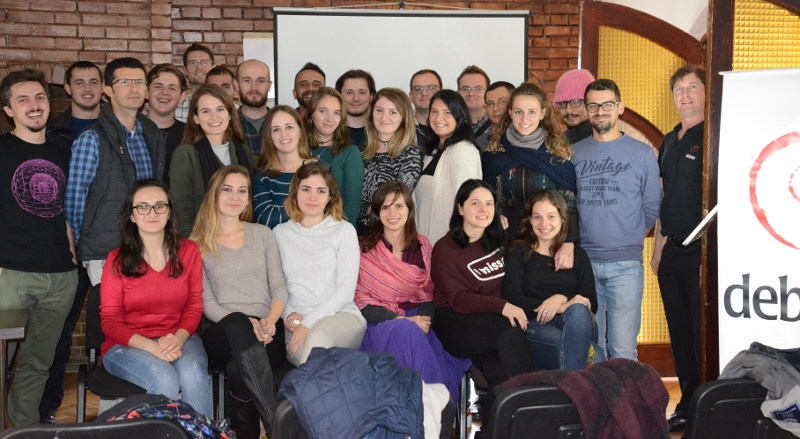
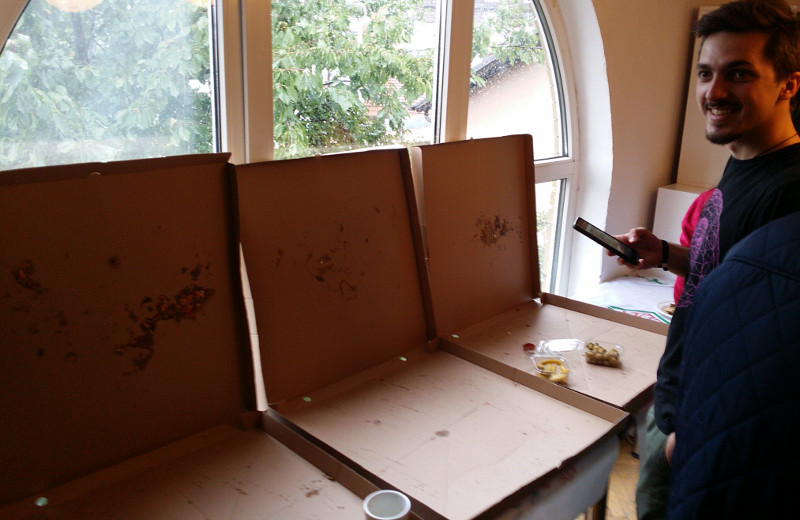
Have you been to an event recently involving free software or a related topic? How did you find it? Are you organizing an event and don't want to fall into the trap of using Facebook or Meetup or other services that compete for a share of your community's attention? Are you keen to find events in foreign destinations related to your interest areas to coincide with other travel intentions? Have you been concerned when your GSoC or Outreachy interns lost a week of their project going through the bureaucracy to get a visa for your community's event? Would you like to make it easier for them to find the best events in the countries that welcome and respect visitors? In many recent discussions about free software activism, people have struggled to break out of the illusion that social media is the way to cultivate new contacts. Wouldn't it be great to make more meaningful contacts by attending more a more diverse range of events rather than losing time on social media? Making it happen There are already a number of tools (for example, Drupal plugins and Wordpress plugins) for promoting your events on the web and in iCalendar format. There are also a number of sites like Agenda du Libre and GriCal who aggregate events from multiple communities where people can browse them. How can we take these concepts further and make a convenient, compelling and global solution? Can we harvest event data from a wide range of sources and compile it into a large database using something like PostgreSQL or a NoSQL solution or even a distributed solution like OpenDHT? Can we use big data techniques to mine these datasources and help match people to events without compromising on privacy? Why not build an automated iCalendar "to-do" list of deadlines for events you want to be reminded about, so you never miss the deadlines for travel sponsorship or submitting a talk proposal? I've started documenting an architecture for this on the Debian wiki and proposed it as an Outreachy project. It will also be offered as part of GSoC in 2018. Ways to get involved If you would like to help this project, please consider introducing yourself on the debian-outreach mailing list and helping to mentor or refer interns for the project. You can also help contribute ideas for the specification through the mailing list or wiki. Mini DebConf Prishtina 2017 This weekend I've been at the MiniDebConf in Prishtina, Kosovo. It has been hosted by the amazing Prishtina hackerspace community. Watch out for future events in Prishtina, the pizzas are huge, but that didn't stop them disappearing before we finished the photos:
1 October 2017

Thorsten Alteholz: My Debian Activities in September 2017

FTP assistant This month almost the same numbers as last month appeared in the statistics. I accepted 213 packages and rejected 15 uploads. The overall number of packages that got accepted this month was 425. Debian LTS This was my thirty-ninth month that I did some work for the Debian LTS initiative, started by Raphael Hertzog at Freexian. This month my all in all workload has been 15.75h. During that time I did LTS uploads of: I also took care of libstrusts1.2-java and marked all CVEs as not-affected and I marked all CVEs for jasper as no-dsa. I also started to work on sam2p. Just as I wanted to upload a new version of libofx, a new CVE was discovered that was not closed in time. I tried to find a patch on my own but had difficulties in reproducing this issue. Other stuff This month I made myself familiar with glewlwyd and according to upstream, the Debian packages work out-of-the box. However upstream does not stop working on that software, so I uploaded new versions of hoel, ulfius and glewlwyd. As libjwt needs libb64, which was orphanded, I used it as DOPOM and adopted it. Does anybody still know the Mayhem-bugs? I could close one by uploading an updated version of siggen. I also went through my packages and looked for patches that piled up in the BTS. As a result i uploaded updated versions of radlib, te923con, node-starttls, harminv and uucp. New upstream versions of openoverlayrouter and fasttree also made it into the archive. Last but not least I moved several packages to the debian-mobcom group.

28 September 2017

Russ Allbery: Review: The Seventh Bride

Review: The Seventh Bride, by T. Kingfisher
Publisher: 47North
Copyright: 2015
ISBN: 1-5039-4975-3
Format: Kindle
Pages: 225
There are two editions of this book, although only one currently for sale. This review is of the second edition, released in November of 2015. T. Kingfisher is a pen name for Ursula Vernon when she's writing for adults. Rhea is a miller's daughter. She's fifteen, obedient, wary of swans, respectful to her parents, and engaged to Lord Crevan. The last was a recent and entirely unexpected development. It's not that she didn't expect to get married eventually, since of course that's what one does. And it's not that Lord Crevan was a stranger, since that's often how it went with marriage for people like her. But she wasn't expecting to get married now, and it was not at all clear why Lord Crevan would want to marry her in particular. Also, something felt not right about the entire thing. And it didn't start feeling any better when she finally met Lord Crevan for the first time, some days after the proposal to her parents. The decidedly non-romantic hand kissing didn't help, nor did the smug smile. But it's not like she had any choice. The miller's daughter doesn't say no to a lord and a friend of the viscount. The miller's family certainly doesn't say no when they're having trouble paying the bills, the viscount owns the mill, and they could be turned out of their livelihood at a whim. They still can't say no when Lord Crevan orders Rhea to come to his house in the middle of the night down a road that quite certainly doesn't exist during the day, even though that's very much not the sort of thing that is normally done. Particularly before the marriage. Friends of the viscount who are also sorcerers can get away with quite a lot. But Lord Crevan will discover that there's still a limit to how far he can order Rhea around, and practical-minded miller's daughters can make a lot of unexpected friends even in dire circumstances. The Seventh Bride is another entry in T. Kingfisher's series of retold fairy tales, although the fairy tale in question is less clear than with The Raven and the Reindeer. Kirkus says it's a retelling of Bluebeard, but I still don't quite see that in the story. I think one could argue equally easily that it's an original story. Nonetheless, it is a fairy tale: it has that fairy tale mix of magical danger and practical morality, and it's about courage and friendships and their consequences. It also has a hedgehog. This is an T. Kingfisher story, so it's packed full of bits of marvelous phrasing that I want to read over and over again. It has wonderful characters, the hedgehog among them, and it has, at its heart, a sort of foundational decency and stubborn goodness that's deeply satisfying for the reader. The Seventh Bride is a lot closer to horror than the other T. Kingfisher books I've read, but it never fell into my dislike of the horror genre, despite a few gruesome bits. I think that's because neither Rhea nor the narrator treat the horrific aspects as representative of the true shape of the world. Rhea instead confronts them with a stubborn determination and an attempt to make the best of each moment, and with a practical self-awareness that I loved reading about.
The problem with crying in the woods, by the side of a white road that leads somewhere terrible, is that the reason for crying isn't inside your head. You have a perfectly legitimate and pressing reason for crying, and it will still be there in five minutes, except that your throat will be raw and your eyes will itch and absolutely nothing else will have changed.
Lord Crevan, when Rhea finally reaches him, toys with her by giving her progressively more horrible puzzle tasks, threatening her with the promised marriage if she fails at any of them. The way this part of the book finally resolves is one of the best moments I've read in any book. Kingfisher captures an aspect of moral decisions, and a way in which evil doesn't work the way that evil people expect it to work, that I can't remember seeing an author capture this well. There are a lot of things here for Rhea to untangle: the nature of Crevan's power, her unexpected allies in his manor, why he proposed marriage to her, and of course how to escape his power. The plot works, but I don't think it was the best part of the book, and it tends to happen to Rhea rather than being driven by her. But I have rarely read a book quite this confident of its moral center, or quite as justified in that confidence. I am definitely reading everything Vernon has published under the T. Kingfisher name, and quite possibly most of her children's books as well. Recommended, particularly if you liked the excerpt above. There's an entire book full of paragraphs like that waiting for you. Rating: 8 out of 10

26 September 2017

Russ Allbery: Review: Artemis Fowl

Review: Artemis Fowl, by Eoin Colfer
Series: Artemis Fowl #1
Publisher: Disney-Hyperion
Copyright: 2001
ISBN: 1-4231-2452-9
Format: Kindle
Pages: 281
Artemis Fowl is the heir to the Fowl criminal empire and a child prodigy. He's also one of the few humans to know of the existence of fairies, who are still present in the world, hiding from humans and living by their own rules. As the book opens, he's in search of those rules: a copy of the book that governs the lives of fairies. With that knowledge, he should be able to pull off a heist worthy of his family's legacy. Captain Holly Short is a leprechaun... or, more correctly, a LEPrecon. She's one of the fairy police officers that investigate threats to the fairies who are hiding in a vast underground civilization. The fairies have magic, but they also have advanced (and miniaturized) technology, maintained in large part by a grumpy and egotistical centaur (named Foaly, because it's that sort of book). She's also the fairy unlucky enough to be captured by Artemis's formidable personal bodyguard their first attempt to kidnap a hostage for their ransom demands. This is the first book of a long series of young adult novels that has also spawned graphic novels and a movie currently in production. It has that lean and clear feeling of the younger side of young adult writing: larger-than-life characters who are distinctive and easy to remember, a short introductory setup that dives directly into the main plot, and a story that neatly pulls together every element raised in the story. The world-building is its strongest point, particularly the mix of tongue-in-cheek technology ships that ride magma plumes, mechanical wings, and helmet-mounted lights to blind trolls and science-tinged magic that the fairies build their police and army on. Fairies are far beyond humans in capability, and can be deadly and ruthless, but they have to follow a tightly constrained set of rules that are often not convenient. Sadly, the characters don't live up to the world-building. I did enjoy a few of them, particularly Artemis's loyal bodyguards and the dwarf Mulch Diggums. But Holly, despite being likable, is a bit of a blank slate: the empathetic, overworked trooper who is mostly indistinguishable from other characters in similar stories. The gruff captain, the sarcastic technician Foaly, and the various other LEP agents all felt like they were taken straight from central casting. And then there's Artemis himself. Artemis is the protagonist of the story, in that he's the one who initiates all of the action and the one who has the most interesting motivations. The story is about him, as the third-person narrator in the introduction makes clear. He's trying very hard to be a criminal genius with the deductive abilities of Sherlock Holmes and the speaking style of a Bond villain, but he's also twelve, his father has disappeared, and his mother is going slowly insane. I picked this book up on the recommendation of another reader who found that contrast compelling. Unfortunately, I thought Artemis was just an abusive jerk. Yes, yes, family tragedy, yes, he's trapped in his conception of himself, but he's arrogant, utterly uncaring about how his actions affect other people, and dismissive and cruel even to his bodyguards (who are much better friends than he deserves). I think liking this book requires liking Artemis at least well enough to consider him an anti-hero, and I can squint and see that appeal if you have that reaction. But I just wanted him to lose. Not in the "you will be slowly redeemed over the course of a long series" way, but in the "you are a horrible person and I hope you get what's coming to you" way. The humor of the fairy parts of the book was undermined too much by the fact that many of them would like to kill Artemis for real, and I mostly wanted them to succeed. This may or may not have to do with my low tolerance for egotistical smart-asses who order other people to do things that they refuse to explain. Without some appreciation for Artemis, this is a story with some neat world-building, a fairly generic protagonist in Holly, and a plot in which the bad guys win. To make matters worse, I thought the supposedly bright note at the end of the story was just creepy, as was everything else involving Artemis's mother. The review I read was of the first three books, so it's entirely possible that this series gets better as it goes along, but there wasn't enough I enjoyed in the first book for me to keep reading. Followed by Artemis Fowl: The Arctic Incident. Rating: 5 out of 10

19 September 2017

Gunnar Wolf: Call to Mexicans: Open up your wifi #sismo

Hi friends, ~3hr ago, we just had a big earthquake, quite close to Mexico City. Fortunately, we are fine, as are (at least) most of our friends and family. Hopefully, all of them. But there are many (as in, tens) damaged or destroyed buildings; there have been over 50 deceased people, and numbers will surely rise until a good understanding of the event's strength are evaluated. Mainly in these early hours after the quake, many people need to get in touch with their families and friends. There is a little help we can all provide: Provide communication. Open up your wireless network. Set it up unencrypted, for anybody to use. Refrain from over-sharing graphical content Your social network groups don't need to see every video and every photo of the shaking moments and of broken buildings. Download of all those images takes up valuable time-space for the saturated cellular networks. This advice might be slow to flow... The important moment to act is two or three hours ago, even now... But we are likely to have replicas; we are likely to have panic moments again. Do a little bit to help others in need!

17 September 2017

Dirk Eddelbuettel: RcppClassic 0.9.7

A rather boring and otherwise uneventful release 0.9.7 of RcppClassic is now at CRAN. This package provides a maintained version of the otherwise deprecated first Rcpp API; no new projects should use it. Once again no changes in user-facing code. But this makes it the first package to use the very new and shiny pinp package as the backend for its vignette, now converted to Markdown---see here for this new version. We also updated three sources files for tabs versus spaces as the current g++ version complained (correctly !!) about misleading indents. Otherwise a file src/init.c was added for dynamic registration, the Travis CI runner script was updated to using run.sh from our r-travis fork, and we now strip the library after they have been built. Again, no user code changes. And no iterate: nobody should use this package. Rcpp is so much better in so many ways---this one is simply available as we (quite strongly) believe that APIs are contracts, and as such we hold up our end of the deal. Courtesy of CRANberries, there are changes relative to the previous release. Questions, comments etc should go to the rcpp-devel mailing list off the R-Forge page.

This post by Dirk Eddelbuettel originated on his Thinking inside the box blog. Please report excessive re-aggregation in third-party for-profit settings.

14 September 2017

Lior Kaplan: Public money? Public Code!

An open letter published today to the EU government says:
Why is software created using taxpayers money not released as Free Software?
We want legislation requiring that publicly financed software developed for the public sector be made publicly available under a Free and Open Source Software licence. If it is public money, it should be public code as well. Code paid by the people should be available to the people!
See https://publiccode.eu/ for the campaign details. This makes me think of starting an Israeli version
Filed under: Uncategorized

13 September 2017

Shirish Agarwal: Android, Android marketplace and gaming addiction.

This would be a longish piece so please bear and play with tea, coffee, beer or anything stronger that you desire while reading below  I had bought an Android phone, a Samsung J5 just before going to debconf 2016. It was more for being in-trend rather than really using it. The one which I shared is the upgraded version (recentish) the one I have is 2 GB for which I had paid around double of what the list price was. The only reason I bought the model is that it had removable battery at the price point I was willing to pay. I did see that Samsung has the same ham-handed issues with audio as previous Nokia devices use to, the speakers and microphone probably the cheapest you can get on the market. Nokia was same too, at least on the lower-end of the market, while Oppo has loud ringtones and loud music, perfect for those who are a bit hard of hearing (as yours truly is). I had been pleasantly surprised by the quality of photos Samsung J5 was churning even though I m less than average shooter, never been really into it so was a sort of wake-up call for where camera sensor technology is advancing. And of course with newer phones the kind of detail it can capture is mesmerizing to say the least, although wide-angle shots still would take some time to get right I guess. If memory serves me right, sometime back Laura Arjona Reina (who handles part of debian-publicity and part of debian-women among other responsibilities) shared a blog post on p.d.o. where she had shared the troubles she had while exporting data from the phone. While she shared that and I lack the time or the energy to try and find it ( the entry is really bookmarkable, at least that specific blog post). What was interesting though that I had gone few years ago to Bangalore, there is an organization which I like and admire CIS great for researchers. Anyways they had done a project getting between 10-20 phones from the market made of Chinese origin (almost all mobiles sold in India, the fabrication of CPU and APU etc. are done in China/Taiwan and then assembled here). Here what is done at the most is assembly which for all political purposes is called manufacturing . All the mobiles kept quite a bit of info. on the device even after you wiped them clean/put some other ROM on them. The CIS site is more than a bit cluttered otherwise would have shared the direct link. I do hope to send an e-mail to CIS and hopefully they will respond with the report and will share that here as and when. It would be interesting to know if after people flash a custom rom if the status quo is the same as it was before. I do suspect it would be the former as flashing ROMs on phones is still a bit of specialized subject at least here in India with even an average phone costing a month or two s salary or more and the idea of bricking the phone scares most people (including yours truly). Anyways, for a long time I was on bed and had the phone. I used 2 games from the android marketplace which both mum and I enjoy and enjoyed. Those are Real jigsaw and Jigsaw puzzle HD . The permissions dialog which Real jigsaw among other games has is horrible and part of me freaks that all such apps. have unrestricted access to my storage area. Ideally, what Android should have done is either partition or give functionality to the user to have private space for their photos and whatever media they have and the rest of the area is like a public park. If anybody has any thoughts on partitioning on Android phone would like to hear that. One game though which really hooked mumma and me is The Island Experiment . It reminded me of my younger days when gaming addiction was not treated as a disease but thankfully now is . I would call myself somewhat of a functional addict as in do my every day things, work etc. but do dream about the game as to what it will show me next. A part of it is the game is web-based (which means it needs constant internet connection) and web access is somewhat pricey, although with Reliance Jio an upcoming data network operator having bundles of money and promising the moon, network issues at least on low-bandwidth game which I and mum are playing hopefully will not have any issues. I haven t used tshark or any such tool to analyze the traffic but I guess it probably just sends short messages of number of clicks in a time period and things like that, all the rest (I guess) is happening on the mobile itself. I know at sometime I probably will try to put a custom rom on it but which one is the question as there are so many and also which is most compatible with my device. It seems I would have to do lot of homework before I can make any choices. Couple of months back, a friend of mine Akshat who has been using Android for few years enabled Developer Options which I didn t know about till he shared that info. with me. I do hope people do check Akshat s repo. as he has made/has quite a few useful scripts, especially if you are into digital photography. I have shared with him gimp scripting few days back so along with imagemagick you might see him doing some rough scripts in it. Of course, if people use it and give feedback he might clean the scripts a bit so it gives useful error messages and gives statement like gimp is not installed on your system, please install it or ask for specific version but as it works in free software it is somewhat directly proportional to the number of users, bugs and users behind it. A good example of what I mean is youtube-dl . I filed 873853 where I shared the upstream ticket. Apparently YouTube again changed few days back and while upstream has fixed it, the youtube-dl maintainer probably needs to find time and get the new version up. Apparently the issues lies in [$] dpkg -L youtube-dl grep youtube.py
/usr/lib/python3/dist-packages/youtube_dl/extractor/youtube.py
Hopefully somebody does the needful. Btw, I find f-droid extremely useful and especially osmand but sadly both of them are not shared or talked about by people  The reason I shared about Developer Options in Android is that few days back I noticed that the phone wonks off and has unpredictable behaviour such as not letting me browse the web, do additions or deletions using the google play store and alike . Things came to a head when few days back I saw a fibre-optic splicing operation being carried by some workers near my home by the state operator which elated me and wanted to shoot the video for it but the battery died/there was no power even though I hadn t used it much. I have deliberately shared the hindi version which tells how that knowledge is now coming to the masses. I had seen fibre-optic splicing more than a decade and a half back at some net conference where it was going to be in your neighbourhood soonish, hopefully it will happen soon  I had my suspicions for quite sometime all the issues with the phone were not due to proper charging. During course of my investigation, found out that in Developer Options there is an option called USB Configuration and changing that from the default MTP (Media Transfer Protocol) (which is basically used to put or take movies, music or any file from the phone to the computer or vice-versa improved much better behaviour on my android phone. But this caused an unexpected side-effect, I got pretty aggressive polling of the phone by the computer even after saying I do not want to share the phone details with the computer. This I filed as 874216 . The phone and I am guessing most Samsung phones today come with an adaptor with a USB male socket which goes in to the phone s usb port. There is the classical port for electricity but like most people heavily rely on usb charging even for deep fully powered down phone for full charging. One interesting project which I saw which came in Debian some days back is dummydroid. I did file a bug about it . I do hope that either the maintainer gives some more documentation. I am sure many people might use and add to the resource if the documentation was/is there. I did take a look at the package and the profile seems to be like an xml pair kind of database. Having more profiles shouldn t be hard if we knew what info. needs to be added and how do we find that info. Lastly, I am slowly transferring all the above knowledge to my mum as well, although in small doses. She, just like me has and had problems coming from resistive touchscreen to capacitive touchscreen. You can call me wrong but resistive touchscreen seemed to be superior and not as error-prone or liable to commit mistakes as is possible in capacitive touchscreens. There may be a setting to higher/lower the threshold for touching which I have not been able to find as of yet. Hope somebody finds something useful in there. I do hope that Debian does become a replacement to be used on such mobiles but then they would have to duplicate/also have some sort of mainstream content with editors to help people find stuff, something that Debian is not so good at currently. Also I m not sure Synaptic is good fit as a mobile store.
Filed under: Miscellenous Tagged: #Android, #capacitive touchscreen, #custom ROMs, #digital photography, #dummydroid, #f-droid, #fabrication, #flashing, #game addiction, #Google Play Store, #Mainstreaming Debian, #mobile connectivity, #Oppo, #osmand, #planet-debian, #resistive touchscreen, #Samsung Galaxy J5, #scripting, #USB charging, #USB configuration, #youtube-dl, gaming

Reproducible builds folks: Reproducible Builds: Weekly report #124

Here's what happened in the Reproducible Builds effort between Sunday September 3 and Saturday September 9 2017: Media coverage GSoC and Outreachy updates Debian will participate in this year's Outreachy initiative and the Reproducible Builds is soliciting mentors and students to join this round. For more background please see the following mailing list posts: 1, 2 & 3. Reproduciblity work in Debian In addition, the following NMUs were accepted: Reproduciblity work in other projects Patches sent upstream: Packages reviewed and fixed, and bugs filed Reviews of unreproducible packages 3 package reviews have been added, 2 have been updated and 2 have been removed in this week, adding to our knowledge about identified issues. Weekly QA work During our reproducibility testing, FTBFS bugs have been detected and reported by: diffoscope development Development continued in git, including the following contributions: Mattia Rizzolo also uploaded the version 86 released last week to stretch-backports. reprotest development tests.reproducible-builds.org Misc. This week's edition was written by Bernhard M. Wiedemann, Chris Lamb, Holger Levsen, Mattia Rizzolo & reviewed by a bunch of Reproducible Builds folks on IRC & the mailing lists.

11 September 2017

Steinar H. Gunderson: rANS encoding of signed coefficients

I'm currently trying to make sense of some still image coding (more details to come at a much later stage!), and for a variety of reasons, I've chosen to use rANS as the entropy coder. However, there's an interesting little detail that I haven't actually seen covered anywhere; maybe it's just because I've missed something, or maybe because it's too blindingly obvious, but I thought I would document what I ended up with anyway. (I had hoped for something even more elegant, but I guess the obvious would have to do.) For those that don't know rANS coding, let me try to handwave it as much as possible. Your state is typically a single word (in my case, a 32-bit word), which is refilled from the input stream as needed. The encoder and decoder works in reverse order; let's just talk about the decoder. Basically it works by looking at the lowest 12 (or whatever) bits of the decoder state, mapping each of those 2^12 slots to a decoded symbol. More common symbols are given more slots, proportionally to the frequency. Let me just write a tiny, tiny example with 2 bits and three symbols instead, giving four slots:
Lowest bits Symbol
00 0
01 0
10 1
11 2
Note that the zero coefficient here maps to one out of two slots (ie., a range); you don't choose which one yourself, the encoder stashes some information in there (which is used to recover the next control word once you know which symbol there is). Now for the actual problem: When storing DCT coefficients, we typically want to also store a sign (ie., not just 1 or 2, but also -1/+1 and -2/+2). The statistical distribution is symmetrical, so the sign bit is incompressible (except that of course there's no sign bit needed for 0). We could have done this by introducing new symbols -1 and -2 in addition to our three other ones, but this means we'll need more bits of precision, and accordingly larger look-up tables (which is negative for performance). So let's find something better. We could also simply store it separately somehow; if the coefficient is non-zero, store the bits in some separate repository. Perhaps more elegantly, you can encode a second symbol in the rANS stream with probability 1/2, but this is more expensive computationally. But both of these have the problem that they're divergent in terms of control flow; nonzero coefficients potentially need to do a lot of extra computation and even loads. This isn't nice for SIMD, and it's not nice for GPU. It's generally not really nice. The solution I ended up with was simulating a larger table with a smaller one. Simply rotate the table so that the zero symbol has the top slots instead of the bottom slots, and then replicate the rest of the table. For instance, take this new table:
Lowest bits Symbol
000 1
001 2
010 0
011 0
100 0
101 0
110 -1
111 -2
(The observant reader will note that this doesn't describe the exact same distribution as last time zero has twice the relative frequency as in the other table but ignore that for the time being.) In this case, the bottom half of the table doesn't actually need to be stored! We know that if the three bottom bits are >= 110 (6 in decimal), we have a negative value, can subtract 6, and then continue decoding. If we are go past the end of our 2-bit table despite that, we know we are decoding a zero coefficient (which doesn't have a sign), so we can just clamp the read; or for a GPU, reads out-of-bounds on a texture will typically return 0 anyway. So it all works nicely, and the divergent I/O is gone. If this pickled your interest, you probably want to read up on rANS in general; Fabian Giesen (aka ryg) has some notes that work as a good starting point, but beware; some of this is pretty confusing. :-)

7 September 2017

Gunnar Wolf: It was thirty years ago today... (and a bit more): My first ever public speech!

I came across a folder with the most unexpected treasure trove: The text for my first ever public speech! (and some related materials)
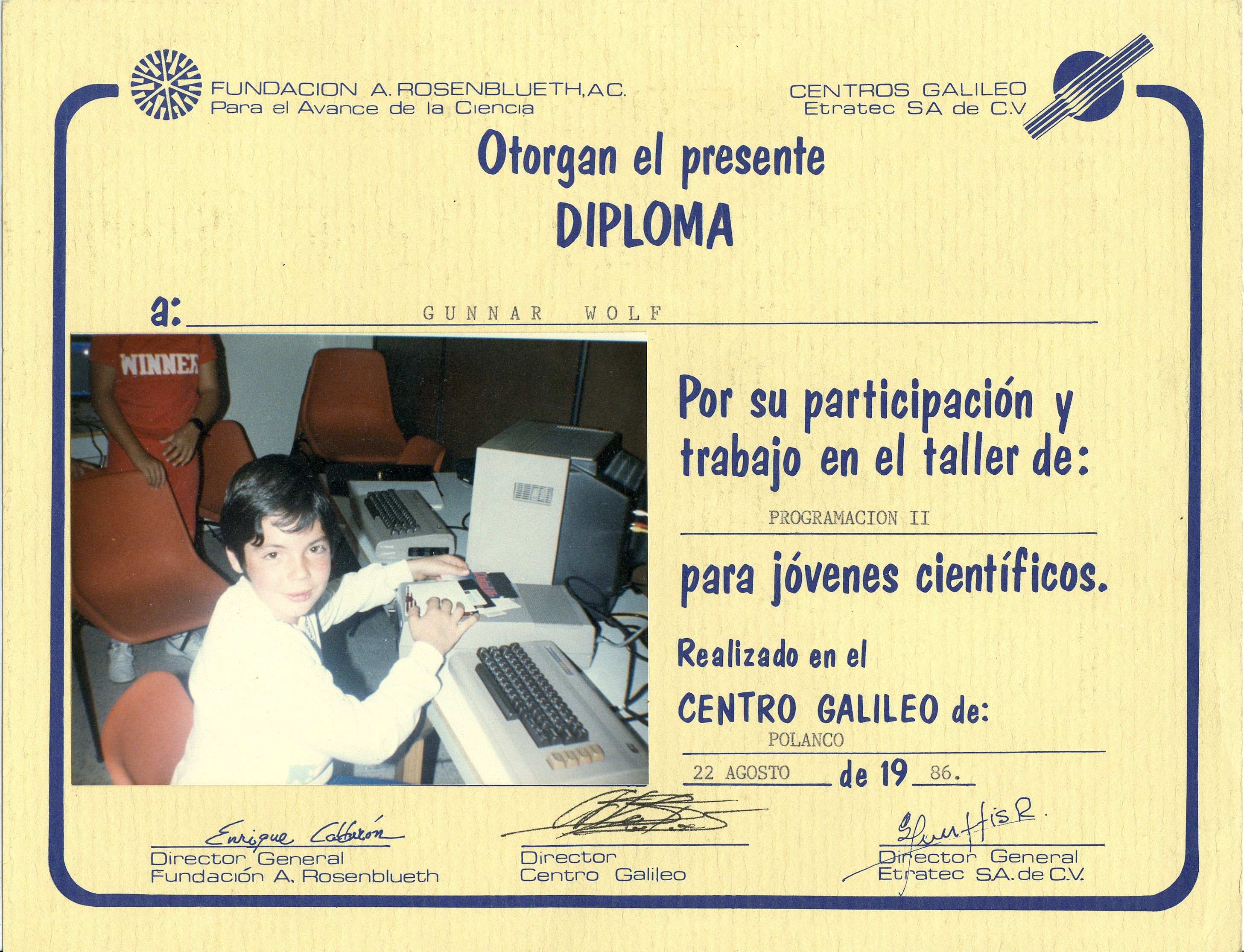
In 1985, being nine years old, I went to the IDESE school, to learn Logo. I found my diploma over ten years ago and blogged about it in this same space. Of course, I don't expect any of you to remember what I wrote twelve years ago about a (then) twenty years old piece of paper! I add to this very old stuff about Gunnar the four pages describing my game, Evitamono ("Avoid the monkey", approximately). I still remember the game quite vividly, including traumatic issues which were quite common back then; I wrote that the sprites were accidentally deleted twice and the game once . I remember several of my peers telling about such experiences. Well, that is good if you account for the second system syndrome! I also found the amazing course material for how to program sound and graphics in the C64 BASIC. That was a course taken by ten year old kids. Kids that understood that you had to write [255,129,165,244,219,165,0,102] (see pages 3-5) into a memory location starting at 53248 to redefine a character so it looked as the graphic element you wanted. Of course, it was done with a set of POKEs, as everything in C64. Or that you could program sound by setting the seven SID registers for each of the three voices containing low frequency, high frequency, low pulse, high pulse, wave control, wave length, wave amplitude in memory locations 54272 through 54292... And so on and on and on... And as a proof that I did take the course: ...I don't think I could make most of my current BSc students make sense out of what is in the manual. But, being a kid in the 1980s, that was the only way to get a computer to do what you wanted. Yay for primitivity! :-D
AttachmentSize
Speech for "Evitamono"1.29 MB
Coursee material for sound and graphics programming in C64 BASIC15.82 MB
Proof that I was there!4.86 MB

Lior Kaplan: FOSScamp Syros 2017 day 3

The 3rd day should have started with a Debian sprint and then a LibreOffice one, taking advantage I m still attending, as that s my last day. But plans don t always work out and we started 2 hours later. When everybody arrive we got everyone together for a short daily meeting (scrum style). The people were divided to 3 teams for translating: Debian Installer, LibreOffice and Gnome. For each team we did a short list of what left and with what to start. And in the end how does what so there will be no toe stepping. I was really proud with this and felt it was time well spent. The current translation percentage for Albanian in LibreOffice is 60%. So my recommendation to the team is translate master only and do not touch the help translation. My plans ahead would be to improve the translation as much as possible for LibreOffice 6.0 and near the branching point (Set to November 20th by the release schedule) decide if it s doable for the 6.0 life time or to set the goal at 6.1. In the 2nd case, we might try to backport translation back to 6.0. For the translation itself, I ve mentioned to the team about KeyID language pack and referred them to the nightly builds. These tools should help with keeping the translation quality high. For the Debian team, after deciding who works on what, I ve asked Silva to do review for the others, as doing it myself started to take more and more of my time. It s also good that the reviewer know the target language and not like me, can catch more the syntax only mistakes. Another point, as she s available more easily to the team while I m leaving soon, so I hope this role of reviewer will stay as part of the team. With the time left I mostly worked on my own tasks, which were packaging the Albanian dictionary, resulting in https://packages.debian.org/sid/myspell-sq and making sure the dictionary is also part of LibreOffice resulting in https://gerrit.libreoffice.org/#/c/41906/ . When it is accepted, I want to upload it to the LibreOffice repository so all users can download and use the dictionary. During the voyage home (ferry, bus, plain and train), I mailed Sergio Durigan Junior, my NM applicant, with a set of questions. My first action as an AM (: Overall FOSScamp results for Albanian translation were very close to the goal I set (100%): That s the result of work by Silva Arapi, Eva Vranici, Redon Skikuli, Anisa Kuci and Nafie Shehu.
Filed under: Debian GNU/Linux, i18n & l10n, LibreOffice

4 September 2017

Daniel Pocock: Spyware Dolls and Intel's vPro

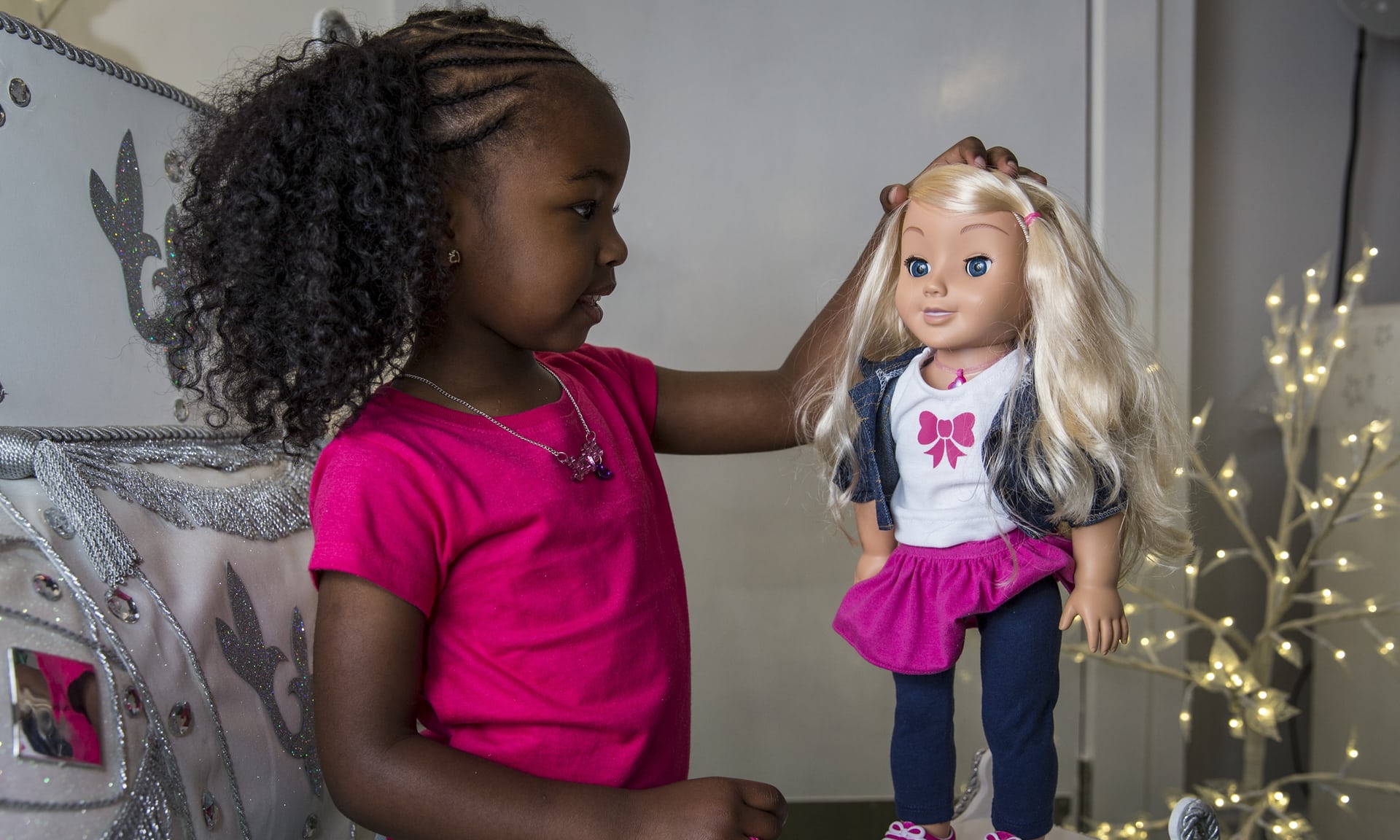
Back in February, it was reported that a "smart" doll with wireless capabilities could be used to remotely spy on children and was banned for breaching German laws on surveillance devices disguised as another object. Would you trust this doll? For a number of years now there has been growing concern that the management technologies in recent Intel CPUs (ME, AMT and vPro) also conceal capabilities for spying, either due to design flaws (no software is perfect) or backdoors deliberately installed for US spy agencies, as revealed by Edward Snowden. In a 2014 interview, Intel's CEO offered to answer any question, except this one. The LibreBoot project provides a more comprehensive and technical analysis of the issue, summarized in the statement "the libreboot project recommends avoiding all modern Intel hardware. If you have an Intel based system affected by the problems described below, then you should get rid of it as soon as possible" - eerily similar to the official advice German authorities are giving to victims of Cayla the doll. All those amateur psychiatrists suggesting LibreBoot developers suffer from symptoms of schizophrenia have had to shut their mouths since May when Intel confirmed a design flaw (or NSA backdoor) in every modern CPU had become known to hackers. Bill Gates famously started out with the mission to put a computer on every desk and in every home. With more than 80% of new laptops based on an Intel CPU with these hidden capabilities, can you imagine the NSA would not have wanted to come along for the ride? Four questions everybody should be asking
  • If existing laws can already be applied to Cayla the doll, why haven't they been used to alert owners of devices containing Intel's vPro?
  • Are exploits of these backdoors (either Cayla or vPro) only feasible on a targeted basis, or do the intelligence agencies harvest data from these backdoors on a wholesale level, keeping a mirror image of every laptop owner's hard disk in one of their data centers, just as they already do with phone and Internet records?
  • How long will it be before every fast food or coffee chain with a "free" wifi service starts dipping in to the data exposed by these vulnerabilities as part of their customer profiling initiatives?
  • Since Intel's admissions in May, has anybody seen any evidence that anything is changing though, either in what vendors are offering or in terms of how companies and governments outside the US buy technology?
Share your thoughts This issue was recently raised on the LibrePlanet mailing list. Please feel free to join the list and click here to reply on the thread.

1 September 2017

Raphaël Hertzog: My Free Software Activities in August 2017

My monthly report covers a large part of what I have been doing in the free software world. I write it for my donors (thanks to them!) but also for the wider Debian community because it can give ideas to newcomers and it s one of the best ways to find volunteers to work with me on projects that matter to me. Debian LTS This month I was allocated 12h and during this time I did 4 days of front desk handling CVE triage (28 commits to the security tracker). I had a bit of time left and I opted to work on a package that had been lingering for a while: exiv2. It turns out the security researchers who requested the CVE did not even contact the upstream author so I opened 12 tickets on GitHub. The upstream author was unaware of those issues and is relatively unfamiliar with the general process of handling security updates. I started the work of reproducing each issue and so far they only affect the version 0.26 in experimental. Misc Debian/Kali work live-build and live-config. I pushed a few updates: dropping the useless xorriso hardlinks option (as discussed in https://bugs.kali.org/view.php?id=4109), adding a .disk/mkisofs file on request of Thomas Schmitt, fixing a severe issue with the handling of locales configuration that broke wayland sessions entirely. open-vm-tools and vmwgfx. The switch of GNOME to Wayland by default resulted in multiple regressions reported by Kali users, in particular for VMWare users where desktop resizing was no longer working. There was a patch available but it did not work for me, so I worked with Thomas Hellstrom (of VMWare) to identify the problems and he provided me an updated patch. I submitted this patch to Debian too (bug report, pull request). Linux 4.12 also showed another regression for VMWare users where the screen would not be refreshed/updated when you are using Wayland/KMS. I did multiple tests for Thomas and provided the requested data so that they could create a fix (which I incorporated into Kali and should come to Debian through the upstream stable tree). Packaging. I uploaded zim 0.67 to unstable. I fixed an RC bug on shiboken to get pyside and ubertooth back into testing. I had to hack the package to use gcc-6 on mips64el because that architecture is suffering from a severe gcc bug which probably broke a large part of the code compiled since the switch to gcc-7 (and which triggered a test failure in shiboken, fortunately) I wonder if anybody will make sure to recompile all packages that might have been misbuilt. Infrastructure. In a discussion on debian-devel, the topic of using tracker.debian.org to store who is maintaining what came up again. I responded to let know that this is something that I d like to see done and that I have already taken measures to go into this direction. I wanted to make an experiment with my zim package but quickly came on a problem with ftpmaster s lintian auto-rejects (which I submitted in #871575). The BTS is now linking to tracker.debian.org on its web interface. To continue and give a push to this move, I scanned all the files in the qa SVN repository and updated many occurrences of packages.qa.debian.org with tracker.debian.org. I also spotted a small problem in the way we handle autoremovals mails in tracker.debian.org, we often get them twice: I filed #871683 to get this fixed on release.debian.org. Bug reports. vmdebootstrap creates unbootable qemu image (#872999). bugs in udebs are not shown on view by source package (#872784). New upstream release of ethtool (#873692). Upstream bugreport on systemd: support a systemd.swap=no boot command-line option. I also shared some of my ideas/dreams in #859867 speaking of a helper tool to setup and maintain up-to-date build chroots and autopkgtest qemu images. More bug fixes and pull requests. I created a patch to fix a build failure of systemd when /tmp is an overlayfs (#854400, the pull request has been discarded). I fixed the RC bug #853570 on ncrack and forwarded my changes upstream (here and here). Thanks See you next month for a new summary of my activities.

No comment Liked this article? Click here. My blog is Flattr-enabled.

Russ Allbery: Review: Regeneration

Review: Regeneration, by Julie E. Czerneda
Series: Species Imperative #3
Publisher: DAW
Copyright: 2006
ISBN: 0-7564-0345-6
Format: Hardcover
Pages: 543
This is the third book of the Species Imperative trilogy, and this is the type of trilogy that's telling a single story in three books. You don't want to read this out of order, and I'll have to be cautious about aspects of the plot to not spoil the earlier books. Mac is still recovering from the effects of the first two books of the series, but she's primarily worried about a deeply injured friend. Worse, that friend is struggling to explain or process what's happened, and the gaps in her memory and her very ability to explain may point at frightening, lingering risks to humanity. As much as she wants to, Mac can't give her friend all of her focus, since she's also integral to the team trying to understand the broader implications of the events of Migration. Worse, some of the non-human species have their own contrary interpretations that, if acted on, Mac believes would be desperately risky for humanity and all the other species reachable through the transects. That set of competing priorities and motivations eventually sort themselves out into a tense and rewarding multi-species story, but they get off to an awkward start. The first 150 pages of Regeneration are long on worry, uncertainty, dread, and cryptic conversations, and short on enjoyable reading. Czerneda's recaps of the previous books are appreciated, but they weren't very smoothly integrated into the story. (I renew my occasional request for series authors to include a simple plot summary of the previous books as a prefix, without trying to weave it into the fiction.) I was looking forward to this book after the excellent previous volumes, but struggled to get into the story. That does change. It takes a bit too long, with a bit too much nameless dread, a bit too much of an irritating subplot between Fourteen and Oversight that I didn't think added anything to the book, and not enough of Mac barreling forward doing sensible things. But once Mac gets back into space, with a destination and a job and a collection of suspicious (or arrogant) humans and almost-incomprehensible aliens to juggle, Czerneda hits her stride. Czerneda doesn't entirely avoid Planet of the Hats problems with her aliens, but I think she does better than most of science fiction. Alien species in this series do tend to be a bit all of a type, and Mac does figure them out by drawing conclusions from biology, but those conclusions are unobvious and based on Mac's mix of biological and human social intuition. They refreshingly aren't as simple as biology completely shaping culture. (Czerneda's touch is more subtle than James White's Sector General, for example.) And Mac has a practical, determined, and selfless approach that's deeply likable and admirable. It's fun as a reader to watch her win people over by just being competent, thoughtful, observant, and unrelentingly ethical. But the best part of this book, by far, are the Sinzi. They first appeared in the second book, Migration, and seemed to follow the common SF trope of a wise elder alien race that can bring some order to the universe and that humanity can learn from. They, or more precisely the one Sinzi who appeared in Migration, was very good at that role. But Czerneda had something far more interesting planned, and in Regeneration they become truly alien in their own right, with their own nearly incomprehensible way of viewing the universe. There are so many ways that this twist can go wrong, and Czerneda avoids all of them. She doesn't undermine their gravitas, nor does she elevate them to the level of Arisians or other semi-angelic wise mentors of other series. Czerneda makes them different in profound ways that are both advantage and disadvantage, pulls that difference into the plot as a complicating element, and has Mac stumble yet again into a role that is accidentally far more influential than she intends. Mac is the perfect character to do that to: she has just the right mix of embarrassment, ethics, seat-of-the-pants blunt negotiation skills, and a strong moral compass. Given a lever and a place to stand, one can believe that Mac can move the world, and the Sinzi are an absolutely fascinating lever. There are also three separate, highly differentiated Sinzi in this story, with different goals, life experience, personalities, and levels of gravitas. Czerneda's aliens are good in general, but her focus is usually more on biology than individual differentiation. The Sinzi here combine the best of both types of character building. I think the ending of Regeneration didn't entirely work. After all the intense effort the characters put into understanding the complexity of the universe over the course of the series, the denouement has a mopping-up feel and a moral clarity that felt a bit too easy. But the climax has everything I was hoping for, there's a lot more of Mac being Mac, and I loved every moment of the Sinzi twist. Now I want a whole new series exploring the implications of the Sinzi's view of the universe on the whole history of galactic politics that sat underneath this story. But I'll settle for moments of revelation that sent shivers down my spine. This is a bit of an uneven book that falls short of its potential, but I'll remember it for a long time. Add it on to a deeply rewarding series, and I will recommend the whole package unreservedly. The Species Imperative is excellent science fiction that should be better-known than it is. I still think the romance subplot was unfortunate, and occasionally the aliens get too cartoony (Fourteen, in particular, goes a bit too far in that direction), but Czerneda never lingers too long on those elements. And the whole work is some of the best writing about working scientific research and small-group politics that I've read. Highly recommended, but read the whole series in order. Rating: 9 out of 10

30 August 2017

Daniel Silverstone: STM32 USB and Rust - Packet Memory Area

In this, our next exciting installment of STM32 and Rust for USB device drivers, we're going to look at what the STM32 calls the 'packet memory area'. If you've been reading along with the course, including reading up on the datasheet content then you'll be aware that as well as the STM32's normal SRAM, there's a 512 byte SRAM dedicated to the USB peripheral. This SRAM is called the 'packet memory area' and is shared between the main bus and the USB peripheral core. Its purpose is, simply, to store packets in transit. Both those IN to the host (so stored queued for transmission) or OUT from the host (so stored, queued for the application to extract and consume). It's time to actually put hand to keyboard on some Rust code, and the PMA is the perfect starting point, since it involves two basic structures. Packets are the obvious first structure, and they are contiguous sets of bytes which for the purpose of our work we shall assume are one to sixty-four bytes long. The second is what the STM32 datasheet refers to as the BTABLE or Buffer Descriptor Table. Let's consider the BTABLE first.

The Buffer Descriptor Table The BTABLE is arranged in quads of 16bit words. For "normal" endpoints this is a pair of descriptors, each consisting of two words, one for transmission, and one for reception. The STM32 also has a concept of double buffered endpoints, but we're not going to consider those in our proof-of-concept work. The STM32 allows for up to eight endpoints (EP0 through EP7) in internal register naming, though they support endpoints numbered from zero to fifteen in the sense of the endpoint address numbering. As such there're eight descriptors each four 16bit words long (eight bytes) making for a buffer descriptor table which is 64 bytes in size at most.
Buffer Descriptor Table
Byte offset in PMA Field name Description
(EPn * 8) + 0 USB_ADDRn_TX The address (inside the PMA) of the TX buffer for EPn
(EPn * 8) + 2 USB_COUNTn_TX The number of bytes present in the TX buffer for EPn
(EPn * 8) + 4 USB_ADDRn_RX The address (inside the PMA) of the RX buffer for EPn
(EPn * 8) + 6 USB_COUNTn_RX The number of bytes of space available for the RX buffer for EPn (and once received, the number of bytes received)
The TX entries are trivial to comprehend. To transmit a packet, part of the process involves writing the packet into the PMA, putting the address into the appropriate USB_ADDRn_TX entry, and the length into the corresponding USB_COUNTn_TX entry, before marking the endpoint as ready to transmit. To receive a packet though is slightly more complex. The application must allocate some space in the PMA, setting the address into the USB_ADDRn_RX entry of the BTABLE before filling out the top half of the USB_COUNTn_RX entry. For ease of bit sizing, the STM32 only supports space allocations of two to sixty-two bytes in steps of two bytes at a time, or thirty-two to five-hundred-twelve bytes in steps of thirty-two bytes at a time. Once the packet is received, the USB peripheral will fill out the lower bits of the USB_COUNTn_RX entry with the actual number of bytes filled out in the buffer.

Packets themselves Since packets are, typically, a maximum of 64 bytes long (for USB 2.0) and are simply sequences of bytes with no useful structure to them (as far as the USB peripheral itself is concerned) the PMA simply requires that they be present and contiguous in PMA memory space. Addresses of packets are relative to the base of the PMA and are byte-addressed, however they cannot start on an odd byte, so essentially they are 16bit addressed. Since the BTABLE can be anywhere within the PMA, as can the packets, the application will have to do some memory management (either statically, or dynamically) to manage the packets in the PMA.

Accessing the PMA The PMA is accessed in 16bit word sections. It's not possible to access single bytes of the PMA, nor is it conveniently structured as far as the CPU is concerned. Instead the PMA's 16bit words are spread on 32bit word boundaries as far as the CPU knows. This is done for convenience and simplicity of hardware, but it means that we need to ensure our library code knows how to deal with this. First up, to convert an address in the PMA into something which the CPU can use we need to know where in the CPU's address space the PMA is. Fortunately this is fixed at 0x4000_6000. Secondly we need to know what address in the PMA we wish to access, so we can determine which 16bit word that is, and thus what the address is as far as the CPU is concerned. If we assume we only ever want to access 16bit entries, we can just multiply the PMA offset by two before adding it to the PMA base address. So, to access the 16bit word at byte-offset 8 in the PMA, we'd look for the 16bit word at 0x4000_6000 + (0x08 * 2) => 0x4000_6010.

Bundling the PMA into something we can use I said we'd do some Rust, and so we shall
    // Thanks to the work by Jorge Aparicio, we have a convenient wrapper
    // for peripherals which means we can declare a PMA peripheral:
    pub const PMA: Peripheral<PMA> = unsafe   Peripheral::new(0x4000_6000)  ;
    // The PMA struct type which the peripheral will return a ref to
    pub struct PMA  
        pma_area: PMA_Area,
     
    // And the way we turn that ref into something we can put a useful impl on
    impl Deref for PMA  
        type Target = PMA_Area;
        fn deref(&self) -> &PMA_Area  
            &self.pma_area
         
     
    // This is the actual representation of the peripheral, we use the C repr
    // in order to ensure it ends up packed nicely together
    #[repr(C)]
    pub struct PMA_Area  
        // The PMA consists of 256 u16 words separated by u16 gaps, so lets
        // represent that as 512 u16 words which we'll only use every other of.
        words: [VolatileCell<u16>; 512],
     
That block of code gives us three important things. Firstly a peripheral object which we will be able to (later) manage nicely as part of the set of peripherals which RTFM will look after for us. Secondly we get a convenient packed array of u16s which will be considered volatile (the compiler won't optimise around the ordering of writes etc). Finally we get a struct on which we can hang an implementation to give our PMA more complex functionality. A useful first pair of functions would be to simply let us get and put u16s in and out of that word array, since we're only using every other word
    impl PMA_Area  
        pub fn get_u16(&self, offset: usize) -> u16  
            assert!((offset & 0x01) == 0);
            self.words[offset].get()
         
        pub fn set_u16(&self, offset: usize, val: u16)  
            assert!((offset & 0x01) == 0);
            self.words[offset].set(val);
         
     
These two functions take an offset in the PMA and return the u16 word at that offset. They only work on u16 boundaries and as such they assert that the bottom bit of the offset is unset. In a release build, that will go away, but during debugging this might be essential. Since we're only using 16bit boundaries, this means that the first word in the PMA will be at offset zero, and the second at offset two, then four, then six, etc. Since we allocated our words array to expect to use every other entry, this automatically converts into the addresses we desire. If we pop (and please don't worry about the unsafe stuff for now):
    unsafe   (&*usb::pma::PMA.get()).set_u16(4, 64);  
into our main function somewhere, and then build and objdump our test binary we can see the following set of instructions added:
 80001e4:   f246 0008   movw    r0, #24584  ; 0x6008
 80001e8:   2140        movs    r1, #64 ; 0x40
 80001ea:   f2c4 0000   movt    r0, #16384  ; 0x4000
 80001ee:   8001        strh    r1, [r0, #0]
This boils down to a u16 write of 0x0040 (64) to the address 0x4006008 which is the third 32 bit word in the CPU's view of the PMA memory space (where offset 4 is the third 16bit word) which is exactly what we'd expect to see. We can, from here, build up some functions for manipulating a BTABLE, though the most useful ones for us to take a look at are the RX counter functions:
    pub fn get_rxcount(&self, ep: usize) -> u16  
        self.get_u16(BTABLE + (ep * 8) + 6) & 0x3ff
     
    pub fn set_rxcount(&self, ep: usize, val: u16)  
        assert!(val <= 1024);
        let rval: u16 =  
            if val > 62  
                assert!((val & 0x1f) == 0);
                (((val >> 5) - 1) << 10)   0x8000
              else  
                assert!((val & 1) == 0);
                (val >> 1) << 10
             
         ;
        self.set_u16(BTABLE + (ep * 8) + 6, rval)
     
The getter is fairly clean and clear, we need the BTABLE base in the PMA, add the address of the USB_COUNTn_RX entry to that, retrieve the u16 and then mask off the bottom ten bits since that's the size of the relevant field. The setter is a little more complex, since it has to deal with the two possible cases, this isn't pretty and we might be able to write some better peripheral structs in the future, but for now, if the length we're setting is 62 or less, and is divisible by two, then we put a zero in the top bit, and the number of 2-byte lumps in at bits 14:10, and if it's 64 or more, we mask off the bottom to check it's divisible by 32, and then put the count (minus one) of those blocks in, instead, and set the top bit to mark it as such. Fortunately, when we set constants, Rust's compiler manages to optimise all this very quickly. For a BTABLE at the bottom of the PMA, and an initialisation statement of:
    unsafe   (&*usb::pma::PMA.get()).set_rxcount(1, 64);  
then we end up with the simple instruction sequence:
80001e4:    f246 001c   movw    r0, #24604  ; 0x601c
80001e8:    f44f 4104   mov.w   r1, #33792  ; 0x8400
80001ec:    f2c4 0000   movt    r0, #16384  ; 0x4000
80001f0:    8001        strh    r1, [r0, #0]
We can decompose that into a C like *((u16*)0x4000601c) = 0x8400 and from there we can see that it's writing to the u16 at 0x1c bytes into the CPU's view of the PMA, which is 14 bytes into the PMA itself. Since we know we set the BTABLE at the start of the PMA, it's 14 bytes into the BTABLE which is firmly in the EP1 entries. Specifically it's USB_COUNT1_RX which is what we were hoping for. To confirm this, check out page 651 of the datasheet. The value set was 0x8400 which we can decompose into 0x8000 and 0x0400. The first is the top bit and tells us that BL_SIZE is one, and thus the blocks are 32 bytes long. Next the 0x4000 if we shift it right ten places, we get the value 2 for the field NUM_BLOCK and multiplying 2 by 32 we get the 64 bytes we asked it to set as the size of the RX buffer. It has done exactly what we hoped it would, but the compiler managed to optimise it into a single 16 bit store of a constant value to a constant location. Nice and efficient. Finally, let's look at what happens if we want to write a packet into the PMA. For now, let's assume packets come as slices of u16s because that'll make our life a little simpler:
    pub fn write_buffer(&self, base: usize, buf: &[u16])  
        for (ofs, v) in buf.iter().enumerate()  
            self.set_u16(base + (ofs * 2), *v);
         
     
Yes, even though we're deep in no_std territory, we can still get an iterator over the slice, and enumerate it, getting a nice iterator of (index, value) though in this case, the value is a ref to the content of the slice, so we end up with *v to deref it. I am sure I could get that automatically happening but for now it's there. Amazingly, despite using iterators, enumerators, high level for loops, function calls, etc, if we pop:
    unsafe   (&*usb::pma::PMA.get()).write_buffer(0, &[0x1000, 0x2000, 0x3000]);  
into our main function and compile it, we end up with the instruction sequence:
80001e4:    f246 0000   movw    r0, #24576  ; 0x6000
80001e8:    f44f 5180   mov.w   r1, #4096   ; 0x1000
80001ec:    f2c4 0000   movt    r0, #16384  ; 0x4000
80001f0:    8001        strh    r1, [r0, #0]
80001f2:    f44f 5100   mov.w   r1, #8192   ; 0x2000
80001f6:    8081        strh    r1, [r0, #4]
80001f8:    f44f 5140   mov.w   r1, #12288  ; 0x3000
80001fc:    8101        strh    r1, [r0, #8]
which, as you can see, ends up being three sequential halfword stores directly to the right locations in the CPU's view of the PMA. You have to love seriously aggressive compile-time optimisation :-) Hopefully, by next time, we'll have layered some more pleasant routines on our PMA code, and begun a foray into the setup necessary before we can begin handling interrupts and start turning up on a USB port.
29 August 2017

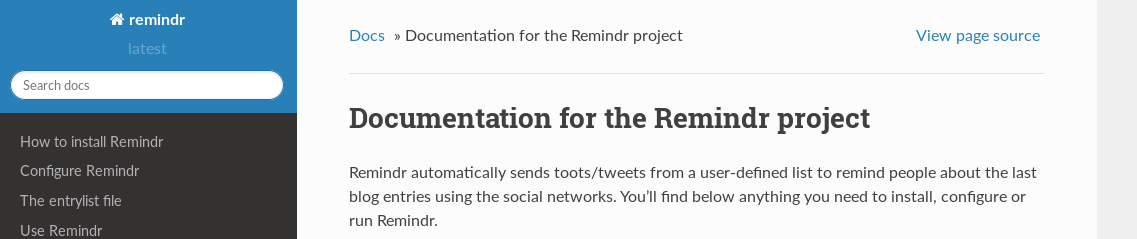
Carl Chenet: Send scheduled messages to both Twitter and Mastodon with the Remindr bot

Do you need to send messages to both Twitter and Mastodon? Use the Remindr bot! Remindr is written in Python, released under the GPLv3 license. 1. How to install Remindr Install Remindr from PyPI:
# pip3 install remindr
2. How to configure Remindr First, start by writing a messages.txt file with the following content:
o en Send scheduled messages to both Twitter and Mastodon with the Remindr bot https://carlchenet.com/send-scheduled-messages-to-both-twitter-and-mastodon-with-the-remindr-bot #remindr #twitter #mastodon
x en Follow Carl Chenet for great news about Free Software! https://carlchenet.com #freesoftware
The first field only indicates if the line is the next one to be considered by Remindr, the o indicates the next line to be sent, x means it won t. The second field is the 2-letters code language your content is using, in my example en or fr. Next content on the line will compose the body of your messages to Mastodon and Twitter. You need to configure the Mastodon and the Twitter credentials in order to allow Remindr to send the messages. First you need to generate the credentials. For Twitter, you need to manually create an app on apps.twitter.com. For Mastodon, just launch the following command:
$ register_remindr_app
Some information will be asked by the command. At the end, two files are created, remindr_usercred.txt and remindr_clientcred.txt. You re going to need them for the Remindr configuration above. For the Remindr configuration, here is a complete configuration using the
[mastodon]
instance_url=https://mastodon.social
user_credentials=remindr_usercred.txt
client_credentials=remindr_clientcred.txt
[twitter]
consumer_key=a6lv2gZxkvk6UbQ30N4vFmlwP
consumer_secret=j4VxM2slv0Ud4rbgZeGbBzPG1zoauBGLiUMOX0MGF6nsjcyn4a
access_token=1234567897-Npq5fYybhacYxnTqb42Kbb3A0bKgmB3wm2hGczB
access_token_secret=HU1sjUif010DkcQ3SmUAdObAST14dZvZpuuWxGAV0xFnC
[image]
path_to_image=/home/chaica/blog-carl-chenet.png
[entrylist]
path_to_list=/etc/remindr/messages.txt
Your configuration is complete! Now we have to check if everything is fine.

Read the full documentation on Readthedocs.

3. How to use Remindr Now let s try your configuration by launching Remindr the first time by-hand:
$ remindr -c /etc/remindr/remindr.ini
The messages should appear on both Twitter and Mastodon. 4. How to schedule the Remindr execution The easiest way is to use you user crontab. Just add the following line in your crontab file, editing it with crontab -e
00 10 * * * remindr -c /etc/remindr/remindr.ini
From now on, your message will be sent every day at 10:00AM. Going further with Remindr and finally You can help me developing tools for Mastodon and other social networks by donating anything through Liberaypay (also possible with cryptocurrencies). Any contribution will be appreciated. That s a big factor motivation
Donate You also may follow my account @carlchenet on Mastodon

27 August 2017

Carl Chenet: The Importance of Choosing the Correct Mastodon Instance

Remember, Mastodon is a new decentralized social network, based on a free software which is rapidly gaining users (already there is more than 1.5 million accounts). As I ve created my account in June, I was a fast addict and I ve already created several tools for this network, Feed2toot, Remindr and Boost (mostly written in Python).

Now, with all this experience I have to stress out the importance of choosing the correct Mastodon instance.

Some technical reminders on how Mastodon works

First, let s quickly clarify something about the decentralized part. In Mastodon, decentralization is made through a federation of dedicated servers, called instances , each one with a complete independent administration. Your user account is created on one specific instance. You have two choices:

  • Create your own instance. Which requires advanced technical knowledge.
  • Create your user account on a public instance. Which is the easiest and fastest way to start using Mastodon.

You can move your user account from one instance to another, but you have to follow a special procedure which can be quite long, considering your own interest for technical manipulation and the total amount of your followers you ll have to warn about your change. As such, you ll have to create another account on a new instance and import three lists: the one with your followers, the one with the accounts you have blocked, and the one with the account you have muted.

From this working process, several technical and human factors will interest us.

A good technical administration for instance

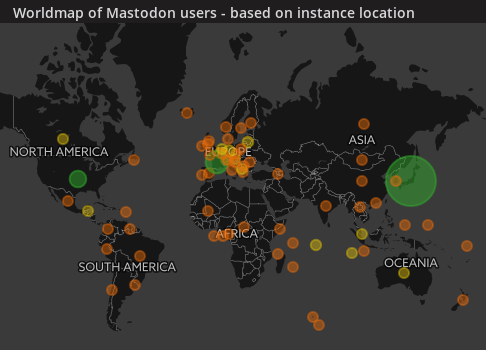
As a social network, Mastodon is truly decentralized, with more than 1.5 million users on more than 2350 existing instances. As such, the most common usage is to create an account on an open instance. To create its own instance is way too difficult for the average user. Yet, using an open instance creates a strong dependence on the technical administrator of the chosen instance.

The technical administrator will have to deal with several obligations to ensure its service continuity, with high-quality hardware and regular back-ups. All of these have a price, either in money and in time. Regarding the time factor, it would be better to choose an administration team over an individual, as life events can change quite fast everyone s interests. As such, Framasoft, a French association dedicated to promoting the Free software use, offers its own Mastodon instance named: Framapiaf. The creator of the mastodon project, also offers a quite solid instance, Mastodon.social (see below).

Regarding the money factor, many instance administrators with a large number of users are currently asking for donation via Patreon, as hosting an instance server or renting one cost money.

Mastodon.social, the first instance of the Mastodon network

The Ideological Trend Of Your Instance

If anybody could have guessed the previous technical points since the recent registration explosion on the Mastodon social network, the following point took almost everyone by surprise. Little by little, different instances show their culture , their protest action, and their propaganda on this social network.

As the instance administrator has all the powers over its instance, he or she can block the instance of interacting with some other instances, or ban its instance s users from any interaction with other instances users.

With everyone having in mind the main advantages to have federalized instance from, this partial independence of some instances from the federation was a huge surprise. One of the most recent example was when the Unixcorn.xyz instance administrator banned its users from reading Aeris account, which was on its own instance. It was a cataclysm with several consequences, which I ve named the #AerisGate as it shows the different views on moderation and on its reception by various Mastodon users.

If you don t manage your own instance, when you ll have to choose the one where to create your account, make sure that the content you plan to toot is within the rules and compatible with the ideology of said instance s administrator. Yes, I know, it may seem surprising but, as stated above, by entering a public instance you become dependent on someone else s infrastructure, who may have an ideological way to conceive its Mastodon hosting service. As such, if you re a nazi, for example, don t open your Mastodon account on a far-left LGBT instance. Your account wouldn t stay open for long.

The moderation rules are described in the about/more page of the instance, and may contain ideological elements.

To ease the process for newcomers, it is now possible to use a great tool to select what instance should be the best to host your account.

Remember that, as stated above, Mastodon is decentralized, and as such there is no central authority which can be reached in case you have a conflict with your instance administrator. And nobody can force said administrator to follow its own rules, or not to change them on the fly. Think Twice Before Creating Your Account

If you want to create an account on an instance you don t control, you need to check two elements: the availability of the instance hosting service in the long run, often linked to the administrator or the administration group of said instance, and the ideological orientation of your instance. With these two elements checked, you ll be able to let your Mastodon account growth peacefully, without fearing an outage of your instance, or simple your account blocked one morning because it doesn t align with your instance s ideological line.

in Conclusion

To help me get involved in free software and writing articles for this blog, please consider a donation through my Liberapay page, even if it s only a few cents per week. My contact Bitcoin and Monero are also available on this page. Follow me on Mastodon Translated from French to English by St phanie Chaptal.

Next.

Previous.