Search Results: "az"

17 November 2017

Renata Scheibler: Hello, world!

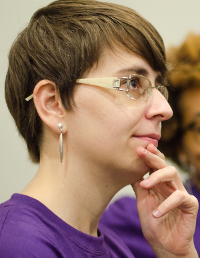
Renata's picture, a white woman profile. She touches her chin with her left hand fingertips About me Hello, world! For those who are meeting me for the first time, I am a 31 year old History teacher from Porto Alegre, Brazil. Some people might know me from the Python community, because I have been leading PyLadies Porto Alegre and helping organize Django Girls workshops in my state since 2016. If you don't, that's okay. Either way, it's nice to have you here. Ever since I learned about Rails Girls Summer of Code, during the International Free Software Forum - FISL 16, I have been wanting to get into a tech internship program. Google Summer of Code made into my radar as well, but I didn't really feel like I knew enough to try and get into those programs... until I found Outreachy. From their site:
Outreachy is an organization that provides three-month internships for people from groups traditionally underrepresented in tech. Interns work remotely with mentors from Free and Open Source Software (FOSS) communities on projects ranging from programming, user experience, documentation, illustration and graphical design, to data science.
There were many good projects to choose from on this round, a lot of them with few requirements - and most with requirements that I believed I could fullfill, such as some knowledge of HTML, CSS, Python or Django. I ought to say that I am not an expert in any of those. And, since you're reading this, I'm going to be completely honest. Coding is hard. Coding is hard to learn, it takes a lot of studying and a lot of practice. Even though I have been messing around computers pretty much since I was a kid, because I was a girl lucky enough to have a father who owned a computer store, I hadn't began learning how to program until mid-2015 - and I am still learning. I think I became such an autodidact because I had to (and, of course, because I was given the conditions to be, such as having spare time to study when I wasn't at school). I had to get any and all information from my surroundings and turn into knowledge that I could use to achieve my goals. In a time when I could only get new computer games through a CD-ROM and the computer I was allowed to use didn't have a CD-ROM drive, I had to try and learn how to open a computer cabinet and connect/disconnect hardware properly, so I could use my brother's CD-ROM drive on the computer I was allowed to and install the games without anyone noticing. When, back in 1998, I couldn't connect to the internet because the computer I was allowed to use didn't have a modem, I had to learn about networks to figure out how to do it from my brother's computer on the LAN (local network). I would go to the community public library and read books and any tech magazines I could get my hands into (libraries didn't usually have computers to be used by the public back then). It was about 2002 when I learned how to create HTML sites by studying at the source code from pages I had saved to read offline in one of the very, very few times I was allowed to access the internet and browse the web. Of course, the site I created back then never saw the light of the day, because I didn't have really have internet access at home. So, how come it is that only now, 14 years later, I am trying to get into tech? Because when I finished high school in 2003, I was still a minor and my family didn't allow me to go to Vocational School and take an IT course. (Never mind that my own oldest brother had graduated in IT and working with for almost a decade.) I ended up going to study... teacher training in History as an undergrad course. A lot has happened since then. I took the exam to become a public school teacher and more than two years had passed without being called to work. I spent 3 years in odd-jobs that paid barely enough to pay rent (and, sometimes, not even that). Since the IT is the new thing and all jobs are in IT, finally, finally it seemed okay for me to take that Vocational School training in a public school - and so I did. I gotta say, I thought that while I studied, I would be able to get some sort of job or internship to help with my learning. After all, I had seen it easily happening with people I met before getting into the course. And by "people", of course, I mean white men. For me, it took a whole year of searching, trying and interviewing for me to get an internship related to the field - tech support in a school computer lab, running GNU/Linux. And, in that very same week, I was hired as a public school teacher. There is a lot more... actually, there is so much more to this story, but I think I have told enough for now. Enough to know where I came from and who I am, as of now. I hope you stick around. I am bound to write here every two weeks, so I guess I will see you then! o/

14 November 2017

Jonathan Dowland: WadC 2.2

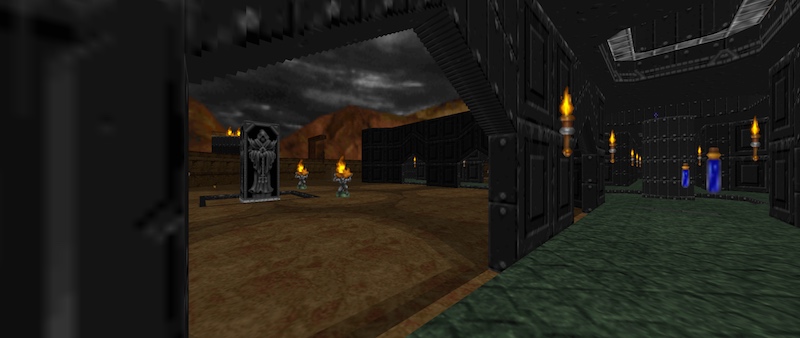
Bird Cage, a WadC-generated map for Heretic
Bird Cage map
I have recently released version 2.2 of Wad Compiler, a lazy functional programming language and IDE for the construction of Doom maps. The biggest change in this version is a reworking of the preferences system (to use the Java Preferences API), the wadcli command-line interface respecting preferences and a new preferences UI dialog (adapted from Quake Injector). There are two new example maps: A Labyrinth demonstration contributed by "Yoruk", and a Heretic map Bird Cage by yours truly. These are both now amongst the largest examples in the collection, although laby.wl was generated by a higher-level program. For more information see the release notes and the reference, or check out the new gallery of examples or skip straight to downloads. I have no plans to work on WadC further (but never say never, I suppose.)

13 November 2017

Steve Kemp: Paternity-leave is half-over

I'm taking the month of November off work, so that I can exclusively take care of our child. Despite it being a difficult time, with him teething, it has been a great half-month so far. During the course of the month I've found my interest in a lot of technological things waning, so I've killed my account(s) on a few platforms, and scaled back others - if I could exclusively do child-care for the next 20 years I'd be very happy, but sadly I don't think that is terribly realistic. My interest in things hasn't entirely vanished though, to the extent that I found the time to replace my use of etcd with consul yesterday, and I'm trying to work out how to simplify my hosting setup. Right now I have a bunch of servers doing two kinds of web-hosting: Hosting static-sites is trivial, whether with a virtual machine, via Amazons' S3-service, or some other static-host such as netlify. Hosting for "dynamic stuff" is harder. These days a trend for "serverless" deployments allows you to react to events and be dynamic, but not everything can be a short-lived piece of ruby/javascript/lambda. It feels like I could setup a generic platform for launching containers, or otherwise modernising FastCGI, etc, but I'm not sure what the point would be. (I'd still be the person maintaining it, and it'd still be a hassle. I've zero interest in selling things to people, as that only means more support.) In short I have a bunch of servers, they mostly tick over unattended, but I'm not really sure I want to keep them running for the next 10+ years. Over time our child will deserve, demand, and require more attention which means time for personal stuff is only going to diminish. Simplify things now wouldn't be a bad thing to do, before it is too late.

7 November 2017

Rog rio Brito: Some activities of the day

Yesterday, I printed the first draft of the first chapter when my little boy was here and he was impressed with this strange object called a "printer". Before I printed what I needed, I fired up LibreOffice and chose the biggest font size that was available and let him type his first name by himself. He was quicker than I thought with a keyboard. After seeing me print his first name, he was jumping up and down with joy of having created something and even showed grandma and grandpa what he had done. He, then, wanted more and I taught him how to use that backspace key, what it meant and he wanted to type his full name. I let him and taught him that there is a key called space that he should type every time he wants to start a new word and, in the end, he typed his first two names. To my surprise, he memorized the icon with the printer (which I must say that I have to hunt every time, since it seems so similar to the adjacent ones!) and pressed this new key called "Enter". When he pressed, he wasn't expecting the printer on his right to start making noises and printing his name. He was so excited and it was so nice to see his reaction full of joy to get a job done! I am thinking of getting a spare computer, building it with him and for him, so that he can call it his computer every time he comes to see daddy. As a serendipitous situation, Packt Publishing offered yesterday their title "Python Projects for Kids". Unfortunately, he does not yet know how to read, but I guess that the right age is coming soon, which is a good thing to make him be educated "the right way" (that is, with the best support, teaching and patience that I can give him). Anyway, I printed the first draft of the first chapter and today I have to turn it in. As I write this, I am downloading a virtual machine from Microsoft to try to install Java on it. Let me see if it works. I have none of the virtualization options used, tough the closest seems to be virtualbox. Let me cross my fingers. In other news, I updated some of the tags of very old posts of this blog, and I am seriously thinking about switching from [ikiwiki][0] to another blog platform. It is slow, very slow on my system with the repositories that I have, especially on my armel system. Some non-interpreted system would be best, but I don't know if such a thing even exists. But the killer problem is that it doesn't support easily the typing of Mathematics (even though a 3rd party plugin for MathJax exists). On the other hand, I just received an answer on twitter from @telegram and it was nice:
Hello, Telegram supports bold and italic. You can type **bold** and __italic__. On mobile, you can also highlight text for this as well.
It is nice that this works with telegram-desktop too. Besides that, I filed some bugs on Debian's BTS, responded to some issues on my projects on GitHub (I'm slowly getting back on maintaining things) and file wishlist bugs on some other projects. Oh, and I grabbed a copy of "Wonder woman" ("Mulher Maravilha") and "Despicable Me 3" ("Meu Malvado Favorito 3") dubbed in Brazilian Portuguese for my son. I have to convert the audio from AAC-LC in 6 channels to AC3 or to stereo. Otherwise, my TVs have problem with the videos (one refuses to play the entire file and another plays the audio with sounds of hiccups). Edit: After converting the VirtualBox image taken from Microsoft, I could easily use qemu/kvm to create screenshots of the installation of Java. The command that I used (for future reference) is: qemu-system-x86_64 -enable-kvm -m 4096 -smp 2 -net nic,model=e1000 -net user -soundhw ac97 -drive index=0,media=disk,cache=unsafe,file=win7.qcow2 Edit: Fixed some typos.

6 November 2017

Jonathan Dowland: Coil

Peter Christopherson and Jhonn Balance, from [Santa Sangre](https://santasangremagazine.wordpress.com/2014/11/16/the-angelic-conversation-in-remembrance-of-coil/) Peter Christopherson and Jhonn Balance, from Santa Sangre
A friend asked me to suggest five tracks by Coil that gave an introduction to their work. Trying to summarize Coil in 5 tracks is tough. I think it's probably impossible to fairly summarize Coil with any subset of their music, for two reasons. Firstly, their music was the output of their work but I don't think is really the whole of the work itself. There's a real mystique around them. They were deeply interested in arcania, old magic, Aleister Crowley, scatology; they were both openly and happily gay and their work sometimes explored their experiences in various related underground scenes and sub-cultures; they lost friends to HIV/AIDS and that had a profound impact on them. They had a big influence on some people who discovered them who were exploring their own sexualities at the time and might have felt excluded from mainstream society. They frequently explored drugs, meditation and other ways to try to expand and open their minds; occultism. They were also fiercely anti-commercial, their stuff was released in limited quantities across a multitude of different music labels, often under different names, and often paired with odd physical objects, runes, vials of blood, etc. Later fascinations included paganism and moon worship. I read somewhere that they literally cursed one of their albums. Secondly, part of their "signature" was the lack of any consistency in their work, or to put it another way, their style over time varied enormously. I'm also not necessarily well-versed in all their stuff, I'm part way on this journey myself... but these are tracks which stand out at least from the subset I've listened to. Both original/core members of Coil have passed away and the legal status of their catalogue is in a state of limbo. Some of these songs are available on currently-in-print releases, but all such releases are under dispute by some associate or other.

1. Heaven's Blade Like (probably) a lot of Coil songs, this one exists in multiple forms, with some dispute about which are canonical, which are officially sanctioned, etc. the video linked above actually contains 5 different versions, but I've linked to a time offset to the 4th: "Heaven's Blade (Backwards)". This version was the last to come to light with the recent release of "Backwards", an album originally prepared in the 90s at Trent Reznor's Nothing Studios in New Orleans, but not finished or released. The circumstances around its present-day release, as well as who did what to it and what manipulation may have been performed to the audio a long time after the two core members had passed, is a current topic in fan circles. Despite that, this is my preferred version. You can choose to investigate the others, or not, at your own discretion.

2. how to destroy angels (ritual music for the accumulation of male sexual energy) A few years ago, "guidopaparazzi", a user at the Echoing the Sound music message board attempted to listen to every Coil release ever made and document the process. He didn't do it chronologically, leaving the EPs until near the end, which is when he tackled this one (which was the first release by Coil, and was the inspiration behind the naming of Trent Reznor's one-time side project "How To Destroy Angels"). Guido seemed to think this was some kind of elaborate joke. Personally I think it's a serious piece and there's something to it but this just goes to show, different people can take things in entirely different ways. Here's Guido's review, and you can find the rest of his reviews linked from that one if you wish. https://archive.org/details/Coil-HowToDestroyAngels1984

3. Red Birds Will Fly Out Of The East And Destroy Paris In A Night Both "Musick To Play In The Dark" volumes (one and two) are generally regarded as amongst the most accessible entry points to the Coil discography. This is my choice of cut from volume 1. For some reason this reminds me a little of some of the background music from the game "Unreal Tournament". I haven't played that in at least 15 years. I should go back and see if I can figure out why it does. The whole EP is worth a listen, especially at night. https://archive.org/details/CoilMusickToPlayInTheDarkVol1/Coil+-+Musick+To+Play+In+The+Dark+Vol+1+-+2+Red+Birds+Will+Fly+Out+Of+The+East+And+Destroy+Paris+In+A+Night.flac

4. Things Happen It's tricky to pick a track from either "Love's Secret Domain" or "Horse Rotorvator"; there are other choices which I think are better known and loved than this one but it's one that haunted me after I first heard it for one reason or another, so here it is.

5. The Anal Staircase Track 1 from Horse Rotorvator. What the heck is a Horse Rotorvator anyway? I think it was supposed to have been a lucid nightmare experienced by the vocalist Jhonn Balance. So here they wrote a song about anal sex. No messing about, no allusion particularly, but why should there be? https://archive.org/details/CoilHorseRotorvator2001Remaster/Coil+-+Horse+Rotorvator+%5B2001+remaster%5D+-+01+The+Anal+Staircase.flac

Bonus 6th: 7-Methoxy-B-Carboline (Telepathine) From the drone album "Time Machines", which has just been re-issued by DIAS records, who describe it as "authorized". Each track is titled by the specific combination of compounds that inspired its composition, supposedly. Or, perhaps it's a "recommended dosing" for listening along. https://archive.org/details/TimeMachines-TimeMachines

Post-script If those piqued your interest, there's some decent words and a list of album suggestions in this Vinyl Factory article. Finally, if you can track them down, Stuart Maconie had two radio shows about Coil on his "Freak Zone" programme. The main show discusses the release of "Backwards", including an interview with collaborator Danny Hyde, who was the main person behind the recent re-issue. The shorter show is entitled John Doran uncoils Coil. Guest John Doran from The Quietus discusses the group and their history interspersed with Coil tracks and tracks from their contemporaries. Interestingly they chose a completely different set of 5 tracks to me.

John Goerzen: The Yellow House Phone Company (Featuring Asterisk and an 11-year-old)

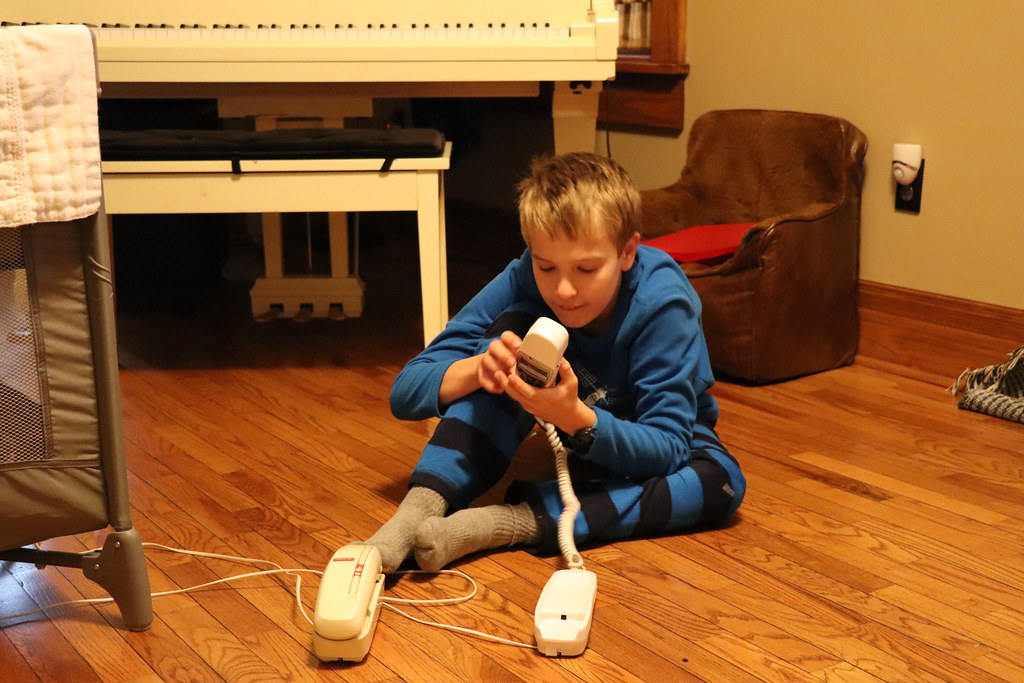
Well Jacob, do you think we should set up our own pretend phone company in the house? We can DO THAT? Yes! Then yes. Yes! YES YES YESYESYESYES YES! Let s do it, dad! Not long ago, my parents had dug up the old phone I used back in the day. We still have a landline, and Jacob was having fun discovering how an analog phone works. I told him about the special number he could call to get the time and temperature read out to him. He discovered what happens if you call your own number and hang up. He figured out how to play Mary Had a Little Lamb using touchtone keys (after a slightly concerned lecture from me setting out some rules to make sure his musical dialing wouldn t result in any, well, dialing.) He was hooked. So I thought that taking it to the next level would be a good thing for a rainy day. I have run Asterisk before, though I had unfortunately gotten rid of most of my equipment some time back. But I found a great deal on a Cisco 186 ATA (Analog Telephone Adapter). It has two FXS lines (FXS ports simulate the phone company, and provide dialtone and ring voltage to a connected phone), and of course hooks up to the LAN. We plugged that in, and Jacob was amazed to see its web interface come up. I had to figure out how to configure it (unfortunately, it uses SCCP rather than SIP, and figuring out Asterisk s chan_skinny took some doing, but we got there.) I set up voicemail. He loved it. He promptly figured out how to record his own greetings. We set up a second phone on the other line, so he could call between them. The cordless phones in our house support SIP, so I configured one of them as a third line. He spent a long time leaving himself messages. IMG_3465 Pretty soon we both started having ideas. I set up extension 777, where he could call for the time. Then he wanted a way to get the weather forecast. Well, weather-util generates a text-based report. With it, a little sed and grep tweaking, the espeak TTS engine, and a little help from sox, I had a shell script worked up that would read back a forecast whenever he called a certain extension. He was super excited! That s great, dad! Can it also read weather alerts too? Sure! weather-util has a nice option just for that. Both boys cackled as the system tried to read out the NWS header (their timestamps like 201711031258 started with two hundred one billion ) Then I found an online source for streaming NOAA Weather Radio feeds Jacob enjoys listening to weather radio and I set up another extension he could call to listen to that. More delight! But it really took off when I asked him, Would you like to record your own menu? You mean those things where it says press 1 or 2 for this or that? Yes. WE CAN DO THAT? Oh yes! YES, LET S DO IT RIGHT NOW! So he recorded a menu, then came and hovered by me while I hacked up extensions.conf, then eagerly went back to the phone to try it. Oh the excitement of hearing hisown voice, and finding that it worked! Pretty soon he was designing sub-menus ( OK Dad, so we ll set it up so people can press 2 for the weather, and then choose if they want weather radio or the weather report. I m recording that now. Got it? ) He has informed me that next Saturday we will build an intercom system like we have at school. I m going to have to have some ideas on how to tie Squeezebox in with Asterisk to make that happen, I think. Maybe this will do.

5 November 2017

Dirk Eddelbuettel: pinp 0.0.4: Small tweak

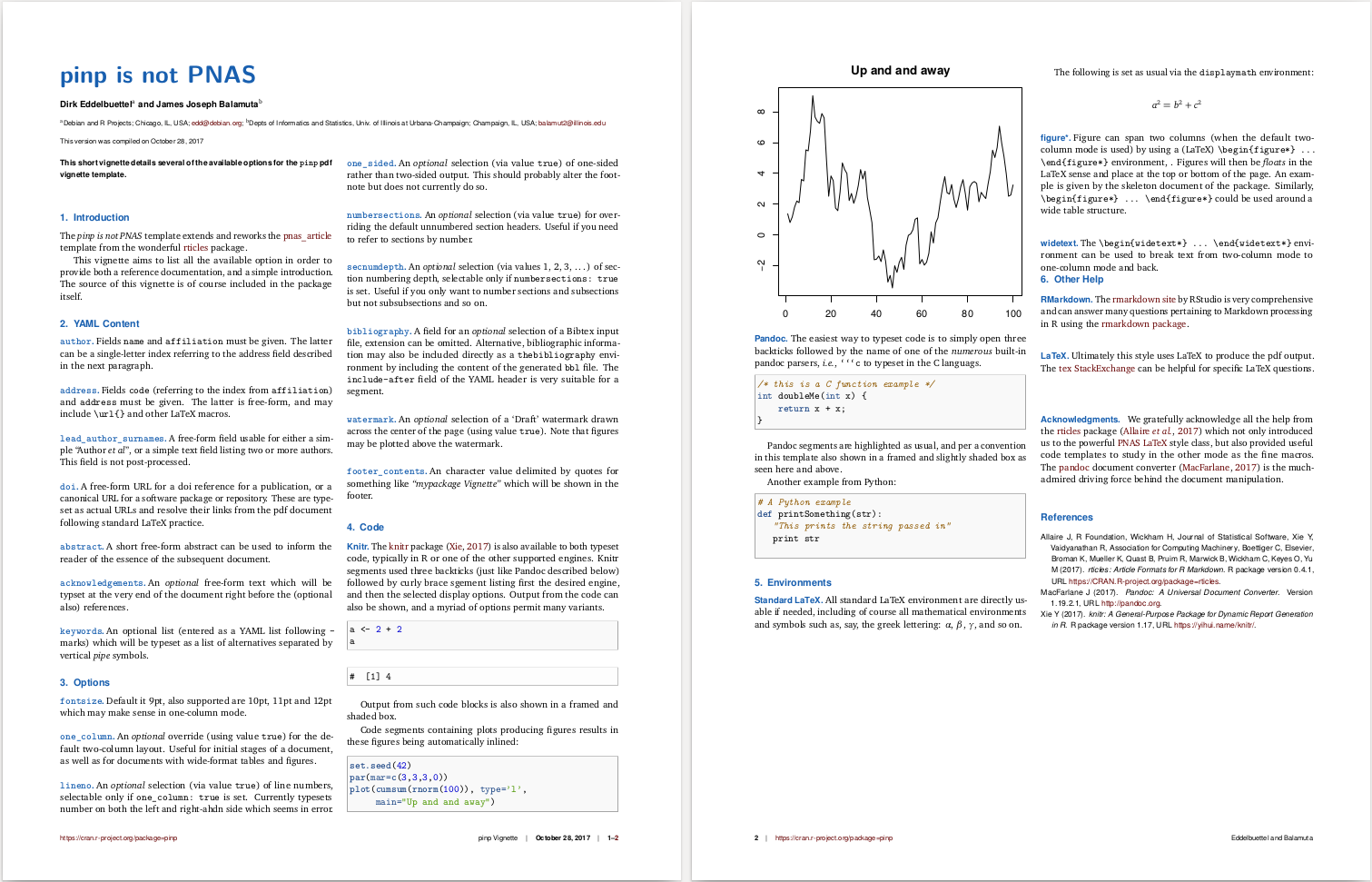
A maintenance release of our pinp package for snazzier one or two column vignettes is now on CRAN as of yesterday. In version 0.0.3, we disabled the default \pnasbreak command we inherit from the PNAS LaTeX style. That change turns out to have been too drastic. So we reverted yet added a new YAML front-matter option skip_final_break which, if set to TRUE, will skip this break. With a default value of FALSE we maintain prior behaviour. A screenshot of the package vignette can be seen below. Additional screenshots of are at the pinp page.
The NEWS entry for this release follows.

Changes in pinp version 0.0.4 (2017-11-04)
  • Correct NEWS headers from 'tint' to 'pinp' (#45).
  • New front-matter variables skip_final_break skips the \pnasbreak on final page which back as default (#47).

Courtesy of CRANberries, there is a comparison to the previous release. More information is on the tint page. For questions or comments use the issue tracker off the GitHub repo.

This post by Dirk Eddelbuettel originated on his Thinking inside the box blog. Please report excessive re-aggregation in third-party for-profit settings.

3 November 2017

Reproducible builds folks: Reproducible Builds: Weekly report #131

Here's what happened in the Reproducible Builds effort between Sunday October 22 and Saturday October 28 2017: Past Events Upcoming/current events Documentation updates Bernhard Wiedemann started The Unreproducible Package which "is meant as a practical way to demonstrate the various ways that software can break reproducible builds using just low level primitives without requiring external existing programs that implement these primitives themselves. It is structured so that one subdirectory demonstrates one class of issues in some variants observed in the wild." Reproducible work in other projects Hush, a fork of ZCash, opened an issue into reproducible builds. A new tag was added to lintian (lint checker for Debian packages) to ensure that changelog entry timestamps are strictly increasing. This avoids certain real-world issues with identical timestamps, documented in Debian #843773. Packages reviewed and fixed, and bugs filed Patches sent upstream: Debian bug reports: Reviews of unreproducible packages 14 package reviews have been added, 35 have been updated and 28 have been removed in this week, adding to our knowledge about identified issues. 1 issue type has been updated: Weekly QA work During our reproducibility testing, FTBFS bugs have been detected and reported by: strip-nondeterminism development Version 0.040-1 was uploaded to unstable by Mattia Rizzolo. It included contributions already covered by posts of the previous weeks, as well as new ones from: reprotest development Development continued in git: buildinfo.debian.net development Development continued in git: reproducible-website development Misc. This week's edition was written by Ximin Luo, Chris Lamb, Bernhard M. Wiedemann and Holger Levsen & reviewed by a bunch of Reproducible Builds folks on IRC & the mailing lists.

2 November 2017

Antoine Beaupr : October 2017 report: LTS, feed2exec beta, pandoc filters, git mediawiki

Debian Long Term Support (LTS) This is my monthly Debian LTS report. This time I worked on the famous KRACK attack, git-annex, golang and the continuous stream of GraphicsMagick security issues.

WPA & KRACK update I spent most of my time this month on the Linux WPA code, to backport it to the old (~2012) wpa_supplicant release. I first published a patchset based on the patches shipped after the embargo for the oldstable/jessie release. After feedback from the list, I also built packages for i386 and ARM. I have also reviewed the WPA protocol to make sure I understood the implications of the changes required to backport the patches. For example, I removed the patches touching the WNM sleep mode code as that was introduced only in the 2.0 release. Chunks of code regarding state tracking were also not backported as they are part of the state tracking code introduced later, in 3ff3323. Finally, I still have concerns about the nonce setup in patch #5. In the last chunk, you'll notice peer->tk is reset, to_set to negotiate a new TK. The other approach I considered was to backport 1380fcbd9f ("TDLS: Do not modify RNonce for an TPK M1 frame with same INonce") but I figured I would play it safe and not introduce further variations. I should note that I share Matthew Green's observations regarding the opacity of the protocol. Normally, network protocols are freely available and security researchers like me can easily review them. In this case, I would have needed to read the opaque 802.11i-2004 pdf which is behind a TOS wall at the IEEE. I ended up reading up on the IEEE_802.11i-2004 Wikipedia article which gives a simpler view of the protocol. But it's a real problem to see such critical protocols developed behind closed doors like this. At Guido's suggestion, I sent the final patch upstream explaining the concerns I had with the patch. I have not, at the time of writing, received any response from upstream about this, unfortunately. I uploaded the fixed packages as DLA 1150-1 on October 31st.

Git-annex The next big chunk on my list was completing the work on git-annex (CVE-2017-12976) that I started in August. It turns out doing the backport was simpler than I expected, even with my rusty experience with Haskell. Type-checking really helps in doing the right thing, especially considering how Joey Hess implemented the fix: by introducing a new type. So I backported the patch from upstream and notified the security team that the jessie and stretch updates would be similarly easy. I shipped the backport to LTS as DLA-1144-1. I also shared the updated packages for jessie (which required a similar backport) and stretch (which didn't) and those Sebastien Delafond published those as DSA 4010-1.

Graphicsmagick Up next was yet another security vulnerability in the Graphicsmagick stack. This involved the usual deep dive into intricate and sometimes just unreasonable C code to try and fit a round tree in a square sinkhole. I'm always unsure about those patches, but the test suite passes, smoke tests show the vulnerability as fixed, and that's pretty much as good as it gets. The announcement (DLA 1154-1) turned out to be a little special because I had previously noticed that the penultimate announcement (DLA 1130-1) was never sent out. So I made a merged announcement to cover both instead of re-sending the original 3 weeks late, which may have been confusing for our users.

Triage & misc We always do a bit of triage even when not on frontdesk duty, so I: I also did smaller bits of work on: The latter reminded me of the concerns I have about the long-term maintainability of the golang ecosystem: because everything is statically linked, an update to a core library (say the SMTP library as in CVE-2017-15042, thankfully not affecting LTS) requires a full rebuild of all packages including the library in all distributions. So what would be a simple update in a shared library system could mean an explosion of work on statically linked infrastructures. This is a lot of work which can definitely be error-prone: as I've seen in other updates, some packages (for example the Ruby interpreter) just bit-rot on their own and eventually fail to build from source. We would also have to investigate all packages to see which one include the library, something which we are not well equipped for at this point. Wheezy was the first release shipping golang packages but at least it's shipping only one... Stretch has shipped with two golang versions (1.7 and 1.8) which will make maintenance ever harder in the long term.
We build our computers the way we build our cities--over time, without a plan, on top of ruins. - Ellen Ullman

Other free software work This month again, I was busy doing some serious yak shaving operations all over the internet, on top of publishing two of my largest LWN articles to date (2017-10-16-strategies-offline-pgp-key-storage and 2017-10-26-comparison-cryptographic-keycards).

feed2exec beta Since I announced this new project last month I have released it as a beta and it entered Debian. I have also wrote useful plugins like the wayback plugin that saves pages on the Wayback machine for eternal archival. The archive plugin can also similarly save pages to the local filesystem. I also added bash completion, expanded unit tests and documentation, fixed default file paths and a bunch of bugs, and refactored the code. Finally, I also started using two external Python libraries instead of rolling my own code: the pyxdg and requests-file libraries, the latter which I packaged in Debian (and fixed a bug in their test suite). The program is working pretty well for me. The only thing I feel is really missing now is a retry/fail mechanism. Right now, it's a little brittle: any network hiccup will yield an error email, which are readable to me but could be confusing to a new user. Strangely enough, I am particularly having trouble with (local!) DNS resolution that I need to look into, but that is probably unrelated with the software itself. Thankfully, the user can disable those with --loglevel=ERROR to silence WARNINGs. Furthermore, some plugins still have some rough edges. For example, The Transmission integration would probably work better as a distinct plugin instead of a simple exec call, because when it adds new torrents, the output is totally cryptic. That plugin could also leverage more feed parameters to save different files in different locations depending on the feed titles, something would be hard to do safely with the exec plugin now. I am keeping a steady flow of releases. I wish there was a way to see how effective I am at reaching out with this project, but unfortunately GitLab doesn't provide usage statistics... And I have received only a few comments on IRC about the project, so maybe I need to reach out more like it says in the fine manual. Always feels strange to have to promote your project like it's some new bubbly soap... Next steps for the project is a final review of the API and release production-ready 1.0.0. I am also thinking of making a small screencast to show the basic capabilities of the software, maybe with asciinema's upcoming audio support?

Pandoc filters As I mentioned earlier, I dove again in Haskell programming when working on the git-annex security update. But I also have a small Haskell program of my own - a Pandoc filter that I use to convert the HTML articles I publish on LWN.net into a Ikiwiki-compatible markdown version. It turns out the script was still missing a bunch of stuff: image sizes, proper table formatting, etc. I also worked hard on automating more bits of the publishing workflow by extracting the time from the article which allowed me to simply extract the full article into an almost final copy just by specifying the article ID. The only thing left is to add tags, and the article is complete. In the process, I learned about new weird Haskell constructs. Take this code, for example:
-- remove needless blockquote wrapper around some tables
--
-- haskell newbie tips:
--
-- @ is the "at-pattern", allows us to define both a name for the
-- construct and inspect the contents as once
--
--   is the "empty record pattern": it basically means "match the
-- arguments but ignore the args"
cleanBlock (BlockQuote t@[Table  ]) = t
Here the idea is to remove <blockquote> elements needlessly wrapping a <table>. I can't specify the Table type on its own, because then I couldn't address the table as a whole, only its parts. I could reconstruct the whole table bits by bits, but it wasn't as clean. The other pattern was how to, at last, address multiple string elements, which was difficult because Pandoc treats spaces specially:
cleanBlock (Plain (Strong (Str "Notifications":Space:Str "for":Space:Str "all":Space:Str "responses":_):_)) = []
The last bit that drove me crazy was the date parsing:
-- the "GAByline" div has a date, use it to generate the ikiwiki dates
--
-- this is distinct from cleanBlock because we do not want to have to
-- deal with time there: it is only here we need it, and we need to
-- pass it in here because we do not want to mess with IO (time is I/O
-- in haskell) all across the function hierarchy
cleanDates :: ZonedTime -> Block -> [Block]
-- this mouthful is just the way the data comes in from
-- LWN/Pandoc. there could be a cleaner way to represent this,
-- possibly with a record, but this is complicated and obscure enough.
cleanDates time (Div (_, [cls], _)
                 [Para [Str month, Space, Str day, Space, Str year], Para _])
    cls == "GAByline" = ikiwikiRawInline (ikiwikiMetaField "date"
                                           (iso8601Format (parseTimeOrError True defaultTimeLocale "%Y-%B-%e,"
                                                           (year ++ "-" ++ month ++ "-" ++ day) :: ZonedTime)))
                        ++ ikiwikiRawInline (ikiwikiMetaField "updated"
                                             (iso8601Format time))
                        ++ [Para []]
-- other elements just pass through
cleanDates time x = [x]
Now that seems just dirty, but it was even worse before. One thing I find difficult in adapting to coding in Haskell is that you need to take the habit of writing smaller functions. The language is really not well adapted to long discourse: it's more about getting small things connected together. Other languages (e.g. Python) discourage this because there's some overhead in calling functions (10 nanoseconds in my tests, but still), whereas functions are a fundamental and important construction in Haskell that are much more heavily optimized. So I constantly need to remind myself to split things up early, otherwise I can't do anything in Haskell. Other languages are more lenient, which does mean my code can be more dirty, but I feel get things done faster then. The oddity of Haskell makes frustrating to work with. It's like doing construction work but you're not allowed to get the floor dirty. When I build stuff, I don't mind things being dirty: I can cleanup afterwards. This is especially critical when you don't actually know how to make things clean in the first place, as Haskell will simply not let you do that at all. And obviously, I fought with Monads, or, more specifically, "I/O" or IO in this case. Turns out that getting the current time is IO in Haskell: indeed, it's not a "pure" function that will always return the same thing. But this means that I would have had to change the signature of all the functions that touched time to include IO. I eventually moved the time initialization up into main so that I had only one IO function and moved that timestamp downwards as simple argument. That way I could keep the rest of the code clean, which seems to be an acceptable pattern. I would of course be happy to get feedback from my Haskell readers (if any) to see how to improve that code. I am always eager to learn.

Git remote MediaWiki Few people know that there is a MediaWiki remote for Git which allow you to mirror a MediaWiki site as a Git repository. As a disaster recovery mechanism, I have been keeping such a historical backup of the Amateur radio wiki for a while now. This originally started as a homegrown Python script to also convert the contents in Markdown. My theory then was to see if we could switch from Mediawiki to Ikiwiki, but it took so long to implement that I never completed the work. When someone had the weird idea of renaming a page to some impossible long name on the wiki, my script broke. I tried to look at fixing it and then remember I also had a mirror running using the Git remote. It turns out it also broke on the same issue and that got me looking in the remote again. I got lost in a zillion issues, including fixing that specific issue, but I especially looked at the possibility of fetching all namespaces because I realized that the remote fetches only a part of the wiki by default. And that drove me to submit namespace support as a patch to the git mailing list. Finally, the discussion came back to how to actually maintain that contrib: in git core or outside? Finally, it looks like I'll be doing some maintenance that project outside of git, as I was granted access to the GitHub organisation...

Galore Yak Shaving Then there's the usual hodgepodge of fixes and random things I did over the month.
There is no [web extension] only XUL! - Inside joke

1 November 2017

Jonathan Dowland: In defence of "Thought for the Day"

BBC Radio 4's long-running "Thought for the Day" has been in the news this week, as several presenters for the Today Programme have criticised the segment in an interview with Radio Times magazine. One facet of the criticism was whether the BBC should be broadcasting three minutes of religious content daily when more than half of the population are atheist. I'm an atheist and in my day-to-day life I have almost zero interaction with people of faith, certainly none where faith is a topic of conversation. However when I was an undergrad at Durham, I was a member of St John's College which has a Christian/Anglican/Evangelical heritage, and I met a lot of religious friends during my time there. What I find a little disturbing about the lack of faithful people in my day-to-day life, compared to then, is how it shines a light on how disjoint our society is. This has become even more apparent with the advent of the "filter bubble" and how irreconcilable factions are around topics like Brexit, Trump, etc. For these reasons I appreciate Thought for the Day and hearing voices from communities that I normally have little to do with. I can agree with the complaints about the lack of diversity, and I particularly enjoy hearing Thoughts from Muslims, Sikhs, Hindus, Buddhists, and such. Another criticism levelled against the segment was that it can be "preachy". I haven't found that myself. I get the impression that most of the monologues are carefully constructed to be as unpreaching as possible. I can usually appreciate the ethical content of the talks, without having to buy into the faith aspect. Interestingly the current principal of St John's College, David Wilkinson, has written his own response to the interview for the Radio Times.

James McCoy: Monthly FLOSS activity - 2017/10 edition

Debian subversion vim
libvterm
pangoterm
vim-gnupg
neovim
vim

31 October 2017

Chris Lamb: Free software activities in October 2017

Here is my monthly update covering what I have been doing in the free software world in October 2017 (previous month):
Reproducible builds

Whilst anyone can inspect the source code of free software for malicious flaws, most software is distributed pre-compiled to end users. The motivation behind the Reproducible Builds effort is to allow verification that no flaws have been introduced either maliciously or accidentally during this compilation process by promising identical results are always generated from a given source, thus allowing multiple third-parties to come to a consensus on whether a build was compromised. I have generously been awarded a grant from the Core Infrastructure Initiative to fund my work in this area. This month I:


I also made the following changes to our tooling:
diffoscope

diffoscope is our in-depth and content-aware diff utility that can locate and diagnose reproducibility issues.

  • Improve names in output of "internal" binwalk members. (#877525).
  • Don't crash on malformed md5sums files. (#877473).
  • Omit misleading "any of" prefix when only complaining about a single module on import. [...]
  • Adjust tests as ps2ascii now varies its output on timezone. [...]

strip-nondeterminism

strip-nondeterminism is our tool to remove specific non-deterministic results from a completed build.

  • Clojure considers .class file to be stale if it shares the same timestamp of the .clj. We thus adjust the timestamps of the .clj to always be younger. (#877418).
  • Print a message in --verbose mode if no canonical time was specified. [...]

buildinfo.debian.net

buildinfo.debian.net is my experiment into how to process, store and distribute .buildinfo files after the Debian archive software has processed them.

  • Always show SHA-256 checksums, regardless of the browser viewport size. [...]
  • Add an API endpoint to fetch specific .buildinfo files for a certain package/version/architecture. [...]


Debian My activities as the current Debian Project Leader are covered in my "Bits from the DPL" email to the debian-devel-announce mailing list.
Patches contributed
  • devscripts: Please print the actual arguments debuild makes to Lintian. (#880124)
  • hw-detect: Drop reference to floppy disks; it's almost 2018. (#880122)
  • debci:
    • Use deb.debian.org over http.debian.net. (#879654)
    • Document how to use an alternative mirror. (#879655)

Debian LTS

This month I have been paid to work 18 hours on Debian Long Term Support (LTS). In that time I did the following:
  • "Frontdesk" duties, triaging CVEs, etc.
  • Followed up on a large number of upstream "pings" that have been left dormant.
  • Issued DLA 1121-1 to fix an out-of-bounds read vulnerability in curl where a malicious FTP server could abuse this to prevent clients from interacting with it.
  • Issued DLA 1123-1 for the "Go" programming language where an attacker could generate a MIME request such that the server ran out of file descriptors.
  • Issued DLA 1126-1 for the libxfont font selection and rasterisation library, correcting two vulnerabilities, both involving the library being tricked into reading invalid/random memory.
  • Issued DLA 1134-1 for sdl-image1.2, an image loading library. A maliciously-crafted .xcf file could cause a stack-based buffer overflow resulting in potential code execution.

Uploads
  • python-django:
    • 2.0~beta1-1 New upstream 2.x release.
    • 1.11.6-1 New upstream bugfix release.
  • gunicorn (19.6.0-10+deb9u1) Prepared a release for stable to avoid a runtime dependency on a compiler. (#877722)
  • redis:
    • 4:4.0.2-3:
      • Drop the Debian-specific /etc/redis/redis-server.pre-up.d (etc.) hooks and remove them if unchanged.
      • Include systemd redis-server@.service and redis-sentinel@.service template files to easily run multiple Redis instances. (#877702)
      • Patch redis.conf and sentinel.conf with quilt instead of maintaining our own versions under debian/.
    • 4:4.0.2-4:
      • Add input validity checking to cluster config slot numbers to fix CVE-2017-15047. (#878076)
      • Drop debian/bin/generate-parts now we aren't calling it.
      • Correct Bash-ism in NEWS file.
    • 4:4.0.2-5: Replace the existing patch for CVE-2017-15047 with an upstream-blessed version that covers another case.
  • redisearch (0.21.3-5) Initial release.
  • docbook2man (2.0.0-40) Correct spelling mistakes in binaries and other misc packaging tidying.
  • python-redis (2.10.6-1) New upstream release.
  • bfs (1.1.3-1) New upstream release.

FTP Team

As a Debian FTP assistant I ACCEPTed 103 packages: amcheck, argagg, binutils, blockui, bro-pkg, chkservice, citus, django-axes, docker-containerd, doctest, dtkwidget, duktape, feed2exec, fontforge, fonttools, gcc-8, gcc-8-cross, generator-scripting-language, gitgraph.js, haskell-uri-encode, hoel, iniparser, its, jquery-areyousure, kodi, libcatmandu-mods-perl, libcatmandu-template-perl, libcatmandu-xml-perl, libcatmandu-xsd-perl, libcode-tidyall-plugin-sortlines-naturally-perl, libgdamm5.0, libinfinity, libmods-record-perl, libreoffice-dictionaries, libset-intervaltree-perl, libsodium, linux, linux-grsec, ltsp-manager, lxqt-themes, mailman3-core, measurement-kit, mini-buildd, musescore, node-babel, node-babel-eslint, node-babel-loader, node-babel-plugin-add-module-exports, node-babel-plugin-transform-define, node-gulp-newer, node-regenerate-unicode-properties, node-regexpu-core, node-regjsparser, node-unicode-data, node-unicode-loose-match, openjdk-9, orafce, pgaudit, pgsql-ogr-fdw, pk4, postgresql-mysql-fdw, powa-archivist, python-azure-devtools, python-colormap, python-darkslide, python-dotenv, python-karborclient, python-logfury, python-lupa, python-marshmallow, python-murano-pkg-check, python-octaviaclient, python-pathspec, python-pgpy, python-pydub, python-randomize, python-sabyenc, python-searchlightclient, python-stestr, python-subunit2sql, python-twitter, python-utils, python-wsgilog, r-cran-bindr, r-cran-desc, r-cran-hms, r-cran-readstata13, r-cran-rprojroot, r-cran-wikidatar, r-cran-wikipedir, r-cran-wikitaxa, repmgr, requests-file, resteasy3.0, sdl-kitchensink, stardicter, systemd-el, thunderbird, tomcat8.0, uwsgi-plugin-luajit, uwsgi-plugin-mongo, uwsgi-plugin-php & uwsgi-plugin-v8. I additionally filed 3 RC bugs against packages that had incomplete debian/copyright files against: fonttools, generator-scripting-language & libsodium.

Dirk Eddelbuettel: pinp 0.0.3: More docs, more features

Our pinp package for snazzier one or two column vignette received it second update. Now at version 0.0.3, it arrived on CRAN on Saturday with minimal fuzz as an 'CRAN-pretest-publish' transition. We added more frontmatter options, documented more, and streamlined some internals of the LaTeX class borrowed from PNAS. A screenshot of the (updated) vignette can be seen below. Additional screenshots of are at the pinp page.
The NEWS entry for this release follows.

Changes in tint version 0.0.3 (2017-10-28)
  • Section 'Acknowledgements' now conditional on a frontmatter setting, section 'Matmethods' has been removed, pnasbreak no longer used which stabilizes LaTeX float formatting. References are now shown in the column just like other content (Dirk in #36).
  • Vignette now uses new numbered sections frontmatter switch which improves the pdf outline.
  • New front-matter options for title/section header colors, and link colors (Dirk in #39).
  • YAML frontmater options are now documented in the help page for pinp as well (Dirk in #41).
  • Some typos were fixed (Michael in #42 and #43).

Courtesy of CRANberries, there is a comparison to the previous release. More information is on the tint page. For questions or comments use the issue tracker off the GitHub repo.

This post by Dirk Eddelbuettel originated on his Thinking inside the box blog. Please report excessive re-aggregation in third-party for-profit settings.

23 October 2017

Patrick Schoenfeld: Testing javascript in a dockerized rails application with rspec-rails

The other day I wanted to add support for tests of javascript functionality in a (dockerized) rails application using rspec-rails. Since rails 5.1 includes system tests with niceties like automatically taking a screenshot on failed tests, I hoped for a way to benefit from this
features without changing to another test framework. Lucky me only recently the authors of rspec-rails added support for so-called system specs. There is not much documentation so far (but there are a lot of useful information in the corresponding bug report #1838 and a friendly guy named Thomas Walpole (@twalpole) is helpfully answering to questions in that issue. To make things a little bit more complicated: the application in question is usually running in a docker container and thus the tests of the application are also run in a docker container. I didn t want to change this, so here is what it took me to get this running. Overview Let s see what we want to achieve exactly: From a technical point of view, we will have the application under test (AUT) and the tests in one container (let s call it: web) and we will need another container running a javascript-capable browser (let s call it browser). Thus we need the tests to drive a remote running browser (at least when running in a docker environment) which needs to access the application under a different address than usually. Namely an address reachable by the chrome-container, since it will not be reachable via 127.0.0.1 as is (rightfully) assumed by default. If we want Warden authentication stubbing to work (as we do, since our application uses Devise) and transactional fixtures as well (e.g. rails handling database cleanup between tests without database_cleaner gem) we also need to ensure that the application server is being started by the tests and the tests are actually run against that server. Otherwise we might run into problems. Getting the containers ready Assuming you already have a container setup (and are using docker-compose like we do) there is not that much to change on the docker front. Basically you need to add a new service called chrome and point it to an appropriate image and add a link to it in your existing web-container. I ve decided to use standalone-chrome for the browser part, for which there are docker images provided by the selenium project (they also have images for other browsers). Kudos for that.
...
services:
  chrome:
    image: selenium/standalone-chrome
   
  web:
   
    links:
      - chrome
The link ensures that the chrome instance is available before we run the tests and that the the web-container is able to resolve the name of this container. Unfortunately this is not true for the other way round, so we need some magic in our test code to find out the ip-address of the web-container. More to this later. Other than that, you probably want to configure a volume for you to be able to access the screenshots, which get saved to tmp/screenshots
in the application directory. Preparing the application for running system tests There is a bit more to do on the application side. The steps are roughly:
  1. Add necessary depends / version constraints
  2. Register a driver for the remote chrome
  3. Configure capybara to use the appropriate host for your tests (and your configured driver)
  4. Add actual tests with type: :system and js: true
Let s walk them through. Add necessary depends What we need is the following: The required features are already part of 3.7.0, but this version is the version I used and it contains a bugfix, which may or may not be relevant. One comment about the rails version: for the tests to properly work it s viable to have puma use certain settings. In rails 5.1.4 (the version released, at time of writing this) uses the settings from config/puma.rb which most likely collides with the necessary settings. You can ensure these settings yourself or use rails from branch 5-1-stable which includes this change. I decided for the latter and pinned my Gemfile to the then current commit. Register a driver for the remote chrome To register the required driver, you ll have to add some lines to your rails_helper.rb:
if ENV['DOCKER']
  selenium_url =
      "http://chrome:4444/wd/hub"
  Capybara.register_driver :selenium_remote do  app 
    Capybara::Selenium::Driver.new(app,
         :url => selenium_url, :browser => :remote, desired_capabilities: :chrome )
  end
end
Note that I added those lines conditionally (since I still want to be able to use a local chrome via chromedriver) if an environment variable DOCKER is set. We defined that environment variable in our Dockerfile and thus you might need to adapt this to your case. Also note that the selenium_url is hard-coded. You could very well take a different approach, e.g. using an externally specified SELENIUM_URL, but ultimately the requirement is that the driver needs to know that the chrome instance is running on host chrome, port 4444 (the containers default). Configure capybara to use the appropriate host and driver The next step is to ensure that javascript-requiring system tests are actually run with the given driver and use the right host. To achieve that we need to add a before-hook to the corresponding tests or we can configure rspec accordingly to always include such a hook by modifying the rspec-configuration in rails_helper.rb like this:
RSpec.configure do  config 
  ...
  config.before(:each, type: :system, js: true) do
    if ENV['DOCKER']
      driven_by :selenium_remote
      ip = Socket.ip_address_list.detect addr  addr.ipv4_private?  .ip_address
      host! "http://# ip :# Capybara.server_port "
    else
      driven_by :headless_chrome
    end
  end
Note the part with the ip-address: it tries to find an IPv4 private address for the web-container (the container running the tests) to ensure the chrome-container uses this address to access the application. The Capybara.server_port is important here, since it will correspond to the puma instance launched by the tests. That heuristic (first ipv4 private address) works for us at the moment, but it might not work for you. It is basically a workaround to the fact that I couldn t get web resolvable for the chrome container which may be fixable on the docker side, but I was to lazy to further investigate that. If you change it: Just make sure the host! method uses an URI pointing to an address of the web-container that is reachable to the chrome-container. Define tests with type: :system and js: true Last but certainly not least, you need actual tests of the required type and with or without js: true. This can be achieved by creating tests files starting like this:
RSpec.feature "Foobar", type: :system, js: true do
Since the new rspec-style system tests are based around the feature-specs which used to be around previously, the rest of the tests is exactly like it is described for feature specs. Run the tests To run the tests a commandline like the following should do: docker-compose run web rspec It won t make a big noise about running the tests against chrome, unless something fails. In that case you ll see a message telling you where the screenshot has been placed. Troubleshooting Below I add some hints about problems I ve seen during configuring that: Test failing, screenshot shows login screen In that case puma might be configured wrongly or you are not using transactional fixtures. See the hints above about the rails version to use which also includes some pointers to helpful explanations. Note that rspec-rails by default does not output the puma startup output as it clutters the tests. For debugging purposes it might be helpful to change that by adding the following line to your tests:
ActionDispatch::SystemTesting::Server.silence_puma = false
Error message: Unable to find chromedriver This indicates that your driver is not configured properly, because the default for system tests is to be driven_by selenium, which tries to spawn an own chrome instance and is suitable for non-dockerized tests. Check if your tests are marked as js: true (if you followed the instructions above) and that you properly added the before-hook to your rspec-configuration. Collisions with VCR If you happen to have tests that make use of the vcr gem you might see it complaining about not knowing what to do with the requests between the driver and the chrome instance. You can fix this, by telling VCR to ignore that requests, by adding a line where you configured VCR:
VCR.configure do  config 
# required so we don't collide with capybara tests
config.ignore_hosts 'chrome'
...

22 October 2017

Michael Stapelberg: Which VCS do Debian s Go package upstreams use?

In the pkg-go team, we are currently discussing which workflows we should standardize on. One of the considerations is what goes into the upstream Git branch of our repositories: should it track the upstream Git repository, or should it contain orig tarball imports? Now, tracking the upstream Git repository only works if upstream actually uses Git. The go tool, which is widely used within the Go community for managing Go packages, supports Git, Mercurial, Bazaar and Subversion. But which of these are actually used in practice? Let s find out! Option 1: If you have the sources lists of all suites locally anyway
/usr/lib/apt/apt-helper cat-file \
  $(apt-get indextargets --format '$(FILENAME)' 'ShortDesc: Sources' 'Origin: Debian') \
    sed -n 's,Go-Import-Path: ,,gp' \
    sort -u
Option 2: If you prefer to use a relational database over textfiles This is the harder option, but also the more complete one. First, we ll need the Go package import paths of all Go packages which are in Debian. We can get them from the ProjectB database, Debian s main PostgreSQL database containing all of the state about the Debian archive. Unfortunately, only Debian Developers have SSH access to a mirror of ProjectB at the moment. I contacted DSA to ask about providing public ProjectB access.
  ssh mirror.ftp-master.debian.org "echo \"SELECT value FROM source_metadata \
  LEFT JOIN metadata_keys ON (source_metadata.key_id = metadata_keys.key_id) \
  WHERE metadata_keys.key = 'Go-Import-Path' GROUP BY value\"   \
    psql -A -t service=projectb" > go_import_path.txt
I uploaded a copy of resulting go_import_path.txt, if you re curious. Now, let s come up with a little bit of Go to print the VCS responsible for each specified Go import path:
go get -u golang.org/x/tools/go/vcs
cat >vcs4.go <<'EOT'
package main
import (
	"fmt"
	"log"
	"os"
	"sync"
	"golang.org/x/tools/go/vcs"
)
func main()  
	var wg sync.WaitGroup
	for _, arg := range os.Args[1:]  
		wg.Add(1)
		go func(arg string)  
			defer wg.Done()
			rr, err := vcs.RepoRootForImportPath(arg, false)
			if err != nil  
				log.Println(err)
				return
			 
			fmt.Println(rr.VCS.Name)
		 (arg)
	 
	wg.Wait()
 
EOT
Lastly, run it in combination with uniq(1) to discover
go run vcs4.go $(tr '\n' ' ' < go_import_path.txt)   sort   uniq -c
    760 Git
      1 Mercurial

18 October 2017

Norbert Preining: Kobo firmware 4.6.9995 mega update (KSM, nickel patch, ssh, fonts)

It has been ages that I haven t updated the MegaUpdate package for Kobo. Now that a new and seemingly rather bug-free and quick firmware release (4.6.9995) has been released, I finally took the time to update the whole package to the latest releases of all the included items. The update includes all my favorite patches and features: Kobo Start Menu, koreader, coolreader, pbchess, ssh access, custom dictionaries, and some side-loaded fonts. Kobo Logo So what are all these items: Install procedure Download Mark6 Kobo GloHD firmware: Kobo 4.6.9995 for GloHD Mega update: Kobo-4.6.9995-combined/Mark6/KoboRoot.tgz Mark5 Aura firmware: Kobo 4.6.9995 for Aura Mega update: Kobo-4.6.9995-combined/Mark5/KoboRoot.tgz Mark4 Kobo Glo, Aura HD firmware: Kobo 4.6.9995 for Glo and AuraHD Mega update: Kobo-4.6.9995-combined/Mark4/KoboRoot.tgz Latest firmware Warning: Sideloading or crossloading the incorrect firmware can break/brick your device. The link below is for Kobo GloHD ONLY. The first step is to update the Kobo to the latest firmware. This can easily be done by just getting the latest firmware from the links above and unpacking the zip file into the .kobo directory on your device. Eject and enjoy the updating procedure. Mega update Get the combined KoboRoot.tgz for your device from the links above and put it into the .kobo directory, then eject and enjoy the updating procedure again. After this the device should reboot and you will be kicked into KSM, from where after some time of waiting Nickel will be started. If you consider the fonts too small, select Configure, then the General, and add item, then select kobomenuFontsize=55 and save. Remarks to some of the items included The full list of included things is above, here are only some notes about what specific I have done. WARNINGS If this is the first time you install this patch, you to fix the password for root and disable telnet. This is an important step, here are the steps you have to take (taken from this old post):
  1. Turn on Wifi on the Kobo and find IP address
    Go to Settings Connect and after this is done, go to Settings Device Information where you will see something like
    IP Address: 192.168.1.NN

    (numbers change!)
  2. telnet into your device
    telnet 192.168.1.NN
    it will ask you the user name, enter root (without the quotes) and no password
  3. (ON THE GLO) change home directory of root
    edit /etc/passwd with vi and change the entry for root by changing the 6th field from: / to /root (without the quotes). After this procedure the line should look like
    root::0:0:root:/root:/bin/sh
    don t forget to save the file
  4. (ON THE GLO) create ssh keys for dropbear
    [root@(none) ~]# mkdir /etc/dropbear
    [root@(none) ~]# cd /etc/dropbear
    [root@(none) ~]# dropbearkey -t dss -f dropbear_dss_host_key
    [root@(none) ~]# dropbearkey -t rsa -f dropbear_rsa_host_key
  5. (ON YOUR PERSONAL COMPUTER) check that you can log in with ssh
    ssh root@192.168.1.NN
    You should get dropped into your device again
  6. (ON THE GLO) log out of the telnet session (the first one you did)
    [root@(none) ~]# exit
  7. (ON THE GLO) in your ssh session, change the password of root
    [root@(none) ~]# passwd
    you will have to enter the new password two times. Remember it well, you will not be easily able to recover it without opening your device.
  8. (ON THE GLO) disable telnet login
    edit the file /etc/inetd.conf.local on the GLO (using vi) and remove the telnet line (the line starting with 23).
  9. restart your device
The combined KoboRoot.tgz is provided without warranty. If you need to reset your device, don t blame me!

17 October 2017

Jonathan Dowland: Electric Dreams

No spoilers, for those who have yet to watch it... Channel 4 have been broadcasting a new 10-part series called Electric Dreams, based on some of the short fiction of Philip K Dick. The series was commissioned after Channel 4 lost Black Mirror to Netflix, perhaps to try and find something tonally similar. Electric Dreams is executive-produced by Brian Cranston, who also stars in one of the episodes yet to broadcast. I've read all of PKD's short fiction1 but it was a long time ago so I have mostly forgotten the stories upon which the series is based. I've quite enjoyed going back and re-reading them after watching the corresponding episodes to see what changes they've made. In some cases the changes are subtle or complementary, in other cases they've whittled the original story right out and installed a new one inside the shell. A companion compilation has been published with just the relevant short stories in it, and from what I've seen browsing it in a book shop it also contains short introductions which might be worth a read. Things started strong with The Hood Maker, which my wife also enjoyed, although she was disappointed to realise we wouldn't be revisiting those characters in the future. The world-building was strong enough that it seemed like a waste for a single episode. My favourite episode of those broadcast so far was The Commuter, starring Timothy Spall. The changes made were complementary and immensely expanded the emotional range of the story. In some ways, a key aspect of the original story was completely inverted, which I found quite funny: my original take on Dick's story was Dick implying a particular outcome was horrific, whereas it becomes desirable in the TV episode.
Episode 4, *Crazy Diamond* Episode 4, Crazy Diamond
One of the stories most hollowed-out was Sales Pitch which was the basis for Tony Grisoni s episode Crazy Diamond, starring Steve Buscemi and Sidse Babett Knudsen. Buscemi was good but Knudsen totally stole every frame she was in. Fans of the cancelled Channel 4 show Utopia should enjoy this one: both were directed by Marc Munden and the directing, photography and colour balance really recall it. The last episode broadcast was Real Life directed by Ronald D Moore of Battlestar Galactica reboot fame and starring Anna Paquin. Like Sales Pitch it bears very little resemblance to the original story. It played around with similar ideas explored in a lot of Sci-Fi movies and TV shows but left me a little flat; I didn't think it contributed much that I hadn't seen before. I was disappointed that there was a relatively conclusive ending. There was a subversive humour in the Dick short that was completely lost in the retelling. The world design seemed pretty generic. I'm looking forward to Autofac, which is one of the shorts I can remember particularly enjoying.

  1. as collected in the 5 volumes of The Collected Stories of Philip K Dick, although I don't doubt there are some stragglers that were missed out when that series was compiled.

Russ Allbery: Bundle haul

Confession time: I started making these posts (eons ago) because a close friend did as well, and I enjoyed reading them. But the main reason why I continue is because the primary way I have to keep track of the books I've bought and avoid duplicates is, well, grep on these posts. I should come up with a non-bullshit way of doing this, but time to do more elegant things is in short supply, and, well, it's my blog. So I'm boring all of you who read this in various places with my internal bookkeeping. I do try to at least add a bit of commentary. This one will be more tedious than most since it includes five separate Humble Bundles, which increases the volume a lot. (I just realized I'd forgotten to record those purchases from the past several months.) First, the individual books I bought directly: Ilona Andrews Sweep in Peace (sff)
Ilona Andrews One Fell Sweep (sff)
Steven Brust Vallista (sff)
Nicky Drayden The Prey of Gods (sff)
Meg Elison The Book of the Unnamed Midwife (sff)
Pat Green Night Moves (nonfiction)
Ann Leckie Provenance (sff)
Seanan McGuire Once Broken Faith (sff)
Seanan McGuire The Brightest Fell (sff)
K. Arsenault Rivera The Tiger's Daughter (sff)
Matthew Walker Why We Sleep (nonfiction)
Some new books by favorite authors, a few new releases I heard good things about, and two (Night Moves and Why We Sleep) from references in on-line articles that impressed me. The books from security bundles (this is mostly work reading, assuming I'll get to any of it), including a blockchain bundle: Wil Allsop Unauthorised Access (nonfiction)
Ross Anderson Security Engineering (nonfiction)
Chris Anley, et al. The Shellcoder's Handbook (nonfiction)
Conrad Barsky & Chris Wilmer Bitcoin for the Befuddled (nonfiction)
Imran Bashir Mastering Blockchain (nonfiction)
Richard Bejtlich The Practice of Network Security (nonfiction)
Kariappa Bheemaiah The Blockchain Alternative (nonfiction)
Violet Blue Smart Girl's Guide to Privacy (nonfiction)
Richard Caetano Learning Bitcoin (nonfiction)
Nick Cano Game Hacking (nonfiction)
Bruce Dang, et al. Practical Reverse Engineering (nonfiction)
Chris Dannen Introducing Ethereum and Solidity (nonfiction)
Daniel Drescher Blockchain Basics (nonfiction)
Chris Eagle The IDA Pro Book, 2nd Edition (nonfiction)
Nikolay Elenkov Android Security Internals (nonfiction)
Jon Erickson Hacking, 2nd Edition (nonfiction)
Pedro Franco Understanding Bitcoin (nonfiction)
Christopher Hadnagy Social Engineering (nonfiction)
Peter N.M. Hansteen The Book of PF (nonfiction)
Brian Kelly The Bitcoin Big Bang (nonfiction)
David Kennedy, et al. Metasploit (nonfiction)
Manul Laphroaig (ed.) PoC GTFO (nonfiction)
Michael Hale Ligh, et al. The Art of Memory Forensics (nonfiction)
Michael Hale Ligh, et al. Malware Analyst's Cookbook (nonfiction)
Michael W. Lucas Absolute OpenBSD, 2nd Edition (nonfiction)
Bruce Nikkel Practical Forensic Imaging (nonfiction)
Sean-Philip Oriyano CEHv9 (nonfiction)
Kevin D. Mitnick The Art of Deception (nonfiction)
Narayan Prusty Building Blockchain Projects (nonfiction)
Prypto Bitcoin for Dummies (nonfiction)
Chris Sanders Practical Packet Analysis, 3rd Edition (nonfiction)
Bruce Schneier Applied Cryptography (nonfiction)
Adam Shostack Threat Modeling (nonfiction)
Craig Smith The Car Hacker's Handbook (nonfiction)
Dafydd Stuttard & Marcus Pinto The Web Application Hacker's Handbook (nonfiction)
Albert Szmigielski Bitcoin Essentials (nonfiction)
David Thiel iOS Application Security (nonfiction)
Georgia Weidman Penetration Testing (nonfiction)
Finally, the two SF bundles: Buzz Aldrin & John Barnes Encounter with Tiber (sff)
Poul Anderson Orion Shall Rise (sff)
Greg Bear The Forge of God (sff)
Octavia E. Butler Dawn (sff)
William C. Dietz Steelheart (sff)
J.L. Doty A Choice of Treasons (sff)
Harlan Ellison The City on the Edge of Forever (sff)
Toh Enjoe Self-Reference ENGINE (sff)
David Feintuch Midshipman's Hope (sff)
Alan Dean Foster Icerigger (sff)
Alan Dean Foster Mission to Moulokin (sff)
Alan Dean Foster The Deluge Drivers (sff)
Taiyo Fujii Orbital Cloud (sff)
Hideo Furukawa Belka, Why Don't You Bark? (sff)
Haikasoru (ed.) Saiensu Fikushon 2016 (sff anthology)
Joe Haldeman All My Sins Remembered (sff)
Jyouji Hayashi The Ouroboros Wave (sff)
Sergei Lukyanenko The Genome (sff)
Chohei Kambayashi Good Luck, Yukikaze (sff)
Chohei Kambayashi Yukikaze (sff)
Sakyo Komatsu Virus (sff)
Miyuki Miyabe The Book of Heroes (sff)
Kazuki Sakuraba Red Girls (sff)
Robert Silverberg Across a Billion Years (sff)
Allen Steele Orbital Decay (sff)
Bruce Sterling Schismatrix Plus (sff)
Michael Swanwick Vacuum Flowers (sff)
Yoshiki Tanaka Legend of the Galactic Heroes, Volume 1: Dawn (sff)
Yoshiki Tanaka Legend of the Galactic Heroes, Volume 2: Ambition (sff)
Yoshiki Tanaka Legend of the Galactic Heroes, Volume 3: Endurance (sff)
Tow Ubukata Mardock Scramble (sff)
Sayuri Ueda The Cage of Zeus (sff)
Sean Williams & Shane Dix Echoes of Earth (sff)
Hiroshi Yamamoto MM9 (sff)
Timothy Zahn Blackcollar (sff)
Phew. Okay, all caught up, and hopefully won't have to dump something like this again in the near future. Also, more books than I have any actual time to read, but what else is new.

13 October 2017

Alex Muntada: My Free Software Activities in Jul-Sep 2017

If you read Planet Debian often, you ve probably noticed a trend of Free Software activity reports at the beginning of the month. First, those reports seemed a bit unamusing and lengthy, but since I take the time to read them I ve learnt a lot of things, and now I m amazed at the amount of work that people are doing for Free Software. Indeed, I knew already that many people are doing lots of work. But reading those reports gives you an actual view of how much it is. Then, I decided that I should do the same and write some kind of report since I became a Debian Developer in July. I think it s a nice way to share your work with others and maybe inspire them as it happened to me. So I asked some of the people that have been inspiring me how do they do it. I mean, I was curious to know how they keep track of the work they do and how long it takes to write their reports. It seems that it takes quite some time, it s mostly manual work and usually starts by the end of the month, reviewing their contributions in mailing lists, bug trackers, e-mail folders, etc. Here I am now, writing my first report about my Free Software activities since July and until September 2017. I hope you like it: Happy hacking!

Shirish Agarwal: I need to speak up now X Economics

Dear all, This would be a longish blog post (as most of mine are) compiled over days but as there is so short a time and so much to share. I had previously thought to share beautiful photographs of Ganesh mandals taking out the procession at time of immersion of the idol or the last day of Durga Puja recent events around do not make my mood to share photos at this point in time. I may share some of them in a future blog post or two . Before going further, I would like to offer my sympathies and condolences to people hurt and dislocated in Hurricane Irma , the 2017 Central Mexico Earthquake and lastly the most recent Las Vegas shooting as well as Hurricane Maria in Puerto Rico . I am somewhat nonplussed as to why Americans always want to name, especially hurricanes which destroy people s lives and livelihood built over generations and why most of the hurricanes are named after women. A look at weather.com site unveiled the answer to the mystery. Ironically (or not) I saw some of the best science coverage about Earthquakes or anything scientific reporting and analysis after a long time in mainstream newspapers in India. On another note, I don t understand or even expect to understand why the gunman did what he did 2 days back. Country music AFAIK is one of the most chilled-out kind of music, in some ways very similar to classical Indian singing although they are worlds apart in style of singing, renditions, artists, the way they emote etc. I seriously wish that the gunman had not been shot but caught and reasons were sought about what he did, he did. While this is certainly armchair thinking as was not at the scene of crime, but if a Mumbai Police constable could do it around a decade ago armed only with a lathi could do it, why couldn t the American cops who probably are trained in innumerable ways to subdue people without killing them, did. While investigations are on, I suspect if he were caught just like Ajmal Kasab was caught then lot of revelations might have come up. From what is known, the gentleman was upwardly mobile i.e. he was white, rich and apparently had no reason to have beef with anybody especially a crowd swaying to some nice music, all of which makes absolutely no sense. Indian Economy Slowdown Anyways, back to one of the main reasons of writing this blog post. Few days back, an ex-finance Minister of India Yashwant Sinha wrote what was felt by probably millions of Indians, an Indian Express article called I need to speak up now While there have been many, many arguments made since then by various people. A simple search of I need to speak up would lead to lead to many a result besides the one I have shared above. The only exception I have with the article is the line Forty leading companies of the country are already facing bankruptcy proceedings. Many more are likely to follow suit. I would not bore you but you ask any entrepreneur trying to set up shop in India i.e. ones who actually go through the processes of getting all the licenses for setting up even a small businesses as to the numerous hurdles they have to overcome and laid-back corrupt bureaucracy which they have to overcome. I could have interviewed some of my friends who had the conviction and the courage to set up shop and spent more than half a decade getting all the necessary licenses and approval to set up but it probably would be too specific for one industry or the other and would lead to the same result. Co-incidentally, a new restaurant, leaf opened in my vicinity few weeks before. From the looks it looked like a high-brow, high-priced restaurant hence like many others I did not venture in. After a few days, they introduced south-Indian delicacies like Masala Dosa, Uttapam at prices similar to other restaurants around. So I ventured in and bought some south Indian food to consume between mum and me. Few days later, I became friends with the owner/franchisee and I suggested (in a friendly tone) that why he doesn t make it like a CCD play where many people including yours truly use the service to share, strategize and meet with clients. The CCD joints usually serve coffee and snacks (which are over-priced but still run out pretty fast) but people come as they have chilled-out atmosphere and Wi-Fi access which people need for their smartphones, although the Wi-Fi part may soon become redundant With Reliance Jio making a big play. I also shared why he doesn t add more variety and time (the south Indian items are time-limited) as I see/saw many empty chairs there. Anyways, the shop-owner/franchisee shared his gross costs including salary, stocking, electricity, rent and it doesn t pan out to be serving Rs.80/- dish (roughly a 1US dollar and 25 cents) then serving INR Rs. 400/- a dish (around 6 $USD). One round of INR 400/- + dishes make his costs for the day, around 12 tables were there. It s when they have two full rounds of dishes costing INR 400/- or more that he actually has profits and he is predicting loss for at least 6 months to a year before he makes a rebound. He needs steady customers rather than just walk-ins that will make his business work/click. Currently his family is bearing the costs. He didn t mention the taxes although I know apart from GST there are still some local body taxes that they will have to pay and comply with. There are a multitude of problems for shutting a shop legally as well as they have to again renavigate the bureaucracy for the same. I have seen more than a few retailers downing their shutters for 6-8 months and then either sell it to new management, let go of the lease or simply sell the property to a competitor. The Insolvency and Bankruptcy Code is probably the first proper exit policy for large companies. So the 40 odd companies that Mr. Sinha were talking about were probably sick for a long time. In India, there is also an additional shame of being a failed entrepreneur unlike in the west where Entrepreneurs start on their next venture. As seen from Retailing In India only 3.3% of the population or at the most 4% of the population is directly or indirectly linked with the retail trade. Most of the economy still derives its wealth from the agrarian sector which is still reeling under the pressure from demonetization which happened last year. Al jazeera surprisingly portrayed a truer picture of the effects demonetization had on common citizen than many Indian newspapers did at the time. Because of the South African Debconf, I had to resort to debit cards and hence was able to escape standing in long lines in which many an old and women perished. It is only yesterday that the Government has acknowledged which many prominent Indians have been saying for months now, that we are in a slowdown . Be aware of the terms being used for effect by the Prime Minister. There are two articles which outlines the troubles India is in atm. The only bright spot has been e-commerce which so far has eluded GST although the Govt. has claimed regulations to put it in check. Indian Education System Interestingly, Ravish Kumar has started a series on NDTV where he is showcasing how Indian education sector, especially public colleges have been left to teachers on contract basis, see the first four episodes on NDTV channel starting with the first one I have shared as a hyperlink. I apologize as the series is in Hindi as the channel is meant for Indians and is mostly limited to Northern areas of the Country (mostly) although he has been honest that it is because they lack resources to tackle the amount of information flowing to them. Ravish started the series with sharing information about the U.S. where the things are similar with some teachers needing to sleep in cars because of high-cost of living to some needing to turn to sex-work . I was shocked when I read the guardian article, that is no way to treat our teachers.I went on to read How the American University was Killed following the breadcrumbs along the way. Reading that it seems Indians have been following the American system playbook from the 1980 s itself. The article talks about HMO as well and that seems to have followed here as well with my own experience of hospital fees and drugs which I had to entail a few weeks/month ago. Few years ago, when me and some of my friends had the teaching bug and we started teaching in a nearby municipal school, couple of teachers had shared that they were doing 2-3 jobs to make ends meet. I don t know about others in my group, at least I was cynical because I thought all the teachers were permanent and they make good money only to realize now that the person was probably speaking the truth. When you have to do three jobs to make ends meet from where do you bring the passion to teach young people and that too outside the syllabus ? Also, with this new knowledge in hindsight, I take back all my comments I made last year and the year before for the pathetic education being put up by the State. With teachers being paid pathetically/underpaid and almost 60% teachers being ad-hoc/adjunct teachers they have to find ways to have some sense of security. Most teachers are bachelors as they are poor and cannot offer any security (either male or female) and for women, after marriage it actually makes no sense for them to continue in this profession. I salute all the professors who are ad-hoc in nature and probably will never get a permanent position in their life. I think in some way, thanx to him, that the government has chosen to give 7th pay commisson salary to teachers. While the numbers may appear be large, there are a lot of questions as to how many people will actually get paid. There needs to be lot of vacancies which need to be filled quickly but don t see any solution in the next 2-3 years as well. The Government has taken a position to use/re-hire retired teachers rather than have new young teachers as an unwritten policy. In this Digital India context how are retired teachers supposed to understand and then pass on digital concepts is beyond me when at few teacher trainings I have seen they lack even the most basic knowledge that I learnt at least a decade or two ago, the difference is that vast. I just don t know what to say to that. My own experience with my own mother who had pretty good education in her time and probably would have made a fine business-woman if she knew that she will have a child that she would have to raise by herself alone (along with maternal grand-parents) is testimonial to the fact how hard it is for older people to grasp technology and here I m talking just using the interface as a consumer rather than a producer or someone in-between who has the idea of how companies and governments profit from whatever data is shared one way or the other. After watching the series/episodes and discussing the issue with my mother it was revealed that both her and my late maternal grandfather were on casual/ad-hoc basis till 20-25 years in their service in the defense sector. If Ravish were to do a series on the defense sector he probably would find the same thing there. To add to that, the defense sector is a vital component to a country s security. If 60% of the defense staff in all defense establishments have temporary staff how do you ensure the loyalty of the people working therein. That brings to my mind Ignorance is bliss . Software development and deployment There is another worry that all are skirting around, the present dispensation/government s mantra is minimum government-maximum governance with digital technologies having all solutions which is leading to massive unemployment. Also from most of the stories/incidents I read in the newspapers, mainstream media and elsewhere it seems most software deployments done in India are done without having any system of internal checks and balances. There is no lintian for software to be implemented. Contracts seem to be given to big companies and there is no mention of what prerequisites or conditions were laid down by the Government for software development and deployment and if any checks were done to ensure that the software being developed was in according to government specifications or not. Ideally this should all be in public domain so that questions can be asked and responsibility fixed if things go haywire, as currently they do not. Software issues As my health been not that great, I have been taking a bit more time and depth while filing bugs. #877638 is a good example. I suspect though that part of the problem might be that mate has moved to gtk3 while guake still has gtk-2 bindings. I also reported the issue upstream both in mate-panel as well as guake . I haven t received any response from either or/and upstreams . I also have been fiddling around with gdb to better understand the tool so I can exploit/use this tool in a better way. There are some commands within the gdb interface which seem to be interesting and hopefully I ll try how the commands perform over days, weeks to a month. I hope we see more action on the mate-panel/guake bug as well as move of guake to gtk+3 but that what seemingly seemed like wait for eternity seems to have done by somebody in last couple of days. As shared in the ticket there are lots of things still to do but it seems the heavy lifting has been done but seems merging will be tricky as two developers have been trying to update to gtk+3 although aichingm seems to have a leg up with his 3! branch. Another interesting thing I saw is the below picture. Firefox is out of date on wordpress.com The firefox version I was using to test the site/wordpress-wp-admin was Mozilla Firefox 52.4.0 which AFAIK is a pretty recentish one and people using Debian stretch would probably be using the same version (firefox stable/LTS) rather than the more recent versions. I went to the link it linked to and it gave no indication as to why it thought my browser is out-of-date and what functionality was/is missing. I have found that wordpress support has declined quite a bit and people don t seem to use the forums as much as they used to before. I also filed a few bugs for qalculate. #877716 where a supposedly transitional package removes the actual application, #877717 as the software has moved its repo. to github.com as well as tickets and other things in process and lastly #877733. I had been searching for a calculator which can do currency calculations on the fly (say for e.g. doing personal budgeting for Taiwan debconf) without needing to manually enter the conversion rates and losing something in the middle. While the current version has support for some limited currencies, the new versions promise more as other people probably have more diverse needs for currency conversions (people who do long or short on oil, stocks overseas is just one example, I am sure there are many others) than simplistic mine.
Filed under: Miscellenous Tagged: #American Education System, #bug-filing, #Climate change, #Dignity, #e-commerce, #gtk+3, #gtk2, #Indian Economy 'Slowdown', #Indian Education System, #Insolvency and Bankruptcy Code, #Las Vegas shooting, #Modern Retail in India, #planet-debian, #qalculate, Ad-hoc and Adjunct Professors, wordpress.com

Next.

Previous.