Search Results: "ana"

10 September 2023

Jelmer Vernooij: Transcontinental Race No 9

After cycling the Northcape 4000 (from Italy to northern Norway) last year, I signed up for the transcontinental race this year. The Transcontinental is bikepacking race across Europe, self-routed (but with some mandatory checkpoints), unsupported and with a distance of usually somewhere around 4000 km. The cut-off time is 15 days, with the winner usually taking 7-10 days. This year, the route went from Belgium to Thessaloniki in Greece, with control points in northern Italy, Slovenia, Albania and Meteora (Greece). The event was great - it was well organised and communication was a lot better than at the Northcape. It did feel very different from the Northcape, though, being a proper race. Participants are not allowed to draft off each other or help each other, though a quick chat here or there as you pass people is possible, or when you re both stopped at a shop or control point.
My experience The route was beautiful - the first bit through France was a bit monotonic, but especially the views in the alps were amazing. Like with other long events, the first day or two can be hard but once you get into the rhythm of things it s a lot easier. From early on, I lost a lot of time. We started in the rain, and I ran several flats in a row, just 4 hours in. In addition to that, the thread on my pump had worn so it wouldn t fit on some of my spare tubes, and my tubes were all TPU - which are hard to patch. So at 3 AM I found myself by the side of an N-road in France without any usable tubes to put in my rear wheel. I ended up walking 20km to the nearest town with a bike shop, where they fortunately had good old butyl tubes and a working pump. But overall, this cost me about 12 hours in total. In addition to that, my time management wasn t great. On previous rides, I d usually gotten about 8 hours of sleep per night while staying in hotels. On the transcontinental I had meant to get less sleep but still stay in hotels most night, but I found that not all hotels accomodated well for that - especially with a bike. So I ended up getting more sleep than I had intended, and spending more time off the bike than I had planned - close to 11 or 12 hours per day. I hadn t scheduled much time off work after the finish either, so arriving in Greece late wasn t really an option. And then, on an early morning in Croatia (about 2000km in) in heavy fog, I rode into a kerb at 35 km/h, bending the rim of my front wheel (but fortunately not coming off my bike). While I probably would have been able to continue with a replacement wheel (and mailing the broken one home), that would have taken another day to sort out and I almost certainly wouldn t have been able to source a new dynamo wheel in Croatia - which would have made night time riding a lot harder. So I decided to scratch and take the train home from Zagreb. Overall, I really enjoyed the event and I think I ve learned some useful lessons. I ll probably try again next year.

Bits from Debian: DebConf23 starts today in Kochi On Sun 10 September 2023

DebConf23, the 24th annual Debian Developer Conference, is taking place in Kochi, India from September 10th to 17th, 2023. Debian contributors from all over the world have come together at Infopark, Kochi to participate and work in a conference exclusively run by volunteers. Today the main conference starts with over 373 expected attendants and 92 scheduled activities, including 45-minute and 20-minute talks, Bird of a Feather ("BoF") team meetings, workshops, a job fair, as well as a variety of other events. The full schedule is updated each day, including activities planned ad-hoc by attendees over the course of the conference. If you would like to engage remotely, you can follow the video streams available from the DebConf23 website for the events happening in the three talk rooms: Anamudi, Kuthiran and Ponmudi. Or you can join the conversations happening inside the talk rooms via the OFTC IRC network in the #debconf-anamudi, #debconf-kuthiran, and the #debconf-ponmudi channels. Please also join us in the #debconf channel for common discussions related to DebConf. You can also follow the live coverage of news about DebConf23 provided by our micronews service or the @debian profile on your favorite social network. DebConf is committed to a safe and welcoming environment for all participants. Please see our Code of Conduct page on the DebConf23 website for more information on this. Debian thanks the commitment of numerous sponsors to support DebConf23, particularly our Platinum Sponsors: Infomaniak, Proxmox and Siemens. DebConf23 logo ~

Bits from Debian: DebConf23 welcomes its sponsors!

DebConf23 logo DebConf23, the 24th edition of the Debian conference is taking place in Infopark at Kochi, Kerala, India. Thanks to the hard work of its organizers, it will be, this year as well, an interesting and fruitful event for attendees. We would like to warmly welcome the sponsors of DebConf23, and introduce them to you. We have three Platinum sponsors. Our Gold sponsors are: Our Silver sponsors are: Bronze sponsors: And finally, our Supporter level sponsors: A special thanks to the Infoparks Kerala, our Venue Partner! Thanks to all our sponsors for their support! Their contributions make it possible for a large number of Debian contributors from all over the globe to work together, help and learn from each other in DebConf23.

Freexian Collaborators: Debian Contributions: /usr-merge updates, Salsa CI progress, DebConf23 lead-up, and more! (by Utkarsh Gupta)

Contributing to Debian is part of Freexian s mission. This article covers the latest achievements of Freexian and their collaborators. All of this is made possible by organizations subscribing to our Long Term Support contracts and consulting services.

/usr-merge work, by Helmut Grohne, et al. Given that we now have consensus on moving forward by moving aliased files from / to /usr, we will also run into the problems that the file move moratorium was meant to prevent. The way forward is detecting them early and applying workarounds on a per-package basis. Said detection is now automated using the Debian Usr Merge Analysis Tool. As problems are reported to the bug tracking system, they are connected to the reports if properly usertagged. Bugs and patches for problem categories DEP17-P2 and DEP17-P6 have been filed. After consensus has been reached on the bootstrapping matters, debootstrap has been changed to swap the initial unpack and merging to avoid unpack errors due to pre-existing links. This is a precondition for having base-files install the aliasing symbolic links eventually. It was identified that the root filesystem used by the Debian installer is still unmerged and a change has been proposed. debhelper was changed to recognize systemd units installed to /usr. A discussion with the CTTE and release team on repealing the moratorium has been initiated.

Salsa CI work, by Santiago Ruano Rinc n August was a busy month in the Salsa CI world. Santiago reviewed and merged a bunch of MRs that have improved the project in different aspects: The aptly job got two MRs from Philip Hands. With the first one, the aptly now can export a couple of variables in a dotenv file, and with the second, it can include packages from multiple artifact directories. These MRs bring the base to improve how to test reverse dependencies with Salsa CI. Santiago is working on documenting this. As a result of the mass bug filing done in August, Salsa CI now includes a job to test how a package builds twice in a row. Thanks to the MRs of Sebastiaan Couwenberg and Johannes Schauer Marin Rodrigues. Last but not least, Santiago helped Johannes Schauer Marin Rodrigues to complete the support for arm64-only pipelines.

DebConf23 lead-up, by Stefano Rivera Stefano wears a few hats in the DebConf organization and in the lead up to the conference in mid-September, they ve all been quite busy. As one of the treasurers of DebConf 23, there has been a final budget update, and quite a few payments to coordinate from Debian s Trusted Organizations. We try to close the books from the previous conference at the next one, so a push was made to get DebConf 22 account statements out of TOs and record them in the conference ledger. As a website developer, we had a number of registration-related tasks, emailing attendees and trying to estimate numbers for food and accommodation. As a conference committee member, the job was mostly taking calls and helping the local team to make decisions on urgent issues. For example, getting conference visas issued to attendees required getting political approval from the Indian government. We only discovered the full process for this too late to clear some complex cases, so this required some hard calls on skipping some countries from the application list, allowing everyone else to get visas in time. Unfortunate, but necessary.

Miscellaneous contributions
  • Rapha l Hertzog updated gnome-shell-extension-hamster to a new upstream git snapshot that is compatible with GNOME Shell 44 that was recently uploaded to Debian unstable/testing. This extension makes it easy to start/stop tracking time with Hamster Time Tracker. Very handy for consultants like us who are billing their work per hour.
  • Rapha l also updated zim to the latest upstream release (0.74.2). This is a desktop wiki that can be very useful as a note-taking tool to build your own personal knowledge base or even to manage your personal todo lists.
  • Utkarsh reviewed and sponsored some uploads from mentors.debian.net.
  • Utkarsh helped the local team and the bursary team with some more DebConf activities and helped finalize the data.
  • Thorsten tried to update package hplip. Unfortunately upstream added some new compressed files that need to appear uncompressed in the package. Even though this sounded like an easy task, which seemed to be already implemented in the current debian/rules, the new type of files broke this implementation and made the package no longer buildable. The problem has been solved and the upload will happen soon.
  • Helmut sent 7 patches for cross build failures. Since dpkg-buildflags now defaults to issue arm64-specific compiler flags, more care is needed to distinguish between build architecture flags and host architecture flags than previously.
  • Stefano pushed the final bit of the tox 4 transition over the line in Debian, allowing dh-python and tox 4 to migrate to testing. We got caught up in a few unusual bugs in tox and the way we run it in Debian package building (which had to change with tox 4). This resulted in a couple of patches upstream.
  • Stefano visited Haifa, Israel, to see the proposed DebConf 24 venue and meet with the local team. While the venue isn t committed yet, we have high hopes for it.

8 September 2023

Reproducible Builds: Reproducible Builds in August 2023

Welcome to the August 2023 report from the Reproducible Builds project! In these reports we outline the most important things that we have been up to over the past month. As a quick recap, whilst anyone may inspect the source code of free software for malicious flaws, almost all software is distributed to end users as pre-compiled binaries. The motivation behind the reproducible builds effort is to ensure no flaws have been introduced during this compilation process by promising identical results are always generated from a given source, thus allowing multiple third-parties to come to a consensus on whether a build was compromised. If you are interested in contributing to the project, please visit our Contribute page on our website.

Rust serialisation library moving to precompiled binaries Bleeping Computer reported that Serde, a popular Rust serialization framework, had decided to ship its serde_derive macro as a precompiled binary. As Ax Sharma writes:
The move has generated a fair amount of push back among developers who worry about its future legal and technical implications, along with a potential for supply chain attacks, should the maintainer account publishing these binaries be compromised.
After intensive discussions, use of the precompiled binary was phased out.

Reproducible builds, the first ten years On August 4th, Holger Levsen gave a talk at BornHack 2023 on the Danish island of Funen titled Reproducible Builds, the first ten years which promised to contain:
[ ] an overview about reproducible builds, the past, the presence and the future. How it started with a small [meeting] at DebConf13 (and before), how it grew from being a Debian effort to something many projects work on together, until in 2021 it was mentioned in an executive order of the president of the United States. (HTML slides)
Holger repeated the talk later in the month at Chaos Communication Camp 2023 in Zehdenick, Germany: A video of the talk is available online, as are the HTML slides.

Reproducible Builds Summit Just another reminder that our upcoming Reproducible Builds Summit is set to take place from October 31st November 2nd 2023 in Hamburg, Germany. Our summits are a unique gathering that brings together attendees from diverse projects, united by a shared vision of advancing the Reproducible Builds effort. During this enriching event, participants will have the opportunity to engage in discussions, establish connections and exchange ideas to drive progress in this vital field. If you re interested in joining us this year, please make sure to read the event page, the news item, or the invitation email that Mattia Rizzolo sent out, which have more details about the event and location. We are also still looking for sponsors to support the event, so do reach out to the organizing team if you are able to help. (Also of note that PackagingCon 2023 is taking place in Berlin just before our summit, and their schedule has just been published.)

Vagrant Cascadian on the Sustain podcast Vagrant Cascadian was interviewed on the SustainOSS podcast on reproducible builds:
Vagrant walks us through his role in the project where the aim is to ensure identical results in software builds across various machines and times, enhancing software security and creating a seamless developer experience. Discover how this mission, supported by the Software Freedom Conservancy and a broad community, is changing the face of Linux distros, Arch Linux, openSUSE, and F-Droid. They also explore the challenges of managing random elements in software, and Vagrant s vision to make reproducible builds a standard best practice that will ideally become automatic for users. Vagrant shares his work in progress and their commitment to the last mile problem.
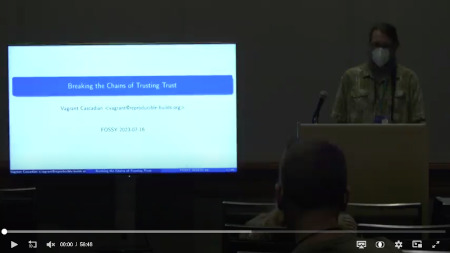
The episode is available to listen (or download) from the Sustain podcast website. As it happens, the episode was recorded at FOSSY 2023, and the video of Vagrant s talk from this conference (Breaking the Chains of Trusting Trust is now available on Archive.org: It was also announced that Vagrant Cascadian will be presenting at the Open Source Firmware Conference in October on the topic of Reproducible Builds All The Way Down.

On our mailing list Carles Pina i Estany wrote to our mailing list during August with an interesting question concerning the practical steps to reproduce the hello-traditional package from Debian. The entire thread can be viewed from the archive page, as can Vagrant Cascadian s reply.

Website updates Rahul Bajaj updated our website to add a series of environment variations related to reproducible builds [ ], Russ Cox added the Go programming language to our projects page [ ] and Vagrant Cascadian fixed a number of broken links and typos around the website [ ][ ][ ].

Software development In diffoscope development this month, versions 247, 248 and 249 were uploaded to Debian unstable by Chris Lamb, who also added documentation for the new specialize_as method and expanding the documentation of the existing specialize as well [ ]. In addition, Fay Stegerman added specialize_as and used it to optimise .smali comparisons when decompiling Android .apk files [ ], Felix Yan and Mattia Rizzolo corrected some typos in code comments [ , ], Greg Chabala merged the RUN commands into single layer in the package s Dockerfile [ ] thus greatly reducing the final image size. Lastly, Roland Clobus updated tool descriptions to mark that the xb-tool has moved package within Debian [ ].
reprotest is our tool for building the same source code twice in different environments and then checking the binaries produced by each build for any differences. This month, Vagrant Cascadian updated the packaging to be compatible with Tox version 4. This was originally filed as Debian bug #1042918 and Holger Levsen uploaded this to change to Debian unstable as version 0.7.26 [ ].

Distribution work In Debian, 28 reviews of Debian packages were added, 14 were updated and 13 were removed this month adding to our knowledge about identified issues. A number of issue types were added, including Chris Lamb adding a new timestamp_in_documentation_using_sphinx_zzzeeksphinx_theme toolchain issue.
In August, F-Droid added 25 new reproducible apps and saw 2 existing apps switch to reproducible builds, making 191 apps in total that are published with Reproducible Builds and using the upstream developer s signature. [ ]
Bernhard M. Wiedemann published another monthly report about reproducibility within openSUSE.

Upstream patches The Reproducible Builds project detects, dissects and attempts to fix as many currently-unreproducible packages as possible. We endeavour to send all of our patches upstream where appropriate. This month, we wrote a large number of such patches, including:

Testing framework The Reproducible Builds project operates a comprehensive testing framework (available at tests.reproducible-builds.org) in order to check packages and other artifacts for reproducibility. In August, a number of changes were made by Holger Levsen:
  • Debian-related changes:
    • Disable Debian live image creation jobs until an OpenQA credential problem has been fixed. [ ]
    • Run our maintenance scripts every 3 hours instead of every 2. [ ]
    • Export data for unstable to the reproducible-tracker.json data file. [ ]
    • Stop varying the build path, we want reproducible builds. [ ]
    • Temporarily stop updating the pbuilder.tgz for Debian unstable due to #1050784. [ ][ ]
    • Correctly document that we are not variying usrmerge. [ ][ ]
    • Mark two armhf nodes (wbq0 and jtx1a) as down; investigation is needed. [ ]
  • Misc:
    • Force reconfiguration of all Jenkins jobs, due to the recent rise of zombie processes. [ ]
    • In the node health checks, also try to restart failed ntpsec, postfix and vnstat services. [ ][ ][ ]
  • System health checks:
    • Detect Debian live build failures due to missing credentials. [ ][ ]
    • Ignore specific types of known zombie processes. [ ][ ]
In addition, Vagrant Cascadian updated the scripts to use a predictable build path that is consistent with the one used on buildd.debian.org. [ ][ ]

If you are interested in contributing to the Reproducible Builds project, please visit our Contribute page on our website. However, you can get in touch with us via:

6 September 2023

Jonathan McDowell: DebConf 23 Key Signing + setting up a new key

I ve just finalised the OpenPGP key list for the DebConf 23 Keysigning party. This will follow the new style approach of being a continuous keysigning throughout the course of the conference, with an introduction session up front to confirm no one s fingerprint is corrupted and that we all calculated the same hash of the file. Participants will then verify each other s identities over the conference week, hopefully being able to build up a better level of verification than a one shot key signing session. Those paying attention will note that my key details have changed this year; I am finally make a concerted effort to migrate to an elliptic curve based key. I managed to bootstrap it sufficiently at OMGWTFBBQ, but I m keen to ensure it s well integrated into the web of trust, so please do come talk to me at DebConf so we can exchange fingerprints!
pub   ed25519 2023-08-19 [C] [expires: 2025-08-18]
      419F B4B6 567E 6EF7 DEAF  80A0 9026 108F B942 BEA4
uid           [ultimate] Jonathan McDowell <noodles@earth.li>
(I ve no reason to suspect problems with my old key and will be making a graceful changeover in the Debian keyring at some point in October after I ve performed the September keyring update; that ll give things a couple of months to catch up before it s my turn to do an update again.)

5 September 2023

Russ Allbery: Review: Before We Go Live

Review: Before We Go Live, by Stephen Flavall
Publisher: Spender Books
Copyright: 2023
ISBN: 1-7392859-1-3
Format: Kindle
Pages: 271
Stephen Flavall, better known as jorbs, is a Twitch streamer specializing in strategy games and most well-known as one of the best Slay the Spire players in the world. Before We Go Live, subtitled Navigating the Abusive World of Online Entertainment, is a memoir of some of his experiences as a streamer. It is his first book. I watch a lot of Twitch. For a long time, it was my primary form of background entertainment. (Twitch's baffling choices to cripple their app have subsequently made YouTube somewhat more attractive.) There are a few things one learns after a few years of watching a lot of streamers. One is that it's a precarious, unforgiving living for all but the most popular streamers. Another is that the level of behind-the-scenes drama is very high. And a third is that the prevailing streaming style has converged on fast-talking, manic, stream-of-consciousness joking apparently designed to satisfy people with very short attention spans. As someone for whom that manic style is like nails on a chalkboard, I am therefore very picky about who I'm willing to watch and rarely can tolerate the top streamers for more than an hour. jorbs is one of the handful of streamers I've found who seems pitched towards adults who don't need instant bursts of dopamine. He's calm, analytical, and projects a relaxed, comfortable feeling most of the time (although like the other streamers I prefer, he doesn't put up with nonsense from his chat). If you watch him for a while, he's also one of those people who makes you think "oh, this is an interestingly unusual person." It's a bit hard to put a finger on, but he thinks about things from intriguing angles. Going in, I thought this would be a general non-fiction book about the behind-the-scenes experience of the streaming industry. Before We Go Live isn't really that. It is primarily a memoir focused on Flavall's personal experience (as well as the experience of his business manager Hannah) with the streaming team and company F2K, supplemented by a brief history of Flavall's streaming career and occasional deeply personal thoughts on his own mental state and past experiences. Along the way, the reader learns a lot more about his thought processes and approach to life. He is indeed a fascinatingly unusual person. This is to some extent an expos , but that's not the most interesting part of this book. It quickly becomes clear that F2K is the sort of parasitic, chaotic, half-assed organization that crops up around any new business model. (Yes, there's crypto.) People who are good at talking other people out of money and making a lot of big promises try to follow a startup fast-growth model with unclear plans for future revenue and hope that it all works out and turns into a valuable company. Most of the time it doesn't, because most of the people running these sorts of opportunistic companies are better at talking people out of money than at running a business. When the new business model is in gaming, you might expect a high risk of sexism and frat culture; in this case, you would not be disappointed. This is moderately interesting but not very revealing if one is already familiar with startup culture and the kind of people who start businesses without doing any of the work the business is about. The F2K principals are at best opportunistic grifters, if not actual con artists. It's not long into this story before this is obvious. At that point, the main narrative of this book becomes frustrating; Flavall recognizes the dysfunction to some extent, but continues to associate with these people. There are good reasons related to his (and Hannah's) psychological state, but it doesn't make it easier to read. Expect to spend most of the book yelling "just break up with these people already" as if you were reading Captain Awkward letters. The real merit of this book is that people are endlessly fascinating, Flavall is charmingly quirky, and he has the rare mix of the introspection that allows him to describe himself without the tendency to make his self-story align with social expectations. I think every person is intriguingly weird in at least some ways, but usually the oddities are smoothed away and hidden under a desire to present as "normal" to the rest of society. Flavall has the right mix of writing skill and a willingness to write with direct honesty that lets the reader appreciate and explore the complex oddities of a real person, including the bits that at first don't make much sense. Parts of this book are uncomfortable reading. Both Flavall and his manager Hannah are abuse survivors, which has a lot to do with their reactions to their treatment by F2K, and those reactions are both tragic and maddening to read about. It's a good way to build empathy for why people will put up with people who don't have their best interests at heart, but at times that empathy can require work because some of the people on the F2K side are so transparently sleazy. This is not the sort of book I'm likely to re-read, but I'm glad I read it simply for that time spent inside the mind of someone who thinks very differently than I do and is both honest and introspective enough to give me a picture of his thought processes that I think was largely accurate. This is something memoir is uniquely capable of doing if the author doesn't polish all of the oddities out of their story. It takes a lot of work to be this forthright about one's internal thought processes, and Flavall does an excellent job. Rating: 7 out of 10

2 September 2023

Junichi Uekawa: September.

September. Looking at performance traces and analysing scheduling and other issues. CPU Cache doesn't really play into effect until I figure out the scheduling issues. They don't collide.

30 August 2023

Andrew Cater: Building a mirror of various Red Hat oriented "stuff"

Building a mirror for rpm-based distributions.
I've already described in brief how I built a mirror that currently mirrors Debian and Ubuntu on a daily basis. That was relatively straightforward given that I know how to install Debian and configure a basic system without a GUI and the ftpsync scripts are well maintained, I can pull some archives and get one pushed to me such that I've always got up to date copies of Debian and Ubuntu.I wanted to do something similar using Rocky Linux to pull in archives for Almalinux, Rocky Linux, CentOS, CentOS Stream and (optionally) Fedora.(This was originally set up using Red Hat Enterprise Linux on a developer's subscription and rebuilt using Rocky Linux so that the machine could be passed on to someone else if necessary. Red Hat 9.1 has moved to x86_64v2 - on the machine I have (HP Microserver gen 8) 9.1 it fails immediately. It has been rebuilt to use Rocky 8.8).This is a minimal install of Rocky as console only - the machine it's on only has 4G of memory so won't run a GUI reliably. It will run Cockpit so can be remotely administered. One user to run everything - mirror.
Minimal install of Rocky 8.7 from DVD .iso. SELinux is enabled, SSH works for remote access. SELinux had to be tweaked to allow /srv/ the appropriate permissions to be served by nginx. /srv is a large LVM volume rather than a RAID 6 - I didn't have enough disks
Adding nginx, enabling Cockpit and editing the Rocky Linux mirroring scripts resulted in something straightforward to reproduce.

nginx

I cheated and stole large parts of my Debian config. The crucial part to remember is that there is no autoindexing by default and I had to dig to find the correct configuration snippet.

# Load configuration files for the default server block.

include /etc/nginx/default.d/*.conf;

location /
autoindex on;
autoindex_exact_size off;
autoindex_format html;
autoindex_localtime off;
# First attempt to serve request as file, then
# as directory, then fall back to displaying a 404.
try_files $uri $uri/ =404;

Rocky Linux mirroring scripts

Systemd unit file for service

[Unit]
Description=Rocky Linux Mirroring script

[Service]
Type=simple
User=mirror
Group=mirror
ExecStart=/usr/local/bin/rockylinux

[Install]
WantedBy=multi-user.target

Rocky linux timer file
[Unit]
Description=Run Rocky Linux mirroring script daily

[Timer]
OnCalendar=*-*-* 08:13:00
OnCalendar=*-*-* 22:13:00
Persistent=true

[Install]
WantedBy=timers.target

Mirror script

#!/bin/env bash
#
# mirrorsync - Synchronize a Rocky Linux mirror
# By: Dennis Koerner <koerner@netzwerge.de>
#

# The latest version of this script can be found at:
# https://github.com/rocky-linux/rocky-tools
#
# Please read https://docs.rockylinux.org/en/rocky/8/guides/add_mirror_manager
# for further information on setting up a Rocky mirror.
#
# Copyright (c) 2021 Rocky Enterprise Software Foundation

This is a very long script in total.
Crucial parts I changed only listed the mirror to pull from and the place to put it.

# A complete list of mirrors can be found at
# https://mirrors.rockylinux.org/mirrormanager/mirrors/Rocky
src="mirrors.vinters.com::rocky"

# Your local path. Change to whatever fits your system.
# $mirrormodule is also used in syslog output.
mirrormodule="rocky-linux"
dst="/srv/$ mirrormodule "

filelistfile="fullfiletimelist-rocky"
lockfile="/home/mirror/rocky.lockfile"
logfile="/home/mirror/rocky.log"

Logfile looks something like this: the single time spec file is used to check whether another rsync needs to be run
deleting 9.1/plus/x86_64/os/repodata/3585b8b5-90e0-4856-9df2-95f646bc62c7-PRIMARY.xml.gz

sent 606,565 bytes received 38,808,194,155 bytes 44,839,746.64 bytes/sec
total size is 1,072,593,052,385 speedup is 27.64
End: Fri 27 Jan 2023 08:27:49 GMT
fullfiletimelist-rocky unchanged. Not updating at Fri 27 Jan 2023 22:13:16 GMT
fullfiletimelist-rocky unchanged. Not updating at Sat 28 Jan 2023 08:13:16 GMT
It was essentially easier to store fullfiletimelist-rocky in /home/mirror than anywhere else.

Very similar small modifications to the Rocky mirroring scripts were used to mirror the other distributions I'm mirroring. (Almalinux, CentOS, CentOS Stream, EPEL and Rocky Linux).

29 August 2023

Jonathan Dowland: Gazelle Twin

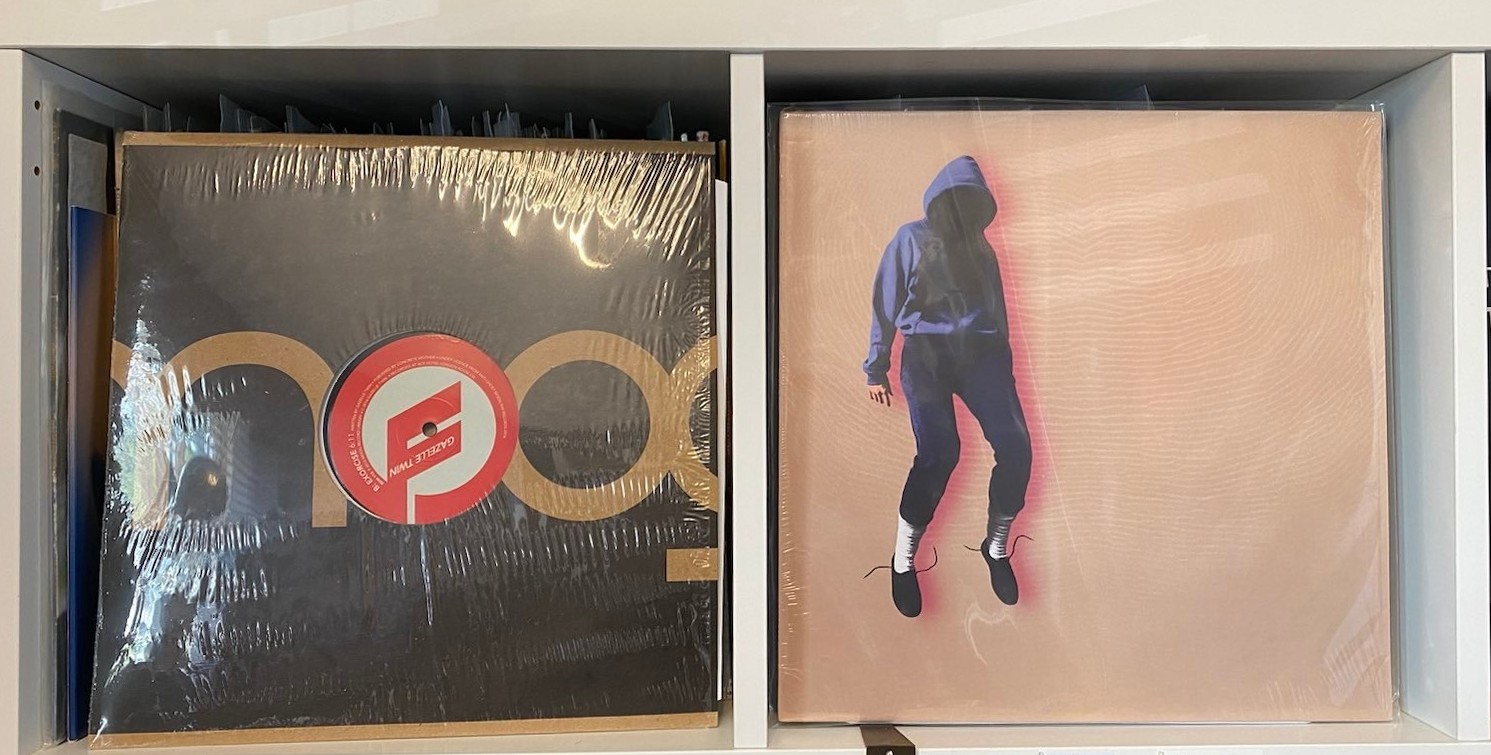
A couple of releases A couple of releases
I discovered Gazelle Twin last year via Stuart Maconie's Freak Zone (two of her tracks ended up on my 2022 Halloween playlist). Through her website I learned of The Horror Show! exhibition at Somerset House1 in London that I managed to visit earlier this year. I've been intending to write a 5-track blog post (a la Underworld, the Cure, Coil) for a while but I have been spurred on by the excellent news that she's got a new album on the way, and, she's performing at the Sage Gateshead in November. Buy tickets now!! Here's the five tracks I recommend to get started:
  1. Anti-Body, from 2014's UNFLESH. I particularly love the percussion. Perc did a good hard-house-style remix on Fleshed Out, the companion remix album. Anti-Body by Gazelle Twin
  2. Fire Leap, from Gazelle Twin and NYX's collaborative album Deep England. The album is a re-interpretation of material from Gazelle Twin's earlier album, Pastoral, with the exception of this track, which is a cover of Paul Giovanni's song from The Wicker Man. There's a common aesthetic in all three works: eerie-folk, England's self-mythologising as seen through a warped and cracked lens. Anti-Body by Gazelle Twin There's a fantastic performance video of the whole album, directed by Iain Forsyth and Jane Pollard, available on YouTube.
  3. Better In My Day, from the aforementioned Pastoral. This track and this album are, I think, less accessible, more challenging than the re-interpreted material. That's not a bad thing: I'm still working on digesting it! This is one of the more abrasive, confrontational tracks. Better In My Day by Gazelle Twin
  4. I am Shell I am Bone, from way back to her first release, The Entire City in 2011. Composed, recorded, self-produced, self-released. It's remarkable to me how different each phase of GT's work are to one another. This album evokes a strong sense of atmosphere and place to me. There's a hint of possible influence of Joy Division's Unknown Pleasures (or New Order's Movement) in places. The b-side to this song is a cover of Joy Division's The Eternal. I Am Shell I Am Bone by Gazelle Twin
  5. GT re-issued This Entire City in 2022 along with a companion-piece EP of newly-released material from the same era, The Wastelands. This isn't cutting room floor stuff, though, as evidenced by the strength of my final pick, Hole in my Heart. Hole In My Heart by Gazelle Twin
It's hard to pick just five tracks when doing these (that's the point I suppose). I note that I haven't picked anything from her wide-ranging soundtrack work: her last three or four of her releases have been soundtrack works, released on the well-respected UK label Invada, as will be her forthcoming album. You can find all the released stuff on Gazelle Twin's Bandcamp Page.

  1. I recently learned that PJ Harvey once hosted album sessions in Somerset House, and allowed fans to watch her at work during the recording: https://www.theguardian.com/music/2015/jan/16/pj-harvey-somerset-house-recording-in-progress

Matthew Garrett: Unix sockets, Cygwin, SSH agents, and sadness

Work involves supporting Windows (there's a lot of specialised hardware design software that's only supported under Windows, so this isn't really avoidable), but also involves git, so I've been working on extending our support for hardware-backed SSH certificates to Windows and trying to glue that into git. In theory this doesn't sound like a hard problem, but in practice oh good heavens.

Git for Windows is built on top of msys2, which in turn is built on top of Cygwin. This is an astonishing artifact that allows you to build roughly unmodified POSIXish code on top of Windows, despite the terrible impedance mismatches inherent in this. One is that until 2017, Windows had no native support for Unix sockets. That's kind of a big deal for compatibility purposes, so Cygwin worked around it. It's, uh, kind of awful. If you're not a Cygwin/msys app but you want to implement a socket they can communicate with, you need to implement this undocumented protocol yourself. This isn't impossible, but ugh.

But going to all this trouble helps you avoid another problem! The Microsoft version of OpenSSH ships an SSH agent that doesn't use Unix sockets, but uses a named pipe instead. So if you want to communicate between Cygwinish OpenSSH (as is shipped with git for Windows) and the SSH agent shipped with Windows, you need something that bridges between those. The state of the art seems to be to use npiperelay with socat, but if you're already writing something that implements the Cygwin socket protocol you can just use npipe to talk to the shipped ssh-agent and then export your own socket interface.

And, amazingly, this all works? I've managed to hack together an SSH agent (using Go's SSH agent implementation) that can satisfy hardware backed queries itself, but forward things on to the Windows agent for compatibility with other tooling. Now I just need to figure out how to plumb it through to WSL. Sigh.

comment count unavailable comments

27 August 2023

Gunnar Wolf: Interested in adopting the RPi images for Debian?

Back in June 2018, Michael Stapelberg put the Raspberry Pi image building up for adoption. He created the first set of unofficial, experimental Raspberry Pi images for Debian. I promptly answered to him, and while it took me some time to actually warp my head around Michael s work, managed to eventually do so. By December, I started pushing some updates. Not only that: I didn t think much about it in the beginning, as the needed non-free pacakge was called raspi3-firmware, but By early 2019, I had it running for all of the then-available Raspberry families (so the package was naturally renamed to raspi-firmware). I got my Raspberry Pi 4 at DebConf19 (thanks to Andy, who brought it from Cambridge), and it soon joined the happy Debian family. The images are built daily, and are available in https://raspi.debian.net. In the process, I also adopted Lars great vmdb2 image building tool, and have kept it decently up to date (yes, I m currently lagging behind, but I ll get to it soonish ). Anyway This year, I have been seriously neglecting the Raspberry builds. I have simply not had time to regularly test built images, nor to debug why the builder has not picked up building for trixie (testing). And my time availability is not going to improve any time soon. We are close to one month away from moving for six months to Paran (Argentina), where I ll be focusing on my PhD. And while I do contemplate taking my Raspberries along, I do not forsee being able to put much energy to them. So This is basically a call for adoption for the Raspberry Debian images building service. I do intend to stick around and try to help. It s not only me (although I m responsible for the build itself) we have a nice and healthy group of Debian people hanging out in the #debian-raspberrypi channel in OFTC IRC. Don t be afraid, and come ask. I hope giving this project in adoption will breathe new life into it!

25 August 2023

Scarlett Gately Moore: KDE Snaps Weekly report, Debian recommenced!

Now that all the planets are fixed, please see what you missed here! /https://www.scarlettgatelymoore.dev/kde-a-day-in-the-life-the-kde-snapcrafter-part-2/ EXTREMELY IMPORTANT: I am still looking for a super awesome team lead for a super amazing project involving KDE and Snaps. Time is running out and well the KDE world will be a better a better place if this project goes through! I would like to clarify, this is a paid position! A current KDE developer would be ideal as it is a small team so your time will be split managing and coding alike. If you or anyone you know might be interested please contact me ASAP! Lots of news on the snap front 23.04.3 is now complete with new snaps! I know, just in time for 23.08.0. I have fixed some major issues in this release, 23.08 should go much quicker. Even quicker if my per repo snapcraft files gets approved! We have more PIM snaps, however I am waiting for reserved name approvals from the snap store. I was approached to decouple qt and frameworks sdk snaps and I have agreed for the fact that security updates are near impossible when new versions are released. Conversation here: https://forum.snapcraft.io/t/proposal-for-changes-to-kde-content-snap-and-extension I have started qt5 here https://github.com/ScarlettGatelyMoore/qt-5-15-10-snap And some exciting news I have started the KF6 content pack! I am doing like above and I am using the qt6 content pack Jarred Wilson has made. This is a requirement to start the plasma snap. Progress can be tracked here: https://github.com/ScarlettGatelyMoore/kf6-snap I am still have on on going request for snapcraft files in their respective repositories. While defending my request I have tested some options. Snapcraft files in the repository does allow for proper snap recipes in launchpad by mirroring the repo in launchpad -> create snap recipe. I created a recipe based on stable branch and it created and published the snap as expected. After being pointed to the flatpak workflow I discovered snaps has a similiar store feature with github, however I will need to create a github repo for each snap, which is tempting. I want to avoid duplication of snapcraft files, but I guess this is what they do for flatpak? I never received an answer. Snapcraft: Some more tidying of the qmake plugin and resolved some review conversations. Debian! I am back to getting things in Debian proper, starting with the golang packages I was working on for bubble-gum a cool console beautification application. As each one passes through NEW I will keep uploading. I will be checking in with the qt-kde team to see what needs doing. I am looking into seeing if openvoices is still a viable replacement for mycroft, hopefully all that work isn t wasted time. And finally, I do hate having to ask, but as we quickly approach September, I have not come close to enough to pay my pesky bills, required to have a place to live and eat! I am seeking employment as a backup if my amazing project falls through. I tried to enable ads, but that broke my planet feeds, I can t have that! So without further ado Anything helps! Also please share! Thanks for your consideration.

Debian Brasil: Debian Day 30 anos online no Brasil

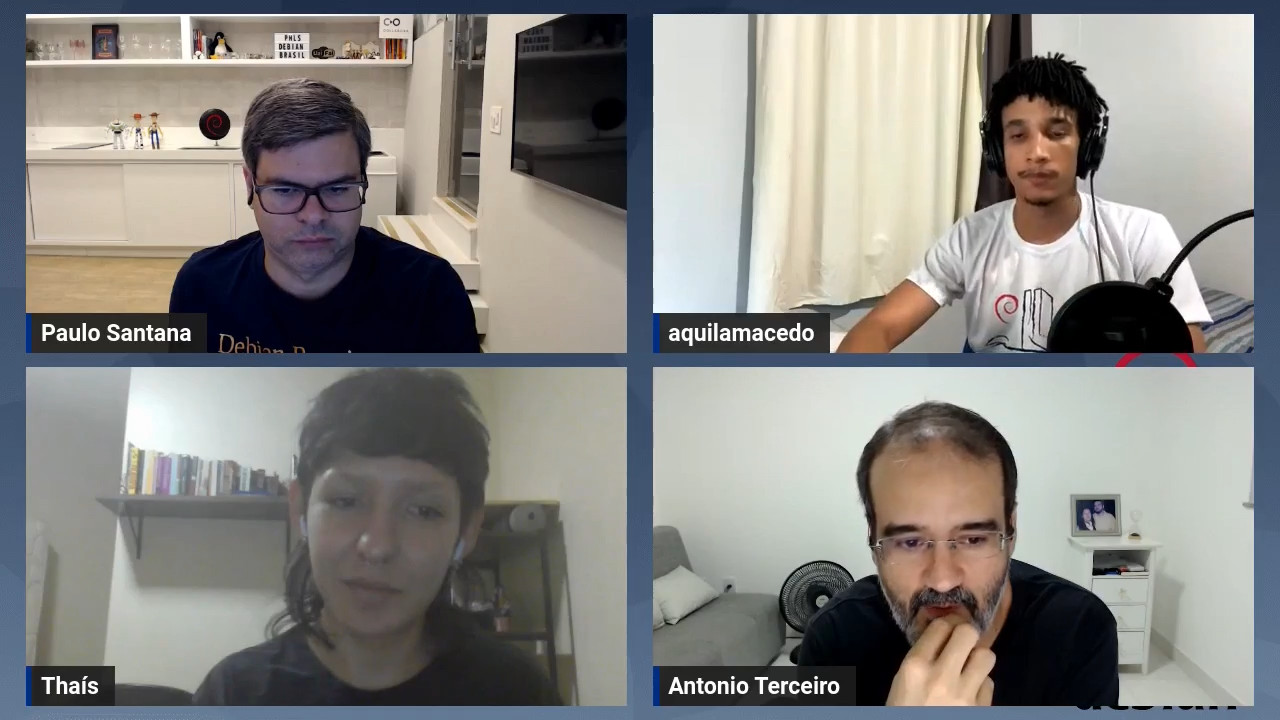
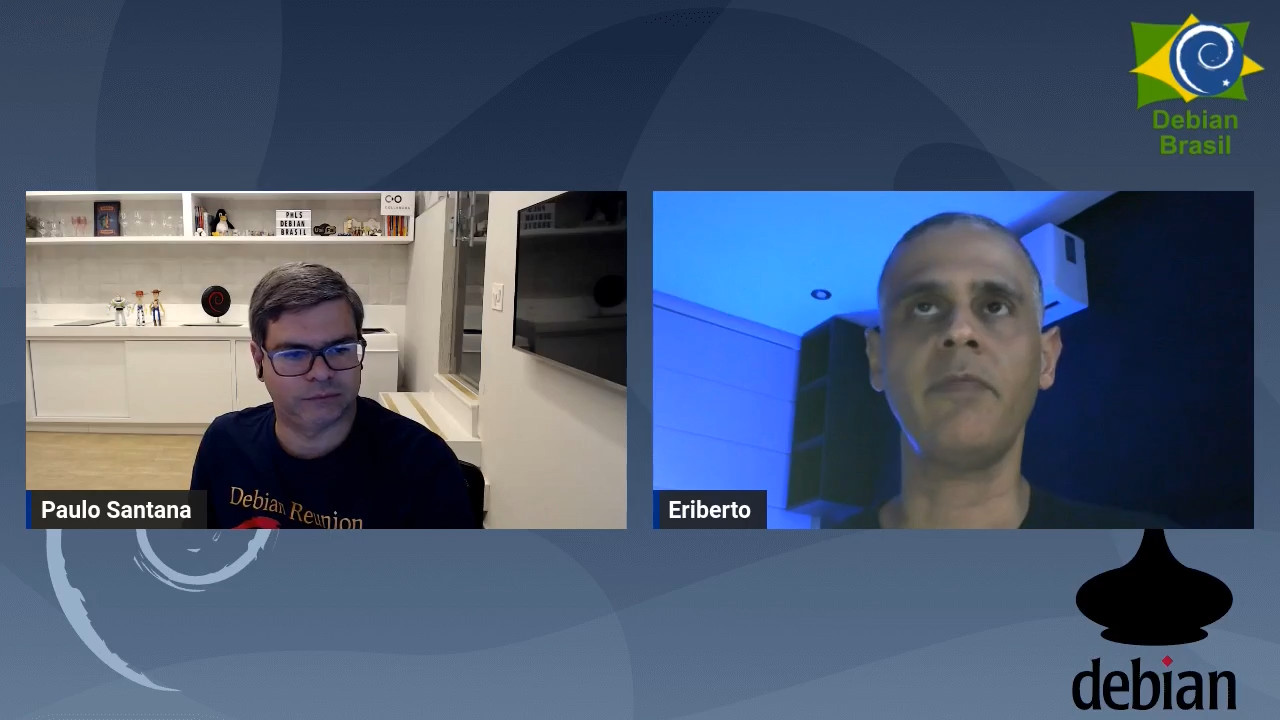
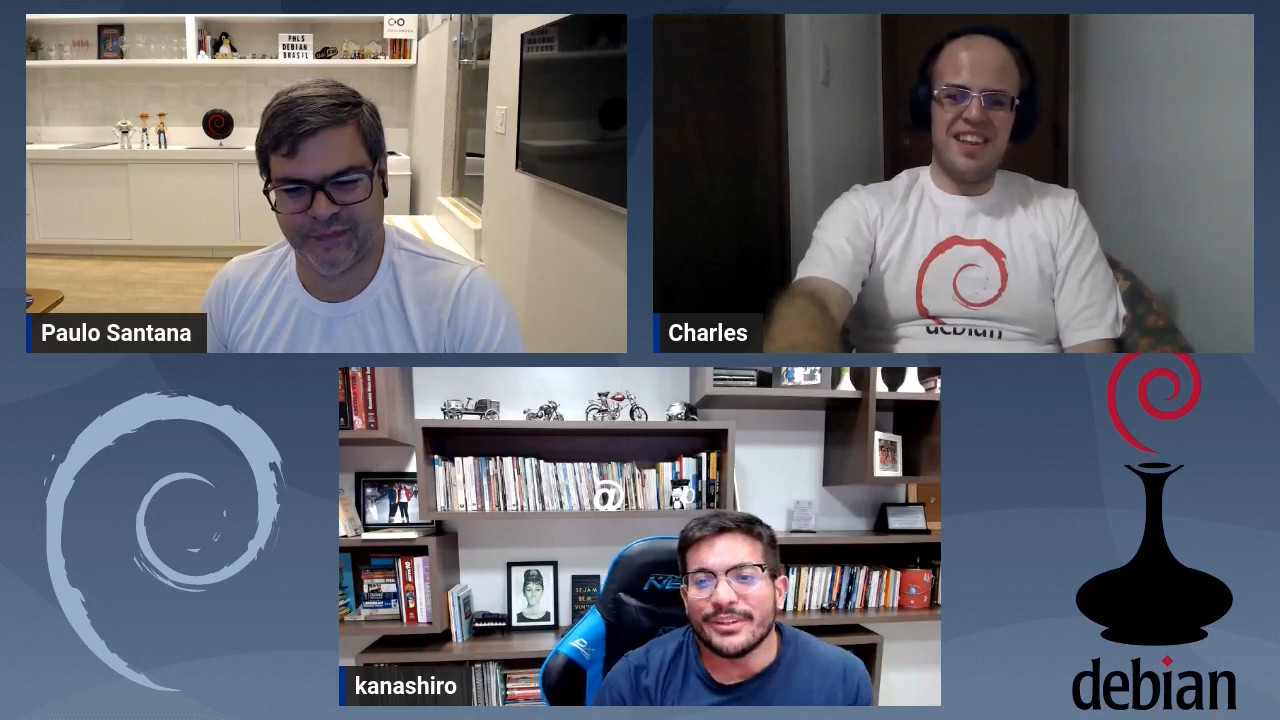
Em 2023 o tradicional Debian Day est sendo celebrado de forma especial, afinal no dia 16 de agostoo Debian completou 30 anos! Para comemorar este marco especial na vida do Debian, a comunidade Debian Brasil organizou uma semana de palestras online de 14 a 18 de agosto. O evento foi chamado de Debian 30 anos. Foram realizadas 2 palestras por noite, das 19h s 22h, transmitidas pelo canal Debian Brasil no YouTube totalizando 10 palestras. As grava es j est o dispon veis tamb m no canal Debian Brasil no Peertube. Nas 10 atividades tivemos as participa es de 9 DDs, 1 DM, 3 contribuidores(as). A audi ncia ao vivo variou bastante, e o pico foi na palestra sobre preseed com o Eriberto Mota quando tivemos 47 pessoas assistindo. Obrigado a todos(as) participantes pela contribui o que voc s deram para o sucesso do nosso evento. Veja abaixo as fotos de cada atividade: Nova gera o: uma entrevista com iniciantes no projeto Debian
Nova gera o: uma entrevista com iniciantes no projeto Debian Instala o personalizada e automatizada do Debian com preseed
Instala o personalizada e automatizada do Debian com preseed Manipulando patches com git-buildpackage
Manipulando patches com git-buildpackage debian.social: Socializando Debian do jeito Debian
debian.social: Socializando Debian do jeito Debian Proxy reverso com WireGuard
Proxy reverso com WireGuard Celebra o dos 30 anos do Debian!
Celebra o dos 30 anos do Debian! Instalando o Debian em disco criptografado com LUKS
Instalando o Debian em disco criptografado com LUKS O que a equipe de localiza o j  conquistou nesses 30 anos
O que a equipe de localiza o j conquistou nesses 30 anos Debian - Projeto e Comunidade!
Debian - Projeto e Comunidade! Design Gr fico e Software livre, o que fazer e por onde come ar
Design Gr fico e Software livre, o que fazer e por onde come ar

Ian Jackson: I cycled to all the villages in alphabetical order

This last weekend I completed a bike rides project I started during the first Covid lockdown in 2020: I ve cycled to every settlement (and radio observatory) within 20km of my house, in alphabetical order. Stir crazy In early 2020, during the first lockdown, I was going a bit stir crazy. Clare said you re going very strange, you have to go out and get some exercise . After a bit of discussion, we came up with this plan: I d visit all the local villages, in alphabetical order. Choosing the radius I decided that I would pick a round number of kilometers, as the crow flies, from my house. 20km seemed about right. 25km would have included Ely, which would have been nice, but it would have added a great many places, all of them quite distant. Software I wrote a short Rust program to process OSM data into a list of places to visit, and their distances and bearings. You can download a tarball of the alphabetical villages scanner. (I haven t published the git history because it has my house s GPS coordinates in it, and because I committed the output files from which that location can be derived.) The Rides I set off on my first ride, to Aldreth, on Sunday the 31st of May 2020. The final ride collected Yelling, on Saturday the 19th of August 2023. I did quite a few rides in June and July 2020 - more than one a week. (I d read the lockdown rules, and although some of the government messaging said you should stay near your house, that wasn t in the legislation. Of course I didn t go into any buildings or anything.) I m not much of a morning person, so I often set off after lunch. For the longer rides I would usually pack a picnic. Almost all of the rides I did just by myself. There were a handful where I had friends along: Dry Drayton, which I collected with Clare, at night. I held my bike up so the light shone at the village sign, so we could take a photo of it. Madingley, Melbourn and Meldreth, which was quite an expedition with my friend Ben. We went out as far as Royston and nearby Barley (both outside my radius and not on my list) mostly just so that my project would have visited Hertfordshire. The Hemingfords, where I had my friend Matthew along, and we had a very nice pub lunch. Girton and Wilburton, where I visited friends. Indeed, I stopped off in Wilburton on one or two other occasions. And, of course, Yelling, for which there were four of us, again with a nice lunch (in Eltisley). I had relatively little mechanical trouble. My worst ride for this was Exning: I got three punctures that day. Luckily the last one was close to home. I often would stop to take lots of photos en-route. My mum in particular appreciated all the pretty pictures. Rules I decided on these rules: I would cycle to each destination, in order, and it would count as collected if I rode both there and back. I allowed collecting multiple villages in the same outing, provided I did them in the right order. (And obviously I was allowed to pass through places out of order, without counting them.) I tried to get a picture of the village sign, where there was one. Failing that, I got a picture of something in the village with the village s name on it. I think the only one I didn t manage this for was Westley Bottom; I had to make do with the word Westley on some railway level crossing equipment. In Barway I had to make do with a planning application, stuck to a pole. I tried not to enter and leave a village by the same road, if possible. Edge cases I had to make some decisions: I decided that I would consider the project complete if I visited everywhere whose centre was within my radius. But the centre of a settlement is rather hard to define. I needed a hard criterion for my OpenStreetMap data mining: a place counted if there was any node, way or relation, with the relevant place tag, any part of which was within my ambit. That included some places that probably oughtn t to have counted, but, fine. I also decided that I wouldn t visit suburbs of Cambridge, separately from Cambridge itself. I don t consider them separate settlements, at least, not if they re conurbated with Cambridge. So that excluded Trumpington, for example. But I decided that Girton and Fen Ditton were (just) separable. Although the place where I consider Girton and Cambridge to nearly touch, is administratively well inside Girton, I chose to look at land use (on the ground, and in OSM data), rather than administrative boundaries. But I did visit both Histon and Impington, and all each of the Shelfords and Stapleford, as separate entries in my list. Mostly because otherwise I d have to decide whether to skip (say) Impington, or Histon. Whereas skipping suburbs of Cambridge in favour of Cambridge itself was an easy decision, and it also got rid of a bunch of what would have been quite short, boring, urban expeditions. I sorted all the Greats and Littles under G and L, rather than (say) Shelford, Great , which seemed like it would be cheating because then I would be able to do Shelford, Great and Shelford, Little in one go. Northstowe turned from mostly a building site into something that was arguably a settlement, during my project. It wasn t included in the output of my original data mining. Of course it s conurbated with Oakington - but happily, Northstowe inserts right before Oakington in the alphabetical list, so I decided to add it, visiting both the old and new in the same day. There are a bunch of other minor edge cases. Some villages have an outlying hamlet. Mostly I included these. There are some individual farms, which I generally didn t count. Some stats I visited 150 villages plus the Lords Bridge radio observatory. The project took 3 years and 3 months to complete. There were 96 rides, totalling about 4900km. So my mean distance was around 51km. The median distance per ride was a little higher, at around 52 km, and the median duration (including stoppages) was about 2h40. The total duration, if you add them all up, including stoppages, was about 275h, giving a mean speed including photo stops, lunches and all, of 18kph. The longest ride was 89.8km, collecting Scotland Farm, Shepreth, and Six Mile Bottom, so riding across the Cam valley. The shortest ride was 7.9km, collecting Cambridge (obviously); and I think that s the only one I did on my Brompton. The rest were all on my trusty Thorn Audax. My fastest ride (ranking by distance divided by time spent in motion) was to collect Haddenham, where I covered 46.3km in 1h39, giving an average speed in motion of 28.0kph. The most I collected in one day was 5 places: West Wickham, West Wratting, Westley Bottom, Westley Waterless, and Weston Colville. That was the day of the Wests. (There s only one East: East Hatley.) Map Here is a pretty picture of all of my tracklogs:
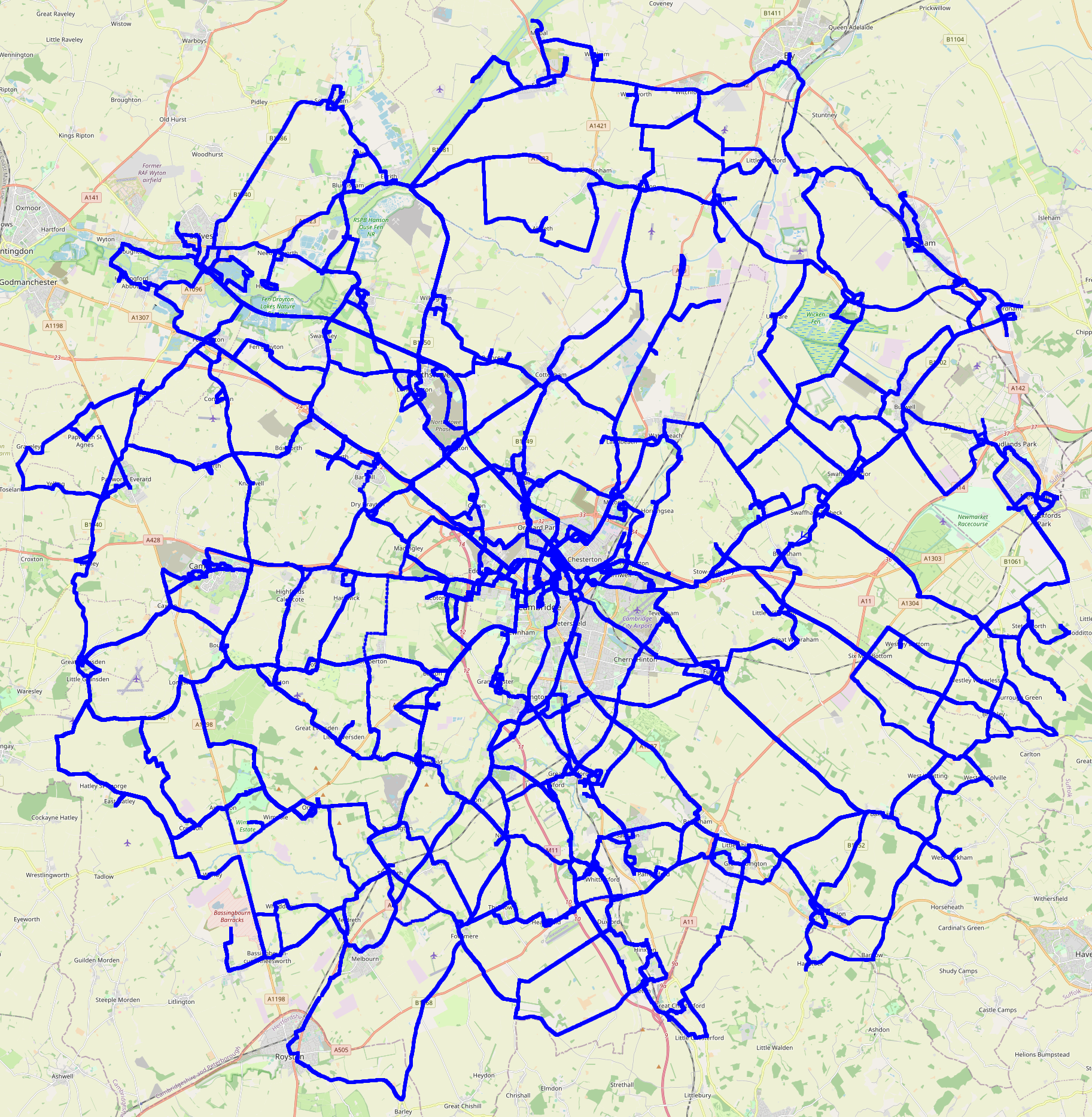
Edited 2023-08-25 01:32 BST to correct a slip.


comment count unavailable comments

24 August 2023

Debian Brasil: Debian Day 30 years in Belo Horizonte - Brazil

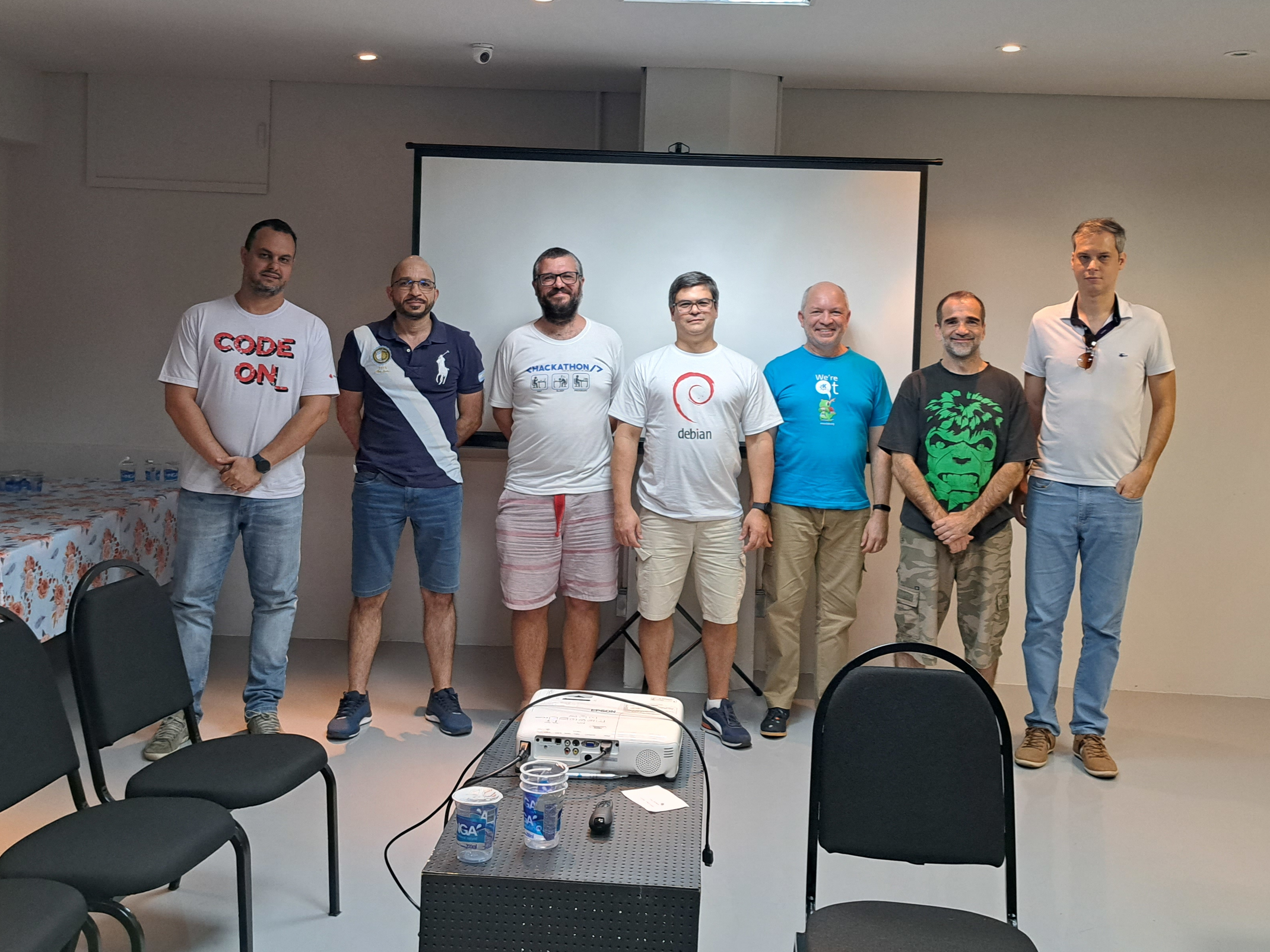
For the first time, the city of Belo Horizonte held a Debian Day to celebrate the anniversary of the Debian Project. The communities Debian Minas Gerais and Free Software Belo Horizonte and Region felt motivated to celebrate this special date due the 30 years of the Debian Project in 2023 and they organized a meeting on August 12nd in UFMG Knowledge Space. The Debian Day organization in Belo Horizonte received the important support from UFMG Computer Science Department to book the room used by the event. It was scheduled three activities: In total, 11 people were present and we took a photo with those who stayed until the end. Presentes no Debian Day 2023 em BH

Debian Brasil: Debian Day 30 anos em Belo Horizonte

Pela primeira vez a cidade de Belo Horizonte realizou um Debian Day para celebrar o anivers rio do Projeto Debian. As comunidades Debian Minas Gerais e Software Livre de BH e Regi o se sentiram motivadas para celebrar esta data especial devido aos 30 anos do Projeto Debian em 2023 e organizou um encontro no dia 12 de agosto dentro Espa o do Conhecimento da UFMG. A organiza o do Debian Day em Belo Horizonte recebeu o importante apoio do Departamento de Ci ncia da Computa o da UFMG para reservar a sala que foi utilizada para o evento. A programa o contou com tr s atividades: No total etiveram presentes 11 pessoas e fizemos uma foto com as que ficaram at o final. Presentes no Debian Day 2023 em BH

Debian Brasil: Debian Day 30 years in Curitiba - Brazil

As we all know, this year is a very special year for the Debian project, the project turns 30!
The Brazilian Community joined in and during the anniversary week, organized some online activities through the Debian Brasil YouTube channel.
Information about talks given can be seen on the commemoration website.
Talks are also have been published individually on the Debian social Peertube and Youtube. After this week of celebration, the Debian Community in Curitiba, decided to get together for a lunch for confraternization among some local members.
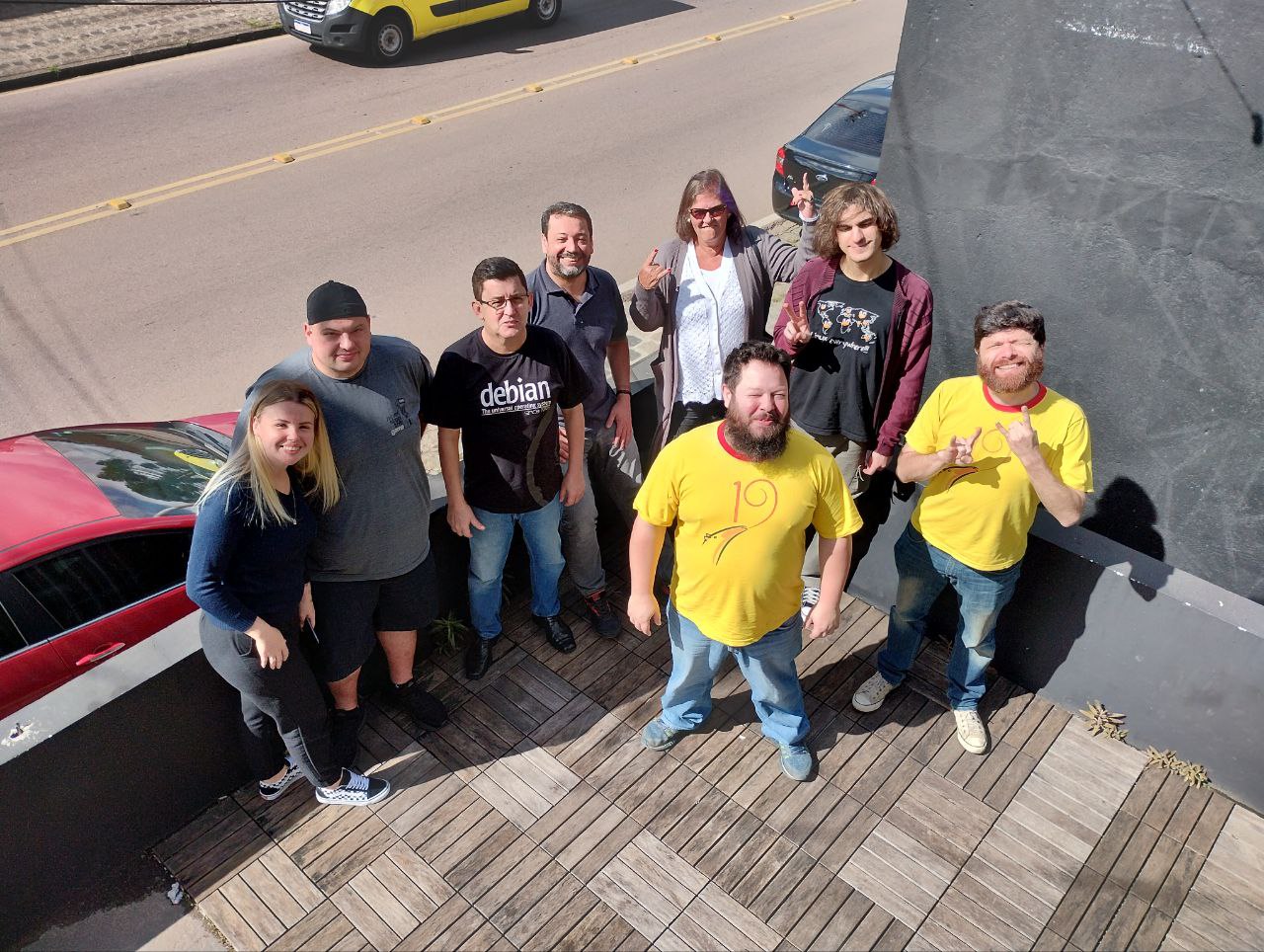
The confraternization took place at The Barbers restaurant. The local menu was a traditional Feijoada (Rice, Beans with pork meat, fried banana, cabbage, orange and farofa). The meeting took place with a lot of laughs, conversations, fun, caipirinha and draft beer! We can only thank the Debian Project for providing great moments! A small photographic record of the people present! Group photo

Lukas M rdian: Netplan v0.107 is now available

I m happy to announce that Netplan version 0.107 is now available on GitHub and is soon to be deployed into a Linux installation near you! Six months and more than 200 commits after the previous version (including a .1 stable release), this release is brought to you by 8 free software contributors from around the globe.

Highlights Highlights of this release include the new configuration types for veth and dummy interfaces:
network:
  version: 2
  virtual-ethernets:
    veth0:
      peer: veth1
    veth1:
      peer: veth0
  dummy-devices:
    dm0:
      addresses:
        - 192.168.0.123/24
      ...
Furthermore, we implemented CFFI based Python bindings on top of libnetplan s API, that can easily be consumed by 3rd party applications (see full cffi-bindings.py example):
from netplan import Parser, State, NetDefinition
from netplan import NetplanException, NetplanParserException

parser = Parser()
# Parse the full, existing YAML config hierarchy
parser.load_yaml_hierarchy(rootdir='/')
# Validate the final parser state
state = State()
try:
    # validation of current state + new settings
    state.import_parser_results(parser)
except NetplanParserException as e:
    print('Error in', e.filename, 'Row/Col', e.line, e.column, '->', e.message)
except NetplanException as e:
    print('Error:', e.message)
# Walk through ethernet NetdefIDs in the state and print their backend
# renderer, to demonstrate working with NetDefinitionIterator &
# NetDefinition
for netdef in state.ethernets.values():
    print('Netdef', netdef.id, 'is managed by:', netdef.backend)
    print('Is it configured to use DHCP?', netdef.dhcp4 or netdef.dhcp6)

Changelog:

Bug fixes:

23 August 2023

Jo Shields: Retirement

Apparently it s nearly four years since I last posted to my blog. Which is, to a degree, the point here. My time, and priorities, have changed over the years. And this lead me to the decision that my available time and priorities in 2023 aren t compatible with being a Debian or Ubuntu developer, and realistically, haven t been for years. As of earlier this month, I quit as a Debian Developer and Ubuntu MOTU. I think a lot of my blogging energy got absorbed by social media over the last decade, but with the collapse of Twitter and Reddit due to mismanagement, I m trying to allocate more time for blog-based things instead. I may write up some of the things I ve achieved at work (.NET 8 is now snapped for release Soon ). I might even blog about work-adjacent controversial topics, like my changed feelings about the entire concept of distribution packages. But there s time for that later. Maybe. I ll keep tagging vaguely FOSS related topics with the Debian and Ubuntu tags, which cause them to be aggregated in the Planet Debian/Ubuntu feeds (RSS, remember that from the before times?!) until an admin on those sites gets annoyed at the off-topic posting of an emeritus dev and deletes them. But that s where we are. Rather than ignore my distro obligations, I ve admitted that I just don t have the energy any more. Let someone less perpetually exhausted than me take over. And if they don t, maybe that s OK too.

Next.

Previous.