Search Results: "ag"

26 December 2014

Vasudev Kamath: Notes: LXC How-To

LXC - Linux Containers allows us to run multiple isolated Linux system under same control host. This will be useful for testing application without changing our existing system. To create an LXC container we use the lxc-create command, it can accepts the template option, with which we can choose the OS we would like to run under the virtual isolated environment. On a Debian system I see following templates supported
[vasudev@rudra: ~/ ]% ls /usr/share/lxc/templates
lxc-alpine*    lxc-archlinux*  lxc-centos*  lxc-debian*    lxc-fedora*  lxc-openmandriva*  lxc-oracle*  lxc-sshd*    lxc-ubuntu-cloud*
lxc-altlinux*  lxc-busybox*    lxc-cirros*  lxc-download*  lxc-gentoo*  lxc-opensuse*      lxc-plamo*   lxc-ubuntu*
For my application testing I wanted to create a Debian container for my By default the template provided by lxc package creates Debian stable container. This can be changed by passing the option to debootstrap after -- as shown below.
sudo MIRROR=http://localhost:9999/debian lxc-create -t debian \
     -f   container.conf -n container-name -- -r sid
-r switch is used to specify the release, MIRROR environment variable is used to choose the required Debian mirror. I wanted to use my own local approx installation, so I can save some bandwidth. container.conf is the configuration file used for creating the LXC, in my case it contains basic information on how container networking should b setup. The configuration is basically taken from LXC Debian wiki
lxc.utsname = aptoffline-dev
lxc.network.type = veth
lxc.network.flags = up
lxc.network.link = br0.1
lxc.network.name = eth0
lxc.network.ipv4 = 192.168.3.2/24
lxc.network.veth.pair = vethvm1
I'm using VLAN setup described in Debian wiki: LXC VLAN Networking page. Below is my interfaces file.
iface eth0.1 inet manual
iface br0.1  inet manual
   bridge_ports eth0.1
   bridge_fd 0
   bridge_maxwait 0
Before launching the LXC make sure you run below command
sudo ifup eth0.1
sudo ifup br0.1
# Also give ip to bridge in same subnet as lxc.network.ipv4
sudo ip addr add 192.168.3.1/24 dev br0.1
I'm giving ip address to bridge so that I can communicate with container from my control host, once it comes up. Now start the container using below command
sudo lxc-start -n container -d -c tty8
We are starting lxc in daemon mode and attaching it to console tty8. If you want, you can drop -d and -c option to start lxc in foreground. But its better you start it in background and attach using lxc-console command shown below.
sudo lxc-console -n container -t tty8
You can detach from console using Ctrl+a q combination and let lxc execute in background. Its also possible to simply ssh into the running container since we have enabled networking. Stopping the container should be done using lxc-stop command, but without -k switch (kill) this command never returned. Even with timeout container is not stopped.
sudo lxc-stop -n container
-r can be used for reboot of container. Since I couldn't get clean shutdown I normally attach the console and issue a halt command in container itself. Not sure if this is the right way, but it gets the thing done. I consider Linux container as a better alternative for spawning a virtual Linux environment instead of running a full blown VM like Virtualbox or VMware.

Russ Allbery: rra-c-util 5.6

rra-c-util is my personal collection of infrastructure for C and Perl packages. This release has a quite-large accumulation of small fixes, mostly from work Julien LIE has done on merging it into INN and testing INN's portability on a wide variety of platforms. The highlights: You can get the latest version from the rra-c-util distribution page.

25 December 2014

Dirk Eddelbuettel: rfoaas 0.0.4.20141225 -- not on CRAN

A new version of rfoaas was prepared for CRAN, but refused on the grounds of having been updated within 24 hours. Oh well. To recap, the rfoaas package provides an interface for R to the most excellent FOAAS service -- which provides a modern, scalable and RESTful web service for the frequent need to tell someone to eff off. And having seen the Christmas Eve (ie December 24) update, upstream immediatly and rather kindly added a new xmas(name, from) function -- so now we could do rfoaas::xmas("CRAN Maintainers") to wish the CRAN Maintainers a very Merry Christmas. So for once, there is no CRANberries report as the package is not on CRAN :-/ There is of course always GitHub. Questions, comments etc should go to the GitHub issue tracker off the GitHub repo.

This post by Dirk Eddelbuettel originated on his Thinking inside the box blog. Please report excessive re-aggregation in third-party for-profit settings.

Russ Allbery: C TAP Harness 3.2

This is a fairly minor release, mostly to have a release of files that I'm updating in rra-c-util. Most of the changes are typos and other cosmetic fixes. But I hate releasing a new version of something without a little bit of new functionality, so I implemented comment support in test lists. The runtests driver now ignores comments (lines starting with #) and blank lines in test list files, and leading whitespace in front of test names. You can get the latest version from the C TAP Harness distribution page.

Russ Allbery: Review: Bad Pharma

Review: Bad Pharma, by Ben Goldacre
Publisher: Faber and Faber
Copyright: 2012, 2013
Printing: 2014
ISBN: 0-86547-806-6
Format: Trade paperback
Pages: 397
If you have previously read Bad Science by Ben Goldacre, it's doubtful you need me to do anything other than point out that he has a new book. Oh, and it's subtitled How Drug Companies Mislead Doctors and Harm Patients, and it's written with the same indignant determination, clear explanation, and appreciation for real science as Bad Science. If you haven't read Bad Science, I recommend it. You don't have to read it before Bad Pharma, but it's a more approachable start, and a funnier book. Bad Science opens with some obviously horrible examples, and slowly develops the tools required to analyze more advanced and deceptive quackery. Bad Pharma jumps straight into the deep end of statistical biases in data, how and why they're introduced, and why they undermine your health care. This is a more serious book than Bad Science, since it lacks the medical quackery that is so ludicrous it's funny. Everything in Bad Science is successfully sold to someone there are people who believe in candling but most readers of the book can laugh a bit that anyone would believe in such things before getting to the parts of the book where the quackery is widespread and kills people. Bad Pharma focuses on the mainstream pharmaceutical industry and the way that it distorts the scientific process, which leads to serious consequences quite quickly. Goldacre is more pointedly on a mission here than in his previous book. This is not just an expos . It includes detailed recommendations for how to make the drug evaluation process better, and some specific ethical recommendations for doctors to avoid being unduly influenced by drug company marketing. But before that, he provides the best detailed explanation of how the drug research and approval process is supposed to work that I've seen. There's also a lot of good information about how to detect trials and related studies that haven't been done properly, and how to separate marketing language from scientific evidence. Goldacre wisely does not get into all the details of how to do a trial properly, which would be way beyond the scope of this book, but he does provide valuable rules of thumb and red flags that indicate when someone is probably not doing the trial properly. A point that's both frustrating and enlightening, and made very well by this book, is that fixing many of the problems with the drug approval process is not that difficult. Fixing all of them would be exceedingly difficult, of course, since they involve humans, complex financial motivations, the effectiveness of propaganda, and talented people who are paid well to create favorable impressions for new drugs. But we could get quite significant benefits from a few straightforward enhancements of the existing drug approval process, such as requiring that all clinical trials be pre-registered and all trial results published as a prerequisite for any drug approval. Goldacre makes his case for these changes forcefully and persuasively, and with justified anger. The current situation is bad enough for people like me who are only potential patients with no urgent medical issues. For a practicing doctor like Goldacre, it's infuriating to be actively denied the information required to effectively save people's lives. Normally, I find books like this interesting, but depressing and frustratingly limited. It's easy to write books about abuses that currently exist, or the limitations of the current approach. It's much harder to do what Goldacre does here: clearly describe the goals and ideals of drug testing for the lay reader, detail how the current approaches fall short of that goals, and then propose practical and concrete ways to correct the situation. And keep the details interesting and entertaining enough that I enjoyed reading every page of a nearly 400 page book. This is not a book that will fill you with trust or enthusiasm for the medical establishment (anywhere in the world). But it's still oddly comforting: we do know how to do these things properly, and occasionally we even act on that knowledge. These problems are serious, but they should provoke outrage partly because they're correctable and yet aren't being corrected. And there are doctors like Goldacre who are trying to push medicine towards proper use of evidence, research, and knowledge, instead of commercial manipulation. Recommended if you have any interest at all in how medicine or scientific research is actually done, and what its pitfalls look like. Rating: 8 out of 10

Dirk Eddelbuettel: rfoaas 0.0.4.20141224

A new version of rfoaas is now on CRAN. The rfoaas package provides an interface for R to the most excellent FOAAS service -- which provides a modern, scalable and RESTful web service for the frequent need to tell someone to eff off. This is minor update, affecting only the rfoaas side without changes at the FOAAS backend side. We documented that the result may need an encoding update (at least on the World's leading consumer OS), and now provide a default value for from so that many services can be called argument-less, or at least with one argument less than before. Both of these were suggested by Richie Cotton via issue tickets at the GitHub repo. CRANberries also provides a diff to the previous release. Questions, comments etc should go to the GitHub issue tracker off the GitHub repo.

This post by Dirk Eddelbuettel originated on his Thinking inside the box blog. Please report excessive re-aggregation in third-party for-profit settings.

24 December 2014

Chris Lamb: find(1), trailing slashes and symbolic links to directories

Here's a nice little "gotcha" in find(1). First, let's create a directory and a symlink to that directory. We'll add an empty file just underneath to illustrate what is going on:
$ mkdir a
$ ln -s a b
$ touch a/file
If we invoke find with a trailing slash, everything works as expected:
$ find a/
a/
a/file
$ find b/
b/
b/file
... but if we omit the trailing slash, find does not traverse the symlink:
$ find a
a
a/file
$ find b
b
This implies that any normal-looking invokation of find such as:
find /path/to/dir -name 'somefile.ext' ...
... is subtly buggy as it won't accomodate the sysadmin replacing that path with a symlink.
This is, of course, well-covered in the find(1) manpage (spoiler: the safest option is to specify -H, or simply to append the trailing slash), but I would still class this as a "gotcha" because of the subtle difference between the trailing and non-trailing slash variants. Putting it another way, it's completely reasonable that find doesn't follow symlinks, but when this behaviour based on the presence of the trailing slash a usually meaningless syntactic distinction it crosses the rubicon to being counter-intutive.

Joey Hess: generating shell scripts from haskell using a shell monad

Shell script is the lingua franca of Unix, it's available everywhere and often the only reasonable choice to Get Stuff Done. But it's also clumsy and it's easy to write unsafe shell scripts, that forget to quote variables, typo names of functions, etc. Wouldn't it be nice if we could write code in some better language, that generated nicely formed shell scripts and avoided such gotchas? Today, I've built a Haskell monad that can generate shell code. Here's a fairly involved example. This demonstrates several features, including the variadic cmd, the ability to define shell functions, to bind and use shell variables, to build pipes (with the -:- operator), and to factor out generally useful haskell functions like pipeLess and promptFor ...
santa = script $ do
    hohoho <- func $
        cmd "echo" "Ho, ho, ho!" "Merry xmas!"
    hohoho
    promptFor "What's your name?" $ \name -> pipeLess $ do
        cmd "echo" "Let's see what's in" (val name <> quote "'s") "stocking!"
        forCmd (cmd "ls" "-1" (quote "/home/" <> val name)) $ \f -> do
            cmd "echo" "a shiny new" f
            hohoho
    cmd "rm" "/table/cookies" "/table/milk"
    hohoho
pipeLess :: Script () -> Script ()
pipeLess c = c - - cmd "less"
promptFor :: T.Text -> (Var -> Script ()) -> Script ()
promptFor prompt cont = do
    cmd "printf" (prompt <> " ")
    var <- newVar "prompt"
    readVar var
    cont var
When run, that haskell program generates this shell code. Which, while machine-generated, has nice indentation, and is generally pretty readable.
#!/bin/sh
f1 ()   :
    echo 'Ho, ho, ho!' 'Merry xmas!'
 
f1
printf 'What'"'"'s your name?  '
read '_prompt1'
(
    echo 'Let'"'"'s see what'"'"'s in' "$_prompt1"''"'"'s' 'stocking!'
    for _x1 in $(ls '-1' '/home/'"$_prompt1")
    do :
        echo 'a shiny new' "$_x1"
        f1
    done
)   (
    less
)
rm '/table/cookies' '/table/milk'
f1
Santa has already uploaded shell-monad to hackage and git. There's a lot of things that could be added to this library (if, while, redirection, etc), but I can already see using it in various parts of propellor and git-annex that need to generate shell code.

Chris Lamb: 8:20AM. Sunday, 22 December 2013

Running east into the sun, he hadn't seen another human for over half an hour. He navigates Westferry Circus and heads south, cutting from the road through to the riverside pathway. He keeps is breathing steady - no reason to hurry. The wind catches him from Westminster. It smells slightly salty but it's an ersatz attempt, nowhere near bracing enough to be a real sea breeze. Pressing on, the vacant citadel of Canary Wharf disappears behind him. But as the peninsula curves around, a man appears in the distance. Even half a mile away he looks out of place, or rather given the hour time. He's walking purposefully, but it doesn't feel the kind of route someone would be taking to work. He's not wearing quite enough clothes for the weather either, and homeless people are rarely made to feel welcome in the Docklands. His supermarket denim visibly flaps in the breeze. "Relaxed fit", they call it. When he gets within earshot the man cocks his head, not expecting to hear the regular cadence of approaching footsteps. He turns slightly to reveal he's cradling a large bottle of Coca-Cola, meekly wrapped in the swathing bands of two anonymously blue corner-shop plastic bags. The runner eyes the Coke greedily but can quickly see that it has already been opened, tainted. Although only a mouthful or so has gone, a brown froth sloshes against the top of the container. Amateur, he thinks. He'll regret that later. He looks back up to the man, who is now smiling at him. His left hand bccomes visible as he strides: a four-pack of Carling. The man laughs. "Oh, you and me mate are worlds apart!" the man shouts. It's immediately friendly. He starts to raise his Carling as but thinks better of it. It's momentarily awkward. "Worlds apart mate", the man continues. "Have a good one!" The runner smiles back. Only in time, the runner thinks. They both can't stop.

Gunnar Wolf: More on Debian as a social, quasi-familiar project

I have long wanted to echo Gregor's beautiful Debian Advent Calendar posts. Gregor is a dear project member and a dear friend to many of us Debianers, who has shown an amount of stamina and care for the project that inspires everybody; this year, after many harsh flamefests in the project (despite which we are moving at a great rate towards a great release!), many people have felt the need to echo how Debian even as often seen from the outside as a hostile mass of blabbering geeks is actually a great place to work together and to create a deep, strong social fabric And that's quite probably what binds the project together and ensures it will continue existing and excelling for a long time. As for the personal part: This year, my Debian involvement has once again reduced. Not because I care less about Debian, much to the contrary, but because I have taken several responsabilities which require my attention and time. Technically, I'm basically maintaining a couple of PHP-based packages I use for work (most prominently, Drupal7). I have stepped back of most of my DebConf responsabilities, although I stay (and will stay, as it's an area of the project I deeply enjoy doing) involved. And, of course, my current main area of involvement is keyring-maint (for which I have posted here several status updates). I have to say that we expected having a much harder time (read: Stronger opposition and discussions) regarding the expiry of 1024D keys. Of course, many people do have a hard time connecting anew to the web of trust, and we will still face quite a bit of work after January 1st, but the migration has been a mostly pleasant (although clearly intensive) work. Jonathan has just told me we are down to only 306 1024D keys in the keyring (which almost exactly matches the "200-300" I expected back at DC14). Anyway: People predicting doomsday scenarios for Debian do it because they are not familiar with how deep the project runs in us, how important it is socially, almost at a family level, to us that have been long involved in it. Debian is stronger than a technical or political discussion, no matter how harsh it is. And, as a personal thank-you: Gregor, your actions (the GDAC, the RC bug reports) inspire us to stay active, to do our volunteer work better, and remind us of how great is it to be a part of a global, distributed will to Do It Right. Thanks a lot!

Gregor Herrmann: GDAC 2014/24

the last year hasn't been an easy one for debian. we've seen lots of fights, unproductive discussions, & in general behaviour which contributed to what enrico in his brilliant blog post called the "stink in the kitchen". people's feelings were hurt, some became less active, others resigned from a specific position or retired completely. it happened to me as well that reading through threads full of trolling, aggressiveness, finger-pointing, unrespectful or abusive behaviour, etc. made me frustrated, or sad, or angry, or all kinds of other negative feelings. but then I usually told myself: this is not the debian project as I know it; this is only a small part a part which urgently needs improvement! ; but if we only look at it alone, our picture of debian at large is distorted. the much bigger part of the debian life I know doesn't happen on this handful of high-profile mailing lists; it happens on dozens of specialized mailing lists, in many small IRC channels, in the BTS, & in in-person meetings. & what I see there is most of the time constructive, collaborative, respectful communication, & committed, helpful, funny, awesome people. the idea of this advent calendar was to give examples of some of my recent experiences which demonstrate what the bright side of debian is in my opinion & what contributes to my fun in debian. with the aim of sharing my impression that the proverbial "stink" is, if we take a step back, only one piece of the bigger picture, & that we shouldn't let ourselves get demotivated by only staring at this puzzle piece. thanks to all the awesome contributors for polishing existing & adding new shiny puzzle pieces to our common picture every day! finally: thanks for reading this series of posts, & especially thank you to all who provided positive feedback this in turn motivated me to follow through! & now: back to work, & don't forget to help cleaning the kitchen :)
this posting is part of GDAC (gregoa's debian advent calendar), a project to show the bright side of debian & why it's fun for me to contribute.

Benjamin Mako Hill: Images of Japan

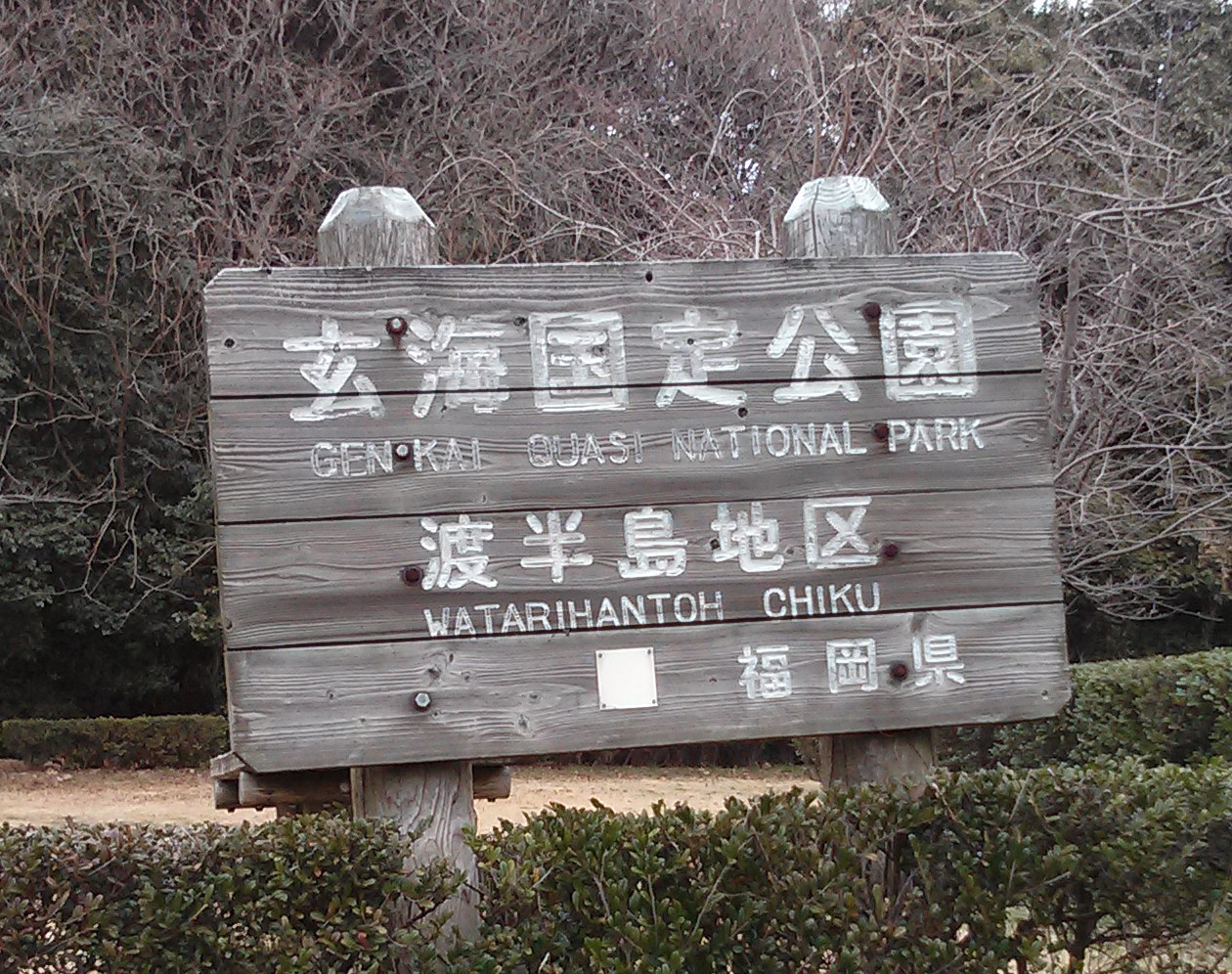
Going through some photos, I was able to revisit some of the more memorable moments of my trip to Japan earlier this year. For example, the time I visited Genkai Quasi National Park a beautiful spot in Fukuoka that had a strong resemblance to, but may not actually have been, a national park. Genkai Quasi National Park There was the time that I saw a Saw a curry fault bread. Saw a Curry Fault Bread And a shrine one could pray at in a barcalounger. Shrine Comfortable Chair There was the also the fact that we had record snowfall while in Tokyo which left the cities drainage system in a rather unhappy state. Japan Unhappy Drain

23 December 2014

Gregor Herrmann: GDAC 2014/23

when I think about debian, one term that comes to my mind is "quality". of course it can be annoying when the ftp-masters REJECT a new package or when potential sponsors nit-pick on packaging details but in general this all leads to our excellent software quality. & yes, I've also seen less-than-excellent packages when working on RC bugs but I still believe that as a whole we strive to Do Things Right . - thanks to all mentors, QA people, ftp-masters, & diligent package maintainers!
this posting is part of GDAC (gregoa's debian advent calendar), a project to show the bright side of debian & why it's fun for me to contribute.

Dirk Eddelbuettel: RcppEigen 0.3.2.3.0

A new release of RcppEigen is now on CRAN, and will get to Debian shortly. This is thanks to a fabulous pull request by Yixuan Qiu who single-handedly managed to upgrade to the new minor release of Eigen -- after having expanded the unit tests a few weeks earlier in another pull request. The NEWS file entry follows.
Changes in RcppEigen version 0.3.2.3.0 (2014-12-22)
  • Updated to version 3.2.3 of Eigen
  • Added a number of additional unit tests for wrap, transform and sparse
  • Updated one of the examples
Courtesy of CRANberries, there is also a diffstat report for the most recent release.

This post by Dirk Eddelbuettel originated on his Thinking inside the box blog. Please report excessive re-aggregation in third-party for-profit settings.

Ulrike Uhlig: How to contribute to the AppArmor upstream profiles

If you want to contribute to existing/upstream AppArmor profiles, you need to create an account on Canonical s launchpad. You ll also need to upload an SSH key to be able to push your changes. You will also need to install Canonical s version control system, called Bazaar:
apt-get install bzr
Go or create a repository where you want to checkout the changes:
mkdir apparmor-dev
cd apparmor-dev
bzr branch lp:apparmor-profiles master
ls master
Define your identity like this:
bzr whoami "My Name <my@email.com>"
Bazaar does not handle branches like Git does, unfortunately. It is a little bit weird in first place that you will need to create a directory where you would create a copy of the master branch. You would then work on this branch and later ask for a merge and pull into the master branch.
mkdir myname
bzr branch master myname/pidgin
ls myname/pidgin
Then, start modifying the profiles using a test editor and test them. Testing is done through dis/enabling the profile.
Once done, you can push the changes to your distant repository:
bzr push
Then, you need to connect to Launchpad s web interface. Go to your page, and look for the branch you just pushed. Click on change branch details and link the branch to apparmor-profiles. Then you will be able to do a merge request through the webinterface.

Ulrike Uhlig: How does my AppArmor profile get into Debian?

I have spent the last days trying to understand the relationship between AppArmor, the AppArmor profiles and Debian s AppArmor profiles. Let me try to briefly introduce you to this. First of all, let me emphasize that one needs to distinguish between AppArmor, the kernel module, and the AppArmor profiles, which define rules for application confinement. As stated on the project s wiki:
The AppArmor project source is split between the kernel module, available in the Linux kernel and git development tree and the user space tools available in launchpad.
So, we can find the upstream AppArmor profile development taking place at Canonical s launchpad. The profiles which are developed there serve as a basis for those included in Debian. It is thus useful to try to contribute to this upstream when updating a profile for Debian. Since AppArmor 2.9 has been introduced, the rules of a profiles which are not applicable for a system are ignored. Thus, collaboration between different Linux distributions shipping AppArmor will become much simpler. In the aforementioned Ubuntu repository you can find the profiles that are currently in development. Once tested and ready, they are removed from this repository and finally included into the corresponding package. For example, the profile for Evince, the GNOME PDF viewer, is available in the evince package. In Debian on the contrary, there are only some packages which ship their own profiles. This concernes for example bind, clamav, cups, tor.
But many profiles are not yet included with their package, but instead delivered through the apparmor-profiles and apparmor-profiles-extra packages. These are maintained by the the Debian AppArmor packaging team. The team takes care of merging changes from the upstream profiles into Debian. Today, the relationship between Upstream and Debian looks like this:

Upstream/bzr

Debian source package

Debian binary package

Ubuntu source package

Ubuntu binary package

apparmor

apparmor

apparmor-profiles

-

-

apparmor-profiles

apparmor-profiles-extra

apparmor-profiles-extra

-

-

ubuntu-evince

apparmor-profiles-extra

apparmor-profiles-extra

evince

evince

In the future, this should change. It would indeed be desirable that package maintainers include profiles with the packages they maintain and take care of updating them accordingly when the package itself is updated. It is much more logical to to it that way, as changes in a package like Pidgin or Evince can occur at a different point in time then when the apparmor-profiles-extra package is updated. I started working on a documentation for Debian Package Maintainers which describes how to do this.

Vincent Bernat: Eudyptula Challenge: superfast Linux kernel booting

The Eudyptula Challenge is a series of programming exercises for the Linux kernel, that start from a very basic Hello world kernel module, moving on up in complexity to getting patches accepted into the main Linux kernel source tree.
One of the first tasks of this quite interesting challenge is to compile and boot your own kernel. eudyptula-boot is a self-contained shell script to boot any kernel image to a shell. It is packed with the following features: In the following video, eudyptula-boot is used to boot the host kernel and execute a few commands:
In the next one, we use it to boot a custom kernel with an additional system call. This is the fifteenth task of the Eudyptula Challenge. A test program is used to check that the system call is working as expected. Additionaly, we demonstrate how to attach a debugger to the running kernel.
While this hack could be used to run containers3 with an increased isolation, the performance of the 9p filesystem is unfortunately quite poor.

  1. The only requirement is to have 9p virtio support enabled. This can easily be enabled with make kvmconfig.
  2. Only udev is started.
  3. A good way to start a container is to combine --root, --force and --exec parameters. Add --readwrite to the mix if you want to keep the modifications.

Michael Stapelberg: Debian Code Search: taming the latency tail

It s been a couple of weeks since I ve launched Debian Code Search Instant, so people have had the chance to use it for a while and that gives me plenty of data points to look at :-). For every query, I log the search term itself as well as the duration the query took to execute. That way, I can easily identify queries that take a long time and see why that is. There is a class of queries for which Debian Code Search (DCS) doesn t perform so well, and that s queries that consist of trigrams which are extremely common. Whenever DCS receives such a query, it needs to search through a lot of files. Note that it doesn t really matter if there are plenty of results or not it s the number of files that potentially contain a result which matters. One such query is arse (we get a lot of curse words). It consists of only two trigrams ( ars and rse ), which are extremely common in program source code. As a couple of examples, the terms parse , sparse , charset and coarse are all matched by that. As an aside, if you really want to search for just arse , use word boundaries, i.e. \barse\b , which also makes the query significantly faster. Fixing the overloaded frontend When DCS first received the query, arse would lead to our frontend server crashing. That was due to (intentionally) unoptimized code we were aggregating all search results from all 6 source backends in memory, sorted them, and then wrote them out to disk. I addressed this in commit d2922fe92 with the following measures:
  1. Instead of keeping the entire result in memory, just write the result to a temporary file on disk ( unsorted.json ) and store pointers into that file in memory, i.e. (offset, length) tuples. In order to sort the results, we also need to store the ranking and the path (to resolve ties and thereby guarantee a stable result order over multiple search queries). For grouping the results by source package, we need to keep the package name.
  2. If you think about it, you don t need the entire path in order to break a tie the hash is enough, as it defines an ordering. That ordering may be different, but any ordering is good enough for the purpose of merely breaking a tie in a deterministic way. I m using Go s hash/fnv, the only non-cryptographic (fast!) hash function that is included in Go s standard library.
  3. Since this was still leading to Out Of Memory errors, I decided to not store a copy of the package name in each search result, but rather use a pointer into a string pool containing all package names. The number of source package names is relatively small, in the order of 20,000, whereas the number of search results can be in the millions. Using the stringpool is a clear win the overhead in the case where #results < #srcpackages is negligible, but as soon as #results > #srcpackages, you save memory.
With all of that fixed, the query became at all possible, albeit with a runtime of around 20 minutes. Double Writing When running such a long-running query, I noticed that the query ran smooth for a while, but then it took multiple seconds without any visible progress at the end of the query before the results appeared. This was due to the frontend ranking the results and then converting unsorted.json into actual result pages. Since we provide results ordered by ranking, but also results grouped by source packages, it was writing every result twice to disk. What s even worse is that due to re-ordering, every read was essentially random (as opposed to sequential reads). What s even worse is that nobody will ever click through all the hundreds of thousands of result pages, so they are prepared entirely in vain. Therefore, with commit c744b236e I made the frontend generate these result pages on demand. This cut down the time for the ranking phase at the end of each query from 20-30 seconds (for big queries) to typically less than one second. Profiling/Monitoring After adding monitoring to each of the source-backends, I realized that during these long-running queries, the disk I/O and network I/O was nowhere near my expectations: each source-backend was sending only a low single-digit number of megabytes per second back to the frontend (typically somewhere between 1 MB/s and 3 MB/s). This didn t match up at all with the bandwidth I observed in earlier performance tests, so I used wget -O /dev/null to send a query and discard the result in order to get some theoretical performance numbers. Suddenly, I was getting more than 10 MB/s worth of results, maxing out the disks with a read rate of about 200 MB/s. So where is the bottleneck? I double-checked that neither the CPU on any of our VMs, nor the network between them was saturated. Note that as of this point, the CPU of the frontend was at roughly 70% (of one core), which didn t seem a lot to me. Then, I followed this excellent tutorial on profiling Go programs to see where the frontend is spending its time. Turns out, the biggest consumer of CPU time was the encoding/json Go package, which is used for deserializing results received from the backend and serializing them again before sending them to the client. Since I was curious about it for a while already, I decided to give cap n proto a try to replace JSON as serialization mechanism for communication between the source backends and the frontend. Switching to it (commit 8efd3b41) brought down the CPU load immensely, and made the query a bit faster. In addition, I killed the next biggest consumer: the lseek(2) syscall, which we used to call with SEEK_CUR and an offset of 0 so that it would tell us the current position. This was necessary in the first place because we don t know in advance how many bytes we re going to write when serializing a result to disk. The replacement is a neat little trick:
type countingWriter int64
func (c *countingWriter) Write(p []byte) (n int, err error)  
    *c += countingWriter(len(p))
    return len(p), nil
 
// [ ]
// Then, use an io.MultiWriter like this:
var written countingWriter
w := io.MultiWriter(s.tempFiles[backendidx], &written)
result.WriteJSON(w)
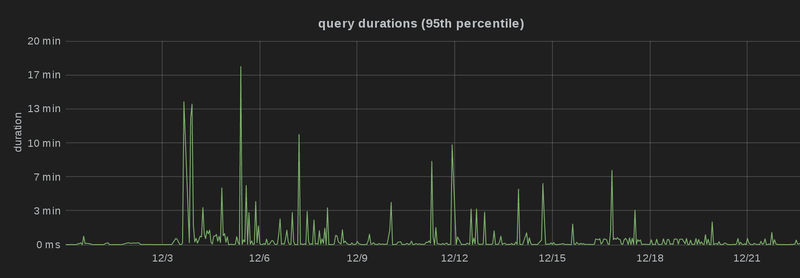
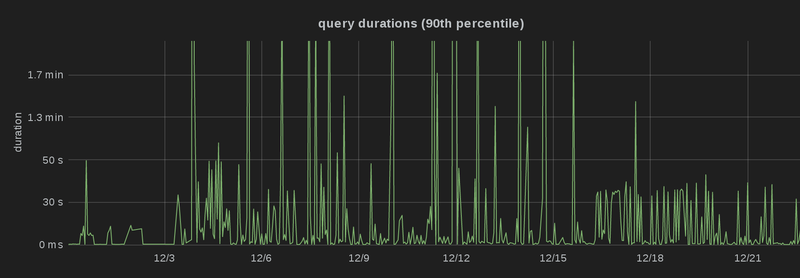
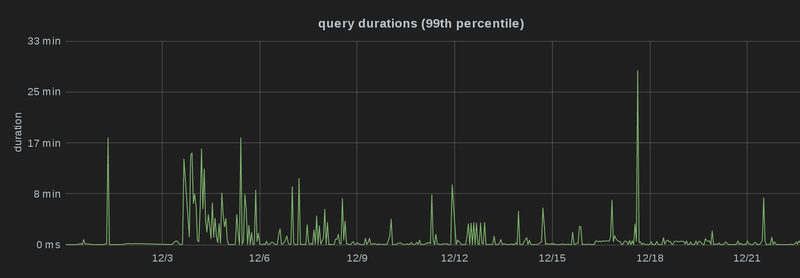
With some more profiling, the new bottleneck was suddenly the read(2) syscall, issued by the cap n proto deserialization, operating directly on the network connection buffer. strace revealed that crunching through the results of one source backend for a long query, read(2) was called about 250,000 times. By simply using a buffered reader (commit 684467ae), I could reduce that to about 2,000 times. Another bottleneck was the fact that for every processed result, the frontend needed to update the query state, which is shared amongst all goroutines (there is one goroutine for each source backend). All that parallelism isn t very effective if you need to synchronize the state updates in the end. So with commit 5d46a572, I refactored the state to be per-backend, so that locking is only necessary for the first couple of results, and the vast vast majority of results can be processed entirely without locking. This brought down the query time from 20 minutes to about 5 minutes, but I still wasn t happy with the bandwidth: the frontend was doing a bit over 10 MB/s of reads from all source backends combined, whereas with wget I could get around 40 MB/s with the same query. At this point, the CPU utilization was around 7% of one core on the frontend, and profiling didn t immediately reveal an obvious culprit. After a bit of experimenting (by commenting out code here and there ;-)), I figured out that the problem was that the frontend was still converting these results from capnproto buffers to JSON. While that doesn t take a lot of CPU time, it delays the network stream from the source-backend: once the local and remote TCP buffers are full, the source-backend will (intentionally!) not continue with its search, so that it doesn t run out of memory. I m still convinced that s a good idea, and in fact I was able to solve the problem in an elegant way: instead of writing JSON to disk and generating result pages on demand, we now write capnproto directly to disk (commit 466b7f3e) and convert it to JSON only before sending out the result pages. That decreases the overall CPU time since we only need to convert a small fraction of the results to JSON, but most importantly, the frontend is now not in the critical path anymore. It can directly pass the data through, and in fact it uses an io.TeeReader to do exactly that. Conclusion With all of these optimizations, we re now down to about 2.5 minutes for the search query arse , and the architecture of the system actually got simpler to reason about. Most importantly, though, the optimizations don t only play out for a single query, but for many different queries. I ve deployed the optimized version at the 15th of December 2014, and you can see that the 99th, 95th and 90th percentile latency dropped significantly, i.e. there are a lot fewer spikes than before, and more queries are processed faster, which is particularly obvious in the third graph (which is capped at 2 minutes):

Russ Allbery: Review: Wakulla Springs

Review: Wakulla Springs, by Andy Duncan & Ellen Klages
Publisher: Tor
Copyright: October, 2013
ASIN: B00EWZDPH4
Format: Kindle
Pages: 99
This is another nominee for the 2014 Hugo Awards (for works published in 2013), this time in the novella category. In this case, though, I read the free ebook version from Tor (Macmillan) rather than the version from the voter packet, since I usually grab all the free ebooks of Tor.com stories. (Even if I'm quite behind in reading them, since I don't read much short fiction.) As an independently-published novella, it gets its own review in the book category. Wakulla Springs is the story of three generations (and four protagonists) who lived near or visited Wakulla Springs in the Florida panhandle. This is a real place: a huge freshwater springs and underwater cave system, now protected as a national park. Two of the four episodes in this story revolve around the filming of movies: a Tarzan movie and Creature from the Black Lagoon. This actually happened as well, although of course the story takes liberties with the details. This is also the story of race relations in the American deep south: the tense and uncertain interactions between black locals and rich white people, both locals and people from the film industry who came for a brief time and then left again. It's also a story about water, swimming, and the sense of being part of the water and knowing it well. This story doesn't develop any particular point; rather, it's more of a collection of character sketches, grabbing moments in time, glimpsing what it's like to cross racial barriers and to feel at home with one's choices. It's also, in a nicely subtle way, about encountering mythical creatures that are not part of one's world. To the locals, the film stars who visit Wakulla Springs are as wild and strange as the imagined creatures of the swamp, and in their way even more foreign. What this is not, though, is science fiction, or even fantasy. One of the complaints I'd heard about Wakulla Springs in the context of the Hugos was that it didn't qualify as a genre story. I'm usually inclined to dismiss these sorts of complaints, since they're often put forth by people with a far narrower definition of genre than mine. But, having read this story, I have to concur. It's very well-written and engaging, but it's not genre in any sense that I'd define it. There are some rare mentions of mythical creatures, but only in ways that are part of the setting, and which are no more fantastic than I'd expect from many mainstream stories. I'm a bit baffled why an SFF publisher would have bought it for an explicitly SFF forum; I have to assume that it's just because it's well-written and the authors have both written SFF. That said, even though this is not the sort of story I'd normally seek out, I'm still glad I read it. I thought the best part of the story was the first, which follows a black woman who takes a job at the Wakulla Springs resort during the filming of a Tarzan movie. The color lines are simply taken for granted by everyone, but Johnny Weissmuller comes off very well in his fictional representation and adds an enthusiastic energy that plays off well against the thoughtful care of the protagonist. The second part echoes this with a boy as the protagonist, but shifts a generation later. This means the color line is fought instead of simply assumed, although with limited success. I thought this part of the story had the best descriptions of the joy of swimming, and once again the movie folks bring a disruptive and positive change to the tightly-drawn lines of local roles and politics. The third and fourth parts I found slighter, elaborating on the story by showing the reader glimpses of the later life of the first two protagonists, but not, I thought, adding anything fundamental to the story. I'm not sure this would be satisfying if you were looking for a science fiction or fantasy story, but it's a solid mainstream story about race, class, and the joy of knowing and feeling a place. It captures an angle of Hollywood that I've rarely seen in movies: a disruptive and almost subversive playfulness and energy that doesn't fix problems but that does provide moments of escape from the realities of the world, even outside of the film. Worth reading, particularly since it's free. Rating: 7 out of 10

Russell Coker: wp-spamshield

Yesterday I installed the wp-spamshield plugin for WordPress [1]. It blocks automated comment spam systems by using JavaScript and cookies, apparently most spammers can t handle that. Before I installed it I was getting hundreds of spam comments per day even with the block spam by math plugin enabled. Now I ve had it running for 24 hours without any spam. The real advantage of this is that now when a legitimate comment gets flagged as spam I ll notice it, previously I was deleting hundreds or thousands of comments at a time without reading them. deb http://www.coker.com.au wheezy wordpress The above repository has the wordpress-wp-spamshield package for Debian/Wheezy. I have no immediate plans for uploading it to Debian because the security support for WordPress plugins doesn t fit in with the Debian model. I am prepared to negotiate about this if someone has good reasons for including it or any of the other WordPress plugins I ve packages. My packaging work is under the GPL (of course) so any DD who disagrees with me could just rebuild the package and upload it. Within Debian there is no rule taking another DD s GPL d code that they decided not to upload and then uploading it. There is a consensus that such things are not appropriate without permission, but anyone who wishes can take this blog post as permission.

Next.

Previous.