Search Results: "ron"

21 September 2007

Michael Prokop: grml-live - framework for building a live system

[Gnaaaaa, sorry Planet Debian for sending a german article to you a few hours ago. I just chose the wrong category for the article. I removed the tag already and the article disappeared from Planet Debian right now; so if you don’t know what I’m talking about just don’t care. ;-) To the german readers: it’s just the same article as my previous one, but this time in english. :-)] grml-live is a framework which lets you build a grml/Debian based Linux Live-CD with one single command. grml-live is based on FAI (Fully Automatic Installation) and uses its class based concept: Screenshot: grml-live In this example I built a full grml-ISO. All I did was setting the Debian-Mirror in /etc/grml/grml-live.conf to my local one (to save traffic and time) and invoking the following command:
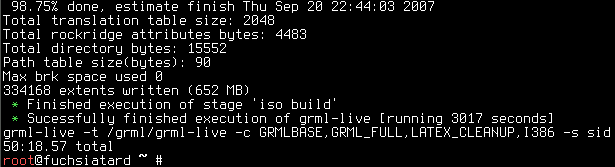
# grml-live -t /grml/grml-live -c GRMLBASE,GRML_FULL,LATEX_CLEANUP,I386 -s sid
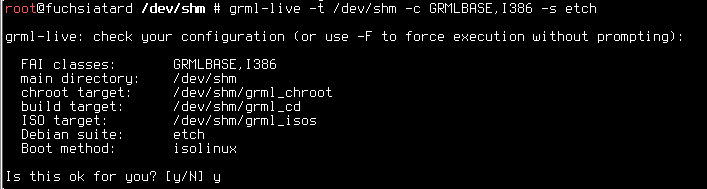
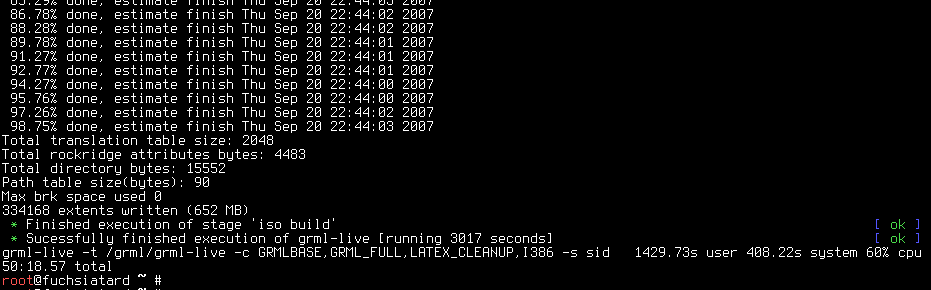
About 50 minutes later I have a grml-ISO inside grml_isos at directory /grml/grml-live/ (-t …). It was built using the classes (-c …) GRMLBASE (all the core, essential stuff), GRML_FULL (software selection like official grml provides), LATEX_CLEANUP (clean up some very big LaTeX directories) and I386 (x86-specific packages like kernel). Debian unstable/sid was used as the suite (-s). And that’s it. You want a smaller grml-version using Debian/stable? No problem, let’s do it in shared memory (being very fast, and with enough RAM and mountoptions rw,suid,dev no problem at all): Screenshot grml-live: the beginning A ‘grml-live -t /dev/shm -c GRMLBASE,I386 -s etch’ and not even 5(!) minutes later I’ve my 135MB small grml: Screenshot grml-live: done So using grml-live you can build your own, customized Linux Live-CD without having to deal with remastering in detail. Via creating a new class (or just editing an existing one) its easy to include the software you would like to get. So, will the official grml-ISOs become obsolet? No, definitely not. The goal of grml-live is to give the grml-team a buildsystem providing exactly what we need. It should give us the possibility to concentrate on the important and interesting tasks, like: testing, bugfixing, implementing new features, working on the kernel, quality assurance, documentation,… grml-live should work on every Debian based system. If you want to give it a try just grab the Debian package from grml’s repository. The source is available (as usual) via mercurial. Find more details on the grml-live-webpage. If you have any further questions that aren’t answered by the docs yet, have feature requests, bugreports or patches: please let me know.

20 September 2007

Russell Coker: Google Custom Search Engine

I’ve just been experimenting with Google Custom Search [1]. Below are two custom search engines I created to generate searches for Planet Debian and Planet Ubuntu (for each Planet it searches all the blogs that are syndicated - and doesn’t just get the category that is syndicated). It’s interesting to compare search terms such as “selinux” to get an idea for how much topics are being discussed in the two communities. I’m going to set up cron jobs to update these CSEs as the Planet subscription lists change. Also it would be quite easy for me to set up a custom search that covers both Debian and Ubuntu, and other planets as well. If nothing else this will save me from the problem of finding a blog post that has just scrolled off a Planet that I read. Planet Debian (homepage):
Google Custom Search
Planet Ubuntu (homepage):
Google Custom Search

Adrian von Bidder: Who'd have thought it?

Who'd have thought it ... Dan Lyons (one of the louder SCO backers) actually published a May Culpa, admitting that he was wrong all the time. A respectful nod in his direction from me, I'd not have expected this. Remains to be said that covering a lawsuit by (judging by the description of what he did before publishing the first article) more or less only talking to one party and, probably, not actually knowing much about the actual topic under discussion still seems to be very bad journalism, but at least he doesn't try to wriggle out of it now. And, IIRC, IBM did not talk much about this lawsuit, while SCO talked to everybody who might listen at length, so you might call that mitigating circumstances. Hmm. Completely unrelated, but ... Konqueror crashes when I try to leave the Forbes web page. Somehow I don't think I'm all too interested in this particular bug being fixed. I still like what the Canberra Times wrote about Forbes Magazine in August 2004:
[Forbes Magazine] looks ... like corporate pornography, giving middle-management dreamers fodder for their fantasies, and this sort of exercise, basically meaningless, hardly seems useful or instructive.

19 September 2007

Neil Williams: gpe-cash developments

If anyone was wondering why I've been quiet / claiming to be busy for the last week or so:
gpe-cash finally has a stable "main window" that supports creating new accounts along with the transactions and splits necessary to support an opening balance in the gnucash objects.
Current SVN requires current QOF CVS, accessible via the respective SourceForge repositories. gpe-cash is nowhere near release right now - the actual balances don't show up for one thing and I still need to write the window that will allow the creation of transactions within the accounts - but one step at a time. I'll see about some screenshots eventually but the gpe-cash main window is quite similar to that of gpe-expenses.
The main side-effect of all this is a much improved SQLite backend for QOF that is closer to being able to properly support double-entry financial data.
Note this does not mean that GnuCash itself will be able to use the QOF SQLite backend - the GnuCash currency/commodity handling is incompatible with QOF so gpe-cash uses the currency handling from gpe-expenses which in turn came from pilot-qof and the range of currencies supported by the Palm Expenses applet. The currencies are directly equivalent to the respective GnuCash currencies but not all GnuCash currencies are supported by pilot-qof, gpe-expenses or gpe-cash. The biggest change in gpe-cash is that this conversion is now working so that the gnucash code sees a gnucash currency when actually it is handling a pilot-qof currency.
gpe-cash is GPL-3+ and single-user (== single-file or single-book) as well as single-currency. Adding multi-currency support is possible but not a priority.
Once gpe-cash is closer to release, the codebase will be able to support gpe-invoice using the GnuCash business objects which will interface with gpe-cash to create invoices from other GPE data and store the payments and charges in gpe-cash.
If multi-currency support can be achieved, it would be possible to create "gpe-shares" as a different add-on to gpe-cash, although that is only theoretical at this stage.
The SQL-type query support inherent in QOF, together with perl support for the XML backend data via libxml-qofqsf-perl and XSL support for same XML backend via datafreedom-qsfxsl should make report generation trivial. I may also be able to add QOF support to the still experimental quicklist. I also plan to include support for import/export from all the datafreedom packages with HomeBank data which is returning to a NEW queue near you quite soon . . .
Overall, I'm getting closer to having a full range of individual applications that achieve a long term goal - the breakup of GnuCash source code into small, individual tools in the Unix tradition, all built on SQL-type queries, multiple backends and generic data handling. (See data-freedom.) Down with bloat!
:-)
<rant>
It's about time users had free financial data as well as merely free financial software. The lack of data interchange between existing free software "financial solutions" is a scandal, IMNSHO.
The rest of the "Office" dataset have a range of file formats and a range of filters. Financial data relies on the horribly broken QIF file that was never designed to be a standard and OFX where support is horribly patchy and doesn't provide data interchange between programs on the same machine.
</rant>

18 September 2007

Kai Hendry: The keyboard

NC4400 versus X40 I was thinking of getting an nc2400 after seeing one at debconf7. However lately I’ve been studying my house mate’s nc4400, which I think is roughly the same as the nc2400, except no CD/DVD drive and sadly a trackpad. Correct me if I’m wrong. It’s the little things I like about the X40. The PGUP/PGDOWN buttons above and below each other. The escape key which isn’t tiny. I hate the thought that I am to upgrade to an X60 because of the keyboard. I can’t stand the fact that they’ve changed their PSU standard (like Nokia did I guess) and, omg have you seen the uninspiring Lenovo blogs?. :/

Sven Mueller: Brane Dump The Thoughts of Matt Palmer

In “Documentation - the chicken and the egg” [1], Matt Palmer wrote about the problem that noone writes documentation because noone reads it and that noone reads documentation because the few documentation in existence usually isn’t very good. So he, like me hs the habit of searching for help on the net instead of in a projects documentation. However I disagree with him in the consequences a bit. Because I noticed that on several projects with good documentation (subversion is an example that immediately comes to my mind, but postfix isn’t too bad either), the internet search returns a reference to the docs more often than not. Of course, this means that the documentation needs to be searchable for those webcrawlers. So if you have the task to write documentation, I strongly suggest to make it searchable in some way. For company-internal projects, this obviously means that the documentation must be reachable via an internal search engine. In a project a few years back, we implemented an internal search engine which included company internal information (even with user based access rules so that each user only got those results he could actually access) as well as an external search engines results. It was closed source, but a pretty nice idea. It didn’t, however, index any locally (user’s desktop) stored documents, only what was on some company web page (but including .doc, .rtf, .pdf and the like which where retrievable via http). [1] http://www.hezmatt.org/~mpalmer/blog/general/documentation_the_chicken_and_the_egg.html

Benjamin Mako Hill: You Rule!

Inspired by Mitchell Charity's printable paper rulers and Steve Pomeroy's CSS ruler, I wrote a little python script to generate an on-screen ruler for the OLPC XO-1. The XO-1 screens are super high resolution (200dpi) and are each identical. This makes for a very accurate ruler. It's one of a few project I've done or am working on that tries to take advantage of the physical qualities (and physical consistencies) of the XOs. Also, a ruler is just a really useful thing for a school child -- or anyone else for that matter. Of course, different screens have different pixel sizes so the ruler for the XO won't work on another screen. This made some of my friends jealous. To appease them, I spent a couple hours and hacked up a little web frontend to my ruler generator which allows anyone to create custom on-screen rulers and to save them and share them with others who might have the same screen. I've called it YouRule. Please check it out or download the source and send me improvements.
http://projects.mako.cc/yourule

MJ Ray: Co-operative food stores ethical policy

I just received the autumn 2007 edition of the Co-operative Group's membership magazine. It came with a cover letter that finally prompted me to answer the food ethical policy consultation The announcement was covered in the Guardian under the slightly inaccurate headline How green do you want your bananas? Co-op ballots members on ethical issues and in the Metro under the headline "Flight logo row" focusing on the criticism of the Tesco and M+S branding (which I think was a little unfair in some ways). Even so, it's good to see the Co-operative Group getting our message across and wrong-footing the BBC's attack dogs, described in Cambridge Co-operator: Ethical Policy. Last time on five live, our man got a bit mauled. Will this change make a difference, like it has to the Co-operative Bank? Can an ethical policy persuade you to change where you buy your food? (2007-09-19: 1 comment)

17 September 2007

Steve McIntyre: Remaining Debconf T-shirts on the way

At/after Debconf it transpired that various people didn't get the T-shirts they should: attendees who left before the Ts were released by customs in the UK, and volunteers and orga team who didn't fit in the small allocation that we had printed up-front. In the weeks since then, we've got more shirts printed thanks to Gunnar and Gaby. I've just sent out (almost) the last of them this weekend to people all over the world, and I'll be hand-delivering the last couple next month. A small number of people also asked for extra Ts if they could pay for them, and I'm emailing them now to confirm what the cost is. UPDATE: Sorry, maybe I wasn't clear enough in the above. We have had more Debconf Ts made for people, but they asked ages ago either at Debconf or shortly afterwards. I'm not planning on getting any more printed for people that ask now. Sorry, it's too late.

Ross Burton: Sound Juicer "The Best Blue Is Through The Trees" 2.20.0

Sound Juicer "The Best Blue Is Through The Trees" 2.20.0 is out. Tarballs are available on burtonini.com, or from the GNOME FTP servers. Also thanks to the tireless translation team: Djihed Afifi (ar), Ihar Hrachyshka (be), Alexander Shopov (bg), Runa Bhattacharjee (bn_IN), Jordi Mallach (ca), Ask Hjorth Larsen (da), Hendrik Richter (de), Tshewang Norbu (dz), Kostas Papadimas (el), David Lodge (en_GB), Jorge Gonz lez (es), Ivar Smolin (et), I aki Larra aga Murgoitio (eu), Ilkka Tuohela (fi), Christophe Benz (fr), Ignacio Casal Quinteiro (gl), Ankit Patel (gu), Eyal Mamo (he), Gabor Kelemen (hu), Francesco Marletta (it), Takeshi AIHANA (ja), Young-Ho Cha (ko), Erdal Ronahi (ku), ygimantas Beru ka (lt), Raivis Dejus (lv), Arangel Angov (mk), Kjartan Maraas (nb), Wouter Bolsterlee (nl), Tomasz Dominikowski (pl), Og Maciel (pt_BR), Duarte Loreto (pt), Mugurel Tudor (ro), Nickolay V. Shmyrev (ru), Danishka Navin (si), Matic gur (sl), Elian Myftiu (sq), (sr), Daniel Nylander (sv), Dr.T.Vasudevan (ta), Theppitak Karoonboonyanan (th), Baris Cicek (tr), Maxim Dziumanenko (uk), Clytie Siddall (vi), Funda Wang (zh_CN), Chao-Hsiung Liao (zh_HK, zh_TW).

Russell Coker: Web-Scabs

I have just read an interesting post by Ted Ts’O about copyright protection on the net [1]. Ted is well known as a free software programmer, but it’s slightly less well known that he is an avid Science-Fiction fan. In the Free Software community most people seem to be interested in Sci-Fi, but Ted is more interested than most. Ted’s post concerns the irresponsible actions of the Science Fiction and Fantasy Writers of America [2] (SFWA). To summarise it they issued DMCA [3] take-down notices for any web page that matched a search on the names “Asimov” or “Silverberg“. I don’t approve of the DMCA laws as a collection, but take-down notices are not necessarily bad (I have issued such notices for unauthorised copies of my own work in the past). The problem in this case is that the words in question are extremely common, not only might they be used as the names for other people (authors or characters) but Asimov in particular is a well known term when describing the potential development of intelligent computers that operate robots (see the Three Laws of Robotics [4]), the term “not Asimov Compliant” has been used by Alastair Reynolds in Century Rain to refer to a class of military robots that have no compunction about killing humans. Among the fall-out of the SFWA actions was the removal of a free novel by Cory Doctorow [4]. Incidentally my favourite free to download Cory Doctorow book is Eastern Standard Tribe [5]. craphound.com has Cory’s blog as well as links to other free Sci-Fi that he’s written. Reading the links from Ted’s post took me to a blog entry by the current SFWA vice-president [6] which describes authors such as Cory Doctorow as “webscabs“. This offends me greatly. My work and that of my friends in writing free software could be described in the same way (and in fact is described in a similar way by some software monopolists). Every blogger could have their work described in a similar way by paid journalists. The fact that the SFWA VP is not representing SFWA when writing such comments does little to allay concern about this. It seems to me that people with such ideas are intent on attacking my community, and that it would be wrong of me to give any of them $0.50 by buying one of their books. I resolve to not buy any more Sci-Fi books until I have read all the freely available books that I want to read. After that I will prioritise my book purchases with a significant factor being how well the author gets the concepts of copyright etc. If nothing else an author who can’t understand how copyright (something that is essential to their own livelyhood) interacts with current computer systems will have significant difficulties in predicting how technology and society will develop over the next hundred or thousand years. My problem in reading Sci-Fi books is not in discovering books that are enjoyable and which contain interesting concepts, but in finding time to read them. Thanks to SFWA for giving me an extra criteria to cull the list of books to read.

MJ Ray: Vuelta a Espa a - final week

Eurosport coverage of Vuelta a Espa a at 19 east continues with commentary in English (analogue only) and German. Scheduled times:-
Mon 17.09.2007
(no show, rest day)
Tue 18.09.2007
16:00-17:30 CET
Wed 19.09.2007
09:00-09:30 and 16:00-17:30 CET
Thu 20.09.2007
15:00-15:45 and 15:45-17:30 CET
Fri 21.09.2007
16:15-17:30 CET
Sat 22.09.2007
16:00-17:45 CET
Sun 23.09.2007
17:15-18:00 CET
TVEi are broadcasting in Spanish at 13 and 19 east. Scheduled times:-
Mon 17.09.2007
(no show, rest day)
Tue 18.09.2007 to Sun 23.09.2007
16:40-18:00 CET
Enjoy the finale!

Colin Watson: Encodings in man-db

I've spent some quality upstream time lately with man-db. Specifically, I've been upgrading its locale support. I recently published a pre-release, man-db 2.5.0-pre2, mainly for translators, but other people may be interested in having a look at it as well. I hope to release 2.5.0 quite soon so that all of this can land in Debian. Firstly, man-db now supports creating and using databases for per-locale hierarchies of manual pages, not just English. This means that apropos and whatis can now display information about localised manual pages. Secondly, I've been working on the transition to UTF-8 manual pages. Now, modulo some hacks, groff can't yet deal with Unicode input; some possible input characters are reserved for its internal use which makes full 32-bit input difficult to do properly until that's fixed. However, with a few exceptions, manual pages generally just need the subset of Unicode that corresponds to their language's usual legacy character set, so for now it's good enough to just recode on the fly from UTF-8 to some appropriate 8-bit character set and use groff's support for that. man-db has actually supported doing this kind of thing for a while, but it's been difficult to use since it only applies to /usr/share/man/ll_CC.UTF-8/ directories, while manual pages usually aren't country-specific. So, man-db 2.5.0 supports using /usr/share/man/ll.UTF-8/ instead, which is a bit more appropriate. Also, following a discussion with Adam Borowski, man-db can now try decoding manual pages as UTF-8 and fall back to 8-bit encodings even in directories without an explicit encoding tag; if this fails for some reason, you can put a '\" -*- coding: UTF-8 -*- line at the top of the page. I'm still debating whether Debian policy should recommend installing UTF-8 manual pages in /usr/share/man/ll.UTF-8/ or just in /usr/share/man/ll/. Initially I was very strongly in favour of an encoding declaration, but now that man-db can do a pretty good job of guesswork I'm coming round to Adam Borowski's position that people should be able to forget about character sets with UTF-8. Opinions here would be welcome. One thing I haven't moved on is that any design that assumes that the encoding of manual pages on the filesystem has anything to do with the user's locale is demonstrably incorrect and broken; I'm not going to use LC_CTYPE for anything except output. However, maybe "UTF-8 or the usual legacy encoding provided that the latter is not typically confused for the former" is a good enough specification, and that still has the desirable property of not requiring a flag day. I'll try to come down from the fence before unleashing this code on the world.

Miriam Ruiz: Storing data in $HOME directory

When packaging games, one of the operations I often have to do to the source code is modifying it so that it uses absolute file and directory names instead of relative ones. When coders develop for Windows, or when they develop their games to be able to play them from their home directory, they just would go that way and won’t care about it, but when the idea is installing the files in the system, the Filesystem Hierarchy Standard (FHS) must be respected, and thus things will need to be place in their proper directories. For read-only files, this is not a big deal, all that has to be done is replacing the relative file name in the file opening commands with the absolute one, doing fopen(”/usr/share/games/package/dir/file”) instead of fopen(”dir/file”). I usually prefer to do it like fopen(DATADIR “/dir/file”) and set DATADIR from the Makefile, with a -DDATADIR=\”/usr/share/games/package\” switch added to the CFLAGS, and maybe also setting it inside the code if it’s not previously defined (#ifndef and so). There are some files and directories in which doing this is not possible, because they want read-write permissions. This files include saving the configuration, hiscores, new levels created with the game editor, game saves and so. They might be moved to some directory under “/var/lib/”, and create a new group en the system so that it’s writable, and so on. I don’t like that approach a single bit. I prefer to move all tthat data to the user’s directory. This is not as straightforward as it was for read-only data, but it’s not really that difficult anyway. It would be more or less like:

#ifndef _WIN32
#include <stdlib.h>
#include <stdio.h>
#include <string.h>
#include <unistd.h>
#include <limits.h>
#include <pwd.h>
#include <fcntl.h>
#include <sys/stat.h>
#include <sys/types.h>
#endif
#ifndef _WIN32
char file[PATH_MAX];
char *home;
struct passwd *passwd;
if (!getuid()   !(home = getenv("HOME"))) 
passwd = getpwuid (getuid());
home=passwd->pw_dir;
if (!home) 
fprintf(stderr, "$HOME is not defined.n");
exit(-1)
 
 
if (strlen(home) > PATH_MAX - sizeof("/.package/settings.ini")) 
fprintf(stderr, "$HOME is excessively long.n");
exit(-1)
 
snprintf(file, sizeof(file), "%s/.package", home);
mkdir(file, S_IRWXU   S_IRWXG   S_IROTH   S_IXOTH) == 0;
strncat(file, "/settings.ini", sizeof(file)-1);
#else
char file[21];
snprintf(file, sizeof(file), "./Data/settings.ini");
#endif
FILE *f = fopen(file, "w");
Sometimes you also need that the files are already created, you can check if they already exist with stat(), and then acting accordingly, either creating them from your C code, or maybe triggering a system() shell call whith whatever is needed.
struct stat stat_buf;
stat(file, &stat_buf);
if (stat(file, &stat_buf) == -1) 
int settings_fd = creat(file, O_WRONLY);
close(settings_fd);
 
NOTE: I’ve updated the code to add some suggestions. Thanks to Gon ri Le Bouder and Nico Golde.

16 September 2007

Steve McIntyre: Remaining Debconf T-shirts on the way

At/after Debconf it transpired that various people didn't get the T-shirts they should: attendees who left before the Ts were released by customs in the UK, and volunteers and orga team who didn't fit in the small allocation that we had printed up-front. In the weeks since then, we've got more shirts printed thanks to Gunnar and Gaby. I've just sent out (almost) the last of them this weekend to people all over the world, and I'll be hand-delivering the last couple next month. A small number of people also asked for extra Ts if they could pay for them, and I'm emailing them now to confirm what the cost is.

Russell Coker: iRiver H320 and Liquid

Recently my iRiver [1] H320 had some milk based drink spilt on it. I’m not sure what the drink was (I discovered it when my iRiver stopped working and the drink was dry) but it smelled like coffee or hot chocolate when I washed it off (I considered tasting it but decided that knowing exactly which drink had damaged my iRiver probably wouldn’t help me fix it). The initial problem was that no buttons other than the play button (which is also used to turn it on) worked. When I first discovered this I had no way of hitting the reset button so my iRiver played until the battery ran flat. I tried to disassemble it by removing the five tiny phillips-head screws from the sides, but that didn’t make any part of it loose. I tried using a small amount of force on the front piece of plastic and broke two of the clips that hold it in place while getting another two loose without breaking (but there were still at least four clips to go). Then I realised that the problem was that the keys were physically sticking and that maybe if I washed the keypad out I might get it to work. So I spent some time in a cycle of dripping water into my iRiver, pressing the buttons to get some of the nasty stuff dissolved, and then using a towel to soak up some of the water with milk or whatever. After repeating this for a while the buttons all seemed to work well apart from the play button which kept registering presses when I wasn’t touching it. This meant that it always automatically turned on and then played a song in a stuttering manner as the play button is also the pause button and it paused and played as rapidly as it could. Finally I left it in the sun to dry for a few hours, which seemed to do some good. The play button mostly works now. Also it seems quite easy to get water between the front layer of protective plastic and the layer behind (which actually houses the keypad). So I have several large drops of water spread out between the layers which move around as I squeeze it. I think that if I get that dried out before algae can grow then everything will be fine.

Christian Perrier: RWC: Stunning Georgia

We watched either parts or the entire three matches yesterday. So, long report..:-) The day began with the most unbalanced game of this world cup, featuring New Zealand, world's top rugby team, against Portugal, ranked 22nd. Rugby in Portugal is played by about 4200 people only, in less than 50 clubs. All players are amateur but one (Gon alvo Uva, playing in Montpellier, France), being dentists, students, etc...and coming to RWC during their holidays. The result (108-13 and 16 tries) was expected but the feeling when Portugal scored a try was great, with the 40,000 attendees in Lyon supporting Portugal. Personnally, I had great time chatting on IRC with Miguel Figueiredo, one of the leaders of the portuguese l10n team in Debian, during the match. We watched Wales-Australia (20-32) during the evening. That game was obviously the key match of this pool, with the winner very probably finishing 1st in the pool. Wales playing in Millenium Stadium in Cardiff is always astonishing and show how much the Welsh people love this sport. During 1st half, Australia strongly dominated and logically lead 25-3 with 3 tries. Berrick Barnes, their new fly half (Stephen Larkham injured), is a very promising player and, imho, the match's MVP (even after being severely bashed by Gareth Thomas on Australia's first try). After half time, the Welsh team courageously fought and came back to 13-25, menacing Australia which was more hesitating. Unfortunately, Australia scored a try after a big mistake by Stephen Jones. So, even with good play by Wales and another try by the incredible wing player Shane Williams, Australia logically won this game. Again, a southern hemisphere team dominated a northern hemisphere one. This is probably what will happen during this entire WC and I bet that New Zealand, Australia and South Africa will end up in semi-finals, quite probably along with Argentina, unless France does a miracle and ends up 1st in their pool. I think that Australia is slightly weaker than NZ and RSA, though. So, my current bet is NZ-RSA for the final (this can happen, given their respective track to the final and given that they certainly will end up first of their respective pools). Finally, we watched the second half of Ireland-Georgia (14-10). *That* was quite a surprise. Ireland was very close to lose this game with Georgian forwards crushing them repeatedly at the end of the match and nearly scoring a try that would have made them win. Everybody was waiting for Georgia to swell after their strong 1st half (3-7) but they managed to fight until the last second, supported by Bordeaux 40,000 attendees (minus a few thousands of Irish supporters, of course). So, while the initial question was whether Ireland would score a bonus point, the final question became about them to *win* the match. This gives even more credit to Argentina's victory last Tuesday. Full standing ovation for Georgia at the end of the match. Today is again a busy day. I'll probably skip Fidji-Canada (which happens at the same time than France-Namibia) but certainly won't miss Samoa-Tonga and, of course, France-Namibia. Samoa have to win to keep their chances of qualifying (they can beat England, really) and, well, France has of course to win *and* score a bonus point. In this world cup where to so-called "small" teams are not that small, everything can happen and France is anything but safe, ehre.

Theodore Ts'o: Whack the Gopher

I recently came across three very well written and very thoughtful blog postings by Rick Cook (author of the Wiz Zumwalt Wizardry series):
  1. Copyrights, Whack-the-Gopher, and SFWA — Why I Quit
  2. The Economics of Theft: Son of Whack the Gopher
  3. WHACK THE GOPHER III: The Return of the Mutant Grandson
The incident which kicked off these postings was an informal DMCA takedown notice posted by the Vice President of the Science Fiction Writers of America, Dr. Andrew Burt which was created by a process only slightly more sophisticated than using word search for “Asimov” and “Silverberg”. Unfortunately, this takedown notice erroneously included a junior high school teacher’s list of 300+ recommended books (which naturally contained the strings “Issac Asimov” and “Robert Silverberg”, an on-line published science-fiction magazine that referenced the science fiction author Isaac Asimov in a review, and a creative-commons licensed science fiction novel which had been deliberately published on the web for free distribution, and for which the author had explicitly forbidden the SFWA from taking any action on behalf of his books. The entire incident was wonderfully filled with irony — from the fact that an organization of writers who purport to write about what the future might bring given scientific and technological advances could so totally fail to get the Internet or understand that such a campaign might cause them to alienate their readers and fan base, to the the fact that Doctor Andrew Burt, Ph.D. is a professor in computer science at the University of Denver with a research interest in copyright and electronic piracy, could so incompetently foul up a DMCA takedown request and not understand that “grep” might result in false positives that would require human checking (”Andrew? Your alma mater is calling; they would like their degree back…”) One good thing that has come out of this whole mess is that it has been, as junior high school teacher Nick Singer put it, “a teachable moment”, and an opportunity for people to reflect about issues of copyright, the rights of authors, ebooks, and the Internet. This is a hard problem; I very strongly believe that (at the same time) “Art wants to be free; Artists want to be paid” (to use a phrased coined by a friend of mine, Jesse Vincent (blog here), to the point that I’ve been willing to put my money where my mouth is. So far the solutions for achieving this are nowhere near perfect, but they are certainly better than sending out shotgun DMCA takedown requests. In any case, Rick Cook’s thoughts on the subject are a worthy contribution to the subject. He says he’s going to do one more article on his blog proposing an economic solution to this problem; I can’t wait to see what he has to say on the subject.

Gintautas Miliauskas: Opening files quickly in Vim

My Python development environment consists of a GVim window for editing code and a gnome-terminal for running the unit tests. This works out well, but leaves some integration to be desired. In particular, jumping to a test failure point is a little cumbersome. I used to do it this way: copy the filename from the traceback, switch to vim, then type :e, paste the filename with middle-click (now I know I can use * instead) and press Enter, then enter the line number and press G. That is barely acceptable; this particular wart has even contributed to pushing a ex-co-worker towards Emacs (the horror!). I have written a small vimscript function to make the aforementioned use case slightly easier. Now to jump to a failure point, just triple-click the corresponding line in the traceback (that selects the whole line), switch to Vim and invoke the function, which scrapes the clipboard for a filename and line number and opens it in the active buffer. Installation: paste the OpenFileFromClipboard function in your ~/.vimrc and bind it to a key by adding the following lines to your .vimrc:
nmap  :call OpenFileFromClipboard()
imap  :call OpenFileFromClipboard()
These commands bind the key F4 to our function. The first command handles normal mode, and the second handles insert mode (hence the to momentarily escape the insert mode). You can of course change the shortcut to whatever you like. The function should handle following types of references from the clipboard: I hope someone finds this useful.

15 September 2007

MJ Ray: Low Carbon Lifestyle Tour on TV

It's nice to get email from someone previously mentioned on my site. Mukti Mitchell emailed:
"The Southampton Boatshow programme made by Meridian ITV will include 4 minutes on the Low Carbon Lifestyle Tour and will be screened this week as follows: Sunday 16th September 1800 ITV4; Monday 17th September After Midnight (0100 Tuesday 18th) ITV4; Thursday 20th September 1930 ITV Meridian (ITV1 in South England) (ITV4 Is a national network channel available via your free digi box.) The programme includes footage filmed on board yacht Chance during the round Britain tour. I hope you enjoy the programme."

Next.

Previous.