Search Results: "tar"

19 January 2011

Eddy Petrișor: Picking up the pieces

Update: After trying KiBi's suggestion to take advantage of this information, I looked for more info on the issue and found this conversation. A git upgrade to the backported git 1:1.7.1-1.1~bpo50+1 version, and git svn rebase started pulling the right stuff in. Yes, I left the svn-remote.svn.rewriteRoot stuff set to the old value and the svn-remote.svn.url to the new value.

Keywords:

Unable to determine upstream SVN information from working tree history

when running git svn reabase


As I said yesterday, I am going to come back to being active in Debian.

I remember looking a little at my page on the Debian Wiki and it was clear that it was stale. (I sometimes find it amusing how I presented myself my name is Eddy Petrisor .) For some reason now the wiki seems to be down.

Two days ago I tried to get the Wormux/Warmux upstream source but git svn appears not to like the rename although I even modified the .git/config and .git/svn/.metadata, but it still wasn't satisfied and answered in a bad mood with this message (after a long waiting period):

$ git svn rebase
Unable to determine upstream SVN information from working tree history


And, yes, I am aware of the compromise and I changed my password for the project on gna.org.

I guess is better if I try to take a look at the RC bugs for the moment.

Gunnar Wolf: Mandate for what?

I lived in Israel between 1994 and 1996 This was just after the signature of the Oslo agreements, the Rabin-Arafat signature. 1994-95 was a beautiful time to be in Israel; there was the excitement of a prospect of real peace with the Palestinians, something that had been just seen as unattainable for the past 50 years. But we also saw the buildup of a huge tension, of real hatred. And the dream of the end of the conflict, of two people living in peace side by side was heavily shattered on November 4 1995, when prime minister Rabin was assassinated. But for the sake of where I'm trying to get to (this post is meant to be about current Mexico, not of Israel 15 years ago), lets go a couple of months back. The Israeli society is a deeply democratic one (although I understand many people feel it is losing that trait). Lots of political propaganda of all sorts, many of it very creative, are posted on the streets And not by the government or by political parties, but by citizen movements. I tried to follow it... I remember a particular sticker that I started seeing very often: Rabin has no mandate over the Golan . At first, I understod that the Golan residents rejected Rabin's authority (but, why was it posted all over the country? And what specifically was it about?), until a friend explained to me that it meant that it rather meant that the right wing all over the country felt that Rabin had no right to push for negotiations involving in any way the Golan heights return to Syria because that was not his electoral platform. So, fast-forward in time, and 12500Km to the west. If you have followed my ramblings for the past ~five years, you are aware of what I think about Mexico's government It is an illegitimate government, which got the power thanks to a dirty and illegal (as per Mexico's legal system) campaign and to voting fraud. And, according to what I have read, around 30% of the population still believe firmly the elections were stolen. But even if they were legal, valid and legitimate What has happened since 2006 should not be seen as valid. In Mexico, we don't have such a democratic culture. The society is not used to demanding anything from the politicians. We often see, as an example, that when talking about political organs, there is a divide everybody understands although makes no sense: We talk about citizens as people unaffiliated to political parties (v.gr. the 1996 Federal Electoral Institute was very well regarded as it was "el IFE ciudadano", and has since then been overtaken by the parties). Why are the parties' members not seen as citizens? Well, maybe because of the same distortion field that makes us believe our de-facto president when he stated that, from the (then) over 28000 people killed in the war campaign against crime (he oficially declared he never used the term war... Of course, he was proved wrong), only ~10% were civilians. In my book, that would mean that ~25000 soldiers have been killed But no, he means mostly drug trafficants. So, as they are not innocent bystanders, they somehow stopped being civilians? But again, I'm straying off the topic. Let us assume for a minute that the 2006 elections were clean legal, and that the campaigns were not diffamatory, and all that. And tha we had a modern government, with the stated separation between the three powers and all that. By today, the Legislative power would have surely called for the government's disolution. Why? Again, we Mexicans are not used to what a democratic system means. We can see over and over examples of people who have been voted to power and forgot/betrayed everything they campaigned for. And we are used to that being... Normal. But, who did we vote for? Given the suposition of this last paragraphs (clean elections led to our current government), did the majority of the population vote for Felipe Calder n, the person? Or did it vote for Partido Acci n Nacional, the abstract entity organized as a party? No. The vote was (should have been) for the political campaign, for the things he promised he would work for, the priorities in the direction he would give the nation. Not too long ago, we took pride of living in a peaceful country. Yes, everybody feared the crime rate in the streets, everybody knew big cities such as the one I live in (and love living in) have deep problems. But the country had good relations and good respect from the international players, and it was mostly safe. And, I don't think any of the few readers that have read this far (regardless of where they live or how much they know me) has that opinion of Mexico anymore. What is now heard inside and outside is that we have a huge organized crime (mostly due to drug traffic), and that it's taking over the country. Why did this happen? The fact is, Calder n lacked legitimacy when he reached the presidency in December 2006. And although his campaign was centered on pushing work generation (his slogan was El presidente del empleo, The president of the jobs), lifting restrictions to entreprises, opening borders, getting more money in our economy... He knew he had to please the people that would protect him from any (then, probable) insurrection: Military and police. Our army has always been more a joke than an army... But they still have their guns. So, contrary to everything he promised, the first things he signed was a salary increase to all order-keeping forces in the country, and an all-out attack against drug traffic cartels. He had to make the order-keeping forces protagonist, useful and loyal. Now, fast-forward again to 2011. The country is living the worst violence since the end of the 1910-1920 revolution. Over 30,000 people have been killed. Economy has fallen as it had not for many years (this was the worst-performing country in America in 2009). Work generation was said to be high, but then corrected to indicate it was mediocre (just about the baseline of population growth). So, the balance so far of four years of... Government? Economic disaster. Social disaster. Promises unachieved. Starting actions he had no mandate to do. Felipe Calder n has no mandate to get us in this war. Even if he had been democratically elected, he would have to step down.

Robert Millan: Finally, amd32 is taking shape

When AMD launched its now widely used 64-bit architecture in year 2000, it started marketing it as a significant step forward because of it having longer word and pointer size. One just has to check the advertising material and notice those big 64 being touted as the main improvement. But it is commonly accepted that most applications don t need a 64-bit address space for anything. Building them in LP64 model is just a waste of memory due to increase of pointer size. Even though this made most applications lag behind, the new architecture still was an improvement in terms of speed because of the AMD revised ISA, featuring changes like: To summarize, most of the merit from AMD64 architecture was in fixing some of the insanity of Intel 386 ISA (instruction set architecture), rather than the increased pointer size which was a source of inefficiency most of the time. Perhaps AMD didn t evaluate this correctly, or perhaps its marketing side won over technical merit. However, although the new hardware is biased towards LP64 data model, it s not actually enforced. It was a matter of time until an independent project took over and attempted to fix this, combining the AMD64 ISA with ILP32 data model. I ve been reading with much interest in the binutils and gcc mailing lists that such project is beginning to take shape. A port of binutils, GCC, GDB and Linux is already available. Future plans include porting Glibc which will make it possible to build a standard GNU derivative out of this. Sadly, I don t have the time to devote to this project myself, but I ll continue following its progress. I m looking forward to bringing this speed boost to my machines.

Evgeni Golov: funny spam

yes, I do collect funny spam ;)Today I will present you some spammy funny comments I got on my (wordpress-powered) blog in the last months.
  1. 2010/09/24 at 03:08
    I cant believe, Facebook is currently down with a DNS failure. I guess Facebook having some issues. Businesses are reporting a near impossible 480% increase in productivity
  2. 2010/10/25 at 11:07
    Not quite on topic BUT really important: Please guys, donate something for Haiti! I just came back from a trip down there and I have to say the situation is really terrible! It s soon christmas time, so please be so kind and do something good! Thanks
  3. 2010/10/27 at 11:07
    Hey, I can t view your site properly within Opera, I actually hope you look into fixing this.
  4. 2010/11/18 at 12:26
    Are you watch Sarah Palin s TV show? I saw the trailer & wtf? -__- She s like, This is so much better than being in politics. It s like she s doing this just because she is losser. o.O What do you think? Do you believe she can be the next american presiden? ..
  5. 2010/11/30 at 15:40
    Wende im Proze gegen J rg Kachelmann. Die des Publikumslieblings haben ihr Mandat niederlegt. Der Proze in Mannheim soll dennoch planm ig fortgesetzt werden. Es werde keinen Antrag auf Aussetzung des Prozesses geben, f gte Rechtsanwalt Ralf Hoecker hinzu. Der neue Strafverteidiger Johann Schwenn (Hamburg) und die seit Verfahrensbeginn anwesende Pflichtverteidigerin Andrea Comb werden top vorbereitet sein, sagte er weiter.
  6. 2010/12/09 at 17:31
    How I can download documents from WikiLeaks?
    Thanks
  7. 2010/12/10 at 10:09
    Hi, you should check out http://www.voteonwikileaks.com. It s sort of like a crowdsourced collection of arguments against Wikileaks. Considering you re a blogger, i think you d find it to be an interesting read
  8. 2010/12/16 at 18:38
    It appears as though Julian Assange will at least be out on bail any minute but what about Bradley Manning? Solitary confinement for seven months so far without being convicted of anything, without a trial, even. That s bad!
  9. 2010/12/24 at 09:03
    Gibt es ein Jailbreakme f r Nerdomaten? Gen gend Bugs sollte es im IE6 geben :D
  10. 2010/12/29 at 13:22
    Der hammer bei den dingern ist aber eigentlich, dass sie nicht mit win7 laufen sondern mit: XP!!!!!!! Das ist doch der Hammer oder? hab auch ein Beweisvideo vom Hochfahren des Teils
  11. 2010/12/30 at 05:03
    Widespread criticism of RealVNC vulnerability is fixed
    A security report claimed that RealVNC software virtual network a high-risk vulnerability could allow a malicious attacker does not need a password to login to a remote system
  12. 2011/01/05 at 18:10
    is it true that it is not possible to use that sky thing with verizon?
Sorry, some are in German ;)What s so funny about them you ask? Well, the do contain actual content (even if not always matching to the posts they were attached to), they look relevant to the time they were posted and still are spam: the links in the homepage field of the comment led to spamsites. Numbers 9 and 10 even funnier: they are exact copies of already present comments to the same post.And oh, I think WikiLeaks should leak a cable about downloading stuff from WikiLeaks ;)

Russell Coker: Free Amazon EC2 Servers

Amazon is providing free EC2 access for new customers (who have never been customers before) for one year [1]. It is 750 hours per month (enough to run non-stop for an entire month) of access to a Linux micro instance which has 613M of RAM and the ability to burst to two ECUs of compute power. The main EC2 web page [2] describes an ECU as the equivalent CPU capacity of a 1.0-1.2 GHz 2007 Opteron or 2007 Xeon processor and they also describe a single core of a modern CPU as having 3.5 ECUs. So a micro instance could burst to half the CPU power of a single core. The DomU that runs my blog (as well as some web sites for friends) has been averaging less than 1% use of a CPU core over the last few months, so the CPU capacity of a micro instance should be more than adequate for most things that run on the net.The free offering only provides 15G of free data transmission and 15G of free data reception per month. For my blog server that would be more than adequate as it has sent 24.5G and received 14G over the last 75 days.The Cost of Disk IOThe offer requires that you sign up with a credit card so if you use more than the free capacity then you have to start paying. It seems that the main issue in this regard is disk IO.The only storage that is available for a micro instance is the Elastic Block Store (EBS) [3]. The main way that EC2 operates is that when you create a new virtual machine it copies the data from an existing image so you can easily create dozens or hundreds of virtual machines with local disk performance and the data is removed when the instance is shut down. EBS is essentially SAN based storage, it s persistent and operates like a regular disk.The pricing for EBS is $0.10 per allocated GB per month plus $0.10 per million IOs. Unfortunately they don t define what an IO is apart from mentioning that you can use IOSTAT to measure them. According to iostat the server running my blog is doing 0.99 tps, so that means in a 30 day month I would expect 30*24*3600*0.99 = 2.56M transactions. Iostat also tells me that my blog server has read 62075330 blocks and written 91683344 blocks over the last 75 days 16 hours of uptime, that means it would do about (62075330+91683344)/75.66*30 = 61M block transfers in a 30 day month. So if I was to run my blog server on EC2 I could be spending either $0.15 or $6.00 per month on disk IO depending on how they count it (or maybe something in between, something larger than a 512 byte block but smaller than a transaction as reported by iostat could be used). Given that the last time I checked the prices one could rent a DomU for less than $6 per month [4] the difference in possible ways of measuring IOs is very significant!The MySQL server that is the backend to my blog (as well as a few other things) seems to be averaging about 3 writes per second (and no reads during operation because the databases are small). So it might be another 5 million IOs per month for the database.It s unfortunate that Amazon haven t clearly specified what they mean when measuring IO for billing purposes. Some aspects of measurement such as whether the bills for bandwidth include Ethernet headers can be ignored as a 26 byte Ethernet header won t make much difference to the bill when the average packet size is around 400 bytes or more (from ifconfig output it seems that my blog server sends packets of an average size of 459 bytes and receives packets of an average size of 1250 bytes). But the methods of measuring disk IO could give a factor of 20 difference in the bill.Optimising for EC2If I was going to put my blog on EC2 then I would start by configuring Apache to log to a fifo and then write a daemon that stores the log data and allows my home server to poll it and get the log data. As the filesystem is already mounted with noatime it seems that writing logs is the cause of all the disk writes so if they were stored in RAM (which shouldn t be a problem with 4M of logs per day) then all those writes could be avoided. Another possible solution to this would be to make /var/log be a tmpfs and then rsync the files periodically to my home server. I don t really need to have all the logs remain on the server I just need them to remain somewhere.Amazon also offers 100,000 messages on their Simple Queue Service (SQS) for free [5]. The messages can be up to 8K in size and are stored for up to 4 days. So it seems possible to put Apache logs into SQS messages in bundles of less than 8K and then get them out later for transfer to a server outside EC2.If I was able to get my disk writes to almost zero then there s a good chance that I could get into the free zone for one year.ConclusionWould I use this service? If I was looking for new hosting for my blog then I would seriously consider it. EC2 is quite fast and well connected and depending on how they work out the billing for disk IO I could probably keep the cost close to zero.EC2 is a different way of running things so you can t just have a virtual server running and expect it to automatically restart if it goes down for any reason (a standard feature of virtual hosting companies). Amazon does have a range of tools for managing EC2 instances and they all seem to be available in the free trial. So after spending the time to learn those tools the result should be good.I think that there are two groups of people who could benefit from using this. One is hobbyists, this is a great way to learn some skills related to high-end server stuff and EC2 experience should look good on a CV. The other is companies who want to use EC2 anyway and who will just save some money that they would otherwise pay. I ve seen someone recommend the free offering from EC2 for a company that needed a small server, I think that isn t a good option as a company that only wants a single small server will be better off paying something between $5 and $20 per month for a DomU from one of the virtual hosting providers.After a year you have to pay regular prices. A micro instance costs $0.02 per hour which is $14.40 per month, SQS costs $0.10 per month for sending up to 1G of data in and at $0.01 per 10,000 SQS requests would costs $0.03 (the 4M of log data I generate per day would be 1000 requests to write and read it which would be 30,000 requests per month), the EBS for MySQL would cost $0.10 for 1G of storage and maybe $0.50 for IOs. That means $15.13 before counting bandwidth.My blog server averages just under 10G of transmitted data per month, the first Gig is free so that would cost $0.15 for each subsequent Gig which is $1.35 per month. It receives just under 6G per month which at $0.10 per gig would be $0.60. So including data transfer it would be about $17.08 per month.This is a lot more expensive than some of the cheaper virtual server offerings but admittedly the cheaper virtual offerings don t have as much RAM. Also with a blog instance running on EC2 I could easily configure it so that I could create some big instances that use the same MySQL database if a lot of extra traffic suddenly started arriving. A micro instance running MySQL on it s own could cope with a heap of load a lot more easily than the PHP code for my blog. So using bigger servers to run the PHP code while running MySQL on the same server would be a good option particularly if the bigger servers use caching.Finally if you want to run an EC2 instance for a year then you can get a reserved instance, you pay $54 per annum and the cost drops to $0.007 per hour instead of $0.02 per hour. Using a reserved instance for my blog would give a cost of $54+365*24*0.007+12*(0.10+0.03+0.10+0.50) or about $124.08 per annum. $10 per month isn t too bad. So if I migrated my blog to EC2 then I would probably keep it there after the free period expired. The ability to expand rapidly when necessary is worth paying extra. Of course I am making some assumptions such as that the performance of a micro instance doesn t totally suck as Amazon don t specify what bursting to 2ECU really means it could have some performance problems.Note that all prices in this post are in US Dollars.

Benjamin Mako Hill: An Only Slightly Fictionalized Story

Before heading back to graduate school, my brother worked full-time as a personal fitness and strength trainer. Like many trainers, he started out in an established gym and then struck out on his own once he had established an clientele base. Working on his own, he got almost all of his new business from referrals. Although one might think that a trainer's trusted long-term clients would be the source of most new business, it was mostly the newer, less established clients who referred new trainees. The established clients had already referred everyone in their social network that might be interested. That's how I learned about the weak ties of strength.

Dirk Eddelbuettel: RcppBDT 0.1.0

The family of Rcpp packages just grew by one: the first 0.1.0 release of RcppBDT is now on CRAN. RcppBDT stands for Rcpp Boost Date_Time. It employs what we call Rcpp modules: a mechanism which provides easier ways to expose C++ functions and classes to R (and which bears some resemblance to Boost.Python---see this vignette about Rcpp modules for more details). And thus RcppBDT provides R users with access to (some) Boost Date.Time functionality. I used Boost Date.Time because it is widely known, useful and well tested. It can also be used in pure template mode not requiring linking (if one foregoes string parsing and formatting which is fine here as we get this from R already; it can be added via a #define in the header file). With that, the package is rather portable as it only needs to find the Boost headers. (And no, I have not yet added a configure option for that.) Basic usage follows Rcpp modules and provides the C++ class via a Reference Class in R. That means using a new constructor and assessing functions via the $ operator. Here is an example:
R> library(RcppBDT)
Creating a new generic function for "print" in "RcppBDT"
Creating a new generic function for "format" in "RcppBDT"
R> d <- new(bdtMod$date, 2011, 1, 18)
R> format(d)
[1] "2011-01-18"
R>
Not very exiting yet: we create a date, using explicit year, months and date arguments and then format it. Something more useful follows:
R> d$getDayOfWeek()
[1] 2
R> d$getModJulian()
[1] 55579
R> d$getFirstOfNextMonth()
[1] "2011-02-01"
R>
We can use accessors to extracts parts of the date, or use functions to convert the date to different representations such as a modified Julian date. Moreover, given a date, we can apply helper functions such as get me the date of the beginning of the next month. More interesting still are helper functions such as the ones below. Note that this also shows the alternate access method using wrapper functions I added for the package, this may be more familiar to most R users:
R> getNthDayOfWeek(third, Wed, Dec, 2010)
[1] "2010-12-15"
R> getLastDayOfWeekInMonth(Sat, Dec, 2010)
[1] "2010-12-25"
R> getFirstDayOfWeekInMonth(Sat, Dec, 2010)
[1] "2010-12-04"
R> getFirstDayOfWeekAfter(Wed, as.Date("2010-12-31"))
[1] "2011-01-05"
R>
This uses some of the constants Jan, Feb, ... , Dec; Sun, Mon, ..., Sat and first ... fifth defined in the package; normal integers can also be used. The third Wednesday in a month is also known as the IMM Date to Finance-heads; the example was borrowed from Whit's earlier rboostdatetime code on github. More examples are in the demo available with the package and accessible via demo(RcppBDT) once you install the package. As always, feedback would be welcome, both on the usefulness (or lack thereof) of the Boost Date.Time functionality as well as on the Rcpp modules wrapping. Additional Boost Date.Time functionality (durations, times, ...) may be added; contributions would be welcome. The rcpp-devel mailing list off the R-Forge page for Rcpp is the best place to start a discussion.

18 January 2011

Eddy Petri&#537;or: Back to coding and similar stuff soon

There has been a quite long hiatus in my Debian activity, first due to my involvement in OpenStreeMap and later due to some personal reasons. This has left the packages I was responsible for basically without a maintainer, even in the case of the game packages which should have been taken care by the Debian Games Team. Sadly, it seems the principle there are other people which can get involved was at work in this case.

The good news is that I foresee a period when I will be able to get involved again in Debian work, although I don't know yet how long will it take to start and how long will it last.

The first thing on the agenda should be the Womux - Warmux rename and packaging the latest version of the game.

And yes, currently I am totally clueless about the state of squeeze release and the RC bug count. If I get fast enough back in the Debian work wagon, I'll probably try to help fix a couple of RC bugs here and there.

Russell Coker: Conferences and People on the Autism Spectrum

There have been some recent discussions about issues related to the treatment of women at Free Software conferences, I ve written posts about Aspie Social Skills and Free Software [1] and Empathy, Autism, and Geeks [2] about this. But of course discussion continued on how Aspies supposedly cause problems that no-one seems to be noticing.Lisa of Chaotic Idealism wrote an interesting post about the NT social bias [3]. In summary NTs seem to think that Autism Spectrum Disorders are only about socialisation, not realising that for many people on the Spectrum it s sensory issues that are their main problem. Social problems are exacerbated by sensory issues and other causes of stress, so I think it s worth considering ways in which conferences can be planned to be less stressful for people on the Autism Spectrum, people who have SPD [4] that isn t associated with an ASD, and NTs who just get annoyed by loud noises etc.What Autism Conferences DoAutscape is one of only two conferences for people on the Autism Spectrum and the only one which clearly documents how they plan their conference [5]. The first noteworthy thing that they do is have badge colors to indicate what level of social interaction is desired by each delegate, I don t think that this is relevant to Free Software conferences as people who don t have sufficient social skills to suit at least a green badge probably won t be attending. But I think that when attending a conference about Free Software or any other equally geeky topic (if there is an equally geeky topic) it s worth keeping in mind the fact that there are probably a lot of people who would like to talk to you but lack the social skills to start a conversation.
No initiationRedPlease do not initiate any interaction with me.
Prior PermissionYellowPlease do not initiate unless I have already given you permission to approach me on a yellow badge.
Please initiateGreenI would like to socialise, but I have difficulty initiating. Please initiate with me.
NeutralWhite (or no badge)I am able to regulate my own interaction.
The next thing that they document is a black circle badge which indicates that the wearer shouldn t be photographed. Prior to reading that web site I wasn t aware of this being an Autistic issue, I was only aware of it being an issue for women who don t want zoomed-in pictures of themselves appearing on guys web sites (even pictures that aren t up-skirt or down-blouse can be unwelcome). A conference policy that prohibited photographs that zoom in on one person without that person s consent (or parental consent in the case of minors) would probably be a good idea.Another thing about badges is that it s a really good idea to have the delegate s name on both sides of the badge if the badge is attached in a way that permits it to turn. People on the Autism Spectrum tend to have some difficulty in recognising people and in remembering names. I find it inconvenient when someone expects me to recognise them but has their badge turned around so I can t see their name. Some people get really unhappy if they think that someone doesn t recognise them.Autscape has long breaks between activities and a leisure session each afternoon to allow delegates to recover from the stress of dealing with people. It seems to me that computer conferences in some cases could do with longer breaks between sessions. I find that a lot of the benefit of a conference is in what happens outside sessions and the standard practice of publishing videos of presentations makes personal meetings a more important part of the conference.Autscape has designated quiet spaces. I think that for computer conferences which have hack-labs (which seems to be most Free Software conferences nowadays even if they aren t labelled as such) it would be good to have some lab areas designated as quiet zones. I think that it is a really good thing to meet people you ve only known by email and then play some LAN based games against them and that this should be encouraged as part of a conference, but having that sort of thing separated from people who want to do some quiet coding is a really good idea. Whether people want to do quiet coding, read email, or just escape from the stress of a conference a quiet hack-lab would be a good place for it.An issue that s related to quiet spaces is the ability to escape from social situations. One of my pet hates is corporate meetings on boats, when the boat is in motion there is no escape. Corporate meetings that are only accessible by coach are also bad. Fortunately most conferences aren t like that.The Autscape web site states that they prohibit people from wearing perfume or aftershave to help people who are sensitive to smell. My observation of Free Software conferences is that encouraging everyone to have a shower every morning would be a good idea as there are stronger smells from unwashed people than from perfume.One thing that s interesting about the Autscape web site is that they have different color schemes available and have tested it in multiple web browsers including Safari and Konqueror (which apparently don t work so well). It s interesting to note that they test with such a variety of browsers including free software ones most corporations don t do that.Sensory Processing IssuesThe main SPD issues related to conferences seem to be noise and light related.For social events one difficulty that most people on the Spectrum seem to face is in listening to one person in a noisy crowded room. As well as that sudden noises and loud background noises can be very stressful. While it s sometimes impossible to avoid crowds (which can be another problem) it is often possible to select venues that have less noise problems. A venue with carpet on the floor and soft walls (anything other than brick or concrete) will be a lot quieter than one with hard surfaces that reflect noise. It seems that a quiet venue will benefit NTs as well, there seems to be a strong correlation between the price of food at restaurants and the amount of sound absorbing material on the floor and walls people who can afford a good dining experience seem to want it quiet.In terms of visual issues the relevant problems seem to be related to sudden transitions and lecture halls that are extremely dark. The only thing that can be done by conference organisers is to seek to have the lights in the lecture halls as bright as possible without preventing the viewing of the projector screen, this is usually done anyway.For social events the whole binge drinking at crowded bars thing doesn t work too well due to noise, poor lighting, crowds, and the smell of vomit. But there s no shortage of reasons to discourage binge drinking at conferences.FoodPsychology Today has a good article about preferences for food and picky eaters [6]. Lots of people on the Autism Spectrum have similar issues. The thing to do when arranging a conference meal is to have things neat and without needless combinations. Think about making food look more like what you would expect to see in a Japanese restaurant and less like Paella. Also having some very plain food on offer is a good thing, I think that bread-rolls for dinner and ice-cream for desert makes a viable meal. But any dish with a word like hash or mixed in it s name isn t a good option. Finally some combinations are really bad, I always find rare steak and potatoes on the same plate to be rather disgusting potato that s blood-stained doesn t appeal. The majority of conference meals satisfy these criteria.Autscape provides options of eating outside the main dining hall for people who can t tolerate the noise. For a Free Software conference it might be a better idea to provide seating outside the main area for people who are going to make noise. I don t mind people who want to get really drunk at the conference dinner, but I would prefer them to be in a separate room. Also when assisting a drunk friend to leave the venue before they cause more problems it would be convenient if there was a good place to take them to. The one occasion when I had to strongly encourage a friend to leave a conference dinner to reduce his embarrassment the next day (and reduce the annoyance for everyone else) there was no good place to take him so he just came back!ConclusionI don t expect that anyone will make any significant changes to conference plans after reading this post. I have tried to focus on things that would benefit NTs as well, but there are practical issues that get in the way such as the cost and availability of venues that are large enough. But there are some smaller ideas that can be implemented with relative ease.I hope that the people who are making claims about Autism and conference behavior will refer to this in future. If you think that there is a problem with the way people on the Spectrum act at conferences then the solution will more likely involve the suggestions I make here than anything else.

John Goerzen: Backing Up to the Cloud

I m recently taking some big-picture looks at how we do things, and one thing that I think could be useful would be for us to back up a limited set of data to an offsite location states away. Prices are cheap enough for this to make it useful. Services such as Amazon S3 and Rackspace Cloud Files (I ve heard particularly good things about that one) seem to be perfect for this. I m not quite finding software that does what I want, though. Here are my general criteria:
  1. Storage fees of $0.15 per gigabyte-month or less
  2. Free or cheap ($0.20 per gigabyte or less) bandwidth fees
  3. rsync-like protocol to avoid having to re-send those 20GB files that have 20MB of changes in their entirety every night
  4. Open Source and cross-platform (Linux, Windows, Mac, Solaris ideally; Linux and Windows at a minimum)
  5. Compression and encryption
  6. Easy way to restore the entire backup set or individual files
  7. Versatile include/exclude rules
  8. Must be runnable from scripts, cron, etc. without a GUI
  9. Nice to have: block or file-level de-duplication
  10. Nice to have: support for accurately backing up POSIX (user, group, permission bits, symlink, hard links, sparse files) and Windows filesystem attributes
  11. Nice to have: a point-and-click interface for the non-Unix folks to use to restore Windows files and routine restore requests
So far, here s what I ve found. I should note that not a single one of these solutions appears to handle hard links or sparse files correctly, meaning I can t rely on them for complete system-level backups. That doesn t mean they re useless I could still use them to back up critical user data just less useful. Of the Free Software solutions, Duplicity is a leading contender. It has built-in support for Amazon S3 and Rackspace Cloud Files storage. It uses rdiff, which is a standalone implementation of the rsync binary delta algorithm. So you send up a full backup, then binary deltas from that for incrementals. That makes it bandwidth-efficient for incremental backups, and storage-efficient. However, periodic full backups will have to be run, which will make it less bandwidth-efficient. (Perhaps not incredibly *often*, but they will still be needed.) Duplicity doesn t offer block-level de-deuplication or a GUI for the point-and-click folks. But it DOES offer the most Unixy approach and feels like a decent match for the task overall. The other service relying on Free Software is rsync.net, which supports rsync, sftp, scp, etc. protocols directly. That would be great, as it could preserve hard links and be compatible with any number of rsync-based backup systems. The downside is that it s expensive really expensive. Their cheapest rate is $0.32 per GB-month and that s only realized if you store more than 2TB with them. The base rate is $0.80 per GB-month. They promise premium support and such, but I just don t think I can justify that for what is, essentially, secondary backup. On the non-Open Source side, there s JungleDisk, which has a Server Edition that looks like a good fit. The files are stored on either S3 or Rackspace, and it seems to be a very slick and full-featured solution. The client, however, is proprietary though it does seem to offer a non-GUI command-line interface. They claim to offer block-level de-duplication which could be very nice. The other nice thing is that the server management is centralized, which presumably lets you easily automate things like not running more than one backup at a time in order to not monopolize an Internet link. This can, of course, be managed with something like duplicity with appropriate ssh jobs kicked off from appropriate places, but it would be easier if the agent just handled it automatically. What are people s thoughts about this sort of thing?

Stefano Zacchiroli: cross-distribution meeting on application installer

saluting the cross-distro app installer meeting I just want to wish luck to the cross-distribution meeting on applications installers, which is starting today. For some background, check out Vincent's nice blog post on the subject. As far as my memory goes, this is one of the first attempts if not the first one to get representative of as many distros as possible around the same table to design, hack, and discuss a common topic of interest. We don't know yet how it will turn out, but the approach to the meeting has been a commendable one: aim at as much diversity as possible (first gathering people informally to get some ballpark dates, then with an announcement sent to the most appropriate place), be transparent about the organization, and engage in keeping others informed ex post. As they say here in France, chapeau for this attempt at factual cross-distro collaboration. Debian is present at the meeting, represented by Enrico Zini and David Kalnischkies. Thanks to them (for being there), to Vincent Untz (for the organization), to Novell/SUSE (for sponsoring part of Debian attendees' expenses), and to Debian donors (whose donations have been used to sponsor the rest).

17 January 2011

Joey Hess: the conversion

It's summer in Spain, and outside there's a dry heat, but in the hack lab, it's frigid. I'm sitting across the table from Otavio, and each of our laptops is showing the same identical screen of text, editing the same file. Slowly. The file is located in Colorado, and we're fighting serious conference lag, plus transatlantic lag. Type a few lines, wait a minute, hope it shows up, and restart the converter to see if it worked. We're struggling with figuring out how to make it work, and pair programming across the table like this helps -- although we also struggle with each others accents sometimes, so we're eventually mostly communicating via text on the computers. Eventually Otavio rolls off to bed. Later, everyone else in the conference goes to bed or whatever -- I don't really notice. At some point a cleaning woman comes in, and seems suprised to see me. I muster up enough Spanish to ask if this muy fio air conditioning can be turned off. A bit later, I make this commit and then go out, look at storks in early morning light, and go to bed.
r59731   joeyh   2009-07-24 12:30:52 -0400 (Fri, 24 Jul 2009)   1 line
up to r15000; also skip the packages/po accient revs
That would have been 6 am local time. The log shows us back at it by 11 am local. There's so much detail in these logs, and it's hard to tell how any individual bit will turn out useful, but the value in aggregate is undeniable and that's why we struggle to retain it as technology marches on.
A few days later and the conversion is caught up to the commits documenting it. Everyone goes home. Later still, and work is done to verify the conversion. Problems are found, fixed. The worst of them involves the Danish language, and absolute evil. Tempers flare, and I have the last argument I'll ever have the pleasure of having with Frans. At some point in there, I do rather more coding in C++ than I ever have before, or ever wanted to. Frans's objections are addressed by that, more or less. We're using a weird tool that was developed as a kind of one-off for another project, but happens to meet our needs pretty well -- but we're stuck dealing with its bugs. And its need for copious handholding and historical research. The file we started out editing grows to two thousand lines, and now covers ten years of odd bits of history.
Suddenly it's a year and a half later. I'm in a cabin in winter, Otavio is down in summer, and I'm once again dealing with lag (dialup lag this time). We run the converter again -- one last time. And a time more.. and four or five more "last times". Finally, after a longish day, it's done.
This was not a major project, just some little bits of time here and there, maybe a week's worth in total, spread out over a few years and four or five people. It hardly seems worth writing about, just another codebase converted from Subversion to Git, a bit behind most of the other ones. Just thought I'd give you a glimpse behind the curtain.

Julien Viard de Galbert: Triaging bugs is not that hard !

There is a big thread on -devel that started about Forwarding bugs upstream, the idea is that it should be the maintainer s job. While it s true in general, some understaffed teams are so flooded by bugs that they just can t do it.
I ve seen more than once the X Strike Force asking a user to report upstream (pointing to the relevant BTS) and come back with the tracking URL to be attached to the bug. This was mostly for driver issue if I remember well.
And most users did it, so thanks! Then the thread evolved in lots of directions, I m not following all of it, but there was the question of the bug triaging and as I m doing it for the X packages, I want to share about my experience here. The available triaging docs The debian wiki already have a general Bug Triage page.
The thread pointed to the KDE Bug triaging page.
The X Strike Force has some pages, one on the wiki and a new one more specific to bug triaging on the alioth project s doc.
And when it comes to closing bugs with version information, there is a good read on the wiki: Bugs Version Tracking.
Finally don t hesitate to reopen the BTS documentation whenever you need to write to control@b.d.o ! Now if all those docs don t help you, then try to improve the docs as a first step ! ;) Talk with the maintainer(s) Well I did met Julien Cristau and Cyril Brulebois in person during mini-DebConf Paris/2010 that certainly helped. But we exchanged several mails, or met on IRC channel #debian-x.
But the triaging rules of the X Strike Force (linked above) were pretty clear anyway. My current process This process has evolved over time with the response of several contributors either to help or to fix to my mistakes, thanks!
  1. List bug from UDD: XSF unstable bugs sorted by date.
  2. Pick an old bug (once you answer and UDD runs, the bug moves down the list, so there are always old bugs on the top).
  3. Read the report, don t be afraid by the subject, it might be unrelated, the bug might be merged with other bugs, then reading the other bugs can help.
  4. If relevant try to reproduce it. (most bugs in X are hardware related or specific to one setup, so it s not that often that I have something to test).
  5. Decide what to do, most of the time, I will ping the submitter.
  6. I m a mutt user, and to my help the bts command as a way to open the bug mbox in mutt, that makes it really easy to answer the bug.
    So I launch bts -m show $n where $n is the bug number, and I can then answer the bug from mutt.
    The triaging procedure suggest to ping -submitter, but using mutt it s easier to just reply and add a -quiet to the bug number (this avoid spamming the debian-x with all my pings).
  7. In the message, always try to be kind and helpful, most of the time ask to test newer versions.
  8. Keep track of the pinged bugs, well I do it for my blog but it will be useful anyway, see below.
  9. When the submitter answers, just react accordingly, if the bug can be closed, then close it ! ;)
  10. If after some time, the bug are still not answered, consider closing them (I haven t started that yet, but this will probably get the bug number down faster:) ).
Note: Sometime I don t send the bug to -quiet so that other debian-x subscriber can have a look at the bug. They then can give me advices, or close the bug directly with a stronger reason than any I could have found. ;) To submitters, please keep the bug CCed when you answer, thanks. For the skeptics Yes as a newbie I did some mistakes, but I was always corrected in a nice way, with explanations. Also I try to have a conservative approach, I don t close bugs if I m not sure, I ask if I can close them, so it might take longer, but in the end the effect is the same for the bug, but not the same to the submitter ! ;) Also this work might look boring, but it s actually rewarding, most of the answers I received included a cheerful message thanking me for following up on the bug. Not to mention all I ve learned on Xorg. Conclusion As long as I have time for it, I ll continue to triage bugs and I d love to see others coming to help me on X or probably better go and help some other teams that also need help, and flood the planet with bug triaging reports ! ;) Get involved !

Julien Danjou: OrgCamp 2011

I'll be at the OrgCamp 2011 in Paris next Saturday. Flattr this

Rapha&#235;l Hertzog: Review of my Debian related goals for 2010

Last year I shared my Debian related goals for 2010 . I announced that I would not be able to complete them all and indeed I have not, but I have still done more than what I expected. Let s have a look. Translate my Debian book into English and get it published: NOT DONE Or rather not yet done. It s still an important project of mine and I will do it this year. When I wrote this last year, I expected to find a publisher that would take care of everything but we failed to find a suitable one so we re going to do it ourselves. Cleanup the dpkg perl API and create libdpkg-perl: DONE libdpkg-perl has been introduced with dpkg 1.15.6. Create dpkg-buildflags: DONE dpkg-buildflags has been introduced with dpkg 1.15.7. It s not widely used yet and it won t really be until debhelper 7 supports it (see #544844). It would be nice to see progress on this front this year. Ensure the new source formats continue to gain acceptance: DONE The adoption rate has been steady, it clearly slowed down since the freeze though. I have implemented quite a few features to satisfy the needs of users, like the possibility to unapply the patches after the build, or the possibility to fail in case of unwanted upstream changes. Design a generic vcs-buildpackage infrastructure to be integrated in dpkg-dev: NOT DONE I believe it s something important on the long term but it never made it to my short-term TODO list and it s unlikely to change any time soon. Continue fixing dpkg bugs faster than they are reported: PARTLY DONE We have dealt with many bugs over the year, but we still have 20 more bugs than at the start of last year (370 vs 350). We re not doing bad compared to many other Debian teams but we can still benefit from some help. Start here if you re interested. Enhance our infrastructure to ease interaction between contributors and to have a better view of how each package is maintained: NOT DONE I am convinced that we need something to have a clearer idea of the commitments made by each contributor. I don t put the same amount of care in maintaining smarty-gettext that I do on dpkg. If we had a database of the stuff that we know we don t do well enough, it s easier to point new contributors towards those. Anyway, this project is still unlikely to come to the top of my priorities any time soon. Work on the developers-reference: NOT DONE We have switched the Maintainer field to debian-policy@lists.debian.org to have more review of the changes suggested through the bug tracking system but that has not changed much on the global situation. I still hope to become more active on it sometimes this year. Maybe by trying to make it more fun and creating the text for some of the wishlist bugs as blog articles first. Rewrite in C the last Perl scripts provided by the dpkg binary package: DONE Dpkg 1.15.8 was the first version working without Perl, I announced it in July. Integrate the 3-way merge tool for Debian changelogs in dpkg-dev: DONE dpkg-mergechangelogs is part of dpkg-dev since 1.15.7. I enjoy it regularly. Unfortunately it doesn t work well for cherry-picks. Would be nice to see this fixed, anyone up to the task? :-)
Click here to subscribe to my free newsletter and get my monthly analysis on what s going on in Debian and Ubuntu. Or just follow along via the RSS feed, Identi.ca, Twitter or Facebook.

One comment Liked this article? Click here. My blog is Flattr-enabled.

David Welton: The Kindle and Book Sharing

I'm very pleased with the Kindle; all of a sudden, I can quickly, easily, and fairly cheaply buy lots of English language books that otherwise I would have had to order (not cheap, not quick). Furthermore, they're not cluttering up my house, either! Not that I view books as clutter, but sooner or later we're going to have to move out of the apartment we're in, and the less I have to haul around, the better. However, the fact that it's not easy to share the books with my wife is starting to annoy me. I could always give her the Kindle itself to read something, but that would deprive me of not only that book, but all the others I have as well. Indeed, the difficulty of the problem lies in the difference between digital goods and physical goods. Real books are: Ebooks are: Setting aside the costs and benefits to society of DRM, intellectual property, and so on, let's take the point of view of Amazon, book publishers and authors, who all want to maximize their income, and of readers, who want as much freedom as possible, and also, for the sake of argument, believe that paying for books leads to more money for authors, which leads to more books. I think the trick is to try and make the ebook market as similar as possible to that for real books. For instance, if you had the freedom to resell an ebook quickly and easily, the price would likely start dropping quickly, as people started selling their "used" copies of books they didn't want to keep. This would be good for the consumer, but potentially quite bad for authors, as fewer new copies would be sold. Sure, we have used book stores, but the practical limitations involved, and the fact that real books show some wear and tear, mean that there's still an incentive to buy new books. On the other hand, an ebook ought to be a bit cheaper than a real book if it's something you'd consider reading and then selling, because you no longer have that option, so the lack of freedom should be priced in to the original price. The other problem they seem to be having is with the lending of books. If you lend a real book, you can only lend it to someone who you see with some frequency, so there's already a big geographical limitation. Also, while they're reading it, you obviously can't. You have to have some trust in them, that they'll give it back to you sooner or later, so you won't just loan it to anyone: if you wanted a transaction with more finality, you'd simply sell it. Currently, Kindle books can only be lent for two weeks, and you can't access it while the other person has it. I think the latter part of that is fair, but two weeks seems like an arbitrary number. Remember though, that they don't want you to be able to just give someone a book, with no strings attached and no return-by date, because then you could also sell it, undercutting their store prices, and so on, as above. So to make lending work, they have to have some "strings attached". I think "two weeks" is a fairly arbitrary string though. What would work better? Perhaps a way that permanently differentiates the original purchaser from anyone borrowing it. For instance, a "recall now" button? This button would, when the original purchaser pressed it, disable it on the borrower's device and reenable it on the buyer's device. This would prevent secondary markets, or at least limit them, because the 'borrowed' books would be inferior to the originals. And yet it might still work well for lending; I could lend books to people who trust me without problems. Interestingly, I became aware of this site the other day: http://www.kindlelendingclub.com/ so it looks like whatever Amazon does, there are going to be tradeoffs involved. And of course, there is the point of view that all of the costs involved by DRM are too high, but that's a fairly involved discussion in its own right. What do you think?

16 January 2011

Dirk Eddelbuettel: Plotting overbought / oversold regions in R

The good folks at Bespoke Investment Group frequently show charts of so-called overbought or oversold levels; see e.g. here for the most recent global markets snapshot. Classifying markets as overbought or oversold is a popular heuristic. It starts from computing a rolling smoothed estimate of the prices, usually via a (exponential or standard) moving average over a suitable number of days (where Bespoke uses 50 days, see here). This is typically coupled with a (simple) rolling standard deviation. Overbought and oversold regions are then constructed by taking the smoothed mean plus/minus one and two standard deviations. Doing this is in R is pretty easy thanks to the combination of R's rich base functions and its add-on packages from CRAN. Below is a simply function I wrote a couple of months ago---and I figured I might as well release. It relies on the powerful packages quantmod and TTR by my pals Jeff Ryan and Josh Ulrich, respectively.
## plotOBOS -- displaying overbough/oversold as eg in Bespoke's plots
##
## Copyright (C) 2010 - 2011  Dirk Eddelbuettel
##
## This is free software: you can redistribute it and/or modify it
## under the terms of the GNU General Public License as published by
## the Free Software Foundation, either version 2 of the License, or
## (at your option) any later version.
suppressMessages(library(quantmod))     # for getSymbols(), brings in xts too
suppressMessages(library(TTR))          # for various moving averages
plotOBOS <- function(symbol, n=50, type=c("sma", "ema", "zlema"), years=1, blue=TRUE)  
    today <- Sys.Date()
    X <- getSymbols(symbol, src="yahoo", from=format(today-365*years-2*n), auto.assign=FALSE)
    x <- X[,6]                          # use Adjusted
    type <- match.arg(type)
    xd <- switch(type,                  # compute xd as the central location via selected MA smoother
                 sma = SMA(x,n),
                 ema = EMA(x,n),
                 zlema = ZLEMA(x,n))
    xv <- runSD(x, n)                   # compute xv as the rolling volatility
    strt <- paste(format(today-365*years), "::", sep="")
    x  <- x[strt]                       # subset plotting range using xts' nice functionality
    xd <- xd[strt]
    xv <- xv[strt]
    xyd <- xy.coords(.index(xd),xd[,1]) # xy coordinates for direct plot commands
    xyv <- xy.coords(.index(xv),xv[,1])
    n <- length(xyd$x)
    xx <- xyd$x[c(1,1:n,n:1)]           # for polygon(): from first point to last and back
    if (blue)  
        blues5 <- c("#EFF3FF", "#BDD7E7", "#6BAED6", "#3182BD", "#08519C") # cf brewer.pal(5, "Blues")
        fairlylight <- rgb(189/255, 215/255, 231/255, alpha=0.625) # aka blues5[2]
        verylight <- rgb(239/255, 243/255, 255/255, alpha=0.625) # aka blues5[1]
        dark <- rgb(8/255, 81/255, 156/255, alpha=0.625) # aka blues5[5]
      else  
        fairlylight <- rgb(204/255, 204/255, 204/255, alpha=0.5)         # grays with alpha-blending at 50%
        verylight <- rgb(242/255, 242/255, 242/255, alpha=0.5)
        dark <- 'black'
     
    plot(x, ylim=range(range(xd+2*xv, xd-2*xv, na.rm=TRUE)), main=symbol, col=fairlylight) 		# basic xts plot
    polygon(x=xx, y=c(xyd$y[1]+xyv$y[1], xyd$y+2*xyv$y, rev(xyd$y+xyv$y)), border=NA, col=fairlylight) 	# upper
    polygon(x=xx, y=c(xyd$y[1]-1*xyv$y[1], xyd$y+1*xyv$y, rev(xyd$y-1*xyv$y)), border=NA, col=verylight)# center
    polygon(x=xx, y=c(xyd$y[1]-xyv$y[1], xyd$y-2*xyv$y, rev(xyd$y-xyv$y)), border=NA, col=fairlylight) 	# lower
    lines(xd, lwd=2, col=fairlylight)   # central smooted location
    lines(x, lwd=3, col=dark)           # actual price, thicker
    invisible(NULL)
 
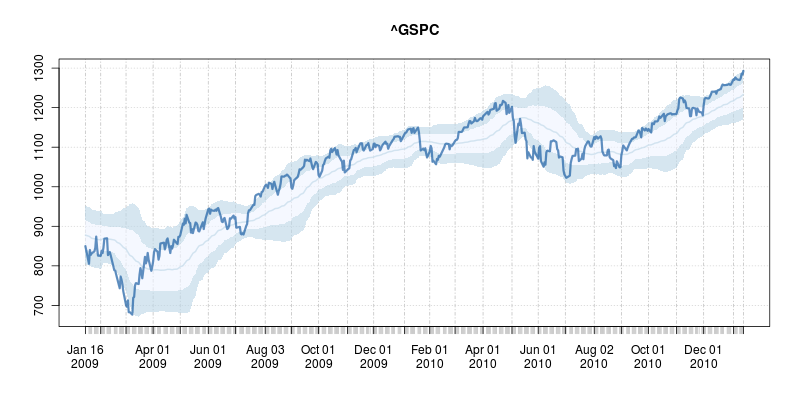
After downloading data and computing the rolling smoothed mean and standard deviation, it really is just a matter of plotting (appropriate) filled polygons. Here I used colors from the neat RColorBrewer package with some alpha blending. Colors can be turned off via an option to the function; ranges, data length and type of smoother can also be picked. To call this in R, simply source the file and the call, say, plotOBOS("^GSPC", years=2) which creates a two-year plot of the SP500 as shown here: Example chart of overbought/oversold levels from plotOBOS() function This shows the market did indeed bounce off the oversold lows nicely on a few occassions in 2009 and 2010 --- but also continued to slide after hitting the condition. Nothing is foolproof, and certainly nothing as simple as this is, so buyer beware. But it may prove useful in conjunction with other tools. The code for the script is here and of course available under GPL 2 or later. I'd be happy to help incorporate it into some other finance package. Lastly, if you read this post this far, also consider our R / Finance conference coming at the end of April.

Edit: Corrected several typos with thanks to Josh.

John Goerzen: 24 hours with Jacob

Friday, I wrote about the train trip Jacob and I were planning to take. Here s the story about it. Friday night, Jacob was super excited. He was running around the house, talking about trains. I had him pack his own backpack with toys this time, which were you guessed it trains. Plus train track. His usual bedtime is around 7. He was still awake in his room at about 11, too excited to sleep. The train was an hour late into Newton, so got up, got ready, and then went into Jacob s room at 3:15AM. I put my arm around him and said his name softly. No response. I said, just a little louder, Jacob, it s time to wake up to go to the train station. There was about a 2-second pause and then he sat bolt upright rubbing his eyes. A couple seconds later, in a very tired but clear voice, OK dad, let s go! That is, I believe, a record for waking up speed for Jacob. We went downstairs, got coats, mittens, hats, etc. on, made sure we had the stuffed butterfly he always sleeps with, and went out the door. As usual, Jacob chattered happily during the entire 15-minute drive to the Amtrak station. One of these days I need to remember to record it because it s unique. He described things to me ranging from the difference between freight and passenger trains, to what the dining car is all about, to tractors and how to ride them safely. Newton has some winter lights , and a few places still had Christmas lights, which were of course big hits. We had to wait a few minutes at the Amtrak station, and Jacob hadn t shown any signs of slowing down yet. He wanted to look at every Amtrak poster, picture, logo, or sign in the building. This generally meant me holding him up high while he leaned over to touch it and make out a few words. Then, of course, he would pick out minute details about the trains, such as how many coach cars he thought they had, and we d visit about that for awhile. We got on at about 4:20. We found our seats, and Jacob showed no signs of calming down, despite having had only 4 hours of sleep (instead of his usual 11) so far. We checked out the buttons for lights. And, of course, he excitedly yelled out, Dad, the train is moving! He spent the next while mostly watching out his window, but also still exploring his space. Finally at about 5, I said, Jacob, I am really tired. I am going to sleep now. Will you sleep too? His response: Oh sure dad, I will sleep with my eyes open! As a result, no sleep was had for Jacob, and only a little for me. The dining car opens for breakfast at 6:30, which is normally a rather foreign time for breakfast on the train for us. But we were both awake so I figured might as well go. So Jacob and I went to the dining car. We sat with a woman going from New Mexico to Lawrence for her grandpa s funeral, though it was expected and she was having a good time on the train. Jacob turned completely shy, and refused to say a word, except maybe a few whispered into my ear. He got his favorite railroad French toast, and had me drizzle some syrup on it. I used the word drizzle for syrup the first time he had French toast on the train, and if I fail to use that word in the dining car, I will hear about it in no uncertain terms from Jacob. He loved his dining car breakfast, but we spent about an hour and a half there. He was really slow at eating because his face was pressed up against the window so much. But that was just fine; we had nowhere else to be, the person eating breakfast with us enjoyed visiting (and, apparently, scaring the dining car staff with tales of bears in the New Mexico mountains). This was what the train trip was all about, after all. We played in the lounge car for awhile. The almost floor-to-ceiling wrap-around windows provided a great view for him, and more opportunities to press his face against a window. We talked about freight trains that he saw, noticed the snow on some of them. Then we found the back of the train and he got to look out the back window. Back at our seat, he played with his toys for about 10 minutes, which was all he used them on the entire trip. There was just too much else to enjoy. When we used the restroom on the train, he d comment on how much he liked the Amtrak soap. It smells SO very very good! He wanted to wash his hands on the train. By late morning, he had decided: Dad, I LOVE this Amtrak soap. It smells like peaches! Shall your hands smell like peaches too? And, when we d get back up to our seats, he d put his hands in my face, saying, Dad, smell that! My hands smell like peaches! It was from the AMTRAK SOAP! At some point, he discovered the airline-style safety brochures in the seat back pockets. These were filled with diagrams of the train car, a few photos, and lots of icons with descriptions. I don t know how many times I read the thing to him, or really how many times he then recited it to me from memory. It was a lot. He spent hours with those brochures. Jacob had already told me that he wanted pizza for lunch, so I got him the kid-sized pizza. It wasn t all that big, and he could have devoured at least half of it when hungry. But he was getting really tired and ate only a few bites of pizza and a few chips. Pretty soon he was leaning up against me, the window, and eventually had his head on the table in some tomato sauce. But he didn t quite fall asleep by the time we went back to our seats, and of course was wide awake by that point. Jacob loves spotting the word Amtrak on things. It was very exciting when he noticed his orange juice at breakfast, and milk at lunch, were Amtrak juice and Amtrak milk due to the logo on the cups. At dinner he noticed we had Amtrak plates, and when I pointed out that his metal fork had the Amtrak logo on it, he got very excited and had to check every piece of silverware within reach. Dad, I have an Amtrak fork too! . And dad, YOU also have an Amtrak fork! We ALL have Amtrak forks! *cackling laughter* I finally insisted that Jacob lay down for some quiet time. I closed the curtains, and he finally did fall asleep less than an hour before our arrival into Galesburg. So by 2:15 he was up to 4.75 hours of sleep, I guess. We stopped in the train station briefly, then started our walk to the Discovery Depot Children s Museum, which was right nearby. Although I made no comment about it, Jacob said, Dad, there is a train museum RIGHT HERE! Yes, you re right Jacob. I can see a steam engine and some cars here. Let s go in! I don t think it s open today. It IS open shall we go check? It wasn t, and that was mighty sad though when he spotted another old caboose sitting outside the children s museum, the day suddenly seemed brighter. He complained of how cold he was, although my suggestion that he stop walking through the big piles of snowdrifts was met with a whiny, But dad, I WANT to do that! We went inside the museum (having to walk right buy the locked caboose thankfully the people at the desk promised to unlock it for us when we were ready) and Jacob started to explore. There was some wooden play trains big enough for children to climb in which he enjoyed, but in general he went from one thing to the next every minute or two as he does when he s really tired or overstimulated. Until, that is, he discovered the giant toy train table. It had a multi-level wooden track setup, and many toy trains with magnetic hitches. It was like what we have at home, only much bigger and fancier. He spent a LONG time with that. We then briefly explored the rest of the museum and went out into the caboose. It wasn t the hit it might have been, possibly because there are several at the Great Plains Transportation Museum that he gets to go in on a somewhat regular basis. After that, he was ready to go back into the museum, but I was feeling rather over-stimulated. On a day when the highs were still well below freezing, it seemed just about every family in Galesburg was crowded into the children s museum, making it loud and crowded which I don t enjoy at all. So I suggested maybe it was snack time instead. A moment s thought, then he started to pull me out of the caboose before I could get my gloves back on Yes dad, I think it IS snack time. Let s go. Let s go NOW! We walked over to Uncle Billy s Bakery (Google link or minimal website). Jacob spotted some sugar cookies shaped like mittens. Despite my reluctance to get him more sugar, he was so excited plus I had barely prevented a meltdown at lunch by promising him that he would get dessert later in the day so he picked two red mitten cookies. I got myself a wonderful peach muffin and a croissant and we sat down at one of the tables by the window. I taught Jacob how to hang his coat on his chair and he lit into those cookies. I spotted a guy at the next table over wearing a BNSF jacket, and asked him if he worked for the railroad. He had retired as an engineer a couple of years ago, and had worked various jobs before that. He grew up in Manhattan, KS and so was interested in our trip and very friendly. While we visited, Jacob devoured his cookies and increasing portions of my snack as well. He told us about a new shop The Stray Cat just two stores down that was having a grand opening event today. They make decorations and art out of basically discarded items, and had some really nifty things that I may have bought had I not been wanting for space in our backpack. Then I spotted Sweets Old-Fashioned Ice Cream, Candy, and Soda Shop across the road. I figured he d love it and I was already in for the sugar so might as well. He picked out some birthday cake flavor ice cream for himself. I got huckleberry ice cream, which he insisted on calling purpleberry and managed to get some tastes of as well. After that, we went to the train station. It was about an hour until our train would be there. I wasn t sure if we d find enough to do, but I shouldn t have worried. Earlier, we had made the happy discovery that the station s restroom featured the Amtrak soap, so there was that. Then there was the model Amtrak train in the ticket window, which Jacob kept wanting to look at while I d hold him. And also, the California Zephyr came in. We watched it arrive from the station window, saw people get off and on, and saw it leave maybe the first time Jacob has witnessed all that in person. And, of course, we looked at the pictures in that train station. The ticketmaster gave Jacob a paper conductor s hat with puzzles and mazes on the back side. And then it was time to get onto our train back home. We ate dinner Jacob again ate little and almost fell asleep and got back to our seats. I let Jacob stay awake until about 8, when he was starting to get a bit fragile. It took him awhile to fall asleep, but he finally did at about 8:30. Today he s still been all excited. He will randomly tell us about bits of the trip, that the man at supper called his grilled cheese sandwich piece little when it was really big, what we did at the ice cream store, etc. And I do think that he is now a train safety expert. All in all, I think that is probably the most excitement he s ever had in 24 hours and it was a lot of fun to be with him for it!

Nikita Youshchenko: Render PDFs on GPU?

Recently I tried once more to read a pdf file on n900. And as usual, it worked bad. Not only because of small screen that particular pdf had two-column formatting, and n900 s screen is wide enough to display one of these two columns with a readable font. Much worse was extremely slow redrawing. Finger scrolling on a touch screen is cool but only if system has enough power to immediately show content as it is scrolled to be visible. In practice I try to scroll with finger, then a second or two pass, then page on the screen starts to move, replaying all my finger movement during that second or two (which was not very direct because of no quick visual feedback), by the way text at borders goes out of screen for a moment, and that area becomes broken and is redrawn only after several more seconds. And then, in less than a minute (after reading displayed content), all that has to be repeated. In total, this makes UI almost unusable. While looking at this, I thought why not use GPU here? This device has a powerful GPU, enough even for non-trivial games. So why not convert a pdf page into a scene description for GPU, and then get zero-delay scrolling and scaling at least? This could be useful even on desktops sometimes pdf viewers do have interactivity problems, especially at very-large scale (400% or more) which is needed to view board schematics diagrams. Anyone ever implemented this? Or maybe wants to implement?.. :)

Daniel Kahn Gillmor: resetting passphrases for mapped LUKS volumes

Let's say you set up a machine using an encrypted disk with LUKS (debian-installer's partman makes this wonderfully easy!). You choose an initial passphrase, get the machine working, and it's working great. Then, you need to restart it, and realize that (for whatever reason) you've forgotten or lost the passphrase for the volume. oops! (i'm sure this has never happened to you -- let's just pretend it's your less-fortunate friend). If your system is still running, and you have superuser access to it, you can actually set a new passphrase for the LUKS volume using information that the dm-crypt kernel module has about the in-use mapping. In my examples, i'll imagine that the source volume is /dev/XXX2 and the exported cleartext volume is known by the device-mapper as XXX2_crypt In the bigger picture, this should serve as a reminder that even though your disk is encrypted, if someone gets live access to the superuser account on a system with the encryption keys loaded, your data is no longer secret. Before you do any tweaking, you might want to back up your LUKS header, just in case:
0 root@example:~# umask 077
0 root@example:~# cryptsetup luksHeaderBackup /dev/XXX2 --header-backup-file XXX2.luksheader.backup
0 root@example:~# 
Maybe also copy that off the machine, since a copy of the LUKS header stored within its own volume isn't terribly useful for a backup-recovery situation. You might also be interested in looking at the contents of the LUKS header:
0 root@example:~# cryptsetup luksDump /dev/XXX2
LUKS header information for /dev/XXX2
Version:       	1
Cipher name:   	aes
Cipher mode:   	cbc-essiv:sha256
Hash spec:     	sha1
Payload offset:	2056
MK bits:       	256
MK digest:      93 51 6c 66 ec ce 32 54 6f 6b 52 d1 27 9b 5a 62 6f 6b 52 d1
MK salt:       	b2 ca 20 49 9f 78 49 c2 fe 15 b4 0f 74 11 23 49
               	64 9e 61 bb f2 82 60 47 a5 76 fa a4 24 0e 5a 7e
MK iterations: 	10
UUID:          	052f1da0-21a1-11e0-ac64-0800200c9a66
Key Slot 0: ENABLED
	Iterations:         	218733
	Salt:               	f2 ae 8c 53 48 a5 f0 bf e1 2c 06 5f 5a bd ff d9
	                      	9a 2e d1 49 3a 63 f8 49 82 ed ae 86 7b 7b 7e 76 
	Key material offset:	8
	AF stripes:            	4000
Key Slot 1: DISABLED
Key Slot 2: DISABLED
Key Slot 3: DISABLED
Key Slot 4: DISABLED
Key Slot 5: DISABLED
Key Slot 6: DISABLED
Key Slot 7: DISABLED
0 root@example:~# 
Now, the fix: We pull the live "master key" from the running device map, and fill a new luksKeySlot from it (this example uses bash's <() syntax for process substitution -- if you use a different shell, i'm sure you can find a different way to do it):
0 root@example:~# cryptsetup --master-key-file <( 
> dmsetup --showkeys table   awk '/^XXX2_crypt: /  print $6  '   tr -d '\n'   perl -e 'print pack("H*", <STDIN>);' 
> ) luksAddKey /dev/XXX2
Enter new passphrase for key slot: abc123
Verify passphrase: abc123
2 root@example:~# 
(note that the luksAddKey invocation above returned an error code of 2 even though it succeeded. I think this is a bug in cryptsetup's return code, not a bug in the password resetting -- it should have returned 0 instead of 2). You can check to see that a new key slot was enabled by re-running cryptsetup luksDump And if you really want to double-check before you reboot, you can try enabling a third keyslot using the passphrase you just added, since this would not succeed if your new passphrase failed to unlock any of the existing keyslots:
0 root@example:~# cryptsetup luksAddKey /dev/XXX2
Enter any passphrase: abc123
Enter new passphrase for key slot: anotherpassphrase
Verify passphrase: anotherpassphrase
0 root@example:~# 
You can also get rid of the original keyslot (which you don't know the passphrase to) like this:
0 root@example:~# cryptsetup luksKillSlot /dev/XXX2 0
Enter any remaining LUKS passphrase: abc123
0 root@example:~# 
(the above commands were all demonstrated using debian testing, with cryptsetup 2:1.1.3-4 and dmsetup 2:1.02.48-4) Tags: cryptsetup, dmsetup, luks, tip

Next.

Previous.