Search Results: "spa"

2 March 2007

Jeff Bailey: Water broke

I just had a total Mr & Mrs. Smith moment. You know the bit where they're standing in the elevator, listening to the elevator music. Waiting for the door to open.

That would be the waiting time between the water breaking, causing us to page the midwife and her phoning us back. =)

The advice: Sleep now, relax.

And so shall it be. =)

(Update: 9am)
Contractions are 6 minutes apart, but still the kind she can sleep through, so she is. Spoke to the midwife, and she advises more rest. Next update with her, assuming nothing eventful, is around 1pm.

(Update: 2pm)
Contractions have slowed to every 12 minutes, but have increased in intensity. Just spoke to the midwife, who gave some tips about moving things along. She just got into the birthing centre after 3 hours of being on the road. It's usually a 30 minute trip, and she lives near us. She thinks that it will be fine, though, given that she was mostly stuck behind snow plows. Next phone call in 2 hours.

(Update: 4:30pm)
Contractions up to 5 minutes apart, lasting about 45 seconds each. We're enjoying a relaxing afternoon watching X-files. She's convinced that she's talking fine through her contractions, but her sister did a great impression:


Well, as I was saying, I ...

(she crouches over)

Oh there's one. Yup.. I'm having a contraction..

(pause)

Yup. Well. I can still talk through them.


Mhm, yup. Sure you can. =)

The midwife called us to check in. Angie described herself as "impatient". Otherwise everything seems to be going as normal. The midwife will call us again in an hour or so to sort out plans for the evening, probably including a visit to us at home since we're close enough to where she lives.

(Update: 6pm)
We've hit the magical number of contractions: every 4 minutes for 45 seconds. Apparently we're supposed to phone after two hours of this, but we phoned after one. My bad, but this is when we had planned to talk anyway. She answered the phone when we paged the midwife, and was sufficiently unable to talk that she handed to phone over to me. The midwife will be here for an in-person visit in about an hour (subject to speed of traffic)

(Update: 7:30pm)
At 7, I went out to shovel a space for the midwife to park. It turns out she drives a cute little VW bug. so at 7:15, I dig her out of the snowbank she got wedged into because I hadn't dug enough of a spot. 7:30, we're now both inside. =) Temperature is being taken, contraction charts being reviewed, etc.

(Update: 8:15pm)
The midwife just left. Right now Angie's 2cm dilated. Apparently there are multiple membranes, and they haven't all broken. This is a good thing because it continues to protect the child and give it manuverability. Charlotte will be back in 2 hours to see how we're doing.

---

I'll update this entry with random little updates, and post a new one when we head out.

Andrew Pollock: [opinion] On whacky spare tyre ideas

Russell Coker writes about not carrying spare tyres and relying on roadside assistance companies instead. I had a similar idea a while ago when I had two of my tyres slashed. I was carrying a viable spare, but with two tyres out of action, it didn't do me a lot of good. I got a tow to the nearest tyre place probably within a kilometre, but they had to order in the tyres to match what was already on the car, so I was left without a car for the remainder of the day and some of the next one. I thought it'd be a great business idea to be able to call up for roadside tyre replacement, similar to how you can "holler for a Marshall" when you get a flat battery. Incidentally, I've clearly been living here too long. I had to battle with myself to not write "tire" all the time.

1 March 2007

Paul van Tilburg: Space Efficient Algorithms

Last Tuesday I finished my paper about Space Efficient Algorithms and Histograms that will comprise most of the grade of my last remaining Master course, Advanced Algorithms. While I’ve been mostly enjoying writing this paper, I am glad it is finished for several reasons, one of them being able to do other things than just working on it and another is that it allows me to focus fully on my Master Project which is starting to progress nicely. (More about this later.) FOSDEM 2007 Due to the amount of time I needed to work on the paper, the need to save money (I really would like to go to Debconf7) and that the scheduled talks didn’t seem to interest me that much, I decided to break with tradition and not to go to FOSDEM this year. Just before FOSDEM, however, it seemed that lots of the people I would have liked to meet did go. While that was a pity, I hope to meet them in three months at Debconf7.

Ross Burton: Tasks Translations

2007-03-01  Ross Burton  
	* tr.po:
	Turkish translation, thanks Tuyan Ozipek.
	* es.po:
	Spanish, thanks Adolfo Gonz lez Bl zquez.
	* de.po:
	German, thanks Christoph Brill.
	* nl.po:
	Dutch, thanks Max Beauchez.
Thanks guys!

28 February 2007

Michael Koch: Spam protection considered harmful?

I wanted to read some blog entry today I got a lot of 403 errors. I thought this is strange that bloggers deny access to their readers. So I wanted to blog about this. So I wanted to access my own blog but got a lot of 403 errors again. After some digging into the issue I found out that I had the BadBehavior plugin for Wordpress enabled and my IP was listed in three different RBLs. I really wonder how it got into them all. What do others do about this? Disabling comments or just live with this? Or use a different way to fight against spam in your blogs?

Evan Prodromou: 9 Vent se CCXV

Lots of short, sharp items today that I want to get down.

LinuxQuestions.org supports OpenID First, I'm psyched to see that LinuxQuestions Wiki now supports OpenID. Jeremy gave the scoop in The LQ Wiki Now Supports OpenID. I was glad to see that LQ's on the OpenID path. It's a really strong community site, and I think it'll benefit greatly from opening up the authentication process. tags:

Wikia and OpenID Angela Beesley had some comments on my Journal/7 Vent se CCXV posting about wikiHow's support of OpenID. In that posting, I said that I thought companies with lots of wikis, like Wikia or wiki farms, might have a disincentive to participate in the OpenID network. Angela put me straight on the issue in a post on WikiAngela about OpenID. I'm glad to hear that Wikia is considering supporting the protocol. Then again, it's hard to believe that an Open Content, Open Source company is really going to go out of its way to avoid open standards and open login. tags:

DemoCampMontreal1 I had a good time last night at DemoCampMontreal1. I gave the first demo -- on, of course, the MediaWiki OpenID extension -- and I had some technical difficulties that didn't let me show off all the functionality. Which was kind of a bummer, but there were lots of questions about it from the audience, so that kind of made up my time. The room was packed, by the way -- pretty much anyone who's anyone in Montreal tech was there. I'm looking forward to DemoCampMontreal2 on 29 March! tags:

certifi.ca One of the best ways to establish credentials on the Web is to use a signed SSL certificate in your browser. It's fast, incredibly secure, and once you get it set up you can just forget it. They're also practically immune to phishing. Unfortunately, most people don't even know what browser certificates are, how they work, or what to do with them. Consequently, most Web sites don't support browser certificate authentication. Vicious cycle. But, one of the cool things about OpenID is that you can disconnect the authentication method from the Web site you're using. Most OpenID identity providers still use username/password combos for authentication, which is why critics have said that the standard is vulnerable to phishing attacks. I wanted to see if it were possible to set up an OpenID identity provider that used browser certificates as the only authentication system. So, in my copious free time, I've hacked up certifi.ca. It's based on the cool PHP OpenID Server that JanRain made, but I've ripped out all the password stuff, and now it runs on luscious certificatey goodness. I'm going to be enhancing the service in the near future, but I wanted to get feedback from folks interested in OpenID as soon as possible. I'm using it for my primary OpenID delegate, and it seems to be working great. Please give it a try and let me know what you think (admin@certifi.ca). tags:

DemoCampMontreal1 on Montreal Poutine There's an article on DemoCampMontreal1 on Midnight Poutine. That's me up on the stage, in the photo! tags:

Nepean Hotspurs Selects win On Saturday, a Muslim girl named "Azzy" Mansour, from Ontario playing in a soccer tournament in Laval was ejected from the tournament (by a Muslim referee, notably) for wearing a hijab -- reportedly because it was a safety hazard. (Montreal Gazette story, registration required.) Admirably, her entire team forfeited the tournament in protest. I'm not excited about Quebec's reactionary activity around Muslim, Sikh, and other religious community's different clothing rules. However, I understand that Quebecois -- and French people -- have a different idea of personal freedom than Americans. I try to be understanding and put myself in the Quebec headspace for this kind of stuff. Mostly, though: I admire the soccer team, the Nepean Hotspurs Selects, for standing up for their teammate and their friend. A lot of teams might have gone ahead and played without her, and it took some courage to drop out of a tournament they'd had high hopes for. They're sixth-grade girls, but they've learned something about integrity that most adults never learn. Kudos to them. tags:

27 February 2007

Meike Reichle: Deutsche Post - when fact beats fiction

Sometimes it happens, that items that are handeled by the German Mail (Deutsche Post) get damaged by their technical installations. When this happens, the item is put into a transparent plastic bag, together with a letter excusing the accident and telling the recipient how to file a request for investigation. So far so good. Unfortunately the envelope that got ripped in that case included two pendants that fell out and got lost. I didn't expect this to be much of a problem, but when I tried to file my request at the mail office it turned out, that there is no form for that kind of incident. The regular form used for requests for investigation assumes that the whole shipment got lost. There is no way to indicate, that it is not an envelope that is missing but merely its content. Trying to exlpain that to the lady there also wasn't successful. Except for repeatedly telling me that I had no right to claim compensation when posting things via regular mail (I know!!) she wasn't of much help. In the end I filled out the form as good as possiblei, gave comments where necessary and the lady promised me I would at least get a confirmation from the service centre. So today, after waiting for more then two weeks I finally got a letter from the service centre. Guess what it said:
"Dear Mister(!) Reichle.
The investigation can not be carried out at the moment, since the information you provided is not complete. Please complete and correct the information according the missing item ..."
And now, guess how I got it. Ripped, in a transparent plastic bag.

Enrico Zini: only-one-way

Python: "There's Only One Way To Do It"
import array
import numarray
import numeric
import numpy
They're all almost the same, but not quite. When google gives you an online piece of documentation, it's hard to say what it refers to. And different scientific modules use one or the other, more or less unpredictably. Maybe in the future numpy will replace them all. In the meantime, if I hear someone saying "There's Only One Way To Do It", I will spank their cheeks with a wet fish.

Martin F. Krafft: Printing on translucent materials

Dear Lazyweb: I am on the look for a print shop that can print on translucent material in such a way that the colour can't be rubbed off. It also must not cost an arm and a leg. Can anyone recommend such a company, preferably in Switzerland or Germany, but that's not a requirement? Thanks! NP: Opeth / Morningrise Update: I am not looking for transparencies, nor do I want to print myself. I want thicker material that has a milky appearance to be used for flyers and business cards.

25 February 2007

Uwe Hermann: LinuxBIOS talk video recording from FOSDEM 2007

LinuxBIOS logo Highly recommended for anybody who might be even remotely interested in LinuxBIOS: There's a video recording (OGG, 234 MB) of the LinuxBIOS talk at FOSDEM 2007 by LinuxBIOS-founder Ron Minnich. The talk is about LinuxBIOS, its history, how it works, what the main challenges are, where it's used today and what the future will likely hold. Watch it, you won't regret it. And if you want to know more, or maybe even consider contributing, head over to linuxbios.org or contact the mailing list.

Jeff Bailey: img_7860.jpg


img_7860.jpg
Originally uploaded by jbailey.
Finished! It's a little greener than I'd hoped, but it makes sense given that we didn't bleach it all the way.

Now back to waiting for Sprout to appear...

Adam Rosi-Kessel: Grimmelmann and Kozinski on Law

I recently came across two old and unrelated writings about law, both of which are worth reading, especially for people with strong opinions but no formal training. The first is this piece, entitled Seven Ways in Which Code Equals Law (And One in Which It Does Not), by recently-appointed New York Law School professor James Grimmelmann and EFF Legal Director Cindy Cohn. Several observations are particularly appropriate for the slashdot crowd (and, to a lesser extent, certain members of the Debian community and others who grew up on a diet of BASIC, Pascal, and then C and later perl). I especially like this bit about “hacking the law”:
Some people, seeing this connection, and remembering the values of good code, try to improve the legal system by treating it as a computer. People come to me with ideas for hacking the law. The government says that cryptography is a weapon, they say, but the Bill of Rights says we have the right to bear arms. So that means we have a Constitutional right to use cryptography. But the legal system isn t a computer. If you can t convince a judge that what you re proposing is consistent with the values underlying a law, your argument will go nowhere. People go to jail every year because they think they ve found a way to hack the Sixteenth Amendment. The income tax is illegal, they say, or, The income tax is voluntary, see, it says so right here, and then they get convicted of tax evasion and sent to jail. We did convince several judges about the Constitutional dimension of cryptography, but the claim started from the values of the First Amendment, not a mechanical reading of its words. It s a category mistake to treat the legal system as just another architecture with its own specialized language. Code and law are different ways of regulating; they have different textures. All of those people who are required to make the legal system work leave their mark on its outcomes: they make a certain amount of drift and discretion almost inevitable. Code doesn t have such a limit: it can make perfectly hard-nosed bright-line rules and hold everyone in the world to them. Code is capable of a kind of regulatory clarity and intensity that law can only state, never really achieve.
I don’t entirely agree with the other article, entitled What I Ate For Breakfast and Other Mysteries of Judicial Decision Making by outspoken Ninth Circuit Judge Alex Kozinski (unofficial site maintained by Aaron Swartz, wikipedia entry). For example, I think critical legal studies has resulted in some interesting insights, some of which actually have practical applciation. Still, Judge Kozinski makes an important point about the numerous factors that act as a check on discretion in judicial decisionmaking:
It is popular in some circles to suppose that judicial decision making can be explained largely by frivolous factors, perhaps for example the relationship between what judges eat and what they decide. Answering questions about such relationships is quite simple - it is like being asked to write a scholarly essay on the snakes of Ireland: There are none. But as far back as I can remember in law school, the notion was advanced with some vigor that judicial decision making is a farce. Under this theory, what judges do is glance at a case and decide who should win - and they do this on the basis of their digestion (or how they slept the night before or some other variety of personal factors). If the judge has a good breakfast and a good night’s sleep, he might feel lenient and jolly, and sympathize with the downtrodden. If he had indigestion or a bad night’s sleep, he might be a grouch and take it out on the litigants. Of course, even judges can’t make both sides lose; I know, I’ve tried. So a grouchy mood, the theory went, is likely to cause the judge to take it out on the litigant he least identifies with, usually the guy who got run over by the railroad or is being foreclosed on by the bank. This theory immodestly called itself Legal Realism. Just to prove that even the silliest idea can be pursued to its illogical conclusion, Legal Realism spawned Critical Legal Studies. As I understand this so-called theory, the notion is that because legal rules don’t mean much anyway, and judges can reach any result they wish by invoking the right incantation, they should engraft their own political philosophy onto the decision-making process and use their power to change the way our society works. So, if you accept that what a judge has for breakfast affects his decisions that day, judges should be encouraged to have a consistent diet so their decisions will consistently favor one set of litigants over the other. I am here to tell you that this is all horse manure. And, like all horse manure, it contains little seeds of truth from which tiny birds can take intellectual nourishment. The little truths are these: Under our law judges do in fact have considerable discretion in certain of their decisions: making findings of fact, interpreting language in the Constitution, statutes and regulations; determining whether officials of the executive branch have abused their discretion; and, fashioning remedies for violations of the law, including fairly sweeping powers to grant injunctive relief. The larger reality, however, is that judges exercise their powers subject to very significant constraints. They simply can’t do anything they well please.
Finally, I will link, but not embed, this video of the Anna Nicole Smith court order, for an entirely different perspective on the legal process. You almost don’t really want to have to see this stuff.

Biella Coleman: New(ish) collections on commons, openness and space

In the shade of the commons, to download go here Open Hybrid Space

24 February 2007

Andrew Stribblehill: Laphroaig quarter-cask

We went to Scotland on a family holiday this week (brave or stupid, answers on a postcard). You would not believe the number of puns you can get from the simple town of Ayr. For example, R: “You should have turned right there!” Me: “Oh well. To Ayr is human.” I shall spare you the rest: if your mind isn’t already overflowing with similar appalling jokes, you’re no friend of mine. Whilst in Ayr, I came across a marvellous whisky shop, Robbie’s Drams, and bought a bottle of Laphroaig quarter-cask and another of Smokehead. This article, or what remains of it, is to describe the Laphroaig quarter-cask whisky. Should you wish to avoid the Flash-animated website, here’s a precis. Tales are told of a time when the business of Laphroaig was carried on less than legally and it was useful to carry away smaller casks when the Excise men were coming than the more conventional full-size casks. Over the past few years, they have tried their best to recreate the whisky that would have been drunk as Laphroaig a couple of centuries ago: quarter-sized casks, slightly higher strength and an older filtration model. The effect of the smaller barrels is to increase the surface area to volume ratio substantially, so more flavour will enter the whisky from the barrel. Thus, they bottle it much younger than their standard ten-year-old offering. To smell it, a sweet smell hits the nose — perhaps toffee apple. On the taste, there is an initial earthy sensation followed quickly by a brief flash of kedgeree, leaving the smoky aftertaste of turmeric at the back of the throat. This is a much more subtle whisky than Laphroaig’s ten-year-old: thinner and less oily, and with a much more delicate, though still substantial, peaty hit. Because it’s not chill-filtered, the whisky becomes delightfully cloudy when water is added. I recommend that you try it both with and without additional water: many of the flavours become more muted with water, but a creamy taste comes to the fore. In summary: if you can get your hands on a bottle or two of this, it’s well worth doing so. An excellent whisky. I should also say that even if you’ve disliked other Laphroaigs in the past, give this a shot. It may just be your way into the other delights from the Laphroaig distillery.

Benjamin Mako Hill: Fit For an Emperor

I found this box outside my apartment labeled, "The Emperor Clothes." Fortunately, the contents were exactly what I was expecting.    Surely clothing fit for an emperor. That is of course, if you are fit enough to appreciate them.

23 February 2007

Martin F. Krafft: The Inet

The folks of I, Cringely published some thoughts by a guy called David Harrison, who proposes to replace the ICANN-dominated DNS infrastructure with a new kind, which is backed by new technology and stricter rules from the start. I would really like to see the "Independent Network" ("Inet") be run by the open-source community. And I think we should get started soon. If there are people knowledgeable of whois databases and the DNS protocol, let's get in touch. If you're going to be at FOSDEM 2007, let's do it live!

Simon Law: DemoCamp Montr al 1


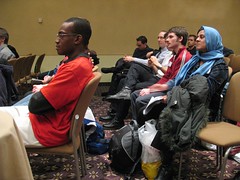
Audience
Originally uploaded by sfllaw.
There's less than a week before Montr al's next little technology un-conference. DemoCamp Montreal 1 (Fran ais) follows in the footsteps of Toronto's DemoCamp, bringing neat demonstrations to the spotlight. What is DemoCamp? It's a mini-conference where you show up and get to see people present the cool things that they're doing. Be it some software they wrote, a robot they built, or even a live tutorial, there's always something interesting happening. And you need to know. All you have to do is show up. We'll be at the Societ des arts technologiques which has been cool enough to donate their space for us. Just show up on Tuesday 27 February 2007 at 18:30, after putting your name down on the registration list. Don't be shy, it's free! Demonstrations are short, sweet, and PowerPoint slides are forbidden. You get to actually see something happen, which is a much more exciting than your usual conference lecture. In addition, we'll hang out afterwards to shoot the breeze and discuss what we saw. I'll be there with my camera, helping my friends [info]gorbash_dragon and [info]peaceful_dragon run the show. Jonathan Kopanas, who went to Concordia, is coming up to introduce the presenters and Austin Hill is drumming up publicity. DemoCamp Montr al 1
Tuesday 27 February 2007
18:30 20:30
Societ des arts technologiques
1195 boul. St-Laurent
Free admission
( Sign up Upcoming.org Google Maps ) I'll see you there!

Christian Perrier: Why my free space vanishes...

With all NMU work, I keep many copies of many packages on my local HD. However, I was recently still puzzled by my disk space slowly decreasing in the /home partition of my laptop. Today, I found why:
bubulle@mykerinos:~/travail/debian/nmu-debconf/INTENT/geneweb> du -s
~/.devscripts_cache/bts
1931348 /home/bubulle/.devscripts_cache/bts
As I do much work offline, I use the "bts cache" feature intensively to be able to access to bugs of packages I NMU for l10n. And, of course, I never clean this out. So, apprently, I need to make a major cleanup and I will claim 2GB out of my /home partition (which is 15GB). Should be good..:-)

22 February 2007

Benjamin Mako Hill: Notorious in Libraries

My Overprice Tags projects from a few days back has been getting a bunch of attention. Perhaps most interesting, the MIT libraries -- whose journals we defaced augmented in the project -- have been unbelievably positive about the project! They've written up a very positive description of the event on their website and published an interview with me as well!

Eddy Petrișor: Useful and unknown feature of apt

Note: this feature was at least unknown to me.

If you have a local mirror and one which is further, you will most surely have the local mirror listed first in your /etc/apt/sources.list so that apt tries to download first from the local mirror. Nothing new here.

Add a laptop to that mix and moving frequently to another place, let's say office at work, where the link to the second mirror is waaay faster than the one to your home local mirror.

How do you make updates/installations via the most speedy connection, no matter if you are at work or near the local mirror at home?

Simple (if you count simple something I had to figure out in 1 months or so - to quote partially aj :-); apt will use that mirror if you comment out the lines that point to your local mirror and will use those without the need to run update.

Are you getting my drift? So, how does that add up? Throw in there laptop-net and its feature to replace files depending on profile and you got it all almost sorted out (you'll have to make a restore feature based on the $ PROFILE /before-deselect hook).

So, to conclude, here are the instructions:
Now you should be able to always install from the fastest mirror at all times.

Next.

Previous.