Search Results: "ron"

14 October 2007

Christian Perrier: RWC: That will be South Africa-England

...and, really, we nearly never though that Argentina could win tonight. South Africa was really too strong for them. The only domain were Argentinians dominated were scrums but this was much compensated by their great weakness on line-outs, losing something like 5 or 6 of them. South Africa thus logical won very easily...and Bryan Habana is now the best try scorer all along RWCs, along with Jonah Lomu. He is a really great player, indeed. Much much impressive South Africa: they'll be by far the favourites of the final against England, which they beated already during that World Cup. I said several times that I'm not a deep fan of RSA's play, but I could become one. Their game improved all along the World Cup and today, they probably played their best match. Two remakes next week-end: France-Argentina for the 3rd place and South Africa-England as final. That will be good matches, no doubt...and I hope that Bernard Laporte will change the French team to play against Argentina.

Russell Coker: AUUG 2007

Today was the final day of the AUUG 2007 conference [1]. Yesterday I gave a talk about SE Linux for about an hour (not sure exactly as I forgot to make an MP3). AUUG is well known for having conferences with very technical delegates and I wasn’t expecting an easy audience. At the start of my talk I asked for a show of hands as to who has used SE Linux before, about 1/3 of the delegates raised their hand. Someone requested that I poll the audience as to who had used SE Linux involuntarily, it wasn’t what I had planned to ask but it’s best to get these things out in the open so I asked the question. More people raised their hand as being unwilling users of SE Linux than those who had firstly admitted to using it! A theme of the AUUG conference was quality, and I had planned to cover some of the ways that SE Linux improves the quality of code by making certain classes of bugs show up (EG file handle leaks) and by allowing the developers and sys-admins to know exactly what programs are doing. But I ended up explaining why you want to use SE Linux, the concepts of policy analysis tools (as compared to the absence of such tools for Unix permissions), the benefits of MAC and why SE Linux is worth using. I believe that the talk did some good and conversations with delegates afterwards revealed that some of them had done some positive things with SE Linux. Today I wore a T-shirt advertising the root password for my new SE Linux Play Machine [2] which will be online shortly (hopefully tomorrow) which got some interest (AFAIK I’m the first person to wear a root password on a T-shirt). When I have my play machine online I plan to wear the shirt whenever I visit an electronics store or any other location where geeks are likely to congregate. ;) After the conference finished about 1/3 of the delegates went to Ginza Teppanyaki [3] for dinner. Some of the guys wanted to photograph me wearing my shirt. Finally, the conference went pretty well, the delegates and speakers all seemed to enjoy themselves and learn some useful things. Congratulations to the AUUG conference organisers!

Mike Hommey: Adding some VCS information in bash prompt

I don’t spend a lot of time customizing my “working” environment nowadays, like enhancing vim configuration, or tweaking the shell. But when I read MadCoder’s zsh git-enabled prompt, I though it was too convenient to not have something like that. Except I don’t work with git only (sadly, but that’s changing), and I don’t like colours in prompt (and a 2 lines prompt is too much). Anyways, since I have a bunch of directories in my $HOME that contain either svk, svn, mercurial, or git working trees, I thought it would be nice to have some information about all this on my prompt. After a few iterations, here are the sample results:
mh@namakemono:~/dd/packages$
mh@namakemono:(svn)~/dd/packages/iceape[trunk:39972]debian/patches$
mh@namakemono:(svk)~/dd/packages/libxml2[trunk:1308]include/libxml$
mh@namakemono:(hg)~/moz/cvs-trunk-mirror[default]uriloader/exthandler$
mh@namakemono:(git)~/git/webkit[debian]JavaScriptCore/wtf$
The script follows, with a bit of explanation intertwined.
_bold=$(tput bold)
_normal=$(tput sgr0)
tput is a tool I only dicovered recently, and avoids the need to know the escape codes. There are also options for cursor placement, colours, etc. It lies in the ncurses-bin package, if you want to play with it.
__vcs_dir()
  local vcs base_dir sub_dir ref
  sub_dir()
    local sub_dir
    sub_dir=$(readlink -f "$ PWD ")
    sub_dir=$ sub_dir#$1
    echo $ sub_dir#/
  
We declare as much as possible as local (even functions), so that we avoid cluttering the whole environment. sub_dir is going to be used in several places below, which is why we declare it as a function. It outputs the current directory, relative to the directory given as argument.
  git_dir()
    base_dir=$(git-rev-parse --show-cdup 2>/dev/null) return 1
    base_dir=$(readlink -f "$base_dir/..")
    sub_dir=$(git-rev-parse --show-prefix)
    sub_dir=$ sub_dir%/
    ref=$(git-symbolic-ref -q HEAD git-name-rev --name-only HEAD 2>/dev/null)
    ref=$ ref#refs/heads/
    vcs="git"
  
This is the first function to detect a working tree, for git this time. Each of these functions set the 4 variables we declared earlier: vcs, base_dir, sub_dir and ref. They are, respectively, the VCS type, the top-level directory of the working tree, the current directory, relative to base_dir, and the branch, revision or a reference in the repository, depending on the VCS in use. These functions return 1 if the current directory is not in a working tree of the currently considered VCS.
The base directory of a git working tree can be deduced from the result of git-rev-parse --show-cdup, which gives the way up to the top-level directory, relative to the current directory. readlink -f then gives the canonical top-level directory. The current directory, relative to the top-level, is simply given by git-rev-parse --show-prefix.
git-name-rev --name-only HEAD gives a nice reference for the current HEAD, especially if you’re on a detached head. But this can turn out to do a lot of work, introducing a slight lag when you cd for the first time in the git working tree, while most of the time, the HEAD is just a symbolic ref. This is why we first try git-symbolic-ref --name-only HEAD.
  svn_dir()
    [ -d ".svn" ] return 1
    base_dir="."
    while [ -d "$base_dir/../.svn" ]; do base_dir="$base_dir/.."; done
    base_dir=$(readlink -f "$base_dir")
    sub_dir=$(sub_dir "$ base_dir ")
    ref=$(svn info "$base_dir" awk '/^URL/ sub(".*/","",$0); r=$0 /^Revision/ sub("[^0-9]*","",$0); print r":"$0 ')
    vcs="svn"
  
Detecting an svn working tree is easier : it contains a .svn directory, be it top-level or sub directory. We look up the top-level directory by checking the last directory containing a .svn sub directory on the way up. This obviously doesn’t work if you checkout under another svn working tree, but I don’t do such things.
For the ref, I wanted something like the name of the directory that has been checked out at the top-level directory (usually “trunk” or a branch name), followed by the revision number.
  svk_dir()
    [ -f ~/.svk/config ] return 1
    base_dir=$(awk '/: *$/ sub(/^ */,"",$0); sub(/: *$/,"",$0); if (match("'$ PWD '", $0"(/ $)")) print $0; d=1; /depotpath/ && d == 1 sub(".*/","",$0); r=$0 /revision/ && d == 1 print r ":" $2; exit 1 ' ~/.svk/config) && return 1
    ref=$ base_dir##*

    base_dir=$ base_dir%%
*
    sub_dir=$(sub_dir "$ base_dir ")
    vcs="svk"
  
svk doesn’t have repository files in the working tree, so we would have to ask svk itself if the current directory is a working tree. Unfortunately, svk is quite slow at that (not that it takes several seconds, but that induces a noticeable delay to display the prompt), so we have to parse its config file by ourselves. We avoid running awk twice by outputing both the informations we are looking for, separated by a carriage return, and then do some tricks with bash variable expansion.
  hg_dir()
    base_dir="."
    while [ ! -d "$base_dir/.hg" ]; do base_dir="$base_dir/.."; [ $(readlink -f "$ base_dir ") = "/" ] && return 1; done
    base_dir=$(readlink -f "$base_dir")
    sub_dir=$(sub_dir "$ base_dir ")
    ref=$(< "$ base_dir /.hg/branch")
    vcs="hg"
  
I don’t use mercurial much, but I happen to have exactly one working tree (a clone of http://hg.mozilla.org/cvs-trunk-mirror/), so I got some basic information. There is no way we can ask mercurial itself for information, it is too slow for that (main culprit being the python interpreter startup), so we take the informations we can (and since I don’t know much about mercurial, that’s really basic). Note that if you’re deep in the VFS tree, but not in a mercurial working tree, the while loop may be slow. I didn’t bother much looking for a better solution.
  git_dir
  svn_dir
  svk_dir
  hg_dir
  base_dir="$PWD"
Here we just run all these functions one by one, stopping at the first that matches. Adding some more for other VCS would be easy.
  echo "$ vcs:+($vcs) $ _bold $ base_dir/$HOME/~ $ _normal $ vcs:+[$ref]$ _bold $ sub_dir $ _normal "

PS1='$ debian_chroot:+($debian_chroot) \u@\h:$(___vcs_dir)\$ '
Finally, we set up the prompt, so that it looks nice with all the gathered information. Update: made the last lines of the script a little better and factorized.

John Goerzen: My New Printer

Yesterday, Terah and I were in a store selling used items. I spotted a good deal: a used printer for $25. Here are some of its features: Here are some photos:
img_3705.jpg
img_3707.jpg
img_3706.jpg

Brice Goglin: Debian X.org notes - RandR 1.2 guide

Given the massive changes implied by multiple RandR 1.2 drivers being available, and looking at how many bugs were reported because of wrong X configuration, I wrote a RandR 1.2 guide on the wiki. It should at least be useful for people upgrading from old drivers...
(Permanent link) 

13 October 2007

Biella Coleman: Bad Apples .

I am not even sure what to make of this article, written by a professor at a well-known university, on the perils of advising graduate students. Given that I have been sitting at my computer for nearly 12 hours straight and since 4 a.m, I don’t think I am really in a state of mind to think too much of it. Neither do I have much experience doing this (though whatever experience I have had, it has been good so far), so I can’t really comment back via personal experience. I only hope that her/his experience was the exception or that he/she allowed too many boundaries to be crossed, but whatever the case, interesting food for thought. I am sure a graduate student could write an interesting counterpoint, talking about all the questionable things their professors did back to them too and knowing the web, I am sure that will be forthcoming soon.

Adam Rosi-Kessel: Useful Email Disclaimer

Unlike some email disclaimers, this snippet recently observed in a signature block could actually prove useful:
Please consider the environment - do you really need to print this email?

Biella Coleman: On Networks and Experimental Writing

One of my dissertation thesis advisors, Christopher Kelty, is teaching a superb looking course at Harvard this fall on networks. The only thing I would add to that syllabus right now is a book by a department colleague, Alexander Galloway, who just published a book with Eugene Thacker The Exploit. And while I have not read more than a chapter, what I like about it is its experimental style. They open this book with the following orientation:
It is our intention in this book to avoid the limits of academic writing in favor of a more experimental, speculative approach. To that end, we adopt a two-tier format. Throughout Part I, “Nodes,” you will find a number of condensed, italicized header that are glued together with more standard prose. For quick immersion, we suggest skikking Part I by reading the italicized sections only…. In this sense, we hope you will experience the book not as the step-by-step propositional evolution of a complete theory but as a series of marginal claims, disconnected in a living environment of many thoughts, distributed across as many pages.
The good thing is while the form is experimental, at the sentence level, things are quite clear. I have often had the experience of reading experimental work whose content was the experiment but not the form, and basically I did not understand a thing. In this case, it is the form that achieves their desire to explore and present their marginal claims. Annemarie Mol in The Body Multiple also uses a two-tiered experimental approach that is just fantastic, especially since her writing is especially accessible.

Raphael Geissert: Blog Action Day

What about one day on which every blog posts on the same subject: the environment


On October 15th don't forget to blog about the environment: what you do not to polute very much, how you care about the environment in your day-a-day life, or whatever you want to say about the environment.

The mission is to have mass participation worldwide, so don't forget to spread the word and check out this video.


Visit http://blogactionday.org/ for more information :).

I'm looking forward to see Planet Debian full of environment-related blog posts on October 15th :yes:

John Goerzen: Young People NOT Delinquent?

Here's an interesting and probably controversial article. It starts with:

When I hear people my age (35+) rip the younger generation I usually keep my mouth shut. But I have something I need to say, so this is my public response to the people who think there is something wrong with young people today.

Let me tell you what I think about young people:

The kids coming of age right now are the greatest generation, and we don t give them the respect and freedom we were given and it is shameful.


And it goes on from there.

Also I should point out that George Bush is a baby boomer.

12 October 2007

Andrea Veri: iBluepaper: My new home .

Having a new home on the web is alwais something really special for me and installing wordpress listening to some good music make me feel quite happy and ready to write a new chapter of my web-life on a new home. I’ve decided to start up a new blog to share my thoughts and opinions on a bigger area of users with the idea to link it to the existing italian one on blogspot (http://andreaveri.blogspot.com), maybe subscribing my feed to community planets such as Ubuntu and Debian one respectively at http://planet.ubuntu.com and http://planet.debian.org. I’m currently trying to install a new bittorrent client called linkage… ….but something is going wrong making it, seems something like the use of a bad syntax or even an ABI breakage on compiling it with the new libtorrent-rasterbar 0.12, I hope to find out a workaround for this; I would like to use linkage again hoping to have it fixed upstream in the near future……and I suggest everyone to browse linkage’s homepage at http://zeflunk.googlepages.com/ and maybe try it out, every istruction on having it installed on Ubuntu can be found at http://code.google.com/p/linkage/wiki/Installation, and yeah…it looks too nice to avoid his use as your main bit-torrent application… What to say….try it out!

11 October 2007

Russell Coker: Cheap Laptops for Children

I was recently browsing an electronics store and noticed some laptops designed for children advertised at $50AU. These machines were vastly different from what most of us think of when the term laptop is used, they had tiny screens, flimsy keyboards, no IO devices, and a small set of proprietary programs. It was more of a toy that pretends to be a laptop than a real laptop (although I’m sure that it had more compute power than a desktop machine from 1998). After seeing that I started wondering what we can do to provide cheap serious laptops for children running free software. The One Laptop Per Child (OLPC) [1] program aims at producing laptops for $100US to give to children in developing countries. It’s a great project, the hardware and software are innovative in every way and designed specifically for the needs of children. However they won’t have any serious production capacity for the near future, and even $100US is a little more expensive than desired. Laptops have significant benefits for teaching children in that they can be used at any time and in any place - including long car journeys (inverters that can be used to power laptops from a car power socket are cheap). A quick scan of a couple of auction sites suggests that laptops get cheap when they have less than 256M of RAM. A machine with 128M of RAM seems likely to cost just over $200 and a machine with less than 128M is likely to be really cheap if you can find someone selling it. So I’m wondering, what can you do to set up a machine with 64M of RAM to run an educational environment for a child? KDE and GNOME are moderately user-friendly (nothing like the OLPC system, and even Windows 3.0 was easier in some ways) but too big to run on such a machine (particularly when GIMP is part of a computer education system). This should be a solvable problem, Windows 3.0 ran nicely in 4M of RAM, one of the lighter X window managers ran well in 8M of RAM for me in Linux 0.99 days, and the OS/2 2.0 Workplace Shell (which in many ways beats current KDE and GNOME systems) ran nicely in 12M). I think that a GUI that vaguely resembles Windows 3.0 should run well on a machine with 64M of RAM - is there such a GUI? I have briefly scanned the Debian-Edu [2] site but the only reference to hardware requirements is for running LTSP.

Lars Wirzenius: Debian: In the interest of full disclosure

<liw> Guest1482, iirc fakeroot doesn't work on all architectures, and there may be situations where it doesn't work on any, but it should certainly be used when possible <Clint> liw: it should always work the same on all the linux ones <liw> Clint, I have a vague recollection of libc making life difficult for fakeroot on... sh? hppa? but I may be utterly wrong here, and I hope I am <Clint> liw: there was a crackheaded struct change on alpha, but vorlon and i fixed that <Clint> "fixed" <liw> Clint, ok, so I'm utterly wrong, and the world is a better place for it <Clint> that's right, so stop spreading fakeroot fud <Clint> OR ELSE
I take it back, I offer a complete and utter retraction. The imputation was totally without basis in fact, and was in no way fair comment, and was motivated purely by malice, and I deeply regret any distress that my comments may have caused fakeroot, or its family, and I hereby undertake not to repeat any such slander at any time in the future.

Steve Kemp: I put a spell on you

Felipe Sateler kindly made a Debian package for the chronicle blog compiler, so you can now get it from my apt-get repository. He suggested it be uploaded to Debian sid, I'm happy to do so if there is any interest. Otherwise I'll keep placing release there when they occur. (To be honest I don't anticipate any major development unless there are bugs, or people would like to contribute themes ..)

Matthew Palmer: EBay Sez: Linux is for scammers

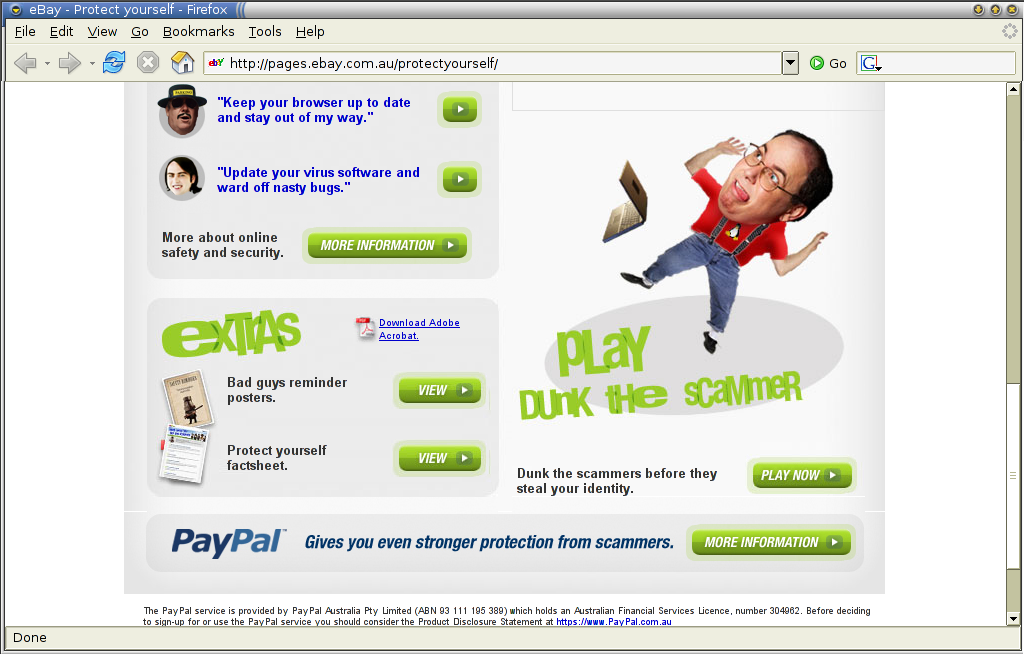
In what I can only assume is a case of "graphic design spec gone horribly wrong", EBay has decided to portray our lovable penguin friend as the mascot of the online scam artist: Linux is for scammers, says EBay (Click on the image for a full-size version) Personally, I think the scam artists' best friend is a Windows machine, as it provides a rich source of untraceable connectivity, but my guess is that Microsoft has scarier lawyers. I don't know how long the image has been up there for, but I'd imagine it won't last long. Linux users may not be that numerous, but we're a noisy lot. <grin>
Andrew Pollock: [life] The fun doesn't stop

We went to see Sarah's cardiologist the week after she was discharged from hospital, and he said that looking back over all of the echocardiograms that have been taken in the 18 months or so that he's been following her, it looks like her aortic aneurysm has gotten a little bit bigger. It's still below the size that they'd normally operate at, but he said that in his opinion it should be repaired before attempting another pregnancy, to play it safe. He even said that afterwards, Sarah could go back to doing triathlons, which is a big step back towards a normal life. So on Monday, we had an appointment with Dr Craig Miller, who is apparently the best cardiac surgeon in the US, and one of the top three in the world, when it comes to aortic aneurysm repair whilst being able to save the heart valve. We'd done a heap of reading up on Dr Miller before the appointment, and the cardiologist's clinic administrator had told us about him as well. Apparently he's a real character. He certainly looked it from the staff photo (linked above). In reality he looked much more like this. But he's certainly a real cowboy type. We saw his nurse practitioner on Monday before we saw him, and his nurse practitioner was this moderately pierced, cowboy boot wearing, "y'all" speaking kinda guy, who really knew his stuff. In fact we exhausted all of our questions that we had for Dr Miller on him before we even saw Dr Miller, because he was running a bit late with the previous patient. This is where Sarah's got a pretty detailed write-up of what they're planning on doing. They're going to replace more of the aorta than they would otherwise (because the enlargement seems to be continuing further up the aorta), which makes the surgery a little more involved, in that they're messing with the arteries that lead up to the brain, so they've got to some more funky bypass work, and lower her core temperature so her brain copes with the blood flow being monkeyed with. Dr Miller was very softly spoken, and a lot older looking than I'd expected, given the whole cowboy hat thing. He seemed really nice and thorough, and explained everything. He also showed us what a mechanical valve looked like. The reason sparing the valve is so important is that the alternatives if they can't are either a pig's heart valve or a mechanical one. Both have their drawbacks. A pig's valve won't last the rest of Sarah's life. She'd need to have valve replacement surgery at some point down the track (I think they said about 8 years, although they wear out faster in younger people). A mechanical valve requires you to take blood thinning drugs for the rest of your life. One of the side effects of these drugs are birth defects. It's also audible from outside the body. We got to see (and keep) a sample of the Dacron tubing that they use to replace the part of the aorta they're removing. I was totally taken aback by the diameter of it. I hadn't sat down and really thought about what 4.4cm (which is about what her aneurysm is currently at) really looked like. The operation is likely to take 8 to 10 hours. I'm not looking forward to that waiting game. Dr Miller said the procedure, whilst sounding pretty bloody scary has about a 1% risk. I'm not exactly sure what that is a risk of though. Sarah's booked in for January 3 next year. The road ahead is still long.

10 October 2007

John Goerzen: Hey Dell, Can You Hear Me Now?

A couple of years ago, I had an apparent lapse of judgement and bought a 21" Dell LCD because it seemed to be a good monitor and a good price. Even after my earlier experiences with Dell.

Last winter, it developed an odd dim area in the shape of an L. It was under warranty.

I made the mistake of contacting Dell support. It probably took 2-3 hours of calling before they agreed to replace it. I'm pretty sure I said each of these things to them at least 5 times:


Eventually I spoke to somebody that understood the concept of a serial number and agreed to send me a replacement monitor. I made the mistake of giving them a shipping address for that.

Ever since then, they have sent me stupid catalogs.

NO, DELL, I DO NOT WANT TO BUY A FLAMINGO PINK INSPIRON NOTEBOOK

that is what I think each week when I get such a catalog.

I have gone to their website to try to get off of these mailings. They have different privacy forms for their different units (home, small business, etc.), and I sent in a removal form for all of them. That didn't help. I called their customer service department, and after getting the run around yet again, they said they'd take me off right away. That didn't help either. This was all months ago. They are blatantly violating their stated privacy policy.

Today I got another magazine. Featuring Flamingo Pink inspirons yet again. And a page that says "Raze your standards." Need I say more?

I will therefore be following the advice of Junkbusters.com and will file a Prohibitory Order against Dell at my earliest convenience. That's the first time I've been motivated to do that.

And if they don't honor that, they'll be hearing from the postal inspectors.

Dell has now become my most despised company ever. Yes, even more than Sprint.

Steve Kemp: I role and I tumble practically all night long

Today mostly consisted of a new release of the chronicle blog compiler. Interestingly this received several random mails today. I wonder what caused that all of a sudden? The release of the compiler is timely, as it reminds me I've still not managed to find a decent gallery compiler. Although the thought of writing my own, rightly, fills me with depression. I've been interested in reading more about both Git and SELinux upon Planet <strike>Coker</strike> Debian recently. I've switched several small projects over to GIT but I've not yet listed them publically. First of all I would like to see if there is a version of trac that I can install which supports git repositories. I guess that's a job to research tomorrow. I wonder if I would confuse people by hosting GIT projects upon cvsrepository.org? ;)

Clint Adams: Good job, rats

[jjjjordi] El a o pasado 1,944 neoyorquinos vieron algo y dijeron algo. Gracias por mantener tus ojos y o dos bien abiertos. Y no guardar tus sospechas para ti mismo. Si ves algo, di algo! Habla con un polic a o con un empleado de la xxx. O llama al 1-888-xxx-xxxx

Clint Adams: I need an admin assistant to glue papers to other papers

buxy is on the wrong track. DSA is a fundamentally-flawed organization; all of the self-selecting committees in Debian are: you cannot have a functional and respectable subgroup if it maintains autonomy like that. The solution to the current set of problems that have been plaguing us for years is not to have backroom discussions and negotiations. It is not to add MORE team members, because that will, at best, achieve minor performance improvements. At worst, that will bolster its structural problems. To fix DSA cleanly and healthily, the honorable members need to resign, and Debian needs to fire the rest. Attempt anything else and you will likely become part of the problem.

Next.

Previous.