Search Results: "pa"

2 March 2015

DebConf team: Inviting speakers to DebConf15 (Posted by Ren Mayorga)

Last year for the DebConf edition that took place in Portland, we had some invited speakers that helped bring a different point of view to the matters discussed during the conference. This year we would like to do this again. If you would like to suggest inviting someone that would not regularly attend DebConf, the DebConf Content Team encourages you to do that now. We will stop accepting new suggestions on 10 March 2015. You can follow the simple procedure described on the Inviting Speakers page in the DebConf s Wiki Please keep in mind that we don t promise to bring to Heidelberg everyone that is suggested. The final list of invited speakers will depend on the speakers availability and our limited budget.

1 March 2015

Robert Edmonds: Converting to --upstream-vcs-tag

Recently, the Google protobuf developers announced a migration of their project's source code from an svn repository to a git repository. Up until this point, the Debian protobuf package repository had only tracked upstream development by embedding upstream release tarballs using gbp import-orig with pristine-tar. It would be nice to smoothly migrate the packaging repository to additionally make use of the --upstream-vcs-tag option to gbp import-orig, the advantages of which have been well described by Russ Allbery. This turned out to be harder than expected, so for reference I documented the steps I took below. Note that this packaging repository uses the default gbp import-orig repository layout, where upstream sources are placed on a branch named upstream, and the Debian branch is named master. Add an upstream remote configured to track the upstream repository's master branch and tags.
$ git remote add --tags --track master upstream https://github.com/google/protobuf.git
The upstream remote shouldn't be confused with our upstream branch. Note that git-remotes are local to the repository, so the upstream remote should probably be documented in the debian/README.source file. Fetch the upstream branch and tags.
$ git fetch upstream
warning: no common commits
remote: Counting objects: 5210, done.
remote: Compressing objects: 100% (861/861), done.
remote: Total 5210 (delta 3869), reused 5194 (delta 3855)
Receiving objects: 100% (5210/5210), 3.57 MiB   1.43 MiB/s, done.
Resolving deltas: 100% (3869/3869), done.
From https://github.com/google/protobuf
 * [new branch]      master     -> upstream/master
 * [new tag]         v2.6.0     -> v2.6.0
$
We now have a git-remote upstream, a remote-tracking branch upstream/master which corresponds to the master branch that upstream makes releases from, and a release tag v2.6.0. Note that the remote-tracking branch upstream/master shouldn't be confused with our master branch. Up until this point, our upstream branch has been synthetically generated by importing upstream's release tarballs with gbp import-orig. We need to merge this synthetic history with upstream/master. Unfortunately, I couldn't find a way to do this without using a temporary branch.
$ git checkout -b tmp upstream/master
Branch tmp set up to track remote branch master from upstream.
Switched to a new branch 'tmp'
$ git merge -s ours -m \
  "Merge the original 'upstream' branch with upstream's new master branch" upstream
Merge made by the 'ours' strategy.
$ git checkout upstream
Switched to branch 'upstream'
Your branch is up-to-date with 'origin/upstream'.
$ git merge --ff-only tmp
Updating 7ed940b..9ba221e
Fast-forward
 CHANGES.txt                                                          49 +-
 COPYING.txt => LICENSE                                                0
 Makefile.am                                                          64 +-
 Makefile.in                                                        1041 --
 README.txt => README.md                                              49 +-
[...many more lines...]
$ git branch -D tmp
Deleted branch tmp (was 5f18f02).
$
There are now an additional 400 or so commits on our upstream branch, corresponding to the new git repository history published by upstream. Import the 2.6.0 release tarball against the upstream v2.6.0 tag, using the --upstream-vcs-tag option.
$ git checkout master
Switched to branch 'master'
Your branch is up-to-date with 'origin/master'.
$ gbp import-orig -u 2.6.0 --upstream-vcs-tag=v2.6.0 ~/debian/tarballs/protobuf_2.6.0.orig.tar.gz
gbp:info: Importing '/home/edmonds/debian/tarballs/protobuf_2.6.0.orig.tar.gz' to branch 'upstream'...
gbp:info: Source package is protobuf
gbp:info: Upstream version is 2.6.0
pristine-tar: committed protobuf_2.6.0.orig.tar.gz.delta to branch pristine-tar
gbp:info: Merging to 'master'
gbp:info: Successfully imported version 2.6.0 of /home/edmonds/debian/tarballs/protobuf_2.6.0.orig.tar.gz
$
The upstream branch now contains a mixture of the original series of release tarball content imported by plain gbp import-orig and the upstream/master branch as published by upstream. Updating the Debian packaging repository when new upstream releases occur only requires a git fetch to pull down upstream's updated git history and release tag and using the --upstream-vcs-tag option when importing the release tarball with gbp import-orig.

Dirk Eddelbuettel: drat 0.0.2: Improved Support for Lightweight R Repositories

A few weeks ago we introduced the drat package. Its name stands for drat R Archive Template, and it helps with easy-to-create and easy-to-use repositories for R packages. Two early blog posts describe drat: First Steps Towards Lightweight Repositories, and Publishing a Package. A new version 0.0.2 is now on CRAN. It adds several new features: Courtesy of CRANberries, there is a comparison to the previous release. More detailed information is on the drat page.

This post by Dirk Eddelbuettel originated on his Thinking inside the box blog. Please report excessive re-aggregation in third-party for-profit settings.

Thorsten Alteholz: My Debian Activities in February 2015

FTP assistant Processing the new queue got off the ground again. This month I marked 154 packages for accept and rejected 20 packages. Some emails I got were rather funny and people are very creative when trying to interpret the license of upstream. But hey, most of the time upstream has a reason to choose a specific wording. You can try to interpret those words, but don t waste your time. Better ask upstream about their intention and whether this fits into the world of Debian. It only sounds strange when upstream publishes their stuff under licenseA and wants to distribute their files under licenseB but insists on keeping the wording of licenseA. That s life! Squeeze LTS This was my eighth month that I did some work for the Squeeze LTS initiative, started by Raphael Hertzog at Freexian. This month I got assigned a workload of 14.5h and I spent these hours to upload new versions of: For whatever reason, the DLA-145-2 didn t reach debian-lts-announce. As the listmaster didn t find any reason for this (at least the other emails all appeared), I think there has been some extraterrestrial influence ( The Truth Is Out There ). Anyway, I also worked on an upload for binutils, but one patch is a real 100kB-beast. Meanwhile I am down to only one regression in one source file, so I hope that there will be an upload in March. I also uploaded one DLA for libgtk2-perl ([DLA 161-1] libgtk2-perl security update although no LTS sponsor indicated any interest. Other packages I didn t do any work on other packages, but looking at the bug count, the number of bugs has increased. So, sorry, if you sent in a bug report and I didn t answer. It is not forgotten. Donations After adding some micro payment buttons to my blog in January, I already got a donation of 20 in February. I really appreciate this and I feel vindicated that my contributions to Debian are still useful.

28 February 2015

Ben Hutchings: Debian LTS work, February 2015

This was my third month working on Debian LTS, and the first where I actually uploaded packages. I also worked on userland packages for the first time. In the middle of February I finished and uploaded a security update for the kernel package (linux-2.6 version 2.6.32-48squeeze11, DLA 155-1). I decided not to include the fix for CVE-2014-9419 and the large FPU/MMX/SSE/AVX state management changes it depends on, as they don't seem to be worth the risk. The old patch system used in linux-2.6 in squeeze still frustrates me, but I committed a script in the kernel subversion repository to simplify adding patches to it. This might be useful to any other LTS team members working on it. In the past week I uploaded security updates for cups (version 1.4.4-7+squeeze7, DLA 159-1) and sudo (1.7.4p4-2.squeeze.5, DLA 160-1). My work on the cups package was slowed down by its reliance on dpatch, which thankfully has been replaced in later versions. sudo is a more modern quilt/debhelper package, but upstream has an odd way of building manual pages. In the version used in squeeze the master format is Perl POD, while in wheezy it's mandoc, but in both cases the upstream source includes pre-generated manual pages and doesn't rebuild them by default. debian/rules is supposed to fix this but doesn't (#779363), so I had to regenerate 'by hand' and fold the changes into the respective patches. Finally, I started work on addressing the many remaining security issues in eglibc. Most of the patches applied to wheezy were usable with minimal adjustment, but I didn't have time left to perform any meaningful testing. I intend to upload what I've done to people.debian.org for testing by interested parties and then make an upload early in March (or let someone else on the LTS or glibc team do so). Update: I sent mail about the incomplete eglibc update to the debian-lts list.

Petter Reinholdtsen: The Citizenfour documentary on the Snowden confirmations to Norway

Today I was happy to learn that the documentary Citizenfour by Laura Poitras finally will show up in Norway. According to the magazine Montages, a deal has finally been made for Cinema distribution in Norway and the movie will have its premiere soon. This is great news. As part of my involvement with the Norwegian Unix User Group, me and a friend have tried to get the movie to Norway ourselves, but obviously we were too late and Tor Fosse beat us to it. I am happy he did, as the movie will make its way to the public and we do not have to make it happen ourselves. The trailer can be seen on youtube, if you are curious what kind of film this is. The whistle blower Edward Snowden really deserve political asylum here in Norway, but I am afraid he would not be safe.

Zlatan Todori : Interviews with FLOSS developers: Joey Hess

Edit: Now translated to Chinese. Thanks zhang wei! There is really hardly a better way to open a series of interviewing with developers behind Free Libre Open Source Software project, then with incredible mind such as Joey Hess. To write his contributions to Free software ecosystem, especially in Debian, would be a book by itself. His impact exceeds even his projects - people literally follow his blog posts to see what he is doing and how is he living. A hacker from cabin. If you really need to have a picture of true hacker, then Joey is the one. As this isn't a book I will just mention few projects that he has been behind - git-annex, ikiwiki, etckeeper, debian installer, parts of dpkg, debhelper, devscripts, taskel. So without further waiting here it is. Picture of Joey Hess me: Who are you? joeyh: I'm Joey -- https://joeyh.name/ me: How did you start programming? joeyh: Atari 130XE which came with BASIC and a boring word processor and not much else. No other friends had one, so the only way to get software was to type in demo programs from manual and then begin to change and write my own. So, the easy way to learn. Also some Logo in school. me: How would you now advise others to start programming? joeyh: Difficult question, it seems much harder to get an intimate understanding of things than when I started, and much harder to be motivated to program when there's so much stuff easily available. Maybe simple bare-metal systems like Arduino coupled with real-world interaction are the answer. I've recently been mentoring my nephew who is learning python and Python the Hard Way has gotten him far impressively fast. me: Setup of your development machine? joeyh: Lenovo laptop de-spywared with Debian unstable, xmonad, xfce, vim. me: Your thoughts on Purism (the open hardware laptop initiative that got recently funded on CrowdSupply)? joeyh: I don't know much about that one, but it seems that consumer level hardware has gotten so low quality, and so closed and untrustworthy that it makes sense to either build alternatives that are open, or pick out, as a community, the stuff we can adapt to our needs and concentrate on it. Several projects are trying, I hope they succeed. me: How do you see future of Debian development? joeyh: Well, I've mostly stopped worrying about it. If you look back at my presentations at the past 2 or 3 DebConfs, you'll find my best thoughts on the matter. me: You retired as Debian developer - do you intend sometime soon to come back and/or do you plan to join some other communities? joeyh: It would be glorious to come back, wouldn't it? But I don't think I will. Can't step in the same river twice, and all. Instead, Debian will probably have to put up with me as an annoying upstream author who doesn't ship tarballs, but does ship debian/ directories, and as a bug reporter who enjoys reporting amusing bugs like -0 NaN. I seem to have more time to spend in other online communities since I left Debian, but in a more diffuse way. Maybe that's just what it's like, to be involved in Free Software but not in the embrace of a big project like Debian. me: Some memorable moments from Debian conferences? joeyh: There are so many! Picnicing on berries and tamales at the Portland farmer's market right outside the venue; rainbows and bonfire in Switzerland after crazy busy days; impromptu pipe organ repair in a weird night venue in Edinburgh; walking through Porto Alegre at night with Ian Murdock and how humble he was about what he'd started; hacking all night in Spain; failing to sleep through midnight sun and incessent partying Finland; hanging out in the hotel lobby in Atlanta where we designed Build-Depends. me: Are you a gamer? Valve Steam games are offered for free to Debian Developers - do you use steam and play Valve games? joeyh: I've played through Half Life and Portal, but nethack has claimed more of my time. I mostly enjoy short, indie games, or games that tell us something new about the medium of games, A recent favorite was A Dark Room. But really, I have more pure fun playing real world Tabletop games with friends, like Carcassanne Discovery and Hive. In March, I am going to try to write a roguelike game in one week, in Haskell, for the Seven Day Roguelike Challenge and I'll be blogging about my progress daily. me: You are nowdays a Haskell hacker (git-annex) - what would you like to say about this language and how does it compare to Python, C, JavaScript, Ruby and Perl? joeyh: Not just git-annex; all my current projects are written in Haskell. I think it's amazing how much we expect programmers to keep in their heads while writing code. Is that buffer going to overflow? Is changing the value of that global variable going to break some other part of the code? Is that input sanitized yet? Did that interface change? Haskell solves some of these outright, but more, it makes you start noticing this kind of pervasive issue, and it provides ways to completely eliminate a class of problems from your code. For example http://joeyh.name/blog/entry/making_propellor_safer_with_GADTs_and_type_families/. The class of bugs I avoided there had never affected my code even once, but it was still worth preventing that whole class of bugs, so I don't have to worry about them ever again. me: Would you suggest Haskell as first language to learn especially for those that have an itch for mathematics? joeyh: I think that can work well. Or it can go other the way -- I had an affinity to mathematics when I was young, but it got knocked out of me in the way that happens to many people, and languages like perl and C don't do much to make you want to learn more about higher-order math. I've been picking up a bit more here and there via Haskell. me: How do you compare your productivity in Haskell compared to your Perl days? joeyh: It's very different; I'm a very different programmer now. I probably would bang out quick hacks more quickly when I was writing Perl. But, they tended to stay quick hacks. Now, I might take a little longer to get there, but the code seems a lot more solid, while also being more malleable to turn into larger or different programs. I'm also a lot more drawn toward writing software libraries. me: Can you describe your philosophy of life (you live in cabin, in forest, using a lot of solar power - many people are intrigued (including myself) what drives you towards that kind of life and how does it impact your overall quality of life and happiness. Looking the todays modern predator capitalistic society, in which you could easily earn more then $10.000 a month, you seem to be an anarchist and very humble human)? joeyh: I want to build worthwhile things that might last. Which is super hard in the world of software, both because it's hard to think far ahead at all, and because most jobs don't emphasize that kind of real value. I've been lucky and bootstrapped up to a point where I've been able to work full time on free software for years, and I'm willing to forgo a lot to continue that. Living in the woods without modern conveniences is great, because it's quiet and you can think as much as you like; the internet is just as close as it is anywhere else (maybe a bit slower); and when you've spent too much time quietly thinking you'll need to go chop wood, or haul water, or jump in the river to cool off, depending on the season. (Humble? Like most programmers, I am internally a flaming tower of ego...)
Vote on Hacker News

Mathieu Parent: Hello Planet Debian

After more than five years of being a Debian developer, here is my first post on Planet Debian! I currently maintain 165 packages. My focus has changed since 2009, but those are still mostly sysadmin packages: Now that the first post is online, I will try to keep up!

Dirk Eddelbuettel: RcppEigen 0.3.2.4.0

A new release of RcppEigen is now on CRAN and in Debian. It synchronizes the Eigen code with the 3.2.4 upstream release, and updates the RcppEigen.package.skeleton() package creation helper to use the kitten() function from pkgKitten for enhanced package creation. The NEWS file entry follows.
Changes in RcppEigen version 0.3.2.4.0 (2015-02-23)
  • Updated to version 3.2.4 of Eigen
  • Update RcppEigen.package.skeleton() to use pkgKitten if available
Courtesy of CRANberries, there is also a diffstat report for the most recent release.

This post by Dirk Eddelbuettel originated on his Thinking inside the box blog. Please report excessive re-aggregation in third-party for-profit settings.

Gunnar Wolf: Welcome to the world, little ones!

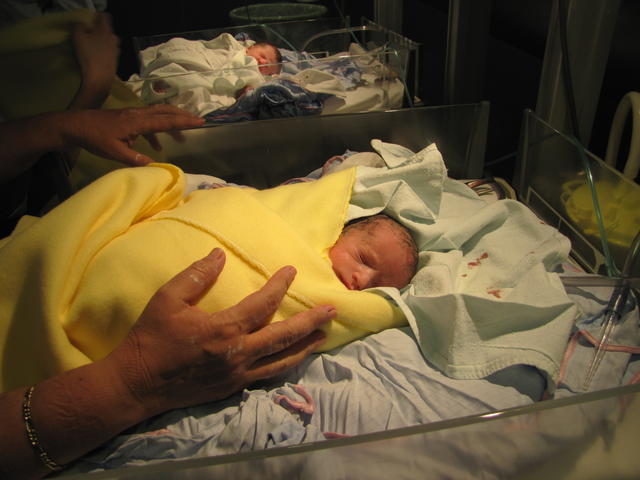
Welcome to the world, little ones!
Welcome little babies! Yesterday night, we entered the hospital. Nervous, heavy, and... Well, would we ever be ready? As ready as we could. A couple of hours later, Alan and Elena Wolf Daichman became individuals on their own right. As is often the case in the case of twins, they were brought to this world after a relatively short preparation (34 weeks, that's about 7.5 months). At 1.820 and 1.980Kg, they are considerably smaller than either of the parents... But we will be working on that! Regina is recovering from the operation, the babies are under observation. As far as we were told, they seem to be quite healthy, with just minor issues to work on during neonatal care. We are waiting for our doctors to come today and allow us to spend time with them. And as for us... It's a shocking change to finally see the so long expected babies. We are very very very happy... And the new reality is hard to grasp, to even begin understanding :) PS- Many people have told me that my blog often errors out under load. I expect it to happen today :) So, if you cannot do it here, there are many other ways to contact us. Use them! :)

27 February 2015

Richard Hartmann: Release Critical Bug report for Week 09

The UDD bugs interface currently knows about the following release critical bugs: How do we compare to the Squeeze and Wheezy release cycles?
Week Squeeze Wheezy Jessie
43 284 (213+71) 468 (332+136) 319 (240+79)
44 261 (201+60) 408 (265+143) 274 (224+50)
45 261 (205+56) 425 (291+134) 295 (229+66)
46 271 (200+71) 401 (258+143) 427 (313+114)
47 283 (209+74) 366 (221+145) 342 (260+82)
48 256 (177+79) 378 (230+148) 274 (189+85)
49 256 (180+76) 360 (216+155) 226 (147+79)
50 204 (148+56) 339 (195+144) ???
51 178 (124+54) 323 (190+133) 189 (134+55)
52 115 (78+37) 289 (190+99) 147 (112+35)
1 93 (60+33) 287 (171+116) 140 (104+36)
2 82 (46+36) 271 (162+109) 157 (124+33)
3 25 (15+10) 249 (165+84) 172 (128+44)
4 14 (8+6) 244 (176+68) 187 (132+55)
5 2 (0+2) 224 (132+92) 175 (124+51)
6 release! 212 (129+83) 161 (109+52)
7 release+1 194 (128+66) 147 (106+41)
8 release+2 206 (144+62) 147 (96+51)
9 release+3 174 (105+69) 152 (101+51)
10 release+4 120 (72+48)
11 release+5 115 (74+41)
12 release+6 93 (47+46)
13 release+7 50 (24+26)
14 release+8 51 (32+19)
15 release+9 39 (32+7)
16 release+10 20 (12+8)
17 release+11 24 (19+5)
18 release+12 2 (2+0)
Graphical overview of bug stats thanks to azhag:

Enrico Zini: python-api-stability

Another day in the life of a poor developer
try:
    # After Python 3.3
    from collections.abc import Iterable
except ImportError:
    # This has changed in Python 3.3 (why, oh why?), reinforcing the idea that
    # the best Python version ever is still 2.7, simply because upstream has
    # promised that they won't touch it (and break it) for at least 5 more
    # years.
    from collections import Iterable
import shlex
if hasattr(shlex, "quote"):
    # New in version 3.3.
    shell_quote = shlex.quote
else:
    # Available since python 1.6 but deprecated since version 2.7: Prior to Python
    # 2.7, this function was not publicly documented. It is finally exposed
    # publicly in Python 3.3 as the quote function in the shlex module.
    #
    # Except everyone was using it, because it was the only way provided by the
    # python standard library to make a string safe for shell use
    #
    # See http://stackoverflow.com/questions/35817/how-to-escape-os-system-calls-in-python
    import pipes
    shell_quote = pipes.quote
import shutil
if hasattr(shutil, "which"):
    # New in version 3.3.
    shell_which = shutil.which
else:
    # Available since python 1.6:
    # http://stackoverflow.com/questions/377017/test-if-executable-exists-in-python
    from distutils.spawn import find_executable
    shell_which = find_executable

Dirk Eddelbuettel: RcppArmadillo 0.4.650.1.1 (and also 0.4.650.2.0)

A new Armadillo release 4.650.1 was released by Conrad a few days ago. Armadillo is a powerful and expressive C++ template library for linear algebra aiming towards a good balance between speed and ease of use with a syntax deliberately close to a Matlab. It turned out that this release had one shortcoming with respect to the C++11 RNG initializations in the R use case (where we need to protect the users from the C++98 RNG deemed unsuitable by the CRAN gatekeepers). And this lead to upstream release 4.650.1 which we wrapped into RcppArmadillo 0.4.650.1.1. As before this, was tested against all 107 reverse dependencies of RcppArmadillo on the CRAN repo. This version is now on CRAN, and was just uploaded to Debian. Its changes are summarized below based on the NEWS.Rd file.
Changes in RcppArmadillo version 0.4.650.1.1 (2015-02-25)
  • Upgraded to Armadillo release Version 4.650.1 ("Intravenous Caffeine Injector")
    • added randg() for generating random values from gamma distributions (C++11 only)
    • added .head_rows() and .tail_rows() to submatrix views
    • added .head_cols() and .tail_cols() to submatrix views
    • expanded eigs_sym() to optionally calculate eigenvalues with smallest/largest algebraic values fixes for handling of sparse matrices
  • Applied small correction to main header file to set up C++11 RNG whether or not the alternate RNG (based on R, our default) is used
Now, it turns out that another small fix was needed for the corner case of a submatrix within a submatrix, ie V.subvec(1,10).tail(5). I decided not to re-release this to CRAN given the CRAN Repository Policy preference for releases no more than every 1 2 months . But fear not, for we now have drat. I created a drat package repository in the RcppCore account (to not put a larger package into my main drat repository often used via a fork to initialize a drat). So now with these two simple commands
## if needed, first install 'drat' via:   install.packages("drat")
drat:::add("RcppCore")
update.packages()
you will get the newest RcppArmadillo via this drat package repository. And course install.packages("RcppArmadillo") would also work, but takes longer to type :) Lastly, courtesy of CRANberries, there is also a diffstat report for the most recent CRAN release. As always, more detailed information is on the RcppArmadillo page. Questions, comments etc should go to the rcpp-devel mailing list off the R-Forge page.

This post by Dirk Eddelbuettel originated on his Thinking inside the box blog. Please report excessive re-aggregation in third-party for-profit settings.

26 February 2015

Daniel Pocock: PostBooks accounting and ERP suite coming to Fedora

PostBooks has been successful on Debian and Ubuntu for a while now and for all those who asked, it is finally coming to Fedora. The review request has just been submitted and the spec files have also been submitted to xTuple as pull requests so future upstream releases can be used with rpmbuild to create packages. Can you help? A few small things outstanding:
  • Putting a launcher icon in the GNOME menus
  • Packaging the schemas - they are in separate packages on Debian/Ubuntu. Download them here and load the one you want into your PostgreSQL instance using the instructions from the Debian package.
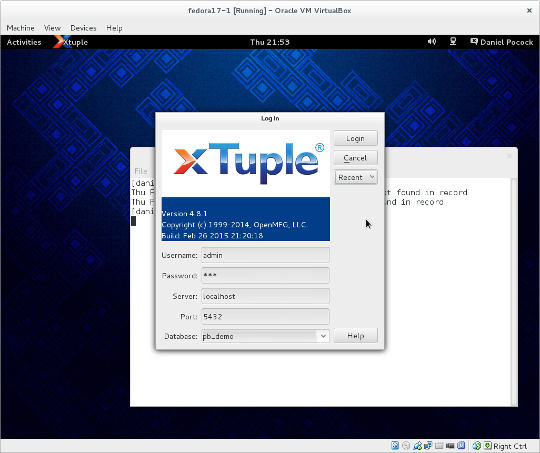
Community support The xTuple forum is a great place to ask any questions and get to know the community. Screenshot Here is a quick look at the login screen on a Fedora 19 host:

EvolvisForge blog: tomcat7 log encoding

TIL: the encoding of the catalina.out file is dependent on the system locale, using standard Debian wheezy tomcat7 package. Fix for ? instead of umlauts in it:
cat >>/etc/default/tomcat7 <<EOF
LC_CTYPE=C.UTF-8
export LC_CTYPE
EOF
My problem here is that I have the system locale be the C locale, to get predictable behaviour; applications that need it can set a locale by themselves. (Many don t bother with POSIX locales and use different/separate means of determining especially encoding, but possibly also i18n/l10n. But it seems the POSIX locales are getting more and more used.) Update: There is also adding -Dfile.encoding=UTF-8 to $JAVA_OPTS which seems to be more promising: no fiddling with locales, no breakage if someone defined LC_ALL already, and it sets precisely what it should set (the encoding) and nothing else (since the encoding does not need to correlate to any locale setting, why should it).

EvolvisForge blog: tomcat7 init script is asynchronous

TIL: the init script of tomcat7 in Debian is asynchronous. For some piece of software, our rollout (install and upgrade) process works like this: The first tomcat7 start here is just to unzip the *.war files. For some reason, people like to let tomcat7 do that. This failed today; there were two webapps. Manually unzipping it also did not work for some reason. Re-doing it, inserting a sleep 30 after the here , made it work. In a perfect world, initscripts only return when the service is running, so that the next one started in a nice sequential (not parallel!) init or manual start sequence can do what it needs to, assuming the previous command has fully finished. In this perfect world, those who do wish for faster startup times use a different init system, one that starts things in parallel, for example. Even there, dependencies will wish for the depended-on service to be fully running when they are started; even more so, since the delays between starting things seem to be less for that other init system. So, this is not about the init system, but about the init script; a change that would be a win-win for users of both init schemes. Update: Someone already contacted me with feedback: they suggested to wait until the shutdown port is listened on by tomcat7. We ll look at this later. In the meantime, we re trying to also get rid of the config (and logs) in webapps/ part
PS: If someone is interested in an init script (Debian/LSB sysvinit, I made the effort to finally learn that some months before the other system came) that starts Wildfly (formerly known as JBoss AS) synchronously, waiting until all *.?ar files are fully deployed before returning (though with a timeout in case it won t ever finish), just ask (maybe it will become a dialogue, in which we can improve it together). (We have two versions of it, the more actively maintained one is in a secret internal project though, so I d have to merge it and ready it for publication though, plus the older one is AGPLv3, the newer one was relicenced to a BSDish licence.)

Michael Banck: 26 Feb 2015

My recent Debian LTS activities

Over the past months, my employer credativ has sponsored some of my work time to keep PostgreSQL updated for squeeze-lts. Version 8.4 of PostgreSQL was declared end-of-life by the upstream PostgreSQL Global Development Group (PGDG) last summer, around the same time official squeeze support ended and squeeze-lts took over. Together with my colleagues Christoph Berg (who is on the PostgreSQL package maintainer team) and Bernd Helmle, we continued backpatching changes to 8.4. We tried our best to continue the PGDG backpatching policy and looked only at commits at the oldest still maintained branch, REL9_0_STABLE.

Our work is publicly available as a separate REL8_4_LTS branch on Github. The first release (called 8.4.22lts1) happened this month mostly coinciding with the official 9.0, 9.1, 9.2, 9.3 and 9.4 point releases. Christoph Berg has uploaded the postgresql-8.4 Debian package for squeeze-lts and release tarballs can be found on Github here (scroll down past the release notes for the tarballs).

We intend to keep the 8.4 branch updated on a best-effort community basis for the squeeze-lts lifetime. If you have not yet updated from 8.4 to a more recent version of PostgreSQL, you probably should. But if you are stuck on squeeze, you should use our LTS packages. If you have any questions or comments concerning PostgreSQL for squeeze-lts, contact me.

Wouter Verhelst: Dear non-Belgian web developer,

Localization in the web context is hard, I know. To make things easier, it may seem like a good idea to use GeoIP to detect what country an IP is coming from and default your localization based on that. While I disagree with that premise, this blog post isn't about that. Instead, it's about the fact that most of you get something wrong about this little country. I know, I know. If you're not from here, it's difficult to understand. But please get this through your head: Belgium is not a French-speaking country. That is, not entirely. Yes, there is a large group of French-speaking people who live here. Mostly in the south. But if you check the numbers, you'll find that there are, in fact, more people in Belgium who speak Dutch rather than French. Not by a very wide margin, mind you, but still by a wide enough margin to be significant. Wikipedia claims the split is 59%/41% Dutch/French; I don't know how accurate those numbers are, but they don't seem too wrong. So please, pretty please, with sugar on top: next time you're going to do a localized website, don't assume my French is better than my English. And if you (incorrectly) do, then at the very least make it painfully obvious to me where the "switch the interface to a different language" option in your website is. Because while it's annoying to be greeted in a language that I'm not very good at, it's even more annoying to not be able to find out how to get the correctly-localized version. Thanks.

25 February 2015

Joachim Breitner: DarcsWatch End-Of-Life d

Almost seven years ago, at a time when the VCS wars have not even properly started yet, GitHub was seven days old and most Haskell related software projects were using Darcs as their version control system of choice, when you submitted a patch, you simply ran darcs send and mail with your changes would be sent to the right address, e.g. the maintainer or a mailing list. This was almost as convenient as Pull Requests are on Github now, only that it was tricky to keep track of what was happening with the patch, and it would be easy to forget to follow up on it. So back then I announced DarcsWatch: A service that you could CC in your patch submitting mail, which then would monitor the repository and tell you about the patches status, i.e. whether it was applied or obsoleted by another patch. Since then, it quitely did its work without much hickups. But by now, a lot of projects moved away from Darcs, so I don t really use it myself any more. Also, its Darcs patch parser does not like every submissions by a contemporary darcs, so it is becoming more and more unreliable. I asked around on the xmonad and darcs mailing lists if others were still using it, and noboy spoke up. Therefore, after seven years and 4660 monitored patches, I am officially ceasing to run DarcsWatch. The code and data is still there, so if you believe this was a mistake, you can still speak up -- but be prepared to be asked to take over maintaining it. I have a disklike for actually deleting data, so I ll keep the static parts of DarcsWatch web page in the current state running. I d like to thank the guys from spiny.org.uk for hosting DarcsWatch on urching for the last 5 years.

Holger Levsen: 20150225-apparmor-user-stories

Developing is a use case too For whatever reason Ulrike's blog post about AppArmor user stories and user tags was not syndicated to planet.d.o, despite it should have been and despite planet admins nicely having looked into it. Whatever... As you might have guessed by now, the user stories referred to in this blog post are about developers supporting AppArmor (a kernel module for restricting capabilities of processes) in their Debian packages. So if you're maintaining packages and have always been pondering to look into this apparmor thingy, go read that blog post! Hopefully the next post will "magically" appear on planet again ;-)

Next.

Previous.