Search Results: "mak"

8 June 2010

Matt Zimmerman: DevOps and Cloud

DevOps I first heard about DevOps from Lindsay Holmwood at linux.conf.au 2010. Since then, I ve been following the movement with interest. It seems to be about cross-functional involvement in software teams, specifically between software development and system administration (or operations). In many organizations, especially SaaS shops, these two groups are placed in opposition to each other: developers are driven to deliver new features to users, while system administrators are held accountable for the operation of the service. In the best case, they maintain a healthy balance by pushing in opposite directions, but more typically, they resent each other for getting in the way, as a result of this dichotomy:
Development Operations
is responsible for creating products offering services
is measured on delivery of new features high reliability
optimizes by increasing velocity controlling change
and so is perceived as reckless and irresponsible obstructing progress
Of course, both functions are essential to a viable service, and so DevOps aims to replace this opposition with cooperation. By removing this friction from the organization, we hope to improve efficiency, lower costs, and generally get more work done.
So, DevOps promotes the formation of cross-functional teams, where individuals still take on specialist development or operations roles, but work together toward the common goal of delivering a great experience to users. By working as teammates, rather than passing work over the wall , they can both contribute to development, deployment and maintenance according to their skills and expertise. The team becomes a devops team, and is responsible for the entire product life cycle. Particular tasks may be handled by specialists, but when there s a problem, it s the team s problem. Some take it a step further, and feel that what s needed is to combine the two disciplines, so that individuals contribute in both ways. Rather than thinking of themselves as developers or sysadmins , these folks consider themselves devops . They work to become proficient in both roles, and to synthesize new ways of working by drawing on both types of skills and experience. A common crossover activity is the development of sophisticated tools for automating deployment, monitoring, capacity management and failure resolution. DevOps meets Cloud Like DevOps, cloud is not a specific technology or method, but a reorganization of the model (as I ve written previously). It s about breaking down the problem in a different way, splitting and merging its parts, and creating a new representation which doesn t correspond piece-for-piece to the old one. DevOps drives cloud because it offers a richer toolkit for the way they work: fast, flexible, efficient. Tools like Amazon EC2 and Google App Engine solve the right sorts of problems. Cloud also drives DevOps because it calls into question the traditional way of organizing software teams. A development/operations division just doesn t fit cloud as well as a DevOps model. Deployment is a classic duty of system administrators. In many organizations, only the IT department can implement changes in the production environment. Reaping the benefits of an IaaS environment requires deploying through an API, and therefore deployment requires development. While it is already common practice for system administrators to develop tools for automating deployment, and tools like Puppet and Chef are gaining momentum, IaaS makes this a necessity, and raises the bar in terms of sophistication. Doing this well requires skills and knowledge from both sides of the fence between development and operations, and can accelerate development as well as promote stability in production.
This is exemplified by infrastructure service providers like Amazon Web Services, where customers pay by the hour for black box access to computing resources. How those resources are provisioned and maintained is entirely Amazon s problem, while its customers must decide how to deploy and manage their applications within Amazon s IaaS framework. In this scenario, some operations work has been explicitly outsourced to Amazon, but IaaS is not a substitute for system administration. Deployment, monitoring, failure recovery, performance management, OS maintenance, system configuration, and more are still needed. A development team which is lacking the experience or capacity for this type of work cannot simply switch to an IaaS model and expect these needs to be taken care of by their service provider.
With platform service providers, the boundaries are different. Developers, if they build their application on the appropriate platform, can effectively outsource (mostly) the management of the entire production environment to their service provider. The operating system is abstracted away, and its maintenance can be someone else s problem. For applications which can be built with the available facilities, this will be a very attractive option for many organizations. The customers of these services may be traditional developers, who have no need for operations expertise. PaaS providers, though, will require deep expertise in both disciplines in order to build and improve their platform and services, and will likely benefit from a DevOps approach. Technical architecture draws on both development and operations expertise, because design goals like performance and robustness are affected by all layers of the stack, from hardware, power and cooling all the way up to application code. DevOps itself promotes greater collaboration on architecture, by involving experts in both disciplines, but cloud is a great catalyst because cloud architecture can be described in code. Rather than talking to each other about their respective parts of the system, they can work together on the whole system at once. Developers, sysadmins and hybrids can all contribute to a unified source tree, containing both application code and a description of the production environment: how many virtual servers to deploy, their specifications, which components run on which servers, how they are configured, and so on. In this way, system and network architecture can evolve in lockstep with application architecture. Cloudy promises such as dynamic scaling and fault tolerance call for a DevOps approach in order to be realized in a real-world scenario. These systems involve dynamically manipulating production infrastructure in response to changing conditions, and the application must adapt to these changes. Whether this takes the form of an active, intelligent response or a passive crash-only approach, development and operational considerations need to be aligned. So what? DevOps and cloud will continue to reinforce each other and gain momentum. Both individuals and organizations will need to adapt in order to take advantage of the opportunities provided by these new models. Because they re complementary, it makes sense to adopt them together, so those with expertise in both will be at an advantage.

Russell Coker: Is the PC Dying?

I just read an interesting article about the dispute between Microsoft and Apple about types of PC [1]. Steve Jobs predicted a switch from desktop PCs to portable devices, while Steve Ballmer of Microsoft claimed that the iPad is just a new PC. Defining a PC I think that the defining characteristic of the IBM Compatible PC was it s open architecture. Right from the start the PC could have it s hardware expanded by adding new circuit boards into slots on the motherboard (similar to other PC systems of that era such as the Apple 2 and the S-100 bus). The deal with IBM included Intel sharing all it s CPU designs with other manufacturers such as NEC and AMD from the 8086 until the mid-90 s. AMD specialised in chips that were close copies of Intel chips at low prices and higher clock rates while NEC added new instructions. Compaq started the PC clone market as well as the laptop market, and system software for the IBM compatible PCs was primarily available from IBM and Microsoft in the early days, along with less popular variants such as CP/M86, Novell Netware and others. In the late 80 s there was OS/2 as an alternate OS and Windows as one of several optional GUI environments to run on top of MS-DOS or PC-DOS. In the mid 90 s PCs were used for running protected mode OSs such as Linux and Windows/NT. Now if we look at a system such as a Netbook then it clearly misses some of the defining characteristics of the desktop PC. I can t upgrade a Netbook in any meaningful way changing a storage device or adding more RAM does not compare to adding an ISA/MCA/EISA/VL-Bus/PCI/PCIe expansion card. With my EeePC 701 I don t even have an option of replacing the storage as it is soldered to the motherboard! A laptop allows me to add a PCMCIA or PC-Card device to expand it, but with a maximum of two cards and a high price this isn t a great option. What is Best for Home Users? For a while now my parents have been using 3G net access for their home Internet use [2]. So it seems that a laptop provides greater benefits for their use now than it previously did when they used Cable and ADSL net access. My parents have been considering getting a new monitor (1920*1080 resolution monitors are getting insanely cheap nowadays) and driving such a monitor effectively might require a more capable PC. I recently bought myself a nice refurbished Thinkpad for $796 [3], it seems likely that I could find a refurbished Thinkpad at auction which is a little older and slower for a lower price, even buying an old T41p would be a reasonable option. This would give my parents not only the option of using the Internet when on holidays, but also in a different part of their house when they are at home. The Apple iPad would probably be quite a reasonable Internet platform for my parents if it wasn t for the fact that it uses DRM. While it s not a great platform for writing, my parents probably don t do enough that it would be a huge problem for them. So I might look for a less restrictive tablet platform for my parents. At the moment the best resolution for a tablet seems to be 1024*768, but I expect that some tablets (maybe with a hybrid tablet/laptop design like the Always Innovating Smartbook [4]) with a higher resolution will be released soon. I hope that the iPad and other closed devices don t get any serious market share, but it seems likely that OSs such as Android which are only slightly more open will have a significant market share. Ultra-Mobile Design vs PCs Design One significant problem with ultra-mobile devices is that they make significant engineering trade-offs to get the small size. For a desktop system there are lots of ways of doing things inefficiently, running the AMD64 or i386 architecture which is wasteful of energy and having lots of unused space inside the box in case you decide to upgrade it. But for a laptop there are few opportunities for being inefficient, and for a tablet or smart phone everything has to be optimised. When the optimisation of a device starts by choosing a CPU that s unlike most other systems (note that there is a significant range of ARM CPUs that are not fully compatible with each other) it makes it very difficult to produce free software to run it. I can salvage a desktop PC from a rubbish bin and run Linux on it (and I ve done that many times), but I wouldn t even bother trying to run Linux on an old mobile phone. It seems that in the near future my parents (and many other people with similar needs) will be best suited by having a limited device such as a tablet that stores all data on the Internet and not having anything that greatly resembles a PC. In many ways it would be easier for me to support my parents by storing their data in the cloud and then automatically backing it up to removable SATA disks than with my current situation of supporting a fully capable PC and backing it up to a USB device whenever I visit them. I m also considering what to do for some relatives who are about to go on a holiday in Europe, they want to be able to send email etc. It might not be possible just yet, but it seems like an ideal way of doing this would be to provide them with something like an iPad that they can use with a local 3G SIM for the country that they stay in and they could then upload all their best photos to some server that I can backup and send email to everyone they know. An iPad isn t good for this now as you don t want to go on holidays in another country while carrying something that is really desirable to thieves. Ultra Mobile Devices are Killing PCs It seems to me that Google Android and the Apple iPad/iPhone OS are taking over significant parts of the PC market. The people who are doing traditional PC things are increasingly using Laptops and Netbooks, and the number of people who get the freedom that a PC user did in the 80 s and 90 s is decreasing rapidly. I predict that by 2012 the majority of Linux systems will be running Google Android on hardware that doesn t easily allow upgrading to more open software. At the moment probably the majority of Linux systems are wireless routers and other embedded devices that people don t generally think about. But when iPad type devices running a locked-down Linux installation start replacing Ubuntu and Fedora desktop systems people will take notice. I don t think that the death of the PC platform as we know it will kill Linux, but it certainly won t do us any good. If there were smarter people at Microsoft then they would be trying to work with the Linux community on developing innovative new ways of using desktop PCs. Of all the attempts that Microsoft has made to leave the PC platform the only success has been the X-Box which is apparently doing well. Tablet devices such as the iPad could work really well in a corporate environment (where MS makes most of it s money). On many occasions I ve been in a meeting and we had to adjourn due to someone needing to go to their desk to look something up. If everyone had an iPad type device at their desk that used a wired network when it was available and encrypted wireless otherwise then for a meeting everyone could take their tablet without it s keyboard and be able to consult all the usual sources of data without any interruption. Could a high-resolution version of the iPad kill MS-Windows in the corporate environment?

7 June 2010

Martín Ferrari: Python WTF

Lately, I have recurring WTF moments when working with Python. I'm still more or less a novice in Python, as I started to use it in my day job last year, so sometimes it could be blamed to ignorance. Today I was writing some code that takes any file descriptor as argument, and thought it could be nice to accept also objects that represent one. But it seems there is no common ancestor to file objects and socket objects, for example. In Perl, I'd just check for IO::Handle. Then, I wrote code to check if a passed argument was a socket, or a file descriptor to one, with some obvious check: isinstance(s, socket.socket). WRONG, when you create sockets with socketpair, they are of an undocumented type which is not a descendant of socket, nor of SocketType! (There is a patch for this since 2007) In general, I have found a lack of any reasonable object hierarchy, and many inconsistencies in the low-level interfaces, which is a pity, because Python is in general quite tidy. Comparing with Perl is unavoidable, and I would have expected that Python had learnt more from it. Another thing that amazes me is the lack of anything like CPAN, which is one of the reasons Perl was so successful. The cheese factory doesn't come close, as you need to publish your files somewhere else, there is no automated testing, no automatically generated documentation, or anything that requires access to the source code. In Perl-land, many people loathe the venerable MakeMaker, and some of the alternatives are ugly as hell. The Python equivalent (or so) to Makemaker, distutils, looks to me like a bad joke: advanced customisation is black magic (if possible at all), and doesn't provide absolutely basic things like running your unit tests! After fighting with it for some days, I decided to go back writing my own Makefile and calling distutils just to build and install. Tags: Planet Debian, Planet Lugfi, Programaci n

Steve McIntyre: Also sad about the Poulsbong^H^H

Apropos Matthew's post... I picked up a cheap netbook for Jo a couple of months ago, an Acer Aspire One 751. She liked the look and feel of the machine, and it was much smaller and more carryable than the massive old Dell "slab" she'd been using previously. Got a very good deal on it too, as it was the last one in stock at the local Comet store. All went well until we got it home and I started playing with it. That was when I found the painful truth: it was based on the Poulsbo, using Intel's crippled GMA500 graphics chipset. Up until then, I'd been very happy with buying Intel kit: for the last few years it's been a sure sign that the hardware would work well with Debian and Linux. Now they've come out with a crappy product that has destroyed that goodwill. I spent many hours working through various options to try and get this new netbook up and running properly using Debian, but to no avail - the various binary blobs wanted newer versions of code than was in Lenny and (by then) older stuff than was available in Squeeze. In the end I gave up and installed an outdated version of Ubuntu on the machine just so Jo could have it working for her when we went on holiday together. Since then, she's had to get used to the machine locking up once or twice a day while she's using it (something I can only assume is caused by the shitty drivers). She's happy enough in that it's much better than her old Vista-infested Dell machine, but it's really not a great experience for her compared to the Thinkpads she sees others using reliably and flawlessly at home. At some point I guess we'll simply ditch the machine altogether and get something less nasty. Thanks for the good stuff you used to make, Intel, but you've lost your way. I'll be damned careful next time to avoid this trap.

5 June 2010

Jos? Parrella: Ditching PCI cards in Asterisk for fun and profit

In the past, I ve used PCI cards providing telephony TDM for my Asterisk-based projects. I ve only worked with Digium s FXO/FXS and T1/E1 cards, both in PCI and PCI-x formats, until a client asked for a gateway solution with FXO, FXS and E1, where using the PCI cards in a 1U IPBX was simply out of the question. Using Ethernet gateways has always been a problem in those cases, since entry-to-medium level solutions lack the processing power for massive call handling, and signalling is poor, making the architecture unfit for reporting purposes and specialized apps such as call centers. But hey, that s my experience with gateways. Therefore, I looked into Xorcom s Astribank. They pack FXO, FXS and PRI/BRI ports inside a convenient 19 1U case, which can connect to an Asterisk-based IPBX server via USB and gets recognized as an integral DAHDI device in modern setups. So I ordered a composite 8xFXO, 8xFXS and 1xE1 PRI from Astribank, labelled XR0072. Getting the equipment from Arizona to Florida was easy, and since I worked with DHL, getting it to Guayaquil in Ecuador was a breeze (next-day delivery) but passing customs is, as always in Latin America, a time-consuming operation. After paying 12.5% taxes and then some for DHL operations, and 15 days waiting, I got the equipment in Quito. To my surprise, the Astribank was extremely light and small, slightly near 3 Kg in 1U form factor and under 1/4 depth in the rack. While it had a rack-mounting kit, which I used, it could also rest securely over my IPBX without rack screws. My Astribank uses a single USB cable to connect to the master PBX it could also be connected to a secondary PBX and provide a fault tolerant setup. It also depends on a DC supply, which they included. Since I was using a modern Debian, with a modern Asterisk with already-compiled modern DAHDI (formerly called Zapata/Zaptel) drivers, I just connected the equipment via USB to the IPBX, issued an invoke-rc.d dahdi restart and we were good to go. Note: you do need the fxload package in Debian for firmware loading to the Astribank. And for good to go I mean you can check the registered spans with dahdi_registration and, as soon as you connect the E1 cable that comes from the CPE to the CPE port (which in my XR0072 is the first on the lower row for PRI) you get an OK status with dahdi_tool. Also note that I use an E1/CPE port, which is the default for the Astribank, otherwise I d have to set the XPP_PRI_SETUP variable as indicated on the User Manual. DAHDI insists on configuring a crc4 parameter for the detected spans, which I needed to remove and restart DAHDI so the equipment could sync with the CPE (that is, the box that the telco provided, with the balun and the crossover RJ45 cable) and avoid some nasty noise issues on the line, that also occur with Digium s Wildcard for PRI.
usb:008/005          xpp_usb+     e4e4:1162 Astribank-modular FPGA-firmware
 LABEL=[usb:...]       CONNECTOR=@usb-0000:00:1d.7-1
	XBUS-00/XPD-00: E1       (31)  Span 1  DAHDI-SYNC
	XBUS-00/XPD-10: FXS      (8)   Span 2
	XBUS-00/XPD-20: FXO      (8)   Span 3
Using DAHDI s dahdi_genconf command writes an /etc/asterisk/dahdi-channels.conf file with the group and channel configuration as detected by DAHDI. It should be included by the chan_dahdi.conf file, which, in my case, is not necessary since I only wanted to enable one DAHDI group (DAHDI/g0) with my 31 E1 channels (1-15,17-31)
group=0
context=from-pstn
channel => 1-15,17-31
That means that when I want to use the FXO/FXS ports, it d probably be easier to include the dahdi-channels.conf (FXS ports, for example, belong to a different context, from-internal) so I don t have to type more than my laziness permits. I also found that, in my setup, some Asterisk parameters were superfluous, such as the switchtype (either national or euroisdn work, and the former is the default) or the echo-cancelling stuff, so I assume Astribank s doing a great job in negotiating that with the CPE. Do take note, however, that in my case the CPE needed to be cold-restarted so I could get an Up status in Asterisk (pri show spans) and that my only non-default, channel related configuration in chan_dahdi.conf is signalling=pri_cpe. So far, so good. I m really happy with the Astribank and I can fully understand how useful it is in terms of price (quite competitive in comparison with traditional cards, specially when bought from resellers -like me-), size/weight and functionality/ease of setup and administration. Kudos!

Ingo Juergensmann: Drupal - direkt import into database

I was trying the last week to import data from one database into a Drupal database. Basically this worked fairly well. The needed fields from the old database are easy to get by simple SELECT statements. Because I don't know anything about PHP, I doing the export/import with a Python script directly into the database. After all this is about articles, comments and tags, that need to be imported into a Drupal database.

The articles will be stored into tables node_revisions, node and node_counter. The tags into tables term_data and term_node. Comments will go into table comments. Here are the INSERTs:

Articles:

"insert into node_revisions (uid, body, teaser, log, timestamp, format, nid, title) values ('3', '%s', '%s', '', '%s', '1', '%s', '%s')" % (body, body, timestamp, i, title)

"insert into node (vid, type, uid, status, created, changed, comment, promote, moderate, sticky, language, tnid, translate, title) values ('%s', 'blog', '3', '1', '%s', '%s', '2', '1', '0', '0', '', '0', '0', '%s')" % (vid, timestamp, timestamp, title)

"insert into node_counter (nid,totalcount,daycount,timestamp) values ('%s', '100', '0','%s')" % (nid, timestamp)

Tags:

"insert into term_data (vid, name) values ('3', '%s')" % tag

"insert into term_node (nid, vid, tid) values ('%s', '%s', '%s')" % (nid, vid, tagtid)

Comments:

"insert into comments (pid, nid, uid, subject, comment, hostname, timestamp, status, format, thread, name, mail, homepage) values ('%s', '%s', '0', '%s', '%s', '%s', '%s', '0', '1', '01', '%s', '%s', '%s')" % (parentid, nid, ctitle, cbody, cip, ctimestamp, cauthor, cemail, curl)

sql="insert into term_node (nid, vid, tid) values ('%s', '%s', '%s')" % (nid, vid, tid)

The import is successful as there are comments and tags attached to each article or node. But there are still some problems. When accessing Recent Posts there are no entries listed. Yet, Drupal still thinks there are so many articles that it lists more than 30 pages:

Recent Post Errors

Something similar happens to the tags. The tags are actually assigned to and are displayed as well with the nodes. But when accessign taxonomys vocabular and trying to list the terms, the resulting page is empty:

Tag Errors

If my understanding of the Drupal6 database (on PostgreSQL this is) is correct, everything should be fine and properly stored into the database. But apparently there's something missing. But what? As already mentioned I have no clue about PHP, so using node_api or any other API calls by Drupal/PHP is no option for me. Except when the calls can be placed via Pythons system() call.

If anyone has some tips or hints for me, I would appreciate when you write a comment.

When there's interest I can provide the entire Python import script. I'm going to make it public anyway, when the last problems are solved.

Ingo Juergensmann: Drupal - direct import into database

I was trying the last week to import data from one database into a Drupal database. Basically this worked fairly well. The needed fields from the old database are easy to get by simple SELECT statements. Because I don't know anything about PHP, I doing the export/import with a Python script directly into the database. After all this is about articles, comments and tags, that need to be imported into a Drupal database.

The articles will be stored into tables node_revisions, node and node_counter. The tags into tables term_data and term_node. Comments will go into table comments. Here are the INSERTs:

Articles:

"insert into node_revisions (uid, body, teaser, log, timestamp, format, nid, title) values ('3', '%s', '%s', '', '%s', '1', '%s', '%s')" % (body, body, timestamp, i, title)

"insert into node (vid, type, uid, status, created, changed, comment, promote, moderate, sticky, language, tnid, translate, title) values ('%s', 'blog', '3', '1', '%s', '%s', '2', '1', '0', '0', '', '0', '0', '%s')" % (vid, timestamp, timestamp, title)

"insert into node_counter (nid,totalcount,daycount,timestamp) values ('%s', '100', '0','%s')" % (nid, timestamp)

Tags:

"insert into term_data (vid, name) values ('3', '%s')" % tag

"insert into term_node (nid, vid, tid) values ('%s', '%s', '%s')" % (nid, vid, tagtid)

Comments:

"insert into comments (pid, nid, uid, subject, comment, hostname, timestamp, status, format, thread, name, mail, homepage) values ('%s', '%s', '0', '%s', '%s', '%s', '%s', '0', '1', '01', '%s', '%s', '%s')" % (parentid, nid, ctitle, cbody, cip, ctimestamp, cauthor, cemail, curl)

sql="insert into term_node (nid, vid, tid) values ('%s', '%s', '%s')" % (nid, vid, tid)

The import is successful as there are comments and tags attached to each article or node. But there are still some problems. When accessing Recent Posts there are no entries listed. Yet, Drupal still thinks there are so many articles that it lists more than 30 pages:

Recent Post Errors

Something similar happens to the tags. The tags are actually assigned to and are displayed as well with the nodes. But when accessign taxonomys vocabular and trying to list the terms, the resulting page is empty:

Tag Errors

If my understanding of the Drupal6 database (on PostgreSQL this is) is correct, everything should be fine and properly stored into the database. But apparently there's something missing. But what? As already mentioned I have no clue about PHP, so using node_api or any other API calls by Drupal/PHP is no option for me. Except when the calls can be placed via Pythons system() call.

If anyone has some tips or hints for me, I would appreciate when you write a comment.

When there's interest I can provide the entire Python import script. I'm going to make it public anyway, when the last problems are solved.

UPDATE:

Killes on IRC hinted me that node_comment_statistics and term_hierarchy needs to be filled as well. Thanks for the hint!

Russell Coker: Bugs in Google Chrome

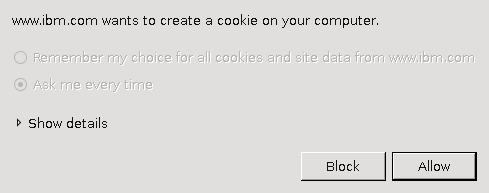
I m currently running google-chrome-beta version 5.0.375.55-r47796 on Debian/Unstable. It s the fastest web browser I ve used in recent times it s the first time that I ve run a browser that feels faster than my recollection of running IBM WebExplorer for OS/2 on a 486-66 system! It has a good feature set, and it s the only browser I ve used that in a typical configuration will make proper use of the screen space by not having a permanent status bar at the bottom of the sceen and by having tabs in the title-bar. But it s not perfect, here is a list of some bugs: Chrome Titlebar when maximisedChrome Titlebar when not maximisedRight of Chrome Titlebar when not maximised Above are three partial screen captures of Chrome, the first is when maximised and the second is when the window isn t maximised. Notice the extra vertical space above the tab in the title bar in the second picture. The third picture shows the right side of the titlebar and you can see a space below the three buttons where you can drag the window around no matter how many tabs you open that space below the three buttons is reserved. If the Chrome developers had removed the extra vertical space in the titlebar and reserved slightly more horizontal space then you would be able to drag the window around. While an anonymous commentator made a good point that the extra vertical space can be used to drag the window around when the maximum number of tabs are open, it seems that there are other ways of achieving that goal without wasting ~18 vertical pixels. Doing so would be a lot less ugly than what they did with finding text in the page. When I visit a web site that uses cookies from an Incognito Window (which means that cookies etc aren t stored) there is no option to say allow all cookies . This is really annoying when you get to a web site such as the IBM one which stores 5 cookies when you first load the page and then at least one new cookie write for every page you visit. Given that cookie data will be discarded as soon as the window is closed it seems like a good idea to have an option to allow all cookies for Incognito Windows even if all cookies aren t allowed for regular windows. Blocking all cookies would be OK too, anything but having to click on Block or Allow multiple times for each page load. The J and K keys don t work in a view of Venus version 0~bzr95-2+lenny1 (the latest version in Debian/Lenny). I once had a situation where I entered a . at the end of a domain name (which is quite legal there is always an implied dot) and Chrome then wouldn t take note of my request to accept all cookies from the domain. I haven t been able to reproduce that bug, but I have noticed that it stores the settings for whether cookies should be stored separately for domains that end in . , so www.cnn.com. is different from www.cnn.com . Iceweasel seems to just quietly strip the trailing dot. Of course this is better than Konqueror which won t even load a URL with a dot at the end. Chrome can be relied on to restore all windows rapidly after a crash, unlike Iceweasel which restores them at it s normal load speed (slow) and Konqueror which doesn t tend to restore windows. This is good as it does seem to crash regularly. In a response to my post about Chrome and SE Linux [1] Ben Hutchings pointed out that the --no-sandbox option to chrome disables the creation of a PID namespace and therefore makes debugging a lot easier, if I get a lot of spare time I ll try and track down some of the Chrome SEGVs. The JavaScript compiler is either buggy or it s not buggy in situations where people expect IE bugs. When using the Dell Australia web site I can t always order all options. When trying to order a Dell R300 1RU server with hot-plug disks in a hardware RAID array it seems impossible to get all the necessary jumpers which is a precondition to completing the order fortunately I only wanted to blog about how cheap Dell servers are so I don t actually need to complete an order. Dell s web site is also difficult in Iceweasel on occasion, so it s obviously more demanding than most sites. It might be a good test site for people who work on browsers as it s both demanding and important. When I select a URL to be opened in a new window (or when JavaScript does this) then the new tab is opened with about:blank listed as the URL. If the URL is for a PDF file (or something else that is to be downloaded) then the URL entry field is never updated to give the real URL. I believe that this is wrong, either the new tab shouldn t be opened or it should have the correct URL on display there is no benefit with a tab open to show nothing but about:blank in the URL entry field. Also if a URL takes some time to load then it may keep about:blank in the URL entry field for some time. This means that if you use the middle mouse button to rapidly open a few new tabs you won t be able to see what is to be loaded in each one. Sometimes I have several tabs loading and I m happy to close some unimportant ones if they are slow but some are worth waiting for. Overall that s not too bad. I can use Dell s site in Iceweasel, so the only critical bug is the cookies issue in Incognito Windows which makes the Incognito feature almost unusable for some sites.
Julien Valroff: Goodbye Facebook

Today, I have finally permanently deleted my Facebook account. I have followed Matt Zimmerman s procedure, and it seems everything went well.
Now, I just need to not login to Facebook over the next 14 days, which shouldn t be a problem at all (my last connection was something like 2 or 3 months ago!). My aim is now to make more and more people use identi.ca as their primary social network. I will also follow the Diaspora project. My identi.ca profile : http://identi.ca/julienvalroff

4 June 2010

Marco Túlio Gontijo e Silva: Summer of Code weekly report #4

My project. I m publishing my report earlier this week, because there was a lot to talk about. This week I started to make changes in the code going in the direction of what I want to do. I haven t started a final implementation, but I m studying about how what I want to do will affect the rest of the Garbage Collection (GC). I noticed the code in rts/sm/Sweep.c was simple and similar to what I m planning to do, so I started changing how it works. Sweep in the Glasgow Haskell Compiler (GHC) is done by a bitmap, which contains a bit for each word in a memory block, and is set to 1 when there s an object starting in the mapped area and 0 otherwise. When there s a block with no objects starting at it, that is, all bits of the bitmap are set to 0, the block is freed.
        if (resid == 0)
         
            freed++;
            gen->n_old_blocks--;
            if (prev == NULL)  
                gen->old_blocks = next;
              else  
                prev->link = next;
             
            freeGroup(bd);
         
The bits are analyzed in a group of BITS_IN(W_), where BITS_IN(W_) is the number of bits in a word.
        for (i = 0; i < BLOCK_SIZE_W / BITS_IN(W_); i++)
         
            if (bd->u.bitmap[i] != 0) resid++;
         
If more than of the groups are completely set to 0, the block is considered fragmented.
            if (resid < (BLOCK_SIZE_W * 3) / (BITS_IN(W_) * 4))  
                fragd++;
                bd->flags  = BF_FRAGMENTED;
             
Immix, the GC algorithm I plan to implement in GHC, divides the blocks of memory in lines. My initial plan was to identify free lines. I decided to consider a the size of a line fixed in BITS_IN(W_) words, because it will map to a word in the bitmap, and the code was already analyzing in groups of BITS_IN(W_) words. This was very easy with the current code.
            if (bd->u.bitmap[i] != 0) resid++;
            else printf("DEBUG: line_found(%p)\n", bd->start + BITS_IN(W_) * i);
This worked, and showed some free lines. I m sure there are other ways of logging in GHC, but printf was the simplest way I could thought of. I measured the occurrence of free lines using the bernouilli program from the NoFib benchmark suite, calling it with 500 +RTS -w, to make it uses sweep. In 782 calls to GarbageCollect(), sweep() was called 171 times, for 41704 blocks to be swept and found 230461 free lines. This gives us about 5.5 free lines per block, from the 8 lines in each block (on 64 bits systems). The problem is that the bitmap is marked only in the start of the objects allocated, so even in a line that all bits are marked with 0 we can t assume that it s completely free, because there may be an object that starts in the previous line that is using the space of the line. Checking only for the previous line doesn t work either, because a big object can span several lines. What we can do here is a variation of conservative marking, as proposed in the Immix paper, checking only the previous line and working only with objects smaller than a line. To make sure I was working only with objects smaller than a line, I had to mark the blocks that contains medium objects and avoid them when seeking free lines. The block flags are defined in includes/rts/storage/Block.h, so I included another flag in this file, BF_MEDIUM.
/* Block contains objects evacuated during this GC */
#define BF_EVACUATED 1
/* Block is a large object */
#define BF_LARGE     2
/* Block is pinned */
#define BF_PINNED    4
/* Block is to be marked, not copied */
#define BF_MARKED    8
/* Block is free, and on the free list  (TODO: is this used?) */
#define BF_FREE      16
/* Block is executable */
#define BF_EXEC	     32
/* Block contains only a small amount of live data */
#define BF_FRAGMENTED 64
/* we know about this block (for finding leaks) */
#define BF_KNOWN     128
/* Block contains objects larger than a line */
#define BF_MEDIUM    256
The GHC GC is generational, there is, objects are allocated in a generation and, after a time, the ones that are still being used are moved the next generation. This idea assumes the death probability of younger objects is higher, so few objects are moved to the next generation. Sweep and Immix work only in the last generation so, to mark blocks with medium objects we have to check the size of the objects that are moved to the next generation. This is done in the copy_tag function of rts/sm/Evac.c. I inserted a code that checks for the object size and marks the block when it s bigger than BITS_IN(W_).
STATIC_INLINE GNUC_ATTR_HOT void
copy_tag(StgClosure **p, const StgInfoTable *info,
         StgClosure *src, nat size, generation *gen, StgWord tag)
 
    StgPtr to, from;
    nat i;
    to = alloc_for_copy(size,gen);
    if(size > 8)  
        Bdescr(to)->flags  = BF_MEDIUM;
     
So I updated the code in rts/sm/Sweep.c to only inspect for free lines in blocks without BF_MEDIUM mark.
            if (bd->u.bitmap[i] != 0) resid++;
            else if(!(bd->flags & BF_MEDIUM))  
                printf("DEBUG: line_found(%p)\n", bd->start + BITS_IN(W_) * i);
             
This also worked. Now, in the 32012 blocks there were 189015 free lines, found in the same number of GCs, making about 5.9 free lines per block. We considered only blocks with small objects, but we didn t ignore the first line of each group of free lines. This can be achieved by checking if the previous line was also free.
            if (bd->u.bitmap[i] != 0) resid++;
            else if(!(bd->flags & BF_MEDIUM) && i > 0 && bd->u.bitmap[i] == 0)  
                printf("DEBUG: line_found(%p)\n", bd->start + BITS_IN(W_) * i);
             
Now, from the 32239 blocks, 165547 free lines were found, giving 5.1 free lines per block. But there are more things to improve. If the whole block is free, we want to free it, instead of marking it s lines as free. So it s better to mark the lines after we know that the blocks are not completely free. So I left the code that checks the bitmap as it was, and included a line check only for blocks that are not completely free. At this point, I also associated the fragmentation test with blocks with medium objects, because in blocks of small objects we plan to allocate in free lines, so fragmentation is not a (big) issue.
            if (resid < (BLOCK_SIZE_W * 3) / (BITS_IN(W_) * 4) &&
                (bd->flags & BF_MEDIUM))  
                fragd++;
                printf("DEBUG: BF_FRAGMENTED\n");
                bd->flags  = BF_FRAGMENTED;
             
            else if(!(bd->flags & BF_MEDIUM))  
                for(i = 1; i < BLOCK_SIZE_W / BITS_IN(W_); i++)
                 
                    if(bd->u.bitmap[i] == 0 && bd->u.bitmap[i - 1] == 0)  
                        printf("DEBUG: line_found(%p)\n", bd->start + BITS_IN(W_) * i);


The total ammount of blocks increased dramatically: the blocks that become fragmented and were not called again in sweep made a huge difference. From the 345143 blocks, 1633268 free lines were found, or about 4.7 free lines per block. 9434 blocks were free, so, from the remaining blocks, we have about 4.9 free lines per block. Something we ll need then is a way to access these lines latter. The simplest way I thought to achieve it is constructing a list of lines, in each the first word of each free line is a pointer to the next free line, and the first word of the last free line is 0. It s useful to keep reporting the lines to stdout, so that we can then follow the list and check if we went to the same lines.
                    if(bd->u.bitmap[i] == 0 && bd->u.bitmap[i - 1] == 0)  
                        StgPtr start = bd->start + BITS_IN(W_) * i;
                        printf("DEBUG: line_found(%p)\n", start);
                        if(line_first == NULL)  
                            line_first = start;
                         
                        if(line_last != NULL)  
                            *line_last = (StgWord) start;
                         
                        line_last = start;
                        *line_last = 0;


    for(line_last = line_first; line_last; line_last = (StgPtr) *line_last)  
        fprintf(stderr, "DEBUG: line_found(%p)\n", line_last);
     
I printed the inclusion of the lines on the list to stdout, and the walking on the list in stderr, so that it d be easy to diff. There was no difference between the lists. There re another improvements that can be made, like using a list of groups of free lines, but I think it ll be better to think about this after studying how the allocation in the free lines will be done. That s where I m going to now.
There are some minor things I learned, and thought they worth blogging. The current GHC uses three strategies for collecting the last generation: copying, mark-compact and mark-sweep. Copying is the default until the memory reaches 30% of the maximum heap size; after that, mark-compact is used. Sweep can be chosen by a Real Time System (RTS) flag, -w. To use mark-compact always, the flag is -c. I ve been submitting small patches to the cvs-ghc mailling list, mostly about outdated comments. Most of them were accepted, except for one which contained a lot of commentary, and that indeed was not completely correct. I corrected it and resend to the list, but the message is waiting for approval because the message header matched a filter rule. I believe this is because I replied the message generated from darcs. There s a very useful ghc option, specially for testing the compiler, because in this case you need to rebuild the source, even when there re no changes in it. It s -fforce-recomp, and it makes only sense when used with --make.

Colin Watson: Hacking on grub2

Various people observed in a long thread on debian-devel that the grub2 package was in a bit of a mess in terms of its release-critical bug count, and Jordi and Stefano both got in touch with me directly to gently point out that I probably ought to be doing something about it as one of the co-maintainers. Actually, I don't think grub2 was in quite as bad a state as its 18 RC bugs suggested. Of course every boot loader failure is critical to the person affected by it, not to mention that GRUB 2 offers more complex functionality than any other boot loader (e.g. LVM and RAID), and so it tends to accumulate RC bugs at rather a high rate. That said, we'd been neglecting its bug list for some time; Robert and Felix have both been taking some time off, Jordi mostly only cared about PowerPC and can't do that any more due to hardware failure, and I hadn't been able to pick up the slack. Most of my projects at work for the next while involve GRUB in one way or another, so I decided it was a perfectly reasonable use of work time to do something about this; I was going to need fully up-to-date snapshots anyway, and practically all the Debian grub2 bugs affect Ubuntu too. Thus, with the exception of some other little things like releasing the first Maverick alpha, I've spent pretty much the last week and a half solidly trying to get the grub2 package back into shape, with four uploads so far. The RC issues that remain are: If we can fix that lot, or even just the ones that are reasonably well-understood, I think we'll be in reasonable shape. I'd also like to make grub-mkconfig a bit more robust in the event that the root filesystem isn't one that GRUB understands (#561855, #562672), and I'd quite like to write some more documentation. On the upside, progress has been good. We have multiple terminal support thanks to a new upstream snapshot (#506707), update-grub runs much faster (#508834, #574088), we have DM-RAID support with a following wind (#579919), the new scheme with symlinks under /dev/mapper/ works (#550704), we have basic support for btrfs / as long as you have something GRUB understands properly on /boot (#540786), we have full info documentation covering all the user-adjustable settings in /etc/default/grub, and a host of other smaller fixes. I'm hoping we can keep this up. If you'd like to help, contact me, especially if there's something particular that isn't being handled that you think you could work on. GRUB 2 is actually quite a pleasant codebase to work on once you get used to its layout; it's certainly much easier to fix bugs in than GRUB Legacy ever was, as far as I'm concerned. Thanks to tools like grub-probe and grub-fstest, it's very often possible to fix problems without needing to reboot for anything other than a final sanity check (although KVM certainly helps), and you can often debug very substantial bits of the boot loader - the bits that actually go wrong - using standard tools such as strace and gdb. Upstream is helpful and I've been able to get many of the problems above fixed directly there. If you have a sound knowledge of C and a decent level of understanding of the environment a boot loader needs to operate in - or for that matter specialist knowledge of interesting device types - then you should be able to find something to do.

Adrian von Bidder: Filesystems Quo Vadis: Clients

Probably it's just a question of me not paying enough attention to the news... So: pointers welcome. There are quie a few shiny new filesystems for local storage, like btrfs or HAMMER (and nilfs, Tux3, ext4, Reiser4...) It seems the distributed storage side is covered as well, with ceph being merged recently. There are other systems (like, for example, Lustre), but they haven't appeared much in the news channels I tend to read. What I'd be curious is if any of these support hierarchical storage architectures like pushing out rarely used data to tape libraries. (But this is just idle speculation, I don't need this anywhere.) But what I would really need is a replacement for NFS (v3): a classical client-server filesystem. I'm not sure NFSv4 is the right solution (where I'd use it, I currently can't because we rely too much on POSIX ACLs there, making the transition to NFSv4 quite a chore.) I think POHMELFS might be a solution in the long term, or CRFS, but I'm not sure how much progress there is on these; apt-cache search is silent, not a good sign. There's Samba 4 I guess I'll have to look at it, since it's supposed to be much cleaner and nicer to use than its predecessors and might be a good solution even if no Microsoft systems are involved. Is this what small environments (a fileserver and 100 clients or so) will want to use? Comments are very welcome.

Russ Allbery: NVIDIA, bug handling, and patience

Recently, the long-time maintainer of the NVIDIA packages for Debian stepped down, after having not had much time to work on the packages for some time. I don't really like maintaining non-free packages, but I have some NVIDIA hardware and nouveau isn't quite far enough along yet for me to feel comfortable just switching, so I decided to help, despite having very little spare time. Thankfully, Andreas Beckmann stepped up and has been submitting patches like crazy, so I've not had to do a lot of the work. This is a very difficult package to maintain, since it's completely non-free. Nearly all the code is a binary object, which we cannot change in any way, so it's frustrating because we can't do anything about basically any bugs. Upstream distributes their code in a weird, annoying package format. It's also very complicated, full of random upstream libraries for providing various interfaces to the GPU to do computing, and it conflicts with and replaces various X bits like the GL library. And on top of that, it comes in four different variants, all of which need to be separately packaged, plus a bunch of supporting packages and libraries (some non-free and some free). Oh, and it builds a kernel module. And we historically provided pre-built kernel modules and meta-packages. And the packaging infrastructure hadn't been overhauled in quite some time, so it wasn't using current packaging techniques. Did I mention the RC bugs and the nearly 200 open bugs on just the main non-legacy package (now much lower thanks to Andreas's hard work). We're slowly making progress. nvidia-graphics-drivers migrated to testing for the first time since around the lenny release and now supports DKMS, and Andreas has massively modernized the packaging. We also have just about finished the transition to using the free libvdpao library rather than the one included with the NVIDIA packages. But given that background, you might understand why one might find blog posts like this one (about a bug that was first reported for KDE just one week ago!) just a little demotivating. (The problem had been previously observed with GDM, but it appeared to be fixed somehow in GDM 3.) I'm sure there are better ways that I could have communicated the bug status, and I probably stressed a bit more than I need to the point that the module is completely opaque and non-free and there isn't much that we can do to change its behavior. But reading negative comments about one's work on Planet Debian is really kind of frustrating, particularly when that work is on something that it's hard to get Debian to care about and that's kind of thankless to start with. I'm not trolling for praise here; I have a thick skin. But this does seem like a good opportunity for a reminder that this is a volunteer project, some packages are kind of annoying to maintain, and things take time. If you don't agree with a maintainer's determination of whether or not something is RC (I still don't think this bug is RC), one can certainly have that conversation. But unless the maintainer marks the bug wontfix, please don't jump to the conclusion that no one cares about trying to find a resolution. And one week is a rather short time period to arrive at that conclusion, even if the maintainer is fairly negative about the bug. Sometimes that just means that you caught them on a bad day. For the record, I'm currently pondering asking the people with this bug to try adding nvidia to /etc/modules and see if forcing the module load earlier works around this problem. I think what's happening is that the module is doing some sort of prolonged initialization, and it just needs more lead time before it's expected to respond to the X server.

Dirk Eddelbuettel: inline 0.3.5

Yesterday morning, Romain pushed inline release 0.3.5 to CRAN. This is some ways a continuation of the 0.3.4 release I had made in December. That release had opened the door for the wide use of inline in our Rcpp package. And just how Rcpp has grown, we now have needs beyond the initial change. See the post on Romain's blog for details, but in a nutshell we are now gaining Last but not least, our thanks to Oleg Sklyar for letting us extend his amazing inline package for use by Rcpp.

3 June 2010

Steve Kemp: Everybody loves me, and I intend to keep it that way.

Would it be wrong to make a new blog entry just to test the blogging platform? If so I'm wrong. To pretend that isn't the case I'll briefly document some recent events:

Coding
I've been making changes to the blogging software, chronicle, to support RSS feeds on comments, and to allow outgoing Pings on new entries. I've also been flirting with an OpenID-backed image upload and sharing site, provisionally named picshare. Why? Partly for fun, partly because I like comments, and partly to flirt with RESTful design and API construction.
Photography
I've provisionally agreed to be the photographer for a special event at a local hair-dressers. This will either be fun, or all end badly. No money, but free food and the chance to experiment more. So all good.
There. Almost like a real entry, right? ObSubject: Cruel Intentions

Matthew Garrett: Poulsbo still makes me sad

Meego 1.0 was released last month. Predictably enough, it lacks any form of support for the GMA500 graphics chipset[1], which is reasonably in line with Intel's placing of US15W as an embedded product for MID-type devices rather than having anything to do with netbooks. Of course, the market pretty much ignored that detail, so we're left with the release of a netbook experience that's incompatible with a large number of netbooks.

There's been hints that there might be some sort of new driver coming, though, and Intel's rapidly heading towards the release of Moorestown - their new MID platform that's x86 but not a PC, that replaces Poulsbo (unless you want to run Windows) and which has the same SGX 3D core[2] as Poulsbo. Moorestown support has started landing in the mainline Linux kernel and Intel are talking about devices shipping with it this year, so we ought to see the graphics driver soon, right?

Well, kind of. Digging through the Meego kernel git tree reveals an updated driver with Moorestown support. The blob is too big for gitorious to display, so I've put up a copy here. Things to note - this isn't a new driver (it's clearly derived from the PSB one), it includes a huge blob of Imagination's platform-independent code, the front end of the driver is still pretty much the i915 driver with a small number of PSB-specfic changes and despite the cheerily optimistic "Patch-mainline: 2.6.35?" at the top it stands pretty much no chance whatsoever of going mainline given that it's even more offensive than the previous version and that one got rejected out of hand.

So it's not clear what Intel's doing here. If this is the driver that Intel are developing for upstream then there's been a pretty serious breakdown in communication over what their driver has to look like. If it's not, Intel have another and presumably better driver somewhere that they're developing entirely behind closed doors despite having shipped millions of units of hardware that people would dearly love to be able to run mainline kernels on. Neither case looks especially good, so the continuing perception would seem to be that only a subset of the company understands the Linux development model - we'll see how this ends up interacting with Meego as a whole.

(Huh. I was about to hit "Post" on this, and then found that another and entirely different driver was submitted for the Meego kernel last week. A copy of it's here. "IVI" in this context appears to stand for "In-vehicle interface" and is aimed at those contexts rather than generic ones. It includes much the same Imagination glue code as the Moorestown driver, appears to be derived from a driver that has support for other Intel chipsets, was written to be at least partially OS-independent given that it abstracts things like PCI and stands even less chance of going upstream than the other driver - as acknowledged by "Patch-mainline: Never". Hilariously, if we include IEGD, that makes three different drivers for the same hardware from the same company, each having no chance to go upstream. Thintel.)

[1] Weirdly, it includes the kernel DRM for Matrox cards. No X driver though.
[2] It's clocked higher, though

Jan Hauke Rahm: Berlin, next week

It seems I ve missed quite a few weeks in my countdown to our Mini DebConf. Fortunately, it s not too late for you to join even if, right now, you don t know why you should! So what s the status? Well, we ve had out problems in the beginning to start the whole thing but we managed. There are a few minor issues left, I admit. If you happen to have a bit time on 10th or 11th to hold the camera for an hour or so, contact us! Or if there is *anything* you would wanna do to help us out a bit, don t be shy. You don t need to be a known Debian contributor, you don t need to know us. Arguably, you should know Debian but then, if you re able to spell the name correctly, you re probably in. :-) Apart from that, we really think it s gonna be awesome. Not only will there be a few Debian Developers from outside Germany, like our project leader zack who we have the honor of listening to for he has the first talk on Thursday. There will also be quite a few German faces that some of us haven t met yet have you met Sebastian, the chief of our beloved debianforum.de, yet? We are going to have a great time and you re a fool not to join. Thus, a last time for all of you who still don t know what I m talking about: Next week there ll be the famous LinuxTag in Berlin from Wednesday to Saturday. Right in the middle, on Thursday and Friday, we, the Debian community, will have a Mini DebConf right there. There will be talks about different Debian related things. And many active developers will be there happy to talk to you about whatever you always wanted to know or say about Debian. And then, not to forget, we ll have a hacklab where you can easily plug in your notebook and start hacking with us. Have an idea to improve Debian? Always wanted to know how to fix a bug? You want to make Debian Squeeze the best Debian release ever? Join us it seems we re fighting on the same side. See you there, guys! PS: The latest and hottest news about it.

1 June 2010

Steve Langasek: bzr-git case study

Robert Collins did a very nice writeup not so long ago of creating a Debian package with bzr-builddeb, but he starts from the assumption that upstream also uses bzr. As we all know, there are many projects that have their upstream sources in a VCS, but don't use bzr. Can we still get reasonable results from bzr-builddeb, including the ability to merge new upstream releases direct from the VCS, if, say, upstream is using git? Yes, we can! Of course, if you're happy with using git as the VCS for your Debian packaging already, there's probably no compelling reason for you to switch to bzr. But if you prefer to use bzr and have been frustrated at having to choose between being able to use the VCS client of your choice for your packages and being able to use your VCS client to access upstream revision history, read on. Thanks to the fine work of Jelmer Vernooij and friends, bzr-git has been usable for a while if you just want to track the default git branch. But what if you care about tracking multiple upstream branches? Enter bzr git-import, which we'll use to set up a bzr repo from scratch for our cifs-utils package, with a full import of all the branches of upstream's git tree. First we do some work to set up a shared bzr repository. As long as we're going to the effort of mirroring all the git branches, we probably want to publish them for other people to use, so we make sure our bzr repository is reasonably configured for sharing data between branches:
$ bzr init-repo --no-trees cifs-utils.server
Shared repository (format: 2a)
Location:
  shared repository: cifs-utils.server
$ cd cifs-utils.server
Then we use bzr git-import, provided by the bzr-git plugin, to do a full import of the upstream branches into a cleverly named subdirectory:
$ bzr git-import git://git.samba.org/cifs-utils.git upstream
[/                   ] Counting objects: 181, done.
Now we create our own local 'trunk' for the package, by branching from the upstream tag matching the release version we're going to package.
$ bzr branch -r tag:cifs-utils-4.0rc1 upstream/HEAD trunk
Branched 42 revision(s).
Do a little more prep work for future branches...
$ mkdir branches
And that's it. Now we have a bzr repo locally that we can push out to our hosting server of choice (N.B.: we could do this all directly on the server, but alioth doesn't currently have bzr-git installed):
$ rsync -az . alioth.debian.org:/bzr/pkg-samba/cifs-utils/
$
Now that we have a bzr repository, it's time to get ourselves a working directory and do some packaging. We're probably going to work with multiple branches locally as well, so we create another shared repository for local use, and get a copy of the trunk branch we created before.
$ bzr init-repo cifs-utils
Shared repository with trees (format: 2a)
Location:
  shared repository: cifs-utils
$ cd cifs-utils
$ bzr co bzr+ssh://bzr.debian.org/bzr/pkg-samba/cifs-utils/trunk
Now we grab the upstream tarball, and whip up some quick packaging with (what else?) debhelper 7:
$ wget ftp://ftp.samba.org/pub/samba/cifs-utils/cifs-utils-4.0rc1.tar.bz2
$ ln -s cifs-utils-4.0rc1.tar.bz2 cifs-utils_4.0~rc1.orig.tar.bz2
$ cd trunk
$ mkdir -p debian/source
$ echo '3.0 (quilt)' > debian/source/format
$ echo 7 > debian/compat
$ cp /usr/share/doc/debhelper/examples/rules.tiny debian/rules
$ dch --package cifs-utils --versio 4.0~rc1-1 --create 'Initial package'
Create debian/control by hand, generate an initial source package, and import it into bzr with bzr-builddeb.
$ debuild -uc -us -S -i
$ rm -r debian
$ bzr import-dsc ../*.dsc
$
Since we want to continue tracking upstream development, we need to periodically sync our bzr import of the git tree.
$ bzr git-import git://git.samba.org/cifs-utils.git bzr+ssh://bzr.debian.org/bzr/pkg-samba/cifs-utils/upstream
$
And when we find a new upstream version in that import that we want to package, bzr-builddeb makes this a snap, too.
$ cd cifs-utils
$ wget ftp://ftp.samba.org/pub/samba/cifs-utils/cifs-utils-$version.tar.bz2
$ cd trunk
$ bzr merge-upstream --v3 --version $version_with_epoch \
    ../cifs-utils-$version.tar.bz2 -r tag:cifs-utils-$version \
    bzr+ssh://bzr.debian.org/bzr/pkg-samba/cifs-utils/upstream/HEAD
No distribution specified, and no changelog, assuming 'debian'
Committing to: /tmp/tmpbzOVMs/upstream/
Committed revision 2.
All changes applied successfully.
The new upstream version has been imported.
You should now review the changes and then commit.
$ bzr diff
<review changes>
$ bzr commit -m "merge upstream $version"
Committing to: bzr+ssh://bzr.debian.org/bzr/pkg-samba/cifs-utils/trunk
modified debian/changelog
Committed revision 50.
$
And that's it! It's exciting to see signs of real interoperability between DVCSes at last. Thanks to everyone who's helped make it possible!

Petter Reinholdtsen: KDM fail at boot with NVidia cards - and no one try to fix it?

It is strange to watch how a bug in Debian causing KDM to fail to start at boot when an NVidia video card is used is handled. The problem seem to be that the nvidia X.org driver uses a long time to initialize, and this duration is longer than kdm is configured to wait. I came across two bugs related to this issue, #583312 initially filed against initscripts and passed on to nvidia-glx when it became obvious that the nvidia drivers were involved, and #524751 initially filed against kdm and passed on to src:nvidia-graphics-drivers for unknown reasons. To me, it seem that no-one is interested in actually solving the problem nvidia video card owners experience and make sure the Debian distribution work out of the box for these users. The nvidia driver maintainers expect kdm to be set up to wait longer, while kdm expect the nvidia driver maintainers to fix the driver to start faster, and while they wait for each other I guess the users end up switching to a distribution that work for them. I have no idea what the solution is, but I am pretty sure that waiting for each other is not it. I wonder why we end up handling bugs this way.

Russell Coker: Can SE Linux Implement Traditional Unix Users and Groups?

I was asked by email whether SE Linux could implement traditional Unix users and groups. The Strictly Literal Answer to that Question The core of the SE Linux access control is the domain-type model where every process has a domain and every object that a process can access (including other processes) has a type. Domains are not strongly differentiated from types. It would be possible to create a SE Linux policy that created a domain for every combination of UID and GID that is valid for a user shell given that such combinations are chosen by the sysadmin who could limit them to some degree. There are about 2^32 possible UIDs and about 2^32 possible GIDs, as every domain is listed in kernel memory we obviously can t have 2^64 domains, but we could have enough to map a typical system that s in use. Of course the possible combinations of supplemental groups probably makes this impossible for even relatively small systems, but we can use a simpler model that doesn t emulate supplemental groups. For files there are more possible combinations because anyone who is a member of a group can create a SETGID directory and let other users create files in it. But in a typical system the number of groups is not much greater than the number of users the maximum number of groups is typically the number of users plus about 60. So if we had 100 users then the number of combinations of UID and GID would be something like 100*(100+60)=16,000 it should be possible to have that many domains in a SE Linux policy (but not desirable). Then all that would be needed is rules specifying that each domain (which is based on a combination of UID and GID) can have certain types of access to certain other types based on them having either the same UID or the same GID. Such a policy would be large, it would waste a lot of kernel memory, it would need to be regenerated whenever a user is added, and it s generally something you don t want to use. No-one has considered implementing such a policy, I merely describe it to illustrate why certain configuration options are not desirable. The rest of this post is about realistic things that you can do with SE Linux policy and how it will be implemented in Debian/Squeeze. My previous post titled Is SE Linux Unixish? addresses this issue at a more conceptual level and also considers MAC vs DAC [1]. The History of mapping Unix Accounts to SE Linux Access Control In the early releases of SE Linux (long before it was included in Fedora) every user who could login to a system needed to have their user-name compiled into the policy. The policy specified which roles the user could access, the roles specified which domains could be accessed, and therefore what the user could do. The identity of files on disk was used for two purposes, one was logging (you could see who created a file) and the other was a permission check for the SE Linux patched version of Vixie cron which would not execute any command on behalf of a user unless the identity on the crontab file in the cron spool matched the identity used to run it this is an analogy of the checks that Vixie cron makes on the Unix UID of the crontab file (some other cron daemons do fewer checks). Having to recompile policy source every time you added a user was annoying. So a later development was to allow arbitrary mappings between Unix account names and SE Linux Identities (which included a default identity) and another later development was to have a utility program semanage to map particular Unix account and group names to SE Linux identities. This was all done years ago. Fedora Core 5 which was released in 2006 had the modular policy which included these features (apart from mapping Unix groups to SE Linux identities which was more recent). Fedora Core 5 also introduced MCS which was comprised of a set of categories that a security context may have. The sysadmin would configure the set of categories that each account would have. A recent development has been a concept named UBAC (User Based Access Control) which basically means that a process running directly on behalf of a regular user (IE with a SE Linux identity that s not system_u) can only access files that have an identity of system_u or which have the same identity as the process. This means that you can only access your own files or system files not files of other users which may have inappropriate Unix permissions. So for example if a user with a SE Linux identity of john gives their home directory the Unix permission mode of 0777 then a user with a SE Linux identity of jane can t access their files. Of course this means that if you have a group of people working together on a project then they probably need to all have the same Identity and in practice you would probably end up with everyone having the same identity. I ve given up on the idea of using UBAC in Debian. The Current Plan for Users and SE Linux Access Control in Debian My plan is to have things work in Squeeze in much the same way as in Lenny. You have a SE Linux identity assigned to a login session and everything related to it (including cron jobs) based on the Unix account name or possibly the Unix group name (if there are login entries for both the user-name and the group-name then the user-name entry has precedence). The mapping between Unix accounts and SE Linux identities is configured by the sysadmin and SE Linux identities don t matter much for the Targeted configuration (which is what most people use). The identity determines which roles may be used and also has a limit on the MCS categories. The MCS categories are also specified in the login configuration which has to be a sub-set of the categories used by the identity record. So for example the following is the output of a couple of commands run on a Debian/Unstable system. They show that the test Unix account is assigned a SE Linux identity of staff_u and an MCS range of s0-s0:c1 (this means it creates files by default at level s0 and can also write to other files at that level, but can also have read/write access to files at the level s0:c1 ). The staff_u identity (as shown in the output of semanage user -l can be used with all categories in the set s0:c0.c1023 where the dot means the set of categories from c0 to c1023 inclusive) but in the case of the test user only one category will be used. The test group however (as expressed with %test ) is given the identity user_u and is not permitted to use any categories.
# semanage login -l
Login Name    SELinux User    MLS/MCS Range           
%test         user_u          s0                     
__default__   unconfined_u    s0-s0:c0.c1023         
root          unconfined_u    s0-s0:c0.c1023         
system_u      system_u        s0-s0:c0.c1023         
test          staff_u         s0-s0:c1               
# semanage user -l
             Labeling   MLS/       MLS/                         
SELinux User Prefix     MCS Level  MCS Range         SELinux Roles
root         sysadm     s0         s0-s0:c0.c1023    staff_r sysadm_r system_r
staff_u      staff      s0         s0-s0:c0.c1023    staff_r sysadm_r
sysadm_u     sysadm     s0         s0-s0:c0.c1023    sysadm_r
system_u     user       s0         s0-s0:c0.c1023    system_r
unconfined_u unconfined s0         s0-s0:c0.c1023    system_r unconfined_r
user_u       user       s0         s0                user_r
I hope to get the policy written to support multiple user roles in time for the release of Squeeze. If I don t make it then I will put such a policy on my own web site and try to get it included in an update. The policy currently basically works for a Targeted configuration where the users are not confined (apart from MCS). How MMCS Basically Works The vast majority of SE Linux users run with the MCS policy rather than the MLS policy. For Debian I have written a modified version of MCS that I call MMCS. MMCS is mandatory (you can t relabel files to escape it) and it prevents write-down. If a process has the range s0-s0:c1,c3 then it has full access to files labelled as s0, s0:c1, s0:c3, and s0:c1,c3 and any files it creates will be labeled as s0. If a process has the range s0:c1-s0:c1,c3 then it has read-only access to files labelled as s0 and s0:c3 and read-write access to files labelled as s0:c1 and s0:c1,c3. This means that any secret data it accesses that was labelled with category c1 can t be leaked down to a file that is not labelled with that category. Now MCS currently has no network access controls, so there s nothing stopping a user from using scp or other network utilities to transfer files. But that s the way with most usable systems. I don t think that this is necessarily a problem, the almost total lack of network access controls in a traditional Unix model doesn t seem to concern most people. Now to REALLY Answer that Question SE Linux is a Mandatory Access Control (MAC) system, this makes it inherently different to a Discretionary Access Control (DAC) system such as traditional Unix access controls. Unix permissions are based on each file having a UID, a GID, and a set of permissions and each process having a UID, a GID, and a set of supplementary GIDs. If a user runs a setuid or setgid program then the process will have extra privileges. It also has a lot of stuff that most people aren t aware of such as real vs effective UIDs, the tag bit, setgid directories, and lots more including some quite arbitrary things like making ports <1024 special. SE Linux is based on every object (process, file, socket, etc) having a single security label which includes an identity, a role, a type, and a sensitivity label (MCS categories or an MLS range). There is no support for an object to have more than one label. The SE Linux equivalent to setuid/setgid files is a label for a file which triggers a domain transition when it s executed. This differs from setuid files in that the domain transition is complete (the old privileges can t be restored) and the transition is generally not to a strict super-set of the access (usually a different sub-set of possible access and sometimes to lesser access). These differences are quite fundamental. So really SE Linux can t implement traditional Unix access control. What SE Linux is designed to do is to provide a second layer of defense and to also provide access controls that have different aims than that of Unix permissions such as being mandatory and implementing features such as MLS.

Next.

Previous.