Search Results: "sto"

11 April 2009

Russell Coker: The AP and Copyright on the Web

The New York Times has an article about the Associated Press (AP) trying to gain more control over material that it distributes [1]. The article is not clear on the details. One noteworthy fact is that the AP apparently don t like search engines showing snippets of their articles. This should however be an issue for the organisations that license the AP content and redistribute it (newspapers etc), they can use a robots.txt file on their web server to prevent search engines from showing snippets of their content - then once their traffic drops dramatically they can threaten to boycott AP if they can t do things properly. Speaking for myself the majority of the articles I read on major news sites come from Google results, if they stop Google from indexing AP content then I will read a lot less of it. The end of the article says that there is some sort of battle in Europe between Google and newspapers. Has Google stopped respecting robots.txt? How can this be a problem, if someone copies the entire article you can sue them and you can ask Google not to index your site. That should cover it. The AP will be going after sites that copy large portions of articles, but this is not news at all. I often see web sites copy my blog content in ways that breach the license terms. As I m not well equipped to deal with such people I usually try to find an instance of the same splog (spam blog) copying articles from a major news site and report it to employees of the news organisation. They can often get the splogs shut down, sometimes rather quickly. They are apparently after SEO, they want to get the top entries in search engines for their articles and not have a site that paraphrases the article or quotes it. I don t think that my blog posts which paraphrase and quote from mainstream media articles are likely to do that, but the newspapers have to deal with the fact that when Slashdot and other popular sites reference their articles then they will lose on SEO. They should be happy that they can win most of the time. Brendan Scott has a rather harsh take on this [2] which he unfortunately has not explained in any detail. The people who write the news articles for AP get paid for their work and then AP needs to get paid to run a viable business - which is in the public interest. It may be that the AP are doing something really bad, but the New York Times article that Brendan cites doesn t seem to support any such claim.

Christian Perrier: First KDE4 impressions

I finally more or less completed my switch to KDE4. Thanks the great great KDE maintenance team we have. Simultaneously, X.org packages were updated so possible problems may have ben triggerred by it more than KDE, though. At first glance, this new KDE is nice and has great improvements but generally speaking painfully slow..:-) So, I began deactivating again all visual effects so that my poor old Dell X1 survives the upgrade. I was also greatly annoyed by losing the "Terminal sessions" which I was very actively using with Konsole. No more "Terminal Sessions" menu in my task bar to connect to various hosts over the network. Bleh. I have to redo everything with Konsole's "profiles". Also sucking a lot is the default setting for fonts in Konsole (antialiased fonts). It makes scrolling painfully slooooooow. I just deactivated this and it's much much much better. I also lost my old mail notification utility (Korn). It is still working but having it running leaves a kio_mbox process eating all my CPU. Actually, korn is still something from KDE3, so I might expect it to be rebuilt for KDE4, hopefully. I never found anything as good as it in the gazillion of mail notification utilities we have. Maybe my dear Lazyweb will help. I'm still left with weird keyboard behaviour which is hard to identify. Apparently the delay before key repetition starts when one leaves a finger on a key has changed in some way and despite my attempts to restore this in the adequate KDE thing, it doesn't change that much. I suspect some weird interaction with X.org stuff. Such "minor" details are very annoying as they interfere with year of (bad) typing habits. In general, as a very old KDE user (I adopted it back in 2001 or so because of Kbabel), I'm somewhat happy with that upgrade but it will take time to be used to all the new concepts (ah, these "Plasmoids" thing...) and also restore the overall speed of my machine...:-)

Dirk Eddelbuettel: New Garmin Forerunner

Going for a run--or a race--almost always meant grabbing the GPS and often also meant setting a target pace and distance. For the last four and a half years, this was measured by a Garmin Forerunner 201. That's the large rectangular model in the original "brick" form factor. I've come to love the device. Training is great because the distance log, as well as the pacing, keeps you honest. Racing is probably better because it helps a lot with the pacing (but then I also had PRs in race where I had forgotten the GPS at home). But there is a downside. This model sometimes takes forever to find tracking, and has interference / weak signal problems when it is cloudy or moist. But worst of all, it just bonks out in the 'urban jungle' downtown where it drops signals too easily. And now after all these years the display had some minor damage, the strap didn't really hold anymore, and it was generally time for something new. On Tuesday it even lost a quarter mile when we were going for a short but really fast three miler. But then a few days prior I had followed fellow Debian marathoner Christian and used my birthday at the end of this month (as well as the upcoming Boston Marathon) as an excuse for conspicuous comsumption. After some price comparison, I ordered a factory reconditioned Garmin Forerunner 405 from this web discounter at a nice rebate to the regular price. It arrived this afternoon, seemingly shining new and I have been fiddling with it for the last little while. This device features wireless data transfer to a usbstick. This meant booting the laptop in windoze for the first time in years to load the 'client software' after which data transfer proceeded. The Garmin Connect site has very slick presentation and aggregation of the data. The trouble is of course how to get the data there when running Linux... Christian had mentioned the garmin-forerunner-tools package. Unfortunately, this seems to really be written for the Forerunner 305 models as it doesn't see the device at all. Some more googling lead to this page and the gant tarball. All still fairly raw, but with some prodding in the settings of the 405 ('pairing' set to 'on', 'force send' set to 'yes'; which may have to be reset each time ?) I got my two xml files off the gps watch. Yay. We'll see what mode I will settle one. With the 201 and its ancient serial port, I basically just dropped the run and training histories which their fairly limited data collections. Last but not least, fellow Oak Park runner Peter Sagal had a humorous Runner's World column on the whole GPS geekyness. If he'd only known how to pair it with programming geekyness...

10 April 2009

Filip Van Raemdonck: The Times They Are a-Changin'

... And so is computing.

At the beginning of last year, I finally bought a replacement for all the old junk that I was using as computer substitutes; a quad-core (Q6600) system with 4 GiB of memory.

For a couple of reasons, I set it up in a hurry, using software raid on two 160 GB harddisks, but last july I decided to redo it properly and at the same time consolidate as many as possible of the old systems I was using virtualization.
Until that time, I had been using VMware for virtualization at home, to be able to run appliances or historical VMs I had sitting around. This time I would try to move over to an opensource solution, if any could fullfill my needs.
Continue reading "The Times They Are a-Changin'"

Ingo Juergensmann: Converting RAW/NEF images to JPEG

Oh well.... after the last weekend I ended up with a bunch of Nikon RAW images (*.NEF) from a different camera (Nikon D40X). I made my pictures as RAW+FINE with stores as well RAW files as JPEGs together. But for the images of that other camera I need to convert the images to JPEGs all by myself. Usually I use digikam to manage my images, which comes with some sort of RAW converter.

But needless to say that the results are disappointing. Very dull, dark and greyish JPEGs were generated from the RAW files, although digikam displayed the RAW images just fine and as bright as expected. So I wonder why there is this difference between what digikam displays and what you get out of RAW conversion?

For the time being I now convert the RAW files manually by invoking dcraw and convert as follows:

dcraw -w -b 1.2 -q 3 -T DSC_0*.NEF
for i in *.tiff ; do j= echo $i sed -e 's/tiff/jpg/g' ; convert $i $j ; done


The result is not the optimum, but fairly OK. It's still a little bit dull, dark and greyish, but not as worse as the standard conversion from digikam as you can see here:

Left side: RAW/NEF, Right side: converted JPEG

MJ Ray: Do Some Good on Good Friday

Bloggers Unite for Earth Day
from BloggersUnite resources It s Good Friday and even if you don t believe the stories, maybe you d like to do some good today. Here are some things you might want to support:-

Obey Arthur Liu: Google Summer of Code 2009: Debian s Shortlist

Copy of http://lists.debian.org/debian-devel/2009/04/msg00421.html. Hi folks, We have been pretty busy these past few weeks with the whole Google Summer of Code 2009 student application process.
I can say that we have this year a very good set of proposals and I d like to thank all the students and mentors for this. I am going to present to you our shortlist of projects that we would like to be funded and believe we can reasonably manage to get funded. As always, remember that the number of slots is not final yet at this point so we can t promise anything. The first preliminary slot count given today was *10* (same as last year) and we hope to get *2* more (as we did last year). This shortlist is alphabetically ordered because we don t want to reveal the current internal rankings. I am inviting you to debate what you think is cool, what is useful, what is important to Debian, maybe give us pointers to resources or people that could be helpful for the projects. We will try to alter our current rankings to reflect the zeitgeist in Debian, while taking into account the personal information that we have about each student involved. The deadline for any modification is on the 15th, so get everything in by the 14th. The final selected projects will be announced by Google April 20th, ~12 noon PDT / 19:00 UTC. We ll have another announcement then. Three proposals need or may need a mentor, I indicated it. For more information about the projects or mentoring and how to talk to us directly, scroll down past the list. Debian s Shortlist : - Aptitude Package Management History Tracking
- Automatic Debug Packages Creation and Handling
- Debbugs Web UI: Amancay Strikes Back
- Control Files Parsing/Editing Library/Qt4-Debconf Qt4-Perl bindings
- Debian-Installer Support for GNU/kFreeBSD
- KDE/Qt4 Adept 3.0 Package Manager
- Large Scientific Dataset Package Management
- MIPS N32 ABI Port
- MTD Embedded Onboard flash Partitioning and Installation
- On-demand Cloud Computing with Amazon EC2 and Eucalyptus Integration
- Port back update-manager to Debian and all Derivatives
- Debian Autobuilding Infrastructure Rewrite And the details: Aptitude Package Management History Tracking Student: Cristian Mauricio Porras Duarte, Mentor: Daniel Burrows Aptitude currently does not track actions that the user has performed beyond a single session of the program. One of the most frequent requests from users is to find out when they made a change to a package, or why a package was changed; we want to store this information and expose it in the UI in convenient locations. As a side effect, this might also provide some ability to revert past changes. Automatic Debug Packages Creation and Handling Student: Emilio Pozuelo Monfort, Mentor: Marc Brockschmidt This proposal aims at providing debug binary packages for the packages in the Debian archive in an automatic manner, moving them away from the official Debian archive to an special one. This has the benefits of providing thousands of debug packages without any work needed from the developers, for all the architectures, without bloating
the archive. Debbugs Web UI: Amancay Strikes Back Student: Diego Escalante Urrelo, Mentor: Margarita Manterola The Amancay project aims to be a new read/write web frontend to Debian s BTS; allowing DDs and contributors to easily interact with bugs via an intuitive yet powerful interface, enabling new workflows and creating new contribution opportunities like triaging while upholding reporting quality. Control Files Parsing/Editing Library/Qt4-Debconf Qt4-Perl bindings Student: Jonathan Yu, Mentor: (probably) Dominique Dumont see below This project proposes a common library for parsing and manipulating Debian Control files, including control, copyright and changelog. Main ideas include validating and parsing of these files, with both Strict and Quirks modes for the parser. The second idea is a new frontend for Debconf using Qt4 (for which Perl bindings will be written). Debian-Installer Support for GNU/kFreeBSD Student: Luca Favatella, Mentor: Aurelien Jarno GNU/kFreeBSD is currently using a hacked version of the FreeBSD installer combined with crosshurd as its own installer. While this works more or less correctly for standard installations (read: the exact same installation as in the documentation), it does not allow any changes in the installation process except the hard disk partitioning. This project is about porting debian-installer on GNU/kFreeBSD, and to a bigger extent, make debian-installer less Linux dependant. KDE/Qt4 Adept 3.0 Package Manager Student: Mateusz Marek, Mentor: NEEDS MENTOR, see below. Finish Adept 3.0, a fully integrated package manager for Qt4/KDE4. Adept is currently the only viable path to a Debian native package manager on KDE that would support modern features such as tags, indexed search or good conflict resolving. With Aptitude-gtk still in development and only available for GTK+ and (K)PackageKit having fundamental problems, Debian needs this project to stay in control of its package management on KDE after much neglect in the recent years. Large Scientific Dataset Package Management Student: Roy Flemming Hvaara, Mentor: Charles Plessy Large public datasets, like databases for bioinformatics are typically too big and too volatile to fit the traditional source/binary packaging scheme of Debian. There are some programs that are distributed in Debian, like blast and emboss, that can index specialised databases, but Debian lacks a tool to install or update the datasets they need and keep their indexing in sync. MIPS N32 ABI Port Student: Sha Liu, Mentor: Anthony Fok This project first focuses on creating a new MIPS N32 ABI port for Debian. Different from O32 and N64, N32 is an address model which has most 64-bit capabilities but using 32-bit data structures to save space and process time. A second focus will be given on making such a mipsn32el arch fully optimized for the Loongson 2F CPU which gains more and more popularity in subnotebooks/netbooks in many countries. MTD Embedded Onboard flash Partitioning and Installation Student: Per Andersson, Mentor: Wookey Many embedded devices have MTD onboard flash as persistent storage like the Kurobox Pro NAS, the Neo Freerunner, the Sheeva Plug or the OLPC. With MTD flash being so popular and with increases in capacity, support for MTD partition/installation would make Debian even more interesting to a wide range of of devices, making it one step closer to being universal. On-demand Cloud Computing with Amazon EC2 and Eucalyptus Integration Student: David Wendt Jr, Mentor: (probably) Steffen Moeller see below In many academic fields, as well as commercial industries, people use clusters to distribute tasks among multiple machines. Many times this is done by packaging a whole operating system disk image, uploading it onto the cluster, and having the cluster run it in a VM. This project intends to make it easier for Debian to distribute prepared disk images templates like they distribute CD images now, for the users to recreate or customise these templates with Debian packages and for administrators to host such clusters with Debian. Port back update-manager to Debian and all Derivatives Student: Stephan Peijnik, Mentor: Michael Vogt The project would involve taking the distribution-(Ubuntu-)specific update-manager code, analyzing it, and creating a package with just its core functionality, decoupling the distribution-specific parts and thus making the core code extensible by distribution-specific add-ons. This in turn would remove the need of porting update-manager to Debian with every upstream release. An additional optional goal would be replacing the synaptics-backend with a python-apt based one. Debian Autobuilding Infrastructure Rewrite Student: Philipp Kern, Mentor: Luk Claes Rewrite the software that currently runs the Debian autobuilding infrastructure in a way that makes it more maintainable and robust. It will use Python as its programming language and PostgreSQL for the database backend. By harmonizing buildds, many build failures can be prevented and wasteful workload on buildd volunteers can be reduced. On mentoring: Petr Rockai, the original developer of Adept has offered help to anyone willing to adopt Adept. Sune Vuorela has offered help for any Qt4 and KDE related issues. *We really need a mentor here*. The student is quite competent but Google dictates that we provide a mentor to handle student management. Dominique Dumont, although not DD, has signaled interest in mentoring this, although it hasn t been confirmed yet. Sune Vuorela has offered to help co-mentor for the Qt4-Debconf and Qt4-Perl bindings part. Steffen Moeller has signaled interest in mentoring this, although it hasn t been formally confirmed yet. Charles Plessy of the Debian Med team will provide help for use cases related issues. Eric Hammond, developer of the original vmbuilder image creation tool and maintainer of a set of Debian and Ubuntu images will provide help for Amazon EC2 and image creation issues. Chris Grzegorczyk from the Eucalyptus team will provide help for Eucalyptus and Eucalyptus/Debian integration issues. Contacting us: Considering the tight schedule, most stuff happens live on IRC: #debian-soc on irc.debian.org You can also consult our wiki page for some additional information:
<http://wiki.debian.org/SummerOfCode2009> We have a mailing-list at:
<http://lists.alioth.debian.org/mailman/listinfo/soc-coordination> Keep this discussion on debian-devel@lists.debian.org while cc-ing soc-coordination@lists.alioth.debian.org. This thread is for debian-devel primarily.

Russell Coker: Fixing the Correct Network Bottleneck

The latest news in the Australian IT industry is the new National Broadband Network (NBN) plan [1]. It will involve rolling out Fiber To The Home for 90% of the population, the plan is that it will cost the government $43,000,000,000 making it the biggest government project. Kevin Rudd used Twitter to say Just announced biggest ever investment in Australian broadband - really exciting, infrastructure for the future [2]. Now whenever someone says that a certain quantity of a resource is enough you can expect someone to try and refute that claim by mentioning that Bill Gates supposedly stated that 640K is enough when referring to the RAM limits of the original IBM PC. As an aside, it s generally believed that Bill Gates actually didn t claim that 640K would be enough RAM, Wikiquote has him claiming to have never said any such thing [3]. He did however say that he had hoped that it would be enough for 10 years. I think that I needed that disclaimer before stating that I think that broadband speeds in Australia are high enough at the moment. In any computer system you will have one or more resources that will be limited and will be bottlenecks that limit the overall performance. Adding more of other resources will often make no difference to performance that a user might notice. On the machine I m using right now to browse the web the bottleneck is RAM. A combination of bloated web pages and memory inefficient web browsers uses lots of memory, I have 1.5G of RAM and currently there is 1.3G of swap in use and performance suffers because of it. It s not uncommon for the machine to page enough that the mouse cursor is not responsive while browsing the web. My options for getting faster net access on this machine are to add more RAM (it can t take more than 2G - so that doesn t gain much), to use more memory efficient web browsers and X server, and to simply buy a new machine. Dell is currently selling desktop machines with 2G of RAM, as they are 64bit systems and will therefore use more memory than 32bit systems for the same tasks they will probably give less performance than my 32bit machine with 1.5G of RAM for my usage patterns. Also the latest EeePC [4] ships with 1G of RAM as standard and is limited to a maximum of 2G, I think that this is typical of Netbook class systems. I don t use my EeePC for any serious work, but I know some people who do. Does anyone have suggestions on memory efficient web browsers for Linux? I m currently using Konqueror and Iceweasel (Firefox). Maybe the government could get a better return on their investment by spending a small amount of money sponsoring the development of free web browsers. A million dollars spent on optimising Firefox seems likely to provide good performance benefits for everyone. My wife s web browsing experience is bottlenecked by the speed of the video hardware in her machine (built-in video on a Dell PowerEdge T105 which is an ATI ES1000). The recent dramatic price reductions of large TFT monitors seem likely to make video performance more of an issue, and also increases the RAM used by the X server. Someone who has reasonably good net access at the moment will have an ADSL2+ connection and a computer that is equivalent to a low-end new Dell machine (which is more powerful than the majority of systems in use). In that case the bottleneck will be in the PC used for web browsing if you are doing anything serious (EG having dozens of windows open, including PDFs and other files that are commonly loaded from the web). If however a machine was used for simply downloading web pages with large pictures in a single session then FTTH would provide a real benefit. Downloading movies over the net would also benefit a lot from FTTH. So it seems to me that browsing the web for research and education (which involves cross-referencing many sites) would gain more of a benefit from new hardware (which will become cheap in a few years) while porn surfing and downloading movies would gain significantly from FTTH. The NBN will have the potential to offer great bi-directional speeds. The ADSL technology imposes a limit on the combination of upload and download speeds, and due to interference it s apparently technically easier to get a high download speed. But the upload speeds could be improved a lot by using different DSLAMS. Being able to send out data at a reasonable speed (20Mbit/s or more) has the potential to significantly improve the use of the net in Australia. But if the major ISPs continue to have terms of service prohibiting the running of servers then that won t make much difference to most users. Finally there s the issue of International data transfer which is slow and expensive. This is going to keep all affordable net access plans limited to a small quota (20G of downloads per month or less). It seems to me that the best way of spending taxpayer money to improve net access would be to provide better connectivity to the rest of the world through subsidised International links. Brendan makes an interesting point that the NBN is essentially a subsidy to the entertainment industry and that copyright law reform should be a higher priority [5].

9 April 2009

Manoj Srivastava: Manoj: kernel-package: Add support for kernel image debug package

A new version of kernel-package in Incoming at the time of writing adds support for creating a package which contains the Linux kernel debug image. This means the debugging information for the modules in the kernel image package, and the uncompressed vmlinux image. This builds on suggestions and code from Troy Heber, Theodore Y. Ts o, and Dann Frazier. As support for kexec/kdump support becomes more real, it will be very useful to be able to build kernels that have debugging information available, but not necessarily to install the debugging information on every single client system. The .ko object files are stripped of the debugging information before they are placed in the standard linux-image installation package. However, before that, a copy of the vmlinux and unstripped .ko files are saved in a debuginfo package, and everything except for the debugging information is removed from them using objcopy --keep-only-debug. This means that if someone ends up with a crash dump, they can send it to a support engineer and only the support engineer needs to install the debuginfo package and use the crash utility to debug the crash dump. It s also useful for developers, since the debuginfo information can be stored somewhere outside of /lib for storing its debug information, for example. This is useful for keeping the size of the root partition small, for those who keep / separate from /usr. The locations used are compatible also with SystemTap, which provides free software infrastructure to simplify the gathering of information about the running Linux system. This assists diagnosis of a performance or functional problem. SystemTap eliminates the need for the developer to go through the tedious and disruptive instrument, recompile, install, and reboot sequence that may be otherwise required to collect data. Also, I had to clear out some FUD about kernel-package from the ircbot dpkg on the OFTC Debian IRC channel, since someone had implied that kernel-package was some how obsolete. As can be seen, it is being actively developed, and features are being added apace.

8 April 2009

Eddy Petri&#537;or: About the protests in Moldavian Republic

Many people in the western world are completely unaware that in the Moldavian Republic there is an ongoing protest against the current Communist Party which is at power after the parliamentary elections held on Sunday. The protestants accuse the Communists of election fraud and there are numerous reports of dead people being recorded as voters, people which, by religion, chose not to vote, and other several people which couldn't have voted.

Tuesday the protests took a violent turn, apparently "aided" by some instigators which were reported to be seen as recording the protesters, taking notes and, generally, not fitting the picture. During the day the national television broadcasted absolutely no information on the events, and aired documentaries, cartoons and no news on any of the protests. To me, this looked very much alike what the Romanian Television aired during the Romanian Revolution in December '89 when during the fights in the streets of Bucharest the Television aired no images from the centre of Bucharest.

But, back to Moldavia, at the end of the day, sadly, the Parliament and Presidency buildings were devastated, making it easy for the Communist leaders to produce some disinformation propaganda based on real footage.

Yet again, sadly, but it seems under the protection of some of the aforementioned instigators, the flags of the EU and Romania were waved at the highest levels of the Parliament building during the time the protesters allegedly took over that building (there were several reports that the Police forces actually simply let them in, without actually needing/being forced to do that; also the passivity of the policemen seen in the footage from Romanian televisons was obvious).

As many Moldavian students live and study in Romania, some of them wanted to go home and take part at the protests happening in Chi in u. To their surprise, many of them were denied the right to enter their home country. Many, if not all, Romanian journalists were also denied access in the country accusing alternatively technical issues, lack of proper papers (although only the passport or the ID card was officially required), lack of safety, or simply refusing without reason.


Today, the Moldavian president Voronin, accused Romania as being behind the manifestations in Chi in u, Moldova's capital and said it will declare as a persona non grata the Ambasador of Romania in Moldova, and thus forcing him to leave Moldova within 24 hours. He went even further and said that visas will be required from now on for Romanian nationals. As soon as this was announced, it was one of the most invoked reasons by the Moldavian customs as a rejection reason, although, according to Moldavian Embassy officials in Romania, no rules or procedure were known for the release of visas for Romanian nationals.

Also, during Wenesday, Moldavian crossing points were opened and closed alternatively but incosistently accros the entire border for Moldavian nationals. Romanian nationals were denied in most cases (although some Romanian truck drivers were reported as allowed to cross). At some point during the day the Moldavian officials from the customs told the Moldavian students awating at the border that they are offered access on the condition they go direclty home with the buses provided by the Moldavian customs and were warned that going to Chi in u wasn't a smart choice for them. Some of the information from students which managed to enter their home country suggested that is advisable to not enter the country since they were going to be denied of the right to leave the country later, when they were to return to Romania to their studies (after Easter).

What's sadder is that the Moldavian voting system is built in such a way that the vote counting, in the end is done by Government officials behind closed doors, inside a Ministry. OTOH, the international official observed the things which happend in public, but did not see any of the dead voter lists (since they were not present when those votes were casted), and declared the vote as mostly legal and without major or significant incidents.


According to the media, before the elections, the Communists were credited with 35-37% of the votes in an independent poll, while in the exit poll conducted by the Communists themselves they were credited with 42-45% of the votes. In the end the last official partial results credited them with approximately 51% of the votes.

About Vladimir Voronin, it is a known fact that he has double citizenship, Moldavian and Russian and is a reserve general within the Russian Army and currently has a pretty nice pension from the Russian state.


All I can say is that, although the Moldavians' desire to have a real democracy is a legal and reasonable request, the western world chose, due to the international circumstances, to look the other way around and not to incommodate Russia in any way. Moreover, to accuse Romania to have unionist desires an act upon those desires is planly stupid since now Romania is part of the EU and Moldova uniting with Romania is simply impossible now, since Moldavia's economy would sunk even more the fragile and regressing Romanian economy and Romania would instantly fail the EU requirements which would mean disaster for us.

Marc 'Zugschlus' Haber: partition table gone, data still present

I just wanted to make an USB stick bootable and wondered why mkdiskimage -4 /dev/sda 0 32 64 complained about the disk having too many cylinders. After a few moments, it ocurred to me that since libata, the system hard disk has become sda and that the stick was sdb or sdc. One ctrl-C later, fdisk confirmed both counts: That I accidentally started mkdiskimaging my main system hard disk and that the partition table was already gone. A few hours later, the notebook is back in business without too much data loss. Lucky me. My notebook has an alibi installation of Windows XP in its first primary partition sized 4 GB. Since I aborted the mkdiskimage process early enough, I hoped that only the windows installation was hosed. The Linux system is entirely in LVM (with crypted LVs), and LVM hadn t noticed yet that its PV was gone. I reckoned that I still had a chance to rescue my data if I didn t reboot. So I hastily commandeered an USB hard disk (thanks, $CUSTOMER, for quickly supplying one), fdisked, pvcreated and vgextended it and started the pvmove. While this was happening, I theoretically was able to continue working, which I didn t because I was afraid of losing. About half an hour into the copy process, the USB disk chose to deregister itself and the pvmove aborted. Rebooting the disk made it reappear as sde (it was sdd before), and miraculously, a new pvmove call just worked. However, a good fraction of actions on the shell resulted in a lot of input/output errors on the screen. I guessed that this was the first sign of my data finally dying, but I let the pvmove continue. After the pvmove was finished (which was rather fast since the move of the crypted LV means that the crypted data is moved and not de- and recrypted), I had to recreate a /dev/sda2 partition with type 8e before the LVM tools allowed me to vgreduce the VG. I then zeroed out the first 10 GB of the internal disk and spent a few hours reinstalling and patching XP from scratch before I finally went through the pvcreate, vgextend, pvmove routine in the other direction. Then the big moment arrived: fsck of all LVs. I guess that the reason for the input/output errors was that /usr was completely hosed (no single file outside lost+found), but /home and all other file systems holding data where the way back to the (a week old) backup would have been quite painful were ok. I pulled /, /usr and /var from the backup to be consistent again, updated to current sid (avoiding KDE 4 for the time being) and could start working again. The only real loss was a few hours of work that were stored in /usr/local which died along with /usr, so the result of my stupidity was not very catastrophic but still a good lesson. And I have learned that LVM is a robust and resilient beast. Good work. Now I d like to know what happened to my /usr - I always had the impression that pvmove should not break data even when the target disk suddenly goes away...

Bastian Venthur: Migrating a project from one SVN repository to another using git-svn

sounds probably like a stupid idea since you could just copy the repository from the old to the new location, but in this case we don t have direct access to the repositories, only accounts with commit-access. Ahh, and we want to preserve the complete history, of course. Ok, the plan is to use git-svn to get a copy of the old SVN repository, complete with history and then apply each commit to the new location: Getting the old repository git svn clone http://old/repo/
cd repo
Removing the traces of the old repository Now we have a git repository containing the complete history of the old SVN repository. That git repository is connected to the old SVN repository via git-svn. In order to commit it to the new repository we have to remove the traces of git-svn: # Remove the remote branch
git branch -rD git-svn
# Remove the rest
rm -rf .git/svn/

Edit .git/config and remove the svn-remote stanza Commiting into the new repository Now that we can connect our git repository to the new SVN location and commit all the stuff: # Create the new repository directory if necessary
svn mkdir http://new/repo/
# Init, fetch, rebase and commit:
git svn init http://new/repo
git svn fetch
git rebase git-svn
git svn dcommit
Maybe not the most elegant solution but it works. The new repository contains everything from the old one, only the commit dates are messed up.

MJ Ray: Why is public and charity money paying for the private sector s marketing?

The workshop I went to recently and the ICT Champions in general ( Website Under Development - release early, anyone?) seem to be funded by public and charity money. As I mentioned, the worst thing was all the needless promotion of certain companies products, so why are they promoting private products instead of being neutral and open? That s bad for Britain, bad for the competing products that are co-produced by the Voluntary and Community Sector and bad for the VCS workers because it trains them in single-tool methods instead of transferable skills. Let the private sector pay for their own adverts! Why can t we stop making this mistake? Which brings me to the other problem with that ICT advice: well-meaning common-sector businesses like ours can t update it autonomously, for two reasons:
  1. All the texts I saw were under various Non-Commercial and No Derivative licences which make them hazardous or unusable to IT support businesses.
  2. Particularly on Free and Open Source Software, the advice is at best misleading and unhelpful. This is very frustrating: based on our private work and success in explaining things, I m sure we could do better, but for various reasons, no-one is paying for us to publish that. Instead, someone s paying to publish statements like There s no such thing as open source written by someone from an association that includes Microsoft and Oracle.
Again, why is public and charity money paying for the private sector s marketing? Why is it published under blocking copyright terms, scattering broken glass across the path just built? Where can we get funding to publish our explanations?

John Goerzen: Goodbye

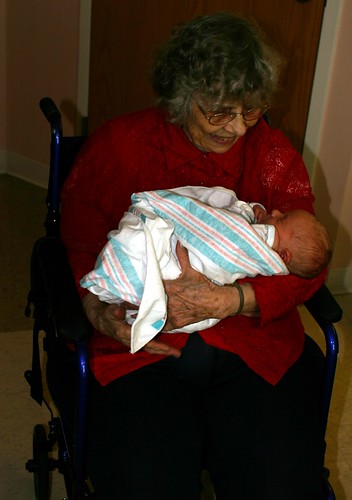
Jacob has lately been telling us gate gamma kassen so sick (Great Grandma Klassen is so sick), after his visit to the hospital, and it s true. Today started normal enough, but by 2:45 I got an email from my mom, saying that grandma had taken yet another turn for the worse; her pulse was racing, her temperature feverish, and her breathing shallow and difficult. The last grandchild that was going to be there made it, and got the last flicker of recognition from grandma. I wrapped some things up at work. Then I made the short drive from work to the nursing home, and got there just after 4. I went in to her room there, and it was full of family. Two of her children were singing her favorite hymns. I can never forget my uncle s deep bass voice as he stood at her bedside, holding her arm, while my aunt patted her head, both of them singing. Grandma s only remaining sibling, her younger brother Melvin, sat on the other side of the bed, looking on. Grandma s white table and chairs, which were in grandma and grandpa s house as long as I can remember, and followed grandma through all of the four other places she lived in the last years of her life, were in her room at the nursing home too. It always felt like home to be with grandma and those familiar things that she always took with her. Despite what was happening, I was glad she was back at home. My uncle motioned me over to her bedside, and I took her hand for a few minutes. It felt cold and weak; for the first time, she didn t grab my hand at all. A nurse came in to check oxygen saturation, but the machine wasn t able to get a reading due to poor circulation to her hand. She wasn t able to get a heart rate either because the heart was racing so fast. She discussed briefly whether the family wanted them to continue giving her oxygen, and they decided that they would, for her comfort. My uncle and aunt kept singing. I blew my nose and dabbed at my eyes, and there were hugs all around. And just a few minutes later, grandma peacefully stopped breathing, maybe 20 minutes after I had arrived. They went to get the nurse, who came back to listen to grandma s heart again, though we knew what she would find. She took the stethoscope off, and she almost lost her composure, but managed to say you can turn the oxygen off now. Several people gave grandma a last hug. After a few minutes with just the family, they told the nurses to go ahead and call the funeral home. That set off a lot of activity making arrangements for the next few days, funeral plans, and the like. I stepped back into grandma s room a few times, while the family was in the sitting area right outside it discussing. I looked around at the family photos on the wall, the old table and chairs, the recliner. Now, these are the things that were grandma s. It didn t feel like home anymore. Terah and Jacob were stuck at home Terah s car was at the mechanic for repair today. I called to give her the news. She wanted to come to be with the family, but I didn t really want to leave. She tried calling some friends to see if they could give her a lift to the mechanic, but not one of them was available. I talked to her again and suggested she just call the mechanic. She wasn t even halfway through describing the situation when he interrupted with, We ll have it at your place right away! Well, I don t expect you to have to do that, or you could certainly wait until you close. Nope, this isn t your average community, we ll bring it right over. You should be there. Grandma has enjoyed a simple life and had requested a simple death: no extraordinary measures at the end of life, no embalming either. So, by law, the burial must happen within 24 hours of death, and will be tomorrow. After all the arrangements, people realized nobody had supper yet. We went to the quickest available option pizza and ate there. It was paid for out of grandma s remaining money the last meal of so many that she provided for her family over the years. It was a happy meal. As I drove home, NPR news was on the radio. There were the same stories we hear all the time: the economy, the mideast, the president. Normally I m interested, but today I shut it off. Today is different. Tomorrow, for the second time in four years, I will help carry a grandparent s casket a few days before Easter. I ll end tonight with this photo. It was taken soon after Jacob was born. Grandma came to the hospital and held him. That smile sums her up perfectly. img_4965r.jpg

7 April 2009

Steve Kemp: A mystery of open questions

Date 30th March 2009 All being well the Debian Administration website now fully supports UTF-8. This change was a long time coming, considering the amount of time the site has been live. Most of the changes have been present for a while: The only missing part was ensuring the at the text input by visitors/users was correctly decoded and treated as UTF-8. This was handled by updating changing the Perl CGI module to explicitly call charset appropriately. Since the code behind the site masks the database, memcached, and CGI handles behind singletons the change itself was pretty trivial: I made more changes this evening to tie it all together, and to ensure that my Database connection is always forced to use UTF but I think that wasn't so important. I hope this is vaguely useful the next time I have to fight with character sets & encodings. It is just all so nasty. Failing that these pages are vaguely useful: ObFilm: Run Lola Run

Jon Dowland: zte mf622

I'm currently waiting for my ADSL to be setup and so I've borrowed my mum's "three" 3G mobile broadband USB dongle. The device is a "ZTE MF622" and getting this working in Linux apparently used to be a bit of a nightmare. However, with Debian Lenny and 2.6.26-1-amd64 it is trivial: you plug it in, it appears as a USB mass storage device; wait a little bit and it disappears and comes back as some USB serial devices. You can then chat to /dev/ttyUSB0 (or whatever the first ttyUSB device belonging to the dongle is). There's a working wvdial configuration at http://ubuntuforums.org/archive/index.php/t-665332.html, reproduced here for convenience:
[Dialer Defaults]
Init2 = ATZ
Init3 = ATQ0 V1 E1 S0=0 &C1 &D2 +FCLASS=0
Stupid Mode = 1
Modem Type = Analog Modem
ISDN = 0
Phone = *99#
Modem = /dev/ttyUSB0
Username = user
Dial Command = ATDT
Password = pass
Baud = 460800
IF you don't want to use wvdial there are bare ppp scripts at http://hillj.co.uk/2008/01/31/how-to-get-online-with-three-mobile-uk-and-linux-ubuntu/, although I haven't tested these. Whilst researching this I stumbled across several examples of more extreme ways of getting the initial switchover to work, including http://blog.ufsoft.org/zte-mf622-usb-modem-under-linux#extended which includes a udev snippet that forcefully calls rmmod and modprobe. This will totally fail if you are using usb-storage or usb-serial for anything else, which is probably not the case for the majority of people trying to get this to work at the time they are trying, but there are several examples out there of people complaining that their USB has failed since trying these instructions. We are often accused of having a problem of missing documentation in the free software world. I'm wondering if this is one example of where we have bad, damaging documentation. How can we deal with that? Incidentally, for those whose devices won't automatically switch over to the serial device, there's a program usb-modeswitch (currently in sid) that can do the job for you. There are apparently hacks in the usb-storage Linux kernel module that special-case the switchover for some Huawei devices. I couldn't find anything in there for the ZTE device.

Adeodato Sim : Piglatin in Debian!

This is too good not to blog it, but it s horribly old too. While composing a message for #522776, I wanted to see where the output of locale-gen is stored (/usr/lib/locale/locale-archive, it seems), but my first try ended up with me looking at /usr/share/locale, where I couldn t help but notice that Inkscape comes with a translation to, wait for it... Piglatin (apparently since 2006). There sure are people with lots of spare time, and I sure hope he did the translation programmatically! Anyway, here s the obligatory screenshot, including some out of date strings: If you d like to run it yourself, you ll need to create an en_US@piglatin locale first. I did it by sticking this file in /usr/share/i18n/locales/en_US@piglatin and adding a line en_US@piglatin UTF-8 to /etc/locale.gen, etc.

Mike Hommey: How not to provide robust clustered storage with Linux and GFS

(The title is a bit strong, on purpose) LWN links to an article describing how to provide robust clustered storage with Linux and GFS. While explaining how to setup GFS can be nice, the incentive made me jump. The author writes:
Load balancing is difficult; often we need to share file systems via NFS or other mechanisms to provide a central location for the data. While you may be protected against a Web server node failure, you are still sharing fate with the central storage node. Using GFS, the free clustered file system in Linux, you can create a truly robust cluster that does not depend on other servers. In this article, we show you how to properly configure GFS.
In case you don t know, GFS is not exactly a clustered storage . It is more a shared storage . You have one storage, and several clients accessing it. You have one storage array, compared to the NFS case, where you have one central server for the data. But what is a storage array except a special (and expensive) kind of server ? You don t depend on other servers, but you depend on other servers ? How is that supposed to be different ?
Conceptually, a clustered file system allows multiple operating systems to mount the same file system, and write to it at the same time. There are many clustered file systems available including Sun s Lustre, OCFS from Oracle, and GFS for Linux.
OCFS and GFS are the same class of file systems, but Lustre is definitely out of league and would, actually, provide a truly robust cluster that does not depend on other servers. Lustre is a truly clustered filesystem, that distributes data on several nodes such that losing some nodes don t make you lose access to the data. With the incentive given by the author, and considering he lists Lustre as an example, I would actually have preferred an article about setting up Lustre.

Manoj Srivastava: Manoj: Not your father's kernel-package

A few hours ago, a new version of kernel-package was uploaded to experimental. This is a major change,and I would appreciate it if folks took it out for a spin, kicked the tires, and provide feedback about where this version is lacking. This is only part of the way along in this development cycle. I would like to add a debug-info separation, either in a different directory than / in the image packages, or a separate package by itself. I would also like to create an overlay directory for /usr/share/kernel-package/, so people can inject code or override the defaults for kernel-package easily. I am also willing to make any changes to standardize the handling of hook scripts for kernel packages in Debian.
Table of Contents

./debian/ is ephemeral
make-kpkg removes and re-creates ./debian on every invocation. This started as an exercise to protect ourselves from the upstream builddep functionality, that randomly cleaned out ./debian whether or not it had created it, effectively making it impossible to run dpkg-buildpackage easily (which is ok, if all you care about is the image package) This does make the kernel-package far more nimble; we now offer less surprise to users who did not expect stampts that the kernel-packagge used to not do duplicate work. Now, if you edit a couple of files in the kernel source, and run make-kpkg, the kernel will build as expected. There are no more version mismatch errors, and the kernel version can be modified using localconfig as one desires. With this, kernel-package can routinely be used to build kernels out of the git tree. The con is that we no longer cater to official kernels, or to anyone who expected content in ./debian to persist. At some point, there are plans to implement an overlay directory that will shadow /usr/share/kernel-package/ruleset, but that is not yet implemented. In any case, the kernel team in Debian regards kernel-package to be broken, and have been bad mouthing it and deprecating it for a few years now, so this will not be a loss for them.

Get rid of the facility to patch kernel sources
The patch the kernel facility was adding complexity, and failing to provide the flexibility required for a generic patching facility. It used to be useful at one point, but in the modern parlance, witht he widespread use of distribute version control systems, and various facilities to manage source and patch them, the built in version was clunky. This means the --added-patches option of make-kpkg is gone, the work-around is to prepare the kernel sources before calling make-kpkg.

Remove special case code for official kernels
For the longest tine (well, ever since Herbert Xu too over building kernel images from me), kernel-package has carried specal case code for official images. This has caused some problems, recently, since the need to preserve ./debian has caused no end of problems when the version changed out from under ./debian, or when people wanted to edit a file and expected kernel-package to do a minimal recompile. However, sometime in the Etch release cycle, the kernel team deprecated kernel-package as the means of building official kernels. They have recently started saying they think kernel-package is broken, and have their own recommendation for how to build kernel packages. Therefore, a full release cycle later, we can get rid of the special case rules used for official packages. Also, this allows us to drop ./debian at the drop of a hat, and recreate it with an version that reflects the current state of the kernel sources.

Header package no longer create symbolic links in /usr/src
Instead, ship an example shell script that replicates the old behaviour. This script can then be deployed on the target machines, and could be a part of a locally created kernel configuration package, if one needs to deploy the same behavior across a cluster of machines.

The postinst no longer manipulates symlinks
This is a shift from previous behaviour. Any symbolic link manipulation must now be done with hook scripts in /etc/kernel/*.d directories. Firstly, modern boot loaders scan the boot directory for kernel images, and the user no longer has to code in the path to the symbolic links that the kernel image package used to manipulate. Secondly, hardcoding the behaviour into the postinst made for a very rigid policy; and user wanted more flexibility than that. There is an example shipped with the package that shows a more flexible scheme that kept two symbolic links for version 2.4 kernels, and two symbolic links for 2.6 kernels; it can be easily modified to keep two links for 2.9 kernels and two links for 2.8 kernels, or one of each, or whatever the user wants.

Image postinst no longer runs a boot loader
Please note that this was already the case for grub, one of the more popular boot loaders. Now that we have a mechanism for running arbitrary scripts when the image packages are manipulated, we can stop embedding the boot loader actions in the package itself. This means that lilo, elilo, etc will no longer be run directly by the post install script, and all the code related to detecting the boot loader, managing the configuration, and adding bits about bootloader documentation is all removed from the postinst. This allows the image package to be more flexible, since the end user is no longer restricted to the actions encoded in the image package. This is a fairly large change. It also opens the door for the user to easily use non-standard bootloaders, if they so desire.

The image postinst no longer creates an initramfs
Instead, there are example scripts provided that will perform the task. These scripts will work for official kernel images as well. The initramfs scripts provided work with the make-kpkg images as well as the official images, and are thus better than the script shipped with initramfs-tools themselves, as they offer a super set of functionality. This also demonstrates how the posts install script communicates with the initramfs creation scripts so that no initramfs is generated in case you do not want it.

6 April 2009

Brandon Holtsclaw: Simplify Dropbox URL s with Apache2 (reverse)proxy

First off this is a (late) response to Christer Edwards way of simplifying his public Dropbox URL's with .htaccess and mod_rewrite, it can be found here. While his solution works, it leaves the URL ugly e.g. a Picture of my son and his toy duck at would redirect to http://dl.getdropbox.com/u/461492/eric-n-duck.jpg . Below is my solution to the "problem". Simply setup apache2 as a reverse proxy for your public folder on Dropbox. Here is the sample config I use on http://storage.imbrandon.com/ , its just a couple of added lines to your vhost/httpd.conf ( change the number after the /u/ to your Dropbox user ID number ).

<Proxy *>
Order deny,allow
Allow from all
</Proxy>
ProxyRequests Off
ProxyPass /dropbox http://dl.getdropbox.com/u/461492/
ProxyPassReverse /dropbox http://dl.getdropbox.com/u/461492/
So now when you visit http://storage.imbrandon.com/dropbox/eric-n-duck.jpg the URL never changes.

Next.

Previous.