Pietro Abate: xen 4 on debian squeeze
It's time to upgrade my xen servers to squeeze. I've already put this off too long and now I've to task to go from etch to squeeze in one long step. In order to avoid problems I just did a first upgrade etch -> lenny and then to squeeze. However, since so much has changed in the meantime, and so much twicking of essential components is needed (such as Xen !), I guess I could have gone directly from etch to squeeze in one go, and fix everthing in the process... Anyway, to late for this kind of considerations.
This will pull the latest linux kernel and xen-hypervisor to run on dom0 .
By default the hypervisor is probably not going to be the default kernel. If you want to change this, you should edit the grub default values :
to make sure that the default kernel on dom0 is the xen-hypervisor. This is tricky, because grub let you define a default w.r.t the list of available kernels. so if you install a new kernel, you have to change the default accordingly with the list of kernels in /boot/grub/grub.cfg. It would be nice if I could define the default kernel with a label instead of a number... ( ref #505517 )
Alternatively, as suggested in the wiki, you can just move the xen kernel out of the way ...
When installing xen related tools, aptitude will also probably install by default rinse and xenwatch. The first one is to boostrap redhat machines and maybe you don't need it. The second one is a GUI and will pull in a lot of X-related dependencies. If we have similar needs, you can just remove what is not needed...
Something that is new, is the new schema for virtual devices. Now all vms will see /dev/xdva1 instead of /dev/sda1 as before. This needs to be changed in the domU as well as in the xen config files (
A last note is about the merge upstream of the xen patch !! \o/ yeiiii !!
The xen debian wiki is full of invaluable information. Kudos to the xen team for their hard work. To get you started on squeeze you need to install the xen hypervisor. Everything is provided by one package:
aptitude install xen-linux-system-2.6-xen-amd64
vi /etc/default/grub
mv -i /etc/grub.d/10_linux /etc/grub.d/50_linux
aptitude purge rinse rpm rpm-common
aptitude purge xenwatch
aptitude purge xenwatch
/etc/xen/vm.cfg).
One fantastic news is that xen 4 now uses pyGrub. It is not mandatory (so if you want, you can stick with the old configuration file). But if you use pygrub, on the domU you can install whatever kernel you want. Finally, your users will have complete freedom to pick and choose their kernels !
There was a small detail I didn't notice on the debian wiki, that is, if you try to use grub2 in squeeze, it will fail when probing the device#601974 . The workaround described in the wiki is to use xvd a,b,c,... as device names (and not xvd 1,2,3,... ) to make grub happy. Once you have changed then naming schema, grub will be able to see the disks and install the bootloader. Another solution is to install the os-prober from unstable / experimental. It seems a patch is on the works.
On newly created images, you can also pass the --scsi parameter to xen-create-image to ignore this problem altogeher... I'm not sure if this will have other implications... The console name is also changes from tty to xhv0 . To get back the console you should add this line in the inittab of all you VMs.
vc:2345:respawn:/sbin/getty 38400 hvc0
 Hrmh... I am listening to a local news radio station. Of course, what I am about to write lacks information and insight but it follows a conversation I have had with several groups of friends.
Our de-facto president has decreed that the tuition for private schools will be deducted from the Impuesto sobre la renta (revenue/profit tax) up to a given tuition level (IIRC up to MX$2000 a month per child per school). The interviewed subsecretary said they expect this deduction will reach MX$13,000 million, around US$1,000 million. This is, about a third of what is assigned to the National University (UNAM).
At a first sight, this sounds good. However, I just thought about a discussion I have had with many friends. This money the government will hand back to the taxpayers has to be cut from somewhere (after all, we are not in a country with huge superavit or anything like that).
Why does this sound unfair ot me? Because it benefits the few in perjudice of the many. I did a quick search, and found
 .

 Last week, we learned



 As much for my own reference as anything else...
I quite often use vmplayer on my work desktop, and occasionally on
my laptop. Other options might work better for other people, but the
company have already settled on using vmware on their Linux machines
to give users access to Outbreak, Office etc. I try to avoid them as
much as possible, but about the only effective option for calendaring
at work is Outbreak. *spit*. And on my laptop, I just have a vmplayer
setup containing a trivial Windows XP installation for things like
Nokia firmware updates. It's more hassle than I can be arsed with to
move to something else - the only thing worse than using Windows is
installing it, in my experience.
In most respects, vmplayer is working OK for me. But: it has one
intermittent and really annoying bug. Every now and
again, as I switch away from the vmplayer session to another desktop
using Ctrl-Alt, then Ctrl-Alt-Cursor, vmplayer eats the state of the X
keyboard modifier keys. This makes things interesting
after that point: my normal use of emacs, firefox, xterms, mutt (etc.)
is fairly heavily dependent on being able to use the Shift and Ctrl
keys.
This looks like it has been documented as a bug in a number of
places over the past few months/years
(
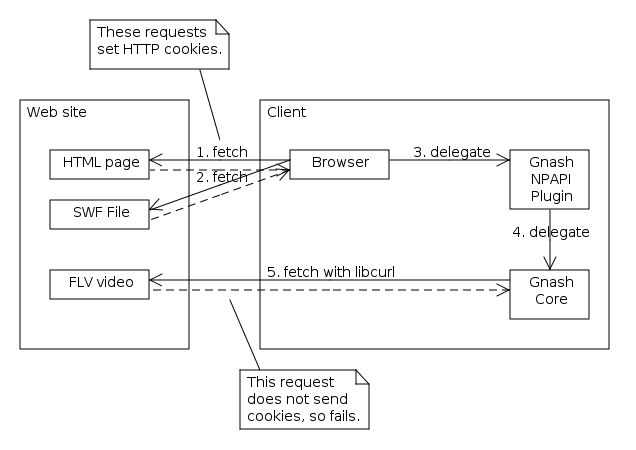 As of Gnash 0.8.8, a workaround was added, calling an NPAPI
function NPN_GetValueForURL to ask the web browser for the
relevant cookies. New diagram:
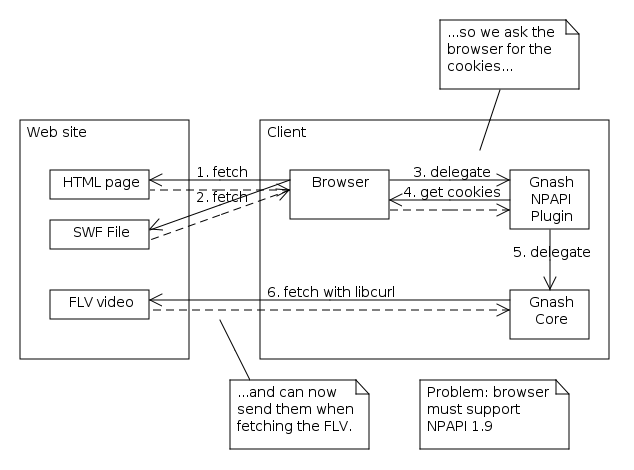 The downside is that this function was only added in NPAPI version
1.9. This means:
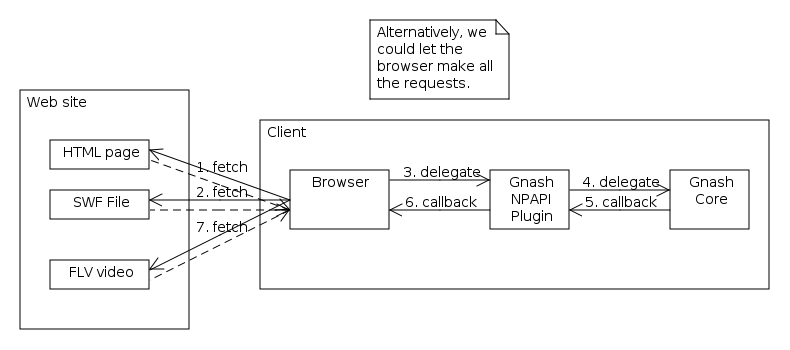 So, the good news is, this problem should almost certainly get
fixed over the coming Debian release cycle, if only because all the
browsers will get updated. In the meantime, disabling cookies (and
removing stale ones from YouTube) is a workaround.
 As I've already
 Did not exist.Will never exist.There was quite a lot of buzz about privacy with that new IPv6 thingy. Some say it is bad, as you will have a static address. Some say the privacy extensions will fix everything. I say: lemme rant ;)First of all, that was the internet, when I started using it back in 1999:
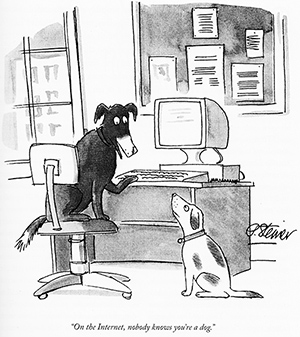

 I just realized that the

 Now that Squeeze has been released, we (the pkg-xfce group) are
in the process of uploading 4.8 to Debian. And we are
uploading it to experimental for good reasons.
Not that 4.8 is broken, but the packages are, and we're
aware of it. Some packages are still in NEW, some are not uploaded
because of some licensing issues, some have not been uploaded
because we didn't yet have the time.
What does this mean for you? That you should *not* upgrade to
Xfce 4.8. Not all packages will be upgraded, and mixing
4.6 and 4.8 is a bad idea. We don't know yet what
will happen (and that's the whole point of uploading to
experimental), and it seems that there are
 The first day of