Search Results: "sto"

15 April 2009

Julien Danjou: Taking the other direction

I've started to develop awesome more than 18 months ago, and somehow I feel it's time to stop a bit and think where we come from and where we are going to. The motivation I never though I'd be written a window manager one day. That seems kinda stupid when you see how many window manager there's around. As many people, I've tested and have been using tons of window manager: Window Maker, Fluxbox, etc. In August 2007, I was using fvwm since 2004 and was quite happy with it. I used the famous fvwm crystal as a configuration starter and then rewrote lots of stuff. Digging into fvwm configuration files was boring, and since I'm lazy, I never really configured it to fit entirely my needs. The thing is that, in July 2007, my workstation died. I bought a new one based on the amd64 architecture. Too bad, with this new box, fvwm decided that it will not longer runs and was segfaulting almost every time I logged in. I was really upset. Another failure in the window manager world. So I decided to get the yearly ride of testing many window managers. I went on the no more developed stuff like the *boxes, ion3, etc but well, I did not like them, there were not powerful enough, too bugged or upstream was insane. Then I found xmonad. The Haskell configuration file format made my cry. I did not want to learn Haskell, it seemed too obfuscated to me. At that time it was even not packaged for Debian, so I gave up. But I found dwm in the meantime, and I loved it. It was simple, and the source code was almost understandable and easy to hack. I subscribed to the dwm mailing-list, in order to participate to its development, etc But I got really disappointed. No patch were welcome and the development seemed to be almost finish in this sight. People patches were lying around, but no one really care. Each user was managing its own set of patches. That's not what I learnt and what I love in free software. So, as many users, I began to maintain my patches in my corner. But I began to have more ideas The jdwm I just added a 'j' in front of dwm and started to hack it days and nights to add many feature I missed, like multi-head, etc On 5th September 2007, I created a git repository to host my code. That's gonna be awesome. Five days later, on 10th September, I finally found a name for my new pet: awesome, borrowed from Barney Stinson who heavily uses and abuses this word. The 1.x branch The first releases until December were noted 1.x. It was just a better dwm with a simple flat configuration file.. The configuration file used libconfig, but it was a very poor choice. And I was not able to put in into Debian because of name clash. The 2.x branch The 2.x branch came in January 2008 with a brand new configuration file format based on libconfuse, which was a bit more powerful. Many concepts and features that have been added in this branch are still used in the current 3.x branch. At this time, between December 2007 and April 2008, the community was growing smoothly. But as I said, awesome 2 was based on a flat configuration file. That raised a problem very soon: users expectation were growing and the development team (me and a couple of regular contributors) was unable to cope with them. One of the event that started to change my mind was the support for titlebars. When I've added titlebar support, it was minimal. It was on top of a window, with the window title. Dot. Then I've started to add a lot of options, like the application icon drawing, the position (left, right, bottom) etc. And then users started to ask for more, like: "add titlebar on windows only when the window is floating". That's ok, but that's complicated: that's again another option to do some stuff conditionally. And then, why don't add titlebar on windows when <insert random events here>? The 3.x branch Why At that time, around April 2008, I'd totally stopped development. I was trying to find a solution which was simple and powerful. But after 2 weeks of thinking, I was not able to find anything else than: use a real language for configuration. So, I've started prototyping awesome 3 using Lua. The choice was not obvious, and despite the problem Lua might suffer, it's one of the easiest language to integrate into an existing application. There's still a video of a first version here. But, let's go a little back: in January 2008, Arnaud Fontaine contacted me because he was interested to use awesome as one of its school project. He decided to port awesome from Xlib to XCB, a modern asynchronous X library. His work took some time, but in May 2008, Arnaud did finished to port git master version of awesome to use XCB. Consequently, I decided to start a new major branch, using XCB instead of Xlib (no change for users in this regard) and Lua instead of our previous flat configuration file format. Development It took me a while to get from here to there, but in September 2008, it was ready. We had a simple Lua API, and the XCB port was working perfectly. It took us some time to release and have something totally working, because we had to work on XCB and contribute back to the project. It was really not ready to use by an application, but we did great work in this area and it's now really fine. We're still here Releases continue to happens, 3.1 around December 2008, and 3.2 around March 2009. 3.3 should be here in June. One of the drawback we had, is that we moved many stuff from C to Lua. Why? Because writing things in Lua is quicker and easier to maintain than C, and makes thing more configurable for the user. For example, the layout algorithm used to organize window were written in C until 3.2 came out. At that time, users had no choice than using a set of predefined layout to organize their windows. Starting with 3.2, if they have minimal knowledge about geometry, they can start writing a layout function organising windows on the screen. But this kind of API changes was a bit rough for users, since they had to port some part of their configuration file to the new API. The thing is that the project was still a teenager at that time, not really knowing were it will go. But I'm happy to announce that API breakage are more and more rare (so far only one minor between 3.2 and 3.3), and anyway always for the Good. But I admit that it built a bad reputation around awesome 3.x during its first month of existence. Future direction I am currently working on 3.3 development. We have still many things to do. Time passing, we get more idea, and more users. And more users bring more ideas. We also have many more contributors, and some guys are even taking maintainer-ship of some code area. Conclusion My post title is "Taking the other direction" because I feel this way. I've got that feeling that some approaches in projects like GNOME are sometimes bad. Please don't misread me, I know we are not playing in the same yard. When adding a key shortcut for starting an application makes you dig into gconf, I wonder how this is a win for the user. Well, it's probably a win for the end-user, but I surely am not one of them. And I don't intend to target them with my software, anyway. And now, when I hear things like GNOME 3.0 and the "desktop shell" approach, that makes me smile. Guys, it was time, but have luck. What I see from here, is that any desktop control interface is wrong somehow, and that there's no approach that can fulfill all users wishes. I think that we, the awesome development team (no pun intended) took the direction of building a frame-work window manager rather than a solution written in marble. We (partially) solved the issue of UI ergonomic by not writing one and allowing the user to write his own. I don't say that's easy to do for most of users, but it's doable. And I think it's worth it: I use window managers since I use Linux, around 1998. If something like awesome came 5 years ago, I'd be using it so far, because you can write Fluxbox or WindowMaker using awesome in a hundred of Lua code. And you can write your own version of it. And it starts in less than 3 seconds, supporting almost all standard desktop specification (ICCCM, EWMH, XDG, system tray, message notification, D-Bus, etc), whereas many of the window mangers do not. You can even write and play space invaders. Finally, I'm happy about the the road we took so far, and hope we will continue into that direction. The rants I read about our project are not that big, compared to the kudos we received.

Bdale Garbee: TeleMetrum Mounted

Last night, I stayed up late reworking the avionics bay in my Giant Leap Vertical Assault kit. This is the rocket I set my personal best altitude to date of 14,141 feet above ground level with. The Missile Works RRC2 mini will move to a lesser airframe to keep it below 10k feet AGL since it's an early unit with the supposedly-buggy early firmware. In its place, I've mounted a PerfectFlite MiniAlt/WD to handle primary deployment duties... and serial number 1 of TeleMetrum! Meanwhile, Keith has completely rewritten the guts of the firmware in the last few days to eliminate FreeRTOS since it turns out to just be too heavy for our needs on this project. My board is now running a snapshot of his latest work, and in bench testing I've confirmed that it can do launch detect, log sensor data until the non-volatile memory chip is full, and dump the raw data over USB for analysis after a flight. Weather has been an issue in Colorado recently, but as soon as we get a decent launch day (maybe as early as this weekend?), I'm looking forward to flying this rocket on one or all of the Cesaroni I205, I540, and J285 currently in my box to get some initial flight data recorded. Keep your fingers crossed for me that the storm front headed towards us clears out by the weekend!

Axel Beckert: Useless Statistics, the 2nd

Myon recently posted a nice statistic about popular single letter package name prefixes. Just out of curiosity I started wondering about popular single letter package name suffixes: On a machine with Debian oldstable, stable, testing, unstable and experimental in its sources.list, I ran the following command:
$ apt-cache search -n .   \
    awk ' print $1 '   \
    sed -e 's/.$//'   \
    sort   \
    uniq -c   \
    sort -n
And to my surprise there is a non-obvious winner:
$ apt-cache search -n '^gp.$'
gpa - GNU Privacy Assistant
gpc - The GNU Pascal compiler
gpe - The G Palmtop Environment (GPE) metapackage
gpm - General Purpose Mouse interface
gpp - a general-purpose preprocessor with customizable syntax
gpr - GUI for lpr: print files and configure printer-specific options
gps - Graphical Process Statistics using GTK+
gpt - G-Portugol is a portuguese structured programming language
gpw - Trigraph Password Generator
But since I searched through the binary packages many other hits are more obvious, like the seven packages hbf-cns40-1 to hbf-cns40-7:
      [...]
      4 ar
      4 aspell-f
      4 automake1.
      4 cpp-4.
      4 e
      4 g++-4.
      4 gappletviewer-4.
      4 gcc-4.
      4 gcj-4.
      4 gcompris-sound-e
      4 gfortran-4.
      4 gij-4.
      4 go
      4 gobjc-4.
      4 gobjc++-4.
      4 h
      4 iceweasel-l10n-e
      4 iceweasel-l10n-k
      4 kde-i18n-f
      4 kde-i18n-h
      4 kde-l10n-e
      4 kde-l10n-s
      4 kile-i18n-e
      4 koffice-i18n-e
      4 koffice-i18n-s
      4 koffice-l10n-e
      4 koffice-l10n-f
      4 libqbanking
      4 myspell-f
      4 myspell-h
      4 openoffice.org-help-e
      4 openoffice.org-l10n-b
      4 openoffice.org-l10n-h
      4 openoffice.org-l10n-k
      4 sd
      4 tcl8.
      4 tk8.
      5 aspell-e
      5 aspell-h
      5 iceweasel-l10n-s
      5 kde-i18n-b
      5 kde-i18n-e
      5 kde-i18n-t
      5 kde-l10n-k
      5 openoffice.org-l10n-e
      5 openoffice.org-l10n-t
      5 pa
      5 tc
      6 gc
      6 kde-i18n-s
      6 libdb4.
      6 m
      6 openoffice.org-l10n-n
      6 openoffice.org-l10n-s
      6 s
      7 hbf-cns40-
      9 gp
But there are also some other interesting observations to make: I leave it as an exercise to the reader to find the full names of the other package names starting with s, m, gc, pa or tc and having just one additional character. ;-)

Michal &#268;iha&#345;: Gammu stable version 1.24.0

Gammu 1.24.0 is out! It does not bring any new outstanding features, just small optimizations in SMSD, documentation improvements and various bug fixes. Full list of changes: You can download from usual place: http://cihar.com/gammu/, Debian users will find packages in unstable soon, SUSE, Fedora and Mandriva users can check repository in OpenSuse Build Service and Ubuntu in my PPA.

Stefano Zacchiroli: xmonad + gnome on Debian

... finally I'm tiling too! Short story: I've just switched to xmonad as my window manager of choice within a Gnome desktop environment; I give some tips on how to achieve that quickly on a current Debian/unstable machine. /me and tiling window managers I switched to Gnome a long time ago. The benefit of that over good old window managers is enjoying an integrated environment and a workplace that you can find on other machines (e.g., the netbook you installed for your mother, the office desktop, the student lab machines, ...). Still, I've never been particularly happy about Gnome's default window manager: metacity. The feature I was missing the most is the ability to configure windows programmatically so that they appear where and how I want by default; sadly enough, the Gnome session mechanism is not yet able to do that properly. Hence, I've tried various time switching to a tiling window manager, imposing the extra requirement that it should integrate with Gnome. The coolest guy on the block of that area seems to be awesome and I gave it a try some months ago. I liked most of its (sometime revolutionary) principles, like window tagging, but I equally hated various aspects of it: People nowadays tell me that awesome works fine with Gnome, so maybe I've just been unlucky back then, but sometime the first impression does count. I've never considered seriously xmonad, thinking (with no sound reason, apparently) that it was a project of the series: "I'm a fan of programming language $LANG, all my apps should be written in $LANG, my window manager is no exception", with LANG=haskell. Then two things happened:
  1. a couple of weeks ago I stumbled upon the xmonad wiki and documentation, and I was impressed by the average quality of the information shipped there. It is not something you usually find in "language showcase" projects.
  2. Patrick blogged about its switch to xmonad + Gnome, with enthusiastic feedback. If that's not a sign I don't know what it can be :-)
Getting started with xmonad + Gnome on Debian There is a page explaining how to use xmonad with Gnome in the xmonad wiki, but a handful of additional tips will help you get started in Debian, even if you know (almost) nothing about Haskell (yet). The (crazy) way in which xmonad works is that you create your config file as ~/.xmonad/xmonad.hs. That file is a full fledged Haskell program, which gets compiled to obtain your own xmonad executable which you run as your own window manager. /usr/bin/xmonad is the executable you initially run, but is just a wrapper around the compilation + run mechanism The modMask setting means that ALT will get delivered to applications, while all xmonad commands are delivered via the infamous windows key: no more conflicts between apps and WM \o/. The default Gnome configuration is quite nice: you can retain your Nautilus desktop (in spite of what is written on the wiki), mod-p will get you a gnome-run dialog box, and appropriate padding for the (upper!) Gnome panel. The only glitch is that you will get 9 desktops which can clutter your workspace switched. My solution is to have the appler show workspaces on 2 rows but beware of bug 524065, which is really annoying. The above example will make the pidgin buddy list and run application dialog box float by default. The commented line is an example of how to deliver specific windows to arbitrary workspaces. To find out window properties on which match in your xmonad.hs, my magic command is xprop egrep "CLASS NAME". Note that you don't need to care about panel placement because it is already taken care of by the default gnome config. Still beware of not using myManageHook as your only management hook, you should update the default one using the <+> monad as I did above. xmonad rant So, what's wrong with xmonad + Gnome in Debian? Well, the fact that it will take about 200 Mb of disk space on amd64 by default. o_O Why so? Because xmonad is affected by the static linking hell which seems to be shared by modern statically typed functional languages, including in the category both Haskell and my beloved OCaml. In short, applications written for those language link statically code written in the implementation language in most cases; they rely on legacy shared libraries only for bindings to C libraries. For xmonad that means that if you are fine with the default configuration you will get a cheap 2 Mb binary package. If you are not, you will need to write your conffile ... which is a Haskell program ... using several contrib libraries ... and needing ghc6 to be compiled and run as your own window manager executable. This is plainly dumb and induces all the usual problems of static linking, like disk consumption due to non-shared (Haskell) code, and worries about staying up to date with the latest library release in case of fixes (including security fixes) need to be propagated to user executables. Truth to be said, /usr/bin/xmonad does a wonderful job in hiding all this to the final user, but still the design choice is an unpleasant one.

Uwe Hermann: Resolving mysterious kernel/firmware problems via apt-get install firmware-linux

If you recently upgraded your kernel to the 2.6.29 Debian package, you might have noticed some (e.g. graphics) drivers stopped working or are working slower. In my case, this was the radeon driver, which inexplicably seemed to cause lots of slowdowns in some applications and games. A quick look into dmesg revealed the reason:
  [drm] Initialized radeon 1.29.0 20080528 on minor 0
  agpgart-intel 0000:00:00.0: AGP 2.0 bridge
  agpgart-intel 0000:00:00.0: putting AGP V2 device into 4x mode
  pci 0000:01:00.0: putting AGP V2 device into 4x mode
  [drm] Setting GART location based on new memory map
  [drm] Loading R200 Microcode
  platform radeon_cp.0: firmware: requesting radeon/R200_cp.bin
  radeon_cp: Failed to load firmware "radeon/R200_cp.bin"
  [drm:radeon_do_init_cp] *ERROR* Failed to load firmware!
As noted in the changelog file, the radeon firmware R200_cp.bin has been removed from the kernel, and is now available in the separate firmware-linux Debian package. So the simple fix for this issues is:
  $ apt-get install firmware-linux
  $ dpkg -L firmware-linux   grep R200_cp.bin
  /lib/firmware/radeon/R200_cp.bin
After restarting X, the dmesg output looks more sane again:
  agpgart-intel 0000:00:00.0: AGP 2.0 bridge
  agpgart-intel 0000:00:00.0: putting AGP V2 device into 4x mode
  pci 0000:01:00.0: putting AGP V2 device into 4x mode
  [drm] Setting GART location based on new memory map
  [drm] Loading R200 Microcode
  platform radeon_cp.0: firmware: requesting radeon/R200_cp.bin
  [drm] writeback test succeeded in 2 usecs

14 April 2009

Michael Schutte: Chain of unfortunate events

I did some work on kbd today. I basically took an old Debian patch, the only significant divergence from the original tarball, and altered it in a way that I can read and understand it more easily (so I can send it upstream in good conscience). This process naturally involved a lot of errors. As I m talking about loadkeys here, they became unpleasantly obvious whenever I tested my code: First I messed up everything but plain printable ASCII characters (so the return key was mapped to Unicode U+0201 instead of the correct K(0x02, 0x01)), then I managed to completely freeze everything. In both cases, Alt+F7 was affected by the damage. Just like Ctrl+Alt+Del. Time for the good old boring elephants. I learn from mistakes when I make them twice, so a while sleep 60; do chvt 7; done loop saved me from further reboots. I nuked /dev/tty1 once more (in the really cool, irreversible way that disables all keypresses), but I could move on to the next VT. After a final adjustment, my modified patch finally worked. I sent it upstream, forgot about the troublesome debugging and went on to something else. Later in the evening, I decided to end the last school holidays in my life with a bit of instant messaging. BitlBee, a Jabber IRC gateway, is running on my virtual private server for this purpose. Being the occasional chatter that I am, I haven t touched it since the recent upgrade to Lenny. The format of its account configuration files has apparently changed, so I started to set up BitlBee anew. It kept telling me that there is an Authentication failure ; given the peculiar setup of the XMPP server I use, this didn t really surprise me. But still, this thing had worked before. Perhaps I really got my password wrong? I haven t typed it for ages, BitlBee stored it for me. As the administrator of my Jabber server, I could easily reset my password to what I thought it was. BitlBee still refused to get past the identification stage. I decided to install Gajim, entered my account information and told it to connect. Gnah. One or the other Python exception caused an eternal stream of error dialogue boxes to appear simultaneously and steal my focus. I don t have a keyboard shortcut for xkill and I couldn t type anything in a Urxvt (error message #54321 would receive the keystrokes). Ctrl+Alt+F1, get me out of here! Oh, right, I broke that one! At that point, I burst into a laugh. Somewhere in this post, there are a few bugs to report.

John Goerzen: Two Things I Don t Understand About Facebook

Item #1 Say you want to do something like take a quiz to tell you what Star Wars character you are, and have to result posted to your wall. It would make sense for Facebook to prompt you for authorization for the app to make a one-time post to your wall. But instead, they ask you for permission to pull your profile information, photos, your friends info, and other content that it requires to work. And we have no idea what this other content is. So yes, in order to be told that you most closely resemble Storm Trooper Extra #3, you must let the app developer have access to all your updates, your list of friends, your hometown, email address, whatever else only your close friends can see. Why can t Facebook make this a tad less invasive? Item #2 I also don t understand why people click Allow to these apps, having no idea just who is getting access to their information or what information they re getting. And Terah thinks I m being paranoid because I said that criminals probably are writing cute facebook apps ah well.

Biella Coleman: Paris in June (and better with hackers)

========================================================================
/tmp/lab announces the second Hacker Space Festival
(Paris, 26-30 June 2009)
======================================================================== Hacker Space Festival 2009 Call For Proposals HSF2009 In 2008, we organized HSF[1] on the spot, as an ad-hoc meeting for
hackerspaces-related networks, technical and artistic research emerging
from them and social questionning arising from them. This sudden
experiment proved to be a huge success, as much as on the
self-organizing level as on the participants and meetings quality, as
well as the emotionally-charged ambient, the kind of which you make
fond memories. The 2008 edition generated a strong emulation in France, from its
historical role as the first official hack meeting there, and in Europe
with the subsequent creation of the Hacker Space Brussels[2], the
rapprochement with The Fiber in Amsterdam and the hackerspaces.org[3]
network. Initiatives of hackerspace openings in Grenoble or Lille, or
the upcoming FrHack[4] conference show an actual enthusiasm in the
French hackers community that was doomed to the underground not so
long ago. We salute these initiatives and their diversity! Soon enough, we wanted to reiterate the HSF experience : however, it
was out of the question to institutionalize this temporary autonomous
zone, nor make it an ersatz of the previous edition, nor even to wrap
it into an elite or underground aura. On the opposite, we ardently
desire; and especially to explore further, in all directions some
lesser known domains (see below) et foster meeting and sharing around
experiences at the confluence of art, technology and politics. The world financial crisis, the decay of democracy in Europe, the
obscurantism, paranoia and lack of culture presiding over legislation
(Internet and Reaction Err Creation Law[5][6]) seem a fertile
environment for the sensible development of new (social ) life forms.
Quick! Let s rest for a few days in jubilation and ecstasy to take a
deep breathe of freedom under the indelicate smells of the medicine
factory nearby! For if the public space is shrinking to oblivion, where any side-step
becomes suspect, and that, from an early age (deviant behavior
detection in nursery school), where moving without a mobile phone
becomes suspect (hello you Julien Coupat[7], a French political
prisoner in France!), there s a domain that the Leviathan would have a
lot of trouble to contain, and for a reason: that of sensitivity. Even
the desperate attempts of the State to block the free and premonitory
expression of sense (hello you Demeure du Chaos![8]) cannot do anything
against a loud laughter or a knowing glance, a sensual kiss or an
explosion of colors. Sensitivity, we could say, is what is left to a human being when she
has nothing anymore, and differenciates her from the body corporate or
the institution, that are, in essence, devoid of it. Therefore, Art
definitely remains the public space to share between humans, and only
between us. And if it the last one to share, we propose to explore it
and take it over during the upcoming edition of the Hacker Space
Festival, from the 26th to 30th of June, 2009 at Vitry sur Seine[9]. ========================================================================
Keynote Speakers: Sergey Grim and Larry Fake with Eric Schmoudt
Groogle Summer of Crode, Survivor style
VLC, I vote against you because you really fucked up when ========================================================================
== W A N T E D ========================================================= Focus on solutions rather than problems. * The Final (Hardware) Frontier: Open FPGA Cores, Reverse Engineering
* Designer Religions and Creative Beliefs Systems
* WiFiDoors & WiFi System-on-Chip controllers firmware hacking,
infection & backdooring
* Telecom Core Network Equipment Reverse Engineering: MSC, STP,
Switches,
* Algebraic Attacks and Modern Cryptography Attacks
* Autonomous, Parasitic and Viral Drones
* Enhanced or Infected Reality Swarms
* Auto-Builders / Self-Fabrication
* Embedded OS breakins stories & recipes
* Actualization rather than mere concepts
* FPGA & ASIC hacking / backdooring
* Cloud+Privacy+Open Source: O Brave New World?
* Explosion-Proof clothing
* Radio Appz & Hackz: Mesh @ RF Layer 1-3
* Database & Privacy
* Problematic & Ethical Open Source/Content Licenses
* Institutional Relationships: Lobbying or Licking?
* Non Lethal Protection (anti-taser vests?)
* Survival in the Age of the Ministry of Immigration and National
Identity
* Mental asylum improvised visit
* Open Source Legacy Media(TM) Production Solutions (TV, Radio, Press,
DRM)
* Gas Sensors & Environmental Benchmarking
* Building Hackerspaces Without Money
* Milsatcomm hacking: Military satellites shots, broken birds in the
sky
* Other research topics on security and insecurity
* Academics and Hackers
* Organics and Fermentation
* Clean Food in Tainted Environment
* Low Impact Energy & Recycling
* Media Sandwich: layers of crap makes good food?
* Deconstructing Carla Sarkozy
* Knitting DIY Factory (jazzy, eh?)
* Signs of life among industrial wasteland
* Hallucinogenic & Computing: Can you Code on Acid?
* Mesh Networking (Wireless BattleMesh Royal!)
* Legal Sabotage: When Democracy Needs You And anything that does not fit. ========================================================================
== P R O P O S E ======================================================= Send you contributions to HSF2009-CFP@lists.tmplab.org + Type of the proposal: 1. conference (45min. presentation + 10min. for questions)
2. workshop / demo (30min. 2 heures)
3. installation / performance (music, plastic, sound, video) Lightning talks can be proposed and organized until the last moment,
according to available space and schedule, in the form of BarCamps or
Blitz Conferences. + Required Information: * Title of the presentation
* Type (see above)
* Language : French or English
* Name of speaker(s)
* Affiliation (organization / company)
* Short biography
* Abstract (5 to 10 lines)
* Topics / Keywords
* Includes a demo? YES NO
* Release during the festival? YES NO
* Internet connection required? YES NO + Acceptable Formats * Open Document
* PDF
* Plain Text
* RTF + Agenda * beginning of proposals : now
* end of proposals : 01 May 2009
* selection notification : 07 May 2009
* publication of program : 15 May 2009 + Evaluation criteria for proposals: 1. Innovating Topic
2. Open Technology
3. Demonstration / Live Act
4. DIY Reproducibility
5. Fun Potential The Programming Committee resembles that of last year
See : http://hackerspace.net/committee ========================================================================
== V E N U E =========================================================== /tmp/lab
6 Bis rue Leon Geffroy
94400 Vitry sur Seine
France http://hackerspace.net/directions ========================================================================
== P A R T I C I P A T E =============================================== Email : http://lists.tmplab.org/listinfo.cgi/hsf2009-talk-tmplab.org
CFPmail: HSF2009-CFP@lists.tmplab.org
IRC : irc://irc.freenode.net/frlab
Jabber : xmpp:hsf2009@space.cepheide.org?join
Wiki : http://hackerspace.net/hsf2009 ========================================================================
== L I N K S =========================================================== The CFP is available online at http://hackerspace.net/cfp [1] http://hackerspace.net/hsf2008
[2] http://hsb.wikidot.com/
[3] http://hackerspaces.org/
[4] http://www.frhack.org/
[5] http://jaimelesautistes.fr/
[6] http://laquadrature.net/
[7] http://fr.wikipedia.org/wiki/Julien_Coupat
[8] http://www.demeureduchaos.org/
[9] http://hackerspace.net/
Philippe Langlois
Email: philippelanglois@free.fr
PGP Key: 8DAEE244

13 April 2009

Andrew Pollock: [tech] Queensland Rail to get WiFi

I just read that they plan to put WiFi on the trains in Brisbane. I had one of my crazy business ideas to try and do this years ago. I think it'd be great for public transport adoption. Imagine being able to be on top of your email by the time you arrive at your desk? Of course, with mobile broadband becoming more and more ubiquitous, you don't really need WiFi on the train, so it may be too late...

12 April 2009

Sean Finney: a productive weekend for debian stuff

(note that i've just tried enabling the comments feature of ikiwiki, so feel free to use it :) ) (update: okay so i apparently failed to enable comments earlier... but it should be working now :) ) compiz(-fusion) 0.8.2 uploaded to unstable for all you lovers of desktop bling, the latest stable release of compiz-fusion has been uploaded to unstable. new features of note: new one-off script for building compiz packages the biggest problem with trying to maintain compiz packages is that they're for some reason distributed as almost a dozen different source projects upstream, but extremely interdependant wrt their API. therefore updating the packages to a new upstream version is a Big Pain. i've numbed that pain a bit with a new helper script, which should amongst other things make it easier to manage backports to lenny, which i've already seen people requesting. compiz 0.8.2 lenny packages available for testing ..which brings us to our next topic. before i upload them to somewhere a little more official, i figure i could put a call out to teh lazywebs to do some QA work and make sure that it doesn't totally explode on your system (unless you're using the explode animation plugin, in which case it's functioning properly) sources.list entry to try it out on an amd64 lenny system:
deb http://people.debian.org/~seanius/compiz/lenny-backports/amd64 ./

sources.list entry to try it out on an i386 lenny system:
deb http://people.debian.org/~seanius/compiz/lenny-backports/i386 ./

and then apt-get install compiz compiz-fusion-plugins-main (etc) so give it a try and let me know how it goes! pkg-php moving to git with some initial legwork from Mark Hershberger we've migrated to a git repository for the php packaging vcs. due to the long and convoluted history of our svn repository, we decided it wasn't worth the effort of trying to get every single svn commit mapped into the new repo. as a compromise to having to start from scratch, we used the existing branches/tags on top of a series of upstream tarball imports to get an accurate representation of the release history. new git<->bts integration hook for debian packaging i've been dabbling with a new hook to make for more useful integration from a git-buildpackage oriented workflow. in this workflow the changelog is often the last thing prepared, possibly days or even weeks after a fix has been committed for a bug. therefore the standard tagpending and typical changelog-scanning hooks aren't incredibly useful. instead, this hook scans for "Closes:" meta-info in the commits, similar to how "git dch" does, and then sends a notification and/or control commands to the bts. here's an example. note that it also mentions the branch that recieved the fix in the notification, so it's easier to see which branches have a fix at a quick glance. how to use this for your own git repo:
REPO_PATH=/path/to/your/repo.git
HOOK_REPO_PATH=/somewhere/you/want/to/put/it
git clone git://git.debian.org/users/seanius/vcs-hooks/git-hooks.git $HOOK_REPO_PATH
ln -sf $HOOK_REPO_PATH/git-post-receive-url-notifications.py $REPO_PATH/hooks/post-receive

there's a number of configurable options (take a look at the top of the file for some fairly verbose comments), but it should work with some fairly reasonable defaults out of the box. it can also be configured to do the more traditional changelog-scanning, but i'm finding it to be a better workflow to avoid combining changelog entries with the actual fixes (makes them harder to cherry-pick later), and a notification with a link to the changelog entry really isn't that useful beyond what "bts tag nnn pending" can already do. plus i don't like the typical duplication involved in manually managing the changelog. i find it better to generate the changelog via git-dch and automatically get all the "closes:" tags, and then just do a bit of editorial touchups before preparing/releasing the upload. so give it a try if you like, feel free to send feedback/fixes/etc. for example i think the utf-8 support might still be a bit dodgy, as well as possibly the automatic gitweb url detection and changelog scanning.

Biella Coleman: Too cute to handle

Possibly the cutest pictures and story of the decade?!

Biella Coleman: Too cute to handle

Possibly the cutest pictures and story of the decade?!

John Goerzen: Flowers, Music, and Grandparents

Flowers I ve written a lot lately about my Grandma Klassen, who passed away this week. But I m going to start this post about my Grandma Goerzen. She died when I was just an infant. I never knew her, but as the years pass, it seems that I remember her better and better. After we moved out to the farm where she and Grandpa Goerzen lived for decades, we noticed some flowers she had planted 30 years ago were still coming up, having withstood hail, hot summers, frost, construction equipment, and neglect all that time. Terah said, It s like your grandma left us a housewarming gift. Some of these flowers had never bloomed. Until this week. One bloomed for the first time the day Grandma Klassen died. A second bloom appeared the day of her funeral. Music #1 My jr. high and high school band teacher loves music (and old engines, but that s another story). You couldn t sign up for band at my high school; you d sign up for the class called LIFE. To him, music and life are indistinguishable. He says that anybody can speak to somebody, but music is the best way to speak to the heart. My Grandpa Klassen died when I was 11. Grandma Klassen, before her health declined, loved to tell me the story of the music at his funeral. At his funeral, my mom and I played a piano duet of Nearer, My God to Thee which we had already learned for a different event. When we were done, Rev. Epp went to the pulpit and said something along the lines of, If the music in heaven is as good as that, it ll be a great place indeed. I was just 11, and though music did speak to me at that age already, I don t think I understood how it moved people, such as my grandma, until many years later. Music #2 Grandma Klassen loved music, too, and that s reflected in each of her children all of them play trumpet, for instance. So it s no surprise that there was a lot of music this week. She died as two of her children were singing hymns to her at her room in the nursing home. Two of her grandchildren played trumpet for her at her burial. And my brother and his wife played trumpet and piano at her funeral. It was all beautiful, and like my band teacher said, it spoke to my heart. Music #3 I knew about gradma s love of music for quite awhile. When she was in better health, I took her to concerts sometimes. One of her favorite hymns was Joyful, Joyful, but she hadn t known it was based on Beethoven s 9th Symphony. I learned that the Wichita Symphony Orchestra was performing the 9th, and took her to the performance. She loved it, and I seem to recall that she kept talking about it for a few years afterwards. It certainly didn t hurt that the singing on the 4th movement was in German. I burned her a new-fangled CD of it, which I frequently saw in or near her CD player. The Kansas Mennonite Men s Chorus is an all-volunteer choir with about 300 members. They give a couple of concerts a year, and occasionally tour throughout North America and Europe. Their motto is we sing that others may live because 100% of money collected at their concerts goes directly to charity. Attending one of their concerts is a powerful experience not easily forgotten. I think the only time I ve heard a choir come close to being as amazing as that was when I had the opportunity to attend a Robert Shaw concert a few years ago. I went with grandma to one of the Kansas Mennonite Men s Chorus performances a few years ago. As you might expect, she loved it I think she called it powerfully good. This year, I finally joined the choir. I still remember that first practice. We warmed up by singing Holy God, We Praise Thy Name a song that has opened every KMMC concert for years. These people hadn t sung together for almost a year, and there were plenty of new people like me there too. But it only took a few bars of singing before I realized just what it was I had joined. The choir started out with the quietest, but most powerful singing you can imagine: Holy God, we praise thy name. By the time we got to the end of the page, the building was ringing from 300 men singing Infinite thy vast domain, everlasting is thy reign! at the top of their voices, in perfect harmony. We got to the end. The director said. . . Wow. I don t think a first practice ever spoke to my heart before that day. Music #4 Nearly 20 years ago, Grandma Klassen bought me a new bible. After she gave it to me, I asked her what some of her favorite passages were. She took me straight to the blessing in Numbers 6, and made sure I underlined it and bookmarked it. It goes like this:
The Lord bless you,
The Lord keep you,
Make his face to shine upon you and be gracious unto you,
The Lord life up his countenance upon you and give you peace.
My uncle had read this blessing to her the last time he talked to her. And the KMMC for years has ended their concerts with a beautiful benediction based on this passage. Grandma heard it at the concert I attended with her. It has been a favorite of my mom for years, too. So I had the thought: we really ought to sing it as a benediction at her funeral. It was hard to find the right mix of people on short notice, but we wound up with me singing baritone, my brother singing 2nd tenor (we both normally sing bass), and his wife both playing piano and singing 1st tenor, and relying on the piano to fill in the bass part. We had a little chance to practice before the funeral, but not a lot. The two of them have done a lot musically, but I haven t nearly as much, so I got in some extra practice at home, too. When it came time to sing, it was an emotional moment for sure more than a bit hard to focus, knowing the history and meaning of these words. When we got to and give you peace , and moved into the chorus of amen that finishes the song, I almost broke down right there, but didn t quite. We didn t give a perfect performance, for sure, on such short notice. (And they had me singing with them, so we wouldn t have been perfect even with plenty of notice!) But it didn t have to be perfect. After we ended the last, quiet amen , I think I heard about a half-dozen noses blowing all at once. My band teacher was right about music speaking to the heart. Later, during lunch, my aunt said to me, Wow, John, I ve never heard you sing before! That s right, and this may be the last time you hear me sing, too! I don t normally sing in a small group like this. A few minutes later, my uncle that gave the message came over and talked to the three of us. John, today you three brainwashed me. Oh? Yes. For years, I thought that there was no music as beautiful as the trumpet. After hearing you three sing, I have to reconsider. And so my band teacher was also right: music is life. My grandma was a person that could hardly speak without touching the heart. That beautiful melody of her life didn t stop when she died Tuesday afternoon. I ve been hearing it all week.

John Goerzen: Goodbyes

Yesterday was my grandma Klassen s funeral at Alexanderwohl Mennonite Church, where she had been a member for decades. My uncle, a pastor, gave the meditation. He had been a missionary in Vietnam during the war, and he remained there after the United States withdrawal. During that time, things were very dangerous for him, and all means of communicating with the family back home were completely cut off. My grandparents had no way of knowing if he was OK. He later heard of a conversation my grandma had with a neighbor one day during this time: Neighbor: You must be so worried about your son in Vietnam! Grandma: Not really. I gave him back to the Lord the day he graduated high school. Neighbor: If you re not worried, then I m REALLY worried! Grandma: Why worry? Heaven is just as close to Vietnam as it is to Kansas. That exchange sums her up pretty well, I think. She was so deeply religious that it gave her a great sense of peace about life. We heard so many stories about her this week. We heard how, when she was already in her upper 80s, she helped a farmer get his equipment out of the mud and ran some heavy farm machinery. She was in charge of my cousin s schoolwork for a little while (she lived with them back then, and his parents were taking a trip). She apparently made sure he did every little assignment left for him in exacting detail, even the ones that his mother had said were extra , just in case he needed something else to do. Apparently when his parents got back, he said he loved his time with grandma, but begged them to never put her in charge of his schoolwork again! I told the story of learning to play chess when I was a child. My grandpa was teaching me the game. I was having some trouble learning some of the rules, and was frustrated because he was also beating me (like usual). After a little while of me getting more and more frustrated, grandma said something to him in German and all of a sudden I started winning. Yesterday evening was the community Good Friday church, with the combined choirs of our church and Alexanderwohl singing. That wasn t the easiest thing to do after the funeral in the morning, but I m glad I did. Tomorrow I ll be singing again for Easter.

Andrew Pollock: [debian] Grappling with Git, episode 1

At work, we have a bit of a vested interest in the Puppet and Facter packages that are in Debian, because we ultimately consume them in Ubuntu. We noticed that what was in Debian unstable was lagging a bit behind what was released upstream, and when one of my co-workers tried getting in contact with the Debian developers that were maintaining the Puppet package and got no response, I got involved. I got in touch with Micah Anderson and got myself and Nigel Kersten added to the Alioth project for Puppet. Despite Jamie Wilkinson being listed as the maintainer of the facter package in Debian, he claimed this was news to him, and Matt Palmer, who was listed as an uploader, didn't really claim much knowledge of maintaining the package either, so we took that as blessing to take over that package as well. This is where the fun begins. I've been meaning to try out Git ever since Debconf 7, where all the cool kids were using it and raving about it. I've been meaning to make the Debian DHCP package collaboratively-maintained, and use Git for the revision control, but I haven't quite gotten off my good intentions and done it yet. Part of the problem is not knowing exactly what workflow I should use, and suffering from paralysis by analysis, reluctant to experiment, because I don't want to go down the wrong path. Anyway, this is about Puppet, not DHCP. The Puppet package, as it turns out, is already maintained in Git on Alioth, so the problem here was more one of figuring out what the current workflow was, and trying to follow it. This is where Nigel came in. Conveniently, the upstream Puppet development is done in Git also, and Nigel is a contributor to Puppet upstream, so he had some Git-fu. So between the instructions on how to get started with Git on Alioth and what he knew, we could start fumbling around. It seems like the Alioth Git repository was also tracking the upstream Puppet repository, as there were commits in the Alioth one by Luke Kanies, and we didn't really imagine that he was doing Debian-specific stuff. Here's what we ended up doing to try and get what was in the Alioth repository up to the upstream version 0.24.8 of Puppet:
git clone ssh://apollock@git.debian.org/git/pkg-puppet/puppet.git
This part was fairly straight forward. Clone what's in Alioth locally.
git remote add reductive git://reductivelabs.com/puppet
git remote update
git fetch --tags reductive
Next, we added a remote branch that tracked upstream. We called it "reductive", and we updated it. The bit that took some fiddling with was fetching the tags. Nigel later figured out that tags are inherently private to a repository, and normally stay that way. So if I have a local clone of say the upstream Puppet repository, I can tag it to my heart's content, and normally those tags would stay in my local repository, because they're probably only meaningful to me.
git checkout -b upstream/0.24.8 0.24.8
This bit took a bit of work to arrive at as well. What we wanted to do was create a new branch called upstream/0.24.8, which was at what was tagged 0.24.8 in the reductive repository. Nigel pondered what would happen if you already had a tag or a branch called "0.24.8" before you added the remote repository. This is also why we had to fetch the tags from the remote repository, so we had something to check out.
git checkout master
git merge upstream/0.24.8
Next, we switched back to the master branch and merged the contents of our local upstream/0.24.8 branch that we just created. This now got the Puppet source in the master branch up to what was released as version 0.24.8. (and this is better than just running uupdate?) We did some fiddling with the debian/control file and debian/changelog and fixed up a few things that Lintian was bitching about, and were done. I'd set up a sid chroot with cowdancer previously, and had to do some faffing around with git-buildpackage to convince it to use pbuilder. I ended up using
git-buildpackage --git-builder="pdebuild --debbuildopts '-i\.git -I.git' --basepath /var/cache/pbuilder/base-unstable.cow"
So now we've got most of what we want to ship checked into Git on Alioth. I have no idea if we've done it "right", I suspect we may have done something wrong by operating on the master branch. Looking at the revision history in the Git repository on Alioth, it looks like previously things have been done a few different ways. I certainly want to write up a definitive workflow once we've figured one out. We haven't uploaded the new package to unstable yet, because we're still trying to give it a modicum of testing, and we'd like to sort out the Facter package as well. The Facter package was a more greenfield exercise, as while there was already a Git repository on Alioth for it, it was empty. So Nigel had to do some futzing around to get it checked in the right way to make git-buildpackage want to build it. He did this by himself, so I'm not sure exactly what he did. I've since discovered that it's probably lacking some dependencies it needs, so that'll need to get fixed before it gets uploaded. I look forward to reading blog posts from the smart people who actually know how to use Git properly, telling me how we should have done it. I'm still very interested in coming up with a proper workflow for preparing packages and committing the changes, and for doing code review.

11 April 2009

Benjamin Mako Hill: American Gothic and the Free Culture Imperative

About a year ago, I read American Gothic by Steven Biel and the book has left a surprising lasting impression on me. The book describes the background, history, and life of "American Gothic: America's most famous painting" by Grant Wood. Even if you don't recognize the name "American Gothic", you are likely to recognize the picture or the scene. The book is a serious and -- as far as I can tell -- reasonably comprehensive treatment of the subject that is interesting, insightful at points, and a breeze to read. Thumbnail of the American Gothic Painting Of course, the book is not actually about the painting that hangs in the Art Institute of Chicago -- although it will certainly teach you more than you probably ever wanted to know about that painting, its subjects, its settings, etc. The book is really the story of how that paining has been received, understood, and used. Nearly half of the book focuses on examples of people who have remixed, reworked, reimagined, and reproduced the painting in myriad forms, formats, settings, and ways. The book contains scores of photographs of celebrities posing in American Gothic style settings, dozens of political cartoons based on the paintings, images of talk shows, magazine covers, Broadway plays, product advertisements, toys, gifts, kitch, and more, done up in recognizeable representations of the basic American Gothic form. There is a very incomplete of references to American Gothic in popular culture at Wikipedia that can give a tiny taste of what is out there. The last chapter of the book is devoted to these "parodies" and there's some brief talk of issues around copyright and control of the image. Wood's sister Nan was the owner of the copyright for much of the second half of the twentieth century and is also the woman in the painting. She famously charged several makers of more lurid take-offs with defamation and successfully blocked a number of remixes. In 1988, Nan transferred ownership to the Visual Artists and Galleries Association (VAGA) which will hold the copyright until 2025. VAGA also claims "rights of publicity" in Nan's image which will last until 2060. VAGA takes a very expansive view of its copyright claims and argues that it has both veto power and royalty rights to any recognizably similar work. For example, VAGA does not want the American Gothic image used in alcohol advertisements and has successfully had such ads pulled. Biel's book contains no reference to the amount of money made from licensing the work but one can only conclude that it must be massive. VAGA blocked a plan by Iowa to use the picture on the back of the Iowa state quarter due to licensing disagreements; instead Iowa used a different Wood painting that was clearly in the public domain. What struck me most about Biel's book is related to just how deeply ingrained in American culture the American Gothic image has become. The book cites simple surveys that show that almost every American recognizes the painting (although only a small fraction know the painting's name or who painted it). The thousands of parodies that the book documents are testament to the fact that the painting has become a way of representing something essential about American culture and its values. But in a strange way, the painting's popularity and incessant reuse has also made it part of the culture that it so effectively captured. We can think of culture as a set of shared values and references that help us related to each other and to communicate. Just like idioms in language, culture helps us communicate more effectively, certainly, but also lets us communicate messages that would not be communicable otherwise. When Out Magazine, Coors, or any of several dozen others replace the figures in American Gothic with a gay or lesbian couple, they are succinctly sending a message about homosexual relationships and American traditional values that could not be made any other way. In this way, American Gothic -- both the painting and Biel's book -- represent a strong argument for free culture. If American Society has infused American Gothic with so much value, how can it be fair to let one person or organization own it? Are they not owning an essential mode through which a society can relate, experience, and communicate? I can't help but conclude that it shouldn't matter if VAGA does not like alcohol, advertisements, homosexuality, or wants to make a some money every time someone makes a cartoon parody. These are trivial concerns next to the importance of our society's need to communicate about these issues. If doing so requires the use of a shared cultural reference in VAGA's painting, I find it hard to justify VAGA's position of control. We need to be able to reproduce and reimagine American Gothic because it has become part of us. It's a striking example of the way that art becomes culture and the reason that truly free culture is the only appropriate response. We can't afford to let our experience of the world and each other -- to let ourselves at a very fundamental level -- be owned and controlled.

Neil Williams: Thanks, Debian.

Hmm, this is a little story of how to break Xorg in Sid and then use Squeeze to fix it. :-)

I never liked having extraneous packages, so I don't like xserver-xorg-video-all - I just want xserver-xorg-video-foo (nv in the case of the laptop in question). So the latest upgrade from Sid wanted to bring in all the video (and input) packages and I tried to work around it. Hmm. Turns out, I could use -o Apt::Get::Download-Only=true and dpkg --force-depends -i to get the packages I wanted. The thing is, one of the modules needs to be installed for the dependency on xserver-xorg-video-all to be met by a Provides. It's the Provides that has changed. So I installed xserver-xorg-video-nv by force and logged out. Oops. No X.

Various other hacks later, I tried to build xserver-xorg-video-vga (which I thought was probably the missing one) only for the build to fail on amd64. Brokenness. Hmm. (it doesn't build in a pbuilder chroot either, bug filed.)

I've always run a pure Sid install but I know people who mix Sid and Squeeze, so I added a Squeeze source and started doing a lot of apt-get install xserver-xorg-video-foo/testing - again concentrating on just the video packages I need. Aha! X restarted - umm, but the mouse didn't move and the keyboard did nothing in X, only in the existing terminal. Repeat process with xserver-xorg-input-all/testing and I'm back in a working X. Phew.

My own fault, I know (I shouldn't have forced the package installations, should have just waited for the complete dependency chain to be available), but it's nice to get out of this mess so easily.

Christine Spang: continued world domination

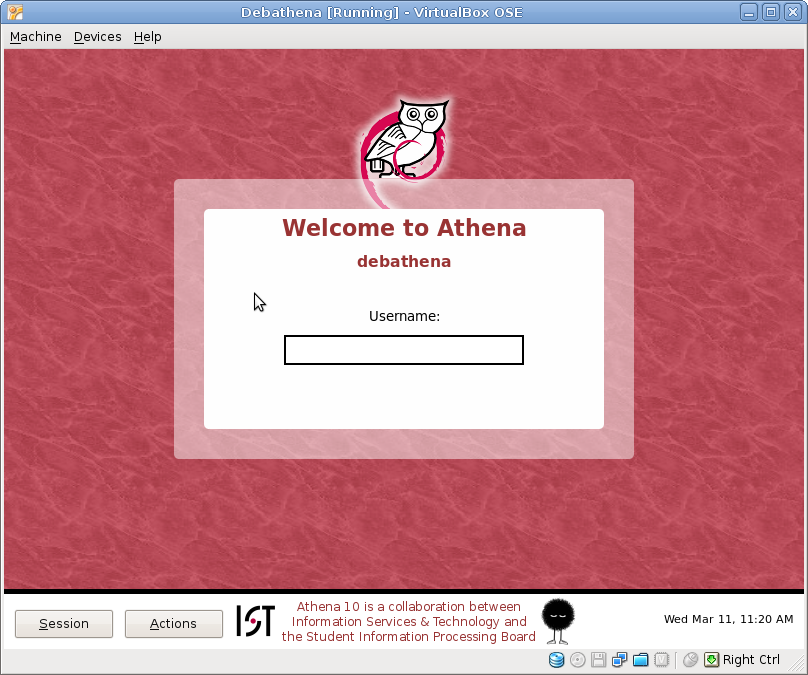
Debathena Beta was rolled out to something along the lines of 10% of formerly RHEL-based computing cluster machines about a month ago. I talked about the plans for this some time ago, and it's exciting to see it actually occurring on vaguely the intended schedule. Now I can tool on campus on Debian (well, almost), and thanks to a generous application of magic**, I can even install any package in Ubuntu's universe repository on cluster machines if I need it (the machine will be restored to a good state on session logout). Rock on.

** I hear it involves schroot and LVM snapshots, but at any rate it appears to be approximately indistinguishable from magic.

Jeff Bailey: Creationism Museum

On our move down to California, Angie, Leif and I stopped by the Creationism Museum. I mentioned this a couple of Augusts ago. Unfortunately, I didn't want to post about it without having the pictures, and I've only just finally got around to uploading them. I suck, news at 11.

http://picasaweb.google.com/kaladron/CreationismMuseum

We went with Stephanie, and had a great time. We got there a bit late, so didn't get to see the floor show and stuff, but we did get a chance to see the exhibits. The people there were a little reminiscent of the TV show Circle Square, where the people were just a little too friendly, and blinked just a little too rarely.

How we heard about the creationism museum was from an Interview on CBC, where the guy who opened the museum talked about how they were trying to show a different interpretation of the results of archaelogical digs, and how they saw this as a religion, and that science is just another religion. We were a bit shocked when we got to the US to discover that the guy is somewhat less rational there, claiming that what they're doing is good pure science, etc.

The premise is an interesting one: They start with the literal truth of the bible and then interpret everything against that backdrop. The argument is a vaguely reasonable one: Scientists do this all the time using what they've learned in school. They've learned that the universe is billions of years old, and therefore will do carbon dating a certain way, etc. If you start with the bible saying that the universe is 6000-odd years old, then results wind up getting interpreted differently.

The key to most of how the world wound up the way it is is apparently tied up in two major events: First, the story with the apple (Sorry I'm a little light on details, I didn't grow up Christian) caused people to start eating meat and wearing clothes.

Aside of the moment, my in-laws have a great fridge magnet from restoringeden.org: "God's original plan was to hang out in a garden with some naked vegetarians"

The second big event was the great flood, which killed all the dinosaurs, caused turbulence, moved continents around, and some other stuff.

Amusingly enough, when looking for a link to the CBC review, I found a review of a complaint about the interview: http://www.cbc.ca/ombudsman/ombudsmanweb/39.htm

Anyhow, had a great time. Enjoy the photos. =)

Next.

Previous.