Search Results: "pa"

12 March 2015

Hideki Yamane: localized directory name is harmful

Summary: xdg user directory spec is broken, I want to fix it.

One of annoyed things in Linux Desktop environment is localized user's directory (e.g. $HOME/ , instead of $HOME/Download). I know it is handled by XDG, my ~/.config/user-dirs.dirs has setting as below (by default).

XDG_DESKTOP_DIR="$HOME/ "
XDG_DOWNLOAD_DIR="$HOME/ "
XDG_TEMPLATES_DIR="$HOME/ "
XDG_PUBLICSHARE_DIR="$HOME/ "
XDG_DOCUMENTS_DIR="$HOME/ "
XDG_MUSIC_DIR="$HOME/ "
XDG_PICTURES_DIR="$HOME/ "
XDG_VIDEOS_DIR="$HOME/ "

So XDG utlility program changes it as setting, moves ~/Desktop to ~/ . However, it is NOT what users want.

Because if you would play with shell, you should also input localized characters in your terminal. Imagine, sometimes I download files with browser, then use it in terminal - download some tar.xz file and extract it. Well, it is downloaded in ~/ directory... it's not convinient - you cannot use tab completion without IME (input method editor), e.g. Anthy or Mozc for Japanese. And if you don't want to install it, what do you do? Use mouse to copy&paste?

Then, some Japanese people create webpages about "How to change localized user directory back to English name" ;)

Windows and OS X has localized Desktop, Download, Document directory, too. But it's not directory itself. In Windows, you can see " " (Desktop) with Windows Explorer but it is seen as just "Desktop" directory with cmd.exe (I don't know how to trick it. Maybe Windows registory magic). And in OS X, same thing with Finder. Those users don't annoy with localized directory name, it's friendly and convinient for cmd/shell users, and also for GUI (Windows' Explorer/OS X's Finder) users.


And also, it seems that localized directory name is good for average users who use File manager (Nautilus, etc). Just labeled with only English is not friendly to non-English native users like my mother ;) (Yes, localization is important!) But it's _better_ for *everyone* to set directory name with English _and_ localized with hardlink (and probably not harm anyone).

So lazyweb, could you tell me where should I go to talk this issue with upstream? It's not big thing, but still annoying. I can change it with xdg-user-dirs-update for my environment but it's just a workaround, not solution for this problem.

Gergely Nagy: Lost in a maze, looking for cheese

ApologyAs a twisted turn of fate, I need to start my platform with an apology. Last year, I withdrew my nomination, because my life turned upside down, and the effects of that are still felt today, and will continue to have a considerable footprint for the rest of my life. But this is not what I want to apologise for! I want to apologise because my nomination, my platform, and my plans are rather uncommon - or so I believe. Unlike past Project Leaders, if elected, I will not have as much time to travel, as some of them. Nor will I have the resources to do all the things one may expect from a Project Leader. But - as you'll read later - I consider this both the biggest weakness and the greatest strength of my platform.Furthermore, I will not be available from the second half of the voting period until after the new Project Leader's term starts: I'll be getting married, and will enjoy a nice honeymoon, and as such, my email will remain unread from the 9th of April until we're back on the 21st of April.On the mouse behind the keyboardMy name is Gergely Nagy, or algernon, for those of you who may know me by my online presence. I used to be a lot of things: a flaming youth, an application manager, package maintainer, upstream, ftp-assistant, a student, a mentor, a hacker. In the end, however, I am but a simple, albeit sometimes crazy person. I imagine, a lot of people reading this will not know me, and that is actually not only fine, but in my case, desirable.The Role of the Project LeaderThe role of the Project Leader, what people perceive about the role, and what is actually done by one single person changed dramatically over time. In some ways for the better, some ways for the worse. It should be sufficiently clear by now that if we combine all the things past Project Leaders have done, and what people expect the Project Leader to do, then not even all the time in the world would be enough to accomplish everything. On the other hand, we should not cut the responsibilities back to constitution-granted ones only.There has been some discussion about this very topic on debian-project@, back in February, with excellent observations by both past Project Leaders and the current one. I encourage my dear readers to stop reading this platform now, and read at least Lucas's mail. I'll be right here when you get back.Back? Good.You may notice that unlike in previous years, I do not have a Grand Vision, not in the same sense at least. No matter what I envision, however noble that vision may be, it is not the Project Leader's job to save the world, so to say. While I still believe that we have serious problems with motivation, inspiration and innovation within the project, the Project Leader is the wrong person to try and solve these issues with.Apart from the constitutionally required responsibilities, the primary purpose of the Project Leader in my opinion, is to be an enabler: the Project Leader is not a front runner to lead the herd to victory, but a gentle shepherd to make them happy.HappyThere are many ways to make people happy. One such way is to enable them to pursue their passion - and not just enable them, but encourage and fuel that passion, too! -, to remove barriers, to empower them, or in a lot of cases, to include them in the first place. My vision is a project that is greater than just an amazing distribution. More than a role model for technical excellence. I want to do away with territorial pissings (with which I don't mean to imply that this would be the general atmosphere within the project - far from it!), and would rather see a warm, welcoming culture within the project - the kind of "I'm home!" feeling I had at the DebConfs I had the privilege to attend -, on public and private media alike.That is the vision I have, but I can't do it. At best, I can hope to enable people much better at the these things to do what needs to be done. I wish to take the burden of administration, bureaucracy off their shoulders, so they can focus on what they do best. I feel that this is the most important part of being a Project Leader: to enable the project to grow. And this is why I feel that most of you not knowing my name is an advantage here: When you look at a beautiful flower, you admire the flower itself, rarely the gardener.In the endI wish to be the Project Leader no one remembers. I'd rather see people remember all the great things the Project - as a whole - accomplished, for there are many. My purpose is to let You pursue your passion, which in turn enables even more people to pursue their happiness, and allows the greater Free Software community to bask in the warm glow of accomplished dreams.

Matthew Garrett: Vendors continue to break things

Getting on for seven years ago, I wrote an article on why the Linux kernel responds "False" to _OSI("Linux"). This week I discovered that vendors were making use of another behavioural difference between Linux and Windows to change the behaviour of their firmware and breaking things in the process.

The ACPI spec defines the _REV object as evaluating "to the revision of the ACPI Specification that the specified \_OS implements as a DWORD. Larger values are newer revisions of the ACPI specification", ie you reference _REV and you get back the version of the spec that the OS implements. Linux returns 5 for this, because Linux (broadly) implements ACPI 5.0, and Windows returns 2 because fuck you that's why[1].

(An aside: To be fair, Windows maybe has kind of an argument here because the spec explicitly says "The revision of the ACPI Specification that the specified \_OS implements" and all modern versions of Windows still claim to be Windows NT in \_OS and eh you can kind of make an argument that NT in the form of 2000 implemented ACPI 2.0 so handwave)

This would all be fine except firmware vendors appear to earnestly believe that they should ensure that their platforms work correctly with RHEL 5 even though there aren't any drivers for anything in their hardware and so are looking for ways to identify that they're on Linux so they can just randomly break various bits of functionality. I've now found two systems (an HP and a Dell) that check the value of _REV. The HP checks whether it's 3 or 5 and, if so, behaves like an old version of Windows and reports fewer backlight values and so on. The Dell checks whether it's 5 and, if so, leaves the sound hardware in a strange partially configured state.

And so, as a result, I've posted this patch which sets _REV to 2 on X86 systems because every single more subtle alternative leaves things in a state where vendors can just find another way to break things.

[1] Verified by hacking qemu's DSDT to make _REV calls at various points and dump the output to the debug console - I haven't found a single scenario where modern Windows returns something other than "2"

comment count unavailable comments

Bits from Debian: Debian Project Leader elections 2015

It's that time of year again for the Debian Project: the elections of its Project Leader! Starting on April 1st, and during the following two weeks, the Debian Developers will vote to choose the person who will guide the project for one year. The results will be published on April 15th and the term for new the project leader will start on April 17th, 2015. Lucas Nussbaum who has held the office for the last two years won't be seeking reelection this year and Debian Developers will have to choose between three candidates: Gergely Nagy and Neil McGovern previously ran for DPL in past years; it's the first run for Mehdi Dogguy. The campaigning period started today and will last until March 31st. The candidates are expected to engage in debates and discussions on the debian-vote mailing list where they'll reply to questions from users and contributors.

11 March 2015

Joey Hess: 7drl 2015 day 5 type directed spell system development

I want my 7drl game Scroll to have lots of interesting spells. So, as I'm designing its spell system, I've been looking at the types, and considering the whole universe of possible spells that fit within the constraints of the types. My first throught was that a spell would be a function from World -> World. That allows any kind of spell that manipulates the game map. Like, for instance a "whiteout" that projects a stream of whitespace from the player's mouth. Since Scroll has a state monad, I quickly generalized that; making spell actions a state monad M (), which lets spells reuse other monadic actions, and affect the whole game state, including the player. Now I could write a spell like "teleport", or "grow". But it quickly became apparent this was too limiting: While spells could change the World map, the player, and even change the list of supported spells, they had no way to prompting for input. I tried a few types of the Event -> M () variety, but they were all too limiting. Finally, I settled on this type for spell actions: M NextStep -> M NextStep. And then I spent 3 hours exploring the universe of spells that type allows! To understand them, it helps to see what a NextStep is:
type Step = Event -> M NextStep
data NextStep = NextStep View (Maybe Step)
Since NextStep is a continuation, spells take the original continuation, and can not only modify the game state, but can return an altered continuation. Such as one that prompts for input before performing the spell, and then calls the original continuation to get on with the game. That let me write "new", a most interesting spell, that lets the player add a new way to cast an existing spell. Spells are cast using ingredients, and so this prompts for a new ingredient to cast a spell. (I hope that "new farming" will be one mode of play to possibly win Scroll.) And, it lets me write spells that fail in game-ending ways. (Ie, "genocide @"). A spell can cause the game to end by returning a continuation that has Nothing as its next step. Even better, I could write spells that return a continuation that contains a forked background task, using the 66 line contiuation based threading system I built in day 3. This allows writing lots of fun spells that have an effect that lasts for a while. Things like letting the player quickly digest letters they eat, or slow down the speed of events. And then I thought of "dream". This spell stores the input continuation and game state, and returns a modified continuation that lets the game continue until it ends, and then restores from the point it saved. So, the player dreams they're playing, and wakes back up where they cast the spell. A wild spell, which can have different variants, like precognitive dreams where the same random numbers are used as will be used upon awaking, or dreams where knowledge carries back over to the real world in different ways. (Supports Inception too..) Look how easy it was to implement dreaming, in this game that didn't have any notion of "save" or "restore"!
runDream :: M NextStep -> M NextStep -> (S -> S) -> M NextStep
runDream sleepcont wakecont wakeupstate = go =<< sleepcont
   where
         go (NextStep v ms) = return $ NextStep v $ Just $
        maybe wake (go <=<) ms
         wake _evt = do
                 modify wakeupstate
                 wakecont
I imagine that, if I were not using Haskell, I'd have just made the spell be an action, that can do IO in arbitrary ways. Such a spell system can of course do everything I described above and more. But, I think that using a general IO action is so broad that it hides the interesting possibilities like "dream". By starting with a limited type for spells, and exploring toward more featureful types, I was able to think about the range of possibilities of spells that each type allowed, be inspired with interesting ideas, and implement them quickly. Just what I need when writing a roguelike in just 7 days!
Fun comment thread on reddit

Richard Hartmann: 100g for deleting

On the assumption that the post titled "Delete file when you have more than 100g for deleting" on the "Linux.com - Content Feed" is not an elaborate joke, it's not unlikely that it will be deleted so I will conserve it here: Hello Linix community members, Today I would like to share a simple script for deleting files when you have more than 100g for deleting and when you try to delete using rm -rm /path/fo/files failed. To do this I use the following procedure; first I use a "for" ciclo to read file that I going to delete also you can use a mtime for calculate file's date that you're going to delete or you can to calculate previous date of a past day "x=TZ=GMT+24 date +%Y%m%d" Ex;
#!/bin/bash -x
x= TZ=GMT+24 date +%Y%m%d 
delcnt=0
for files in  find /path/of/file/to/eraser/ -name \*$x*.bin.gz 
do
echo "Deleting file $files"
/bin/rm -rf $files
delcnt=$(($delcnt + 1))
done

Best regards Charles E. Rivera Solaris Server Specialist Engeeneer But then, Linux.com still aggregates Phoronix, so their focus is not exactly on quality.

Tiago Bortoletto Vaz: Freeing myself from flickr

A flickr standard account gives you a free as in facebook service (I really wanted to reuse it!!!). I don't know about the pro account, but I don't believe it will give you much respect. Anyway, I realized that my photo albums in flickr are still online. And I'm currently unable to access my photos locally. I needed to download all them, then I decided to give flickrbackup a try. I started coding it a few years ago because at that time there was no free tools available for that. And then I abandoned it, too bad I feel. But for my surprise it worked without issues! And that's all I needed in my Debian box:
$ apt-get install flickrbackup $ mkdir myflickr $ flickrbackup -o myflickr/
(this will open a default browser for authentication and will automatically get the API key, then I just need an ENTER to start getting all my albums) I'm not sure whether there're other free tools (as in freedom) for that, but before paying for a license or trusting an online service for downloading your sets please give flickrbackup a chance :) I'll probably set a piwigo instance in a vps. But I fear php. So, suggestions on web galleries are very welcome.

10 March 2015

Joey Hess: 7drl 2015 day 4 coding through exhaustion

Slow start today; I was pretty exhausted after yesterday and last night's work. Somehow though, I got past the burn and made major progress today. All the complex movement of both the player and the scroll is finished now, and all that remains is to write interesting spells, and a system for learning spells, and to balance out the game difficulty.
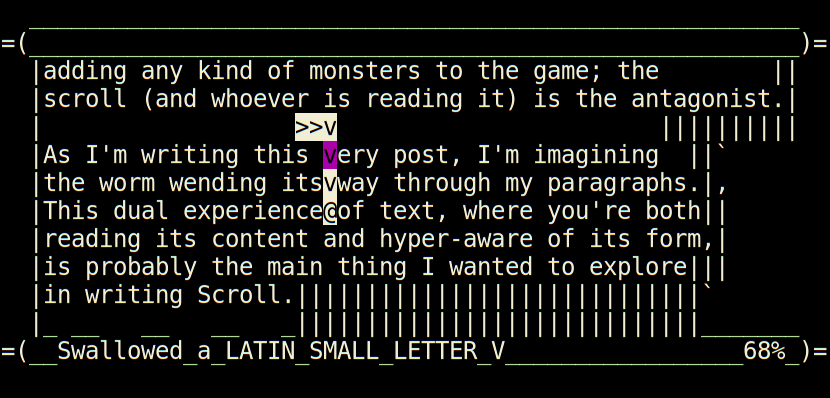
I haven't quite said what Scroll is about yet, let's fix that: In Scroll, you're a bookworm that's stuck on a scroll. You have to dodge between words and use spells to make your way down the page as the scroll is read. Go too slow and you'll get wound up in the scroll and crushed. The character is multiple chars in size (size is the worm's only stat), and the worm interacts with the scroll in lots of ways, like swallowing letters, or diving through a hole to the other side of the scroll. While it can swallow some letters, if it gets too full, it can't move forward anymore, so letters are mostly consumed to be used as spell components. I think that I will manage to get away without adding any kind of monsters to the game; the scroll (and whoever is reading it) is the antagonist. As I'm writing this very post, I'm imagining the worm wending its way through my paragraphs. This dual experience of text, where you're both reading its content and hyper-aware of its form, is probably the main thing I wanted to explore in writing Scroll. As to the text that fills the scroll, it's broadly procedurally generated, in what I hope are unusual and repeatedly surprising (and amusing) ways. I'm not showing any screenshots of the real text, because I don't want to give that surprise away. But, the other thing about Scroll is that it's scroll, a completely usable (if rather difficult..) Unix pager!

9 March 2015

Joey Hess: 7drl 2015 day 3 movement at last

Got the player moving in the map! And, got the map to be deadly in its own special way.
        HeadCrush -> do
                showMessage "You die."
                endThread
Even winning the game is implemented. The game has a beginning, a middle, and an end. I left the player movement mostly unconstrained, today, while I was working on things to do with the end of the game, since that makes it easier to play through and test them. Tomorrow, I will turn on fully constrained movement (an easy change), implement inventory (which is very connected to movement constraints in Scroll), and hope to start on the spell system too.
At this point, Scroll is 622 lines of code, including content. Of which, I notice, fully 119 are types and type classes. Only 4 days left! Eep! I'm very glad that scroll's central antagonist is already written. I don't plan to add other creatures, which will save some time.
Last night as I was drifting off to sleep, it came to me a way to implement my own threading system for my roguelike. Since time in a roguelike happens in discrete ticks, as the player takes each action, normal OS threads are not suitable. And in my case, I'm doing everything in pure code anyway and certianly cannot fork off a thread for some background job. But, since I'm using continuation passing style, I can just write my own fork, that takes two continuations and combines them, causing both to be run on each tick, and recursing to handle combining the resulting continuations. It was really quite simple to implement. Typechecked on the first try even!
fork :: M NextStep -> M NextStep -> M NextStep
fork job rest = do
        jn <- job
        rn <- rest
        runthread jn rn
  where
        runthread (NextStep _ (Just contjob)) (NextStep v (Just contr)) =
                return $ NextStep v $ Just $ \i -> do
                        jn <- contjob i
                        rn <- contr i
                        runthread jn rn
        runthread (NextStep _ Nothing) (NextStep v (Just contr)) =
                return $ NextStep v (Just contr)
        runthread _ (NextStep v Nothing) =
                return $ NextStep v Nothing
endThread :: M NextStep
endThread = nextStep Nothing
background :: M NextStep -> M NextStep
background job = fork job continue
demo :: M NextStep
demo = do
    showMessage "foo"
    background $ next $ const $
        clearMessage >> endThread
That has some warts, but it's good enough for my purposes, and pretty awesome for a threading system in 66 LOC.

Ulrike Uhlig: Final report from the Outreach Program round 9

Between december 9th 2014 and march 9th 2015 I ve been working as an intern for Debian on Improving AppArmor support in Debian. Progress Before the internship started, I had no clue about AppArmor at all. Reading the Wikipedia page and the AppArmor wiki did barely enlighten me. At least, until I got my hands dirty and installed and activated it. I was able to do this only because there was already some basic documentation on the Debian wiki on how to get AppArmor running on a Debian system. When the internship started I felt a little bit lost. I started to read the documentation and to play around with some AppArmor profiles. But the error messages I saw and the profiles I opened for reading overwhelmed me. What did all these lines mean? Then one mentor briefed me about the current status of AppArmor in Debian. I took many notes and tried to bring some order into the information I was being given. These notes became the first page of the documentation and my first blog post.
Surprise: suddenly I was in the middle of knowing what we were talking about and how the next few weeks would look like. To start with, I have set up a test environment and continued to test some of the profiles which came with the packages I had installed, namely apparmor-profiles-extra which provided me with a profile for Pidgin. I was very much interested in securing this several thousand lines long C-code application on my machine! As a Pidgin user, I noticed immediately that one of my favourite features pidgin blinklight threw an error in the logs. I tried to fix it on my test VM and eventually made it work. Now knowing that such fixes should first be done upstream, i cloned the corresponding upstream repository and sent my first patch. It was not easy at first to switch to another VCS than Git, although I had been using Bazaar and Subversion years ago. Shortly afterwards, I saw my patch showing up on the upstream mailing list, and some days later it got merged. That was a huge encouragement. I was now able to write more documentation on how to contribute upstream. In order to organize the documentation, we ve set up some User Stories. I did not know about this tool before and had quite a hard time to grasp all the details but it proved to be very useful as some pages started to become long and confusing. Writing the documentation took up a lot of time, but before being able to write anything down, I needed to work everything out! This way I incidentally learned how to interact with many parts of Debian s infrastructure: While playing around with the tools provided to inspect AppArmor status on the system, I even accidentally found a little bug in one of the upstream tools. It got fixed very quickly after I mentioned it on the AppArmor team s mailing list. Organization Although I was uncomfortable with this in the beginning, we organized public meetings every two weeks on IRC. These meetings were also attended by MeetBot who took care of taking notes and leaving a trace of our discussions.
Based on the meetings, I maintained a progress page and todo list on the Debian wiki, which helped us to know which tasks were planned for the next two weeks. Before each meeting I sent a status update to the mailing list, so the mentors could catch up with my work. During the meetings I was not only asked to provide feedback on progress but also on mentoring itself. It proved to be very useful to be able to say where I was stuck and if the mentoring process worked out well enough (it did!).
Furthermore, I got regular, detailed and pedantic (thanks for trying to push me to perfection!) feedback on the team s mailing list. The mentors had introduced me on the upstream IRC channel in the beginning, so most of the people who are active there knew about my existence, something which also proved to be handy! Future The internship time is over, but some work remains to be done. As a new member of the AppArmor Packaging team, I am committed to make it happen: Thanks I feel much more confident after these three months, technically but also personally. Thank you: Holger Levsen and intrigeri for mentoring and encouraging me on this journey and to upstream contributors Christian Boltz, Steve Beattie (and everybody else I might forget here) for providing help and feedback. The Debian community (OPW organizers, sponsors, Alioth maintainers, planet.debian.org maintainers although my posts don t show up anymore :( -and others) has been very friendly and welcoming and I am very happy to be part of it.

Axel Beckert: Do we need a zsh-static package in Debian?

Dear Planet Debian, the Debian Zsh Packaging Team (consisting of Michael Prokop, Frank Terbeck, Richard Hartmann and myself) wonders if there s still a reason to build and ship a zsh-static package in Debian. There are multiple reasons: So we ask you, the Planet Debian reader:

Do you need Debian s zsh-static package? If so, please send an e-mail to us Debian Zsh Maintainers <pkg-zsh-devel@lists.alioth.debian.org> and state that you use zsh-static, and, if you want, please also state why or how you re using it. Thanks in advance! Mika, Frank, RichiH and Axel

Petter Reinholdtsen: Frikanalen, Norwegian TV channel for technical topics

The Norwegian Unix User Group, where I am a member, and where people interested in free software, open standards and UNIX like operating systems like Linux and the BSDs come together, record our monthly technical presentations on video. The purpose is to document the talks and spread them to a wider audience. For this, the the Norwegian nationwide open channel Frikanalen is a useful venue. Since a few days ago, when I figured out the REST API to program the channel time schedule, the channel has been filled with NUUG talks, related recordings and some Creative Commons licensed TED talks (from archive.org). I fill all "leftover bits" on the channel with content from NUUG, which at the moment is almost 17 of 24 hours every day. The list of NUUG videos uploaded so far include things like a one hour talk by John Perry Barlow when he visited Oslo, a presentation of Haiku, the BeOS re-implementation, the history of FiksGataMi, the Norwegian version of FixMyStreet, the good old Warriors of the net video and many others. We have a large backlog of NUUG talks not yet uploaded to Frikanalen, and plan to upload every useful bit to the channel to spread the word there. I also hope to find useful recordings from the Chaos Computer Club and Debian conferences and spread them on the channel as well. But this require locating the videos and their meta information (title, description, license, etc), and preparing the recordings for broadcast, and I have not yet had the spare time to focus on this. Perhaps you want to help. Please join us on IRC, #nuug on irc.freenode.net if you want to help make this happen. But as I said, already the channel is already almost exclusively filled with technical topics, and if you want to learn something new today, check out the Ogg Theora web stream or use one of the other ways to get access to the channel. Unfortunately the Ogg Theora recoding for distribution still do not properly sync the video and sound. It is generated by recoding a internal MPEG transport stream with MPEG4 coded video (ie H.264) to Ogg Theora / Vorbis, and we have not been able to find a way that produces acceptable quality. Help needed, please get in touch if you know how to fix it using free software.

Stefano Zacchiroli: interview for The Setup

my setup, take #2 Look Ma, I've been interviewed by The Setup, a popular blog with "interviews asking people from all walks of life what they use to get the job done"; so I now sport a fancy http://stefano.zacchiroli.usesthis.com too. While there is overlap with my previous take on my setup, the questions are different so most of the content is novel. In particular, I quite enjoyed the question about what would be my "dream setup", and indulged in free software/hardware desiderata. Many thanks to Daniel Bogan for running the blog and kudos for his editing work: while it's just a detail, such an abundance and quality of link titles is not easy to come by on the Web.

NOKUBI Takatsugu: Travatar, an OpenSource statistical machine translation system

Graham Neubig published Travater , an OpenSource statistical machine translation system and the demosite (http://ahclab.naist.jp/travatar/translator/). Graham said It makes good result likely Google Translation. Unfortunately, it seems to be crwoded, so I can t get correct result (output IO Error dialog). Anyway, it is a good new for Japanese processing scene.

8 March 2015

Joey Hess: 7drl 2015 day 2 level generation and game concept

Much as I want to get my @ displayed and moving around screen, last night and today have focused on level generation instead. Scroll has kinda strange level generation method, compared to how I suppose most roguelikes do it. There are only 3 calls to rand in all of Scroll. Just a 3 random parameters, but that's enough to ensure a different level each time.
-- Random level generation function.
level :: Bool -> StdGen -> [String]
level randomize r = concat
        [ final (length tutorial + extra) $ concat $ rand mariner1body
        , concat $ rand mariner1end
        , concatMap rand kubla
        ]
  where
    -- here be spoilers
You could say there are two influences in Scroll's level generation method: Nick Montfort and Samuel Taylor Coleridge.
I have thought some about Scroll before starting the 7drl week, but my idea for the game was missing some key concepts. There was nothing to keep the player engaged in moving forward, an unclear victory condition, no clue how to generate appropriate random levels, a large potential for getting stuck, and no way to lose the game. This is all a problem for a roguelike. But, I had an idea finally last night, about a single unified thing that all of that stuff falls out from. And it's right there in the name of the game! Now that I understand Scroll better, I wrote the tutorial level. It's a very meta tutorial level that sets the scene well and serves more purposes than are at first apparent. I count a total of 6 things that this "tutorial level" will let the user do. And interestingly, while the tutorial level is static, it interacts with the rest of the game in a way that will make it be experienced differently every time through.
The strangest line of code I wrote today is:
import GPL
Somehow, I have never before, in all my time programming, written a line like that one.
Finally, after 7 hours of nonstop coding, I got ncurses to display the generated game world, scrolling around in the display viewport. No @ yet; that will need to wait for tonight or tomorrow!

Carl Chenet: Verify your backups or lose them all

Follow me on Identi.ca or Twitter or Diaspora*diaspora-banner As a good sysadmin, you thought you had backups for your server but you didn t verify them before the major migration you attempted? When you need them, they re empty or full of useless files. And now it s too late
nobackup

Wen you discover that you don t have usable backups lesjoiesdusysadmin.fr

You won t guess how often this situation occurs. Backup Checker is a command line software developed in Python 3.4 on GitHub (stars appreciated :) ) allowing users to verify the integrity of archives (tar, gz, bz2, lzma, zip, tree of files) and the state of the files inside an archive in order to find corruptions or intentional of accidental changes of states or removal of files inside an archive. github-logo Install Backup Checker from PyPI The easiest way to install Backup Checker is from PyPi using the following command:
$ pip3.4 install backupchecker
Debian Wheezy and Squeeze packages for Backup Checker Backup Checker Debian packages are now available for your stable servers Wheezy and Squeeze in the MyTux Debian repositories. Debian Squeeze Just copy/paste the following command on your server to add the MyTux Debian Squeeze repository and install Backup Checker:
apt-key adv --keyserver pgp.mit.edu --recv-keys 2B24481A \
&& echo "deb http://debian.mytux.fr squeeze main" > /etc/apt/sources.list.d/mytux.list \
&& apt-get update \
&& apt-get install backupchecker
debian-squeeze-toy Debian Wheezy Just copy/paste the following command on your server to add the MyTux Debian Wheezy repository and install Backup Checker:
apt-key adv --keyserver pgp.mit.edu --recv-keys 2B24481A \
 && echo "deb http://debian.mytux.fr wheezy main" > /etc/apt/sources.list.d/mytux.list \
 && apt-get update \
 && apt-get install backupchecker
wheezy Using Backup Checker 2 steps are needed to secure your backups. First you need to generate the configuration files of your backups, using the following command: $ backupchecker -G /backups/backup-08032015.tar.gz This generates 2 files /backups/backup-08032015.conf and /backups/backup-08032015.list you need to store in order to verify this archive later (the -O option lets you define a custom location to store the files). Second step is to verify your backup. It is as simple as: $ backupchecker -c /etc/backupchecker/backup-08032015.conf -l /var/log/backupchecker.log Then check if warnings have been sent to /var/log/backupchecker.log. Really simple isn t it? Scripting this command, your backups are now verified and secured. If any modification occurs, it will be detected and pinpointed. What do you thing about it? As usual, any feedback is welcome, through bug reports, emails of the author or comments on this blog. Several companies now use Backup Checker to secure their backups. Let us know if we can help you.

Gregor Herrmann: RC bugs 2015/07-10

finally, some simple RC bugs appeared, & I could contribute a bit towards the jessie release:

Jaldhar Vyas: No 7DRL for Me This Year

It's time once again for the Seven Day Roguelike Challenge but I've decided to try and force some discipline on myself and not participate until I actually complete one of my earlier entries into a properly playable game. I did have some fun thinking of names though. You may use them in your own entry free of charge.

Hideki Yamane: community booth @ "developers summit 2015" in Tokyo (19th&20th Feb)

I'm back to Developers Summit at (Meguro Gajoen), Tokyo. I was an attendee 2 years ago, and I'm at community booth this year :)

We were at booth "Debian JP Project" (Japanese local Debian community) and other distro people (Ubuntu Japanese Team, openSUSE, VineLinux)


Its conference mostly focuses "development style" in companies, not FLOSS -Keyword: Agile (Scrum), DevOps, using cloud infrastructure, IoT, etc. So, we're a bit stranger but enjoyed chat with some people.

Next.

Previous.