Search Results: "will"

20 February 2011

Evgeni Golov: Desktop in a shell

People are using computers, everywhere, really! ;)
As you might guess correctly, so do I.Basically, I am using three computers: my laptop (ThinkPad X201s, awesome machine, but pabs told me not to post any more adverts for ThinkPads on Planet Debian *g*), my smartphone (Motorola Milestone, yes, that counts as a computer) and random_pc (for random as in my girlfriends or some other trusted (!!!) friends computer).
My laptop is running Debian GNU/Linux unstable with Xfce4.6, my smartphone is running Android 2.2.1 Froyo, my girlfriend has Ubuntu with GNOME, a friend runs Debian unstable with GNOME, another one Arch Linux with KDE4 and so on. And on all these machines I want be able to work, which means I have to read mail and rss, chat via IRC, JabberXMPP and ICQ, have a look at my to-do list, ssh into different machines, write some code, tweet and dent etc.In the following series of posts I will describe how I can handle about 90% of my work on every (trusted) computer out there, using ssh, screen, mutt, irssi, BitlBee, newsbeuter etc.As I am describing the setup as a Desktop in a shell , let s start with a login- and desktop/window-manager: ssh+screen.sshObviously, you need a machine to ssh into it, where the Desktop will live on. For me, that s my home router/fileserver/vm-server dorei, running Debian GNU/Linux LennySqueeze with OpenSSH as a kind of login manager ;)Yes, my user is allowed to login with a password instead of a public key. And well, that s all for the login-manager, no extra configuration needed.screenAfter logging in, I start my window-manager with screen -rd, -r for reattach a running screen session, -d for detach it if it is already attached somewhere else. Or I can start a new session by just typing screen. Inside the screen I have multiple windows (one can create new ones with ^A c) with all the needed software running. I can switch windows by pressing ^A N, N being the number of the window, ^A n for the next window, ^A p for the previous one or ^A ^a for the last one. Or I can get a window-list with ^A w. If needed, I can rename windows with ^A A, followed by the new name. That should be enough for almost everyone. Let s just add a window-list to the bottom (as you might have seen on GNOME, Xfce, KDE and even Windows ;) by adding the following to the ~/.screenrc:
caption always " "                    # clear line before hardstatus
hardstatus alwayslastline "% = kb [ % B %H:$USER % b ][ %=% w %?%-Lw%?% b (% W %n*%f %t%?(%u)%?% b )% w %?%+Lw%?%?%= % b ][% B  %l % B % W %d.%0m % b ]"
You get the current host- and username, the machine load and the date for free ;)Even if it is possible, I do not have any autostart like stuff in my .screenrc as the machine is running stable and I start the screen and the apps inside maybe once a year after a reboot.screenrcMy .screenrc looks like this:
# detach on hangup
  autodetach on
# don't display the copyright page
  startup_message off
# set scrollback to 2000 lines, default 100
  defscrollback 2000
# set silencewait to 15 seconds, default 30
  silencewait 15
# new shells should be started as login-shells
  shell -$SHELL
# make a fancy statusline
  caption always " "                    # clear line before hardstatus
  hardstatus alwayslastline "% = kb [ % B %H:$USER % b ][ %=% w %?%-Lw%?% b (% W %n*%f %t%?(%u)%?% b )% w %?%+Lw%?%?%= % b ][% B  %l % B % W %d.%0m % b ]"
# make higlighting bold, black on blue background
  sorendition +b bk
# some fixes, no I do not know where they come from :)
  termcap  xterm hs@:cs=\E[%i%d;%dr:im=\E[4h:ei=\E[4l
  terminfo xterm hs@:cs=\E[%i%p1%d;%p2%dr:im=\E[4h:ei=\E[4l
  termcapinfo  xterm Z0=\E[?3h:Z1=\E[?3l:is=\E[r\E[m\E[2J\E[H\E[?7h\E[?1;4;6l
  termcapinfo xterm* OL=100
  termcapinfo xterm 'VR=\E[?5h:VN=\E[?5l'
  termcapinfo xterm 'k1=\E[11~:k2=\E[12~:k3=\E[13~:k4=\E[14~'
  termcapinfo xterm 'kh=\EOH:kI=\E[2~:kD=\E[3~:kH=\EOF:kP=\E[5~:kN=\E[6~'
  termcapinfo xterm 'hs:ts=\E]2;:fs=\007:ds=\E]2;screen\007'
  termcapinfo xterm 'vi=\E[?25l:ve=\E[34h\E[?25h:vs=\E[34l'
  termcapinfo xterm 'XC=K%,%\E(B,[\304,\\\\\326,]\334, \344, \366, \374,~\337'
  termcapinfo xterm* be
  termcapinfo xterm xterms xs ti@:te=\E[2J
  termcapinfo wy75-42 xo:hs@
  termcapinfo wy* CS=\E[?1h:CE=\E[?1l:vi=\E[?25l:ve=\E[?25h:VR=\E[?5h:VN=\E[?5l:cb=\E[1K:CD=\E[1J
  termcapinfo  hp700 'Z0=\E[?3h:Z1=\E[?3l:hs:ts=\E[62"p\E[0$~\E[2$~\E[1$ :fs=\E[0 \E[61"p:ds=\E[62"p\E[1$~\E[61"p:ic@'
  termcap  vt100* ms:AL=\E[%dL:DL=\E[%dM:UP=\E[%dA:DO=\E[%dB:LE=\E[%dD:RI=\E[%dC
  terminfo vt100* ms:AL=\E[%p1%dL:DL=\E[%p1%dM:UP=\E[%p1%dA:DO=\E[%p1%dB:LE=\E[%p1%dD:RI=\E[%p1%dC
  termcapinfo linux C8
# some bindings
  bind k
  bind ^k
  bind .
  bind ^\
  bind \\
  bind ^h
  bind h
  bind 'w' windowlist -b
  bind 'W' windows
  bind 'K' kill
  bind 'I' login on
  bind 'O' login off
  bind ' ' history
  bind = resize =
  bind + resize +3
  bind - resize -3
# Mutt demands this
# http://wiki.mutt.org/?MuttFaq/Appearance
 defbce on
 term screen-bce
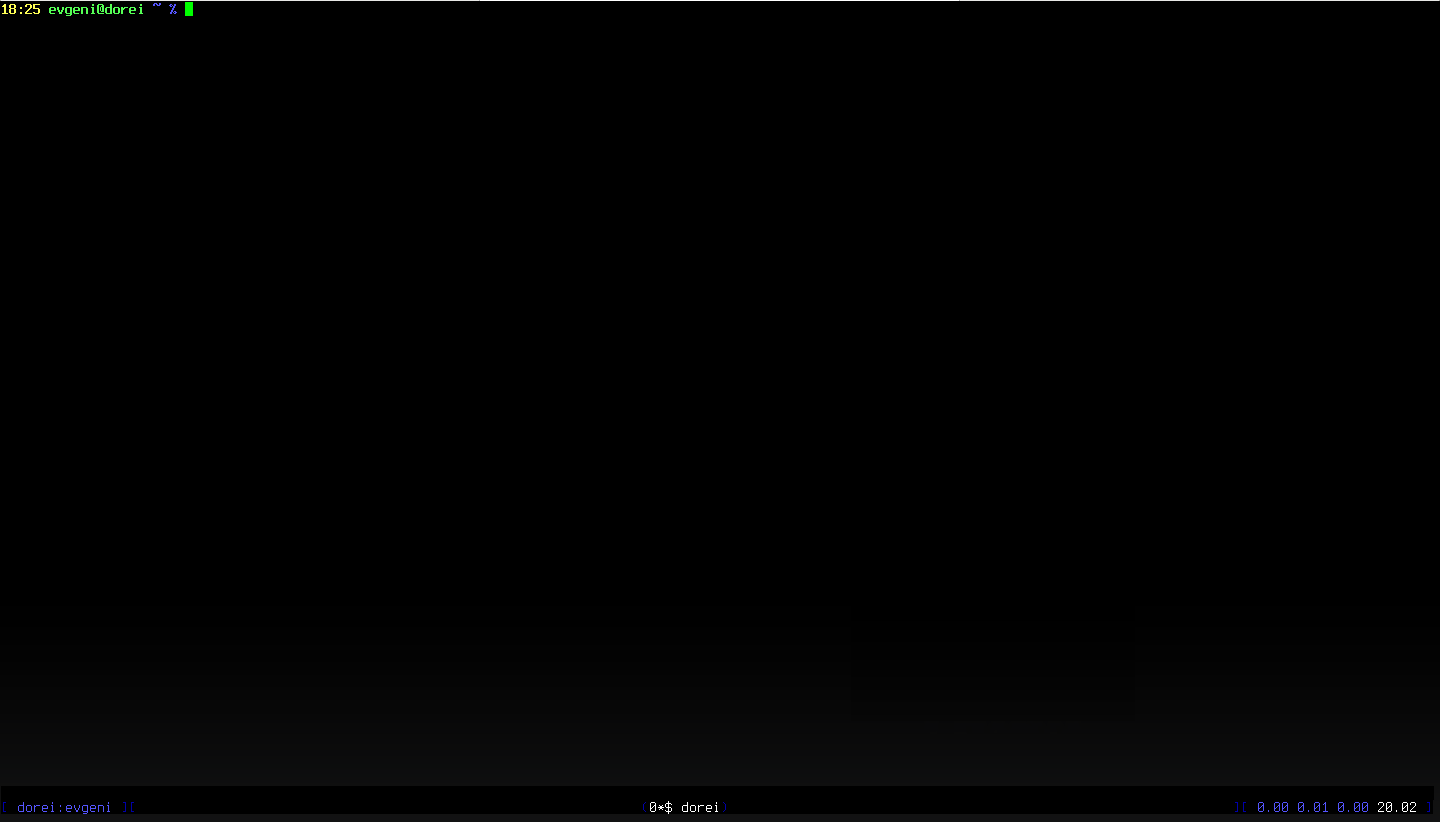
That s all for my screen setup. The obvious, boring screenshot follows:See you next time, when I will present my mutt setup here.

Andreas Metzler: license incompatibilities

GnuTLS has recently made Nettle its prefered crypto backend. I think Debian will need to continue to use libgcrypt for license reasons. While GnuTLS+libgcrypt and its dependencies are LGPL-2.1+ nettle itself is LGPL-2.1+, except for small GPL-2+ parts (serpent and blowfish). But these are being replaced by LGPL-2.1+ implementations currently. However nettle's public key library (libhogweed) uses and links against the GNU Multiple Precision Arithmetic Library which is LGPL-3+. Afaiui this is a deal-breaker, GPL-2 (without the "any later version" clause) and (L)GPL-3 are incompatible. A nontrivial number of GnuTLS using applications and libraries are licensed (L)GPL-2. I started checking but stopped at "j" after finding cherokee-1.0.20, cluster-glue-1.0.7, cups-1.4.6, drizzle-2010.09.180, echoping-6.0.2, elinks-0.12~pre5, gtk-vnc-0.4.2, inspircd-1.1.22+dfsg and jd-2.8.1~beta110214.

19 February 2011

Thorsten Glaser: Where in the world is Carmen Sanbuggo?

Eh. Why does mksh built with (a patched: mkstemp(3) added) klibc work suddenly, unexpectedly? To reproduce, I just uploaded mksh_39.3.20110218-1.dsc and you can run DEB_BUILD_OPTIONS=mksh-static=klibc,dietlibc,eglibc dpkg-buildpackage -rfakeroot to verify it, once you have mkstemp(3). (I will probably send a smaller implementation of that in, later.) I have that and the open fix and the m68k patch applied, nothing else where did my bug go? ObQuestion: what s the legal (copyright/trademark) status of the Atari logo (the one in rainbow colours, with three things going up, right and left leg looking like an umbrella stand s)?

Kees Cook: ptracing siblings

In Ubuntu, the use of ptrace is restricted. The default allowed relationship between the debugger and the debuggee is that parents are allowed to ptrace their descendants. This means that running gdb /some/program and strace /some/program Just Works. Using gdb s attach and strace s -p options need CAP_SYS_PTRACE, care of sudo. The next most common use-case was that of crash handlers needing to do a live ptrace of a crashing program (in the rare case of Apport being insufficient). For example, KDE applications have a segfault handler that calls out to kdeinit and requests that the crash handling process be started on it, and then sits in a loop waiting to be attached to. While kdeinit is the parent of both the crashing program (debuggee) and the crash handling program (debugger), the debugger cannot attach to the debugee since they are siblings, not parent/descendant. To solve this, a prctl() call was added so that the debugee could declare who s descendants were going to attach to it. KDE patched their segfault handler to make the prctl() and everything Just Works again. Breakpad, the crash handler for Firefox and Chromium, was updated to do effectively the same thing, though they had to add code to pass the process id back to the debuggee since they didn t have it handy like KDE. Another use-case was Wine, where for emulation to work correctly, they needed to allow all Wine processes to ptrace each other to correctly emulate Windows. For this, they just declared that all descendants of the wine-server could debug a given Wine process, there-by confining their ptrace festival to just Wine programs. One of the remaining use-cases is that of a debugging IDE that doesn t directly use ptrace itself. For example, qtcreator will launch a program and then later attach to it by launching gdb and using the attach command. This looks a lot like the crash handler use-case, except that the debuggee doesn t have any idea that it is running under an IDE. A simple solution for this is to have the IDE run its programs with the LD_PRELOAD environment variable aimed at a short library that just calls prctl() with the parent process id, and suddenly the IDE and its descendants (i.e. gdb) can debug the program all day long. I ve got an example of this preloadable library written. If it turns out this is generally useful for IDEs, I could package it up like fakeroot and faketime.

18 February 2011

Gustavo Noronha Silva: A clutter port of WebKit

In case you missed the news on webkit-dev, Collabora has been working on developing a clutter port of WebKit. It shares the build system with EFL, and most of the backend code comes from the GTK+ port. That means networking is handled by soup, drawing by cairo, multimedia by GStreamer, and so on. If you d like to give it a try, you can clone the repository from gitorious: $ git clone git://gitorious.org/webkit-clutter/webkit-clutter.git Then to build it you use cmake. From inside the source code directory do this: $ mkdir build
$ cd build
$ cmake .. -DPORT=Clutter -DSHARED_CORE=1 -DBUILD_MX_LIB=1
$ make
The BUILD_MX_LIB option is optional it will build what we call the Mx toolkit library in addition to the vanilla one. Then you can test that the library is built and working by running the programs inside the Programs directory. Enjoy!

Russell Coker: Sony Ericsson Xperia X10i First Experience

I have just got a new Xperia X10i for my wife. It s with Virgin who use the Optus network. Optus apparently have better coverage than Three (who we have been using for 6.5 years) and Virgin offers the best deals they have good phones on low monthly rates and do nice things like selling most phones unlocked (the Xperia is one that comes unlocked).I chose the phone for use in system administration work. A large screen should be good for reading email and running a ssh client. Hopefully I will be able to use the phone s Wifi to provide mobile net access to a laptop for any problem that can t be solved on a tiny screen. My wife doesn t do much sysadmin work nowadays, but it ll save some effort if we can both use the same model of phone. Also according to Amobil.no the Xperia X10 is the second best phone for camera-phone functionality [1], and my wife would really like to take some good pictures with her phone (she loves the LG U990 Viewty that she has right now).ScreenOne major reason for choosing this phone is that it has the biggest and highest resolution of any phone that doesn t cost a huge amount of money. It does well in this regard, the screen is very good to look at. However it is apparently not particularly sensitive and we still have the protective cover on the screen which makes the swipe to unlock operation quite difficult. My wife generally likes to keep the protective plastic on such screens for a while to prevent damage, but she may take this off sooner than on other devices.Sony FoolishnessOne reason that this phone is cheaper than any other phone with similar specs is that it s made by Sony. Sony won t provide updates to Android 2.2 or better and they have their own stupid applications installed in an intrusive manner. The main screen of the phone has a large icon for the Sony Timescape program. If you choose a background image of a person s face then the Timescape logo is in the ideal location to obscure the person s eyes. Generally it s not desired to have the person in your phone background look like Zorro. Fortunately you can delete icons from the home screen, you just have to press and hold the icon until a trash-can appears at the bottom of the screen and then drag it to the trash.Phone BookThe core phone functionality is fairly important for a mobile phone. But it seems that every modern phone has some serious failings in this regard. The Xperia comes with a phone book that is reasonably good for managing contacts and partially coalesces multiple entries with the same name which is convenient as I somehow managed to import 3 copies of each entry in my wife s phone book. The down-side is that the multiple entries are still stored, so when it comes time to update someone s phone number my wife will have to separate the entries and then delete all but one of them, adding probably a minute of effort for each one. With 60 phone book entries that s probably an hour of wasted time during the course of her phone use.They really should do a time based analysis of phone use and optimise the UI for efficiently performing common tasks. I think that an ideal design would start off by asking the user to rate the importance of phone functionality, camera, facebook, twitter, etc and then give a UI that matches the important tasks. A device that has 384M of RAM, 1G of built-in Flash storage, and an 8G micro-SD card (which Virgin provided with the phone) should be able to offer a selection of UIs.CameraThe configuration for the camera allows some settings to be changed easily and others have to be changed through the advanced settings which requires one more button press and a few extra taps on the screen. One real stupidity is to have the phone light be in the advanced settings, so if the room happens to be a little darker than expected you suddenly need to go to a lot of extra effort to turn on the light.Finally it would be really good to be able to take a quick picture. I would like to be able to be able to press a combination of buttons and have it immediately take a picture regardless of what had been running before. Not press the main menu button, the camera icon (which I made a link from the home screen), wait a second for it to load, and then press the shutter button. Ideally I would like to press a combination of hardware buttons to have it immediately take a picture even when the screen is locked. I don t want to wait for the screen unlock process, sometimes the perfect shot is only available for a second.WifiIt doesn t support ad-hoc networks. This is really annoying for me as I don t own an access point and I don t plan to buy one just for a phone. My laptop (Thinkpad T61 with Intel Corporation PRO/Wireless 3945ABG [Golan]) doesn t seem to support running as an access point, and my EeePC 701 with an Atheros AR5001 has the same problem, here is the error message:# iwconfig wlan0 mode master essid x
Error for wireless request Set Mode (8B06) :
SET failed on device wlan0 ; Invalid argument.I have a cheap Realtec USB Wifi device that claims to support being an access point but just fails when I try it. So presumably it doesn t really support it but the driver is buggy.It seems that I may need to put a custom Android installation on it to get ad-hoc working.Also it s apparently necessary to root the Xperia to get Wifi tethering to work for providing net access to a laptop. So I guess I ll hacking it soon.Internet AccessThe Virgin web site couldn t help me set up the Internet access because I ported a phone number from another Telco. I had to use the phone number supplied by Virgin to login to their web site and the site then wanted to sent (probably SMS) the settings to my phone, but of course it couldn t SMS to that number as I ve got the Three number active. Presumably they were expecting that customers would setup Internet access before porting their old number.I phoned the Virgin tech support and used the settings they suggested, but it didn t work. Then I took the phone to a Virgin store and it started working after they rebooted it with no changes to settings. Just like Windows used to be. :(Email Access Default AppThe email setup defaults to port 143 IMAP access, so even when a mail server provides access on port 993 for IMAPS and on port 995 for POP3S probably most users will not use any encryption because their phone doesn t default to it. Also one annoying feature is that when I gave it the email address test@coker.com.au it decided to use test as the user-name for IMAP by default. It seems that a very large portion of the active email accounts nowadays are on systems that handle multiple domains and thus require the domain name in authentication, and a large portion of the remainder accept domain names even when they aren t required. Besides it s a lot easier to delete a domain name when it s not needed than to type it in when it is.The default hostname for sending and receiving mail is the domain name, if the MUA configuration program had checked the MX record it would have known that smtp.sws.net.au is a better default choice for the mail server. I ve now started the practice of creating a CNAME entry named m in every domain I run, so when someone is setting up a mobile phone they just have to add m. to the start of the default hostname to use for sending and receiving mail. By doing this I can probably save an average user at least 30 seconds of typing, which is particularly important if I happen to be talking them through the process!The MUA uses IMAP commands to load the text of the message without attachments and then loads attachments on demand, this will be handy for when people attach unreasonably large files. With IMAP caching and partial loads the core functionality seems OK, and some quick tests of standard but not commonly used IMAP functions such as noticing that mail has been deleted by another client seemed to work well. The performance of loading a new mailbox with 369 message was quite poor, I m not sure how much of this is due to the network connection and how much is due to the client implementation. This is a real concern for me as I typically have about 7,000 messages in my IMAP account and 3,000 unread messages most of which are in two folders.Another problem is the fact that there seems to be no way of searching in the list of messages, sorting/grouping by subject or sender, or showing unread messages. This makes the Xperia unsuitable for the task of reading mailing lists when on public transport. I would really like to be able to sort through a folder of mailing-list mail, delete messages that I don t need to keep and flag ones that need attention when I have the resources of a desktop system when I m on a tram or in other situations where a laptop can be inconvenient.One undeniable bug I discovered (as opposed to the missing features I listed) is that when a message has a line with a URL followed by many spaces it won t load correctly in the web browser, the spaces will be treated as part of the URL. I ve changed the default signature in my email to have a description followed by a URL to avoid triggering this bug. Presumably other Android phones are bug for bug compatible. :(Moxier MailThere is a complete set of email and calendaring applications preloaded from Moxier.com. The Moxier mail client uses company.com as an example domain name (they should use example.com does no-one read the RFCs?). It s nice that they verify the SSL certificate and display the details when it s not signed.Unfortunately Moxier doesn t support anything other than Exchange, and I can t delete it either as it s part of the base set of applications from Sony.SMSThe SMS application is supposedly conversation based. This doesn t seem like a benefit to me, it s a pity that there is no option to make it act more like every other SMS implementation I ve used over the last 12 years.BatteryThe battery is described as having a capacity of 1500mAh, for comparison a AA rechargeable batteries have capacities ranging from 1800mAh to 2800mAh. My first mobile phone had a rechargeable battery that took the same space as 4*AA batteries and the phone was designed to run on AA batteries if the main battery wasn t charged. I would like to have an Android phone that had a battery pack of similar size to at least 2*AA batteries, and 4*AA would be OK too.The Xperia battery was reported as being half discharged after playing with the phone for less than an hour. Basically when doing anything with the phone that is remotely intensive I need to have it plugged in. Unless of course I m using one of the star-chart applications LightsThere are two white leds in the gaps between the keys for Settings, Main-Menu, and Back on the front. They are quite bright and annoying to look into at night.SSHSSH was one of the reasons for getting an Android phone, but it was one of the last things I worked on because everything else was so much fun. I m currently using ConnectBot, it supports storing ssh host keys, generating a key-pair from random screen touches, locking and unlocking the key-pair (with a pass-phrase) and pasting the public key to an open window. All the basic functions just work although it s rather inconvenient to enter the CTRL keys.The next thing to investigate is a small and light Bluetooth keyboard. Using an external hardware keyboard will save me from the pain of entering CTRL keys (which is even worse than the pain of entering passwords that contain digits and mixed case). It will also allow me to type a lot faster and use the entire screen for the ssh session.Current Bug SummaryWifi doesn t do ad-hoc mode or tethering.MUA doesn t correctly handle URLs in messages if many spaces follow the URL and is also unsuitable for mailing list mail.Sometimes requires a reboot to make Internet access settings take affect.Camera light can t be easily turned on and off.This isn t too bad.ConclusionMost things do what I want. Once I get a MUA working with all my email, Wifi doing what I want, and a Bluetooth keyboard it ll be a fairly ideal mobile sysadmin terminal. I ll probably order one for myself this weekend.

Vincent Sanders: Shedding

For some time now Melodie has wanted more outside storage.

The current outhouse is an 3 foot by 8 foot converted outside toilet. Due to its age (built 1884) this building is no longer watertight and is generally disintegrating at an alarming rate. One day soon it will have to be demolished. That day has not yet arrived, instead we purchased a plastic shed.

Unfortunately the only viable place for the new shed was next to the old one, this required removing a six foot section of flower bed complete with ivy, bamboo and an old sink.

Last Saturday I completed this removal and lay a concrete base ready to take the new shed. You would not think such a small area (2.8m square) would require so much material and effort to concrete over. 300Kg of 3:2:1 aggregate:sand:cement concrete mix went into the hole along with 100Kg of instant set concrete (for a rapid surface in the changable weather).

Thursday afternoon Geoff (my nice helpful neighbour) offered to assist me in the assembly of the shed. I re-arranged my work schedule (yay home working) and after three hours the shed was assembled.

This morning it occurred to me that my webcam had recorded a time-lapse movie of the construction. I uploaded it to YouTube and present it here for your amusement.

<iframe allowfullscreen="" frameborder="0" height="240" src="http://www.youtube.com/embed/brTXLO2R5D0?rel=0" title="YouTube video player" width="320"></iframe>

17 February 2011

David Paleino: Getting network devices with Python and udev

UPDATE I wrote a new article based on Ben Hutching's response. Just a quick post, mainly as a reminder for when I'll try to implement this in WICD:
#!/usr/bin/python
import gudev
client = gudev.Client(['rfkill', 'net'])
for dev in client.query_by_subsystem('net'):
    if dev.get_sysfs_attr_as_int("type") != 1:
        continue
    driver = dev.get_driver()
    if not driver:
        parent = dev.get_parent()
        if parent:
            driver = parent.get_driver()
    print type, dev.get_name(), driver, dev.get_sysfs_path()
This will print all network devices with ethernet-encapsulated packets (that's what sysfs type "1" is). Here's the output on my system:
eth0 e1000e /sys/devices/pci0000:00/0000:00:19.0/net/eth0
wlan0 b43 /sys/devices/pci0000:00/0000:00:1c.1/0000:10:00.0/ssb0:0/net/wlan0
I'm still missing how to reliably detect if a device is a "wired" or a "wireless" one. I suspect that checking the existence of /phy80211 would be enough, but I can't really tell, and seems like I'm not able to find an exhaustive sysfs reference manual.

Rapha&#235;l Hertzog: People behind Debian: Maximilian Attems, member of the kernel team

Maximilian, along with the other members of the Debian kernel team, has the overwhelming job of maintaining the Linux kernel in Debian. It s one of the largest package and certainly one where dealing with bug reports is really difficult as most of them are hardware-specific, and thus difficult to reproduce. He s very enthusiastic and energetic, and does not fear criticizing when something doesn t please him. You ll see. My questions are in bold, the rest is by Maximilian. Who are you? My name is Maximilian Attems. I am a theoretical physicist in my last year of PhD at the Technical University of Vienna. My main research area is the early phase of a Quark-Gluon Plasma as produced in heavy ion collisions at the LHC at CERN. I am developing simulations that take weeks on the Vienna Scientific Cluster (in the TOP 500 list). The rest of the lab is much less fancy and boils down to straight intel boxes without any binary blobs or external drivers (although lately we add radeon graphics for decent free 3D). Mathematica and Maple are the rare exceptions to the many dev tools of Debian (LaTeX, editors, git, IDE s, Open MPI, ..) found at the institute, as those are unfortunately yet unmatched in Free Software for symbolic computations. The lab mostly runs a combination of Debian stable (testing starting from freeze) for desktops and oldstable/stable for servers. Debian is in use for more than 10 years. So people in the institute know some ups and downs of the project. Newcomers like my room neighbors are always surprised how functional a free Debian Desktop is. :) What s your biggest achievement within Debian? Building lots and lots of kernels together with an growing uptake of the officially released linux images. I joined the Debian kernel team shortly after Herbert Xu departed. I had been upstream Maintainer of the linux-2.6 janitor project for almost a year brewing hundreds of small cleanups with quilt in a tree named kjt for early linux-2.6. In Debian we had lots of fun in sorting out the troubles that the long 2.5 freeze had imposed: Meaning we were sitting on a huge diverging monolithic semi-good patchset. It was great fun to prepare 2.6.8 for Sarge with a huge team enthusiastic in shipping something real close to mainline (You have to imagine that back then you had no stable or longterm release nor any useful free tools like git. This involved passing patches around, hand editing them and seeing what the result does.) From the Sarge install reports a common pattern emerged that the current Debian early userspace was causing lots of boot failures. This motivated me to develop an alternative using the new upstream initramfs features. So I got involved in early userspace. Thanks to large and active development team initramfs-tools got a nice ecosystem. It still tries to be as generic and flexible as possible and thus gains many nice features. Also H. Peter Anvin (hpa) gave me the official co-maintenance of klibc. klibc saw uptake and good patches from Google in the last 2 years. I am proud that the early userspace is working out fairly well these days, meaning you can shuffle discs around and see your box boot. Later on we focused on 2.6.18 for Etch, which turned out to a be good release and picked up by several other distributions. Only very much later we would see such a sync again. With 2.6.26 for Lenny we got somehow unlucky as we just missed the new longterm release by one release. We also pushed for another update very late (during freeze) in the release cycle, which turned out to semi-work as too much things depend on linux-2.6. For Squeeze 2.6.32 got picked thanks to discussions at Portland Linux Plumbers and it turned out to be a good release picked up by many distributions and external patchsets. The long-term support is going very well. Greg KH is doing a great job in collecting various needed fixes for it. Somehow we had hoped that the Squeeze freeze would start sooner and that the freeze duration would be shorter, since we were ready for a release starting from the actual freeze on. The only real big bastard on the cool 2.6.32 sync is Red Hat. Red Hat Enterprise 6.0 is shipping the linux-2.6 2.6.32 in obfuscated form. They released their linux-2.6 as one big tarball clashing with the spirit of the GPL. One can only mildly guess from the changelog which patches get applied. This is in sharp contrast to any previous Red Hat release and has not yet generated the sharp and snide comments in press it deserves. Red Hat should really step back and not make such stupid management moves. Next to them even the semi-maintained Oracle Unbreakable 2.6.32 branch looks better: It is git fetchable. What are your plans and those of the kernel team for Debian Wheezy? Since 2.6.32 many of the used patches landed upstream or are on the way (speakup, Kbuild Debian specific targets, ..). The proper vfs based unionfs is something we d be looking forward. We haven t yet picked the next upstream release we will base Wheezy on, so currently we can happily jump to the most recent ones. There are plans for better interaction with Debian Installer thanks to generating our udebs properly in linux-2.6 source itself. Also we are looking forward to using git as tool of maintenance. We d hope that this will also allow for even better cross distribution collaboration. Concerning early userspace I plan to release an initramfs-tools with more generic userspace for the default case and finally also a klibc only for embedded or tuning cases. What do you like most in Debian? For one thing I do like the 2 year release cycle. It is not too long to have completely outdated software and on the other hand it gives enough time to really see huge progress from release to release. Also at my institute the software is is recent enough without too much admin overhead. For servers the three years support are a bit short, but on the manageable side. I do enjoy a lot the testing distribution. For my personal use it is very stable and thus I mainly run testing on my desktop and work boxes. (Occasionally mixing in things from sid for unbreaking transition or newer security fixes). Debian is independent and not a commercial entity. I think this is its main force and even more important these days. I enjoy using the Debian platform a lot at work thus in return this motivates me to contribute to Debian itself. I also like the fact that we strive for technical correctness. Is there some recurrent problem that hinders the progress of Debian? The New Maintainer process is a strange way to discourage people to contribute to Debian. It is particularly bureaucratic and a huge waste of time both for the applicant and his manager. It should be completely thrown overboard. One needs a more scalable approach for trust and credibility that also enhances the technical knowledge for coding and packaging of the applicant. NM is currently set in stone as any outside critics is automatically rejected. Young and energetic people are crucial for Debian and the long-term viability of the project, this is the reason why I d consider the New Maintainer process as Debian s biggest problem. Note from Rapha l Hertzog: I must say I do not share this point of view on the New Maintainer process, I have witnessed lots of improvements lately thanks to the addition of the Debian Maintainer status, and to the fact that a good history of contribution can easily subsume the annoying Tasks & Skills questionnaire. Another thing I miss is professional graphics input both for the desktop theme and the website. I know that effort has been done there lately and it is good to see movement there, but the end result is still lacking. Another trouble of Debian is its marketing capabilities. It should learn to better sell itself. It is the distribution users want to run and use not the rebranded copies of itself with lock-in sugar . Debian is about choice and it offers plenty of it: it is a great default Desktop. Linus Torvalds doesn t find Debian (and/or Ubuntu) a good platform to hack on the kernel. Do you know why and what can we do about this? The Fedora linux-2.6 receives contributions from several Red Hat employed upstream sub-Maintainers. Thus it typically carries huge patches which are not yet upstream. As a consequence eventual userland troubles get revealed quite quickly and are often seen there first. The cutting edge nature of Fedora rawhide is appealing for many developers. The usual Debian package division of library development files and the library itself is traditionally an entry barrier for dev on Debian. Debian got pretty easily usable these days, although we could and should again improve a lot more in this sector. Personally I think that Linus hasn t tried Debian for years. I have the feeling that the implication of the Debian Kernel team in LKML has been on the rise. Is that true and how do you explain this? Ben Hutchings is the Nr.1 contributor for 2.6.33. He also is top listed as author of patches on stable 2.6.32. Debian is not listed as organization as many send their linux-2.6 patches from their corporate or personal email address and thus it won t be attributed to Debian. There is currently no means to see how many patches get forwarded for the stable tree, but I certainly forwarded more then fifty patches. I was very happy when Greg KH personally thanked me in the 2.6.32.12 release. In the Squeeze kernel, the firmwares have been stripped and moved into separate packages in the non-free section. What should a user do to ensure his system keeps working? There is a debconf warning on linux-2.6 installation. It is quite clear that the free linux-2.6 can t depend on the firmware of the non-free archive (also there is no strict dependency there technically). On the terminal you d also see warnings by update-initramfs on the initramfs generation for drivers included in the initramfs. The debconf warning lists the filename(s) of the missing firmware(s). One can then apt-cache search for the firmware package name and install it via the non-free repository. The check runs against the current loaded modules. The match is not 100% accurate for special cases as the one where the device might be handled well by this driver without firmware, but is accurate enough to warrant the warning. The set of virtualization technologies that the official Debian kernel supports seems to change regularly. Which of the currently available options would you recommend to users who want to build on something that will last? KVM has been a smooth ride from day zero. It almost got included instantly upstream. The uptake it has is great as it sees both dev from Intel and AMD. Together with libvirt it s management is easy. Also the performance of virtio is very good. The linux containers are the thing we are looking forward for enhanced chroots in the Wheezy schedule. They are also manageable by libvirt. Xen being the bad outside boy has an incredible shrinking patchset, thus is fair to expect to see it for Wheezy and beyond. For many it may come a bit late, but for old hardware without relevant CPU it is there. Many tend to overstate the importance of the virtualization tech. I d be much more looking forward to the better Desktop support in newer linux-2.6. The Desktop is important for linux and something that is in heavy use. The much better graphics support of the radeon and nouveau drivers: The performance optimizations thanks to dcache scalability work and the neat automatic task-grouping for the CPU scheduler are very promising features for the usability of the linux desktop. Another nice to have feature is the online defrag of ext4 and its faster mkfs. Even cooler would be better scalability in ext4 (This side seems to have seen not enough effort lately). Is there someone in Debian that you admire for their contributions? Hans Peter Anvin and Ted Tso are a huge source of deep linux-2.6 knowledge and personal wisdom. I do enjoy all sorts of interactions with them. Christoph Hellwig with Matthew Wilcox and also William Irwin for setting up the Debian kernel Team. Several Debian leaders including the previous and the current one for their engagement, which very often happens behind the scene. The Debian Gnome Team work is great, also the interactions have always been always easy and a pleasure. Martin Michlmayr and previously Thiemo Seufer do an incredible job in porting Debian on funny and interesting ARM and MIPS boxes. Debian has a lot of upcoming potential on this area. I m looking forward to other young enthusiastic people in that area. Colin Watson is bridging Debian and Ubuntu, which is an immense task. Michael Prokop bases on Debian an excellent recovery boot CD: http://www.grml.org. I d be happy if any Debian Developer would work as carefully coding and working.
Thank you to Maximilian for the time spent answering my questions. I hope you enjoyed reading his answers as I did. Subscribe to my newsletter to get my monthly summary of the Debian/Ubuntu news and to not miss further interviews. You can also follow along on Identi.ca, Twitter and Facebook.

One comment Liked this article? Click here. My blog is Flattr-enabled.

16 February 2011

Lucas Nussbaum: Introducing the Debian packaging tutorial

One of the common complains about Debian packaging is that it s hard to learn because, while there is quite a lot of high-quality documentation, it is often written more as a reference manual than as a tutorial: it s great if you already know everything and want to check some detail, but not so great if you want to learn everything from scratch. I have been volunteered (i.e, someone decided I volunteered) for a Debian packaging tutorial at work, so I decided to give a try at tackling this issue. I also volunteered (voluntarily this time) for a similar talk at RMLL 2011 to make sure I would be forced to do the work and prepare the actual tutorial. I m also considering teaching this next year in Licence Pro ASRALL, but I haven t made up my mind about it yet. The result is a work in progress (hey, I still have a lot of time), but in the release-early-release-often tradition, I m making it public now in the hope that someone will pick up the idea and do all the work for me (you never know). I ve decided to create a set of slides using Latex Beamer. The current version can be found here. The sources are available in a git repository, and all contributions are welcomed (including plain comments or suggestions). The last slide is the current TODO list.

David Welton: Rails Application Templates

Thanks to some friends on twitter, I recently discovered RailsWizard which is a very handy way of generating new Rails applications with the "right" things included. I liked what it did a lot, so I took the generated file and saved it as a github gist: https://gist.github.com/829521
Which provides me with a very handy starting place for new Rails projects. This is a great way to get some of the housekeeping out of the way before we start: ensure we're using jQuery, add some gems that I always use like exception_notifier and will_paginate, and so on.

Steve Kemp: Upgrading from Lenny to Squeeze

Rather than waiting for a few months, as I typically do, I decided to be brave and upgrade my main virtual machine from Lenny to Squeeze. That host runs QPSMTPD, Apache, thttpd, and my blogspam server; nothing too complex or atypical. The upgrade was mostly painless; I was interrupted several times by debconf asking me if I wished to replace configuration files I'd modified, but otherwise there were only two significant messages in the process:
crm114
crm114 warned me that its spam database and/or configuration files had changed and would most likely result in brokenness, post-upgrade, and I should do something to stop avoiding lost mail. Happily this was expected.
sysv-rc
It transpired I had a couple of local init scripts which didn't have dependency information succesfully encoded into them; so I couldn't migrate to dependency-based bootup. Given that this server gets a reboot maybe once every six months that wasn't really worth telling me about; but nevermind. No harm done.
That aside there were no major surprises; all services seemed to start normally and my use of locally-compiled backports meant that custom services largely upgraded in a clean fashion. The only exception was my patched copy of mutt which was replaced unexpectedly. That meant my lovely mutt-sidebar was horribly full of mailboxes, rather than showing only new messages. I created a hasty backported mutt package for Squeeze and made it available. (This patch a) enables the side-bar, and b) allows you to toggle between the display of all mailboxes and those with only new mail in them. It is buggy if you're using IMAP; but works for me. I would not choose to live without it.) Now that I've had a quick scan over the machine the only other significant change was an upgrade of the mercurial revision control system, the updated templates broke my custom look & feel and also required some Apache mod_rewrite updates to allow simple clones via HTTP. (e.g. "hg clone http://asql.repository.steve.org.uk/"). So in conclusion: ObQuote - "Hmm, upgrades " - The Matrix Reloaded (shudder).

David Welton: The UnderPerformingStocks.com sale - halfway in

A few weeks ago, I had an "out-there" idea to try creating and selling a site at the same time. So far, it's not exactly raking in a major amount of cash: www.underperformingstocks.com is For Sale on Flippa! At $100 with a couple of bids, it doesn't look like I'll be able to retire on it! That said, I haven't spent a great deal of time on it, and part of the idea of the experiment was to limit the amount of time the 'new idea' would distract me from other things. I did hope to receive a few more "audience requests" in terms of what to build on Flippa.com, though. Hopefully, things will heat up a bit during the final two weeks of the auction, but I don't think "flipping" web sites is really a business I want to be in. It's been fun to see how much you can build with how little, though, what with all the widgets and API's out there these days. Since I'm a coder at heart, I also released some Ruby code that utlizes Google's stock screener API: https://github.com/davidw/google-screener - it's under the Apache license, and is kind of neat to play around with, I think, and is what I use to fetch information for the site.

Gintautas Miliauskas: Interviewing with Google

I somehow made it through Google's phone interviews in one piece, and now they are flying me in for an on-site interview in Munich (Germany), which will take place tomorrow. Keep your fingers crossed for me!

I will be landing in Munich in a few hours, and today I am free to look around the city. Anyone from here up for lunch or a beer?

Gunnar Wolf: Responsible biking: We are not exempt from the traffic rules!

As you know, I very often advocate using the bycicle as the main means of transportation in Mexico City. The city is very apt for biking through it, and contrary to the fears of mostly everybody, the city is neither aggressive nor as dangerous as people say. However, I have seen cyclists which seem to be looking for the best ways to be hit by a car, or to hit a pedestrian. Yesterday, I read this note in La Jornada: The local Environment Secretary calls cyclists to respect vial regulations. Many cyclists assume they are a special case of pedestrians, and zig-zag as they please between the road and the walkway, or just stay in the walkway. That is dangerous, both to pedestrians and to themselves. You might find children, elderly or motion-challenged people on your way. Also, not only will pedestrians only expect other people in the walkway, moving at their pace or slightly more, but cars will also not expect somebody moving at 10-20Km/h. A car driver pulling out of his garage, or crossing a street, will not have enough warning when he sees you, and you are very likely to end up in an accident. Since ~5 years ago, Mexico City is growing a grid of Metrob s and confined troleb s cero emisiones (trolleybus) lanes. Many cyclists use those lanes That is VERY dangerous. Public transport vehicles are large, have a lot of inertia, and will take longer to react to finding you ahead of them. Besides, they can go way faster than a regular bike (~60Km/h for metrob s, ~40Km/h for troleb s), and have to stop every couple of blocks. So, you will be uncomfortable if trailing them, and you will be a liability to ~100 people if you go ahead of them. Besides, it is illegal to drive in the confined lanes if you are not a public, semimassive transport vehicle! Surprisingly many people have argued they prefer riding their bicycles against the traffic I think they prefer staring at Death into its blue, glowing eyes (or into its long, thin whiskers)... By far, most cars that hit a bicycle do so from the side, when crossing a road. And if you arrive at a crossing from the wrong way, the way a driver does not expect you, don't expect the driver to be aware of you. Also, in the much less likely event of a car running into you, would it be better to be hit at 80Km/h (60Km/h of the car plus 20Km/h of your own speed on a full frontal crash), or at 40Km/h (substracting instead of adding)? Yes, some people say that looking at the car will allow you to maneuver How far in advance would you know a car coming from the front will hit you? One second? That's 22 meters at 80Km/h (again, if you realize the 60Km/h car is heading straight to you, at 20Km/h). Too short notice for you to do anything Any maneuver will most likely end in an accident. And the driver would not be so much to blame, as he would not be anticipating you riding against the traffic. Make sure you get seen. By night, always use proper lights (red on the back, white on the front, and reflective material to the sides). Day or night, wear bright, reflective clothes (or over-clothes material). Act in a predictable fashion. Remember you are riding a vehicle and are subject to the same rules any driver is A cyclist is not exempt from driving correctly! Do not jump red lights. Never ride on the walkway. Do your best to enjoy the ride. And ride. Yes, ride, take the streets, enjoy the streets. But don't attempt to drive the traffic out of it The streets belong to us all, and we can all share them. PS I also saw this note in the same paper: Sunday Rides in "Campo Militar N mero Uno". The main military field was open as a park this weekend! I have to make sure it is regularly open I am definitively going there!

15 February 2011

Lars Wirzenius: Experiences with SD

For a few months now I've been using SD for tracking bugs in many of my personal projects. SD is a distributed bug tracker, and I believe such systems to be the future, just like distributed version control has become the obviously correct choice. Distributed bug tracking is still in its infancy, and the tools are still developing. However, SD, at least, is already usable, at least for the small kinds of projects as mine are. I have no idea, at least yet, how it scales up to large projects with many developers. Life with SD is similar to life with a DVCS. You have your bug repository, and you make changes there as find bugs, fix them, and so on. When it is suitable and convenient, you synchronise your repository with others. I mainly sync to my server, so that others can sync from that if they wish. (I don't know if anyone does that.) There are several distributed bug trackers. I chose SD because it seemed the most mature one, but also because it does not tie the bug repository with the source code version control tree. This is quite important, I think. If there's a bug in the project's website, then that does not need to be committed to the project's source code. If I work on a bug in a separate code branch, I would like to make any necessary notes about it in a central bug repository for all the branches on my laptop. This is helpful, for example, if I have to back out of my code changes, because I did something stupid, but want to keep the notes I took in the bug repository. SD is not without its weirdness. The command line syntax is a bit un-Unixy, and it requires setting an environment variable to specify the location of the bug repository. (I wrote a little wrapper script to set it: all my branches for project foo are in ~/foo, and the bug repository is in ~/foo/bugs.) It could perhaps also be faster, but it's not exactly slow, either: it is a joy to be able to just run sd ticket close 123 rather than open a web browser, navigate to the right bug, and click close there. Also, once you have a bunch of projects, each with its own bug repository, it becomes an effort to synchronise each of them. I'm hoping mr will someday support SD, but until then I'm using a little wrapper that syncs my SD repositories to my server. I also have a third wrapper that allows me to run an SD command on each repository, so that I can, for example, easily get a list of all open bugs in all projects, which is helpful for my GTD weekly review.

Dirk Eddelbuettel: Rcpp 0.9.1

A new release 0.9.1 of Rcpp went to CRAN and Debian yesterday. This version contains mostly bug-fixes and rather few enhancements. The changes are mostly 'internal fixes' and not user-facing; they mostly address some issues in memory management which, while not tripping up the unit tests or common usage, caused trouble for advanced Rcpp modules use and repeated memory allocation / deallocation. This bit Doug Bates repeatedly, and he put his head down and debugged the issue. A number of changes fairly deep-down in Rcpp (as well as in R-devel) later, this looks much better and we owe him a hearfelt Thank You! A big Thanks! also goes to Luke Tierney who out some new memory debugging code into R-devel which the --enable-strict-barrier in R 2.13.0 (due in April) will enable. A related fix is also in R 2.12.2 due on the 25th. The NEWS entry is below; more detail is in the ChangeLog file in the package.
0.9.1   2011-02-14
    o   A number of internal changes to the memory allocation / protection of
        temporary objects were made---with a heartfelt "Thank You!" to both
        Doug Bates for very persistent debugging of Rcpp modules code, and to
        Luke Tierney who added additional memory allocation debugging tools
        to R-devel (which will be in R 2.13.0 and may also be in R 2.12.2)
        
    o   Removed another GNU Make-specific variable from src/Makevars in order
        to make the build more portable; this was noticed on FreeBSD
    o   On *BSD, do not try to compute a stack trace but provide file and
        line number (which is the same behaviour as implemented in Windows)
    o   Fixed an int conversion bug reported by Daniel Sabanes Bove on r-devel,
        added unit test as well
    
    o   Added unit tests for complex-typed vectors (thanks to Christian Gunning)
    
    o   Expanded the Rcpp-quickref vignette (with thanks to Christian Gunning)
    o   Additional examples were added to the Rcpp-FAQ vignette
Thanks to CRANberries, there is also a diff to the previous release 0.9.0. As always, even fuller details are on the Rcpp Changelog page and the Rcpp page which also leads to the downloads, the browseable doxygen docs and zip files of doxygen output for the standard formats. A local directory has source and documentation too. Questions, comments etc should go to the rcpp-devel mailing list off the R-Forge page

Michal &#268;iha&#345;: phpMyAdmin translation status

Another week is over and it's time to look again at state of translations for phpMyAdmin 3.4. There was quite a good progress in last week and hope it will continue this way. We now have eight translations at 100%: There are three which were close last week, but are still not at 100%: Was your language not listed? You can help it being better!

Filed under: English Phpmyadmin 0 comments Flattr this!

Gerfried Fuchs: Peter Alexander

I guess it won't be very many people reading this blog to know the name, even though he was without any doubt one of the biggest entertainers. Lots of movies, his own TV show, and an enormous amount of albums made him well known far outside the borders of Austria, his home country. Last saturday he died in the age of 84, yesterday was his funeral. This is a special dedication to him. Peter, you will be missed. Servus.

/music permanent link Comments: 1 Flattr this

Michal &#268;iha&#345;: phpMyAdmin theme survey

About month ago, we've announced contest for new default theme in phpMyAdmin 3.4. The submission period is over and now it's time to decide which theme will be the winning one. You can choose from five themes (all of them are listed on our wiki). Every opinion counts, so please visit our survey and choose the one you like most: http://survey.phpmyadmin.net/index.php?sid=72977 Besides the Original and Darkblue_orange themes, there are following to choose: Toba: Toba theme Graphite: Graphite theme pmahomme: pmahomme theme

Filed under: English Phpmyadmin 0 comments Flattr this!

Next.

Previous.