Search Results: "pa"

14 March 2015

Bits from Debian: apt install dpl-candidate: Gergely Nagy

0. Who are you and what's your history with Debian Project? I'm a little mouse behind a keyboard, going by the nickname "algernon". I used to be a lot of things: a flaming youth, an application manager, package maintainer, upstream, ftp-assistant, a student, a mentor, a hacker. In the end, however, I am but a simple, albeit sometimes crazy person. I did a number of things within Debian - mostly small and marginal things, mind you. With a little break, I've been here for over a decade, and am planning to stay for at least another. 1. What's your most proud moment as Debian Developer? At last year's LinuxTag, I was wandering around a stand where they sold Raspberry Pis (with cases and other accessories). I had a nice chat with one of the staffers there, inquired about the price (including the case, of course), and a few other things. He asked a few things back: what I'll be using it for, and so on. After it turned out that I'm a Debian Developer, and syslog-ng hacker, he went to the back, and emerged a few minutes later with a boxed up Pi, and gave it to me as a gift, for working on Debian. This was an incredibly touching moment, in many, many ways. 2. In your opinion what is the strongest part of Debian Project? That's hard to say, to be honest. There are a good number of things Debian is incredibly strong at, and it would be hard to arbitrarily pick one. Quality, responsibility, safety, predictability are all areas we are very good at. But those are the qualities of the OS. As a project, we are remarkably well organised, given the volunteer & distributed nature of the project. 3. And what is the weakest part of Debian Project? While we can resolve and work with technical issues in a reasonable manner, the project as a whole is rather lacking in all other areas. To grow beyond being the creators of the Universal OS, we, as a project, need to pursue goals beyond the OS. Being part of GSoC and Outreachy are great steps forward. But we still have a lot of internal issues that need to be resolved. Areas such as innovation, team work, where we're in dire need of improvement. 4. How do you intend to resolve the weakest part? As explained in my platform, my primary goal is to remove roadblocks. The DPL can do very little alone, his time and powers are better spent on enabling those who have the required skills and desires, to pursue those. 5. DPL term lasts for one year - what would you challenge during that term and what have you learned from previous DPL's? The most valuable thing I learned from past DPLs is that the expectations are sky-high, yet, a significant portion of what the DPL does is very different than what I imagined in past years. I'd like to challenge the status quo of the DPL being a nearly full-time job. 6. What motivates you to work in Debian and run for DPL? I'm in it for the fame and glory, of course! And because my Tamagotchi told me to. But on a more serious tone, my main motivation to work on Debian is because contributing makes me happy. It satisfies my hunger for doing useful work. Debian is - in my opinion - the perfect platform to give back to the wider Free Software community. Similarly, my motivation to run for DPL is to allow Debian to be a stronger member of that greater

Bits from Debian: apt install dpl-candidate: Neil McGovern

0. Who are you and what's your history with Debian Project? My name's Neil, I've been involved with Debian for over 10 years now. I've held a variety of roles, from the SPI board, writing policy and secure testing team, to being one of the Release Managers for Squeeze and Wheezy. 1. What's your most proud moment as Debian Developer? Probably the release of Squeeze, my first as RM. It was the end of a great effort to get the release out. I particularly remember at the end of DebConf 10 in New York going to the local Disney store and buying every single small squeeze plush toy they had, so I could send a thank you gift to the rest of the release team! Another perhaps was when I first got my Debian kilt. 2. In your opinion what is the strongest part of Debian Project? I think this is our social contract. It guides us, and is what we all agree on. This is our promise to ourselves, to the wider open source community and to our users. 3. And what is the weakest part of Debian Project? At a push, I'd say it's the variety of packages we have in the archive. I'm not sure it's weakness, but it's certainly a challenge. It becomes exponentially harder to ensure that everything integrates well as you add more packages. To have made it do so this far is quite impressive. 4. How do you intend to resolve the weakest part? Well, see the section in my platform on PPAs, and modernising our build and infrastructure system Wouldn't it be great if you could stage a package against all of stable, testing and unstable, and see what fails to build and where, with live build logs on all architectures? 5. DPL term lasts for one year - what would you challenge during that term and what have you learned from previous DPL's? I think my primary role as DPL for 2015 would be to get a great start of development for Stretch. The start of a new release cycle is the exact time to implement wide changes that are potentially disruptive. Every couple of years we seem to relax after the release, rather than get geared up for the next one, and then time passes, and plans slip, and before we know it, the freeze is fast approaching. If we start planning /now/, then we can hopefully enter the freeze with fewer RC bugs, which should be great news for everyone! For the second part, I've talked to a lot of the previous DPLs, and worked with them in one role or another. The main thing I was told was that I shouldn't try and do everything I planned on. It's hard work, and all sorts of things pop up that derail your original plans. 6. What motivates you to work in Debian and run for DPL? The people involved. I've met and worked with some of my greatest friends due to the project. The work, dedication and commitment of those over the years is outstanding. Most of these people are still with us, and unfortunately, a few are not. Whenever I'm feeling disheartened or annoyed, usually due to a giant flame-war then I simply remember that what we're doing is truly remarkable, and the effort that everyone has put in over the years isn't something that should be taken for granted.

Tiago Bortoletto Vaz: MuseScore 2.0 is great, try it!

A bit of context: two years ago I joined an undergraduate program in electroacoustic music composition at the Universit de Montr al. Fortunately the faculty has decided to use mostly free software in the classes. They recently moved from Max/MSP to Pure Data to teach algorithmic composition. OpenMusic has been used for computer assisted composition classes. On acoustics classes, Sonic Visualiser is the recommended tool. For everything related to audio processing and sound synthesis we mainly use Python pyo library and Cecilia, both developed by the professor himself. Other many free softwares are used for building digital musical instruments in the courses: Arduino, SuperCollider, OpenCV, openFrameworks etc. So far I touched two proprietary softwares for my classes. First it was Reaper, a sequencer which has been recently adopted in replacement of Pro Tools in some grades. Reaper has a less unfair distribution model compared to Pro Tools and despite being a closed piece of software it somewhat looks like a community-oriented project, being developed by a small team of free software enthusiasts. Being an amazing, complete and still lightweight DAW I hope it goes free some day in the future (I've read about this possibility somewhere in a forum that I can't find now). Anyway, after some months playing with Reaper I went back to Ardour. Because it's free, not because it's better (Reapper still seems unbeatable here). The other was Finale, an alternative to MuseScore for music notation. I used it for three compositions mainly due to its playback capabilities. As a middle-aged music student I don't have the internal ear enough developed to listen orchestral textures, articulations and other details provided by expensive VST stuff. However, I found editing with Finale a pain in the ass. It's so bugged that I thought I were using a sort of alpha version. Basic editing is much more logical and elegant with MuseScore. After all, these first experiences with Finale didn't convince me that such realistic playbacks are adding any value to my music. I suspect that moving back to soundfonts or even composing with no playback at all will probably force me to exercice more critical/analytical listening whenever I need to understand the effects of a specific instrumental gesture and instrument combinations. So, I'm back to MuseScore. Not only because it's free, but also because it's better (at least for my current needs). MuseScore has allowed me to easily edit music scores in a free operating system, using a small and not so powerful laptop. Unable to donate money to this amazing project I've been happily giving some time to it, by testing new releases, reporting issues, translating to portuguese and making available unofficial Debian packages while the current maintainer prepares the official one, which seems to be coming very soon. If you're a Finale/Sibelius user and don't strictly need that universe of orchestral VSTs samples for your music work, please give MuseScore a try. Have a quick look at its online handbook and in a few minutes you will be able to experience the real pleasure of music scoring using a computer. You can try different soundfonts, including the so nice Sonatina Symphonic Orchestra. Below is a screenshot of MuseScore 2.0, which will be released very soon. You can download the RC version for your system in the MuseScore website.
/images/mscore2.png

MuseScore 2.0

Yves-Alexis Perez: ThinkPad X250

So, I also got myself a new toy. My current ThinkPad is a bit ancient, but still sturdy. It's an X201s from 2010 (brought refurbished), and it's still working pretty fine, but eh, I couldn't resist. The X230 was nice, but didn't have a large resolution screen (1366 768). The X240 brought a full HD (1920 1080) IPS screen, but lost the hardware trackpoint buttons. Finally, the X250 brings back the buttons, still have a nice screen (not qHD or some other trendy resolutions, but still FHD and IPS). And on top of that, it comes with Broadwell, so that means I get smap. It runs mostly fine out of the box on Debian sid, but for full support some tuning is needed. I've setup a page with more information on the laptop, and some images can be found over there.

Dirk Eddelbuettel: littler 0.2.3

max-heap image A new minor release of littler is available now. It adds or extends a number of things: See the littler examples page for more details. Full details for the littler release are provided as usual at the ChangeLog page. The code is available via the GitHub repo, from tarballs off my littler page and the local directory here. A fresh package has gone to the incoming queue at Debian; Michael Rutter will probably have new Ubuntu binaries at CRAN in a few days too. Comments and suggestions are welcome via the mailing list or issue tracker at the GitHub repo.

This post by Dirk Eddelbuettel originated on his Thinking inside the box blog. Please report excessive re-aggregation in third-party for-profit settings.

Dimitri John Ledkov: Intel CPU microcode support in ubuntu-drivers-common

Ubuntu Vivid Vervet 15.04 is on its final approach to release at the end of next month. Here is a highlight of one of the features that I have helped to land.

ubuntu-drivers-common is a framework to detect hardware-dependent components on user's machine and offer to install additional packages to enable better support for such hardware. Typical examples are drivers for the graphics cards. This cycle I have added CPU family detection plugin, which helps to detect cpu family and install appropriate microcode update. E.g. if one is running Intel CPU, intel-microcode package is installed.

Check out:
$ ubuntu-drivers devices
$ ubuntu-drivers list
$ ubuntu-drivers autoinstall

Mathieu Parent: Guest sessions in Debian

We have several computers at home, and we want to allow guests to use one of them to access the Internet. This feature comes out of the box in Ubuntu and is called Guest sessions . My attempt to provide the same on Debian jessie is in a script Some notes:

13 March 2015

Dirk Eddelbuettel: Why Drat? A Guest Post by Steven Pav

Editorial Note: The following post was kindly contributed by Steven Pav.

Why Drat? After playing around with drat for a few days now, my impressions of it are best captured by Dirk's quote:
It just works.

Demo To get some idea of what I mean by this, suppose you are a happy consumer of R packages, but want access to, say, the latest, greatest releases of my distribution package, sadist. You can simply add the following to your .Rprofile file:
drat::add("shabbychef")
After this, you instantly have access to new releases in the github/shabbychef drat store via the package tools you already know and tolerate. You can use
install.package('sadists')
to install the sadists package from the drat store, for example. Similarly, if you issue
update.packages(ask=FALSE)
all the drat stores you have added will be checked for package updates, along with their dependencies which may well come from other repositories including CRAN.

Use cases The most obvious use cases are:
  1. Micro releases. For package authors, this provides a means to get feedback from the early adopters, but also allows one to push small changes and bug fixes without burning through your CRAN karma (if you have any left). My personal drat store tends to be a few minor releases ahead of my CRAN releases.
  2. Local repositories. In my professional life, I write and maintain proprietary packages. Pushing package updates used to involve saving the package .tar.gz to a NAS, then calling something like R CMD INSTALL package_name_0.3.1.9001.tar.gz. This is not something I wanted to ask of my colleagues. With drat, they can instead add the following stanza to .Rprofile: drat:::addRepo('localRepo','file:///mnt/NAS/r/local/drat'), and then rely on update.packages to do the rest.
I suspect that in the future, drat might be (ab)used in the following ways:
  1. Rolling your own vanilla CRAN mirror, though I suspect there are better existing ways to accomplish this.
  2. Patching CRAN. Suppose you found a bug in a package on CRAN (inconceivable!). As it stands now, you email the maintainer, and wait for a fix. Maybe the patch is trivial, but suppose it is never delivered. Now, you can simply make the patch yourself, pick a higher revision number, and stash it in your drat store. The only downside is that eventually the package maintainer might bump their revision number without pushing a fix, and you are stuck in an arms race of version numbers.
  3. Forgoing CRAN altogether. While some package maintainers might find this attractive, I think I would prefer a single huge repository, warts and all, to a landscape of a million microrepos. Perhaps some enterprising group will set up a CRAN-like drat store on github, and accept packages by pull request (whether github CDN can or will support the traffic that CRAN does is another matter), but this seems a bit too futuristic for me now.

My wish list In exchange for writing this blog post, I get to lobby Dirk for some features in drat:
  1. I shudder at the thought of hundreds of tiny drat stores. Perhaps there should be a way to aggregate addRepo commands in some way. This would allow curators to publish their suggested lists of repos.
  2. Drat stores are served in the gh-pages branch of a github repo. I wish there were some way to keep the index.html file in that directory reflect the packages present in the sources. Maybe this could be achieved with some canonical RMarkdown code that most people use.

This post by Dirk Eddelbuettel originated on his Thinking inside the box blog. Please report excessive re-aggregation in third-party for-profit settings.

Joey Hess: 7drl 2015 day 7 scroll success

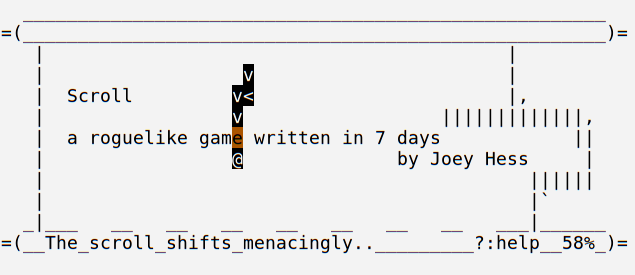
A frantic last day of work on Scroll. Until 3 am last night, I was working on adding a new procedurally generated level. This morning, fixed two major bugs reported by playesters overnight. Also fixed crashes on small screens and got the viewport to scroll. Added a victory animation in time for lunch. After lunch, more level generation work. Wasted an entire hour tracking down a bug in level gen I introduced last night, when I was bad and didn't create a data type to express an idea. Added a third type of generated level, with its own feel. Finished up with a level selection screen, which needed just 47 lines of code and features a playable character. I have six hours until my 7drl is officially over, but I'm done! Success! You can download the code, play, etc, at Scroll's homepage

Richard Hartmann: Release Critical Bug report for Week 11

The UDD bugs interface currently knows about the following release critical bugs: How do we compare to the Squeeze and Wheezy release cycles?
Week Squeeze Wheezy Jessie
43 284 (213+71) 468 (332+136) 319 (240+79)
44 261 (201+60) 408 (265+143) 274 (224+50)
45 261 (205+56) 425 (291+134) 295 (229+66)
46 271 (200+71) 401 (258+143) 427 (313+114)
47 283 (209+74) 366 (221+145) 342 (260+82)
48 256 (177+79) 378 (230+148) 274 (189+85)
49 256 (180+76) 360 (216+155) 226 (147+79)
50 204 (148+56) 339 (195+144) ???
51 178 (124+54) 323 (190+133) 189 (134+55)
52 115 (78+37) 289 (190+99) 147 (112+35)
1 93 (60+33) 287 (171+116) 140 (104+36)
2 82 (46+36) 271 (162+109) 157 (124+33)
3 25 (15+10) 249 (165+84) 172 (128+44)
4 14 (8+6) 244 (176+68) 187 (132+55)
5 2 (0+2) 224 (132+92) 175 (124+51)
6 release! 212 (129+83) 161 (109+52)
7 release+1 194 (128+66) 147 (106+41)
8 release+2 206 (144+62) 147 (96+51)
9 release+3 174 (105+69) 152 (101+51)
10 release+4 120 (72+48) 112 (82+30)
11 release+5 115 (74+41) 97 (68+29)
12 release+6 93 (47+46)
13 release+7 50 (24+26)
14 release+8 51 (32+19)
15 release+9 39 (32+7)
16 release+10 20 (12+8)
17 release+11 24 (19+5)
18 release+12 2 (2+0)
Graphical overview of bug stats thanks to azhag:

Wouter Verhelst: New toy: Fujitsu Lifebook e734

My Lenovo x220, which I've owned for almost four years now (I remember fetching it from the supplier shortly before driving off to Banja Luka), was getting somewhat worn out. The keyboard and the screen had both been replaced at some point already, and the wwan interface had given up as well. The case was all cracked, and the NIC connector wasn't doing very well anymore either; there have been a few cases of me trying to configure the wireless network at a customer, but this being harder than it needs to be because the NIC will only work if I put in the network cable just so, and someone dropped a piece of paper onto the cable. In other words, it was time for a new one. At first I wanted to buy a Lenovo x250, but then I noticed that the Fujitsu came with an i7 4712MQ, which I liked (as today it is still quite exceptional for an ultrabook to have a quadcore processor). Fujitsu also claims up to 9 hours of battery life, but it's not clear to me whether this is supposed to be the case with the default battery only. They also have a battery for the modular bay, which I bought as well (to replace the optical drive whic I sometimes use, but only rarely), and on top of that it came with a free port replicator. Not all is well, however. In the x220, getting the WWAN interface to work involved some creative use of chat against /dev/ttyACM0 wherein I issue a few AT commands to put the WWAN interface into a particular mode, and from then on the WWAN interface is just a regular Ethernet interface on which I can do DHCP. The new laptop has a "Sierra Wireless, Inc." WWAN interface (USB id 1199:9041) which annoyingly doesn't seem to expose the ttyACM (or similar) devices, and I'm not sure what to use instead. Just trying to do DHCP doesn't work -- yes, I tried. Unfortunately, the keyboard isn't very good; it's of the bubble gum type, and I keep getting annoyed at it not picking up my keystrokes all the time. When I'm at home or at my main customer, I have a Das Keyboard Ultimate S (3rd (customer) and 4th (home) generation), so it's only a problem when I'm not at home, but it's still extremely annoying. There is a "backlight" function in that keyboard, but that's not something I think I'll ever use (hint: "das keyboard ultimate s"). The display can't do more than 1366x768, which is completely and utterly wrong for a computer -- but it's the same thing as my x220, so it's not really a regression. The "brightness" ACPI keys don't seem to work. I may have to fiddle with some ACPI settings at some point, I suppose, but it's not a major problem. When I plugged it in, I noticed that fdpowermon ignored the second battery. I had originally written fdpowermon with support for such a second battery, but as my x220 had only one, I never tested it. Apparently there was a bug, but that's been fixed now -- at least in unstable. On the good side of the equation, it has three USB3 ports in the laptop, and four in the port replicator, with no USB2; this is a major leap forwards from the one USB3 and six USB2 in the x220. A positive surprise was the CCID smartcard reader that I somehow missed while reading the specs, but which -- given my current major customer, is very welcome, indeed. Update: After having used it a few days, there were a few minor annoyances:

Lior Kaplan: PHP7 replaces non-free JSON extension

For many the PHP JSON extension license might look like a storm in a teacup, but for many Linux distributions the bits of the free software licenses are very important. That was the case when Debian decided (#692613) to remove the non-free JSON extension as part of the transition to PHP 5.5 in May 2013 (after the Debian 7 release). This change was done with the help of Remi Collet (from Fedora / Red Hat) who wrote an alternative extension based on JSON-C implementation. A similar change was done by other Linux distributions, and this became the defacto standard for most Linux users. The situation has recently changed with the acceptance of the Jakub Zelenka s jsond RFC to replace the current non-free implementation with a free one. The change was committed to the code base on early February (Closing #63520) and expected to be released later this year as part of PHP7.
Filed under: Free software licenses, PHP

Mike Hommey: Announcing git-cinnabar 0.1.1

0.1.1 is a one-bugfix release fixing an issue where git-cinnabar could be confused if commands were started from a subdirectory of the repository. It might be the cause for corruptions leading to issues such as the impossibility to push. If you do encounter failures please report them. Please also paste the output of git cinnabar fsck.

John Goerzen: Suggestions for visiting the UK?

My wife and I have been thinking of visiting the UK for awhile, and we re finally starting to make some plans. I would be grateful to anyone reading this that might have some time to make suggestions on places to go, things to do, etc. Here s a bit of background, if it helps. We have both traveled internationally before; this would actually be the first time either of us has visited another English-speaking country. We are content, and in fact would prefer, to venture outside the most popular touristy areas (though that doesn t mean we d want to miss something awesome just because it s popular.) We will have a little less than a week, most likely. That means staying on one area, or two at the most. Some other tidbits: Finally, we would probably not be able to go until September. Is that a reasonable time? Is part of September maybe less busy but still decent weather? Thanks for any advice!

12 March 2015

Joey Hess: 7drl 2015 day 6 must add more

Last night I put up a telnet server and web interface to play a demo of scroll and send me playtester feedback, and I've gotten that almost solid today. Try it! Today was a scramble to add more features to Scroll and fix bugs. The game still needs some balancing, and generally seems a little too hard, so added a couple more spells, and a powerup feature to make it easier. Added a way to learn new spells. Added a display of spell inventory on 'i'. For that, I had to write a quick windowing system (20 lines of code). Added a system for ill effects from eating particular letters. Interestingly, since such a letter is immediately digested, it doesn't prevent the worm from moving forwards. So, the ill effects can be worth it in some situations. Up to the player to decide. I'm spending a lot of time now looking at letter frequency historgrams to decide which letter to use for a new feature. Since I've several times accidentially used the same letter for two different things (most amusingly, I assigned 'k' to a spell, forgetting it was movement), I refactored all the code to have a single charSet which defines every letter and what it's used for, be that movement, control, spell casting, or ill effects. I'd like to use that to further randomize which letters are used for spell components, out of a set that have around the same frequency. However, I doubt that I'll have time to do that. In the final push tonight/tomorrow, I hope to add an additional kind of level or two, make the curses viewport scroll when necessary instead of crashing, and hopefully work on game balance/playtester feedback. I've written ~2800 lines of code so far this week!

Andrew Cater: Windows 8.1 / Debian 8 dual boot on Lenovo laptop

Just proved this to be feasible on a new SSD. This was done using Windows bootable media and a Jessie netinst. The Debian netinst was copied onto a USB stick.

1. Switch Secure Boot to "off" in BIOS / system settings

2. Set machine to UEFI boot.

3. Install Windows 8.1 to first part of the disk in a custom install. On a 128GB disk, I gave Windows 8.1 30GB.

4. Install Jessie from USB: allow Grub efi to install.

It does work and was a useful demonstration for a friend.

Enrico Zini: crypttab-reuse-passwords

Reuse passwords in /etc/crypttab Today's scenario was a laptop with an SSD and a spinning disk, and the goal was to deploy a Debian system on it so that as many things as possible are encrypted. My preferred option for it is to setup one big LUKS partition in each disk, and put a LVM2 Physical Volume inside each partition. At boot, the two LUKS partition are opened, their contents are assembled into a Volume Group, and I can have everything I want inside. This has advantages: However, by default this causes cryptsetup to ask for the password once for each LUKS partition, even if the passwords are the same. Searching for ways to mitigate this gave me unsatisfactory results, like: The solution that I found was something that did not show up in any of my search results, so I'm documenting it here:
    # <target name> <source device>   <key file>   <options>
    ssd             /dev/sda2         main         luks,initramfs,discard,keyscript=decrypt_keyctl
    spin            /dev/sdb1         main         luks,initramfs,keyscript=decrypt_keyctl
This caches each password for 60 seconds, so that it can be reused to unlock other devices that use it. The documentation can be found at the beginning of /lib/cryptsetup/scripts/decrypt_keyctl, beware of the leopard . main is an arbitrary tag used to specify which devices use the same password. This is also useful to work easily with multiple LUKS-on-LV setups:
    # <target name> <source device>          <key file>  <options>
    home            /dev/mapper/myvg-chome   main        luks,discard,keyscript=decrypt_keyctl
    backup          /dev/mapper/myvg-cbackup main        luks,discard,keyscript=decrypt_keyctl
    swap            /dev/mapper/myvg-cswap   main        swap,discard,keyscript=decrypt_keyctl

Bits from Debian: DebConf15: Call for Proposals

The DebConf Content team is pleased to announce the Call for Proposals for the DebConf15 conference, to be held in Heidelberg, Germany from the 15th through the 22nd of August, 2015. Submitting an Event In order to submit an event, you must be registered as an attendee of DebConf15. If you have any questions about the registration process, please check the related information on the conference website. Once registered, go to "Propose an event" and describe your proposal. Please note, events are not limited to traditional presentations or informal sessions (BoFs). We welcome submissions of tutorials, performances, art installations, debates, or any other format of event that you think would be beneficial to the Debian community. Please include a short title, suitable for a compact schedule, and an engaging description of the event. You should use the field "Notes for Content Team" to provide us information such as additional speakers, scheduling restrictions, or any special requirements we should consider for your event. Regular sessions may either be 20 or 45 minutes long (including time for questions) and will be followed by a 10 or 15 minutes break, respectively. Other kinds of sessions (like workshops) could have different durations. Please make sure to choose the most suitable duration for your event and justify any special requests. Timeline The first batch of accepted proposals will be announced in May. If you depend on having your proposal accepted in order to attend the conference, please submit it as soon as possible so that it can be considered during this first evaluation period. All proposals must be submitted before June 15th, 2015 to be evaluated for the official schedule. Topics and Tracks Though we invite proposals on any Debian or FLOSS related subject, we will have some broad topics arranged as tracks for which we encourage people to submit proposals. The currently proposed list is: If you have ideas for further tracks, or would like to volunteer as a track coordinator, please contact content@debconf.org. In order for a track to take place during DebConf15, we must have received a sufficient amount of proposals on that specific theme. Track coordinators will play an important role in inviting people to submit events. Video Coverage Providing video of sessions amplifies DebConf achievements and is one of the conference goals. Unless speakers opt-out, official events will be streamed live over the Internet to promote remote participation. Recordings will be published later under the DebConf license, as well as presentation slides and papers whenever available. Contact and Thanks to Sponsors DebConf would not be possible without the generous support of all our sponsors, especially our platinum sponsor HP. DebConf15 is still accepting sponsors; if you are interested, please get in touch! You are welcome to contact the Content Team with any concerns about your event, or with any ideas or questions ambout DebConf events in general. You can reach us at content@debconf.org. We hope to see you all in Heidelberg!

Marko Lalic: solicit - an HTTP/2 Library for Rust

For quite some time now, I've been following Rust, a new(ish) programming language by Mozilla. It's been around for a while, but recently it's been attracting a lot of buzz. Around the new year, I finally decided to take a deeper look into the language. I find that the best way to learn a new programming language is to simply dive in and try to build something nontrivial. At that point I'd also been interested in learning more about the specifics behind the new HTTP/2 spec, so I decided to combine the two... The result is a (work in progress) client library for HTTP/2 written in Rust, which can be found at this GitHub repository: https://github.com/mlalic/solicit What follows is a description of what I aim to achieve with the library, as well as an overview of its current design. If that doesn't interest you, you can just check out the GitHub repo for some examples or the source code itself. Goals Given that there are already some fairly popular HTTP libraries for Rust (hyper leading the way), I decided that I wouldn't aim to replace them. Rather, the idea is to focus on the lower levels of the HTTP/2 protocol what is essentially another transport protocol and expose an API that allows those libraries to use an HTTP/2 connection to send requests and receive responses. HTTP/2 doesn't change the semantics of the protocol, so once any HTTP/1.1 library gets the raw headers and body, it should be able to represent the response regardless of the fact that it came on an HTTP/2 connection. The same holds for sending requests: only the representation of the request changes, not its content. There are some minor differences, such as HTTP/2 doing away with the reason phrases being part of the response, but those were only meant to be human readable and "MUST NOT" have had any influence on the semantics of the response. Therefore, the primary goal for the library is to provide an API for using an HTTP/2 connection on the lowest level, but making it easy for clients to customize or augment any particular step of handling a response, without having to know the details of functionality below the layer they want to customize. As an example, if one wanted to build a client that sends out progress notifications for downloads, it wouldn't be good if they needed to muck about with raw HTTP/2 frames ideally, they'd only need to implement a new way to handle incoming data chunks for streams. The same applies for implementing a client that streams the download into a file (instead of saving it in memory) or one that sends the chunks to a different component for processing as soon as they're received (e.g. parsing HTML). Since the Rust standard library only exposes blocking IO primitives, I decided to base this library on blocking IO, as well. However, the goal was to make it flexible enough so that clients that would like to allow multiple requests to be sent concurrently on the same HTTP/2 connection can be built, but without the library itself spawning any threads. Finally, on a less conceptual level (and more of an implementation level), the code should have extensive test coverage. Design The library is split into several layers, each of which provides services to the one above it. A brief description of each layer follows. Transport Layer This layer provides the API for raw byte stream communication with the peer. Essentially, it's a wrapper around the particular transport protocol that is used for the HTTP/2 connection. As the HTTP/2 spec allows the transport protocol to be either a cleartext TCP connection or a TLS-protected one, those are the ones that need to be implemented at this level. The API of the layer is represented by a single trait TransportStream that simply requires io::Read and io::Write to be implemented and (for now) provides a single convenience method based on the underlying io::Read implementation. For a clear-text TCP connection, the only thing that was required to implement it was one line of code:
impl TransportStream for TcpStream  
HTTP/2 Connection Layer The connection layer provides an API for reading and writing to a raw HTTP/2 connection. This means reading and writing HTTP/2 frames, not arbitrary bytes. Each HTTP/2 frame has to follow the same basic structure(a 9-byte header followed by a sequence of byte representing the payload of the frame). This is represented by the RawFramestruct. Each HTTP/2 frame type can have its own specific format for the content of the payload and assign meaning to the flags found in the header. Therefore, each frame needs to have its own implementation that can parse a RawFrame or return an error if the raw frame does not represent a valid frame of that type. Some common methods that each frame type implementation needs to support are given by the Frametrait that must be implemented by the implementations. Finally, the HttpConnectionstruct handles reading the byte stream from the underlying TransportStream instance, correctly delineating frames and parsing them into the appropriate frame type implementation (by delegating to the correct Frame implementation based on the frame type found in the header). Obviously, varying the implementation of the transport layer is a matter of choosing the appropriate TransportStream implementation. This includes using mock implementations for testing the HttpConnection itself. HTTP/2 Client Connection The ClientConnectionbuilds upon the HttpConnection by using it to expose functionality that is specific to the client side of an HTTP/2 connection. This includes sending requests and reading responses. The struct takes care of creating frames that need to be sent for a given request (including HPACK header encoding) and shipping them off to the server (using the underlying HttpConnection instance). As for handling a response, the ClientConnection expects to get an instance of a struct implementing the Sessiontrait when constructed. This trait essentially defines a number of callbacks: methods that will be called on this instance when the corresponding event occurs in the ClientConnection. Therefore, the ClientConnection understands the semantics of the particular frames that it reads (e.g. performs the decoding of the HEADERS frames' payloads, passing the raw data received in a DATA frame to the session, etc.). However, it does not know anything about streams; it only passes the stream ID up to the session layer, without thinking about whether the stream is open, valid, etc. HTTP/2 Session As mentioned in the previous section, each ClientConnection requires an instance of a struct implementing the Sessiontrait to be passed to it at construction time. The Session trait defines a number of callbacks that are invoked in the appropriate moments during the processing of frames read on a client connection. For example, new_headers (takes a list of heaers and a stream on which they were received) or new_data_chunk (a buffer and a stream on which the data arrived). The session is in charge of handling these events as they arise. It is up to it to decide what (if anything) should be done with the data that it receives. There is a default implementation of the Session trait (unimaginatively named DefaultSession), which provides an implementation that tracks which streams are currently open and delegates the processing of new events on particular streams to instances of a Streamtrait. This allows for client implementations to simply vary the implementation of a Stream that they provide to the DefaultSession in order to change how a particular part of a response is handled, but let the DefaultSession take care of tracking which streams are open and valid. Different implementations of a Session still can exist, if the particular client needs more fine-grained customization over how these events are handled, but for most purposes the default session, along with Stream customization should probably be enough. HTTP/2 Stream Again, as mentioned previously, the DefaultSessionimplementation of the Session trait relies on a Streamtrait providing the handling for events arising on individual streams. This level should be the one that gets customized most often in alternate implementations. A default stream implementation DefaultStreamhandles the messages by building up a response in-memory. Different implementations could instead send progress notifications on an associated channel, for instance. HTTP/2 Client The final layeris that of a client that exposes methods that would usually be expected for a client HTTP library: sending requests, obtaining responses. This layer is not the primary focus, though, and it only exposes two simple implementations that showcase how the lower level APIs can be used to build a client. The second purpose it fulfills is as a "sanity check" that the APIs actually do allow the goals to be met. Therefore, one of the clients allows for requests to be sent from concurrently running threads and the responses to those requests to be obtained asynchronously (in the form of a Future<Response>). However, the responses are basic and very raw: they are stored fully in memory (not available until they've been read until the end) and both the body, as well as the headers, exposed as raw byte sequences. As an example how this clientcan be used (as well as the simpler single-threaded version), check out the Examplessection in the GitHub repository's README file. Future Work Refactoring APIs As the project was started as a Rust learning exercise, the initial APIs are slightly awkward and fairly inefficient to work with. For example, the solicit::hpackmodule requires headers to be represented as a tuple of Vec<u8>, which means that whenever we need to encode a header list, even though their values might be (statically known) byte sequence literals, such as (b":method", b"GET"), we need to make a bunch of to_vec calls on the &[u8]s before passing them to the encoder, leading not only to a really ugly and tedious way of obtaining the encoded representation of the headers, but also to a lot of unnecessary allocations. Another API that will see some refactoring and improvement is the TransportStream, as well as the HttpConnection in order to make it possible to have separate threads perform reads and writes on the connection. Currently, the socket is owned by the HttpConnection instance and all writes and reads require a &mut reference, making this impossible. This change would tackle this by embracing Rust's new try_clone method on the TcpStream into the TransportStream and refactoring the HttpConnection to allow splitting it into a write and read handle. HTTP/2 Features As already mentioned, only a small subset of the full HTTP/2 spec is currently implemented, so, obviously, implementing the rest of it falls under the most important future work. Some near- to mid-term priorities that will be tackled are: Obviously, those aren't all the features of HTTP/2, but it's a rough list of things I'm planning on working on myself as the next steps. Integration With an (existing?) HTTP Library I would like it if in the end the library or at least some of its pieces ended up being used in the scope of one of the fully featured HTTP libraries. If there's any interest in this, I wouldn't mind putting in some extra legwork to help make it happen. Conclusion While I'm certain that there can be better, more efficient, more elegant implementations, I've had a lot of fun working on this so far (learning new things is always fun!) and if nothing else I'll continue in order to gain the deepest possible understanding of HTTP/2. For anyone that might have read all the way through, thanks for reading and I'm open for any sort of feedback!

Erich Schubert: The sad state of sysadmin in the age of containers

System administration is in a sad state. It in a mess.
I'm not complaining about old-school sysadmins. They know how to keep systems running, manage update and upgrade paths.
This rant is about containers, prebuilt VMs, and the incredible mess they cause because their concept lacks notions of "trust" and "upgrades".
Consider for example Hadoop. Nobody seems to know how to build Hadoop from scratch. It's an incredible mess of dependencies, version requirements and build tools.
None of these "fancy" tools still builds by a traditional make command. Every tool has to come up with their own, incomptaible, and non-portable "method of the day" of building.
And since nobody is still able to compile things from scratch, everybody just downloads precompiled binaries from random websites. Often without any authentication or signature.
NSA and virus heaven. You don't need to exploit any security hole anymore. Just make an "app" or "VM" or "Docker" image, and have people load your malicious binary to their network.
The Hadoop Wiki Page of Debian is a typical example. Essentially, people have given up in 2010 to be able build Hadoop from source for Debian and offer nice packages.
To build Apache Bigtop, you apparently first have to install puppet3. Let it download magic data from the internet. Then it tries to run sudo puppet to enable the NSA backdoors (for example, it will download and install an outdated precompiled JDK, because it considers you too stupid to install Java.) And then hope the gradle build doesn't throw a 200 line useless backtrace.
I am not joking. It will try to execute commands such as e.g.
/bin/bash -c "wget http://www.scala-lang.org/files/archive/scala-2.10.3.deb ; dpkg -x ./scala-2.10.3.deb /"
Note that it doesn't even install the package properly, but extracts it to your root directory. The download does not check any signature, not even SSL certificates. (Source: Bigtop puppet manifests)
Even if your build would work, it will involve Maven downloading unsigned binary code from the internet, and use that for building.
Instead of writing clean, modular architecture, everything these days morphs into a huge mess of interlocked dependencies. Last I checked, the Hadoop classpath was already over 100 jars. I bet it is now 150, without even using any of the HBaseGiraphFlumeCrunchPigHiveMahoutSolrSparkElasticsearch (or any other of the Apache chaos) mess yet.
Stack is the new term for "I have no idea what I'm actually using".
Maven, ivy and sbt are the go-to tools for having your system download unsigned binary data from the internet and run it on your computer.
And with containers, this mess gets even worse.
Ever tried to security update a container?
Essentially, the Docker approach boils down to downloading an unsigned binary, running it, and hoping it doesn't contain any backdoor into your companies network.
Feels like downloading Windows shareware in the 90s to me.
When will the first docker image appear which contains the Ask toolbar? The first internet worm spreading via flawed docker images?

Back then, years ago, Linux distributions were trying to provide you with a safe operating system. With signed packages, built from a web of trust. Some even work on reproducible builds.
But then, everything got Windows-ized. "Apps" were the rage, which you download and run, without being concerned about security, or the ability to upgrade the application to the next version. Because "you only live once".
Update: it was pointed out that this started way before Docker: Docker is the new 'curl sudo bash' . That's right, but it's now pretty much mainstream to download and run untrusted software in your "datacenter". That is bad, really bad. Before, admins would try hard to prevent security holes, now they call themselves "devops" and happily introduce them to the network themselves!

Next.

Previous.