Search Results: "tg"

12 April 2012

Tanguy Ortolo: Why www. ?

Three big  W s in shades of green Many websites have addresses that use a www.- prefix. Some people are encouraging this practice, other are advising against it. I, for one, think this prefix makes sense and is really useful, so here is an explanation of my opinion. In a nutshell: the Wold Wide Web is one Internet service among many other such as domain name, mail, mailboxes or instant messenging; using a dedicated prefix allows to distribute all these services to specific servers in a convenient way.On Internet, you can expose several services, the most common being domain names (DNS), websites (HTTP), incoming mail (SMTP), outgoing mail submission (submission), mailbox fetching (POP) or consultating (IMAP) and instant messenging (XMPP). Constraints Modern Internet services can have constraints such as load balancing, failover and most importantly the possibility to use specific servers for each service instead of having all of them on the same server. Dedicated records Some service were designed or revised to take these contraints into account; this include the domain name, incoming mail and instant messenging, by using dedicated DNS records:
example.com.                    NS              roquefort.example.com.
example.com.                    MX  10          morbier.example.com.
_xmpp-server._tcp.example.com.  SRV 10 100 5269 morbier.example.com.
In that example, the name service of example.com. is provided by the server Roquefort while the incoming mail and instant messenging service are provided by Morbier Dedicated prefixes On the contrary, some services were not designed to take these constraint into account, and may be too fossilized to be revised for that; this includes the Web and mailbox service. A convenient way to work around the antiquated design of these services is to use a well known prefix:
www.example.com.                CNAME           ossau-iraty.example.com.
smtp.example.com.               CNAME           morbier.example.com.
pop.example.com.                CNAME           morbier.example.com.
imap.example.com.               CNAME           morbier.example.com.
In that example, the Web service of example.com. is provided by the server Ossay-Iraty while the email submission and mailbox services are provided by Morbier. Readability and flexibility Using dedicated records and prefixes increases the consistency and readability of a DNS zone, since it allows to refer to the servers by their canonical host name, and to define their IP addresses once and for all:
; Services
example.com.                    NS              roquefort.example.com.
example.com.                    MX  10          morbier.example.com.
pop.example.com.                CNAME           morbier.example.com.
imap.example.com.               CNAME           morbier.example.com.
www.example.com.                CNAME           ossau-iraty.example.com.
; Hosts
roquefort.example.com.          A               192.2.0.12
                                AAAA            2001:db8::12
morbier.example.com             A               192.2.0.42
                                AAAA            2001:db8::42
ossau-iraty.example.com.        A               192.2.0.51
                                AAAA            2001:db8::51
You can think of that practice as connecting dots between services and hosts:
name service    Roquefort
incoming mail   Morbier
mailboxes         Ossau-Iraty
website        
With such a DNS zone, it is very easy to identify which server is hosting each service. Using host names rather than IP addresses multiple times reduces the information duplication, which in turn facilitates future chances and reduces the risk of error (it is easier to swith the website from Ossay-Iraty to Morbier than from 192.2.0.51/2001:db8::51 to 192.2.0.42/2001:db8::42).

10 April 2012

Bernd Zeimetz: working on spacewalk support for and in debian

With the latest release of Spacewalk PostgreSQL seems to be supported properly - finally. Also there are efforts to support Debian as a client system. So I'm thinking about using the upcoming BugSquashingParty in Salzburg to in the hope that you (yes, you!) are joining me! Please let me know if you are interested to work on Spacewalk related packages, even if you are not able to come to Salzburg.

8 April 2012

John Goerzen: 26 Hours At The Creek

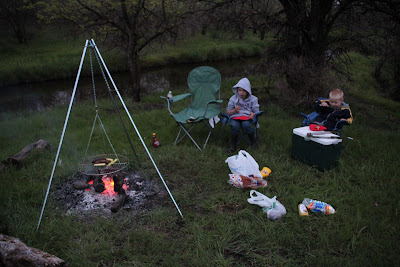
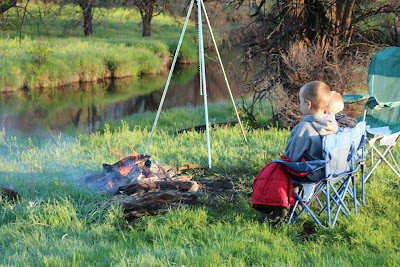
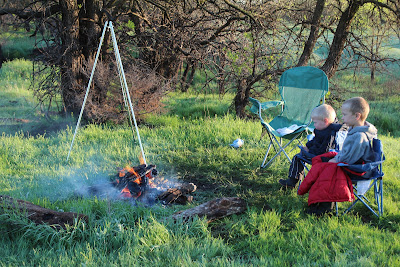
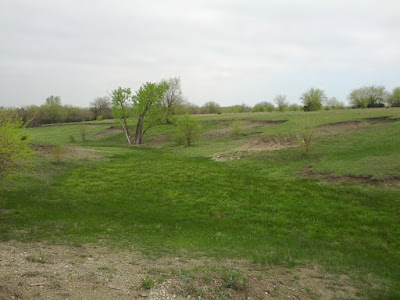
I m back from one of the best experiences a father can have a whole day with two happy boys. I took Jacob (5) and Oliver (2) camping with me out by our creek. This was the first time we d camped there, and also the first time I d taken the boys camping without Terah along. So there were some unknowns, but it worked out great. When we got out there, I started to get the tents set up. The boys were interested, but pretty soon invented some games. A large nearby tree with plenty of low branches on its trunk became their locomotive, and certain sticks made the train go forward or backward, whistle, or ding its bell. This was good for quite some entertainment. Another nearby tree, near the bank of the creek, had some erosion near it. Combined with its roots, this made some natural steps. Jacob named some the enter steps and others the exit steps , and I sure heard about it if I walked the wrong way on the exit steps. We then gathered up sticks and the things we needed to build a campfire. We cooked up brats and zucchini. Although it was later than usual for supper, they loved it just the same. After that, we made smores for dessert another thing they loved. Then, one of the big highlights: sleeping in tents and sleeping bags. I had showed them the sleeping bags earlier, and they were excited to try them out. Morning was beautiful when the sun came out, it was shining right on the heavy dew on the ground, making the grass shine brightly. It s not every day that they get to start their morning slowly waking up by a warm fire. They were content to sit for quite awhile while I got things going for breakfast. It was chilly outside, so I helped them change clothes by the fire where. I then cooked them some scrambled eggs which, despite the lack of salt and pepper, seemed so much better than normal to the boys and then we went exploring. I took them to some areas with erosion, which Jacob called the big holes in the ground. It s really quite beautiful in spring, which this cellphone photo completely fails to capture. The boys loved climbing up and down these areas, some of which were quite tall. They discovered different kinds of rock on the way up and down, and with my help avoided discovering too much of the mud at the bottom. We hiked back to our camping spot through grass almost as tall as Oliver much to his delight and then after warming up by the fire for a bit, went off in the other direction. There is a grove of trees by the creek over there, which surprise became another train. Here are the boys explaining how it works. <iframe allowfullscreen="allowfullscreen" frameborder="0" height="315" src="https://www.youtube.com/embed/43EcEK8F_ic?rel=0" width="560"></iframe> They helped pack things back up, too. Actually, it took some convincing to get Jacob to not pull up all the stakes for the tent before I was ready for them. Things didn t go perfectly, but then, they never do, and that was OK with everyone. Camping is an adventure, and it wouldn t be an adventure if you knew every detail beforehand. It is rare in life to be able to think that I have enough time to do anything the boys might want to do. Spend half an hour pretending a tree is a train sure, no problem. Today Oliver asked to go camping again, and was a bit disappointed when I didn t agree to go camping again right this minute, today. Jacob said, we had an EXCELLENT time and gave me hugs thinking about it. I have a lot of happy memories about the creek. We camped at the same spot where I went fishing or camped as a child. There have been family gatherings and even a birthday party out there. The boys and I have enjoyed a hike or a wagon ride to the area, but as I learned, nothing could possibly match the excitement of camping there. It is wonderful to add another happy memory of a time at the creek. And it s even better to see another generation of Goerzens discover that there s a lot of fun to be had down by the creek.

5 April 2012

Steve Kemp: So I want a backup solution

I look after a lot of systems, and most of them want identical and simple backups taking of their filesystems. Currently I use backup2l which works but suffers from a couple of minor issues. In short I want to take a full filesystem backup (i.e. Backup "/"). I wish to only exclude a few directories and mounted filesystems. So my configuration looks like this:
# List of directories to make backups of.
# All paths MUST be absolute and start with a '/'!
SRCLIST=(  / /boot -xdev )
# The following expression specifies the files not to be archived.
SKIPCOND=( -path '/var/backups/localhost' -o -path '/var/run/' -o \
    -path '/tmp'  -o -path '/var/tmp' \
    -o -path '/dev' -o -path '/spam' \
    -o -path '/var/spool/' )
The only surprising thing here is that I abuse the internals of backup2l because I know that it uses "find" to build up a list of files - so I sneakily add int "-xdev" to the first argument. This means I don't accidentally backup any mounted gluster filesystem, mounted MySQL binary/log mounts, etc. backup2l then goes and does its jobs. It allows me to define things to run before and after the backup runs via code like this:
# This user-defined bash function is executed before a backup is made
PRE_BACKUP ()
 
   if [ -d /etc/backup2l/pre.d/ ]; then
      run-parts /etc/backup2l/pre.d/
   fi
 
So what is my gripe? Well I get a daily email, per-system, which shows lots of detail - but the key thing. The important thing. The thing I care about more than anything else, the actual "success" or "fail" result is only discoverable by reading the mail. If the backup fails, due to out of disk, I won't know unless I read the middle of the mail. If the pre/post-steps fail I won't know unless I examine the output. As I said to a colleague today in my view the success or failure of the backup is the combination of each of three distinct steps: If any of the three fail I want to know. If they succeed then ideally I don't want a mail at all - but if I get one it should have:
Subject: Backup Success - $(hostname) - $(date)
So I've looked around at programs such as backup-ninja, backup-manager and they seem similar. It is a shame as I mostly like backup2l, but in short I want to do the same thing on about 50-250 hosts: In my case it is usually the rsync-step that fails. Which is horrific if you don't notice (quota exceeded. connection reset by peer. etc). The local backups are good enough for 95% of recovery times - but if the hardware is fried having the backups be available, albeit slowly, is required. Using GNU Tar incrementally is trivial. If it weren't such a messy program I'd probably be inclined to hack on backup2l - but in 2012 I can't believe I need to. (Yes, backuppc rocks. So does duplicity. So does amanda. But they're not appropriate here. Sadly.) ObQuote: "Oh, I get it. I see now. You've been training for two years to take me out, and now here I am. Whew! " - Blade II - An example of a rare breed, a sequel that doesn't suck. No pun intended.

28 March 2012

Andrew Pollock: [life/americania] Four days in New Orleans

Sarah's Mum had accrued too much annual leave and had to take some time off work, so Sarah did some (very mild) arm twisting and convinced her to come over for 3 weeks, and do a 5 day cruise to Mexico out of New Orleans. Unfortunately, my annual leave situation wasn't quite so abundant, and I had a lot going on at work, so regretfully I didn't join them on the cruise, and instead went to New Orleans for a four day weekend when they returned. From all reports, the cruise was very good. Zoe handled it well, although she did say "home" a lot. One of the two stops in Mexico was to check out some Mayan ruins, which looked awesome from the photos. The other stop involved a dolphin encounter. I was incredibly envious of all that they got to do, and would have loved to have gone with them, as I've never been on a cruise ship either. I can also report that no cats were lost during this bachelor stint. I had a night flight on the Wednesday evening to get there, which was scheduled to get in at around midnight, and I'd booked a motel room near the airport for that night, and we'd booked a vacation rental home for Thursday to Sunday nights. Unfortunately, my flight ended being delayed something like 2.5 hours, so I didn't get into New Orleans until around 2am. The house we rented did the trick nicely. It was a small "shotgun" duplex in what looked like a nice neighbourhood. It was advertised as being close to the street car line, but they were doing some work on the tracks, so the street car didn't seem to be running as far down the line as it usually did, so it ended up being a bit more of a trek to get to it. It was also extremely slow, and there was a marathon on the Sunday, which closed everything down for a long time, making it a generally pretty unreliable form the transport. We ended up renting a car for Saturday and Sunday, which was something of a saga in itself, as Enterprise didn't have any cars at the location we'd booked one, so after a couple of hours cooling our heels there (Zoe was incredibly well-behaved, all things considered), they shuttled us over to another location and we ended up with a minivan instead of a compact, which for the same price, allayed our concerns about being able to transport all of our luggage to the airport on Monday morning. We had a very early morning flight on Monday morning to come back, which got into SFO at around 9am, and I went directly to work from there. Thursday We all arrived at the house, separately. It ended up taking them 2 hours to disembark the ship when it came back into port, with Customs taking an eternity to process everyone. I think we went exploring the local area that afternoon, and took a street car into the city to check out Bourbon Street, having a Cajun dinner at Remoulade. Friday In the morning, we went to check out Lafayette Cemetery Number 2. Sarah took Zoe back to the house for a nap, and Sarah's Mum and I continued back to explore the French Quarter some more, walking down the length of Royal Street (which was vastly different from Bourbon Street, just one block over). We had lunch at the French Market. The cemetery was interesting, as pretty much all of the graves were these huge above ground tombs, that seemed to have multiple family members interred in them. Apparently the cemetery filled up quite quickly courtesy of a Yellow Fever outbreak. After lunch, Sarah's Mum and I continued wandering around the French Quarter. We went and took a look at the Mississippi River, and I had an encounter with a grifter who was so good at his job I couldn't bring myself to argue with him over the $20 he diddled me out of. We tried to get to the Civil War Museum, but it closed at 4pm. We looked at the Robert E. Lee Monument, which seemed to be draped in drunks, and then I think we rendezvoused with Sarah and Zoe back on Canal Street for dinner at The Court of Two Sisters (which apparently we were under-dressed for, as Sarah and her Mum said we were getting a lot of dirty looks from other patrons). Saturday On Saturday morning, we had the aforementioned car rental experience from hell, and by the time we had the car it was lunchtime, so Zoe napped in the car after lunch on the way out to Oak Alley Plantation, where we were introduced to the delightful beverage known as the mint julep, and took a tour of the house and wandered the grounds. Sunday On Sunday, Sarah and her Mum did a swamp tour, and Zoe and I went to the zoo. As I said earlier, there was a marathon that completely closed down Saint Charles Avenue, which is where the street cars run, so after walking down to where the street cars started operating (which ended up being most of the way down South Carrollton Avenue), the driver informed me that the street cars were queuing up at the corner of South Carrollton and Saint Charles, and I should get off her street car and get on the one at the front of the queue. I did this, but the driver of the front street car informed me that she wouldn't be leaving for an hour and half. At this point, I started considering a bus instead. Zoe and I went to check out the Mississippi River, which was quite close to where we were, and then I went back, and despite a street car having left (without any passengers) the driver of the current street car couldn't tell me when she'd be leaving, so I started walking down Saint Charles Avenue. Unfortunately, Zoe's going through a phase where she wants to be carried everywhere, so I was lugging her all over the place on my hip. Sarah didn't take a stroller with her, and instantly regretted it. Lesson learned. Eventually we managed to get onto a bus, which dropped us off at Audubon Park, which had Audubon Zoo at the other end of it. There was a playground near the Saint Charles Avenue end of the park, so Zoe had a bit of a play on that, and then we continued through the park to the zoo. Mercifully, the zoo had dodgy strollers for rent, and there was no way in the world I wasn't going to rent one of them, so that made getting around with Zoe a lot easier on my back. We had a really good time at the zoo. There was some sort of a music festival on in the parklands within the zoo grounds, and that included a jumping castle, which Zoe expressed a desire to have a go on. She had a fabulous time on it. I think she probably spent about 15 minutes in there, without any tears. I was very impressed. I took a brief video of some of her antics. It was getting close to Zoe's nap time, and she was getting tired, but fortunately Sarah and her Mum were able to pick us up from the zoo after their swamp tour and Zoe got to nap back at the house. Monday We had a very early start. Unfortunately, our flight (with United) was a couple of days after United and Continental officially merged, and despite having checked in online, we had to queue up with everyone else (for an extended period of time) to drop off our checked luggage. Then there was a 45 minute line for security screening. We pulled the "toddler going to melt down" card and jumped to the head of the line, but Sarah's Mum had to wait. The flight ended up being delayed because people were stuck in the security line. Overall impressions of New Orleans Fabulous architecture. There were so many gorgeous houses on Saint Charles Avenue and the surrounding area. I'd have loved to do an architecture tour. Crap (but cheap) public transport. $3 gets you a day pass. The street cars are cute, but slow and unpredictable. The drivers were remarkably unhelpful. The buses were okay. Great food. Zoe seemed to have a liking for the spicy stuff. I gave her some fresh alligator jerky, and after some initial coughing and spluttering at the spiciness of it, she came back for more. Post-Katrina recovery. We really only saw a very small part of the city, but there were still some houses with boarded up windows, and some vacant blocks where buildings had been demolished, but largely you'd not have been able to tell that large parts of the city had been underwater, from casual inspection. I really enjoyed the trip, even though it was brief, I feel like I got a good feel for the place. We were there just after Mardi Gras, and there were still beads everywhere. Draped all over fences. Over power lines. Trees on the parade route were absolutely covered in beads. I'd have loved to have been there for Mardi Gras. My friend Brandon, who is an excellent street photographer, took some great photos that capture some of it. Photos from Sarah's cruise and our time in New Orleans are here.

27 March 2012

Diego Escalante Urrelo: All the new cool stuff in Epiphany, alias, Web

Today we released Epiphany 3.4. It includes all the fixes, enhancements and new cool features that we build since September 2011. That is 6 months of cool stuff! Xan already explained the bigger picture but I want to highlight some details in the spirit of Every Detail Matters. Improved location bar, and the new history backend The location bar suggestions now load extra-extra-fast, thanks to our new SQLite backend. Besides being extra fast, SQLite allows us to make complex queries to offer better results in the completion. Goal for 3.6: to successfully handle searches like that page, with the dog, you know, that one with the funny one . This also makes possible to have a cool Overview start page for 3.6. Much like Chrome or Opera do. An awesome UI: cleaner toolbar, loading progress That is all the chrome you are getting, kid! Less distractions, more web! All the usual tools are still available in the gear menu: Oh, and this other one is a pretty one. Check out the new load progress indicator: You might have already noticed the combined stop/reload button. Some other niceties like the new link tooltips are all over the place. I will not ruin the surprise :-) . Reliable download icons This is my friend Juanjo:
He is always happy. One day he said: Diego, my PDF documents are shown as boxes while downloading. It makes me mad! I want Juanjo to keep that happy hacker smile. So I decided to fix this. Downloads now have a better idea of the icon they should show: Page icons, now a WebKitGTK+ feature Do you notice something? Yeah, icons for every of the loaded pages. The support for this is now in WebKitGTK+, available to other applications. This means it is better supported and maintained! Redesigned about: pages For a time now we have had some geeky about: pages. One for memory (about:memory), one for plugins (about:plugins), and perhaps the most useful one, one to manage applications (about:applications): And, last but not least Less lines:
$ git diff --shortstat 3.2.0..3.4.0
328 files changed, 73211 insertions(+), 104528 deletions(-)
Unlike other browsers, Epiphany does not have dozens of engineers behind the project. This means that the more code we have to maintain, the less time we have to develop new features and to even maintain that code! Also, this makes Xan happy. But luckily Igalia has hackers like Martin Robinson who are willing to show us how hacking should be done: Epiphany 3.4.0, alias, Web. Is an awesome release. It will soon be in your distro of choice. Thanks Allan for the screenshot help!

23 March 2012

Rapha&#235;l Hertzog: People behind Debian: J rg Jaspert, FTPmaster, Debian Account Manager, and more

Photo by Wouter Verhelst

J rg is a very active contributor within Debian, and has been for a long time. This explains why he holds so many roles (FTPmaster and Debian Account Manager being the 2 most important ones) Better known as Ganneff (his IRC nick), he s not exactly the typical hacker. He has no beard and used to drink milk instead of beers. :-) Check out his interview to learn more about some of the numerous ways one can get involved in Debian, managing its infrastructure and without having to be a packager. Raphael: Who are you? J rg: My name is J rg Jaspert and I m 35 years old working for a small company doing system administration and consulting work for our customers. I m married for a little while now and sometime soon a little Ganneff will be crawling out of my wife. (Whoever didn t think of the movie Alien now is just boring). Raphael: How did you start contributing to Debian? J rg: I started using Debian somewhere around 2000, 2001. Before that I had the misfortune to try SuSE and RedHat, both with a user experience that let me fully understand why people think Linux is unusable. (Due to my work I m in the unfortunate situation to have to use RedHat on two machines. Funny how they are still utter crap and worse than bad toys). And all of this lets get a Linux running here came up because I was trying to find a replacement for my beloved OS/2 installation, which I had for some years. So after I got Debian installed, good old Potato, I got myself active on our mailing lists, starting with the German user one. A bit later I replied to a question if someone can help as staff for a Debian booth somewhere. It was the most boring event I ever visited (very nice orga, unfortunately no visitors), but I got a few important things there: The software I packaged, found me a sponsor and voila, maintainer I was. Some more packages got added and at some point my sponsor turned out to be my advocate. The NM process run around 2 months, and mid April 2002 I got THE MAIL. Raphael: Some Debian developers believe that you have too many responsibilities within Debian (DAM, FTPMaster, Debconf, Partners, Planet Debian, Mirrors, ). Do you agree that it can be problematic, and if yes, are you trying to scale down? J rg: It s DebConf, tssk. And yes, I do have some extra groups and roles. And you even only list some, leaving out all I do outside Debian. But simply counting number of roles is a plain stupid way to go. Way more interesting is how much work is behind a role and how many other people are involved. And looking at those you listed I don t see any I am a SPOF. Let s look at those you listed: DAM: Here I did start out assisting James to get the huge backload down which had accumulated over time. Nowadays I am merely the one with the longest term as DAM. Christoph Berg joined in April 2008 and Enrico Zini followed during October 2010, both very active. Especially Enrico, lately with the redesign of the NM webpages. FTPMaster: The basic outline of the FTPMaster history is similar to the DAM one. I joined as an assistant, after the oh-so-famous Vancouver meeting in 2004. Together with Jeroen, we both then got the backload down which had accumulated there. He did most of the removals while I had a fun time cleaning up NEW. And we both prepared patches for the codebase. And in 2007, as the last action as DPL, Sam made me FTPMaster. Since then I haven t been alone either. In fact we have much more rotation in the team than ever before, which is a good thing. Today we are 3 FTPMasters, 4 FTP Assistants and 1 Trainee. Though we always like new blood and would welcome more volunteers. DebConf: I am very far outside the central DebConf team. I am not even a delegate here. Currently I am merely an admin, though there are 4 others with the same rights on the DebConf machines. I ve not taken any extra jobs this year, nor will I. Probably for next year again, but not 2012. Planet: I am one of three again, but then Planet is mostly running itself. Debian developers can just edit the config, cron is doing the work, not much needed here. Occasional cleanups, every now and then a mail to answer, done. In short: No real workload attached. Mirrors: My main part here is the ftpsync scriptset. Which is a small part of the actual work. The majority of it, like checking mirrors, getting them to fix errors, etc. is done by Simon Paillard (and since some time, Raphael Geissert is active there too, you might have heard about his http.debian.net). Having said that, there is stuff I could have handled better or probably faster. There always is. Right now I have 2 outstanding things I want to do a (last) cleanup on and then give away. Raphael: You got married last year. I know by experience that entertaining a relationship and/or a family takes time. How do you manage to combine this with your Debian involvement? J rg: Oh well, I first met my wife at the International Conference on OpenSource 2009 in Taiwan. So OpenSource, Debian and me being some tiny wheel in the system wasn t entirely news to her. And in the time since then she learned that there is much more behind when you are in a community like Debian, instead of just doing it for work. Even better that she met Debian people multiple times already, and knows with who I am quarreling Also, she is currently attending a language school having lots of homework in the evening. Gives me time for Debian stuff. :) How that turns out with the baby I have no idea yet. I do want to train it to like pressing the M key, so little-Ganneff can deal with NEW all on its own (M being Manual reject), but it might take a day or twenty before it gets so far. :) Raphael: Thanks to the continuous work of many new volunteers, the NEW queue is no longer a bottleneck. What are the next challenges for the FTPmaster team? J rg: Bad link, try this one. :) Also, no longer sounds like its recent. It s not, it s just that people usually recognize the negative only and not the positive parts. Well, there are a few challenges actually. The first one, even if it sounds simple, is an ongoing one: We need Debian Developers willing to do the work that is hidden behind those simple graphs. Yes, we are currently having a great FTP Team doing a splendid work in keeping that queue reasonably small this is a/THE sisyphean task per excellence. There will always be something waiting for NEW, even if you just cleaned the queue, you turn around and there is something else back in already. Spreading this workload to more people helps not burning one out. So if one or more of the readers is interested, we always like new volunteers. You simply need to be an uploading DD and have a bit of free time. For the rest we do have training procedures in place. Another one is getting the multi-archive stuff done. The goal is to end up with ONE host for all our archives. One dak installation. But separate overrides, trees, mirrors, policies and people (think RMs, backports team, security team). While this is halfway easy to think of in terms of merging backports into main it gets an interesting side note when you think of merging security into main . The security archive does have information that is limited to few people before public release of a security announce, and so we must make sure our database isn t leaking information. Or our filesystem layer handling. Or logs. Etc. Especially as the database is synced in (near) realtime to a DD accessible machine. And the filesystem data too, just a little less often. There is also a discussion about a good way to setup a PPA for Debian service. We do have a very far developed proposal here how it should work, and I really should do the finishing touches and get it to the public. Might even get a GSoC project on it. So far for some short to middle term goals. If you want to go really long term, I do think that we should get to the point where we get rid of the classical view of a source package being one (or more) tarballs plus the Debian changes. Where a new version requires the full upload of one or more of those parts of the source package. I don t know exactly where it should end up. Sure, stuff like one central DVCS, maintainers push there, the archive generates the source tarballs and prepares the mirrors do sound good for a quick glance. But there are lots of trouble and pitfalls and probably some dragons hidden here. Raphael: The Debian repositories are managed by DAK (Debian Archive Kit) which is not packaged. Thus Debian users pick tools like reprepro to manage their package repositories. Is that how things should be? J rg: Oh, Mark Hymers wants to do a package again. More power to him if he does, though yes, DAK is not exactly a quick-and-easy thing to install. But nowadays it is a trillion times easier than the past thanks to Mark s work people can now follow the instructions, scripts and whatever they find inside the setup directory. Still, it really depends on the archive size you are managing. A complex tool like dak does not make sense for someone who wants to publish one or a dozen of his own packages somewhere. Thats just like doing a finger amputation with a chainsaw it certainly works and is fun for the one with the chainsaw but you probably end up a little overdoing it. I myself am using dpkg-scan[packages sources] from a shell script but also mini-dinstall in places (never got friend with reprepro when I looked at it). Works, and for the few dozen packages those places manage it is more than enough. Also, using dak forces you into some ways of behaviour that are just what Debian wants but might not be what a user wants. Like inability to overwrite an existing file. One of the reasons why mentors.debian.net won t work with dak. Or the use of a postgres database. Or that of gpg. Sure, if you end up having more than just a dozen packages, if you have many suites and also movement between them, then dak is sure a thing to look at. And how should things be : however the user and admins of that certain install of reprepro, mini-dinstall, dak, whatever want it. This is not one-tool-for-all land :) Raphael: What is the role of Debian Account Managers (DAM)? Do you believe that DAMs have a responsibility to shape Debian by defining limits in terms of who can join and what can be done within Debian? J rg: Quote from https://lists.debian.org/debian-devel-announce/2010/10/msg00010.html:
The Debian Account Managers (DAM) are responsible for maintaining the list of members of the Debian Project, also known as Debian Developers. DAMs are authoritative in deciding who is a member of the Debian Project and can take subsequent actions such as approving and expelling Project members.
Now, aside from this quote, my OWN PERSONAL OPINION, without wearing anything even vaguely resembling a DAM hat: DAM is the one post that is entitled to decide who is a member or not. Usually that is in the way of joining (or not), which is simple enough. But every now and then this also means acting on a request to do something about whatever behaviour of a Debian Project member. I hate that (and i think one can easily replace I with WE there). But it s our job. We usually aren t quick about it. And we don t act on our own initiative when we do, we always have (numerous) other DDs complain/appeal/talk/whatever to us first. The expulsion procedure , luckily not invoked that often, does guarantee a slow process and lots of input from others. Are we the best for it? Probably not, we are just some people out of a thousand who happen to have a very similar hobby Debian. We aren t trained in dealing with the situations that can come up. But we are THE role inside Debian that is empowered to make such decisions, so naturally it ends up with us. Raphael: You did a lot of things for Debian over the years. What did bring you the most joy? Are there things that you re still bitter about? J rg: The most joy? Hrm, without being involved in Debian and SPI I would never have met my wife.
Or my current job. Or a GR against me. Not many running around with that badge, though I m still missing my own personal Serious problems with Mr. Jaspert thread. Bad you all.
Or visited so many places. Think of all the DebConfs, QA meetings, BSPs and whatever events.
Or met so many people.
Or learned so many things I would never even have come near without being DD. Raphael: Is there someone in Debian that you admire for their contributions? J rg: Yes.
Thank you to J rg for the time spent answering my questions. I hope you enjoyed reading his answers as I did. Note that older interviews are indexed on wiki.debian.org/PeopleBehindDebian.

Subscribe to my newsletter to get my monthly summary of the Debian/Ubuntu news and to not miss further interviews. You can also follow along on Identi.ca, Google+, Twitter and Facebook.

One comment Liked this article? Click here. My blog is Flattr-enabled.

18 March 2012

Gregor Herrmann: RC bugs 2012/10-11

since I was travelling in the pre-ultimate week for a few days, there was no report about my RC bugs fixing activities. so here we go with an overview covering two weeks:

17 March 2012

Kai Wasserb ch: The joy of building Wine in a non-multiarch environment

This is an updated and consolidated post for/of two previous blog entries. Before I continue, let me make it clear, that this post isn't intended to criticise anybody. It is meant as a instruction leaflet to go with my unofficial (source) package(s). The best idea, until all build dependencies of Wine have been made multiarch ready (we're almost there), is to create a base.tgz for pbuilder in which you make the required changes. So you don't have to remember applying them everytime (note, this is only needed for amd64 builds). After you created yourself a base.tgz for Wine, do the follwoing:
  1. Log into the chroot stored in your base.tgz for Wine: pbuilder --login --save-after-login --basetgz /path/to/your/wine.base.tgz
  2. Update the package list and installed packages with aptitude update && aptitude safe-upgrade unless you know, everything is updated.
  3. Install ia32-libs-dev and libjpeg-dev: aptitude install ia32-libs-dev libjpeg-dev
  4. Work around #638543:
    1. cd /usr/lib32
    2. rm libjpeg.so libjpeg.so.62* (you can also remove the libjpeg.a and libjpeg.la files)
    3. ln -s libjpeg.so.8 libjpeg.so
    4. cd /usr/include
    5. ln -s x86_64-linux-gnu/jconfig.h
  5. As we build build with GCC 4.5 (due to a problem with GCC 4.6, see WineHQ bug #22053 for more details) on amd64 (i386 isn't using GCC 4.5 anymore (since the 1.5.0-0.2 packages), because that resulted in linking errors), we hit #638418. To work around that, you need to create the symlink yourself. Execute ln -s x86_64-linux-gnu/asm asm in /usr/include.
  6. Exit the chroot, pbuilder should now update your base.tgz.
  7. Build the source package with pbuilder.
For i386 users this shouldn't be required. Not even the symlinking of the asm directory, as we don't use GCC 4.5 anylonger on i386 (due to various linking errors). Though that comes at the cost of potential issues with e.g. Steam.

13 March 2012

Don Armstrong: Debbugs forcemerge support

One of the earliest features I wrote for the Debian bug tracking system (Debbugs) after joining the team was support for forcibly merging bugs. Originally, merging two bugs required that the bugs be in exactly the same state before merging them; forcemerge removed this requirement. Unfortunately, the way I originally implemented this was shortsighted, and merely forced the merge partners to have the same values as the merge master. This meant that owners, blocking bugs, and many other things were silently changed, which meant that people weren't notified of changes, and bugs could end up in an inconsistent state. A while ago, I decided to fix this by calculating the changes required to actually merge the bugs, making those changes, and then merging the bugs normally; thus, doing everything that a maintainer would normally have done for them. This necessitated abstracting out the entire control apparatus into the Debbugs::Control module. Now that it's complete, you can do the following:
> forcemerge 1 2
Bug #1 [foo] new title
Bug #2  Done: foo@bugs.something  [foo] foo
Unset bug forwarded-to-address
Severity set to 'wishlist' from 'grave'
3 was blocked by: 2
3 was not blocking any bugs.
Removed blocking bug(s) of 3: 2
2 was blocked by: 4
2 was not blocking any bugs.
Removed blocking bug(s) of 2: 4
Bug reopened
Removed annotation that bug was owned by bar@baz.com.
Removed indication that 2 affects bleargh
Removed tag(s) unreproducible and moreinfo.
Merged 1 2
> thanks
Stopping processing here.
and bug 2 now is merged with 1 and matches the state of 1. [The above is the control output from the appropriate bit of the 06_mail_handling.t test.] This change also means that I'll be able to finally write support for control@ operations at submit@ time. Also, all of the bug modifications that happen at submit@ or nnn@ time (setting title, found, etc.) will be implemented as calls to Debbugs::Control so we can eventually keep a postgresql database updated in addition to the flatfile database.

Joachim Breitner: ghc-heap-view: Complete referential opacity

During the last week, I created ghc-heap-view, a library to investigate the actual memory representation of Haskell values. It is inspired by vacuum and the GHCi debugger, but goes beyond them by allowing the user to look inside thunks and functions and see what other values they refer to. Let me demonstrate it by running the included demo: ghc-heap-view-demo Here are a four different lists, where the first three are already evaluated.
The first one, l, was defined as a top level constant as
> l = [1,2,3]
and is now found at 0x00000000006d1750/2 (where the /2 is the pointer tag information) and fully evaluated:
  ConsClosure  info = StgInfoTable  ptrs = 2, nptrs = 0, tipe = CONSTR_STATIC, srtlen = 1 , 
                 ptrArgs = [0x00000000006d16e0/1,0x00000000006d1730/2],
                 dataArgs = [], descr = "ghc-prim:GHC.Types.:" 
The second one, l2, is locally defined
> let l2 = 4:l
and now found at 0x00007fdce19fe4b0/2. See how the cons-cell references l!
  ConsClosure  info = StgInfoTable  ptrs = 2, nptrs = 0, tipe = CONSTR_2_0, srtlen = 1 ,
                 ptrArgs = [0x00000000006dca50/1,0x00000000006d1750/2],
                 dataArgs = [],
                 descr = "ghc-prim:GHC.Types.:" 
And the binding
> args <- map length  fmap  getArgs
evaluates to the one , global empty list at 0x00000000006db640/1:
  ConsClosure  info = StgInfoTable  ptrs = 0, nptrs = 0, tipe = CONSTR_NOCAF_STATIC, srtlen = 0 ,
                 ptrArgs = [],
                 dataArgs = [],
                 descr = "ghc-prim:GHC.Types.[]" 
And now we have, at 0x00007fdce19fe4c8, the concatenation of them, but unevaluated:
> let x = l ++ l2 ++ args
The thunk keeps a reference to l2 and args, but not l, as that is at a static address, unless you are running this in GHCi:
  ThunkClosure  info = StgInfoTable  ptrs = 2, nptrs = 0, tipe = THUNK_2_0, srtlen = 1 ,
                  ptrArgs = [0x00007fdce19fe4b0/2,0x00000000006db640/1],
                  dataArgs = [] 
Now to some more closure types. m and m' locally bound of type the unboxed type Int#, with values 42 resp. 23.
> let f = \x n -> take (I# m + I# x) n ++ args
  t = f m' l2
So here is (0x00007fdce1937d50/2), referencing its free variables args and 42:
  FunClosure  info = StgInfoTable  ptrs = 1, nptrs = 1, tipe = FUN_1_1, srtlen = 65553 ,
                ptrArgs = [0x00000000006db640/1],
                dataArgs = [42] 
And t is a thunk that applies f (also referenced here) to an unboxed value (23) and l2:
  ThunkClosure  info = StgInfoTable  ptrs = 2, nptrs = 1, tipe = THUNK, srtlen = 0 ,
                  ptrArgs = [0x00007fdce19fe4b0/2,0x00007fdce1937d50/2],
                  dataArgs = [23] 
Lastly, here is the standard example for self reference:
> let x = id (:) () x
This is what x (0x00007fdce1947940) looks like, at least without -O:
  ThunkClosure  info = StgInfoTable  ptrs = 0, nptrs = 0, tipe = THUNK, srtlen = 1 ,
                  ptrArgs = [],
                  dataArgs = [] 
So it is unevaluated. Let us evaluate it using seq. Now we have, still at 0x00007fdce1947940:
  IndClosure  info = StgInfoTable  ptrs = 1, nptrs = 0, tipe = BLACKHOLE, srtlen = 0 ,
                indirectee = 0x00007fdce194cc98/2 
The thunk was replaced by an indirection. If we look at the target, 0x00007fdce194cc98/2, we see that it is a newly created cons-cell referencing the original location of x:
  ConsClosure  info = StgInfoTable  ptrs = 2, nptrs = 0, tipe = CONSTR_2_0, srtlen = 1 ,
                 ptrArgs = [0x00000000006db620/1,0x00007fdce1947940],
                 dataArgs = [],
                 descr = "ghc-prim:GHC.Types.:" 
After running the garbage collector (performGC), we find that the address of x is now 0x00007fdce19f30d0/2 and that the self-reference is without indirections:
  ConsClosure  info = StgInfoTable  ptrs = 2, nptrs = 0, tipe = CONSTR_2_0, srtlen = 1 ,
                 ptrArgs = [0x00000000006db620/1,0x00007fdce19f30d0/2],
                 dataArgs = [],
                 descr = "ghc-prim:GHC.Types.:" 
Future plans The output of ghc-heap-view is not really pretty yet; even the indentation in this blog post was added manually by me, so this really needs a pretty printer providing a nicer, possibly more compact representation, including something like what vacuum provides. Maybe vacuum can be ported to use this library, and also include the thunk s and function s references in the output. Maybe also the GHCi debugger can be extended to show more information about unevaluated expressions using this. Internally, the library is not very polished yet either. It only handles those closures types that I have seen so far, and is likely to break horribly if run in a threaded or debugging enabled runtime. How it works Obviously, this is not standard Haskell 98 code, but rather deep trickery involving the GHC API and some C code. Initially I tried to use the API that vacuum and the GHCi debugger rely on, which is an operation
unpackClosure# :: a -> (# Addr#, Array# b, ByteArray# #)
which takes any Haskell value and returns the address to its info table, the pointers and the non-pointer-data in the closure. Unfortunately, it was not complete in that it was meant only for data closures and will for other closure types, e.g. thunks, return no data and no pointers (as can be seen in the code). So I implemented my own version of this operation:
foreign import prim "slurpClosurezh" slurpClosure# :: Any -> (# Addr#, ByteArray#, Array# b #)
where the returned ByteArray# contains the complete closure, including extra information fields such as the arity of a function. The Array# is again the list of pointers in the closure. At first glance, this is a duplication, as the pointers are of course also contained in the ByteArray#. But as soon as the GHC runtime reigns again, a garbage collector run can happen, the referenced values will move somewhere else, and the words that once were pointers in the ByteArray# become useless. But the corresponding entries in the Array# are updated by the garbage collector, as it knows that these are pointers, and not just words. This way, we get both a faithful copy of the closure on the heap and useful references to the contained data. Here is a demonstration of this effect:
$ ghci -XMagicHash -package ghc-heap-view
GHCi, version 7.4.1: http://www.haskell.org/ghc/  :? for help
Loading package ghc-prim ... linking ... done.
[..]
Loading package ghc-7.4.1 ... linking ... done.
Loading package ghc-heap-view-0.1 ... linking ... done.
Prelude> let  a = [1,2,3,4]; b = 5:a 
Prelude> :m + GHC.HeapView 
Prelude GHC.HeapView> rawHeapData <- getClosureRaw b
Prelude GHC.HeapView> rawHeapData 
(0x000000004080d658,[1082185320,140040739366568,140040739365928],[0x00007f5dc68626a8,0x00007f5dc6862428])
Prelude GHC.HeapView> System.Mem.performGC
Prelude GHC.HeapView> rawHeapData 
(0x000000004080d658,[1082185320,140040739366568,140040739365928],[0x00007f5dc41b3ad8,0x00007f5dc41b3b28]) 
The function rawHeapData is a thin wrapper around slurpClosure# which turns the primitive array in normal lists. Note that the second component of the triple is unchanged, but the third is updated by the garbage collector. Of course this means that the Show instance for the data type that ghc-heap-view uses to reference values is not referential transparent either. The foreign function import above is of type prim , i.e. does not call a C function but rather a Cmm function. Cmm is a reduced C that GHC uses internally to compile the Haskell code to, and most primitive operations are implemented in this language although I do quickly call regular C from my Cmm code to do the more complicated stuff, mainly figuring out what words of the closure are pointers. The knowledgeable reader might notice that I am passing a boxed value of type Any to the foreign function. This is currently not possible with foreign prim functions, and to actually use that code, you need the patch in GHC ticket #5931. But you can use ghc-heap-view without that as well (and the Cabal package will by default use that path), using the following hack to obtain the pointer to a Haskell value on the Heap as an unboxed type that can pass to the primitive operation:
foreign import prim "slurpClosurezh" slurpClosure'# :: Word#  -> (# Addr#, ByteArray#, Array# b #)
data Ptr' a = Ptr' a
aToWord# :: Any -> Word#
aToWord# a = case Ptr' a of mb@(Ptr' _) -> case unsafeCoerce# mb :: Word of W# addr -> addr
slurpClosure# :: Any -> (# Addr#, ByteArray#, Array# b #)
slurpClosure# a = slurpClosure'# (aToWord# a)
This works because a Word and a Ptr' have the same closure layout, only differing in the fact that one stores an a, and the other stores a Word#. Once we obtained the raw representation of the closure, we do the parsing in Haskell. Using the info table and the raw closure, we have enough information to tell which words have to be replaced by the appropriate pointer (which might already have been updated by the garbage collector) in the pointers list. This work was supported by a scholarship from the Deutsche Telekom Stiftung.

Flattr this post

10 March 2012

Gustavo Noronha Silva: WebKitGTK+ Debian packaging repository changes

For a while now the git repository used for packaging WebKitGTK+ has been broken. Broken as in nobody was able to clone it. In addition to that, the packaging workflow had been changing over time, from a track-upstream-git/patches applied one to a import-orig-only/patches-not-applied one. After spending some more time trying to unbreak the repository for the third time I decided it might be a good time for a clean up. I created a new repository, imported all upstream versions for series 1.2.x (which is in squeeze), 1.6.x (unstable), and 1.7.x (experimental). I also imported packaging-related commis for those versions using git format-patch and black magic. One of the good things about doing this move, and which should make hacking the WebKitGTK+ debian package more pleasant and accessible can be seen here:
kov@goiaba ~/s/debian-webkit> du -sh webkit/.git webkit.old/.git
27M webkit/.git
1.6G webkit.old/.git
If you care about the old repository, it s on git.webkit.org still, named old-webkit.git. Enjoy!

28 February 2012

Jon Dowland: Budgeting

I'm seeking advice on budgeting. Historically, I've been crap at managing money. Things have improved in recent years. My main tool is Martin Lewis' Money Saving Expert budget planner. It's simply a spreadsheet, into which you feed your income and outgoings. You can supply each line item as either a daily, monthly or annual income or expense. The sheet works out both a monthly and an annual total for each and the difference (be it positive or negative). The monthly summary is a useful benchmark against which you can compare your monthly bank statements, but it's not sufficient. Consider a one-off annual expense, such as a holiday payment. On the budget planner, the expense will be divided up into monthly chunks and deducted from your monthly income. However, the expense won't be on your bank statements, unless you've made a special arrangement to pay out a monthly sum to another account, such as savings account, for every annual expense. Therefore you can't just compare the planner's monthly summary against your bank statement summary and hope the two match. I really need to see what my monthly outgoings should total to, rather than what all my outgoings are, presented monthly, in order to meaningfully compare the two. How should I handle this? Should I do as I suggested there and total up my annual one-offs, divide by twelve and make a monthly payment for that sum to a savings account? I'd still want to be able to quickly look at my main statement and judge the overall figure as either 'good' or 'bad'. Perhaps I should feed my various statements into one place, perhaps a finance tool, in which case, which one? How do you manage your finances?

27 February 2012

Enrico Zini: SQLAlchemy, MySQL and sql_mode=traditional

SQLAlchemy, MySQL and sql_mode=traditional As everyone should know, by default MySQL is an embarassing stupid toy:
mysql> create table foo (val integer not null);
Query OK, 0 rows affected (0.03 sec)
mysql> insert into foo values (1/0);
ERROR 1048 (23000): Column 'val' cannot be null
mysql> insert into foo values (1);
Query OK, 1 row affected (0.00 sec)
mysql> update foo set val=1/0 where val=1;
Query OK, 1 row affected, 1 warning (0.00 sec)
Rows matched: 1  Changed: 1  Warnings: 1
mysql> select * from foo;
+-----+
  val  
+-----+
    0  
+-----+
1 row in set (0.00 sec)
Luckily, you can tell it to stop being embarassingly stupid:
mysql> set sql_mode="traditional";
Query OK, 0 rows affected (0.00 sec)
mysql> update foo set val=1/0 where val=0;
ERROR 1365 (22012): Division by 0
(There is an even better sql mode you can choose, though: it is called "Install PostgreSQL") Unfortunately, I've been hired to work on a project that relies on the embarassing stupid behaviour of MySQL, so I cannot set sql_mode=traditional globally or the existing house of cards will collapse. Here is how you set it session-wide with SQLAlchemy 0.6.x: it took me quite a while to find out:
import sqlalchemy.interfaces
# Without this, MySQL will silently insert invalid values in the
# database, causing very long debugging sessions in the long run
class DontBeSilly(sqlalchemy.interfaces.PoolListener):
    def connect(self, dbapi_con, connection_record):
        cur = dbapi_con.cursor()
        cur.execute("SET SESSION sql_mode='TRADITIONAL'")
        cur = None
engine = create_engine(..., listeners=[DontBeSilly()])
Why does it take all that effort is beyond me. I'd have expected this to be turned on by default, possibly with a switch that insane people could use to turn it off.

13 February 2012

Siegfried Gevatter: eSpeak GUI 0.4 is out!

A few of you may remember espeak-gui, a graphical user interface for eSpeak I did release two years ago. While I haven t been dedicating much time to it, it s still alive and I m happy to announce its fourth release! This new release introduced automatic language guessing, a feature I ve wanted for a while, as well as spell checking (contributed by Joe Burmeister). Version 0.3, released a year ago and which I didn t announce here, did also introduce Undo/Redo, pausing, file history logging, a bunch of translations and some voice options. It s sister project, python-espeak, did also get some bug fixes since its first release. As usual, packages for both espeak-gui and python-espeak are available in my PPA, and since last month in Debian unstable. Make sure you also install libtextcat0 (version 2.2-8 or newer) to get the language identification support. Related posts:
  1. espeak-gui 0.2 Yesterday I did a first release of espeak-gui, so while...
  2. Introducing espeak-gui I m joining the hype of presenting little new projects there...
  3. Here is Zeitgeist 0.2.1! One month after the first Zeitgeist release (0.2), here is...
flattr this!

10 February 2012

Dominique Dumont: Dpkg: edit debian/control description without worrying about leading . and

Hello In Debian package, the debian/control file has a specific syntax where each line must begin with a space and paragraphs are separated by a single . . If you want to follow DEP-5 syntax for debian/copyright files, you have a similar problem when comes the time to fill the license text for creative-common license: it s easy to miss a space or a dot. Let s say I want to add a new section in the description of my package. Here s the current description:
Description: module to automate definition of a DBIx::Class::Schema
 DBIx::Class::Schema::Loader is an extension to DBIx::Class that automates the
 definition of a DBIx::Class::Schema by scanning table schemas and setting up
 columns and primary keys appropriately. It supports MySQL, PostgreSQL, SQLite
 and DB2.
 .
 Bare table definitions are fairly straightforward, but relationship creation
 is somewhat heuristic, especially with respect to choosing relationship types
 and names, as well as join types. The relationships generated by this module
 will probably never be as well-defined as hand-generated ones.
I want to add This package is awesome but I don t want to be bothered by leading dots and white spaces. First, I go in the package directory, then check the syntax with cme:
$ cme check dpkg
Then create a loop directory, where the dpkg content will be mapped to a fuse directory:
$ mkdir loop
$ cme fusefs dpkg -fuse-dir loop/
Mounting config on loop/ in background.
Use command 'fusermount -u loop/' to unmount
$ cat loop/control/binary/libdbix-class-schema-loader-perl/Description
DBIx::Class::Schema::Loader is an extension to DBIx::Class that automates the
definition of a DBIx::Class::Schema by scanning table schemas and setting up
columns and primary keys appropriately. It supports MySQL, PostgreSQL, SQLite
and DB2.
Bare table definitions are fairly straightforward, but relationship creation
is somewhat heuristic, especially with respect to choosing relationship types
and names, as well as join types. The relationships generated by this module
will probably never be as well-defined as hand-generated ones.
Then edit loop/control/binary/libdbix-class-schema-loader-perl/Description with your favorite editor. For the sake of this blog, I will use echo to edit this file:
$ echo -e "\nThis module is awesome" >> loop/control/binary/libdbix-class-schema-loader-perl/Description
Now umount the loop (note that the actual debian/control is not changed before this step):
fusermount -u loop
Now the result:
$ cat debian/control
[...]
Description: module to automate definition of a DBIx::Class::Schema
 DBIx::Class::Schema::Loader is an extension to DBIx::Class that automates the
 definition of a DBIx::Class::Schema by scanning table schemas and setting up
 columns and primary keys appropriately. It supports MySQL, PostgreSQL, SQLite
 and DB2.
 .
 Bare table definitions are fairly straightforward, but relationship creation
 is somewhat heuristic, especially with respect to choosing relationship types
 and names, as well as join types. The relationships generated by this module
 will probably never be as well-defined as hand-generated ones.
 .
 This module is awesome
Here s another example to fill the license text for a license while respecting DEP-5 syntax, (done after the cme command):
# creating this dir will create a new DEP-5
# standalone license section with name CC-BY-30
mkdir loop/copyright/License/CC-BY-30
# fill the text part of the  license
wget http://creativecommons.org/licenses/by/3.0/legalcode -O - \
   html2text -style pretty > loop/copyright/License/CC-BY-30/text
$ fusermount -u loop
$ cat debian/copyright
[...]
License: CC-BY-30
 .
 .
 .
                                Creative_Commons
 .
 .
 Creative Commons Legal Code
 .
 .
 Attribution 3.0 Unported
[...]
And that s it. (note that cme command is new and is available only from version 2.004 of Config::Model) Of course, there s more than a awy to do it: you can also run cme edit dpkg and add or edit license text in the GUI (or in an editor launched by the GUI). cme will take care of the syntax details. All the best

5 February 2012

Steve Kemp: Some domains just don't learn

For the past few years the anti-spam system I run has been based on a simplified version of something I previously ran commercially. Although the code is similar in intent there were both explicit feature removals, and simplifications made. Last month I re-implimented domain-blacklisting - because a single company keeps ignoring requests to remove me. So LinkedIn.com if you're reading this: I've also implemented TLD-blacklisting which has been useful.
TLD-blacklisting in my world is not about blocking mail from foo@bar.ph (whether in the envelope sender, or the from: header), instead it is about matching the reverse DNS of the connecting client. If I recieve a connection from 1.2.3.4 and the reverse DNS of that IP address matches, say, /\.sa$/i then I default to denying it. My real list is longer, and handled via files:
steve@steve:~$ ls /srv/_global_/blacklisted/tld/ -C
ar  br  cn  eg  hr  in  kr  lv  mn  np  ph  ro  sg  tg  ua  ve  zw
aw  cc  cy  gm  hu  is  kz  ma  my  nu  pk  rs  sk  th  ug  vn
be  ch  cz  gr  id  it  lk  md  mz  nz  pl  ru  su  tr  uy  ws
bg  cl  ec  hk  il  ke  lt  mk  no  om  pt  sa  sy  tw  uz  za
On average I'm rejecting about 2500 messagse a day at SMTP-time, and 30 messages, or so, hit my SPAM folder after being filtered with CRM114 after being accepted for delivery. (They are largely from @hotmail and @yahoo, along with random compromised machines. The amount of times I see a single mail from a host with RDNS mysql.example.org is staggering.). (Still looking forward to the development of Haraka, a node.js version of qpsmtpd.) ObQuote: "Mr. Mystery Guest? Are you still there? " - Die Hard

Petter Reinholdtsen: Saving power with Debian Edu / Skolelinux using shutdown-at-night

Since the Lenny version of Debian Edu / Skolelinux, a feature to save power have been included. It is as simple as it is practical: Shut down unused clients at night, and turn them on again in the morning. This is done using the shutdown-at-night Debian package. To enable this feature on a client, the machine need to be added to the netgroup shutdown-at-night-hosts. For Debian Edu, this is done in LDAP, and once this is in place, the machine in question will check every hour from 16:00 until 06:00 to see if the machine is unused, and shut it down if it is. If the hardware in question is supported by the nvram-wakeup package, the BIOS is told to turn the machine back on around 07:00 +- 10 minutes. If this isn't working, one can configure wake-on-lan to try to turn on the client. The wake-on-lan option is only documented and not enabled by default in Debian Edu. It is important to not turn all machines on at once, as this can blow a fuse if several computers are connected to the same fuse like the common setup for a classroom. The nvram-wakeup method only work for machines with a functioning hardware/BIOS clock. I've seen old machines where the BIOS battery were dead and the hardware clock were starting from 0 (or was it 1990?) every boot. If you have one of those, you have to turn on the computer manually. The shutdown-at-night package is completely self contained, and can also be used outside the Debian Edu environment. For those without a central LDAP server with netgroups, one can instead touch the file /etc/shutdown-at-night/shutdown-at-night to enable it. Perhaps you too can use it to save some power?

29 January 2012

Sylvain Beucler: Cross-compile FreeType for Android ARM

If you want to use FreeType in your native C/C++ Android app, you'll need to cross-compile it. The Android system uses FreeType internally but it doesn't expose it to native apps. First, prepare the cross-compiler from the NDK:
/usr/src/android-ndk-r7/build/tools/make-standalone-toolchain.sh \
  --platform=android-9 \
  --install-dir=/usr/src/ndk-standalone-9
PATH=/usr/src/ndk-standalone-9/bin:$PATH
Then use it to cross-compile freetype:
tar xf freetype-2.4.8.tar.bz2
cd freetype-2.4.8/
CFLAGS="-std=gnu99" ./configure --host=arm-linux-androideabi --prefix=/freetype \
  --without-zlib
make
make install DESTDIR=$(pwd)
See this discussion for the --std option. --without-zlib uses the internal copy of zlib inside freetype rather than one independently recompiled for Android. Otherwise you'd get errors such as:
./obj/local/armeabi/libfreetype.a(ftgzip.o): In function  ft_gzip_file_init':
ftgzip.c:(.text+0x3c4): undefined reference to  inflateInit2_'
./obj/local/armeabi/libfreetype.a(ftgzip.o): In function  ft_gzip_file_done':
ftgzip.c:(.text+0x43c): undefined reference to  inflateEnd'
./obj/local/armeabi/libfreetype.a(ftgzip.o): In function  ft_gzip_file_reset':
ftgzip.c:(.text+0x514): undefined reference to  inflateReset'
./obj/local/armeabi/libfreetype.a(ftgzip.o): In function  ft_gzip_file_fill_output':
ftgzip.c:(.text+0x780): undefined reference to  inflate'
Then write an Android.mk file in the new freetype/ directory:
#####
LOCAL_PATH:= $(call my-dir)
include $(CLEAR_VARS)
LOCAL_MODULE := freetype
LOCAL_SRC_FILES := lib/libfreetype.a
LOCAL_EXPORT_C_INCLUDES := $(LOCAL_PATH)/include $(LOCAL_PATH)/include/freetype2
include $(PREBUILT_STATIC_LIBRARY)
#####
See docs/STANDALONE-TOOLCHAIN.html and docs/PREBUILTS.html in the NDK for details. The CLEAR_VARS bit is not documented, but is necessary to avoid mixed-up paths; it is used in the native_app_glue NDK module. To use FreeType in your project, edit your Android.mk:
...
LOCAL_STATIC_LIBRARIES := ... freetype
...
$(call import-module,freetype)
You will need to specify the freetype directory location as well, using the NDK_MODULE_PATH variable. For instance, you can copy freetype in your project directory and build using:
    ndk-build NDK_MODULE_PATH=. ...
[Latest version of these instructions can be found at the OpenGL Wikibook]

23 January 2012

Matthew Garrett: UEFI and bugs

I gave a presentation on UEFI at LCA 2012 - you can watch it here, with the bonus repeat (and different jokes) here. It's a gentle introduction to UEFI, followed by some discussion of the problems we've faced in dealing with implementation bugs.

The fundamental problem is that UEFI is a lot of code. And I really do mean a lot of code. Ignoring drivers, the x86 Linux kernel is around 30MB of code. A comparable subset of the UEFI tree is around 35MB. UEFI is of a comparable degree of complexity to the Linux kernel. There's no reason to assume that the people who've actually written this code are significantly more or less competent than an average Linux developer, so all else being equal we'd probably expect somewhere around the same number of bugs per line. Of course, not all else is equal.

Even today, basically all hardware is shipping with BIOS by default. The only people to enable UEFI are enthusiasts. Various machines will pop up all kinds of dire warnings if you try to turn it on. UEFI has had very little real world testing. And it really does show. In the few months I've been working on UEFI I've discovered machines where SetVirtualAddressMap() calls code that has already been (per spec) discarded. I've seen cases where it was possible to create variables, but not to delete them. I've seen a machine that would irreparably corrupt its firmware when you tried to set a variable. I've tripped over code that fails to parse invalid boot variables, bricking the hardware. Many vendors independently fail to report the correct framebuffer stride. And those are just the ones that have ended up on hardware which crosses my desk, which means I haven't even tested the majority of consumer-grade hardware with UEFI.

The problems with UEFI have very little to do with its design or the ability of the people implementing it. After a few years of iterative improvements it stands a good chance of being more reliable and useful than BIOS. Increased commonality of code between vendors is a blessing and a curse - in the long term it means that these bugs can be shaken out, but in the short term it means that at least one hardware-destroying bug has ended up carried by multiple vendors. Right now we're still in the short term and it's likely that we'll find yet more UEFI bugs that cause all sorts of problems. The next few years will probably be a bumpy ride.

comment count unavailable comments

Next.

Previous.