Search Results: "rra"

13 November 2015

Jaldhar Vyas: New Year Resolutions

Now this could just be the prodigious amounts of sugar and ghee I've been eating the past few days, but I'm bursting with energy for working on Debian so here is a list of things I want to do in the upcoming year. This will happen soon. Sooner if you people will stop filing bugs all the time. The rest of the items are more long term. To keep all of this on track, I shall adopt the practice lately seen on Debian Planet of periodically posting a report of my Debian activities.

11 November 2015

Lucy Wayland: Differences bring us together

On the 13th of May this year, I legally became Lucy Wayland. I d been living as a woman full time a couple of months before that, but that is when two dear friends witnessed my name change. I am going to post about the whole experience when it is finally into the completion zone. However, this last weekend just gone, I was helping out with the Cambridge (UK) MiniDebConf. I was mostly gophering and front-desk-helpering, with side orders of beverages, so I missed most of the talks. Which is not the point. I met nearly everybody at the conference. Many of them knew me as Jon, a goateed man. I was there as Lucy, a woman. And nobody batted an eyelid. The only time I had to produce my Deed Poll out was for keysigning, as I still do not have photo ID with my new name on. I proffered it along with my passport, so there was no embarrassment. I know other people within Debian have gone through the same process. However, I just have to say how wonderful it is, to be accepted just that way. And hence the title of my article. Our differences bring us together. So many different people from so many different cultures came together, wanted to create, and my change of gender was just irrelevant. And that s how it should be.

Jonathan Dowland: Useful Mac programs

A little over a year ago I wrote about how I'd been using a Mac as my main work machine. I hadn't written anything on the subject since. Here are four useful Mac programs that I can recommend to people. Sizeup, from Irradiated Software. A bit Like Windows' aero snap, but on steroids. I love this. I regularly move windows between two desktops (external and internal display), resize and centre them or put them in one quarter of the screen with just a few presses. The "snapback" feature is also great. X Lossless Decoder (XLD). A handy transcoder that can use QuickTime encoders and so can write out Apple/Quicktime/iTunes-encoded AAC/MP4 files en-mass, translating file meta-data.
LimeChat LimeChat
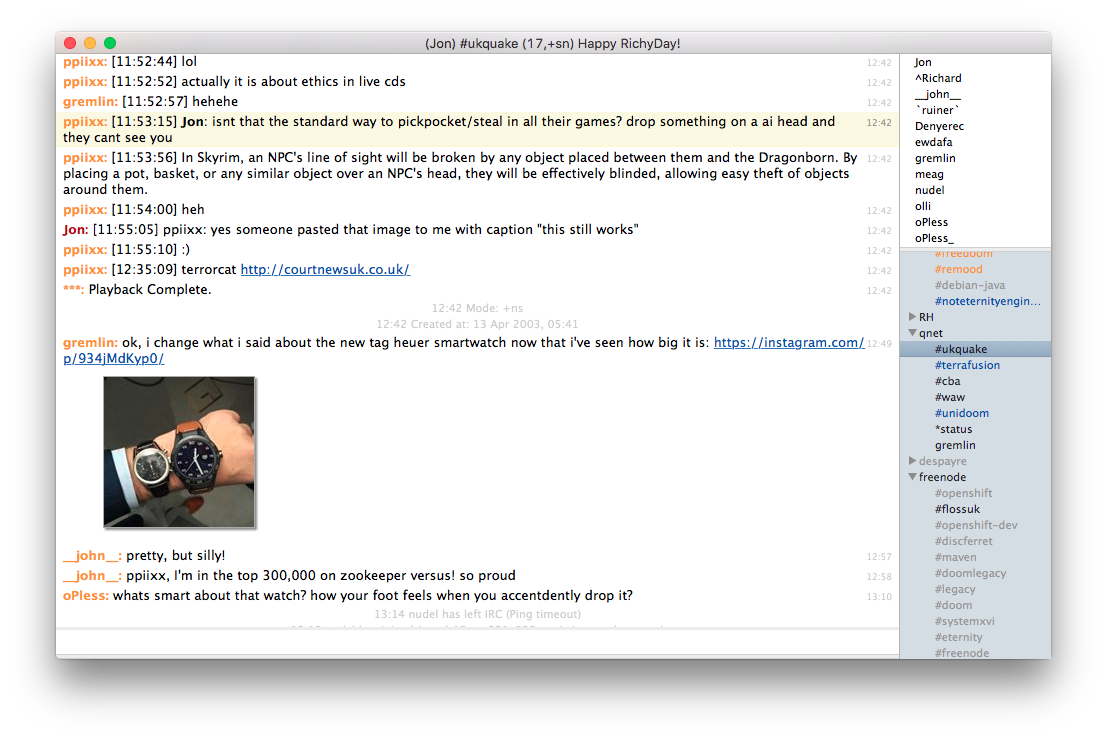
LimeChat, an IRC client. I theme it to look like Colloquy. The net result is pretty clean. I like using a proportional-font for text things, so getting IRC out of a terminal is a win for me. LimeChat automatically fetches and thumbnails URIs to images that people paste in channels, which is either incredibly convenient or a curse, depending on the channel. You can toggle that behaviour but only across the whole client, not on a channel or network basis. Finally, 1Password is an incredibly slick password manager. I use it in a very basic fashion: no mobile client, no syncing to anything outside of my workstation. You could also use LastPass which is similar and has a Linux client. I haven't tried it, but there's a third party tool to read 1Password password stores on Linux written by Ryan Coleman of SDL fame called 1pass.

Ritesh Raj Sarraf: apt-offline 1.7

Hello World, In this part of the world, today is a great day. Today is Diwali - the festival of lights On this day, I am very happy to announce the release of apt-offline, version 1.7. This release brings in a large number of fixes and is a recommended update. Thanks to Bernd Dietzel for uncovering the shell injection bug which could be exploited by carefully crafting the signature file. Since apt-offline could be run as 'root', this one was an important bug. Also thanks to him for the fix. During my tests, I also realized that apt-offline's --install-src-packages implementation had broken over time. --install-src-packages option can be useful to users who would like the offline ability to download a [Debian] source package, along with all its Build Dependencies. For further details on many of the other fixes, please refer to the git repository at the homepage. Packages for Debian (and derivatives) are already in the queue. Wishing You and Your Loved Ones a Very Happy Diwali.

Categories:

Keywords:

Images:

Like:

9 November 2015

Vasudev Kamath: Forwarding host port to service in container

Problem I've lxc container running distcc daemon and I would like to forward the distcc traffic coming to my host system to container.
Solution Following simple script which uses iptable did the job.
 #!/bin/sh
 set -e
usage()  
    cat <<EOF
    $(basename $0) [options] <in-interface> <out-interface> <port> <destination>
    --clear           Clear the previous rules before inserting new
                      ones
    --protocol        Protocol for the rules to use.
    in-interface      Interface on which incoming traffic is expected
    out-interface     Interface to which incoming traffic is to be
                      forwarded.
    port              Port to be forwarded. Can be integer or string
                      from /etc/services.
    destination       IP and port of the destination system to which
                      traffic needs to be forwarded. This should be in
                      form <destination_ip:port>
(C) 2015 Vasudev Kamath - This program comes with ABSOLUTELY NO
WARRANTY. This is free software, and you are welcome to redistribute
it under the GNU GPL Version 3 (or later) License
EOF
 
setup_portforwarding ()  
    local protocol="$1"
    iptables -t nat -A PREROUTING -i $IN_INTERFACE -p "$protocol" --dport $PORT \
           -j DNAT --to $DESTINATION
    iptables -A FORWARD -p "$protocol" -d $ DESTINATION%%\:*  --dport $PORT -j ACCEPT
    # Returning packet should have gateway IP
    iptables -t nat -A POSTROUTING -s $ DESTINATION%%\:*  -o \
           $IN_INTERFACE -j SNAT --to $ IN_IP%%\/* 
 
if [ $(id -u) -ne 0 ]; then
    echo "You need to be root to run this script"
    exit 1
fi
while true; do
    case "$1" in
      --clear)
          CLEAR_RULES=1
          shift
          ;;
      --protocol --protocol=*?)
      if [ "$1" = "--protocol" -a -n "$2" ];then
          PROTOCOL="$2"
          shift 2
      elif [ "$ 1#--protocol= " != "$1" ]; then
          PROTOCOL="$ 1$--protocol= "
          shift 1
      else
          echo "You need to specify protocl (tcp udp)"
          exit 2
      fi
      ;;
      *)
          break
          ;;
    esac
done
if [ $# -ne 4 ]; then
    usage $0
    exit 2
fi
IN_INTERFACE="$1"
OUT_INTERFACE="$2"
PORT="$3"
DESTINATION="$4"
# Get the incoming interface IP. This is used for SNAT.
IN_IP=$(ip addr show $IN_INTERFACE \
             perl -nE '/inet\s(.*)\sbrd/ and print $1')
if [ -n "$CLEAR_RULES" ]; then
    iptables -t nat -X
    iptables -t nat -F
    iptables -F
fi
if [ -n "$PROTOCOL" ]; then
    setup_portforwarding $PROTOCOL
else
    setup_portforwarding tcp
    setup_portforwarding udp
fi
Coming to systemd-nspawn I see there is --port option which takes argument in form proto:hostport:destport where proto can be either tcp or udp, hostport and destport are number from 1-65535. This option assumes private networking enabled in the container. I've not tried this option yet but that simplifies quite a lot of thing, its like -p switch used by docker.

8 November 2015

Andrew Cater: MiniDebconf Cambridge - ARM, Cambridge, 1340

Lightning talks -

David McBride Scalable infrastructure package distribution - even more mad idea than last year for his scalable package distribution round University of Cambridge - npn

Iain Learmonth - Vmdebootstrap sprint report detailing the work from the Sprint on Thursday/Friday. Live-build-ng needs more unit testing, boot testing, documentation. Working now and some images have been built but still in progress http://vmdebootstrap.alioth.debian.org

Helen (elgriff) talking about her weird keyboard
Repetittive strain injuries, carpal tunnel injuries.
Extensive computer use / brass instrument playing AND ignoring pain doing the above. Dont do this.
Vertical keyboards - SafeType and Yogitype.
You should care. If it hurts stop.You don't come with a five year warranty

Stefano Rovera (stefanor) - SVN-Git migration. Debian Python migration team did this for hundreds of packages. "Subversion is really, really evil - it's more evil than you thought"

Sledge - Update on ARM ports. Three ports - armel - older hardware. Armhf - ARMv7 hard float ABI. ARM64 / aarch64 - in Jessie - mostly working. Bits and pieces to be done. Over time, requirements have gone up and there are bits and pieces to work on. For the oldest machines in armel there's an amount of work to do - port may not survive beyond stretch: manpower / people who care is critical.


7 November 2015

Mart n Ferrari: Tales from the SRE trenches: Coda

This is the fifth -and last- part in a series of articles about SRE, based on the talk I gave in the Romanian Association for Better Software. Previous articles can be found here: part 1, part 2, part 3, and part 4.

Other lessons learned Apart from these guidelines for SRE I have described in previous posts, there were a few other practices I learned at google that I believe could benefit most operations teams out there (and developers too!).

Automate everything It's worth repeating, it is not sustainable to do things manually. When your manual work grows linearly with your usage, either your service is not growing enough, or you will need to hire more people than there are available in the market.

Involve Ops in systems design Nobody knows better than Ops the challenges of a real production environment, getting early feedback from your operations team can save you a lot of trouble down the road. They might give you insights about scalability, capacity planning, redundancy, and the very real limitations of hardware.

Give Ops time and space to innovate If there is so much emphasis on limiting the amount of operational load put on SRE, that freed time is not only used for creating monitoring dashboards or writing documentation. As I said in the beginning, SRE is an engineering team. And when engineers are not running around putting fires off all day long, they get creative. Many interesting innovations come from SREs even when there is no requirement for them.

Write design documents Design documents are not only useful for writing software. Fleshing out the details of any system on paper is a very useful way to find problems early in the process, communicate with your team exactly what are you building, and convince them why it is a great idea.

Review your code, version your changes This is something that is ubiquitous at Google, and not exclusive to SRE: everything is committed into source control: big systems, small scripts, configuration files. It might not seem worth it at the beginning, but having complete history of all your production environment is invaluable. And with source control, another rule comes into play: no change is committed without first being reviewed by a peer. It can be frustrating having to find a reviewer and wait for the approval for every small change, and some times reviews will be suboptimal, but once you get used to it, the benefits greatly out-weights any annoyances.

Before touching, measure Monitoring is not only for sending alerts, it is an essential tool of SRE. It allows you to gauge your availability, evaluate trends, forecast growth, perform forensic analysis. Also very importantly, it should give you the data needed to take decisions based on reality and not on guesses. Before optimising, find really where the bottleneck is; do not decide which database instance to use until you saw the utilisation of the past few months, etc. And speaking of that... We really need to have a chat about your current monitoring system. But that's for another day.
I hope I did not bore you too much with these walls of text! Some people told me directly they were enjoying these posts, so soon I will be writing more about related topics. In particular I would like to write about modern monitoring and Prometheus. I would love to hear your comments, questions, and criticisms. Comment

Andrew Cater: Mini Debconf 2015 ARM Cambridge - ARM, 7 November

Belated thanks to the ARM folk who arranged car park spaces for me for Thursday and Friday. I'm mobility impaired so this made a huge difference.

Today is the more open day - not so much programming, more presentations and talks. Also being live streamed. http://video.debconf.org:8000/minidebconf.ogv

Schedule is slightly changed but the wiki is correct

The auditorium is pretty full even at 0925

Thanks as ever to front desk and the ARM security staff who have wekcined ** welcomed us. Here's to a good day

** typing on laptop balanced on lap

6 November 2015

Mike Gabriel: Do Jolla Smartphones really exist?

Having ordered a Jolla smartphone in the last week of September 2015, I already accepted by now that possibly Jolla smartphones don't really exist. But today (finally!) after six weeks of acceptance... / waiting... I received a mail with the below subject:
    Subject: Jolla Shop: Shipping confirmation for order #500010511
Maybe Jolla smartphones do really exist... Let's see if that phone will be a venerable successor for my beloved N900.
\o/ .oO ( Hurray ! )
I will keep you posted, so stay tuned...
light+love
Mike

Matthew Garrett: Why improving kernel security is important

The Washington Post published an article today which describes the ongoing tension between the security community and Linux kernel developers. This has been roundly denounced as FUD, with Rob Graham going so far as to claim that nobody ever attacks the kernel.

Unfortunately he's entirely and demonstrably wrong, it's not FUD and the state of security in the kernel is currently far short of where it should be.

An example. Recent versions of Android use SELinux to confine applications. Even if you have full control over an application running on Android, the SELinux rules make it very difficult to do anything especially user-hostile. Hacking Team, the GPL-violating Italian company who sells surveillance software to human rights abusers, found that this impeded their ability to drop their spyware onto targets' devices. So they took advantage of the fact that many Android devices shipped a kernel with a flawed copy_from_user() implementation that allowed them to copy arbitrary userspace data over arbitrary kernel code, thus allowing them to disable SELinux.

If we could trust userspace applications, we wouldn't need SELinux. But we assume that userspace code may be buggy, misconfigured or actively hostile, and we use technologies such as SELinux or AppArmor to restrict its behaviour. There's simply too much userspace code for us to guarantee that it's all correct, so we do our best to prevent it from doing harm anyway.

This is significantly less true in the kernel. The model up until now has largely been "Fix security bugs as we find them", an approach that fails on two levels:

1) Once we find them and fix them, there's still a window between the fixed version being available and it actually being deployed
2) The forces of good may not be the first ones to find them

This reactive approach is fine for a world where it's possible to push out software updates without having to perform extensive testing first, a world where the only people hunting for interesting kernel vulnerabilities are nice people. This isn't that world, and this approach isn't fine.

Just as features like SELinux allow us to reduce the harm that can occur if a new userspace vulnerability is found, we can add features to the kernel that make it more difficult (or impossible) for attackers to turn a kernel bug into an exploitable vulnerability. The number of people using Linux systems is increasing every day, and many of these users depend on the security of these systems in critical ways. It's vital that we do what we can to avoid their trust being misplaced.

Many useful mitigation features already exist in the Grsecurity patchset, but a combination of technical disagreements around certain features, personality conflicts and an apparent lack of enthusiasm on the side of upstream kernel developers has resulted in almost none of it landing in the kernels that most people use. Kees Cook has proposed a new project to start making a more concerted effort to migrate components of Grsecurity to upstream. If you rely on the kernel being a secure component, either because you ship a product based on it or because you use it yourself, you should probably be doing what you can to support this.

Microsoft received entirely justifiable criticism for the terrible state of security on their platform. They responded by introducing cutting-edge security features across the OS, including the kernel. Accusing anyone who says we need to do the same of spreading FUD is risking free software being sidelined in favour of proprietary software providing more real-world security. That doesn't seem like a good outcome.

comment count unavailable comments

4 November 2015

Mart n Ferrari: Tales from the SRE trenches: What can SRE do for you?

This is the fourth part in a series of articles about SRE, based on the talk I gave in the Romanian Association for Better Software. Previous articles can be found here: part 1, part 2, and part 3. As a side note, I am writing this from Heathrow Airport, about to board my plane to EZE. Buenos Aires, here I come!

So, what does SRE actually do? Enough about how to keep the holy wars under control and how to get work away from Ops. Let's talk about some of the things that SRE does. Obviously, SRE runs your service, performing all the traditional SysAdmin duties needed for your cat pictures to reach their consumers: provisioning, configuration, resource allocation, etc. They use specialised tools to monitor the service, and get alerted as soon as a problem is detected. They are also the ones waking up to fix your bugs in the middle of the night. But that is not the whole story: reliability is not only impacted by new launches. Suddenly usage grows, hardware fails, networks lose packets, solar flares flip your bits... When working at scale, things are going to break more often than not. You want these breakages to affect your availability as little as possible, there are three strategies you can apply to this end: minimise the impact of each failure, recover quickly, and avoid repetition. And of course, the best strategy of them all: preventing outages from happening at all.

Minimizing the impact of failures A single failure that takes the whole service down will affect severely your availability, so the first strategy as an SRE is to make sure your service is fragmented and distributed across what is called "failure domains". If the data center catches fire, you are going to have a bad day, but it is a lot better if only a fraction of your users depend on that one data center, while the others keep happily browsing cat pictures. SREs spend a lot of their time planning and deploying systems that span the globe to maximise redundancy while keeping latencies at reasonable levels.

Recovering quickly Many times, retrying after a failure is actually the best option. So another strategy is to automatically restart in milliseconds any piece of your system that fails. This way, less users are affected, while a human has time to investigate and fix the real problem. If a human needs to intervene, it is crucial that they get notified as fast as possible, and that they have quick access to all the information that is needed to solve the problem: detailed documentation of the production environment, meaningful and extensive monitoring, play-books1, etc. After all, at 2 AM you probably don't remember in which country the database shard lives, or what were the series of commands to redirect all the traffic to a different location. Implementing monitoring and automated alerts, writing documentation and play-books, and practising for disaster are other areas where SREs devote much effort.

Avoiding repetition Outages happen, pages ring, problems get fixed, but it should always be a chance for learning and improving. A page should require a human to think about a problem and find a solution. If the same problem keeps appearing, the human is not needed any more: the problem needs to be fixed at the root. Another key aspect of dealing with incidents is to write post-mortems2. Every incident should have one, and these should be tools for learning, not finger-pointing. Post-mortems can be an excellent tool, if people are honest about their mistakes, they are not used to blame other people, and issues are followed up by bug reports and discussions.

Preventing outages Of course nobody can prevent hard drives from failing, but there are certain classes of outages that can be forecasted with careful analysis. Usage spikes can bring a service down, but an SRE team will ensure that the systems are load-tested at higher-than-normal rates. They could also be prepared to quickly scale the service, provided the monitoring system will alert as soon as a certain threshold is reached. Monitoring is actually the key part in this: measuring relevant metrics for all the components of a system, and following their trends over time, SREs can completely avoid many outages: latencies growing out of acceptable bounds, disks filling up, progressive degradation of components, are all examples of typical problems automatically monitored (and alerted on) in an SRE team.
This is getting pretty long, so the next post will be the last one of these series, with some extra tips from SRE experience that I am sure can be applied in many places.

  1. A play-book is a document containing critical information needed when dealing with a specific alert: possible causes, hints for troubleshooting, links to more documentation. Some monitoring systems will automatically add a play-book URL to every alert sent, and you should be doing it too.
  2. Similarly to their real-life counterparts, a post-mortem is the process of examining a dead body (the outage), gutting it out and trying to understand what caused its demise.
Comment

Craig Sanders: Part-time sysadmin work in Melbourne?

I m looking for a part-time Systems Administration role in Melbourne, either in a senior capacity or happy to assist an existing sysadmin or development team. I m mostly recovered from a long illness and want to get back to work, on a part-time basis (up to 3 days per week). Preferably in the City or Inner North near public transport. I can commute further if there is scope for telecommuting once I know your systems and people, and trust has been established. If you have a suitable position available or know of someone who does, please contact me by email. Why hire me? Pros: Cons: Full CV available on request. I m in the top few percent on ServerFault and Unix & Linux StackExchange sites if you want to get a preview of my problem-solving and technical communication skills, see my profile at: http://unix.stackexchange.com/users/7696/cas?tab=profile CV Summary: Systems Administrator and Programmer with extensive exposure to a wide variety of hardware and software systems. Excellent fault-diagnosis, problem-solving and system design skills. Strong technical/user support background. Ability to communicate technical concepts clearly to non-IT people. Significant IT Management and supervisory experience. Particular Skills Part-time sysadmin work in Melbourne? is a post from: Errata

2 November 2015

Daniel Pocock: FOSDEM 2016 Real-Time Communications dev-room and lounge

FOSDEM is one of the world's premier meetings of free software developers, with over five thousand people attending each year. FOSDEM 2016 takes place 30-31 January 2016 in Brussels, Belgium. This call-for-participation contains information about:
  • Real-Time communications dev-room and lounge,
  • speaking opportunities,
  • volunteering in the dev-room and lounge,
  • related events around FOSDEM, including the XMPP summit,
  • social events (including the Saturday night dinner),
  • the Planet aggregation sites for RTC blogs
Call for participation - Real Time Communications (RTC) The Real-Time dev-room and Real-Time lounge is about all things involving real-time communication, including: XMPP, SIP, WebRTC, telephony, mobile VoIP, codecs, privacy and encryption. The dev-room is a successor to the previous XMPP and telephony dev-rooms. We are looking for speakers for the dev-room and volunteers and participants for the tables in the Real-Time lounge. The dev-room is only on Saturday, 30 January 2016 in room K.3.401. The lounge will be present for both days in building K. To discuss the dev-room and lounge, please join the FSFE-sponsored Free RTC mailing list. Speaking opportunities Note: if you used Pentabarf before, please use the same account/username Main track: the deadline for main track presentations was midnight on 30 October. Leading developers in the Real-Time Communications field are encouraged to consider submitting a presentation to the main track. Real-Time Communications dev-room: deadline 27 November. Please also use the Pentabarf system to submit a talk proposal for the dev-room. On the "General" tab, please look for the "Track" option and choose "Real-Time devroom". Other dev-rooms: some speakers may find their topic is in the scope of more than one dev-room. It is permitted to apply to more than one dev-room but please be kind enough to tell us if you do this. See the full list of dev-rooms. Lightning talks: deadline 27 November. The lightning talks are an excellent opportunity to introduce a wider audience to your project. Given that dev-rooms are becoming increasingly busy, all speakers are encouraged to consider applying for a lightning talk as well as a slot in the dev-room. Pentabarf system to submit a lightning talk proposal. On the "General" tab, please look for the "Track" option and choose "Lightning Talks". First-time speaking? FOSDEM dev-rooms are a welcoming environment for people who have never given a talk before. Please feel free to contact the dev-room administrators personally if you would like to ask any questions about it. Submission guidelines The Pentabarf system will ask for many of the essential details. Please remember to re-use your account from previous years if you have one. In the "Submission notes", please tell us about:
  • the purpose of your talk
  • any other talk applications (dev-rooms, lightning talks, main track)
  • availability constraints and special needs
You can use HTML in your bio, abstract and description. If you maintain a blog, please consider providing us with the URL of a feed with posts tagged for your RTC-related work. We will be looking for relevance to the conference and dev-room themes, presentations aimed at developers of free and open source software about RTC-related topics. Please feel free to suggest a duration between 20 minutes and 55 minutes but note that the final decision on talk durations will be made by the dev-room administrators. As the two previous dev-rooms have been combined into one, we may decide to give shorter slots than in previous years so that more speakers can participate. Please note FOSDEM aims to record and live-stream all talks. The CC-BY license is used. For any questions, please join the FSFE-sponsored Free RTC mailing list. Volunteers needed To make the dev-room and lounge run successfully, we are looking for volunteers:
  • FOSDEM provides video recording equipment and live streaming, volunteers are needed to assist in this
  • organizing one or more restaurant bookings (dependending upon number of participants) for the evening of Saturday, 30 January
  • participation in the Real-Time lounge
  • helping attract sponsorship funds for the dev-room to pay for the Saturday night dinner and any other expenses
  • circulating this Call for Participation to other mailing lists
FOSDEM is made possible by volunteers and if you have time to contribute, please feel free to get involved. Related events - XMPP and RTC summits The XMPP Standards Foundation (XSF) has traditionally held a summit in the days before FOSDEM. There is discussion about a similar summit taking place on 28 and 29 January 2016. Please see the XSF Summit 19 wiki and join the mailing list to discuss. We are also considering a more general RTC or telephony summit, potentially on 29 January. Please join the Free-RTC mailing list and send an email if you would be interested in participating, sponsoring or hosting such an event. Social events and dinners The traditional FOSDEM beer night occurs on Friday, 29 January On Saturday night, there are usually dinners associated with each of the dev-rooms. Most restaurants in Brussels are not so large so these dinners have space constraints. Please subscribe to the Free-RTC mailing list for further details about the Saturday night dinner options and how you can register for a seat. Spread the word and discuss If you know of any mailing lists where this CfP would be relevant, please forward this email. If this dev-room excites you, please blog or microblog about it, especially if you are submitting a talk. If you regularly blog about RTC topics, please send details about your blog to the planet site administrators:
http://planet.jabber.org ralphm@ik.nu
http://planet.sip5060.net daniel@pocock.pro
http://planet.opentelecoms.org daniel@pocock.pro
Please also link to the Planet sites from your own blog or web site. Contact For discussion and queries, please subscribe to the Free-RTC mailing list. The dev-room administration team:

31 October 2015

Chris Lamb: Free software activities in October 2015

Here is my monthly update covering a large part of what I have been doing in the free software world (previously):
Debian My work in the Reproducible Builds project was also covered in more depth in Lunar's weekly reports (#23, #24, #25, #26).
LTS

This month I have been paid to work 11 hours on Debian Long Term Support (LTS). In that time I did the following:
  • DLA 326-1 for zendframework fixing an SQL injection vulnerability.
  • DLA 332-1 for optipng correcting a use-after-free issue.
  • DLA 333-1 for cakephp preventing a remote Denial of Service attack.
  • DLA 337-1 for busybox fixing a vulnerability when unzipping a specially crafted zip file/
  • DLA 338-1 for xscreensaver preventing a crash when hot-swapping monitors.

Uploads
  • redis New upstream release as well as changing the default UNIX socket location and correctly supporting "cluster" mode config file hardening and redis-sentinel's runtime directory handling under systemd. An update for jessie was also uploaded.
  • python-redis Attempting to get the autopkgtest tests to finally pass.
  • debian-timeline Making the build reproducible.
  • gunicorn New upstream release.


30 October 2015

Ritesh Raj Sarraf: Fixing broken videos

Post iPhone launch, in this new age, it is common to carry a device capable of capturing high definition images and videos. Most people today carry a high end device capable of capturing video/audio, in the form of a Mobile Phone. This has made us raise our expectation that we should capture most moments, if not all. But as is with everything, sometimes things ditch you right at the moment when you did not want it to. In new age phones, scenarios usually are: you capturing a video and the actual data not written to the disk (battery drain, cpu overheat, software bug: Whatever). Such was my case from the year 2012, where one of the videos was corrupt. Corrupt as in, A/V not in sync. Now everytime I solve a real world problem using Free Software tools, I feel the need to express my gratitude. It also serves as a note for me (and maybe others too), for future, if I run into similar problems. ;-) So as it turns out (in layman terms), a video clip is nothing but 2 streams: Video and Audio. Now most video run at 30 frames per second. And the audio stream synchronizes with the video frames. Sorry, I did not read up beyond that, as I was able to fix my problem. cheekywink So, my thought was that the video stream is not corrupt. It just is rendering at a slower frame rate. So, there were 2 problems. 1: Video rendering slower than the usual 30 fps rate. 2: As a result of 1, audio not being in sync with video. Thanks to gpac tools, even a novice, I was able to quickly separate the streams. And then re-encode the video stream into 30 fps. And then merge the audio + video stream together. And the result: Just awesome. In below steps, Strip the video which results in a raw H264 data file. Similar for audio. And then just re-encode the streams, specifying the framerate.
MP4Box -add 20121002_164608.mp4#video -raw 1 -new test1
test1_track1.h264
MP4Box -add 20121002_164608.mp4#audio -raw 2 -new test1_audio
test1_audio_track2.aac
MP4Box -add test1_track1.h264:fps=30 -add test1_audio_track2.aac -new test1_audio_30fps.mp4

Categories:

Keywords:

Like:

29 October 2015

Mart n Ferrari: Tales from the SRE trenches: SREs are not firefighters

This is the third part in a series of articles about SRE, based on the talk I gave in the Romanian Association for Better Software. If you haven't already, you might want to read part 1 and part 2 first. In this post, I talk about some strategies to avoid drowning SRE people in operational work.

SREs are not firefighters As I said before, it is very important that there is trust and respect between Dev and Ops. If Ops is seen as just an army of firefighters that will gladly put away fires at any time of the night, there are less incentives to make good software. Conversely, if Dev is shielded from the realities of the production environment, Ops will tend to think of them as delusional and untrustworthy.

Common staffing pool for SRE and SWE The first tool to combat this at Google -and possibly a difficult one to implement in small organisations- is to have single headcount budgets for Dev and Ops. That means that the more SREs you need to support your service, the less developers you have to write it. Combined with this, Google offers the possibility to SREs to move freely between teams, or even to transfer out to SWE. Because of this, a service that is painful to support will see the most senior SREs leaving and will only be able to afford less experienced hires. All this is a strong incentive to write good quality software, to work closely and to listen to the Ops people.

Share 5% of operational work with the SWE team On the other hand, it is necessary that developers see first hand how the service works in production, understand the problems, and share the pain of things failing. To this end, SWEs are expected to take on a small fraction of the operational work from SRE: handling tickets, being on-call, performing deployments, or managing capacity. This results in better communication among the teams and a common understanding of priorities.

Cap operational load at 50% One very uncommon rule from SRE at Google, is that SREs are not supposed to spend more than half of their time on "operational work". SREs are supposed to be spending their time on automation, monitoring, forecasting growth... Not on repeatedly fixing manually issues that stem from bad systems.

Excess operational work overflows to SWE If an SRE team is found to be spending too much time on operational work, that extra load is automatically reassigned to the development team, so SRE can keep doing their non-operational duties. On extreme cases, a service might be deemed too unstable to maintain, and SRE support is completely removed: it means the development team now has to carry pagers and do all the operational work themselves. It is a nuclear option, but the threat of it happening is a strong incentive to keep things sane.
The next post will be less about how to avoid unwanted work and more about the things that SRE actually do, and how these make things better. Comment

27 October 2015

Mart n Ferrari: Tales from the SRE trenches: Dev vs Ops

This is the second part in a series of articles about SRE, based on the talk I gave in the Romanian Association for Better Software. On the first part, I introduced briefly what is SRE. Today, I present some concrete ways in which SRE tried to make things better, by stopping the war between developers and SysAdmins.

Dev vs Ops: the eternal battle So, it starts at looking at the problem: how to increase the reliability of the service? It turns out that some of the biggest sources of outages are new launches: a new feature that seemed innocuous somehow managed to bring the whole site down. Devs want to launch, and Ops want to have a quiet weekend, and this is were the struggle begins. When launches are problematic, bureaucracy is put in place to minimise the risks: launch reviews, checklists, long-lived canaries. This is followed by development teams finding ways of side-stepping those hurdles. Nobody is happy. One of the key aspects of SRE is to avoid this conflict completely, by changing the incentives, so these pressures between development and operations disappear. At Google, they achieve this with a few different strategies:

Have an SLA for your service Before any service can be supported by SRE, it has to be determined what is the level of availability that it must achieve to make the users and the company happy: this is called the Service Level Agreement (SLA). The SLA will define how availability is measured (for example, percentage of queries handled successfully in less than 50ms during the last quarter), and what is the minimum acceptable value for it (the Service Level Objective, or SLO). Note that this is a product decision, not a technical one. This number is very important for an SRE team and its relationship with the developers. It is not taken lightly, and it should be measured and enforced rigorously (more on that later). Only a few things on earth really require 100% availability (pacemakers, for example), and achieving really high availability is very costly. Most of us are dealing with more mundane affairs, and in the case of websites, there are many other things that fail pretty often: network glitches, OS freezes, browsers being slow, etc. So an SLO of 100% is almost never a good idea, and in most cases it is impossible to reach. In places like Google an SLO of "five nines" (99.999%) is not uncommon, and this means that the service can't fail completely for more than 5 minutes across a whole year!

Measure and report performance against SLA/SLO Once you have a defined SLA and SLO, it is very important that these are monitored accurately and reported constantly. If you wait for the end of the quarter to produce a hand-made report, the SLA is useless, as you only know you broke it when it is too late. You need automated and accurate monitoring of your service level, and this means that the SLA has to be concrete and actionable. Fuzzy requirements that can't be measured are just a waste of time. This is a very important tool for SRE, as it allows to see the progression of the service over time, detect capacity issues before they become outages, and at the same time show how much downtime can be taken without breaking the SLA. Which brings us to one core aspect of SRE:

Use error budgets and gate launches on them If SLO is the minimum rate of availability, then the result of calculating 1 - SLO is what fraction of the time a service can fail without failing out of the SLA. This is called an error budget, and you get to use it the way you want it. If the service is flaky (e.g. it fails consistently 1 of every 10000 requests), most of that budget is just wasted and you won't have any margin for launching riskier changes. On the other hand, a stable service that does not eat the budget away gives you the chance to bet part of it on releasing more often, and getting your new features quicker to the user. The moment the error budget is spent, no more launches are allowed until the average goes back out of the red. Once everyone can see how the service is performing against this agreed contract, many of the traditional sources of conflict between development and operations just disappear. If the service is working as intended, then SRE does not need to interfere on new feature launches: SRE trusts the developers' judgement. Instead of stopping a launch because it seems risky or under-tested, there are hard numbers that take the decisions for you. Traditionally, Devs get frustrated when they want to release, but Ops won't accept it. Ops thinks there will be problems, but it is difficult to back this feeling with hard data. This fuels resentment and distrust, and management is never pleased. Using error budgets based on already established SLAs means there is nobody to get upset at: SRE does not need to play bad cop, and SWE is free to innovate as much as they want, as long as things don't break. At the same time, this provides a strong incentive for developers to avoid risking their budget in poorly-prepared launches, to perform staged deployments, and to make sure the error budget is not wasted by recurrent issues.
That's all for today. The next article will continue delving into how traditional tensions between Devs and Ops are played in the SRE world. Comment

24 October 2015

Mart n Ferrari: Tales from the SRE trenches - Part 1

A few weeks ago, I was offered the opportunity to give a guest talk in the Romanian Association for Better Software. RABS is a group of people interested in improving the trade, and regularly hold events where invited speakers give presentations on a wide array of topics. The speakers are usually pretty high-profile, so this is quite a responsibility! To make things more interesting, much of the target audience works on enterprise software, under Windows platforms. Definitely outside my comfort zone! Considering all this, we decided the topic was going to be about Site Reliability Engineering (SRE), concentrating on some aspects of it which I believe could be useful independently of the kind of company you are working for. I finally gave the talk last Monday, and the audience seemed to enjoy it, so I am going to post here my notes, hopefully some other people will like it too.

Why should I care? I prepared this thinking of an audience of software engineers, so why would anyone want to hear about this idea that only seems to be about making the life of the operations people better? The thing is, having your work as a development team supported by an SRE team will also benefit you. This is not about empowering Ops to hit you harder when things blow apart, but to have a team that is your partner. A partner that will help you grow, handle the complexities of a production environment so you can concentrate on cool features, and that will get out of the way when things are running fine. A development team may seem to only care about adding features that will drive more and more users to your service. But an unreliable service is a service that loses users, so you should care about reliability. And what better to have a team has Reliability on their name?

What is SRE? SRE means Site Reliability Engineering, Reliability Engineering applied to "sites". Wikipedia defines Reliability Engineering as:
[..] engineering that emphasizes dependability in the life-cycle management of a product.
This is, historically, a branch of engineering that made possible to build devices that will work as expected even when their components were inherently unreliable. It focused on improving component reliability, establishing minimum requirements and expectations, and a heavy usage of statistics to predict failures and understand underlying problems. SRE started as a concept at Google about 12 years ago, when Ben Treynor joined the company and created the SRE team from a group of 7 production engineers. There is no good definition of what Site Reliability Engineering means; while the term and some of its ideas are clearly inspired in the more traditional RE, he defines SRE with these words1:
Fundamentally, it's what happens when you ask a software engineer to design an operations function.

Only hire coders After reading that quote it is not surprising that the first item in the SRE checklist2, is to only hire people who can code properly for SRE roles. Writing software is a key part of being SRE. But this does not mean that there is no separation between development and operations, nor that SRE is a fancy(er) name for DevOps3. It means treating operations as a software engineering problem, using software to solve problems that used to be solved by hand, implementing rigorous testing and code reviewing, and taking decisions based on data, not just hunches. It also implies that SREs can understand the product they are supporting, and that there is a common ground and respect between SREs and software engineers (SWEs). There are many things that make SRE what it is, some of these only make sense within a special kind of company like Google: many different development and operations teams, service growth that can't be matched by hiring, and more importantly, firm commitment from top management to implement these drastic rules. Therefore, my focus here is not to preach on how everybody should adopt SRE, but to extract some of the most useful ideas that can be applied in a wider array of situations. Nevertheless, I will first try to give an overview of how SRE works at Google.
That's it for today. In the next post I will talk about how to end the war between developers and SysAdmins. Stay tuned!

  1. http://www.site-reliability-engineering.info/2014/04/what-is-site-reliability-engineering.html
  2. SRE checklist extracted from Treynor's talk at SREcon14: https://www.usenix.org/conference/srecon14/technical-sessions/presentation/keys-sre
  3. By the way, I am still not sure what DevOps mean, it seems that everyone has a different definition for it.
Comment

23 October 2015

Russ Allbery: Review: Watchtower

Review: Watchtower, by Elizabeth A. Lynn
Series: Chronicles of Tornor #1
Publisher: Berkley
Copyright: February 1979
Printing: November 1982
ISBN: 0-425-06195-7
Format: Mass market
Pages: 226
Ryke is a soldier in service to Athor, lord of Tornor Keep. Or, at least, he was. Shortly before the opening lines of this book, Tornor Keep was taken by a southerner named Col Istor, and Athor was killed. Ryke is about to change sides under duress: his service to Col as a watch commander is the price of keeping Errel, Athor's son, alive. Alive does not mean treated with dignity, however; Errel's new place is to become court jester for Col's small domain. At the start of this book, I had no idea who Col Istor was or why he'd want to take over one of the border keeps that guard the country of Arun against its northern neighbor Anhard. At the end of this book, I still had little idea. Watchtower's relationship with world-building is not what you'd normally expect from a fantasy novel. There are only a few locations in this novel, and they're described in close detail but without much historical or strategic context. The narrative, despite being third person, follows Ryke very closely, and Ryke is not interested in thinking much about the history of his world that he knows and the reader doesn't. Or he may not care. Ryke does not come across as a curious or thoughtful person. He's a soldier, he lives to serve his lord, and that service transfers from Athor to Errel and simply stays there, with little discussion or argument. The opening section of this novel shows Ryke trying to take care of Errel while serving Col and listening to his plans to take over the rest of the northern keeps. I found it slow, claustrophobic, and not very interesting. It reads a bit like a day in the life in some grim medieval military, with little world-building or context. Watchtower is technically fantasy, but mostly because the geography and politics are imaginary. Magic is limited to a very tiny bit of (essentially) Tarot card reading and has little impact on the plot. The story does get somewhat more interesting when two green clan messengers enter the story, and Ryke and Errel escape. Lynn introduces another community and another way of life into the story than the one Ryke is used to, one that seemed modeled after monastic orders (but with the religion toned down to nearly nonexistent). I think the intended conflict of the story is between those ways of life, their draws and implications, but even that conflict is never clearly stated. Ryke seems to move from one inevitability to another, and while he does question some of his previous views and seems to open his mind a bit, actual growth is limited in this story. I reached the end of the book feeling the world was largely unchanged from its start. This story won the World Fantasy award for best novel in 1980. I have to admit I'm baffled, although partly that's because this is not really my thing. I prefer my fantasy to have more epic sweep and a lot more world-building. But perhaps the award was for the writing, which is evocative and fills the moments of the story with closely-observed detail. It has a distinctive, choppy feel, full of short declarative sentences:
The wind blew. Like some night creature caught in a trap, Col Istor's banner flapped on its pole. Ryke wondered where his wolfhound was. Sheltering, he hoped, in some warm and windless corner. He thrust his hands beneath his armpits to warm them. He entered the kitchen, nodding at the guard who stood there, and went toward the scullery. The kitchenboys huddled together in sleep like dogs in front of the oven. He stepped over their legs. The iron pots on the walls vibrated softly.
That's a paragraph chosen at random from the start of the book and should give you a good feel for the style. I think I would have liked this novel better if it had followed anyone other than Ryke. Not only did I not care for him and his simplistic loyalties, he's the least interesting character in this story. Everyone else Col, Errel, Sorren, Van, and others is more complex and more thoughtful than he is, and I think many of them would have made a better protagonist. He spends much of the center part of the book being suspicious and closed and incurious, which means the reader can only guess at what's going on between the other characters. I can't really recommend this book, but the writing is solid and it has some interesting properties for late 1970s fantasy, including both a frank look at the role of women in this society and same-sex relationships. If your taste in fantasy leans towards the gritty and realistic, you might like it more than I did. I may try the later books of the series in the hope that they have more interesting protagonists. Followed by Dancers of Arun. Rating: 6 out of 10

22 October 2015

Joey Hess: propellor orchestration

With the disclamer that I don't really know much about orchestration, I have added support for something resembling it to Propellor. Until now, when using propellor to manage a bunch of hosts, you updated them one at a time by running propellor --spin $somehost, or maybe you set up a central git repository, and a cron job to run propellor on each host, pulling changes from git. I like both of these ways to use propellor, but they only go so far... All those scenarios are supported by propellor now! Well, I haven't actually implemented concurrently yet, but the point is that the conducts property can be used with any of propellor's property combinators, like before etc, to express all kinds of scenarios. The conducts property works in combination with an orchestrate function to set up all the necessary stuff to let one host ssh into another and run propellor there.
main = defaultMain (orchestrate hosts)
hosts = 
    [ master
    , webservers 
    , ...
    ]
The orchestrate function does a bunch of stuff: I've very pleased that I was able to add the Propellor.Property.Conductor module implementing this with only a tiny change to the rest of propellor. Almost everything needed to implement it was there in propellor's infrastructure already. Also kind of cool that it only needed 13 lines of imperative code, the other several hundred lines of the implementation being all pure code.

Next.

Previous.