Search Results: "nic"

31 December 2023

Chris Lamb: Favourites of 2023

This post should have marked the beginning of my yearly roundups of the favourite books and movies I read and watched in 2023. However, due to coming down with a nasty bout of flu recently and other sundry commitments, I wasn't able to undertake writing the necessary four or five blog posts In lieu of this, however, I will simply present my (unordered and unadorned) highlights for now. Do get in touch if this (or any of my previous posts) have spurred you into picking something up yourself

Books

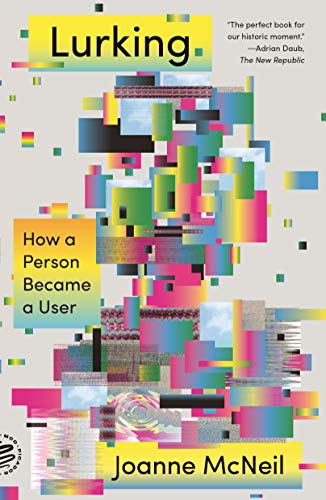
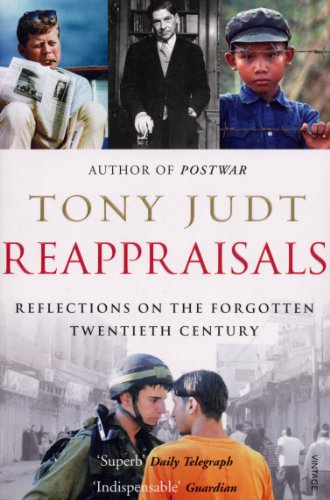
Peter Watts: Blindsight (2006) Reymer Banham: Los Angeles: The Architecture of Four Ecologies (2006) Joanne McNeil: Lurking: How a Person Became a User (2020) J. L. Carr: A Month in the Country (1980) Hilary Mantel: A Memoir of My Former Self: A Life in Writing (2023) Adam Higginbotham: Midnight in Chernobyl (2019) Tony Judt: Postwar: A History of Europe Since 1945 (2005) Tony Judt: Reappraisals: Reflections on the Forgotten Twentieth Century (2008) Peter Apps: Show Me the Bodies: How We Let Grenfell Happen (2021) Joan Didion: Slouching Towards Bethlehem (1968)Erik Larson: The Devil in the White City (2003)

Films Recent releases

Unenjoyable experiences included Alejandro G mez Monteverde's Sound of Freedom (2023), Alex Garland's Men (2022) and Steven Spielberg's The Fabelmans (2022).
Older releases (Films released before 2022, and not including rewatches from previous years.) Distinctly unenjoyable watches included Ocean's Eleven (1960), El Topo (1970), L olo (1992), Hotel Mumbai (2018), Bulworth (1998) and and The Big Red One (1980).

30 December 2023

Riku Voipio: Adguard DNS, or how to reduce ads without apps/extensions

Looking at the options for blocking ads, people usually first look at browser extensions. Google's plan is to disable adblock extensions in 2024. The alternative is usually an app (on phones) or a "VPN" that does filtering for you. All these methods are quite heavyweight, and require installing software on your phone or PC. What is less known, is that you can you DNS-over-TLS or DNS-over-HTTPS for ad blocking.
What is DNS-over-TLS and DNS-over-HTTPS
Since Android 9, Google has provided a setting calledPrivate DNS. Traditional DNS is unencrypted UDP so anyone can monitor your requests and/or return false records. With private DNS, DNS-over-TLS or DNS-over-HTTPS is used to guarantee the DNS request is sent to the server you configured. Which Google hopes is of course Google's own public servers. If you do so, your ISP and hotspot providers no longer can monitor, monetize and enshittify your DNS requests - only Google can do so.
Subverting private DNS for ad blocking
This is where AdGuard DNS comes useful. By setting the AdGuard DNS server as your "private DNS" server following the instructions,you can start blocking right away. Note, on PC you can also configure the Adguard DNS server on the Browser settings (Firefox -> Enable secure DNS and Chrome -> Use Secure DNS) instead of configuring a system-wide DNS server. Blocking via DNS, of course, limits effectiveness to ads distributed from 3rd party servers.
Other uses for AdGuard DNS
If you register for Adguard DNS, you get your "own", customizable DNS server address to point to. You can, for example, create your own /etc/hosts style records that are now available to all you devices you have connected to the Adguard DNS server - whether your a are home or not. Of course, you choose to use the personal DNS server, your DNS query privacy is in the hands of AdGuard.
Going further
What else is ruining the web than Ads? Well commercial social media. An article ("Ei n in! Algoritmi hky") from the latest Finnish Magazine SKROLLI (mainos: jos luet suomeksi, Tilaa skrolli!) hit a chord for me. The algorithms of social media sites are designed not to serve you, but to addict you. For example, If you stop to watch a hateful meme image, the algorithm will record "The user spent time watching this, show more of the same!". It doesn't help block or mute - yeah that spefic hate engager will be blocked, but all the dozens similar hate pages will still be shown to you. Worse, the social media sites are being overrun by AI-generated crap. Unfortunately the addictive nature of the algorithms works. You reload in vain, hoping this time the algorithmic god will show something your friends share. How do you cure addiction? By blocking yourself out:
Epilogue
I didn't block myself out of Fediverse - yet. It's not engineered to be addictive, which is also probably why it isn't as popular as the commercial alternatives...

Russ Allbery: Review: The Hound of Justice

Review: The Hound of Justice, by Claire O'Dell
Series: Janet Watson Chronicles #2
Publisher: Harper Voyager
Copyright: July 2019
ISBN: 0-06-269938-5
Format: Kindle
Pages: 325
The Hound of Justice is a near-future thriller novel with Sherlock Holmes references. It is a direct sequel to A Study in Honor. This series is best read in order. Janet Watson is in a much better place than she was in the first book. She has proper physical therapy, a new arm, and a surgeon's job waiting for her as soon as she can master its features. A chance meeting due to an Inauguration Day terrorist attack may even develop into something more. She just needs to get back into the operating room and then she'll feel like her life is back on track. Sara Holmes, on the other hand, is restless, bored, and manic, rudely intruding on Watson's date. Then she disappears, upending Watson's living arrangements. She's on the trail of something. When mysterious destructible notes start appearing in Watson's books, it's clear that she wants help. The structure of this book didn't really work for me. The first third or so is a slice-of-life account of Watson's attempt to resume her career as a surgeon against a backdrop of ongoing depressing politics. This part sounds like the least interesting, but I was thoroughly engrossed. Watson is easy to care about, hospital politics are strangely interesting, and while the romance never quite clicked for me, it had potential. I was hoping for another book like A Study in Honor, where Watson's life and Holmes's investigations entwine and run in parallel. That was not to be. The middle third of the book pulls Watson away to Georgia and a complicated mix of family obligations and spy-novel machinations. If this had involved Sara's fae strangeness, verbal sparring, and odd tokens of appreciation, maybe it would have worked, but Sara Holmes is entirely off-camera. Watson is instead dealing with a minor supporting character from the first book, who drags her through disguises, vehicle changes, and border stops in a way that felt excessive and weirdly out of place. (Other reviews say that this character is the Mycroft Holmes equivalent; the first initial of Micha's name fits, but nothing else does so far as I can tell.) Then the last third of the novel turns into a heist. I like a heist novel as much as the next person, but a good heist story needs a team with chemistry and interplay, and I didn't know any of these people. There was way too little Sara Holmes, too much of Watson being out of her element in a rather generic way, and too many steps that Watson is led through without giving the reader a chance to enjoy the competence of the team. It felt jarring and disconnected, like Watson got pulled out of one story and dropped into an entirely different story without a proper groundwork. The Hound of Justice still has its moments. Watson is a great character and I'm still fully invested in her life. She was pulled into this mission because she's the person Holmes knows with the appropriate skills, and when she finally gets a chance to put those skills to use, it's quite satisfying. But, alas, the magic of A Study in Honor simply isn't here, in part because Sara Holmes is missing for most of the book and her replacements and stand-ins are nowhere near as intriguing. The villain's plan seems wildly impractical and highly likely to be detected, and although I can come up with some explanations to salvage it, those don't appear in the book. And, as in the first book, the villain seems very one-dimensional and simplistic. This is certainly not a villain worthy of Holmes. Fittingly, given the political movements O'Dell is commenting on, a lot of this book is about racial politics. O'Dell contrasts the microaggressions and more subtle dangers for Watson as a black woman in Washington, D.C., with the more explicit and active racism of the other places to which she travels over the course of the story. She's trying very hard to give the reader a feeling for what it's like to be black in the United States. I don't have any specific complaints about this, and I'm glad she's attempting it, but I came away from this book with a nagging feeling that Watson's reactions were a tiny bit off. It felt like a white person writing about racism rather than a black person writing about racism: nothing is entirely incorrect, but the emotional beats aren't quite where black authors would put them. I could be completely wrong about this, and am certainly much less qualified to comment than O'Dell is, but there were enough places that landed slightly wrong that I wanted to note it. I would still recommend A Study in Honor, but I'm not sure I can recommend this book. This is one of those series where the things that I enjoyed the most about the first book weren't what the author wanted to focus on in subsequent books. I would read more about the day-to-day of Watson's life, and I would certainly read more of Holmes and Watson sparring and circling and trying to understand each other. I'm less interested in somewhat generic thrillers with implausible plots and Sherlock Holmes references. At the moment, this is academic, since The Hound of Justice is the last book of the series so far. Rating: 6 out of 10

Valhalla's Things: I've been influenced

Posted on December 30, 2023
Tags: madeof:atoms
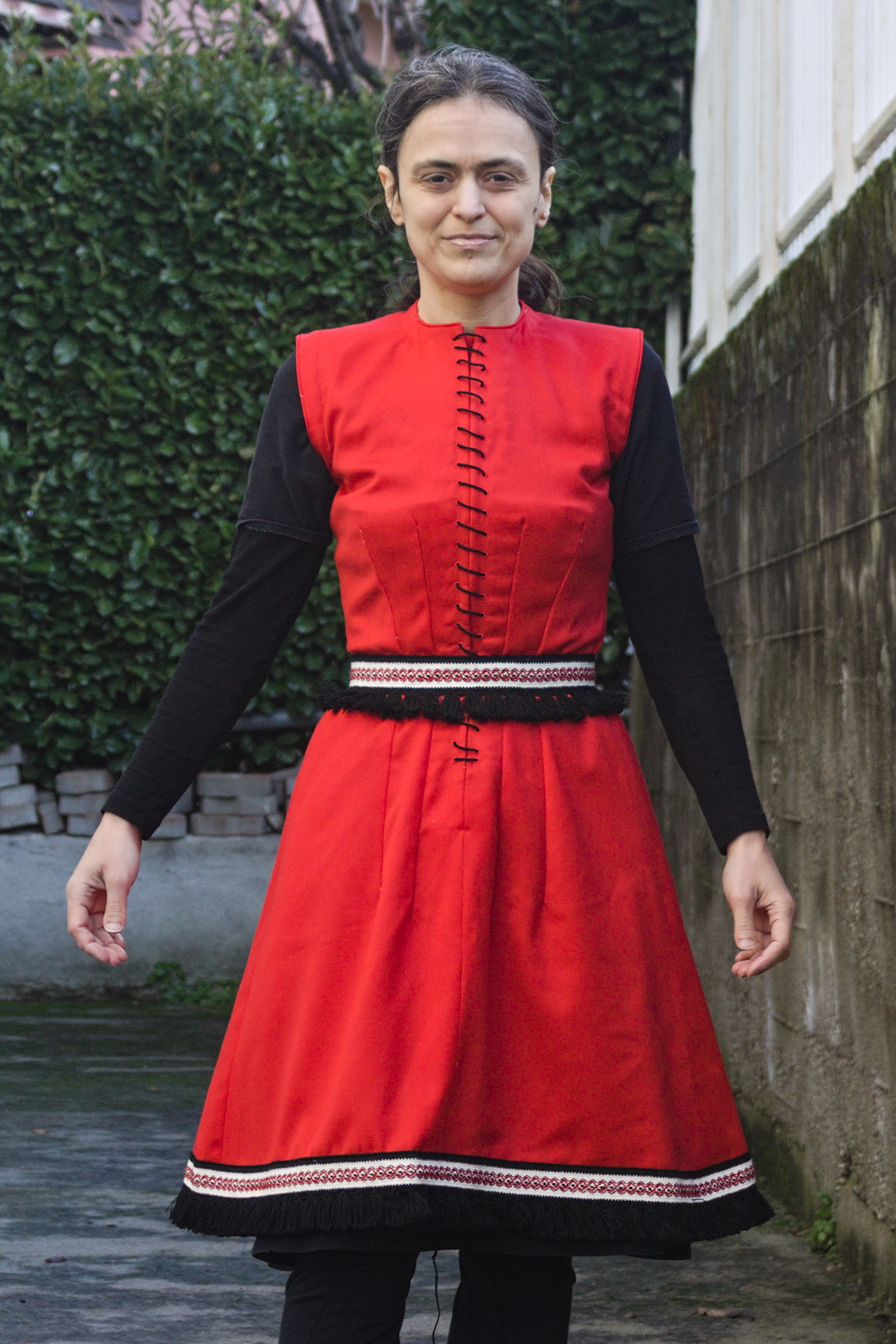
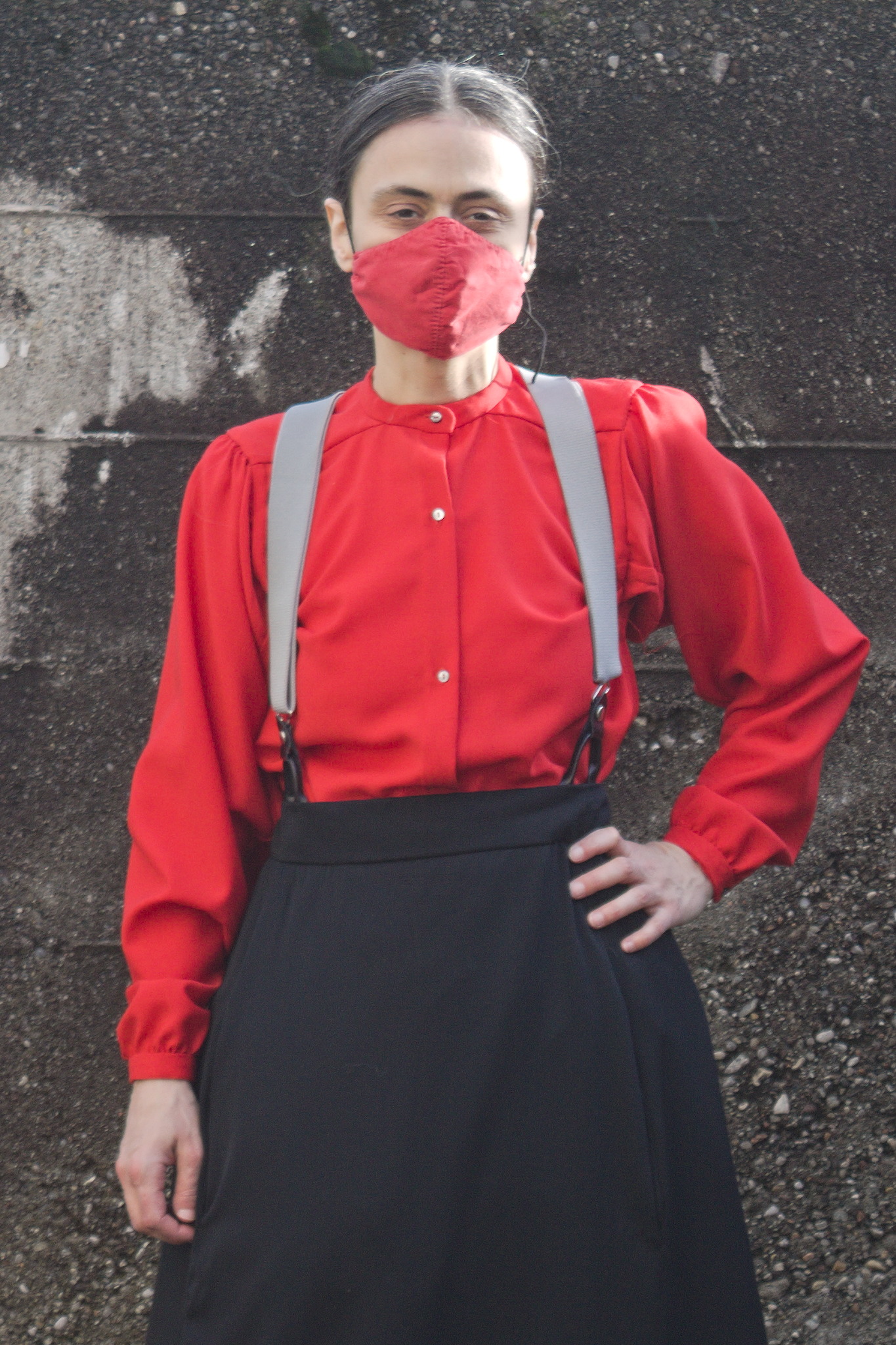
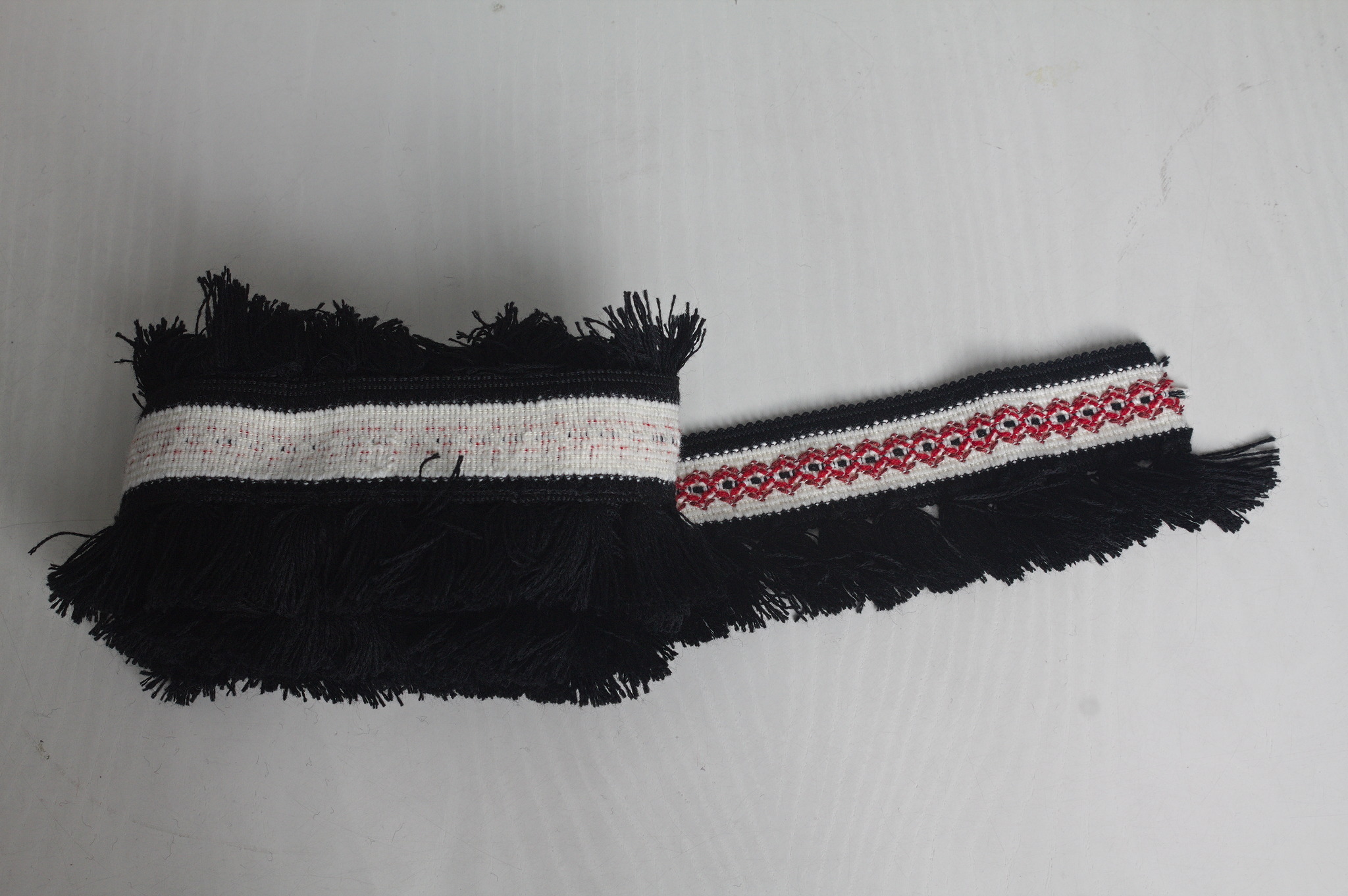
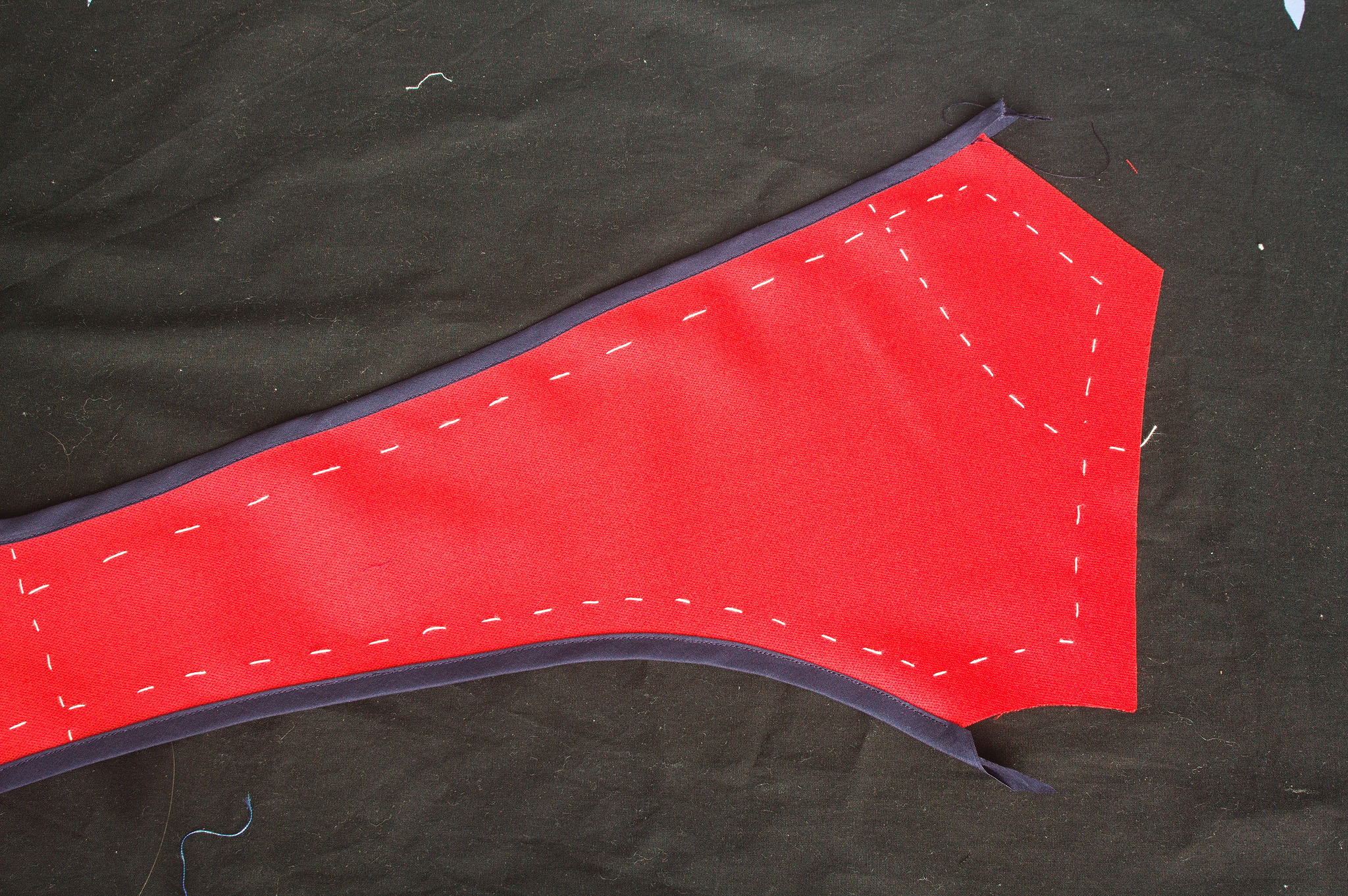
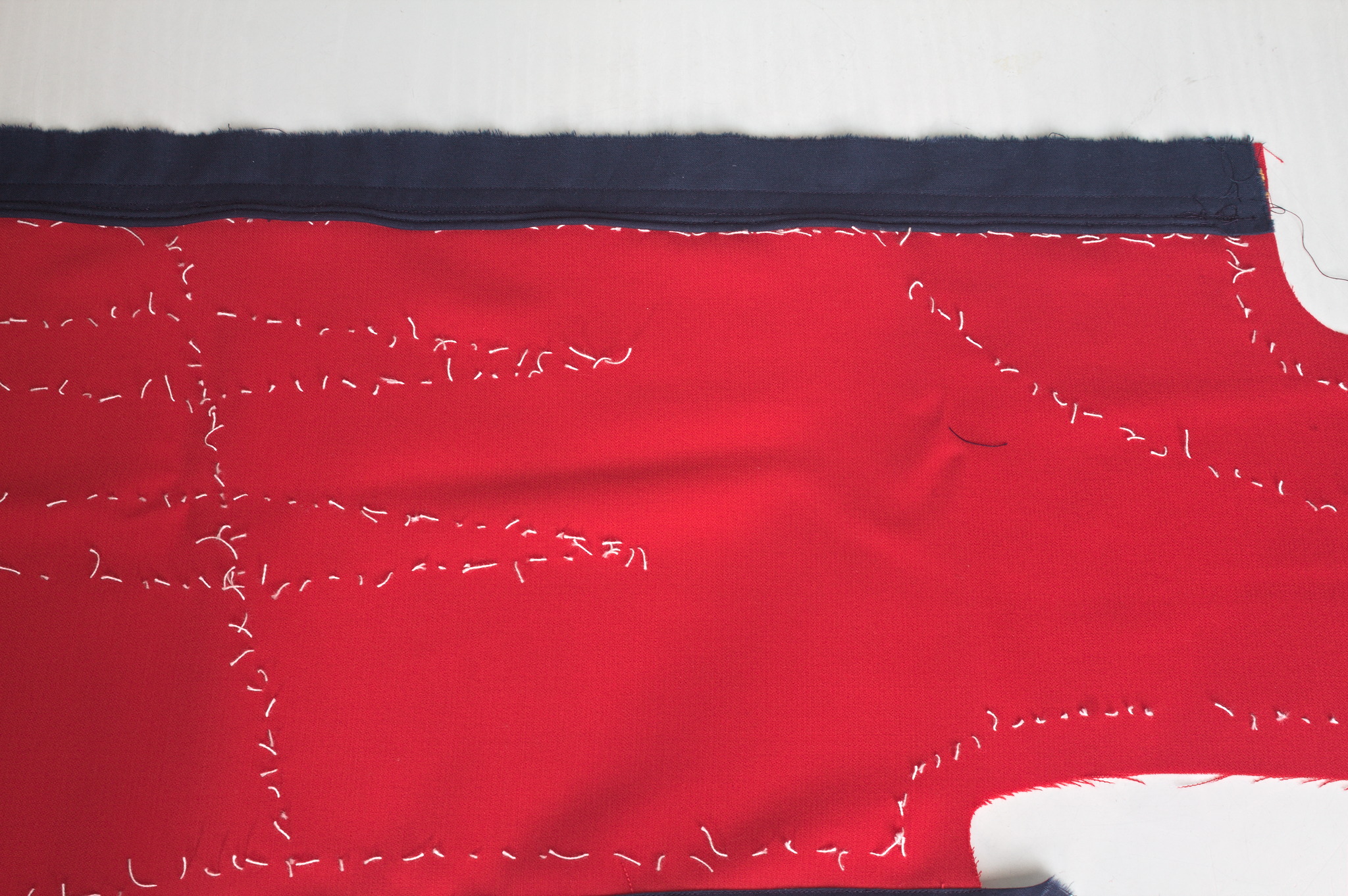
A woman wearing a red sleeveless dress; from the waist up it is fitted, while the skirt flares out. There is a white border with red embroidery and black fringe at the hem and a belt of the same material at the waist. By the influencers on the famous proprietary video platform1. When I m crafting with no powertools I tend to watch videos, and this autumn I ve seen a few in a row that were making red wool dresses, at least one or two medieval kirtles. I don t remember which channels they were, and I ve decided not to go back and look for them, at least for a time. A woman wearing a red shirt with wide sleeves, a short yoke, a small collar band and 3 buttons in the front. Anyway, my brain suddenly decided that I needed a red wool dress, fitted enough to give some bust support. I had already made a dress that satisfied the latter requirement and I still had more than half of the red wool faille I ve used for the Garibaldi blouse (still not blogged, but I will get to it), and this time I wanted it to be ready for this winter. While the pattern I was going to use is Victorian, it was designed for underwear, and this was designed to be outerwear, so from the very start I decided not to bother too much with any kind of historical details or techniques. A few meters of wool-imitation fringe trim rolled up; the fringe is black and is attached to a white band with a line of lozenge outlines in red and brown. I knew that I didn t have enough fabric to add a flounce to the hem, as in the cotton dress, but then I remembered that some time ago I fell for a piece of fringed trim in black, white and red. I did a quick check that the red wasn t clashing (it wasn t) and I knew I had a plan for the hem decoration. Then I spent a week finishing other projects, and the more I thought about this dress, the more I was tempted to have spiral lacing at the front rather than buttons, as a nod to the kirtle inspiration. It may end up be a bit of a hassle, but if it is too much I can always add a hidden zipper on a side seam, and only have to undo a bit of the lacing around the neckhole to wear the dress. Finally, I could start working on the dress: I cut all of the main pieces, and since the seam lines were quite curved I marked them with tailor s tacks, which I don t exactly enjoy doing or removing, but are the only method that was guaranteed to survive while manipulating this fabric (and not leave traces afterwards). A shaped piece of red fabric with the long edges bound in navy blue bias tape and all the seamlines marked with basting thread. While cutting the front pieces I accidentally cut the high neck line instead of the one I had used on the cotton dress: I decided to go for it also on the back pieces and decide later whether I wanted to lower it. Since this is a modern dress, with no historical accuracy at all, and I have access to a serger, I decided to use some dark blue cotton voile I ve had in my stash for quite some time, cut into bias strip, to bind the raw edges before sewing. This works significantly better than bought bias tape, which is a bit too stiff for this. A bigger piece of fabric with tailor's tacks for the seams and darts; at the top edge there is a strip of navy blue fabric sewn to a wide seaming allowance, with two rows of cording closest to the center front line. For the front opening, I ve decided to reinforce the areas where the lacing holes will be with cotton: I ve used some other navy blue cotton, also from the stash, and added two lines of cording to stiffen the front edge. So I ve cut the front in two pieces rather than on the fold, sewn the reinforcements to the sewing allowances in such a way that the corded edge was aligned with the center front and then sewn the bottom of the front seam from just before the end of the reinforcements to the hem. The front opening being worked on: on one side there are hand sewn eyelets in red silk that matches the fabric, on the other side the position for more eyelets are still marked with pins. There is also still basting to keep the folded allowance in place. The allowances are then folded back, and then they are kept in place by the worked lacing holes. The cotton was pinked, while for the wool I used the selvedge of the fabric and there was no need for any finishing. Behind the opening I ve added a modesty placket: I ve cut a strip of red wool, a strip of cotton, folded the edge of the strip of cotton to the center, added cording to the long sides, pressed the allowances of the wool towards the wrong side, and then handstitched the cotton to the wool, wrong sides facing. This was finally handstitched to one side of the sewing allowance of the center front. I ve also decided to add real pockets, rather than just slits, and for some reason I decided to add them by hand after I had sewn the dress, so I ve left opening in the side back seams, where the slits were in the cotton dress. I ve also already worn the dress, but haven t added the pockets yet, as I m still debating about their shape. This will be fixed in the near future. Another thing that will have to be fixed is the trim situation: I like the fringe at the bottom, and I had enough to also make a belt, but this makes the top of the dress a bit empty. I can t use the same fringe tape, as it is too wide, but it would be nice to have something smaller that matches the patterned part. And I think I can make something suitable with tablet weaving, but I m not sure on which materials to use, so it will have to be on hold for a while, until I decide on the supplies and have the time for making it. Another improvement I d like to add are detached sleeves, both matching (I should still have just enough fabric) and contrasting, but first I want to learn more about real kirtle construction, and maybe start making sleeves that would be suitable also for a real kirtle. Meanwhile, I ve worn it on Christmas (over my 1700s menswear shirt with big sleeves) and may wear it again tomorrow (if I bother to dress up to spend New Year s Eve at home :D )

  1. yep, that s YouTube, of course.

29 December 2023

Ulrike Uhlig: How do kids conceive the internet? - part 4

Read all parts of the series Part 1 // Part 2 // Part 3 // Part 4 I ve been wanting to write this post for over a year, but lacked energy and time. Before 2023 is coming to an end, I want to close this series and share some more insights with you and hopefully provide you with a smile here and there. For this round of interviews, four more kids around the ages of 8 to 13 were interviewed, 3 of them have a US background these 3 interviews were done by a friend who recorded these interviews for me, thank you! As opposed to the previous interviews, these four kids have parents who have a more technical professional background. And this seems to make a difference: even though none of these kids actually knew much better how the internet really works than the other kids that I interviewed, specifically in terms of physical infrastructures, they were much more confident in using the internet, they were able to more correctly name things they see on the internet, and they had partly radical ideas about what they would like to learn or what they would want to change about the internet! Looking at these results, I think it s safe to say that social reproduction is at work and that we need to improve education for kids who do not profit from this type of social and cultural wealth at home. But let s dive into the details.

The boy and the aliens (I ll be mostly transribing the interview, which was short, and which I find difficult to sum up because some of the questions are written in a way to encourage the kids to tell a story, and this particular kid had a thing going on with aliens.) He s a 13 year old boy living in the US. He has his own computer, which technically belongs to his school but can be used by him freely and he can also take it home. He s the first kid saying he s reading the news on the internet; he does not actually use social media, besides sometimes watching TikTok. When asked: Imagine that aliens land and come to you and say: We ve heard about this internet thing you all talk about, what is it? What do you tell them? he replied:
Well, I mean they re aliens, so I don t know if I wanna tell them much.
(Parents laughing in the background.) Let s assume they re friendly aliens.
Well, I would say you can look anything up and play different games. And there are alien games. But mostly the enemies are aliens which you might be a little offended by. And you can get work done, if you needed to spy on humans. There s cameras, you can film yourself, yeah. And you can text people and call people who are far away
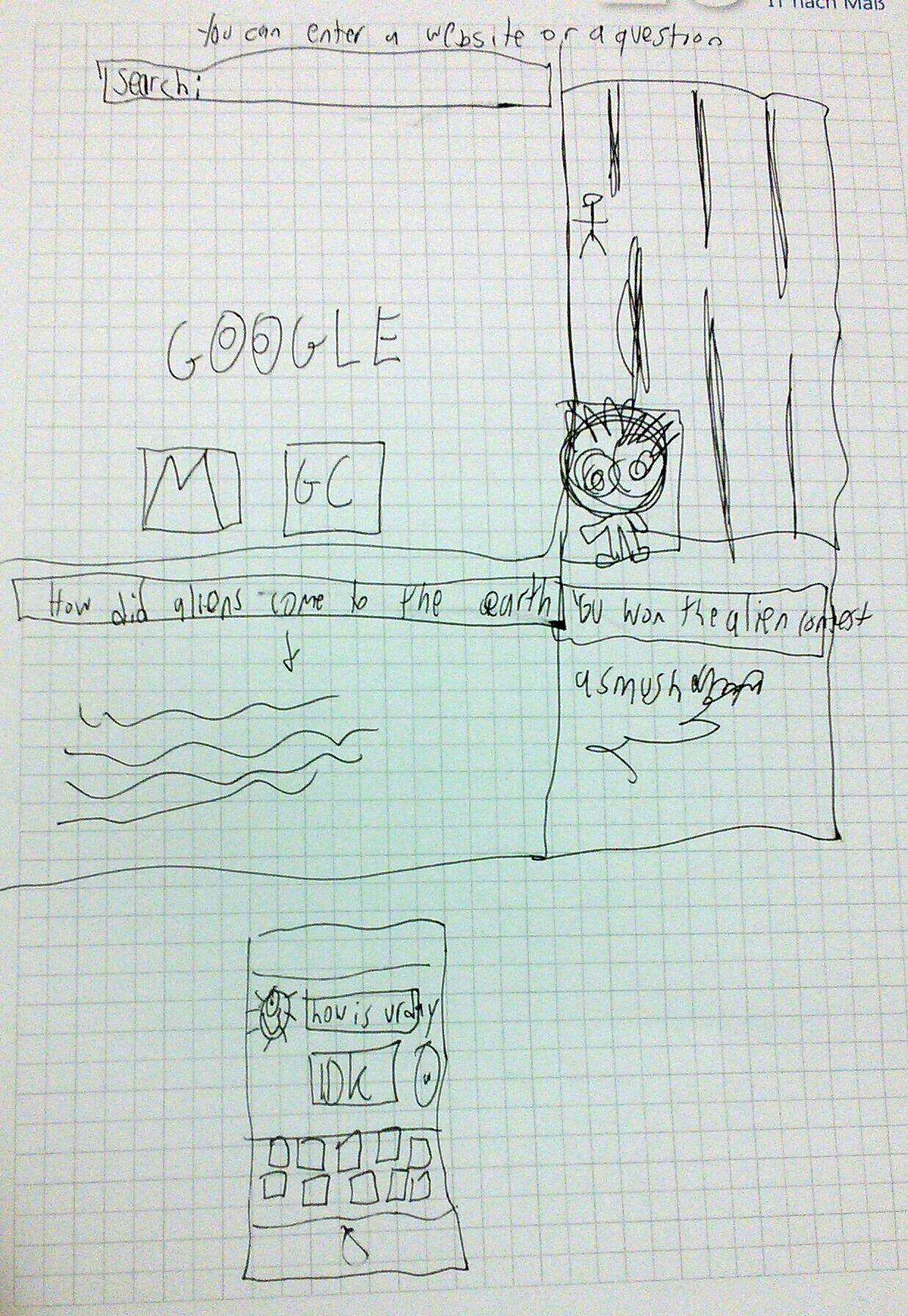
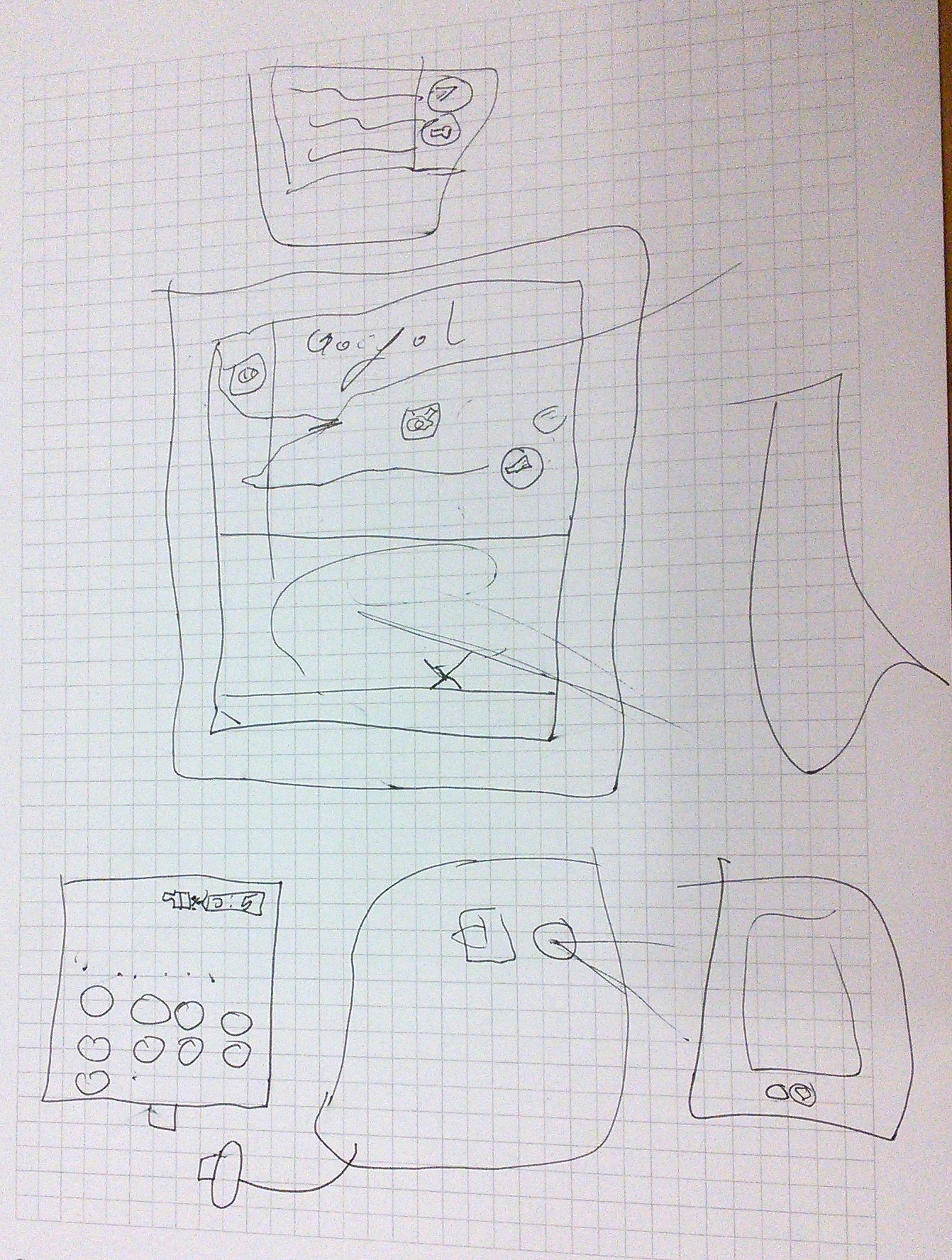
And what would be in a drawing that would explain the internet? Google, an alien using Twitch, Google search results, and the interface of an IM software on an iPhone drawn by a 13 year old boy And here s what he explains about his drawing:
First, I would draw what I see when you open a new tab, Google.
On the right side of the drawing we see something like Twitch.
I don t wanna offend the aliens, but you can film yourself playing a game, so here is the alien and he s playing a game.
And then you can ask questions like: How did aliens come to the Earth? And the answer will be here (below). And there ll be different websites that you can click on.
And you can also look up Who won the alien contest? And that would be Usmushgagu, and that guy won the alien contest.
Do you think the information about alien intergalactic football is already on the internet?
Yeah! That s how fast the internet is.
On the bottom of the drawing we see an iPhone and an instant messaging software.
There s also a device called an iPhone and with it you can text your friends. So here s the alien asking: How was ur day? and the friend might answer IDK [I don t know].
Imagine that a wise and friendly dragon could teach you one thing about the internet that you ve always wanted to know. What would you ask the dragon to teach you about?
Is there a way you don t have to pay for any channels or subscriptions and you can get through any firewall?
Imagine you could make the internet better for everyone. What would you do first?
Well you wouldn t have to pay for it [paywalls].
Can you describe what happens between your device and a website when you visit a website?
Well, it takes 0.025 seconds. [ ] It s connecting.
Wow, that s indeed fast! We were not able to obtain more details about what is that fast thing that s happening exactly

The software engineer s kid This kid identifies as neither boy nor girl, is 10 years old and lives in Germany. Their father works as a software engineer, or in the words of the child:
My dad knows everything.
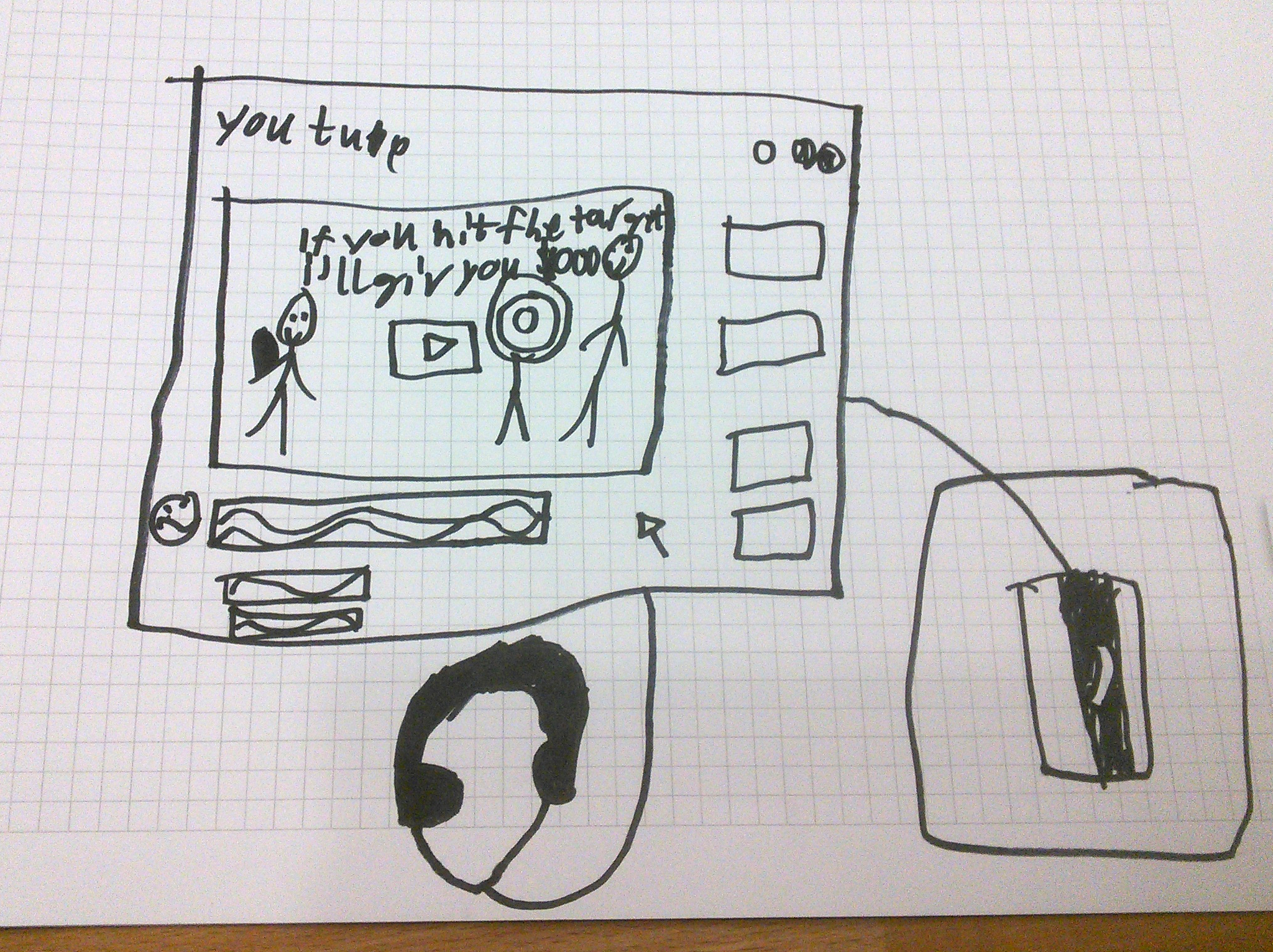
The kid has a laptop and a mobile phone, both with parental control they don t think that the controlling is fair. This kid uses the internet foremostly for listening to music and watching prank channels on Youtube but also to work with Purple Mash (a teaching platform for the computing curriculum used at their school), finding 3d printing models (that they ask their father to print with them because they did not manage to use the printer by themselves yet). Interestingly, and very differently from the non-tech-parent kids, this kid insists on using Firefox and Signal - the latter is not only used by their dad to tell them to come downstairs for dinner, but also to call their grandmother. This kid also shops online, with the help of the father who does the actual shopping for them using money that the kid earned by reading books. If you would need to explain to an alien who has landed on Earth what the internet is, what would you tell them?
The internet is something where you search, for example, you can look for music. You can also watch videos from around the world, and you can program stuff.
Like most of the kids interviewed, this kid uses the internet mostly for media consumption, but with the difference that they also engage with technology by way of programming using Purple Mash. drawing of the internet by a 10 year old showing a Youtube prank channel, an external device trackpad, and headphones In their drawing we see a Youtube prank channel on a screen, an external trackpad on the right (likely it s not a touch screen), and headphones. Notice how there is no keyboard, or maybe it s folded away. If you could ask a nice and friendly dragon anything you d like to learn about the internet, what would it be?
How do I shutdown my dad s computer forever?
And what is it that he would do to improve the internet for everyone? Contrary to the kid living in the US, they think that
It takes too much time to load stuff!
I wonder if this kid experiences the internet as being slow because they use the mobile network or because their connection somehow gets throttled as a way to control media consumption, or if the German internet infrastructure is just so much worse in certain regions If you could improve the internet for everyone, what would you do first? I d make a new Firefox app that loads the internet much faster.

The software engineer s daughter This girl is only 8 years old, she hates unicorns, and her dad is also a software engineer. She uses a smartphone, controlled by her parents. My impression of the interview is that at this age, kids slightly mix up the internet with the devices that they use to access the internet. drawing of the internet by an 8 year old girl, Showing Google and the interface to call and text someone In her drawing, we see again Google - it s clearly everywhere - and also the interfaces for calling and texting someone. To explain what the internet is, besides the fact that one can use it for calling and listening to music, she says:
[The internet] is something that you can [use to] see someone who is far away, so that you don t need to take time to get to them.
Now, that s a great explanation, the internet providing the possibility for communication over a distance :) If she could ask a friendly dragon something she always wanted to know, she d ask how to make her phone come alive:
that it can talk to you, that it can see you, that it can smile and has eyes. It s like a new family member, you can talk to it.
Sounds a bit like Siri, Alexa, or Furby, doesn t it? If you could improve the internet for everyone, what would you do first? She d have the phone be able to decide over her free time, her phone time. That would make the world better, not for the kids, but certainly for the parents.

The antifascist kid This German boy s dad has a background in electrotechnical engineering. He s 10 years old and he told me he s using the internet a lot for searching things for example about his passion: the firefighters. For him, the internet is:
An invisible world. A virtual world. But there s also the darknet.
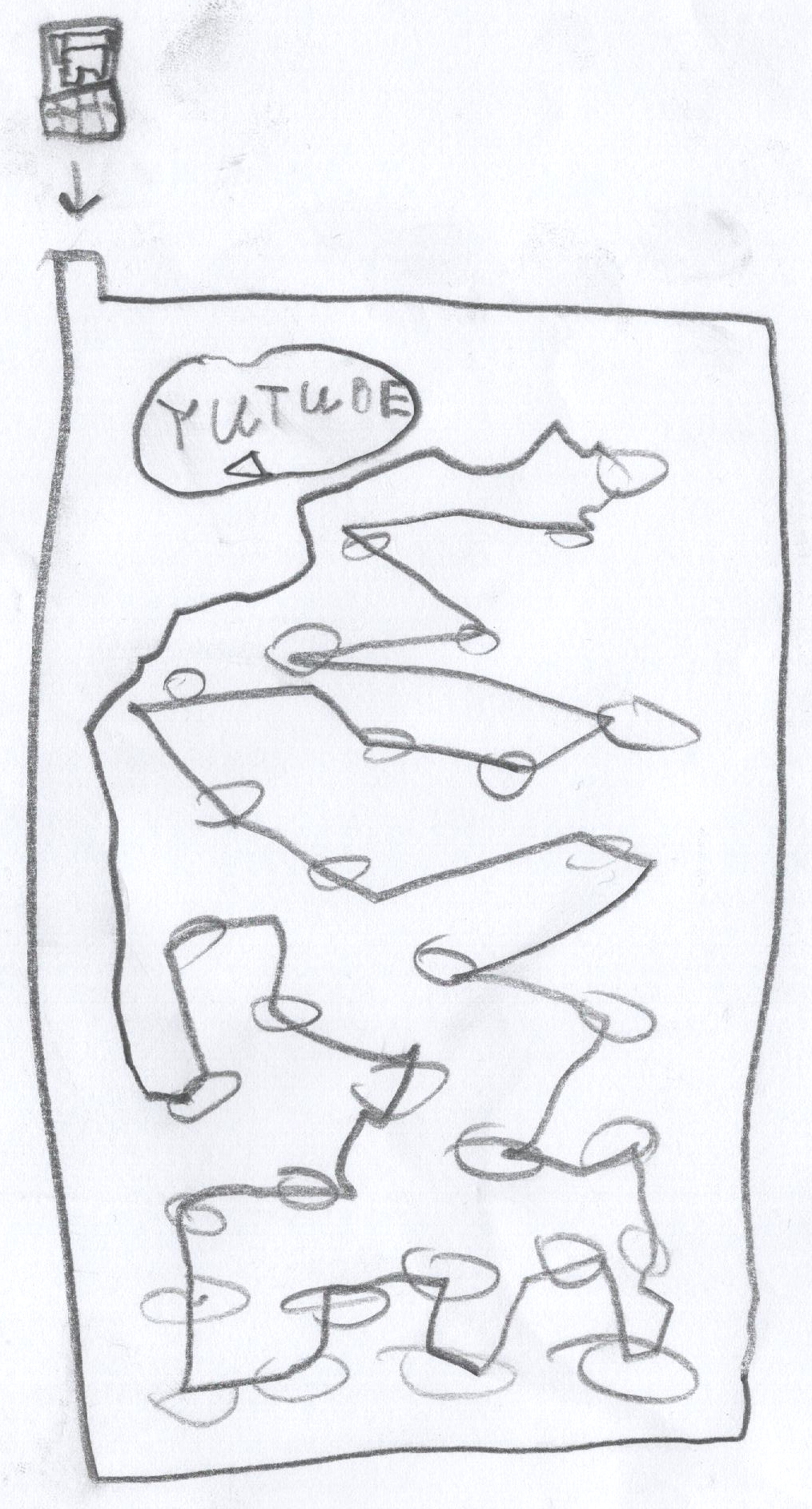
He told me he always watches that German show on public TV for kids that explains stuff: Checker Tobi. (In 2014, Checker Tobi actually produced an episode about the internet, which I d criticize for having only male characters, except for one female character: a secretary Google, a nice and friendly woman guiding the way through the huge library that s the internet ) This kid was the only one interviewed who managed to actually explain something about the internet, or rather about the hypertextual structure of the web. When I asked him to draw the internet, he made a drawing of a pin board. He explained:
Many items are attached to the pin board, and on the top left corner there s a computer, for example with Youtube and one can navigate like that between all the items, and start again from the beginning when done.
hypertext structure representing the internet drawn by a kid When I asked if he knew what actually happens between the device and a website he visits, he put forth the hypothesis of the existence of some kind of
Waves, internet waves - all this stuff somehow needs to be transmitted.
What he d like to learn:
How to get into the darknet? How do you become a Whitehat? I ve heard these words on the internet, the internet makes me clever.
And what would he change on the internet if he could?
I want that right wing extreme stuff is not accessible anymore, or at least, that it rains turds ( Kackw rste ) whenever people watch such stuff. Or that people are always told: This video is scum.
I suspect that his father has been talking with him about these things, and maybe these are also subjects he heard about when listening to punk music (he told me he does), or browsing Youtube.

Future projects To me this has been pretty insightful. I might share some more internet drawings by adults in the future, which I think are also really interesting, as they show very different things depending on the age of the person. I ve been using the information gathered to work on a children s book which I hope to be able to share with you next year.

Russ Allbery: Review: The Afterward

Review: The Afterward, by E.K. Johnston
Publisher: Dutton Books
Copyright: February 2019
Printing: 2020
ISBN: 0-7352-3190-7
Format: Kindle
Pages: 339
The Afterward is a standalone young adult high fantasy with a substantial romance component. The title is not misspelled. Sir Erris and her six companions, matching the number of the new gods, were successful in their quest for the godsgem. They defeated the Old God and destroyed Him forever, freeing King Dorrenta from his ensorcellment, and returned in triumph to Cadrium to live happily ever after. Or so the story goes. Sir Erris and three of the companions are knights. Another companion is the best mage in the kingdom. Kalanthe Ironheart, who distracted the Old God at a critical moment and allowed Sir Erris to strike, is only an apprentice due to her age, but surely will become a great knight. And then there is Olsa Rhetsdaughter, the lowborn thief, now somewhat mockingly called Thief of the Realm for all the good that does her. The reward was enough for her to buy her freedom from the Thief's Court. It was not enough to pay for food after that, or enough for her to change her profession, and the Thief's Court no longer has any incentive to give her easy (or survivable) assignments. Kalanthe is in a considerably better position, but she still needs a good marriage. Her reward paid off half of her debt, which broadens her options, but she's still a debt-knight, liable for the full cost of her training once she reaches the age of nineteen. She's mostly made her peace with the decisions she made given her family's modest means, but marriages of that type are usually for heirs, and Kalanthe is not looking forward to bearing a child. Or, for that matter, sleeping with a man. Olsa and Kalanthe fell in love during the Quest. Given Kalanthe's debt and the way it must be paid, and her iron-willed determination to keep vows, neither of them expected their relationship to survive the end of the Quest. Both of them wish that it had. The hook is that this novel picks up after the epic fantasy quest is over and everyone went home. This is not an entirely correct synopsis; chapters of The Afterward alternate between "After" and "Before" (and one chapter delightfully titled "More or less the exact moment of"), and by the end of the book we get much of the story of the Quest. It's not told from the perspective of the lead heroes, though; it's told by following Kalanthe and Olsa, who would be firmly relegated to supporting characters in a typical high fantasy. And it's largely told through the lens of their romance. This is not the best fantasy novel I've read, but I had a fun time with it. I am now curious about the intended audience and marketing, though. It was published by a YA imprint, and both the ages of the main characters and the general theme of late teenagers trying to chart a course in an adult world match that niche. But it's also clearly intended for readers who have read enough epic fantasy quests that they will both be amused by the homage and not care that the story elides a lot of the typical details. Anyone who read David Eddings at an impressionable age will enjoy the way Johnston pokes gentle fun at The Belgariad (this book is dedicated to David and Leigh Eddings), but surely the typical reader of YA fantasy these days isn't also reading Eddings. I'm therefore not quite sure who this book was for, but apparently that group included me. Johnston thankfully is not on board with the less savory parts of Eddings's writing, as you might have guessed from the sapphic romance. There is no obnoxious gender essentialism here, although there do appear to be gender roles that I never quite figured out. Knights are referred to as sir, but all of the knights in this story are women. Men still seem to run a lot of things (kingdoms, estates, mage colleges), but apart from the mage, everyone on the Quest was female, and there seems to be an expectation that women go out into the world and have adventures while men stay home. I'm not sure if there was an underlying system that escaped me, or if Johnston just mixed things up for the hell of it. (If the latter, I approve.) This book does suffer a bit from addressing some current-day representation issues without managing to fold them naturally into the story or setting. One of the Quest knights is transgender, something that's revealed in a awkward couple of paragraphs and then never mentioned again. Two of the characters have a painfully earnest conversation about the word "bisexual," complete with a strained attempt at in-universe etymology. Racial diversity (Olsa is black, and Kalanthe is also not white) seemed to be handled a bit better, although I am not the reader to notice if the discussions of hair maintenance were similarly awkward. This is way better than no representation and default-white characters, to be clear, but it felt a bit shoehorned in at times and could have used some more polish. These are quibbles, though. Olsa was the heart of the book for me, and is exactly the sort of character I like to read about. Kalanthe is pure stubborn paladin, but I liked her more and more as the story continued. She provides a good counterbalance to Olsa's natural chaos. I do wish Olsa had more opportunities to show her own competence (she's not a very good thief, she's just the thief that Sir Erris happened to know), but the climax of the story was satisfying. My main grumble is that I badly wanted to dwell on the happily-ever-after for at least another chapter, ideally two. Johnston was done with the story before I was. The writing was serviceable but not great and there are some bits that I don't think would stand up to a strong poke, but the characters carried the story for me. Recommended if you'd like some sapphic romance and lightweight class analysis complicating your Eddings-style quest fantasy. Rating: 7 out of 10

28 December 2023

Russ Allbery: Review: Nettle & Bone

Review: Nettle & Bone, by T. Kingfisher
Publisher: Tor
Copyright: 2022
ISBN: 1-250-24403-X
Format: Kindle
Pages: 242
Nettle & Bone is a standalone fantasy novel with fairy tale vibes. T. Kingfisher is a pen name for Ursula Vernon. As the book opens, Marra is giving herself a blood infection by wiring together dog bones out of a charnel pit. This is the second of three impossible tasks that she was given by the dust-wife. Completing all three will give her the tools to kill a prince. I am a little cautious of which T. Kingfisher books I read since she sometimes writes fantasy and sometimes writes horror and I don't get along with horror. This one seemed a bit horrific in the marketing, so I held off on reading it despite the Hugo nomination. It turns out to be just on the safe side of my horror tolerance, with only a couple of parts that I read a bit quickly. One of those is the opening, which I am happy to report does not set the tone for the rest of the book. Marra starts the story in a wasteland full of disease, madmen, and cannibals (who, in typical Ursula Vernon fashion, turn out to be nicer than the judgmental assholes outside of the blistered land). She doesn't stay there long. By chapter two, the story moves on to flashbacks explaining how Marra ended up there, alternating with further (and less horrific) steps in her quest to kill the prince of the Northern Kingdom. Marra is a princess of a small, relatively poor coastal kingdom with a good harbor and acquisitive neighbors. Her mother, the queen, has protected the kingdom through arranged marriage of her daughters to the prince of the Northern Kingdom, who rules it in all but name given the mental deterioration of his father the king. Marra's eldest sister Damia was first, but she died suddenly and mysteriously in a fall. (If you're thinking about the way women are injured by "accident," you have the right idea.) Kania, the middle sister, is next to marry; she lives, but not without cost. Meanwhile, Marra is sent off to a convent to ensure that there are no complicating potential heirs, and to keep her on hand as a spare. I won't spoil the entire backstory, but you do learn it all. Marra is a typical Kingfisher protagonist: a woman who is way out of her depth who persists with stubbornness, curiosity, and innate decency because what else is there to do? She accumulates the typical group of misfits and oddballs common in Kingfisher's quest fantasies, characters that in the Chosen One male fantasy would be supporting characters at best. The bone-wife is a delight; her chicken is even better. There are fairy godmothers and a goblin market and a tooth extraction that was one of the creepiest things I've read without actually being horror. It is, in short, a Kingfisher fantasy novel, with a touch more horror than average but not enough to push it out of the fantasy genre. I think my favorite part of this book was not the main quest. It was the flashback scenes set in the convent, where Marra has the space (and the mentorship) to develop her sense of self.
"We're a mystery religion," said the abbess, when she'd had a bit more wine than usual, "for people who have too much work to do to bother with mysteries. So we simply get along as best we can. Occasionally someone has a vision, but [the goddess] doesn't seem to want anything much, and so we try to return the favor."
If you have read any other Kingfisher novels, much of this will be familiar: the speculative asides, the dogged determination, the slightly askew nature of the world, the vibes-based world-building that feels more like a fairy tale than a carefully constructed magic system, and the sense that the main characters (and nearly all of the supporting characters) are average people trying to play the hands they were dealt as ethically as they can. You will know that the tentative and woman-initiated romance is coming as soon as the party meets the paladin type who is almost always the romantic interest in one of these books. The emotional tone of the book is a bit predictable for regular readers, but Ursula Vernon's brain is such a delightful place to spend some time that I don't mind.
Marra had not managed to be pale and willowy and consumptive at any point in eighteen years of life and did not think she could achieve it before she died.
Nettle & Bone won the Hugo for Best Novel in 2023. I'm not sure why this specific T. Kingfisher novel won and not any of the half-dozen earlier novels she's written in a similar style, but sure, I have no objections. I'm glad one of them won; they're all worth reading and hopefully that will help more people discover this delightful style of fantasy that doesn't feel like what anyone else is doing. Recommended, although be prepared for a few more horror touches than normal and a rather grim first chapter. Content warnings: domestic abuse. The dog... lives? Is equally as alive at the end of the book as it was at the end of the first chapter? The dog does not die; I'll just leave it at that. (Neither does the chicken.) Rating: 8 out of 10

27 December 2023

David Bremner: Added a derived backend for org export

See web-stacker for the background. yantar92 on #org-mode pointed out that a derived backend would be a cleaner solution. I had initially thought it was too complicated, but I have to agree the example in the org-mode documentation does pretty much what I need. This new approach has the big advantage that the generation of URLs happens at export time, so it's not possible for the displayed program code and the version encoded in the URL to get out of sync.
;; derived backend to customize src block handling
(defun my-beamer-src-block (src-block contents info)
  "Transcode a SRC-BLOCK element from Org to beamer
         CONTENTS is nil.  INFO is a plist used as a communication
         channel."
  (let ((attr (org-export-read-attribute :attr_latex src-block :stacker)))
    (concat
     (when (or (not attr) (string= attr "both"))
       (org-export-with-backend 'beamer src-block contents info))
     (when attr
       (let* ((body  (org-element-property :value src-block))
              (table '(? ?\n ?: ?/ ?? ?# ?[ ?] ?@ ?! ?$ ?& ??
                         ?( ?) ?* ?+ ?, ?= ?%))
              (slug (org-link-encode body table))
              (simplified (replace-regexp-in-string "[%]20" "+" slug nil 'literal)))
         (format "\n\\stackerlink %s " simplified))))))
(defun my-beamer-export-to-latex
    (&optional async subtreep visible-only body-only ext-plist)
  "Export current buffer as a (my)Beamer presentation (tex).
    See org-beamer-export-to-latex for full docs"
  (interactive)
  (let ((file (org-export-output-file-name ".tex" subtreep)))
    (org-export-to-file 'my-beamer file
      async subtreep visible-only body-only ext-plist)))
(defun my-beamer-export-to-pdf
    (&optional async subtreep visible-only body-only ext-plist)
  "Export current buffer as a (my)Beamer presentation (PDF).
  See org-beamer-export-to-pdf for full docs."
  (interactive)
  (let ((file (org-export-output-file-name ".tex" subtreep)))
    (org-export-to-file 'my-beamer file
      async subtreep visible-only body-only ext-plist
      #'org-latex-compile)))
(with-eval-after-load "ox-beamer"
  (org-export-define-derived-backend 'my-beamer 'beamer
    :translate-alist '((src-block . my-beamer-src-block))
    :menu-entry '(?l 1 ((?m "my beamer .tex" my-beamer-export-to-latex)
                        (?M "my beamer .pdf" my-beamer-export-to-pdf)))))
An example of using this in an org-document would as below. The first source code block generates only a link in the output while the last adds a generated link to the normal highlighted source code.
* Stuff
** Frame
#+attr_latex: :stacker t
#+NAME: last
#+BEGIN_SRC stacker :eval no
  (f)
#+END_SRC
#+name: smol-example
#+BEGIN_SRC stacker :noweb yes
  (defvar x 1)
  (deffun (f)
    (let ([y 2])
      (deffun (h)
        (+ x y))
      (h)))
  <<last>>
#+END_SRC
** Another Frame 
#+ATTR_LATEX: :stacker both
#+begin_src smol :noweb yes
  <<smol-example>>
#+end_src

Bits from Debian: Statement about the EU Cyber Resilience Act

Debian Public Statement about the EU Cyber Resilience Act and the Product Liability Directive The European Union is currently preparing a regulation "on horizontal cybersecurity requirements for products with digital elements" known as the Cyber Resilience Act (CRA). It is currently in the final "trilogue" phase of the legislative process. The act includes a set of essential cybersecurity and vulnerability handling requirements for manufacturers. It will require products to be accompanied by information and instructions to the user. Manufacturers will need to perform risk assessments and produce technical documentation and, for critical components, have third-party audits conducted. Discovered security issues will have to be reported to European authorities within 25 hours (1). The CRA will be followed up by the Product Liability Directive (PLD) which will introduce compulsory liability for software. While a lot of these regulations seem reasonable, the Debian project believes that there are grave problems for Free Software projects attached to them. Therefore, the Debian project issues the following statement:
  1. Free Software has always been a gift, freely given to society, to take and to use as seen fit, for whatever purpose. Free Software has proven to be an asset in our digital age and the proposed EU Cyber Resilience Act is going to be detrimental to it. a. As the Debian Social Contract states, our goal is "make the best system we can, so that free works will be widely distributed and used." Imposing requirements such as those proposed in the act makes it legally perilous for others to redistribute our work and endangers our commitment to "provide an integrated system of high-quality materials with no legal restrictions that would prevent such uses of the system". (2) b. Knowing whether software is commercial or not isn't feasible, neither in Debian nor in most free software projects - we don't track people's employment status or history, nor do we check who finances upstream projects (the original projects that we integrate in our operating system). c. If upstream projects stop making available their code for fear of being in the scope of CRA and its financial consequences, system security will actually get worse rather than better. d. Having to get legal advice before giving a gift to society will discourage many developers, especially those without a company or other organisation supporting them.
  2. Debian is well known for its security track record through practices of responsible disclosure and coordination with upstream developers and other Free Software projects. We aim to live up to the commitment made in the Debian Social Contract: "We will not hide problems." (3) a.The Free Software community has developed a fine-tuned, tried-and-tested system of responsible disclosure in case of security issues which will be overturned by the mandatory reporting to European authorities within 24 hours (Art. 11 CRA). b. Debian spends a lot of volunteering time on security issues, provides quick security updates and works closely together with upstream projects and in coordination with other vendors. To protect its users, Debian regularly participates in limited embargos to coordinate fixes to security issues so that all other major Linux distributions can also have a complete fix when the vulnerability is disclosed. c. Security issue tracking and remediation is intentionally decentralized and distributed. The reporting of security issues to ENISA and the intended propagation to other authorities and national administrations would collect all software vulnerabilities in one place. This greatly increases the risk of leaking information about vulnerabilities to threat actors, representing a threat for all the users around the world, including European citizens. d. Activists use Debian (e.g. through derivatives such as Tails), among other reasons, to protect themselves from authoritarian governments; handing threat actors exploits they can use for oppression is against what Debian stands for. e. Developers and companies will downplay security issues because a "security" issue now comes with legal implications. Less clarity on what is truly a security issue will hurt users by leaving them vulnerable.
  3. While proprietary software is developed behind closed doors, Free Software development is done in the open, transparent for everyone. To retain parity with proprietary software the open development process needs to be entirely exempt from CRA requirements, just as the development of software in private is. A "making available on the market" can only be considered after development is finished and the software is released.
  4. Even if only "commercial activities" are in the scope of CRA, the Free Software community - and as a consequence, everybody - will lose a lot of small projects. CRA will force many small enterprises and most probably all self employed developers out of business because they simply cannot fulfill the requirements imposed by CRA. Debian and other Linux distributions depend on their work. If accepted as it is, CRA will undermine not only an established community but also a thriving market. CRA needs an exemption for small businesses and, at the very least, solo-entrepreneurs.

Information about the voting process: Debian uses the Condorcet method for voting. Simplistically, plain Condorcets method can be stated like so : "Consider all possible two-way races between candidates. The Condorcet winner, if there is one, is the one candidate who can beat each other candidate in a two-way race with that candidate." The problem is that in complex elections, there may well be a circular relationship in which A beats B, B beats C, and C beats A. Most of the variations on Condorcet use various means of resolving the tie. Debian's variation is spelled out in the constitution, specifically, A.5(3) Sources: (1) CRA proposals and links & PLD proposals and links (2) Debian Social Contract No. 2, 3, and 4 (3) Debian Constitution

Russ Allbery: Review: A Study in Scarlet

Review: A Study in Scarlet, by Arthur Conan Doyle
Series: Sherlock Holmes #1
Publisher: AmazonClassics
Copyright: 1887
Printing: February 2018
ISBN: 1-5039-5525-7
Format: Kindle
Pages: 159
A Study in Scarlet is the short mystery novel (probably a novella, although I didn't count words) that introduced the world to Sherlock Holmes. I'm going to invoke the 100-year-rule and discuss the plot of this book rather freely on the grounds that even someone who (like me prior to a few days ago) has not yet read it is probably not that invested in avoiding all spoilers. If you do want to remain entirely unspoiled, exercise caution before reading on. I had somehow managed to avoid ever reading anything by Arthur Conan Doyle, not even a short story. I therefore couldn't be sure that some of the assertions I was making in my review of A Study in Honor were correct. Since A Study in Scarlet would be quick to read, I decided on a whim to do a bit of research and grab a free copy of the first Holmes novel. Holmes is such a part of English-speaking culture that I thought I had a pretty good idea of what to expect. This was largely true, but cultural osmosis had somehow not prepared me for the surprise Mormons. A Study in Scarlet establishes the basic parameters of a Holmes story: Dr. James Watson as narrator, the apartment he shares with Holmes at 221B Baker Street, the Baker Street Irregulars, Holmes's competition with police detectives, and his penchant for making leaps of logical deduction from subtle clues. The story opens with Watson meeting Holmes, agreeing to split the rent of a flat, and being baffled by the apparent randomness of Holmes's fields of study before Holmes reveals he's a consulting detective. The first case is a murder: a man is found dead in an abandoned house, without a mark on him although there are blood splatters on the walls and the word "RACHE" written in blood. Since my only prior exposure to Holmes was from cultural references and a few TV adaptations, there were a few things that surprised me. One is that Holmes is voluble and animated rather than aloof. Doyle is clearly going for passionate eccentric rather than calculating mastermind. Another is that he is intentionally and unabashedly ignorant on any topic not related to solving mysteries.
My surprise reached a climax, however, when I found incidentally that he was ignorant of the Copernican Theory and of the composition of the Solar System. That any civilized human being in this nineteenth century should not be aware that the earth travelled round the sun appeared to be to me such an extraordinary fact that I could hardly realize it. "You appear to be astonished," he said, smiling at my expression of surprise. "Now that I do know it I shall do my best to forget it." "To forget it!" "You see," he explained, "I consider that a man's brain originally is like a little empty attic, and you have to stock it with such furniture as you chose. A fool takes in all the lumber of every sort that he comes across, so that the knowledge which might be useful to him gets crowded out, or at best is jumbled up with a lot of other things so that he has a difficulty in laying his hands upon it. Now the skilful workman is very careful indeed as to what he takes into his brain-attic. He will have nothing but the tools which may help him in doing his work, but of these he has a large assortment, and all in the most perfect order. It is a mistake to think that that little room has elastic walls and can distend to any extent. Depend upon it there comes a time when for every addition of knowledge you forget something that you knew before. It is of the highest importance, therefore, not to have useless facts elbowing out the useful ones."
This is directly contrary to my expectation that the best way to make leaps of deduction is to know something about a huge range of topics so that one can draw unexpected connections, particularly given the puzzle-box construction and odd details so beloved in classic mysteries. I'm now curious if Doyle stuck with this conception, and if there were any later mysteries that involved astronomy. Speaking of classic mysteries, A Study in Scarlet isn't quite one, although one can see the shape of the genre to come. Doyle does not "play fair" by the rules that have not yet been invented. Holmes at most points knows considerably more than the reader, including bits of evidence that are not described until Holmes describes them and research that Holmes does off-camera and only reveals when he wants to be dramatic. This is not the sort of story where the reader is encouraged to try to figure out the mystery before the detective. Rather, what Doyle seems to be aiming for, and what Watson attempts (unsuccessfully) as the reader surrogate, is slightly different: once Holmes makes one of his grand assertions, the reader is encouraged to guess what Holmes might have done to arrive at that conclusion. Doyle seems to want the reader to guess technique rather than outcome, while providing only vague clues in general descriptions of Holmes's behavior at a crime scene. The structure of this story is quite odd. The first part is roughly what you would expect: first-person narration from Watson, supposedly taken from his journals but not at all in the style of a journal and explicitly written for an audience. Part one concludes with Holmes capturing and dramatically announcing the name of the killer, who the reader has never heard of before. Part two then opens with... a western?
In the central portion of the great North American Continent there lies an arid and repulsive desert, which for many a long year served as a barrier against the advance of civilization. From the Sierra Nevada to Nebraska, and from the Yellowstone River in the north to the Colorado upon the south, is a region of desolation and silence. Nor is Nature always in one mood throughout the grim district. It comprises snow-capped and lofty mountains, and dark and gloomy valleys. There are swift-flowing rivers which dash through jagged ca ons; and there are enormous plains, which in winter are white with snow, and in summer are grey with the saline alkali dust. They all preserve, however, the common characteristics of barrenness, inhospitality, and misery.
First, I have issues with the geography. That region contains some of the most beautiful areas on earth, and while a lot of that region is arid, describing it primarily as a repulsive desert is a bit much. Doyle's boundaries and distances are also confusing: the Yellowstone is a northeast-flowing river with its source in Wyoming, so the area between it and the Colorado does not extend to the Sierra Nevadas (or even to Utah), and it's not entirely clear to me that he realizes Nevada exists. This is probably what it's like for people who live anywhere else in the world when US authors write about their country. But second, there's no Holmes, no Watson, and not even the pretense of a transition from the detective novel that we were just reading. Doyle just launches into a random western with an omniscient narrator. It features a lean, grizzled man and an adorable child that he adopts and raises into a beautiful free spirit, who then falls in love with a wild gold-rush adventurer. This was written about 15 years before the first critically recognized western novel, so I can't blame Doyle for all the cliches here, but to a modern reader all of these characters are straight from central casting. Well, except for the villains, who are the Mormons. By that, I don't mean that the villains are Mormon. I mean Brigham Young is the on-page villain, plotting against the hero to force his adopted daughter into a Mormon harem (to use the word that Doyle uses repeatedly) and ruling Salt Lake City with an iron hand, border guards with passwords (?!), and secret police. This part of the book was wild. I was laughing out-loud at the sheer malevolent absurdity of the thirty-day countdown to marriage, which I doubt was the intended effect. We do eventually learn that this is the backstory of the murder, but we don't return to Watson and Holmes for multiple chapters. Which leads me to the other thing that surprised me: Doyle lays out this backstory, but then never has his characters comment directly on the morality of it, only the spectacle. Holmes cares only for the intellectual challenge (and for who gets credit), and Doyle sets things up so that the reader need not concern themselves with aftermath, punishment, or anything of that sort. I probably shouldn't have been surprised this does fit with the Holmes stereotype but I'm used to modern fiction where there is usually at least some effort to pass judgment on the events of the story. Doyle draws very clear villains, but is utterly silent on whether the murder is justified. Given its status in the history of literature, I'm not sorry to have read this book, but I didn't particularly enjoy it. It is very much of its time: everyone's moral character is linked directly to their physical appearance, and Doyle uses the occasional racial stereotype without a second thought. Prevailing writing styles have changed, so the prose feels long-winded and breathless. The rivalry between Holmes and the police detectives is tedious and annoying. I also find it hard to read novels from before the general absorption of techniques of emotional realism and interiority into all genres. The characters in A Study in Scarlet felt more like cartoon characters than fully-realized human beings. I have no strong opinion about the objective merits of this book in the context of its time other than to note that the sudden inserted western felt very weird. My understanding is that this is not considered one of the better Holmes stories, and Holmes gets some deeper characterization later on. Maybe I'll try another of Doyle's works someday, but for now my curiosity has been sated. Followed by The Sign of the Four. Rating: 4 out of 10

26 December 2023

Russ Allbery: Review: A Study in Honor

Review: A Study in Honor, by Claire O'Dell
Series: Janet Watson Chronicles #1
Publisher: Harper Voyager
Copyright: July 2018
ISBN: 0-06-269932-6
Format: Kindle
Pages: 295
A Study in Honor is a near-future science fiction novel by Claire O'Dell, a pen name for Beth Bernobich. You will see some assertions, including by the Lambda Literary Award judges, that it is a mystery novel. There is a mystery, but... well, more on that in a moment. Janet Watson was an Army surgeon in the Second US Civil War when New Confederacy troops overran the lines in Alton, Illinois. Watson lost her left arm to enemy fire. As this book opens, she is returning to Washington, D.C. with a medical discharge, PTSD, and a field replacement artificial arm scavenged from a dead soldier. It works, sort of, mostly, despite being mismatched to her arm and old in both technology and previous wear. It does not work well enough for her to resume her career as a surgeon. Watson's plan is to request a better artificial arm from the VA (the United States Department of Veterans Affairs, which among other things is responsible for the medical care of wounded veterans). That plan meets a wall of unyielding and uninterested bureaucracy. She has a pension, but it's barely enough for cheap lodging. A lifeline comes in the form of a chance encounter with a former assistant in the Army, who has a difficult friend looking to split the cost of an apartment. The name of that friend is Sara Holmes. At this point, you know what to expect. This is clearly one of the many respinnings of Arthur Conan Doyle. This time, the setting is in the future and Watson and Holmes are both black women, but the other elements of the setup are familiar: the immediate deduction that Watson came from the front, the shared rooms (2809 Q Street this time, sacrificing homage for the accuracy of a real address), Holmes's tendency to play an instrument (this time the piano), and even the title of this book, which is an obvious echo of the title of the first Holmes novel, A Study in Scarlet. Except that's not what you'll get. There are a lot of parallels and references here, but this is not a Holmes-style detective novel. First, it's only arguably a detective novel at all. There is a mystery, which starts with a patient Watson sees in her fallback job as a medical tech in the VA hospital and escalates to a physical attack, but that doesn't start until a third of the way into the book. It certainly is not solved through minute clues and leaps of deduction; instead, that part of the plot has the shape of a thriller rather than a classic mystery. There is a good argument that the thriller is the modern mystery novel, so I don't want to overstate my case, but I think someone who came to this book wanting a Doyle-style mystery would be disappointed. Second, the mystery is not the heart of this book. Watson is. She, like Doyle's Watson, is the first-person narrator, but she is far more present in the book. I have no idea how accurate O'Dell's portrayal of Watson's PTSD is, but it was certainly compelling and engrossing reading. Her fight for basic dignity and her rage at the surface respect and underlying disinterested hostility of the bureaucratic war machinery is what kept me turning the pages. The mystery plot is an outgrowth of that and felt more like a case study than the motivating thread of the plot. And third, Sara Holmes... well, I hesitate to say definitively that she's not Sherlock Holmes. There have been so many versions of Holmes over the years, even apart from the degree to which a black woman would necessarily not be like Doyle's character. But she did not remind me of Sherlock Holmes. She reminded me of a cross between James Bond and a high fae. This sounds like a criticism. It very much is not. I found this high elf spy character far more interesting than I have ever found Sherlock Holmes. But here again, if you came into this book hoping for a Holmes-style master detective, I fear you may be wrong-footed. The James Bond parts will be obvious when you get there and aren't the most interesting (and thankfully the misogyny is entirely absent). The part I found more fascinating is the way O'Dell sets Holmes apart by making her fae rather than insufferable. She projects effortless elegance, appears and disappears on a mysterious schedule of her own, thinks nothing of reading her roommate's diary, leaves meticulously arranged gifts, and even bargains with Watson for answers to precisely three questions. The reader does learn some mundane explanations for some of this behavior, but to be honest I found them somewhat of a letdown. Sara Holmes is at her best as a character when she tacks her own mysterious path through a rather grim world of exhausted war, penny-pinching bureaucracy, and despair, pursuing an unexplained agenda of her own while showing odd but unmistakable signs of friendship and care. This is not a romance, at least in this book. It is instead a slowly-developing friendship between two extremely different people, one that I thoroughly enjoyed. I do have a couple of caveats about this book. The first is that the future US in which it is set is almost pure Twitter doomcasting. Trump's election sparked a long slide into fascism, and when that was arrested by the election of a progressive candidate backed by a fragile coalition, Midwestern red states seceded to form the New Confederacy and start a second civil war that has dragged on for nearly eight years. It's a very specific mainstream liberal dystopian scenario that I've seen so many times it felt like a cliche even though I don't remember seeing it in a book before. This type of future projection of current fears is of course not new for science fiction; Cold War nuclear war novels are probably innumerable. But I had questions, such as how a sparsely-populated, largely non-industrial, and entirely landlocked set of breakaway states could maintain a war footing for eight years. Despite some hand-waving about covert support, those questions are not really answered here. The second problem is that the ending of this book kind of falls apart. The climax of the mystery investigation is unsatisfyingly straightforward, and the resulting revelation is a hoary cliche. Maybe I'm just complaining about the banality of evil, but if I'd been engrossed in this book for the thriller plot, I think I would have been annoyed. I wasn't, though; I was here for the characters, for Watson's PTSD and dogged determination, for Sara's strangeness, and particularly for the growing improbable friendship between two women with extremely different life experiences, emotions, and outlooks. That part was great, regardless of the ending. Do not pick this book up because you want a satisfying deductive mystery with bumbling police and a blizzard of apparently inconsequential clues. That is not at all what's happening here. But this was great on its own terms, and I will be reading the sequel shortly. Recommended, although if you are very online expect to do a bit of eye-rolling at the setting. Followed by The Hound of Justice, but the sequel is not required. This book reaches a satisfying conclusion of its own. Rating: 8 out of 10

25 December 2023

Russ Allbery: Review: The Blackwing War

Review: The Blackwing War, by K.B. Spangler
Series: Deep Witches #1
Publisher: A Girl and Her Fed Books
Copyright: March 2021
ISBN: blackwing-war
Format: Kindle
Pages: 284
The Blackwing War is the first book of a projected space opera series. I previously reviewed Stoneskin, which was intended as a prelude to this series. In theory you can start here, but I would read Stoneskin first. Tembi is a Witch, which means she can ask the Deep to do things for her. At the start of the book, those things mostly involve disarming bombs. The galaxy is in the middle of a genocidal war between the well-equipped and all-but-officially supported Sagittarius Armed Forces, also known as the Blackwings, and the Sabenta resistance movement. To settle the galaxy, humans fiddled with their genes to adapt themselves to otherwise-hostile planets. The Blackwings take exception, in the tradition of racist humans throughout history, and think it's time to purify human bloodlines again. Both sides are using bombs. The Deep is the brilliant idea of this series. It seems to exist everywhere simultaneously, it's alive, it adores teleporting things, and it's basically a giant cosmic puppy. Humans are nearly incomprehensible to the Deep, and it's nearly incomprehensible to humans, but it somehow picks out specific humans who can (sort of) understand it and whom it gets attached to and somehow makes immortal. These are the Witches, and they have turned the Deep into the logistical backbone of human civilization. Essentially all commerce and travel is now done through Deep teleportation, requested by a Witch and coordinated by Lancaster, the Witches' governing council. The exception is war. Lancaster is strictly neutral; it does not take sides, even in the face of an ongoing genocide, and it refuses to transport military ships, any type of weapons, or even war refugees. Domino, Lancaster's cynically manipulative leader, is determined to protect its special privileges and position at all costs. Tembi is one of the quasi-leaders of a resistance against that position, but even they are reluctant to ask the Deep to take sides in a war. To them, the Deep is a living magical creature that they are exploiting, and which also tends to be a bundle of nerves. Using it as a weapon feels like a step too far. That's how the situation lies at the start of this book when, after a successful bomb defusing, the Deep whisks Tembi away to watch an unknown weapon blow up a moon. A lot of this book consists of Tembi unraveling a couple of mysteries, starting with the apparent experimental bomb and then expanding to include the apparent drugging and disappearance of her former classmate. The low-grade war gets worse throughout, leaving Tembi torn between the justifications for Lancaster's neutrality and her strong sense of basic morality. The moments when Tembi gets angry enough or impatient enough to take action are the best parts, but a lot of this book is quite grim. Do not expect all to be resolved in a happy ending. There is some catharsis, but The Blackwing War is also clearly setup for a longer series. Tembi is a great character and the Deep is even better. I thoroughly enjoyed reading about both of them, and Tembi's relationship with the Deep is a delight. Usually I get frustrated by baffling incomprehensibility as a plot devices, but Spangler pulls it off as well as I've seen it done. But unfortunately, this book is firmly in the "gets worse before it will get better" part of the overall story arc, and the sequels have not yet appeared. The Blackwing War ends on a cliffhanger that portends huge changes for the characters and the setting, and if I had the next book to rush into, I wouldn't mind the grimness as much. As is, it was a somewhat depressing reading experience despite its charms, and despite a somewhat optimistic ending (that I doubt will truly resolve anything). I think the world-building elements were a touch predictable, and I wish Spangler wouldn't have her characters keep trying to justify Domino's creepy, abusive, and manipulative actions. But the characters are so much fun, and the idea of the Deep as a character is such a delight, that I am hooked on this series regardless. Recommended, although I will (hopefully) be able to recommend it more heartily once at least one sequel has been published. Content warnings: genocide, racism, violent death. Rating: 7 out of 10

22 December 2023

Gunnar Wolf: Pushing some reviews this way

Over roughly the last year and a half I have been participating as a reviewer in ACM s Computing Reviews, and have even been honored as a Featured Reviewer. Given I have long enjoyed reading friends reviews of their reading material (particularly, hats off to the very active Russ Allbery, who both beats all of my frequency expectations (I could never sustain the rythm he reads to!) and holds documented records for his >20 years as a book reader, with far more clarity and readability than I can aim for!), I decided to explicitly share my reviews via this blog, as the audience is somewhat congruent; I will also link here some reviews that were not approved for publication, clearly marking them so. I will probably work on wrangling my Jekyll site to display an (auto-)updated page and RSS feed for the reviews. In the meantime, the reviews I have published are:

Russ Allbery: Review: Wintersmith

Review: Wintersmith, by Terry Pratchett
Series: Discworld #35
Publisher: Clarion Books
Copyright: 2006
Printing: 2007
ISBN: 0-06-089033-9
Format: Mass market
Pages: 450
Wintersmith is the 35th Discworld novel and the 3rd Tiffany Aching novel. You could probably start here, since understanding the backstory isn't vital for following the plot, but I'm not sure why you would. Tiffany is now training with Miss Treason, a 113-year-old witch who is quite different in her approach from Miss Level, Tiffany's mentor in A Hat Full of Sky. Miss Level was the unassuming and constantly helpful glue that held the neighborhood together. Miss Treason is the judge; her neighbors are scared of her and proud of being scared of her, since that means they have a proper witch who can see into their heads and sort out their problems. On the surface, they're quite different; part of the story of this book is Tiffany learning to see the similarities. First, though, Miss Treason rushes Tiffany to a strange midnight Morris Dance, without any explanation. The Morris Dance usually celebrates the coming of spring and is at the center of a village party, so Tiffany is quite confused by seeing it danced on a dark and windy night in late autumn. But there is a hole in the dance where the Fool normally is, and Tiffany can't keep herself from joining it. This proves to be a mistake. That space was left for someone very different from Tiffany, and now she's entangled herself in deep magic that she doesn't understand. This is another Pratchett novel where the main storyline didn't do much for me. All the trouble stems from Miss Treason being maddeningly opaque, and while she did warn Tiffany, she did so in that way that guarantees a protagonist of a middle-grade novel will ignore. The Wintersmith is a boring, one-note quasi-villain, and the plot mainly revolves around elemental powers being dumber than a sack of hammers. The one thing I will say about the main plot is that the magic Tiffany danced into is entangled with courtship and romance, Tiffany turns thirteen over the course of this book, and yet this is not weird and uncomfortable reading the way it would be in the hands of many other authors. Pratchett has a keen eye for the age range that he's targeting. The first awareness that there is such a thing as romance that might be relevant to oneself pairs nicely with the Wintersmith's utter confusion at how Tiffany's intrusion unbalanced his dance. This is a very specific age and experience that I think a lot of authors would shy away from, particularly with a female protagonist, and I thought Pratchett handled it adroitly. I personally found the Wintersmith's awkward courting tedious and annoying, but that's more about me than about the book. As with A Hat Full of Sky, though, everything other than the main plot was great. It is becoming obvious how much Tiffany and Granny Weatherwax have in common, and that Granny Weatherwax recognizes this and is training Tiffany herself. This is high-quality coming-of-age material, not in the traditional fantasy sense of chosen ones and map explorations, but in the sense of slowly-developing empathy and understanding of people who think differently than you do. Tiffany, like Granny Weatherwax, has very little patience with nonsense, and her irritation with stupidity is one of her best characteristics. But she's learning how to blunt it long enough to pay attention, and to understand how people she doesn't like can still be the right people for specific situations. I particularly loved how Granny carries on with a feud at the same time that Tiffany is learning to let go of one. It's not a contradiction or hypocrisy; it's a sign that Tiffany is entitled to her judgments and feelings, but has to learn how to keep them in their place and not let them take over. One of the great things about the Tiffany Aching books is that the villages are also characters. We don't see that much of the individual people, but one of the things Tiffany is learning is how to see the interpersonal dynamics and patterns of village life. Somehow the feelings of irritation and exasperation fade once you understand people's motives and see more sides to their character. There is a lot more Nanny Ogg in this book than there has been in the last few, and that reminded me of how much I love her character. She has a completely different approach than Granny Weatherwax, but it's just as effective in different ways. She's also the perfect witch to have around when you've stumbled into a stylized love story that you don't want to be a part of, and yet find oddly fascinating. It says something about the skill of Pratchett's characterization that I could enjoy a book this much while having no interest in the main plot. The Witches have always been great characters, but somehow they're even better when seen through Tiffany's perspective. Good stuff; if you liked any of the other Tiffany Aching books, you will like this as well. Followed by Making Money in publication order. The next Tiffany Aching novel is I Shall Wear Midnight. Rating: 8 out of 10

20 December 2023

Ulrike Uhlig: How volunteer work in F/LOSS exacerbates pre-existing lines of oppression, and what that has to do with low diversity

This is a post I wrote in June 2022, but did not publish back then. After first publishing it in December 2023, a perfectionist insecure part of me unpublished it again. After receiving positive feedback, i slightly amended and republish it now. In this post, I talk about unpaid work in F/LOSS, taking on the example of hackathons, and why, in my opinion, the expectation of volunteer work is hurting diversity. Disclaimer: I don t have all the answers, only some ideas and questions.

Previous findings In 2006, the Flosspols survey searched to explain the role of gender in free/libre/open source software (F/LOSS) communities because an earlier [study] revealed a significant discrepancy in the proportion of men to women. It showed that just about 1.5% of F/LOSS community members were female at that time, compared with 28% in proprietary software (which is also a low number). Their key findings were, to name just a few:
  • that F/LOSS rewards the producing code rather than the producing software. It thereby puts most emphasis on a particular skill set. Other activities such as interface design or documentation are understood as less technical and therefore less prestigious.
  • The reliance on long hours of intensive computing in writing successful code means that men, who in general assume that time outside of waged labour is theirs , are freer to participate than women, who normally still assume a disproportionate amount of domestic responsibilities. Female F/LOSS participants, however, seem to be able to allocate a disproportionate larger share of their leisure time for their F/LOSS activities. This gives an indication that women who are not able to spend as much time on voluntary activities have difficulties to integrate into the community.
We also know from the 2016 Debian survey, published in 2021, that a majority of Debian contributors are employed, rather than being contractors, and rather than being students. Also, 95.5% of respondents to that study were men between the ages of 30 and 49, highly educated, with the largest groups coming from Germany, France, USA, and the UK. The study found that only 20% of the respondents were being paid to work on Debian. Half of these 20% estimate that the amount of work on Debian they are being paid for corresponds to less than 20% of the work they do there. On the other side, there are 14% of those who are being paid for Debian work who declared that 80-100% of the work they do in Debian is remunerated.

So, if a majority of people is not paid, why do they work on F/LOSS? Or: What are the incentives of free software? In 2021, Louis-Philippe V ronneau aka Pollo, who is not only a Debian Developer but also an economist, published his thesis What are the incentive structures of free software (The actual thesis was written in French). One very interesting finding Pollo pointed out is this one:
Indeed, while we have proven that there is a strong and significative correlation between the income and the participation in a free/libre software project, it is not possible for us to pronounce ourselves about the causality of this link.
In the French original text:
En effet, si nous avons prouv qu il existe une corr lation forte et significative entre le salaire et la participation un projet libre, il ne nous est pas possible de nous prononcer sur la causalit de ce lien.
Said differently, it is certain that there is a relationship between income and F/LOSS contribution, but it s unclear whether working on free/libre software ultimately helps finding a well paid job, or if having a well paid job is the cause enabling work on free/libre software. I would like to scratch this question a bit further, mostly relying on my own observations, experiences, and discussions with F/LOSS contributors.

Volunteer work is unpaid work We often hear of hackathons, hack weeks, or hackfests. I ve been at some such events myself, Tails organized one, the IETF regularly organizes hackathons, and last week (June 2022!) I saw an invitation for a hack week with the Torproject. This type of event generally last several days. While the people who organize these events are being paid by the organizations they work for, participants on the other hand are generally joining on a volunteer basis. Who can we expect to show up at this type of event under these circumstances as participants? To answer this question, I collected some ideas:
  • people who have an employer sponsoring their work
  • people who have a funder/grant sponsoring their work
  • people who have a high income and can take time off easily (in that regard, remember the Gender Pay Gap, women often earn less for the same work than men)
  • people who rely on family wealth (living off an inheritance, living on rights payments from a famous grandparent - I m not making these situations up, there are actual people in such financially favorable situations )
  • people who don t need much money because they don t have to pay rent or pay low rent (besides house owners that category includes people who live in squats or have social welfare paying for their rent, people who live with parents or caretakers)
  • people who don t need to do care work (for children, elderly family members, pets. Remember that most care work is still done by women.)
  • students who have financial support or are in a situation in which they do not yet need to generate a lot of income
  • people who otherwise have free time at their disposal
So, who, in your opinion, fits these unwritten requirements? Looking at this list, it s pretty clear to me why we d mostly find white men from the Global North, generally with higher education in hackathons and F/LOSS development. ( Great, they re a culture fit! ) Yes, there will also always be some people of marginalized groups who will attend such events because they expect to network, to find an internship, to find a better job in the future, or to add their participation to their curriculum. To me, this rings a bunch of alarm bells.

Low diversity in F/LOSS projects a mirror of the distribution of wealth I believe that the lack of diversity in F/LOSS is first of all a mirror of the distribution of wealth on a larger level. And by wealth I m referring to financial wealth as much as to social wealth in the sense of Bourdieu: Families of highly educated parents socially reproducing privilege by allowing their kids to attend better schools, supporting and guiding them in their choices of study and work, providing them with relations to internships acting as springboards into well paid jobs and so on. That said, we should ask ourselves as well:

Do F/LOSS projects exacerbate existing lines of oppression by relying on unpaid work? Let s look again at the causality question of Pollo s research (in my words):
It is unclear whether working on free/libre software ultimately helps finding a well paid job, or if having a well paid job is the cause enabling work on free/libre software.
Maybe we need to imagine this cause-effect relationship over time: as a student, without children and lots of free time, hopefully some money from the state or the family, people can spend time on F/LOSS, collect experience, earn recognition - and later find a well-paid job and make unpaid F/LOSS contributions into a hobby, cementing their status in the community, while at the same time generating a sense of well-being from working on the common good. This is a quite common scenario. As the Flosspols study revealed however, boys often get their own computer at the age of 14, while girls get one only at the age of 20. (These numbers might be slightly different now, and possibly many people don t own an actual laptop or desktop computer anymore, instead they own mobile devices which are not exactly inciting them to look behind the surface, take apart, learn, appropriate technology.) In any case, the above scenario does not allow for people who join F/LOSS later in life, eg. changing careers, to find their place. I believe that F/LOSS projects cannot expect to have more women, people of color, people from working class backgrounds, people from outside of Germany, France, USA, UK, Australia, and Canada on board as long as volunteer work is the status quo and waged labour an earned privilege.

Wait, are you criticizing all these wonderful people who sacrifice their free time to work towards common good? No, that s definitely not my intention, I m glad that F/LOSS exists, and the F/LOSS ecosystem has always represented a small utopia to me that is worth cherishing and nurturing. However, I think we still need to talk more about the lack of diversity, and investigate it further.

Some types of work are never being paid Besides free work at hacking events, let me also underline that a lot of work in F/LOSS is not considered payable work (yes, that s an oxymoron!). Which F/LOSS project for example, has ever paid translators a decent fee? Which project has ever considered that doing the social glue work, often done by women in the projects, is work that should be paid for? Which F/LOSS projects pay the people who do their Debian packaging rather than relying on yet another already well-paid white man who can afford doing this work for free all the while holding up how great the F/LOSS ecosystem is? And how many people on opensourcedesign jobs are looking to get their logo or website done for free? (Isn t that heart icon appealing to your altruistic empathy?) In my experience even F/LOSS projects which are trying to do the right thing by paying everyone the same amount of money per hour run into issues when it turns out that not all hours are equal and that some types of work do not qualify for remuneration at all or that the rules for the clocking of work are not universally applied in the same way by everyone.

Not every interaction should have a monetary value, but Some of you want to keep working without being paid, because that feels a bit like communism within capitalism, it makes you feel good to contribute to the greater good while not having the system determine your value over money. I hear you. I ve been there (and sometimes still am). But as long as we live in this system, even though we didn t choose to and maybe even despise it - communism is not about working for free, it s about getting paid equally and adequately. We may not think about it while under the age of 40 or 45, but working without adequate financial compensation, even half of the time, will ultimately result in not being able to care for oneself when sick, when old. And while this may not be an issue for people who inherit wealth, or have an otherwise safe economical background, eg. an academic salary, it is a huge problem and barrier for many people coming out of the working or service classes. (Oh and please, don t repeat the neoliberal lie that everyone can achieve whatever they aim for, if they just tried hard enough. French research shows that (in France) one has only 30% chance to become a class defector , and change social class upwards. But I managed to get out and move up, so everyone can! - well, if you believe that I m afraid you might be experiencing survivor bias.)

Not all bodies are equally able We should also be aware that not all of us can work with the same amount of energy either. There is yet another category of people who are excluded by the expectation of volunteer work, either because the waged labour they do already eats all of their energy, or because their bodies are not disposed to do that much work, for example because of mental health issues - such as depression-, or because of physical disabilities.

When organizing events relying on volunteer work please think about these things. Yes, you can tell people that they should ask their employer to pay them for attending a hackathon - but, as I ve hopefully shown, that would not do it for many people, especially newcomers. Instead, you could propose a fund to make it possible that people who would not normally attend can attend. DebConf is a good example for having done this for many years.

Conclusively I would like to urge free software projects that have a budget and directly pay some people from it to map where they rely on volunteer work and how this hurts diversity in their project. How do you or your project exacerbate pre-existing lines of oppression by granting or not granting monetary value to certain types of work? What is it that you take for granted? As always, I m curious about your feedback!

Worth a read These ideas are far from being new. Ashe Dryden s well-researched post The ethics of unpaid labor and the OSS community dates back to 2013 and is as important as it was ten years ago.

Russell Coker: Abuse and Free Software

People in positions of power can get away with mistreating other people. For any organisation to operate effectively there have to be mechanisms to address bad behaviour, both to help the organisation to achieve it s goals and to protect people who work for it. When an organisation operates in the public interest there is a greater reason to try to prevent bad behaviour as hurting people is not in the public interest. There are many forms of power, in the free software community a reputation for doing good technical work or work related to supporting software development gives some power and influence. We have seen examples of technical contributions used to excuse mistreatment of other people. The latest example of using a professional reputation to cover for abuse is Eben Moglen who has done some good legal work in the past while also treating members of the community badly (as documented by Matthew Garrett) [1]. Matthew has also documented how since 2016 Eben has not been doing good work for the free software community [2]. When news comes out about people who did good work while abusing other people they are usually defended with claims such as we can t lose the great contributions of this one person so it s worth losing the contributions of everyone who can t work with them , but in such situations it s very common to discover that they haven t been doing great work. This might be partly due to abusive people being better at self-promoting than actually doing good work and might be partly due to the fact that people who are afraid to speak out when they are doing good work might suddenly feel ready to go public if the person s work (defence) is decreasing. Bradley Kuhn s article about this situation is worth reading [3]. I don t have as much knowledge of the people involved in these disputes as Matthew, but I know enough about what is happening to be confident that Matthew s summary is accurate.

Melissa Wen: The Rainbow Treasure Map Talk: Advanced color management on Linux with AMD/Steam Deck.

Last week marked a major milestone for me: the AMD driver-specific color management properties reached the upstream linux-next! And to celebrate, I m happy to share the slides notes from my 2023 XDC talk, The Rainbow Treasure Map along with the individual recording that just dropped last week on youtube talk about happy coincidences!

Steam Deck Rainbow: Treasure Map & Magic Frogs While I may be bubbly and chatty in everyday life, the stage isn t exactly my comfort zone (hallway talks are more my speed). But the journey of developing the AMD color management properties was so full of discoveries that I simply had to share the experience. Witnessing the fantastic work of Jeremy and Joshua bring it all to life on the Steam Deck OLED was like uncovering magical ingredients and whipping up something truly enchanting. For XDC 2023, we split our Rainbow journey into two talks. My focus, The Rainbow Treasure Map, explored the new color features we added to the Linux kernel driver, diving deep into the hardware capabilities of AMD/Steam Deck. Joshua then followed with The Rainbow Frogs and showed the breathtaking color magic released on Gamescope thanks to the power unlocked by the kernel driver s Steam Deck color properties.

Packing a Rainbow into 15 Minutes I had so much to tell, but a half-slot talk meant crafting a concise presentation. To squeeze everything into 15 minutes (and calm my pre-talk jitters a bit!), I drafted and practiced those slides and notes countless times. So grab your map, and let s embark on the Rainbow journey together! Slide 1: The Rainbow Treasure Map - Advanced Color Management on Linux with AMD/SteamDeck Intro: Hi, I m Melissa from Igalia and welcome to the Rainbow Treasure Map, a talk about advanced color management on Linux with AMD/SteamDeck. Slide 2: List useful links for this technical talk Useful links: First of all, if you are not used to the topic, you may find these links useful.
  1. XDC 2022 - I m not an AMD expert, but - Melissa Wen
  2. XDC 2022 - Is HDR Harder? - Harry Wentland
  3. XDC 2022 Lightning - HDR Workshop Summary - Harry Wentland
  4. Color management and HDR documentation for FOSS graphics - Pekka Paalanen et al.
  5. Cinematic Color - 2012 SIGGRAPH course notes - Jeremy Selan
  6. AMD Driver-specific Properties for Color Management on Linux (Part 1) - Melissa Wen
Slide 3: Why do we need advanced color management on Linux? Context: When we talk about colors in the graphics chain, we should keep in mind that we have a wide variety of source content colorimetry, a variety of output display devices and also the internal processing. Users expect consistent color reproduction across all these devices. The userspace can use GPU-accelerated color management to get it. But this also requires an interface with display kernel drivers that is currently missing from the DRM/KMS framework. Slide 4: Describe our work on AMD driver-specific color properties Since April, I ve been bothering the DRM community by sending patchsets from the work of me and Joshua to add driver-specific color properties to the AMD display driver. In parallel, discussions on defining a generic color management interface are still ongoing in the community. Moreover, we are still not clear about the diversity of color capabilities among hardware vendors. To bridge this gap, we defined a color pipeline for Gamescope that fits the latest versions of AMD hardware. It delivers advanced color management features for gamut mapping, HDR rendering, SDR on HDR, and HDR on SDR. Slide 5: Describe the AMD/SteamDeck - our hardware AMD/Steam Deck hardware: AMD frequently releases new GPU and APU generations. Each generation comes with a DCN version with display hardware improvements. Therefore, keep in mind that this work uses the AMD Steam Deck hardware and its kernel driver. The Steam Deck is an APU with a DCN3.01 display driver, a DCN3 family. It s important to have this information since newer AMD DCN drivers inherit implementations from previous families but aldo each generation of AMD hardware may introduce new color capabilities. Therefore I recommend you to familiarize yourself with the hardware you are working on. Slide 6: Diagram with the three layers of the AMD display driver on Linux The AMD display driver in the kernel space: It consists of three layers, (1) the DRM/KMS framework, (2) the AMD Display Manager, and (3) the AMD Display Core. We extended the color interface exposed to userspace by leveraging existing DRM resources and connecting them using driver-specific functions for color property management. Slide 7: Three-layers diagram highlighting AMD Display Manager, DM - the layer that connects DC and DRM Bridging DC color capabilities and the DRM API required significant changes in the color management of AMD Display Manager - the Linux-dependent part that connects the AMD DC interface to the DRM/KMS framework. Slide 8: Three-layers diagram highlighting AMD Display Core, DC - the shared code The AMD DC is the OS-agnostic layer. Its code is shared between platforms and DCN versions. Examining this part helps us understand the AMD color pipeline and hardware capabilities, since the machinery for hardware settings and resource management are already there. Slide 9: Diagram of the AMD Display Core Next architecture with main elements and data flow The newest architecture for AMD display hardware is the AMD Display Core Next. Slide 10: Diagram of the AMD Display Core Next where only DPP and MPC blocks are highlighted In this architecture, two blocks have the capability to manage colors:
  • Display Pipe and Plane (DPP) - for pre-blending adjustments;
  • Multiple Pipe/Plane Combined (MPC) - for post-blending color transformations.
Let s see what we have in the DRM API for pre-blending color management. Slide 11: Blank slide with no content only a title 'Pre-blending: DRM plane' DRM plane color properties: This is the DRM color management API before blending. Nothing! Except two basic DRM plane properties: color_encoding and color_range for the input colorspace conversion, that is not covered by this work. Slide 12: Diagram with color capabilities and structures in AMD DC layer without any DRM plane color interface (before blending), only the DRM CRTC color interface for post blending In case you re not familiar with AMD shared code, what we need to do is basically draw a map and navigate there! We have some DRM color properties after blending, but nothing before blending yet. But much of the hardware programming was already implemented in the AMD DC layer, thanks to the shared code. Slide 13: Previous Diagram with a rectangle to highlight the empty space in the DRM plane interface that will be filled by AMD plane properties Still both the DRM interface and its connection to the shared code were missing. That s when the search begins! Slide 14: Color Pipeline Diagram with the plane color interface filled by AMD plane properties but without connections to AMD DC resources AMD driver-specific color pipeline: Looking at the color capabilities of the hardware, we arrive at this initial set of properties. The path wasn t exactly like that. We had many iterations and discoveries until reached to this pipeline. Slide 15: Color Pipeline Diagram connecting AMD plane degamma properties, LUT and TF, to AMD DC resources The Plane Degamma is our first driver-specific property before blending. It s used to linearize the color space from encoded values to light linear values. Slide 16: Describe plane degamma properties and hardware capabilities We can use a pre-defined transfer function or a user lookup table (in short, LUT) to linearize the color space. Pre-defined transfer functions for plane degamma are hardcoded curves that go to a specific hardware block called DPP Degamma ROM. It supports the following transfer functions: sRGB EOTF, BT.709 inverse OETF, PQ EOTF, and pure power curves Gamma 2.2, Gamma 2.4 and Gamma 2.6. We also have a one-dimensional LUT. This 1D LUT has four thousand ninety six (4096) entries, the usual 1D LUT size in the DRM/KMS. It s an array of drm_color_lut that goes to the DPP Gamma Correction block. Slide 17: Color Pipeline Diagram connecting AMD plane CTM property to AMD DC resources We also have now a color transformation matrix (CTM) for color space conversion. Slide 18: Describe plane CTM property and hardware capabilities It s a 3x4 matrix of fixed points that goes to the DPP Gamut Remap Block. Both pre- and post-blending matrices were previously gone to the same color block. We worked on detaching them to clear both paths. Now each CTM goes on its own way. Slide 19: Color Pipeline Diagram connecting AMD plane HDR multiplier property to AMD DC resources Next, the HDR Multiplier. HDR Multiplier is a factor applied to the color values of an image to increase their overall brightness. Slide 20: Describe plane HDR mult property and hardware capabilities This is useful for converting images from a standard dynamic range (SDR) to a high dynamic range (HDR). As it can range beyond [0.0, 1.0] subsequent transforms need to use the PQ(HDR) transfer functions. Slide 21: Color Pipeline Diagram connecting AMD plane shaper properties, LUT and TF, to AMD DC resources And we need a 3D LUT. But 3D LUT has a limited number of entries in each dimension, so we want to use it in a colorspace that is optimized for human vision. It means in a non-linear space. To deliver it, userspace may need one 1D LUT before 3D LUT to delinearize content and another one after to linearize content again for blending. Slide 22: Describe plane shaper properties and hardware capabilities The pre-3D-LUT curve is called Shaper curve. Unlike Degamma TF, there are no hardcoded curves for shaper TF, but we can use the AMD color module in the driver to build the following shaper curves from pre-defined coefficients. The color module combines the TF and the user LUT values into the LUT that goes to the DPP Shaper RAM block. Slide 23: Color Pipeline Diagram connecting AMD plane 3D LUT property to AMD DC resources Finally, our rockstar, the 3D LUT. 3D LUT is perfect for complex color transformations and adjustments between color channels. Slide 24: Describe plane 3D LUT property and hardware capabilities 3D LUT is also more complex to manage and requires more computational resources, as a consequence, its number of entries is usually limited. To overcome this restriction, the array contains samples from the approximated function and values between samples are estimated by tetrahedral interpolation. AMD supports 17 and 9 as the size of a single-dimension. Blue is the outermost dimension, red the innermost. Slide 25: Color Pipeline Diagram connecting AMD plane blend properties, LUT and TF, to AMD DC resources As mentioned, we need a post-3D-LUT curve to linearize the color space before blending. This is done by Blend TF and LUT. Slide 26: Describe plane blend properties and hardware capabilities Similar to shaper TF, there are no hardcoded curves for Blend TF. The pre-defined curves are the same as the Degamma block, but calculated by the color module. The resulting LUT goes to the DPP Blend RAM block. Slide 27: Color Pipeline Diagram  with all AMD plane color properties connect to AMD DC resources and links showing the conflict between plane and CRTC degamma Now we have everything connected before blending. As a conflict between plane and CRTC Degamma was inevitable, our approach doesn t accept that both are set at the same time. Slide 28: Color Pipeline Diagram connecting AMD CRTC gamma TF property to AMD DC resources We also optimized the conversion of the framebuffer to wire encoding by adding support to pre-defined CRTC Gamma TF. Slide 29: Describe CRTC gamma TF property and hardware capabilities Again, there are no hardcoded curves and TF and LUT are combined by the AMD color module. The same types of shaper curves are supported. The resulting LUT goes to the MPC Gamma RAM block. Slide 30: Color Pipeline Diagram with all AMD driver-specific color properties connect to AMD DC resources Finally, we arrived in the final version of DRM/AMD driver-specific color management pipeline. With this knowledge, you re ready to better enjoy the rainbow treasure of AMD display hardware and the world of graphics computing. Slide 31: SteamDeck/Gamescope Color Pipeline Diagram with rectangles labeling each block of the pipeline with the related AMD color property With this work, Gamescope/Steam Deck embraces the color capabilities of the AMD GPU. We highlight here how we map the Gamescope color pipeline to each AMD color block. Slide 32: Final slide. Thank you! Future works: The search for the rainbow treasure is not over! The Linux DRM subsystem contains many hidden treasures from different vendors. We want more complex color transformations and adjustments available on Linux. We also want to expose all GPU color capabilities from all hardware vendors to the Linux userspace. Thanks Joshua and Harry for this joint work and the Linux DRI community for all feedback and reviews. The amazing part of this work comes in the next talk with Joshua and The Rainbow Frogs! Any questions?
References:
  1. Slides of the talk The Rainbow Treasure Map.
  2. Youtube video of the talk The Rainbow Treasure Map.
  3. Patch series for AMD driver-specific color management properties (upstream Linux 6.8v).
  4. SteamDeck/Gamescope color management pipeline
  5. XDC 2023 website.
  6. Igalia website.

19 December 2023

Antoine Beaupr : (Re)introducing screentest

I have accidentally rewritten screentest, an old X11/GTK2 program that I was previously using to, well, test screens.

Screentest is dead It was removed from Debian in May 2023 but had already missed two releases (Debian 11 "bullseye" and 12 "bookworm") due to release critical bugs. The stated reason for removal was:
The package is orphaned and its upstream is no longer developed. It depends on gtk2, has a low popcon and no reverse dependencies.
So I had little hope to see this program back in Debian. The git repository shows little activity, the last being two years ago. Interestingly, I do not quite remember what it was testing, but I do remember it to find dead pixels, confirm native resolution, and various pixel-peeping. Here's a screenshot of one of the screentest screens: screentest screenshot showing a white-on-black checkered background, with some circles in the corners, shades of gray and colors in the middle Now, I think it's safe to assume this program is dead and buried, and anyways I'm running wayland now, surely there's something better? Well, no. Of course not. Someone would know about it and tell me before I go on a random coding spree in a fit of procrastination... riiight? At least, the Debconf video team didn't seem to know of any replacement. They actually suggested I just "invoke gstreamer directly" and "embrace the joy of shell scripting".

Screentest reborn So, I naively did exactly that and wrote a horrible shell script. Then I realized the next step was to write an command line parser and monitor geometry guessing, and thought "NOPE, THIS IS WHERE THE SHELL STOPS", and rewrote the whole thing in Python. Now, screentest lives as a ~400-line Python script, half of which is unit test data and command-line parsing.

Why screentest Some smarty pants is going to complain and ask why the heck one would need something like that (and, well, someone already did), so maybe I can lay down a list of use case:
  • testing color output, in broad terms (answering the question of "is it just me or this project really yellow?")
  • testing focus and keystone ("this looks blurry, can you find a nice sharp frame in that movie to adjust focus?")
  • test for native resolution and sharpness ("does this projector really support 4k for 30$? that sounds like bullcrap")
  • looking for dead pixels ("i have a new monitor, i hope it's intact")

What does screentest do? Screentest displays a series of "patterns" on screen. The list of patterns is actually hardcoded in the script, copy-pasted from this list from the videotestsrc gstreamer plugin, but you can pass any pattern supported by your gstreamer installation with --patterns. A list of patterns relevant to your installation is available with the gst-inspect-1.0 videotestsrc command. By default, screentest goes through all patterns. Each pattern runs indefinitely until the you close the window, then the next pattern starts. You can restrict to a subset of patterns, for example this would be a good test for dead pixels:
screentest --patterns black,white,red,green,blue
This would be a good sharpness test:
screentest --patterns pinwheel,spokes,checkers-1,checkers-2,checkers-4,checkers-8
A good generic test is the classic SMPTE color bars and is the first in the list, but you can run only that test with:
screentest --patterns smpte
(I will mention, by the way, that as a system administrator with decades of experience, it is nearly impossible to type SMPTE without first typing SMTP and re-typing it again a few times before I get it right. I fully expect this post to have numerous typos.)
Here's an example of the SMPTE pattern from Wikipedia: SMPTE color bars For multi-monitor setups, screentest also supports specifying which output to use as a native resolution, with --output. Failing that, it will try to look at the outputs and use the first it will find. If it fails to find anything, you can specify a resolution with --resolution WIDTHxHEIGHT. I have tried to make it go full screen by default, but stumbled a bug in Sway that crashes gst-launch. If your Wayland compositor supports it, you can possibly enable full screen with --sink waylandsink fullscreen=true. Otherwise it will create a new window that you will have to make fullscreen yourself. For completeness, there's also an --audio flag that will emit the classic "drone", a sine wave at 440Hz at 40% volume (the audiotestsrc gstreamer plugin. And there's a --overlay-name option to show the pattern name, in case you get lost and want to start with one of them again.

How this works Most of the work is done by gstreamer. The script merely generates a pipeline and calls gst-launch to show the output. That both limits what it can do but also makes it much easier to use than figuring out gst-launch. There might be some additional patterns that could be useful, but I think those are better left to gstreamer. I, for example, am somewhat nostalgic of the Philips circle pattern that used to play for TV stations that were off-air in my area. But that, in my opinion, would be better added to the gstreamer plugin than into a separate thing. The script shows which command is being ran, so it's a good introduction to gstreamer pipelines. Advanced users (and the video team) will possibly not need screentest and will design their own pipelines with their own tools. I've previously worked with ffmpeg pipelines (in another such procrastinated coding spree, video-proxy-magic), and I found gstreamer more intuitive, even though it might be slightly less powerful. In retrospect, I should probably have picked a new name, to avoid crashing the namespace already used by the project, which is now on GitHub. Who knows, it might come back to life after this blog post; it would not be the first time. For now, the project lives along side the rest of my scripts collection but if there's sufficient interest, I might move it to its own git repositories. Comments, feedback, contributions are as usual welcome. And naturally, if you know something better for this kind of stuff, I'm happy to learn more about your favorite tool! So now I have finally found something to test my projector, which will likely confirm what I've already known all along: that it's kind of a piece of crap and I need to get a proper one.

13 December 2023

Jonathan Dowland: equivalence problems with StreamGraph

I've been tackling an equivalence problem with rewritten programs in StrIoT, our proof-of-concept stream-processing system. The StrIoT Logical Optimiser applies a set of rewrite rules to a stream-processing program, generating a set of variants that can be reasoned about, ranked, and deployed. The problem I've been tackling is that a variant may appear to be semantically equivalent to another, but compare (with ==) as distinct. The issue relates to the design of our data-type representing programs, in particular, a consequence of our choice to outsource the structural aspect to a 3rd-party library (Algebra.Graph). The Graph library deems nodes that compare as equivalent (again with ==) to be the same. Since a stream-processing program may contain many operators which are equivalent, but distinct, we needed to add a field to our payload type to differentiate them: so we opted for an Integer field, vertexId (something I've described as a "wart" elsewhere) Here's a simplified example of our existing payload type, StreamVertex:
data StreamVertex = StreamVertex
      vertexId   :: Int
    , operator   :: StreamOperator
    , parameters :: [ExpQ]
    , intype     :: String
    , outtype    :: String
     
A rewrite rule might introduce or eliminate operators from a stream-processing program. For example, consider the rule which "hoists" a filter upstream from a merge operator. In pseudo-Haskell,
streamFilter p . streamMerge [a , b, ...]
=>
streamMerge [ streamFilter p a
            , streamFilter p b
            , ...]
The original streamFilter is removed, and new streamFilters are introduced, one per stream arriving at streamMerge. In general, rules may need to synthesise new operators, and thus new vertexIds. Another rewrite rule might perform the reverse operation. But the individual rules operate in isolation: and so, the program variant that results after applying a rule and then applying an inverse rule may not have the same vertexIds, or the same order of vertexIds, as the original program. I thought of the outline of two possible solutions to this. "well-numbered" StreamGraphs The first was to encode (and enforce) some rules about how vertexIds are used. If they always began from (say) 1, and were strictly-ascending from the source operator(s), and rewrite rules guaranteed that a "well numbered" input would be "well numbered" after rewriting, this would be sufficient to rule out a rewritten-but-semantically-equivalent program being considered distinct. The trouble with this approach is using properties of a numerical system built around vertexId as a stand-in for the real structural problem. I was not sure I could prove both that the stand-in system was sound and that it was a proper analogue for the underlying structural issue. It feels to me more that the choice to use an external library to encode the structure of a stream-processing program was the issue: the structure itself is a fundamental part of the semantics of the program. What if we had encoded the structure of programs within the same data-type? alternative data-type StrIoT programs are trees. The root is the sink node: there is always exactly one. There can be multiple source (leaf nodes), but they always converge. Operators can have multiple inputs (including zero). The root node has no output, but all other operators have exactly one. I explored transforming StreamVertex into a tree by adding a field representing incoming streams, and dispensing with Graph and vertexId. Something like this
data StreamProg = StreamProg StreamOperator [Exp] String String [StreamProg]
A uni-directional transformation from Graph StreamVertex to StreamProg is all that's needed to implement something like ==, so we don't need to keep track of vertexId mappings. Unfortunately, we can't fix the actual Eq (Graph StreamVertex) implementation this way: it delegates to Eq StreamVertex, and we just don't have enough information to fix the problem at that level. But, we can write a separate graphEq and use that instead where we need to. could I go further? Spoiler: I haven't. But I've been sorely tempted. We still have a separate StreamOperator type, which it would be nice to fold in; and we still have to use a list around the incoming nodes, since different operators accept different numbers of incoming streams. It would be better to encode the correct valences in the type. In 2020 I explored iteratively reducing the StreamVertex data-type to try and get it as close as possible to the ideal end-user API: simple functions. I wrote about one step along that path in Template Haskell and Stream-processing programs, but concluded that, since this was not my main PhD focus, I wouldn't go further. But it was nagging at my subconcious ever since. I allowed myself a couple of days exploring some advanced concepts including typed Template Haskell (that has had some developments since 2020), generalised abstract data types (GADTs) and more generic programming to see what could be achieved. I'll summarise all that in the next blog post.

12 December 2023

Freexian Collaborators: Monthly report about Debian Long Term Support, November 2023 (by Roberto C. S nchez)

Like each month, have a look at the work funded by Freexian s Debian LTS offering. Some notable fixes which were made in LTS during the month of November include the gnutls28 cryptographic library and the freerdp2 Remote Desktop Protocol client/server implementation. The gnutls28 update was prepared by LTS contributor Markus Koschany and dealt with a timing attack which could be used to compromise a cryptographic system, while the freerdp2 update was prepared by LTS contributor Tobias Frost and is the result of work spanning 3 months to deal with dozens of vulnerabilities. In addition to the many ordinary LTS tasks which were completed (CVE triage, patch backports, package updates, etc), there were several contributions by LTS contributors for the benefit of Debian stable and old-stable releases, as well as for the benefit of upstream projects. LTS contributor Abhijith PA uploaded an update of the puma package to unstable in order to fix a vulnerability in that package while LTS contributor Thosten Alteholz sponsored an upload to unstable of libde265 and himself made corresponding uploads of libde265 to Debian stable and old-stable. LTS contributor Bastien Roucari s developed patches for vulnerabilities in zbar and audiofile which were then provided to the respective upstream projects. Updates to packages in Debian stable were made by Markus Koschany to deal with security vulnerabilities and by Chris Lamb to deal with some non-security bugs. As always, the LTS strives to provide high quality updates to packages under the direct purview of the LTS team while also rendering assistance to maintainers, the stable security team, and upstream developers whenever practical.

Debian LTS contributors In November, 18 contributors have been paid to work on Debian LTS, their reports are available:
  • Abhijith PA did 7.0h (out of 0h assigned and 14.0h from previous period), thus carrying over 7.0h to the next month.
  • Adrian Bunk did 15.0h (out of 14.0h assigned and 9.75h from previous period), thus carrying over 8.75h to the next month.
  • Anton Gladky did 10.0h (out of 9.5h assigned and 5.5h from previous period), thus carrying over 5.0h to the next month.
  • Bastien Roucari s did 16.0h (out of 18.25h assigned and 1.75h from previous period), thus carrying over 4.0h to the next month.
  • Ben Hutchings did 12.0h (out of 16.5h assigned and 12.25h from previous period), thus carrying over 16.75h to the next month.
  • Chris Lamb did 18.0h (out of 17.25h assigned and 0.75h from previous period).
  • Emilio Pozuelo Monfort did 15.5h (out of 23.5h assigned and 0.25h from previous period), thus carrying over 8.25h to the next month.
  • Guilhem Moulin did 13.0h (out of 12.0h assigned and 8.0h from previous period), thus carrying over 7.0h to the next month.
  • Lee Garrett did 14.5h (out of 16.75h assigned and 7.0h from previous period), thus carrying over 9.25h to the next month.
  • Markus Koschany did 30.0h (out of 30.0h assigned).
  • Ola Lundqvist did 6.5h (out of 8.25h assigned and 15.5h from previous period), thus carrying over 17.25h to the next month.
  • Roberto C. S nchez did 5.5h (out of 12.0h assigned), thus carrying over 6.5h to the next month.
  • Santiago Ruano Rinc n did 3.25h (out of 13.62h assigned and 2.375h from previous period), thus carrying over 12.745h to the next month.
  • Sean Whitton did 3.25h (out of 10.0h assigned), thus carrying over 6.75h to the next month.
  • Sylvain Beucler did 10.0h (out of 13.5h assigned and 10.25h from previous period), thus carrying over 13.75h to the next month.
  • Thorsten Alteholz did 14.0h (out of 14.0h assigned).
  • Tobias Frost did 12.0h (out of 12.0h assigned).
  • Utkarsh Gupta did 0.0h (out of 6.0h assigned and 17.75h from previous period), thus carrying over 23.75h to the next month.

Evolution of the situation In November, we have released 35 DLAs.

Thanks to our sponsors Sponsors that joined recently are in bold.

Next.

Previous.