Thanks to the reproducible-build team for running a buildd from hell. gregor herrmann
Mattia Rizzolo modified the script added last week to reschedule a package from
Alioth, a reason can now be optionally specified.
Holger Levsen splitted the package
sets page
so each set now has its own page. He also added new sets for Java
packages,
Haskell
packages,
Ruby
packages,
debian-installer
packages,
Go
packages,
and OCaml
packages.
Reiner Herrmann added locales-all to
the set of packages installed in the build environment as its needed to
properly identify variations due to the current locale.
Holger Levsen improved the scheduling so new uploads get tested sooner. He also
changed the .json output that is used by
tracker.debian.org to lists FTBFS issues again
but only for issues unrelated to the toolchain or our test setup. Amongst many
other small fixes and additions, the graph colors should now be
more friendly to red-colorblind people.
The fix for pbuilder given in
#677666 by Tim Landscheidt is now used. This
fixed several FTBFS for OCaml packages.
Work on rebuilding with different CPU has continued, a kvm-on-kvm build host
has been set been set up for this purpose.
debbindiff development
Version 19 of
debbindiff included a fix for a
regression when handling info files.
Version 20 fixes a bug when diffing
files with many differences toward a last line with no newlines. It also now
uses the proper encoding when writing the text output to a
pipe, and detects info files better.
Documentation update
Thanks to Santiago Vila, the unneeded -depth option used with find when
fixing mtimes has been removed from the examples.
Package reviews
113 obsolete
reviews have
been removed this week while 77 has been added.
Christian Hofstaedtler uploaded yard/0.8.7.4-2 which will not write timestamps in the generated documentation. Original patch by Chris Lamb, does not write timestamps in the generated documentation anymore.
Emmanuel Bourg uploaded maven-plugin-tools/3.3-2 which removes the date from the plugin descriptor. Patch by Reiner Herrmann.
Emmanuel Bourg uploaded maven-archiver/2.6-1 which now uses the date set in the DEB_CHANGELOG_DATETIME environment variable for the timestamp in the pom.properties file embedded in the jar files. Original patch by Chris West.
Nicolas Boulenguez uploaded dh-ada-library/6.4 which will warn against non deterministic ALI for sources newer than changelog.
reproducible.debian.net
Alioth now hosts a script that can be used to redo builds and test for a package. This
was preliminary done manually through requests over the IRC channel. This should reduce
the number of interruptions for jenkins' maintainers
The graph of the oldest build per day has been fixed. Maintainance scripts will not
error out when they are no files to remove.
Holger Levsen started work on being able to test variations of CPU features and
build date (as in build in another month of 1984) by using virtual machines.
debbindiff development
Version 18 has been released. It will uses proper comparators for pk3 and info
files. Tar member names are now assumed to be UTF-8 encoded.
The limit for the maximum number of different lines has been removed. Let's see
on reproducible.debian.net how it goes for pathological cases.
It's now possible to specify both --html and --text output. When neither of
them is specified, the default will be to print a text report on the standard
output (thanks to Paul Wise for the suggestion).
Documentation update
Nicolas Boulenguez investigated Ada
libraries.
Package reviews
451 obsolete
reviews have
been removed and 156 added this week.
New identified issues: running kernel version getting captured, random filenames in GHC debug symbols, and timestamps in headers generated by qdbusxml2cpp.
Misc.
Holger Levsen went to re:publica and talked about
reproducible builds to developers and users there.
Holger also had a chance to meet FreeBSD developers and discuss the status of
FreeBSD. Investigations have
started on how it could be made part of our current test
system.
Laurent Guerby gave Lunar access to systems in the GCC Compile
Farm. Hopefully access to these powerful
machines will help to fix packages for GCC, Iceweasel, and similar packages
requiring long build times.
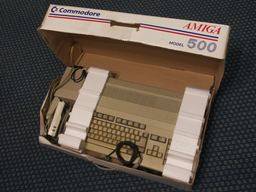
My first computer was an Amiga A500, and my brother and I spent a
fair chunk of our childhoods creating things with it. These things are
locked away on 3.5" floppy disks, but they were also lost a long time
ago.
A few weeks ago my dad found them in a box in his loft, so a disk-reading
project is now on the horizon! Step one is to catalogue what we've got,
which I've done here. Step two is to check which, if
any, of these are not already in circulation amongst archivists. Thanks
to Matthew Garrett for pointing me at the Software Preservation Society,
which is a good first place to check.
When we get to the reading step, there are quite a few approaches I could
take. Which one to use depends to some extent on which disks we need to
read, and whether they employ any custom sector layout or other copy
protection schemes. I think the easiest method using equipment I already
have is probably Amiga Explorer and
a null-modem cable, as this approach will work on an A500 with Workbench
1.3.
There are a variety of hardware tools and projects for reading Amiga floppies
on a PC, but the most interesting one to me is
DiscFerret, which is open hardware and software.
This was my fifth month working on Debian LTS. I was assigned 16
hours
by Freexian's
Debian LTS initiative. I worked on several packages but haven't
uploaded updates yet.
linux-2.6
There is a steady stream of security issues in all Linux kernel
versions. As we don't want to prompt reboots too often, these won't
necessarily result in an update every month; it depends on the
severity of the issue(s). However, I triaged
the current
issues
and committed
the available fixes to version control.
dpkg
The PGP signature validation in dpkg-source has a number of
bugs,
including CVE-2015-0840
which allows the validation to be completely subverted. I
backported fixes for these from the 1.16 (wheezy) branch to the 1.15
(squeeze) branch. dpkg has a test suite and the fixes all came with
new regression tests, so this was easy to verify.
As dpkg is a native package (i.e. there is little separation between
the 'upstream' and Debian packaging), I preferred that the dpkg
maintainers would turn this into an 'upstream' release that I could
upload. Guillem Jover has now reviewed and (semi-)released my
changes, so I will complete this update soon.
tiff
A large number of bugs have been found in the venerable tiff library
and tools, mostly by 'fuzzing' them
with afl. The bugs
have been unhelpfully grouped into a smaller number of CVE IDs,
although it's not clear that these groups were introduced at the
same time and they certainly weren't fixed at the same time.
Most of the upstream bug reports come with samples to reproduce the
bug (crash or memory corruption detectable with valgrind), but
many of these did not turn out to be reproducible (either upstream
or with the version in 'squeeze'). Where they were reproducible,
I've verified that the patches fix the issue.
Unfortunately tiff does not have a test suite, so I made a
call
for testing on the debian-lts list. If I don't get any
responses soon, I'll run my own basic tests with programs that use
libtiff before uploading.
Debian Jessie has been released on April 25th, 2015. This has opened the
Stretch development cycle. Reactions to the idea of making Debian
build reproducibly have
been pretty enthusiastic. As the pace is now likely to be even faster,
let's see if we can keep everyone up-to-date on the developments.
Before the release of Jessie
The story goes back a long
way
but a formal announcement to the
project
has only been sent in February 2015.
Since then, too much work has happened to make a complete report, but
to give some highlights:
New variations are now tested: umask, kernel version, domain name,
and timezone. We might only be missing CPU type and current date now.
Number of identified issues has grown from about 80 to 123 today.
Lunar did a pretty improvised lightning
talk
during the Mini-DebConf in
Lyon.
This past week
It seems changes were pilling behind the curtains given the amount of activity
that happened in just one week.
Toolchain fixes
Niels Thykier uploaded
debhelper/9.20150501
which includes fixes to dh_makeshlibs
(#774100), dh_icons
(#774102), dh_usrlocal
(#775020). Patches written
by Lunar.
Helmut Grohne uploaded
doxygen/1.8.9.1-3 which
will not generate timestamps in HTML by default. Kudos to
akira for bringing the issue
upstream.
Kenneth J. Pronovici uploaded
epydoc/3.0.1+dfsg-6
adding a --no-include-build-time option.
Patch by Jelmer
Vernooij.
David Pr vot uploaded
php-apigen/2.8.1+dfsg-2
which now has reproducible output.
C dric Boutillier uploaded
ruby-prawn/2.0.1+dfsg-1
which now produce a deterministic output when using gradients.
Patch by Lunar.
Jelmer Vernooij uploaded
samba/2:4.1.17+dfsg-4 which
contains a patch by Matthieu Patou making the output of pidl
(from libparse-pidl-perl) reproducible.
Dmitry Shachnev uploaded
sphinx/1.3.1-1 in experimental
which should produce deterministic output. The original
patch from Chris Lamb has
inspired the upstream
fix.
Improvements to reproducible.debian.net
Mattia Rizzolo has been working on compressing logs using gzip to save
disk space. The web server would uncompress them on-the-fly for clients
which does not accept gzip content.
Mattia Rizzolo worked on a new page listing various
breakage: missing
or bad debbindiff output, missing build logs, unavailable build
dependencies.
Holger Levsen added a new execution environment to run debbindiff using
dependencies from testing. This is required for packages built with
GHC as the compiler only understands interfaces built by the same
version.
debbindiff development
Version 17 has been uploaded to unstable. It now supports comparing
ISO9660 images, dictzip files and should compare identical files much
faster.
Documentation update
Various small updates and fixes to the pages about
PDF produced by LaTeX,
DVI produced by
LaTeX,
static
libraries,
Javadoc,
PE
binaries,
and Epydoc.
Package reviews
Known issues have been tagged when known to be deterministic as some
might unfortunately not show up on every single build.
For example, two new issues have been identified by building with one
timezone in April and one in May. RD
and help2man add current month and
year to the documentation they are producing.
1162 packages have been removed and 774 have been added in
the past week. Most of them are the work of proper automated
investigation done by Chris West.
Summer of code
Finally, we learned that both akira and Dhole were accepted for
this Google Summer of
Code.
Let's welcome them!
They have until May 25th before coding officialy begins. Now is the good time
to help them feel more comfortable by sharing all these little bits of
knowledge on how Debian works.
A hotfix release for the Finance-YahooQuote Perl module on CPAN is now available. Available Yahoo! Finance decided to change the base URL. My thanks to Nicola Chiapolini who not only noticed but also sent me the one-line patch fixing this:
--- YahooQuote.pm~      2010-03-27 01:44:10.000000000 +0100
+++ YahooQuote.pm       2015-04-29 11:31:20.407926674 +0200
@@ -34,7 +34,7 @@
 $VERSION = '0.24';

 ## these variables govern what type of quote the modules is retrieving
-$QURLbase = "http://download.finance.yahoo.com/d/quotes.csvr?e=.csv&f=";
+$QURLbase = "http://download.finance.yahoo.com/d/quotes.csv?e=.csv&f=";
 $QURLformat = "snl1d1t1c1p2va2bapomwerr1dyj1x";        # default up to 0.19
 $QURLextended = "s7t8e7e8e9r6r7r5b4p6p5j4m3m4";        # new in 0.20
 $QURLrealtime = "b2b3k2k1c6m2j3"; # also new in 0.20
If need be, edit your file YahooQuote.pm by hand.
This change in Finance-YahooQuote will also affect Beancounter and smtm both of which use this module.
The fix has been pushed to Debian for the corresponding package and to PAUSE for CPAN package.
Having maintained this since 2002 in RCS, I also just created a GitHub repo for it where development/maintenance will now happen.
I just migrated my blog(s) to WordPress.
Just recently I decided to put more time into blogging again. I wasn t entirely happy with Movable Type anymore, especially since the last update broke my customized theme and I struggled with the installation of another theme, which basically just were never found, no matter which path I put it into.
What I wanted is just more blogging, not all that technical stuff. And since the Movable Type makers also seem to have gone crazy (their Getting started site tells users to head over to movabletype.com to get a 999$ license) I decided to get back to WordPress.
There were reasons, why I haven t chosen WordPress back when I migrated from blogger to MT, but one has to say anyway, that things have moved a lot since then. And WordPress is as easy as it can be and has a prosper community, something I cannot say about MovableType.
The migration went okay, although there were some oddities in the blog entries exported by MT (e.g. datetime strings with EM and FM at the EOL) and I needed to figure out how the multisite feature in WordPress works. But now I have exactly what I want.
What happens if you remove randomness from Doom?
For some reason, recently I have been thinking about Doom. This
evening I was wanting to explore some behaviour in an old version of
Doom and to do so, I hex-edited the binary and replaced the random
number lookup table with static values.
Rather than consume system randomness, Doom has a fixed 256-value
random number table from which numbers are pulled by aspects of the
game logic. By replacing the whole table with a constant value, you
essentially make the game entirely deterministic.
What does it play like? I tried two values, 0x00 and 0xFF. With
either value, the screen "melt" effect that is used at the end of
levels is replaced with a level vertical wipe: the randomness was
used to offset each column. Monsters do not make different death
noises at different times; only one is played for each category of
monster. The bullet-based (hitscan) weapons have no spread at all:
the shotgun becomes like a sniper rifle, and the chain-gun is
likewise always true. You'd think this would make the super-shotgun
a pretty lethal weapon, but it seems to have been nerfed: the
spread pattern is integral to its function.
With 0x00, monsters never make their idle noises (breathing etc.)
On the other hand, with 0xFF, they always do: so often, that each
sample collides with the previous one, and you just get a sort-of
monster drone. This is quite overwhelming with even a small pack of
monsters.
With 0xFF, any strobing sectors (flickering lights etc.), are
static. However, with 0x00, they strobe like crazy.
With 0x00, monsters seem to choose to attack much more frequently than
usual. Damage seems to be worst-case. The most damaging floor type
("super hellslime"/20%) can hurt you even if you are wearing a radiation
suit: There was a very low chance of it hurting whilst wearing the
suit (~2.6%)
each time the game checked; this is rounded up to 100%.
Various other aspects of the game become weird. A monster may always
choose to use a ranged attack, regardless of how close you are. They
might give up pursuing you. I've seen them walk aimlessly in circles
if they are obstructed by another thing. The chance of monster
in-fighting is never, or a certainty. The player is either mute, or
cries in pain whenever he's hurt.
If you want to try this yourself, the easiest way is to hack the m_random.c
file in the source, but you can hex-edit a binary. Look for a 256-byte sequence
beginning beginning ['0x0', '0x8', '0x6d', '0xdc', '0xde', '0xf1'] and ending
['0x78', '0xa3', '0xec', '0xf9'].
A new major version 5.000 of Armadillo was released by Conrad a couple of days ago. Armadillo is a powerful and expressive C++ template library for linear algebra aiming towards a good balance between speed and ease of use with a syntax deliberately close to a Matlab.
This version brings several new functions for sparse matrices, and automagically switches to 64-bit matrix indices in C++11 mode. See below for a short description of all the major changes based on the NEWS.Rd file.
This version is now on CRAN, as well as in Debian. The integration into CRAN was delayed by a few days as my testing had a shortcoming. We run full reverse-dependency checks against all 115 CRAN package depending in RcppArmadillo, and we even made full pre-release 0.4.999.1 and 0.5.000.0 shipped to the drat repo of the RcppCore GitHub organization (which was described in the previous release post). But a minor flaw in my setup made it miss how the change in indexing affected packages dfcomb and dfmta. My thanks to its maintainer Marie-Karelle Riviere for providing updates to her packages permitting this release to get onto CRAN. The testing process has been tightened and this should not happen again.
Changes in RcppArmadillo version 0.5.000.0 (2015-04-12)
Upgraded to Armadillo release Version 5.000 ("Ankle Biter")
added spsolve() for solving sparse systems of linear equations
added svds() for singular value decomposition of sparse matrices
added nonzeros() for extracting non-zero values from matrices
added handling of diagonal views by sparse matrices
expanded repmat() to handle sparse matrices
expanded join_rows() and join_cols() to handle sparse matrices
sort_index() and stable_sort_index() have been placed in the delayed operations framework for increased efficiency
use of 64 bit integers is automatically enabled when using a C++11 compiler
workaround for a bug in recent releases of Apple Xcode
workaround for a bug in LAPACK 3.5
Changes in RcppArmadillo version 0.4.999.1.0 (2015-04-04)
A few months ago, I wrote a long post about what I called back then the
"Gnocchi experiment".
Time passed and we me and the rest of the Gnocchi team continued to work on
that project, finalizing it.
It's with a great pleasure that we are going to release our first 1.0 version
this month, roughly at the same time that the integrated
OpenStack projects release their Kilo milestone. The
first release candidate numbered 1.0.0rc1
has been released this morning!
The problem to solve
Before I dive into Gnocchi details, it's important to have a good view of what
problems Gnocchi is trying to solve.
Most of the IT infrastructures out there consists of a set of resources. These
resources have properties: some of them are simple attributes whereas others
might be measurable quantities (also known as metrics).
And in this context, the cloud infrastructures make no exception. We talk about
instances, volumes, networks which are all different kind of resources. The
problems that are arising with the cloud trend is the scalability of storing
all this data and being able to request them later, for whatever usage.
What Gnocchi provides is a REST API that allows the user to manipulate
resources (CRUD) and their attributes, while preserving the history of those
resources and their attributes.
Gnocchi is fully documented and the
documentation is available online.
We are the first OpenStack project to require patches to integrate the
documentation. We want to raise the bar, so we took a stand on that. That's
part of our policy, the same way it's part of the OpenStack policy to require
unit tests.
I'm not going to paraphrase the whole Gnocchi documentation, which covers
things like installation (super easy), but I'll guide you through some basics
of the features provided by the REST API. I will show you some example so you
can have a better understanding of what you could leverage using Gnocchi!
Handling metrics
Gnocchi provides a full REST API to manipulate time-series that are called
metrics. You can easily create a metric using a simple HTTP request:
The archive_policy_name parameter defines how the measures that are being
sent are going to be aggregated. You can also define archive policies using the
API and specify what kind of aggregation period and granularity you want. In
that case , the low archive policy keeps 1 hour of data aggregated over 1
second and 1 day of data aggregated to 30 minutes. The functions used for
aggregations are the mathematical functions standard deviation, minimum,
maximum, and even 95th percentile. All of that is obviously customizable and
you can create your own archive policies.
If you don't want to specify the archive policy manually for each metric, you
can also create archive policy rule, that will apply a specific archive
policy based on the metric name, e.g. metrics matching disk.* will be high
resolution metrics so they will use the high archive policy.
It's also worth noting Gnocchi is precise up to the nanosecond and is not tied
to the current time. You can manipulate and inject measures that are years old
and precise to the nanosecond. You can also inject points with old timestamps
(i.e. old compared to the most recent one in the timeseries) with an archive
policy allowing it (see back_window parameter).
It's then possible to send measures to this metric:
These measures are synchronously aggregated and stored into the configured
storage backend. Our most scalable storage drivers for now are either based on
Swift or Ceph which are both
scalable storage objects systems.
It's then possible to retrieve these values:
As older Ceilometer users might notice here, metrics are only storing points
and values, nothing fancy such as metadata anymore.
By default, values eagerly aggregated using mean are returned for all supported
granularities. You can obviously specify a time range or a different
aggregation function using the aggregation, start and stop query
parameter.
Gnocchi also supports doing aggregation across aggregated metrics:
This computes the mean of mean for the metric
65071775-52a8-4d2e-abb3-1377c2fe5c55 and
9ccdd0d6-f56a-4bba-93dc-154980b6e69a starting on 6th October 2014 at 14:34
UTC.
Indexing your resources
Another object and concept that Gnocchi provides is the ability to manipulate
resources. There is a basic type of resource, called generic, which has very
few attributes. You can extend this type to specialize it, and that's what
Gnocchi does by default by providing resource types known for OpenStack such as
instance, volume, network or even image.
The resource is created with the UUID provided by the user. Gnocchi handles the
history of the resource, and that's what the revision_start and
revision_end fields are for. They indicates the lifetime of this revision of
the resource. The ETag and Last-Modified headers are also unique to this
resource revision and can be used in a subsequent request using If-Match or
If-Not-Match header, for example:
Which is useful to synchronize and update any view of the resources you might
have in your application.
You can use the PATCH HTTP method to modify properties of the resource, which
will create a new revision of the resource. The history of the resources are
available via the REST API obviously.
The metrics properties of the resource allow you to link metrics to a
resource. You can link existing metrics or create new ones dynamically:
Haystack, needle? Find!
With such a system, it becomes very easy to index all your resources, meter
them and retrieve this data. What's even more interesting is to query the
system to find and list the resources you are interested in!
You can search for a resource based on any field, for example:
That query will return a list of all resources owned by the user_idbd3a1e52-1c62-44cb-bf04-660bd88cd74d.
You can do fancier queries such as retrieving all the instances started by a
user this month:
And you can even do fancier queries than the fancier ones (still following?).
What if we wanted to retrieve all the instances that were on host foobar the
15th April and who had already 30 minutes of uptime? Let's ask Gnocchi to look
in the history!
I could also mention the fact that you can
search for value in metrics.
One feature that I will very likely include in Gnocchi 1.1 is the ability to
search for resource whose specific metrics matches some value. For example,
having the ability to search for instances whose CPU consumption was over 80%
during a month.
Cherries on the cake
While Gnocchi is well integrated and based on common OpenStack technology,
please do note that it is completely able to function without any other
OpenStack component and is pretty straight-forward to deploy.
Gnocchi also implements a full RBAC system based on the
OpenStack standard oslo.policy
and which allows pretty fine grained control of permissions.
There is also some work ongoing to have HTML rendering when browsing the API
using a Web browser. While still simple, we'd like to have a minimal Web
interface served on top of the API for the same price!
Ceilometer alarm subsystem supports Gnocchi with the Kilo release, meaning you
can use it to trigger actions when a metric value crosses some threshold. And
OpenStack Heat also supports auto-scaling your
instances based on Ceilometer+Gnocchi alarms.
And there are a few more API calls that I didn't talk about here, so don't
hesitate to take a peek at the
full documentation!
Towards Gnocchi 1.1!
Gnocchi is a different beast in the OpenStack community. It is under the
umbrella of the Ceilometer program, but it's one of the first projects that is
not part of the (old) integrated release. Therefore we decided to have a
release schedule not directly linked to the OpenStack and we'll release more
often that the rest of the old OpenStack components probably once every 2
months or the like.
What's coming next is a close integration with Ceilometer (e.g. moving the
dispatcher code from Gnocchi to Ceilometer) and probably more features as we
have more requests from our users. We are also exploring different backends
such as InfluxDB (storage) or MongoDB (indexer).
Stay tuned, and happy hacking!
git grep is a very effective way to run a recursive grep over a git
repository, or part of a git repository (by default, it limits its search to
the sub-tree you are currently sitting in). I quite often find myself wanting
to edit every file that matched a search, and so wrote this snippet.
The /dev/tty-ugliness is to work around vi complaining that it's standard
input was set to /dev/null by xargs. BSD xargs has a command, -o, which
sorts this out; GNU xargs doesn't, but the manual suggests the above portable
workaround. This marks the first time a BSD tool has had a feature I've wanted
and the GNU equivalent doesn't.
For these who similarily suffer from having to use Googlemail at work. If anyone else has more of these, please do share.
Deactivate the spamfilter
The site admins can do that. Otherwise, you will have work-relevant eMails, for example from your own OTRS system, end up in Spam (where you don t see it, as their IMAP sucks) and deleted without asking 30 days later. (AIUI, the only way to get eMails actually deleted from Google )
Do not use their SMTP service
Use your own outgoing MTA. This brings back the, well, not feature but should-have-been-granted-but-Google-doesn t-do-it-anyway that, when you write to a mailing list, you also get your own messages into your own INBOX.
Calendars
I have no solutions for this. I stopped using the Googlemail calendars because they didn t think it a problem that, when I accept an invitation in Kontact (KDEPIM as packaged in Debian sid), the organiser of the calendar item in the sender s calendar (for which I do not have write permissions) changes to me (so the actual meeting organiser cannot change anything afterwards) and/or calendar items get doubled. I now run a local uw-imapd (forward-ported to sid by means of a binNMU) for sent-mail folders etc. and a local iCalendar directory for calendars.
Winter time is a good time for some nature observation. Yesterday I had a woodpecker (picture) in front of my kitchen window. During the recent weeks there were long-tailed tits, a wren and other rarely seen birds. So I thought, it might be a good idea to capture some of these events :) I still own a Logitech C910 USB camera which allows HD video capturing up to 1080p. So I checked the web for some software that would begin video capturing in the case of motion detection and found motion, already available for Debian users. So I gave it a try. I tested all available resolutions of the camera together with the capturing results. I found that the resulting framerate of both the live stream and the captured video is highly depending on the resolution and some few configuration options. Below is a summary of my tests and the results I've achieved so far.
Logitech C910 HD cameraJust a bit of data regarding the camera. AFAIK it allows for fluent video streams up to 720p.
$ dmesg
[..]
usb 7-3: new high-speed USB device number 5 using ehci-pci
usb 7-3: New USB device found, idVendor=046d, idProduct=0821
usb 7-3: New USB device strings: Mfr=0, Product=0, SerialNumber=1
usb 7-3: SerialNumber: 91CF80A0
usb 7-3: current rate 0 is different from the runtime rate 16000
usb 7-3: current rate 0 is different from the runtime rate 32000
uvcvideo: Found UVC 1.00 device  (046d:0821)
input: UVC Camera (046d:0821) as /devices/pci0000:00/0000:00:1a.7/usb7/7-3/7-3:1.2/input/input17

$ lsusb
[..]
Bus 007 Device 005: ID 046d:0821 Logitech, Inc. HD Webcam C910
[..]

$ v4l2-ctl -V -d /dev/video1
Format Video Capture:
Width/Height  : 1280/720
Pixel Format  : 'YUYV'
Field         : None
Bytes per Line: 2560
Size Image    : 1843200
Colorspace    : SRGB
Also the uvcvideo kernel module is loaded and the user in question is part of the video group. Installation and startInstallation of the software is as easy as always:
apt-get install motion
It is possible to run the software as a service. But for testing, I copied /etc/motion/motion.conf to ~/.motion/motion.conf, fixed its permissions (you cannot copy the file as user - it's not world readable) and disabled the daemon mode.
daemon off
Note that in my case the correct device is /dev/video1 because the laptop has a built-in camera, that is /dev/video0. Also the target directory should be writeable by my user:
videodevice /dev/video1
target_dir ~/Videos
Then running motion from the command line ...
$ motion
[..]
[0] [NTC] [ALL] motion_startup: Motion 3.2.12+git20140228 Started
[..]
[1] [NTC] [ALL] motion_init: Thread 1 started , motion detection Enabled
[0] [NTC] [ALL] main: Thread 1 is device: /dev/video1 input -1
[1] [NTC] [VID] v4l2_get_capability:
------------------------
cap.driver: "uvcvideo"
cap.card: "UVC Camera (046d:0821)"
cap.bus_info: "usb-0000:00:1a.7-1"
cap.capabilities=0x84000001
------------------------
[1] [NTC] [VID] v4l2_get_capability: - VIDEO_CAPTURE
[1] [NTC] [VID] v4l2_get_capability: - STREAMING
[1] [NTC] [VID] v4l2_select_input: name = "Camera 1", type 0x00000002, status 00000000
[1] [NTC] [VID] v4l2_select_input: - CAMERA
[..]
[1] [NTC] [ALL] image_ring_resize: Resizing pre_capture buffer to 1 items
... will begin to capture motion detection events and also output a live stream. CTRL+C will stop it again. Live streamThe live stream is available by pointing the browser to localhost:8081. However, the stream seems to run at 1 fps (frames per second) and indeed does. The stream gets more quality by this configuration:
stream_motion on
stream_maxrate 100
The first option is responsible, that the stream only runs at one fps if there is no motion detection event. Otherwise the framerate increases to its maximum value, which is either the one given by stream_maxrate or the camera limit. The quality of the stream picture can be increased a bit further too by increasing the stream_quality value. Because I neither need the stream nor the control feed I disabled both:
stream_port 0
webcontrol_port 0
Picture capturingBy default there is video and picture capturing if a motion event is detected. I'm not interested in these pictures, so I turned them off:
output_pictures off
FYI: If you want a good picture quality, then the value of quality should very probably be increased. Video capturingThis is the really interesting part :) Of course if I will "shoot" some birds (with the camera), then a small image of say 320x240 pixels is not enough. The camera allows for a capture resolution up to 1920x1080 pixels (1080p). It is advertised for fluent video streams up to 720p (1280x720 pixels). So I tried the following resolutions: 320x240, 640x480, 800x600, 640x360 (360p), 1280x720 (720p) and 1920x1080 (1080p). These are easily configured by the width and height variables. For example the following configures motion for 1280x720 pixels (720p):
width 1280
height 720
The result was really disappointing. No event is captured with more then 20 fps. At higher resolutions the framerate drops even further and at the highest resolution of 1920x1080 pixels, the framerate is only two(!) fps. Also every created video runs much too fast and even faster by increasing the framerate variable. Of course its default value of 2 (fps) is not enough for fluent videos. AFAIK the C910 can run with 30 fps at 1280x720 pixels. So increasing the value of framerate, the maximum framerate recorded, is a must-do. (If you wanna test yourself, check the log output for the value following event_new_video FPS.)The solution to the issue, that videos are running too fast, however is to increase the pre_capture value, the number of pre-captured (buffered) pictures from before motion was detected. Even small values like 3..5 result in a distinctive improvement of the situation. Though increasing the value further didn't have any effect. So the values below should almost get the most out of the camera and result in videos in normal speed.
framerate 100
pre_capture 5
Videos in 1280x720 pixels are still captured with 10 fps and I don't know why. Running guvcview, the same camera allows for 30 fps in this resolution (even 60 fps in lower resolutions). However, even if the framerate could be higher, the resulting video runs fluently. Still the quality is just moderate (or to be honest, still disappointing). It looks "pixelated". Only static pictures are sharp. It took me a while to fix this too, because I first thought, the reason is the camera or missing hardware support. It is not :) The reason is, that ffmpeg is configured to produce a moderate(?)-quality video. The relevant variables are ffmpeg_bps and ffmpeg_variable_bitrate. I got the best results just changing the latter:
ffmpeg_variable_bitrate 2
Finally the resulting video quality is promising. I'll start with this configuration setting up an observation camera for the bird feeding ground.There is one more tweak for me. I got even better results by enabling the auto_brightness feature.
auto_brightness on
Complete configurationSo the complete configuration looks like this (only those options changed to the original config file)
daemon off
videodevice /dev/video1
width 1280
height 720
framerate 100
auto_brightness on
ffmpeg_variable_bitrate 2
target_dir /home/user/Videos
stream_port 0 #8081
stream_motion on
stream_maxrate 100
webcontrol_port 0 #8080
The annoucement below just went to the R-SIG-Finance list. More information is as usual at the R / Finance page.
Registration for R/Finance 2015 is now open!
The conference will take place on May 29 and 30, at UIC in Chicago. Building on the success of the previous conferences in 2009-2014, we expect more than 250 attendees from around the world. R users from industry, academia, and government will joining 30+ presenters covering all areas of finance with R.
We are very excited about the four keynote presentations given by Emanuel Derman, Louis Marascio, Alexander McNeil, and Rishi Narang. The conference agenda (currently) includes 18 full presentations and 19 shorter "lightning talks". As in previous years, several (optional) pre-conference seminars are offered on Friday morning.
There is also an (optional) conference dinner at The Terrace at Trump Hotel. Overlooking the Chicago river and skyline, it is a perfect venue to continue conversations while dining and drinking.
Registration information and agenda details can be found on the conference website as they are being finalized. Registration is also available directly at the registration page.
We would to thank our 2015 sponsors for the continued support enabling us to host such an exciting conference:
International Center for Futures and Derivatives at UICRevolution Analytics MS-Computational Finance and Risk Management at University of WashingtonKetchum Trading OneMarketData RStudio SYMMS
On behalf of the committee and sponsors, we look forward to seeing you in Chicago!
For the program committee:
Gib Bassett, Peter Carl, Dirk Eddelbuettel, Brian Peterson, Dale Rosenthal, Jeffrey Ryan, Joshua Ulrich
I usually use rdiff-backup to backup several of my systems. One is a workstation which goes to sleep after some time of idling around. Now having a user logged in running rdiff-backup (or rsync, rsnapshot etc for that matter) won't prevent the system from being put to sleep. Naturally this happens before the backup is complete. So some time ago I was looking for a resolution and recieved a suggestion to use a script in /etc/pm/sleep.d/. I had to modify the script a bit, because the query result always was true. So this is my solution in /etc/pm/sleep.d/01_prevent_sleep_on_backup now:
#!/bin/sh

. "$ PM_FUNCTIONS "

command_exists rdiff-backup   exit $NA

case "$1" in
        hibernate suspend)
                if ps cax   grep -q rdiff-backup
                then
                        exit 1
                fi
        ;;
esac

exit 0
Currently testing ... UpdateThe above works with pm-utils; but it fails with systemd. Seems I have to move and modify the script for my system. Update 2It doesn't work. In short: exit 1 doesn't prevent systemd from going to suspend. I can see, that the script itself leads to the results I want, so the logic is correct. But I cannot find a way to tell systemd, to stop suspend. Shouldn't it be doing this automtically in a case, where a remote user is logged in and runs a command? Update 3There is also a related bug report.
Follow me on Identi.caor Twitteror Diaspora*
Unverified backups are useless, every sysadmins know that. But manually verifying a backup means wasting time and resources. Moreover it s boring. You should automatize it!
Charlie Chaplin Modern Times
Backup Checker is a command line software developed in Python 3.4 on GitHub (stars appreciated :) ) allowing users to verify the integrity of archives (tar, gz, bz2, lzma, zip, tree of files) and the state of the files inside an archive in order to find corruptions or intentional of accidental changes of states or removal of files inside an archive.
Backup Checker on github
The new feature of the latest version 1.4 is the control of outdated archives with the new outdated parameter. Lots of data are outdated quite fast, because they are dependent of other data, or because they are only useful in a specific context.
Hey, this database dump is 6 months old, it s useless today!
Backup Checker now controls the expiration duration and triggers a warning if the given duration starting from the last modification of the archive (mtime) is expired. Short examples of the warning:
WARNING:root:/backups/backups-12022015.tar.gz is outdated. Was good until 01/03/15 00:00:00 now 22/03/15 21:38:20
You won t be surprized any more by outdated useless data in your backups.
Backup Checker also offers lots of other controls. Check the features list!
Installing Backup Checker
Backup Checker is available from PyPI using the following command:
# pip3.4 install backupchecker
It s also available for your Debian Squeeze or Debian Wheezy. Check how to get it for your specific distributions.
What about you? How and what for do you use Backup Checker? We would be happy to get your feedbacks. The project cares about our users and the outdated feature was a awesome idea in a feature request by one of the Backup Checker user, thanks Laurent!
Now I'm back to Linux on the Desktop for my dayjob, I was slightly
nervous about checking out the state of the art for Linux music players;
an area I've never felt the Linux desktop was very strong on.
However for the time being I've largely side-stepped the issue by
listening to BBC 6 Music for most of the
day. For better or worse, I scrobble, and
somebody has written a neat web app for scrobbling along to radio
stations. When I want to listen to
something different for a change, I've been trying out a trial of
Google Play Music, for
which somebody has written a Chrome extension to
scrobble. On the rare occasions I listen to
local music, I'm using VLC.
Google Play Music seems pretty good, but I'm not getting a lot from my
trial because 6 Music is generally fantastic.
Scrobbling 6 Music has revealed a bit of a disconnect for how I use
last.fm, and how website thinks you should use it. Within a day or two,
my "music compability" with 6 Music was (predictably) "SUPER". Looking
at my "Top artists", right near the top are 6 Music's current playlist
favourites Courtney Barnett and Nadine Shah, who I can (at least) recall
the songs that have been played; just below them are Young Fathers, who
I cannot. A little lower are Hot Chip and Slaves: both artists who have
current singles out which I enjoyed for a while, but the relentless BBC
playlist policy is overdoing them and I'm inclined to switch over when
they come on now. If I listen to a whole album in a given week, then the
artist will likely (and rightly) be sat at the top of "last 7 days"; if
I don't, then it could be something I can't even remember listening to.
Update: I was able to get in touch with the Googlers responsible for the
dl.google.com service, and the root cause for the mismatched signature problem
described below has been found and fixed. I now consistently receive from
Google's servers Release and Release.gpg files that pass apt's signature
validation on my home connection.
Google publishes Linux software repositories for several of their products,
including Google Chrome, which is available from the following apt source:
deb http://dl.google.com/linux/chrome/deb/ stable main
These repositories are signed with an 8 year old 1024-bit DSA key:
pub   1024D/7FAC5991 2007-03-08
      Key fingerprint = 4CCA 1EAF 950C EE4A B839  76DC A040 830F 7FAC 5991
uid                  Google, Inc. Linux Package Signing Key <linux-packages-keymaster@google.com>
sub   2048g/C07CB649 2007-03-08
Asymmetric 1024-bit keys are not considered strong enough and were, for
instance, aggressively retired from Google's SSL frontends almost two years
ago. Such short keys should not be used to protect the integrity of software
package repositories.
Note that this key has a longer 2048-bit ElGamal subkey, which is not actually
used to produce signatures, but only for encryption. In fact, only a signing key
is needed to sign the files in a secure apt repository, and, for instance, the
archive keys used to sign official debian.org repositories do not contain an
encryption subkey.
Since years, many users have reported an error message like the following when
running apt-get update:
W: GPG error: http://dl.google.com stable Release: The following signatures were
invalid: BADSIG A040830F7FAC5991 Google, Inc. Linux Package Signing Key
<linux-packages-keymaster@google.com>
This error might resolve itself if apt-get update is run again. Apparently,
this is due to "bad pushes" occurring in the Google infrastructure. An example
of this can be seen in the following curl output:
$ curl -v http://dl.google.com/linux/chrome/deb/dists/stable/Release \
        http://dl.google.com/linux/chrome/deb/dists/stable/Release.gpg
* Hostname was NOT found in DNS cache
*   Trying 74.125.196.136...
* Connected to dl.google.com (74.125.196.136) port 80 (#0)
> GET /linux/chrome/deb/dists/stable/Release HTTP/1.1
> User-Agent: curl/7.38.0
> Host: dl.google.com
> Accept: */*
>
< HTTP/1.1 200 OK
< Accept-Ranges: bytes
< Content-Length: 1347
< Content-Type: application/octet-stream
< Etag: "518b8"
< Expires: Sun, 22 Mar 2015 18:55:19 PDT
< Last-Modified: Fri, 20 Mar 2015 04:22:00 GMT
* Server downloads is not blacklisted
< Server: downloads
< X-Content-Type-Options: nosniff
< X-Frame-Options: SAMEORIGIN
< X-Xss-Protection: 1; mode=block
< Date: Sun, 22 Mar 2015 01:55:19 GMT
< Alternate-Protocol: 80:quic,p=0.5
<
Origin: Google, Inc.
Label: Google
Suite: stable
Codename: stable
Version: 1.0
Date: Thu, 19 Mar 2015 22:55:29 +0000
Architectures: amd64 i386
Components: main
Description: Google chrome-linux repository.
MD5Sum:
 53375c7a2d182d85aef6218c179040ed 144 main/binary-i386/Release
 c556daf52ac818e4b11b84cb5943f6e0 4076 main/binary-i386/Packages
 867ba456bd6537e51bd344df212f4662 960 main/binary-i386/Packages.gz
 2b766b2639b57d5282a154cf6a00b172 1176 main/binary-i386/Packages.bz2
 89704f9af9e6ccd87c192de11ba4c511 145 main/binary-amd64/Release
 fa88101278271922ec9b14b030fd2423 4082 main/binary-amd64/Packages
 1ba717117027f36ff4aea9c3ea60de9e 962 main/binary-amd64/Packages.gz
 19af18f376c986d317cadb3394c60ac5 1193 main/binary-amd64/Packages.bz2
SHA1:
 59414c4175f2cc22e67ba6c30687b00c72a7eafc 144 main/binary-i386/Release
 1764c5418478b1077ada54c73eb501165ba79170 4076 main/binary-i386/Packages
 db24eafac51d3e63fd41343028fb3243f96cbed6 960 main/binary-i386/Packages.gz
 ad8be07425e88b2fdf2f6d143989cde1341a8c51 1176 main/binary-i386/Packages.bz2
 153199d8f866350b7853365a4adc95ee687603dd 145 main/binary-amd64/Release
 7ce66535b35d5fc267fe23af9947f9d27e88508b 4082 main/binary-amd64/Packages
 a72b5e46c3be8ad403df54e4cdcd6e58b2ede65a 962 main/binary-amd64/Packages.gz
 dbc7fddd28cc742ef8f0fb8c6e096455e18c35f8 1193 main/binary-amd64/Packages.bz2
* Connection #0 to host dl.google.com left intact
* Found bundle for host dl.google.com: 0x7f24e68d06a0
* Re-using existing connection! (#0) with host dl.google.com
* Connected to dl.google.com (74.125.196.136) port 80 (#0)
> GET /linux/chrome/deb/dists/stable/Release.gpg HTTP/1.1
> User-Agent: curl/7.38.0
> Host: dl.google.com
> Accept: */*
>
< HTTP/1.1 200 OK
< Accept-Ranges: bytes
< Content-Length: 198
< Content-Type: application/octet-stream
< Etag: "518f4"
< Expires: Sun, 22 Mar 2015 18:55:19 PDT
< Last-Modified: Fri, 20 Mar 2015 04:05:00 GMT
* Server downloads is not blacklisted
< Server: downloads
< X-Content-Type-Options: nosniff
< X-Frame-Options: SAMEORIGIN
< X-Xss-Protection: 1; mode=block
< Date: Sun, 22 Mar 2015 01:55:19 GMT
< Alternate-Protocol: 80:quic,p=0.5
<
-----BEGIN PGP SIGNATURE-----
Version: GnuPG v1.4.10 (GNU/Linux)
iEYEABECAAYFAlULm7YACgkQoECDD3+sWZFyxACeNPuK/zQ0v+3Py1n2s09Wk/Ti
DckAni8V/gy++xIinu8OdUXv7c777V9H
=5vT6
-----END PGP SIGNATURE-----
* Connection #0 to host dl.google.com left intact
Note that both the Release and Release.gpg files were fetched with the same
HTTP connection, so the two files must have come from the same web frontend.
(Though, it is possible they were served by different backends.) However, the
detached signature in Release.gpg does not match the content in Release:
gpgv: Signature made Fri 20 Mar 2015 12:01:58 AM EDT using DSA key ID 7FAC5991
gpgv: BAD signature from "Google, Inc. Linux Package Signing Key <linux-packages-keymaster@google.com>"
Performing the same pair of fetches again, the same Release.gpg file is
returned, but the Release file is slightly different:
$ curl -v http://dl.google.com/linux/chrome/deb/dists/stable/Release \
        http://dl.google.com/linux/chrome/deb/dists/stable/Release.gpg
* Hostname was NOT found in DNS cache
*   Trying 74.125.196.136...
* Connected to dl.google.com (74.125.196.136) port 80 (#0)
> GET /linux/chrome/deb/dists/stable/Release HTTP/1.1
> User-Agent: curl/7.38.0
> Host: dl.google.com
> Accept: */*
>
< HTTP/1.1 200 OK
< Accept-Ranges: bytes
< Content-Length: 1347
< Content-Type: application/octet-stream
< Etag: "518f3"
< Expires: Sun, 22 Mar 2015 18:55:04 PDT
< Last-Modified: Fri, 20 Mar 2015 04:05:00 GMT
* Server downloads is not blacklisted
< Server: downloads
< X-Content-Type-Options: nosniff
< X-Frame-Options: SAMEORIGIN
< X-Xss-Protection: 1; mode=block
< Date: Sun, 22 Mar 2015 01:55:04 GMT
< Alternate-Protocol: 80:quic,p=0.5
<
Origin: Google, Inc.
Label: Google
Suite: stable
Codename: stable
Version: 1.0
Date: Fri, 20 Mar 2015 04:02:02 +0000
Architectures: amd64 i386
Components: main
Description: Google chrome-linux repository.
MD5Sum:
 89704f9af9e6ccd87c192de11ba4c511 145 main/binary-amd64/Release
 fa88101278271922ec9b14b030fd2423 4082 main/binary-amd64/Packages
 1ba717117027f36ff4aea9c3ea60de9e 962 main/binary-amd64/Packages.gz
 19af18f376c986d317cadb3394c60ac5 1193 main/binary-amd64/Packages.bz2
 53375c7a2d182d85aef6218c179040ed 144 main/binary-i386/Release
 c556daf52ac818e4b11b84cb5943f6e0 4076 main/binary-i386/Packages
 867ba456bd6537e51bd344df212f4662 960 main/binary-i386/Packages.gz
 2b766b2639b57d5282a154cf6a00b172 1176 main/binary-i386/Packages.bz2
SHA1:
 153199d8f866350b7853365a4adc95ee687603dd 145 main/binary-amd64/Release
 7ce66535b35d5fc267fe23af9947f9d27e88508b 4082 main/binary-amd64/Packages
 a72b5e46c3be8ad403df54e4cdcd6e58b2ede65a 962 main/binary-amd64/Packages.gz
 dbc7fddd28cc742ef8f0fb8c6e096455e18c35f8 1193 main/binary-amd64/Packages.bz2
 59414c4175f2cc22e67ba6c30687b00c72a7eafc 144 main/binary-i386/Release
 1764c5418478b1077ada54c73eb501165ba79170 4076 main/binary-i386/Packages
 db24eafac51d3e63fd41343028fb3243f96cbed6 960 main/binary-i386/Packages.gz
 ad8be07425e88b2fdf2f6d143989cde1341a8c51 1176 main/binary-i386/Packages.bz2
* Connection #0 to host dl.google.com left intact
* Found bundle for host dl.google.com: 0x7ffa33d8b6a0
* Re-using existing connection! (#0) with host dl.google.com
* Connected to dl.google.com (74.125.196.136) port 80 (#0)
> GET /linux/chrome/deb/dists/stable/Release.gpg HTTP/1.1
> User-Agent: curl/7.38.0
> Host: dl.google.com
> Accept: */*
>
< HTTP/1.1 200 OK
< Accept-Ranges: bytes
< Content-Length: 198
< Content-Type: application/octet-stream
< Etag: "518f4"
< Expires: Sun, 22 Mar 2015 18:55:05 PDT
< Last-Modified: Fri, 20 Mar 2015 04:05:00 GMT
* Server downloads is not blacklisted
< Server: downloads
< X-Content-Type-Options: nosniff
< X-Frame-Options: SAMEORIGIN
< X-Xss-Protection: 1; mode=block
< Date: Sun, 22 Mar 2015 01:55:05 GMT
< Alternate-Protocol: 80:quic,p=0.5
<
-----BEGIN PGP SIGNATURE-----
Version: GnuPG v1.4.10 (GNU/Linux)
iEYEABECAAYFAlULm7YACgkQoECDD3+sWZFyxACeNPuK/zQ0v+3Py1n2s09Wk/Ti
DckAni8V/gy++xIinu8OdUXv7c777V9H
=5vT6
-----END PGP SIGNATURE-----
* Connection #0 to host dl.google.com left intact
Note that the Date line in the Release file is different:
@@ -6 +6 @@
-Date: Thu, 19 Mar 2015 22:55:29 +0000
+Date: Fri, 20 Mar 2015 04:02:02 +0000
The file hashes listed in the Release file are in a different order, as well,
though the actual hash values are the same. This Release file does have a
valid signature:
gpgv: Signature made Fri 20 Mar 2015 12:01:58 AM EDT using DSA key ID 7FAC5991
gpgv: Good signature from "Google, Inc. Linux Package Signing Key <linux-packages-keymaster@google.com>"
Note that the Release.gpg files in the good and bad cases are the same, and
the same signature cannot cover two files with different content. Also note that
the same mis-signed content is available via HTTPS, so it is probably not
caused by a MITM attack.
The possibility of skew between the Release and Release.gpg files is
precisely why inline signed Release files were introduced, but Google's
repositories use only the older format with a detached signature.
It would be nice if Google could fix the underlying bug in their infrastructure
that results in mis-signed repositories being published frequently, because it
trains users to ignore cryptographic failures.
 What happened about the reproducible
builds effort for this week:
Toolchain fixes



 This was my fifth month working on Debian LTS. I was assigned 16
hours
by
 A hotfix release for the


 Gnocchi provides a full REST API to manipulate time-series that are called
metrics. You can easily create a metric using a simple HTTP request:


 Another object and concept that Gnocchi provides is the ability to manipulate
resources. There is a basic type of resource, called generic, which has very
few attributes. You can extend this type to specialize it, and that's what
Gnocchi does by default by providing resource types known for OpenStack such as
instance, volume, network or even image.

 For these who similarily suffer from having to use Googlemail at work. If anyone else has more of these, please do share.
Deactivate the spamfilter
The site admins can do that. Otherwise, you will have work-relevant eMails, for example from your own OTRS system, end up in Spam (where you don t see it, as their IMAP sucks) and deleted without asking 30 days later. (AIUI, the only way to get eMails actually deleted from Google )
Do not use their SMTP service
Use your own outgoing MTA. This brings back the, well, not feature but should-have-been-granted-but-Google-doesn t-do-it-anyway that, when you write to a mailing list, you also get your own messages into your own INBOX.
Calendars
I have no solutions for this. I stopped using the Googlemail calendars because they didn t think it a problem that, when I accept an invitation in Kontact (KDEPIM as packaged in Debian sid), the organiser of the calendar item in the sender s calendar (for which I do not have write permissions) changes to me (so the actual meeting organiser cannot change anything afterwards) and/or calendar items get doubled. I now run a local uw-imapd (forward-ported to sid by means of a binNMU) for sent-mail folders etc. and a local iCalendar directory for calendars.


 Ingredients