Search Results: "hug"

23 August 2013

Gregor Herrmann: DebConf 2013

[still no pictures here, feel free to go to gallery.debconf.org]. After my report about DebCamp, & after being home for 5 days now, here are some thoughts about DebConf13: First of all, I really enjoyed being there, & this was one of the best DebConfs for me so far. An important reason for this was the place: Le Camp was in my opinion the best DebConf venue ever (I've been to), with everything & everyone in one place, & still enough space (especially outdoors space!) for work & relaxing. Kudos to the local team for finding this spot, & for sticking to it despite some criticism. In general, I'd like to say thanks to the local team for the perfect organisation of all aspects you did a great job! What else did I enjoy? As usual, meeting old friends & making new ones was an important part. It was great to see people I've worked together with on-line in person for the first time, & also to get to know new people. Debian not only produces a great operating system, it also is an awesome community! Speaking of which: I attended quite a few seesions from the Community and Team tracks, & it's good to see that lots of energy & thoughts are going into improving how we deal with new or existing contributors. Like each year, we had the "use Perl;" BoF, the annual meeting of the Debian Perl Group, where we discussed various topics around our tasks, tools, & workflow. As each year, in a very friendly & collaborative atmosphere. Besides that, I attended talks about systemd & upstart; the first one disappointed me, since it felt more like a sales pitch than a technical talk & the presenter come across alot like "I know better than you what's good for you", the latter was better but tried to avoid upstart's main issue, the infamous Canonical Contributor License Agreement; of course the audience raised this topic in the Q&A part afterwards. Rock vs. hard place Other interesting topics were what Debian can learn from Ubuntu's QA processes for its own testing migration (mail from the Release Team pending, AFAIK); lots of git stuff, & especially the "birth" of dgit, a tool to treat the Debian archive as a git remote. If this gets traction, it could be a revolution in packaging! The lintian BoF encouraged me further to try to create some pkg-perl specific checks, & then there was jenkins, piuparts, autopkgtest, etc. On Friday we celebrated Debian's 20th birthday with a huge Krem nita/Cr meschnitte/mille-feuille. & with the Poetry Night at the campfire. Usually I'd close with "See you next year in Portland!"; but since it seems like the local team has decided to scratch DebCamp (which they only said after being asked in the Q&A after their presentation), I'm not sure how attractive this really is for me We'll see. Thanks again to everyone who made this DebConf possible!

21 August 2013

Joey Hess: experimental multiuser git-annex repository

On the last day of DebConf 13, RichiH and Ganneff and I set up a git-annex repository that all Debian developers have automatic commit access to, and everyone can clone and browse. See the announcement email. This is an interesting repository for me for several reasons. Selfishly, I have always wanted an easy way to download lots of DebConf photos for offline viewing, and never seem to get around to downloading everything from gallery.debconf.org when I have bandwidth. I've also wanted an example repository that shows how git-annex can be used by a large group for collaboration. Finally, the way this repository is set up with an incoming queue is fairly unique. With 430 files in the repository, totaling over 3.5 gigabytes (which doesn't include all the talk videos that are #included into it), and at least 18 people having cloned the repository so far, the debconf-share repository is well on its way to being a sort of large git-annex repository. Just running git annex whereis is interesting; many of the files already have 8 copies. Some talk videos are more popular than others and you can see when they're downloaded too. But enough snooping.. ;) So far people have uploaded mostly photos and talk slides. Other places exist to store those things in the DebConf infrastructure, but it's nice to have them all available in one tree. I particularly like today's addition of chrysn's files which include the raw photos and hugin files used to produce panoramas, and then pull those together into a postcard which has all its sources available. In my corner of the debconf-share repository, I'm collecting together files regarding the possibly-historic dpkg-source-git-re-re-redesign process that would have otherwise been scattered around various places and probably not all published. This includes an hour long recording of the main design session (recorded with permissions) made by my laptop's mic, which, surprisingly, turned out to be pretty listenable. I will probably have more to say about this process later, once Ian announces dgit. So, we're still seeing how usage develops. I hope that having this available during the next DebConf, and other Debian meetings, rather than only at the end, will further facilitate file sharing and storage. Especially if a fast clone is available right on the DebConf LAN. ;)
The technical details of how the repository is put together are: I've found at least 4 bugs in git-annex as a result of this repository, which is a rather unusual use case. And fixed 2 of them so far..

Lucas Nussbaum: DebConf was fantastic (not just the view)

So, I m back from DebConf, which probably translated to the 10 busiest days of my life, but also to one of the best times of my life. The Le Camp venue clearly contributed to this success: having everybody at the same place, but at the same time many opportunities for quiet chat or just enjoying the view, was really a good idea. Everybody who made DebConf possible deserve a huge thank you , as well as all attendees: it is really a honor to be a part of such a fantastic community. Now, let s go back to daily life, and to my re-filled Debian TODO list!

17 August 2013

Andrew Cater: Debian - 20th birthday

Happy Birthday! Second oldest Linux distribution still going - Slackware is a little older. It's also been the bane of my life / my obsession / fixation and joy for about 15 of those years. I'm pleased and proud to be associated with the Debian Project as a Debian developer: many of my colleagues are at Debconf 13 in Vaumarcus in Switzerland right now but there will be celebrations around the world.

Great distribution: great hardware support on lots of architectures: huge numbers of derivatives - but what makes it is the people, including some of those who have contributed hugely but are sadly no longer with us. Debian is a phenomenal, supportive, family but, as ever, sometimes dysfunctional

Joel Klecker, Chris Rutter, Frans Pop, Adrian von Bidder and all the others - I so wish you'd all been here to see this.

16 August 2013

Michael Stapelberg: My DebConf13 talks are online

I gave two talks at this year s DebConf, both about systemd. A huge thanks goes to the video team for their excellent work and putting up the videos that quickly! Find the recordings and slides here:
  1. Making your package work with systemd (508 MiB ogv) (Slides ( 230 KiB PDF))
  2. systemd myths debunked! (456 MiB ogv) (Slides ( 230 KiB PDF))

12 August 2013

Chris Lamb: Cotswold Classic Middle Distance triathlon

https://chris-lamb.co.uk/wp-content/2013/cotswold_course.jpg Since becoming interested in triathlon in October of last year, my goal in 2013 was not to just finish a "70.3" (or "Half-Ironman"), but to complete one in under 5 hours. At the time, each discipline was woefully inadequate; I had not swum in over a decade, my cycling was average and I had only begun running again after years away from exercise. The somewhat arbitrary target time would dictate my training. For example, the high proportion of time spent on the bike combined with the injury-sensitive nature of running meant that cycling would have a highest return on investment of the three disciplines. Despite that, I would need to take the run seriously but carefully - I decided to enter a series of monthly 10K races where I could steadily reduce my times over the year. Races themselves formed a crucial part of my preparation and a carefully balanced race calendar was surprisingly important, balancing upcoming milestones that would provide an achievable goal as well as uncovering weaknesses in enough time so they could be worked on. Whilst I did post about my first triathlon, I felt no compulsion with the interleaving five or six races as I was evaluating them in the context of the 70.3 rather than as races in their own right.
Swim
Distance
1900m
Time
37:42
Whilst this wasn't my worst open water swim, it was certainly not my best. The first 500m was straightforward, but I lost my form over the next 500m and I overcompensated with excessive kick. My calves responded by cramping badly two or three times after that, losing both momentum and time. Curiously, whenever I could identify my speed relative to my effort (for example, by some underwater reeds) I could use that as feedback and my rotation (etc.) would temporarily return. Pool swimming always has markers of this kind, whilst a murky lake does not. In conclusion, my lack of open water training outside of races held me back more than I expected.
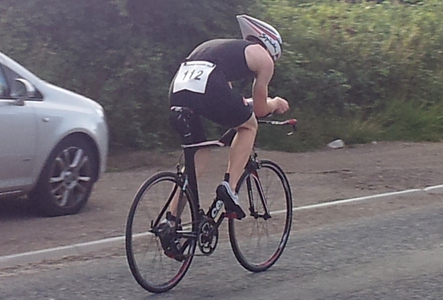
Bike https://chris-lamb.co.uk/wp-content/2013/cotswold_bike.jpg
Distance
52 miles
Time
2:22 (21.9 mph average)
I had thoroughly absorbed the advice that you should prepare for your primary race so that it feels like another day at the office. On this criterion, the bike leg was almost perfect. My nutrition strategy energy drink every 5 minutes, gel every 30 minutes worked fine until mile 35 where I felt like I had taken on too much fluid (and no time to take a bathroom break). I had a temporary hiccup with my rear derailleur but my "tame" 52/34 12x28 gearing was vindicated on the climbs, although in retrospect that might mostly be schadenfreude. Tens of hours acclimatising to a time trial bike was rewarded by being able to spend the entire leg in "aero" position (ignoring 90-degree turns or serious gradients), improving efficiency.
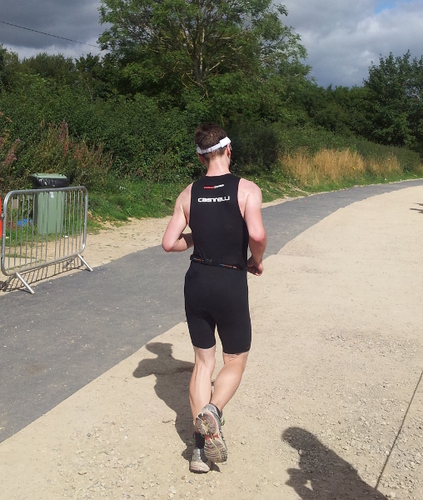
Run https://chris-lamb.co.uk/wp-content/2013/cotswold_run.jpg
Distance
13.1 miles (21km)
Time
1:54:18 (5:25/km)
I had prepared a chart which provided the pace I required based on the race time at the start of the run. I would then only need to monitor my run pace instead of repeatedly extrapolating a finish time as even basic arithmetic can become impossible when fatigued. This strategy was chosen as I was too risk-adverse to aim for a faster time than strictly required; the downside of missing the target from aiming too high and "blowing up" outweighed going a few minutes faster overall. Despite that, I ran half-marathon personal best. Unfortunately, due to pressing the wrong watch button after the swim, the chart was worthless unless I could assume the race started exactly at 6:30AM. With no other option I decided to trust that with some padding, but the uncertainly it added was unsettling. Adding to that feeling, my left hip started to twinge at 7K, something it has never done before. My plan was to get to 16K, take a caffeine gel and then keep ratcheting up the pace until the finish. In my long run training I could speed up to a 4:10/km pace but after 5 hours of racing and being reasonably sure I was going to reach my goal, the best I could summon was 4:45/km. My form completely shot, I crossed the finish line and got into a fetal position in the shade behind a tent, scaring the race organisers for a few minutes.
Overall
Total time
4:56:50
Writing this the day after the race, I am still a little unsure of how I feel. I am obviously extremely content that I reached my goal but given the volume and detail of preparation it was not a huge surprise to me on race day that I did so. This combined with the "real" work and progress being achieved throughout the training seems to have robbed the event of some element of triumph it could have had, but that in itself was somewhat expected. Where next? I had always dismissed the consensus view of needing to take a decent break after the season has ended but now I am looking forward to putting triathlon-specific training on hold for a while and explore other things. I highly doubt this will be my last triathlon though. https://chris-lamb.co.uk/wp-content/2013/cotswold_result.jpg (Full results)

6 August 2013

Ian Wienand: Running cloud images locally

Fedora and Ubuntu both provide compact cloud images that are useful for spinning up small VM's quickly (much quicker than installing from a huge ISO or even net-install). Both these pages have single-click buttons to simply launch the VM's at Amazon, which is very cool. However, you may have reason to use them "offline" with a local KVM (outside of EC2 or OpenStack) for testing, or on a plane, etc. I didn't find a lot of information on this (although it is all available once you know what you're looking for). So here's my quick guide for the complete newbie. Firstly, download your image of choice and put it in /var/lib/libvirt/images. Open up virt-manager and you can create your new VM via "import existing image". You can try booting it, but the problem you'll hit is the images have no default password or way to log-in because, very sensibly, you're expected to inject that. Booting you'll see cloud-init attempting to contact 169.254.169.254 to collect the meta-data to initalize the VM; eventually it will time out and you're left at a login prompt you can't log in at. cloud-init does many things and is very flexible with lots of different plugins to initialise images in various ways. The particular one we're interested in is the No cloud plugin. This will look for data from a locally attached CD drive, which works very easily for this scenario. Now that you know that's what you're looking for, the instructions are fairly clear; I'll repeat them just for clarity. Firstly you want to create a minimal meta-data file that has a host-name and an instance-id:
$ cat meta-data
instance-id: iid-local01;
local-hostname: myhost;
Modifying the instance-id will signal to cloud-init that it should run again because something changed. This is also where you can put static IP address data; see the documentation. Secondly, create a user-data file that has the commands to enable password login; set a password, and inject your ssh public key so you can easily log-in:
$ cat user-data
#cloud-config
password: mypassword
ssh_pwauth: True
chpasswd:   expire: False  
ssh_authorized_keys:
  - ssh-rsa ... foo@foo.com (insert ~/.ssh/id_rsa.pub here)
Note for new players: that #cloud-config isn't an optional comment, it's a directive. If you leave it out, you'll probably see a little something about Unhandled non-multipart userdata starting... and your changes won't apply. Insert those two into files into an iso:
$ genisoimage -output init.iso -volid cidata -joliet -rock user-data meta-data
Then copy init.iso into /var/lib/libvirtd/images as well, and connect that as a virtual-cd drive to your virtual-machine created from the image. When you boot you should see some output as it injects your key. It should get an address via DHCP and then you should be able to log-in with fedora or ubuntu users. Then you can start getting more complicated with things like static addresses, package installations, running commands, etc by reading the documentation.

3 August 2013

Paul Tagliamonte: Hy: The survival guide

One of my new favorite languages is a peppy little lisp called hy. I like it a lot since it's a result of a hilarious idea I had while talking with some coworkers over mexican food. Since I'm the most experienced Hypster on the planet, I figured I should write a survival guide. This will go a lot easier if you already know Lisp, but you can get away with quite a bit of Python. The Tao of Hy We don't have many rules (yet), but we do have quite a bit of philosophy. The collective Hyve Mind has spent quite a bit of time working out Hy's internals, and we do spend a bit of time looking at how the language feels . The following is a brief list of some of the design decisions we've picked out.
  1. Look like a lisp, DTRT with it (e.g. dashes turn to underscores, earmuffs turn to all-caps.)
  2. We're still Python. Most of the internals translate 1:1 to Python internals.
  3. Use unicode everywhere.
  4. Tests or it doesn't exist.
  5. Fix the bad decisions in Python 2 when we can (see true_division)
  6. When in doubt, defer to Python.
  7. If you're still unsure, defer to Clojure
  8. If you're even more unsure, you're fucked (see also: defer to Common Lisp)
Naturally, this doesn't cover everything, but if you can drop into that mindset, things start to make quite a bit of sense. The Style of Hy Although I am perhaps the least qualified person to do so (I still don't write idiomatic Lisp all the time), I'm going to set up a few ground-rules when it comes to idiomatic Hy code. We borrow quite a bit of syntax from Common Lisp and Clojure, so again, feel free to defer to either if you're not working on Hy internals. I prefer the Clojure Style Guidelines myself. As such, these are what we will defer to in the case that the Hy style is undefined. Clojure-isms Hy has quite a few Clojure-isms that I rather prefer, such as the threading macro, and dot-notation (for accessing methods on an Object), which I would rather see used throught the hylands.
;; good:
(with [fd (open "/etc/passwd")]
    (print (.readlines fd)))
;; bad:
(with [fd (open "/etc/passwd")]
    (print (fd.readlines)))
Some other hy devs very much disagree, and there's nothing syntactically invalid about the latter, and it will continue to be supported (in fact, it makes some things easier!), but it will not be considered for Hy internal code. We also very much encourage use of the threading macro throughout code where it makes sense.
;; good:
(import [sh [cat grep]])
(-> (cat "/usr/share/dict/words") (grep "-E" "tag$"))
;; bad:
(import [sh [cat grep]])
(grep (cat "/usr/share/dict/words") "-E" "tag$")
However, do use it when it helps aid in clarity, like all things, there are cases where it makes a mess out of something that ought to not be futzed with. Python-isms In addition to stealing quite a bit of syntax from Clojure, I'm going to take a few Python rules from PEP8 that apply to Hy as well. These are taken because PEP8 is a really great set of rules, and Hy code ends up pretty, well, Pythonic. The following are a collection of Pythonic rules that explicitly apply to Hy code. Trailing spaces is a huge one. Never ever ever shall it be OK to have trailing spaces on internal Hy code. For they suck. As with Python, you shall always double-space module-level definitions if seperated with a newline. All public functions must always contain docstrings. Inline comments shall be two spaces from the end of the code, if they are inline comments. They must always have a space between the comment character and the start of the comment. Hy-isms Indentation shall be two spaces, except where matching the indentation of the previous line.
;; good (and prefered):
(defn fib [n]
  (if (<= n 2)
      n
      (+ (fib (- n 1)) (fib (- n 2)))))
;; still OK:
(defn fib [n]
  (if (<= n 2) n (+ (fib (- n 1)) (fib (- n 2)))))
;; still OK:
(defn fib [n]
  (if (<= n 2)
    n
    (+ (fib (- n 1)) (fib (- n 2)))))
;; Stupid as hell
(defn fib [n]
    (if (<= n 2)
            n
      (+ (fib (- n 1)) (fib (- n 2)))))
Parens must never be alone, sad, all by their lonesome on their own line.
;; good (and prefered):
(defn fib [n]
  (if (<= n 2)
      n
      (+ (fib (- n 1)) (fib (- n 2)))))
;; Stupid as hell
(defn fib [n] 
    (if (<= n 2)
      n
      (+ (fib (- n 1)) (fib (- n 2)))
    )
)  ; GAH, BURN IT WITH FIRE
Don't use S-Expression syntax where vector syntax is really required. For instance, the fact that:
;; bad (and evil)
(defn foo (x) (print x))
(foo 1)
works is just because the compiler isn't overly strict. In reality, the correct syntax in places such as this is:
;; good (and prefered):
(defn foo [x] (print x))
(foo 1)
Notice This guide is, above all, a guide. This is also only truely binding for working on Hy code internally. This post is also super subject to change in the future, whenever I can be bothered to ensure that we have more of the de facto rules written down.

29 July 2013

Thomas Goirand: OpenStack Havana b2 available, openstack-debian-images approved

I have finished preparing the beta 2 of the next release of OpenStack. It is currently only available from out Git on Alioth (in /git/openstack), and directly from my jenkins repository, which creates Wheezy backports for it:
deb ftp://havana.pkgs.enovance.com/debian havana main
deb http://archive.gplhost.com/debian havana-backports main
As for every OpenStack release, a large number of Python modules needed to be packaged and are waiting in the FTP master NEW queue to be approved: oslo-sphinx, python-django-discover-runner, python-hacking, python-jsonrpclib, python-lesscpy, python-neutronclient, python-nosehtmloutput, python-requestbuilder, python-termcolor, sphinxcontrib-httpdomain and sphinxcontrib-pecanwsme. Let s hope that they will be approved before the next beta release in september (time where OpenStack Havana will be in feature freeze). The total number of packages maintained by the OpenStack team (on which I really am the only active maintainer for the moment ), there s 53 packages, plus these 11 packages waiting in the NEW queue. That s a big number of package, and I wouldn t mind some help One thing that annoyed all the community is that Quantum, the OpenStack network virtualization module, had to be renamed as Neutron, because of a trademark from Quantum (you probably remember the Quantum Fireball hard drives? Well, it s the same company ). Another good news is that my openstack-debian-images package has just been approved and landed in Sid. With it, you can automate the process of building a Debian image for OpenStack with a simple shell command (there s a man page that I wrote with it: read it if you need to build images). It is made of a single shell script to build the image, using kpartx, parted, mbr, debootstrap, extlinux and friends. I tried to keep it simple, not involving a huge amount of components. With the release of cloud-init 0.7.2-3, I have fixed a few bugs (3 important bugs, out of which 2 where RC bugs), thanks to contributions in the debian-cloud@lists.debian.org mailing list. This includes adding new init.d scripts, so we now have support for user data. This doesn t only benefits OpenStack images, but anyone willing to start virtual machines in the cloud (nowadays, every cloud implementation needs cloud-init installed in the virtual images). This means you can include a script in the metadata of the virtual machine you start it, and it will be executed at startup. If everything goes as planned (that is, no new RC bug), I will upload an update of cloud-init to backports in 5 days (there is already a version there, but it doesn t have the necessary init.d scripts to execute the user data scripts), and openstack-debian-images in 9 days. Then it will be possible to build OpenStack images with absolutely all the tools available from Wheezy (and backports). I hope to be able to discuss that during Debconf 13.

27 July 2013

Christian Perrier: [life] Running update July 27th 2013: Bubulle now runs in moutains

My last running update was sent after I had a great April month with two successful trail races (35km then 44km). The next target was Mont-Blanc marathon in Chamonix valley in early July, so it's time for me to send a new update before summer. May and June was mostly training. Huge training. Very long distances with 375km in May and over 430 in June (breaking my former monthly record by over 50 kilometers). Yes, that means over 14 kilometers every day..:-) I indeed achieved that with my "go to work partly by running" habits, which are now deeply included in my daily schedule. Much more convenient than bus ride (with the typical random schedules of RATP, which French people translate by "Rentre Avec Tes Pieds" or "Come back home by walking"....which is exactly what I'm doing). With such training (sometimes including extra rides in the forests, with short but steep ups and downs)....I was well prepared for THE early summer goal : Marathon du Mont-Blanc in Chamonix (not Ultra Trail du Mont-blanc : this one, I'm not ready for....yet).. My first mountain trail race, and what race! Imagine 42km in the moutain lovers heaven, namely the Chamonix Valley, with the Mont-Blanc, Aiguille Verte, Aiguille du Midi, Aiguilles Rouges, etc. above your head. Of course, not only in the valley but goind up and down "slightly"....in short 2200 meters positive climb..:-) I ran it with a female friend of mine, who I met in local races and through runners web forums. Sabine has about the same running skills than me and we developed a good and nice friendship, sharing our love for running in the nature. So, during May and June, we decided to run this race together as we were both registered for it. A first trial in a local 35km trail race two weeks before the MMB was very successful. We ended up in 3h40 and Sabine was ranked 5th female runner. And, moreover, we had a tremendous pleasure by crossing the finishing line together. So, we did it again in Chamonix. And, hell, we did it well: I had set the goal to 6 hours and 30 minutes and we completed the race in..... 6 hours and 34 minutes. Much much better than I and she would have expected. And, believe me, crossing the finishing line was again a special moment, particularly because the crowd at the end of this race make it look like l'Alpe d'Huez on the Tour de France. And, this on a wonderful sunny day, arriving at Planpraz, facing the Mont-Blanc. If you've ever been to Chamonix, you know what I mean. So, first moutain trail and, hell, not the last one! For those of you who can read French...or just want to see some pictures of a running bubulle, here is the link to the story. And these 42 kilometers were indeed so well done that the day after, while coming down from the famous Aiguille du Midi with Elisabeth (who came with me to Chamonix, of course)...I decided to run down from the cable car intermediate stop (2300m altitude) to Chamonix (1050m). Over 1200 meters down in 48 minutes... :-). Just a bit slower than the cable car....:) The remaining of July saw me again running back and forth to work and I'm indeed about to break my monthly record, eventually reaching 450 kilometers in one month and only two days NOT running in the whole month. Yeah, crazy. The upcoming Sunday, August 4th, just before going to Debconf 13, I'll spend a few days in Lanslebourg and will be running the EDF Cenis Tour trail, for 50 kilometers and 2600 meters positive climb. This time, a very "small" race, with no more than 150 runners. So, that will be another experience by running nearly entirely alone between 1400 and 2700 meters altitude. I'll post the outcome (or you'll probably hear about it at DC13....). See you, hopefully not in 3 months, for another update about running Bubulle.

25 July 2013

John Goerzen: Spring Always Comes

There will come a time when you believe everything is finished. That will be the beginning. Louis L Amour
Last year, I wrote about the difficult times in my life and hope for future, but never really explained why. I have written little since, because there is little I can write without a bit of explanation. It is partly because of the complexity of the task of telling my story without telling too much of others stories. But it is important I tell this story. So often on the Internet, we hear only the brave face, the positive things that happen. This story involves tears and difficulty. And also we often see only anger and bitterness. This story involves joy and celebration. One afternoon last year, I was working as usual (I work from home) when two sheriff deputies arrived on my doorstep. They gave me paperwork showing that my now ex-wife had filed for divorce, had asked them to serve me the paperwork, and that she had been given temporary possession of the house. I had 2 hours to gather up clothes and a little computer equipment (there was a list) and leave the house. Thus began the most difficult time in my life. I went from reading a bedtime story and singing a bedtime song to my young boys every night to seeing them only a little, from living in the house my grandparents and dad had lived in to having no particular plan for where I d sleep that night, from thinking I had a good idea of what the future held to not knowing when, if ever, I d ever be back home. I worried about how the boys would fare (they have done well so far). And it was incomprehensible; I couldn t find answers to why? . In the time since, the divorce became final, I did return home, the boys spend more time with me, and a new normal emerged. At the time, it seemed like a sudden, deep winter blizzard. I couldn t see very far down the road, spring seemed far off, and I couldn t see very well either forward or backward. But I was determined to find positives in the situation. It started almost immediately; I had never been a person to talk about pain, but just a few hours after the divorce was filed, I knew I needed to talk to someone about it, and did. A week later, I shared about it in church. Amazing friends, locally and all over the world, provided support and encouragement. I had less total time with the boys than before the divorce, but more time with just the three of us, and we used it to play together at home, spend days in town, and even take a train trip to Santa Fe, where none of us had ever been before. I realized how much I could forgive, and that my ex-wife probably did the best she could with the persistent legacy of difficult life events that happened to her long before she met me. I understood this, and was never angry, just sad, for everyone. I have always known nobody is perfect, myself included, but can be hard on myself when I m less than perfect. I forgave myself, too, realizing that I did my best to help in the most unfamiliar of waters, and although I sometimes didn t get it right, my conscience is clear because my heart was in the right place and I tried, very hard. Most incredibly, I became a person with a deep sense of inner peace. I always tried to work hard to set life on a good path; I got good grades in school, am a good employee, and have a strong set of values. But where courts are involved, there s a strong sense of powerlessness. At times, there was nothing I could do to make life better for my boys or for me. I finally had to let go of taking on responsibility for all that on my own shoulders. I simply knew that things would be OK, and in fact were OK, and that there is nothing in life that really deserves worries. That doesn t mean worries are never present, but that mostly they are subdued, like a radio quietly playing in another room. When they aren t, I can sit down at the piano, play my penny whistle, sing, walk to my creek, talk to friends, or any of so many things that let them melt away. I stopped searching for happiness and peace, and let those things find me. In religious terms, my faith became not just an intellectual one, but also a spiritual one. An atheist friend asked me, Just what does religion mean to you anyway? My answer: The certainty that spring always comes, for everyone that understands this.
People speak of misfortunes and sufferings, remarked Pierre, but if at this moment I were asked: Would you rather be what you were before you were taken prisoner, or go through all this again? then for heaven s sake let me again have captivity and horseflesh! We imagine that when we are thrown out of our usual ruts all is lost, but it is only then that what is new and good begins. While there is life there is happiness. There is much, much before us. Tolstoy, War and Peace
By Thanksgiving, I had much to be thankful for. Some of it under my nose waiting to be rediscovered after years of distraction, such as the glorious Kansas sunrises. Some things were new, such as roasting a turkey all by myself (or, rather, with Jacob and Oliver) for the first time, and having it come out absolutely perfectly. And some were just the things of everyday life: that I lived in my own house again, that I could walk out to the creek at the edge of my property whenever I wanted, that I could play piano, that the sounds of laughter and little running feet again could often be heard on my wood floors. That s not to say everything was easy; the courts sometimes made decisions sometimes I didn t think were in the boys best interests, legal things dragged on and on, but in the end, peace endured. Happiness endured. I found myself thinking at Thanksgiving that it was the best Thanksgiving ever. Not much later, I considered myself happier than I ve ever been. I was focusing on the daily gifts of life, marveling at the sunrises, looking forward to life s next adventure, confident that it would be far better than the last. And then, to my complete surprise, I found myself in a relationship again. On top of all the wonderful things happening in my life, I met Laura. I never could have imagined a friend so wonderful, a relationship so loving and joyful, something to treasure so deeply. I can look back at events and shake my head in amazement and wonder, that I found myself happier than I d ever been, and then this wonderful relationship on top of that. I have been blessed to have the life I do, and feel almost embarrassingly lucky. I share this story because friends that had been through divorce years ago shared their stories. They gave me hope. And if I didn t share this story in this public way, I would be squandering an opportunity to find more positives from what happened. I hope that this helps, somehow, someone that is in pain know that there is beauty in the valley, and spring always comes, every single year. And I share it because happiness like this can t be repressed for long. Tolstoy was right. While there is life, there is happiness. I ll end with a story from last Thanksgiving. It was 6:10AM that weekend. I was still asleep, and heard this: Jacob, yelling from his room: Dad? Dad! Me, groggy: Yes, Jacob? Jacob: Can I go down and look at the Christmas tree? Me: Sure, and you can turn it on too. Jacob: Great! At that point, I could have gone back to sleep. I was really short on sleep that morning, and Jacob would have been fine. But I gave him a couple of minutes, then I went downstairs too. He was curled up on the piano bench, looking at the tree. I quietly turned up the downstairs thermostat, got a chair, put it next to the piano bench, and sat down by the tree too. Jacob crawled over onto my lap and snuggled up for awhile. Neither of us said anything. Then: Dad? Yes? This is the best Thanksgiving ever. And he gave me a big hug. And he was right. Yes, he was RIGHT! That will be the beginning. Spring comes!

23 July 2013

Russell Coker: Security is Impossible

The Scope of the Problem Security is inherently complex because of the large number of ways of circumventing it. For example Internet facing servers have been successfully attacked based on vulnerabilities in the OS, the server application, public key generation, DNS, SSL key certificates (and many other programs and algorithms in use), as well as the infrastructure and employees of all companies in the chain. When all those layers work reasonably well (not perfectly but well enough to not obviously be the weakest link) there are attacks on the end user systems that access the servers (such as the trojan horse programs used to attack PCs used for online banking). My Area of Interest The area of security that interests me is Linux software development. There are many related areas such as documentation and default configurations to make it easier for people to secure their systems (instead of insecure systems being the default option) which are all important. There are also many related fields such as ensuring that all people with relevant access are trustworthy. There are many interesting problems to solve in such areas most of which aren t a good match for my skills or just require more time than I have available. I sometimes write blog posts commenting on random security problems in other areas. Sometimes I hope to inspire people to new research, sometimes I hope to just inform users who can consider the issues when implementing solutions to security problems. Bugs In the software development side there are ongoing problems of bugs in code that weaken security. The fact that the main area of concern for people who are interested in securing systems is fixing bugs is an indication that the problem of software quality needs a lot of work at the moment. The other area that gets a reasonable amount of obvious work is in access control. Again it s an area that needs a lot of work, but the fact that we re not done with that is an indication of how far there is to go in generally improving computer security. Authenticating Software Releases There have been cases where source code repositories have been compromised to introduce trojan horse code, the ones I ve read about have been discovered reasonably quickly with little harm done but there could be some which weren t discovered. Of course it s likely that such attacks will be discovered because someone will have the original and the copies can be compared. Repositories of binaries are a bigger problem, it s not always possible to recompile a program and get a binary which checks out as being identical (larger programs often include the build time in the binary). Even for build processes which don t include such data it can be very difficult to determine the integrity of a build process. For example programs compiled with different versions of libraries, header files, or compilers will usually differ slightly. As most developers frequently change the versions of such software they will often be unable to verify their own binaries and any automated verification of such binaries will be impossible for anyone else. So if a developer s workstation was compromised without their knowledge it might be impossible for them to later check whether they released trojan binaries without just running the binaries in question and looking for undesired behavior. The problem of verifying past binaries is solvable for large software companies, Linux distributions, and all other organisations that have the resources to keep old versions of all binaries and libraries used to build software. For proprietary software companies the verification process would have to start with faith in the vendor of their OS and compiler doing the right thing. For Linux distributions and other organisations based on free software it would start by having the source to everything which can then be verified in theory although in practice verifying all source for compilers, the OS, and libraries would be a huge undertaking. Espionage There is a well documented history of military espionage, people who are sworn to secrecy have been subverted by money, blackmail, and by having political beliefs which don t agree with their government. The history of corporate espionage is less well documented but as corporations perform less stringent background checks than military organisations I think it s safe to assume that corporate espionage is much more common. Presumably any government organisation that can have any success at subverting employees of a foreign government can be much more successful in subverting programmers (either in companies such as Microsoft or in the FOSS community). One factor that makes it easier to launch such attacks is the global nature of software development. Government jobs that involve access to secret data have requirements about where the applicant was born and has lived, corporate jobs and volunteer positions in free software development don t have such requirements. The effort involved in subverting an existing employee of a software company or contributor to free software or the effort involved in getting an agent accepted in such a project would be quite small when compared to a nuclear weapons program. Therefore I think we should assume that every country which is capable of developing nuclear weapons (even North Korea) can do such things if they wish. Would the government of such a country want to subvert a major software project that is used by hundreds of millions of people? I can imagine ways that such things could benefit a government and while there would be costs for such actions (both in local politics and international relations) it seems most likely that some governments would consider it to be worth the risk and North Korea doesn t seem to have much to lose. Conclusion We would like every computer to be like a castle with a strong wall separating them from the bad things which can t be breached in ways that aren t obvious. But the way things are progressing with increasingly complex systems depending on more people and other systems it s becoming more like biology than engineering. We can think of important government systems as being comparable to the way people with compromised immune systems are isolated from any risk of catching a disease, the consequences of an infection are worse so greater isolation measures are required. For regular desktop PCs getting infected by a trojan is often regarded as being similar to getting a cold in winter. People just accept that their PC will be infected on occasion and don t bother making any serious effort to prevent it. After an infection is discovered the user (or their management for a corporate PC) tend not to be particularly worried about data loss in spite of some high profile data leaks from companies that do security work and the ongoing attacks against online banking and webcam spying on home PCs. I don t know what it will take for users to start taking security risks seriously. I think that a secure boot is a good step in the right direction, but it s a long way from being able to magically solve all security problems. I ve previously described some of the ways that secure boot won t save you [1]. The problems of subverting developers don t seem to be an immediate concern (although we should consider the possibility that it might be happening already without anyone noticing). The ongoing trend is that the value of computers in society is steadily increasing which therefore increases the rewards for criminals and spy agencies who can compromise them. Therefore it seems that we will definitely face the problems of subverted developers if we can adequately address the current technical problems related to flaws in software and inadequate access control. We just need to fix some of the problems which are exploited more easily to force the attackers to use the more difficult and expensive attacks. Note that it is a really good thing to make attacks more difficult, that decreases the number of organisations that are capable of attack even though it won t stop determined attackers. For end user systems the major problem seems to be related to running random programs from the Internet without a security model that adequately protects the system. Both Android and iOS make good efforts at protecting a system in the face of random hostile applications, but they have both been shown to fail in practice (it might be a good idea to have a phone for games that is separate from the phone used for phone calls etc). More research into OS security is needed to address this. But in the mean time users need to refrain from playing games and viewing porn on systems that are used for work, Internet banking, and other important things. While PCs are small and cheap enough that having separate PCs for important and unimportant tasks is practical it seems that most users don t regard the problems as being serious enough to be worth the effort.

Keith Packard: present sync

Implementing Vblank Synchronization in the Present Extension This is mostly a status update on how the Present extension is doing; the big news this week is that I ve finished implementing vblank synchronized blts and flips, and things seem to be working quite well. Vblank Synchronized Blts The goal here is to have the hardware executing the blt operation in such a way as to avoid any tearing artifacts. In current drivers, there are essentially two different ways to make this happen:
  1. Insert a command into the ring which blocks execution until a suitable time immediately preceding the blt operation.
  2. Queue the blt operation at vblank time so that it executes before the scanout starts.
Option 1. provides the fewest artifacts; if the hardware can blt faster than scanout, there shouldn t ever be anything untoward visible on the screen. However, it also blocks future command execution within the same context. For example, if two vblank synchronized blts are queued at the same time, its possible for the second blt to be delayed by yet another frame, causing both applications to run at half of the frame rate. Option 2. avoids blocking the hardware, allowing for ongoing operations to proceed on the hardware without waiting for the synchronized blt to complete. However, it can cause artifacts if the delay from the vblank event to the eventual execution of the blt command is too long. Queuing the blt right when it needs to execute means that we also have the opportunity to skip some blts; if the application presents two buffers within the same frame time, the blt of the first buffer can be skipped, saving memory bandwidth and time. Present uses Option 2, which may occasionally cause a tearing artifact, but avoids slowing down applications while allowing the X server to discard overlapping blt operations when possible. Queuing the Blt at Vblank There are several options for getting the blt queued and executed when the vblank occurs:
  1. Queue the blt from the interrupt handler
  2. Queue the blt from a kernel thread running in response to the interrupt
  3. Send an event up to user space and have the X server construct the blt command.
These are listed in increasing maximum latency, but also in decreasing complexity. Option 1. is made more complicated as much of the work necessary to get a command queued to the hardware cannot be done from interrupt context. One can imagine having the desired command already present in the ring buffer and have the interrupt handler simply move the ring tail pointer value. Future operations to be queued before the vblank operation could then re-write the ring as necessary. A queued operation could also be adjusted by the X server as necessary to keep it correct across changes to the window system state. Option 2. is similar, but the kernel implementation should be quite a bit simpler as the queuing operation is done in process context and can use the existing driver infrastructure. For the X server, this is the same as Option 1, requiring that it construct a queued blt operation and deliver that to the kernel, and then revoke and re-queue if the X server state changed before the operation was completed. Option 3 is the simplest of all, requiring no changes within the kernel and few within the X server. The X server waits to receive a vblank notification event for the appropriate frame and then simply invokes existing mechanisms to construct and queue the blt operation to the kernel. Oddly, Present currently uses Option 3. If that proves to generate too many display artifacts, we can come back and change the code to try something more complicated. Flipping the Frame Buffer Taking advantage of the hardware s ability to quickly shift scanout from one chunk of memory to another is critical to providing efficient buffer presentation within the X server. It is slightly more complicated to implement than simply copying data to the current scanout buffer for a few reasons:
  1. The presented pixmap is owned by the application, and so it shouldn t be used except when the presented window covers the whole screen. When the window gets reconfigured, we end up copying the window s pixmap to the regular screen pixmap.
  2. The kernel flipping API is asynchronous, and doesn t provide any abort mechanism. This isn t usually much of an issue; we simply delay reporting the actual time of flip until the kernel sends the notification event to the X server. However, if the window is reconfigured or destroyed while the flip is still pending, cleaning that up must wait until the flip has finished.
  3. The applications buffer remains busy until it is no longer being used for scanout; that means that applications will have to be aware of this and ensure that they don t deadlock waiting for the current scanout buffer to become idle before switching to a new scanout buffer.
Present is different from DRI2 in using application-allocated buffers for this operation. For DRI2, when flipping to a window buffer, that buffer becomes the screen pixmap the driver flips the new buffer object into the screen pixmap and releases the previous buffer object for other use. For Present, as the buffer is owned by the application, I figured it would be better to switch back to the real screen buffer when necessary. This also means that applications aren t left holding a handle to the frame buffer, which seems like it might be a nice feature. The hardest part of this work was dealing with client and server shutdown, dealing with objects getting deleted in random orders while other data structures retained references. (The kernel DRM drivers use the term page flipping to mean an atomic flip between one frame buffer and another, generally implemented by simply switching the address used for the scanout buffer. I d like to avoid using the word page in this context as we re not flipping memory pages individually, but rather a huge group of memory that forms an entire frame buffer. We could use plane flipping (as intel docs do), frame buffer flipping (but that s a mouthful), display flipping or almost anything but page flipping ). Overall DRI3000 Status At this point, the DRI3 extension is complete and the Present extension is largely complete, except for redirection for compositors. The few piglit tests for GLX_OML_sync_control all pass now, which is at least better than DRI2 does. I think I ve effectively replicated the essential features of DRI2 while offering room to implement a couple of new GL extensions: The code for this stuff has all been pushed to a number of repositories:

22 July 2013

Daniel Pocock: Winning at any cost

It's not every day that a student messing around with keystroke loggers comes to fame through slashdot. Nonetheless, systematically rigging an election and getting sentenced to 12 months in a dorm with bars has helped raise 22 year old Matthew Weaver's profile well above that of the average script kiddie. Now let's stop and reflect on poor Weaver's future. You may be thinking that with an exchange program like this on his academic record he won't be so popular with employers. Given that he was busted by campus security rather than the FBI he won't even attract the interest of those companies who hire ex-hackers. So where could he go? How is it done in Australia? Not too long ago, when I was a student myself, one of our prominent universities was subjected to a very similar scam. Four members of the Tin Tin for NUS ticket at La Trobe University were implicated in stuffing the ballot the old fashioned way. The incidents even share the characteristics of chronic stupidity: just as Weaver had been caught voting for himself 259 times from the same IP address in a campus computer lab, team Tin Tin had tried to hand their bag of manipulated postal votes directly to the deputy returning officer rather than discretely posting them through the internal mail. According to an official report by the Deputy Returning Officer, Karsten Haley, all four candidates were charged with Dishonest Conduct and Interfering with Ballot Papers. Unfortunately, the report notes that
La Trobe University SRC Electoral Regulations do not empower the Returning Officer or Deputy to enforce charges or disciplinary procedures and the charges were never faced by the accused.
Given the seriousness of the matter, Haley did not give up his attempts to hold them to account. He escalated it to the Dean of the college and then to the University Secretary. He reports that "their disinterest was extraordinary" and that nobody would involve the police. Young Labor suspended Just over a year later, in 1997, the ALP's youth division for the state of Victoria, Young Labor, was suspended after attempts to rig the ballot to elect the Young Labor leadership team. The guilty parties were never publicly named. Nobody was formally suspended or expelled and this simply left them with more time on their hands to invest their energy in other elections. The suspension of Victorian Young Labor remained in effect for a number of years. The specific allegations about the Young Labor ballot suggest that those people particularly keen to win had printed fake student cards and given them to stooges who would impersonate other Young Labor members who had not attended to vote in person. Where are they now? It is no co-incidence that these students were (and still are) members of Labor Unity, a powerful faction within Australia's ruling Labor Party, the ALP. Most political organisations would presumably express concern about these allegations. The ALP does things differently. One of the students who withdrew his nomination in La Trobe, Mr Larocca, subsequently became Mayor in the City of Moreland, one of the ALP's strongholds. Even more remarkably from an outsider's viewpoint, another of these figures, Stephen Donnelly, is currently employed as the Assistant State Secretary of the ALP in Victoria. Communications like this newsletter reveal that he is one of the key figures in the party's pre-selection process. He has recently been appointed to direct the ALP's 2013 federal election campaign for the state of Victoria. Another co-incidence On the same weekend that Weaver was in the news for his antics, Donnelly's latest employer, the ALP's Victorian branch, was conducting pre-selection ballots to choose candidates for the upcoming federal election. So it's no surprise that Monday's newspaper headlines report fresh allegations of voting irregularities. Sadly, I've seen some of Labor Unity's bad behavior first hand. About 10 years ago I was living in South Melbourne, which is in the federal electoral district of Melbourne Ports. A young female friend of mine, a member of the local Elwood branch of the ALP, had spent election day handing out brochures for an ALP candidate in a marginal seat rather than assisting the controversial local ALP candidate, Michael Danby. A few days later I was witness to an incident where Danby aggressively confronted this young woman and demanded to know why he hadn't seen her handing out his own leaflets on polling day. He stood within centimeters of her and was literally looking down on her as he demanded some kind of apology to sooth his bruised ego. She looked terrified and barely responded. Within moments one of his handlers approached and physically moved Danby away from this young woman, I dare to think where things would have gone otherwise. Eye for talent Remarkably, at the same time, the infamous Stephen Donnelly had started shadowing Danby in his movements about the district. Fresh out of university, his talents had been recognised by Danby and he was employed in Danby's office, enabling him to continue honing his skills on a full-time basis with a tax-payer funded salary. What a remarkable contrast to the story of Weaver. Can anybody imagine a US congressman collecting Weaver from the prison gates and deploying him to an office on Capitol Hill? The biggest bankruptcy in student history Around the same time, Donnelly's Student Unity, the student arm of Labor Unity were successful in taking over the student union of my own campus, the University of Melbourne. Not long after I graduated I heard that they had been accused of skimming off $1 million from catering providers and a high-risk $46 million property transaction that put the organisation into liquidation. Unlike Mr Weaver, who's scheme at Cal State barely got off the ground, none of those involved in the Melbourne University incident has faced criminal proceedings. One ALP figure, Andrew Landeryou, spent several months in Costa Rica while wanted for questioning in the Supreme Court. His wife has just been endorsed for a seat in the Senate with support from various Labor Unity figures including Danby. The Gillard questions In 1996, around the same time that Donnelly & Co. were romping around student unions learning the tricks of the political trade, a lawyer quietly departed from the firm Slater and Gorden after an internal investigation into a property transaction linked to a union slush fund. Like Donnelly, this lawyer's next move was to take employment in the office of a Labor Party MP. More recently she was backed by Labor Unity to become Prime Minister. The union slush fund remains under investigation, frustrated by the disappearance of documents. The $60 million heist Recently I blogged about Gillard and Abbott, leaders of the two main political parties in Australia, agreeing to take $60 million of taxpayer money to fund their parties' campaigns in the upcoming federal election, giving themselves an obscenely unfair unadvantage over all other contestants. Where would that money end up? In the case of the ALP, does it appear likely that figures like the Victorian ALP's federal campaign director, Mr Donnelly, would be involved in the expenditure? National shame With this background, it becomes easier to understand the quality (or lack of it) in Australia's national leadership. When you consider that the generation responsible for the La Trobe incident, the Young Labor suspension and the MUSU bankruptcy are now growing into positions of greater responsibility in the ALP it leaves me feeling the quality of leadership is only going to get a lot worse before it starts getting better. For example, the recent incident where coloured people were fed to the sharks has nothing to do with the worldwide refugee crisis and everything to do with maintaining the dumbed-down level of political discourse that Labor Unity thugs and their followers can cope with. Real issues like climate change and energy policy, for example, appear to be beyond the pay grade of Australia's political class Ranjini - coloured, indefinite detention It is startling that up to her own recent demise, Gillard herself had repeatedly begged the public to stop asking questions about her own past and remember that Labor politicians are innocent until proven guilty - yet she had a pregnant coloured woman thrown into a concentration camp on unfounded fears about "national security". No evidence has ever been presented that poor Ranjini committed a crime, but the houses bought with money from trade unions, transactions handled through Gillard's own office, seem to be as solid as bricks and mortar. If only poor Matthew Weaver had been an Australian, how much further would his star have risen? Update: please sign the petition at change.org asking La Trobe university to re-examine the report and refer it formally to the police. If you are concerned about the plight of poor Ranjini and other people subject to Australia's domestic rendition program, please take a moment to see Letters for Ranjini

16 July 2013

Joachim Breitner: Real World Haskell Applications

Today I held a lightning talk at the Karlsruhe Functional Programmer s Group, where I presented Real World Haskell applications, i.e. programs that are written in Haskell, are somewhat mature and well-known and have non-programmers as their target group. Here is the (surely subjective) list that I have come up (also see the slides): There is also an impressive list of industrial users that use Haskell without talking about it much, but that does not work well to show off that you can do any kind of application in Haskell. If I missed anything important, let me know!

7 July 2013

Paul Tagliamonte: Hy 0.9.10 released

A huge release, the combined 0.9.9 and 0.9.10 releases (I made a mistake releasing) are now tagged and pushed to pypi. It features a number of enhancements and fixes, and is just an absolute thrill to play with. Thanks to the contributors this cycle:
Bob Tolbert Christopher Allan Webber Duncan McGreggor Guillermo Vaya Joe H. Rahme Julien Danjou Konrad Hinsen Morten Linderud Nicolas Dandrimont Ralph Moritz rogererens Thomas Ballinger Tuukka Turto
Outstanding! New features are now being considered for 0.9.11. Thanks!

4 July 2013

Gergely Nagy: Onto greener, open pastures

Half a lifetime ago, somewhere at the end of the last millennia I became a free software enthusiast. On and off, I've been working on Free Software for the past fifteen years - most of them unknown, discontinued by now; a huge part of this work was a hobby: small, infrequent contributions. But it was, and still is, something I enjoy doing, something that satisfies my hunger for knowledge, my desire to give back to the community I received so much from. Over the years, what originally started as a desire became a need. What started as a preference, became a requirement. And all through these years, I had a dream, a clear goal I wanted to achieve, which gave purpose to a lot of things I wrote and worked on.This past Monday, the goal was reached. I left the BalaBit support department this week, and went for greener pastures, to do what I wanted to do since I became a free software fanatic: work on free software for a living. As of July first, I'm officially a syslog-ng OSE developer, working full time on 100% Free Software. And not just any software, but something used by millions all over the world. For the first time in my life, I am able to do what I want, for a living.So how did I end up here?It all started on a boring night in December, 2010, when I wrote the first version of the mongodb destination, which also marks my entrance into the syslog-ng contributor scene (apart from a set of bugfixes I was doing in my role as a software engineer at support). From this grew an agreement between the support and development departments (and myself, of course), that I can spend 20% of my time working on syslog-ng OSE. For a while, I spent my Fridays doing just that, eventually obtaining another hat: maintaining the 3.3 stable branch, and later the 3.4 branch too. Meanwhile, the 20% percent was reconsidered, and became 50%, with the premise that it will become 100% in the not too distant future. That future is now.That future is now, and while there will be a slower ramp-up time, there are great things in store, of which, I'll talk about in a later post. Needless to say, though, even if I achieved a dream, there are other desires to pursue, and I'm not going to spend fifteen years achieving them: it's time to fire up the rocket boots, and see where they take me.Two years. Watch this place.

1 July 2013

Russ Allbery: Review: Dark Lies the Island

Review: Dark Lies the Island, by Kevin Barry
Publisher: Greywolf
Copyright: 2012
Printing: 2013
ISBN: 1-55597-651-4
Format: ARC
Pages: 185
This is a literary short story collection by a mainstream Irish writer, rather far from my normal fare. It was the second book in a shipment of Powell's Indiespensable, which is generally (when there is one) a proof or Advanced Reading Copy of something relatively obscure. I'm not really the target audience, not being much of a short story aficionado, but the whole point of doing this Indiespensable experiment is to stretch my reading range. First off, as I would generally expect by mainstream fiction, the quality of the writing is excellent. One thing I particularly like about Barry is that he's refreshingly and unhesitatingly profane. His characters curse like I expect people to curse, some of them at the drop of a hat, and for me it gives a feel of solid realism to his dialogue. He's also very good with eye dialect, giving the impression of accents without making the text hard to read. Some of these stories I liked a great deal, rather more than I had expected. But if there was a general undermining flaw for me, it was that I prefer stories that go somewhere, that have a plot or lead up to a definite point. Some of Barry's do, but a lot of them seem more vignettes or just scenes, sketches of characters, that drift off without resolution. I can admire those as writing exercises, but for me they don't fill the desire I have when I sit down with a story. I'm not sure how useful these reviews will be, given that I don't have a lot of mainstream fiction background to compare them with, but here are some reactions, for whatever they're worth. "Across the Rooftops": This is one of those sketches, but it's one of the best of them. It's a single moment on the rooftops, an attempt to capture the moment of possibility around the first romantic overture. It's sadly quite conventional in gender roles (nervous man initiating, woman as relationship gatekeeper), but apart from that it's very well-written. This kind of thing is normally not to my taste, but Barry does such a great job capturing the sense of uncertainty and the sharp focus on detail that I couldn't help but like it. (7) "Wifey Redux": This is by far my favorite story of this book. I think it's both hilarious and brilliant, right from the starting line.
This is the story of a happy marriage but before you throw up and turn the page let me say that it will end with my face pressed hard into the cold metal of the Volvo's bonnet, my hands cuffed behind my back, and my rights droned into my ear this will occur in the car park of a big-box retail unit on the Naas Road in Dublin.
It's the story of a marriage and how it changes over time, but also the story of being a father and his baffled, flailing reactions to his daughter's sexual explorations. But that's not what makes the story. What makes the story is what leads up to the arrest at the end, which had me laughing out-loud in delight. Barry is great at writing a sort of devilish humor; I wish more of the collection was like this. (9) "Fjord of Killary": This is another one of the ones I enjoyed. It's about an author who buys a hotel (with a bar) on the fjord of Killary thinking that the local culture and contact along with the wild beauty would inspire his poetry. At the start of the story, he's thoroughly sick of both the climate and the people, and the collision between his idyllic dreams and the reality, as well as his acerbic first-person complaints, is quite entertaining. A huge storm and resulting flood provides the conflict and impetus for change, and a few moments of humor in the understated local reactions. I thought the closing epiphany was a bit too obvious and expected, and the ending didn't quite work for me, but it has some good moments. (7) "A Cruelty": Here's where the collection started losing me. This is still well-written and closely observed, but in the case of this story, I wish it weren't, since I found it extremely uncomfortable. The viewpoint character is vulnerable to an encounter of unalloyed nastiness. I'm sure that's the point, but, similar to how I avoid horror, it's the sort of story I'd rather not read. (3) "Beer Trip to Llandudno": This was my second-favorite story of the collection. It's about a group of men who take periodic beer-tasting trips and rate beers. They're just normal men, from a variety of backgrounds and professions, and I thought Barry did a great job capturing the sort of camaraderie that comes from long association with a hobby. That includes, here, the awkward limits on what one talks about and the tendency to use the hobby as a shield from anything that drifts into less certain territory. I thought the story suffered somewhat from not having much of a plot or conclusion, but that's also necessary from the setup. This group of people isn't actually going to solve problems, but will be there for each other in their own way. (8) "Ernestine and Kit": Another very dark story, although that's not quite as obvious at the start. As with "A Cruelty," it's well-written but disturbing and lacks any sort of positive resolution. Here, I think Barry went a bit far into portraying people who are a large part of the popular imagination but who are exceptionally rare in reality. It's the kind of story that, at least for me, plays badly with my brain's threat analysis: too memorable for the level of actual risk, and feeling like it was playing a bit too much with popular boogeymen. (4) "The Mainland Campaign": This one was just too subtle for me. Some of the summaries for this book hint at a meaning for the story that I didn't pick up at all on my first reading. On re-reading, I suspect that analysis is right, but even re-reading the story with that interpretation in mind (this is the sort of story where I'm not sure the average American would pick it up on first reading, but others might), I still don't understand exactly what happened. I think some mainstream writing, and some short stories, tends to err on the side of subtle. (4) "Wistful England": Another one that's way over on the sketch of a moment side of stories. Unlike "Across the Rooftops," it failed to make any impression on me whatsoever; I had to skim it just now to remind myself of any details at all, and by the time I edited this review for posting, I'd forgotten it again. I think it was aiming at capturing a mood, but the mopey viewpoint character didn't mean anything to me. (3) "Doctor Sot": This is another odd one, and I'm not quite sure what I think of it. Either it's another character sketch without much of a plot, or the plot was too subtle. The protagonist is a rather unlikable drunk who doubles as a small town's incompetent doctor. The story involves his encounter with a local sort of hippie encampment, which is moderately interesting even though I couldn't stand the man. Then it leads to an encounter that clearly meant something, but which was entirely lost on me. (4) "The Girls and the Dogs": And from an absence of plot back to the deeply disturbing. This story is about a moderately unlikable drug dealer who gets refuge from an extremely unlikable crazy person in a weird relationship with a woman and her sister. (As is sadly typical, polyamory only makes an appearance when the author wants to paint a scenario that's utterly fucked up and psychotic.) There's a pseudo-fantasy element here in that the characters talk about spells, but I think the only spell involved is authorial fiat to create a deeply broken and sick game that plays into a host of negative stereotypes. Despite myself, I did get drawn into the suspense of the story (Barry's undoubtedly a good writer), but it left me feeling dirty on several levels. (4) "White Hitachi": Finally, another story that I liked, although not as good as the ones earlier in the collection. This one follows a con man and two-bit thief as he gets his brother out of lockup and tries to resolve, or at least stay ahead of, various problems in his life. Again, no real ending, but I thought Barry did a good job at taking a snapshot of a life from a perspective that I don't read much in literature (along with all the sexism and racism that comes along with it). It sort of drifts off rather than ends (although the last sentence is a great bit of characterization), but I found it oddly enjoyable. (6) "Dark Lies the Island": I'm not sure what to make of this. It's another character sketch, a moment of deep psychological significance for a character, floating somewhat alone but described in detail. But the character is a girl struggling with cutting, from a male author whose other stories did not fill me with confidence in his handling of female characters. Barry makes this psychologically believable, but I'm a little nervous about trusting his portrayal of that mindset. It's also, again, just a bit too subtle; I had a hard time getting an emotional feel for how the events of the story connect. (5) "Berlin Arkonaplatz My Lesbian Summer": The final story of the collection is fairly typical of the problem I had with most of it. It seems reasonably well-written, I had a hard time connecting with the protagonist or understanding his motivations. It looks at a slice of life with which I have no familiarity at all (and is interesting for that reason), but I don't quite trust the story enough to submerge in it. Barry seems to write a lot of protagonists who seem aimless, befuddled, or just largely out of control, and I like a bit more agency in the primary character. Silvija is an interesting character, even shown from another's perspective, but the story is almost purely observational: showing her without comment, without obvious motive, and mostly without plot. It's strangely compelling, but not quite compelling enough that I'd actually seek it out. Which, really, is the whole book in a nutshell. (6) Rating: 6 out of 10

28 June 2013

Russ Allbery: Review: This Alien Shore

Review: This Alien Shore, by C.S. Friedman
Publisher: DAW
Copyright: 1998
Printing: July 1999
ISBN: 0-88677-799-2
Format: Mass market
Pages: 564
Jamisia is an orphan taken in by the Shido corporation, but she has a fairly comfortable and happy life in Shido Station. She lives in the care of her tutor, has friends, has something that feels like a relatively normal life. Then the station is attacked and destroyed by a rival corporation and she barely escapes in a one-person lifeboat, sent inexplicably by her tutor with a fake identity to rendezvous with a spaceship heading for the up-and-out. That begins a long and quite confusing flight away from everything she's known, and a discovery that her life is far more complicated than she thought. Meanwhile, far from the backwater of corporate tyranny that Earth has become, a new computer virus is wreaking havoc on Guild outpilots. The Guild navigate the ainniq: a sort of subspace that allows ships to slip between nodes without regard to distance. This is the only acceptable method of interstellar travel now that humans know that the more conventional Hausman Drive causes massive genetic mutations, and only Guerans have the secret of navigating it safely. But a virus of a sophistication no one has seen before appears to be targeting outpilot brains through their implants. This Alien Shore is told in two threads but multiple characters and viewpoints. Jamisia (yes, I stumbled over that name the entire book) spends nearly the whole book running while discovering that her head is a very complicated place for very bad reasons. Meanwhile, various other people (most notably the careful and meticulous Kio Masada) are analyzing and tracing the virus, which is of deep concern to the powers that be in the Guaran-controlled network of human colonies. The threads do come together eventually, helped by a young and much more impulsive hacker named Phoenix who is also on the trail of the virus, but it takes much longer than I expected. The book is a bit of cyberpunk, a bit of space opera, and is stuffed to the brim with world-building ideas. There's always something that feels slightly emotionally off about C.S. Friedman novels. Her characters are a bit too intense, a bit too full of primary colors and inherent natures. They don't do a lot of changing; they're just a little too much purely themselves to feel quite accurate. Sometimes it matters and sometimes it doesn't. This is one of the books where it mostly doesn't, partly because it's full of such an amazing variety of characters, and partly because Friedman does a great job adding situational complexity by playing them off of each other and showing them through each other's eyes. Pyschological realism, though, this isn't, nor would I look to Friedman for that. That's somewhat unfortunate given how central psychology is to this book. The focus that slowly emerges from this novel is the whole-hearted embrace of psychological difference as a force for creativity, power, and perspective. Acceptance, respect for, and integration of difference borders on a religious belief for Guerans, which makes this book one of the most wholeheartedly inclusive stories (at least for psychology) I've read. I loved that message enough to overlook the fact that those psychological differences are not treated with much subtlety. The most central of the differences (a very mild spoiler, but one that's essentially given away on the back cover and that is easy to guess early in the book) is multiple personalities. Sadly, I thought that was also the least successful. Friedman treats the topic respectfully and as a difficult asset, which I liked, but it's bog-standard fictional multiple personalities. The presentation owes much more to popular fiction than to the reality of disassociative identity, and the notes that Friedman hits (and the characteristics that the multiples embody) are predictable. However, her second major psychological idea is simply brilliant. The Guerans have developed a coding system for people to communicate their psychological profile to anyone who sees them, and all of the Gueran characters in the novel actively engage with that system and make extensive use of it. Friedman hints at a great deal of subtlety: a wealth of primary patterns (many of which are described in quite enjoyable animal metaphors as chapter epigraphs), secondary patterns that can be layered underneath, and a complex interaction of base patterns and patterns for daily mood. Here, I think Friedman's mild tendency towards archetypal characters helps, since it makes the psychological coding system clearer for the reader. I wish it had been more central to the story and explained further, although I can see the risk of turning the novel into an RPG sourcebook. (Although, now that I mention it, I would love to read an RPG sourcebook for this universe.) The other point for which I have to give Friedman huge credit is that at least half of the book is about a computer virus, the analysis of that virus, and the hacking culture of her future universe, and at no point during the story did I want to start throwing things. There are no completely unbelievable magic computer programs, the sense of movement of data and virtual presence through computer networks seemed vaguely plausible and less steeped in unrealistic VR metaphors, the sense of aesthetics of code is captured remarkably well for a story of this sort, and Friedman even brings some variety to her computer-savvy characters. There are a few mildly stereotyped young hackers (although even those have a tendency to have more depth than the stereotype), but Friedman also populates her electronic world with the other types you rarely see in these novels: thoughtful, brilliant, but meticulous researchers, competent technicians who don't engage as much on the aesthetic aspects, and even moderately-intelligent users who pay attention to the computers their lives are built around. I could actually believe in both these people and the software they use with only the suspension of disbelief required for any future SF. That's not to say there are no flaws, quibbles, or places where computers probably won't ever work that way. But that's part of what makes me so impressed. Friedman is still using computers and hacking in the direct service of a fairly typical SF plot to achieve specific dramatic ends and to create a mystery. She's not building the story around actual technology; she's staying fairly close to the sort of technology and plots that a lot of cyberpunk and hacking novels have. And yet she manages not to make the computing entirely stupid or unbelievable. It's existence proof that an SF author can pay attention to experts and research without compromising the story they want to tell. I want to take this book and smack Robert Sawyer upside the head with it. This is a great idea book with a heavily computer-driven plot strand that I quite enjoyed. It is, however, not without its flaws. The virus-hunting part of the plot is significantly more interesting than Jamisia's flight, particularly given that she keeps running, and running, and running, encountering various people who seem important and end up not being important at all. It takes more than half the book before anything particularly interesting happens to her; up until then, I was dragging myself through her segments so that I could get back to Masada and the other Guerans. She's also annoyingly dim about some things. I figured out what the deep secret in her brain was within the first four or five chapters (it's entirely obvious from the political structure of Friedman's universe), and I have no idea why it took everyone else so long to figure it out. There is also, as mentioned, the slightly off feeling of the characters that I find typical of Friedman, and a cut-throat power struggle at the heart of the book that just didn't have enough psychological believability to fully engage me. But the ideas are wonderful: technology-driven political structures, corporate-controlled states, ideological clashes, lots of believable cultural interactions, and a neat two-option interstellar travel system (even if the nature of the Hausman Drive damage bears no resemblence to any genetic science known to our reality). And that's on top of a wonderful visual language of psychology and discussions of computer security that I actually enjoyed reading. Friedman's the sort of author who won't be to everyone's tastes. You have to have some tolerance for her tendency to write grand clashes of power between highly flawed, aggressively emotional people. Sometimes you have to put up with rather a lot of setup. But I really liked this novel. I suspect I'm editing out a lot of the boring bits in my memory, but I fondly remember that edited version as a ton of fun. Rating: 8 out of 10

27 June 2013

Andrea Veri: Two years later: Vim, Tmux and my Linux desktop

It s been two years since my latest blog post about my Linux desktop and many things have changed since then. I completely moved all my machines to GNOME 3, switched my main editor from nano to vim and my terminal multiplexer from screen to tmux. What didn t change at all except for a tweaks on the theme is my Irssi setup. dircolors_solarized Switching from nano to vim has been a pain at first, nano is really a straightforward editor, it does what you actually need from a CLI editor but while it works just fine when modifying configuration or text files, it s a bit limiting when it comes to programming. Vim on the other hand is highly customizable in every single part also thanks to its huge amount of plugins. Honestly I admit I spent several hours watching videos, reading documentation, trying out key bindings and I m not completely used to vim to be as much productive I would like to be with it. What I found to be the common error of vim s newcomers is their willingness to look around the web for a complete vimrc configuration file, full of key bindings, custom settings and personalizations. That s definitely something you should avoid when learning to use vim, the perfect vimrc doesn t objectively exist, each of us should spend some time investigating what is the best configuration for your needs and build a vimrc accordingly time by time. vimIt will probably take months to have a complex vimrc file matching your needs completely, until then you won t be able to define your vimrc to be ultimate . And that s actually why wgetting someone else s vimrc and copying it to your home folder won t make you an expert of vim, it ll probably make your life harder when trying a specific action with the stock settings will result in something you wouldn t have expected thanks to a particular key binding on the vimrc you downloaded. tmux The other tool that definitely improved my productivity is Tmux given the huge amount of open terminals I had every day during my sysadmin s duties at GNOME. Each day usually started with one or two open terminals mainly meant for random maintenance issues, after a few hours the amount of open terminals jumped to around 30. irssi Switching between tabs became a pain and the usual amount of time spent finding out which terminal had the the specific remote connection I needed was surprisingly sticking around 10 seconds. I looked around for a possible solution and found Tmux, it has been a joy finding out how easy it was to set it up and get used to it. I m now able to divide my 27 inches monitor into several panels and switch between them with a little keybinding, in addition you can set up as many windows (and consequently as many panels) as you wish, that way I can divide my programming windows from the ones specifically meant as remote consoles. From there I can detach / attach my previous Tmux session with one command and keep working on the same files and connections I had open the last time I used Tmux. In addition to the above tools I ve kept being an huge fan of Irssi and some of its plugins that have improved my overall productivity when daily chatting with Fedora, Debian and GNOME contributors. What actually changed on it since two years ago is the theme which is currently a mix between the Solarized and the XChat themes. Please don t hesitate to ask me any question if you are curious about learning something more about my current working setup! :-)

Next.

Previous.