Search Results: "gio"

8 May 2009

MJ Ray: Enterprise Hubs, Societies, Newsletter and AGM

Cooperatives-SW (which I m currently helping to direct) has been approved for Co-operative Enterprise Hub funding for 2009. Well done to Viv and the rest of the hard-working team who have been doing miracles for co-ops in this region with relatively little funding for so long now. (But if you ve got a pot of money to donate, let me know, please.) Industrial and Provident Societies are the traditional form for registering UK Co-operatives, but there are a number of things in its 1960s law which aren t reflected in general company law (which was mostly updated since the mid-1980s). For starters, IPSes are registered with the FSA, whose website isn t as good as Companies-House WebCHeck for Limited companies. Cooperatives-UK are pressing for the law to be modernised. C-UK sent us a status update (which I can t find on their website yet) this week. Amongst other things, they re seeking to introduce provisions to allow online registration and filing for IPSes. I ve asked them to take the opportunity to press for similar provisions for LLP Co-ops, or directing Companies House to act on any such existing provisions. At the moment, it seems unfair that LLPs are excluded from online filing, so paying double for routine administrative filings and relying on the increasingly dysfunctional Royal Mail. Finally, the next Cooperatives-SW print/PDF newsletter should be out next week. Hope to see lots of you at the AGM in Plymouth on 23 June!

7 May 2009

Robert Collins: 7 May 2009

My desktop machine blew up, so I got a lovely fresh install of Jaunty. And, X and Gnome still disagreed by default about my actual screeen size... it was unreadably small with the default fonts. I've posted the following instructions before - these are basically unchanged except that the location of the fonts dialog has moved. Tip for folk that would like X to show fonts (i.e. the GDM log in screen) in the correct size: Teach X about the dpi setting! Step 1: run xdpyinfo and look for the dimensions: line. There will be something like this: dimensions: 1280x768 pixels (266x161 millimeters) resolution: 122x121 dots per inch Grab a ruler and measure the screen you have. If it matches the millimeters reported by X, then skip step 2. Step 2: edit /etc/X11/xorg.conf, and locate your Monitor section: Section "Monitor" Identifier "Generic Monitor" Option "DPMS" DisplaySize 265 160 EndSection Add in a DisplaySize like I have there. Now logout of your GUI and restart X - you can run /etc/init.d/ g,k dm restart from the console, or do what I do - just hit ctrl-alt-bkspace so it restarts. Your login screen should change appearance slightly - either the fonts and regions will get bigger if your dpi was set too low, or vice verca. Step 3: (For KDE users, someone please tell me what it should be, for GNOME read on)... Run xdpyinfo again and find the Resolution: line. Ignore the fact that it may not be square, grab one of the two numbers ( I suggest the higher).. Go to System, Preferences, Appearance, and the Font tab. Select 'Details'. There is a Resolution field there. Put in the single number you chose. Changes should take effect immediately. Applications I know of which benefit from having this set correctly: xpdf, gnome-* (panels are readable etc etc), firefox.

4 May 2009

Daniel Kahn Gillmor: NYC public services require Microsoft software

Providing city services only to users of specific proprietary software is bad public policy. I just discovered that New York City's 2009 Summer Youth Employment Program requires Internet Explorer in order to apply online. Even downloading the pdf version of the application to print out from the site is impossible under non-IE browsers because the actual pdf link is wrapped in some IE-only javascript. And even if you could download the PDF directly, any additional "online information to help you select a SYEP provider" is inaccessible for the same reason. I just called 311 and filed an official complaint against the NYC Dept. of Youth and Community Development (DYCD), who sponsor the program. I also called the number on the application page (1-800-246-4646), and spoke with "Karen" from the DYCD, who explained that the site was a New York City web site, and that it had been created by DoITT (the Department of Information Technology and Telecommunications) at the request of the DYCD, but that the DYCD didn't program it directly. She seemed to misunderstand the tech behind the situation, saying "we can't bring it to a higher level (like Firefox) because then it wouldn't work for everyone". I was happy that she understood that Firefox was a concern here, but the point is not to build the site "higher" to Firefox, but to use standard technology that all browsers can access for a public site. Karen also seemed to think the situation was acceptable because the city youth "can always use IE on local public library computers" to access the site. Note that the applications involve submitting very detailed information (SSN, health insurance, family income, criminal record, selective service registration #, etc), which are things that i would personally be unwilling to submit over a shared public computer if i had any other choice. Furthermore, this crappy implementation decision encourages the NYPL to continue to spend limited resources on proprietary software to an out-of-state monopolist to run their computer labs, which is money that could be better spent locally (or even spent on books or something similarly quaint and library-like). I'm frustrated. This is 2009. The application process for public services here should not require any proprietary technology, but it uses it gratuitously. This excludes legitimate citizens, and encourages Microsoft in its ongoing pursuit of monopoly status. Both of these are bad things. I submitted feedback on the DYCD customer survey web site, and submitted two 150-word-limited(!) complaints to Commissioner Mulgrav of the DYCD and Commissioner Cosgrave of DoITT. I'm sure they'd be interested in hearing from other people about this. Is this kind of proprietary lock-in what we should expect from a Mayor who cuts budgets city-wide except for IT? Where is all that money going? What is the city getting out of it?Tags: policy

3 May 2009

Steve Kemp: We can't just let you walk away!

My Desktop
I use a number of computers in my daily life, but the machine I use the most often is my "desktop box". This is one of a pair of machines sat side by side on my desk. One machine is desktop (Sid) and one is the backup host (Lenny). The backup machine is used by random visitors to my flat, and otherwise just runs backups for my remote machines (www.steve.org.uk, www.debian-administration.org, etc) every 4/6/24 hours. I apply updates to both boxes regularly but my desktop machine tends to have lots of browsers open, and terminals. I rarely restart it, or logout. So the recent updates to X, hal, udev, mostly pass me by - I can go months without logging out and restarting the system. On Saturday the desktop machine died with a OOM condition when I wrote some bad recursive code for indexing a collection of mailboxes. Oops. When it came back I was greeted with a new login window, and all the fonts look great. Now in the past the fonts looked OK, but now? They look great. I cannot pin down what has changed precisely, but everything looks so smooth and sexy. So, a long entry, the summary is "I restarted my machine after a few months of being logged in, and now it looks better".
Distributed Monitoring?
Random conversation with Alex about monitoring yesterday made me curious to see if anybody has put together a useful distributed monitoring system? Assume you have a network with Nagios, or similar, monitoring it. If your link between the monitoring box and the hosts being checked is flaky, unreliable, or has blips you will see false positives. We've all been there and seen that. So, what is the solution? There are two "obvious" ones:
  • Move the monitoring as close to the services as possible.
  • Monitor from multiple points.
Moving the monitoring closer to the services does reduce the risk of false positives, but introduces its own problems. (i.e. You could be monitoring your cluster, and it could be saying "MySQL up", "Web up", but your ISP could have disconnected you - and you're not connected to the outside world. Oops. The solution there is to test external connectivity too, but that re-introduces the flakyness problem if your link is lossy.) Distributed monitoring brings up its own issues, but seems like a sane way to go. I wrote a simple prototype which has the ability to run as a standalone tester, or a CGI script under Apache. The intention is that you run it upon >3 nodes. If the monitoring detects a service is unavailable it queries the other monitoring nodes to see if they also report a failure - if they do it alerts, if not it assumes the failure is due to a "local" issue. There is a lot of scope for doing it properly, which seems to be Alex's plan, having the nodes run in a mesh and communicate amongst each other "Hey I'm node #1 - I cannot see service X on host Y - Is down for you too?" - but the simple version of having the script just do a wget on the CGI-version on the other nodes is probably "good enough". I really don't track the state of the art in this field, just struggle to battle nagios into submission. Do there exist systems like this already? (sample code is here, sample remote-status checks are here and here. Each node will alert if >=2 nodes see a failure. Otherwise silence is golden.)
ObFilm: X-Men Origins: Wolverine

1 May 2009

Simon McVittie: Implementing D-Bus clients with telepathy-glib (and telepathy-qt4)

(The much-delayed part 2 in an ongoing series: shiny things in telepathy-glib) Over a year ago I explained my first major round of work on telepathy-glib, with which it could be used to implement D-Bus services. I started to write this post shortly after, but then got distracted by a bee or something; recent discussion about having a D-Bus binding in GLib has finally prompted me to finish it. The second major round of work on telepathy-glib dealt with implementing client code, and went sufficiently well that telepathy-qt4 (currently under development) uses essentially the same model. Again, while telepathy-glib is intended for Telepathy implementors, I think TpProxy's ideas are generically useful, particularly for "large" D-Bus APIs.

Some background: dbus-glib and libtelepathy
GObject-CRITICAL: Assertion failed: proxy->convenient
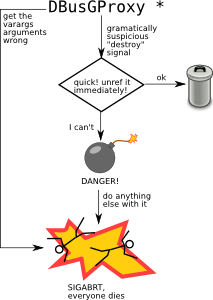
The life-cycle of a DBusGProxy (PD clipart credit: karderio and Andy)
The API provided by dbus-glib for client code is, er, rather less than ideal. The basic object is DBusGProxy, which has a few problems. There's one per interface, rather than one per object; this leads to a maze of twisty GObjects, all suspiciously similar. Our old client library, libtelepathy, got round this by subclassing DBusGProxy to make helper objects called TpChan, TpConn etc., which were simultaneously the proxy for the "main" interface (Channel, Connection etc.), and a factory for proxies for the other interfaces (like Channel.Type.Text and Channel.Interface.Password). This still wasn't ideal, but it was a start. If you use a DBusGProxy in any way after it has emitted the destroy signal, this is considered to be invalid use of the API, and dbus-glib asserts all over the place. We'd rather it didn't do that - remote objects becoming invalid is a fact of life, and if you don't immediately discard all your references to those objects, remote operations on them should just give you a runtime error. You have to be prepared to handle such runtime errors already, because any IPC call can fail at any time. The main API for calling methods uses varargs and is rather subtle. Notably, the calling convention for variant parameters (of D-Bus signature 'v') is not consistent with the calling convention for any other container. For any other container, for instance a GPtrArray *, you pass in a GPtrArray ** pointing to a GPtrArray * variable containing NULL; on success, a pointer to a new GPtrArray is written into that variable. For variant parameters, though, you must pass in a GValue * pointing to a zero-filled GValue, and the result will be written into that GValue. dbus-binding-tool generates thin wrappers around this method-calling API which provide type-safety, although they can't directly specify a non-default timeout. As for signals, before binding to a signal, you have to tell dbus-glib about its signature. This tells dbus-glib how it should push the signal arguments onto the C stack (in GObject terminology: how it should marshal them), to match the signature of the signal-handler function. The documentation claims that this isn't necessary for objects supporting the Introspect method, but that's untrue - on the other hand, if the documented behaviour actually happened, I would consider this to be a critical bug in dbus-glib, since it would enable remote objects to crash dbus-glib clients (by causing signal arguments to be pushed onto the stack in a way that does not match the signature of the signal handler). Of course, the signal-adding function takes varargs, and has to be called exactly once per signal per object. If you don't, dbus-glib asserts when you connect to the signal; if you call it twice, dbus-glib asserts anyway.

TpProxy TpProxy is a GObject subclass vaguely inspired by Python's dbus.proxy.ProxyObject. It isn't a subclass of DBusGProxy, which lets us encapsulate dbus-glib almost completely - in fact, all the references to DBusGProxy are in a separate header, proxy-subclass.h, only used by subclasses of TpProxy (as opposed to normal library API users). TpProxy instances are per-remote-object (per-object-path) like in dbus-python, rather than per-interface like in dbus-glib or QtDBus. As explained below, I believe that this is the most natural object mapping for D-Bus interfaces; in practice it tends to lead to clearer code for us, since one remote object often maps nicely to one UI element (of course, if your objects only have one interface, this approach is no better or worse than dbus-glib's). TpProxy provides support for the following common D-Bus things:
  • Calling methods
  • Connecting to signals
  • Objects becoming invalid
  • Objects with optional interfaces
  • Extensibility
It doesn't currently provide any particular help with Properties - the Properties interface is just another interface as far as we're concerned. We find that, in practice, that's not a problem (even though we use D-Bus properties extensively). In telepathy-qt4 we basically reinvented TpProxy in C++, as Tp::DBusProxy. I've put in some comments below illustrating how the general ideas we used in TpProxy translate into a different object mapping.

Calling methods Method calls on TpProxy are done through auto-generated wrapper functions, much like DBusGProxy. These look something like this:
typedef void (*tp_cli_channel_callback_for_close) (TpChannel *proxy,
    /* any 'out' arguments would go here - Close() doesn't have any */
    const GError *error, gpointer user_data,
    GObject *weak_object);
TpProxyPendingCall *tp_cli_channel_call_close (TpChannel *proxy,
    gint timeout_ms,
    /* any 'in' arguments would go here - Close() doesn't have any */
    tp_cli_channel_callback_for_close callback,
    gpointer user_data,
    GDestroyNotify destroy,
    GObject *weak_object);
Methods for some interfaces, like DBus.Properties, are available on TpProxy itself; others, like Telepathy's Channel.anything, are only available on a particular subclass, like TpChannel. Things to note here:
  • It's an asynchronous call with a callback. General design principle: "this is IPC, get over it". We don't try to hide the fact that IPC is taking place by doing pseudo-blocking calls.
  • The timeout is explicit (although you can always pass -1 to let libdbus pick a "reasonable" default for you). This is because the remote service might not respond, and API users should be at least vaguely aware of this: "this is IPC, get over it".
  • The callback isn't a GCallback; it has an explicit signature, for some semblance of type-safety (it's not much, but it's better than nothing).
  • The callback takes a GError, because any IPC call can fail for any reason.
  • A TpProxyPendingCall * is returned. This is a pointer to an object that only exists until just after the callback is called (so you can ignore it if you don't want it), with a method you can call to cancel the method call (with hindsight this is not ideal, and if I was writing this API now, I'd use gio's GCancellable). "Cancel" is perhaps slightly misleading: the method call still takes place (it was already in libdbus's outgoing queue) but the result gets ignored and the callback isn't called. This is mostly so you an object can forget all the calls it was busy making at the time that the results become irrelevant (e.g. the object is destroyed).
  • There is an extra weak_object argument, which is weakly referenced and is passed to the callback: in practice, most users of telepathy-glib use this as well as or instead of user_data. If the weak_object runs out of references, the callback is automatically cancelled, which means that in practice, explicit cancellation is almost never needed.
  • The generated code has as its first argument a suitable subclass of TpProxy, in this case TpChannel (we tell the code generator about subclasses).
  • You can't see it in the API, but the TpProxy gains an extra ref while a method call is in progress, so you never have to worry about what happens if the proxy gets unreffed during a method call.
  • There's an explicit destructor for the user_data, which is called even if you "cancel" the method call.
In telepathy-qt4, these methods are on small generated helper classes similar to dbus-python's dbus.Interface, one per interface (we provide accessors for them on the non-generated DBusProxy subclass). Instead of using callbacks, we return a temporary QObject per call, which emits a Qt signal on success or failure (that's how all async calls in QtDBus work).

Connecting to signals Similarly, signals have some generated functions:
typedef void (*tp_cli_channel_signal_callback_closed) (TpChannel *proxy,
    /* any arguments would go here - Closed doesn't have any */
    gpointer user_data, GObject *weak_object);
TpProxySignalConnection *tp_cli_channel_connect_to_closed (TpChannel *proxy,
    tp_cli_channel_signal_callback_closed callback,
    gpointer user_data,
    GDestroyNotify destroy,
    GObject *weak_object,
    GError **error);
API notes for these:
  • The callback doesn't take a GError any more, because signals can't fail; the weak_object and the user_data are the same as for method calls
  • This isn't actually a GObject signal at all: those aren't particularly typesafe, and lack namespacing. This might not be very binding-friendly, we haven't tried doing that yet... it might be worth introducing a signal with details, like in dbus-glib, for which these functions are "C bindings".
  • The returned TpProxySignalConnection lets you disconnect from the signal, just like the TpProxyPendingCall above; it can safely be ignored
  • Similarly, if the weak_object dies, then the signal automatically disconnects
  • It is possible for connecting to a signal to fail: this happens if the proxy doesn't actually have the requested interface. If this happens, it's graceful, not a crash. In practice, the flow of code is almost always such that error can safely be NULL because the interfaces are already known.
In telepathy-qt4 the per-interface generated helper classes emit Qt signals. In many cases, we end up proxying these signals by responding to them in the hand-written Tp::DBusProxy subclass by emitting a different signal, in order to give them a nicer representation.

Becoming invalid This is IPC, and any error can happen to you at any time. We found that it was useful to have a general concept of "this object is no longer useful", so we introduced the concept of an object becoming invalidated. The invalidation reason is stored on the object as a GError. If this GError is NULL (as it is initially), then the object is still expected to be valid; if it's non-NULL, the remote object has vanished and the local proxy no longer works. There are several ways a TpProxy can become invalid:
  • its bus name falls off the bus (the process exited or crashed)
  • application-specific reasons (usually triggered by a D-Bus signal in a subclass, like the Telepathy Channel's Closed signal)
  • the GObject gets disposed
Method calls on an invalidated object always fail, with the invalidation reason as the error. This means that calling a method on a TpProxy should never crash your process. The method's callback has to be prepared to handle an error in any case, because this is Sparta^WIPC, so there's no loss in giving it another error. Connecting to signals on an invalidated object always fails, and any existing signal connections are disconnected when it becomes invalidated. This means that if a new remote object appears, and it happens to have the same object path, bus name etc. as the old one, you won't get its signals. A TpProxy can either be bound to a unique bus name or a well-known bus name. In the equivalent code in telepathy-qt4, we call this "stateful" or "stateless" - these names don't capture the intention perfectly, but they're the best we could come up with. A proxy for a stateful API like Telepathy's Channel should always bind to a unique name - when the unique name falls off the bus, the TpProxy becomes invalidated automatically, representing the fact that the Channel you had no longer exists, and nothing can be a perfect replacement for it (the VoIP call has already been terminated, you've already left the chatroom, or whatever - if you make another Channel, that's e.g. a distinct VoIP call). A proxy for a stateless API like Telepathy's ConnectionManager, where an exiting process can disappear, be service-activated again, and still have exactly the same API, should bind to the well-known name. Proxies for well-known names aren't invalidated when the process exits. Qt doesn't have a natural equivalent for GError, so the invalidation reasons in telepathy-qt4 are just a pair of strings, the namespaced name and the message - basically a libdbus DBusError. The principle is the same, though.

Optional interfaces As mentioned above, TpProxy instances are per-remote-object (per-object-path) like in dbus-python, rather than per-interface like in dbus-glib or QtDBus. I believe that this is the most natural object mapping for the D-Bus object model, because the D-Bus interfaces on a remote object can behave like any of these:
  • classes and subclasses (Telepathy.Channel.Type.Text is a Telepathy.Channel)
  • shared interfaces (some Telepathy.Channel objects, of many Types, implement Telepathy.Channel.Interface.Group; any D-Bus object can implement DBus.Properties)
  • optional features (some Telepathy.Channel.Type.Text objects implement Telepathy.Channel.Interface.ChatStates, some do not)
  • discoverable extensions (some Telepathy.Channel.Type.Text objects implement Telepathy.Channel.Interface.Messages, which is more or less Text 2.0)
The way in which interfaces are discovered is also variable. The "classic" D-Bus way to discover interfaces would be to call Introspect. Telepathy services still support that style of introspection, but we don't use it for anything beyond d-feet:
  • Introspect returns a blob of XML, which you have to parse into something useful; if it was in a D-Bus data structure, you'd already have some sensible data structure.
  • Finding out more information about the supported interfaces than their names isn't very useful: in a static language like C you already need to know the methods, signals, properties and their signatures in order to write and compile your code, and in a dynamic language like Python consumers of Introspect end up being remotely crashable by services with unexpected method signatures (this is one of dbus-python's big mistakes in my opinion).
  • If a method that you want to call turns out to be missing, the worst that can happen (in a competently written service) is that it fails with a D-Bus error - and you have to handle D-Bus errors anyway, because this is IPC and anything could fail.
  • Static bindings like dbus-glib have poor support for removing interfaces for which C code exists at runtime, whereas Telepathy needs features like an IM connection that might or might not support avatars (we don't get to find out until we've successfully connected to the server).
Instead, our older interfaces have a method on the "base class" (Channel, Connection etc.) called GetInterfaces, which just returns an array of strings. Newer interfaces (like Account), and older interfaces that have been ported (like Channel), have a property called Interfaces which is, again, an array of strings - this lets us combine the download of the interfaces list with downloading other basic information in a GetAll call. To cater for all these ways to use interfaces, the TpProxy base class has very basic support for interface discovery - you can ask it whether it supports an interface, and you can tell it that it does, in fact, support an interface. Asking which interfaces are supported is directly useful for library users; it's also used as a check by the generated method-call and signal-connection stubs, which return a canned error (Telepathy.Error.NotImplemented in Telepathy's case) if the object isn't known to have the interface. Telling TpProxy that it does support an interface is intended for use by subclasses, and might have been protected if we were writing C++: what happens in practice is that a concrete subclass like TpChannel knows how to discover the fully supported interfaces for this particular object, does so, and calls methods on the TpProxy to tell it which interfaces can work.

Extensibility The API stubs used by TpProxy to call methods and bind to signals are generated from XML documents containing an augmented form of D-Bus introspection data. These XML documents contain various Telepathy-specific extensions, but none of the extensions are language-specific - telepathy-glib, telepathy-python and telepathy-qt4 all operate from exactly the same XML specification. telepathy-qt4's different object-mapping did require us to tighten up some rules that were previously only conventions, but even so, the format is the same. I think this is vitally important - it just doesn't scale to have one set of language-specific annotations in a D-Bus API for each language that will have bindings. One thing that we make heavy use of is what I call "Ugly_Case", which is camel-case with underscores at word boundaries. This gives us a simple, unambiguous and foolproof rule to use in code generators whenever we generate any of the popular conventions for identifiers:
  • CamelCase: delete underscores
  • javaCamelCase: force everything before the first underscore to lower case, then delete underscores
  • lower_case: force everything to lower case, retain underscores
  • UPPER_CASE: force everything to upper case, retain underscores
dbus-glib, by contrast, applies a complex and subtly buggy algorithm to the CamelCase D-Bus names, which results in our SendDTMF method being mapped into GLib as send_dt_mf, and requires that telepathy-glib's Python reimplementation of dbus-binding-tool uses a bug-for-bug compatible implementation (we ended up reimplementing dbus-binding-tool in order to generate the TpProxy-based bindings). Our code generation tools are still rather ad-hoc, because so is our spec format, but for draft interfaces it's possible to copy them into individual projects and use them to generate additional methods for TpProxy or any subclass. This is how we implement unfinished APIs like geolocation in Empathy, for instance. The Interfaces or GetInterfaces hook described above is entirely usable for these extension interfaces, and in fact that's how they're set up. In telepathy-qt4, the generated method stubs are genuine C++ methods, so we can't just append methods to an existing class: this is why we have one helper class per interface, so individual clients can generate a helper class for their particular version of an unfinished API, and instantiate an object of this class attached to a particular Tp::DBusProxy. When an interface becomes stable, it can be added to the set of interfaces for which code is generated in telepathy-glib or telepathy-qt4, at which point any client or service that was already using the final draft of that interface can easily be ported to the library version using sed (the API remains the same).

Becoming ready The concept of being "ready" does not directly exist in TpProxy, but is implemented in TpChannel, TpConnection and TpConnectionManager. The idea is that a freshly created proxy object isn't really fully usable yet - you have to connect to basic signals and recover the initial state of the remote object, as well as checking which extension interfaces are supported. In many well-designed D-Bus APIs you can do this initial setup with a few signal connections and a DBus.Properties.GetAll call. After doing that initial setup (which has to be done asynchronously, because it's IPC), the TpProxy subclass has a local cache of the remote object's state (not necessarily in the same format as the representation on the bus), which can be accessed synchronously at any time, and will be updated in response to change-notification signals. TpChannel and subclasses like it have explicit support for checking for readiness, and having a callback called when the object is ready or invalidated (whichever happens first). The "ready" property also supports the GObject notify signal. telepathy-qt4 took this concept and ran with it - there is library support for objects that can become ready, including a mixin. If I had as much time to work on telepathy-glib as I wish I had, this would be one of the first telepathy-qt4 features to be added to telepathy-glib.

Features becoming ready Going beyond that, in an extensible framework like Telepathy it's probable that not every client understands (or wants to understand) every feature of every object, so it's highly inefficient for every proxy object to subscribe to all the change notification signals and cache all the remote state on the off-chance that the library user wants them. In the API for TpContact (which is not actually a TpProxy for various reasons) we introduced the concept of optional features; telepathy-qt4 extended this idea throughout the library. The idea is that each library user knows which of the optional features are "interesting" to it, and makes a single asynchronous call (which expands into a series of D-Bus calls inside the library) to download the state for core functionality plus all of the selected features, and subscribe to change notification for all of those. This is another telepathy-qt4 thing that telepathy-glib still needs to catch up with; until someone works out how to make the clone() syscall apply to programmers, I fear all libraries are doomed to lag behind how their designers want them to look :-) (license: CC-BY-3.0 / LGPL-2.1+)

29 April 2009

MJ Ray: Bristol Social Enterprise Summit Consultation

Last Thursday, I went to the Social Enterprise summit regional workshop that I mentioned. Apparently, SEC are hoping that ministers Mandelson, Purnell, Byrne and Blears will be at the summit, along with people from various famous co-ops. I took along some email feedback I received on supporting new blood in social enterprise about needing help to bridge the gaps (financial, social, training) between taking on new members and them being productive enough to break even . Happily, that was echoed and reinforced by other delegates - I shared a table with people from Trinity Community Arts, AvonCDA, Sofa Project, Somerset Co-operative Services and Community Action. Emboldened by that, I ranted about the Business Support Simplification Programme (which seems to mean that only BusinessLinkSW has any gov.uk money in our region and they re being really poor at co-op support) and I threw a couple of ideological-explosives into the consultation, suggesting that franchising has failed as a way of spreading social enterprise and we need to start offering General Public Licensing of our business models, because we re not franchising businesses and most of us don t want to be. I wonder if that idea will detonate somewhere helpful. The Social Enterprise Coalition officers had some details of the support programmes that are already announced. One of them is a golden hello where the enterprise gets money when a new person joins. It s run by jobcentreplus. So yesterday, when I was at a Business Link Real help for business event, I asked the jobcentreplus officers there about it: apparently it s useless to TTLLP because all our workers are partners and not employees. I was expecting more support for co-ops from a Labour+Co-op government, but it shouldn t've been a surprise after the budget. After that, I don t think it s worth posting details of the other SE assistance programmes mentioned: they ll probably turn out to be equally useless for co-ops and I don t want to waste your time. I ll rant about that and the BusinessLinkSW event another day or in another place. Ask me if you want details and I ll put them in a comment or email them. And in that spirit, it s back to programming for me!

25 April 2009

Biella Coleman: What We Know So Far

So, when I like something, I tend to yap about it for weeks and weeks. Take Icelandic Yogurt, for example. After re-discovering it a month ago, I went on a mini-binge (not a mega as it is too expensive) and spread the word to anyone who would listen. The stuff, especially with fun flavors like ginger and orange, just made my morning. Another fine fine thing out there is the performance group What We Know So Far who give performance-based lectures that mix intellectual insight with artistic flair. They put us regular academics to shame who are a bit more staid, to put it mildly. After seeing them a few weeks ago at the 3rd Ward, I snagged them to give a version of their A-mazing talk on Memes in my class and am organizing a much larger event at NYU for the fall of 2009. This is a sort of long winded way of announcing their up and coming show on April 27th the Hannah Complex, which entertains, among other topics, the nature of common sense: Can there be more than one common sense? they ask on their site. And I can t wait to hear the answer as this is a recurrent topic that anthropologists like to entertain. And in fact one of my favorite essays to teach is on this topic, Clifford Geertz Common Sense as Cultural System, a short excerpt which I found here and below is his thesis in a nutshell:
There are a number of reasons why treating common sense as a relatively organized body of considered thought, rather than just what anyone clothed and in his right mind knows, should lead on to some useful conclusions; but perhaps the most important is that it is an inherent characteristic of common-sense thought precisely to deny this and to affirm that its tenets are immediate deliverances of experience, not deliberated reflections upon it. Knowing that rain wets and that one ought to come in out of it, or that fire burns and one ought not to play with it (to stick to our own culture for the moment) are conflated into comprising one large realm of the given and undeniable, a catalog of in-the-grain-of-nature realities so peremptory as to force themselves upon any mind sufficiently unclouded to receive them. Yet this is clearly not so. No one, or no one functioning very well, doubts that rain wets; but there may be some people around who question the proposition that one ought to come in out of it, holding that it is good for one s character to brave the elements hatlessness is next to godliness. And the attractions of playing with fire often, with some people usually, override the full recognition of the pain that will result. Religion rests its case on revelation, science on method, ideology on moral passion; but common sense rests its on the assertion that it is not a case at all, just life in a nutshell. The world is its authority.

24 April 2009

Gunnar Wolf: Some prefer marathoning... I prefer going to my old workplace

I was invited to talk about Free Software at yesterday's FLISOL. Yesterday? Aren't FLISOLs organized on Saturday? Well, not this one, for various reasons which I won't quote here. And no, I am not a supporter of the installfests idea, but I went gladly to talk about what is Free Software all about - The philosophy behind Free Software. Besides, the talk was at FES Iztacala, where I worked for four happy years, 1999-2003. I have not been often to Iztacala since 2003 (probably I have visited only three or four times), partly because of the distance (~25Km from home in a straight line, but the city's Northern part is quite poorly communicated). The last time I was there, last October, I went by bike, just to test my endurance and... because I could. Yesterday, I also did, not to be outdone by my fellow Debianers Christian and Dirk. Think they are so cool because they can run for 43Km? Well, I had my 55Km yesterday, and I was not even in a competition! (yes, yes, running and biking is not the same. So sue me. I just didn't want to stand still and let them walk away with all of the fun!) I took slightly different routes (my route to get there on Nokia Sportstracker and OpenStreetMap trace, my route back on Nokia Sportstracker and OpenStreetMap trace), crossing diagonally Azcapotzalco, a region of the city (delegaci n) I hardly know... The Sourthern of it seems like a continuation of Tacuba to the North, small and not-very-well-communicated prior villages engulfed by our hungry, huge city. The Northern half is a mostly industrial area, with very sparse population, lots of trucks, and streets that are not in the best shape. You can end up feeling lonely in those regions, and I am glad not to have crossed back by night. And the trip back was interesting as well... Mexico City is home to many more bikers you would expect given its size, and it is very common to find other people doing nice long stretches. In this case, I started cycling quite close to another guy in a white bike more or less when I got to Calzada Camarones. Possibly we had passed each other over and over until after Tlatelolco, arriving to Guerrero, where I approached him at a stoplight:
Hi! Where to?
Near Vocacional 7, Iztapalapa!
Nice! I'm just going to Copilco Every now and then we crossed each other... Turns out he does this ~30Km commute daily between Iztapalapa and Azcapotzalco. Quite admirable, to be honest. I also crossed my road with Sergio Mendoza, fellow Debianer (and co-administrator of our Mexican mirror) around Centro M dico (about 7Km north from my destination), whom I had only seen before around the University. Nice surprise. And yes, getting to know the city by bike is the best way to go! Back to the conference... my first thought when I was invited was to present Qu es el Software Libre?, a talk I have given over and over since... 2002 (although, yes, with updates). I must say it's one of the best structured talks I have prepared and has almost always been very successful - But give the same talk based on the same script over and over (AFAICT, around 20 times), and you will be fed up with it. And yes, yesterday I didn't take my laptop along, and didn't put my presentation on a USB stick - I took a pen and some paper, and during the presentation prior to mine, wrote some points to go over. And yes, it was a refreshing change. The talk was as successful as expected, and it's much more refreshing to talk about the same topics bot on a different way, and without being constrained to a predefined script. I know that organizing formally your ideas makes sure you don't miss out important points and that the audience is sometimes encouraged to pay attention by having some bullet points to look at - But on the other hand, it is much easier to follow your audience's interest if you are not bound by the script. And the few times I've spoken that way, it has felt refreshing and nice.

23 April 2009

Matthew Palmer: Insane/Brilliant Idea of the Day

I've been talking serial consoles with a couple of the other guys at work: how nice they are to have for machines in the datacenter, how annoying it is that vPro serial-over-LAN doesn't seem to be robust (yet?), and how serial access concentrators are lung-and-kidney expensive (especially when you've got 50-some racks to outfit). This discussion, combined with my ongoing embedded-hardware-fascination lust for a SheevaPlug appears to have spurred my brain into coming up with a Brilliant Idea: tie a SheevaPlug to a pile of USB to serial adapters and use that as your per-rack serial concentrator. Imagine: faffenheimer, a dedicated server you manage for a customer, and located in rack 27 of your DC, has just crashed, and you'd like to know WTF has happened rather than just blindly reboot, but you're in the office 15 minutes away from the DC floor, and the customer's going to want that machine back up and running pretty quickly.
workstation:~/porn$ ssh rack27.serial
rack27:~$ sconsole faffenheimer
[screen session attached]
[minicom running, shows the horror of a kernel crash dump]
[oh look at that, kernel bug]
^A ESC
[pgup pgup]
[enter]
[pgdn pgdn]
[enter]
^A >/tmp/faffenheimer-crash-dump
^A d
rack27:~$ exit
workstation:~/porn$ scp rack27.serial:/tmp/faffenheimer-crash-dump ~
workstation:~/porn$ powercycle rack27 faffenheimer
Shiny! We got a crash dump in a minute or so (rather than having to take phonecam photos of KVM screens in the DC), never had to leave our comfy seat, and the machine's on it's way back up. We're now free to pursue diagnostic activities on that crash dump at our leisure. 10 minutes later, the downtime for faffenheimer that was automatically set when we ran powercycle runs out and Nagios sends us threatening messages. Hmm, something's gone wrong here. Back into the console...
workstation:~/porn$ ssh rack27.serial
rack27:~$ sconsole faffenheimer
[screen session attached]
[Boot is hung waiting for root password after initrd has bombed]
[Type root password]
[Oh look, the root MD appears to have come asunder]
[clickety-click... fixee fixee]
[reboot]
The more I think about this, the more I reckon I'm onto a bona fide winner. The sheevaplug is a powerful ARM-based system with USB/ethernet/SD ports that is packaged literally in it's own power supply wall wart -- it's a plastic box with power plug prongs poking out the side. That's all there is to it. The USB to serial adapter things are likely to be a bit more of a pain, but I've played with enough of them by now to not be too scared. So, you plug the Sheeva into a power socket, plug an Ethernet cable and USB hub into the Sheeva, configure things a bit so that the system knows which serial adapter maps to which machine, and you're away. Oh, and the best bit: the Sheeva apparently draws as little as 2W when idle. A whole datacentre's worth of serial goodness for about a server's worth of power. The cost per rack should be somewhere below AU$250, especially in bulk. Let's see if I can convince work to spring for a Sheeva, a USB hub, and a half dozen or so USB to serial adapters to test this whole thing out. Given that the whole thing looks like it'd cost less than AU$250 (plus my R&D time), I can't imagine it'll be too hard a sell to at least give it a go. Watch this space...

MJ Ray: What do you want to tell a Social Enterprise Summit?

There is a Social Enterprise summit in London in May with cabinetoffice.gov.uk/thirdsector. As part of representing TTLLP to Cooperatives-SW, I will be at a regional workshop this afternoon to enable the sector to input the summit (?). More detail is available at tinyurl.com/cnm5c3 The workshop topics are If you have any thoughts on those themes, please send them to me by IM, microblog or as a comment on this article. I may be commenting on identi.ca if I get internet at the event.

22 April 2009

Gunnar Wolf: Rodrigo denying evasions and religion

Umh, is today the quote your neighbour day? No? Thought so... Still, for the second time in a couple of minutes, I'm quoting/translating here. This time, I'm quoting a short text posted by fellow Mexican Debian guy Rodrigo Gallardo: Deceptions (hmm... Not in the let you down sense, but in the deceiving sense. Sometimes it is hard to translate a single word without twisting it around). My translation is far from perfect - Read it in Spanish, you will enjoy it more. Rodrigo says:
Things and actions are what they are, and the consequences of them will be what they will be; why then should we desire to be deceived? Joseph Butler
I was in Colima, sitting on a slide in a city park, that day I understood why somebody might want to be drunk. Several years later, this time in Tlalpan, I understood why somebody would want to believe in a god. And sometimes I am truly sorry not to be able to embrace neither of both longings. The idea of letting go the facts, to believe they have an inner order, although covered in mistery, or they are just far away, blurry. But where others see destiny, I see things falling naturally in their place. Where others see beauty in the mistery, I see a challenge. And even more beauty in an elegant explanation, in understanding. Motivation, not in the promise of future welfare but in the certainty of this limited but tangible present welfare. Freedom in the absence of a purpose, and inmortality in the little pebble I am in the great human building. I suppose that if Revernd Butler knew his phrase inspired this divagation, it would not make him precisely happy. But, things are what they are, and his argument says what it says.

Russell Coker: Vibration and Strange SATA Performance

Almost two years ago I blogged about a strange performance problem with SATA disks [1]. The problem was that certain regions of a disk gave poor linear read performance on some machines, but performed well on machines which appeared to be identical. I discovered what the problem was shortly after that but was prevented from disclosing the solution due to an SGI NDA. The fact that SGI now no longer exists as a separate company decreases my obligations under the NDA. The fact that the sysadmins of the University of Toronto published all the most important data entirely removes my obligations in this regard [2]. In their Wiki they write after SGI installed rubber grommits around the 5 or 6 tiny fans in the xe210 nodes, the read and write plots now look like and then some graphs showing good disk performance appear. The problem was that a certain brand and model of disk was particularly sensitive to vibrations. When that model of disk was installed in some machines then the vibrations would interfere with disk reads. It seems that there was some sort of harmonic frequency between the vibration of the disk and that of the cooling fans which explains why some sections of the disk were read slowly and some gave normal performance (my previous post has the graphs which show a pattern). Some other servers of the same make and model didn t have that problem, so it seemed that some slight manufacturing differences in the machines determined whether the vibration would affect the disk performance. One thing that I ve been meaning to do is to test the performance of disks while being vibrated. I was thinking of getting a large bass speaker, a powerful amplifier, and using the sound hardware in a PC to produce a range of frequencies. Then having the hard disk securely attached to a piece of plywood which would be in front of the speaker. But as I haven t had time to do this over the last couple of years it seems unlikely that I will do it any time soon. Hopefully this blog post will inspire someone to do such tests. One thing to note if you want to do this is that it s quite likely to damage the speaker, powerful bass sounds that are sustained can melt parts of the coil in a speaker. So buy a speaker second-hand. If someone in my region (Melbourne) wants to try this then I can donate some old IDE disks. I can offer advice on how to run the tests for anyone who is interested. Also it s worth considering that systems which make less noise might deliver better performance.

20 April 2009

Biella Coleman: Medieval Communication

Doesn t this class look great??
Department of History Workshop MEDIA AND COMMUNICATION IN THE MIDDLE AGES Professor Brigitte M. Bedos-Rezak Medieval circumstances presented multiple challenges to media, mobility, and communication. Cultivators were bound to the land and monks to their monasteries; pilgrims traveled to holy places, crusaders and warriors invaded and then settled foreign lands, rulers and nobles were frequently itinerant. Literacy was largely limited to Latin, and possessed principally by churchmen and nuns so the transmission of ideas occurred mainly through the spoken vernacular word, and by means of gestures, images, and the manipulation of symbolic objects (thus, for instance, the relics of saints were carried to distant lands to collect alms, to recover possessions appropriated by nobles, or to aid in battle). While seas, rivers, ports, networks of roads provided with rest houses, ferries and bridges, were generally available, routes and means of transportation selected differed markedly according to the traveler s status and the journey s purpose. Christianity stimulated pilgrimages, missions to convert the heathen, and crusades. Marriage took brides to foreign courts where they served as cultural ambassadors. Medieval kings and great nobles were continually on the road, changing their abode every two or three days. Lesser officials and messengers traveled on government business. Knights sought out tourneys and distant wars to advance their fortunes and reputations. Merchants and carriers transported goods to regional fairs, and engaged in international trade. Minstrels, jongleurs, and troubadours traveled to gain patronage and to extend their repertoire, spreading news and influencing the reputations of warriors, heroes, and kings. Students too journeyed extensively from place to place in order to sit at the feet of famous masters; some wandering scholars came to be known as Goliards. Artists were invited to decorate manuscripts and architects to erect buildings.
The pursuit of favorable opinion became an essential feature in the process of state-building during the Middle Ages. Those who challenged traditional norms also came to rely on the efficiency of communicative systems to expand their ranks with adherents. Through the use of propaganda, medieval society experimented with such forms and methods of communication as symbols, stereotypes, and slogans, thus elaborating features of communication which, however modified, are still in use today.

Russell Coker: The Future of Electric Cars

TED published an interesting interview with Shai Agassi about electric cars [1]. One idea that I hadn t heard before is that of moving car batteries between regions as they lose capacity. An old battery for an electric car that can only handle short journeys may be useful in a region where journeys are typically short. On a similar note I expect that in a few decades the less prosperous countries will import old electric vehicles and fit them with 4 or more batteries. Last time I checked the Prius battery pack weighed about 120Kg, so the car would be usable with 4 battery packs if driven at low speeds. Shai Agassi also gave a TED talk on this topic [2]. The real solution for the problem of providing convenient and affordable electric vehicles is to start by recharging the batteries whenever the vehicle is parked (at the office, shopping center, home, etc). Then on the rare occasions when the car is being driven for longer distances and the battery gets flat it can be swapped for a charged battery. They have apparently designed a robot for changing car batteries, so changing the battery would be like driving through a car-wash. He describes this as an economic model that decouples the expensive battery from the car, so you pay for the use of the battery not the ownership - just as with a petrol car you pay for the petrol you use not for a portion of the ownership of an oil well. He also pointed out that cars produce 25% of the world s CO2 emissions, so his plan for all electric cars everywhere seems to be an essential part of solving the environmental problems. He then compared this to the UK parliamentary discussion on ending slavery, at the time slaves provided 25% of the energy used by the UK. After a month of discussion the decision was made to make the moral choice and end slavery regardless of the cost.

19 April 2009

Biella Coleman: Paris in June (and better with hackers)

/tmp/lab announces the second Hacker Space Festival
(Paris, 26-30 June 2009) Hacker Space Festival 2009 Call For Proposals HSF2009 In 2008, we organized HSF[1] on the spot, as an ad-hoc meeting for
hackerspaces-related networks, technical and artistic research emerging
from them and social questionning arising from them. This sudden
experiment proved to be a huge success, as much as on the
self-organizing level as on the participants and meetings quality, as
well as the emotionally-charged ambient, the kind of which you make
fond memories. The 2008 edition generated a strong emulation in France, from its
historical role as the first official hack meeting there, and in Europe
with the subsequent creation of the Hacker Space Brussels[2], the
rapprochement with The Fiber in Amsterdam and the hackerspaces.org[3]
network. Initiatives of hackerspace openings in Grenoble or Lille, or
the upcoming FrHack[4] conference show an actual enthusiasm in the
French hackers community that was doomed to the underground not so
long ago. We salute these initiatives and their diversity! Soon enough, we wanted to reiterate the HSF experience : however, it
was out of the question to institutionalize this temporary autonomous
zone, nor make it an ersatz of the previous edition, nor even to wrap
it into an elite or underground aura. On the opposite, we ardently
desire; and especially to explore further, in all directions some
lesser known domains (see below) et foster meeting and sharing around
experiences at the confluence of art, technology and politics. The world financial crisis, the decay of democracy in Europe, the
obscurantism, paranoia and lack of culture presiding over legislation
(Internet and Reaction Err Creation Law[5][6]) seem a fertile
environment for the sensible development of new (social ) life forms.
Quick! Let s rest for a few days in jubilation and ecstasy to take a
deep breathe of freedom under the indelicate smells of the medicine
factory nearby! For if the public space is shrinking to oblivion, where any side-step
becomes suspect, and that, from an early age (deviant behavior
detection in nursery school), where moving without a mobile phone
becomes suspect (hello you Julien Coupat[7], a French political
prisoner in France!), there s a domain that the Leviathan would have a
lot of trouble to contain, and for a reason: that of sensitivity. Even
the desperate attempts of the State to block the free and premonitory
expression of sense (hello you Demeure du Chaos![8]) cannot do anything
against a loud laughter or a knowing glance, a sensual kiss or an
explosion of colors. Sensitivity, we could say, is what is left to a human being when she
has nothing anymore, and differenciates her from the body corporate or
the institution, that are, in essence, devoid of it. Therefore, Art
definitely remains the public space to share between humans, and only
between us. And if it the last one to share, we propose to explore it
and take it over during the upcoming edition of the Hacker Space
Festival, from the 26th to 30th of June, 2009 at Vitry sur Seine[9]. ========================================================================
Keynote Speakers: Sergey Grim and Larry Fake with Eric Schmoudt
Groogle Summer of Crode, Survivor style
VLC, I vote against you because you really fucked up when ========================================================================
== W A N T E D ========================================================= Focus on solutions rather than problems. * The Final (Hardware) Frontier: Open FPGA Cores, Reverse Engineering
* Designer Religions and Creative Beliefs Systems
* WiFiDoors & WiFi System-on-Chip controllers firmware hacking,
infection & backdooring
* Telecom Core Network Equipment Reverse Engineering: MSC, STP,
Switches,
* Algebraic Attacks and Modern Cryptography Attacks
* Autonomous, Parasitic and Viral Drones
* Enhanced or Infected Reality Swarms
* Auto-Builders / Self-Fabrication
* Embedded OS breakins stories & recipes
* Actualization rather than mere concepts
* FPGA & ASIC hacking / backdooring
* Cloud+Privacy+Open Source: O Brave New World?
* Explosion-Proof clothing
* Radio Appz & Hackz: Mesh @ RF Layer 1-3
* Database & Privacy
* Problematic & Ethical Open Source/Content Licenses
* Institutional Relationships: Lobbying or Licking?
* Non Lethal Protection (anti-taser vests?)
* Survival in the Age of the Ministry of Immigration and National
Identity
* Mental asylum improvised visit
* Open Source Legacy Media(TM) Production Solutions (TV, Radio, Press,
DRM)
* Gas Sensors & Environmental Benchmarking
* Building Hackerspaces Without Money
* Milsatcomm hacking: Military satellites shots, broken birds in the
sky
* Other research topics on security and insecurity
* Academics and Hackers
* Organics and Fermentation
* Clean Food in Tainted Environment
* Low Impact Energy & Recycling
* Media Sandwich: layers of crap makes good food?
* Deconstructing Carla Sarkozy
* Knitting DIY Factory (jazzy, eh?)
* Signs of life among industrial wasteland
* Hallucinogenic & Computing: Can you Code on Acid?
* Mesh Networking (Wireless BattleMesh Royal!)
* Legal Sabotage: When Democracy Needs You And anything that does not fit. ========================================================================
== P R O P O S E ======================================================= Send you contributions to HSF2009-CFP@lists.tmplab.org + Type of the proposal: 1. conference (45min. presentation + 10min. for questions)
2. workshop / demo (30min. 2 heures)
3. installation / performance (music, plastic, sound, video) Lightning talks can be proposed and organized until the last moment,
according to available space and schedule, in the form of BarCamps or
Blitz Conferences. + Required Information: * Title of the presentation
* Type (see above)
* Language : French or English
* Name of speaker(s)
* Affiliation (organization / company)
* Short biography
* Abstract (5 to 10 lines)
* Topics / Keywords
* Includes a demo? YES NO
* Release during the festival? YES NO
* Internet connection required? YES NO + Acceptable Formats * Open Document
* PDF
* Plain Text
* RTF + Agenda * beginning of proposals : now
* end of proposals : 01 May 2009
* selection notification : 07 May 2009
* publication of program : 15 May 2009 + Evaluation criteria for proposals: 1. Innovating Topic
2. Open Technology
3. Demonstration / Live Act
4. DIY Reproducibility
5. Fun Potential The Programming Committee resembles that of last year
See : http://hackerspace.net/committee ========================================================================
== V E N U E =========================================================== /tmp/lab
6 Bis rue Leon Geffroy
94400 Vitry sur Seine
France http://hackerspace.net/directions ========================================================================
== P A R T I C I P A T E =============================================== Email : http://lists.tmplab.org/listinfo.cgi/hsf2009-talk-tmplab.org
CFPmail: HSF2009-CFP@lists.tmplab.org
IRC : irc://irc.freenode.net/frlab
Jabber : xmpp:hsf2009@space.cepheide.org?join
Wiki : http://hackerspace.net/hsf2009 ========================================================================
== L I N K S =========================================================== The CFP is available online at http://hackerspace.net/cfp [1] http://hackerspace.net/hsf2008
[2] http://hsb.wikidot.com/
[3] http://hackerspaces.org/
[4] http://www.frhack.org/
[5] http://jaimelesautistes.fr/
[6] http://laquadrature.net/
[7] http://fr.wikipedia.org/wiki/Julien_Coupat
[8] http://www.demeureduchaos.org/
[9] http://hackerspace.net/
Philippe Langlois
Email: philippelanglois@free.fr
PGP Key: 8DAEE244

17 April 2009

Erich Schubert: Web data time series

For a research project, I'm looking for some real-world time series data. Time-series are an interesting thing to study, however it is hard to get access to interesting non-trivial real-world data.I was wondering if some people could contribute me some summarized web access data; no URLs or IP addresses.The data I'd like to get can best be explained by the preprocessing step:
...   perl -ne '/\[(\d+\/\w+\/\d 4 :\d\d):\d\d/
&& print $1."\n";'   sort   uniq -c
(Sorry if you aren't fluent in regexp - it extracts the date and hour out of an Apache default log file, nothing else. These lines are then summarized by counting their unique appearances.)That should produce 24 lines per day (one per hour), looking like this:
  count day-of-month/month/year:hour
It would be cool if you could send me some series for a couple of sites, if you happen to be in the position to provide this data. The data should cover at least a few weeks, the longer the better even up to a few years.Too small sites are however not very useful but might be too noisy (so probably not the personal home page of your mom). If you are providing a larger number of series, you are of course free to include them.I don't care much about what the site actually contains, I'd just ask you to give a tiny amount of meta information:Data use:The main project idea is to evaluate different distance metrics in their capability of separting the different data sources, assuming that there is some difference in the shape in these curves. A different problem can be constructed by breaking the series into chunks covering approximately a day and then trying do separate different days, starting hours of the series (or offset server timezone vs. user timezone) and/or weekdays from weekends.In our experiments, we've come to the conclusion that the experimental results are most interesting when there is a sufficient number of classes; so I'd like to get like 20 different interesting data series. At the same time, the series should be long enough, so I can break them into multiple chunks to have a reasonable number of 'sub-series' per class. If I have really long series, or e.g. series covering the same site but from multiple servers, I could even experiment with taking sample of different length from these sets.(Say I have series covering 2 years, that is ~17k samples, from 3 servers, then I can take 51 disjoint sub-series of length 1000, or 102 of length 500, ...)But it's obviously not possible for me to collect this data myself - I don't operate two dozen of such sites myself ...An extra project I've been considering some time is some peak prediction for web accesses. Say you're running some fast growing site, wouldn't it be useful to have a prediction when the number of accesses will likely hit some magical limit (and e.g. overload your server) so you can increase your capacity on time? Of course it would be more sensible to apply this prediction e.g. onto CPU usage, e.g. predicting when your system might hit 90% load average over a 5 minute window in regular operation. Network bandwidth and disk IO also come into mind. You get the idea.Please send them via email to erich.schubert AT gmail comThank you.[P.S. Already recieved the first series, thank you! I can take care of sorting myself, no need to worry about that. And yes, I'm aware that the series will probably all be quite similar - common computer usage patterns such as work hours - but that is common in real world data and part of the challenge. Separting apples from dinosaurs is not a challenge.]

14 April 2009

Biella Coleman: Paris in June (and better with hackers)

========================================================================
/tmp/lab announces the second Hacker Space Festival
(Paris, 26-30 June 2009)
======================================================================== Hacker Space Festival 2009 Call For Proposals HSF2009 In 2008, we organized HSF[1] on the spot, as an ad-hoc meeting for
hackerspaces-related networks, technical and artistic research emerging
from them and social questionning arising from them. This sudden
experiment proved to be a huge success, as much as on the
self-organizing level as on the participants and meetings quality, as
well as the emotionally-charged ambient, the kind of which you make
fond memories. The 2008 edition generated a strong emulation in France, from its
historical role as the first official hack meeting there, and in Europe
with the subsequent creation of the Hacker Space Brussels[2], the
rapprochement with The Fiber in Amsterdam and the hackerspaces.org[3]
network. Initiatives of hackerspace openings in Grenoble or Lille, or
the upcoming FrHack[4] conference show an actual enthusiasm in the
French hackers community that was doomed to the underground not so
long ago. We salute these initiatives and their diversity! Soon enough, we wanted to reiterate the HSF experience : however, it
was out of the question to institutionalize this temporary autonomous
zone, nor make it an ersatz of the previous edition, nor even to wrap
it into an elite or underground aura. On the opposite, we ardently
desire; and especially to explore further, in all directions some
lesser known domains (see below) et foster meeting and sharing around
experiences at the confluence of art, technology and politics. The world financial crisis, the decay of democracy in Europe, the
obscurantism, paranoia and lack of culture presiding over legislation
(Internet and Reaction Err Creation Law[5][6]) seem a fertile
environment for the sensible development of new (social ) life forms.
Quick! Let s rest for a few days in jubilation and ecstasy to take a
deep breathe of freedom under the indelicate smells of the medicine
factory nearby! For if the public space is shrinking to oblivion, where any side-step
becomes suspect, and that, from an early age (deviant behavior
detection in nursery school), where moving without a mobile phone
becomes suspect (hello you Julien Coupat[7], a French political
prisoner in France!), there s a domain that the Leviathan would have a
lot of trouble to contain, and for a reason: that of sensitivity. Even
the desperate attempts of the State to block the free and premonitory
expression of sense (hello you Demeure du Chaos![8]) cannot do anything
against a loud laughter or a knowing glance, a sensual kiss or an
explosion of colors. Sensitivity, we could say, is what is left to a human being when she
has nothing anymore, and differenciates her from the body corporate or
the institution, that are, in essence, devoid of it. Therefore, Art
definitely remains the public space to share between humans, and only
between us. And if it the last one to share, we propose to explore it
and take it over during the upcoming edition of the Hacker Space
Festival, from the 26th to 30th of June, 2009 at Vitry sur Seine[9]. ========================================================================
Keynote Speakers: Sergey Grim and Larry Fake with Eric Schmoudt
Groogle Summer of Crode, Survivor style
VLC, I vote against you because you really fucked up when ========================================================================
== W A N T E D ========================================================= Focus on solutions rather than problems. * The Final (Hardware) Frontier: Open FPGA Cores, Reverse Engineering
* Designer Religions and Creative Beliefs Systems
* WiFiDoors & WiFi System-on-Chip controllers firmware hacking,
infection & backdooring
* Telecom Core Network Equipment Reverse Engineering: MSC, STP,
Switches,
* Algebraic Attacks and Modern Cryptography Attacks
* Autonomous, Parasitic and Viral Drones
* Enhanced or Infected Reality Swarms
* Auto-Builders / Self-Fabrication
* Embedded OS breakins stories & recipes
* Actualization rather than mere concepts
* FPGA & ASIC hacking / backdooring
* Cloud+Privacy+Open Source: O Brave New World?
* Explosion-Proof clothing
* Radio Appz & Hackz: Mesh @ RF Layer 1-3
* Database & Privacy
* Problematic & Ethical Open Source/Content Licenses
* Institutional Relationships: Lobbying or Licking?
* Non Lethal Protection (anti-taser vests?)
* Survival in the Age of the Ministry of Immigration and National
Identity
* Mental asylum improvised visit
* Open Source Legacy Media(TM) Production Solutions (TV, Radio, Press,
DRM)
* Gas Sensors & Environmental Benchmarking
* Building Hackerspaces Without Money
* Milsatcomm hacking: Military satellites shots, broken birds in the
sky
* Other research topics on security and insecurity
* Academics and Hackers
* Organics and Fermentation
* Clean Food in Tainted Environment
* Low Impact Energy & Recycling
* Media Sandwich: layers of crap makes good food?
* Deconstructing Carla Sarkozy
* Knitting DIY Factory (jazzy, eh?)
* Signs of life among industrial wasteland
* Hallucinogenic & Computing: Can you Code on Acid?
* Mesh Networking (Wireless BattleMesh Royal!)
* Legal Sabotage: When Democracy Needs You And anything that does not fit. ========================================================================
== P R O P O S E ======================================================= Send you contributions to HSF2009-CFP@lists.tmplab.org + Type of the proposal: 1. conference (45min. presentation + 10min. for questions)
2. workshop / demo (30min. 2 heures)
3. installation / performance (music, plastic, sound, video) Lightning talks can be proposed and organized until the last moment,
according to available space and schedule, in the form of BarCamps or
Blitz Conferences. + Required Information: * Title of the presentation
* Type (see above)
* Language : French or English
* Name of speaker(s)
* Affiliation (organization / company)
* Short biography
* Abstract (5 to 10 lines)
* Topics / Keywords
* Includes a demo? YES NO
* Release during the festival? YES NO
* Internet connection required? YES NO + Acceptable Formats * Open Document
* PDF
* Plain Text
* RTF + Agenda * beginning of proposals : now
* end of proposals : 01 May 2009
* selection notification : 07 May 2009
* publication of program : 15 May 2009 + Evaluation criteria for proposals: 1. Innovating Topic
2. Open Technology
3. Demonstration / Live Act
4. DIY Reproducibility
5. Fun Potential The Programming Committee resembles that of last year
See : http://hackerspace.net/committee ========================================================================
== V E N U E =========================================================== /tmp/lab
6 Bis rue Leon Geffroy
94400 Vitry sur Seine
France http://hackerspace.net/directions ========================================================================
== P A R T I C I P A T E =============================================== Email : http://lists.tmplab.org/listinfo.cgi/hsf2009-talk-tmplab.org
CFPmail: HSF2009-CFP@lists.tmplab.org
IRC : irc://irc.freenode.net/frlab
Jabber : xmpp:hsf2009@space.cepheide.org?join
Wiki : http://hackerspace.net/hsf2009 ========================================================================
== L I N K S =========================================================== The CFP is available online at http://hackerspace.net/cfp [1] http://hackerspace.net/hsf2008
[2] http://hsb.wikidot.com/
[3] http://hackerspaces.org/
[4] http://www.frhack.org/
[5] http://jaimelesautistes.fr/
[6] http://laquadrature.net/
[7] http://fr.wikipedia.org/wiki/Julien_Coupat
[8] http://www.demeureduchaos.org/
[9] http://hackerspace.net/
Philippe Langlois
Email: philippelanglois@free.fr
PGP Key: 8DAEE244

12 April 2009

John Goerzen: Goodbyes

Yesterday was my grandma Klassen s funeral at Alexanderwohl Mennonite Church, where she had been a member for decades. My uncle, a pastor, gave the meditation. He had been a missionary in Vietnam during the war, and he remained there after the United States withdrawal. During that time, things were very dangerous for him, and all means of communicating with the family back home were completely cut off. My grandparents had no way of knowing if he was OK. He later heard of a conversation my grandma had with a neighbor one day during this time: Neighbor: You must be so worried about your son in Vietnam! Grandma: Not really. I gave him back to the Lord the day he graduated high school. Neighbor: If you re not worried, then I m REALLY worried! Grandma: Why worry? Heaven is just as close to Vietnam as it is to Kansas. That exchange sums her up pretty well, I think. She was so deeply religious that it gave her a great sense of peace about life. We heard so many stories about her this week. We heard how, when she was already in her upper 80s, she helped a farmer get his equipment out of the mud and ran some heavy farm machinery. She was in charge of my cousin s schoolwork for a little while (she lived with them back then, and his parents were taking a trip). She apparently made sure he did every little assignment left for him in exacting detail, even the ones that his mother had said were extra , just in case he needed something else to do. Apparently when his parents got back, he said he loved his time with grandma, but begged them to never put her in charge of his schoolwork again! I told the story of learning to play chess when I was a child. My grandpa was teaching me the game. I was having some trouble learning some of the rules, and was frustrated because he was also beating me (like usual). After a little while of me getting more and more frustrated, grandma said something to him in German and all of a sudden I started winning. Yesterday evening was the community Good Friday church, with the combined choirs of our church and Alexanderwohl singing. That wasn t the easiest thing to do after the funeral in the morning, but I m glad I did. Tomorrow I ll be singing again for Easter.

11 April 2009

Jeff Bailey: Creationism Museum

On our move down to California, Angie, Leif and I stopped by the Creationism Museum. I mentioned this a couple of Augusts ago. Unfortunately, I didn't want to post about it without having the pictures, and I've only just finally got around to uploading them. I suck, news at 11.

http://picasaweb.google.com/kaladron/CreationismMuseum

We went with Stephanie, and had a great time. We got there a bit late, so didn't get to see the floor show and stuff, but we did get a chance to see the exhibits. The people there were a little reminiscent of the TV show Circle Square, where the people were just a little too friendly, and blinked just a little too rarely.

How we heard about the creationism museum was from an Interview on CBC, where the guy who opened the museum talked about how they were trying to show a different interpretation of the results of archaelogical digs, and how they saw this as a religion, and that science is just another religion. We were a bit shocked when we got to the US to discover that the guy is somewhat less rational there, claiming that what they're doing is good pure science, etc.

The premise is an interesting one: They start with the literal truth of the bible and then interpret everything against that backdrop. The argument is a vaguely reasonable one: Scientists do this all the time using what they've learned in school. They've learned that the universe is billions of years old, and therefore will do carbon dating a certain way, etc. If you start with the bible saying that the universe is 6000-odd years old, then results wind up getting interpreted differently.

The key to most of how the world wound up the way it is is apparently tied up in two major events: First, the story with the apple (Sorry I'm a little light on details, I didn't grow up Christian) caused people to start eating meat and wearing clothes.

Aside of the moment, my in-laws have a great fridge magnet from restoringeden.org: "God's original plan was to hang out in a garden with some naked vegetarians"

The second big event was the great flood, which killed all the dinosaurs, caused turbulence, moved continents around, and some other stuff.

Amusingly enough, when looking for a link to the CBC review, I found a review of a complaint about the interview: http://www.cbc.ca/ombudsman/ombudsmanweb/39.htm

Anyhow, had a great time. Enjoy the photos. =)

Next.

Previous.