Search Results: "eric"

1 January 2014

Debian Sysadmin Team: Martin Zobel-Helas: Howto mess up the Debian Project homepage

I recently blogged about the GeoDNS setup we plan for security.debian.org. Even though all DSA team members agree that the GeoDNS setup for security.debian.org should come alive as soon as possible, we still fear to break an important service like security.d.o. Yesterday I decided without further ado to float a trial balloon and converted DNS entries for the Debian Project homepage to our GeoDNS setup. While doing so, we found out that some part of our automatic deployment scripts still need to be adjusted to serve more than one subdomain of the project. That setup is live for about eighteen hours now, and the project homepage now resolves it IPs via GeoDNS. For now, we are using senfl.d.o for Northern America, www.de.debian.org and www.debian.at for Europe and klecker.d.o for the rest of the world. From what I can see from GeoDNS logs, it seems to work fine, and the load stays reasonably low, so after a short test period we might add additional services like security.debian.org to GeoDNS.

Debian Sysadmin Team: Martin Zobel-Helas: raff.debian.org about to be shut down

We are re-purposing raff.debian.org as a new security mirror to be shipped to South America. The raff.debian.org most of you have used as buildd.debian.org in the past will cease to exist in the near future. raff.debian.org will cease acting as a dns server for the debian.org zone in a few days, therfore we will add two new hosts, senfl.d.o and ravel.d.o. All other services formerly hosted on raff.d.o should have been already moved by now, we just want to encourage those of you who had a login on raff, to backup your home directory if you care of the data stored there, as we will not move that. Current plan is to shut down current raff by end of the year (so in about 7 days).

28 December 2013

Keith Packard: Present-redirect-lifetimes

Object Lifetimes under Present Redirection Present extension redirection passes responsibility for showing application contents from the X server to the compositing manager. This eliminates an extra copy to the composite extension window buffer and also allows the application contents to be shown in the right frame. (Currently, the copy from application buffer to window buffer is synchronized to the application-specified frame, and then a Damage event is delivered to the compositing manager which constructs the screen image using the window buffer and presents that to the screen at least one frame later, which generally adds another frame of delay for the application.) The redirection operation itself is simple just wrap the PresentPixmap request up into an event and send it to the compositing manager. However, the pixmap to be presented is allocated by the application, and hence may disappear at any time. We need to carefully control the lifetime of the pixmap ID and the specific frame contents of the pixmap so that the compositing manager can reliably construct complete frames. We ll separately discuss the lifetime of the specific frame contents from that of the pixmap itself. By the frame contents , I mean the image, as a set of pixel values in the pixmap, to be presented for a specific frame. Present Pixmap contents lifetime After the application is finished constructing a particular frame in a pixmap, it passes the pixmap to the X server with PresentPixmap. With non-redirected Present, the X server is responsible for generating a PresentIdleNotify event once the server is finished using the contents. There are three different cases that the server handles, matching the three different PresentCompleteModes:
  1. Copy. The pixmap contents are not needed after the copy operation has been performed. Hence, the PresentIdleNotify event is generated when the target vblank time has been reached, right after the X server calls CopyArea
  2. Flip. The pixmap is being used for scanout, and so the X server won t be done using it until some other scanout buffer is selected. This can happen as a result of window reconfiguration which makes the displayed window no longer full-screen, but the usual case is when the application presents a subsequent frame for display, and the new frame replaces the old. Thus, the PresentIdleNotify event generally occurs when the target vblank time for the subsequent frame has been reached, right after the subsequent frame s pixmap has been selected for scanout.
  3. Skip. The pixmap contents will never be used, and the X server figures this out when a subsequent frame is delivered with a matching target vblank time. This happens when the subsequent Present operation is queued by the X server.
In the Redirect case, the X server cannot tell when the compositing manager is finished with the pixmap. The same three cases as above apply here, but the results are slightly different:
  1. Composite. The pixmap is being used as a part of the screen image and must be composited with other window pixmaps. In this case, the compositing manager will need to hold onto the pixmap until a subsequent pixmap is provided by the application. Thus, the pixmap will remain needed by the compositing manager until it receives a subsequent PresentRedirectNotify for the same window.
  2. Flip. The compositing manager is free to take the application pixmap and use it directly in a subsequent PresentPixmap operation and let the X server flip to it; this provides a simple way of avoiding an extra copy while not needing to fuss around with unredirecting windows. In this case, the X server will need the pixmap contents until a new scanout pixmap is provided, and the compositing manager will also need the pixmap in case the contents are needed to help construct a subsequent frame.
  3. Skip. In this case, the compositing manager notices that the window s pixmap has been replaced before it was ever used.
In case 2, the X server and the compositing manager will need to agree on when the PresentIdleNotify event should be delivered. In the other two cases, the compositing manager itself will be in charge of that. To let the compositing manager control when the event is delivered, the X server will count the number of PresentPixmap redirection events sent, and the compositing manager will deliver matching PresentIdle requests. PresentIdle
 
    PresentIdle
    pixmap: PIXMAP
 
Errors: Pixmap, Match
Informs the server that the Pixmap passed in a PresentRedirectNotify event is no longer needed by the client. Each PresentRedirectNotify event must be matched by a PresentIdle request for the originating client to receive a PresentIdleNotify event. PresentRedirect pixmap ID lifetimes A compositing manager will want to know the lifetime of the pixmaps delivered in PresentRedirectNotify events to clean up whatever local data it has associated with it. For instance, GL compositing managers will construct textures for each pixmap that need to be destroyed when the pixmap disappears. Some kind of PixmapDestroyNotify event is necessary for this; the alternative is for the compositing manager to constantly query the X server to see if the pixmap IDs it is using are still valid, and even that isn t reliable as the application may re-use pixmap IDs for a new pixmap. It seems like this PixmapDestroyNotify event belongs in the XFixes extension it s a general mechanism that doesn t directly relate to Present. XFixes doesn t currently have any Generic Events associated, but adding that should be fairly straightforward. And then, have the Present extension automatically select for PixmapDestroyNotify events when it delivers the pixmap in a PresentRedirectNotify event so that the client is ensured of receiving the associated PixmapDestroyNotify event. One remaining question I have is whether this is sufficient, or if the compositing manager needs a stable pixmap ID which lives beyond the life of the application pixmap ID. If so, the solution would be to have the X server allocate an internal ID for the pixmap and pass that to the client somehow; presumably in addition to the original pixmap ID. XFixesPixmapSelectInput
XFIXESEVENTID   XID  
    Defines a unique event delivery target for Present
    events. Multiple event IDs can be allocated to provide
    multiple distinct event delivery contexts.
PIXMAPEVENTS   XFixesPixmapDestroyNotify  
 
    XFixesPixmapSelectInput
    eventid: XFIXESEVENTID
    pixmap: PIXMAP
    events: SETofPIXMAPEVENTS
 
Errors: Pixmap, Value
Changes the set of events to be delivered for the target pixmap. A Value error is sent if events contains invalid event selections. XFixesPixmapDestroyNotify
 
    XFixesPixmapDestroyNotify
    type: CARD8         XGE event type (35)
    extension: CARD8        XFixes extension request number
    sequence-number: CARD16
    length: CARD32          0
    evtype: CARD16          XFixes_PixmapDestroyNotify
    eventID: XFIXESEVENTID
    pixmap: pixmap
 
This event is delivered to all clients selecting for it on pixmap when the pixmap ID is destroyed by a client. Note that the pixmap may still be referenced by other objects within the X server, as a window background, GC tile or stipple or Picture drawable (among others), but this event serves to notify the selecting client that the ID is no longer associated with the underlying pixmap.

27 December 2013

Russell Coker: Sound Device Order with ALSA

One problem I have had with my new Dell PowerEdge server/workstation [1] is that sound doesn t work correctly. When I initially installed it things were OK but after installing a new monitor sound stopped working. The command aplay -l showed the following:
**** List of PLAYBACK Hardware Devices ****
card 0: Generic [HD-Audio Generic], device 3: HDMI 0 [HDMI 0]
Subdevices: 1/1
Subdevice #0: subdevice #0
card 1: Speaker [Logitech USB Speaker], device 0: USB Audio [USB Audio]
Subdevices: 1/1
Subdevice #0: subdevice #0 So the HDMI sound hardware (which had no speakers connected) became ALSA card 0 (default playback) and the USB speakers became card 1. It should be possible to convert KDE to use card 1 and then have other programs inherit this, but I wasn t able to configure that with Debian/Wheezy. My first attempt at solving this was to blacklist the HDMI and motherboard drivers (as suggested by Lindsay on the LUV mailing list). I added the following to /etc/modprobe.d/hdmi-blacklist.conf:
blacklist snd_hda_codec_hdmi
blacklist snd_hda_intel Blacklisting the drivers works well enough. But the problem is that I will eventually want to install HDMI speakers to get better quality than the old Logitech portable USB speakers and it would be convenient to have things just work. Jason white suggested using the module options to specify the ALSA card order. The file /etc/modprobe.d/alsa-base.conf in Debian comes with an entry specifying that the USB driver is never to be card 0, which is exactly what I don t want. So I commented out the previous option for snd-usb-audio and put in the following ones to replace it:
# make USB 0 and HDMI/Intel anything else
options snd-usb-audio index=0
options snd_hda_codec_hdmi=-2
options snd_hda_intel=-2 Now I get the following from aplay -l and both KDE and mplayer will play to the desired card by default:
**** List of PLAYBACK Hardware Devices ****
card 0: Speaker [Logitech USB Speaker], device 0: USB Audio [USB Audio]
Subdevices: 1/1
Subdevice #0: subdevice #0
card 1: Generic [HD-Audio Generic], device 3: HDMI 0 [HDMI 0]
Subdevices: 1/1
Subdevice #0: subdevice #0

23 December 2013

Russell Coker: The Nexus 5

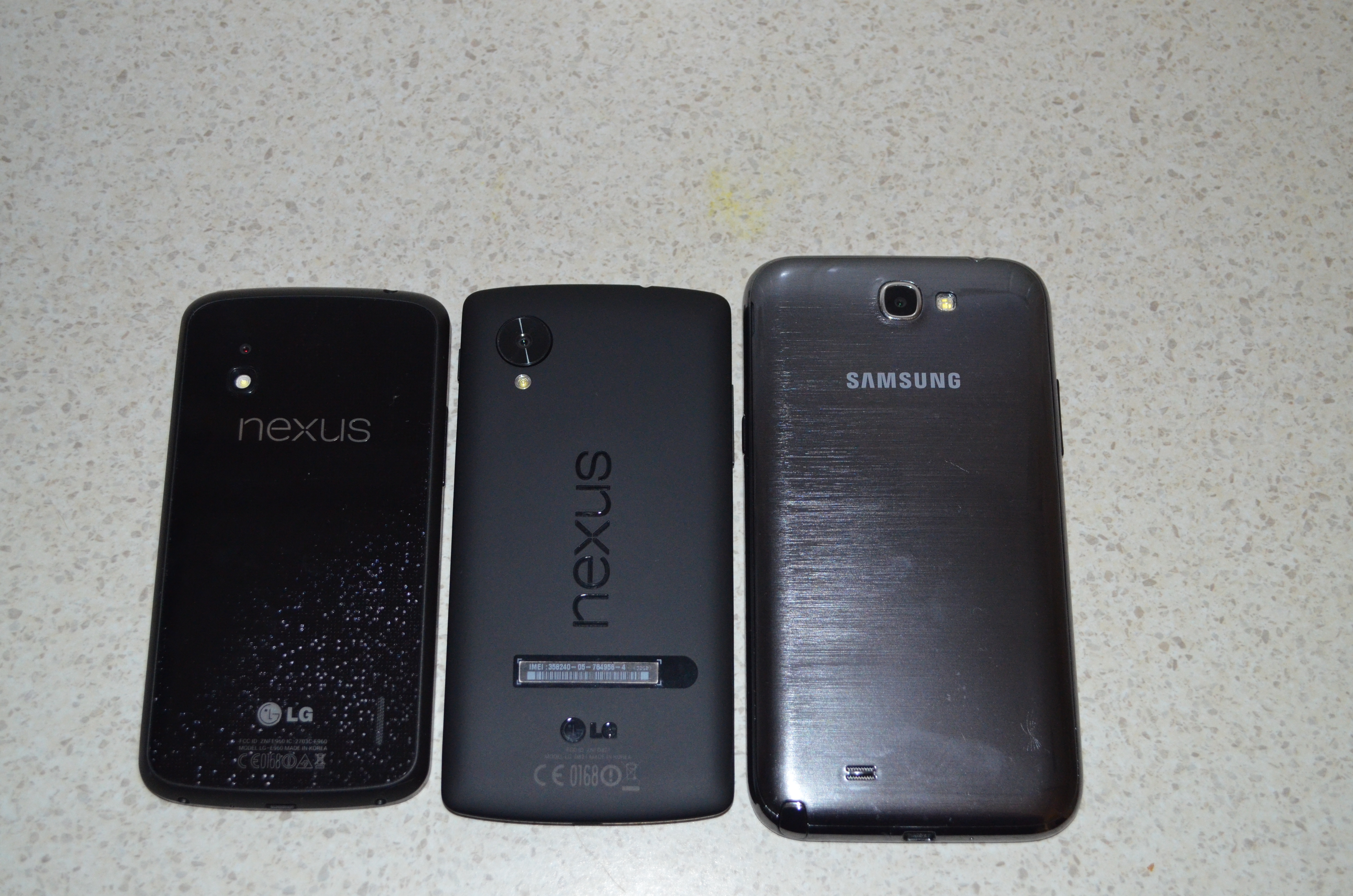
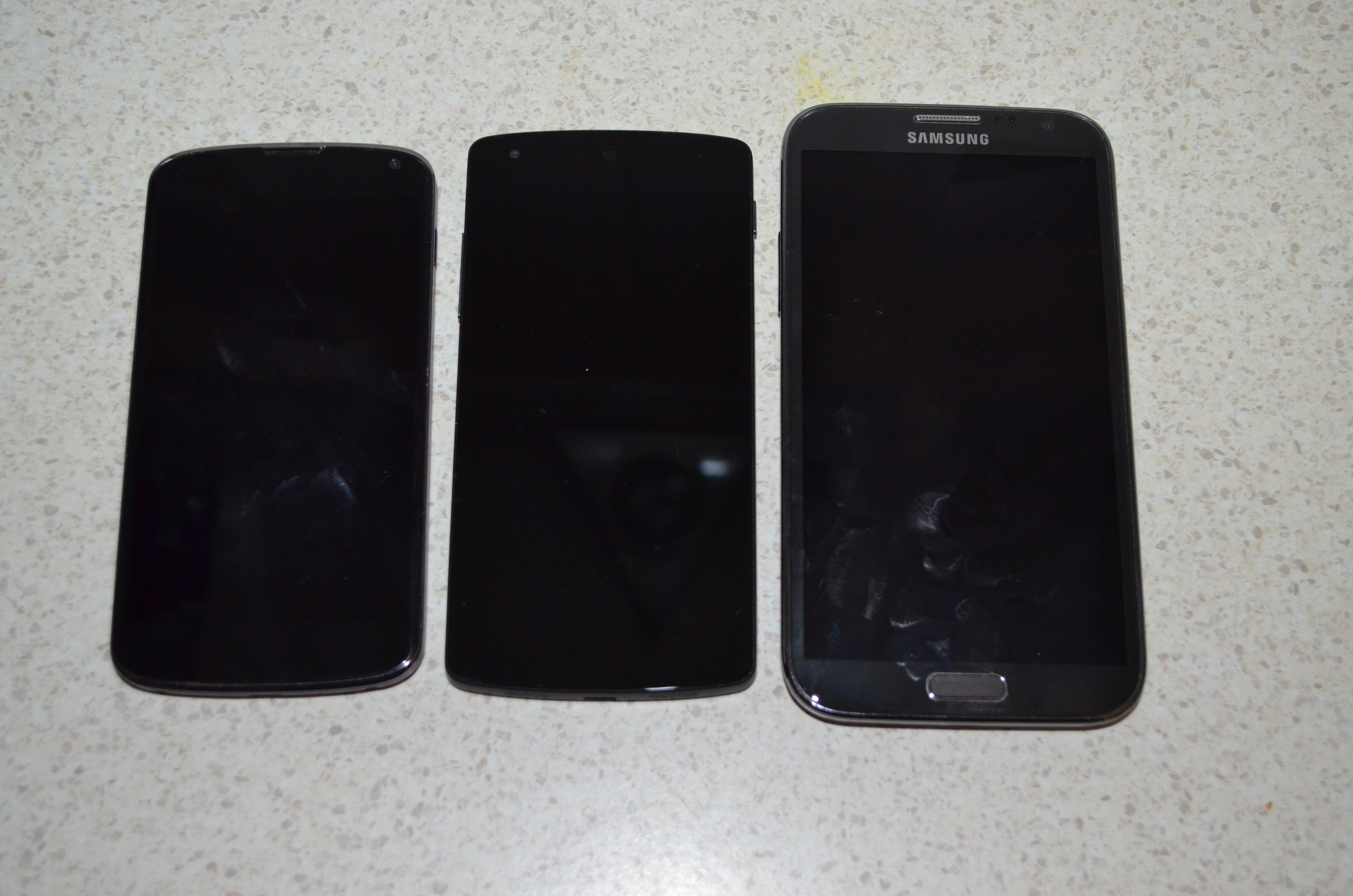
The Nexus 5 is the latest Android phone to be endorsed by Google (and manufactured by LG). It s getting good reviews and the price is good for the specs. I just bought one for my wife, I got her the 32G version because when I bought her a Nexus 4 at the start of the year [1] I chose the 8G version and regretted it ever since. The size of apps is always increasing (some Android games need more than 1G of storage) and higher resolution screens drives the use of high resolution video. Appearance back of Nexus 4, Nexus 5, and Samsung Galaxy Note 2front of Nexus 4, Nexus 5, and Samsung Galaxy Note 2 Above I have pictures of the Nexus 4, the Nexus 5, and the Samsung Galaxy Note 2. The photo of the phone backs captures part of the sparkling pattern on the back of the Nexus 4 and it looks much better in real life (IMHO) because it shimmers as you move the phone. The Nexus 4 looks so good that there s even a transparent case specifically designed to show off the rear panel [2]. It doesn t seem likely that anyone will design such a transparent case for the Nexus 5, it s a good phone to cover up IMHO. The Note 2 isn t the most attractive phone, but I think it has a streamlined elegance of being optimised for it s function. The Nexus 5 has it s camera sticking out, it would be better if they had just made the entire phone thicker and given it a bigger battery but for people who don t want good battery life I guess it s a way of providing a better focal length without making the phone thicker. Sticking the IMEI number on the back of the phone will be useful on rare occasions (and might be a security issue on more occasions) but it definitely makes the phone less attractive. Full HD The quality of the Full HD (1920*1080) display is obvious. The text is slightly clearer when viewing maps and the graphics in Ingress look nicer. Before I used the Nexus 5 I didn t think that there would be any benefit in having such a high resolution in a phone but now I realise that I was wrong. The higher resolution is clearly better. Chris Chavez wrote an article for Phandroid about a rumored Samsung phone with a 2560*1440 display [3]. If such a device had a 6.6 display (IE a new version of the Galaxy Mega) then it would have the same dot-pitch as the Nexus 5. If such a device had a 5.5 display (like the Galaxy Note 3) then it would have a 15% greater DPI than the Nexus 5. It seems that a higher DPI provides a real benefit and this is probably the biggest reason to choose the Nexus 5 over the Nexus 4 and most other Android devices. Comparing with the Nexus 4 The Nexus 5 has the same amount of RAM (2G), a slightly larger display (4.95 vs 4.7 ), higher resolution (a big deal), faster CPU and GPU, and optical zoom. Faster CPU isn t usually going to be a big deal (apart from the fact that more CPU power is needed as well as more GPU power to drive the higher resolution display). The Nexus 5 can come with 16G or 32G of storage while the Nexus 4 has options of 8G and 16G. If you want more than 16G of storage then that s a real benefit for the Nexus 5, but if you only need 16G then it s not an issue. It seems that when playing Ingress on a Nexus 5 it s more likely that running another program (such as Google Hangouts) will cause Ingress to be reloaded than it does on a Nexus 4 or a Galaxy Note 2. While I haven t done a good comparison of the Nexus 4 and the Nexus 5 in this regard I ve compared the Galaxy Note 2 and the Nexus 5 well. My Galaxy Note 2 (which has many daemons running) is much less likely to cause a reload of Ingress (IE have run low on memory and terminated Ingress) than the Nexus 5 my wife is using (which has very little running). So it seems that the OS build on the Nexus 5 uses more memory than the Galaxy Note 2. The Nexus 5 has Gorilla Glass 3 vs Gorilla Glass 2 on the Nexus 4. As my older Android phones with Gorilla Glass 1 (Galaxy S and Sony Ericsson Xperia X10i) didn t get any scratches that matter I don t think this is a benefit for me. Maybe if I lived near a beach I d care more about this. I think that the most significant benefit of the Nexus 5 over the Nexus 4 is the higher resolution display. The optical zoom should provide a theoretical benefit when taking photos, whether that results in better pictures in practice would probably depend on how you hold your phone, the available light, and other factors. I think that if it was possible to buy a Nexus 4 at a sensible price (IE something less than the $250 that Google last charged) then for most people the Nexus 4 would be a better choice than the Nexus 5. But as ebay is full of Nexus 4 phones selling for a higher prices than the Nexus 5 it seems that buying a Nexus 5 is the only option. The range of phones that Kogan sells [4] doesn t have anything for the same price that compares on features. Heat The heat produced by the Nexus 5 is significant and noticable. After some light Ingress playing on a cold day my Galaxy Note 2 with a gel case (that keeps it warm) reported itself as having a battery temperature of 34C. My wife s Nexus 5 reported a temperature of 43C. While the thermometer in the phone might not be the most accurate I don t think there was an accuracy problem, holding my wife s phone was unpleasant and felt like it could burn my hand if I held it tight (40C is the minimum temperature for burns). It seems that a Nexus 5 isn t a good choice if you want to play Ingress in a warm part of the world (EG most of Australia in summer). Also heat dissipated is directly proportional to power use which is going to be a problem for a phone that doesn t permit replacing it s battery. Conclusion I m quite disappointed with the Nexus 5. I expected it to be at least as good as the Nexus 4 in every way and better in many ways. Instead it s not always as good as the Nexus 4 and the ways that it is better won t necessarily provide benefits for everyone. The heat and power use problems are really going to hurt the use of it. But I guess we can always hope that Google release a new Android build that reduces the power use, they might even have a new build that uses less RAM too. I would not consider getting a Nexus 5 for my own use. For my use the Note 2 is clearly more suitable, the larger screen more than compensates for the clarity that the Nexus 5 gets from it s high resolution display. Also I REALLY like having a hardware home button. I ll probably get a Note 3 when the price drops, I m not interested in paying $649 for a phone and I m also not interested in replacing a phone that s less than a year old. So maybe I ll get a Note 3 in the second half of next year.

19 December 2013

Chris Lamb: Quickly switching between imperial and metric units on Strava

British triathletes are quite schizophrenic about their units: not "European" enough to bike using metric units yet not "American" enough to run using their imperial counterparts. Garmin GPS units seem happy enough to accomodate this contradiction but Strava only has a single global setting. Switching units would normally involve visiting your settings page inconvenient when viewing lots of run and bike pages so I wrote a Chrome extension that toggles between the different unit types via a Strava icon in the address bar: https://chris-lamb.co.uk/wp-content/2013/strava-1.png I considered a solution that actually converted the values displayed on the page but the illusion would always be shattered by Javascript elements which would require monkey-patching to ensure the desired unit was rendered: https://chris-lamb.co.uk/wp-content/2013/strava-2.png Source code is available, which should also serve as a template for similar extensions.

18 December 2013

C.J. Adams-Collier: Maxine is now running on mariadb

So back when I was working for MySQL AB as support manager for MaxDB, I created an IRC bot to help manage the #maxdb channel on Freenode. We didn t get a lot of traffic, and Daniel De Graaf mentioned that he could use a bot to help manage some iptables factoids over on #netfilter. So I had her join. He taught her all sorts of interesting things. She stored these factoids in a MySQL database. I have just migrated from MySQL to MariaDB which I compiled from source. Here are the packages: http://www.colliertech.org/~cjac/debian/
cjac@mariadb:~$ mysql -u root -p
Enter password: 
Welcome to the MariaDB monitor.  Commands end with ; or \g.
Your MariaDB connection id is 5322
Server version: 5.5.32-MariaDB-1-log (Debian)
Copyright (c) 2000, 2013, Oracle, Monty Program Ab and others.
Type 'help;' or '\h' for help. Type '\c' to clear the current input statement.
MariaDB [(none)]> use maxine;
Reading table information for completion of table and column names
You can turn off this feature to get a quicker startup with -A
Database changed
MariaDB [maxine]> 
15:22 < cj> maxine: iptables?
15:22 < maxine> hmmm... iptables is a generic table structure for the 
                definition of rulesets. Each rule within a chain consists of a 
                number of classifiers (iptables matches) and one optional 
                connected action (iptables target).

17 December 2013

Joey Hess: completely linux distribution-independent packaging

Sometimes it makes sense to ship a program to linux users in ready-to-run form that will work no matter what distribution they are using. This is hard. Often a commerical linux game will bundle up a few of the more problimatic libraries, and ship a dynamic executable that still depends on other system libaries. These days they're building and shipping entire Debian derivatives instead, to avoid needing to deal with that. There have been a few efforts to provide so-called one click install package systems that AFAIK, have not been widely used. I don't know if they generally solved the problem. More modern appoaches seem to be things like docker, which move the application bundle into a containerized environment. I have not looked at these, but so far it does not seem to have spread widely enough to be a practical choice if you're wanting to provide something that will work for a majority of linux users. So, I'm surprised that I seem to have managed to solve this problem using nothing more than some ugly shell scripts. My standalone tarballs of git-annex now seem fairly good at running on a very wide variety of systems. For example, I unpacked the tarball into the Debian-Installer initramfs and git-annex could run there. I can delete all of /usr and it keeps working! All it needs is a basic sh, which even busybox provides. Looks likely that the new armel standalone tarball of git-annex will soon be working on embedded systems as odd as the Synology NAS, and it's already been verified to work on Raspbian. (I'm curious if it would work on Android, but that might be a stretch.) Currently these tarballs are built for a specific architecture, but there's no particular reason a single one couldn't combine binaries built for each supported architecture. technical details The main trick is to ship a copy of ld-linux.so, as well as all the glibc libraries and associated files, and of course every other library and file the application needs. Shipping ld-linux.so lets a shell script wrapper be made around each binary, that runs ld-linux.so and passes it the library directories to search. This way the binary can be run, bypassing the system's own dynamic linker (which might not like it) and using the included glibc. For example a shell script that runs the git binary from the bundle:
exec "$GIT_ANNEX_LINKER" --library-path "$GIT_ANNEX_LD_LIBRARY_PATH" "$GIT_ANNEX_SHIMMED/git/git" "$@"
I have to set quite a lot of environment variables, to avoid using any files from the system and instead use ones from my tarball. One important one is GCONV_PATH. Note that LD_LIBRARY_PATH does not have to be set, and this is nice because it allows running a few programs from the host system, such as its web browser. worse is better Of course I'll take a proper distribution package anytime over this. Still, it seems to work quite well, in all the horrible cases that require it.

16 December 2013

Erich Schubert: Java Hotspot Compiler - a heavily underappreciated technology

When I had my first contacts with Java, probably around Java 1.1 or Java 1.2, it felt all clumsy and slow. And this is still the reputation that Java has to many developers: bloated source code and slow performance.
The last years I've worked a lot with Java; it would not have been my personal first choice, but as this is usually the language the students know best, it was the best choice for this project, the data mining framework ELKI.
I've learned a lot on Java since, also on debugging and optimizing Java code. ELKI contains a number of tasks that require a good number chrunching performance; something where Java particularly had the reputation of being slow.
I must say, this is not entirely fair. Sure, the pure matrix multiplication performance of Java is not up to Fortran (BLAS libraries are usually implemented in Fortran, and many tools such as R or NumPy will use them for the heavy lifting). But there are other tasks than matrix multiplication, too!
There is a number of things where Java could be improved a lot. Some of this will be coming with Java 8, others is still missing. I'd particularly like to see native BLAS support and multi-valued on-stack returns (to allow intrinsic sincos, for example).

In this post, I want to emphasize that usually the Hotspot compiler does an excellent job.
A few years ago, I have always been laughing at those that claimed "Java code can even be faster than C code"; because the Java JVM is written in C. Having had a deeper look at what the hotspot compiler does, I'm now saying: I'm not surprised that quite often, reasonably good Java code outperforms reasonably good C code.
In fact, I'd love to see a "hotspot" optimizer for C.
So what is it what makes Hotspot so fast? In my opinion, the key ingredient to hotspot performance is aggressive inlining. And this is exactly why "reasonably well written" Java code can be faster than C code written at a similar level.
Let me explain this at an example. Assuming we want to compute a pariwise distance matrix; but we want the code to be able to support arbitrary distance functions. The code will roughly look like this (not heavily optimized):
for (int i = 0; i < size; i++)  
  for (int j = i + 1; j < size; j++)  
    matrix[i][j] = computeDistance(data[i], data[j]);
   
 
In C, if you want to be able to choose computeDistance at runtime, you would likely make it a function pointer, or in C++ use e.g. boost::function or a virtual method. In Java, you would use an interface method instead, i.e. distanceFunction.distance().
In C, your compiler will most likely emit a jmp *%eax instruction to jump to the method to compute the distance; with virtual methods in C++, it would load the target method from the vtable and then jmp there. Technically, it will likely be a "register-indirect absolute jump". Java will, however, try to inline this code at runtime, i.e. it will often insert the actual distance function used at the location of this call.
Why does this make a difference? CPUs have become quite good at speculative execution, prefetching and caching. Yet, it can still pay off to save those jmps as far as I can tell; and if it is just to allow the CPU to apply these techniques to predict another branch better. But there is also a second effect: the hotspot compiler will be optimizing the inlined version of the code, whereas the C compiler has to optimize the two functions independently (as it cannot know they will be only used in this combination).
Hotspot can be quite aggressive there. It will even inline and optimize when it is not 100% sure that these assumptions are correct. It will just add simple tests (e.g. adding some type checks) and jump back to the interpreter/compiler when these assumptions fail and then reoptimize again.
You can see the inlining effect in Java when you use the -Xcomp flag, telling the Java VM to compile everything at load time. It cannot do as much speculative inlining there, as it does not know which method will be called and which class will be seen. Instead, it will have to compile the code using virtual method invocations, just like C++ would use for executing this. Except that in Java, every single method will be virtual (in C++, you have to be explicit). You will likely see a substantial performance drop when using this flag, it is not recommended to use. Instead, let hotspot perform its inlining magic. It will inline a lot by default - in particular tiny methods such as getters and setters.
I'd love to see something similar in C or C++. There are some optimizations that can only be done at runtime, not at compile time. Maybe not even at linking time; but only with runtime type information, and that may also change over time (e.g. the user first computes a distance matrix for Euclidean distance, then for Manhattan distance).

Don't get me wrong. I'm not saying Java is perfect. There are a lot of common mistakes, such as using java.util.Collections for primitive types, which comes at a massive memory cost and garbage collection overhead. The first thing to debug when optimizing Java applications is to check for memory usage overhead. But all in all, good Java code can indeed perform well, and may even outperform C code, due to the inlining optimization I just discussed; in particular on large projects where you cannot fine-tune inlining in C anymore.

Sometimes, Hotspot may also fail. Which is largely why I've been investigating these issues recently. In ELKI 0.6.0 I'm facing a severe performance regression with linear scans (which is actually the simpler codepath, not using indexes but using a simple loop as seen above). I had this with 0.5.0 before, but back then I was able to revert back to an earlier version that still performed good (even though the code was much more redundant). This time, I would have had to revert a larger refactoring that I wanted to keep, unfortunately.
Because the regression was quite severe - from 600 seconds to 1500-2500 seconds (still clearly better than -Xcomp) - I first assumed I was facing an actual programming bug. Careful inspection down to the assembler code produced by the hotspot VM did not reveal any such error. Then I tried Java 8, and the regression was gone.
So apparently, it is not a programming error, but Java 7 failed at optimizing it remotely as good as it did with the previous ELKI version!
If you are an Java guru, interested at tracking down this regression, feel free to contact me. It's in an open source project, ELKI. I'd be happy to have good performance even for linear-scans, and Java 7. But I don't want to waste any more hours on this, but instead plan to move on to Java 8 for other reasons (lambda expressions, which will greatly reduce the amount of glue coded needed), too. Plus, Java 8 is faster in my benchmarks.

7 December 2013

Hideki Yamane: I was in Mini DebConf in Taiwan 2013

I've done GPG key sign for Mini DebConf in Taiwan 2013 participates, and written an article for Japanese magazine, Software Design 2014/Jan. This means, my short trip has been ended, at last.


In this event, I've talked about "local community" for Debian, a bit (PDF/ODF are in Debian Wiki).
Local Community for Debian (2013 Taiwan miniDebConf) from Hideki Yamane

Probably you know, most of Debian contributors are in Euro/America(North and South), not in Asia. But there are lots of talented people. It means: there is huge possibility for Debian :)


I hope we Asian Debian people unite and publish its community work more, and do "DebConf in Asia" - in the future.

19 November 2013

Rapha&#235;l Hertzog: Will Debian s technical committee coopt Keith Packard or Philipp Kern?

The process has been ongoing for more than a year but the Debian technical committee is about to select a candidate to recommend for its vacant seat. The Debian Project Leader will then (likely) appoint him (looks like it won t be a women). According to recent discussions on debian-ctte@lists.debian.org, it seems that either Keith Packard or Philipp Kern will join the committee. If you look at the current membership of the committee, you will see: That s very Anglo-Saxon centric (6 out of 7 members). While I trust the current members and while I know that they are open-minded people, it still bothers me to see this important body with so few diversity. Coming back to the choice at hand, Keith Packard is American and Philipp Kern is German. No new country in the mix. I can only hope that Philipp will be picked to bring some more balance in the body.

9 comments Liked this article? Click here. My blog is Flattr-enabled.

13 November 2013

Julien Danjou: OpenStack Design Summit Icehouse, from a Ceilometer point of view

Last week was the OpenStack Design Summit Icehouse in Hong-Kong where we, OpenStack developers, discussed and designed the new OpenStack release (Icehouse) that is coming up. The week has been wonderful. It was my second OpenStack design summit, and I loved it. Bumping into various people I've never met so far and worked with online was a real pleasure. As it was to meet again with fellow OpenStack developers! The event organisation was great, as were the parties. :-) On the last day, I had the chance to present a talk with Eoghan Glynn and Nick Barcet how we built the auto-scaling feature in Heat, implementing the "alarming" feature needed in Ceilometer.
The slides and video of the talk is online on my talks page. Design sessions This time, Ceilometer design sessions were spread on 3 days. Everything we talked about has its Etherpad instance. The discussions were interesting, and the amount of feedback gathered is big and is going to be very useful. There's a lot of people and companies using Ceilometer now, and the project is getting more and more traction in general. There's a lot of different way to use it and to bend it to one's needs. Considering the amount of features and options that is provided, building functionality with a genericized approach it making Ceilometer useful for a lot of different and interesting use-cases. Icehouse roadmap The list of blueprints targeting Icehouse is available, but not yet complete. I expect people to start filling this list in the next days.If you want to propose blueprints, you're free to do so and inform us about it so we can validate it. The same applies if you wish to implement one of them! Thereafter, I try to guess what the roadmap will look like in the upcoming weeks for Ceilometer based on the discussion we had last week during the summit. Events management A lot of work is going to be put into event management. Ceilometer plans to store notifications sent using oslo.messaging by OpenStack projects. Some work already got merge for Havana, but the API part and future improvements and ideas will continue to flow into the Icehouse release. Agents and group management A lot has been discussed around the polling agents and around the alarm evaluator agent. The current state of the ceilometer-central-agent disallows any kind of high-availability and load-balancing, as the polling task are kept and scheduled on only one node. The high-availability part is already covered by a custom mechanism built into ceilometer-alarm-evaluator, but it came clear to us that a more generic approach is needed. A lot of other projects needs this kind of functionality, and a pattern have been pointed out. A blueprint about group membership has been discussed in an Oslo session, and will end into a new Python library written to solve this in Ceilometer and in other projects. TaskFlow will also probably be leveraged to solve the task distribution issue. Documentation Since a few weeks, Ceilometer auto-generates its API reference documentation using sphinxcontrib-docbookrestapi that parses our API code that uses WSME. We also want to start writing a user guide, and we'll do that inside our own repository. That way, I hope that we will be the first project in OpenStack to require documentation to be incorporated into every patch that's being sent to Ceilometer. This is the best way to assure that nothing can be changed nor added without being accompanied with a documentation update. Tempest testing Testing of Ceilometer already has been a subject during the previous design summit about testing. We already put a large effort on Tempest testing in this last cycle, but we encountered a lot of small issues that we had to tackle to achieve something. Some Ceilometer basic tests are already on their way into Tempest, so this is something that is going to be achieved very soon. Ultimately, I would also want Ceilometer moving towards providing its own set of Tempest tests as part of the code base. That way, it'd be as easy for core reviewers to refuse a patch if it doesn't provide functional tests as it is to refuse it if it doesn't provide unit tests. As we'll do for the documentation. API improvements Once again, a few API improvements will probably be implemented, like aggregation or the ability to specify multiple queries with OR and AND operators. Roll-up, archiving of data There seems to be interest in archiving and rolling-up the data stored by Ceilometer, so work in this area is to be expected. Supporting multiple data storage driver in parallel seems to be something that needs to be done for this and other aspects of Ceilometer feature set. Alarming The alarming feature set is already big, and the work that has been accomplished pretty amazing. A few improvements will be made, as retrieving better metrics and building better statistics (exclusion of low quality data points).

11 November 2013

Daniel Pocock: Outreach Program for Women applications

The deadline for Outreach Program for Women applications is very imminent and a range of applications have now appeared on the OPW wiki It is great to see Debian has attracted a diverse range of women who all appear to have coding experience. Code samples have been submitted in Java, C++ and Python among other things and they come from a range of locations around the globe, including Brazil, the UK, Iran and India. Experience counts Looking through the records of some of these applications, it is interesting to see a range of experience and connections in industry and the wider open source family:
  • translator for O'Reilly
  • IBM internship
  • Linux module programming
  • Working alongside one of the Mercurial contributors in a previous role
Funding needed Recent emails from the OPW organisors and DPL have highlighted the need to raise more funding to ensure that Debian can offer OPW internships to the selected applicants. Solving the biggest problem of GSoC 2014 Many of these applicants are students and will be eligible for GSoC 2014. According to the Google FAQ, even students who graduate in 2014 are eligible as long as they are enrolled in a course on the cut-off date 21 April 2014 One of the biggest challenges facing GSoC mentors is the selection of students who are capable of completing good work and have a long term interest in open source. One of the best ways to overcome that challenge is to start forming relationships with potential GSoC students well in advance and get to know them as they make small contributions over an extended period of time. The interest that these candidates have expressed in Debian and OPW suggests that some of them may well be suitable for Debian to help them get onto this track for the next GSoC. Not only will this make the GSoC 2014 selection process easier but it may help us to select more GSoC candidates with a long term outlook. Women in science, engineering and the wider business world More news items have appeared recently about women in science and engineering and other leadership roles:

In the early 1950s, Morgan was the only female analyst among 900 rocket scientists at North American Aviation. She was also one of the few without a college degree.

"What I saw a thousand times during the downturn was, 'We'd like to give her that opportunity, but we need to go with the sure thing - we can't afford diversity right now,'" - Sallie Krawcheck, former chief executive at Merrill Lynch

Matthew Palmer: Timezones are not optional information

In high school, I had a science teacher who would mark your answers wrong if you forgot to include units. What does that mean? , he would write, 17.2 elephants? The point he was trying to get across was that a bare number, without the relevant units, wasn t precise enough to be useful. Also, carrying the units with you helped to cross-check your work if you got a numeric answer, but the units were garbage (seconds per kilogram, for instance, when you were trying to find an acceleration), then you could be pretty sure you d made a mistake somewhere. Fast forward to today, and I m currently working with a database containing a pile of timestamps. Without timezones. Where the timestamps being inserted are in local time. Thankfully, so far, this particular system has always been run in one timezone, so I ve only got one timezone to deal with, but the potential ramifications of systems with different timezones inserting data into this database terrify me. The naive answer is to just store everything in UTC and be done with it. I m not particularly averse to that solution, as long as it s very clear to everyone what s going on. The correct answer, though, I think, is to always keep timezone information with your timestamps otherwise, you ll never know whether it s 0830 in elephants

10 November 2013

Petter Reinholdtsen: Running TP-Link MR3040 as a batman-adv mesh node using openwrt

Continuing my research into mesh networking, I was recommended to use TP-Link 3040 and 3600 access points as mesh nodes, and the pair I bought arrived on Friday. Here are my notes on how to set up the MR3040 as a mesh node using OpenWrt. I started by following the instructions on the OpenWRT wiki for TL-MR3040, and downloaded the recommended firmware image (openwrt-ar71xx-generic-tl-mr3040-v2-squashfs-factory.bin) and uploaded it into the original web interface. The flashing went fine, and the machine was available via telnet on the ethernet port. After logging in and setting the root password, ssh was available and I could start to set it up as a batman-adv mesh node. I started off by reading the instructions from Wireless Africa, which had quite a lot of useful information, but eventually I followed the recipe from the Open Mesh wiki for using batman-adv on OpenWrt. A small snag was the fact that the opkg install kmod-batman-adv command did not work as it should. The batman-adv kernel module would fail to load because its dependency crc16 was not already loaded. I reported the bug to the openwrt project and hope it will be fixed soon. But the problem only seem to affect initial testing of batman-adv, as configuration seem to work when booting from scratch. The setup is done using files in /etc/config/. I did not bridge the Ethernet and mesh interfaces this time, to be able to hook up the box on my local network and log into it for configuration updates. The following files were changed and look like this after modifying them: /etc/config/network
config interface 'loopback'
        option ifname 'lo'
        option proto 'static'
        option ipaddr '127.0.0.1'
        option netmask '255.0.0.0'
config globals 'globals'
        option ula_prefix 'fdbf:4c12:3fed::/48'
config interface 'lan'
        option ifname 'eth0'
        option type 'bridge'
        option proto 'dhcp'
        option ipaddr '192.168.1.1'
        option netmask '255.255.255.0'
        option hostname 'tl-mr3040'
        option ip6assign '60'
config interface 'mesh'
        option ifname 'adhoc0'
        option mtu '1528'
        option proto 'batadv'
        option mesh 'bat0'
/etc/config/wireless
config wifi-device 'radio0'
        option type 'mac80211'
        option channel '11'
        option hwmode '11ng'
        option path 'platform/ar933x_wmac'
        option htmode 'HT20'
        list ht_capab 'SHORT-GI-20'
        list ht_capab 'SHORT-GI-40'
        list ht_capab 'RX-STBC1'
        list ht_capab 'DSSS_CCK-40'
        option disabled '0'
config wifi-iface 'wmesh'
        option device 'radio0'
        option ifname 'adhoc0'
        option network 'mesh'
        option encryption 'none'
        option mode 'adhoc'
        option bssid '02:BA:00:00:00:01'
        option ssid 'meshfx@hackeriet'
/etc/config/batman-adv
config 'mesh' 'bat0'
        option interfaces 'adhoc0'
        option 'aggregated_ogms'
        option 'ap_isolation'
        option 'bonding'
        option 'fragmentation'
        option 'gw_bandwidth'
        option 'gw_mode'
        option 'gw_sel_class'
        option 'log_level'
        option 'orig_interval'
        option 'vis_mode'
        option 'bridge_loop_avoidance'
        option 'distributed_arp_table'
        option 'network_coding'
        option 'hop_penalty'
# yet another batX instance
# config 'mesh' 'bat5'
#       option 'interfaces' 'second_mesh'
The mesh node is now operational. I have yet to test its range, but I hope it is good. I have not yet tested the TP-Link 3600 box still wrapped up in plastic.

Jelmer Vernooij: The state of distributed bug trackers

A whopping 5 years ago, LWN ran a story about distributed bug trackers. This was during the early waves of distributed version control adoption, and so everybody was looking for other things that could benefit from decentralization. TL;DR: Not much has changed since. The potential benefits of a distributed bug tracker are similar to those of a distributed version control system: ability to fork any arbitrary project, easier collaboration between related projects and offline access to full project data. The article discussed a number of systems, including Bugs Everywhere, ScmBug, DisTract, DITrack, ticgit and ditz. The conclusion of our favorite grumpy editor at the time was that all of the available distributed bug trackers were still in their infancy. All of these piggyback on a version control system somehow - either by reusing the VCS database, by storing their data along with the source code in the tree, or by adding custom hooks that communicate with a central server. Only ScmBug had been somewhat widely deployed at the time, but its homepage gives me a blank page now. Of the trackers reviewed by LWN, Bugs Everywhere is the only one that is still around and somewhat active today. In the years since the article, a handful of new trackers have come along. Two new version control systems - Veracity and Fossil - come with the kitchen sink included and so feature a built-in bug tracker and wiki. There is an extension for Mercurial called Artemis that stores issues in an .issues directory that is colocated with the Mercurial repository. The other new tracker that I could find (though it has also not changed since 2009) is SD. It uses its own distributed database technology for storing bug data - called Prophet, and doesn't rely on a VCS. One of the nice features is that it supports importing bugs from foreign trackers. Some of these provide the benefits you would expect of a distributed bug tracker. Unfortunately, all those I've looked at fail to even provide the basic functionality I would want in a bug tracker. Moreso than with a version control system, regular users interact with a bug tracker. They report bugs, provide comments and feedback on fixes. All of the systems I tried make these actions a lot harder than with your average bugzilla or mantis instance - they provide a limited web UI or no web interface at all. Update: LWN later also publishe articles on on SD and on Fossil. Other interesting links are Eric Sink's article on distributed bug tracking (Erik works at Sourcegear who develop Veracity) and the dist-bugs mailing list.

9 November 2013

Russ Allbery: Review: Fantasy & Science Fiction, July/August 2011

Review: Fantasy & Science Fiction, July/August 2011
Editor: Gordon van Gelder
Issue: Volume 121, No. 1 & 2
ISSN: 1095-8258
Pages: 258
Nothing of particular interest in the book reviews in this issue, although I was entertained to see Charles de Lint review a collection of the Prince Valiant strip. I have memories of that strip being one of the most boring works of art created by mankind. De Lint, of course, quite likes it. Our tastes seem to be very disjoint, although I have to admit that I've not read it collected and it may be more coherent and more interesting in that format. The science column in this issue, by Paul Doherty and Pat Murphy, deserves special mention. It's on roshambo (rock-paper-scissors), human difficulties with randomness, and strategy in roshambo competitions. It's also the first essay I've read that clearly explains how there can be strategy to roshambo, and why that strategy is worth studying. Even though the primary topic of the column is randomness, it's worth reading from the perspective of strategy in competitive human vs. human games. "Bronsky's Dates with Death" by Peter David: Anyone familiar with PAD's body of work will immediately expect a humorous story with some deeper thoughtful bits, and that's exactly what this is. Bronsky, the title character, is a man almost incapable of saying exactly what's on his mind, and what's on his mind is his eventual death. Not that it bothers him that much; he's just thinking a lot about it. But his incessant discussion of it certainly bothers the people around him. This leads to a few entertaining exchanges with his family, and then to more entertaining exchanges with Death. Or Deaths, as there appear to be several different kinds. I found the exact metaphysics a bit confused, but the ending was still touching and a bit funny. (7) "The Way It Works Out and All" by Peter S. Beagle: This is a reprint of a special fund-raising story about Avram Davidson, so a lot of it was lost on me given that I know almost nothing about Davidson and have yet to get to any of his novels I own. But even without that background, it's a diverting story of hidden and parallel worlds and unexpected explorations. There isn't all that much in the way of a plot, but it's a nice bit of characterization set against a fun SF twist. (6) "Less Stately Mansions" by Rob Chilson: This is a story about conservatism in life, about a farmer staying on his farm and resisting change, and about nostalgia, but I liked it much better than I normally like stories with those themes. It's set against a future world in which climate change is making life increasingly untenable. Humans are migrating into space colonies of various types, but Jacob refuses. This frustrates some parts of the family who want a piece of the substantial cash-out he's being offered for his farm, which of course makes Jacob even more stubborn. It's more of an elegy than a story, but I think it captures a particular stubborn mood, and a conscious decision to go with what one knows even if it doesn't have a long future, quite well. (7) "The Ants of Flanders" by Robert Reed: This is the novella of the issue, and, as you might expect from the author, it's thoughtful, meaty, and satisfying. At the start of the book, the planet is visited by an extraterrestrial ship (or ships it's not entirely clear at first). One of the people near one landing is Bloch, a huge teenager who has an odd lack of natural fear. He stays near the center of the story as Reed slowly develops a cosmology and a galactic political background that makes it clear humans may be incidental to everything that's happening. I liked this. It's a touch depressing in spots, and Bloch is a strange protagonist, but the cosmology is not the normal SF background and sparks some thoughts about how a status quo would be maintained by powers that don't care much about individual lives. The interlude with the leopard is nicely done, even if its significance is inobvious at first. (7) "Hair" by Joan Aiken: This is one of those weird Gothic horror stories about creepy families and half-explained supernatural events that some people love and that do nothing for me. (3) "The Witch of Corinth" by Steven Saylor: This is straight historical fantasy, featuring a Roman and his Greek tutor (heroes, apparently, of a series of historical mysteries) visiting the ruins of Corinth and encountering some bloody and dangerous local conflicts. It's slow and atmospheric, carried along by good characterization and description of ruins. It's not that much of a mystery the characters don't figure things out as much as stick around until the answer becomes obvious but it kept me entertained throughout a sizable story. Numerous elements of the story appear to be fantasy and then get other explanations, but there is a fantasy twist to the ending. (6) "Sir Morgravain Speaks of Night Dragons and Other Things" by Richard Bowes: This odd story is set among the knights of King Arthur on Avalon, where they sleep (mostly), awaiting their call to aid Britain again. Most of the story is told as one-sided dialogue from Morgravain, interspersed with some italic narration. Again, not much of a plot; the story, as such, is figuring out what Morgravain is doing and the point of his interactions with the other knights. I thought it was slight and oddly pointless, but I may have just missed the point. (4) "Someone Like You" by Michael Alexander: A time travel story, but one that's less about time travel per se than about examining and speculating about the alternate paths childhood could take and whether those changes produce different people. It takes some time to figure out what's going on, during which Alexander fills in the protagonist's past and the murder mystery that drives the tale. The time travel mechanism is blatantly hand-waved, making this more of a fantasy than an SF story, which matches the emphasis on emotion and psychology. It's not a bad story, and I think I see where the author was going with the slowly-constructed central conflict, but I still found it hard to take the conflict that seriously. One of the problems with time travel is that undermining of causality also undermines finality of decisions and consequences in ways that can rob stories of their punch. (6) "The Ramshead Algorithm" by KJ Kabza: The first-person protagonist is a well-respected and experienced fixer in a world of chaos and dimensional connection, a world with physics and inhabitants very much unlike ours. But the story doesn't spend much time there; his connection to his home earth is threatened, and he returns to try to stabilize it, which leads to the reader discovering that his family considers him a worthless appendage on a wealthy business family whose sole purpose in life is to stay out of their way. And his portal is rooted in a hedge maze that his father intends to demolish. This is one of those stories that gets more interestingly complex the deeper one gets into it. Ramshead's family is badly screwed up along multiple axes, but not without some hope of redemption. He's desperate and ineffective in his home universe, but more confident and capable when it comes to dealing with dimensional portal problems (although he still seems very young and relies on tools given to him by others). And there's always more going on than it first appears, and not as few obvious villains as it first appears. Good stuff, although I would have liked to understand more about Ramshead's world. (7) Rating: 7 out of 10

5 November 2013

Russ Allbery: Review: Asimov's, August 2011

Review: Asimov's Science Fiction, August 2011
Editor: Sheila Williams
Issue: Volume 35, No. 8
ISSN: 1065-2698
Pages: 112
The editorial this issue is about the Dell Magazines Award, so newsy without a lot of content (particularly since we don't get to read the winners). Silverberg's column is much more interesting, focusing on the complex rules of the honor code of the Albanian highlands and pointing out that there's more complexity and strangeness in things we can find on Earth than in a lot of science fiction. Even within the rules of real human cultures. James Patrick Kelly's column this issue is an interesting summary of what graduates of the Clarion writing workshop learned, in their own words. It's a nice barrage of quick writing tips, and an interesting view of what people take away from a writing workshop. The book review column this issue is Peter Heck's normal workman-like job. "The End of the Line" by Robert Silverberg: Someday, I really should read Lord Valentine's Castle. As you might guess from this comment, this is another Majipoor story. This one follows an official who is part of an advance party for the Coronal Lord, the ruler (of sorts). He's decided, as part of those duties, to take the opportunity to learn more about the aboriginal people of Majipoor: the somewhat mysterious metamorphs, or Piurivar. I'm not that familiar with the history of Majipoor, since all I've read is this story and one other, none of the novels. Apparently, knowing that the official in question is named Stiamot will place this story for more familiar readers. For the unfamiliar, such as myself, there's a lot of politics here and what's clearly background for a major event in the world, but as a standalone story it's a bit unsatisfying (and grim). It's not that clear why things had to turn out the way they did, and the characters seem largely without agency. It's well-written, but mostly a story for fans of the series, I think. (6) "Corn Teeth" by Melanie Tem: This is a tight third-person story about a human child raised by alien foster parents, and it's deeply disturbing. Not because of the fostering, which appears wonderful and loving, but because it's a train wreck sort of story: the reader can see the horrible coming and can't do anything about it (and it turns out even worse than one might expect). It's also a story built around failure of communication and failure of empathy, and has a monumentally depressing ending, the kind that leaves scars. I'm sure all of this is entirely intentional; it seems very well-written. But I really didn't want this much horrible misunderstanding and depressing hopelessness in my reading. (2) "Watch Bees" by Philip Brewer: I rather liked this story even if the protagonist is an awful person. The story is set in a future of bioengineered insects and hard economic times, and it features a man who is supposedly working his way from farm to farm to get back home. What he's actually after is more complicated and is closely related to the defense systems that keep intruders off of farms. You might guess some of the rest from the title. It's a story about understanding layered defense systems, and about economic warfare. I didn't care much for any of the characters, but the story is well-plotted and kept me interested in seeing what would happen next. (6) "For I Have Lain Me Down on the Stones of Loneliness and I'll Not Be Back Again" by Michael Swanwick: By Swanwick, so it's a little odd, but I found this story surprisingly moving and ambiguous. It's about an American of Irish descent, a trip to Ireland, and a love affair with a fierce Irish nationalist, all set against an SF background of an Earth conquered by benevolent aliens. It's angry, uncertain, fanatical, and realistic by turns, and left me with profound mixed feelings. I think it does a good job capturing in a brief story the emotional complexities of what it means to give onself to a cause. (7) "We Were Wonder Scouts" by Will Ludwigsen: This is a short and odd story about a variant of the Boy Scouts founded by a man who is a little too obsessed with the paranormal, and an outing in the woods that turns rather creepy. It's a type of story that I'm not very fond of: one that twists the delight of discovery into something dark and mundane. I suppose you could call it horror; it's more horror than fantasy, at least. Anyway, not my thing. (3) "Pairs" by Zachary Jernigan: This story, on the other hand, isn't as dark as it seems like it should be from the setup. Humans have been conquered and enslaved by more powerful alien races, and now human souls are a profitable business. The protagonist is a person who has been embodied in a spaceship, and who works with (and monitors) another largely insane embodied person as they work as couriers, carrying souls to their buyers. But neither of them are as fully under control as they might appear, which is the point of the story. There is no grand tale of redemption, and the price is high, but I found the psychological portrayal oddly satisfying and faintly hopeful, and I was intrigued by the world background. (7) "Paradise is a Walled Garden" by Lisa Goldstein: The cover story, this is by far the best story of the issue. It's steampunk, set in a world where Muslim civilization was not pressed back by Christianity and continues to thrive into the reign of Queen Elizabeth as, among other things, makers of automata. A girl has managed to get herself a job in a British factory by posing as a boy and is the first to sound the alarm when the automata that do most of the work go strangely (and violently) haywire. That leads to her being assigned to the subsequent delegation to Al-Andulus (Muslim Spain, if you're not familiar with that name from history). The protagonist is the best part of this story. She's thoughtful, resourceful, and delights in learning things, something that she's rarely had the opportunity to do. She's also utterly unintimidated. In Al-Andulus, she thrives, despite the contempt of the leader of the expedition and some dangerous intrigues around the source of the anomalous behavior. I won't spoil the ending, but it's a delight, leaving the reader with a lot of hope for her future. I also liked the portrayal of the Muslim world, which is engrossed in its own business and has its own advantages and disadvantages, but is at least open to and focused on learning and technological development. The contrast with the superstitious British delegation is both pointed and historically grounded in Muslim relations with Europe around the point of divergence of Goldstein's world. (8) Rating: 7 out of 10

4 November 2013

Mart&iacute;n Ferrari: Living in Buenos Aires: first week

Continuing my nomadic experiment, I have just arrived in Buenos Aires. My plan is to live here for 3 months, working and enjoying the city like I never did before: I always lived in the suburbs and only came to the city to work or study. After a few days seeing my immediate family and some close friends, today I finally went out, taking advantage of a beautiful spring day. And my first stop is the National Library. Biblioteca Nacional -   Dan DeLuca, downloaded from Wikipedia, licenced as Creative Commons Attribution 2.0 Generic I came with the intention of working a bit on some projects, but arriving as a visitor forbade me to enter the most interesting places of the library (now I have registered so next time they will not treat me as a tourist :)). It is an imposing building, I have seen it a few times before, but never entered it. I only learned today that in these grounds there used to be the presidential residence, back in Per n days, and then it was thoroughly demolished by the barbarians of the '55 coup. I also learned this new building was only opened in 1992, which is surprising, as I don't remember the fact at all, and I was already 14.

3 November 2013

Gregor Herrmann: RC bugs 2013/44

I'm getting the hang of the more or less daily RC bug fixing again. below you find what I did this week. as a side note: as you can see, quite a few of the patches are taken from ubuntu; it's great that someone over there already took the time to come up with a fix; thanks! not so great is that only one of them was in the BTS. guys, you have already been better at forwarding your patches to the debian BTS, please try to get back into this good habit :)

Next.

Previous.