Search Results: "cts"

28 June 2023

Russ Allbery: Review: Translation State

Review: Translation State, by Ann Leckie
Publisher: Orbit
Copyright: June 2023
ISBN: 0-316-29024-6
Format: Kindle
Pages: 354
Translation State is a science fiction novel set in the same universe as the Imperial Radch series and Provenance. It is not truly a sequel of any of those books, but as with Provenance, it has significant spoilers for the conclusion of Ancillary Mercy. Provenance takes place earlier, but it's plot is unrelated as far as I can recall. Enea has spent much of hir adult life living with hir difficult and somewhat abusive grandmanan and, in recent years, running her household. Now, Grandmanan is dead, and the relatives who have been waiting to inherit Grandmanan's wealth are descending like a flock of vultures and treating hir like a servant. Enea can barely stand to be around them. It is therefore somewhat satisfying to watch their reactions when they discover that there is no estate. Grandmanan had been in debt and sold her family title to support herself for the rest of her life. Enea will receive an allowance and an arranged job that expects a minimum of effort. Everyone else gets nothing. It's still a wrenching dislocation from everything Enea has known, but at least sie can relax, travel, and not worry about money. Enea's new job for the Office of Diplomacy is to track down a fugitive who disappeared two hundred years earlier. The request came from the Radchaai Translators Office, the agency responsible for the treaty with the alien Presger, and was resurrected due to the upcoming conclave to renegotiate the treaty. No one truly expects Enea to find this person or any trace of them. It's a perfect quiet job to reward hir with travel and a stipend for putting up with Grandmanan all these years. This plan lasts until Enea's boredom and sense of duty get the better of hir. Enea is one of three viewpoint characters. Reet lives a quiet life in which he only rarely thinks about murdering people. He has a menial job in Rurusk Station, at least until he falls in with an ethnic club that may be a cover for more political intentions. Qven... well, Qven is something else entirely. Provenance started with some references to the Imperial Radch trilogy but then diverged into its own story. Translation State does the opposite. It starts as a cozy pseudo-detective story following Enea and a slice-of-life story following Reet, interspersed with baffling chapters from Qven, but by the end of the book the characters are hip-deep in the trilogy aftermath. It's not the direct continuation of the political question of the trilogy that I'm still partly hoping for, but it's adjacent. As you might suspect from the title, this story is about Presger Translators. Exactly how is not entirely obvious at the start, but it doesn't take long for the reader to figure it out. Leckie fills in a few gaps in the world-building and complicates (but mostly retains) the delightfully askew perspective Presger Translators have on the world. For me, though, the best part of the book was the political maneuvering once the setup is complete and all the characters are in the same place. The ending, unfortunately, dragged a little bit; the destination of the story was obvious but delayed by characters not talking to each other. I tend to find this irritating, but I know tastes differ. I was happily enjoying Translation State but thinking that it didn't suck me in as much as the original trilogy, and even started wondering if I'd elevated the Imperial Radch trilogy too high in my memory. Then an AI ship showed up and my brain immediately got fully invested in the story. I'm very happy to get whatever other stories in this universe Leckie is willing to write, but I would have been even happier if a ship appeared as more than a supporting character. To the surprise of no one who reads my reviews, I clearly have strong preferences in protagonists. This wasn't one of my favorites, but it was a solidly good book, and I will continue to read everything Ann Leckie writes. If you liked Provenance, I think you'll like this one as well. We once again get a bit more information about the aliens in this universe, and this time around we get more Radchaai politics, but the overall tone is closer to Provenance. Great powers are in play, but the focus is mostly on the smaller scale. Recommended, but of course read the Imperial Radch trilogy first. Note that Translation State uses a couple of sets of neopronouns to represent different gender systems. My brain still struggles with parsing them grammatically, but this book was good practice. It was worth the effort to watch people get annoyed at the Radchaai unwillingness to acknowledge more than one gender. Content warning: Cannibalism (Presger Translators are very strange), sexual assault. Rating: 8 out of 10

27 June 2023

Dirk Eddelbuettel: digest 0.6.32 on CRAN: CRC32C and AES Updates

Release 0.6.32 of the digest package arrived at CRAN this morning, and will be uploaded to Debian as well. digest creates hash digests of arbitrary R objects (using the md5, sha-1, sha-256, sha-512, crc32, xxhash32, xxhash64, murmur32, spookyhash, blake3, and crc32c algorithms) permitting easy comparison of R language objects. It is a mature and widely-used (with 58.3 million downloads just on the partial cloud mirrors of CRAN which keep logs) as many tasks may involve caching of objects for which it provides convenient general-purpose hash key generation to quickly identify the various objects. This release brings two changes. First, we added crc32c as a new hashing algorithm. And we did so in a portable minimal fashion while also adding a new CRAN crc32c package with the full hardware-optimised support form x86_64 and Arm64 (M1/M2) chips. Fully integrating the optional added package is still work in progress we may refine. (Now, as it turns out, a first bug report that this is not as portable as we hoped. But it also looks like we already have a fix. So a quick follow-up release is likely.) Second, Dean Attali had looked into AES digests and cyphers using the CBC mode and noticed what we needed padding which he kindly contributed in PR #186. My CRANberries provides the usual summary of changes to the previous version. For questions or comments use the issue tracker off the GitHub repo. If you like this or other open-source work I do, you can now sponsor me at GitHub.

This post by Dirk Eddelbuettel originated on his Thinking inside the box blog. Please report excessive re-aggregation in third-party for-profit settings.

Matt Brown: Designing a PCBA friendly CO2 monitor

co2mon.nz currently uses monitors based on Oliver Seiler s open source design which I am personally building. This post describes my exploration of how to achieve production of a CO2 monitor that could enable the growth of co2mon.nz.

Goals Primarily I want to design a CO2 monitor which allows the majority of the production process to be outsourced. In particular, the PCB should be able to be assembled in an automated fashion (PCBA). As a secondary goal, I d like to improve the aesthetics of the monitor while retaining the unique feature of displaying clear visual indication of the current ventilation level through coloured lights. Overall, I ll consider the project successfull if I can achieve a visually attractive CO2 monitor which takes me less than 10 minutes per monitor to assemble/box/ship and whose production cost has the potential to be lower than the current model.

PCB

Schematic The existing CO2 monitor design provides a solid foundation but relies upon the ESP32 Devkit board, which is intended for evaluation purposes and is not well suited to automated assembly. Replacing this devkit board with the underlying ESP32 module is the major change needed to enable PCBA production, which then also requires moving the supporting electronics from the devkit board directly onto the primary PCB. The basic ESP32 chipset used in the devkit boards is no longer available as a discrete module suitable for placement directly onto a PCB which means the board will also have to be updated to use a more modern variant of the ESP32 chipset which is in active production such as the ESP32-S3. The ESP32-S3-WROOM1-N4 module is a very close match to the original devkit and will be suitable for this project. In addition to the change of ESP module, I made the following other changes to the components in use:
  • Added an additional temperature/humidity sensor (SHT30). The current monitors take temperature/humidity measurements from the SCD40 chipset. These are primarily intended to help in the calculation of CO2 levels and rely on an offset being subtracted to account for the heat generated by the electronic components themselves. I ve found their accuracy to OK, but not perfect. SHT30 is a cheap part, so its addition to hopefully provide improved temperature/humidity measurement is an easy choice.
  • Swapped to USB-C instead of USB-B for the power connector. USB-C is much more common than USB-B and is also smaller and not as tall off the board which provides more flexibility in the case design.
With major components selected the key task is to draw the schematic diagram describing how they electrically connect to each other, which includes all the supporting electronics (e.g. resistors, capacitors, etc) needed. Schematic I started out trying to use the EasyEDA/OSHWLab ecosystem thinking the tight integration with JLCPCB s assembly services would be a benefit, but the web interface was too clunky and limiting and I quickly got frustrated. KiCad proved to be a much more pleasant and capable tool for the job. The reference design in the ESP32 datasheet (p28) and USB-C power supply examples from blnlabs were particularly helpful alongside the KiCad documentation and the example of the existing monitor in completing this step (click the image to enlarge).

Layout The next step is to physically lay out where each component from the schematic will sit on the PCB itself. Obviously this requires first determining the overall size, shape and outline of the board and needs to occur in iteration with the intended design of the overall monitor, including the case, to ensure components like switches and USB sockets line up correctly. In addition to the requirements around the look and function of the case, the components themselves also have considerations that must be taken into account, including:
  • For best WiFi reception, the ESP32 antenna should be at the top of the monitor and should not have PCB underneath it, or for a specified distance either side of it.
  • The SHT30 temperature sensor should be as far from any heat generating components (e.g. the ESP32, BME680 and SCD40 modules) as possible and also considering that any generated heat will rise, as low on the monitor as possible.
  • The sensors measuring the air (SCD40, BME680 and SHT30) must have good exposure to the air outside the case.
PCB Taking all of these factors into account I ended up with a square PCB containing a cutout in the top right so that the ESP32 antenna can sit within the overall square outline while still meeting its design requirements. The SCD40 and BME680 sit in the top left corner, near the edges for good airflow and far away from the SHT30 temperature sensor in the bottom left corner. The LEDs I placed in a horizontal row across the center of the board, the LCD in the bottom right, a push button on the right-hand side and the USB-C socket in the center at the bottom. Once the components are placed, the next big task is to route the traces (aka wires) between the components on the board such that all the required electrical connections are made without any unintended connections (aka shorts) being created. This is a fun constraint solving/optimisation challenge and takes on an almost artistic aspect with other PCB designers often having strong opinions on which layout is best. The majority of the traces and routing for this board were able to be placed on the top layer of the PCB, but I also made use of the back layer for a few traces to help avoid conflicts and deal with places where different traces needed to cross each other. It s easy to see how this step would be much more challenging and time consuming on a larger and more complex PCB design. The final touches were to add some debugging breakouts for the serial and JTAG ports on the ESP32-S3 and a logo and various other helpful text on the silkscreen layer that will be printed on the PCB so it looks nice.

Production For assembly of the PCB, I went with JLCPCB based out of China. The trickiest part of the process was component selection and ensuring that the parts I had planned in the schematic were available. JLCPCB in conjunction with lcsc.com provides a basic and extended part library. If you use only basic parts you get quicker and cheaper assembly, while using extended parts bumps your order into a longer process with a small fee charged for each component on the board. Initially I spent a lot of time selecting components (particularly LEDs and switches) that were in the basic library before realising that the ESP32 modules are only available in the extended library! I think the lesson is that unless you re building the most trivial PCB with only passive components you will almost certainly end up in the advanced assembly process anyway, so trying to stay within the basic parts library is not worth the time. Unfortunately the SCD40 sensor, the most crucial part of the monitor, is not stocked at all by JLCPCB/LCSC! To work around this JLCPCB will maintain a personal component library for you when you ship components to them to for use in future orders. Given the extra logistical time and hassle of having to do this, combined with having a number of SCD40 components already on hand I decided to have the boards assembled without this component populated for the initial prototype run. This also had the benefit of lowering the risk if something went wrong as the cost of the SCD40 is greater than the cost of the PCB and all the other components combined! I found the kicad-jlcpcb-tools plugin for KiCad invaluable for keeping track of what part from lcsc.com I was planning to use for each component and generating the necessary output files for JLCPCB. The plugin allows you to store these mappings in your actual schematic which is very handy. The search interface it provides is fairly clunky and I found it was often easier to search for the part I needed on lcsc.com and then just copy the part number across into the plugin s search box rather than trying to search by name or component type. The LCD screen is the remaining component which is not easily assembled onto the PCB directly, but as you ll see next, this actually turned out to be OK as integrating the screen directly into the case makes the final assembly process smoother. fabricated PCBs The final surprise in the assembly process was the concept of edge rails, additional PCB material that is needed on either side of the board to help with feeding it through the assembly machine in the correct position. These can be added automatically by JLCPCB and have to be snapped off after the completed boards are received. I hadn t heard about these before and I was a little worried that they d interfere or get in the way of either the antenna cut-out at the top of the board, or the switch on the right hand side as it overhangs the edge so it can sit flush with the case. In the end there was no issue with the edge rails. The switch was placed hanging over them without issue and snapping them off once the boards arrived was a trivial 30s job using a vice to hold the edge rail and then gently tipping the board over until it snapped off - the interface between the board and the rails while solid looking has obviously been scored or perforated in some way during the production process so the edge breaks cleanly and smoothly. Magic! The process was amazingly quick with the completed PCBs (picture above) arriving within 7 days of the order being placed and looking amazing.

Case

Design I mocked up a very simple prototype of the case in FreeCAD during the PCB design process to help position and align the placement of the screen, switch and USB socket on the PCB as all three of these components interface directly with the edges of the case. Initially this design was similar to the current monitor design where the PCB (with lights and screen attached) sits in the bottom of the case, which has walls containing grilles for airflow and then a separate transparent perspex is screwed onto the top to complete the enclosure. As part of the aesthetic improvements for the new monitor I wanted to move away from a transparent front panel to something opaque but still translucent enough to allow the colour of the lights to show through. Without a transparent front panel the LCD also needs to be mounted directly into the case itself. The first few prototype iterations followed the design of the original CO2 monitor with a flat front panel that attaches to the rest of the case containing the PCB, but the new requirement to also attach the LCD to the front panel proved to make this unworkable. To stay in place the LCD has to be pushed onto mounting poles containing a catch mechanism which requires a moderate amount of force and applying that force to the LCD board when it is already connected to the PCB is essentially impossible. case with lcd attached As a result I ended up completely flipping the design such that the front panel is a single piece of plastic that also encompasses the walls of the case and contains appropriate mounting stakes for both the screen and the main PCB. Getting to this design hugely simplified the assembly process. Starting with an empty case lying face down on a bench, the LCD screen is pushed onto the mounting poles and sits flush with the cover of the case - easily achieved without the main PCB yet in place. case with pcb in place Next, the main PCB is gently lowered into the case facing downwards and sits on the mounting pole in each corner with the pins for the LCD just protruding through the appropriate holes in the PCB ready to be quickly soldered into place (this took significant iteration and tuning of dimensions/positioning to achieve!). Finally, a back panel can be attached which holds the PCB in place and uses cantilever snap joints to click on to the rest of the case. Overall the design is a huge improvement over the previous case which required screws and spacers to position the PCB and cover relative to the rest of the case, with the spacers and screws being particularly fiddly to work with. The major concern I had with the new design was that the mount to attach the monitor to the wall has moved from being attached to the main case and components directly to needing to be on the removable back panel - if the clips holding this panel to the case fail the core part of the monitor will fall off the wall which would not be good. To guard against this I ve doubled the size and number of clips at the top of the case (which bears the weight) and the result seems very robust in my testing. To completely assemble a monitor, including the soldering step takes me about 2-3 minutes individually, and would be even quicker if working in batches.

Production Given the number of design/testing iterations required to fine tune the case I chose not to outsource case production for now and used my 3D printer to produce them. I ve successfully used JLCPCB s 3D printing service for the previous case design, so I m confident that getting sufficient cases printed from JLCPCB or another supplier will not be an issue now that the design is finalised. completed monitor I tried a variety of filament colours, but settled on a transparent filament which once combined in the necessary layers to form the case is not actually transparent like perspex is, but provides a nice translucent medium which achieves the goal of having the light colour visible without exposing all of the circuit board detail. There s room for future improvement in the positioning of the LEDs on the circuit board to provide a more even distribution of light across the case but overall I really like the way the completed monitor ends up looking.

Evaluation Building this monitor has been a really fun project, both in seeing something progress from an idea, to plans on a screen to a nice physical thing on my wall, but also in learning and developing a bunch of new skills in PCB design, assembly and 3D design. completed monitor The goal of having a CO2 monitor which I can outsource the vast majority of production of is as close to being met as I think is possible without undertaking the final proof of placing a large order. I ve satisfied myself that each step is feasible and that the final assembly process is quick, easy and well below the level of effort and time it was taking me to produce the original monitors. Cost wise it s also a huge win, primarily in terms of the time taken, but also in the raw components - currently the five prototypes I ordered and built are on par with the component cost of the original CO2 monitor, but this will drop further with larger orders due to price breaks and amortisation of the setup and shipping expenses across more monitors. This project has also given me a much better appreciation for how much I m only just scratching the surface of the potential complexities and challenges in producing a hardware product of this type. I m reasonably confident I could successfully produce a few hundred and maybe even a few thousand monitors using this approach, but it s also clear that getting beyond that point is and would be a whole further level of effort and learning. Hardware is hard work. That s not news to anyone, including me, but there is something to be said for experiencing the process first hand to make the reality of what s required real. The PCB and case designs are both shared and can be found at https://github.com/co2monnz/co2monitor-pcb and https://github.com/co2monnz/cad, feedback and suggestions welcome!

25 June 2023

Jonathan McDowell: Figuring out the right card for foreign currency transactions

While travel these days is much reduced I still end up in Dublin regularly enough (though less so now I m not working directly with folk there), and have the occasional US trip. Given that I live and work in the UK, and thus get paid in GBP ( ), this leads to the question of what to do about USD ($) and EUR ( ) transaction. USD turns out to be easy; I still have a US account from when I lived there and keeping it active has, so far, not proved to be a problem. EUR is tricker. In an ideal world I d find a fee-free account that would allow normal Eurozone transfers and provide me with a suitable debit + credit card for use while travelling. I ve found options with a fee, but I don t have enough Euro transactions to make it worthwhile. A friend pointed me at the HSBC Global Money debit card, which claims no fees for currency conversions from and competitive rates. As I already have an account with HSBC it was easy to sign up to try it out. And, having recently been on trip to CenterParcs, I had the perfect opportunity to compare it to my (and my wife s) existing cards to see how the rates played out. In particular I ve always meant to figure out if the cards that don t charge a loading rate end up with the same exchange rate as the cards that do have a separate per transaction charge. So, armed with the HSBC Global Money card, a Monzo debit card, a Nationwide debit card, and a co-operative debit card, we engage on a week of eating out in the interests of data! The results will probably shock no one who s properly looked into this themselves. All the cards were on the VISA network, they all ended up at around 1 1.15. According to Xe that was roughly the mid-market rate for the week I was away, so it seems like trusting VISA to do the currency conversion is a reasonable thing to do. The problem comes with the range of charges:
Card Exchange rate Charge %
Co-Op 1.15 2.65%
HSBC 1.15 0.00%
Monzo 1.15 0.00%
Nationwide 1.15 2.99%
This matches what Nationwide claims for its foreign transaction fees, though Co-Op claims 2.75% and the numbers looked more like 2.65% on the small transactions we incurred. So, the HSBC Global Money card is definitely a decent option. However Monzo is just a good, and has the advantage that it s a normal current account rather than something slightly different you have to funnel money into. Both are let down by the fact you need to use an app to check your balance etc - Monzo seems to only have extremely basic web access to any of their accounts and HSBC don t expose the Global Money account at all via web banking, only the phone app. Finally, what I really want is to be able to do this with a credit card, especially for things like online purchases or staying at hotels. My current credit card suffers from a per-transaction charge, but while looking up the Nationwide debit charge %age to confirm it matched what I saw I discovered that Nationwide credit cards do not charge a fee. So I think I ll be investigating that for my next trip.

21 June 2023

Louis-Philippe V ronneau: New Keyboard, Who This?

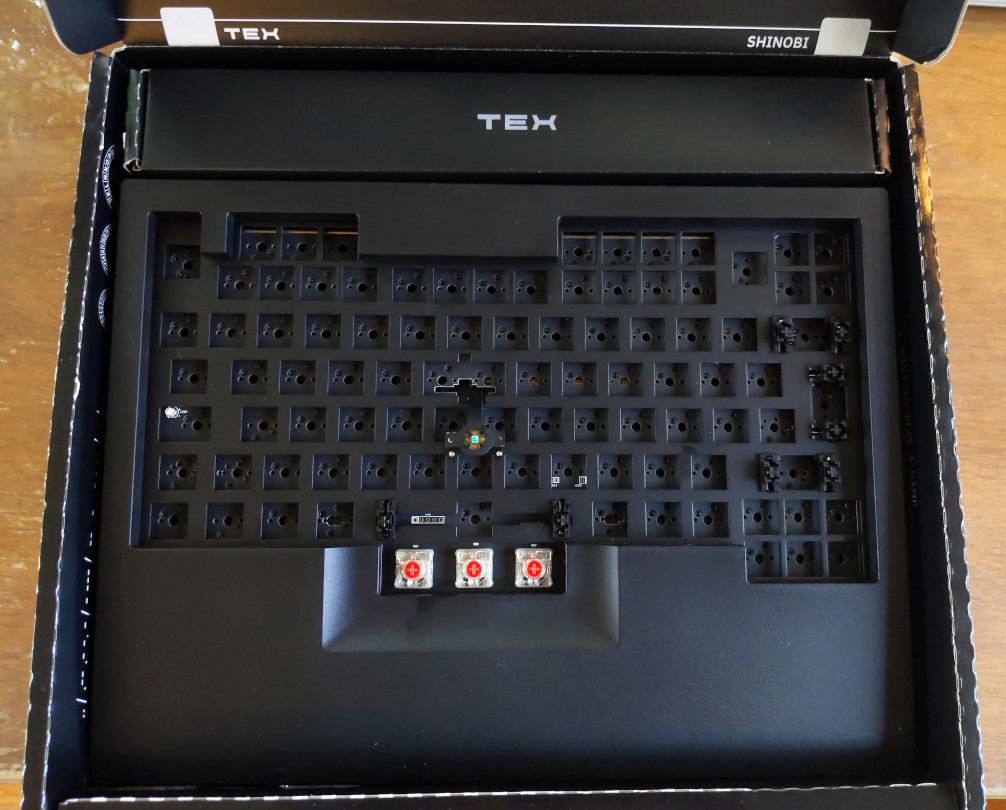
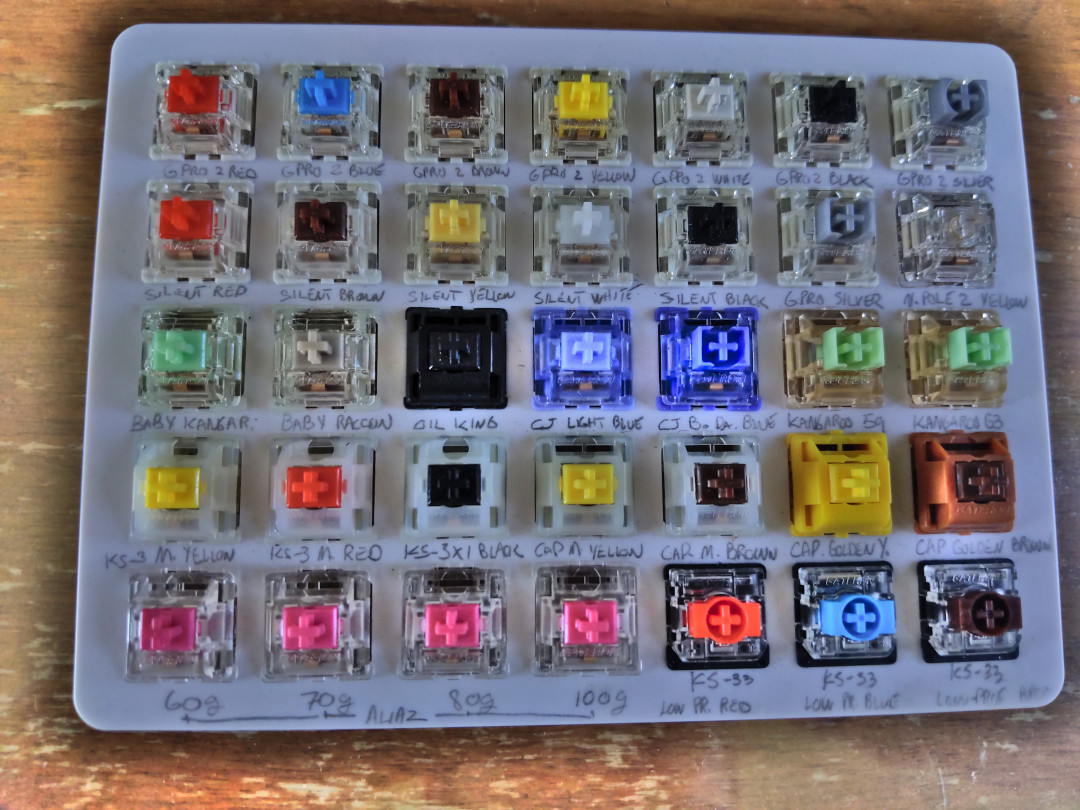
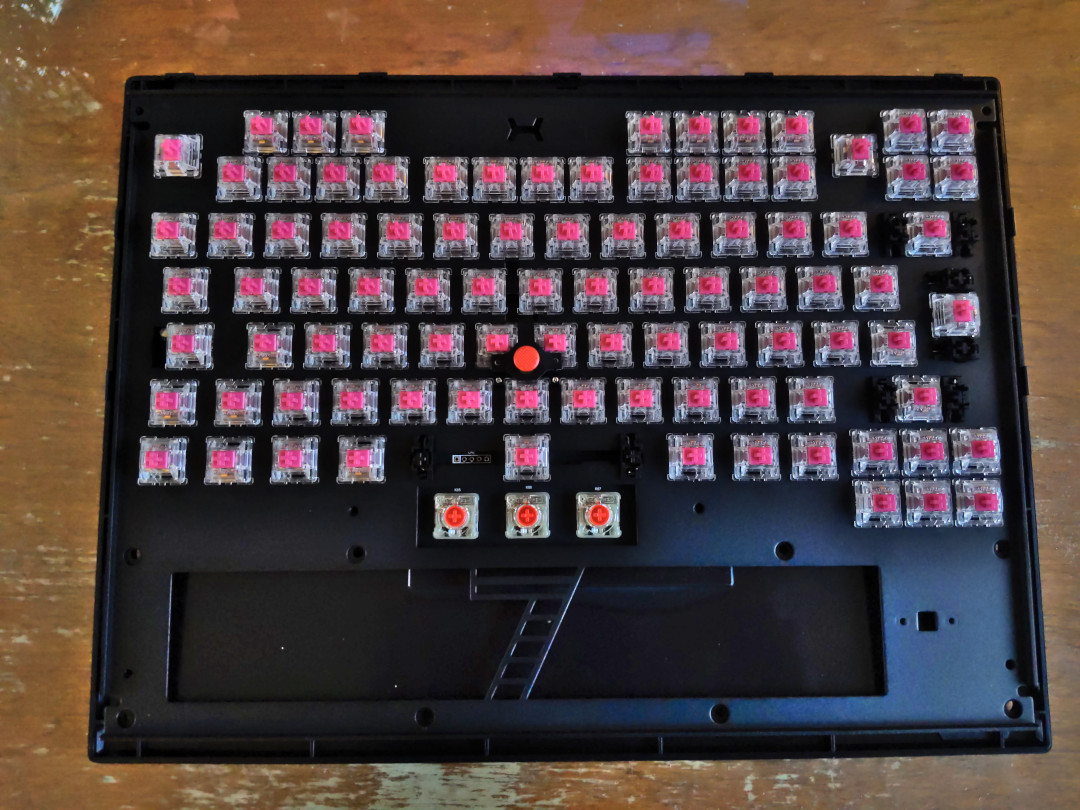
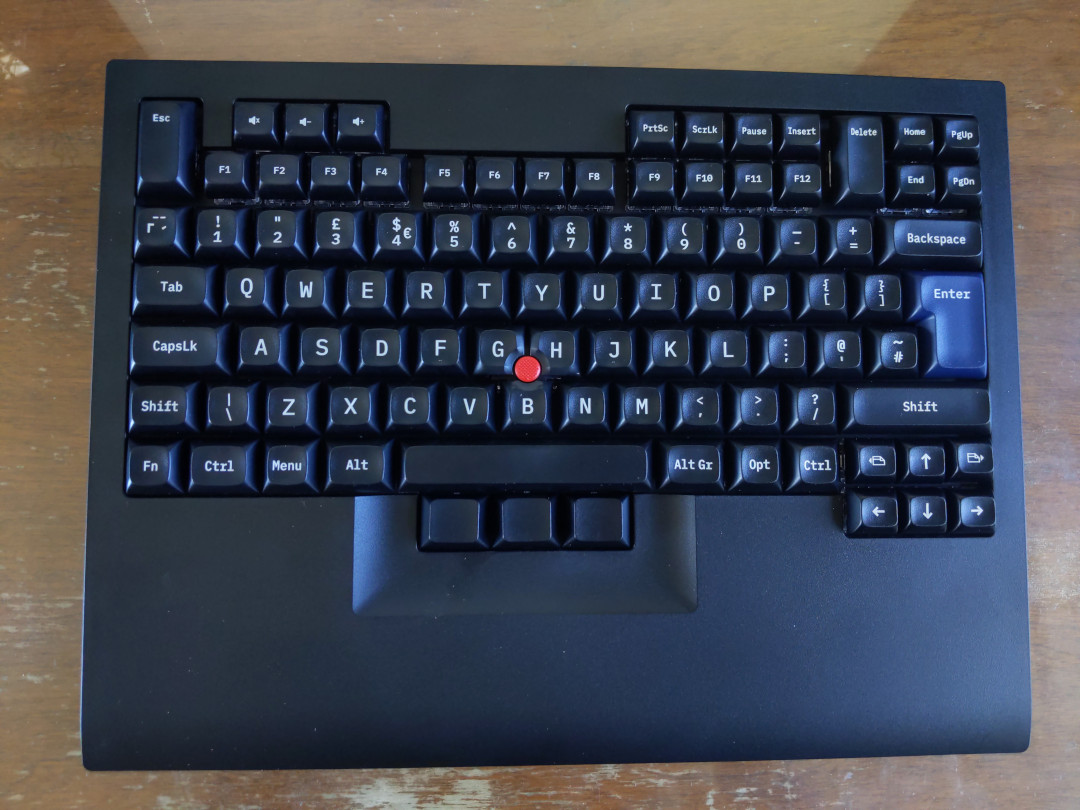
My old Thinkpad X220 has been slowly dying1 and as much as it makes me sad, it is also showing its age in terms of computational power. As such, I've pre-ordered a Framework 13 (the AMD version) and plan to retire my X220 when I get it. One thing I will miss from that laptop is the keyboard. At work, I dock it (on the amazing Thinkpad dock), which lets me use the keyboard while working on a larger monitor. I could probably replicate this setup with the Framework, but I'm not a fan of trackpads. So I built a keyboard. A nice one. One with a trackpoint. The bare board in its box If you follow Debian Planet, you may have seen the Tex Shinobi when Jonathan Dowland featured it on his blog back in January. It is a Tenkeyless board (saving me precious space at work) and is everything you would want from a old-school Thinkpad keyboard replacement. Since I had no previous experience with "Cherry MX"-style keyboard switches2, I decided to go full-bore and buy the "DIY" model that came unpopulated. A 35 switch tester board To know what model of switches I wanted, I bought a nice switch tester and played with it for a few days. After having thoroughly annoyed my SO (turns out 35 different switches on a little board is an incredible fidget toy), I decided to go with the Gateron Aliaz 70g. They are silent tactile switches, similar to the classic Cherry MX Browns, but with a much nicer sound profile and a much stronger actuation force (55g VS 70g). The end result is somewhat "stiff" keyboard that has a nice "THOCC", while still being relatively silent: perfect for a shared office. The keyboard with the switches, but no keycaps The only thing left to do on this keyboard is to replace the three soldered switches that came pre-installed for the mouse buttons. They are Cherry MX Red low-profile switches and are genuinely terrible3. I will be swapping them for Gateron KS-33 low-profile Blue switches when I get the ones I ordered online. My assembled Tex Shinobi Overall, I am very satisfied with this keyboard and I look forward using it daily when schools starts again in September.

  1. The power button sometimes does not work at all (for minutes?) and the laptop has been shutting down randomly (not a heat issue) more and more often...
  2. I am blessed with an IBM M keyboard at home and am in love with those clicky, very loud buckling springs.
  3. Not only are they linear switches (weird choice for mouse buttons), but they are very inconsistent. All three switches feel different and make different sounds.

19 June 2023

Dirk Eddelbuettel: RcppArmadillo 0.12.4.1.0 on CRAN: New Upstream Bugfix

armadillo image Armadillo is a powerful and expressive C++ template library for linear algebra and scientific computing. It aims towards a good balance between speed and ease of use, has a syntax deliberately close to Matlab, and is useful for algorithm development directly in C++, or quick conversion of research code into production environments. RcppArmadillo integrates this library with the R environment and language and is widely used by (currently) 1079 other packages on CRAN, downloaded 29.6 million times (per the partial logs from the cloud mirrors of CRAN), and the CSDA paper) (preprint / vignette) by Conrad and myself has been cited 543 times according to Google Scholar. This release brings bugfix upstream release 12.4.1 made by Conrad at the end of last week. As usual, I prepared the usual release candidate, tested on the over 1000 reverse depends (which sadly takes a long time on old hardware), found no issues and sent it to CRAN. Where it got tested again and was by a stroke of bad luck upheld for two unrelated issue (one package fell over one of its other dependencies changing a data representation, another fell afoul of a tightened test on total test time) so this awaited the usual email handshake with the CRAN maintainers and the weekend got in the way. The release also contains a PR kindly provided by Mikael Jagan for an upcoming change in package Matrix. As a bugfix release, the set of changes is fairly small.

Changes in RcppArmadillo version 0.12.4.1.0 (2023-06-17)
  • Upgraded to Armadillo release 12.4.1 (Cortisol Profusion Redux)
    • fix bug in SpMat::shed_cols()
    • functions such as .is_finite() and find_nonfinite() will now emit a runtime warning when compiled in fast math mode; such compilation mode disables detection of non-finite values
  • Accommodate upcoming change in package Matrix (Mikael Jagan in #417 addressing #415)

Courtesy of my CRANberries, there is a diffstat report relative to previous release. More detailed information is on the RcppArmadillo page. Questions, comments etc should go to the rcpp-devel mailing list off the Rcpp R-Forge page. If you like this or other open-source work I do, you can sponsor me at GitHub.

This post by Dirk Eddelbuettel originated on his Thinking inside the box blog. Please report excessive re-aggregation in third-party for-profit settings.

C.J. Collier: First taste of Debian 12

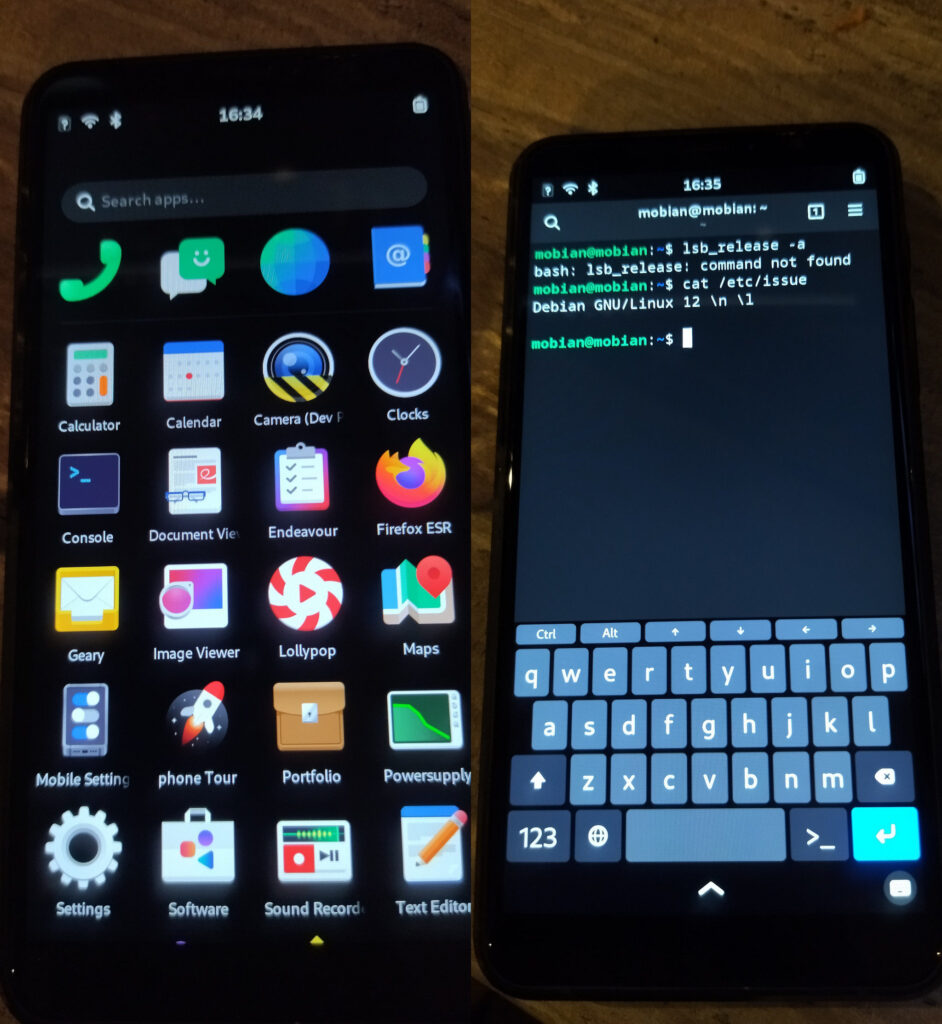
As some of you may know, the Debian project released v12, bookworm to stable on the 10th of this month. I haven t had a reason to try it yet, but I m downloading it now. My first thought is that it s much larger than I expected. The normal sized version used to fit on a CD-ROM disk, so around 650MB. The netinst has until now been even smaller, with the most recent versions being about 256MB if I recall correctly. The netinst, now with proprietary firmware, weighs in over 700MB:
2023-06-18 20:29:29 (6.85 MB/s) -  debian-12.0.0-amd64-netinst.iso  saved [773849088/773849088]
It looks like 738.0MB! The system I m installing is for a piece of software I m crafting for use by Remote Online Notaries. I m building a disk image for the notary s side of the connection. The notary will have a yubikey-style PGP card which they will use as a digital seal similar to the one required to perform notarial acts for the state of washington. I ll leave some ramblings on the blog as I go through the process of implementation. Here s a link to whet your appetite! https://app.leg.wa.gov/wac/default.aspx?cite=308-30-020

18 June 2023

Louis-Philippe V ronneau: Solo V2: nice but flawed

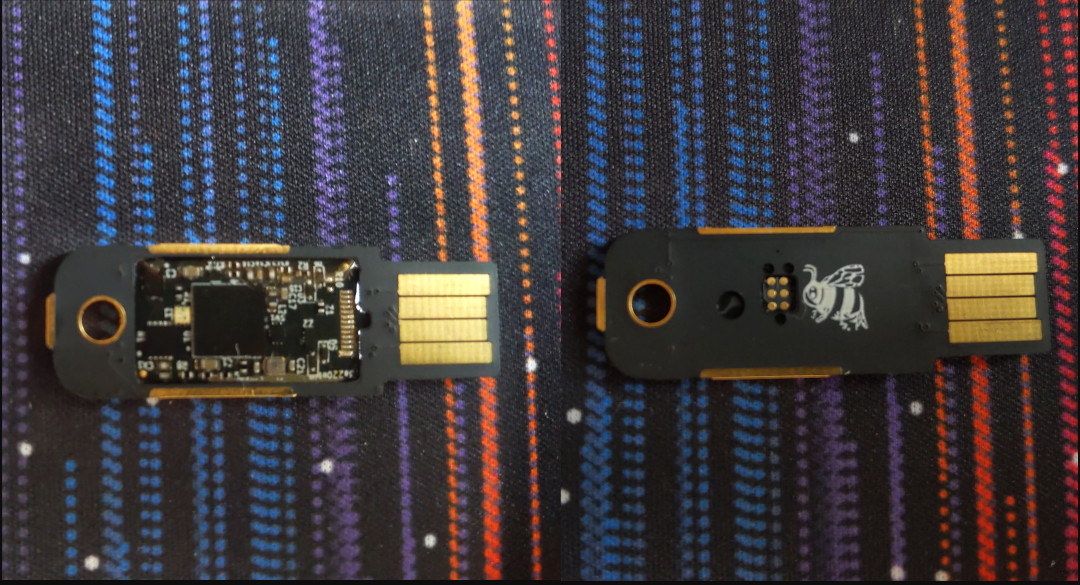
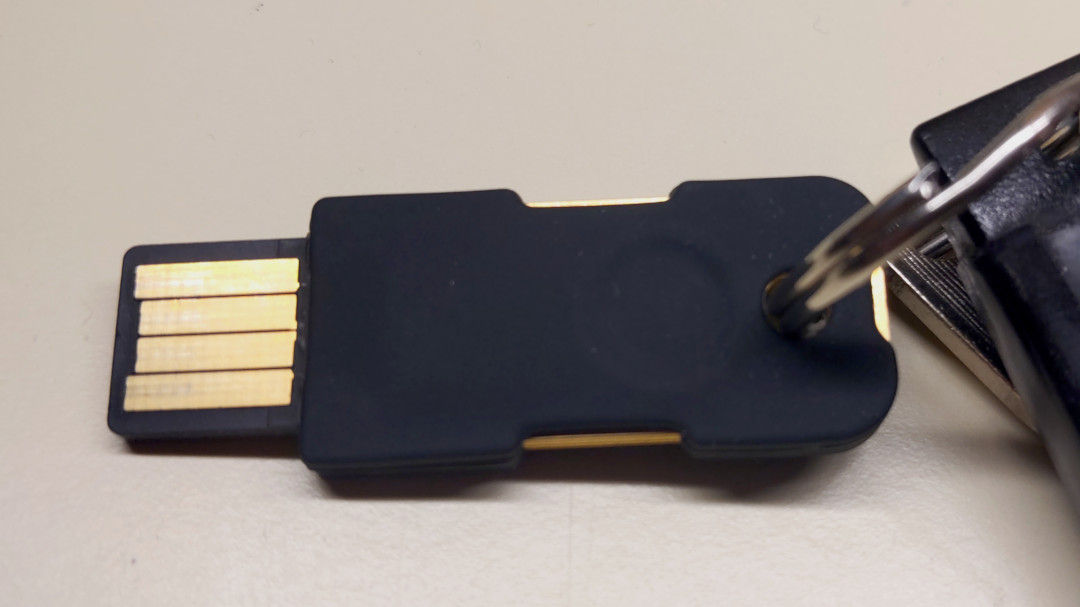
EDIT: One of my 2 keys has died. There are what seems like golden bubbles under the epoxy, over one of the chips and those were not there before. I've emailed SoloKeys and I'm waiting for a reply, but for now, I've stopped using the Solo V2 altogether :( I recently received the two Solo V2 hardware tokens I ordered as part of their crowdfunding campaign, back in March 2022. It did take them longer than advertised to ship me the tokens, but that's hardly unexpected from such small-scale, crowdfunded undertaking. I'm mostly happy about my purchase and I'm glad to get rid of the aging Tomu boards I was using as U2F tokens1. Still, beware: I am not sure it's a product I would recommend if what you want is simply something that works. If you do not care about open-source hardware, the Solo V2 is not for you. The Good A side-by-side view of the Solo V2's top and back sides I first want to mention I find the Solo V2 gorgeous. I really like the black and gold color scheme of the USB-A model (which is reversible!) and it seems like a well built and solid device. I'm not afraid to have it on my keyring and I fully expect it to last a long time. An animation of the build process, showing how the PCB is assembled and then slotted into the shell I'm also very impressed by the modular design: the PCB sits inside a shell, which decouples the logic from the USB interface and lets them manufacture a single board for both the USB-C and USB-A models. The clear epoxy layer on top of the PCB module also looks very nice in my opinion. A picture of the Solo V2 with its silicone case on my keyring, showing the 3 capacitive buttons I'm also very happy the Solo V2 has capacitive touch buttons instead of physical "clicky" buttons, as it means the device has no moving parts. The token has three buttons (the gold metal strips): one on each side of the device and a third one near the keyhole. As far as I've seen, the FIDO2 functions seem to work well via the USB interface and do not require any configuration on a Debian 12 machine. I've already migrated to the Solo V2 for web-based 2FA and I am in the process of migrating to an SSH ed25519-sk key. Here is a guide I recommend if you plan on setting those up with a Solo V2. The Bad and the Ugly Sadly, the Solo V2 is far from being a perfect project. First of all, since the crowdfunding campaign is still being fulfilled, it is not currently commercially available. Chances are you won't be able to buy one directly before at least Q4 2023. I've also hit what seems to be a pretty big firmware bug, or at least, one that affects my use case quite a bit. Invoking gpg crashes the Solo V2 completely if you also have scdaemon installed. Since scdaemon is necessary to use gpg with an OpenPGP smartcard, this means you cannot issue any gpg commands (like signing a git commit...) while the Solo V2 is plugged in. Any gpg commands that queries scdaemon, such as gpg --edit-card or gpg --sign foo.txt times out after about 20 seconds and leaves the token unresponsive to both touch and CLI commands. The way to "fix" this issue is to make sure scdaemon does not interact with the Solo V2 anymore, using the reader-port argument:
  1. Plug both your Solo V2 and your OpenPGP smartcard
  2. To get a list of the tokens scdaemon sees, run the following command: $ echo scd getinfo reader_list gpg-connect-agent --decode awk '/^D/ print $2 '
  3. Identify your OpenPGP smartcard. For example, my Nitrokey Start is listed as 20A0:4211:FSIJ-1.2.15-43211613:0
  4. Create a file in ~/.gnupg/scdaemon.conf with the following line reader-port $YOUR_TOKEN_ID. For example, in my case I have: reader-port 20A0:4211:FSIJ-1.2.15-43211613:0
  5. Reload scdaemon: $ gpgconf --reload scdaemon
Although this is clearly a firmware bug2, I do believe GnuPG is also partly to blame here. Let's just say I was not very surprised to have to battle scdaemon again, as I've had previous issues with it. Which leads me to my biggest gripe so far: it seems SoloKeys (the company) isn't really fixing firmware issues anymore and doesn't seems to care. The last firmware release is about a year old. Although people are experiencing serious bugs, there is no official way to report them, which leads to issues being seemingly ignored. For example, the NFC feature is apparently killing keys (!!!), but no one from the company seems to have acknowledged the issue. The same goes for my GnuPG bug, which was flagged in September 2022. For a project that mainly differentiates itself from its (superior) competition by being "Open", it's not a very good look... Although SoloKeys is still an unprofitable open source side business of its creators 3, this kind of attitude certainly doesn't help foster trust. Conclusion If you want to have a nice, durable FIDO2 token, I would suggest you get one of the many models Yubico offers. They are similarly priced, are readily commercially available, are part of a nice and maintained software ecosystem and have more features than the Solo V2 (OpenPGP support being the one I miss the most). Yubikeys are the practical option. What they are not is open-source hardware, whereas the Solo V2 is. As bunnie very well explained on his blog in 2019, it does not mean the later is inherently more trustable than the former, but it does make the Solo V2 the ideological option. Knowledge is power and it should be free. As such, tread carefully with SoloKeys, but don't dismiss them altogether: the Solo V2 is certainly functioning well enough for me.

  1. Although U2F is still part of the FIDO2 specification, the Tomus predate this standard and were thus not fully compliant with FIDO2. So long and thanks for all the fish little boards, you've served me well!
  2. It appears the Solo V2 shares its firmware with the Nitrokey 3, which had a similar issue a while back.
  3. This is a direct quote from one of the Solo V2 firmware maintainers.

17 June 2023

John Goerzen: Using dar for Data Archiving

This is the third post in a series about data archiving to removable media (optical discs and hard drives). In the first, I explained the difference between backing up and archiving, established goals for the project, and said I d evaluate git-annex and dar. The second post evaluated git-annex, and now it s time to look at dar. The series will conclude with a post comparing git-annex with dar. What is dar? I could open with the same thing I did with git-annex, just changing the name of the program: [dar] is a fantastic and versatile program that does well, it s one of those things that can do so much that it s a bit hard to describe. It is, fundamentally, an archiver like tar or zip (makes one file representing a bunch of other files), but it goes far beyond that. dar s homepage lays out a comprehensive list of features, which I will try to summarize here. So to tie this together for this project, I will set up a 400MB slice size (to mimic what I did with git-annex), and see how dar saves the data and restores it. Isolated cataloges aren t strictly necessary for this, but by using them (and/or dar_manager), we can build up a database of files and locations and thus directly compare dar to git-annex location tracking. Walkthrough: Creating the first archive As with the git-annex walkthrough, I ll set some variables to make it easy to remember: OK, we can run the backup immediately. No special setup is needed. dar supports both short-form (single-character) parameters and long-form ones. Since the parameters probably aren t familiar to everyone, I will use the long-form ones in these examples. Here s how we create our initial full backup. I ll explain the parameters below:
$ dar \
--verbose \
--create $DRIVE/bak1 \
--on-fly-isolate $CATDIR/bak1 \
--slice 400M \
--min-digits 2 \
--pause \
--fs-root $SOURCEDIR
Let s look at each of these parameters: This same command could have been written with short options as:
$ dar -v -c $DRIVE/bak1 -@ $CATDIR/bak1 -s 400M -9 2 -p -R $SOURCEDIR
What does it look like while running? Here s an excerpt:
...
Adding file to archive: /acrypt/no-backup/jgoerzen/testdata/[redacted]
Finished writing to file 1, ready to continue ? [return = YES Esc = NO]
...
Writing down archive contents...
Closing the escape layer...
Writing down the first archive terminator...
Writing down archive trailer...
Writing down the second archive terminator...
Closing archive low layer...
Archive is closed.
--------------------------------------------
581 inode(s) saved
including 0 hard link(s) treated
0 inode(s) changed at the moment of the backup and could not be saved properly
0 byte(s) have been wasted in the archive to resave changing files
0 inode(s) with only metadata changed
0 inode(s) not saved (no inode/file change)
0 inode(s) failed to be saved (filesystem error)
0 inode(s) ignored (excluded by filters)
0 inode(s) recorded as deleted from reference backup
--------------------------------------------
Total number of inode(s) considered: 581
--------------------------------------------
EA saved for 0 inode(s)
FSA saved for 581 inode(s)
--------------------------------------------
Making room in memory (releasing memory used by archive of reference)...
Now performing on-fly isolation...
...
That was easy! Let s look at the contents of the backup directory:
$ ls -lh $DRIVE
total 3.7G
-rw-r--r-- 1 jgoerzen jgoerzen 400M Jun 16 19:27 bak1.01.dar
-rw-r--r-- 1 jgoerzen jgoerzen 400M Jun 16 19:27 bak1.02.dar
-rw-r--r-- 1 jgoerzen jgoerzen 400M Jun 16 19:27 bak1.03.dar
-rw-r--r-- 1 jgoerzen jgoerzen 400M Jun 16 19:27 bak1.04.dar
-rw-r--r-- 1 jgoerzen jgoerzen 400M Jun 16 19:28 bak1.05.dar
-rw-r--r-- 1 jgoerzen jgoerzen 400M Jun 16 19:28 bak1.06.dar
-rw-r--r-- 1 jgoerzen jgoerzen 400M Jun 16 19:28 bak1.07.dar
-rw-r--r-- 1 jgoerzen jgoerzen 400M Jun 16 19:28 bak1.08.dar
-rw-r--r-- 1 jgoerzen jgoerzen 400M Jun 16 19:29 bak1.09.dar
-rw-r--r-- 1 jgoerzen jgoerzen 156M Jun 16 19:33 bak1.10.dar
And the isolated catalog:
$ ls -lh $CATDIR
total 37K
-rw-r--r-- 1 jgoerzen jgoerzen 35K Jun 16 19:33 bak1.1.dar
The isolated catalog is stored compressed automatically. Well this was easy. With one command, we archived the entire data set, split into 400MB chunks, and wrote out the catalog data. Walkthrough: Inspecting the saved archive Can dar tell us which slice contains a given file? Sure:
$ dar --list $DRIVE/bak1 --list-format=slicing less
Slice(s) [Data ][D][ EA ][FSA][Compr][S] Permission Filemane
--------+--------------------------------+----------+-----------------------------
...
1 [Saved][ ] [-L-][ 0%][X] -rwxr--r-- [redacted]
1-2 [Saved][ ] [-L-][ 0%][X] -rwxr--r-- [redacted]
2 [Saved][ ] [-L-][ 0%][X] -rwxr--r-- [redacted]
...
This illustrates the transition from slice 1 to slice 2. The first file was stored entirely in slice 1; the second stored partially in slice 1 and partially in slice 2, and third solely in slice 2. We can get other kinds of information as well.
$ dar --list $DRIVE/bak1 less
[Data ][D][ EA ][FSA][Compr][S] Permission User Group Size Date filename
--------------------------------+------------+-------+-------+---------+-------------------------------+------------
[Saved][ ] [-L-][ 0%][X] -rwxr--r-- jgoerzen jgoerzen 24 Mio Mon Mar 5 07:58:09 2018 [redacted]
[Saved][ ] [-L-][ 0%][X] -rwxr--r-- jgoerzen jgoerzen 16 Mio Mon Mar 5 07:58:09 2018 [redacted]
[Saved][ ] [-L-][ 0%][X] -rwxr--r-- jgoerzen jgoerzen 22 Mio Mon Mar 5 07:58:09 2018 [redacted]
These are the same files I was looking at before. Here we see they are 24MB, 16MB, and 22MB in size, and some additional metadata. Even more is available in the XML list format. Walkthrough: updates As with git-annex, I ve made some changes in the source directory: moved a file, added another, and deleted one. Let s create an incremental backup now:
$ dar \
--verbose \
--create $DRIVE/bak2 \
--on-fly-isolate $CATDIR/bak2 \
--ref $CATDIR/bak1 \
--slice 400M \
--min-digits 2 \
--pause \
--fs-root $SOURCEDIR
This command is very similar to the earlier one. Instead of writing an archive and catalog named bak1, we write one named bak2. What s new here is --ref $CATDIR/bak1. That says, make an incremental based on an archive of reference. All that is needed from that archive of reference is the detached catalog. --ref $DRIVE/bak1 would have worked equally well here. Here s what I did to the $SOURCEDIR: Let s see if dar s command output matches this:
...
Adding file to archive: /acrypt/no-backup/jgoerzen/testdata/file01-unchanged
Saving Filesystem Specific Attributes for /acrypt/no-backup/jgoerzen/testdata/file01-unchanged
Adding file to archive: /acrypt/no-backup/jgoerzen/testdata/cp
Saving Filesystem Specific Attributes for /acrypt/no-backup/jgoerzen/testdata/cp
Adding folder to archive: [redacted]
Saving Filesystem Specific Attributes for [redacted]
Adding reference to files that have been destroyed since reference backup...
...
--------------------------------------------
3 inode(s) saved
including 0 hard link(s) treated
0 inode(s) changed at the moment of the backup and could not be saved properly
0 byte(s) have been wasted in the archive to resave changing files
0 inode(s) with only metadata changed
578 inode(s) not saved (no inode/file change)
0 inode(s) failed to be saved (filesystem error)
0 inode(s) ignored (excluded by filters)
2 inode(s) recorded as deleted from reference backup
--------------------------------------------
Total number of inode(s) considered: 583
--------------------------------------------
EA saved for 0 inode(s)
FSA saved for 3 inode(s)
--------------------------------------------
...
Yes, it does. The rename is recorded as a deletion and an addition, since dar doesn t directly track renames. So the rename plus the deletion account for the two deletions. The rename plus the addition of cp count as 2 of the 3 inodes saved; the third is the modified directory from which files were deleted and moved out. Let s see the files that were created:
$ ls -lh $DRIVE/bak2*
-rw-r--r-- 1 jgoerzen jgoerzen 18M Jun 16 19:52 /acrypt/no-backup/jgoerzen/dar-testing/drive/bak2.01.dar
$ ls -lh $CATDIR/bak2*
-rw-r--r-- 1 jgoerzen jgoerzen 22K Jun 16 19:52 /acrypt/no-backup/jgoerzen/dar-testing/cat/bak2.1.dar
What does list look like now?
Slice(s) [Data ][D][ EA ][FSA][Compr][S] Permission Filemane
--------+--------------------------------+----------+-----------------------------
[ ][ ] [---][-----][X] -rwxr--r-- [redacted]
1 [Saved][ ] [-L-][ 0%][X] -rwxr--r-- file01-unchanged
...
[--- REMOVED ENTRY ----][redacted]
[--- REMOVED ENTRY ----][redacted]
Here I show an example of:
  1. A file that was not changed from the initial backup. Its presence was simply noted, but because we re doing an incremental, the data wasn t saved.
  2. A file that is saved in this incremental, on slice 1.
  3. The two deleted files
Walkthrough: dar_manager As we ve seen above, the two archives (or their detached catalog) give us a complete picture of what files were present at the time of the creation of each archive, and what files were stored in a given archive. We can certainly continue working in that way. We can also use dar_manager to build a comprehensive database of these archives, to be able to find what media is necessary to restore each given file. Or, with dar_manager s when parameter, we can restore files as of a particular date. Let s try it out. First, we create our database:
$ dar_manager --create $DARDB
$ dar_manager --base $DARDB --add $DRIVE/bak1
Auto detecting min-digits to be 2
$ dar_manager --base $DARDB --add $DRIVE/bak2
Auto detecting min-digits to be 2
Here we created the database, and added our two catalogs to it. (Again, we could have as easily used $CATDIR/bak1; either the archive or its isolated catalog will work here.) It s important to add the catalogs in order. Let s do some quick experimentation with dar_manager:
$ dar_manager -v --base $DARDB --list
Decompressing and loading database to memory...
dar path :
dar options :
database version : 6
compression used : gzip
compression level: 9 archive # path basename
------------+--------------+---------------
1 /acrypt/no-backup/jgoerzen/dar-testing/drive bak1
2 /acrypt/no-backup/jgoerzen/dar-testing/drive bak2
$ dar_manager --base $DARDB --stat
archive # most recent/total data most recent/total EA
--------------+-------------------------+-----------------------
1 580/581 0/0
2 3/3 0/0
The list option shows the correlation between dar_manager archive number (1, 2) with filenames (bak1, bak2). It is coincidence here that 1/bak1 and 2/bak2 correlate; that s not necessarily the case. Most dar_manager commands operate on archive number, while dar commands operate on archive path/basename. Now let s see just what files are saved in archive , the incremental:
$ dar_manager --base $DARDB --used 2
[ Saved ][ ] [redacted]
[ Saved ][ ] file01-unchanged
[ Saved ][ ] cp
Now we can also where a file is stored. Here s one that was saved in the full backup and unmodified in the incremental:
$ dar_manager --base $DARDB --file [redacted]
1 Fri Jun 16 19:15:12 2023 saved absent
2 Fri Jun 16 19:15:12 2023 present absent
(The absent at the end refers to extended attributes that the file didn t have) Similarly, for files that were added or removed, they ll be listed only at the appropriate place. Walkthrough: Restoration I m not going to repeat the author s full restoration with dar page, but here are some quick examples. A simple way of doing everything is using incrementals for the whole series. To do that, you d have bak1 be full, bak2 based on bak1, bak3 based on bak2, bak4 based on bak3, etc. To restore from such a series, you have two options: If you get fancy for instance, bak2 is based on bak1, bak3 on bak2, bak4 on bak1 then you would want to use dar_manager to ensure a consistent restore is completed. Either way, the process is nearly identical. Also, I figure, to make things easy, you can save a copy of the entire set of isolated catalogs before you finalize each disc/drive. They re so small, and this would let someone with just the most recent disc build a dar_manager database without having to go through all the other discs. Anyhow, let s do a restore using just dar. I ll make a $RESTOREDIR and do it that way.
$ dar \
--verbose \
--extract $DRIVE/bak1 \
--fs-root $RESTOREDIR \
--no-warn \
--execute "echo Ready for slice %n. Press Enter; read foo"
This execute lets us see how dar works; this is an illustration of the power it has (above pause); it s a snippet interpreted by /bin/sh with %n being one of the dar placeholders. If memory serves, it s not strictly necessary, as dar will prompt you for slices it needs if they re not mounted. Anyhow, you ll see it first reading the last slice, which contains the catalog, then reading from the beginning. Here we go:
Auto detecting min-digits to be 2
Opening archive bak1 ...
Opening the archive using the multi-slice abstraction layer...
Ready for slice 10. Press Enter
...
Loading catalogue into memory...
Locating archive contents...
Reading archive contents...
File ownership will not be restored du to the lack of privilege, you can disable this message by asking not to restore file ownership [return = YES Esc = NO]
Continuing...
Restoring file's data: [redacted]
Restoring file's FSA: [redacted]
Ready for slice 1. Press Enter
...
Ready for slice 2. Press Enter
...
--------------------------------------------
581 inode(s) restored
including 0 hard link(s)
0 inode(s) not restored (not saved in archive)
0 inode(s) not restored (overwriting policy decision)
0 inode(s) ignored (excluded by filters)
0 inode(s) failed to restore (filesystem error)
0 inode(s) deleted
--------------------------------------------
Total number of inode(s) considered: 581
--------------------------------------------
EA restored for 0 inode(s)
FSA restored for 0 inode(s)
--------------------------------------------
The warning is because I m not doing the extraction as root, which limits dar s ability to fully restore ownership data. OK, now the incremental:
$ dar \
--verbose \
--extract $DRIVE/bak2 \
--fs-root $RESTOREDIR \
--no-warn \
--execute "echo Ready for slice %n. Press Enter; read foo"
...
Ready for slice 1. Press Enter
...
Restoring file's data: /acrypt/no-backup/jgoerzen/dar-testing/restore/file01-unchanged
Restoring file's FSA: /acrypt/no-backup/jgoerzen/dar-testing/restore/file01-unchanged
Restoring file's data: /acrypt/no-backup/jgoerzen/dar-testing/restore/cp
Restoring file's FSA: /acrypt/no-backup/jgoerzen/dar-testing/restore/cp
Restoring file's data: /acrypt/no-backup/jgoerzen/dar-testing/restore/[redacted directory]
Removing file (reason is file recorded as removed in archive): [redacted file]
This all looks right! Now how about we compare the restore to the original source directory?
$ diff -durN $SOURCEDIR $RESTOREDIR
No changes perfect. We could instead do this restore via a single dar_manager command, though annoyingly, we d have to pass all top-level files/directories to dar_manager restore. But still, it s one command, and basically automates and optimizes the dar restores shown above. Conclusions Dar makes it extremely easy to just Do The Right Thing when making archives. One command makes a backup. It saves things in simple files. You can make an isolated catalog if you want, and it too is saved in a simple file. You can query what is in the files and where. You can restore from all or part of the files. You can simply play the backups forward, in order, to achieve a full and consistent restore. Or you can load data about them into dar_manager for an optimized restore. A bit of scripting will be necessary to make incrementals; finding the most recent backup or catalog. If backup files are named with care for instance, by date then this should be a pretty easy task. I haven t touched on resiliency yet. dar comes with tools for recovering archives that have had portions corrupted or lost. It can also rebuild the catalog if it is corrupted or lost. It adds tape marks (or escape sequences ) to the archive along with the data stream. So every entry in the catalog is actually stored in the archive twice: once alongside the file data, and once at the end in the collected catalog. This allows dar to scan a corrupted file for the tape marks and reconstruct whatever is still intact, even if the catalog is lost. dar also integrates with tools like sha256sum and par2 to simplify archive integrity testing and restoration. This balances against the need to use a tool (dar, optionally with a GUI frontend) to restore files. I ll discuss that more in the next post.

16 June 2023

John Goerzen: Using git-annex for Data Archiving

In my recent post about data archiving to removable media, I laid out the difference between backing up and archiving, and also said I d evaluate git-annex and dar. This post evaluates git-annex. The next will look at dar, and then I ll make a comparison post. What is git-annex? git-annex is a fantastic and versatile program that does well, it s one of those things that can do so much that it s a bit hard to describe. Its homepage says:
git-annex allows managing large files with git, without storing the file contents in git. It can sync, backup, and archive your data, offline and online. Checksums and encryption keep your data safe and secure. Bring the power and distributed nature of git to bear on your large files with git-annex.
I think the particularly interesting features of git-annex aren t actually included in that list. Among the features of git-annex that make it shine for this purpose, its location tracking is key. git-annex can know exactly which device has which file at which version at all times. Combined with its preferred content settings, this lets you very easily say things like: git-annex can be set to allow a configurable amount of free space to remain on a device, and it will fill it up with whatever copies are necessary up until it hits that limit. Very convenient! git-annex will store files in a folder structure that mirrors the origin folder structure, in plain files just as they were. This maximizes the ability for a future person to access the content, since it is all viewable without any special tool at all. Of course, for things like optical media, git-annex will essentially be creating what amounts to incrementals. To obtain a consistent copy of the original tree, you would still need to use git-annex to process (export) the archives. git-annex challenges In my prior post, I related some challenges with git-annex. The biggest of them quite poor performance of the directory special remote when dealing with many files has been resolved by Joey, git-annex s author! That dramatically improves the git-annex use scenario here! The fixing commit is in the source tree but not yet in a release. git-annex no doubt may still have performance challenges with repositories in the 100,000+-range, but in that order of magnitude it now looks usable. I m not sure about 1,000,000-file repositories (I haven t tested); there is a page about scalability. A few other more minor challenges remain: I worked around the timestamp issue by using the mtree-netbsd package in Debian. mtree writes out a summary of files and metadata in a tree, and can restore them. To save: mtree -c -R nlink,uid,gid,mode -p /PATH/TO/REPO -X <(echo './.git') > /tmp/spec And, after restoration, the timestamps can be applied with: mtree -t -U -e < /tmp/spec Walkthrough: initial setup To use git-annex in this way, we have to do some setup. My general approach is this: Let's get started! I've set all these shell variables appropriately for this example, and REPONAME to "testdata". We'll begin by setting up the metadata-only tracking repo.
$ REPONAME=testdata
$ mkdir "$METAREPO"
$ cd "$METAREPO"
$ git init
$ git config annex.thin true
There is a sort of complicated topic of how git-annex stores files in a repo, which varies depending on whether the data for the file is present in a given repo, and whether the file is locked or unlocked. Basically, the options I use here cause git-annex to mostly use hard links instead of symlinks or pointer files, for maximum compatibility with non-POSIX filesystems such as NTFS and UDF, which might be used on these devices. thin is part of that. Let's continue:
$ git annex init 'local hub'
init local hub ok
(recording state in git...)
$ git annex wanted . "include=* and exclude=$REPONAME/*"
wanted . ok
(recording state in git...)
In a bit, we are going to import the source data under the directory named $REPONAME (here, testdata). The wanted command says: in this repository (represented by the bare dot), the files we want are matched by the rule that says eveyrthing except what's under $REPONAME. In other words, we don't want to make an unnecessary copy here. Because I expect to use an mtree file as documented above, and it is not under $REPONAME/, it will be included. Let's just add it and tweak some things.
$ touch mtree
$ git annex add mtree
add mtree
ok
(recording state in git...)
$ git annex sync
git-annex sync will change default behavior to operate on --content in a future version of git-annex. Recommend you explicitly use --no-content (or -g) to prepare for that change. (Or you can configure annex.synccontent)
commit
[main (root-commit) 6044742] git-annex in local hub
1 file changed, 1 insertion(+)
create mode 120000 mtree
ok
$ ls -l
total 9
lrwxrwxrwx 1 jgoerzen jgoerzen 178 Jun 15 22:31 mtree -> .git/annex/objects/pX/ZJ/...
OK! We've added a file, and it got transformed into a symlink. That's the thing I said we were going to avoid, so:
git annex adjust --unlock-present
adjust
Switched to branch 'adjusted/main(unlockpresent)'
ok
$ ls -l
total 1
-rw-r--r-- 2 jgoerzen jgoerzen 0 Jun 15 22:31 mtree
You'll notice it transformed into a hard link (nlinks=2) file. Great! Now let's import the source data. For that, we'll use the directory special remote.
$ git annex initremote source type=directory directory=$SOURCEDIR importtree=yes \
encryption=none
initremote source ok
(recording state in git...)
$ git annex enableremote source directory=$SOURCEDIR
enableremote source ok
(recording state in git...)
$ git config remote.source.annex-readonly true
$ git config annex.securehashesonly true
$ git config annex.genmetadata true
$ git config annex.diskreserve 100M
$ git config remote.source.annex-tracking-branch main:$REPONAME
OK, so here we created a new remote named "source". We enabled it, and set some configuration. Most notably, that last line causes files from "source" to be imported under $REPONAME/ as we wanted earlier. Now we're ready to scan the source.
$ git annex sync
At this point, you'll see git-annex computing a hash for every file in the source directory. I can verify with du that my metadata-only repo only uses 14MB of disk space, while my source is around 4GB. Now we can see what git-annex thinks about file locations:
$ git-annex whereis less
whereis mtree (1 copy)
8aed01c5-da30-46c0-8357-1e8a94f67ed6 -- local hub [here]
ok
whereis testdata/[redacted] (0 copies)
The following untrusted locations may also have copies:
9e48387e-b096-400a-8555-a3caf5b70a64 -- [source]
failed
... many more lines ...
So remember we said we wanted mtree, but nothing under testdata, under this repo? That's exactly what we got. git-annex knows that the files under testdata can be found under the "source" special remote, but aren't in any git-annex repo -- yet. Now we'll start adding them. Walkthrough: removable drives I've set up two 500MB filesystems to represent removable drives. We'll see how git-annex works with them.
$ cd $DRIVE01
$ df -h .
Filesystem Size Used Avail Use% Mounted on
acrypt/no-backup/annexdrive01 500M 1.0M 499M 1% /acrypt/no-backup/annexdrive01
$ git clone $METAREPO
Cloning into 'testdata'...
done.
$ cd $REPONAME
$ git config annex.thin true
$ git annex init "test drive #1"
$ git annex adjust --hide-missing --unlock
adjust
Switched to branch 'adjusted/main(hidemissing-unlocked)'
ok
$ git annex sync
OK, that's the initial setup. Now let's enable the source remote and configure it the same way we did before:
$ git annex enableremote source directory=$SOURCEDIR
enableremote source ok
(recording state in git...)
$ git config remote.source.annex-readonly true
$ git config remote.source.annex-tracking-branch main:$REPONAME
$ git config annex.securehashesonly true
$ git config annex.genmetadata true
$ git config annex.diskreserve 100M
Now, we'll add the drive to a group called "driveset01" and configure what we want on it:
$ git annex group . driveset01
$ git annex wanted . '(not copies=driveset01:1)'
What this does is say: first of all, this drive is in a group named driveset01. Then, this drive wants any files for which there isn't already at least one copy in driveset01. Now let's load up some files!
$ git annex sync --content
As the messages fly by from here, you'll see it mentioning that it got mtree, and then various files from "source" -- until, that is, the filesystem had less than 100MB free, at which point it complained of no space for the rest. Exactly like we wanted! Now, we need to teach $METAREPO about $DRIVE01.
$ cd $METAREPO
$ git remote add drive01 $DRIVE01/$REPONAME
$ git annex sync drive01
git-annex sync will change default behavior to operate on --content in a future version of git-annex. Recommend you explicitly use --no-content (or -g) to prepare for that change. (Or you can configure annex.synccontent)
commit
On branch adjusted/main(unlockpresent)
nothing to commit, working tree clean
ok
merge synced/main (Merging into main...)
Updating d1d9e53..817befc
Fast-forward
(Merging into adjusted branch...)
Updating 7ccc20b..861aa60
Fast-forward
ok
pull drive01
remote: Enumerating objects: 214, done.
remote: Counting objects: 100% (214/214), done.
remote: Compressing objects: 100% (95/95), done.
remote: Total 110 (delta 6), reused 0 (delta 0), pack-reused 0
Receiving objects: 100% (110/110), 13.01 KiB 1.44 MiB/s, done.
Resolving deltas: 100% (6/6), completed with 6 local objects.
From /acrypt/no-backup/annexdrive01/testdata
* [new branch] adjusted/main(hidemissing-unlocked) -> drive01/adjusted/main(hidemissing-unlocked)
* [new branch] adjusted/main(unlockpresent) -> drive01/adjusted/main(unlockpresent)
* [new branch] git-annex -> drive01/git-annex
* [new branch] main -> drive01/main
* [new branch] synced/main -> drive01/synced/main
ok
OK! This step is important, because drive01 and drive02 (which we'll set up shortly) won't necessarily be able to reach each other directly, due to not being plugged in simultaneously. Our $METAREPO, however, will know all about where every file is, so that the "wanted" settings can be correctly resolved. Let's see what things look like now:
$ git annex whereis less
whereis mtree (2 copies)
8aed01c5-da30-46c0-8357-1e8a94f67ed6 -- local hub [here]
b46fc85c-c68e-4093-a66e-19dc99a7d5e7 -- test drive #1 [drive01]
ok
whereis testdata/[redacted] (1 copy)
b46fc85c-c68e-4093-a66e-19dc99a7d5e7 -- test drive #1 [drive01]
The following untrusted locations may also have copies:
9e48387e-b096-400a-8555-a3caf5b70a64 -- [source]
ok
If I scroll down a bit, I'll see the files past the 400MB mark that didn't make it onto drive01. Let's add another example drive! Walkthrough: Adding a second drive The steps for $DRIVE02 are the same as we did before, just with drive02 instead of drive01, so I'll omit listing it all a second time. Now look at this excerpt from whereis:
whereis testdata/[redacted] (1 copy)
b46fc85c-c68e-4093-a66e-19dc99a7d5e7 -- test drive #1 [drive01]
The following untrusted locations may also have copies:
9e48387e-b096-400a-8555-a3caf5b70a64 -- [source]
ok
whereis testdata/[redacted] (1 copy)
c4540343-e3b5-4148-af46-3f612adda506 -- test drive #2 [drive02]
The following untrusted locations may also have copies:
9e48387e-b096-400a-8555-a3caf5b70a64 -- [source]
ok
Look at that! Some files on drive01, some on drive02, some neither place. Perfect! Walkthrough: Updates So I've made some changes in the source directory: moved a file, added another, and deleted one. All of these were copied to drive01 above. How do we handle this? First, we update the metadata repo:
$ cd $METAREPO
$ git annex sync
$ git annex dropunused all
OK, this has scanned $SOURCEDIR and noted changes. Let's see what whereis says:
$ git annex whereis less
...
whereis testdata/cp (0 copies)
The following untrusted locations may also have copies:
9e48387e-b096-400a-8555-a3caf5b70a64 -- [source]
failed
whereis testdata/file01-unchanged (1 copy)
b46fc85c-c68e-4093-a66e-19dc99a7d5e7 -- test drive #1 [drive01]
The following untrusted locations may also have copies:
9e48387e-b096-400a-8555-a3caf5b70a64 -- [source]
ok
So this looks right. The file I added was a copy of /bin/cp. I moved another file to one named file01-unchanged. Notice that it realized this was a rename and that the data still exists on drive01. Well, let's update drive01.
$ cd $DRIVE01/$REPONAME
$ git annex sync --content
Looking at the testdata/ directory now, I see that file01-unchanged has been renamed, the deleted file is gone, but cp isn't yet here -- probably due to space issues; as it's new, it's undefined whether it or some other file would fill up free space. Let's work along a few more commands.
$ git annex get --auto
$ git annex drop --auto
$ git annex dropunused all
And now, let's make sure metarepo is updated with its state.
$ cd $METAREPO
$ git annex sync
We could do the same for drive02. This is how we would proceed with every update. Walkthrough: Restoration Now, we have bare files at reasonable locations in drive01 and drive02. But, to generate a consistent restore, we need to be able to actually do an export. Otherwise, we may have files with old names, duplicate files, etc. Let's assume that we lost our source and metadata repos and have to restore from scratch. We'll make a new $RESTOREDIR. We'll begin with drive01 since we used it most recently.
$ mv $METAREPO $METAREPO.disabled
$ mv $SOURCEDIR $SOURCEDIR.disabled
$ git clone $DRIVE01/$REPONAME $RESTOREDIR
$ cd $RESTOREDIR
$ git config annex.thin true
$ git annex init "restore"
$ git annex adjust --hide-missing --unlock
Now, we need to connect the drive01 and pull the files from it.
$ git remote add drive01 $DRIVE01/$REPONAME
$ git annex sync --content
Now, repeat with drive02:
$ git remote add drive02 $DRIVE02/$REPONAME
$ git annex sync --content
Now we've got all our content back! Here's what whereis looks like:
whereis testdata/file01-unchanged (3 copies)
3d663d0f-1a69-4943-8eb1-f4fe22dc4349 -- restore [here]
9e48387e-b096-400a-8555-a3caf5b70a64 -- source
b46fc85c-c68e-4093-a66e-19dc99a7d5e7 -- test drive #1 [origin]
ok
...
I was a little surprised that drive01 didn't seem to know what was on drive02. Perhaps that could have been remedied by adding more remotes there? I'm not entirely sure; I'd thought would have been able to do that automatically. Conclusions I think I have demonstrated two things: First, git-annex is indeed an extremely powerful tool. I have only scratched the surface here. The location tracking is a neat feature, and being able to just access the data as plain files if all else fails is nice for future users. Secondly, it is also a complex tool and difficult to get right for this purpose (I think much easier for some other purposes). For someone that doesn't live and breathe git-annex, it can be hard to get right. In fact, I'm not entirely sure I got it right here. Why didn't drive02 know what files were on drive01 and vice-versa? I don't know, and that reflects some kind of misunderstanding on my part about how metadata is synced; perhaps more care needs to be taken in restore, or done in a different order, than I proposed. I initially tried to do a restore by using git annex export to a directory special remote with exporttree=yes, but I couldn't ever get it to actually do anything, and I don't know why. These two cut against each other. On the one hand, the raw accessibility of the data to someone with no computer skills is unmatched. On the other hand, I'm not certain I have the skill to always prepare the discs properly, or to do a proper consistent restore.

15 June 2023

Shirish Agarwal: Ayisha, Manju Warrier, Debutsav, Books

Ayisha After a long time I saw a movie that I enjoyed wholeheartedly. And it unexpectedly touched my heart. The name of the movie is Ayisha. The first frame of the movie itself sets the pace where we see Ayisha (Manju Warrier) who decides to help out a gang as lot of women were being hassled. So she agrees to hoodwink cops and help launder some money. Then she is shown to work as a maid for an elite Arab family. To portray a Muslim character in these polarized times really shows guts especially when the othering of the Muslim has been happening 24 7. In fact, just few days back I was shocked to learn that Muslim homes were being marked as Jews homes had been marked in the 1930 s. Not just homes but also businesses too. And after few days in a total hypocritical fashion one of the judges says that you cannot push people to buy or not buy from a shop. This is after systemically doing the whole hate campaign for almost 2 weeks. What value the judge s statements are after 2 weeks ??? The poison has already seeped in  But I m drifting from the topic/movie.

The real fun of the movie is the beautiful relationship that happens between Ayisha and Mama, she is the biggest maternal figure in the house and in fact, her command is what goes in the house. The house or palace which is the perfect description is shown as being opulent but not as rich as both Mama and Ayisha are, spiritually and emotionally both giving and sharing of each other. Almost a mother daughter relationship, although with others she is shown as having a bit of an iron hand. Halfway through the movie we come to know that Ayisha was also a dramatist and an actress having worked in early Malayalam movies. I do not want to go through all the ups and downs as that is the beauty of the movie and it needs to be seen for that aspect. I am always sort of in two worlds where should I promote a book or series or movie or not because most of the time it is the unexpected that works. When we have expectation it doesn t. Avatar, the Way of the Water is an exception, not many movies I can recall like that where I had expectations and still the movie surpassed it. So maybe go with no expectations at all

Manju Warrier Manju Warrier should actually be called Manju Warrior as she chose to be with the survivor rather than the sexism that is prevalent in the Malayalam film industry which actually is more or less a mirror of Bollywood and society as whole. These three links should give enough background knowledge as to what has been happening although I m sure my Malayalam friends would more than add to that knowledge whatever may be missing. In quite a few movies, the women are making inroads without significant male strength. Especially Manju s movies have no male lead for the last few movies. Whether that is deliberate part on Manju or an obstacle being put in front of her. Anyone knows that having a male lead and a female lead enriches the value of a movie quite a bit. This doesn t mean one is better than the other but having both enriches the end product, as simple as that. This is sadly not happening. Having POSH training and having an ICC is something that each organization should look forward for. It s kind of mandatory need of hour, especially when we have young people all around us. I am hopeful that people who are from Kerala would shed some more background light on what has been happening.

Books I haven t yet submitted an application for Debconf. But my idea is irrespective of whether or not I m there, I do hope we can have a library where people can donate books and people can take away books as well. A kind of circular marketplace/library where just somebody notes what books are available. Even if 100 odd people are coming to Debconf that easily means 100 books of various languages. That in itself would be interesting and to see what people are reading, wanting to discuss etc. We could even have readings. IIRC, in 2016 we had a children s area, maybe we could do some readings from some books to children which fuels their imagination. Even people like me who are deaf would be willing to look at excerpts and be charmed by them. For instance, in all my forays of fantasy literature except for Babylon Steel I haven t read one book that has a female lead character and I have read probably around 100 odd fantasy books till date. Not a lot but still to my mind, is a big gap as far as literature is concerned. How would more women write fantasy if they don t have heroes to look forward to :(. Or maybe I may be missing some authors and characters that others know and I do not. Do others feel the same or this question hasn t even been asked ??? Dunno. Please let me know.

Debutsav So apparently Debutsav is happening 2 days from now. While I did come to know about it few days back I had to think whether I want to apply for this or apply for Debconf as I physically, emotionally can t do justice to both even though they are a few months apart. I wish all the best for the attendees as well as presenters sharing all the projects and hopefully somebody shares at least some of the projects that are presented there so we may know what new projects or softwares to follow or whatever. Till later.

10 June 2023

Freexian Collaborators: Debian Contributions: /usr-merge updates, tox 4 transition, and more! (by Utkarsh Gupta, Stefano Rivera)

Contributing to Debian is part of Freexian s mission. This article covers the latest achievements of Freexian and their collaborators. All of this is made possible by organizations subscribing to our Long Term Support contracts and consulting services.

/usr-merge, by Helmut Grohne, et al Towards the end of April, the discussion on DEP 17 on debian-devel@l.d.o initiated by Helmut Grohne took off, trying to deal with the fact that while Debian bookworm has a merged /usr, files are still being distributed to / and /usr in Debian binary packages, and moving them currently has some risk of breakage. Most participants of the discussion agreed that files should be moved, and there are several competing design ideas for doing it safely. Most of the time was spent understanding the practical implications of lifting the moratorium and moving all the files from / to /usr in a coordinated effort. With help from Emilio Pozuelo Monfort, Enrico Zini, and Raphael Hertzog, Helmut Grohne performed extensive analysis of the various aspects, including quantitative analysis of the original file move problem, analysis of effects on dpkg-divert, dpkg-statoverride, and update-alternatives, analysis of effects on filesystem bootstrapping tools. Most of the problematic cases spawned plausible workarounds, such as turning Breaks into Conflicts in selected cases or adding protective diversions for the symbolic links that enable aliasing. Towards the end of May, Andreas Beckmann reported a new failure scenario which may cause shared resources to inadvertently disappear, such as directories and even regular files in case of Multi-Arch packages, and our work on analyzing these problems and proposing mitigations is on-going. While the quantitative analysis is funded by Freexian, we wouldn t be here without the extensive feedback and ideas of many voluntary contributors from multiple areas of Debian, which are too many to name here. Thank you.

Preparing for the tox 4 transition, by Stefano Rivera While Debian was in freeze for the bookworm release, tox 4 has landed in Debian experimental, and some packages are starting to require it, upstream. It has some backwards-incompatible behavior that breaks many packages using tox through pybuild. So Stefano had to make some changes to pybuild and to many packages that run build-time tests with tox. The easy bits of this transition are now completed in git / experimental, but a few packages that integrate deeply into tox need upstream work.

Debian Printing, by Thorsten Alteholz Just before the release of Bookworm, lots of QA tools were used to inspect packages. One of these tools found a systemd service file in a wrong directory. So, Thorsten did another upload of package lprint to correct this. Thanks a lot to all the hardworking people who run such tools and file bugs. Thorsten also participated in discussions about the new Common Printing Dialog Backends (CPDB) that will be introduced in Trixie and hopefully can replace the current printing architecture in Forky.

Miscellaneous contributions
  • DebConf 23 preparations by Stefano Rivera. Some work on the website, video team planning, accounting, and team documentation.
  • Utkarsh Gupta started to prep the work on the bursary team s side for DC23.
  • Stefano spun up a website for the Hamburg mini-DebConf so that the video team could have a machine-readable schedule and a place to stream video from the event.
  • Santiago Ruano Rinc n reviewed and sponsored four python packages of a prospective Debian member.
  • Helmut Grohne supported Timo Roehling and Jochen Sprickerhof to improve cross building in 15 ROS packages.
  • Helmut Grohne supported Jochen Sprickerhof with diagnosing an e2fsprogs RC bug.
  • Helmut Grohne continued to maintain rebootstrap and located an issue with lto in gcc-13.
  • Anton Gladky fixed some RC-Bugs and uploaded a new stravalib python library.

9 June 2023

Jonathan Carter: Phone upgraded to Debian 12

A long time ago, before the pandemic, I bought a Librem 5 phone from Purism. I also moved home since then, and sadly my phone was sleeping peacefully in a box in the garage since I moved. When I was in Hamburg last month, I saw how great Mobian and Phosh was coming along, and this inspired me to go dig up the Librem 5 which was about 2 Debian releases behind, and upgrade it to the latest and greatest version. I followed the instruction on the Debian wiki, and after some stumbles, managed to flash it with the latest Mobian image:
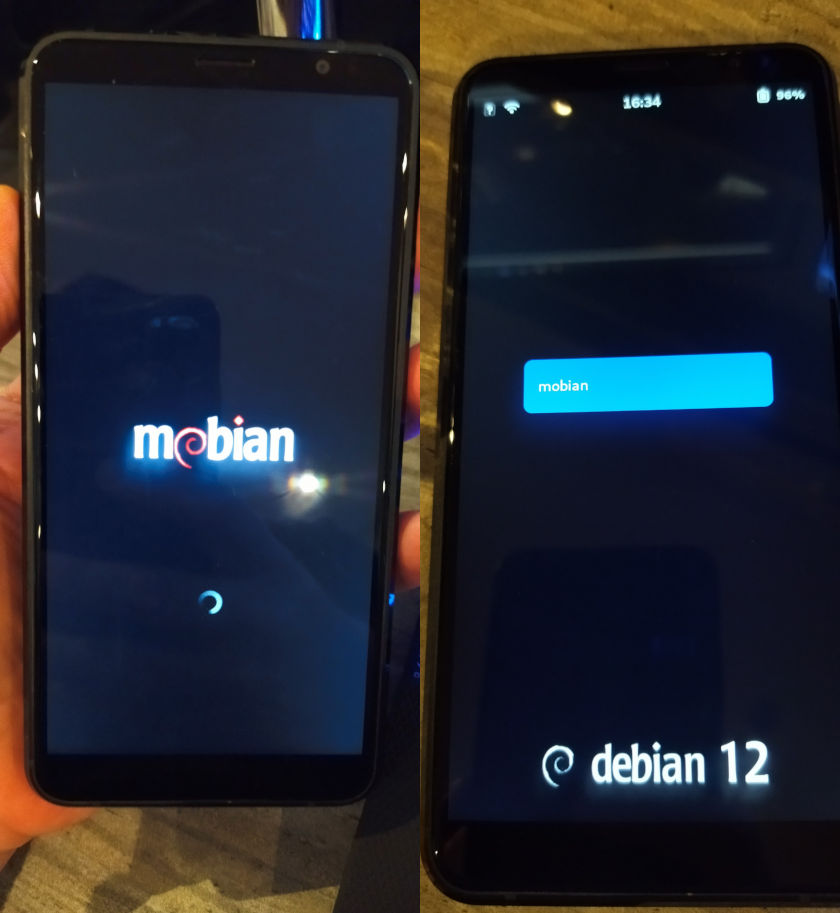
It s still a big bulky phone, but Phosh has really come a long way and the phone feels so much more responsive and usable now. It s also the first time I tried out the new GNOME Console app (I hope they consider taking some features from JuiceSSH so that it s easier to run apps like mc and irssi on the phone).
Next up I want to try out some progressive web apps and also check what the latest state of emulating Android apps is. I ve also been meaning to follow some GTK tutorials, and trying out some ideas on a mobile device motivates me a bit more to do that. It s really impressive the large amount of work people put into making Debian and a mobile GNOME experience work so well on a phone! Good job to everyone who contributes to this eco-system!

6 June 2023

Shirish Agarwal: Odisha Train Crash and Coverup, Demonetization 2.0 & NHFS-6 Survey

Just a few days back we came to know about the horrific Train Crash that happened in Odisha (Orissa). There are some things that are known and somethings that can be inferred by observance. Sadly, it seems the incident is going to be covered up  . Some of the facts that have not been contested in the public domain are that there were three lines. One loop line on which the Goods Train was standing and there was an up and a down line. So three lines were there. Apparently, the signalling system and the inter-locking system had issues as highlighted by an official about a month back. That letter, thankfully is in the public domain and I have downloaded it as well. It s a letter that goes to 4 pages. The RW is incensed that the letter got leaked and is in public domain. They are blaming everyone and espousing conspiracy theories rather than taking the minister to task. Incidentally, the Minister has three ministries that he currently holds. Ministry of Communication, Ministry of Electronics and Information Technology (MEIT), and Railways Ministry. Each Ministry in itself is important and has revenues of more than 6 lakh crore rupees. How he is able to do justice to all the three ministries is beyond me  The other thing is funds both for safety and relaying of tracks has been either not sanctioned or unutilized. In fact, CAG and the Railway Brass had shared how derailments have increased and unfulfilled vacancies but they were given no importance  In fact, not talking about safety in the recently held Chintan Shivir (brainstorming session) tells you how much the Govt. is serious about safety. In fact, most of the programme was on high speed rail which is a white elephant. I have shared a whitepaper done by RW in the U.S. that tells how high-speed rail doesn t make economic sense. And that is an economy that is 20 times + the Indian Economy. Even the Chinese are stopping with HSR as it doesn t make economic sense. Incidentally, Air Fares again went up 200% yesterday. Somebody shared in the region of 20k + for an Air ticket from their place to Bangalore  Coming back to the story itself. the Goods Train was on the loopline. Some say it was a little bit on the outer, some say otherwise, but it is established that it was on the loopline. This is standard behavior on and around Railway Stations around the world. Whether it was in the Inner or Outer doesn t make much of a difference with what happened next. The first train that collided with the goods train was the 12864 (SMVB-HWH) Yashwantpur Howrah Express and got derailed on to the next track where from the opposite direction 12841 (Shalimar- Bangalore) Coramandel Express was coming. Now they have said that around 300 people have died and that seems to be part of the cover-up. Both the trains are long trains, having between 23 odd coaches each. Even if you have reserved tickets you have 80 odd people in a coach and usually in most of these trains, it is at least double of that. Lot of money goes to TC and then above (Corruption). The Railway fares have gone up enormously but that s a question for perhaps another time  . So at the very least, we could be looking at more than 1000 people having died. The numbers are being under-reported so that nobody has to take responsibility. The Railways itself has told that it is unable to identify 80% of the people who have died. This means that 80% were unreserved ticket holders or a majority of them. There have been disturbing images as how bodies have been flung over on tractors and whatnot to be either buried or cremated without a thought. We are in peak summer season so bodies will start to rot within 24-48 hours  No arrangements made to cool the bodies and take some information and identifying marks or whatever. The whole thing being done in a very callous manner, not giving dignity to even those who have died for no fault of their own. The dissent note also tells that a cover-up is also in the picture. Apparently, India doesn t have nor does it feel to have a need for something like the NTSB that the U.S. used when it hauled both the plane manufacturer (Boeing) and the FAA when the 737 Max went down due to improper data collection and sharing of data with pilots. And with no accountability being fixed to Minister or any of the senior staff, a small junior staff person may be fired. Perhaps the same official that actually told them about the signal failures almost 3 months back  There were and are also some reports that some jugaadu /temporary fixes were applied to signalling and inter-locking just before this incident happened. I do not know nor confirm one way or the other if the above happened. I can however point out that if such a thing happened, then usually a traffic block is announced and all traffic on those lines are stopped. This has been the thing I know for decades. Traveling between Mumbai and Pune multiple times over the years am aware about traffic block. If some repair work was going on and it wasn t able to complete the work within the time-frame then that may well have contributed to the accident. There is also a bit muddying of the waters where it is being said that one of the trains was 4 hours late, which one is conflicting stories. On top of the whole thing, they have put the case to be investigated by CBI and hinting at sabotage. They also tried to paint a religious structure as mosque, later turned out to be a temple. The RW says done by Muslims as it was Friday not taking into account as shared before that most Railway maintenance works are usually done between Friday Monday. This is a practice followed not just in India but world over. There has been also move over a decade to remove wooden sleepers and have concrete sleepers. Unlike the wooden ones they do not expand and contract as much and their life is much more longer than the wooden ones. Funds had been marked (although lower than last few years) but not yet spent. As we know in case of any accident, it is when all the holes in cheese line up it happens. Fukushima is a great example of that, no sea wall even though Japan is no stranger to Tsunamis. External power at the same level as the plant. (10 meters above sea-level), no training for cascading failures scenarios which is what happened. The Days mini-series shares some but not all the faults that happened at Fukushima and the Govt. response to it. There is a difference though, the Japanese Prime Minister resigned on moral grounds. Here, nor the PM, nor the Minister would be resigning on moral grounds or otherwise :(. Zero accountability and that was partly a natural disaster, here it s man-made. In fact, both the Minister and the Prime Minister arrived with their entourages, did a PR blitzkrieg showing how concerned they are. Within 50 hours, the lines were cleared. The part-time Railway Minister shared that he knows the root cause and then few hours later has given the case to CBI. All are saying, wait for the inquiry report. To date, none of the accidents even in this Govt. has produced an investigation report. And even if it did, I am sure it will whitewash as it did in case of Adani as I had shared before in the previous blog post. Incidentally, it is reported that Adani paid off some of its debt, but when questioned as to where they got the money, complete silence on that part :(. As can be seen cover-up after cover-up  FWIW, the Coramandel Express is known as the Migrant train so has a huge number of passengers, the other one which was collided with is known as sick train as huge number of cancer patients use it to travel to Chennai and come back

Demonetization 2.0 Few days back, India announced demonetization 2.0. Surprised, don t be. Apparently, INR 2k/- is being used for corruption and Mr. Modi is unhappy about it. He actually didn t like the INR 2k/- note but was told that it was needed, who told him we are unaware to date. At that time the RBI Governor was Mr. Urjit Patel who didn t say about INR 2k/- he had said that INR 1k/- note redesigned would come in the market. That has yet to happen. What has happened is that just like INR 500/- and INR 1k/- note is concerned, RBI will no longer honor the INR 2k/- note. Obviously, this has made our neighbors angry, namely Nepal, Sri Lanka, Bhutan etc. who do some trading with us. 2 Deccan herald columns share the limelight on it. Apparently, India wants to be the world s currency reserve but doesn t want to play by the rules for everyone else. It was pointed out that both the U.S. and Singapore had retired their currencies but they will honor that promise even today. The Singapore example being a bit closer (as it s in Asia) is perhaps a bit more relevant than the U.S. one. Singapore retired the SGD $10,000 as of 2014 but even in 2022, it remains as legal tender. They also retired the SGD $1,000 in 2020 but still remains legal tender.

So let s have a fictitious example to illustrate what is meant by what Singapore has done. Let s say I go to Singapore, rent a flat, and find a $1000 note in that house somewhere. Both practically and theoretically, I could go down to any of the banks, get the amount transferred to my wallet, bank account etc. and nobody will question. Because they have promised the same. Interestingly, the Singapore Dollar has been pretty resilient against the USD for quite a number of years vis-a-vis other Asian currencies. Most of the INR 2k/- notes were also found and exchanged in Gujarat in just a few days (The PM and HM s state.). I am sure you are looking into the mental gymnastics that the RW indulge in :(. What is sadder that most of the people who try to defend can t make sense one way or the other and start to name-call and get personal as they have nothing else

Disability questions dropped in NHFS-6 Just came to know today that in the upcoming National Family Health Survey-6 disability questions are being dropped. Why is this important. To put it simply, if you don t have numbers, you won t and can t make policies for them. India is one of the worst countries to live if you are disabled. The easiest way to share to draw attention is most Railway platforms are not at level with people. Just as Mick Lynch shares in the UK, the same is pretty much true for India too. Meanwhile in Europe, they do make an effort to be level so even disabled people have some dignity. If your public transport is sorted, then people would want much more and you will be obligated to provide for them as they are citizens. Here, we have had many reports of women being sexually molested when being transferred from platform to coach irrespective of their age or whatnot  The main takeaway is if you do not have their voice, you won t make policies for them. They won t go away but you will make life hell for them. One thing to keep in mind that most people assume that most people are disabled from birth. This may or may not be true. For e.g. in the above triple Railways accidents, there are bound to be disabled people or newly disabled people who were healthy before the accident. The most common accident is road accidents, some involving pedestrians and vehicles or both, the easiest is Ministry of Road Transport data that says 4,00,000 people sustained injuries in 2021 alone in road mishaps. And this is in a country where even accidents are highly under-reported, for more than one reason. The biggest reason especially in 2 and 4 wheeler is the increased premium they would have to pay if in an accident, so they usually compromise with the other and pay off the Traffic Inspector. Sadly, I haven t read a new book, although there are a few books I m looking forward to have. People living in India and neighbors please be careful as more heat waves are expected. Till later.

5 June 2023

Reproducible Builds: Reproducible Builds in May 2023

Welcome to the May 2023 report from the Reproducible Builds project In our reports, we outline the most important things that we have been up to over the past month. As always, if you are interested in contributing to the project, please visit our Contribute page on our website.


Holger Levsen gave a talk at the 2023 edition of the Debian Reunion Hamburg, a semi-informal meetup of Debian-related people in northern Germany. The slides are available online.
In April, Holger Levsen gave a talk at foss-north 2023 titled Reproducible Builds, the first ten years. Last month, however, Holger s talk was covered in a round-up of the conference on the Free Software Foundation Europe (FSFE) blog.
Pronnoy Goswami, Saksham Gupta, Zhiyuan Li, Na Meng and Daphne Yao from Virginia Tech published a paper investigating the Reproducibility of NPM Packages. The abstract includes:
When using open-source NPM packages, most developers download prebuilt packages on npmjs.com instead of building those packages from available source, and implicitly trust the downloaded packages. However, it is unknown whether the blindly trusted prebuilt NPM packages are reproducible (i.e., whether there is always a verifiable path from source code to any published NPM package). [ ] We downloaded versions/releases of 226 most popularly used NPM packages and then built each version with the available source on GitHub. Next, we applied a differencing tool to compare the versions we built against versions downloaded from NPM, and further inspected any reported difference.
The paper reports that among the 3,390 versions of the 226 packages, only 2,087 versions are reproducible, and furthermore that multiple factors contribute to the non-reproducibility including flexible versioning information in package.json file and the divergent behaviors between distinct versions of tools used in the build process. The paper concludes with insights for future verifiable build procedures. Unfortunately, a PDF is not available publically yet, but a Digital Object Identifier (DOI) is available on the paper s IEEE page.
Elsewhere in academia, Betul Gokkaya, Leonardo Aniello and Basel Halak of the School of Electronics and Computer Science at the University of Southampton published a new paper containing a broad overview of attacks and comprehensive risk assessment for software supply chain security. Their paper, titled Software supply chain: review of attacks, risk assessment strategies and security controls, analyses the most common software supply-chain attacks by providing the latest trend of analyzed attack, and identifies the security risks for open-source and third-party software supply chains. Furthermore, their study introduces unique security controls to mitigate analyzed cyber-attacks and risks by linking them with real-life security incidence and attacks . (arXiv.org, PDF)
NixOS is now tracking two new reports at reproducible.nixos.org. Aside from the collection of build-time dependencies of the minimal and Gnome installation ISOs, this page now also contains reports that are restricted to the artifacts that make it into the image. The minimal ISO is currently reproducible except for Python 3.10, which hopefully will be resolved with the coming update to Python version 3.11.
On our rb-general mailing list this month: David A. Wheeler started a thread noting that the OSSGadget project s oss-reproducible tool was measuring something related to but not the same as reproducible builds. Initially they had adopted the term semantically reproducible build term for what it measured, which they defined as being if its build results can be either recreated exactly (a bit for bit reproducible build), or if the differences between the release package and a rebuilt package are not expected to produce functional differences in normal cases. This generated a significant number of replies, and several were concerned that people might confuse what they were measuring with reproducible builds . After discussion, the OSSGadget developers decided to switch to the term semantically equivalent for what they measured in order to reduce the risk of confusion. Vagrant Cascadian (vagrantc) posted an update about GCC, binutils, and Debian s build-essential set with some progress, some hope, and I daresay, some fears . Lastly, kpcyrd asked a question about building a reproducible Linux kernel package for Arch Linux (answered by Arnout Engelen). In the same, thread David A. Wheeler pointed out that the Linux Kernel documentation has a chapter about Reproducible kernel builds now as well.
In Debian this month, nine reviews of Debian packages were added, 20 were updated and 6 were removed this month, all adding to our knowledge about identified issues. In addition, Vagrant Cascadian added a link to the source code causing various ecbuild issues. [ ]
The F-Droid project updated its Inclusion How-To with a new section explaining why it considers reproducible builds to be best practice and hopes developers will support the team s efforts to make as many (new) apps reproducible as it reasonably can.
In diffoscope development this month, version 242 was uploaded to Debian unstable by Chris Lamb who also made the following changes: In addition, Mattia Rizzolo documented how to (re)-produce a binary blob in the code [ ] and Vagrant Cascadian updated the version of diffoscope in GNU Guix to 242 [ ].
reprotest is our tool for building the same source code twice in different environments and then checking the binaries produced by each build for any differences. This month, Holger Levsen uploaded versions 0.7.24 and 0.7.25 to Debian unstable which added support for Tox versions 3 and 4 with help from Vagrant Cascadian [ ][ ][ ]

Upstream patches The Reproducible Builds project detects, dissects and attempts to fix as many currently-unreproducible packages as possible. We endeavour to send all of our patches upstream where appropriate. This month, we wrote a large number of such patches, including: In addition, Jason A. Donenfeld filed a bug (now fixed in the latest alpha version) in the Android issue tracker to report that generateLocaleConfig in Android Gradle Plugin version 8.1.0 generates XML files using non-deterministic ordering, breaking reproducible builds. [ ]

Testing framework The Reproducible Builds project operates a comprehensive testing framework (available at tests.reproducible-builds.org) in order to check packages and other artifacts for reproducibility. In May, a number of changes were made by Holger Levsen:
  • Update the kernel configuration of arm64 nodes only put required modules in the initrd to save space in the /boot partition. [ ]
  • A huge number of changes to a new tool to document/track Jenkins node maintenance, including adding --fetch, --help, --no-future and --verbose options [ ][ ][ ][ ] as well as adding a suite of new actions, such as apt-upgrade, command, deploy-git, rmstamp, etc. [ ][ ][ ][ ] in addition a significant amount of refactoring [ ][ ][ ][ ].
  • Issue warnings if apt has updates to install. [ ]
  • Allow Jenkins to run apt get update in maintenance job. [ ]
  • Installed bind9-dnsutils on some Ubuntu 18.04 nodes. [ ][ ]
  • Fixed the Jenkins shell monitor to correctly deal with little-used directories. [ ]
  • Updated the node health check to warn when apt upgrades are available. [ ]
  • Performed some node maintenance. [ ]
In addition, Vagrant Cascadian added the nocheck, nopgo and nolto when building gcc-* and binutils packages [ ] as well as performed some node maintenance [ ][ ]. In addition, Roland Clobus updated the openQA configuration to specify longer timeouts and access to the developer mode [ ] and updated the URL used for reproducible Debian Live images [ ].

If you are interested in contributing to the Reproducible Builds project, please visit our Contribute page on our website. However, you can get in touch with us via:

2 June 2023

Jelmer Vernooij: Porting Python projects to Rust

I ve recently been working on porting some of my Python code to rust, both for performance reasons, and because of the strong typing in the language. As a fan of Haskell, I also just really enjoy using the language. Porting any large project to a new language can be a challenge. There is a temptation to do a rewrite from the ground-up in idiomatic rust and using all new fancy features of the language.
Porting in one go However, this is a bit of a trap:
  • It blocks other work. It can take a long time to finish the rewrite, during which time there is no good place to make other bug fixes/feature changes. If you make the change in the python branch, then you may also have to patch the in-progress rust fork.
  • No immediate return on investment. While the rewrite is happening, all of the investment in it is sunk costs.
  • Throughout the process, you can only run the tests for subsystems that have already been ported. It s common to find subtle bugs later in code ported early.
  • Understanding existing code, porting it and making it idiomatic rust all at the same time takes more time and post-facto debugging.
Iterative porting Instead, we ve found that it works much better to take an iterative approach. One of the hidden gems of rust is the excellent PyO3 crate, which allows creating python bindings for rust code in a way that is several times less verbose and less painful than C or SWIG. Because of rust s strong ownership model, it s also really hard to muck up e.g. reference counts when creating Python bindings for rust code. We port individual functions or classes to rust one at a time, starting with functionality that doesn t have dependencies on other python code and gradually working our way up the call stack. Each subsystem of the code is converted to two matching rust crates: one with a port of the code to pure rust, and one with python bindings for the rust code. Generally multiple python modules end up being a single pair of rust crates. The signature for the pure Rust code follow rust conventions, but the business logic is mostly ported as-is (just in rust syntax) and the signatures of the python bindings match that of the original python code. This then allows running the original python tests to verify that the code still behaves the same way. Changes can also immediately land on the main branch. A subsequent step is usually to refactor the rust code to be more idiomatic - all the while keeping the tests passing. There is also the potential to e.g. switch to using external rust crates (with perhaps subtly different behaviour), or drop functionality altogether. At some point, we will also port the tests from python to rust, and potentially drop the python bindings - once all the caller s have been converted to rust.
Example For example, imagine I have a Python module janitor/mail_filter.py with this function:
 1
 2
 3
 4
 5
 6
 7
 8
 9
10
11
12
13
14
15
16
def parse_plain_text_body(text):
   lines = text.splitlines()
   for i, line in enumerate(lines):
       if line == 'Reply to this email directly or view it on GitHub:':
           return lines[i + 1].split('#')[0]
       if (line == 'For more details, see:'
               and lines[i + 1].startswith('https://code.launchpad.net/')):
           return lines[i + 1]
       try:
           (field, value) = line.split(':', 1)
       except ValueError:
           continue
       if field.lower() == 'merge request url':
           return value.strip()
   return None
Porting this to rust naively (in a crate I ve called mailfilter ) it might look something like this:
 1
 2
 3
 4
 5
 6
 7
 8
 9
10
11
12
13
14
15
16
17
18
19
20
pub fn parse_plain_text_body(text: &str) -> Option<String>  
     let lines: Vec<&str> = text.lines().collect();
     for (i, line) in lines.iter().enumerate()  
         if line == &"Reply to this email directly or view it on GitHub:"  
             return Some(lines[i + 1].split('#').next().unwrap().to_string());
          
         if line == &"For more details, see:"
             && lines[i + 1].starts_with("https://code.launchpad.net/")
          
             return Some(lines[i + 1].to_string());
          
         if let Some((field, value)) = line.split_once(':')  
             if field.to_lowercase() == "merge request url"  
                 return Some(value.trim().to_string());


     None
  
Bindings are created in a crate called mailfilter-py, which looks like this:
 1
 2
 3
 4
 5
 6
 7
 8
 9
10
11
12
13
use pyo3::prelude::*;
 #[pyfunction]
 fn parse_plain_text_body(text: &str) -> Option<String>  
     janitor_mail_filter::parse_plain_text_body(text)
  
 #[pymodule]
 pub fn _mail_filter(py: Python, m: &PyModule) -> PyResult<()>  
     m.add_function(wrap_pyfunction!(parse_plain_text_body, m)?)?;
     Ok(())
  
The metadata for the crates is what you d expect. mailfilter-py uses PyO3 and depends on mailfilter.
 1
 2
 3
 4
 5
 6
 7
 8
 9
10
11
12
[package]
 name = "mailfilter-py"
 version = "0.0.0"
 authors = ["Jelmer Vernoo  <jelmer@jelmer.uk>"]
 edition = "2018"
 [lib]
 crate-type = ["cdylib"]
 [dependencies]
 janitor-mail-filter =   path = "../mailfilter"  
 pyo3 =   version = ">=0.14", features = ["extension-module"] 
I use python-setuptools-rust to get the python ecosystem to build the python bindings. Here is what setup.py looks like:
1
2
3
4
5
6
7
8
9
#!/usr/bin/python3
from setuptools import setup
from setuptools_rust import RustExtension, Binding
setup(
        rust_extensions=[RustExtension(
        "janitor._mailfilter", "crates/mailfilter-py/Cargo.toml",
        binding=Binding.PyO3)],
)
And of course, setuptools-rust needs to be listed as a setup requirement in pyproject.toml or setup.cfg. After that, we can replace the original python code with a simple import and verify that the tests still run:
1
from ._mailfilter import parse_plain_text_body
Of course, not all bindings are as simple as this. Iterators in particular are more complicated, as is code that has a loose idea of ownership in python. But I ve found that the time investment is usually well worth the ability to land changes on the development head early and often. I d be curious to hear if people have had success with other approaches to porting Python code to Rust. If you do, please leave a comment.

Matt Brown: Calling time on DNSSEC: The costs exceed the benefits

I m calling time on DNSSEC. Last week, prompted by a change in my DNS hosting setup, I began removing it from the few personal zones I had signed. Then this Monday the .nz ccTLD experienced a multi-day availability incident triggered by the annual DNSSEC key rotation process. This incident broke several of my unsigned zones, which led me to say very unkind things about DNSSEC on Mastodon and now I feel compelled to more completely explain my thinking: For almost all domains and use-cases, the costs and risks of deploying DNSSEC outweigh the benefits it provides. Don t bother signing your zones. The .nz incident, while topical, is not the motivation or the trigger for this conclusion. Had it been a novel incident, it would still have been annoying, but novel incidents are how we learn so I have a small tolerance for them. The problem with DNSSEC is precisely that this incident was not novel, just the latest in a long and growing list. It s a clear pattern. DNSSEC is complex and risky to deploy. Choosing to sign your zone will almost inevitably mean that you will experience lower availability for your domain over time than if you leave it unsigned. Even if you have a team of DNS experts maintaining your zone and DNS infrastructure, the risk of routine operational tasks triggering a loss of availability (unrelated to any attempted attacks that DNSSEC may thwart) is very high - almost guaranteed to occur. Worse, because of the nature of DNS and DNSSEC these incidents will tend to be prolonged and out of your control to remediate in a timely fashion. The only benefit you get in return for accepting this almost certain reduction in availability is trust in the integrity of the DNS data a subset of your users (those who validate DNSSEC) receive. Trusted DNS data that is then used to communicate across an untrusted network layer. An untrusted network layer which you are almost certainly protecting with TLS which provides a more comprehensive and trustworthy set of security guarantees than DNSSEC is capable of, and provides those guarantees to all your users regardless of whether they are validating DNSSEC or not. In summary, in our modern world where TLS is ubiquitous, DNSSEC provides only a thin layer of redundant protection on top of the comprehensive guarantees provided by TLS, but adds significant operational complexity, cost and a high likelihood of lowered availability. In an ideal world, where the deployment cost of DNSSEC and the risk of DNSSEC-induced outages were both low, it would absolutely be desirable to have that redundancy in our layers of protection. In the real world, given the DNSSEC protocol we have today, the choice to avoid its complexity and rely on TLS alone is not at all painful or risky to make as the operator of an online service. In fact, it s the prudent choice that will result in better overall security outcomes for your users. Ignore DNSSEC and invest the time and resources you would have spent deploying it improving your TLS key and certificate management. Ironically, the one use-case where I think a valid counter-argument for this position can be made is TLDs (including ccTLDs such as .nz). Despite its many failings, DNSSEC is an Internet Standard, and as infrastructure providers, TLDs have an obligation to enable its use. Unfortunately this means that everyone has to bear the costs, complexities and availability risks that DNSSEC burdens these operators with. We can t avoid that fact, but we can avoid creating further costs, complexities and risks by choosing not to deploy DNSSEC on the rest of our non-TLD zones.

But DNSSEC will save us from the evil CA ecosystem! Historically, the strongest motivation for DNSSEC has not been the direct security benefits themselves (which as explained above are minimal compared to what TLS provides), but in the new capabilities and use-cases that could be enabled if DNS were able to provide integrity and trusted data to applications. Specifically, the promise of DNS-based Authentication of Named Entities (DANE) is that with DNSSEC we can be free of the X.509 certificate authority ecosystem and along with it the expensive certificate issuance racket and dubious trust properties that have long been its most distinguishing features. Ten years ago this was an extremely compelling proposition with significant potential to improve the Internet. That potential has gone unfulfilled. Instead of maturing as deployments progressed and associated operational experience was gained, DNSSEC has been beset by the discovery of issue after issue. Each of these has necessitated further changes and additions to the protocol, increasing complexity and deployment cost. For many zones, including significant zones like google.com (where I led the attempt to evaluate and deploy DNSSEC in the mid 2010s), it is simply infeasible to deploy the protocol at all, let alone in a reliable and dependable manner. While DNSSEC maturation and deployment has been languishing, the TLS ecosystem has been steadily and impressively improving. Thanks to the efforts of many individuals and companies, although still founded on the use of a set of root certificate authorities, the TLS and CA ecosystem today features transparency, validation and multi-party accountability that comprehensively build trust in the ability to depend and rely upon the security guarantees that TLS provides. When you use TLS today, you benefit from:
  • Free/cheap issuance from a number of different certificate authorities.
  • Regular, automated issuance/renewal via the ACME protocol.
  • Visibility into who has issued certificates for your domain and when through Certificate Transparency logs.
  • Confidence that certificates issued without certificate transparency (and therefore lacking an SCT) will not be accepted by the leading modern browsers.
  • The use of modern cryptographic protocols as a baseline, with a plausible and compelling story for how these can be steadily and promptly updated over time.
DNSSEC with DANE can match the TLS ecosystem on the first benefit (up front price) and perhaps makes the second benefit moot, but has no ability to match any of the other transparency and accountability measures that today s TLS ecosystem offers. If your ZSK is stolen, or a parent zone is compromised or coerced, validly signed TLSA records for a forged certificate can be produced and spoofed to users under attack with minimal chances of detection. Finally, in terms of overall trust in the roots of the system, the CA/Browser forum requirements continue to improve the accountability and transparency of TLS certificate authorities, significantly reducing the ability for any single actor (say a nefarious government) to subvert the system. The DNS root has a well established transparent multi-party system for establishing trust in the DNSSEC root itself, but at the TLD level, almost intentionally thanks to the hierarchical nature of DNS, DNSSEC has multiple single points of control (or coercion) which exist outside of any formal system of transparency or accountability. We ve moved from DANE being a potential improvement in security over TLS when it was first proposed, to being a definite regression from what TLS provides today. That s not to say that TLS is perfect, but given where we re at, we ll get a better security return from further investment and improvements in the TLS ecosystem than we will from trying to fix DNSSEC.

But TLS is not ubiquitous for non-HTTP applications The arguments above are most compelling when applied to the web-based HTTP-oriented ecosystem which has driven most of the TLS improvements we ve seen to date. Non-HTTP protocols are lagging in adoption of many of the improvements and best practices TLS has on the web. Some claim this need to provide a solution for non-HTTP, non-web applications provides a motivation to continue pushing DNSSEC deployment. I disagree, I think it provides a motivation to instead double-down on moving those applications to TLS. TLS as the new TCP. The problem is that costs of deploying and operating DNSSEC are largely fixed regardless of how many protocols you are intending to protect with it, and worse, the negative side-effects of DNSSEC deployment can and will easily spill over to affect zones and protocols that don t want or need DNSSEC s protection. To justify continued DNSSEC deployment and operation in this context means using a smaller set of benefits (just for the non-HTTP applications) to justify the already high costs of deploying DNSSEC itself, plus the cost of the risk that DNSSEC poses to the reliability to your websites. I don t see how that equation can ever balance, particularly when you evaluate it against the much lower costs of just turning on TLS for the rest of your non-HTTP protocols instead of deploying DNSSEC. MTA-STS is a worked example of how this can be achieved. If you re still not convinced, consider that even DNS itself is considering moving to TLS (via DoT and DoH) in order to add the confidentiality/privacy attributes the protocol currently lacks. I m not a huge fan of the latency implications of these approaches, but the ongoing discussion shows that clever solutions and mitigations for that may exist. DoT/DoH solve distinct problems from DNSSEC and in principle should be used in combination with it, but in a world where DNS itself is relying on TLS and therefore has eliminated the majority of spoofing and cache poisoning attacks through DoT/DoH deployment the benefit side of the DNSSEC equation gets smaller and smaller still while the costs remain the same.

OK, but better software or more careful operations can reduce DNSSEC s cost Some see the current DNSSEC costs simply as teething problems that will reduce as the software and tooling matures to provide more automation of the risky processes and operational teams learn from their mistakes or opt to simply transfer the risk by outsourcing the management and complexity to larger providers to take care of. I don t find these arguments compelling. We ve already had 15+ years to develop improved software for DNSSEC without success. What s changed that we should expect a better outcome this year or next? Nothing. Even if we did have better software or outsourced operations, the approach is still only hiding the costs behind automation or transferring the risk to another organisation. That may appear to work in the short-term, but eventually when the time comes to upgrade the software, migrate between providers or change registrars the debt will come due and incidents will occur. The problem is the complexity of the protocol itself. No amount of software improvement or outsourcing addresses that. After 15+ years of trying, I think it s worth considering that combining cryptography, caching and distributed consensus, some of the most fundamental and complex computer science problems, into a slow-moving and hard to evolve low-level infrastructure protocol while appropriately balancing security, performance and reliability appears to be beyond our collective ability. That doesn t have to be the end of the world, the improvements achieved in the TLS ecosystem over the same time frame provide a positive counter example - perhaps DNSSEC is simply focusing our attention at the wrong layer of the stack. Ideally secure DNS data would be something we could have, but if the complexity of DNSSEC is the price we have to pay to achieve it, I m out. I would rather opt to remain with the simpler yet insecure DNS protocol and compensate for its short comings at higher transport or application layers where experience shows we are able to more rapidly improve and develop our security capabilities.

Summing up For the vast majority of domains and use-cases there is simply no net benefit to deploying DNSSEC in 2023. I d even go so far as to say that if you ve already signed your zones, you should (carefully) move them back to being unsigned - you ll reduce the complexity of your operating environment and lower your risk of availability loss triggered by DNS. Your users will thank you. The threats that DNSSEC defends against are already amply defended by the now mature and still improving TLS ecosystem at the application layer, and investing in further improvements here carries far more return than deployment of DNSSEC. For TLDs, like .nz whose outage triggered this post, DNSSEC is not going anywhere and investment in mitigating its complexities and risks is an unfortunate burden that must be shouldered. While the full incident report of what went wrong with .nz is not yet available, the interim report already hints at some useful insights. It is important that InternetNZ publishes a full and comprehensive review so that the full set of learnings and improvements this incident can provide can be fully realised by .nz and other TLD operators stuck with the unenviable task of trying to safely operate DNSSEC.

Postscript After taking a few days to draft and edit this post, I ve just stumbled across a presentation from the well respected Geoff Huston at last weeks RIPE86 meeting. I ve only had time to skim the slides (video here) - they don t seem to disagree with my thinking regarding the futility of the current state of DNSSEC, but also contain some interesting ideas for what it might take for DNSSEC to become a compelling proposition. Probably worth a read/watch!

1 June 2023

Russell Coker: Do Desktop Computers Make Sense?

Laptop vs Desktop Price Currently the smaller and cheaper USB-C docks start at about $25 and Dell has a new Vostro with 8G of RAM and 2*USB-C ports for $788. That gives a bit over $800 for a laptop and dock vs $795 for the cheapest Dell desktop which also has 8G of RAM. For every way of buying laptops and desktops (EG buying from Officeworks, buying on ebay, etc) the prices for laptops and desktops seem very similar. For all those comparisons the desktop will typically have a faster CPU and more options for PCIe cards, larger storage, etc. But if you don t want to expand storage beyond the affordable 4TB NVMe/SSD devices, don t need to add PCIe cards, and don t need much CPU power then a laptop will do well. For the vast majority of the computer work I do my Thinkpad Carbon X1 Gen1 (from 2012) had plenty of CPU power. If someone who s not an expert in PC hardware was to buy a computer of a given age then laptops probably aren t more expensive than desktops even disregarding the fact that a laptop works without the need to purchase a monitor, a keyboard, or a mouse. I can get regular desktop PCs for almost nothing and get parts to upgrade them very cheaply but most people can t do that. I can also get a decent second-hand laptop and USB-C dock for well under $400. Servers and Gaming Systems For people doing serious programming or other compute or IO intensive tasks some variation on the server theme is the best option. That may be something more like the servers used by the r/homelab people than the corporate servers, or it might be something in the cloud, but a server is a server. If you are going to have a home server that s a tower PC then it makes sense to put a monitor on it and use it as a workstation. If your server makes so much noise that you can t spend much time in the same room or if it s hosted elsewhere then using a laptop to access it makes sense. Desktop computers for PC gaming makes sense as no-one seems to be making laptops with moderately powerful GPUs. The most powerful GPUs draw 150W which is more than most laptop PSUs can supply and even if a laptop PSU could supply that much there would be the issue of cooling. The Steam Deck [1] and the Nintendo Switch [2] can both work with USB-C docks. The PlayStation 5 [3] has a 350W PSU and doesn t support video over USB-C. The Steam Deck can do 8K resolution at 60Hz or 4K at 120Hz but presumably the newer Steam games will need a desktop PC with a more powerful GPU to properly use such resolutions. For people who want the best FPS rates on graphics intensive games it could make sense to have a tower PC. Also a laptop that s run at high CPU/GPU use for a long time will tend to have it s vents clogged by dust and possibly have the cooling fan wear out. Monitor Resolution Laptop support for a single 4K monitor became common in 2012 with the release of the Ivy Bridge mobile CPUs from Intel in 2012. My own experience of setting up 4K monitors for a Linux desktop in 2019 was that it was unreasonably painful and that the soon to be released Debian/Bookworm will make things work nicely for 4K monitors with KDE on X11. So laptop hardware has handled the case of a single high resolution monitor since before such monitors were cheap or common and before software supported it well. Of course at that time you had to use either a proprietary dock or a mini-DisplayPort to HDMI adaptor to get 4K working. But that was still easier than getting PCIe video cards supporting 4K resolution which is something that according to spec sheets wasn t well supported by affordable cards in 2017. Since USB-C became a standard feature in laptops in about 2017 support of more monitors than most people would want through a USB-C dock became standard. My Thinkpad X1 Carbon Gen5 which was released in 2017 will support 2*FullHD monitors plus a 4K monitor via a USB-C dock, I suspect it would do at least 2*4K monitors but haven t had a chance to test. Cheap USB-C docks supporting this sort of thing have only become common in the last year or so. How Many Computers per Home Among middle class Australians it s common to have multiple desktop PCs per household. One for each child who s over the age of about 13 and one for the parents seems to be reasonably common. Students in the later years of high-school and university students are often compelled to have laptops so having the number of laptops plus the number of desktops be larger than the population of the house probably isn t uncommon even among people who aren t really into computers. As an aside it s probably common among people who read my blog to have 2 desktops, a laptop, and a cloud server for their own personal use. But even among people who don t do that sort of thing having computers outnumber people in a home is probably common. A large portion of the computer users can do everything they need on a laptop. For gamers the graphics intensive games often run well on a console and that s probably the most effective way of getting to playing the games. Of course the fact that there is RGB RAM (RAM with Red, Green, and Blue LEDs to light up) along with a lot of other wild products sold to gamers suggests that gaming PCs are not about what runs the game most effectively and that an art/craft project with the PC is more important than actually playing games. Instead of having one desktop PC per bedroom and laptops for school/university as well it would make more sense to have a laptop per person and have a USB-C dock and monitor in each bedroom and a USB-C dock connected to a large screen TV in the lounge. This gives plenty of flexibility for moving around to do work and sharing what s on your computer with other people. It also allows taking a work computer home and having work with your monitor, having a friend bring their laptop to your home to work on something together, etc. For most people desktop computers don t make sense. While I think that convergence of phones with laptops and desktops is the way of the future [4] for most people having laptops take over all functions of desktops is the best option today.

31 May 2023

Arturo Borrero Gonz lez: Wikimedia Hackathon 2023 Athens summary

Post logo During the weekend of 19-23 May 2023 I attended the Wikimedia hackathon 2023 in Athens, Greece. The event physically reunited folks interested in the more technological aspects of the Wikimedia movement in person for the first time since 2019. The scope of the hacking projects include (but was not limited to) tools, wikipedia bots, gadgets, server and network infrastructure, data and other technical systems. My role in the event was two-fold: on one hand I was in the event because of my role as SRE in the Wikimedia Cloud Services team, where we provided very valuable services to the community, and I was expected to support the technical contributors of the movement that were around. Additionally, and because of that same role, I did some hacking myself too, which was specially augmented given I generally collaborate on a daily basis with some community members that were present in the hacking room. The hackathon had some conference-style track and I ran a session with my coworker Bryan, called Past, Present and Future of Wikimedia Cloud Services (Toolforge and friends) (slides) which was very satisfying to deliver given the friendly space that it was. I attended a bunch of other sessions, and all of them were interesting and well presented. The number of ML themes that were present in the program schedule was exciting. I definitely learned a lot from attending those sessions, from how LLMs work, some fascinating applications for them in the wikimedia space, to what were some industry trends for training and hosting ML models. Session Despite the sessions, the main purpose of the hackathon was, well, hacking. While I was in the hacking space for more than 12 hours each day, my ability to get things done was greatly reduced by the constant conversations, help requests, and other social interactions with the folks. Don t get me wrong, I embraced that reality with joy, because the social bonding aspect of it is perhaps the main reason why we gathered in person instead of virtually. That being said, this is a rough list of what I did: The hackathon was also the final days of Technical Engagement as an umbrella group for WMCS and Developer Advocacy teams within the Technology department of the Wikimedia Foundation because of an internal reorg.. We used the chance to reflect on the pleasant time we have had together since 2019 and take a final picture of the few of us that were in person in the event. Technical Engagement It wasn t the first Wikimedia Hackathon for me, and I felt the same as in previous iterations: it was a welcoming space, and I was surrounded by friends and nice human beings. I ended the event with a profound feeling of being privileged, because I was part of the Wikimedia movement, and because I was invited to participate in it.
29 May 2023

Shirish Agarwal: Pearls of Luthra, Dahaad, Tetris & Discord.

Pearls of Luthra Pearls of Luthra is the first book by Brian Jacques and I think I am going to be a fan of his work. This particular book you have to be wary of. While it is a beautiful book with quite a few illustrations, I have to warn that if you are somebody who feels hungry at the very mention of food, then you will be hungry throughout the book. There isn t a single page where food isn t mentioned and not just any kind of food, the kind of food that is geared towards sweet tooth. So if you fancy tarts or chocolates or anything sweet you will right at home. The book also touches upon various teas and wines and various liquors but food is where it shines in literally. The tale is very much like a Harry Potter adventure but isn t as dark as HP was. In fact, apart from one death and one ear missing rest of our heroes and heroines and there are quite a few. I don t want to give too much away as it s a book to be treasured.

Dahaad Dahaad (the roar) is Sonakshi Sinha s entry in OTT/Web Series. The stage is set somewhere in North India while the exploits are based on a real life person called Cyanide Mohan who killed 20 women between 2005-2009. In the web series however, the antagonist s crimes are done over a period of 12 years and has 29 women as his victims. Apart from that it s pretty much a copy of what was done by the person above. It s a melting pot of a series which quite a few stories enmeshed along with the main one. The main onus and plot of the movie is about women from lower economic and caste order whose families want them to be wed but cannot due to huge demands for dowry. Now in such a situation, if a person were to give them a bit of attention, promise marriage and ask them to steal a bit and come with him and whatever, they will do it. The same modus operandi was done by Cynaide Mohan. He had a car that was not actually is but used it show off that he s from a richer background, entice the women, have sex, promise marriage and in the morning after pill there will be cynaide which the women unwittingly will consume. This is also framed by the protagonist Sonakshi Sinha to her mother as her mother is also forcing her to get married as she is becoming older. She shows some of the photographs of the victims and says that while the perpetrator is guilty but so is the overall society that puts women in such vulnerable positions. AFAIK, that is still the state of things. In fact, there is a series called Indian Matchmaking that has all the snobbishness that you want. How many people could have a lifestyle like the ones shown in that, less than 2% of the population. It s actually shows like the above that make the whole thing even more precarious  Apart from it, the show also shows prejudice about caste and background. I wouldn t go much into it as it s worth seeing and experiencing.

Tetris Tetris in many a ways is a story of greed. It s also a story of a lone inventor who had to wait almost 20 odd years to profit from his invention. Forbes does a marvelous job of giving some more background and foreground info. about Tetris, the inventor and the producer that went to strike it rich. It also does share about copyright misrepresentation happens but does nothing to address it. Could talk a whole lot but better to see the movie and draw your own conclusions. For me it was 4/5.

Discord Discord became Discord 2.0 and is a blank to me. A blank page. Can t do anything. First I thought it was a bug. Waited for a few days as sometimes webservices do fix themselves. But two weeks on and it still wasn t fixed then decided to look under. One of the tools in Firefox is Web Developer Tools ( CTRL+Shift+I) that tells you if an element of a page is not appearing or at least gives you a hint. To me it gave me the following
Content Security Policy: Ignoring 'unsafe-inline' within script-src or style-src: nonce-source or hash-source specified
Content Security Policy: The page s settings blocked the loading of a resource at data:text/css,%0A%20%20%20%20%20%20%20%2 ( style-src ). data:44:30
Content Security Policy: Ignoring 'unsafe-inline' within script-src or style-src: nonce-source or hash-source specified
TypeError: AudioContext is not a constructor 138875 https://discord.com/assets/cbf3a75da6e6b6a4202e.js:262 l https://discord.com/assets/f5f0b113e28d4d12ba16.js:1ed46a18578285e5c048b.js:241:118 What is being done is dom.webaudio.enabled being disabled in Firefox. Then on a hunch, searched on reddit and saw the following. Be careful while visiting the link as it s labelled NSFW although to my mind there wasn t anything remotely NSFW about it. They do mention using another tool AudioContext Fingerprint Defender which supposedly fakes or spoofs an id. As this add-on isn t tracked by Firefox privacy team it s hard for me to say anything positive or negative. So, in the end I stopped using discord as the alternative was being tracked by them  Last but not the least, saw this about a week back. Sooner or later this had to happen as Elon tries to make money off Twitter.

Next.

Previous.